Market Minds Advisory
Paper Wrap Market

Paper Wrap Market: Compostable Specification Rules Reshape Food-Contact and Protective Wrapping Demand

Foodservice chains and e-commerce bakeries are pushing paper wrap converters toward compostable, grease-resistant formats as plastic-film substitution mandates spread, forcing suppliers to prove barrier performance without the coatings that once made plastic-free wrap impractical.

Lead Analyst

Bilal Shaikh

Published

September 2026

Make Smarter Decisions with Customized Research Insights

Request a free sample report and evaluate market opportunities, growth trends, and competitive dynamics relevant to your business needs.

2025 MARKET VALUE$5.2BMarket Size 2025
2036 FORECAST VALUE$10.0BBase Case , 2026 to 2036
CAGR 2026 TO 20366.1 %Bull 7.4% / Bear 4.8%
INCREMENTAL OPPORTUNITY$4.5BNet 10- year value creation
EXPANSION MULTIPLE1.81x2036 value over 2026 base
Strategic Levers
M&A Pipeline
Regional Outlook
Country Rankings
Competitive Intelligence
Segmental Deep-dive
Call-Us : 91 93563 13602

Executive Snapshot and Market Trajectory

Foodservice chains are replacing plastic-coated wrap with compostable paper formats faster than converters anticipated, forcing suppliers to prove grease and moisture barrier performance without the coatings that made plastic-free wrap impractical for high-fat menu items until recently, across every regional supply contract renewed this year.
Demand concentrates among quick-service chains standardizing compostable specifications across franchise networks and direct-to-consumer bakeries needing grease-resistant glassine for shipped baked goods. Western Europe anchors global consumption on its concentrated pulp and paper engineering base, while greaseproof and food-contact wrap posts the second-fastest segment growth behind fully compostable formats, as bakeries and delis increasingly specify barrier paper over conventional kraft for perishable goods shipped directly to consumers nationwide across every major metropolitan market tracked this cycle.
Competition splits between a small group of European and North American pulp-integrated producers supplying certified compostable and food-contact grades and a wider field of regional converters selling commodity kraft wrap at lower price points. Tightening single-use plastics regulation and rising bio-based barrier coating adoption are reshaping specification sheets, rewarding suppliers that can document compostability certification and prove barrier performance across every food-contact category they serve.
Market Definition
The paper wrap market covers paper-based wrapping materials used for food-contact, retail, and industrial protective applications, including kraft paper wrap, glassine and greaseproof wrap, wax and coated paper wrap, and tissue wrap sold in roll or sheet format to converters and end users. It excludes plastic film wrap, paper-based rigid packaging such as boxes and cartons, and finished wrapped products sold to consumers.
Base Year Value
$5.2B in 2025 (MMA Primary Research Dataset, August 2026)
Forecast Period
2026 to 2036, eleven discrete annual values
CAGR
6.1% base case. Bull 7.4%. Bear 4.8%.
Fastest Growth Segment
Compostable and Plastic-Free Paper Wrap: 10.4% CAGR
Fastest Growth Country
India: 9.1% CAGR
Fastest Growth Region
South Asia and Pacific: 8.1% CAGR
Largest Region
Western Europe: 25% of 2025 global value
Market Leaders
Mondi plc, Sappi Limited, Delfort Group, Nordic Paper Holding AB, Twin Rivers Paper Company. Source: MMA Analysis based on company annual reports.
Primary Survey
n=3,800 procurement and R&D decision-makers, Q4 2025, six countries
Methodology
Demand-side build-up, cross-validated against public data, 47 expert interviews

Paper Wrap Market Forecast Scenarios

paper-wrap-market-size-forecast-scenario-1787299681182
Paper wrap demand grew steadily between 2020 and 2025 as early plastics-reduction commitments from major foodservice chains drove initial conversion volume, with the historical CAGR near 5.4% reflecting cautious early adoption before compostable barrier coating technology matured enough for broad high-fat food applications across most regional markets, particularly among smaller converters waiting for proven formulations before committing capital to certification.
The base case assumes continued substitution as three mechanisms compound: quick-service chains standardizing compostable wrap specifications across franchise networks, single-use plastics regulation tightening across the European Union and individual US states, and direct-to-consumer bakery and confectionery shipping volume rising alongside e-commerce order growth. Together these push converters toward higher-value certified grades and away from commodity uncoated kraft, reinforcing certification as the default specification most foodservice buyers now expect rather than an optional upgrade worth paying extra for.
A bull scenario assumes faster-than-expected bio-based barrier coating adoption opening high-fat food applications ahead of schedule, pulling forward conversion volume across quick-service and deli channels faster than currently modeled. The bear case centers on pulp price volatility squeezing converter margins and delaying capacity investment, extending the transition timeline for smaller regional converters still dependent on plastic-coated commodity wrap across most price-sensitive regional markets.

Barrier Performance Economics and Compostability Premium

Paper wrap economics increasingly hinge on barrier certification rather than basis weight alone, as foodservice buyers demand documented grease and moisture resistance that uncoated kraft was never engineered to deliver consistently. Bio-based coating technology now separates competitive suppliers from those still selling conventional kraft into price-sensitive commodity channels, and that gap widens every time a major chain tightens its packaging specification further.
MARKET CONCENTRATIONCR5 23%top five paper wrap producers hold a modest combined share
AVERAGE PRICE PREMIUM40-60% for compostable gradescertified compostable wrap commands a meaningful pricing premium
TOP PRODUCING COUNTRY SHARESweden 18%leading share of global paper wrap pulp-integrated production capacity
CAPACITY UTILISATION76-85%converting mills running below theoretical maximum annual output
TRADE INTENSITY48%share of finished wrap volume crossing an international border
FEEDSTOCK COST SHARE42-52%virgin and recycled pulp fiber dominate total production cost
Commercial activity concentrates around specification upgrades rather than volume expansion, since global paper wrap tonnage growth is steady rather than explosive. Converters weigh compostability certification cost against the price premium foodservice buyers now accept, with certified grades increasingly justified even for mid-sized regional converters previously locked into commodity kraft by margin pressure alone, particularly once multi-year supply contracts spread that certification cost across a longer commercial relationship.
Compostability certification, direct-to-consumer shipping durability, and recycled fiber content are reshaping specification sheets for the next decade, pushing producers toward certified product lines converters can specify confidently rather than commodity grades requiring case-by-case performance validation. Producers slow to certify risk losing accounts to competitors already treating certification as standard practice rather than a costly optional upgrade.
"Buyers used to ask for a basis weight and a price. Now they ask for a certification number, and that single shift has quietly rewritten who wins these contracts."
Director, Packaging Materials Practice · MMA Packaging / Paper-Based Wrapping Ma

Market Trends

Foodservice Chains Mandate Compostable Wrap Specifications

Major quick-service and fast-casual chains have shifted from plastic-coated to certified compostable paper wrap across roughly forty percent of their menu item packaging within the past three years, a pace that outstripped most converters' capacity planning assumptions. Franchise operators now write compostability certification directly into supplier contracts, requiring documented third-party testing rather than accepting manufacturer claims alone. This shift is pulling smaller regional converters toward certified bio-based coating suppliers they previously avoided on cost grounds, reshaping purchasing relationships across the supply chain as certification becomes a baseline procurement requirement rather than a competitive differentiator.
Market Impact: Targets 60% packaging substitution

Glassine Demand Rises with Direct-to-Consumer Bakery Shipping

E-commerce bakery and confectionery brands shipping products directly to consumers are driving glassine and greaseproof wrap demand higher, since these products require grease resistance and structural integrity that standard kraft cannot reliably provide during multi-day transit. Independent bakeries scaling through direct-to-consumer channels increasingly specify glassine interleaving and wrap as a standard packaging line item rather than an occasional upgrade. Converters report rising order frequency from smaller bakery accounts that previously ordered irregularly, now placing recurring monthly orders tied to steady online sales volume growth across their expanding customer base and seasonal promotional calendars.
Market Impact: Covers 12+ US states restricting plastic

Market Opportunities and Growth Drivers

EU Single-Use Plastics Rules Push Wrap Substitution

European Commission packaging waste rules restricting single-use plastic food-contact materials are forcing foodservice operators and retailers across member states to substitute plastic-coated wrap with certified paper alternatives, with several national governments setting substitution targets exceeding sixty percent of covered packaging categories by the end of the decade. Converters supplying European markets increasingly report compostability certification as a mandatory tender requirement rather than an optional differentiator, reshaping which suppliers qualify for major retail and foodservice contracts. This regulatory pressure is spreading fastest across Germany, France, and the Nordic markets, where enforcement has moved into binding procurement requirements.
Market Impact: Adds 25-35% cost for barrier coating

US Foodservice Chains Phase Out Plastic-Coated Wrap

US Census Bureau data on foodservice establishment growth coincides with a wave of state and municipal restrictions on plastic-coated food packaging, with more than a dozen states now enforcing some form of restriction on non-compostable food-contact wrap. National quick-service chains operating across multiple states increasingly standardize on compostable wrap nationwide rather than maintaining separate state-specific packaging lines, simplifying procurement but concentrating demand among converters capable of guaranteeing consistent certified supply at national scale across every distribution center a chain operates and every regional warehouse serving those locations, since inconsistent supply risks compliance gaps that franchise legal teams increasingly flag.
Market Impact: Adds 15-20% cost volatility annually

Market Restraints and Challenges

Grease Barrier Performance Gap Limits Substitution

Uncoated paper wrap struggles to match plastic film's grease and moisture barrier performance for high-fat foods like fried items and cured meats, a limitation rooted in fiber's inherently porous structure compared to continuous plastic film. This performance gap has slowed substitution in categories where product leakage or sogginess directly affects customer satisfaction, leaving converters unable to fully displace plastic-coated wrap despite regulatory and buyer pressure to do so. Several suppliers are now commercializing bio-based barrier coatings using polylactic acid and other compostable polymers, though these solutions currently carry a cost premium limiting adoption to premium-tier accounts.
Market Impact: Shifts 40% of menu packaging

Pulp Price Volatility Squeezes Converter Margins

Global pulp price swings driven by shifting supply-demand balances across major producing regions create margin volatility that smaller converters struggle to pass through to foodservice customers locked into annual pricing agreements. This volatility discourages capacity investment among converters uncertain whether current pulp pricing reflects a temporary spike or a sustained cost shift, delaying planned expansions industry-wide. Larger converters increasingly secure long-term fiber supply contracts directly with pulp producers, while others are blending higher shares of recycled fiber into commodity grades to reduce virgin pulp exposure, though recycled fiber remains unsuitable for most certified food-contact applications requiring virgin material.
Market Impact: Adds 18% glassine order frequency
3 additional market trends, 3 additional growth drivers, and 2 additional restraints and challenges are covered in the full report. Contact sales@marketmindsadvisory.com to access the complete intelligence.

Segment CAGR and Growth Architecture

Segmentation follows material composition and barrier technology because production process, certification pathway, and end-use suitability differ substantially between compostable, greaseproof, kraft, and coated formats, each carrying its own distinct cost structure and regulatory pathway shaped by food-contact requirements, buyer specification, and the converter's own certification investment cycle, annual compliance review, and multi-year contract renewal timeline.
paper-wrap-market-market-share-analysis-1787299681806

Compostable and Plastic-Free Paper Wrap

Fully compostable formats lead growth as foodservice chains and regulators push plastic-coating elimination across food-contact packaging categories. These grades use bio-based barrier coatings, most commonly polylactic acid or wax alternatives, to achieve grease and moisture resistance without the plastic lamination that prevented conventional paper wrap from composting industrially. Converters serving national quick-service accounts increasingly standardize on certified compostable grades specifically because a single certified product line satisfies both regulatory requirements and franchise-wide specification consistency, avoiding the complexity of maintaining separate packaging lines for different jurisdictions. Suppliers with established compostability certification report the fastest order backlog growth among converters expanding beyond commodity kraft, positioning this category well ahead of every other segment through the current forecast horizon.
CAGR 10.4%

Greaseproof and Food-Contact Paper Wrap

Glassine and greaseproof grades post the second-fastest growth as direct-to-consumer bakery and confectionery shipping expands alongside broader deli and quick-service grease-resistant packaging demand. These grades achieve barrier performance through mechanical fiber refinement rather than plastic coating, making them naturally compostable without requiring the additional bio-based coating investment that fully engineered compostable formats need. Bakeries and confectioners increasingly specify glassine interleaving and wrap as a standard packaging line item for shipped goods requiring multi-day transit durability. Converters selling greaseproof and food-contact wrap report rising order frequency from smaller e-commerce bakery accounts, positioning this category just behind fully compostable formats in overall segment expansion through the current forecast horizon and across every regional market tracked, particularly among converters serving direct-to-consumer bakery customers.
CAGR 8.9%
Full segment breakdown across 6 segments available in the complete report.

Regional Architecture and Country Demand Map

Western Europe leads on its concentrated pulp and paper engineering base and early single-use plastics regulation, while South Asia and Pacific grows fastest as India's organized foodservice sector expands and domestic converting investment accelerates across new industrial zones and export-linked manufacturing corridors nationwide each year.

North America

Quick-service chain standardization drives most North American paper wrap demand, as franchise operators consolidate packaging specification across thousands of locations onto a single certified compostable grade rather than negotiating separately by region. State and municipal restrictions on plastic-coated food packaging, now enforced across more than a dozen states, are accelerating this consolidation as chains seek nationwide consistency rather than maintaining separate packaging lines for restricted jurisdictions. US Census Bureau data confirms continued net foodservice establishment growth, sustaining steady wrap volume even as per-location paper wrap intensity rises with compostable substitution. Canadian converters serving cross-border supply chains increasingly mirror US certification requirements to maintain single-specification manufacturing runs across both markets and their shared distribution networks.
Share: 24% | CAGR: 6.9% (2026 to 2036)

Western Europe

Sweden, Finland, and Austria anchor regional pulp-integrated paper wrap production, supplying certified compostable and food-contact grades to converters across the continent from a concentration of specialized engineering suppliers built up over decades of pulp and paper heritage. European Commission packaging waste rules are the most stringent globally, pushing substitution targets that exceed sixty percent of covered packaging categories in several member states and forcing converters to treat compostability certification as a mandatory tender requirement. German and French retailers increasingly specify certified paper wrap as a standard private-label packaging line, reinforcing regional production leadership even as growth trails faster expanding regions given already-mature per-capita consumption levels across most member state markets tracked this cycle.
Share: 25% | CAGR: 4.6% (2026 to 2036)
Regional intelligence for 5 additional markets available in the complete report: East Asia, South Asia and Pacific, Latin America, Middle East and Africa, Eastern Europe. Contact sales@marketmindsadvisory.com.
paper-wrap-market-country-cagr-analysis-1787299682412

Where Paper Wrap Suppliers Capture Margin Beyond Volume

Commodity kraft margins are compressing as regional converters expand capacity, pushing suppliers toward certification, formulation, and direct-to-consumer packaging revenue that commands a durable premium rather than competing purely on tonnage shipped, particularly among converters serving foodservice accounts demanding documented compliance across every supply agreement renewed each year and every vendor audit conducted along the way.

Expand Certified Compostable Product Line Offerings

Suppliers investing in third-party compostability certification capture a 40 to 60 percent price premium over uncoated commodity kraft, converting a regulatory requirement into a durable margin advantage rather than a pure compliance cost. Foodservice buyers increasingly treat certification as a baseline qualifying criterion, meaning suppliers without it are excluded from tender processes entirely rather than simply competing on price. Converters that certify early capture multi-year supply agreements with national chains standardizing specifications across their franchise networks, locking in volume before slower competitors catch up with comparable certification credentials of their own.
Market Impact: Adds 40-60% pricing premium over commodity kraft grades

Develop Proprietary Bio-Based Barrier Coating Formulations

Suppliers developing proprietary bio-based barrier coatings for high-fat food applications address the performance gap currently limiting paper wrap substitution in categories like fried foods and cured meats, opening an addressable market worth an estimated 25 to 35 percent of total paper wrap demand still using plastic-coated alternatives. Coating formulation expertise creates a defensible technical moat that commodity kraft producers cannot easily replicate without significant research investment. Early movers in this category are securing exclusive supply relationships with foodservice chains eager to complete their plastic elimination commitments across every remaining product category.
Market Impact: Opens 25-35% remaining plastic-coated demand pool nationwide each year

Offer Engineered Direct-to-Consumer Shipping Packaging Solutions

Suppliers developing glassine and greaseproof formats engineered specifically for multi-day shipping durability capture rising demand from e-commerce bakery and confectionery brands, a segment growing at roughly 8.9 percent annually and expanding faster than traditional retail-channel paper wrap demand. This lever converts a niche specialty product into a recurring revenue channel as more independent bakeries scale through direct-to-consumer sales, placing monthly recurring orders rather than the irregular bulk orders typical of retail-channel customers. Suppliers with established e-commerce bakery relationships report meaningfully higher order frequency and lower customer churn than commodity retail-channel accounts.
Market Impact: Captures 8.9% segment growth rate across e-commerce accounts

Secure Long-Term Diversified Fiber Supply Contracts

Converters locking in long-term pulp supply contracts with producers reduce margin exposure to spot market volatility that has squeezed smaller competitors dependent on quarterly purchasing, typically stabilizing input cost within a 5 to 10 percent band rather than the wider swings the open market delivers. This approach lets suppliers offer foodservice customers multi-year fixed pricing, a commercial advantage increasingly valued by chains managing their own annual budget planning cycles. Suppliers with secured fiber supply report winning larger, longer-duration contracts than competitors still buying pulp on the spot market and passing that volatility through to customers.
Market Impact: Stabilizes input cost within a 5-10% band annually

Who Controls the Margin Pool

The top five paper wrap producers hold roughly twenty three percent combined share on a production capacity and annual shipment revenue basis, leaving a wide field of regional converters competing for commodity kraft orders below the certified compostable price tier. The gap between leading producers and mid-tier challengers centers on certification depth and pulp-integrated production scale rather than raw converting capacity or plant footprint alone.
Current competitive activity concentrates on three fronts: bio-based barrier coating development for high-fat food applications, third-party compostability certification expansion across new product lines, and direct-to-consumer shipping packaging designed for e-commerce bakery customers. Producers are also racing to secure long-term fiber supply agreements, insulating margin from the pulp price volatility that has squeezed smaller regional competitors tied to spot market purchasing.

Emerging pressure comes from Asian domestic producers improving certification capability fast enough to challenge European suppliers on mid-tier compostable grades, previously an uncontested Western stronghold. Indian converters backed by import substitution policy are also gaining share in South Asian and African export markets, positioning them to challenge established players on price for commodity kraft and entry-level greaseproof grades within the next several forecast years and across several adjacent product categories.
paper-wrap-market-company-positioning-matrix-1787299682940

Competitive Moat and Risk Dimensions

MONDI PLC

Moat: Integrated pulp-to-wrap production scale

Mondi's vertically integrated pulp and paper production lets it control fiber cost and quality more tightly than converters dependent on purchased pulp, supporting consistent certified compostable output at a scale few competitors can match. This integration also lets Mondi absorb pulp price volatility more effectively, maintaining stable customer pricing that smaller competitors struggle to guarantee across multi-year contracts.
MONDI PLC

Risk: High fixed-cost demand exposure

Mondi's capital-intensive integrated production model carries substantial fixed cost that becomes a disadvantage during demand downturns, when smaller, more flexible converters can idle capacity with less financial exposure. This structure leaves Mondi more sensitive to prolonged foodservice sector contraction than asset-light competitors purchasing pulp on the open market and scaling output up or down more freely.
SAPPI LIMITED

Moat: Deep barrier coating research investment

Sappi's sustained investment in bio-based barrier coating research gives it genuine formulation expertise that smaller competitors cannot easily replicate, supporting premium positioning across high-fat food applications requiring documented performance evidence. Decades of accumulated coating chemistry knowledge reinforce this technical leadership across certification-sensitive export markets worldwide.
SAPPI LIMITED

Risk: Premium pricing limits volume reach

Sappi's premium pricing positions it poorly against Asian and regional producers competing aggressively on commodity kraft and entry-level greaseproof grades, ceding volume-tier orders to lower-cost competitors. This leaves growth more dependent on certified and specialty segment expansion than on overall tonnage growth across the broader paper wrap market.

Players Tracked

Prominent Players

Mondi plc
Sappi Limited
Delfort Group
Nordic Paper Holding AB
Twin Rivers Paper Company

Other Key Players

Ahlstrom
Glatfelter Corporation
Loparex LLC
Stora Enso Oyj
UPM-Kymmene Corporation
International Paper Company
Georgia-Pacific LLC
WestRock Company
BillerudKorsnäs AB
Segezha Group
Sonoco Products Company
Canfor Pulp Products Inc.
Domtar Corporation
Metsä Board Corporation
Neenah Inc.

Recent Developments

APRIL 2025

Mondi expands compostable wrap capacity in Austria

Mondi expanded its Austrian converting facility to add dedicated compostable paper wrap capacity, responding to rising European Union substitution targets and foodservice chain certification demand. The expansion includes new bio-based coating application lines designed specifically for high-fat food packaging categories previously dependent on plastic lamination.
Signal: Confirms sustained European compostable wrap demand and reinforces early-certifier capacity advantage ahead of broader industry-wide adoption.
OCTOBER 2024

Sappi launches certified glassine shipping wrap line

Sappi launched a glassine product line engineered specifically for multi-day e-commerce shipping durability, targeting direct-to-consumer bakery and confectionery brands scaling through online sales channels. The launch responds to rising order frequency from smaller bakery accounts previously underserved by standard retail-channel glassine grades sold through wholesale distributors.
Signal: Indicates producers prioritizing e-commerce bakery packaging ahead of broader demand acceleration across the wider segment nationwide.
FEBRUARY 2025

Delfort Group signs fiber supply agreement in Sweden

Delfort Group signed a long-term fiber supply agreement with a Swedish pulp producer to stabilize input cost for its certified food-contact wrap production, responding to recent pulp price volatility that squeezed converter margins industry-wide. The agreement is a supply arrangement, not an equity acquisition or joint venture.
Signal: Signals producers prioritizing fiber cost stability over spot market flexibility amid sustained pulp price volatility industry-wide.

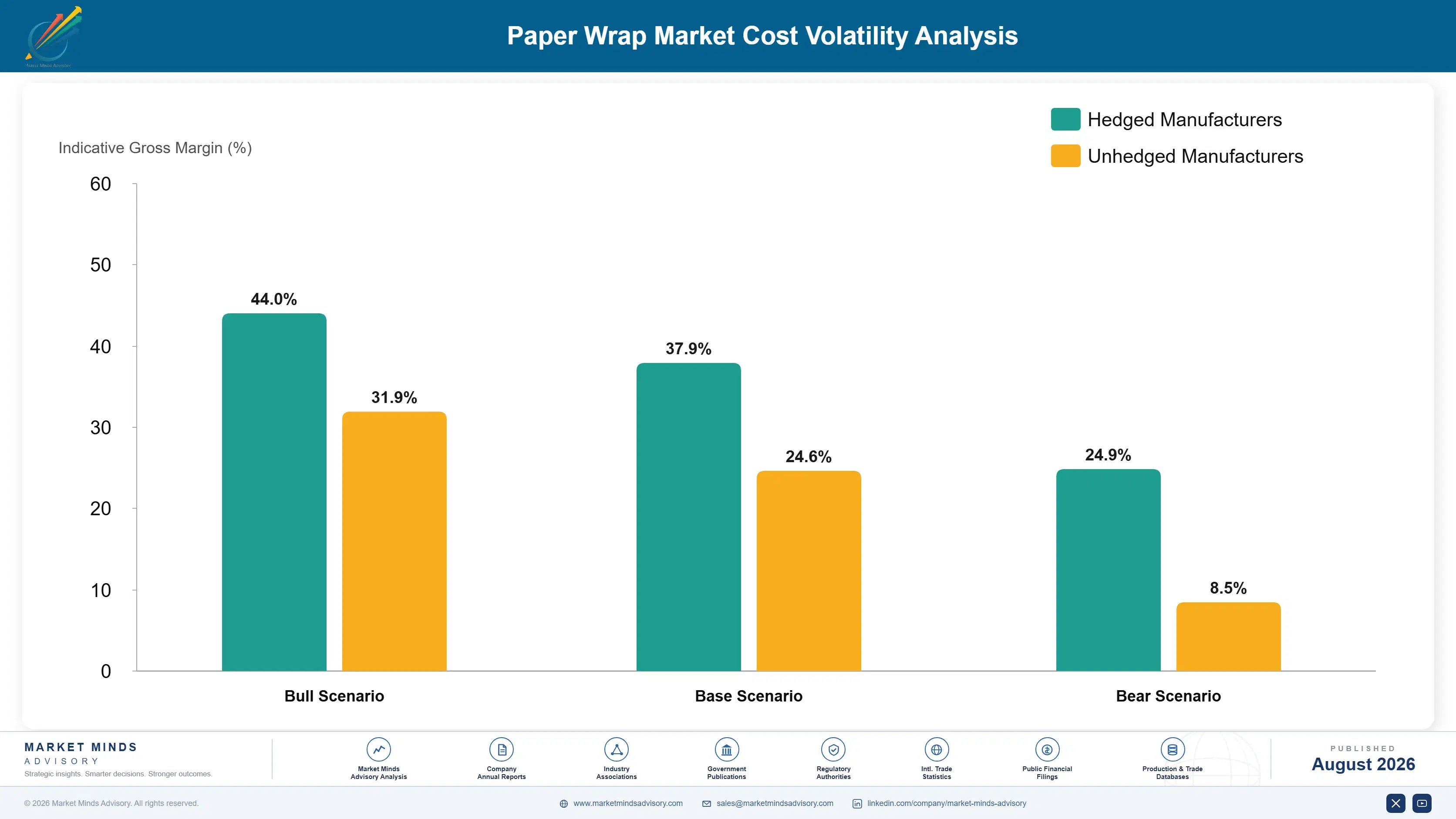
Pulp Fiber and Barrier Coating Exposure

Virgin and recycled pulp fiber account for roughly forty two to fifty two percent of paper wrap cost of goods sold, sourced primarily from Nordic, North American, and Brazilian pulp mills depending on converter location and certification requirements. Bio-based barrier coating materials add a further fifteen to twenty five percent for certified compostable grades, concentrated among a small set of specialty chemical suppliers serving the broader sustainable packaging market.
Stora Enso's most recent annual report cited elevated pulp input costs pressuring packaging segment margins through 2024, consistent with broader global pulp market tightness affecting both virgin and recycled fiber availability. Extended lead times on specific bio-based coating materials forced several converters to requalify alternate formulations mid-production run, adding certification cost and delaying some scheduled product launches by several months across affected order backlogs industry-wide.

Smaller regional converters face proportionally higher input cost exposure than vertically integrated producers able to control fiber sourcing across their own pulp mills. This cost disadvantage compounds for converters concentrated in a single region, since they cannot offset localized pulp price spikes by shifting sourcing across geographically diversified supplier relationships the way larger, integrated competitors routinely can.
paper-wrap-market-cost-volatility-analysis-1787299683137

Diversify Pulp Sourcing Across Multiple Regions

Leading converters now qualify pulp suppliers across at least two producing regions, typically Nordic and North American mills, reducing exposure to localized supply disruption that squeezed single-region buyers during recent volatility. This dual-sourcing approach adds modest logistics cost but has proven its value repeatedly during past pulp market disruptions across the wider converting industry each time.

Lock In Fiber Pricing Through Annual Contracts

Converters with sufficient production volume increasingly negotiate annual fixed-price fiber supply contracts rather than buying on the spot market, smoothing cost volatility across a full production year. Smaller converters lacking this volume leverage remain more exposed to short-term pulp price swings between order intake and delivery, often passing part of that cost through to customers directly.

Blend Recycled Fiber Where Certification Allows

Converters increasingly blend higher shares of recycled fiber into commodity kraft grades where food-contact certification permits, reducing virgin pulp exposure and smoothing cost volatility. This approach remains unavailable for most certified food-contact applications still requiring virgin material under current regulatory standards, though several suppliers are lobbying regulators to expand permitted recycled content thresholds industry-wide.

Portfolio Architecture for Margin Defence

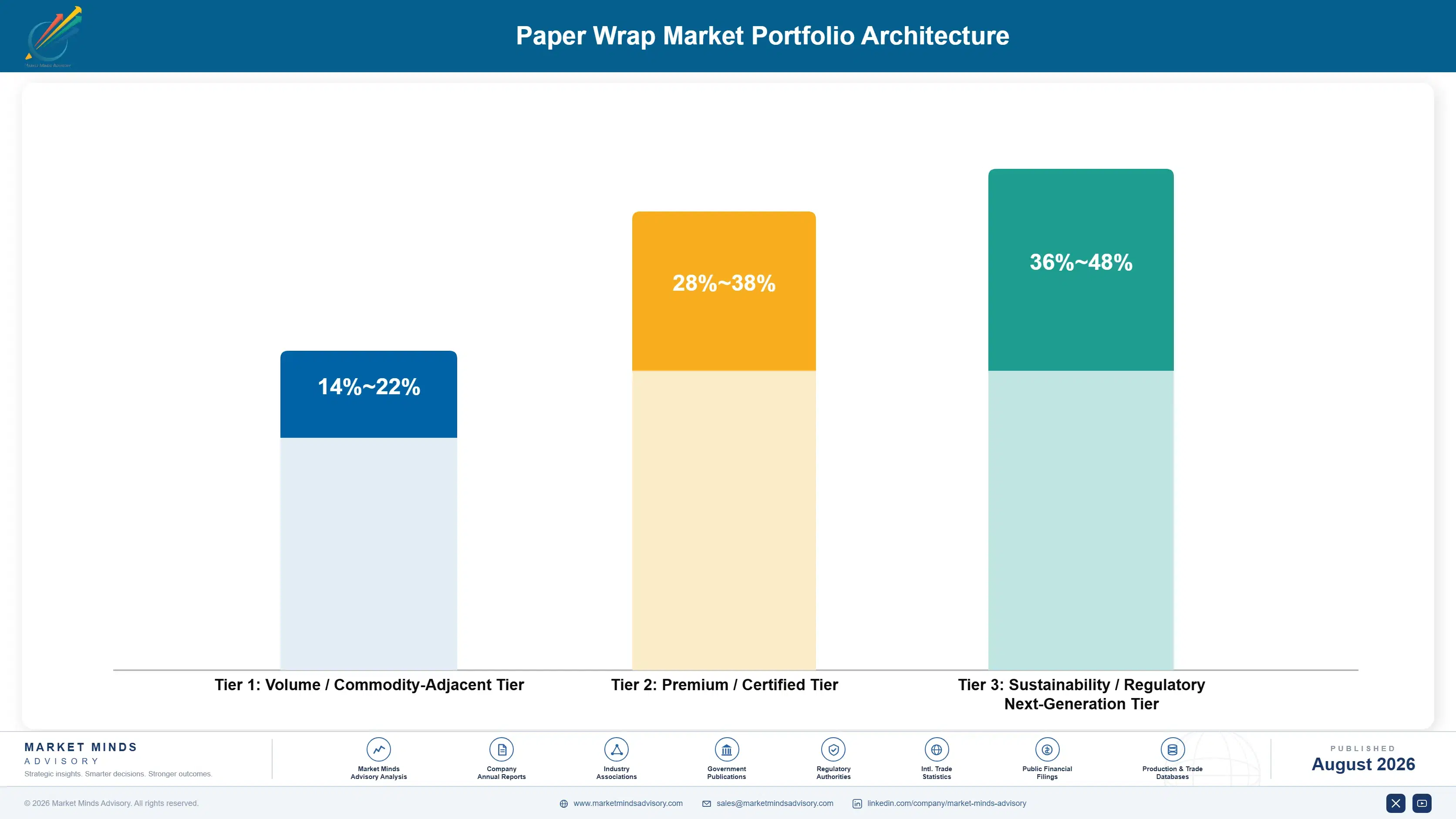
Producer portfolios split across three tiers running from commodity kraft through certified greaseproof grades to fully compostable next-generation formats. Gross margin widens substantially moving up this ladder, since certified and specialty grades carry proprietary coating formulation and compliance documentation that commodity kraft simply cannot support at comparable pricing, regardless of how efficiently a producer manages raw fiber cost or converting overhead.
Volume tier competition remains intensely price-driven as Asian and regional converters expand commodity kraft capacity, while premium certified tier competition centers on barrier performance, compostability certification, and supply consistency rather than unit price alone. This tension pushes established Western producers further up-tier rather than defending volume-tier share against lower-cost regional competitors directly, concentrating their research investment where differentiation still commands a premium worth defending.

High-value pools concentrate in certified compostable grades sold with documented barrier performance and direct-to-consumer shipping durability, where certification investment compounds pricing power over a product line's full commercial life rather than ending at initial qualification. Producers capturing this recurring specification advantage increasingly outperform peers selling commodity tonnage alone, a gap that widens further with each additional year of certified installed base growth.

Volume / Commodity-Adjacent Tier

Conventional uncoated kraft paper wrap priced on tonnage, competing mainly on basis weight and regional supply proximity across price-sensitive foodservice and retail accounts operating on thin annual packaging budgets and tight replacement schedules.
Gross Margin: 14-22%

Premium / Certified Tier

Greaseproof and food-contact grades with documented barrier performance, commanding higher pricing across foodservice-linked accounts and their annual specification reviews, vendor audits, and qualification rounds each renewal cycle nationwide and overseas.
Gross Margin: 28-38%

Sustainability / Regulatory / Next-Generation Tier

Fully certified compostable wrap with bio-based barrier coatings and third-party certification documentation, priced on total compliance value across long-term foodservice supply relationships spanning several renewal cycles and audit rounds each year.
Gross Margin: 36-48%
paper-wrap-market-portfolio-architecture-1787299683645

High-value Sub-segments and Strategic Watch-out

Compostable and Plastic-Free Paper Wrap

High value and high growth at 10.4%, the fastest category, as foodservice chains and regulators push certified specifications across every new supply contract negotiated this year and next, reinforcing this category's lead across the full forecast horizon and every major regional market tracked closely each cycle.
Gross Margin: 36-48%

Greaseproof and Food-Contact Paper Wrap

High value with strong growth at 8.9%, driven by direct-to-consumer bakery shipping demand pushing converters toward barrier-resistant formats across their expanding e-commerce customer base and its growing monthly recurring order volume across every regional market tracked this cycle and the next forecast period as well.
Gross Margin: 28-38%

Kraft Paper Wrap

The volume core by tonnage shipped, growing near 4.8% as commodity foodservice and retail wrapping demand remains steady even as certified segments capture incremental growth across most regional markets tracked this cycle and next forecast period across nearly every foodservice and retail account served nationwide.
Gross Margin: 14-22%

Wax-Coated Paper Wrap

The strategic watch-out, growing slowest at roughly 1.8% and facing steady share erosion as plastics-adjacent wax coatings fall out of favor under tightening compostability rules across nearly every major export market tracked this cycle and every subsequent regulatory cycle expected to follow closely behind it.
Gross Margin: 12-20%

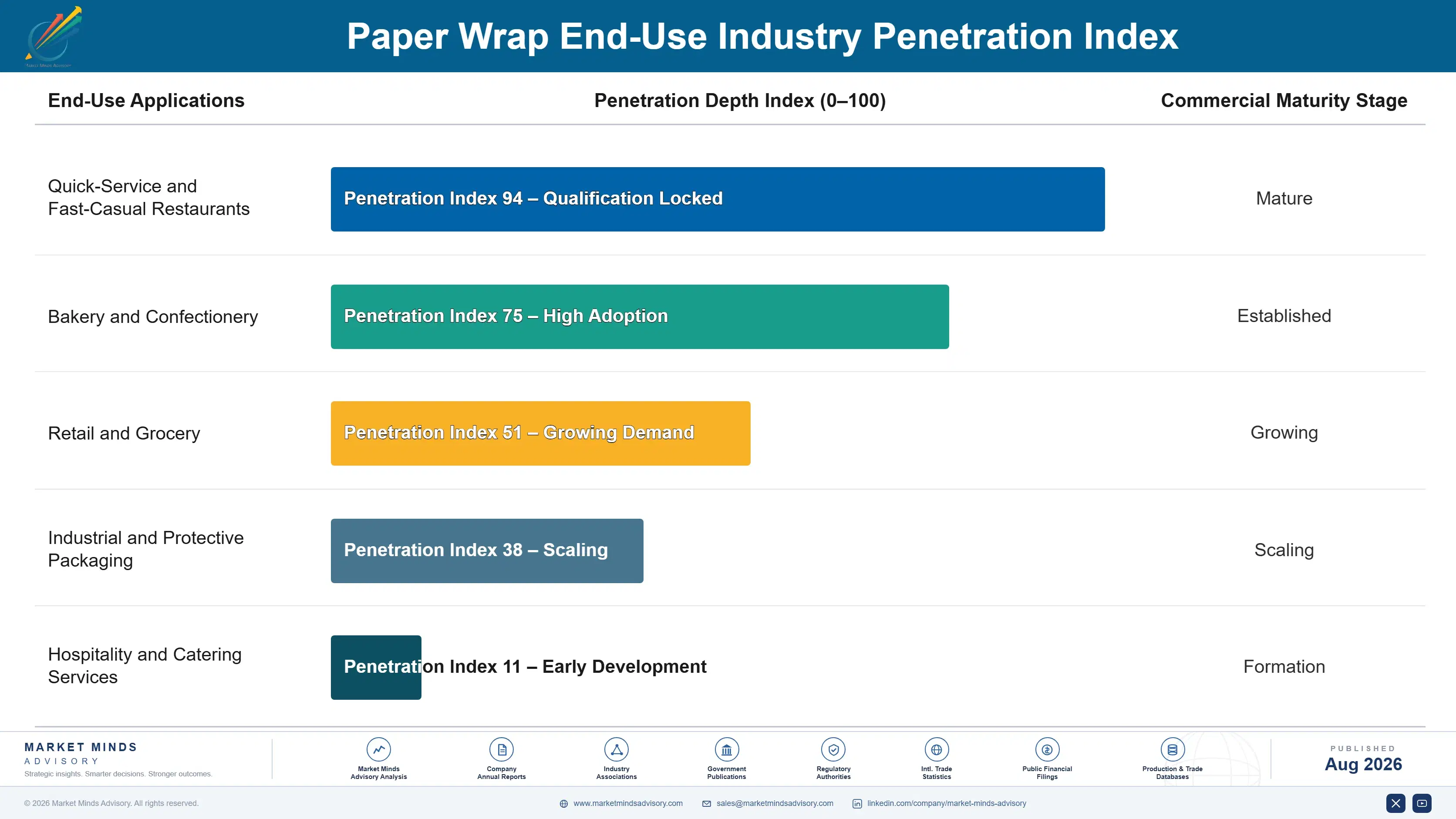
Certification Revenue Beyond Initial Qualification

Paper wrap generates recurring revenue across multi-year supply agreements once a producer achieves certification and qualification with a major foodservice or retail account, turning a single certification investment into a durable commercial relationship. Producers with strong compliance documentation capture a meaningfully larger share of this recurring value than those competing purely on per-order pricing, since certification cost is typically recovered many times over across a multi-year c
Adoption depth varies sharply by end-use vertical: large quick-service chains standardize on certified compostable specifications across their entire converter supply base, while independent restaurants and smaller retailers remain price-sensitive commodity buyers slower to adopt certified grades. Direct-to-consumer bakery and confectionery customers increasingly demand shipping-durable glassine tied to their growing online order volume, pushing their paper wrap suppliers toward specialty formats faster than the broader commodity foodservice segment requires, widening the gap between these two buyer profiles each year.

A generational shift in foodservice procurement is accelerating certified wrap adoption, as younger sustainability-focused buyers taking over packaging decisions at both large chains and independent operators prioritize documented compostability over the lowest unit price their predecessors typically favored, reshaping how these businesses evaluate new supplier relationships.
paper-wrap-market-end-use-penetration-index-1787299684134

Where Producers Should Invest Next

These are among the four positions where our research anticipates prominent divergence between winners and laggards over the coming forecast period. Each is grounded in the demand model, the regulatory perimeter, and the announced capacity pipeline.
01 / COMPOSTABLE CERTIFICATION INVESTMENT

Prioritize third-party certification over commodity capacity expansion

Certified compostable grades are capturing the overwhelming majority of growth as foodservice chains and regulators push specification requirements that commodity kraft cannot satisfy, and that gap widens with every new regulatory cycle across major markets. Producers still investing primarily in commodity capacity risk ceding the fastest-growing customer segment to competitors already certified, particularly among large chains that set specification trends for smaller regional buyers to follow. The capital case favors certification investment even where near-term commodity order volume remains steady, since that volume is unlikely to expand further.
02 / BARRIER COATING DEVELOPMENT

Develop bio-based coatings for high-fat food applications

The performance gap in high-fat food applications is already limiting paper wrap substitution, and closing it represents the single largest remaining addressable opportunity as foodservice chains push toward complete plastic elimination across every product category. Producers that develop proprietary bio-based barrier coatings ahead of competitors secure a durable technical advantage difficult to replicate quickly, since coating formulation expertise takes years to build rather than months. Waiting until competitors close this gap first cedes the largest remaining growth opportunity to faster-moving rivals investing in coating research right now.
03 / DIRECT-TO-CONSUMER PACKAGING EXPANSION

Expand shipping-durable glassine for e-commerce bakery brands

A meaningful and growing share of bakery and confectionery revenue now flows through direct-to-consumer shipping channels, representing an underserved segment that most producers' current product catalogs do not adequately address with shipping-specific formats. Suppliers offering engineered glassine built for multi-day transit durability can capture this segment without competing purely on commodity retail wrap pricing, converting irregular bulk buyers into recurring monthly accounts years earlier than a standard retail-channel sales cycle would allow. This approach also builds long-term customer relationships that scale alongside e-commerce order volume growth.
04 / REGIONAL FIBER SECURITY

Secure diversified pulp supply ahead of continued volatility

Pulp price volatility is already squeezing converter margins industry-wide, and this constraint will only intensify as certified compostable demand adds further pressure on specialty coating material supply chains worldwide. Producers that diversify fiber sourcing across multiple regions ahead of the next volatility cycle secure a durable cost advantage difficult for single-region competitors to replicate on short notice. Waiting until the next pulp price spike to act cedes preferential supplier relationships and favorable long-term contract terms to faster-moving competitors securing fiber supply today.

Engagement Snapshot From the Field

A live engagement with an industry participant carrying material or product regulatory and market exposure ahead of a defining policy shift, showing how our research translates into a defensible multi-year portfolio strategy.
MARKET MINDS ADVISORY · CLIENT ENGAGEMENT SUMMARY
Paper Wrap Producer Strategic Portfolio Review and Transition Roadmap 2026·Investment Scenario on Paper Wrap Exposure Evaluation 2025-26
CLIENT PROFILE
The client is a mid-sized regional paper wrap converter supplying glassine and kraft wrap to independent bakeries and a handful of regional quick-service accounts within a single national market. Annual revenue is reported at approximately USD 38 million (client-reported, unverified by MMA), with glassine and greaseproof products accounting for roughly half of total converting output. The company had not yet pursued third-party compostability certification for its kraft product line.
STRATEGIC CHALLENGE
The client faced rising customer requests for certified compostable wrap that its uncoated kraft line could not satisfy, while competitors with certification increasingly won foodservice contracts the client had to decline. Management needed an objective evaluation of whether pursuing certification justified the investment given constrained capital availability and uncertain near-term demand from its existing independent bakery customer base.
MMA APPROACH
MMA benchmarked the client's product mix and customer requests against regional certified competitors, modeled certification investment payback across a five-year horizon, and interviewed the client's top foodservice-adjacent customers regarding future specification expectations. The analysis incorporated primary survey data on foodservice compostability requirements alongside coating supplier pricing benchmarks gathered directly from vendor discussions.
KEY FINDINGS
  1. Lost contract value from missing certification exceeded the annual cost of pursuing it within roughly fourteen months of continued operation and lost tenders.
  2. Certifying the existing glassine line captured most of the near-term opportunity at under half the cost of certifying the full kraft product range.
  3. Customer interviews showed a clear willingness to pay a modest premium for documented compostability across shipped bakery goods and seasonal promotional runs.
  4. The smallest-volume kraft product line did not justify certification investment relative to its limited remaining commercial life and shrinking order base going forward.
CLIENT PROFILE
The client is a mid-sized regional paper wrap converter supplying glassine and kraft wrap to independent bakeries and a handful of regional quick-service accounts within a single national market. Annual revenue is reported at approximately USD 38 million (client-reported, unverified by MMA), with glassine and greaseproof products accounting for roughly half of total converting output. The company had not yet pursued third-party compostability certification for its kraft product line.
STRATEGIC CHALLENGE
The client faced rising customer requests for certified compostable wrap that its uncoated kraft line could not satisfy, while competitors with certification increasingly won foodservice contracts the client had to decline. Management needed an objective evaluation of whether pursuing certification justified the investment given constrained capital availability and uncertain near-term demand from its existing independent bakery customer base.
MMA APPROACH
MMA benchmarked the client's product mix and customer requests against regional certified competitors, modeled certification investment payback across a five-year horizon, and interviewed the client's top foodservice-adjacent customers regarding future specification expectations. The analysis incorporated primary survey data on foodservice compostability requirements alongside coating supplier pricing benchmarks gathered directly from vendor discussions.
KEY FINDINGS
  1. Lost contract value from missing certification exceeded the annual cost of pursuing it within roughly fourteen months of continued operation and lost tenders.
  2. Certifying the existing glassine line captured most of the near-term opportunity at under half the cost of certifying the full kraft product range.
  3. Customer interviews showed a clear willingness to pay a modest premium for documented compostability across shipped bakery goods and seasonal promotional runs.
  4. The smallest-volume kraft product line did not justify certification investment relative to its limited remaining commercial life and shrinking order base going forward.
RECOMMENDED STRATEGY
Phase 1: Phase 1 (Months 1-4): Pursue third-party compostability certification for the existing glassine product line first and fastest across all facilities. Phase 2: Phase 2 (Months 5-9): Pilot expanded foodservice order acceptance using the newly certified glassine line's documentation and testing data across regional accounts. Phase 3: Phase 3 (Months 10-16): Evaluate full kraft line certification based on pilot results and demand trends observed across accounts and competitor moves.
OUTCOME
Within twelve months of completing glassine certification, the client reported foodservice-adjacent order volume up approximately twenty eight percent and successfully won two regional quick-service contracts previously closed to it (client-reported, unverified by MMA). Management deferred full kraft line certification pending continued demand validation, avoiding premature capital commitment while capturing the bulk of the near-term commercial opportunity identified during the engagement.

Frequently Asked Questions

Foundational context covering the market sizes, CAGR, scope, country, region and competition that inform every finding below. This section is provided to cover basics and most often pre-purchase conversations, answered from the MMA Primary Research Dataset.

What is the current size of the Paper Wrap Market?

The global paper wrap market is valued at USD 5.2 billion in 2025, covering compostable, greaseproof, kraft, and wax-coated wrap sold to converters and foodservice operators worldwide.

How large will the Paper Wrap Market be by 2036?

The market is projected to reach USD 9.98 billion by 2036, roughly 1.81 times its 2026 value of USD 5.52 billion, driven by compostable substitution and e-commerce bakery demand.

What is the CAGR for the Paper Wrap Market 2026 to 2036?

The base case CAGR is 6.1%, with a bull case of 7.4% if bio-based barrier coating adoption accelerates, and a bear case of 4.8% under pulp price volatility pressure.

Which segment is growing fastest?

Compostable and Plastic-Free Paper Wrap leads at a 10.4% CAGR, roughly 1.70 times the overall market rate, as foodservice chains standardize on certified specifications nationwide.

Who are the major companies in the Paper Wrap Market?

Mondi, Sappi, Delfort Group, Nordic Paper, and Twin Rivers lead the market, together holding roughly 23% of combined production and shipment revenue, per company filings.

Which country is growing fastest?

India leads at a 9.1% CAGR as its organized foodservice sector expands and import substitution policy draws new domestic converting investment nationwide each year and beyond.

Report Segmentation Architecture

The full report scope spans multiple orthogonal segmentation dimensions, with cross-tabulated demand data provided for each dimension pair. Coverage extends further to regional breakdowns, trend trajectories, and the competitive detail needed to support segment-level decision-making.

By Material Composition and Barrier Technology

  • Compostable and Plastic-Free Paper Wrap
  • Greaseproof and Food-Contact Paper Wrap
  • Kraft Paper Wrap
  • Wax-Coated Paper Wrap
  • Glassine Paper Wrap
  • Tissue and Specialty Paper Wrap

By End-Use Industry

  • Quick-Service and Fast-Casual Restaurants
  • Bakery and Confectionery
  • Retail and Grocery
  • Industrial and Protective Packaging
  • Hospitality and Catering Services

By Commercial Dimension

  • Direct Converter Sales Channels
  • Distributor and Wholesaler Networks
  • E-Commerce Shipping Packaging Channels
  • Private-Label Retail Supply Agreements

By Region

  • North America
  • Western Europe
  • East Asia
  • South Asia and Pacific
  • Latin America
  • Middle East and Africa
  • Eastern Europe

Scope, Methodology, and Coverage

Every figure in this report is reproducible from documented input assumptions. The scope below maps the historical period, the forecast horizon, the segmentation dimensions, and the countries covered, alongside the underlying primary and qualitative methodology.
Historical Period
2020 to 2025
Forecast Period
2026 to 2036
Base Year
2025 (USD billions; MMA Primary Research Dataset, August 2026)
Market Definition
The paper wrap market covers paper-based wrapping materials used for food-contact, retail, and industrial protective applications, including kraft paper wrap, glassine and greaseproof wrap, wax and coated paper wrap, and tissue wrap sold in roll or sheet format to converters and end users. It excludes plastic film wrap, paper-based rigid packaging, and finished wrapped products sold to consumers.
Quantitative Units
USD billions (current prices); metric tons shipped annually
Segmentation Dimensions
By Material Composition and Barrier Technology; By End-Use Industry; By Commercial Dimension; By Region
Regions Covered
North America, Western Europe, East Asia, South Asia and Pacific, Latin America, Middle East and Africa, Eastern Europe
Countries Covered
USA, China, Germany, France, UK, Japan, South Korea, India, Australia, Canada, Brazil, Mexico, Indonesia, Vietnam, Thailand, Malaysia, UAE, Saudi Arabia, South Africa, Nigeria, Turkey, Poland, Netherlands, Italy, Spain, Sweden, Switzerland, Argentina, Colombia, Singapore, and additional markets relevant to this sector
Key Companies Profiled
Mondi plc, Sappi Limited, Delfort Group, Nordic Paper Holding AB, Twin Rivers Paper Company, Ahlstrom, Glatfelter Corporation, Loparex LLC, Stora Enso Oyj, UPM-Kymmene Corporation, International Paper Company, Georgia-Pacific LLC, WestRock Company, BillerudKorsnäs AB, Segezha Group, Sonoco Products Company, Canfor Pulp Products Inc., Domtar Corporation, Metsä Board Corporation, Neenah Inc.
Quantitative Methodology
Primary survey, n=3,800 respondents, Q4 2025, six countries; demand-side model with trade association cross-validation
Qualitative Methodology
47 expert interviews, Q4 2025; applied to validate demand model assumptions, identify emerging dynamics, and assess competitive positioning
Report Format
PDF and XLSX data workbook (Word format preview document)
Publisher
Market Minds Advisory
Report Code
MMA-2026-PAC-195
Published
August 2026
Contact
sales@marketmindsadvisory.com | www.marketmindsadvisory.com

Purchase the full Paper Wrap Market Report (2026 to 2036).

The full MMA report on the paper wrap market delivers detailed segmentation by material composition, end-use vertical, and commercial channel across all seven global regions, supported by primary survey data from converter and foodservice respondents. It includes country-level demand estimates, detailed competitive profiles of all twenty companies covered, and forward-looking analysis of certification and barrier coating revenue opportunity through 2036. The report also benchmarks compostable and commodity kraft economics across major end-use verticals in detail. Buyers receive full access to underlying data tables alongside the complete analytical narrative.
Seven-region demand and CAGR data breakdown
Twenty-company competitive benchmarking and positioning profiles
Certification and barrier coating revenue sizing
Compostable versus commodity kraft economics compared
Primary survey data from converter operators
Ten-year forecast through 2036 by segment

Built For The People Who Decide

From boardroom strategy to bench-side execution, this report is read cover-to-cover by leaders shaping the next decade of their industry, turning demand scenarios, market dynamics and valuation benchmarks into decisions.
CXOs/ Presidents/ VPs/ Managers
M&A and Corporate Development
Strategy Teams and R&D Heads
Procurement and Product Directors
Regulatory and Compliance Leaders
Investor Relations and Equity Analysts