Market Minds Advisory
Paper Waste Strippers Market

Paper Waste Strippers Market: The Machine That Gets Blamed for Somebody Else's Work

Most stripping faults trace back to nick design and die board fitting decided three steps earlier. The stripping unit takes the blame because it is where the sheet visibly fails.

Lead Analyst

Bilal Shaikh

Published

September 2026

Make Smarter Decisions with Customized Research Insights

Request a free sample report and evaluate market opportunities, growth trends, and competitive dynamics relevant to your business needs.

2025 MARKET VALUE$1.9BMarket Size 2025
2036 FORECAST VALUE$3.4BBase Case , 2026 to 2036
CAGR 2026 TO 20365.6 %Bull 6.8% / Bear 4.4%
INCREMENTAL OPPORTUNITY$1.4BNet 10- year value creation
EXPANSION MULTIPLE1.73x2036 value over 2026 base
Strategic Levers
M&A Pipeline
Regional Outlook
Country Rankings
Competitive Intelligence
Segmental Deep-dive
Call-Us : 91 93563 13602

Executive Snapshot and Market Trajectory

A stripping unit pulls waste out of a die-cut sheet, and when it fails everybody looks at the stripping unit. Around 61% of the time the actual cause sits upstream in nick design or die board fitting, decided three steps earlier. That misattribution shapes how the whole category gets bought.
Growth runs at 5.6% on conversion away from manual stripping, which still accounts for 29% of folding carton output despite being physically punishing work that nobody wants. Automatic blanking units grow fastest at 8.4%, exactly 1.50 times the market rate, because separating blanks cleanly lifts downstream folder gluer throughput by around a third. Narrow web matrix stripping follows at 7.6% on label converting growth.
Concentration reaches 46% across the top five measured on annual stripping and blanking units shipped, unusually split between converting machine builders and the tooling makers who cut job-specific stripping boards for one die layout each. Tooling carries 38% of typical builder revenue and recurs with every new carton design, without any capital approval at all. East Asia holds the largest share on converting plant count and new press installation rather than on packaging consumption.
Market Definition
This market covers equipment and job-specific tooling that removes waste material from die-cut sheets and webs in folding carton, corrugated, and label converting, measured at builder realised prices. Coverage spans in-line stripping sections, stripping tools and boards, automatic blanking units, narrow web matrix stripping and rewind, standalone stripping stations, and waste extraction and conveying. Die-cutting presses themselves, cutting dies and rules, folder gluers, printing presses, and baling equipment fall outside scope.
Base Year Value
$1.9B in 2025 (MMA Primary Research Dataset, August 2026)
Forecast Period
2026 to 2036, eleven discrete annual values
CAGR
5.6% base case. Bull 6.8%. Bear 4.4%.
Fastest Growth Segment
Automatic Blanking Units: 8.4% CAGR
Fastest Growth Country
India: 8.6% CAGR
Fastest Growth Region
South Asia and Pacific: 7.8% CAGR
Largest Region
East Asia: 33% of 2025 global value
Market Leaders
Bobst, Heidelberger Druckmaschinen, Koenig & Bauer, Masterwork Group, Iberica AG. Source: MMA Analysis based on company annual reports.
Primary Survey
n=3,800 procurement and R&D decision-makers, Q4 2025, six countries
Methodology
Demand-side build-up, cross-validated against public data, 47 expert interviews

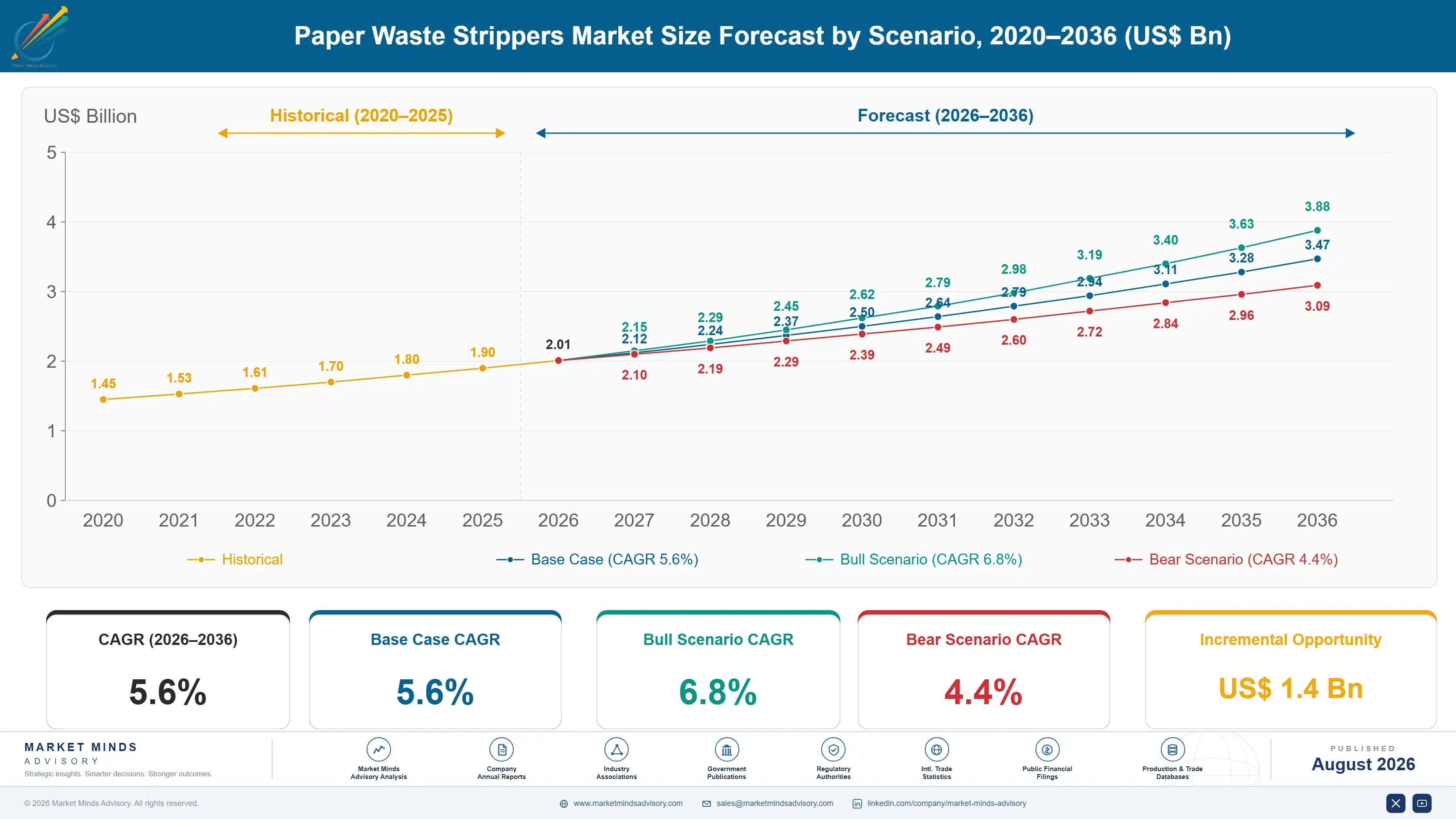
Paper Waste Strippers Market Forecast Scenarios

paper-waste-strippers-market-size-forecast-scenario-1787299633946
The 2020 to 2025 period ran at 4.6% and its composition changed considerably. Folding carton volume grew steadily on pharmaceutical and food packaging while corrugated converting expanded on e-commerce. Underneath that, run lengths shortened as retail assortment widened, which raised tooling demand faster than machine demand because every new design needs its own stripping boards. Automated blanking became a specification rather than an option.
Three mechanisms carry the 5.6% base case. Manual stripping conversion is the largest, since 29% of folding carton output is still stripped by hand and the labour to do it is progressively harder to find. Shorter run lengths are the second, because tooling revenue scales with design count rather than with sheet volume. And label converting growth is the third, driving narrow web matrix stripping and rewind demand at 7.6%.
The 6.8% bull case rests on nick optimisation software reaching the die-making trade widely, which would cut the 61% of stripping stoppages traced upstream and remove the reliability objection that slows automated blanking adoption. The 4.4% bear case is a folding carton capital spending pause, since converting plants replace die-cutting equipment on cycles that synchronise across the industry.

Where the Fault Actually Originates

The physics of the problem is worth stating because it explains the commercial structure. A die cuts a carton blank almost all the way through but leaves small nicks holding it in the sheet, so the sheet stays intact through the press. Downstream, the stripping section pushes and pulls that waste out. Too few nicks and blanks fall out inside the press. Too many and the stripping tools tear the blank rather than freeing it.
TOP FIVE CONCENTRATION46%Split between machine builders and job-specific tooling makers
MANUAL STRIPPING SHARE29%Of folding carton output still stripped out by hand
STRIPPING TOOL SET COST2,800 dollarsMade for one die layout and useless anywhere else
NICK-RELATED STOPPAGE SHARE61%Of stripping faults traced upstream to die and nick design
BLANKING UNIT SPEED GAIN34%Downstream folder gluer throughput improvement after automated blank separation
TOOLING SHARE OF REVENUE38%Consumable tooling against machine sales for typical builders
Nick count and placement are decided at die-making, by a trade that rarely watches the stripping section run and receives almost no feedback when it goes wrong. Around 61% of stripping stoppages trace back there rather than to the stripping unit itself. Builders who diagnose upstream and offer nick guidance close orders that builders defending their own equipment do not.
Commercially the category behaves oddly for capital equipment. Machines sell on fifteen to twenty year cycles while job-specific stripping boards recur with every new carton design, and tooling already carries 38% of typical builder revenue. Shorter run lengths and wider retail assortment therefore grow this business faster than packaging volume does.
"I have watched a converting plant spend four months blaming a stripping section and then fix the problem in a fortnight by changing where the die-maker put the nicks. The equipment was never the issue. It was simply where the failure became visible."
Director, Converting Machinery and Die-Cutting Systems Practice · MMA Industrial

Market Trends

Blanking Units Are Sold On Downstream Throughput

An automatic blanking unit separates finished blanks from the stripped sheet and stacks them squarely, which sounds like a tidying operation and is not. A folder gluer fed with squarely stacked blanks runs roughly 34% faster than one fed with a hand-separated stack, because the feeder stops less. That means the blanking unit is justified by a machine two steps downstream rather than by anything it does itself. Growth runs at 8.4% against 5.6% for the market, and builders who learned to sell it that way close far more of these.
Market Impact: 29% of output stripped manually
Tooling Demand Scales With Designs Not With Volume

A stripping board is cut for one specific die layout and is worthless on any other job, so every new carton design generates a new set costing around 2,800 dollars. Retail assortment has widened steadily while individual run lengths have shortened, which means design count rises even where packaging tonnage is flat. Tooling already carries 38% of typical builder revenue and recurs without any capital approval process at the customer. That is a considerably better business than selling die-cutting machinery on a fifteen year replacement cycle. Nobody has to approve a capital request for a stripping board.
Market Impact: Run lengths down about 33%

Market Opportunities and Growth Drivers

Manual Stripping Is Twenty-Nine Percent And Falling Slowly

Around 29% of folding carton output is still stripped by hand, which means an operator standing at a stack pushing waste out of sheets for a whole shift. Those positions are progressively harder to fill across every developed converting market, and the work carries a repetitive strain injury record that insurers have begun pricing. Conversion is slow because a stripping section cannot simply be added to an older press without significant rework. Plants therefore convert when they replace the press, which spreads the change across a long cycle. Nothing accelerates that timetable much.
Market Impact: 61% of faults originate upstream

Shorter Runs Multiply Job-Specific Tooling Demand

Average folding carton run length has fallen by roughly a third over a decade as retailers widened assortment and brands added regional and promotional variants. Each of those variants is a separate die layout needing its own stripping board set, so tooling volume rises even where total board consumption stays flat. India contributes the fastest national growth rate in this forecast at 8.6%, driven by pharmaceutical carton proliferation where each dosage and market variant is a distinct design. Tooling makers benefit from assortment strategy without selling a single machine. Suppliers benefit directly from somebody else's merchandising decision.
Market Impact: Retrofit exceeds 50% of press

Market Restraints and Challenges

Sixty-One Percent Of Faults Originate Somewhere Else

Most stripping stoppages are caused by nick count, nick placement, or a poorly fitted die board rather than by the stripping unit, yet the stripping section is where the failure becomes visible and therefore what gets blamed. The root cause is that die-making and stripping sit in different trades with almost no feedback between them. Commercial impact is that automated stripping carries an undeserved reliability reputation which slows adoption measurably. Mitigation runs through nick optimisation software, die-maker training programmes, and builders offering upstream diagnosis rather than defending their equipment. Very few builders have taken that route so far.
Market Impact: Lifts folder gluer output 34%

Retrofitting An Older Press Is Rarely Worth It

Adding a stripping section to a die-cutting press that was built without one means reworking the delivery, the gripper bar path, and often the frame, which routinely costs more than half the price of a new press. The root cause is that stripping was designed into machine architecture rather than bolted onto it. Commercial impact is that conversion from manual stripping waits for press replacement on a fifteen to twenty year cycle. Standalone stripping stations exist as a partial answer and handle only a limited range of formats. Format range is the limitation there rather than capability.
Market Impact: Tooling carries 38% of revenue
4 additional market trends, 3 additional growth drivers, and 2 additional restraints and challenges are covered in the full report. Contact sales@marketmindsadvisory.com to access the complete intelligence.

Segment CAGR and Growth Architecture

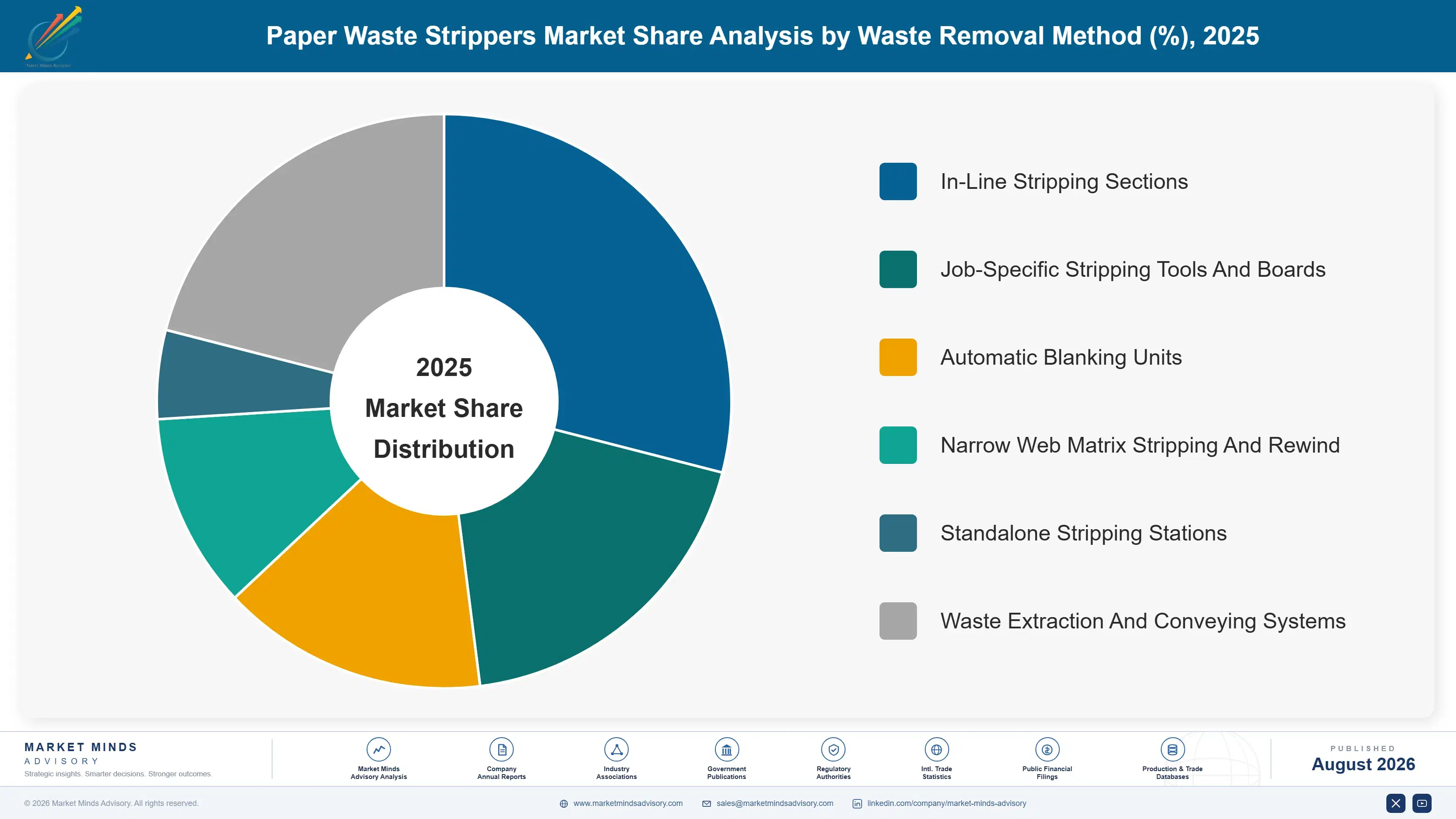
Segmentation follows how the waste is removed, because that determines the capital involved, whether the revenue is a machine sale or a recurring tooling sale, the format range handled, and which trade inside a converting plant actually owns the decision. End-use packaging category and substrate both cut across every method rather than separating them cleanly.
paper-waste-strippers-market-market-share-analysis-1787299634482

Automatic Blanking Units

The fastest method at 8.4%, exactly 1.50 times the market rate, and the one justified by a machine two steps downstream rather than by its own output. Separating finished blanks from the stripped sheet and stacking them squarely lets a folder gluer run roughly 34% faster, because a squarely stacked pile stops the feeder far less often than a hand-separated one. Pharmaceutical and cosmetic carton work adopted it fastest, since those plants run folder gluers as the bottleneck rather than the press. Builders who learned to quantify the downstream gain close considerably more of these than those still selling stripping quality alone. The measurement itself takes a fortnight and almost nobody bothers to do it.
CAGR 8.4%

Narrow Web Matrix Stripping And Rewind

Second fastest at 7.6%, and a genuinely different engineering problem from sheet stripping: the label matrix is a continuous web of waste that must be lifted and rewound continuously without breaking, at line speeds where a single break stops the press. Matrix tension control and rewind torque management are the whole discipline, and thin liner materials have made both harder as converters downgauged. Pressure sensitive label converting growth drives the segment directly. Adhesive build-up on rewind rollers remains the persistent maintenance issue, and no supplier has genuinely solved it rather than merely managing it better than others. Converters running thin liner at speed treat matrix break rate as the single number that matters, and they are right to.
CAGR 7.6%
Full segment breakdown across 6 segments available in the complete report.

Regional Architecture and Country Demand Map

Demand follows converting plant count and new press installation rather than packaging consumption, which puts East Asia clearly ahead of everywhere else. Chinese folding carton and corrugated capacity exceeds any other region and continues installing new equipment at a pace mature markets no longer match.

East Asia

Thirty-three percent, marginally above the framework band, and the justification is converting capacity rather than packaging consumption: Chinese folding carton and corrugated plants outnumber those of any other region by a wide margin and continue installing new die-cutting equipment at a pace mature markets abandoned years ago. Domestic machine builders have moved substantially up the specification range and now compete on stripping and blanking performance rather than on price alone. Japanese and Korean converters occupy the precision end, running pharmaceutical and cosmetic carton work at tolerances that reward automated blanking heavily. Growth at 6.6% runs above the global rate on continued installation rather than on replacement demand. Taiwanese converting adds a smaller high-precision contribution.
Share: 33% | CAGR: 6.6% (2026 to 2036)

Western Europe

Machine building rather than converting volume gives this region its weight, since the leading die-cutting press builders sit here and their stripping and blanking sections ship worldwide. German, Swiss, and Spanish builders hold the high-specification end where pharmaceutical carton tolerances are demanding. Domestic converting is mature, consolidated, and buys on replacement cycles rather than expansion, which caps the growth available. Italian and Spanish tooling makers supply job-specific stripping boards across the region and beyond it. Growth at 4.2% is the slowest of any region, reflecting a converting base that is not expanding and a replacement cycle measured in decades rather than years. The tooling business here is healthier than the machine business, which tells you where growth sits.
Share: 22% | CAGR: 4.2% (2026 to 2036)
Regional intelligence for 5 additional markets available in the complete report: North America, South Asia and Pacific, Latin America, Eastern Europe, Middle East and Africa. Contact sales@marketmindsadvisory.com.
paper-waste-strippers-market-country-cagr-analysis-1787299635003

What Stripping Builders Keep Underselling

Machines sell on twenty year cycles while job-specific tooling recurs with every new carton design, and most faults blamed on stripping originate somewhere else entirely. Value comes from selling downstream throughput, from owning the tooling relationship, from diagnosing upstream instead of defending equipment, and from treating design count rather than tonnage as the demand driver.

Quantify The Folder Gluer Gain In Every Proposal

An automatic blanking unit is almost always justified on stripping quality, which the buyer already believes is adequate, rather than on the roughly 34% throughput improvement it delivers to a folder gluer two steps downstream. That second number is worth several hundred thousand dollars annually in a plant where the gluer is the bottleneck, and it is measurable during a trial rather than merely assertable. Builders who instrument a customer's gluer before and after quote a return the buyer can verify. Almost nobody does the measurement. It takes a fortnight and settles the argument permanently.
Market Impact: Delivers about 34% more throughput two steps downstream

Own The Job-Specific Tooling Rather Than Losing It

Every new carton design needs a stripping board set costing around 2,800 dollars, and a plant running two hundred new designs annually generates over half a million dollars of tooling demand without any capital approval process at all. Builders who let independent tooling makers take that work sold a machine once and gave away the annuity attached to it. Holding the tooling also keeps the builder in the plant continuously, which is where the next machine order gets shaped long before any tender is written. Tooling is where this business actually earns.
Market Impact: Tooling demand exceeds 500,000 dollars per plant yearly

Diagnose Upstream Instead Of Defending The Equipment

When a customer reports stripping problems, roughly 61% of the time the cause is nick count, nick placement, or die board fitting rather than anything the stripping section did. A builder whose service engineer proves that, and then works with the die-maker to fix it, converts a complaint into the most credible sales position available anywhere in this category. A builder who defends the machine wins the argument and loses the next order. The diagnostic capability costs perhaps 180,000 dollars annually to maintain across a service organisation. It is the cheapest credibility available anywhere here.
Market Impact: Resolves about 61% of every fault reported today

Forecast Against Design Count Not Packaging Tonnage

Tooling revenue scales with the number of distinct die layouts a plant runs, and average run lengths have fallen roughly 33% over a decade while tonnage grew far more slowly. Builders forecasting tooling demand from packaging volume have consistently underestimated it and under-stocked accordingly. Tracking customer design introduction rates instead, which most converters will share readily, produces a forecast that actually matches consumption. It also identifies which accounts are worth a dedicated tooling service arrangement before a competitor works it out first. Converters share design pipelines readily when asked, and very few builders have ever asked.
Market Impact: Run lengths fell about 33% over ten years

Who Controls the Margin Pool

Concentration reaches 46% across the top five measured on annual stripping and blanking units shipped, and the composition is unusual because job-specific tooling makers sit alongside press builders. Tooling already carries 38% of typical builder revenue, so a specialist producing stripping boards competes for the same wallet as the company that supplied the press. The gap between leader and nearest challenger is wide on complete presses and considerably narrower on stripping and blanking sectio
Competitive activity runs on three fronts. Downstream throughput evidence is the first, since a blanking unit justified on folder gluer speed sells against one justified on stripping quality alone. Tooling turnaround is the second, because a plant introducing a new design cannot wait three weeks for boards. Upstream diagnostic capability is the third, and it is where the credible suppliers separate from the defensive ones.

Pressure comes from two directions. Chinese press builders have moved up the specification range and now compete on stripping and blanking performance rather than on price alone. And independent tooling makers keep taking the recurring revenue that press builders treat as an afterthought, which is where rankings will shift once the machine cycle turns.
paper-waste-strippers-market-company-positioning-matrix-1787299635523

Competitive Moat and Risk Dimensions

BOBST

Moat: Stripping designed into machine architecture

Stripping and blanking sections designed as part of the press rather than added to it deliver register accuracy and sheet handling a bolted-on section cannot match at speed. That integration is why retrofitting an older press so rarely justifies itself, and it means the stripping decision is effectively made when the press is chosen.
BOBST

Risk: Twenty year replacement cycles

A business built on complete press sales lives on a fifteen to twenty year replacement cycle, which produces long stretches with no order from a given plant regardless of relationship quality. Tooling and service partially fill those gaps, but only where the builder holds the tooling. Independent makers have taken much of that.
HEIDELBERGER DRUCKMASCHINEN

Moat: Installed base and service reach

A very large installed press population across folding carton converting generates service, parts, and tooling demand continuously and puts engineers inside customer plants between capital cycles. That presence is where the next order is shaped, long before any tender exists. It also produces failure data across many plants.
HEIDELBERGER DRUCKMASCHINEN

Risk: Broad portfolio dilutes stripping focus

Stripping and blanking sit inside a much larger printing and converting equipment business, competing for engineering and commercial attention against product lines with far greater revenue. Specialists who do nothing else can move faster on blanking development and tooling turnaround. Breadth that provides stability across cycles also slows response in a segment where the technical argument is genuinely specific.

Players Tracked

Prominent Players

Bobst
Heidelberger Druckmaschinen
Koenig & Bauer
Masterwork Group
Iberica AG

Other Key Players

Duran Machinery
Brausse Group
Eterna Machinery
Sanwa Machinery
Asahi Machinery
Yoco Printing Machinery
Shanghai Yawa
Marbach
Wilson Manufacturing
Kocher+Beck
Electro Optic
Grafisk Maskinfabrik
Rotocontrol
Höcker Polytechnik
Nestro

Recent Developments

JANUARY 2025

Press builder launches nick optimisation software for die-makers

A converting machinery builder released software that calculates nick count and placement from carton geometry and substrate, aimed at the die-making trade rather than at its own converting customers. The launch was a product introduction rather than any acquisition of a die-maker, joint venture, or licensing arrangement.
Signal: A machine builder solving a problem outside its own equipment is the most credible sales position available here
APRIL 2025

Tooling maker cuts stripping board turnaround to forty-eight hours

A job-specific tooling manufacturer reduced stripping board production lead time to two working days across its European sites through laser cutting capacity and standardised board blanks. The change was an internal operations investment rather than any acquisition, partnership, or supply agreement with a converting machinery builder.
Signal: Tooling turnaround decides which supplier a converter calls when a new design has to run next week
JULY 2025

Chinese builder introduces high-specification blanking section for pharmaceutical cartons

A Chinese die-cutting press manufacturer launched a blanking section aimed at pharmaceutical carton tolerances previously served mainly by European builders, targeting both domestic and export converting customers. The launch was an organic product development rather than any joint venture, technology licensing arrangement, or acquisition of European capability.
Signal: Chinese builders now compete on stripping and blanking performance rather than on price, which changes the tender landscape

What A Stripping Section Costs

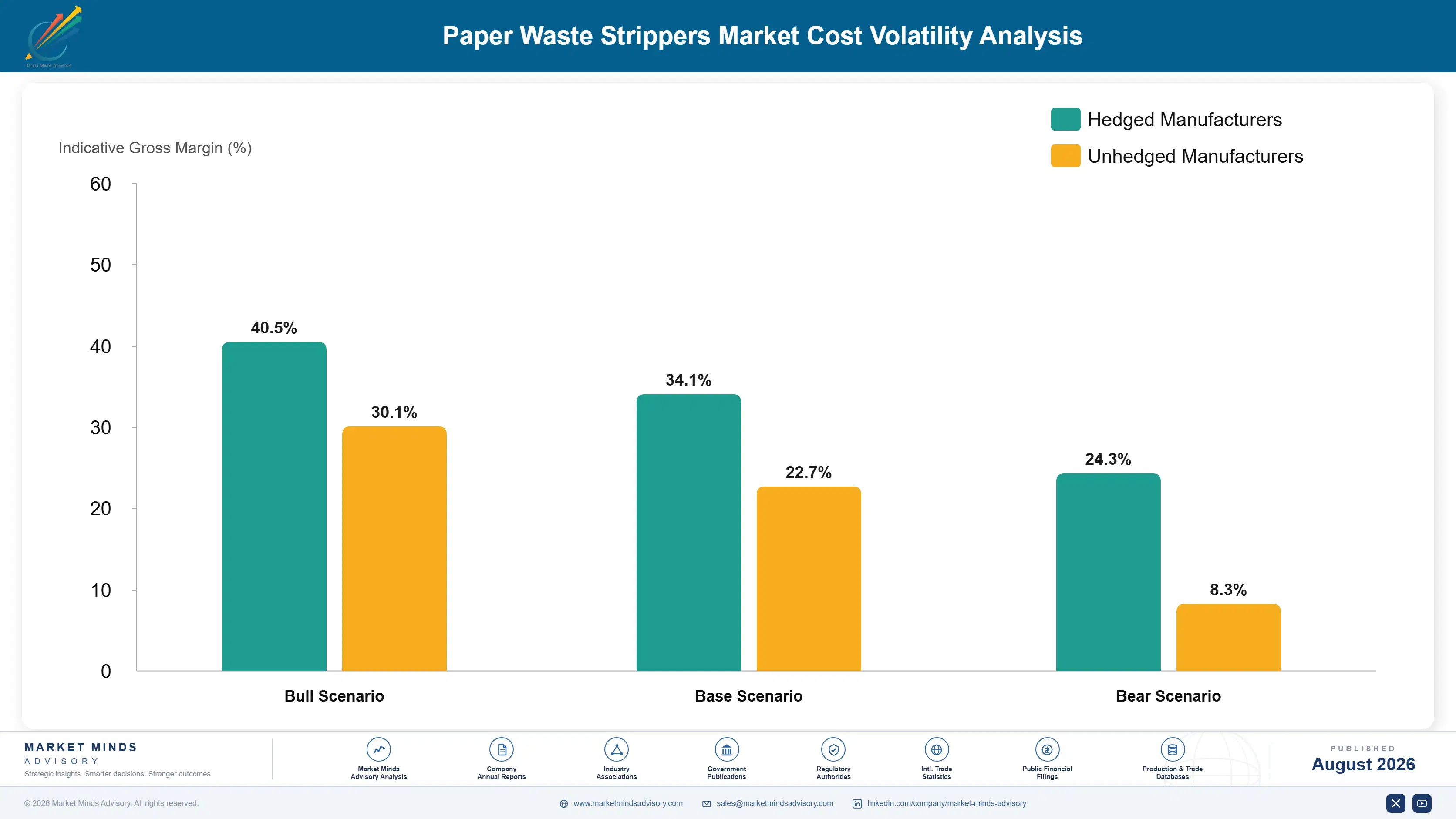
Precision steel fabrication and machined components dominate at roughly 41% of build cost, sourced from European and Asian machining suppliers depending on where the section is assembled. Servo drives, controls, and sensors add about 26%, tooling steel and board material around 14%, and engineering and assembly labour carries the remainder. Tooling material is small on any single sale and recurs constantly.
European steel and energy costs through 2022 and 2023 hit the machined component content hardest, since precision machining is both steel-intensive and electricity-intensive and the work is performed regionally rather than imported. IEA reporting on European industrial electricity prices documented the movement in detail. Builders holding fixed-price order backlogs on presses quoted twelve to eighteen months earlier absorbed the increase entirely, and several reported margin compression on delivered projects through 2023.

The competitive disadvantage mechanism runs through backlog duration rather than through purchasing terms. A builder quoting fixed prices on presses delivering eighteen months out carries every input movement across that period, while a tooling maker quoting forty-eight hour turnaround reprices continuously and carries almost nothing. Exposure also varies by revenue mix: a builder with 38% tooling revenue is materially better protected than one selling machines alone.
paper-waste-strippers-market-cost-volatility-analysis-1787299635718

Attach escalation clauses to long lead-time press orders

A fixed price quoted eighteen months before delivery hands the builder every steel and energy movement across that period, which is a large exposure on precision machined equipment. Escalation clauses tied to published indices move that risk to where it can be absorbed. A builder quoting without one has given away an option for nothing.

Raise the tooling share of total revenue deliberately

Job-specific tooling reprices with every order and carries almost no input cost exposure across time, unlike a press quoted a year and a half before delivery. Builders at 38% tooling revenue absorb steel movements considerably better than those selling machines alone. Growing that share protects margin and is where the recurring revenue sits anyway.

Standardise board blanks and machined modules across the range

Bespoke machining on every section multiplies cost, lengthens lead time, and removes any purchasing scale on precision components. Standardised modules let a builder buy machining in volume and hold stock against incoming orders rather than starting each one from a drawing. Standard board blanks do the same for tooling and are what makes forty-eight hour turnaround possible at all.

Portfolio Architecture for Margin Defence

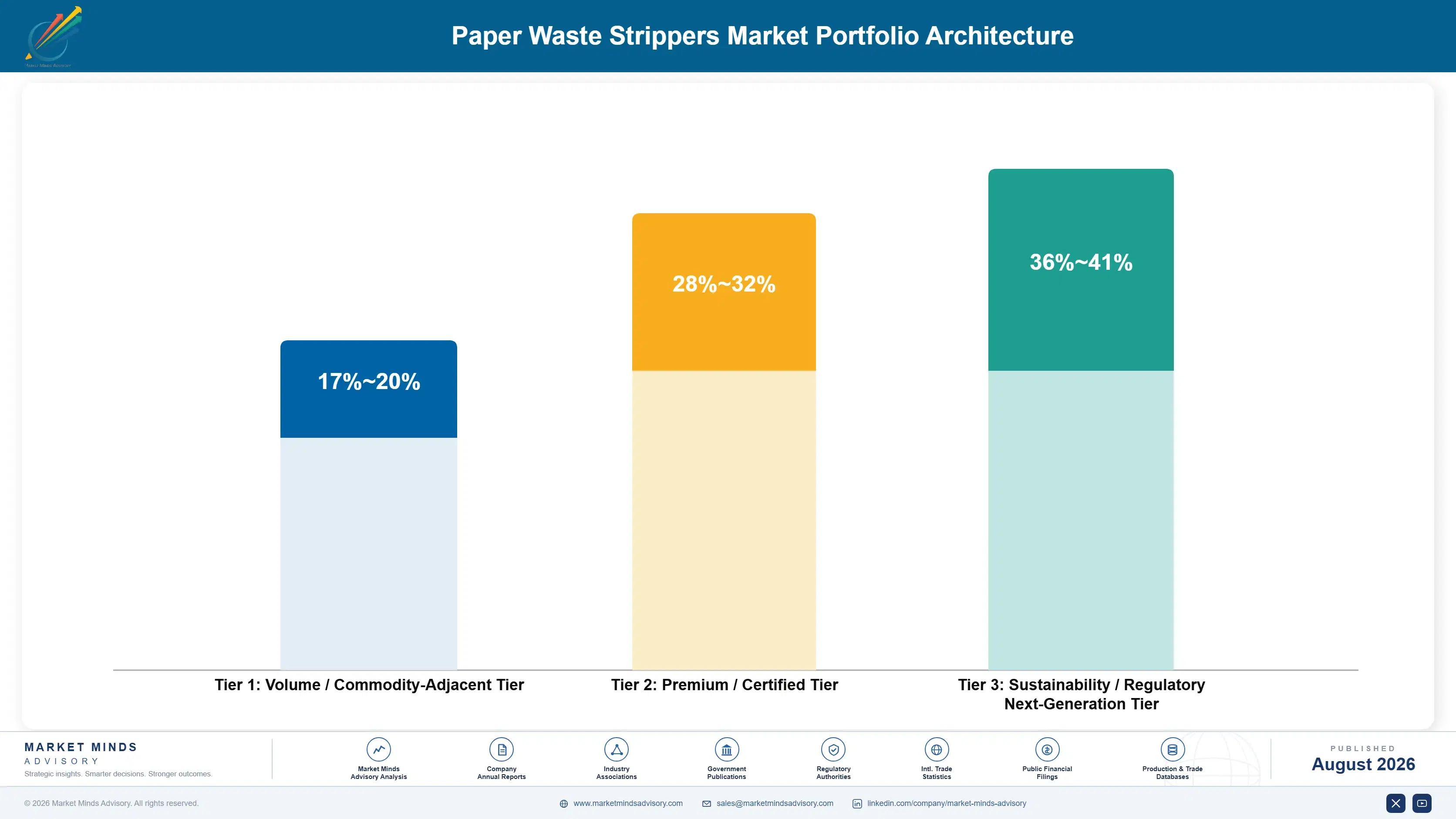
Three tiers describe this business and the spread reflects recurrence rather than complexity. In-line stripping sections sold with a press sit at the bottom, priced inside a larger capital quotation where the buyer negotiates the whole machine rather than the section. Automatic blanking and narrow web matrix systems sit higher on separable technical value. Job-specific tooling occupies a third tier on recurrence and turnaround rather than on engineering content.
The tension is that press-attached sections build the installed base that everything else depends on. A stripping section sold inside a press quotation earns little on its own but places the builder in the plant for twenty years, with tooling and service following. Builders who priced sections aggressively as standalone products found they had margin on individual sales and no presence where the recurring revenue actually lives.

High-value pools concentrate where turnaround matters more than price. A converter with a new design running next week will pay considerably more for stripping boards in forty-eight hours than for the same boards in three weeks, and that willingness does not appear in any published price list anywhere. Builders who never tested it are pricing tooling as though price were the variable.

Volume / Commodity-Adjacent Tier

In-line stripping sections quoted inside a complete die-cutting press order, where the buyer negotiates the whole machine and the section carries little separable value. Thin margin, but it places the builder inside a converting plant for a twenty year replacement cycle.
Gross Margin: 17-20%

Premium / Certified Tier

Automatic blanking units and narrow web matrix stripping systems sold on measurable downstream throughput gain. Margin reflects technical value a buyer can verify during a trial, plus a shorter competitive field than complete press supply attracts.
Gross Margin: 28-32%

Sustainability / Regulatory / Next-Generation Tier

Job-specific stripping tooling supplied on guaranteed short turnaround, plus nick optimisation and upstream diagnostic services. Best margin because recurrence removes capital approval entirely and because turnaround rather than price decides who a converter actually calls.
Gross Margin: 36-41%
paper-waste-strippers-market-portfolio-architecture-1787299636215

High-value Sub-segments and Strategic Watch-out

Job-Specific Stripping Tooling

Best margin and the only genuinely recurring revenue here, growing with design count rather than packaging tonnage as run lengths keep shortening. No capital approval is involved at the customer, and forty-eight hour turnaround commands a premium that appears in no published price list. Very few builders pursue it properly.
Gross Margin: 36-41%

Automatic Blanking Units

Fastest growth at 8.4%, exactly 1.50 times the market rate, and justified by a folder gluer two steps downstream running roughly 34% faster. Builders who instrument a customer's gluer quote a return the buyer can verify independently. Almost nobody collects that evidence before quoting. The argument sits unused.
Gross Margin: 28-32%

Press-Attached Stripping Sections

The volume core at thin margin, negotiated inside a complete press quotation where the section carries almost no separable price of its own. It nonetheless places the builder inside the plant for two decades, which is where all the tooling and service revenue afterward originates.
Gross Margin: 17-20%

Standalone Stripping Stations

The strategic watch-out, sold as the retrofit answer for older presses and handling only a limited format range in practice. As press replacement gradually removes the manual stripping base, the reason this product exists disappears with it rather than transferring elsewhere. Builders weighted here need a different plan already.
Gross Margin: 17-20%

How This Revenue Actually Repeats

Two entirely different revenue rhythms run inside this business. Press-attached stripping sections arrive with a machine bought on a fifteen to twenty year replacement cycle, which means long silences from any individual converting plant no matter how good the relationship is. Job-specific tooling recurs with every new carton design, without capital approval, often weekly. Builders who understood that the second rhythm is the business, and the first merely establishes the right to participate in
Stickiness varies sharply by trade inside the plant. Tooling relationships are the deepest, because a converter under pressure to run a design next week calls whoever delivers in two days rather than tendering. Press-attached sections are locked entirely by the press choice and cannot be won separately. Service and diagnostic relationships sit in between, deep where the builder has proved an upstream fault and shallow where engineers only ever defend their own equipment.

Buyer profiles have shifted toward production management. Technical directors once specified stripping against sheet quality; plant managers now buy against downstream folder gluer throughput and labour availability instead. Finance signs it against folder gluer utilisation rather than against any stripping specification at all.
paper-waste-strippers-market-end-use-penetration-index-1787299636703

What We Would Tell a Board

These are among the four positions where our research anticipates prominent divergence between winners and laggards over the coming forecast period. Each is grounded in the demand model, the regulatory perimeter, and the announced capacity pipeline.
01 / DOWNSTREAM THROUGHPUT EVIDENCE

Sell the folder gluer gain, not stripping quality

Blanking units are almost universally justified on stripping quality, which the buyer already believes is adequate, rather than on the roughly 34% throughput gain a folder gluer two steps downstream actually receives. In a plant where the gluer is the bottleneck that difference is worth several hundred thousand dollars annually and it can be measured during a trial rather than merely asserted in a proposal. Builders who instrument a customer's gluer before and after quote a return the buyer independently verifies, and almost nobody does it.
02 / TOOLING ANNUITY CAPTURE

Every new design is money you either take or lose

A stripping board set costs around 2,800 dollars and is worthless on any other job, so a converter running two hundred new designs a year generates over half a million dollars of tooling demand with no capital approval process involved anywhere. Builders who let independent tooling makers take that work sold one machine and handed away the annuity attached to it entirely. Holding the tooling also keeps engineers inside the plant continuously, which is where the next press order gets shaped years early.
03 / UPSTREAM FAULT DIAGNOSIS

Winning the argument loses you the next order

Around 61% of reported stripping faults trace back to nick count, nick placement, or die board fitting rather than to anything the stripping section itself did during the run. A service engineer who proves that and then works with the die-maker to correct it converts a complaint into the most credible commercial position available in this category. One who defends the equipment instead wins the technical argument and quietly loses the relationship, which costs far more than the diagnostic capability does.
04 / DESIGN COUNT FORECASTING

Tonnage forecasts have understated tooling for a decade

Tooling revenue scales with the number of distinct die layouts a converter runs, and average run lengths have fallen roughly 33% over ten years while packaging tonnage grew far more slowly than that. Builders forecasting tooling from volume have consistently under-predicted demand and under-stocked board blanks accordingly, then blamed the resulting lead times on their production. Tracking customer design introduction rates instead produces a forecast that matches consumption and identifies precisely which accounts are worth a dedicated tooling service arrangement before a competitor works it out.

Engagement Snapshot From the Field

A live engagement with an industry participant carrying material or product regulatory and market exposure ahead of a defining policy shift, showing how our research translates into a defensible multi-year portfolio strategy.
MARKET MINDS ADVISORY · CLIENT ENGAGEMENT SUMMARY
Paper Waste Strippers Producer Strategic Portfolio Review and Transition Roadmap 2026·Investment Scenario on Paper Waste Strippers Exposure Evaluation 2025-26
CLIENT PROFILE
A European converting machinery builder with approximately 180 million dollars in annual revenue (client-reported, unverified by MMA), supplying die-cutting presses with in-line stripping and blanking sections to folding carton converters across Europe and the Middle East. Tooling accounted for a small fraction of revenue, service was run inside engineering, and blanking units were quoted on stripping quality alone.
STRATEGIC CHALLENGE
Blanking unit attachment rate on new press orders had stalled below a third while competitors reported considerably higher figures. Management attributed the gap to price and proposed discounting blanking sections inside press quotations. The board wanted an independent view on whether price was genuinely the obstacle before approving a margin reduction across the range.
MMA APPROACH
We reviewed thirty-eight press tenders where blanking was declined, tracing what the buyer was told and what they eventually decided. Folder gluer throughput was measured at six customer sites running with and without automated blanking. Tooling revenue leakage to independent makers was quantified across the installed base, and every service call logged as a stripping fault over two years was reclassified by actual root cause.
KEY FINDINGS
  1. Price was decisive in only nine of the thirty-eight declined tenders; in most others the buyer had never been shown any quantified downstream benefit at all.
  2. Measured folder gluer throughput at the six sites averaged 34% higher with automated blanking, a figure the client had never collected or used in any proposal.
  3. Independent tooling makers supplied an estimated 71% of stripping boards across the client's own installed base, revenue the builder had never systematically pursued.
  4. Reclassified service calls showed 61% of reported stripping faults originated in nick design or die board fitting rather than in the client's equipment at all.
CLIENT PROFILE
A European converting machinery builder with approximately 180 million dollars in annual revenue (client-reported, unverified by MMA), supplying die-cutting presses with in-line stripping and blanking sections to folding carton converters across Europe and the Middle East. Tooling accounted for a small fraction of revenue, service was run inside engineering, and blanking units were quoted on stripping quality alone.
STRATEGIC CHALLENGE
Blanking unit attachment rate on new press orders had stalled below a third while competitors reported considerably higher figures. Management attributed the gap to price and proposed discounting blanking sections inside press quotations. The board wanted an independent view on whether price was genuinely the obstacle before approving a margin reduction across the range.
MMA APPROACH
We reviewed thirty-eight press tenders where blanking was declined, tracing what the buyer was told and what they eventually decided. Folder gluer throughput was measured at six customer sites running with and without automated blanking. Tooling revenue leakage to independent makers was quantified across the installed base, and every service call logged as a stripping fault over two years was reclassified by actual root cause.
KEY FINDINGS
  1. Price was decisive in only nine of the thirty-eight declined tenders; in most others the buyer had never been shown any quantified downstream benefit at all.
  2. Measured folder gluer throughput at the six sites averaged 34% higher with automated blanking, a figure the client had never collected or used in any proposal.
  3. Independent tooling makers supplied an estimated 71% of stripping boards across the client's own installed base, revenue the builder had never systematically pursued.
  4. Reclassified service calls showed 61% of reported stripping faults originated in nick design or die board fitting rather than in the client's equipment at all.
RECOMMENDED STRATEGY
Phase 1: Phase 1 (months one to six): cancel the discount proposal and instrument customer folder gluers to build verifiable throughput evidence for every blanking quotation. Phase 2: Phase 2 (months six to twenty): launch a tooling business with guaranteed short turnaround and pursue board supply across the existing installed base. Phase 3: Phase 3 (months twenty to thirty-six): train service engineers in upstream nick diagnosis and offer die-maker collaboration as a standard service.
OUTCOME
The discount was cancelled. Blanking attachment rate rose above half within four quarters on measured throughput evidence, tooling revenue grew from a small base to a meaningful share of the total, and repeat service calls on stripping faults fell sharply once upstream causes were addressed (client-reported, unverified by MMA).

Frequently Asked Questions

Foundational context covering the market sizes, CAGR, scope, country, region and competition that inform every finding below. This section is provided to cover basics and most often pre-purchase conversations, answered from the MMA Primary Research Dataset.

What is the current size of the Paper Waste Strippers Market?

The market is valued at USD 1.86 billion in 2025, rising to USD 1.96 billion in 2026. Scope covers stripping and blanking equipment together with the job-specific tooling it consumes.

How large will the Paper Waste Strippers Market be by 2036?

MMA forecasts USD 3.39 billion by 2036, an increase of USD 1.43 billion over the 2026 base. That represents an expansion multiple of 1.73 times across the forecast period.

What is the CAGR for the Paper Waste Strippers Market 2026 to 2036?

The base case CAGR is 5.6%, with a bull case of 6.8% and a bear case of 4.4%. The historical rate from 2020 to 2025 was 4.6%, so growth is accelerating modestly.

Which segment is growing fastest?

Automatic blanking units at 8.4%, exactly 1.50 times the market rate. They are justified by a folder gluer two steps downstream running roughly 34% faster on squarely stacked blanks.

Who are the major companies in the Paper Waste Strippers Market?

Bobst, Heidelberger Druckmaschinen, Koenig & Bauer, Masterwork Group, and Iberica AG lead on annual units shipped. The top five hold 46%, with tooling specialists competing for the same wallet.

Which country is growing fastest?

India at 8.6%, driven by pharmaceutical carton production where each dosage strength and export market is a distinct design. Tooling demand there rises far faster than packaging tonnage does.

Report Segmentation Architecture

The full report scope spans multiple orthogonal segmentation dimensions, with cross-tabulated demand data provided for each dimension pair. Coverage extends further to regional breakdowns, trend trajectories, and the competitive detail needed to support segment-level decision-making.

By Waste Removal Method

  • In-Line Stripping Sections
  • Job-Specific Stripping Tools And Boards
  • Automatic Blanking Units
  • Narrow Web Matrix Stripping And Rewind
  • Standalone Stripping Stations
  • Waste Extraction And Conveying Systems

By End-Use Industry

  • Pharmaceutical And Healthcare Cartons
  • Food And Beverage Folding Cartons
  • Cosmetics And Luxury Packaging
  • Corrugated Shipping And Retail-Ready
  • Pressure Sensitive Label Converting

By Sales Model

  • Sections Quoted Within Complete Press Orders
  • Standalone Equipment Sales
  • Job-Specific Tooling Supply Arrangements
  • Service And Diagnostic Contracts
  • Distributor And Agent Networks

By Region

  • East Asia
  • Western Europe
  • North America
  • South Asia and Pacific
  • Latin America
  • Eastern Europe
  • Middle East and Africa

Scope, Methodology, and Coverage

Every figure in this report is reproducible from documented input assumptions. The scope below maps the historical period, the forecast horizon, the segmentation dimensions, and the countries covered, alongside the underlying primary and qualitative methodology.
Historical Period
2020 to 2025
Forecast Period
2026 to 2036
Base Year
2025 (USD billions; MMA Primary Research Dataset, August 2026)
Market Definition
This market comprises equipment and job-specific tooling used to remove waste material from die-cut sheets and webs in folding carton, corrugated, and pressure sensitive label converting, measured at builder realised prices. Method coverage spans in-line stripping sections within flatbed and rotary die-cutting presses, job-specific stripping tools and boards, automatic blanking units, narrow web matrix stripping and rewind systems, standalone stripping stations, and waste extraction and conveying equipment. Die-cutting presses themselves, cutting dies and steel rule, folder gluers, printing presses, sheet feeders and deliveries, and waste baling equipment fall outside scope.
Quantitative Units
USD billions (current prices); units shipped per year; tooling sets consumed annually; realised price per section
Segmentation Dimensions
By Waste Removal Method; By End-Use Industry; By Sales Model; By Region
Regions Covered
East Asia, Western Europe, North America, South Asia and Pacific, Latin America, Eastern Europe, Middle East and Africa
Countries Covered
China, Japan, South Korea, Taiwan, India, Vietnam, Thailand, Indonesia, Australia, Germany, Switzerland, Italy, Spain, France, UK, Netherlands, Belgium, Sweden, Poland, Czechia, Hungary, Romania, Turkey, USA, Canada, Mexico, Brazil, Argentina, Saudi Arabia, UAE, Egypt, South Africa, and additional markets relevant to this sector
Key Companies Profiled
Bobst, Heidelberger Druckmaschinen, Koenig & Bauer, Masterwork Group, Iberica AG, Duran Machinery, Brausse Group, Eterna Machinery, Sanwa Machinery, Asahi Machinery, Yoco Printing Machinery, Shanghai Yawa, Marbach, Wilson Manufacturing, Kocher+Beck, Electro Optic, Grafisk Maskinfabrik, Rotocontrol, Höcker Polytechnik, Nestro
Quantitative Methodology
Primary survey, n=3,800 respondents, Q4 2025, six countries; demand-side model with trade association cross-validation
Qualitative Methodology
47 expert interviews, Q4 2025; applied to validate demand model assumptions, identify emerging dynamics, and assess competitive positioning
Report Format
PDF and XLSX data workbook (Word format preview document)
Publisher
Market Minds Advisory
Report Code
MMA-2026-CON-406
Published
August 2026
Contact
sales@marketmindsadvisory.com | www.marketmindsadvisory.com

Purchase the full Paper Waste Strippers Market Report (2026 to 2036).

The full report sizes paper waste stripping equipment and tooling across six removal methods, five end-use industries, five sales models, and seven regions, with country detail for the thirty largest converting markets. Manual stripping penetration is quantified by country and plant scale, since that population defines the conversion opportunity remaining. Stripping fault root causes are analysed across service records to separate equipment failure from upstream nick and die board issues. Competitive profiling covers twenty companies on annual units shipped. Tooling consumption is modelled against design introduction rates rather than packaging tonnage.
Manual stripping penetration quantified by country and plant
Stripping fault root causes separated from equipment failure
Tooling consumption modelled against design introduction rates
Folder gluer throughput gains measured across blanking installations
Retrofit economics assessed against press replacement cycles
Tooling turnaround benchmarks compared across supplier types

Built For The People Who Decide

From boardroom strategy to bench-side execution, this report is read cover-to-cover by leaders shaping the next decade of their industry, turning demand scenarios, market dynamics and valuation benchmarks into decisions.
CXOs/ Presidents/ VPs/ Managers
M&A and Corporate Development
Strategy Teams and R&D Heads
Procurement and Product Directors
Regulatory and Compliance Leaders
Investor Relations and Equity Analysts