Market Minds Advisory
Paper Napkin Making Machine Market

Paper Napkin Making Machine Market: Servo Automation and Changeover Speed Redefine Converting Equipment Investment

Servo-driven automation is displacing mechanical napkin lines as foodservice chains demand faster changeovers, embossed variety, and private-label print runs, forcing converting equipment builders to justify capital cost against measurable uptime and web efficiency gains.

Lead Analyst

Bilal Shaikh

Published

September 2026

Make Smarter Decisions with Customized Research Insights

Request a free sample report and evaluate market opportunities, growth trends, and competitive dynamics relevant to your business needs.

2025 MARKET VALUE$1.4BMarket Size 2025
2036 FORECAST VALUE$2.8BBase Case , 2026 to 2036
CAGR 2026 TO 20366.4 %Bull 7.7% / Bear 5.1%
INCREMENTAL OPPORTUNITY$1.3BNet 10- year value creation
EXPANSION MULTIPLE1.86x2036 value over 2026 base
Strategic Levers
M&A Pipeline
Regional Outlook
Country Rankings
Competitive Intelligence
Segmental Deep-dive
Call-Us : 91 93563 13602

Executive Snapshot and Market Trajectory

Foodservice chains and quick-service restaurant operators are pushing napkin converters toward higher-speed servo-driven lines as embossed and printed napkin demand climbs, forcing machine builders to prove changeover speed and web efficiency against older mechanical platforms across every production shift this year and the next production planning cycle.
Demand concentrates among mid-sized regional converters replacing mechanical lines nearing end of service life, while private-label foodservice brands push shorter, more frequent print runs that only servo-controlled platforms handle economically. East Asia anchors global machine consumption on China's converting base, while embossing and printing integrated lines post the second-fastest segment growth behind fully automatic servo platforms, as digital print modules let converters accept smaller custom orders profitably without a full new production line.
Competition splits between a handful of Italian and North American builders supplying complete servo-driven lines and a wider field of regional manufacturers selling mechanical and semi-automatic machines at lower price points. Recycled-fiber handling requirements and tightening workplace safety rules are reshaping specification sheets, rewarding builders that can document runnability on recycled furnish and prove compliance with current machine guarding standards across every export market served.
Market Definition
The paper napkin making machine market covers automated and semi-automated equipment that converts base tissue paper into folded, embossed, and printed napkins, including unwinding, embossing, folding, cutting, and packaging modules sold as integrated production lines. It excludes base tissue paper itself, finished napkin products sold to consumers, and non-napkin converting equipment such as toilet roll or facial tissue lines sold as standalone systems.
Base Year Value
$1.4B in 2025 (MMA Primary Research Dataset, August 2026)
Forecast Period
2026 to 2036, eleven discrete annual values
CAGR
6.4% base case. Bull 7.7%. Bear 5.1%.
Fastest Growth Segment
Servo-Driven Automatic Napkin Machines: 10.2% CAGR
Fastest Growth Country
India: 9.4% CAGR
Fastest Growth Region
South Asia and Pacific: 8.4% CAGR
Largest Region
East Asia: 30% of 2025 global value
Market Leaders
PCMC, Fabio Perini S.p.A., A.Celli Group, Gambini Group, C.G. Bretting Manufacturing Company, Inc. Source: MMA Analysis based on company annual reports.
Primary Survey
n=3,800 procurement and R&D decision-makers, Q4 2025, six countries
Methodology
Demand-side build-up, cross-validated against public data, 47 expert interviews

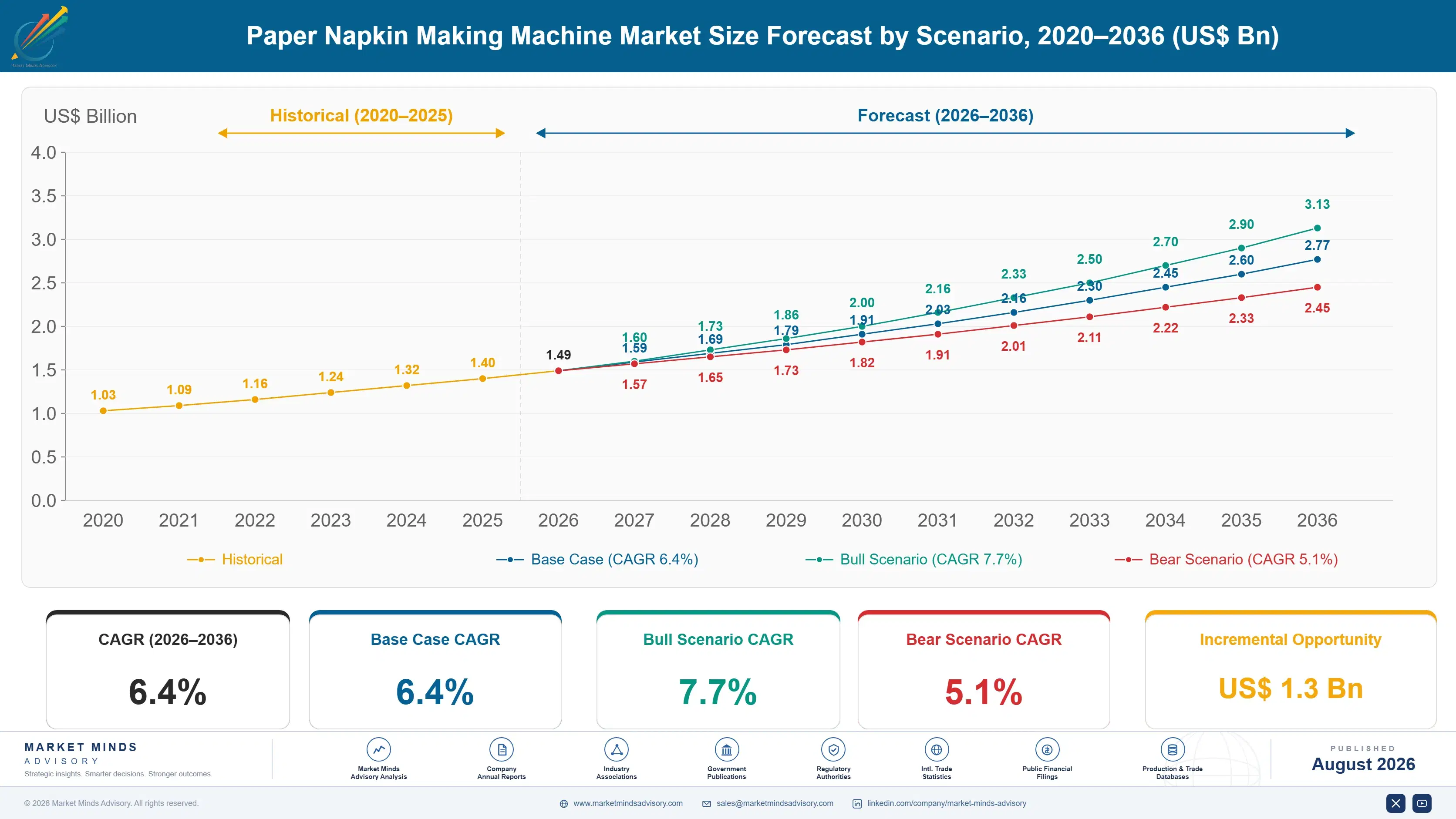
Paper Napkin Making Machine Market Forecast Scenarios

paper-napkin-making-machine-market-size-forecast-scenario-1787299675556
Machine demand grew steadily between 2020 and 2025 as foodservice reopening after pandemic disruption drove a wave of replacement orders, with the historical CAGR near 5.4% reflecting cautious capital spending among small and mid-sized converters through that period, followed by a sharper automation-linked upturn from 2023 onward as labor shortages pushed more operators toward servo platforms than previously planned.
The base case assumes continued servo-line conversion as three mechanisms compound: quick-service chains standardizing embossed napkin specifications across franchise networks, recycled-fiber handling rules forcing retrofit or replacement of older mechanical platforms, and private-label print demand rewarding builders offering integrated digital print modules. Together these push machine builders toward higher average selling prices and shorter order-to-delivery cycles across most regional markets, reinforcing servo platforms as the default specification most converters now expect.
A bull scenario assumes faster-than-expected quick-service restaurant unit expansion across South and Southeast Asia pulling forward machine orders ahead of schedule and lifting servo attach rates faster than currently modeled. The bear case centers on steel and servo component cost inflation squeezing converter capital budgets, delaying automation upgrades and extending replacement cycles for aging mechanical lines beyond their currently projected service horizon across most price-sensitive regional markets.

Automation Economics and Converting Capacity Dynamics

Napkin converting economics increasingly hinge on changeover speed rather than raw output, as foodservice buyers demand more embossing patterns and shorter production runs than mechanical lines built a decade ago were ever designed to handle. Servo control now separates competitive builders from those still selling purely mechanical platforms into price-sensitive regional markets, and that gap is widening each year as buyers grow more comfortable specifying automated equipment outright.
MARKET CONCENTRATIONCR5 32%top five machine builders hold a moderate combined share
AVERAGE MACHINE PRICE PREMIUM35-55% for servo linesfully automatic servo platforms command a meaningful premium
TOP PRODUCING COUNTRY SHAREItaly 24%leading share of global napkin machine manufacturing output
INSTALLED BASE UTILISATION68-79%converting lines running below theoretical maximum annual capacity
TRADE INTENSITY58%share of finished machines shipped across an international border
REPLACEMENT CYCLE LENGTH12-15 yearstypical operating life before converters consider full replacement
Commercial activity concentrates around retrofit and replacement decisions rather than greenfield capacity, since global napkin demand growth is steady rather than explosive. Converters weigh total cost of ownership against labor savings, with faster changeovers increasingly justifying servo premiums even for mid-sized regional operators previously locked into mechanical platforms by upfront cost alone, particularly once financing options spread that cost across a longer repayment horizon.
Recycled-fiber compatibility, digital print integration, and remote diagnostics are reshaping specification sheets for the next decade, pushing builders toward modular platforms converters can upgrade incrementally rather than replace outright. Builders slow to offer this modularity risk losing accounts to competitors already selling it as a standard feature rather than a costly custom option.
"The napkin machine buyers we survey no longer ask how fast a line runs. They ask how quickly it can switch patterns, because that is where the margin actually sits now."
Director, Industrial Equipment Practice · MMA Industrial Equipment / Paper Conve

Market Trends

Servo-Driven Automation Displaces Mechanical Napkin Lines

Machine builders are replacing cam-driven mechanical folding sections with servo-controlled modules that cut changeover time between embossing patterns from roughly ninety minutes to under thirty on new platforms. This shift lets converters run shorter, more frequent orders profitably as foodservice buyers request seasonal and private-label designs more often than mechanical platforms were ever built to accommodate. Component suppliers in Germany and Japan are expanding servo motor and drive production specifically for converting equipment applications, signaling sustained demand from machine builders retooling legacy product lines across their core export markets this planning cycle.
Market Impact: Adds 40,000 new QSR units yearly
Digital Print Modules Enable Smaller Private-Label Runs

Inline digital print attachments now let converters accept custom foodservice orders below five thousand units profitably, a threshold that previously required flexographic plate changes too costly for small orders. Regional foodservice chains and hotel groups increasingly specify branded napkins as a marketing line item rather than a commodity purchase, pushing converters to add print modules to existing servo platforms rather than buy entirely new lines. Machine builders report rising retrofit attachment orders from converters that installed base servo platforms within the past five years and now want print capability without a full line replacement.
Market Impact: Adds 12-18% retrofit capex per line

Market Opportunities and Growth Drivers

Quick-Service Restaurant Expansion Lifts Embossed Napkin Demand

US Census Bureau data tracking foodservice establishment counts shows continued net expansion of quick-service restaurant units across major metropolitan markets, each new location requiring a standardized embossed napkin specification tied to brand guidelines. Franchise operators increasingly centralize napkin procurement, concentrating machine builder attention on converters large enough to guarantee consistent embossing quality across every regional distribution center a chain operates. This concentration favors servo-equipped converters able to replicate identical patterns across multiple production lines without manual recalibration between shifts, widening the gap against smaller mechanical-only competitors unable to guarantee the same consistency across every regional facility.
Market Impact: Adds 3-5 year payback period

Recycled Fiber Handling Rules Push Machine Retrofits

European Commission packaging waste rules requiring higher recycled content in disposable paper products are forcing converters to retrofit tension control and web-break detection systems, since recycled furnish runs less predictably than virgin fiber on older mechanical platforms. Machine builders report rising demand for retrofit kits bundling upgraded sensors and servo tension control specifically engineered for recycled-fiber runnability, rather than full line replacement. Converters unable to demonstrate recycled-content compliance risk losing contracts with foodservice chains now specifying recycled napkins as a standard procurement requirement across their European supply base and annual vendor audits.
Market Impact: Adds 18-30 hours downtime per fault

Market Restraints and Challenges

High Capital Cost Slows Small Converter Automation

Servo-driven lines cost thirty five to fifty five percent more than comparable mechanical platforms, a gap rooted in servo motor, drive, and control system pricing that has not fallen as quickly as buyers expected. Small and regional converters operating on thin margins often delay automation for years, continuing to run older mechanical lines past their optimal replacement window and ceding faster-turnaround orders to better-capitalized competitors. Several machine builders now offer leasing and staged financing programs, and some are introducing partial retrofit kits that let converters add servo control to individual line sections instead of buying an entirely new platform outright.
Market Impact: Cuts changeover time 65%

Skilled Technician Shortage Limits Line Uptime

The rapid shift from mechanical to servo-electronic control has outpaced available mechatronics training capacity, leaving many converters without in-house staff qualified to diagnose drive faults or recalibrate embossing registration quickly. Unplanned downtime on servo lines often runs longer than on simpler mechanical equipment precisely because fewer technicians understand the control architecture well enough to isolate faults without vendor support. Machine builders are responding with remote diagnostics platforms and expanded technician certification programs, though rollout remains uneven across smaller regional service networks still building out qualified coverage fast enough to keep pace with installed base growth.
Market Impact: Enables runs below 5,000 units
3 additional market trends, 3 additional growth drivers, and 2 additional restraints and challenges are covered in the full report. Contact sales@marketmindsadvisory.com to access the complete intelligence.

Segment CAGR and Growth Architecture

Segmentation follows machine automation level and functional configuration because production speed, changeover flexibility, and capital intensity differ substantially between servo-driven, semi-automatic, and mechanical platforms, each carrying its own distinct maintenance profile and total cost of ownership shaped by production volume, labor cost, and the converter's own capital budgeting cycle and annual specification review process.
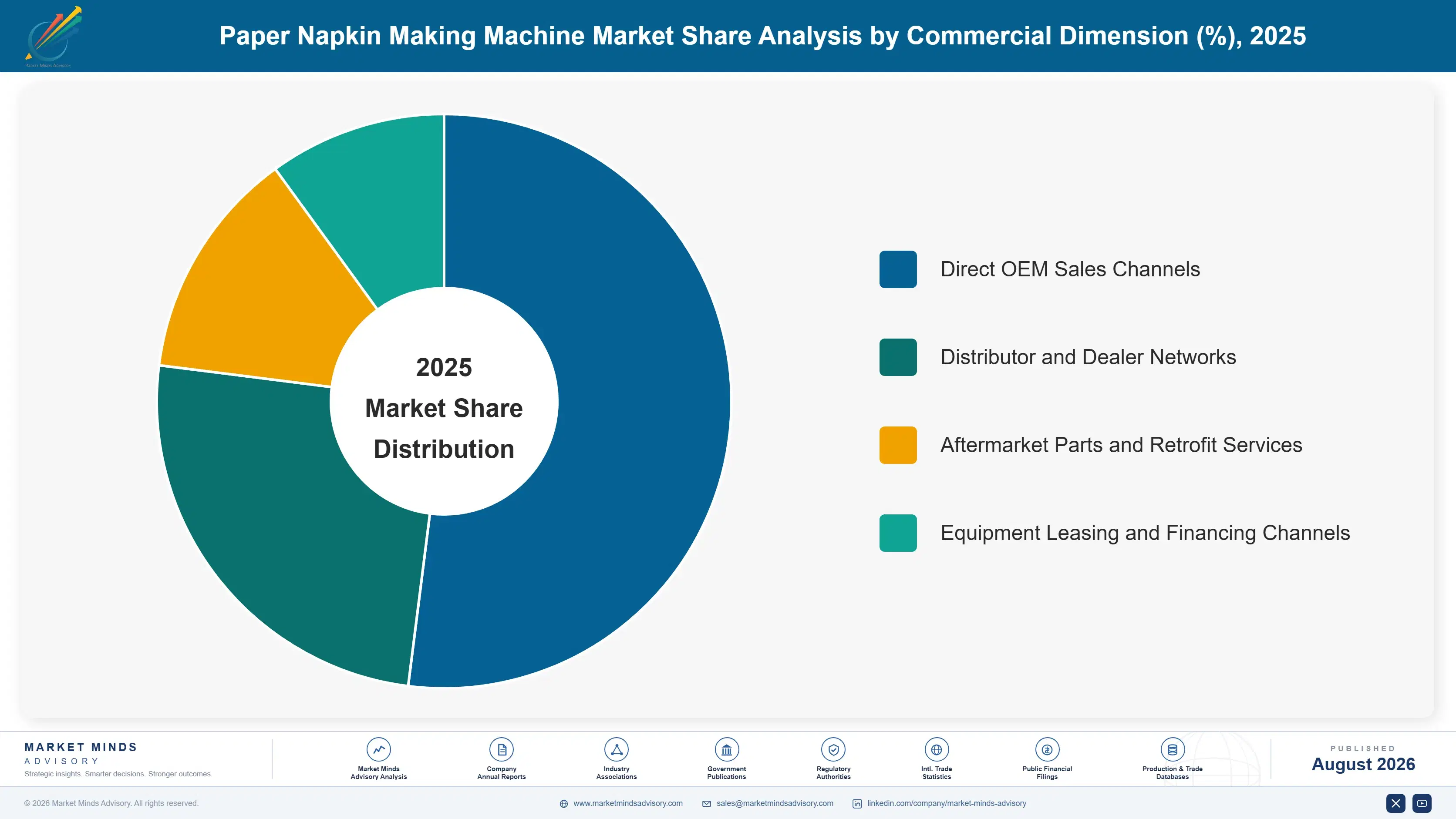
paper-napkin-making-machine-market-market-share-analysis-1787299676125

Servo-Driven Automatic Napkin Machines

Fully automatic servo platforms lead growth as foodservice chains demand faster pattern changeovers and tighter registration tolerance than mechanical lines can deliver consistently. These machines integrate programmable logic controllers governing unwind tension, embossing depth, and fold sequencing, letting a single operator run production that once required a full mechanical line crew. Converters serving multiple foodservice brands from one facility increasingly standardize on servo platforms specifically because pattern changeovers happen through software recall rather than physical tooling swaps. Machine builders report servo platforms now account for the majority of new orders placed by converters with more than two production lines, while smaller single-line operators remain the primary holdouts still weighing the capital premium against measured labor savings.
CAGR 10.2%

Embossing and Printing Integrated Lines

Lines combining embossing and inline digital or flexographic printing post the second-fastest growth as private-label branding shifts from a premium add-on to a standard specification among mid-sized foodservice chains. Converters adding print capability capture higher per-unit pricing than plain embossed output, improving margin without requiring a full new production line when print modules retrofit onto existing servo platforms. Hotel groups and catering operators increasingly specify branded napkins tied to seasonal promotions, favoring converters able to accept shorter runs profitably. Machine builders selling integrated embossing-print lines report the fastest order backlog growth among mid-tier converters expanding beyond commodity plain-white output, positioning this category just behind fully automatic servo platforms in overall segment expansion through the current forecast horizon.
CAGR 8.8%
Full segment breakdown across 6 segments available in the complete report.

Regional Architecture and Country Demand Map

East Asia leads on China's converting manufacturing base and domestic foodservice scale, while South Asia and Pacific grows fastest as India's organized quick-service sector expands and domestic machinery incentives lift local production investment across new export-linked industrial zones nationwide, drawing capacity away from established Italian and North American suppliers.

North America

Replacement demand dominates North American machine orders as converters retire mechanical lines installed in the early 2000s, favoring servo platforms that cut labor cost amid persistently tight warehouse and manufacturing staffing. Quick-service chains headquartered in the region increasingly centralize napkin procurement across franchise networks, pushing converters toward machines capable of running multiple brand-specific embossing patterns without lengthy manual changeovers. US Census Bureau data confirms continued net foodservice establishment growth, sustaining steady embossed napkin volume even as overall population growth moderates. Reshoring of converting capacity previously outsourced to lower-cost regions has added incremental machine orders from operators seeking shorter, more reliable domestic supply chains for foodservice paper goods, particularly among converters serving federal and institutional contract accounts.
Share: 24% | CAGR: 7.2% (2026 to 2036)

Western Europe

Italy's Lucca converting cluster anchors regional machine manufacturing, supplying servo-driven lines to converters across the continent and to export customers worldwide from a concentration of specialized engineering suppliers built up over decades. European Commission packaging waste rules requiring higher recycled fiber content are forcing retrofit investment across the installed base, since recycled furnish runs less predictably on older mechanical platforms than the virgin fiber those machines were originally engineered around. German and French converters are consolidating production into fewer, more automated facilities as labor costs climb, favoring higher-throughput servo lines over adding mechanical capacity. Growth trails other regions as replacement cycles lengthen amid mature per-capita napkin consumption already near saturation.
Share: 19% | CAGR: 4.9% (2026 to 2036)
Regional intelligence for 5 additional markets available in the complete report: East Asia, South Asia and Pacific, Latin America, Middle East and Africa, Eastern Europe. Contact sales@marketmindsadvisory.com.
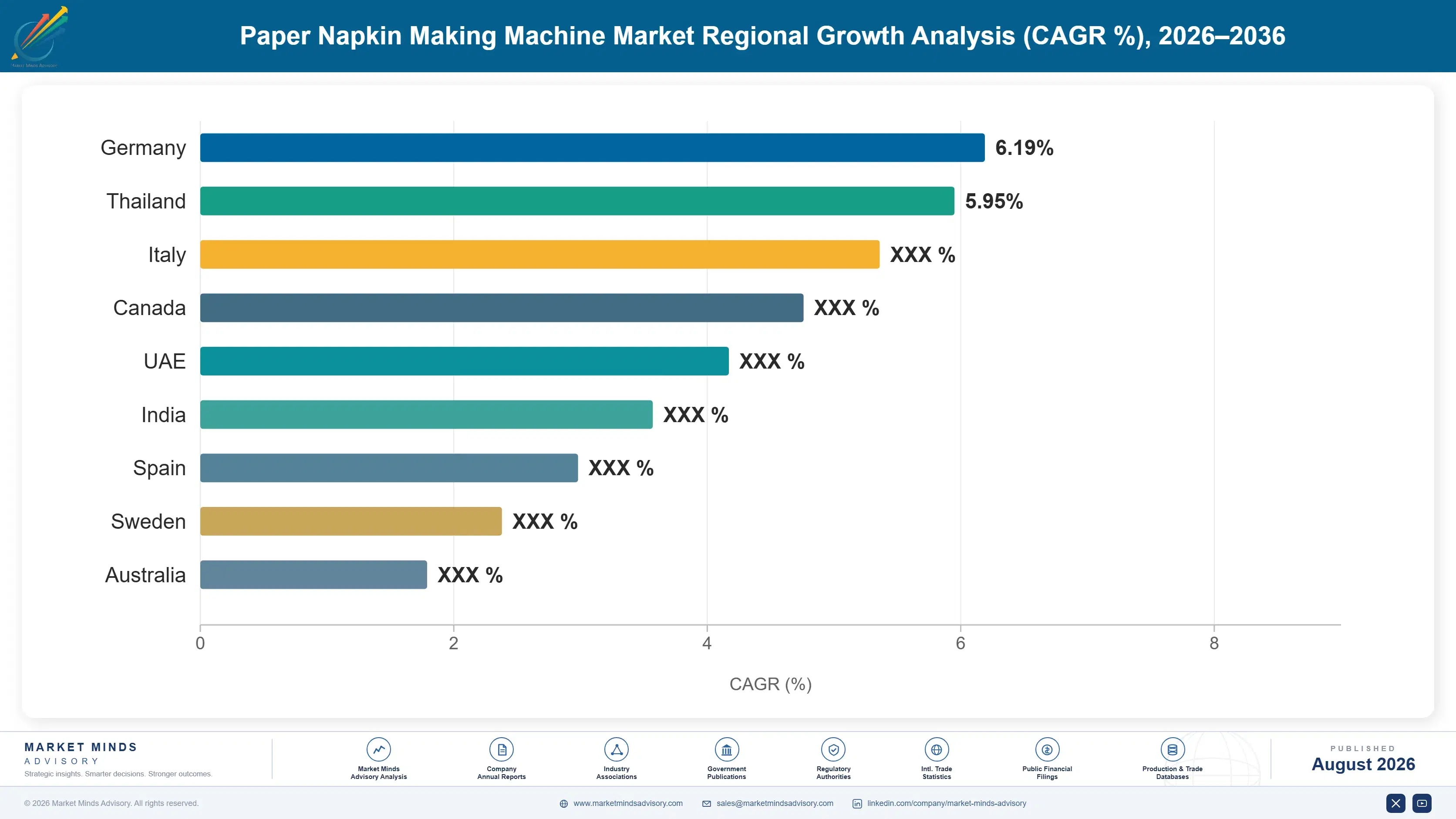
paper-napkin-making-machine-market-country-cagr-analysis-1787299676637

Where Machine Builders Capture Margin Beyond Equipment Sale

Equipment sale margins are compressing as servo components commoditize, pushing builders toward service, retrofit, and financing revenue that scales with the installed base rather than new machine shipments alone, particularly among converters extending platform life through incremental upgrades instead of full replacement across their existing production footprint and multi-year capital plans reviewed each budgeting cycle.

Bundle Predictive Maintenance and Service Contracts

Machine builders offering remote monitoring and predictive maintenance contracts capture recurring revenue that persists well beyond the initial equipment sale, typically pricing service bundles at 8 to 12 percent of original machine value annually. Converters increasingly accept these contracts given the technician shortage limiting in-house diagnostic capability, particularly for servo-driven platforms requiring specialized fault isolation. Builders with established regional service networks can price these contracts at a premium over independent third-party maintenance providers, since only original equipment manufacturers hold complete control system documentation and calibration data across the full installed platform range.
Market Impact: Adds 8-12% annual recurring service contract revenue stream

Offer Modular Servo Retrofit Kits for Legacy Lines

Retrofit kits that add servo control to specific mechanical line sections let converters upgrade incrementally without full replacement capital, typically pricing at 20 to 30 percent of a comparable new machine while extending platform service life by roughly a decade. This approach captures revenue from converters otherwise locked out of automation by capital constraints, expanding the addressable base beyond greenfield and full-replacement buyers alone. Builders offering standardized retrofit modules across multiple legacy platform generations reduce engineering cost per installation, improving retrofit margin relative to bespoke one-off upgrade projects handled through custom engineering quotes each time.
Market Impact: Extends line service life by roughly 10 years

Expand Digital Print Module Attachment Sales

Inline digital print attachments sold as an add-on to existing servo platforms capture incremental revenue from converters chasing private-label foodservice orders without requiring a full new production line. Attachment pricing typically runs 15 to 25 percent of base machine cost, and builders report rising attach rates among converters that installed servo platforms within the past five years and now want print capability. This lever converts an existing installed base into a secondary sales channel, since print module retrofits require far less engineering customization than a comparable new line purchase entirely from scratch.
Market Impact: Adds 15-25% incremental unit revenue per machine sold

Provide Equipment Financing and Leasing Programs

Builders offering direct financing or leasing programs win orders from smaller converters otherwise deterred by servo platform capital cost, typically structuring terms across 5 to 7 years aligned with the equipment's expected payback period. This approach expands the addressable buyer base to include regional converters that would otherwise delay automation indefinitely, converting a one-time capital sale into a longer commercial relationship spanning financing, service, and eventual replacement. Builders with captive financing arms report meaningfully higher close rates among small and mid-sized converters weighing servo platforms against continued mechanical operation and rising labor costs.
Market Impact: Expands addressable buyer base by 20-30% among smaller converters

Who Controls the Margin Pool

The top five machine builders hold roughly thirty two percent combined share on an installed base and annual shipment revenue basis, leaving a wide field of regional manufacturers competing for mechanical and semi-automatic orders below the servo price tier. The gap between leading builders and mid-tier challengers centers on servo engineering depth and global service network reach rather than raw manufacturing scale or plant footprint alone.
Current competitive activity concentrates on three fronts: digital print module integration, recycled-fiber runnability certification, and expanding remote diagnostics coverage to reduce technician-driven downtime. Builders are also racing to standardize control architecture across platform generations, letting converters run mixed-vintage lines through a single operator interface rather than separate proprietary systems tied to each individual machine generation.

Emerging pressure comes from Chinese domestic builders improving servo engineering quality fast enough to challenge Italian suppliers on mid-tier automated platforms, previously an uncontested European stronghold. Indian machine builders backed by domestic manufacturing incentives are also gaining share in South Asian and African export markets, positioning them to challenge established players on price for semi-automatic and entry servo platforms within the next several forecast years and across several adjacent product categories.
paper-napkin-making-machine-market-company-positioning-matrix-1787299677155

Competitive Moat and Risk Dimensions

PCMC

Moat: Deep North American service network

PCMC's established North American technician and parts distribution network lets it guarantee faster response times than smaller regional competitors, a critical differentiator given the technician shortage limiting converter in-house diagnostic capability. Its long operating history with major foodservice-linked converters supports repeat platform orders as those customers expand capacity across multiple facilities nationwide.
PCMC

Risk: Limited exposure outside North America

PCMC's revenue concentration in North America leaves it more exposed to regional foodservice capital spending cycles than competitors with broader international service footprints spanning Europe and Asia. Slower North American replacement demand during a capital spending pullback would weigh more heavily on PCMC than on geographically diversified rivals able to offset softness with orders from faster growing regions.
FABIO PERINI S.P.A.

Moat: Servo engineering and patent depth

Fabio Perini's sustained servo control and embossing registration research under Körber's tissue business area gives it genuine engineering depth that smaller competitors struggle to replicate, supporting premium positioning across converters requiring the tightest pattern registration tolerances. Decades of accumulated patent filings around embossing and folding mechanisms reinforce this technical leadership across export markets worldwide.
FABIO PERINI S.P.A.

Risk: Premium pricing limits volume reach

Fabio Perini's premium pricing positions it poorly against Chinese and Indian builders competing aggressively on mechanical and entry-level semi-automatic platforms, ceding volume-tier orders to lower-cost regional competitors. This leaves growth more dependent on servo and fully automated segment expansion than on overall unit volume growth across the broader machine population worldwide.

Players Tracked

Prominent Players

PCMC
Fabio Perini S.p.A.
A.Celli Group
Gambini Group
C.G. Bretting Manufacturing Company, Inc.

Other Key Players

Toscotec S.p.A.
MTC S.r.l.
Omet S.r.l.
Futura S.p.A.
PAPCEL a.s.
ANDRITZ AG
Voith Group
Recard S.p.A.
O.M.T. Costruzioni Meccaniche S.r.l.
Vic International Group
Kohler Engineering (India) Pvt. Ltd.
Perfect Engineering Equipments Pvt. Ltd.
Zhengzhou Whasion Machinery Co., Ltd.
Fujian Hengchang Machinery Manufacturing Co., Ltd.
Guangzhou Sikai Machinery Equipment Co., Ltd.

Recent Developments

MARCH 2025

PCMC opens expanded servo assembly facility

PCMC opened an expanded assembly facility dedicated to servo-driven napkin and towel converting lines, adding capacity to meet rising domestic replacement demand from foodservice-linked converters. The expansion includes a dedicated customer training center for mechatronics technicians, addressing the industry-wide skilled labor shortage limiting converter uptime on newer platforms nationwide.
Signal: Signals sustained North American servo demand and rising builder investment in technician training capacity ahead of installed base growth.
SEPTEMBER 2024

Fabio Perini launches integrated digital print module

Fabio Perini launched a retrofit-compatible digital print module for its existing servo platform generation, allowing converters to add private-label branding capability without purchasing an entirely new production line. The module targets converters serving hotel and catering customers requesting shorter, branded napkin runs at competitive per-unit pricing.
Signal: Confirms digital print retrofit demand and reinforces installed-base upgrade revenue strategy across established servo platform customers.
JANUARY 2025

A.Celli Group signs distribution agreement in India

A.Celli Group signed a distribution and local service agreement with an Indian engineering partner to support napkin machine sales and maintenance across South Asia, responding to rapid organized foodservice sector growth in the region. The agreement is a supply and service arrangement, not an equity acquisition or joint venture.
Signal: Indicates European builders prioritizing South Asian service coverage ahead of demand acceleration across the current decade and beyond.

Steel, Servo Components, and Electronics Exposure

Structural steel fabrication and stainless steel contact surfaces account for roughly thirty to forty percent of machine cost of goods sold, sourced primarily from European and Chinese steel mills depending on builder location. Servo motors, drives, and PLC control electronics add a further twenty five to thirty five percent, concentrated among a small set of German and Japanese component suppliers.
ANDRITZ AG's most recent annual report cited elevated electronic component and steel input costs pressuring converting equipment segment margins through 2024, consistent with broader industrial automation supply chain tightness affecting servo motor and drive availability. Extended lead times on specific servo drive models forced several builders to requalify alternate suppliers mid-production run, adding engineering cost and delaying some scheduled machine deliveries by several months across affected order backlogs.

Smaller regional builders face proportionally higher input cost exposure than global competitors able to negotiate volume steel and component contracts across multiple product lines simultaneously. This cost disadvantage compounds for builders concentrated in a single region, since they cannot offset localized steel price spikes by shifting sourcing across geographically diversified supplier relationships the way larger competitors routinely can.
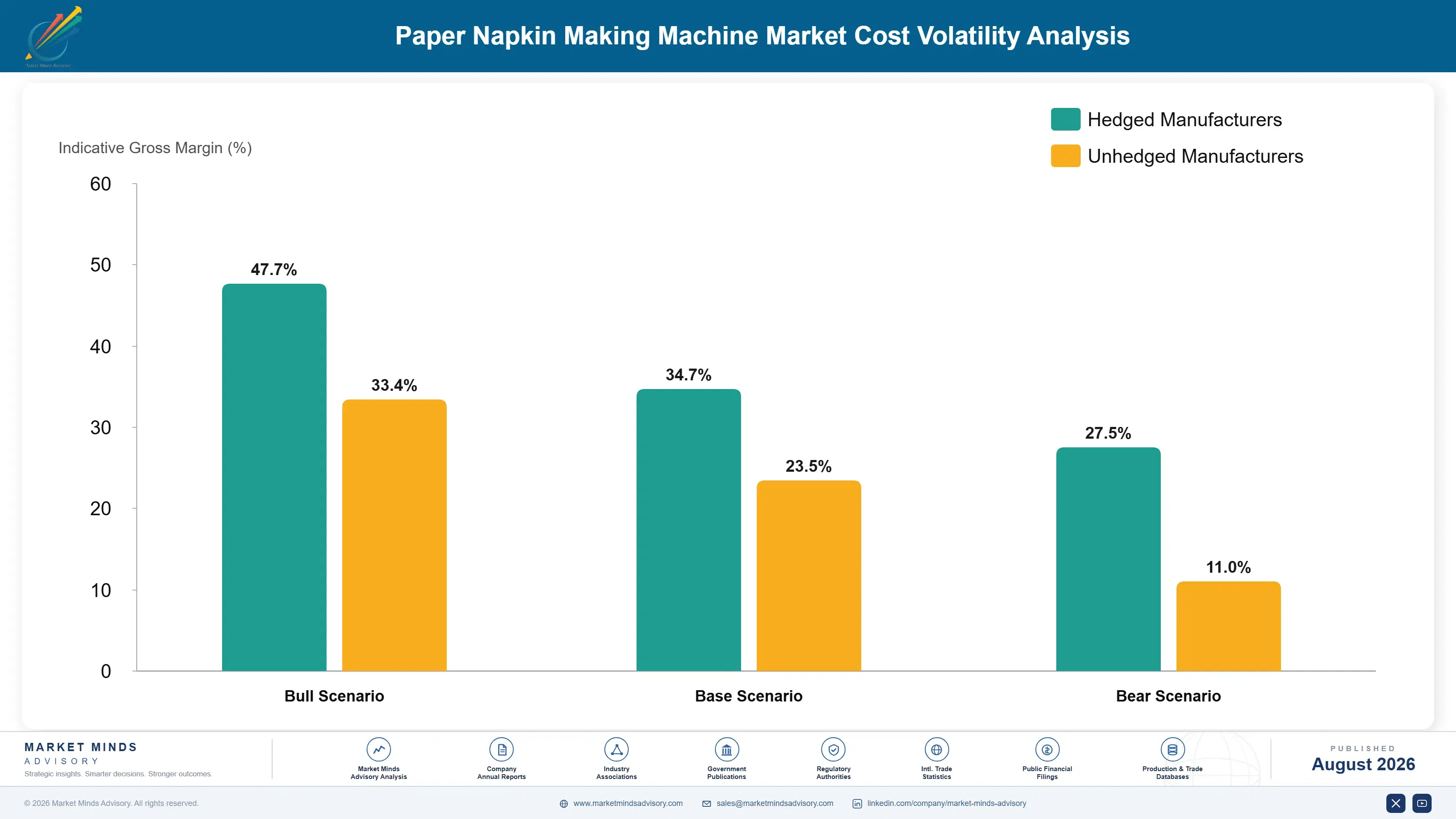
paper-napkin-making-machine-market-cost-volatility-analysis-1787299677350

Diversify Servo Component Sourcing Across Suppliers

Leading builders now qualify at least two servo motor and drive suppliers per platform generation, reducing exposure to single-supplier lead time extensions that delayed deliveries during recent component shortages. This dual-sourcing approach adds modest engineering cost but has proven its value during recent volatility, and several builders are extending the same approach to control electronics sourcing next.

Lock In Steel Pricing Through Annual Contracts

Builders with sufficient production volume increasingly negotiate annual fixed-price steel supply contracts rather than buying on the spot market, smoothing cost volatility across a full production year. Smaller builders lacking this volume leverage remain more exposed to short-term steel price swings between order intake and delivery, often passing part of that cost through to customers directly.

Standardize Control Architecture Across Platforms

Standardizing servo drive and PLC selection across multiple machine models lets builders qualify fewer distinct component variants, simplifying sourcing and reducing the inventory carrying cost of maintaining spare parts across an increasingly diverse installed platform base worldwide, while also shortening the technician training curve for new hires joining regional service teams each quarter and reducing onboarding cost.

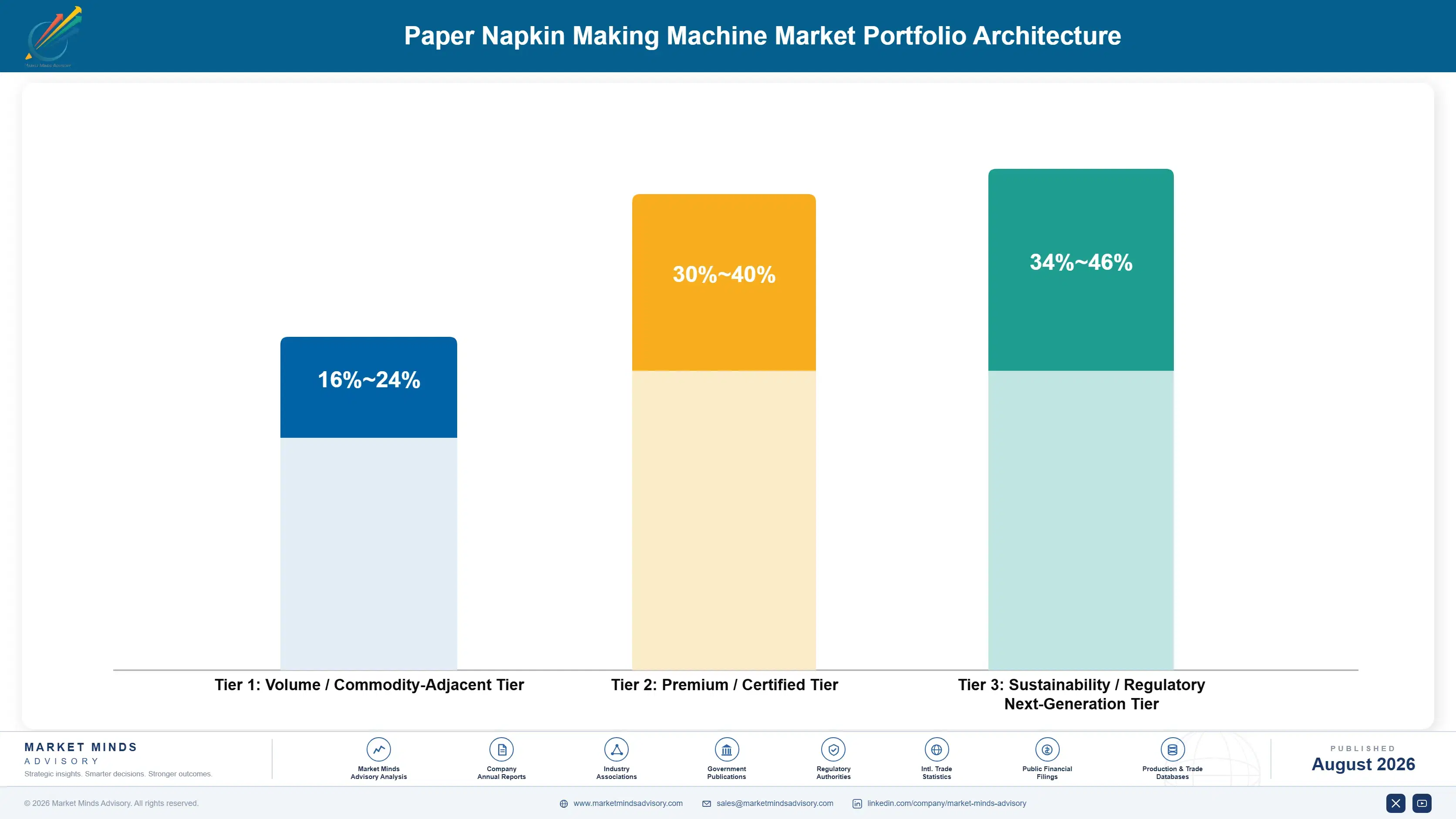
Portfolio Architecture for Margin Defence

Machine builder portfolios split across three tiers running from commodity mechanical platforms through certified servo lines to next-generation digitally integrated systems. Gross margin widens substantially moving up this ladder, since servo and digital print platforms carry proprietary control architecture and service contract attachment that commodity mechanical lines simply cannot support at comparable pricing, regardless of how efficiently a builder manages raw material cost.
Volume tier competition remains intensely price-driven as Chinese and Indian builders expand mechanical and entry semi-automatic capacity, while premium servo tier competition centers on changeover speed, registration accuracy, and service network reach rather than unit price alone. This tension pushes established Western builders further up-tier rather than defending volume-tier share against lower-cost regional competitors directly, concentrating their engineering investment where differentiation still commands a premium.

High-value pools concentrate in servo platforms sold with attached digital print modules and predictive maintenance contracts, where recurring service revenue compounds machine sale margin over a platform's full operating life rather than ending at initial delivery. Builders capturing this recurring layer increasingly outperform peers selling equipment alone on headline unit economics, a gap that widens further with each additional year of installed base growth.

Volume / Commodity-Adjacent Tier

Mechanical and basic semi-automatic napkin machines priced on unit throughput, competing mainly on upfront cost and regional service proximity across price-sensitive converter accounts operating on thin annual capital budgets and tight replacement schedules.
Gross Margin: 16-24%

Premium / Certified Tier

Servo-driven automatic lines with documented registration accuracy and recycled-fiber runnability certification, commanding higher pricing across foodservice-linked converter accounts and their annual specification reviews and vendor qualification audits each renewal cycle.
Gross Margin: 30-40%

Sustainability / Regulatory / Next-Generation Tier

Fully integrated servo platforms with digital print, remote diagnostics, and recycled-content compliance documentation, priced on total platform value across long-term service and financing relationships spanning a full decade or more.
Gross Margin: 34-46%
paper-napkin-making-machine-market-portfolio-architecture-1787299677854

High-value Sub-segments and Strategic Watch-out

Servo-Driven Automatic Napkin Machines

High value and high growth at 10.2%, the fastest category, as converters standardize on servo platforms for changeover speed and consistent embossing registration across every new order placed this year and next, reinforcing this category's lead across the full forecast horizon and every major regional market tracked.
Gross Margin: 30-40%

Embossing and Printing Integrated Lines

High value with strong growth at 8.8%, driven by private-label branding demand pushing converters toward integrated print capability across their existing servo platform installed base and upcoming replacement cycles over the next several years across hospitality and quick-service accounts alike and their seasonal promotional calendars.
Gross Margin: 32-42%

Semi-Automatic Napkin Machines

The volume core by unit count, growing near 5.8% as smaller converters continue buying semi-automatic platforms as an affordable step up from purely mechanical equipment without a full servo commitment or capital outlay, particularly across price-sensitive regional markets and independent operator accounts nationwide and overseas.
Gross Margin: 20-28%

Mechanical/Conventional Napkin Machines

The strategic watch-out, growing slowest at roughly 2.5% and facing steady share erosion as recycled-fiber rules and labor cost pressure push converters toward automated alternatives instead of continued repair and patchwork maintenance across aging production lines nearing the end of their serviceable operating life span.
Gross Margin: 16-22%

Machine Revenue Beyond the Initial Sale

Napkin machines generate recurring revenue across a twelve to fifteen year operating life through spare parts, service contracts, and eventual retrofit or replacement, turning a single capital sale into a decade-plus commercial relationship. Builders with strong service network coverage capture a meaningfully larger share of this lifetime value than those focused solely on initial machine sales, since parts and labor margins typically exceed the margin earned on the original equipment purchase.
Adoption depth varies sharply by end-use vertical: large quick-service restaurant chains standardize on servo platforms across their entire converter supply base, while independent restaurants and smaller catering operators remain price-sensitive commodity buyers slower to adopt automation. Hotel and hospitality customers increasingly demand branded, embossed napkins tied to seasonal promotions, pushing their converter suppliers toward digital print capability faster than the broader commodity foodservice segment requires, widening the gap between these two buyer profiles each year.

A generational shift in converter ownership is accelerating automation adoption, as younger operations managers taking over family-owned converting businesses prioritize digital diagnostics and predictive maintenance data over the hands-on mechanical expertise their predecessors relied on for decades, reshaping how these businesses evaluate new equipment purchases.
paper-napkin-making-machine-market-end-use-penetration-index-1787299678340

Where Machine Builders Should Invest Now

These are among the four positions where our research anticipates prominent divergence between winners and laggards over the coming forecast period. Each is grounded in the demand model, the regulatory perimeter, and the announced capacity pipeline.
01 / SERVO PLATFORM INVESTMENT

Prioritize servo engineering depth over mechanical capacity expansion

Servo-driven platforms are capturing the overwhelming majority of growth as converters chase changeover speed and registration accuracy that mechanical lines cannot match, and that gap widens with every new foodservice specification cycle. Builders still investing primarily in mechanical capacity risk ceding the fastest-growing customer segment to competitors already established in servo engineering, particularly among larger accounts that set specification trends for smaller regional converters to follow. The capital case favors deepening control system expertise even where near-term mechanical order volume remains steady, since that volume is unlikely to expand further.
02 / SERVICE NETWORK EXPANSION

Build technician coverage ahead of servo installed base growth

The mechatronics technician shortage is already limiting converter uptime on existing servo platforms, and installed base growth will only intensify this constraint over the next decade as more converters shift away from purely mechanical equipment entirely. Builders that expand certified technician networks ahead of demand secure a durable service revenue advantage difficult for competitors to replicate quickly, since qualified mechatronics talent takes years to train rather than months. Waiting until shortage-driven downtime becomes a widespread customer complaint cedes this advantage to faster-moving rivals investing in training capacity right now.
03 / RETROFIT PRODUCT DEVELOPMENT

Expand modular retrofit kits to reach capital-constrained converters

A meaningful share of the installed mechanical base remains too capital-constrained to justify full servo line replacement, representing an underserved addressable market that most builders' current product catalogs do not adequately address. Builders offering standardized, lower-cost retrofit kits can capture this segment without competing purely on new machine price, converting price-sensitive holdouts into paying customers years earlier than a full-replacement sales cycle would allow. This approach also builds long-term customer relationships that support eventual full platform replacement once converter capital budgets loosen further down the road.
04 / REGIONAL MANUFACTURING PRESENCE

Establish South Asian assembly capacity ahead of demand acceleration

India's organized foodservice sector and domestic manufacturing incentives are creating durable regional demand that favors builders with local assembly and service presence over pure exporters shipping equipment in from Italy or North America. Establishing regional capacity now, ahead of full demand acceleration, secures preferential positioning against competitors that wait for demand signals to fully materialize before committing capital to a new facility. Early movers also gain from more favorable government incentive terms currently on offer, a window that typically narrows as more foreign builders enter the market.

Engagement Snapshot From the Field

A live engagement with an industry participant carrying material or product regulatory and market exposure ahead of a defining policy shift, showing how our research translates into a defensible multi-year portfolio strategy.
MARKET MINDS ADVISORY · CLIENT ENGAGEMENT SUMMARY
Paper Napkin Making Machine Producer Strategic Portfolio Review and Transition Roadmap 2026·Investment Scenario on Paper Napkin Making Machine Exposure Evaluation 2025-26
CLIENT PROFILE
The client is a mid-sized regional tissue converter operating three napkin production lines across two facilities, serving quick-service restaurant and institutional catering customers within a single national market. Annual revenue is reported at approximately USD 42 million (client-reported, unverified by MMA), with napkin products accounting for roughly sixty percent of total converting output. The company operates two mechanical lines installed over a decade ago alongside one more recent semi-automatic platform.
STRATEGIC CHALLENGE
The client faced rising customer requests for shorter, more frequent embossed napkin runs that its mechanical lines could not changeover profitably, while competitors with servo platforms increasingly won private-label orders the client had to decline. Management needed an objective evaluation of whether full servo replacement or targeted retrofit investment offered better returns given constrained capital availability and uncertain demand growth across its regional customer base.
MMA APPROACH
MMA benchmarked the client's changeover times and order mix against regional servo-equipped competitors, modeled retrofit versus full-replacement economics across a ten-year horizon, and interviewed the client's top foodservice customers regarding future order frequency expectations. The analysis incorporated primary survey data on foodservice private-label demand trends alongside machine builder retrofit pricing benchmarks gathered directly from vendor discussions.
KEY FINDINGS
  1. Lost private-label order value from changeover delays exceeded the annual cost of a servo retrofit within roughly eighteen months of continued operation.
  2. Retrofitting the newer semi-automatic line captured most of the changeover speed benefit at under half the cost of a full new line replacement.
  3. Customer interviews showed a clear willingness to pay a modest premium for guaranteed shorter production run minimums going forward across seasonal ordering cycles.
  4. The oldest mechanical line's remaining service life did not justify retrofit investment relative to eventual full replacement economics over a longer horizon.
CLIENT PROFILE
The client is a mid-sized regional tissue converter operating three napkin production lines across two facilities, serving quick-service restaurant and institutional catering customers within a single national market. Annual revenue is reported at approximately USD 42 million (client-reported, unverified by MMA), with napkin products accounting for roughly sixty percent of total converting output. The company operates two mechanical lines installed over a decade ago alongside one more recent semi-automatic platform.
STRATEGIC CHALLENGE
The client faced rising customer requests for shorter, more frequent embossed napkin runs that its mechanical lines could not changeover profitably, while competitors with servo platforms increasingly won private-label orders the client had to decline. Management needed an objective evaluation of whether full servo replacement or targeted retrofit investment offered better returns given constrained capital availability and uncertain demand growth across its regional customer base.
MMA APPROACH
MMA benchmarked the client's changeover times and order mix against regional servo-equipped competitors, modeled retrofit versus full-replacement economics across a ten-year horizon, and interviewed the client's top foodservice customers regarding future order frequency expectations. The analysis incorporated primary survey data on foodservice private-label demand trends alongside machine builder retrofit pricing benchmarks gathered directly from vendor discussions.
KEY FINDINGS
  1. Lost private-label order value from changeover delays exceeded the annual cost of a servo retrofit within roughly eighteen months of continued operation.
  2. Retrofitting the newer semi-automatic line captured most of the changeover speed benefit at under half the cost of a full new line replacement.
  3. Customer interviews showed a clear willingness to pay a modest premium for guaranteed shorter production run minimums going forward across seasonal ordering cycles.
  4. The oldest mechanical line's remaining service life did not justify retrofit investment relative to eventual full replacement economics over a longer horizon.
RECOMMENDED STRATEGY
Phase 1: Phase 1 (Months 1-4): Retrofit the semi-automatic line with servo tension control and digital print capability ahead of peak season. Phase 2: Phase 2 (Months 5-10): Pilot expanded private-label order acceptance using the upgraded line's shorter changeover capability across several key foodservice accounts. Phase 3: Phase 3 (Months 11-18): Evaluate full servo replacement for the oldest mechanical line based on pilot results and demand trends.
OUTCOME
Within twelve months of completing the retrofit, the client reported private-label order volume up approximately thirty two percent and average changeover time down by more than half (client-reported, unverified by MMA). Management deferred the oldest mechanical line's replacement decision pending continued demand validation, avoiding premature capital commitment while capturing the bulk of the near-term commercial opportunity identified during the engagement.

Frequently Asked Questions

Foundational context covering the market sizes, CAGR, scope, country, region and competition that inform every finding below. This section is provided to cover basics and most often pre-purchase conversations, answered from the MMA Primary Research Dataset.

What is the current size of the Paper Napkin Making Machine Market?

The global paper napkin making machine market is valued at USD 1.4 billion in 2025, covering servo-driven, semi-automatic, and mechanical converting lines sold to converters worldwide.

How large will the Paper Napkin Making Machine Market be by 2036?

The market is projected to reach USD 2.77 billion by 2036, roughly 1.86 times its 2026 value of USD 1.49 billion, driven by servo automation and private-label print demand.

What is the CAGR for the Paper Napkin Making Machine Market 2026 to 2036?

The base case CAGR is 6.4%, with a bull case of 7.7% if quick-service restaurant expansion accelerates, and a bear case of 5.1% under steel and component cost pressure.

Which segment is growing fastest?

Servo-Driven Automatic Napkin Machines lead at a 10.2% CAGR, roughly 1.59 times the overall market rate, as converters standardize on faster, more flexible platforms across their production lines.

Who are the major companies in the Paper Napkin Making Machine Market?

PCMC, Fabio Perini, A.Celli Group, Gambini Group, and C.G. Bretting lead the market, together holding roughly 32% of combined shipment and service revenue, per company filings.

Which country is growing fastest?

India leads at a 9.4% CAGR as its organized quick-service sector expands and Make in India incentives draw new domestic machine assembly investment nationwide each year.

Report Segmentation Architecture

The full report scope spans multiple orthogonal segmentation dimensions, with cross-tabulated demand data provided for each dimension pair. Coverage extends further to regional breakdowns, trend trajectories, and the competitive detail needed to support segment-level decision-making.

By Machine Automation and Technology Type

  • Servo-Driven Automatic Napkin Machines
  • Embossing and Printing Integrated Lines
  • Semi-Automatic Napkin Machines
  • Mechanical/Conventional Napkin Machines
  • Interfold and Multi-Fold Specialty Machines
  • Compact and Low-Speed Napkin Machines

By End-Use Industry

  • Quick-Service and Fast-Casual Restaurants
  • Hotels and Hospitality
  • Institutional and Catering Services
  • Airlines and Transportation Foodservice
  • Retail and Grocery Foodservice

By Commercial Dimension

  • Direct OEM Sales Channels
  • Distributor and Dealer Networks
  • Aftermarket Parts and Retrofit Services
  • Equipment Leasing and Financing Channels

By Region

  • North America
  • Western Europe
  • East Asia
  • South Asia and Pacific
  • Latin America
  • Middle East and Africa
  • Eastern Europe

Scope, Methodology, and Coverage

Every figure in this report is reproducible from documented input assumptions. The scope below maps the historical period, the forecast horizon, the segmentation dimensions, and the countries covered, alongside the underlying primary and qualitative methodology.
Historical Period
2020 to 2025
Forecast Period
2026 to 2036
Base Year
2025 (USD billions; MMA Primary Research Dataset, August 2026)
Market Definition
The paper napkin making machine market covers automated and semi-automated equipment that converts base tissue paper into folded, embossed, and printed napkins, including unwinding, embossing, folding, cutting, and packaging modules sold as integrated production lines. It excludes base tissue paper itself, finished napkin products, and non-napkin tissue converting equipment sold as standalone systems.
Quantitative Units
USD billions (current prices); machine units shipped annually
Segmentation Dimensions
By Machine Automation and Technology Type; By End-Use Industry; By Commercial Dimension; By Region
Regions Covered
North America, Western Europe, East Asia, South Asia and Pacific, Latin America, Middle East and Africa, Eastern Europe
Countries Covered
USA, China, Germany, France, UK, Japan, South Korea, India, Australia, Canada, Brazil, Mexico, Indonesia, Vietnam, Thailand, Malaysia, UAE, Saudi Arabia, South Africa, Nigeria, Turkey, Poland, Netherlands, Italy, Spain, Sweden, Switzerland, Argentina, Colombia, Singapore, and additional markets relevant to this sector
Key Companies Profiled
PCMC, Fabio Perini S.p.A., A.Celli Group, Gambini Group, C.G. Bretting Manufacturing Company, Inc., Toscotec S.p.A., MTC S.r.l., Omet S.r.l., Futura S.p.A., PAPCEL a.s., ANDRITZ AG, Voith Group, Recard S.p.A., O.M.T. Costruzioni Meccaniche S.r.l., Vic International Group, Kohler Engineering (India) Pvt. Ltd., Perfect Engineering Equipments Pvt. Ltd., Zhengzhou Whasion Machinery Co., Ltd., Fujian Hengchang Machinery Manufacturing Co., Ltd., Guangzhou Sikai Machinery Equipment Co., Ltd.
Quantitative Methodology
Primary survey, n=3,800 respondents, Q4 2025, six countries; demand-side model with trade association cross-validation
Qualitative Methodology
47 expert interviews, Q4 2025; applied to validate demand model assumptions, identify emerging dynamics, and assess competitive positioning
Report Format
PDF and XLSX data workbook (Word format preview document)
Publisher
Market Minds Advisory
Report Code
MMA-2026-CON-187
Published
August 2026
Contact
sales@marketmindsadvisory.com | www.marketmindsadvisory.com

Purchase the full Paper Napkin Making Machine Market Report (2026 to 2036).

The full MMA report on the paper napkin making machine market delivers detailed segmentation by automation type, end-use vertical, and commercial channel across all seven global regions, supported by primary survey data from converter and machine builder respondents. It includes country-level machine demand estimates, detailed competitive profiles of all twenty companies covered, and forward-looking analysis of retrofit and service revenue opportunity through 2036. The report also benchmarks servo and mechanical platform economics across major end-use verticals in detail. Buyers receive full access to underlying data tables alongside the complete analytical narrative and supporting appendices.
Seven-region machine demand and CAGR data
Twenty-company competitive benchmarking and positioning profiles
Retrofit and aftermarket revenue sizing detail
Servo versus mechanical platform economics compared
Primary survey data from converter operators
Ten-year forecast through 2036 by segment

Built For The People Who Decide

From boardroom strategy to bench-side execution, this report is read cover-to-cover by leaders shaping the next decade of their industry, turning demand scenarios, market dynamics and valuation benchmarks into decisions.
CXOs/ Presidents/ VPs/ Managers
M&A and Corporate Development
Strategy Teams and R&D Heads
Procurement and Product Directors
Regulatory and Compliance Leaders
Investor Relations and Equity Analysts