Market Minds Advisory
Paper Masking Tapes Market

Paper Masking Tapes Market: Clean Removal, Bake Temperature and the Rework Cost Nobody Attributes to Tape

A masking tape that leaves adhesive behind on a painted car body turns a finished panel into four hours of rework, which is roughly nine hundred times what the tape cost.

Lead Analyst

Bilal Shaikh

Published

September 2026

Make Smarter Decisions with Customized Research Insights

Request a free sample report and evaluate market opportunities, growth trends, and competitive dynamics relevant to your business needs.

2025 MARKET VALUE$3.9BMarket Size 2025
2036 FORECAST VALUE$7.3BBase Case , 2026 to 2036
CAGR 2026 TO 20365.9 %Bull 7.1% / Bear 4.7%
INCREMENTAL OPPORTUNITY$3.2BNet 10- year value creation
EXPANSION MULTIPLE1.77x2036 value over 2026 base
Strategic Levers
M&A Pipeline
Regional Outlook
Country Rankings
Competitive Intelligence
Segmental Deep-dive
Call-Us : 91 93563 13602

Executive Snapshot and Market Trajectory

Masking tape is judged entirely on how it comes off. Adhesion during the job matters, but every complaint that reaches a supplier is about residue left behind, paint bleed under the edge, or a strip that tore rather than lifting cleanly. Removal is the whole specification.
High-temperature automotive masking tapes compound at 8.85%, exactly 1.50 times the market, on bake ovens running hotter and on electric vehicle assembly adding masked operations. East Asia holds 31% of demand on vehicle and electronics manufacturing density. Crepe paper and adhesive run near 57% of producer cost. Automotive holds 34% of market value, and rework from a residue failure runs roughly 900 times the tape cost. Very few buyers have seen that figure.
Five producers hold 49%. Adhesive formulation depth separates them, since clean removal after a bake is a chemistry problem rather than a coating one. Paint shop qualifications reopen at platform change, and electric conversion is reopening them at scale. Nobody defends an incumbent during platform development. A residue problem ends price-driven purchasing quickly, once somebody finally puts the rework number in front of the buyer. Timing beats pricing here.
Market Definition
The market covers pressure-sensitive masking tapes with crepe or flat paper backings, spanning general purpose painter and decorator tapes, high-temperature automotive masking tapes, fine line and precision edge tapes, industrial and powder coating masking tapes, low-tack delicate surface tapes, and paper splicing and core starting tapes. Film-backed masking tapes, cloth and duct tapes, packaging and carton sealing tapes, and reusable masking fixtures are excluded.
Base Year Value
$3.9B in 2025 (MMA Primary Research Dataset, August 2026)
Forecast Period
2026 to 2036, eleven discrete annual values
CAGR
5.9% base case. Bull 7.1%. Bear 4.7%.
Fastest Growth Segment
High-Temperature Automotive Masking Tapes: 8.8% CAGR
Fastest Growth Country
India: 8.6% CAGR
Fastest Growth Region
South Asia and Pacific: 8.1% CAGR
Largest Region
East Asia: 31% of 2025 global value
Market Leaders
3M, Nitto Denko, tesa, Shurtape Technologies, IPG. Source: MMA Analysis based on company annual reports.
Primary Survey
n=3,800 procurement and R&D decision-makers, Q4 2025, six countries
Methodology
Demand-side build-up, cross-validated against public data, 47 expert interviews

Paper Masking Tapes Market Forecast Scenarios

paper-masking-tapes-market-size-forecast-scenario-1787308376795
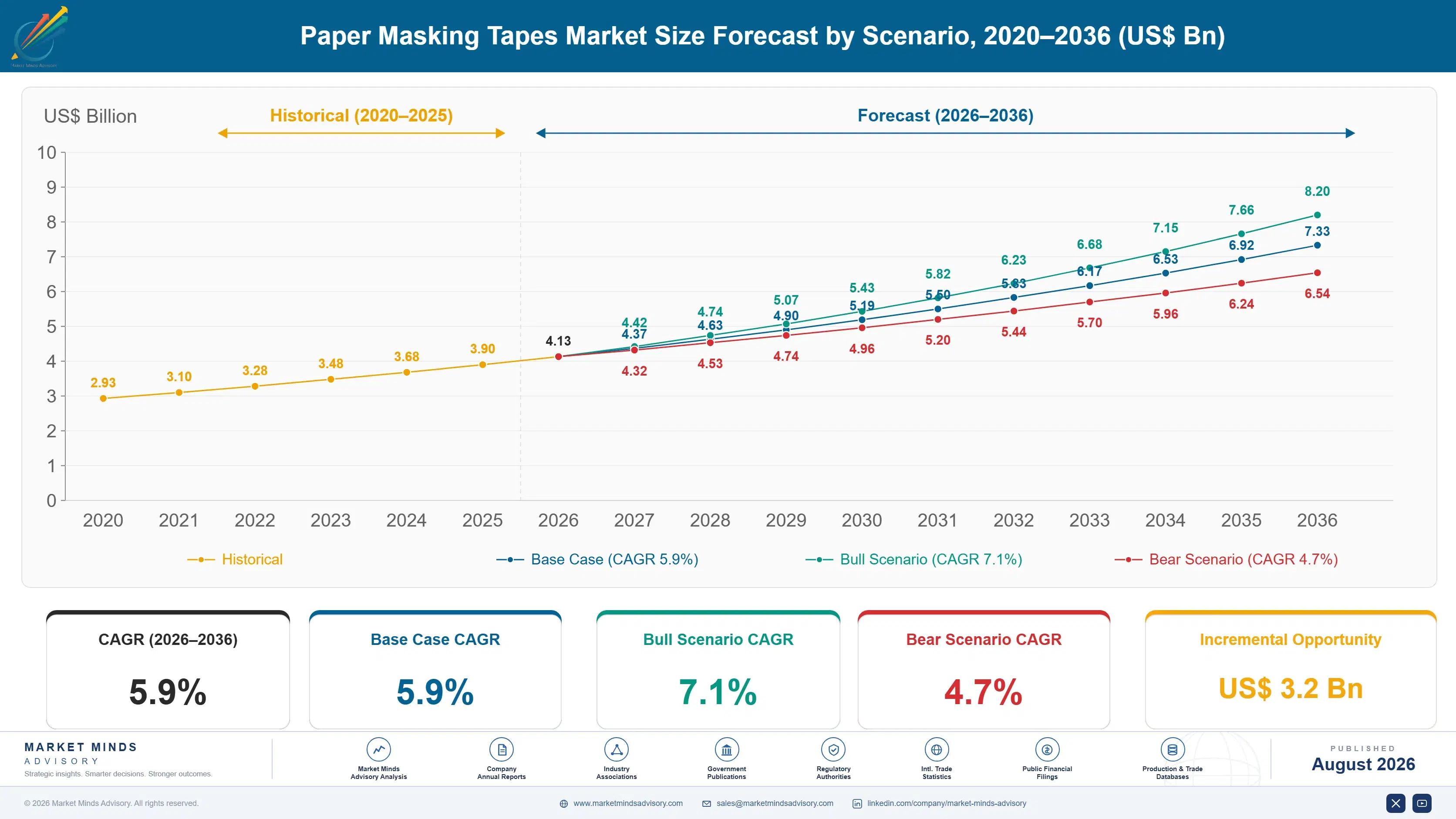
Growth ran at an implied 4.8% across 2020 to 2025 and the composition split sharply. Consumer decorating demand surged through 2020 and then fell back below trend, while industrial and automotive masking grew steadily throughout. Crepe paper and solvent costs both moved hard mid-period, and converters recovered them with a considerable lag. Automotive specification requirements rose throughout the period.
The base case at 5.9% rests on three mechanisms. Automotive assembly keeps adding masked operations as electric vehicle platforms bring battery enclosures and new joining processes into paint shops. Powder coating keeps displacing liquid finishing across industrial manufacturing, which demands higher temperature tolerance. And construction and refurbishment volumes keep supporting general purpose decorating demand. High-temperature grades compound at 8.85% against a market at 5.9%, and fine line precision product takes a further share on two-tone and multi-colour finishing.
The bull case at 7.1% assumes automated masking systems spread through vehicle assembly, which raises specification requirements and tape value per vehicle together. The bear case at 4.7% follows from robotic paint application reducing masked area per vehicle, alongside consumer decorating demand continuing to soften as housing transaction volumes stay depressed in developed markets. Neither scenario turns on tape pricing at all.

Judged Entirely on Coming Off

Nobody buys masking tape for its adhesion. They buy it for removal, and the difference is not semantic. A tape that grips well and then leaves adhesive behind on a finished surface has failed completely, and it has failed at the most expensive possible moment, after every other operation has already been paid for.
TOP FIVE CONCENTRATION49%Combined share held by the five largest tape producers globally
BAKE TEMPERATURE RATING150 degrees CelsiusOven tolerance required in modern automotive paint operations
BACKING COST SHARE57% of COGSCrepe paper and adhesive as a proportion of producer cost
REWORK COST MULTIPLE900 times tape valuePanel refinishing cost against the tape that caused it
CLEAN REMOVAL WINDOW72 hoursPeriod after application within which residue-free removal holds
AUTOMOTIVE SHARE OF VALUE34%Proportion of market value from vehicle assembly and refinishing
In a vehicle paint shop that failure costs roughly 900 times what the tape did. A panel with residue or paint bleed under the tape edge goes back for refinishing, which consumes labour, oven capacity and line time. Yet masking tape is routinely bought on price per roll by procurement functions who have never seen the rework tickets it generates on a night shift. Nobody connects the two records.
The technical demand keeps rising. Bake ovens run at 150 degrees and above, electric vehicle platforms add battery enclosure and joining operations that need masking, and the clean removal window after that thermal exposure is where cheap tape fails. High-temperature automotive tapes compound at 8.85% because the requirement is genuinely harder than it was, not because anybody is paying more for the same product.
"The tape is the cheapest thing in the paint shop and the only one that can write off a finished panel. I have yet to meet a buyer who could tell me their residue rate, and I have met plenty who could recite the price per roll."
Principal, Adhesive Tapes and Industrial Consumables Practice · MMA Adhesive Tap

Market Trends

Electric Vehicle Assembly Adds Masked Operations Per Body

Battery enclosures, new joining processes, sealed electrical penetrations and revised body construction all add masking operations that internal combustion platforms never required. That raises tape consumption per vehicle and it raises specification, since several of those operations run through higher temperature cycles than conventional body painting did. Automotive already accounts for 34% of market value, and high-temperature tapes compound at 8.85% against a market at 5.9% as platform conversion continues across every major vehicle manufacturer. Qualification for those operations was never contemplated in specifications written before the platforms existed, which is why residue failures cluster there.
Market Impact: Rework costing 900 times tape
Powder Coating Displaces Liquid Finishing Across Industry

Industrial manufacturers keep converting from liquid paint to powder coating on emissions, efficiency and finish quality grounds, and powder cure schedules run hotter than most liquid systems did. Standard crepe masking tape carbonises or leaves residue at those temperatures, which forces a specification change the manufacturer usually discovers after a batch is ruined. Bake ratings of 150 degrees and above are now routine requirements rather than specialty ones, and general purpose tape simply cannot serve the application. General purpose tape simply carbonises or bonds permanently, and the manufacturer usually discovers it after a batch is already ruined.
Market Impact: Removal window spanning 72 hours

Market Opportunities and Growth Drivers

Rework Cost Overwhelms Any Conceivable Tape Saving

A finished panel sent back for refinishing because of adhesive residue or paint bleed consumes labour, oven capacity and line time worth roughly 900 times the tape that caused it. The calculation is trivial once anybody performs it, and almost nobody does, because rework tickets sit with production while tape purchasing sits with procurement. Producers who obtain a customer's residue and bleed data and quantify the exposure change the purchase from a price comparison into a defect discussion. Nobody looks at the tape at all. Reclassifying the defect is the first step.
Market Impact: Rework running 900 times cost

Clean Removal After Thermal Exposure Is Chemistry Not Coating

Adhesive that removes cleanly at room temperature can cross-link during a bake cycle and bond permanently to the surface it was protecting. Formulating around that requires controlling adhesive chemistry, crepe saturation and release treatment together, which is materials work rather than converting. Producers holding that capability supply applications where converters buying adhesive on the open market cannot follow, and the clean removal window of around 72 hours after application is the specification that separates them. Datasheet ratings say nothing about behaviour in a specific oven at a specific dwell. Trialling on the real schedule is the only reliable test.
Market Impact: Reducing masked area 7% annually

Market Restraints and Challenges

Procurement Buys Rolls While Production Absorbs Failures

Masking tape is purchased on price per roll and width by functions who never see the rework it generates, and the failure appears on a different shift in a different cost centre. The root cause is that residue and bleed are recorded as paint defects rather than as tape defects. Producers mitigate by obtaining defect data and correlating it against tape batches, which converts an invisible problem into a measured one, and by trialling on the customer's actual substrate and bake schedule. Reclassifying the defect makes the cost visible. Few quality systems record it that way.
Market Impact: Automotive at 34% of value

Robotic Paint Application Reduces Masked Area Per Unit

Precision robotic spray and electrostatic application place paint accurately enough that some masking becomes unnecessary, which reduces tape consumed per vehicle or per component. The root cause is that masking exists to compensate for application imprecision. Producers mitigate by targeting the operations robotics cannot address, including thermal protection, threaded and machined surface protection and multi-stage colour work, and by pursuing the electric vehicle operations adding masked area faster than robotics removes it. Electric vehicle platforms are currently adding masked area faster than robotics removes it, which buys the category time but does not resolve the underlying direction of travel.
Market Impact: Ratings reaching 150 degrees Celsiu
3 additional market trends, 4 additional growth drivers, and 2 additional restraints and challenges are covered in the full report. Contact sales@marketmindsadvisory.com to access the complete intelligence.

Segment CAGR and Growth Architecture

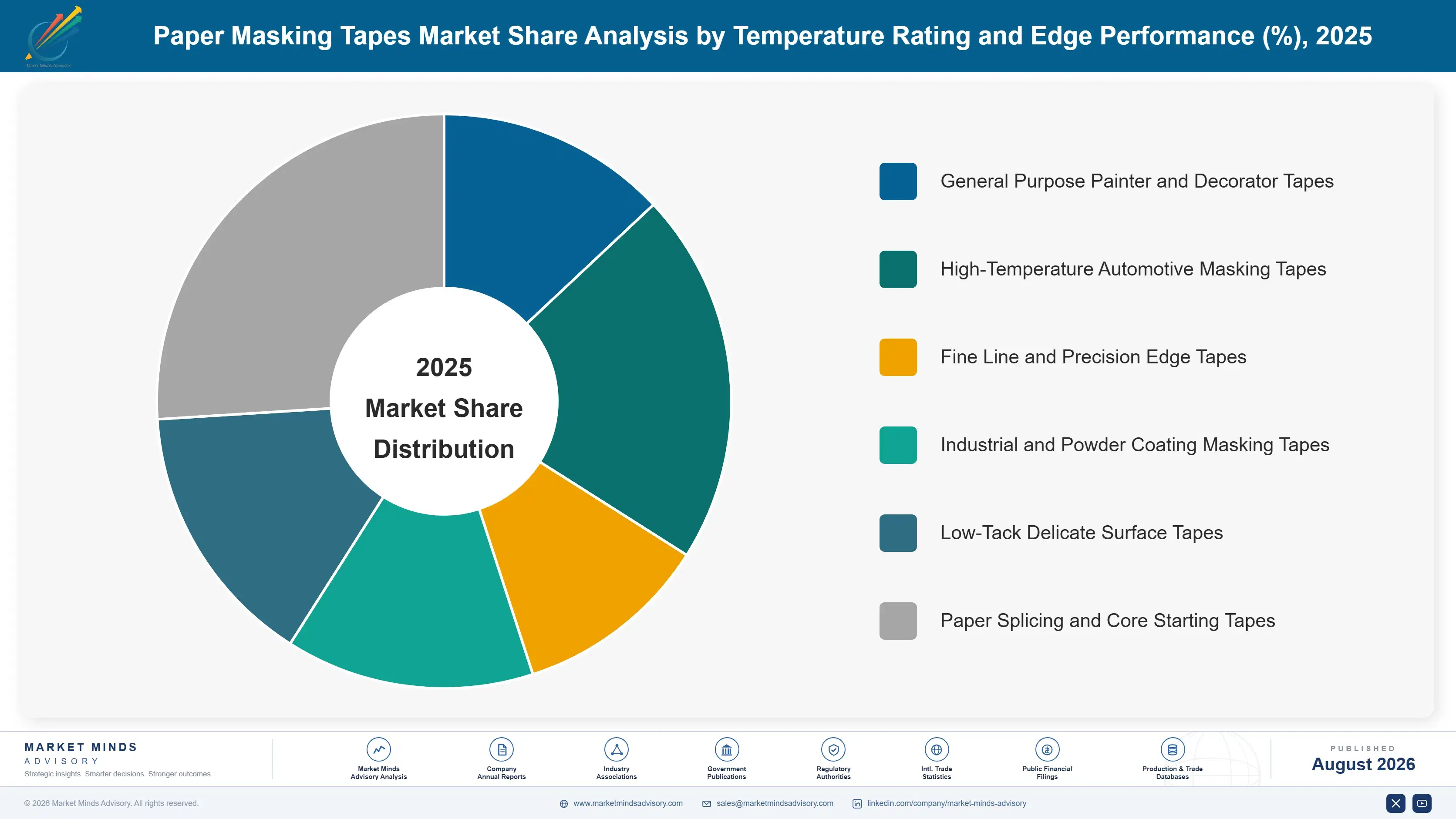
Segmentation follows temperature rating and edge performance, because those two properties decide which applications a tape can serve and how cleanly it releases afterwards. A manufacturer moving from liquid paint to powder coating is changing tape category rather than merely switching to a different supplier. Six performance classes sit in the hierarchy, separated by thermal tolerance and edge behaviour.
paper-masking-tapes-market-market-share-analysis-1787308377742

High-Temperature Automotive Masking Tapes

High-temperature tapes compound at 8.85%, exactly 1.50 times the market, on bake ovens running at 150 degrees and above and on electric vehicle platforms adding masked operations that internal combustion bodies never had. The technical problem is that adhesive removing cleanly at room temperature can cross-link during a bake and bond permanently to the finished surface it was meant to protect. Solving it means controlling adhesive chemistry, crepe saturation and release treatment together, which is materials science rather than converting. Automotive accounts for 34% of market value, and the rework cost of a residue failure runs roughly 900 times the tape price, which is why these accounts rarely move on price alone once a producer has proven clean removal.
CAGR 8.8%

Fine Line and Precision Edge Tapes

Fine line tapes grow at 7.4% on multi-colour vehicle finishing, two-tone body treatments and any application where a paint edge has to be sharp enough to survive inspection. The requirement is edge definition rather than temperature: the adhesive must seal along the boundary tightly enough that no paint bleeds underneath, while the backing stays dimensionally stable so the line does not wander. Thin backings and higher adhesive precision cost more per metre and the volumes are modest, but the failure mode is visible on a finished vehicle rather than hidden, which makes buyers considerably more willing to specify properly. Refinishing and custom work consume disproportionate volume relative to original equipment assembly.
CAGR 7.4%
Full segment breakdown across 6 segments available in the complete report.

Regional Architecture and Country Demand Map

Demand follows vehicle assembly, industrial coating and construction activity together, since those three account for most masked operations. Manufacturing density therefore predicts volume far better than population or general economic size. East Asia leads on assembly and coating density. Electric platform conversion is raising specification requirements fastest.

East Asia

East Asia takes 31% of global demand, growing at 6.9%. Note: this sits slightly above the standard band because Chinese, Japanese and Korean vehicle assembly plus regional electronics and appliance manufacturing together concentrate more masked coating operations than any other region carries. Chinese electric vehicle production is the single largest driver of high-temperature tape demand anywhere, given both volume and the pace of platform conversion. Japanese producers hold the deepest adhesive formulation capability in the region and supply high-specification tape well beyond their own market. Korean and Taiwanese electronics manufacturing adds precision masking demand with quite different substrate requirements. Regional general purpose production competes hard on price while high-temperature formulation stays concentrated among a handful of Japanese producers.
Share: 31% | CAGR: 6.9% (2026 to 2036)

North America

Twenty-four percent of demand sits in North America, growing at 5.6%. Vehicle assembly and collision refinishing together account for the largest share, with the aftermarket refinishing sector consuming disproportionate volumes of fine line and precision edge product. Industrial powder coating conversion is well advanced across appliance, furniture and metal fabrication manufacturing. Construction and professional decorating demand is substantial and cyclical with housing activity. The distribution structure runs heavily through industrial and automotive refinishing suppliers, which shapes who reaches the specifying user rather than the purchasing department. Electric platform conversion is reopening paint shop qualifications settled years ago, and battery enclosure masking demands considerably more than the legacy specifications. Requalification is now happening across most of the major plants at once.
Share: 24% | CAGR: 5.6% (2026 to 2036)
Regional intelligence for 5 additional markets available in the complete report: Western Europe, South Asia and Pacific, Latin America, Middle East and Africa, Eastern Europe. Contact sales@marketmindsadvisory.com.
paper-masking-tapes-market-country-cagr-analysis-1787308378663

Turning Price Comparison Into Defect Data

Masking tape is bought on price per roll by people who never see the rework it causes, in factories where residue gets recorded as a paint defect. Every position worth holding starts by finding that data. Four qualify: two need production records rather than purchasing access, and two turn on where the volume is going.

Correlate Customer Defect Records Against Tape Batches

Residue and paint bleed are logged as paint defects rather than tape defects, so the cost never reaches the buyer comparing price per roll. Producers who obtain defect records and correlate them against tape batch and application area convert an invisible problem into a measured one. With rework running roughly 900 times tape value, the arithmetic ends the price discussion immediately, and the analysis costs a few days of technical time against a defect rate the customer has been carrying for years. Production holds the records and rarely shares them unprompted.
Market Impact: Rework costing 900 times the tape v

Trial on the Customer's Actual Bake Schedule

Adhesive that releases cleanly at room temperature can cross-link during a bake and bond to the surface permanently, and datasheet temperature ratings rarely reflect a specific oven profile, dwell and substrate. Producers who trial on the customer's real schedule rather than quoting a rating solve the failure competitors describe. Ratings of 150 degrees and above are now routine requirements, and high-temperature tapes compound at 8.85%, so most of these conversations are still ahead rather than behind. Most incumbents were qualified against a schedule that no longer exists. Ovens change and specifications rarely follow.
Market Impact: Bake ratings now exceeding 150 degr

Follow Electric Vehicle Platform Conversion Into Paint Shops

Battery enclosures, sealed penetrations and revised joining processes add masked operations that internal combustion bodies never carried, raising both tape consumption and specification per vehicle. Automotive already represents 34% of market value and platform conversion is happening on published timetables at every major manufacturer. Producers who engage during platform development rather than after launch write the specification instead of bidding against it, and paint shop qualifications rarely reopen once a vehicle is in production. Engaging after launch means bidding against a qualified incumbent with production data behind it, which almost never succeeds on price alone.
Market Impact: Automotive holding 34% of the total

Target Operations Robotic Application Cannot Remove

Precision robotic spray reduces masked area by roughly 7% a year in the operations it can reach, and producers competing purely on general purpose masking lose volume steadily to it. Thermal protection, threaded and machined surface protection and multi-stage colour work all sit outside what accurate paint placement solves. Fine line tapes for two-tone and multi-colour finishing grow at 7.4% for the same reason, since the requirement is edge definition rather than compensating for a sprayer's imprecision. Those applications are growing rather than shrinking. Electric platforms are adding masked area faster than robotics removes it.
Market Impact: Robotics removing 7% of masked area

Who Controls the Margin Pool

Five producers hold 49% measured on masking tape revenue, the basis used consistently here. 3M and Nitto Denko lead on adhesive formulation depth and on automotive paint shop qualification, and the gap to the challenger group is narrow on general purpose decorating tape and considerably wider on high-temperature and precision product.
Competition runs on three dimensions. Adhesive chemistry capability decides who can deliver clean removal after a bake cycle at all. Paint shop qualification depth decides who holds automotive volume, since those approvals rarely reopen. And distribution reach into refinishing and industrial channels decides who reaches the specifying user rather than a purchasing department. Coating capability itself qualifies nobody for the specification-critical work.

Two pressures are moving position. Electric vehicle platform conversion opens paint shop specifications that have been closed for years, which is the first real opening for challengers in some time. Meanwhile robotic paint application steadily erodes general purpose volume. Rankings will shift toward producers pairing formulation depth with early access to platform development. Producers competing purely on general purpose volume face regional cost structures they cannot match, which means the base underneath their specification work keeps thinning whether or not they win the platform conversions.
paper-masking-tapes-market-company-positioning-matrix-1787308379624

Competitive Moat and Risk Dimensions

3M

Moat: Automotive paint shop qualification

3M holds masking tape qualifications across most major vehicle manufacturers' paint operations, and those approvals are tied to specific oven profiles, substrates and finish standards rather than to a product datasheet. Requalification happens at platform change rather than at contract renewal, which makes the installed position unusually durable against any pricing pressure.
3M

Risk: Regional cost position erosion

General purpose decorating and light industrial tape is where regional producers in Asia compete hardest, and technical differentiation there is minimal. That volume carries the fixed cost of coating lines, and losing it steadily to lower-cost producers weakens the base underneath the specification-critical work that generates the margin.
NITTO DENKO

Moat: Adhesive chemistry formulation depth

Nitto Denko formulates and manufactures its own adhesive systems rather than buying them, which is what allows clean removal after thermal cross-linking to be engineered rather than hoped for. That capability directly addresses the failure mode generating every serious complaint in this category, and converters buying adhesive on the open market cannot follow into those applications.
NITTO DENKO

Risk: Refinishing channel distribution reach

Collision refinishing and professional decorating buy through fragmented industrial and automotive distribution rather than direct, and those channels reach the specifying user before any technical discussion happens. A producer strong in original equipment supply and materials science competes at a disadvantage in a channel where shelf presence decides the sale.

Players Tracked

Prominent Players

3M
Nitto Denko
tesa
Shurtape Technologies
IPG

Other Key Players

Avery Dennison
Scapa Group
Berry Global
Lintec Corporation
Sekisui Chemical
Advance Tapes International
Beiersdorf
Nichiban
Tombow Pencil
Kikusui Tape
PPM Industries
Bolex Adhesive Products
Sichuan Chuanxi Tape
Yongguan Adhesive Products
Wenzhou Xinyu Tape

Recent Developments

MARCH 2025

Electric vehicle platforms add masked operations in body paint shops

Vehicle manufacturers converting assembly lines to battery electric platforms introduced masking requirements around enclosures, sealed penetrations and revised joining processes. This reflects platform engineering across the vehicle industry rather than any commercial development among tape producers themselves. Legacy tape qualifications had never contemplated those operations at all.
Signal: Platform conversion reopens paint shop tap
JULY 2025

Powder coating conversion raises bake temperatures across industrial coating

Industrial manufacturers moving from liquid finishing to powder coating pushed cure schedules above the tolerance of general purpose crepe masking, producing residue and carbonisation failures. This reflects coating technology adoption rather than any transaction among the tape suppliers affected. Specification changes usually followed a ruined batch rather than preceding one.
Signal: A hotter cure schedule turns a previously
NOVEMBER 2025

Robotic paint application reduces masked area in assembly operations

Precision electrostatic and robotic spray systems placed paint accurately enough that several vehicle manufacturers removed masking steps entirely from specific body operations. This reflects application equipment capability rather than developments among masking tape producers. Masked area per body fell in the operations robotic placement could actually reach.
Signal: Accurate paint placement removes the maski

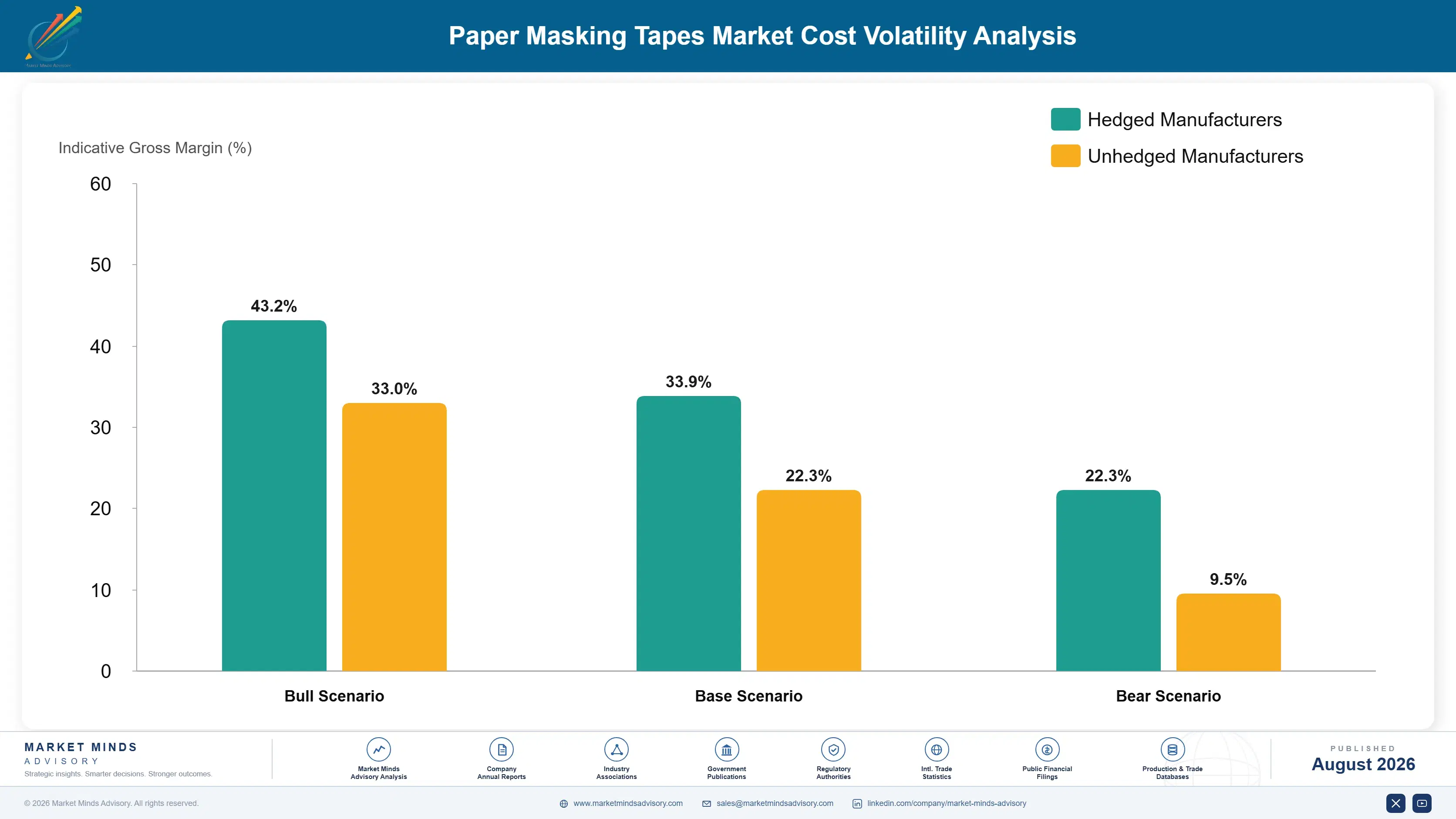
Crepe Paper, Adhesive and Coating Energy

Crepe paper backing and adhesive together account for roughly 57% of producer cost of goods, with saturated crepe for high-temperature grades costing considerably more than general purpose backing. Release coatings and solvents add around 10%. Coating line energy, slitting, converting and packaging make up the remainder, and coating energy is a heavier load than most converted products carry because solvent removal is thermally intensive.
Crepe paper and adhesive raw material costs rose sharply through 2021 and 2022 on pulp market movement and petrochemical feedstock disruption, and producers recovered them with a considerable lag against annual industrial contracts. Company annual reports across the tape and adhesive groups disclose the resulting margin compression. Energy Information Administration data on petrochemical feedstock pricing documents the underlying movement across the same period. Saturated crepe moved separately from commodity paper grades.

Exposure divides by adhesive integration and by grade mix. Producers formulating their own adhesive systems see cost early and reformulate around constrained inputs. Those buying adhesive on the open market absorb whatever the market delivers and cannot substitute freely, because a formulation change on a qualified automotive tape means requalification. High-temperature grades carry saturated crepe exposure that moves separately from commodity paper.
paper-masking-tapes-market-cost-volatility-analysis-1787308379981

Qualify alternate crepe suppliers before pulp markets move

Saturated crepe for high-temperature grades comes from a narrow supplier base, and a qualified automotive tape cannot switch backing without requalification at the customer. Qualifying a second crepe source during initial development, rather than during a shortage, preserves the option to substitute without reopening a paint shop approval that took months to obtain. Few producers hold a second source.

Index industrial contracts to pulp and feedstock references

Annual industrial tape contracts against monthly pulp and petrochemical movement put the whole cycle onto the producer. Indexing to published pulp and feedstock references, with quarterly resets, matches pass-through to the exposure that genuinely moves. Industrial buyers accept the mechanism more readily than automotive accounts, where pricing is set through longer programme agreements. Programme agreements move slowly.

Shift solvent systems toward water-based and hot-melt chemistry

Solvent removal is the heaviest energy load on a coating line and solvent content regulation is tightening in several markets regardless. Moving suitable grades to water-based or hot-melt adhesive systems cuts energy cost and regulatory exposure together, though high-temperature automotive grades remain difficult to convert without losing thermal performance. General purpose grades convert readily.

Portfolio Architecture for Margin Defence

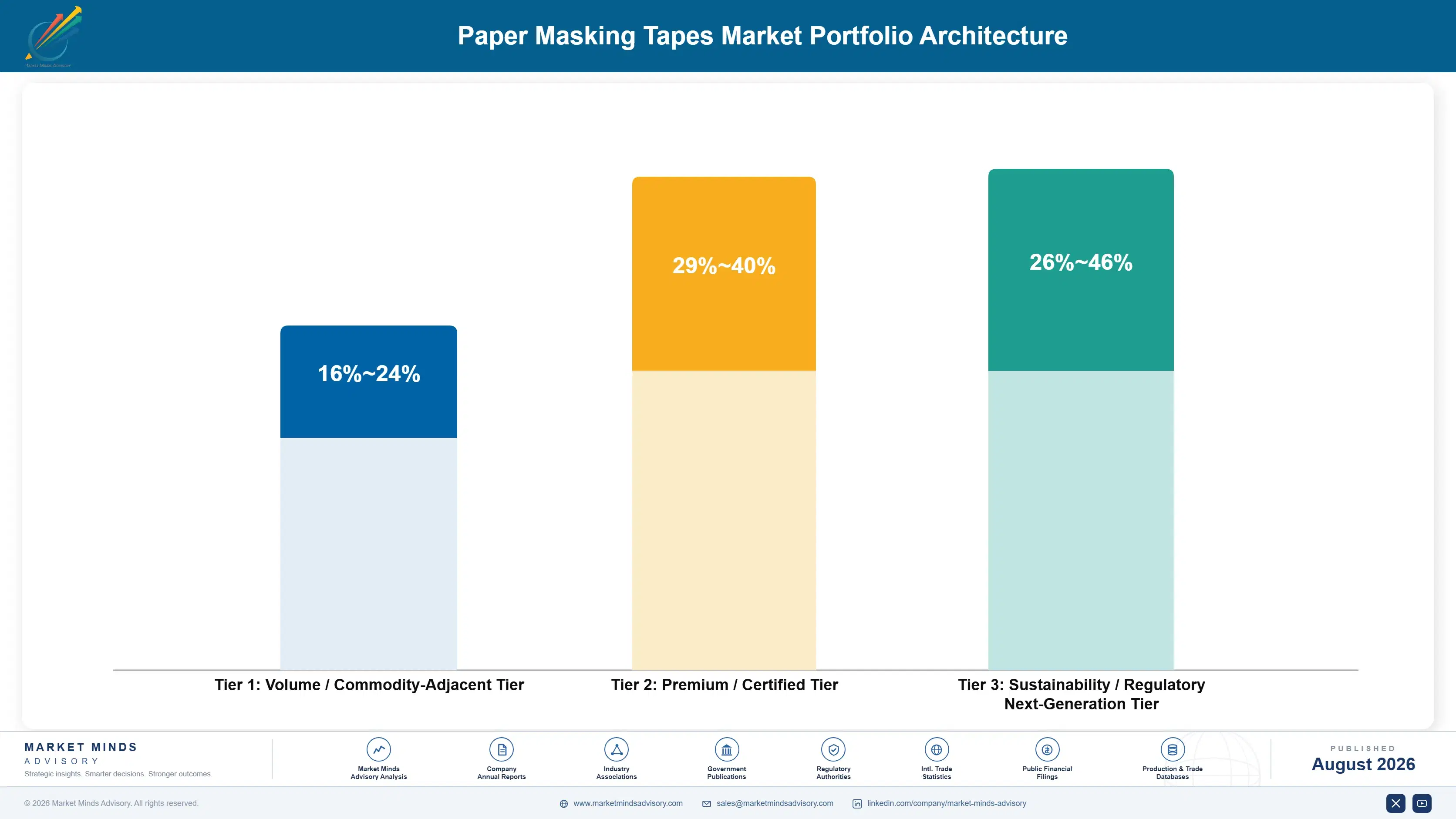
The portfolio separates on temperature tolerance and edge precision. General purpose decorating tape is commodity coating sold on price through distribution. Industrial and powder coating grades add thermal tolerance. High-temperature automotive tape adds adhesive chemistry engineered for clean removal after cross-linking. Fine line tape adds dimensional stability and edge sealing that serves a quite different failure mode.
The tension is between volume and qualification. General purpose tape fills coating lines and faces regional producers competing on price with minimal differentiation available. Specification-critical work carries the margin and consumes far less line time. A producer weighted entirely toward the second finds capacity idle, and one weighted toward the first finds itself in a contest that regional cost structures win.

High-value pools concentrate where removal failure is expensive and formulation is hard. High-temperature automotive tape, fine line precision product and any position where the producer has measured a customer's defect data all qualify, and none of them is decided on price per roll. What they share is a buyer in paint or production engineering rather than procurement, and that group compares defect rates rather than roll prices.

Volume / Commodity-Adjacent Tier

General purpose painter and decorator tapes sold through distribution on price per roll and width. Regional producers compete hardest here, differentiation is minimal, and the volume mainly exists to keep coating lines running at usable utilisation.
Gross Margin: 16-24%

Premium / Certified Tier

High-temperature automotive and industrial powder coating grades qualified against specific oven profiles and substrates. Adhesive chemistry and paint shop approval qualify the supplier, and those approvals reopen only at platform change.
Gross Margin: 29-40%

Sustainability / Regulatory / Next-Generation Tier

Water-based and hot-melt adhesive systems replacing solvent chemistry, plus fine line precision grades for multi-colour work. The wide margin range separates proven thermal performance from conversions still trading away temperature tolerance.
Gross Margin: 26-46%
paper-masking-tapes-market-portfolio-architecture-1787308380813

High-value Sub-segments and Strategic Watch-out

High-Temperature Automotive Masking Tapes

Compounding at 8.85% on bake ovens at 150 degrees and above and on electric vehicle platforms adding masked operations. Clean removal after thermal cross-linking is adhesive chemistry, which excludes converters buying adhesive externally. Approvals reopen at platform change and rarely otherwise, which makes timing worth more than pricing here.
Gross Margin: 31-40%

Fine Line and Precision Edge Tapes

Growing at 7.4% on two-tone and multi-colour finishing where a paint edge must survive inspection. The failure is visible on a finished vehicle rather than hidden, which makes buyers considerably more willing to specify properly here. Refinishing and custom work consume disproportionate volume relative to original assembly.
Gross Margin: 28-38%

General Purpose Decorating Tapes

The volume core at 3.6%, sold through distribution on price per roll against regional producers with lower cost structures. It keeps coating lines loaded and contributes very little margin above the cost of running them. Merchant shelf presence rather than any performance argument decides the sale here.
Gross Margin: 16-24%

Water-Based Adhesive Grades

The strategic watch-out. Solvent regulation is tightening and coating energy favours the conversion, but high-temperature automotive grades lose thermal performance in water-based chemistry and no producer has fully solved that. Coating energy savings favour the conversion anyway, so the pressure here is not going away.
Gross Margin: 22-42%

Consumed Every Shift, Requalified Rarely

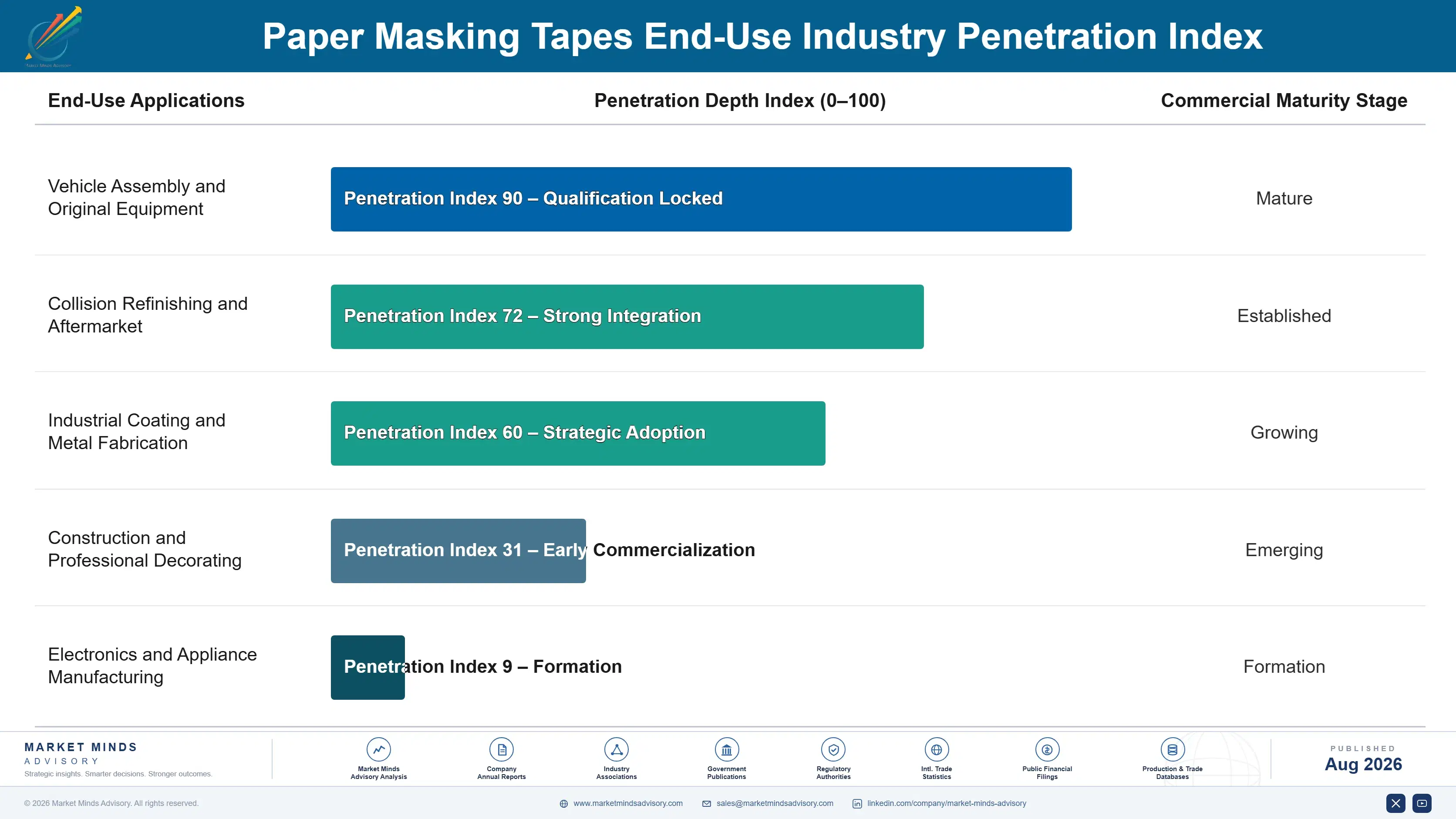
Revenue here is consumption-linked and unusually sticky at the top end. Tape is used up continuously against production volume, so reordering follows the manufacturing schedule without commercial process. In automotive, the qualification is tied to a paint shop's oven profiles and substrates and reopens only at platform change, which means an incumbent holds the position for the life of a vehicle programme rather than for a contract term. Reordering is administrative rather than commercial.
Depth varies by removal difficulty. Vehicle assembly paint shops buy deepest and specify hardest, since a residue failure writes off a finished panel. Collision refinishing buys steadily through distribution with high fine line consumption. Industrial powder coaters buy on thermal tolerance. Construction and decorating buys the largest volume at the lowest specification and switches supplier on price without hesitation.

The deciding population differs sharply by channel. Automotive specification sits with paint shop engineering, who will discuss adhesive chemistry seriously. Industrial specification sits with production. Decorating and construction buys through merchants where shelf presence and brand recognition decide the sale, and no technical argument reaches the user at all. A producer therefore needs three quite different commercial approaches rather than one.
paper-masking-tapes-market-end-use-penetration-index-1787308381715

Where Tape Producers Win

These are among the four positions where our research anticipates prominent divergence between winners and laggards over the coming forecast period. Each is grounded in the demand model, the regulatory perimeter, and the announced capacity pipeline.
01 / DEFECT DATA CORRELATION

Residue is logged as a paint defect, never a tape one

Rework from adhesive residue or paint bleed runs roughly 900 times the value of the tape that caused it, and the cost never reaches the buyer comparing price per roll because production records it as a finishing defect. Producers who obtain those records and correlate them against tape batch and application area turn an invisible problem into a measured one. The analysis costs days against a defect rate the customer has carried for years, and the resulting position holds until the platform itself changes.
02 / BAKE SCHEDULE TRIALLING

A datasheet rating is not an oven profile

Adhesive that releases cleanly at room temperature can cross-link during a bake and bond permanently to the surface it protected, and a published temperature rating tells nobody how it behaves in a specific oven at a specific dwell on a specific substrate. Producers who trial on the customer's real schedule solve what competitors merely describe. Ratings above 150 degrees are now routine, so most of these conversations remain ahead, because most incumbents were qualified against schedules that no longer exist.
03 / PLATFORM DEVELOPMENT ACCESS

Paint shop approvals reopen only when the vehicle changes

Battery enclosures, sealed penetrations and revised joining add masked operations that internal combustion bodies never carried, and automotive already represents 34% of market value. Platform conversion is running to published timetables at every major vehicle manufacturer, which makes the timing knowable in advance. Producers engaging during development write the specification rather than bidding against it, and a paint shop qualification rarely reopens once a vehicle programme has entered production, which makes development-stage access worth considerably more than any pricing advantage.
04 / ROBOTICS-PROOF APPLICATION TARGETING

Compete where accurate spraying solves nothing

Precision robotic application removes roughly 7% of masked area a year in the operations it can reach, and producers competing on general purpose masking lose that volume steadily without any way to contest it. Thermal protection, threaded and machined surface protection and multi-stage colour work sit outside what accurate paint placement addresses. Fine line tapes grow at 7.4% for the same underlying reason, since edge definition is a different requirement entirely, and those applications are growing rather than shrinking under automation.

Engagement Snapshot From the Field

A live engagement with an industry participant carrying material or product regulatory and market exposure ahead of a defining policy shift, showing how our research translates into a defensible multi-year portfolio strategy.
MARKET MINDS ADVISORY · CLIENT ENGAGEMENT SUMMARY
Paper Masking Tapes Producer Strategic Portfolio Review and Transition Roadmap 2026·Investment Scenario on Paper Masking Tapes Exposure Evaluation 2025-26
CLIENT PROFILE
A passenger vehicle manufacturer operating two assembly plants with combined output near 410,000 units annually, including a battery electric platform introduced in 2023 (client-reported, unverified by MMA). Masking tape was purchased on price per roll against a general specification, from two suppliers qualified in 2018 before the electric platform existed. No requalification had been carried out for the new platform.
STRATEGIC CHALLENGE
Refinishing rework on the electric platform ran materially above the internal combustion line and had risen through the year, costing an estimated EUR 3.8 million annually in labour and oven capacity (client-reported, unverified by MMA). Paint engineering attributed it to booth conditions, and two booth adjustments had produced no measurable improvement at all.
MMA APPROACH
MMA reviewed refinishing tickets across eighteen months, classifying each defect by type and by body location, and matched them against masking operations and tape batches. Tape performance was then tested against the electric platform's actual bake profile, which ran hotter and longer than the internal combustion schedule. Tape pricing across both suppliers was compared against the measured rework cost.
KEY FINDINGS
  1. Sixty-seven percent of the excess rework on the electric platform was adhesive residue or paint bleed at masked boundaries, and none of it had ever been recorded against tape rather than against paint.
  2. The electric platform bake schedule ran 22 degrees hotter and eleven minutes longer than the schedule the incumbent tape had been qualified against seven years earlier.
  3. Residue incidence clustered heavily on battery enclosure and sealed penetration masking, which were operations the original 2018 qualification had never contemplated at all.
  4. The annual price advantage of the incumbent tape across both plants was under EUR 40,000 against rework costs approaching a hundred times that figure.
CLIENT PROFILE
A passenger vehicle manufacturer operating two assembly plants with combined output near 410,000 units annually, including a battery electric platform introduced in 2023 (client-reported, unverified by MMA). Masking tape was purchased on price per roll against a general specification, from two suppliers qualified in 2018 before the electric platform existed. No requalification had been carried out for the new platform.
STRATEGIC CHALLENGE
Refinishing rework on the electric platform ran materially above the internal combustion line and had risen through the year, costing an estimated EUR 3.8 million annually in labour and oven capacity (client-reported, unverified by MMA). Paint engineering attributed it to booth conditions, and two booth adjustments had produced no measurable improvement at all.
MMA APPROACH
MMA reviewed refinishing tickets across eighteen months, classifying each defect by type and by body location, and matched them against masking operations and tape batches. Tape performance was then tested against the electric platform's actual bake profile, which ran hotter and longer than the internal combustion schedule. Tape pricing across both suppliers was compared against the measured rework cost.
KEY FINDINGS
  1. Sixty-seven percent of the excess rework on the electric platform was adhesive residue or paint bleed at masked boundaries, and none of it had ever been recorded against tape rather than against paint.
  2. The electric platform bake schedule ran 22 degrees hotter and eleven minutes longer than the schedule the incumbent tape had been qualified against seven years earlier.
  3. Residue incidence clustered heavily on battery enclosure and sealed penetration masking, which were operations the original 2018 qualification had never contemplated at all.
  4. The annual price advantage of the incumbent tape across both plants was under EUR 40,000 against rework costs approaching a hundred times that figure.
RECOMMENDED STRATEGY
Phase 1: Phase 1 (months 1 to 4): Requalify masking tape for the electric platform against its actual bake profile rather than the legacy specification. Phase 2: Phase 2 (months 4 to 11): Reclassify residue and bleed defects as tape defects in the quality system so the cost becomes visible. Phase 3: Phase 3 (months 11 to 18): Move tape specification to paint engineering and write clean removal performance into supply agreements.
OUTCOME
Excess rework on the electric platform fell by approximately 74% within five months of requalification (client-reported, unverified by MMA). Annual tape spend rose by roughly EUR 190,000 against recovered refinishing capacity worth many times that (client-reported, unverified by MMA). Masking tape is now requalified at every platform change rather than carried forward from the previous specification.

Frequently Asked Questions

Foundational context covering the market sizes, CAGR, scope, country, region and competition that inform every finding below. This section is provided to cover basics and most often pre-purchase conversations, answered from the MMA Primary Research Dataset.

What is the current size of the Paper Masking Tapes Market?

The global market was worth USD 3.9 billion in 2025, reaching USD 4.13 billion in 2026. East Asia holds the largest regional share at 31% of demand.

How large will the Paper Masking Tapes Market be by 2036?

MMA forecasts USD 7.33 billion by 2036, an expansion multiple of 1.77 times the 2026 base. That represents roughly USD 3.2 billion of incremental value.

What is the CAGR for the Paper Masking Tapes Market 2026 to 2036?

The base case compounds at 5.9% annually, with a bull case of 7.1% and a bear case of 4.7%. Historical growth from 2020 to 2025 ran at 4.8%.

Which segment is growing fastest?

High-temperature automotive masking tapes compound at 8.85%, exactly 1.50 times the market rate. Hotter bake ovens and electric vehicle platform conversion together drive that growth.

Who are the major companies in the Paper Masking Tapes Market?

3M, Nitto Denko, tesa, Shurtape Technologies and IPG hold a combined 49% of the market. Adhesive formulation depth and paint shop qualification sustain those positions.

Which country is growing fastest?

India compounds at 8.6%, ahead of every other national market. Vehicle and two-wheeler assembly volumes plus improving paint shop capability together drive that expansion forward.

Report Segmentation Architecture

The full report scope spans multiple orthogonal segmentation dimensions, with cross-tabulated demand data provided for each dimension pair. Coverage extends further to regional breakdowns, trend trajectories, and the competitive detail needed to support segment-level decision-making.

By Temperature Rating and Edge Performance

  • General Purpose Painter and Decorator Tapes
  • High-Temperature Automotive Masking Tapes
  • Fine Line and Precision Edge Tapes
  • Industrial and Powder Coating Masking Tapes
  • Low-Tack Delicate Surface Tapes
  • Paper Splicing and Core Starting Tapes

By End-Use Industry

  • Vehicle Assembly and Original Equipment
  • Collision Refinishing and Aftermarket
  • Industrial Coating and Metal Fabrication
  • Construction and Professional Decorating
  • Electronics and Appliance Manufacturing

By Commercial Dimension

  • Direct Supply to Vehicle Manufacturers
  • Industrial and Refinishing Distribution
  • Builders Merchant and Retail Channel
  • Private Label and Contract Coating Programmes

By Region

  • North America
  • Western Europe
  • East Asia
  • South Asia and Pacific
  • Latin America
  • Middle East and Africa
  • Eastern Europe

Scope, Methodology, and Coverage

Every figure in this report is reproducible from documented input assumptions. The scope below maps the historical period, the forecast horizon, the segmentation dimensions, and the countries covered, alongside the underlying primary and qualitative methodology.
Historical Period
2020 to 2025
Forecast Period
2026 to 2036
Base Year
2025 (USD billions; MMA Primary Research Dataset, August 2026)
Market Definition
The market covers pressure-sensitive masking tapes with crepe or flat paper backings, spanning general purpose painter and decorator tapes, high-temperature automotive masking tapes, fine line and precision edge tapes, industrial and powder coating masking tapes, low-tack delicate surface tapes, and paper splicing and core starting tapes, together with the application testing and qualification services supplied alongside them. Film-backed masking tapes, cloth and duct tapes, packaging and carton sealing tapes, foam and double-sided tapes, liquid masking products, and reusable masking fixtures are excluded. Sizing is measured at producer revenue in current prices.
Quantitative Units
USD billions (current prices); tape area in square metres and temperature ratings in degrees Celsius where applicable
Segmentation Dimensions
By Temperature Rating and Edge Performance; By End-Use Industry; By Commercial Dimension; By Region
Regions Covered
North America, Western Europe, East Asia, South Asia and Pacific, Latin America, Middle East and Africa, Eastern Europe
Countries Covered
USA, China, Germany, Japan, France, UK, Italy, South Korea, India, Spain, Canada, Brazil, Mexico, Indonesia, Vietnam, Thailand, Taiwan, Australia, UAE, Saudi Arabia, South Africa, Turkey, Poland, Netherlands, Sweden, Czech Republic, Slovakia, Hungary, Argentina, Colombia, and additional markets relevant to this sector
Key Companies Profiled
3M, Nitto Denko, tesa, Shurtape Technologies, IPG, Avery Dennison, Scapa Group, Berry Global, Lintec Corporation, Sekisui Chemical, Advance Tapes International, Beiersdorf, Nichiban, Tombow Pencil, Kikusui Tape, PPM Industries, Bolex Adhesive Products, Sichuan Chuanxi Tape, Yongguan Adhesive Products, Wenzhou Xinyu Tape
Quantitative Methodology
Primary survey, n=3,800 respondents, Q4 2025, six countries; demand-side model with trade association cross-validation
Qualitative Methodology
47 expert interviews, Q4 2025; applied to validate demand model assumptions, identify emerging dynamics, and assess competitive positioning
Report Format
PDF and XLSX data workbook (Word format preview document)
Publisher
Market Minds Advisory
Report Code
MMA-2026-PAC-878
Published
August 2026
Contact
sales@marketmindsadvisory.com | www.marketmindsadvisory.com

Purchase the full Paper Masking Tapes Market Report (2026 to 2036).

The full report sizes paper masking tapes across six performance classes, three commercial dimensions and seven regions, with annual forecasts to 2036 under base, bull and bear scenarios. Clean removal performance is tested against real bake profiles and substrates rather than datasheet ratings, which is where qualified tapes and adequate ones separate. Rework cost from residue and bleed is quantified against tape value by application. Electric vehicle platform masking requirements are mapped against manufacturer conversion timetables. Twenty producers are profiled on a consistent masking tape revenue basis.
Clean removal tested against real bake profiles and substrates
Rework cost from residue quantified against tape value
Electric vehicle masking requirements mapped to conversion timetables
Robotic paint application impact measured on masked area
Adhesive formulation capability assessed across the producer base
Powder coating cure schedules compared with tape temperature tolerance

Built For The People Who Decide

From boardroom strategy to bench-side execution, this report is read cover-to-cover by leaders shaping the next decade of their industry, turning demand scenarios, market dynamics and valuation benchmarks into decisions.
CXOs/ Presidents/ VPs/ Managers
M&A and Corporate Development
Strategy Teams and R&D Heads
Procurement and Product Directors
Regulatory and Compliance Leaders
Investor Relations and Equity Analysts