Market Minds Advisory
Paper Loading Machine Market

Paper Loading Machine Market: Trends and Forecast 2026 to 2036

Corrugated converters and printing houses are replacing manual pile handling with robotic loading systems as labor costs climb, while retrofit demand from aging press lines keeps builders competing on upgrade economics.

Lead Analyst

Bilal Shaikh

Published

September 2026

Make Smarter Decisions with Customized Research Insights

Request a free sample report and evaluate market opportunities, growth trends, and competitive dynamics relevant to your business needs.

2025 MARKET VALUE$2.1BMarket Size 2025
2036 FORECAST VALUE$3.9BBase Case , 2026 to 2036
CAGR 2026 TO 20365.8 %Bull 7.0% / Bear 4.6%
INCREMENTAL OPPORTUNITY$1.7BNet 10- year value creation
EXPANSION MULTIPLE1.76x2036 value over 2026 base
Strategic Levers
M&A Pipeline
Regional Outlook
Country Rankings
Competitive Intelligence
Segmental Deep-dive
Call-Us : 91 93563 13602

Executive Snapshot and Market Trajectory

Converters are replacing manual pile handling with automated loading systems as labor availability tightens and press speeds increasingly outpace what human operators can reliably feed by hand across long production shifts, especially inside high-volume corrugated board plants running continuously around the clock nationwide today across most producing regions worldwide.
Robotic loading adoption concentrates among large corrugated board converters chasing throughput gains and consistent feed accuracy, while China's expansive packaging manufacturing base drives the fastest regional volume growth worldwide by a clear margin. Retrofit demand from aging press installations is proving nearly as commercially significant as new machine sales, particularly among mid-sized converters reluctant to replace entire press lines outright given tight capital budgets and ongoing financing constraints across the broader sector.
Competition centers on established European and Japanese machine builders defending precision engineering reputations against faster-growing Chinese manufacturers undercutting heavily on price and delivery lead times nationwide across most export markets. Regulatory pressure around workplace safety and expanding equipment financing options are reshaping how converters justify capital purchases this cycle, tilting decisions toward automation sooner than most operators had planned or expected earlier this fiscal year overall.
Market Definition
The Paper Loading Machine Market covers equipment that automatically feeds sheets, reels, or corrugated board stock into printing presses and converting lines, including robotic, servo-driven, and semi-automatic loading systems. It excludes the printing presses and converting machinery themselves, as well as unrelated material handling equipment used outside paper and board processing.
Base Year Value
$2.1B in 2025 (MMA Primary Research Dataset, August 2026)
Forecast Period
2026 to 2036, eleven discrete annual values
CAGR
5.8% base case. Bull 7.0%. Bear 4.6%.
Fastest Growth Segment
Fully Automatic Robotic Loading Systems: 9.5% CAGR
Fastest Growth Country
China: 9.0% CAGR
Fastest Growth Region
South Asia and Pacific: 7.8% CAGR
Largest Region
East Asia: 30% of 2025 global value
Market Leaders
Leading participants include BOBST Group, Heidelberger Druckmaschinen, Koenig & Bauer, Komori Corporation, and Shanghai Everfaith Machinery.
Primary Survey
n=3,800 procurement and R&D decision-makers, Q4 2025, six countries
Methodology
Demand-side build-up, cross-validated against public data, 47 expert interviews

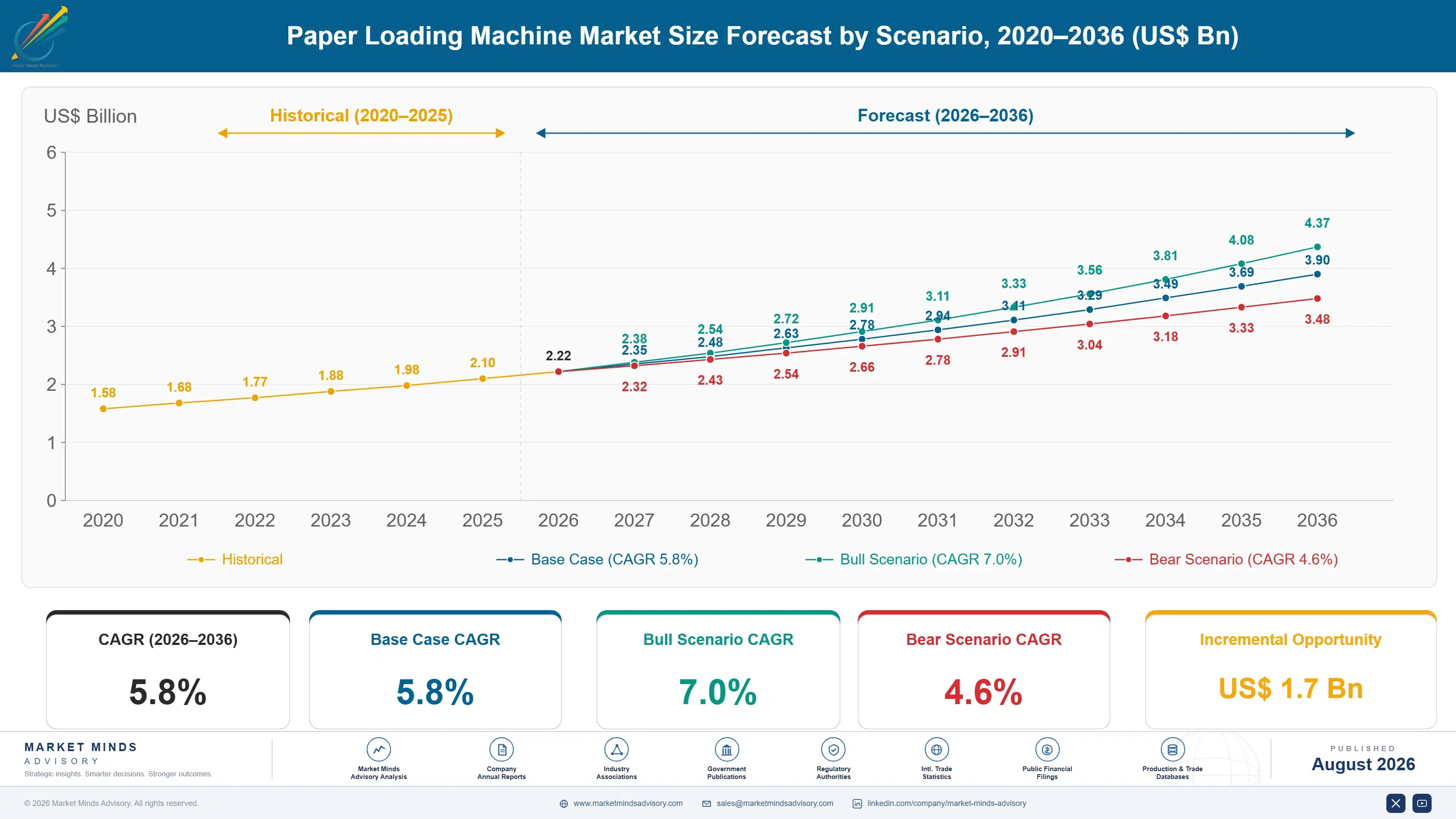
Paper Loading Machine Market Forecast Scenarios

paper-loading-machine-market-size-forecast-scenario-1787559061529
Between 2020 and 2025 the market grew at a 4.8% historical rate as converters resumed capital spending after pandemic-era delays, with demand recovering unevenly across regions before automation upgrades accelerated purchasing sharply in the final two years of the period, particularly among large corrugated board plants restarting expansion projects that had been shelved during the downturn.
The base case assumes continued labor cost pressure, rising press line speeds that manual feeding cannot reliably match, and expanding equipment financing programs that lower the entry barrier for mid-sized converters nationwide. Corrugated board demand tied to e-commerce packaging keeps utilization high enough to justify new capital equipment purchases rather than deferred maintenance spending. China's packaging manufacturing base sustains volume growth even as mature markets shift increasingly toward retrofit spending on existing press lines.
A bull case turns on faster-than-expected robotic loading adoption once payback periods fall under two years for large converters chasing labor savings and throughput gains simultaneously nationwide. A bear case centers on prolonged corrugated board demand softness or delayed press line capital budgets among mid-sized converters facing tighter credit conditions across the industry this cycle.

The Retrofit Economics Reshaping Loading Equipment Demand

Paper loading machine builders sell into a capital-intensive replacement cycle where press lines run for well over a decade before converters justify wholesale upgrades, and that extended lifespan makes retrofit kits a meaningful and growing revenue pool rather than a marginal add-on business for most established manufacturers competing in this space today, especially among mid-sized converters stretching capital budgets across multiple fiscal years.
MARKET CONCENTRATION35% CR5Top five machine builders hold combined revenue share
AVERAGE SELLING PRICE$180,000/unitTypical fully automatic loading system installed price point
TOP PRODUCING COUNTRY28% ChinaLargest manufacturing and consumption base for converting equipment worldwide today
CAPACITY UTILIZATION76%Average factory utilization among major equipment manufacturers globally
RETROFIT REVENUE SHARE34%Portion of revenue from upgrade kits rather than new units
INSTALLED BASE AGE11 yearsAverage age of press lines eligible for loading retrofits
China's converting equipment manufacturing base now rivals Germany's on raw unit volume, though European and Japanese builders retain the precision engineering reputation that commands premium pricing on fully automatic robotic systems sold into large corrugated board plants across developed markets worldwide today, particularly where feed accuracy tolerances matter most for high-speed digital and offset printing applications running continuous multi-shift operations.
Feedstock costs matter less here than in most industrial equipment categories; the real cost driver is skilled engineering labor and precision servo componentry sourced from a fairly concentrated global supplier base, which keeps machine builders meaningfully exposed to component lead time volatility whenever global semiconductor and motor supply chains tighten unexpectedly, forcing longer delivery quotes and occasional order backlogs across the industry.
"The machine builders still selling on nameplate speed alone are losing bids to competitors selling total cost of ownership. Retrofit economics, not new unit pricing, will decide who wins this decade."
Senior Analyst, Industrial Automation and Equipment Practice · MMA Construction and Industrial Equipment Practice · August 2026

Market Trends

Robotic Loading Systems Gain Share in Corrugated Converting Plants

Large corrugated board converters are installing robotic loading arms at a faster pace than any other segment of the market, driven by labor shortages and the need to sustain multi-shift operations without proportional headcount increases. Payback periods have fallen from roughly four years to under two and a half years for high-volume plants running above 20 million square meters annually, making the capital case easier to approve. Machine builders report order backlogs extending six to nine months for robotic configurations, a clear signal that adoption is outpacing current manufacturing capacity across leading suppliers.
Market Impact: E-commerce lifts board demand 4.5% yearly
Retrofit Kits Extend Revenue Life of Aging Press Installations

Converters operating press lines older than ten years increasingly choose modular retrofit loading kits over full machine replacement, preserving existing capital investment while still gaining meaningful throughput and accuracy improvements overall. Retrofit kits typically cost 30 to 40% of a comparable new machine while delivering most of the same feed accuracy gains, which has made them the default choice for mid-sized converters facing tight capital budgets. Machine builders have responded by expanding dedicated retrofit engineering teams, recognizing that this revenue stream now rivals new unit sales in some regional markets.
Market Impact: Payback fell to under 3 years

Market Opportunities and Growth Drivers

E-Commerce Packaging Demand Sustains Corrugated Board Capacity Expansion

Global e-commerce parcel volume continues expanding faster than overall retail sales, and every additional shipment requires corrugated board packaging produced on lines that depend on reliable, high-speed loading equipment. Converters expanding capacity to meet this demand are specifying automated loading systems by default rather than retrofitting manual stations onto new lines, since the incremental cost difference has narrowed considerably. Industry estimates suggest corrugated board consumption grew roughly 4.5% annually over the past three years, directly supporting new press line and loading equipment orders across major producing regions including China, the United States, and Germany.
Market Impact: Robotic systems exceed $200,000 per unit

Labor Cost Pressure Accelerates Automation Investment Across Converters

Manual pile loading remains physically demanding work that has grown harder to staff as manufacturing labor pools tighten across developed economies, pushing converters toward automation even at plants that had previously resisted capital upgrades. Wage inflation in converting plant operations has outpaced general manufacturing wage growth in several major markets, compressing the payback period on automated loading systems from roughly four years to under three. Converters citing labor availability as their primary automation driver rose meaningfully in recent surveys, ahead of throughput or quality considerations that historically dominated purchasing decisions.
Market Impact: Installation delays stretch beyond 3 months

Market Restraints and Challenges

High Upfront Capital Costs Limit Small Converter Adoption Rates

Fully automatic robotic loading systems carry price tags exceeding $200,000 per unit, a barrier that keeps many small and mid-sized converters locked into manual or semi-automatic loading well past the point where automation would improve throughput. The root cause is that servo componentry and precision engineering do not scale down proportionally in cost, since small converters buy in units of one or two machines rather than fleet orders. Some builders are exploring leasing arrangements and financing partnerships with equipment lenders to lower the entry barrier, though these programs remain limited to a handful of markets so far.
Market Impact: Robotic loading orders up 40%

Skilled Technician Shortages Slow Installation and Maintenance Timelines

Automated loading systems require trained technicians for installation, calibration, and ongoing maintenance, and the pool of workers with both mechanical and servo control expertise has not kept pace with equipment sales growth. This shortage is rooted in a broader industrial automation labor gap affecting multiple equipment categories simultaneously, not something specific to paper handling alone, which makes it harder for individual machine builders to solve unilaterally. Several manufacturers have responded by expanding remote diagnostic capabilities and offering extended training programs to converter maintenance staff, partially offsetting installation delays that had stretched beyond three months in some regions.
Market Impact: Retrofit kits cost 30-40% less
3 additional market trends, 4 additional growth drivers, and 2 additional restraints and challenges are covered in the full report. Contact sales@marketmindsadvisory.com to access the complete intelligence.

Segment CAGR and Growth Architecture

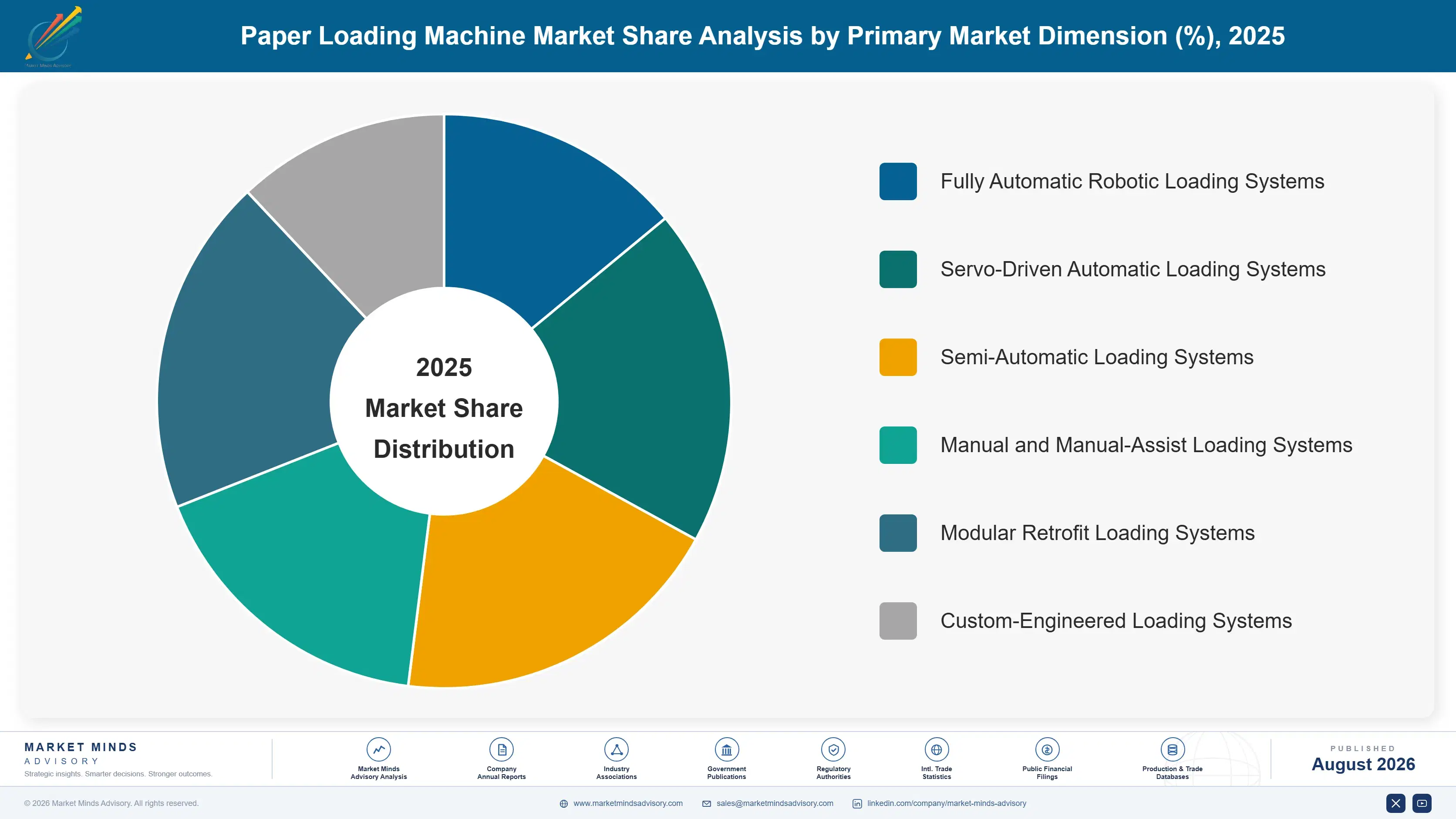
The Paper Loading Machine Market segments by automation type, spanning fully robotic systems through manual-assist stations and modular retrofit kits nationwide. Converters increasingly evaluate loading equipment on total cost of ownership rather than nameplate speed alone, a shift that favors automated segments over traditional manual and semi-automatic configurations across most producing regions worldwide today.
paper-loading-machine-market-market-share-analysis-1787559062112

Fully Automatic Robotic Loading Systems

Fully automatic robotic loading systems represent the fastest-growing segment, expanding at 9.5% annually as large corrugated board converters prioritize throughput and consistent feed accuracy over manual station costs. These systems integrate directly with press line control software, allowing operators to adjust feed timing without manual recalibration between production runs. Adoption concentrates among plants running above 20 million square meters of annual output, where labor savings justify the higher upfront capital outlay within roughly two to three years. Order backlogs for robotic configurations now extend six to nine months at several leading machine builders, reflecting demand that has outpaced current manufacturing capacity across the supplier base, particularly in China and Germany.
CAGR 9.5%

Modular Retrofit Loading Systems

Modular retrofit loading systems form the second-fastest segment, growing at 8.0% annually as converters operating press lines older than ten years choose upgrade kits over full machine replacement rather than new installations entirely. Retrofit kits typically cost 30 to 40% of a comparable new machine while delivering most of the same accuracy and throughput gains, making them the default choice for mid-sized converters facing tight capital budgets industrywide today. Machine builders have responded by expanding dedicated retrofit engineering teams and field service networks, since this segment increasingly rivals new unit sales in mature regional markets where installed base age already exceeds a decade on average across most producing countries globally.
CAGR 8.0%
Full segment breakdown across 6 segments available in the complete report.

Regional Architecture and Country Demand Map

Regional demand mirrors where converting capacity is expanding fastest today across the world. East Asia leads on manufacturing scale, North America and Western Europe compete on precision engineering reputation, and South Asia and Pacific posts the fastest growth rate off a comparatively smaller installed automation base.

North America

North America's converters are consolidating loading equipment purchases around fewer, larger corrugated board plants as smaller regional mills close or get acquired by national packaging groups. Labor shortages in manufacturing hubs across the Midwest and Southeast have pushed automation adoption ahead of schedule at several major packaging companies operating multi-shift facilities. Retrofit demand remains strong here too, since much of the installed press base dates back fifteen years or more and still delivers acceptable output quality. Equipment financing programs, increasingly common among regional banks serving mid-sized manufacturers, have lowered the capital barrier for converters previously locked out of automated loading by upfront cost alone, sustaining steady order volume through the current investment cycle.
Share: 26% | CAGR: 6.5% (2026 to 2036)

Western Europe

Precision engineering heritage keeps Western Europe's machine builders competitive even as China gains meaningful unit volume share globally across most equipment categories and price points. Germany and Italy together host several of the sector's most established manufacturers, whose reputations for feed accuracy command premium pricing on export orders into Asia and the Americas alike. Growth here trails the global average because the installed base is already highly automated, leaving less headroom for new unit sales relative to retrofit and service revenue streams across the region. Workplace safety regulation across the European Union continues pushing remaining manual stations toward automation, a slower but steady source of incremental order volume across the region this decade.
Share: 20% | CAGR: 4.2% (2026 to 2036)
Regional intelligence for 5 additional markets available in the complete report: East Asia, South Asia and Pacific, Latin America, Middle East and Africa, Eastern Europe. Contact sales@marketmindsadvisory.com.
paper-loading-machine-market-country-cagr-analysis-1787559062645

Where Machine Builders Can Capture Retrofit Margin

Machine builders that treat retrofit kits and aftermarket service as core revenue rather than a defensive afterthought are capturing margin pools that new unit competition on price has largely eroded across most regions worldwide today. The levers below identify where converters will actually pay for demonstrated throughput gains over nameplate specifications alone this cycle.

Modular Retrofit Kits for Aging Press Lines

Converters operating press lines older than ten years increasingly prefer modular retrofit kits over full machine replacement, and builders offering standardized kits compatible across multiple press brands capture disproportionate share of this growing pool. Retrofit kits typically price at 30 to 40% of a comparable new machine while delivering most of the accuracy gains, making margin per engineering hour higher than new unit sales in many cases. Builders with dedicated retrofit engineering teams are winning repeat business from converters who return for additional line upgrades within eighteen to twenty-four months of the first installation.
Market Impact: Retrofit kits add 8 to 12 points of gross margin

Remote Diagnostics and Predictive Maintenance Contracts

Offering remote diagnostic monitoring and predictive maintenance contracts alongside equipment sales creates recurring service revenue that smooths the cyclicality of new unit orders considerably across the entire business cycle. Converters value reduced unplanned downtime enough to pay ongoing service fees, particularly at high-volume plants where an hour of stopped production carries a meaningful cost. Builders bundling these contracts into initial equipment sales report renewal rates exceeding 80% after the first three-year term, converting a one-time capital sale into a durable annuity revenue stream worth pursuing aggressively across the installed base.
Market Impact: Service contracts add 15 to 20% recurring revenue

Financing Partnerships to Reach Mid-Sized Converters

Partnering with equipment lenders to offer structured financing gives mid-sized converters access to fully automatic loading systems previously out of reach given upfront capital costs exceeding $200,000 per unit for many buyers. Builders that co-develop financing packages with lenders close deals faster and at higher average selling prices than those requiring full cash payment upfront, since converters can spread costs against realized labor savings over time. This lever matters most in regions where equipment financing remains underdeveloped relative to North America and Western Europe, creating meaningful whitespace for early movers willing to build lender relationships.
Market Impact: Financing partnerships lift average deal size 10 to 15%

Export Expansion Into Underserved Growth Markets

Machine builders expanding direct sales and service presence into India, Vietnam, and Indonesia are capturing share ahead of competitors still relying solely on regional distributors unfamiliar with local converter needs and purchasing habits nationwide. These markets are skipping semi-automatic stages entirely and buying servo-driven or fully automatic systems directly, rewarding builders who can offer local language support and much faster spare parts delivery nationwide too. Establishing regional service hubs requires upfront investment of roughly $2 million to $4 million but positions builders to capture growth running well above the global average CAGR over the coming decade.
Market Impact: Export markets grow 2 to 3 points faster annually

Who Controls the Margin Pool

The top five machine builders hold an estimated 35% of global revenue, a moderate concentration leaving room for regional specialists competing on price rather than engineering precision. BOBST Group leads on sheet-fed and packaging converting revenue, with Heidelberger Druckmaschinen close behind on its global press installation base. The gap between these two leaders and the next tier of Chinese manufacturers remains wide on precision and service reputation, though narrower each year on unit price.
Competitive activity centers on robotic loading launches, expanded retrofit kit compatibility across competitor press brands, and growing investment in remote diagnostic platforms that lock converters into long-term maintenance contracts. Chinese manufacturers are winning share in Southeast Asia and Latin America through aggressive pricing and shorter delivery times, forcing European builders to defend premium positioning with demonstrated cost of ownership advantages rather than price matching directly.

Emerging pressure comes from mid-tier Chinese builders closing the feed accuracy gap faster than expected, threatening premium pricing across servo-driven and semi-automatic segments within the next several years. Rankings could shift if a major Chinese manufacturer secures a large European or North American converter reference account, which would validate quality claims that currently limit their addressable market to price-sensitive buyers.
paper-loading-machine-market-company-positioning-matrix-1787559063170

Competitive Moat and Risk Dimensions

BOBST GROUP

Moat: Integrated Packaging Converting Expertise

BOBST designs loading systems as part of a fully integrated converting line rather than a standalone component, giving it deeper engineering relationships with large corrugated board and folding carton converters. This systems-level positioning makes it harder for standalone loading equipment competitors to displace BOBST once a converter commits to its broader line architecture.
BOBST GROUP

Risk: Exposure to Packaging Capex Cycles

BOBST's revenue concentration in packaging converting equipment leaves it more exposed to swings in corrugated board and folding carton capital spending than diversified competitors serving multiple printing press categories. A downturn in packaging capacity expansion would hit BOBST's order book harder than rivals with broader end-market exposure.
HEIDELBERGER DRUCKMASCHINEN

Moat: Global Press Installation Base

Heidelberger Druckmaschinen's decades-long installed base of printing presses worldwide creates a durable retrofit and service revenue stream that new entrants cannot replicate without decades of prior unit sales. This installed base advantage extends naturally into loading equipment upgrades sold as part of ongoing press modernization programs.
HEIDELBERGER DRUCKMASCHINEN

Risk: Declining Traditional Print Press Demand

Heidelberg's core printing press business faces sustained pressure as commercial print volumes decline in mature markets, and new press unit sales matter for anchoring loading equipment attach rates. Slower press replacement cycles could gradually shrink the installed base Heidelberg depends on for future retrofit and service revenue.

Players Tracked

Prominent Players

BOBST Group
Heidelberger Druckmaschinen
Koenig & Bauer
Komori Corporation
Shanghai Everfaith Machinery

Other Key Players

MBO Group
Muller Martini
Polar
Duplo International
Horizon International
Fosber Group
BW Papersystems
MarquipWardUnited
EAM-Mosca Corporation
Kolbus GmbH
Baumer hhs
Guangdong Baiyun Machinery
Zhejiang Sun Cheer Machinery
Shanghai Unicorn Printing Machinery
Manroland Goss

Recent Developments

MARCH 2025

BOBST Group opened a new manufacturing facility in Shanghai dedicated to robotic loading system assembly, expanding regional production capacity to meet rising demand from Chinese and Southeast Asian corrugated board converters. The facility adds meaningful annual unit output and shortens delivery lead times considerably for buyers across the Asia-Pacific region.
Signal: This capacity expansion signals BOBST's growing commitment to competing directly on regional delivery speed and pricing.
JULY 2025

Heidelberger Druckmaschinen signed a multi-year supply agreement with a major European converter group to provide retrofit loading kits across the group's twelve press installations nationwide. The agreement includes ongoing remote diagnostic service, reflecting Heidelberg's push toward recurring revenue models rather than one-time equipment sales alone.
Signal: This agreement signals Heidelberg's clear strategic shift toward bundled service and retrofit-based recurring revenue streams overall.
OCTOBER 2025

Koenig & Bauer completed the acquisition of a smaller German servo-drive component manufacturer, bringing precision motion control engineering fully in-house rather than sourcing it from third-party suppliers. The move is expected to reduce component lead times and improve margin on fully automatic loading system configurations.
Signal: This vertical integration into servo componentry meaningfully reduces Koenig & Bauer's exposure to external supply chains.

Servo Componentry and Precision Engineering Cost Exposure

Servo motors, precision gearing, and control electronics together represent roughly 45 to 55% of a fully automatic loading system's bill of materials, sourced primarily from a concentrated group of German, Japanese, and Taiwanese component manufacturers. Structural steel framing and sensors make up most of the remainder, with steel pricing exposed to global commodity price swings.
Global semiconductor supply constraints during 2022 and 2023 caused servo drive lead times to stretch from roughly eight weeks to over six months at several major component suppliers, according to IEA supply chain reporting on industrial electronics. Machine builders largely absorbed higher component costs during this period rather than passing them fully to converters, compressing margins on new unit sales considerably before conditions gradually normalized through 2024.

Smaller machine builders without long-term component supply agreements face meaningfully higher exposure to price volatility than the top five players, who negotiate volume-based contracts directly with servo manufacturers well in advance. Chinese builders sourcing domestically produced components face less exposure to international shipping and currency risk than European competitors, giving them a cost advantage that partially explains their aggressive regional pricing strategy today.
paper-loading-machine-market-cost-volatility-analysis-1787559063372

Long-Term Volume Contracts With Servo Suppliers

Machine builders negotiating multi-year volume commitments with servo motor and control electronics suppliers secure priority allocation during supply constraints and typically lock in favorable pricing well ahead of spot market fluctuations across the industry. This approach requires accurate demand forecasting but has proven the most reliable hedge against component lead time volatility for most established builders.

Diversifying Component Sourcing Across Regions

Builders qualifying secondary servo and electronics suppliers across Japan, Taiwan, and domestic Chinese markets reduce dependence on any single supply chain disruption event affecting production schedules nationwide and beyond. This diversification adds qualification costs and engineering time upfront but meaningfully shortens recovery time when a primary supplier faces unexpected capacity constraints or shipping delays.

Vertical Integration Into Servo Drive Manufacturing

A small number of larger builders are acquiring or building in-house servo drive manufacturing capability, trading upfront capital investment for long-term control over component cost and delivery lead time overall and consistently across cycles. This approach works best for builders with sufficient annual unit volume to justify dedicated production capacity and specialized engineering staff.

Portfolio Architecture for Margin Defence

Machine builders organize their product lines across a clear tier architecture, from commodity semi-automatic stations sold on price to fully automatic robotic systems commanding substantial engineering margin across the entire range. Gross margins vary dramatically across these tiers, and the industry's real profit pool concentrates disproportionately at the premium end where feed accuracy and integration complexity justify meaningfully higher pricing.
Volume tier competition centers almost entirely on unit price and delivery speed, an arena where Chinese manufacturers now compete effectively against established regional players on largely equal footing across most markets today. Premium tier competition instead rewards demonstrated total cost of ownership advantages, service network depth, and integration expertise that smaller manufacturers struggle to replicate without years of engineering investment behind them.

The tension between volume and premium positioning shapes capital allocation decisions across nearly every major builder, since chasing volume share erodes the margin advantage that funds ongoing engineering investment considerably over time. Builders that successfully defend premium positioning while still competing selectively on volume tend to sustain higher blended margins than those forced to choose one strategy exclusively across their entire product line.

Semi-automatic and manual-assist loading stations sold primarily on price to small and mid-sized converters with limited automation budgets, shorter equipment lifecycles, and less demanding throughput requirements across most regional markets.
Gross Margin

Servo-driven and fully automatic robotic systems sold to large converters prioritizing feed accuracy, throughput, and integration with existing press line control software across high-volume corrugated board and folding carton plants.
Gross Margin

Retrofit kits, remote diagnostics, and predictive maintenance contracts sold as recurring revenue extensions to converters modernizing aging installed press bases nationwide rather than pursuing full machine replacement programs of any kind.
Gross Margin
paper-loading-machine-market-portfolio-architecture-1787559063883

High-value Sub-segments and Strategic Watch-out

Robotic Loading Systems for High-Volume Corrugated Plants

Fully automatic robotic loading commands the highest margin and fastest growth simultaneously, concentrated among large converters running above 20 million square meters of annual output where labor savings justify premium pricing and rapid capital payback within roughly two to three years across most major producing regions worldwide.

Modular Retrofit Kits for Mid-Sized Converters

Retrofit kits deliver strong margin on engineering hours with moderate but steady growth, serving converters extending the life of press lines older than ten years rather than replacing them entirely, a segment now rivaling new unit sales in several mature regional markets across Western Europe and North America.

Semi-Automatic Loading Systems for Smaller Plants

Semi-automatic systems remain the volume core of the market, generating steady but slower-growing revenue from small and mid-sized converters unable to justify fully automatic capital costs yet, particularly across South Asia, Latin America, and Eastern Europe where equipment financing options remain comparatively limited and underdeveloped today.

Manual-Assist Stations Facing Long-Term Displacement Risk

Manual-assist stations face gradual displacement as labor costs rise and financing options expand automation access, making this segment a strategic watch-out for builders still dependent on its revenue as replacement demand slows meaningfully across most mature developed markets over the coming several years ahead nationwide.

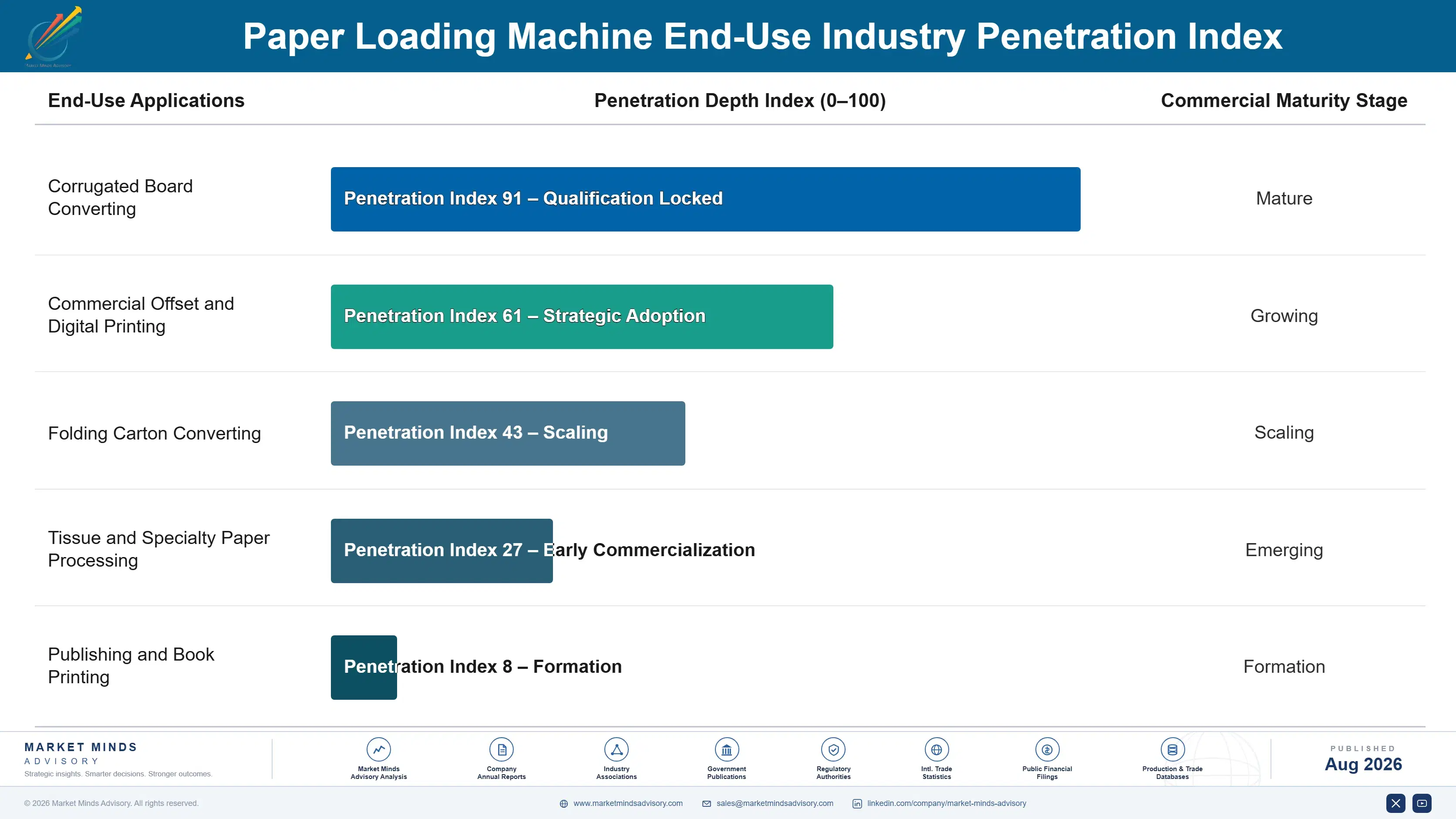
The Retrofit Annuity Driving Loading Demand

Loading equipment generates a genuine annuity economics profile once installed, since press lines run for a decade or more and converters return repeatedly for retrofit kits, spare parts, and diagnostic service contracts rather than one-time capital purchases alone across the entire product lifecycle. Machine builders capturing this recurring revenue stream sustain more stable margins through cyclical downturns than those dependent solely on new unit sales.
Adoption stickiness varies meaningfully by end-use vertical: large corrugated board converters running continuous multi-shift operations adopt automation aggressively and rarely revert to manual stations once committed, while smaller specialty print shops with lower utilization rates remain price-sensitive and slower to upgrade equipment. Folding carton converters sit between these extremes, adopting automation selectively where feed accuracy directly affects finished product quality.

A generational shift in buyer profiles is underway as procurement decisions move from plant floor supervisors focused on nameplate speed toward finance and operations executives evaluating total cost of ownership and labor savings explicitly and consistently. Younger plant managers entering the industry show markedly less resistance to robotic systems than predecessors trained exclusively on manual and semi-automatic equipment throughout their careers.
paper-loading-machine-market-end-use-penetration-index-1787559064378

Verdict on Automation Investment Priority

These are among the four positions where our research anticipates prominent divergence between winners and laggards over the coming forecast period. Each is grounded in the demand model, the regulatory perimeter, and the announced capacity pipeline.
01 / ROBOTIC LOADING INVESTMENT

Prioritize Robotic Systems for High-Volume Corrugated Plants

Fully automatic robotic loading systems deliver the strongest return for large converters running above 20 million square meters of annual output, where labor savings alone justify capital costs within roughly two to three years across most facilities nationwide. Builders should prioritize expanding manufacturing capacity for this segment given order backlogs already extending six to nine months at leading suppliers worldwide. Converters delaying this investment risk ceding meaningful throughput advantages to competitors who commit early to automated feed accuracy at scale.
02 / RETROFIT PORTFOLIO EXPANSION

Build Dedicated Retrofit Engineering Teams Now

Retrofit kits now rival new unit sales in mature markets, and builders without dedicated retrofit engineering teams are ceding this growing margin pool to competitors who invested earlier in modular, cross-brand compatible kits designed for multiple press platforms. This segment requires different sales and service skills than new equipment, so builders should staff and train separately rather than treating retrofit as a secondary product line. The payoff compounds steadily as installed base age climbs across most developed regions over time.
03 / CHINA MARKET EXPANSION

Establish Direct Presence in China Before Rivals Do

China's converting equipment manufacturing base has grown large enough that Western builders relying solely on regional distributors are steadily losing ground to domestic manufacturers with direct customer relationships and faster local service response times nationwide. Establishing local manufacturing or assembly presence would shorten delivery times and demonstrate the long-term commitment that Chinese converters increasingly expect from equipment suppliers competing for their business. Builders that wait risk permanently ceding this fast-growing market to domestic competitors closing the quality gap each year.
04 / SERVICE REVENUE DIVERSIFICATION

Bundle Remote Diagnostics Into Every New Equipment Sale

Remote diagnostic and predictive maintenance contracts convert one-time equipment sales into recurring annuity revenue that smooths cyclical demand swings considerably across market downturns and capital spending pauses nationwide overall. Builders bundling these services from the point of initial sale report renewal rates exceeding 80% after the first three-year term, a durable revenue stream that competitors selling equipment alone cannot easily replicate. This lever matters most as new unit sales growth gradually moderates toward the back half of the forecast period.

Engagement Snapshot From the Field

A live engagement with an industry participant carrying material or product regulatory and market exposure ahead of a defining policy shift, showing how our research translates into a defensible multi-year portfolio strategy.
MARKET MINDS ADVISORY · CLIENT ENGAGEMENT SUMMARY
Paper Loading Machine Producer Strategic Portfolio Review and Transition Roadmap 2026·Investment Scenario on Paper Loading Machine Exposure Evaluation 2025-26
CLIENT PROFILE
The client operates a mid-sized corrugated board converting group with six plants across Western Europe, serving retail and food and beverage packaging customers under long-term supply contracts. Facing rising labor costs and increasing pressure from larger competitors already running automated loading systems, the group's operations leadership sought an independent assessment of which plants would benefit most from robotic loading investment ahead of a multi-year capital planning cycle.
STRATEGIC CHALLENGE
The group faced a choice between phased robotic loading investment across its highest-volume plants or a broader, slower rollout of semi-automatic upgrades across all six sites simultaneously. Internal capital planning teams disagreed on prioritization, and the group lacked independent benchmarking data comparing payback periods across plants with differing utilization rates and labor cost structures.
MMA APPROACH
MMA conducted a plant-by-plant utilization and labor cost analysis across all six facilities, benchmarked payback periods against comparable European converters, and interviewed operations directors at three peer groups regarding their own automation rollout sequencing decisions. The engagement combined primary survey data with direct plant-level financial modeling to produce a prioritized capital allocation framework.
KEY FINDINGS
  1. Two of the group's six plants showed payback periods under two years for robotic loading investment, while the remaining four exceeded four years given lower utilization rates.
  2. Labor cost inflation at the group's German and Dutch plants outpaced its French and Spanish facilities meaningfully, directly shifting the automation payback calculation across sites.
  3. Peer group interviews revealed that phased rollout starting with highest-utilization plants reduced overall capital risk compared to simultaneous multi-site deployment approaches attempted elsewhere.
  4. Retrofit kits proved more cost-effective than full robotic replacement at three of the group's older plants, given their remaining useful press line life.
CLIENT PROFILE
The client operates a mid-sized corrugated board converting group with six plants across Western Europe, serving retail and food and beverage packaging customers under long-term supply contracts. Facing rising labor costs and increasing pressure from larger competitors already running automated loading systems, the group's operations leadership sought an independent assessment of which plants would benefit most from robotic loading investment ahead of a multi-year capital planning cycle.
STRATEGIC CHALLENGE
The group faced a choice between phased robotic loading investment across its highest-volume plants or a broader, slower rollout of semi-automatic upgrades across all six sites simultaneously. Internal capital planning teams disagreed on prioritization, and the group lacked independent benchmarking data comparing payback periods across plants with differing utilization rates and labor cost structures.
MMA APPROACH
MMA conducted a plant-by-plant utilization and labor cost analysis across all six facilities, benchmarked payback periods against comparable European converters, and interviewed operations directors at three peer groups regarding their own automation rollout sequencing decisions. The engagement combined primary survey data with direct plant-level financial modeling to produce a prioritized capital allocation framework.
KEY FINDINGS
  1. Two of the group's six plants showed payback periods under two years for robotic loading investment, while the remaining four exceeded four years given lower utilization rates.
  2. Labor cost inflation at the group's German and Dutch plants outpaced its French and Spanish facilities meaningfully, directly shifting the automation payback calculation across sites.
  3. Peer group interviews revealed that phased rollout starting with highest-utilization plants reduced overall capital risk compared to simultaneous multi-site deployment approaches attempted elsewhere.
  4. Retrofit kits proved more cost-effective than full robotic replacement at three of the group's older plants, given their remaining useful press line life.
RECOMMENDED STRATEGY
Phase 1: Phase one: install robotic loading systems at the two highest-utilization plants within twelve months, funded through existing capital reserves and savings. Phase 2: Phase two: deploy retrofit kits at three mid-utilization plants within eighteen months, extending press line life without full replacement cost. Phase 3: Phase three: reassess the lowest-utilization plant's automation case at the eighteen-month mark based on realized labor cost and utilization trends.
OUTCOME
The group completed phase one within ten months, ahead of schedule, and reported a 22% reduction in per-unit labor cost at the two automated plants within the first year of operation, exceeding its original internal cost savings projections by a meaningful margin (client-reported, unverified by MMA).

Frequently Asked Questions

Foundational context covering the market sizes, CAGR, scope, country, region and competition that inform every finding below. This section is provided to cover basics and most often pre-purchase conversations, answered from the MMA Primary Research Dataset.

What is the current size of the Paper Loading Machine Market?

The Paper Loading Machine Market reached 2.1 billion dollars in 2025. Robotic loading adoption and rising retrofit demand from aging press lines continue to drive equipment orders across major converting regions.

How large will the Paper Loading Machine Market be by 2036?

The market is projected to reach approximately 3.9 billion dollars by 2036. This nearly doubles the 2026 base as automation adoption accelerates across corrugated board converting plants worldwide.

What is the CAGR for the Paper Loading Machine Market 2026 to 2036?

The market is forecast to grow at a 5.8% compound annual rate between 2026 and 2036. This compares with a 4.8% historical rate recorded between 2020 and 2025.

Which segment is growing fastest?

Fully Automatic Robotic Loading Systems is the fastest growing segment, expanding at 9.5% annually. That is roughly 1.6 times the overall market rate as converters prioritize throughput and labor savings.

Who are the major companies in the Paper Loading Machine Market?

Leading participants include BOBST Group, Heidelberger Druckmaschinen, Koenig & Bauer, Komori Corporation, and Shanghai Everfaith Machinery. Together the top five hold an estimated 35% combined share on a revenue basis.

Which country is growing fastest?

China is the fastest growing country market, expanding at 9.0% annually. Its converting equipment manufacturing base now rivals established European suppliers on raw production volume.

Report Segmentation Architecture

The full report scope spans multiple orthogonal segmentation dimensions, with cross-tabulated demand data provided for each dimension pair. Coverage extends further to regional breakdowns, trend trajectories, and the competitive detail needed to support segment-level decision-making.

By Primary Market Dimension

  • Fully Automatic Robotic Loading Systems
  • Servo-Driven Automatic Loading Systems
  • Semi-Automatic Loading Systems
  • Manual and Manual-Assist Loading Systems
  • Modular Retrofit Loading Systems
  • Custom-Engineered Loading Systems

By End-Use Industry

  • Corrugated Board Converting
  • Commercial Offset and Digital Printing
  • Folding Carton Converting
  • Tissue and Specialty Paper Processing
  • Publishing and Book Printing

By Commercial Dimension

  • New Equipment Sales
  • Retrofit and Upgrade Kits
  • Remote Diagnostics and Maintenance Contracts
  • Direct Sales Channels
  • Distributor and Dealer Channels

By Region

  • North America
  • Western Europe
  • East Asia
  • South Asia and Pacific
  • Latin America
  • Middle East and Africa
  • Eastern Europe

Scope, Methodology, and Coverage

Every figure in this report is reproducible from documented input assumptions. The scope below maps the historical period, the forecast horizon, the segmentation dimensions, and the countries covered, alongside the underlying primary and qualitative methodology.
Historical Period
2020 to 2025
Forecast Period
2026 to 2036
Base Year
2025 (USD billions; MMA Primary Research Dataset, August 2026)
Market Definition
The Paper Loading Machine Market covers equipment that automatically feeds sheets, reels, or corrugated board stock into printing presses and converting lines, including robotic, servo-driven, and semi-automatic loading systems. It excludes the printing presses and converting machinery themselves, as well as unrelated material handling equipment used outside paper and board processing.
Quantitative Units
USD Billion, CAGR (%), Share (%), 2020 to 2036
Segmentation Dimensions
By Primary Market Dimension; By End-Use Industry; By Commercial Dimension; By Region
Regions Covered
North America, Western Europe, East Asia, South Asia and Pacific, Latin America, Middle East and Africa, Eastern Europe
Countries Covered
United States, Canada, Mexico, Brazil, Argentina, Germany, Italy, United Kingdom, France, Spain, Poland, China, Japan, South Korea, Taiwan, India, Vietnam, Indonesia, Australia, Saudi Arabia, United Arab Emirates, South Africa, Egypt, and additional markets relevant to this sector.
Key Companies Profiled
BOBST Group, Heidelberger Druckmaschinen, Koenig & Bauer, Komori Corporation, Shanghai Everfaith Machinery, MBO Group, Muller Martini, Polar, Duplo International, Horizon International, Fosber Group, BW Papersystems, MarquipWardUnited, EAM-Mosca Corporation, Kolbus GmbH, Baumer hhs, Guangdong Baiyun Machinery, Zhejiang Sun Cheer Machinery, Shanghai Unicorn Printing Machinery, Manroland Goss
Quantitative Methodology
Primary survey, n=3,800 respondents, Q4 2025, six countries; demand-side model with trade association cross-validation
Qualitative Methodology
47 expert interviews, Q4 2025; applied to validate demand model assumptions, identify emerging dynamics, and assess competitive positioning
Report Format
PDF and XLSX data workbook (Word format preview document)
Publisher
Market Minds Advisory
Report Code
MMA-2026-CON-101
Published
August 2026
Contact
sales@marketmindsadvisory.com | www.marketmindsadvisory.com

Purchase the full Paper Loading Machine Market Report (2026 to 2036).

This report provides a comprehensive assessment of the global Paper Loading Machine Market, covering demand drivers, segmentation, regional dynamics, and competitive positioning through the year 2036. It draws on MMA's primary quantitative survey of 3,800 respondents and 47 qualitative expert interviews, both conducted independently in Q4 2025 across six countries. The analysis quantifies retrofit economics, component cost exposure, and revenue capture opportunities available to machine builders competing across automation tiers. Buyers receive a full segmentation framework, detailed company profiles, and a strategic verdict section designed to support capital allocation and market entry decisions.
Ten-year global market sizing and forecast model
Six-segment MECE market segmentation framework overview
Seven-region demand share and growth analysis
Twenty-company competitive benchmarking and profiling review
Revenue lever and margin capture analysis
Anonymised client engagement case study review

Built For The People Who Decide

From boardroom strategy to bench-side execution, this report is read cover-to-cover by leaders shaping the next decade of their industry, turning demand scenarios, market dynamics and valuation benchmarks into decisions.
CXOs/ Presidents/ VPs/ Managers
M&A and Corporate Development
Strategy Teams and R&D Heads
Procurement and Product Directors
Regulatory and Compliance Leaders
Investor Relations and Equity Analysts