Market Minds Advisory
Paper Edge Protectors Market

Paper Edge Protectors Market: Compression Transfer, Strapping Damage and the Cheapest Way to Stack Higher

A strip of laminated board along a pallet corner carries vertical load that would otherwise crush the cartons beneath it, which is how a warehouse gets another layer of stacking out of the same rack.

Lead Analyst

Bilal Shaikh

Published

September 2026

Make Smarter Decisions with Customized Research Insights

Request a free sample report and evaluate market opportunities, growth trends, and competitive dynamics relevant to your business needs.

2025 MARKET VALUE$1.7BMarket Size 2025
2036 FORECAST VALUE$3.5BBase Case , 2026 to 2036
CAGR 2026 TO 20366.6 %Bull 7.8% / Bear 5.4%
INCREMENTAL OPPORTUNITY$1.7BNet 10- year value creation
EXPANSION MULTIPLE1.93x2036 value over 2026 base
Strategic Levers
M&A Pipeline
Regional Outlook
Country Rankings
Competitive Intelligence
Segmental Deep-dive
Call-Us : 91 93563 13602

Executive Snapshot and Market Trajectory

An edge protector does two jobs at once and gets credit for neither. It stops strapping cutting into a carton corner, which everyone notices, and it carries vertical compression down the stack so the load beneath is not crushed, which almost nobody accounts for. Height, not damage, is the money.
High-compression engineered angleboard compounds at 9.9%, exactly 1.50 times the market, because warehouses want another layer of stacking out of racking they already have. East Asia holds 30% of demand on manufacturing and distribution volume, and every unitised load leaving a Chinese plant needs corner protection whatever else it carries. Unitised volume there exceeds every other region combined. Corner protection travels with every load.
Concentration is very low at 24%, and geometry explains it. Angleboard is long, light and awkward, so freight beyond a few hundred kilometres destroys the economics and regional converters compete perfectly well. Recycled containerboard input and simple laminating equipment keep the entry barrier modest. The top five hold 24% between them, which is unusually low even by transit packaging standards, and no amount of scale changes the freight arithmetic. Volume alone changes nothing.
Market Definition
The market covers paper-based edge and corner protection for palletised and unitised loads, spanning standard laminated angleboard, high-compression engineered angleboard, U-profile and wraparound protectors, round and specialty profile protectors, moisture-resistant and coated protectors, and printed or branded edge protection. Plastic and foam corner protectors, strapping, stretch film, pallets and corrugated packaging are excluded.
Base Year Value
$1.7B in 2025 (MMA Primary Research Dataset, August 2026)
Forecast Period
2026 to 2036, eleven discrete annual values
CAGR
6.6% base case. Bull 7.8%. Bear 5.4%.
Fastest Growth Segment
High-Compression Engineered Angleboard: 9.9% CAGR
Fastest Growth Country
India: 10.4% CAGR
Fastest Growth Region
South Asia and Pacific: 8.8% CAGR
Largest Region
East Asia: 30% of 2025 global value
Market Leaders
Sonoco Products Company, Smurfit Westrock, Mondi, Cascades, Signode Industrial Group. Source: MMA Analysis based on company annual reports.
Primary Survey
n=3,800 procurement and R&D decision-makers, Q4 2025, six countries
Methodology
Demand-side build-up, cross-validated against public data, 47 expert interviews

Paper Edge Protectors Market Forecast Scenarios

paper-edge-protectors-market-size-forecast-scenario-1787308648436
Growth ran at an implied 5.4% across 2020 to 2025 and it tracked warehouse throughput rather than manufacturing output. Distribution volumes rose sharply through 2020 and 2021 as retail moved online, then containerboard cost movement from 2022 dominated commercial conversations far more than any change in the underlying volume of protected loads. Board cost drove the conversation throughout.
The base case at 6.6% rests on three mechanisms. Warehouse storage cost pressure keeps pushing operators toward higher stacking, which requires engineered compression performance rather than simple corner protection. Plastic corner protection is being displaced where a customer wants a single recyclable outer pack. And export freight growth raises demand for moisture-resistant grades that survive ocean transit. None of the three depends on distribution volume growing at all. Each raises value per load independently.
The bull case at 7.8% assumes warehouse rental cost inflation persists across developed markets, since every increase strengthens the case for engineered angleboard against additional storage space. The bear case at 5.4% follows from containerboard cost pressure compressing converter margins alongside continued lightweighting of the cartons that edge protectors are used to stabilise. Neither scenario turns on laminating efficiency.

Carrying Load Nobody Costs Into the Pack

Ask a warehouse manager what an edge protector does and the answer is that it stops the strap cutting the box. That is true and it is the smaller half of the story. The other half is that a stack of cartons carries its vertical load almost entirely at the corners, and a laminated angle placed there takes roughly 62% of that load away from the cartons themselves.
TOP FIVE CONCENTRATION24%Combined share held by the five largest global converters
COMPRESSION LOAD CARRIED62% of stack weightVertical load transferred through corners rather than through cartons
ADDITIONAL STACKING ACHIEVED1.4 extra layersTypical height gain from engineered corner compression performance
CONTAINERBOARD COST SHARE66% of COGSRecycled board input as proportion of total converted cost
ECONOMIC SHIPPING RADIUS350 kmDistance beyond which freight overwhelms delivered protector value
STRAPPING DAMAGE REDUCTION78% fewer incidentsCorner crush claims avoided against unprotected strapped loads
The commercial consequence is stacking height. If the corners carry the load, the cartons beneath do not need to, which means a load can go 1.4 layers higher without crushing. In a market where warehouse rental has risen faster than almost any other logistics cost, that height is worth considerably more than the protector, and it is the argument almost nobody in the category actually makes.
Structure keeps the market fragmented. Angleboard is long, light and awkward to handle, and freight beyond roughly 350 kilometres overwhelms delivered value. Laminating equipment is simple and recycled containerboard is available regionally, so the entry barrier is low. The top five converters hold 24% between them, which is unusually low even for transit packaging.
"Nobody has ever been promoted for specifying a better edge protector. They have been promoted for finding another layer of storage in a warehouse they were about to expand, and those turn out to be the same conversation if anybody bothers to have it."
Director, Transit Packaging and Load Securing Practice · MMA Transit and Unitisi

Market Trends

Warehouse Rental Cost Turns Corner Compression Into Storage Value

Warehouse rental across developed markets has risen faster than most logistics cost lines, and operators respond by seeking height from racking they already occupy. A stack carries vertical load almost entirely at its corners, and engineered angleboard takes roughly 62% of it away from the cartons, permitting about 1.4 additional layers without crushing. Presented as storage recovered rather than packaging specified, that argument reaches a facilities budget instead of a procurement one, and the segment compounds at 9.9% against a market at 6.6%. Almost nobody makes that argument. Racking stays exactly as it was.
Market Impact: Crush claims falling 78% overall

Single-Material Recyclable Packs Displace Plastic Corner Protection

Plastic and foam corner protectors perform adequately and prevent a palletised load entering paper recycling as one item, which matters increasingly where the recipient is a retailer or a small customer rather than a waste sorting operation. Paper angleboard lets the outer pack, the corners and the carton go into one stream together. European Packaging and Packaging Waste Regulation pressure has driven most of the conversion so far, with North American retailer requirements following, and the displaced plastic volume does not return. Displaced plastic volume does not return. Retailers set the requirement.
Market Impact: Board weight down 23% since 2010

Market Opportunities and Growth Drivers

Strapping Tension Damages Cartons Without Corner Protection

A strap tensioned across a carton corner concentrates its entire load on a few square centimetres of board edge, cutting into it and initiating the crush that fails the pack in transit. Edge protectors distribute that tension across a much larger area and reduce corner crush claims by roughly 78% against unprotected strapped loads. Polyester strapping has replaced steel across most industrial applications and is applied at higher tension, which has made corner protection more necessary rather than less over the same period. Higher tension made protection more necessary. Tension keeps rising.
Market Impact: Freight uneconomic beyond 350 kilom

Carton Lightweighting Shifts Load Onto the Corners

Corrugated board weight has fallen steadily as converters and brand owners pursued material reduction, and a lighter carton carries less compression before it deforms. That transfers more of the stack load onto whatever structure is at the corner, which is either an edge protector or nothing at all. The lightweighting that saved on cartons therefore created demand for corner protection, and the two trends have been running in parallel for a decade without anybody costing them together. Nobody has costed the two effects together, though they have been running in parallel for the whole of the past decade.
Market Impact: Top five holding only 24% combined

Market Restraints and Challenges

Freight Geometry Caps the Economic Selling Radius

Angleboard is long, light and awkward, so a trailer fills by volume long before it approaches weight limits. The root cause is geometric rather than commercial: the product must span the height of a pallet load, and that length cannot be reduced without compromising the function. Beyond roughly 350 kilometres freight overwhelms delivered value entirely. Converters mitigate by siting laminating capacity close to consuming clusters and by nesting profiles more densely, though nesting depth trades against handling damage in transit. Geometry sets the limit absolutely. Nesting depth trades against handling damage.
Market Impact: Stacking gaining 1.4 extra layers

Low Entry Barriers Keep the Market Persistently Contested

Laminating equipment for angleboard is simple, recycled containerboard is available regionally and no meaningful intellectual property protects standard profiles. The root cause is that the product has been made the same way for decades and performance differences are invisible to a buyer comparing quotations. Price competition is therefore persistent within every freight radius. Converters mitigate by moving toward engineered high-compression grades where measured performance can be demonstrated, and by attaching load testing services competitors do not offer. Measured performance is the only escape. Load testing services are the other differentiator.
Market Impact: Plastic conversion at 21% of demand
3 additional market trends, 4 additional growth drivers, and 2 additional restraints and challenges are covered in the full report. Contact sales@marketmindsadvisory.com to access the complete intelligence.

Segment CAGR and Growth Architecture

Segmentation follows protector profile and performance grade, because each carries a different compression rating, a different converting setup and a different application. A standard angleboard preventing strap damage and an engineered profile carrying stack load are bought for entirely separate reasons by different people. Compression rating decides which conversation happens. Different people sign for each.
paper-edge-protectors-market-market-share-analysis-1787308648973

High-Compression Engineered Angleboard

Engineered angleboard compounds at 9.9%, exactly 1.50 times the market rate, because it is bought for a reason standard protectors never were. Specifying ply count, board grade and adhesive to a measured compression rating lets the corners carry roughly 62% of stack load, which permits around 1.4 additional layers of height without crushing the cartons beneath. In a warehouse where rental cost has risen faster than almost anything else, that height is worth far more than the protector costs. The commercial requirement is load testing capability, since the customer needs a compression figure rather than a product description, and converters without a testing rig cannot make the argument at all.
CAGR 9.9%

Moisture-Resistant and Coated Protectors

Moisture-resistant grades grow at 8.4% on export freight and cold chain applications where board takes up water and loses compression exactly when the stack most needs it. A container hold near saturation for weeks, or a chilled distribution environment cycling through condensation, both degrade uncoated angleboard measurably. Wax, dispersion coating and impregnation each address it at different cost and recyclability positions, and receiving customers increasingly refuse wax because it cannot be repulped. The technical difficulty is that coating a laminated profile after forming is awkward, so treatment is usually applied to the board before lamination, which raises input cost across the whole product rather than only its surface. Repulpability now decides the coating choice.
CAGR 8.4%
Full segment breakdown across 6 segments available in the complete report.

Regional Architecture and Country Demand Map

Demand follows palletised load volume rather than consumption, since protectors are applied where goods are unitised. Freight geometry keeps production and consumption in the same place, so regional shares describe converting activity as closely as they describe demand. Unitisation rate rather than economic size is the map worth reading here.

East Asia

East Asia holds 30% of global demand, the largest regional share, on the sheer volume of palletised goods leaving Chinese manufacturing and moving through domestic distribution. Every unitised load requires corner protection regardless of what it contains, and Chinese converting capacity is extensive and highly fragmented, with hundreds of laminators competing inside their own freight radius. Export loads bound for European and North American customers increasingly specify moisture-resistant grades that survive ocean transit, which raises the regional value mix above what domestic distribution alone would generate. Japanese and Korean demand is smaller and weighted toward engineered compression grades, since warehouse space is expensive and stacking height matters commercially. Warehouse space costs make height matter.
Share: 30% | CAGR: 7.6% (2026 to 2036)

South Asia and Pacific

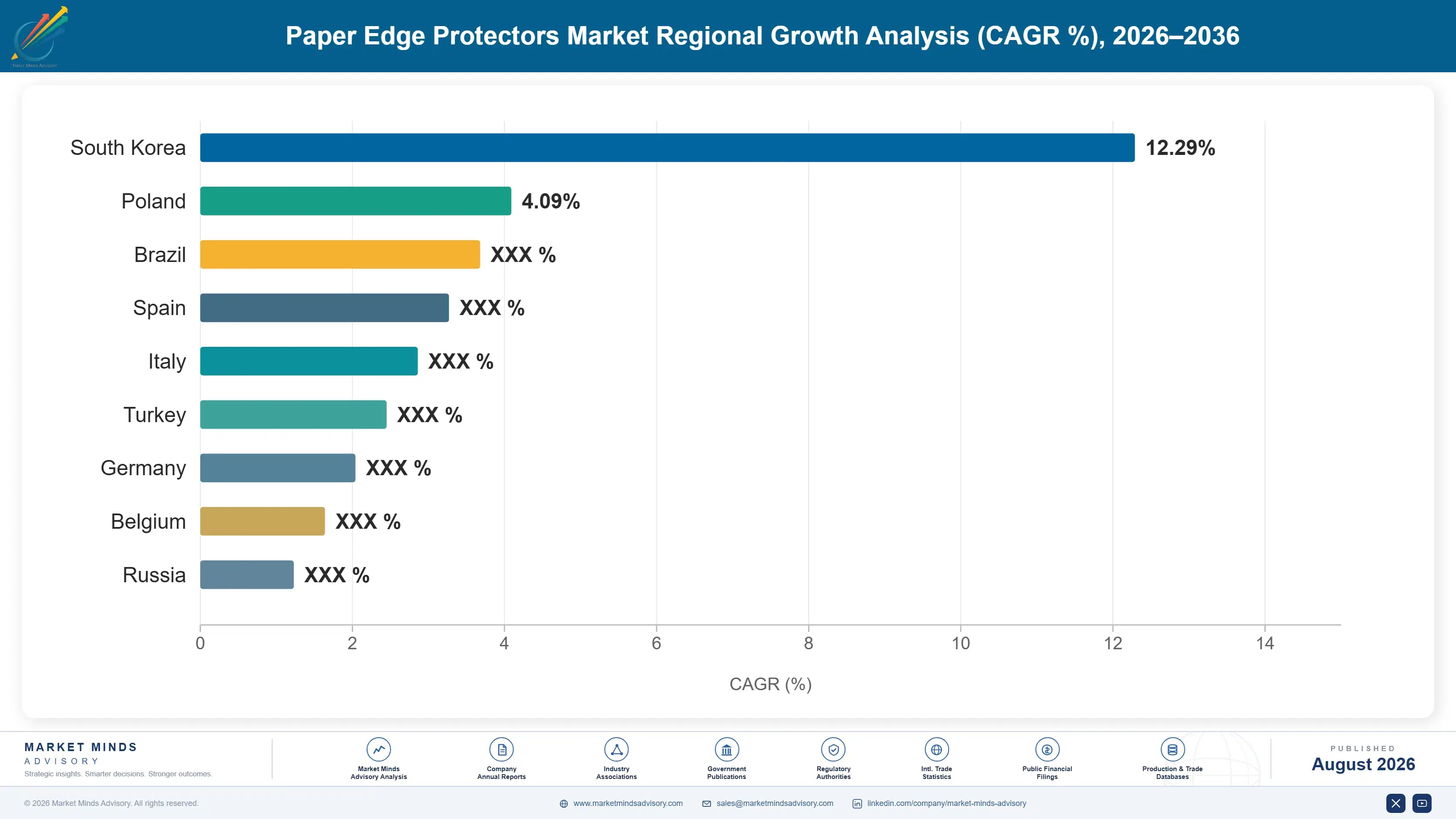
The fastest growing region at 8.8%, with India compounding at 10.4%, South Asia and Pacific accounts for 12% of demand. Indian warehousing consolidation following tax reform created larger regional distribution centres with proper racking, which made stacking height a commercial question where informal storage had never raised it. Palletisation itself is still spreading, since a substantial share of Indian freight moves loose or in mixed loads, so the addressable base grows with unitisation rather than only with volume. Southeast Asian manufacturing logistics adds steady demand across Vietnam, Thailand and Indonesia. Australian demand is smaller and resembles Western European patterns in both grade mix and specification practice. Palletisation itself is still spreading here.
Share: 12% | CAGR: 8.8% (2026 to 2036)
Regional intelligence for 5 additional markets available in the complete report: North America, Western Europe, Latin America, Middle East and Africa, Eastern Europe. Contact sales@marketmindsadvisory.com.
paper-edge-protectors-market-country-cagr-analysis-1787308649502

Selling Storage Space Not Cardboard Angles

Standard angleboard is a commodity made the same way for decades inside a freight radius nobody can escape. Every position worth holding involves demonstrating something a buyer cannot see in a quotation, and reaching a budget that is not packaging procurement. Four qualify. Price per metre reaches only the wrong budget. Freight geometry constrains everything else.

Quantify Stacking Height Against Warehouse Rental Cost

A stack carries vertical load almost entirely at its corners, and engineered angleboard takes roughly 62% of it away from the cartons, permitting about 1.4 additional layers before crushing. In a warehouse where rental cost has risen faster than almost any other logistics line, that height is worth far more than the protector. Converters that calculate the storage value on the customer's own pallet dimensions and rental rate reach a facilities budget rather than packaging procurement, and engineered grades carry margins 12 to 19 points above standard profiles. Rental rates do the selling.
Market Impact: Engineered grades carrying 12 to 19

Install Compression Testing Rather Than Quote Specifications

A customer buying compression performance needs a measured figure for their own load, not a product description or a ply count. Converters holding a compression testing rig can produce that number, demonstrate the stacking gain and defend it when a load fails. Those without one cannot make the argument at all and are left competing on price per metre inside their freight radius. The equipment cost is modest against the positions it opens, and remarkably few regional converters have made that investment despite the barrier being purely financial. Corners carry roughly 62% of stack load and a rig proves it.
Market Impact: Corners carrying 62% of the total s

Convert Plastic Corner Protection on Single-Stream Recyclability

Plastic and foam corner protectors perform adequately and prevent a palletised load entering paper recycling as a single item, which matters where the recipient is a retailer or small customer rather than a sorting facility. Paper angleboard lets carton, corner and outer pack go into one stream together. Roughly 21% of current paper protector demand came from displaced plastic, and that volume does not return. Reaching it means selling to a sustainability or retail compliance function rather than to the packaging buyer who originally specified the plastic. That conversion never reverses.
Market Impact: Plastic displacement at 21% of all

Replace Wax Moisture Protection With Repulpable Coatings

Export and cold chain loads need moisture resistance because board takes up water and loses compression precisely when the stack needs it, and wax has always been the cheap answer. Wax cannot be repulped, and receiving customers holding recyclability commitments increasingly refuse it outright at destination. Dispersion coatings and impregnation solve the same problem while repulping cleanly, growing at 8.4%. Applying treatment before lamination rather than after is the practical route, and it raises input cost across the whole profile rather than only its surface. Destination refusal is now the deciding factor.
Market Impact: Moisture grades now compounding at

Who Controls the Margin Pool

The five largest converters hold 24% of the market measured on edge protector revenue, the basis applied consistently through this section. That is extraordinarily fragmented, and freight geometry rather than any absence of scale advantage explains it. A converter inside its own 350 kilometre radius cannot be undercut from further away regardless of the competitor's cost position. Regional density beats national reach entirely.
Competition operates on three dimensions. Proximity to unitising operations decides who can serve an account at all, since the product is long, light and expensive to move. Compression testing capability decides who can sell engineered grades rather than standard profiles. And containerboard access decides cost position, since board is 66% of converted cost and recycled supply is regional. All three are physical or capability advantages rather than commercial ones.

Two pressures are reshaping position. Integrated packaging groups including Sonoco and Smurfit Westrock can bundle edge protection with corrugated and strapping into a single load securing conversation. Against that, regional independents compete effectively inside their own radius on price. Rankings will move toward whoever pairs regional coverage with genuine compression testing capability. Very few hold both today.
paper-edge-protectors-market-company-positioning-matrix-1787308650025

Competitive Moat and Risk Dimensions

SONOCO PRODUCTS COMPANY

Moat: Load securing system breadth

Sonoco supplies edge protection alongside corrugated, tubes, strapping and protective packaging, which lets it enter the conversation as a load securing system rather than as a component quotation. That position reaches the customer during pallet design and load testing, where compression performance is actually decided, rather than at the point a purchasing function compares price per metre.
SONOCO PRODUCTS COMPANY

Risk: Regional cost competition

Standard angleboard is made the same way by hundreds of regional laminators with lower overhead, and inside any given freight radius the delivered price gap is visible in every quotation. With containerboard at 66% of cost and no meaningful performance difference a buyer can perceive on standard profiles, scale confers very little that a customer will actually pay for.
SMURFIT WESTROCK

Moat: Containerboard integration and reach

Integration from containerboard through conversion matters where recycled board represents 66% of edge protector cost, and a wide European and American footprint places laminating capacity inside multiple freight radii simultaneously. That combination lets the group serve multi-site customers consistently where a single-plant converter can only reach one region economically.
SMURFIT WESTROCK

Risk: Compression testing capability

Engineered grades are sold on a measured compression figure for the customer's specific load, which requires testing capability at or near the converting site rather than centralised laboratory access. Without it a converter defaults to selling standard profiles on price, and the fastest-growing part of the category is precisely the part that testing capability opens up.

Players Tracked

Prominent Players

Sonoco Products Company
Smurfit Westrock
Mondi
Cascades
Signode Industrial Group

Other Key Players

DS Smith
VPK Group
Cordstrap
Kunert Gruppe
Litco International
Palletways
Guangdong Fenghua Packaging
Zhejiang Zhengda Packaging
Hangzhou Kaisheng Packaging
Cartro
Pacfort Packaging
Edge Protectors Limited
Sunrise Packaging Material
Nefab Group
Ranpak

Recent Developments

FEBRUARY 2025

Warehouse rental inflation drives engineered compression specification

Distribution operators across developed markets increasingly specified engineered compression angleboard to raise stacking height within existing racking, responding to warehouse rental costs rising faster than other logistics lines. This reflects facility cost pressure rather than any commercial development between converters. Facilities budgets rather than procurement approve it.
Signal: Storage cost rather than packaging cost is
JUNE 2025

Retailer requirements accelerate plastic corner protector displacement

Grocery and general merchandise retailers extended single-stream recyclability requirements to inbound palletised loads, displacing plastic and foam corner protection that prevented a load entering paper recycling intact. These were retailer policy decisions rather than regulatory actions or supplier transactions. Store staff will not separate materials.
Signal: A load arriving at a store must enter one
OCTOBER 2025

Receiving customers refuse wax-coated moisture protection

European and North American recipients of export loads increasingly rejected wax-coated angleboard on repulpability grounds, requiring dispersion-coated or impregnated alternatives delivering equivalent moisture resistance. These were customer specification changes rather than regulatory requirements or corporate transactions. Coating a formed profile leaves the fold itself unprotected.
Signal: End-of-life handling at destination now de

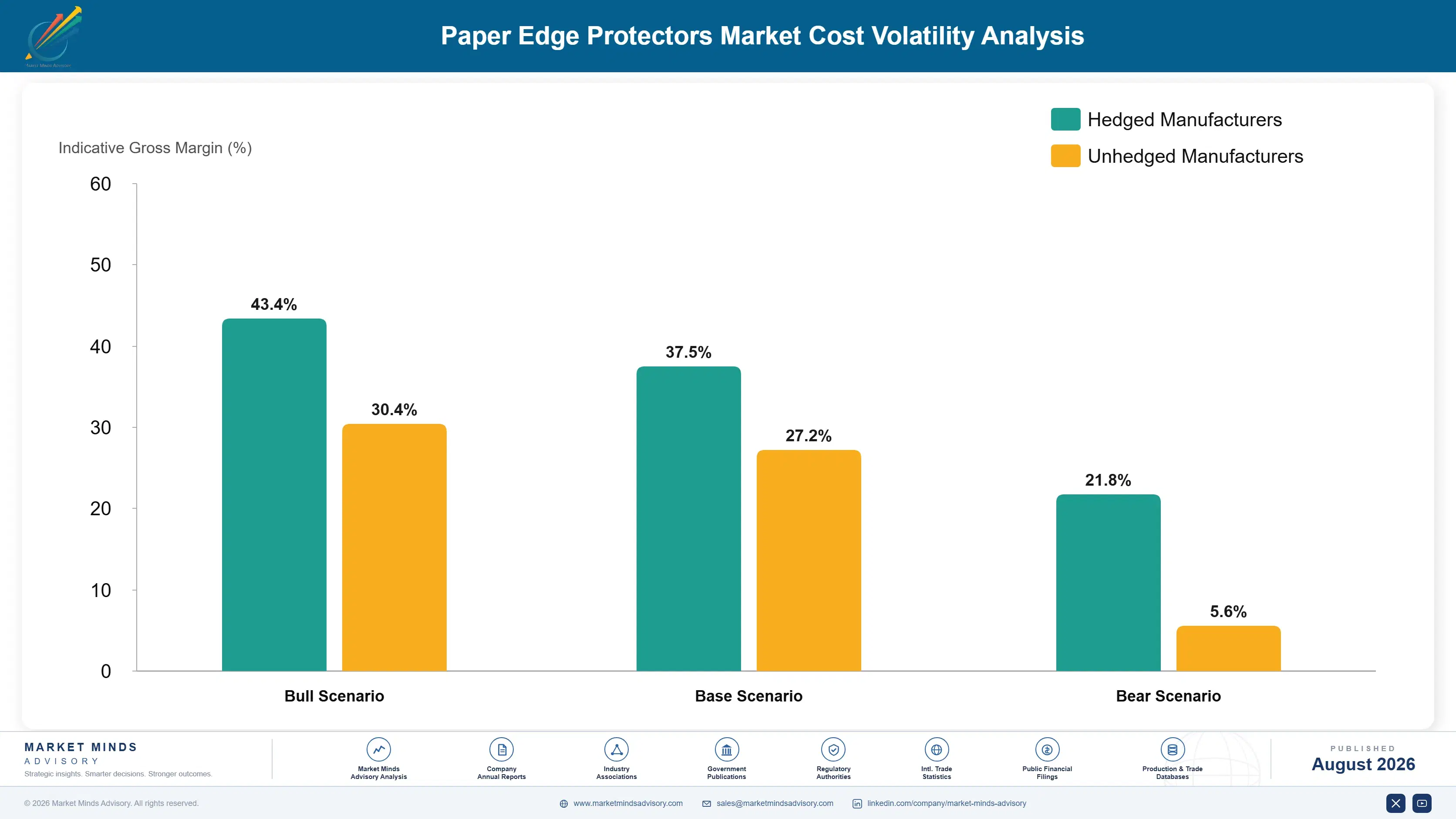
Recycled Board, Adhesive and Freight

Recycled containerboard accounts for roughly 66% of cost of goods, purchased regionally because the material is bulky and low in value relative to transport. Adhesive runs a further 9%, with moisture-resistant treatments and coatings carrying materially higher cost where specified. Laminating labour, cutting, energy and outbound freight make up the balance, and freight is unusually significant given the product's volume to weight ratio.
Recovered paper pricing moved sharply through 2022 and 2023 as European energy disruption raised containerboard production costs, and International Energy Agency reporting across that period documents the underlying movement. Converters passed through only part of it, since edge protectors are quoted annually against distribution contracts. Company annual reports covering industrial packaging segments disclose the resulting margin compression through several consecutive quarters. Recovery lagged by several quarters.

Exposure divides by board access rather than by scale. Integrated converters producing or sourcing containerboard within a group carry the cost at mill level and avoid a merchant margin, while independents face regional supply concentration and full pass-through. The disadvantage falls hardest on small independents inside a freight radius shared with an integrated competitor, since they carry both a higher board cost and no ability to escape the geography.
paper-edge-protectors-market-cost-volatility-analysis-1787308650225

Contract recycled containerboard regionally against forecast volume

Recovered board is bulky, low in value and traded regionally rather than globally, which makes local mill relationships more valuable than purchasing scale. Annual contracting against forecast distribution volumes stabilises the largest cost line, and board consistency matters as much as price because ply variation shows up directly in measured compression performance. Ply variation shows up in testing.

Nest profiles more densely to recover outbound freight cost

Angleboard fills a trailer by volume long before weight, so nesting depth directly determines freight cost per unit delivered. Profile geometry can be adjusted to nest more tightly without compromising compression, though nesting too closely raises handling damage in transit. Getting that balance right is worth more than most converters realise on a product shipped this frequently.

Apply moisture treatment before lamination rather than after

Coating a formed laminated profile is awkward and produces uneven coverage at the fold, whereas treating board before lamination gives consistent protection throughout the section. It raises input cost across the whole product rather than only its surface, which is the honest trade, but it is the only route that delivers reliable performance in ocean transit.

Portfolio Architecture for Margin Defence

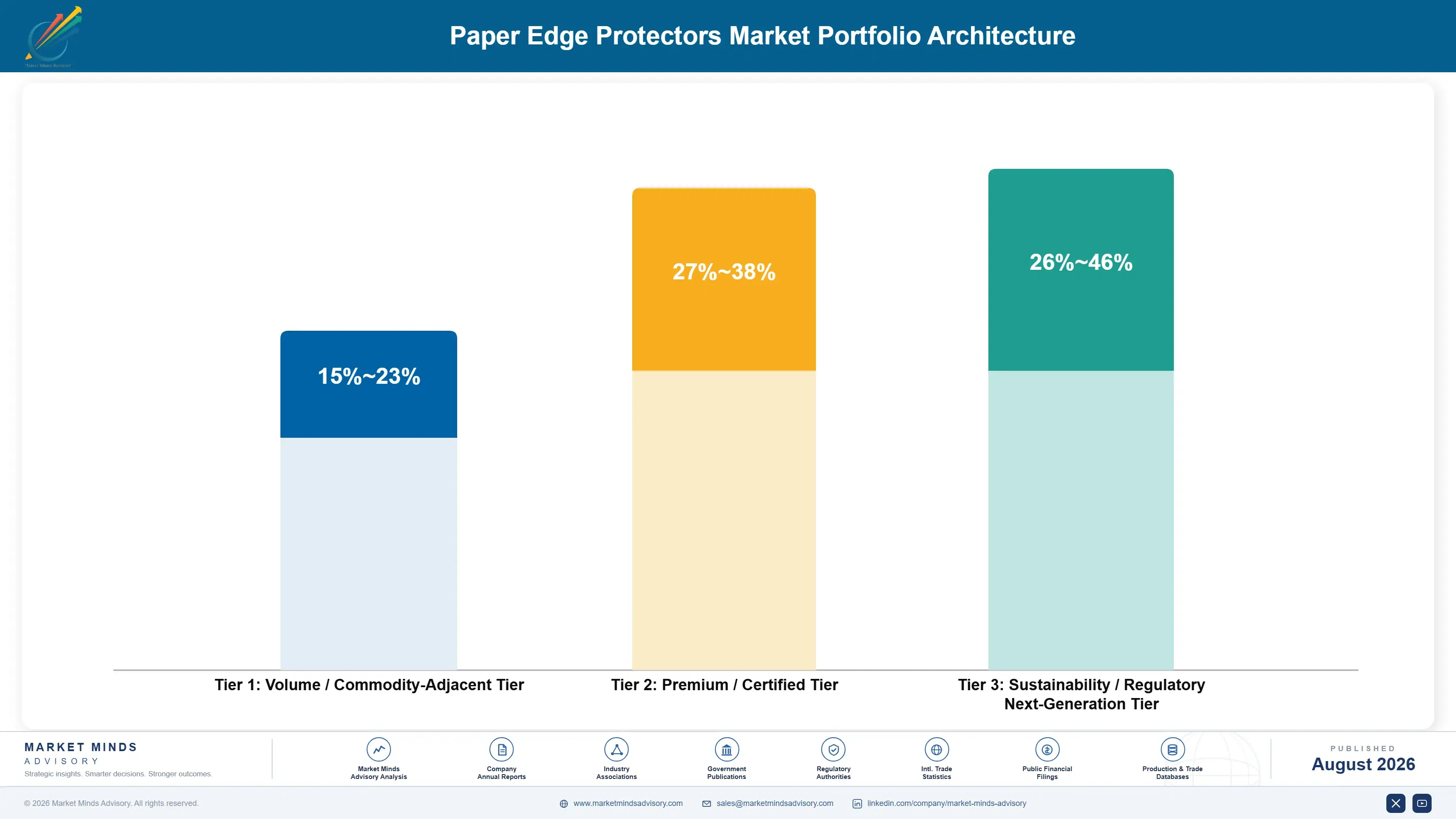
The portfolio separates on whether performance can be measured. Standard angleboard prevents visible strap damage and is bought on price per metre inside a freight radius, with hundreds of laminators able to supply it. Engineered grades carry a compression figure the customer can act on. Moisture-resistant grades survive conditions that destroy ordinary board. Printed and branded protection sells on presentation rather than protection at all. Measurability draws the whole ladder here.
The tension is that standard profiles carry the laminating line utilisation and the distribution relationships from which engineered work follows. A converter that pursues only compression-specified business finds its line underloaded, since engineered grades qualify one customer and one load configuration at a time. Running both, with quite different margin expectations, is the only structure that works at converter scale. Utilisation and margin are separate objectives. Converter scale makes that unavoidable.

High-value pools concentrate where compression, moisture or recyclability sets the requirement rather than where a strap needs protecting. Engineered angleboard, coated export grades and plastic replacement work all qualify, and none is decided on price per metre of profile. Different budget holders approve each of them.

Volume / Commodity-Adjacent Tier

Standard laminated angleboard and U-profile protectors preventing strap damage on general palletised loads. Made the same way by hundreds of regional laminators and bought on delivered price per metre inside a tight freight radius.
Gross Margin: 15-23%

Premium / Certified Tier

High-compression engineered angleboard specified to a measured compression rating for a customer's own load and stacking configuration. Testing capability rather than laminating capacity determines which converters can credibly quote this work.
Gross Margin: 27-38%

Sustainability / Regulatory / Next-Generation Tier

Moisture-resistant and repulpable coated protectors plus paper profiles replacing plastic corner protection. The wide margin range reflects the gap between established coated export grades and plastic replacement work still being specified by retail compliance functions.
Gross Margin: 26-46%
paper-edge-protectors-market-portfolio-architecture-1787308650730

High-value Sub-segments and Strategic Watch-out

Engineered Compression Angleboard

Compounding at 9.9% because corners carry roughly 62% of stack load and engineered profiles permit about 1.4 additional layers of height. Warehouse rental cost makes that height worth far more than the protector, provided somebody actually calculates it for the customer. Testing capability is the entry condition.
Gross Margin: 31-38%

Coated Export and Cold Chain Grades

Growing at 8.4% as board takes up moisture and loses compression precisely when an ocean or chilled stack needs it. Wax is being refused at destination on repulpability grounds, and treatment must be applied before lamination to work reliably. Input cost rises across the whole profile.
Gross Margin: 30-42%

Standard Strap Protection Angleboard

The volume core at 4.8%, made identically by hundreds of laminators and bought on delivered price within a 350 kilometre radius. Run for line utilisation and distribution account presence rather than for any margin it might return. Hundreds of laminators compete. Account presence is the point.
Gross Margin: 15-23%

Plastic Corner Protector Replacement

The watch-out and the opportunity together. Around 21% of paper protector demand came from displaced plastic, and reaching more of it means selling to retail compliance or sustainability functions rather than the packaging buyer. Retail policy rather than regulation drives it. The buying function changes too.
Gross Margin: 24-40%

Specified Once at Load Design

Demand here is set when a pallet configuration is designed and then repeats indefinitely. A load pattern specifying protector profile, length and compression grade is reordered every time that product ships, and nobody revisits it while loads arrive intact. That gives a converter unusually stable volume for a commodity product, though it also means displacing an incumbent requires a load failure or a facility change rather than a better price. A load failure is what opens the account.
Depth varies by what the customer ships. Export shippers buy deepest, needing moisture resistance and compression that survives ocean transit where a collapsed stack is a claim rather than a nuisance. High-bay warehouse operators buy engineered grades on stacking economics. General distribution buys standard profiles on price. Contract packers sit shallowest, using whatever their customer's specification names and switching without consultation.

The deciding population has broadened in a useful way. Edge protection was historically specified by packaging engineering weighing damage rates against cost. Increasingly a facilities function evaluating storage capacity and a retail compliance function holding recyclability requirements both have a view, and neither weighs price per metre at all.
paper-edge-protectors-market-end-use-penetration-index-1787308651222

Where Angleboard Converters Win

These are among the four positions where our research anticipates prominent divergence between winners and laggards over the coming forecast period. Each is grounded in the demand model, the regulatory perimeter, and the announced capacity pipeline.
01 / STORAGE VALUE FRAMING

Nobody buys a better protector and everybody buys extra racking

A stack carries vertical load almost entirely at its corners, and engineered angleboard takes roughly 62% of that load away from the cartons, permitting about 1.4 additional stacking layers before any crushing occurs. In a market where warehouse rental has risen faster than most other logistics costs, that height is worth considerably more than the protector itself. Converters that calculate that storage value using the customer's own pallet dimensions and rental rate reach a facilities budget rather than packaging procurement entirely.
02 / MEASURED PERFORMANCE CAPABILITY

Without a testing rig a converter can only compete on price

A customer buying compression performance needs a measured figure for their own load and stacking configuration, rather than a ply count or a product description printed on a specification sheet. Converters that hold a compression testing rig produce that number, demonstrate the stacking gain and then defend it when a load fails in transit. Those without one default to selling standard profile on price per metre inside their own freight radius, which is precisely where the margin has already gone.
03 / FREIGHT RADIUS REALITY

Geometry protects volume that no cost advantage can take

Angleboard is long, light and awkward to handle, filling a trailer by volume long before it approaches weight limits, and beyond roughly 350 kilometres freight overwhelms delivered value completely. That single constraint explains why the five largest converters hold only 24% of the global market, and why regional independents compete perfectly well against far larger integrated groups. Siting laminating capacity close to unitising clusters therefore secures volume that is defended by simple geometry rather than by process capability or by delivered price.
04 / RECYCLABILITY DRIVEN DISPLACEMENT

Plastic corners fail at the store, not in transit

Plastic and foam corner protectors perform adequately in transit and prevent a palletised load entering paper recycling as a single item, which matters where the recipient is a retailer or small customer rather than a sorting facility. Paper angleboard lets the carton, the corner and the outer pack all go into one stream together. Around 21% of paper protector demand already came from displaced plastic, and reaching more of it means selling to retail compliance functions rather than to packaging procurement.

Engagement Snapshot From the Field

A live engagement with an industry participant carrying material or product regulatory and market exposure ahead of a defining policy shift, showing how our research translates into a defensible multi-year portfolio strategy.
MARKET MINDS ADVISORY · CLIENT ENGAGEMENT SUMMARY
Paper Edge Protectors Producer Strategic Portfolio Review and Transition Roadmap 2026·Investment Scenario on Paper Edge Protectors Exposure Evaluation 2025-26
CLIENT PROFILE
A grocery distribution operator running fourteen regional distribution centres with roughly USD 8.2 billion in throughput value (client-reported, unverified by MMA). Edge protector spend ran near USD 5.1 million annually (client-reported, unverified by MMA), purchased through a national packaging tender on price per metre with no compression specification written into the requirement at any centre.
STRATEGIC CHALLENGE
Two distribution centres were at storage capacity and the property team had scoped additional leased space at substantial annual cost. Separately, transit damage claims on inbound palletised loads had risen and packaging procurement had responded by tendering edge protectors more aggressively, achieving a further price reduction. Neither team had spoken to the other.
MMA APPROACH
MMA measured achievable stack height against carton compression and corner protector performance across the client's twelve highest-volume load configurations, then modelled the storage capacity available from engineered angleboard against the leased space under consideration. Damage claims were traced to load configuration rather than to protector supplier. Regional converter capability was assessed separately.
KEY FINDINGS
  1. Engineered compression angleboard permitted between one and two additional layers on nine of the twelve configurations tested, which together represented more storage capacity than the leased space being scoped.
  2. Damage claims correlated with load configurations where lightweighted cartons carried compression the corners were not rated to take, and the aggressive tendering had made that worse rather than better.
  3. The incumbent supplier held no compression testing capability and had never been asked for a rating, because the tender specification had only ever described dimensions and board weight.
  4. Two regional converters within freight radius of the affected centres held testing rigs and had never been invited to quote, since the national tender favoured suppliers able to serve all fourteen sites.
CLIENT PROFILE
A grocery distribution operator running fourteen regional distribution centres with roughly USD 8.2 billion in throughput value (client-reported, unverified by MMA). Edge protector spend ran near USD 5.1 million annually (client-reported, unverified by MMA), purchased through a national packaging tender on price per metre with no compression specification written into the requirement at any centre.
STRATEGIC CHALLENGE
Two distribution centres were at storage capacity and the property team had scoped additional leased space at substantial annual cost. Separately, transit damage claims on inbound palletised loads had risen and packaging procurement had responded by tendering edge protectors more aggressively, achieving a further price reduction. Neither team had spoken to the other.
MMA APPROACH
MMA measured achievable stack height against carton compression and corner protector performance across the client's twelve highest-volume load configurations, then modelled the storage capacity available from engineered angleboard against the leased space under consideration. Damage claims were traced to load configuration rather than to protector supplier. Regional converter capability was assessed separately.
KEY FINDINGS
  1. Engineered compression angleboard permitted between one and two additional layers on nine of the twelve configurations tested, which together represented more storage capacity than the leased space being scoped.
  2. Damage claims correlated with load configurations where lightweighted cartons carried compression the corners were not rated to take, and the aggressive tendering had made that worse rather than better.
  3. The incumbent supplier held no compression testing capability and had never been asked for a rating, because the tender specification had only ever described dimensions and board weight.
  4. Two regional converters within freight radius of the affected centres held testing rigs and had never been invited to quote, since the national tender favoured suppliers able to serve all fourteen sites.
RECOMMENDED STRATEGY
Phase 1: Phase 1 (months 1 to 5): Rewrite the tender specification around measured compression rating and defer the additional leased space decision pending conversion. Phase 2: Phase 2 (months 5 to 14): Convert the nine viable load configurations to engineered angleboard using regional converters with testing capability. Phase 3: Phase 3 (months 14 to 24): Restructure edge protector purchasing regionally rather than nationally to reflect the freight economics honestly.
OUTCOME
The additional leased space was cancelled, avoiding roughly USD 3.4 million in annual cost (client-reported, unverified by MMA). Edge protector spend rose by approximately USD 900,000, and transit damage claims on the converted configurations fell by close to two thirds (client-reported, unverified by MMA). Purchasing moved to a regional structure.

Frequently Asked Questions

Foundational context covering the market sizes, CAGR, scope, country, region and competition that inform every finding below. This section is provided to cover basics and most often pre-purchase conversations, answered from the MMA Primary Research Dataset.

What is the current size of the Paper Edge Protectors Market?

The global market was worth USD 1.68 billion in 2025, reaching USD 1.79 billion in 2026. East Asia holds the largest regional share at 30% of demand.

How large will the Paper Edge Protectors Market be by 2036?

MMA forecasts USD 3.46 billion by 2036, an expansion multiple of 1.93 times the 2026 base. That represents roughly USD 1.67 billion of incremental value.

What is the CAGR for the Paper Edge Protectors Market 2026 to 2036?

The base case compounds at 6.6% annually, with a bull case of 7.8% and a bear case of 5.4%. Historical growth from 2020 to 2025 ran at 5.4%.

Which segment is growing fastest?

High-compression engineered angleboard compounds at 9.9%, exactly 1.50 times the market rate. Corners carry roughly 62% of stack load, permitting around 1.4 additional stacking layers.

Who are the major companies in the Paper Edge Protectors Market?

Sonoco Products Company, Smurfit Westrock, Mondi, Cascades and Signode Industrial Group hold a combined 24% of the market. Fragmentation is extreme because freight economics favour regional converters.

Which country is growing fastest?

India compounds at 10.4%, ahead of every other national market. Warehousing consolidation created larger distribution centres in which stacking height became a genuine commercial question.

Report Segmentation Architecture

The full report scope spans multiple orthogonal segmentation dimensions, with cross-tabulated demand data provided for each dimension pair. Coverage extends further to regional breakdowns, trend trajectories, and the competitive detail needed to support segment-level decision-making.

By Protector Profile and Grade

  • Standard Laminated Angleboard
  • High-Compression Engineered Angleboard
  • U-Profile and Wraparound Protectors
  • Round and Specialty Profile Protectors
  • Moisture-Resistant and Coated Protectors
  • Printed and Branded Edge Protection

By End-Use Industry

  • Grocery and Retail Distribution
  • Pulp, Paper and Building Materials
  • Beverage and Canned Goods
  • Appliances and Consumer Durables
  • Agricultural and Horticultural Export

By Commercial Dimension

  • Direct Supply to Manufacturers and Distributors
  • Packaging Distributor Channel
  • Load Securing System Supply
  • Contract Packer and Co-Packer Supply

By Region

  • North America
  • Western Europe
  • East Asia
  • South Asia and Pacific
  • Latin America
  • Middle East and Africa
  • Eastern Europe

Scope, Methodology, and Coverage

Every figure in this report is reproducible from documented input assumptions. The scope below maps the historical period, the forecast horizon, the segmentation dimensions, and the countries covered, alongside the underlying primary and qualitative methodology.
Historical Period
2020 to 2025
Forecast Period
2026 to 2036
Base Year
2025 (USD billions; MMA Primary Research Dataset, August 2026)
Market Definition
The market covers paper-based edge and corner protection for palletised and unitised loads, spanning standard laminated angleboard, high-compression engineered angleboard, U-profile and wraparound protectors, round and specialty profile protectors, moisture-resistant and coated protectors, and printed or branded edge protection. Plastic and foam corner protectors, strapping and banding, stretch and shrink film, pallets, dunnage and corrugated packaging are excluded. Sizing is measured at converter revenue in current prices.
Quantitative Units
USD billions (current prices); linear metres of profile and compression rating in kilonewtons where applicable
Segmentation Dimensions
By Protector Profile and Grade; By End-Use Industry; By Commercial Dimension; By Region
Regions Covered
North America, Western Europe, East Asia, South Asia and Pacific, Latin America, Middle East and Africa, Eastern Europe
Countries Covered
USA, China, Germany, France, UK, Japan, South Korea, India, Australia, Canada, Brazil, Mexico, Indonesia, Vietnam, Thailand, Malaysia, UAE, Saudi Arabia, South Africa, Nigeria, Turkey, Poland, Netherlands, Italy, Spain, Sweden, Switzerland, Argentina, Colombia, Singapore, and additional markets relevant to this sector
Key Companies Profiled
Sonoco Products Company, Smurfit Westrock, Mondi, Cascades, Signode Industrial Group, DS Smith, VPK Group, Cordstrap, Kunert Gruppe, Litco International, Palletways, Guangdong Fenghua Packaging, Zhejiang Zhengda Packaging, Hangzhou Kaisheng Packaging, Cartro, Pacfort Packaging, Edge Protectors Limited, Sunrise Packaging Material, Nefab Group, Ranpak
Quantitative Methodology
Primary survey, n=3,800 respondents, Q4 2025, six countries; demand-side model with trade association cross-validation
Qualitative Methodology
47 expert interviews, Q4 2025; applied to validate demand model assumptions, identify emerging dynamics, and assess competitive positioning
Report Format
PDF and XLSX data workbook (Word format preview document)
Publisher
Market Minds Advisory
Report Code
MMA-2026-PAC-773
Published
August 2026
Contact
sales@marketmindsadvisory.com | www.marketmindsadvisory.com

Purchase the full Paper Edge Protectors Market Report (2026 to 2036).

The full report sizes paper edge protectors across six profile and grade categories, three commercial dimensions and seven regions, with annual forecasts to 2036 under base, bull and bear scenarios. Stacking height economics are modelled against warehouse rental cost by market, converting a packaging specification into a storage capacity calculation. Compression testing capability is mapped across the converter set, since it determines who can sell engineered grades at all. Plastic corner protector displacement is tracked by retail and regulatory driver. Twenty converters are profiled on a consistent edge protector revenue basis.
Stacking height economics modelled against warehouse rental cost
Compression testing capability mapped across the converter set
Plastic displacement tracked by retail and regulatory driver
Freight radius economics quantified by profile length and nesting
Carton lightweighting impact on corner load requirements assessed
Moisture treatment options compared on repulpability and performance

Built For The People Who Decide

From boardroom strategy to bench-side execution, this report is read cover-to-cover by leaders shaping the next decade of their industry, turning demand scenarios, market dynamics and valuation benchmarks into decisions.
CXOs/ Presidents/ VPs/ Managers
M&A and Corporate Development
Strategy Teams and R&D Heads
Procurement and Product Directors
Regulatory and Compliance Leaders
Investor Relations and Equity Analysts