Market Minds Advisory
Paper Core Market

Paper Core Market: Crush Resistance, Freight Radius and the Component Nobody Specifies Until a Reel Collapses

A paper core costs almost nothing and holds several tonnes of film at 1,200 metres a minute, which is why nobody notices it until a reel comes apart on a converting line.

Lead Analyst

Bilal Shaikh

Published

September 2026

Make Smarter Decisions with Customized Research Insights

Request a free sample report and evaluate market opportunities, growth trends, and competitive dynamics relevant to your business needs.

2025 MARKET VALUE$7.8BMarket Size 2025
2036 FORECAST VALUE$12.8BBase Case , 2026 to 2036
CAGR 2026 TO 20364.6 %Bull 5.8% / Bear 3.4%
INCREMENTAL OPPORTUNITY$4.6BNet 10- year value creation
EXPANSION MULTIPLE1.57x2036 value over 2026 base
Strategic Levers
M&A Pipeline
Regional Outlook
Country Rankings
Competitive Intelligence
Segmental Deep-dive
Call-Us : 91 93563 13602

Executive Snapshot and Market Trajectory

Nobody buys a paper core for its own sake. It exists so that something else can be wound onto it, unwound off it at speed, and then discarded, and the whole commercial question is simply whether it holds up while all that happens.
High-strength precision-wound cores compound at 6.9%, exactly 1.50 times the market, as film, label and nonwoven lines run faster and reel weights climb. East Asia takes 33% of demand, above the standard band, on converting capacity that dwarfs every other region. Board input runs near 62% of cost, so recovered fibre pricing moves the entire industry together and independent winders feel it first. Freight then keeps supply local, because a core is mostly air.
Concentration is unusually low at 38%. A core is mostly air and cannot travel far before freight destroys the economics, which keeps hundreds of regional winders viable. Line speeds are what change that. Converting runs near 1,200 metres a minute on heavier reels, and cores adequate at slower speeds now fail intermittently rather than outright. Precision work is where the margin sits, and commodity winding pays for the machine.
Market Definition
The market covers spirally and convolutely wound paperboard cores and tubes used as winding mandrels and industrial packaging, spanning standard spiral-wound cores, high-strength precision-wound cores, convolute-wound cores, textile and yarn carriers, protective tubes and cans, and specialty coated or moisture-resistant cores. Plastic and metal cores, composite drums with metal ends, and fibre drums for bulk containment are excluded.
Base Year Value
$7.8B in 2025 (MMA Primary Research Dataset, August 2026)
Forecast Period
2026 to 2036, eleven discrete annual values
CAGR
4.6% base case. Bull 5.8%. Bear 3.4%.
Fastest Growth Segment
High-Strength Precision-Wound Cores: 6.9% CAGR
Fastest Growth Country
India: 7.3% CAGR
Fastest Growth Region
South Asia and Pacific: 6.8% CAGR
Largest Region
East Asia: 33% of 2025 global value
Market Leaders
Sonoco Products, Smurfit Westrock, Greif, Halopack Tubes, Abzac. Source: MMA Analysis based on company annual reports.
Primary Survey
n=3,800 procurement and R&D decision-makers, Q4 2025, six countries
Methodology
Demand-side build-up, cross-validated against public data, 47 expert interviews

Paper Core Market Forecast Scenarios

paper-core-market-size-forecast-scenario-1787308642539
Growth ran at an implied 3.8% across 2020 to 2025, and the period was less stable than that figure suggests. Film, label and hygiene demand surged through 2020 and 2021 while graphic paper cores fell away permanently. Recovered fibre pricing then swung violently, and core prices followed it up faster than they came back down again.
The base case at 4.6% rests on three mechanisms. Flexible packaging and label converting volumes keep growing and every reel needs a core. Line speeds and reel diameters keep rising, which pushes specification toward higher crush and flat-crush resistance. And plastic core replacement is proceeding steadily in textiles and film where recyclability requirements now reach the winding component itself. Precision-wound cores compound at 6.9% against a market at 4.6%, and coated product takes a further share wherever moisture attacks the board directly.
The bull case at 5.8% assumes plastic core substitution accelerates as recycled content rules extend to ancillary components rather than stopping at primary packaging. The bear case at 3.4% follows from continued graphic paper decline removing core demand faster than flexible packaging adds it, combined with reel diameter standardisation reducing the number of cores consumed per tonne converted.

The Cheapest Part of a Reel That Cannot Fail

A paper core is around 1.4% of the value of the reel wound onto it and carries the whole of the risk that the reel fails. At 1,200 metres a minute an inadequate core deflects, the reel runs out of round, tension control loses the plot and the converting line stops. The cost of that stoppage exceeds the annual core spend for most lines within an hour or two.
TOP FIVE CONCENTRATION38%Combined share held by the five largest core producers globally
BOARD COST SHARE62% of COGSPaperboard as a proportion of the producer cost base
ECONOMIC FREIGHT RADIUS320 kilometresDistance beyond which delivered cost stops being competitive
TYPICAL LINE SPEED1,200 metres per minuteConverting speeds that set crush resistance requirements on cores
RECYCLED CONTENT94%Recovered fibre proportion in typical spiral-wound core board
CORE COST OF REEL1.4% of valueCore price as a proportion of the wound reel value
That asymmetry ought to make core specification a serious engineering exercise. Mostly it is not. Cores are bought on price per unit by procurement functions comparing quotes on inside diameter, wall thickness and length, and the crush and flat-crush figures that actually determine performance appear on datasheets nobody reads until something goes wrong on a Tuesday night shift.
The industry structure follows from geometry rather than from strategy. A core is largely air, a trailer fills by volume long before it fills by weight, and delivered cost stops being competitive past roughly 320 kilometres. Hundreds of regional winders therefore remain viable, concentration sits at 38%, and even the largest producers operate as networks of small local plants rather than as consolidated manufacturing.
"Every converter I speak to can tell me their core price to two decimal places and almost none can tell me the flat-crush spec. Then a reel collapses at three in the morning and suddenly everybody is an expert in radial compression."
Director, Paper Converting and Industrial Packaging Practice · MMA Paper Convert

Market Trends

Faster Lines and Heavier Reels Push Core Specification Upward

Film, label and nonwoven converting lines now run at speeds near 1,200 metres a minute on reels considerably heavier than the equipment of a decade ago carried. Both changes load the core harder: radial compression rises with reel weight and dynamic deflection matters more as speed increases. Standard spiral-wound cores that performed adequately at slower speeds now fail intermittently, which is worse than failing consistently because nobody attributes it correctly. High-strength precision-wound cores compound at 6.9% against a market at 4.6% on exactly this shift. Reel diameter increases compound the effect further.
Market Impact: Cores at 1.4% of reel value
Recyclability Requirements Reach the Winding Component

Recycled content and recyclability rules were written for primary packaging and are steadily extending to ancillary components, which brings plastic winding cores into scope for the first time. Paper cores already run near 94% recovered fibre content and enter the recovered paper stream without any separation step. Textile yarn carriers and film cores are where the substitution is live, since both have used plastic extensively. Producers who can document fibre content and recyclability win specification changes that price alone would never have moved. Those conversions rarely reverse once qualification work is complete.
Market Impact: Downtime exceeding 1 year spend

Market Opportunities and Growth Drivers

Flexible Packaging Volume Growth Carries Core Demand With It

Every reel of film, laminate, label stock or foil produced needs a core, and flexible packaging conversion has grown steadily as rigid formats give way across food, personal care and pharmaceutical applications. Core demand tracks that volume almost mechanically, with the only variable being reel diameter, since a larger reel means fewer cores per tonne converted. The relationship is direct enough that core producers forecast off converter capacity announcements rather than off any independent demand model at all. Cores at 1.4% of reel value ride that volume without pricing power of their own.
Market Impact: Radius limited to 320 kilometres

Downtime Cost Asymmetry Justifies Premium Core Specification

A core represents around 1.4% of the value of the reel it carries and effectively all of the risk that the reel fails in service. An unplanned converting line stoppage costs more in an hour or two than a year of core purchasing does, and the calculation is easy once anyone actually performs it. Producers who present crush and flat-crush performance against downtime cost rather than against competitor pricing move customers off commodity purchasing permanently, which is the whole commercial game here. Crush and flat-crush data is what makes that case credible.
Market Impact: Core at 1.4% of reel

Market Restraints and Challenges

Freight Volume Economics Cap Plant Reach Absolutely

A core is mostly enclosed air, so a trailer reaches its volume limit at a fraction of its weight capacity and delivered cost rises steeply with distance. Beyond roughly 320 kilometres a core stops being competitive against a local winder. The root cause is geometric and cannot be engineered away. Producers mitigate by operating dense networks of small plants rather than large centralised ones, and by siting winders inside or adjacent to major converting customers where volumes justify it. Even the largest groups therefore run as networks of small local plants.
Market Impact: Speeds reaching 1,200 metres minute

Commodity Purchasing Suppresses Any Specification Improvement

Cores are bought on price per unit against inside diameter, wall thickness and length, with crush performance treated as a datasheet formality. The root cause is that failures are intermittent and get attributed to the winder, the film or the operator rather than to the core. Producers mitigate by running failure analysis on customer lines and by proposing specification changes tied to measured stoppage data, which is slow work but the only route out of a price comparison. A single documented stoppage typically exceeds a full year of core spend on the affected line.
Market Impact: Recovered content reaching 94% typi
3 additional market trends, 4 additional growth drivers, and 2 additional restraints and challenges are covered in the full report. Contact sales@marketmindsadvisory.com to access the complete intelligence.

Segment CAGR and Growth Architecture

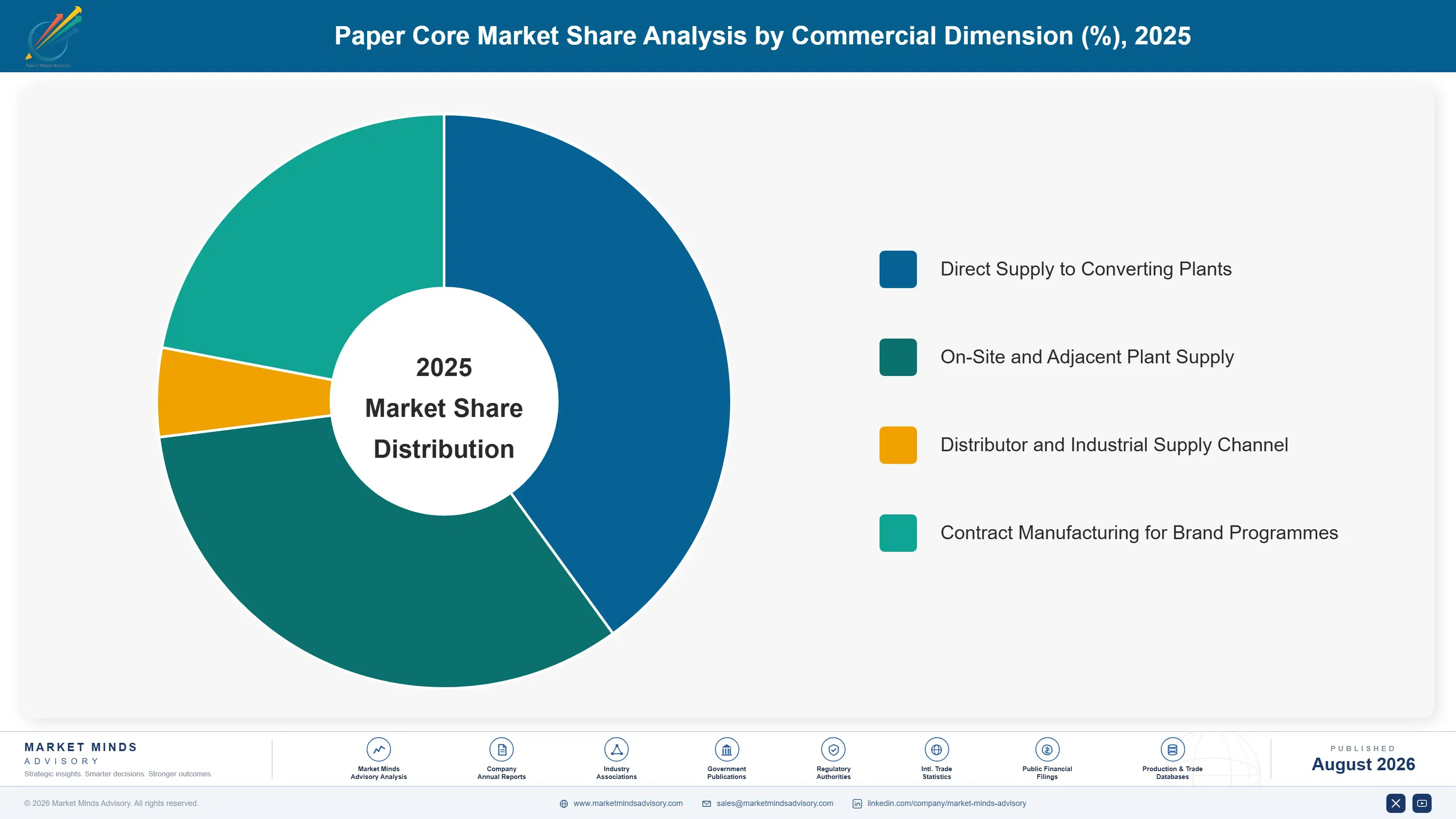
Segmentation follows core construction and performance class, because winding method and board specification together determine crush resistance, dimensional tolerance and cost. A converter choosing between a standard spiral core and a precision-wound one is buying deflection performance rather than any difference in what the core is made from. Six classes sit in the hierarchy, separated by winding method and grade.
paper-core-market-market-share-analysis-1787308643118

High-Strength Precision-Wound Cores

Precision-wound cores compound at 6.9%, exactly 1.50 times the market, on converting line speeds near 1,200 metres a minute and reel weights that standard cores were never designed to carry. Tighter winding tension, higher grade board plies and controlled adhesive application produce a core that holds concentricity under load and resists the dynamic deflection that ruins tension control at speed. Inside diameter tolerance is held far closer than commodity work, which matters because a chuck that does not seat properly transmits runout into the whole reel. The premium over standard cores is substantial in percentage terms and trivial against a single line stoppage, which is the argument producers must make explicitly because customers rarely make it themselves.
CAGR 6.9%

Specialty Coated and Moisture-Resistant Cores

Coated and moisture-resistant cores grow at 5.9% wherever the wound product or the storage environment attacks paperboard directly. Chilled and frozen food film, wet-laid nonwovens, and any reel stored outdoors or in humid conditions will soften a standard core enough to lose crush strength and dimensional stability. Barrier coatings, treated plies and sealed ends address that at a cost premium that is easy to justify once a customer has lost reels to it. The segment also covers cores in contact with sensitive wound products where fibre release or adhesive migration would contaminate the material. Producers need coating capability alongside winding, which is not universal and which limits how many suppliers can quote this work at all.
CAGR 5.9%
Full segment breakdown across 6 segments available in the complete report.

Regional Architecture and Country Demand Map

Demand follows converting capacity rather than consumption, since cores are consumed where reels are wound. Freight economics then force production to sit within a few hundred kilometres of that capacity, so the supply map mirrors the converting map almost exactly. East Asia leads on converting capacity alone.

East Asia

East Asia holds 33% of global demand. Note: this sits above the standard band because Chinese, Japanese, Korean and Taiwanese converting capacity across film, paper, label and textile applications together exceeds all other regions combined, and cores are consumed where reels are wound rather than where products are sold. Chinese flexible packaging and nonwoven conversion is the largest single block. Japanese and Korean demand skews toward high-specification precision cores serving electronics films, optical materials and battery separator production where tolerance requirements are severe. Taiwanese converting supports both. Regional growth of 5.6% reflects continued converting capacity additions rather than any change in core consumption per tonne. Local winders dominate supply because imports cannot cross the freight radius.
Share: 33% | CAGR: 5.6% (2026 to 2036)

South Asia and Pacific

Fastest of the seven regions at 6.8%, with India compounding at 7.3%, South Asia and Pacific takes 11% of demand. Indian flexible packaging conversion has expanded rapidly and textile yarn carrier demand is substantial given the size of the spinning industry, which few other regions carry at comparable scale. Local core winding capacity has grown alongside, since freight makes imports impossible beyond a short radius. Australian demand is smaller and mature. Southeast Asian converting across Vietnam, Thailand and Indonesia is adding capacity steadily as flexible packaging production relocates, and each new converter creates a local core requirement immediately. Yarn carrier volumes alone would place India among the larger national markets.
Share: 11% | CAGR: 6.8% (2026 to 2036)
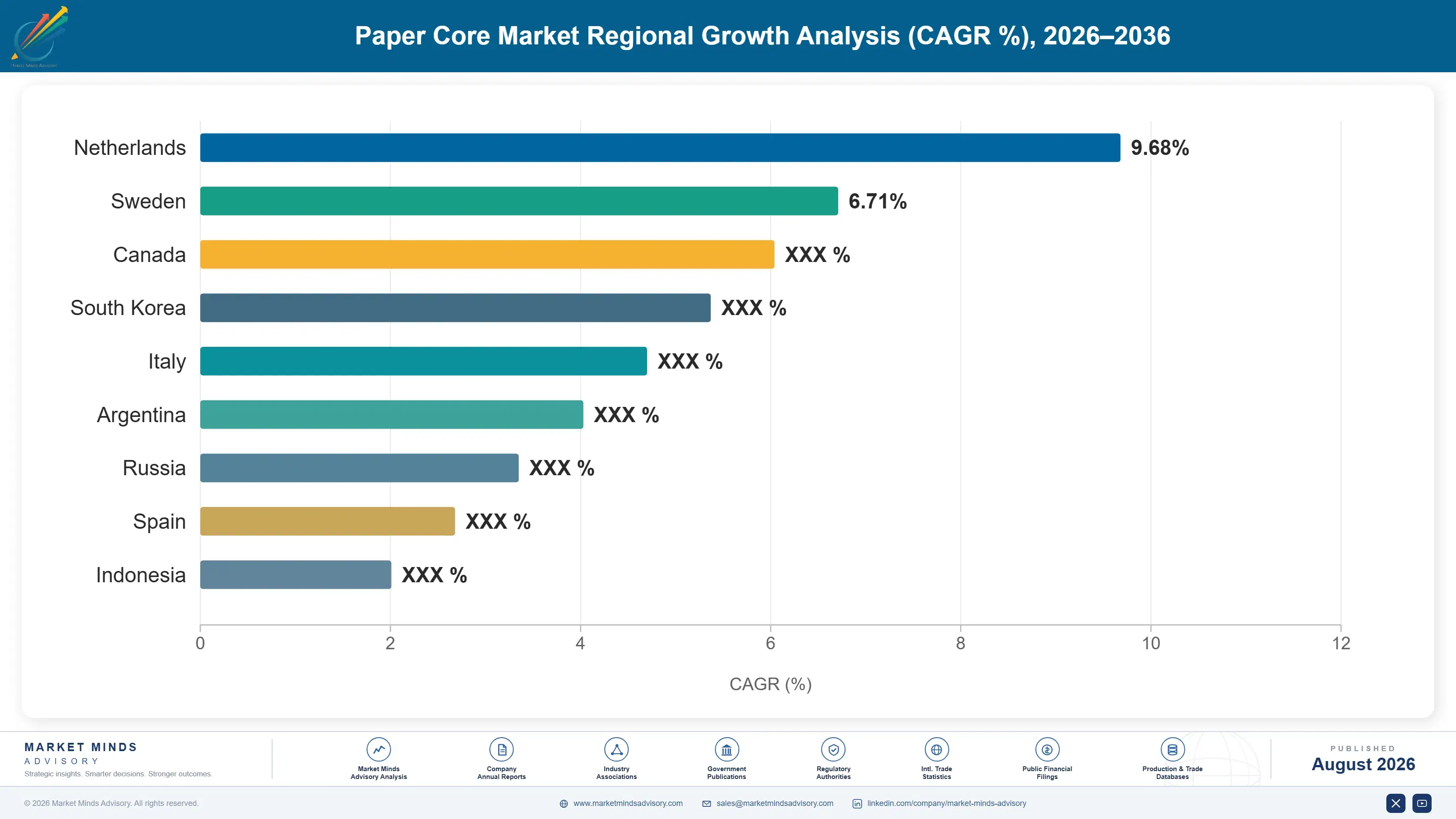
Regional intelligence for 5 additional markets available in the complete report: North America, Western Europe, Latin America, Middle East and Africa, Eastern Europe. Contact sales@marketmindsadvisory.com.
paper-core-market-country-cagr-analysis-1787308643632

Escaping the Price Per Unit Comparison

Core producers compete against local winders on delivered price for a component customers treat as commodity. Every position worth holding here changes what is being compared rather than winning the comparison. Four qualify: two require engineers on customer lines rather than salespeople, and two turn on plant siting and process capability local competitors lack.

Run Failure Analysis on Customer Converting Lines

Intermittent reel failures get attributed to the winder, the film or the operator, almost never to the core, because nobody investigates a component costing 1.4% of reel value. Producers who put technical staff onto a customer line and correlate stoppages against core specification convert an unexplained downtime problem into a specification decision. A single documented stoppage typically exceeds a year of core spend on that line, which reframes the purchase entirely. This is slow work and it is the only reliable route out of a price comparison. Instrumenting a line for six weeks costs less than a single shift lost.
Market Impact: Core at only 1.4% of total reel val

Site Winding Capacity Inside Major Converting Customers

Delivered cost stops being competitive past roughly 320 kilometres because a core is mostly air and a trailer fills by volume. Producers who site a winder inside or immediately adjacent to a large converting plant remove freight from the equation entirely and become extremely difficult to displace, since any competitor quoting from outside the radius starts at a disadvantage no efficiency can close. The volume commitment required is significant, and where it exists the position typically holds for a decade or more. On-site winding also removes inventory and reel handling for the customer.
Market Impact: Freight radius effectively extended

Target Plastic Core Substitution in Textiles and Film

Recycled content and recyclability rules are extending from primary packaging into ancillary components, bringing plastic winding cores into scope where they were previously invisible. Paper cores already carry around 94% recovered fibre and need no separation at end of life. Textile yarn carriers and film cores are where the substitution is commercially live. Producers who can document fibre content and recyclability formally win specification changes that no price argument would have moved, and those conversions rarely reverse once the qualification work is done. Textile carriers alone represent substantial volume in Asian spinning centres.
Market Impact: Recovered fibre content around 94%

Build Coating Capability Alongside Winding Operations

Coated and moisture-resistant cores grow at 5.9% and serve chilled and frozen film, wet-laid nonwovens and any reel stored in humid conditions where a standard core loses crush strength. Coating capability alongside winding is not universal, which limits how many local competitors can quote the work at all. That narrows the comparison from every winder within the freight radius to the two or three who can actually make the product, and it improves realised pricing accordingly. Coated cores grow at 5.9% and the capital requirement is modest against what it removes from the comparison.
Market Impact: Coated cores compounding at 5.9% ev

Who Controls the Margin Pool

Five producers hold 38% measured on core and tube converting revenue, the basis used throughout this section. That is remarkably low for a paper converting category and the reason is geometric: freight economics cap plant reach near 320 kilometres, so a local winder with one machine can hold a customer against any global group. Sonoco and Smurfit Westrock lead on network density rather than on scale in any conventional sense.
Competition operates on three dimensions. Plant proximity to converting capacity decides who can quote at all. Technical capability in crush performance and failure analysis decides who escapes commodity pricing. And coating capability decides participation in the specialty work that local single-machine winders cannot supply. The gap between leaders and the challenger group is narrow on commodity work and wide on both of the others.

Two pressures are moving position. Converting line speeds keep rising, which favours producers with precision winding capability and steadily disqualifies commodity operations from the better work. Meanwhile plastic core substitution opens textile and film positions to whoever can document fibre content. Rankings will shift toward producers pairing dense local networks with genuine technical depth. Board integration protects margin without winning any of it.
paper-core-market-company-positioning-matrix-1787308644157

Competitive Moat and Risk Dimensions

SONOCO PRODUCTS

Moat: Dense global winding network

Sonoco operates the widest network of core plants sited close to converting customers across North America, Europe and Asia, which directly addresses the freight constraint that defines this market. Each plant serves its own short radius, and the aggregate position is expensive and slow to replicate because it must be built plant by plant rather than acquired in one transaction.
SONOCO PRODUCTS

Risk: Local single-plant winder cost

A local winder running one or two machines with minimal overhead can price below any operation carrying group cost structure, and within its radius it is fully competitive on commodity work. Network breadth adds nothing against a competitor who only needs to serve one converter twenty kilometres away, which is why concentration stays low.
SMURFIT WESTROCK

Moat: Integrated board supply position

Board runs near 62% of core production cost, and integrated containerboard and recycled board capacity gives Smurfit Westrock visibility and supply security through recovered fibre cycles that leave independent winders buying at spot. In a category where price moves with fibre and customers resist increases, that input position protects margin others simply absorb.
SMURFIT WESTROCK

Risk: Core technical specialisation depth

Precision winding for high-speed lines and coating for moisture-resistant work are specialist disciplines, and dedicated core producers have built deeper capability than a group whose core business is corrugated and containerboard. As specification moves upward with line speeds, technical depth matters more than board integration does.

Players Tracked

Prominent Players

Sonoco Products
Smurfit Westrock
Greif
Halopack Tubes
Abzac

Other Key Players

Caraustar Industries
Rank Group
Yazoo Mills
Chase Packaging
Valk Industries
Paper Tubes and Sales
Crescent Paper Tube
Sanuki Cardboard
Fujico
Ace Paper Tube
Kunert Gruppe
Mativ Holdings
Star Paper Tube
Kraft Tube
Shanghai Chenxin Packaging

Recent Developments

APRIL 2025

Recycled content rules extend to ancillary packaging components

European recycled content and recyclability requirements were interpreted to cover ancillary components including winding cores, which had previously fallen outside primary packaging scope. This was a regulatory scope clarification rather than a commercial transaction. Plastic winding carriers now face a documentation requirement paper already meets.
Signal: Bringing winding cores into scope converts
AUGUST 2025

Converting line speed increases raise core specification failures

Flexible packaging converters running upgraded lines near 1,200 metres a minute reported rising intermittent reel failures traced to core deflection under load. This reflects equipment investment across the converting base rather than any development among core producers. Several traced it only after control upgrades failed.
Signal: Faster lines expose core specification dec
DECEMBER 2025

Recovered fibre pricing volatility compresses independent winder margins

Recovered paper and core board pricing moved sharply, and independent winders buying board on open market carried the exposure against customer contracts written at fixed prices. This reflects input market conditions rather than corporate activity among the producers involved. Several regional winders exited or were absorbed during the period.
Signal: Board at 62% of cost means fibre volatilit

Board, Adhesive and Trailer Volume

Recycled core board accounts for roughly 62% of production cost of goods, purchased from regional recycled board mills and exposed directly to recovered paper pricing. Adhesives add a further 9%, mostly starch and polyvinyl acetate systems whose pricing tracks agricultural and petrochemical inputs separately. Winding labour, energy and cutting operations make up most of the remainder.
Recovered paper and core board prices moved violently through 2021 and 2022 and again through 2025, and independent winders carried the exposure worst because they buy board at spot against customer contracts written at fixed prices. Company annual reports across the paper converting groups disclose the resulting margin effects in tube and core segments. Energy costs documented in International Energy Agency reporting compounded the pressure for European producers running drying operations.

Exposure divides sharply by board integration. Producers holding recycled board capacity see cost movement early and price against it. Independent winders absorb the lag and are the first to fail in a volatile cycle, which is the main mechanism by which this fragmented industry consolidates at all. Geography matters too, since regions with tight recovered fibre supply carry persistently higher board cost.
paper-core-market-cost-volatility-analysis-1787308644351

Index customer contracts to published recovered fibre movement

Fixed-price core contracts against spot board purchasing is what removes independent winders during volatile cycles. Indexing to a published recovered paper reference with a defined lag moves exposure to the party better placed to carry it. Customers resist the mechanism until a supplier failure interrupts their reel supply, after which the conversation becomes considerably easier.

Qualify multiple regional board mills before pricing moves

Core board is bought regionally and a single-mill relationship becomes a serious exposure when that mill raises price or reallocates capacity. Qualifying two or three mills on ply strength and moisture performance takes one production cycle and costs little, and it converts a price increase from something to absorb into something to negotiate against a live alternative.

Match board specification to actual crush requirement

Winders routinely run one board grade across most output because changeover is simpler, which overspecifies the commodity work and underspecifies the demanding lines. Matching ply grade and count to measured crush requirement per customer recovers board cost on the low end and prevents the failures that cost far more on the high end. Most winders have never run the comparison.

Portfolio Architecture for Margin Defence

The portfolio separates on how much performance the core actually has to deliver. Standard spiral-wound cores for slow lines and light reels are commodity work any winder within the radius can supply. Precision-wound cores for high-speed converting add tolerance and crush performance. Coated and moisture-resistant cores add process capability. Textile carriers and protective tubes sit apart, serving quite different customers with their own requirements.
The tension is that commodity volume pays the fixed cost of a winding plant while specialty work pays the margin, and a plant needs both. Chasing only precision and coated work leaves machines idle, since those volumes are a fraction of commodity flow. Running only commodity work leaves a producer competing purely on delivered price inside a radius where a single-machine local operation has lower overhead.

High-value pools concentrate where failure is expensive or where capability is scarce. Precision cores for fast lines, coated cores for chilled and wet applications, and any position where the producer has documented a customer's failure history all qualify. What they share is that price per unit stops deciding, either because failure cost dominates or because only two or three suppliers inside the radius can make the product.

Volume / Commodity-Adjacent Tier

Standard spiral-wound cores for slower lines and lighter reels, bought on price per unit against inside diameter and wall thickness. Any winder inside the freight radius supplies them, and overhead structure decides who wins the quote.
Gross Margin: 11-19%

Premium / Certified Tier

High-strength precision-wound cores and textile yarn carriers requiring tight tolerance and controlled crush performance. Winding capability and technical support qualify the supplier, and failure history data is what moves the specification.
Gross Margin: 22-32%

Sustainability / Regulatory / Next-Generation Tier

Coated and moisture-resistant cores plus documented-recyclability product replacing plastic winding carriers. The wide margin range reflects the gap between established coating operations and producers still qualifying the capability against their first customers.
Gross Margin: 26-48%
paper-core-market-portfolio-architecture-1787308644849

High-value Sub-segments and Strategic Watch-out

High-Strength Precision-Wound Cores

Compounding at 6.9% as converting lines reach 1,200 metres a minute and reel weights climb beyond what standard cores were designed to carry. Intermittent failures rather than outright ones are what eventually move a customer's specification here. Precision winding capability is not universal among regional suppliers.
Gross Margin: 24-32%

Coated and Moisture-Resistant Cores

Growing at 5.9% across chilled film, wet-laid nonwovens and humid storage where standard board loses crush strength. Coating capability alongside winding is not universal, which narrows the competitive field considerably inside any given freight radius. Realised pricing improves wherever that scarcity holds inside a radius.
Gross Margin: 30-48%

Standard Spiral-Wound Cores

The volume core at 3.4%, carrying the fixed cost of every winding plant and paying almost nothing above it. Competition is delivered price inside a short radius, and the lowest overhead operation usually wins the business. It still pays the fixed cost of every winding plant.
Gross Margin: 11-19%

Plastic Core Replacement Positions

The strategic watch-out. Recyclability rules reaching ancillary components open textile carrier and film core conversions that price never would, but qualification is slow and the volumes only move once per customer. Volumes move once per customer and then stay, which makes early qualification unusually valuable.
Gross Margin: 20-42%

Consumed and Replaced Every Reel

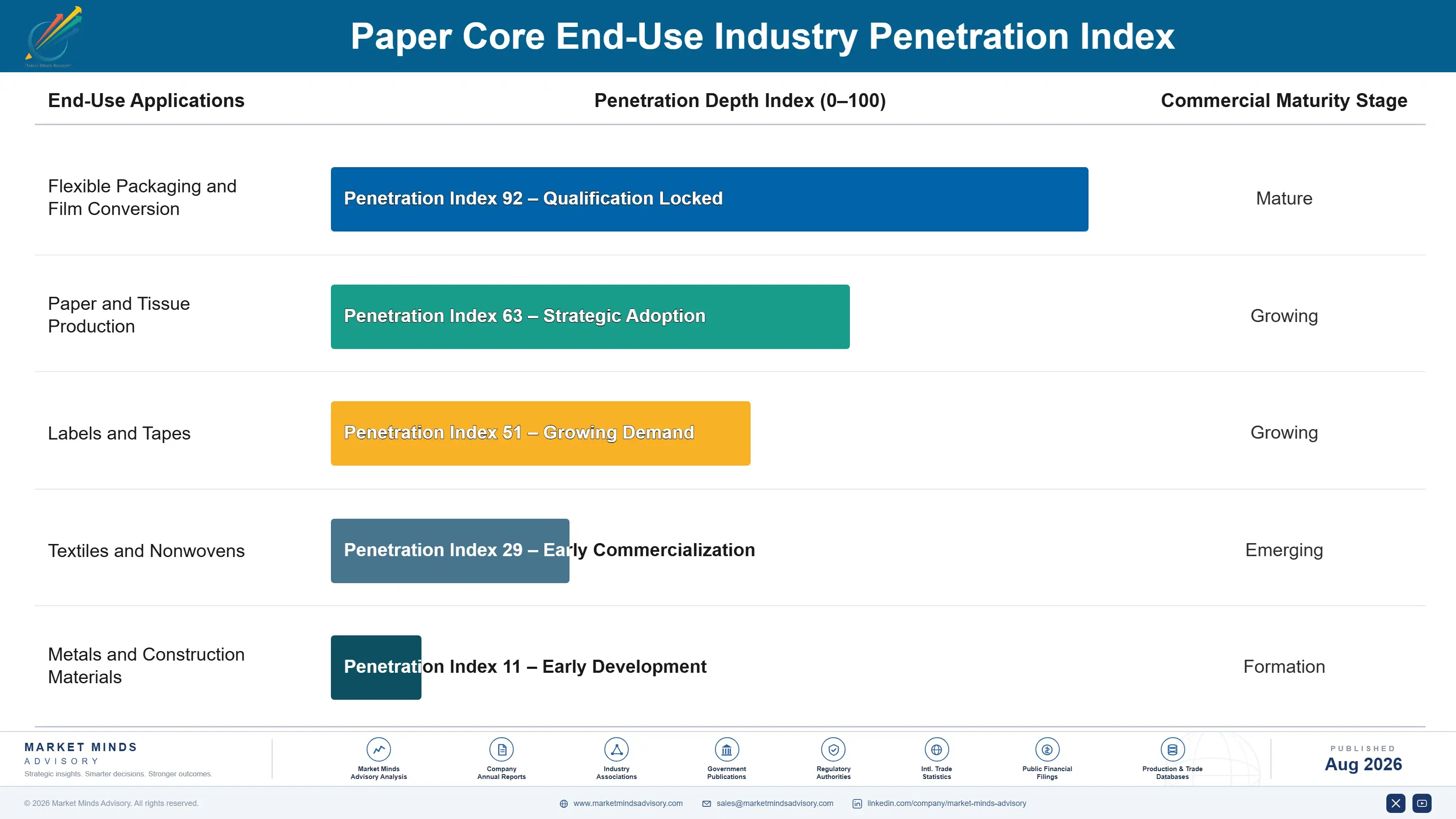
This is genuine annuity demand. A core is consumed with the reel it carries, so a converter running continuously buys continuously, and volumes are predictable to within a few percent from the customer's own production plan. Producers forecast off converter capacity rather than off any demand model. The relationship persists until price or a failure disturbs it, and switching costs are low enough that neither takes long to act on.
Depth varies by what the core has to survive. Film, label and nonwoven converters buy deepest and specify hardest, since their line speeds punish weak cores immediately. Textile spinners buy large volumes of yarn carriers with quite different requirements around surface and dimensional consistency. Paper mills and tissue converters buy heavy commodity volume. Protective tube customers buy episodically against project work.

The buying population has not changed much, which is part of the problem. Cores remain a procurement purchase compared on price per unit, and the technical function that should set specification is rarely consulted until a failure forces it. Producers who reach engineering directly, before a stoppage does it for them, hold considerably better positions.
paper-core-market-end-use-penetration-index-1787308645336

Where Core Producers Win

These are among the four positions where our research anticipates prominent divergence between winners and laggards over the coming forecast period. Each is grounded in the demand model, the regulatory perimeter, and the announced capacity pipeline.
01 / LINE FAILURE DIAGNOSTICS

Nobody blames the component costing one percent of the reel

Intermittent reel failures get attributed to the winder, the film or the operator, because a core at 1.4% of reel value is invisible to everyone involved. Producers who put technical staff onto customer lines and correlate stoppages against core specification turn an unexplained downtime problem into an engineering decision. One documented stoppage typically exceeds a year of core spend on that line, and that arithmetic ends the price comparison permanently, and it moves core purchasing from procurement to engineering where it belongs.
02 / FREIGHT RADIUS POSITIONING

A core is mostly air and cannot travel to win business

Delivered cost stops being competitive past roughly 320 kilometres because a trailer fills by volume long before weight, and no manufacturing efficiency closes that gap. Producers siting winders inside or adjacent to major converting plants remove freight from the comparison and hold positions for a decade or more. This is also why concentration sits at only 38% and why consolidation keeps stalling in a sector that consolidated everything else, because the constraint is geometric rather than anything a balance sheet can overcome.
03 / COATING CAPABILITY SCARCITY

Narrow the field to who can actually make the product

Coated and moisture-resistant cores serve chilled film, wet-laid nonwovens and humid storage where standard board loses crush strength, and they grow at 5.9%. Coating alongside winding is not universal capability, which reduces the competitive field inside any freight radius from every local winder to two or three. Realised pricing improves accordingly, and the investment is modest against what it removes from the comparison, since coating equipment costs far less than the pricing it protects across a decade of specialty work.
04 / FIBRE COST PASS-THROUGH

Board at 62% of cost decides who survives a volatile cycle

Independent winders buying board at spot against fixed-price customer contracts are the first casualties whenever recovered fibre moves sharply, which is the main way this fragmented industry consolidates at all. Indexing contracts to a published recovered paper reference with a defined lag moves that exposure to whoever can actually carry it. Customers resist until a supplier failure interrupts their reel supply, after which the discussion gets easier, and the producers who indexed early kept margin through cycles that removed their neighbours.

Engagement Snapshot From the Field

A live engagement with an industry participant carrying material or product regulatory and market exposure ahead of a defining policy shift, showing how our research translates into a defensible multi-year portfolio strategy.
MARKET MINDS ADVISORY · CLIENT ENGAGEMENT SUMMARY
Paper Core Producer Strategic Portfolio Review and Transition Roadmap 2026·Investment Scenario on Paper Core Exposure Evaluation 2025-26
CLIENT PROFILE
A flexible packaging converter operating eleven laminating and slitting lines across two plants, with roughly EUR 410 million in revenue (client-reported, unverified by MMA). Cores were purchased from four regional winders on annual price agreements, specified by inside diameter, wall thickness and length only, with no crush requirement written into any of the four agreements.
STRATEGIC CHALLENGE
Unplanned stoppages on the two fastest slitting lines had risen through the year and were costing an estimated EUR 2.1 million annually in lost output (client-reported, unverified by MMA). Engineering attributed the failures to tension control, and two control system upgrades had failed to reduce the stoppage rate at all.
MMA APPROACH
MMA instrumented both lines to record reel runout and tension deviation against core batch and supplier, across six weeks of normal production. Core samples from all four suppliers were tested for flat-crush and radial compression, and the results were matched to the recorded stoppage events by batch. Purchase agreements from all four suppliers were reviewed for strength requirements.
KEY FINDINGS
  1. Flat-crush performance varied by 34% across the four suppliers despite every core meeting the dimensional specification written into the purchase agreements, which contained no strength requirement at all.
  2. Stoppages clustered heavily on batches from the two lowest-price suppliers, and the correlation with measured flat-crush was far stronger than any correlation with tension control settings.
  3. Reel runout at full diameter exceeded the tolerance the tension control system was designed to correct, which explained why two control upgrades had produced no measurable improvement.
  4. The combined annual price advantage from the two weaker suppliers was under EUR 60,000 against stoppage costs an order of magnitude larger on the affected lines.
CLIENT PROFILE
A flexible packaging converter operating eleven laminating and slitting lines across two plants, with roughly EUR 410 million in revenue (client-reported, unverified by MMA). Cores were purchased from four regional winders on annual price agreements, specified by inside diameter, wall thickness and length only, with no crush requirement written into any of the four agreements.
STRATEGIC CHALLENGE
Unplanned stoppages on the two fastest slitting lines had risen through the year and were costing an estimated EUR 2.1 million annually in lost output (client-reported, unverified by MMA). Engineering attributed the failures to tension control, and two control system upgrades had failed to reduce the stoppage rate at all.
MMA APPROACH
MMA instrumented both lines to record reel runout and tension deviation against core batch and supplier, across six weeks of normal production. Core samples from all four suppliers were tested for flat-crush and radial compression, and the results were matched to the recorded stoppage events by batch. Purchase agreements from all four suppliers were reviewed for strength requirements.
KEY FINDINGS
  1. Flat-crush performance varied by 34% across the four suppliers despite every core meeting the dimensional specification written into the purchase agreements, which contained no strength requirement at all.
  2. Stoppages clustered heavily on batches from the two lowest-price suppliers, and the correlation with measured flat-crush was far stronger than any correlation with tension control settings.
  3. Reel runout at full diameter exceeded the tolerance the tension control system was designed to correct, which explained why two control upgrades had produced no measurable improvement.
  4. The combined annual price advantage from the two weaker suppliers was under EUR 60,000 against stoppage costs an order of magnitude larger on the affected lines.
RECOMMENDED STRATEGY
Phase 1: Phase 1 (months 1 to 3): Write flat-crush and radial compression minimums into all four core supply agreements and test incoming batches. Phase 2: Phase 2 (months 3 to 9): Move the two fastest slitting lines to precision-wound cores and measure stoppage rates against the instrumented baseline. Phase 3: Phase 3 (months 9 to 18): Consolidate to two suppliers holding precision capability within the freight radius of both plants.
OUTCOME
Unplanned stoppages on the two instrumented lines fell by 71% within four months of the specification change (client-reported, unverified by MMA). Core spend rose by approximately EUR 185,000 annually against recovered output valued well above that figure (client-reported, unverified by MMA). Core purchasing now sits with engineering, and dimensional specification alone is no longer accepted from any supplier.

Frequently Asked Questions

Foundational context covering the market sizes, CAGR, scope, country, region and competition that inform every finding below. This section is provided to cover basics and most often pre-purchase conversations, answered from the MMA Primary Research Dataset.

What is the current size of the Paper Core Market?

The global market was worth USD 7.8 billion in 2025, reaching USD 8.16 billion in 2026. East Asia holds the largest regional share at 33% of demand.

How large will the Paper Core Market be by 2036?

MMA forecasts USD 11.6 billion by 2036, an expansion multiple of 1.42 times the 2026 base. That represents roughly USD 3.44 billion of incremental value.

What is the CAGR for the Paper Core Market 2026 to 2036?

The base case compounds at 4.6% annually, with a bull case of 5.8% and a bear case of 3.4%. Historical growth from 2020 to 2025 ran at 3.8%.

Which segment is growing fastest?

High-strength precision-wound cores compound at 6.9%, exactly 1.50 times the market rate. Converting line speeds near 1,200 metres a minute are what drives that shift.

Who are the major companies in the Paper Core Market?

Sonoco Products, Smurfit Westrock, Greif, Halopack Tubes and Abzac together hold a combined 38%. Freight economics keep concentration far below every other paper converting category.

Which country is growing fastest?

India compounds at 7.3%, ahead of every other national market. Flexible packaging conversion and a very large textile spinning base together drive that demand upward.

Report Segmentation Architecture

The full report scope spans multiple orthogonal segmentation dimensions, with cross-tabulated demand data provided for each dimension pair. Coverage extends further to regional breakdowns, trend trajectories, and the competitive detail needed to support segment-level decision-making.

By Core Construction and Performance Class

  • Standard Spiral-Wound Cores
  • High-Strength Precision-Wound Cores
  • Convolute-Wound Cores
  • Textile and Yarn Carriers
  • Specialty Coated and Moisture-Resistant Cores
  • Protective Tubes and Cans

By End-Use Industry

  • Flexible Packaging and Film Conversion
  • Paper and Tissue Production
  • Labels and Tapes
  • Textiles and Nonwovens
  • Metals and Construction Materials

By Commercial Dimension

  • Direct Supply to Converting Plants
  • On-Site and Adjacent Plant Supply
  • Distributor and Industrial Supply Channel
  • Contract Manufacturing for Brand Programmes

By Region

  • North America
  • Western Europe
  • East Asia
  • South Asia and Pacific
  • Latin America
  • Middle East and Africa
  • Eastern Europe

Scope, Methodology, and Coverage

Every figure in this report is reproducible from documented input assumptions. The scope below maps the historical period, the forecast horizon, the segmentation dimensions, and the countries covered, alongside the underlying primary and qualitative methodology.
Historical Period
2020 to 2025
Forecast Period
2026 to 2036
Base Year
2025 (USD billions; MMA Primary Research Dataset, August 2026)
Market Definition
The market covers spirally and convolutely wound paperboard cores and tubes used as winding mandrels and as industrial packaging, spanning standard spiral-wound cores, high-strength precision-wound cores, convolute-wound cores, textile and yarn carriers, protective tubes and cans, and specialty coated or moisture-resistant cores. Plastic and metal winding cores, composite drums with metal ends, fibre drums for bulk containment, and the wound products themselves are excluded. Sizing is measured at producer revenue in current prices.
Quantitative Units
USD billions (current prices); core units, board tonnage and flat-crush values in newtons where applicable
Segmentation Dimensions
By Core Construction and Performance Class; By End-Use Industry; By Commercial Dimension; By Region
Regions Covered
North America, Western Europe, East Asia, South Asia and Pacific, Latin America, Middle East and Africa, Eastern Europe
Countries Covered
USA, China, Germany, France, UK, Japan, South Korea, India, Australia, Canada, Brazil, Mexico, Indonesia, Vietnam, Thailand, Taiwan, UAE, Saudi Arabia, South Africa, Egypt, Turkey, Poland, Netherlands, Italy, Spain, Sweden, Finland, Argentina, Colombia, Czech Republic, and additional markets relevant to this sector
Key Companies Profiled
Sonoco Products, Smurfit Westrock, Greif, Halopack Tubes, Abzac, Caraustar Industries, Rank Group, Yazoo Mills, Chase Packaging, Valk Industries, Paper Tubes and Sales, Crescent Paper Tube, Sanuki Cardboard, Fujico, Ace Paper Tube, Kunert Gruppe, Mativ Holdings, Star Paper Tube, Kraft Tube, Shanghai Chenxin Packaging
Quantitative Methodology
Primary survey, n=3,800 respondents, Q4 2025, six countries; demand-side model with trade association cross-validation
Qualitative Methodology
47 expert interviews, Q4 2025; applied to validate demand model assumptions, identify emerging dynamics, and assess competitive positioning
Report Format
PDF and XLSX data workbook (Word format preview document)
Publisher
Market Minds Advisory
Report Code
MMA-2026-PAC-829
Published
August 2026
Contact
sales@marketmindsadvisory.com | www.marketmindsadvisory.com

Purchase the full Paper Core Market Report (2026 to 2036).

The full report sizes paper cores across six construction classes, three commercial dimensions and seven regions, with annual forecasts to 2036 under base, bull and bear scenarios. Freight radius economics are modelled by core geometry and board grade to establish the servable distance from any winding plant. Crush and flat-crush requirements are mapped against converting line speeds and reel weights by application. Recovered fibre cost pass-through is assessed across integrated and independent producers through recent volatility. Twenty producers are profiled on a consistent core converting revenue basis.
Freight radius economics modelled by core geometry and grade
Crush requirements mapped against line speeds and reel weights
Recovered fibre pass-through compared across integrated and independent producers
Plastic core substitution assessed by application and regulation
Coating capability distribution measured across regional supply bases
Downtime cost arithmetic quantified against core specification decisions

Built For The People Who Decide

From boardroom strategy to bench-side execution, this report is read cover-to-cover by leaders shaping the next decade of their industry, turning demand scenarios, market dynamics and valuation benchmarks into decisions.
CXOs/ Presidents/ VPs/ Managers
M&A and Corporate Development
Strategy Teams and R&D Heads
Procurement and Product Directors
Regulatory and Compliance Leaders
Investor Relations and Equity Analysts