Market Minds Advisory
Palletizing Robots Market

Palletizing Robots Market: Labor Scarcity and the Warehouse Automation Buildout

Warehouse operators are converting persistent labor shortages and rising injury liability into firm palletizing robot orders, even as cobot entrants undercut established suppliers on price and integration complexity slows deployment at smaller centers.

Lead Analyst

David Horsley

Published

September 2026

Make Smarter Decisions with Customized Research Insights

Request a free sample report and evaluate market opportunities, growth trends, and competitive dynamics relevant to your business needs.

2025 MARKET VALUE$3.4BMarket Size 2025
2036 FORECAST VALUE$10.5BBase Case , 2026 to 2036
CAGR 2026 TO 203610.8 %Bull 12.0% / Bear 9.5%
INCREMENTAL OPPORTUNITY$6.8BNet 10- year value creation
EXPANSION MULTIPLE2.79x2036 value over 2026 base
Strategic Levers
M&A Pipeline
Regional Outlook
Country Rankings
Competitive Intelligence
Segmental Deep-dive
Call-Us : 91 93563 13602

Executive Snapshot and Market Trajectory

Warehouse and distribution center operators are converting chronic labor shortages into firm capital orders for palletizing automation, no longer treating robotic end-of-line palletizing as a discretionary upgrade. That labor-driven urgency is what is pulling deployment forward across mid-sized facilities that once considered robots too costly to justify five years ago.
Collaborative palletizers are capturing the fastest growth as small and mid-sized distribution centers adopt robots without the fenced safety cells and integration cost traditional articulated arms require. East Asia holds the deepest single manufacturing and deployment base, while North American e-commerce fulfillment operators drive the highest per-facility capital spend as they race to offset seasonal labor volatility, particularly around holiday peak order volumes each fourth quarter.
Competitive intensity concentrates around a small set of established industrial robot manufacturers even as a wave of cobot specialists chases the small-facility segment those incumbents have historically ignored. FANUC and ABB's integration depth and global service networks set the pace that challengers chase, while falling sensor and vision system costs pull smaller warehouses into the addressable market each year, exactly where those cobot entrants are now concentrating their sales effort most heavily.
Market Definition
The palletizing robots market covers robotic systems designed to stack, arrange, and depalletize goods onto or from pallets in warehouse, distribution, and manufacturing end-of-line applications, including the robot arm, end-of-arm tooling, and associated control software sold as an integrated palletizing cell. It excludes conventional non-robotic mechanical palletizers, general-purpose industrial robots deployed outside palletizing tasks, and standalone warehouse management software sold without robotic hardware.
Base Year Value
$3.4B in 2025 (MMA Primary Research Dataset, August 2026)
Forecast Period
2026 to 2036, eleven discrete annual values
CAGR
10.8% base case. Bull 12.0%. Bear 9.5%.
Fastest Growth Segment
Collaborative (Cobot) Palletizers: 15.2% CAGR
Fastest Growth Country
India: 14.3% CAGR
Fastest Growth Region
South Asia and Pacific: 13.1% CAGR
Largest Region
East Asia: 30% of 2025 global value
Market Leaders
ABB Ltd, FANUC Corporation, Yaskawa Electric Corporation, KUKA AG, Kawasaki Heavy Industries. Source: MMA Analysis based on company annual reports and investor filings.
Primary Survey
n=3,800 procurement and R&D decision-makers, Q4 2025, six countries
Methodology
Demand-side build-up, cross-validated against public data, 47 expert interviews

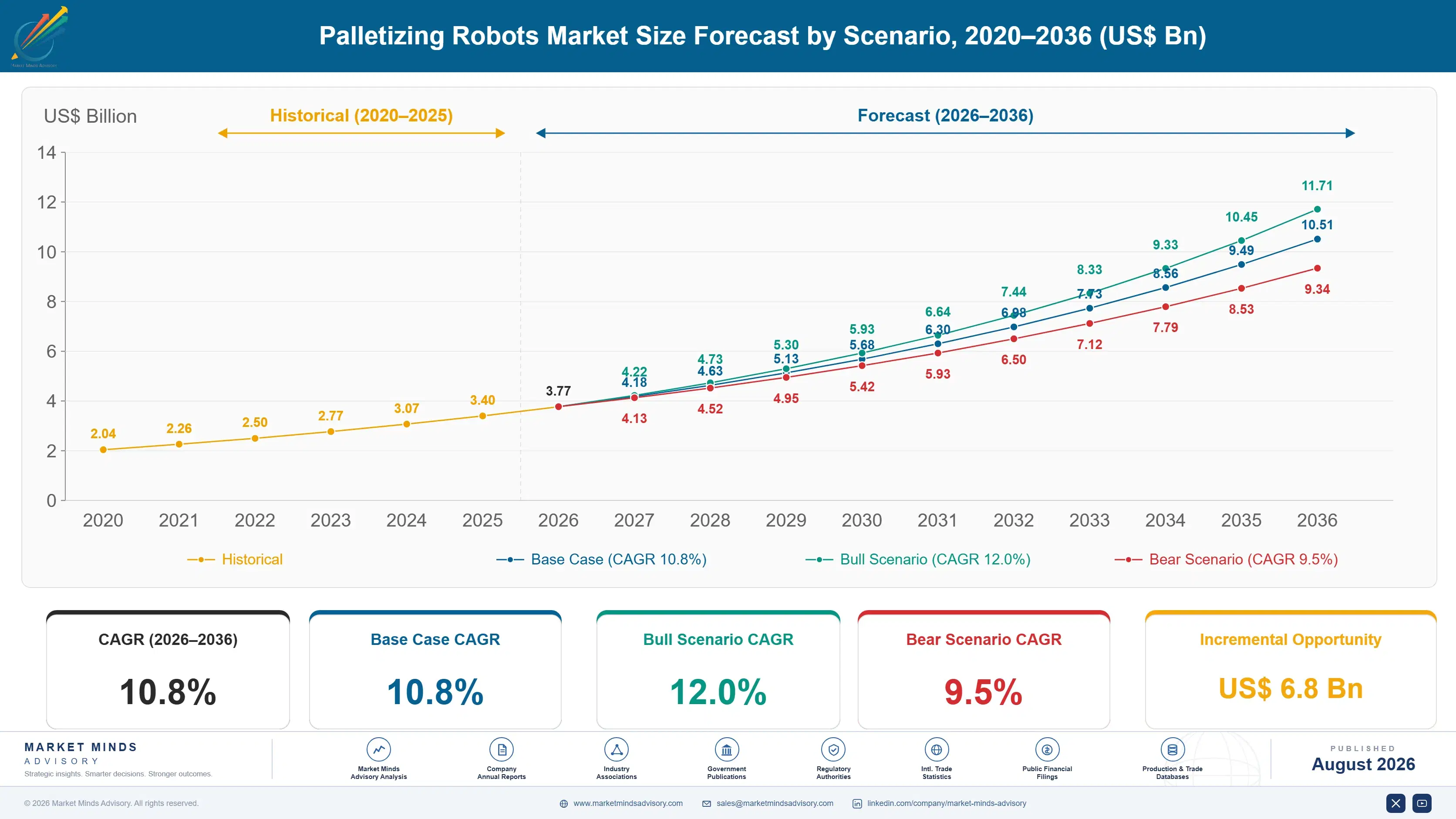
Palletizing Robots Market Forecast Scenarios

palletizing-robots-market-size-forecast-scenario-1787300527786
Palletizing robot demand accelerated unevenly between 2020 and 2025, as pandemic-era e-commerce growth pulled forward warehouse automation capital spending that then cooled briefly in 2023 amid broader logistics sector destocking. Even so, persistent warehouse labor shortages kept deployment growing through the period, closing 2025 at an estimated 9.8% historical CAGR, ahead of general industrial automation broadly.
The base case rests on three reinforcing mechanisms. First, warehouse labor availability keeps tightening in mature logistics markets, pushing operators toward automation regardless of near-term capital cost pressure. Second, cobot palletizer pricing has fallen enough to bring payback periods under two years for many mid-sized facilities that previously found automation uneconomical. Third, e-commerce order volume growth keeps outpacing warehouse labor supply, widening a gap that only throughput automation can close at scale.
The bull case turns on a sharper-than-expected acceleration in US and European minimum wage and warehouse safety regulation, pulling automation forward faster than the base forecast assumes. The bear risk is a broader logistics sector capital spending slowdown should e-commerce growth cool meaningfully, delaying planned automation projects even where the underlying labor case remains intact across most facility types.

Labor Scarcity Economics and the Cobot Entry Curve

Palletizing robots sit at the intersection of two converging pressures: warehouse labor markets that keep tightening year after year, and injury liability costs from repetitive lifting that insurers increasingly price into workers' compensation premiums. Both forces reward automation that removes humans from the highest-injury-rate task on a typical warehouse floor, a case that holds regardless of near-term interest rate cycles or credit conditions.
MARKET CONCENTRATION58% CR5Five established robot makers hold majority but incomplete share
AVERAGE SELLING PRICE$45,000-180,000 per cellPrice varies steeply by payload class and integration scope
TOP PRODUCING COUNTRYJapan, 29% shareJapanese manufacturers supply the largest single national output share
CAPACITY UTILISATION74%Utilisation tracks broader industrial capital equipment order cycles
TRADE INTENSITY63% cross-borderMost robot cells cross a border before final installation
FEEDSTOCK COST SHARE31% of COGSServo motors and precision gearing dominate component spending lines
Commercially, the market increasingly splits between two distinct buying motions. Large distribution centers still buy engineered, integrated palletizing cells from established robot makers with dedicated systems integrators, while small and mid-sized facilities are shifting toward simpler cobot packages that arrive largely pre-configured and require far less on-site integration expertise to commission quickly.
Over the next decade, the balance between these two buying motions will keep shifting toward the simpler end as cobot payload capacity and reach keep expanding into use cases once reserved for traditional articulated arms. Vision system and gripper technology will matter more than raw arm mechanics, and the suppliers that pair software ease-of-use with mechanical reliability stand to capture the largest share of new mid-market deployments over the next several years.
"Palletizing robots stopped being a productivity story and became a labor availability story about three years ago. The interesting question now is whether the cobot entrants can actually service what they sell once installations scale past a few hundred units."
Director, Industrial Automation and Robotics Practice · MMA Construction and Ind

Market Trends

Cobot Palletizers Open the Small-Facility Segment

Collaborative palletizing robots, designed to operate without full safety fencing and requiring less programming expertise, are opening a segment of small and mid-sized warehouses that traditional articulated-arm systems priced out for years. Universal Robots, Doosan Robotics, and Techman Robot have shipped dedicated palletizing kits since 2023, bundling vision guidance and gripper selection into a package staff can commission within days rather than weeks. Average selling prices for cobot cells have fallen roughly 40% below comparable traditional cells over three years, and shipments to facilities with fewer than fifty employees more than doubled between 2023 and 2025.
Market Impact: Cited by 60%+ as driver
Vision-Guided Mixed-SKU Palletizing Gains Wider Ground

Advanced 3D vision and AI-based path planning are letting palletizing robots handle mixed-SKU pallets, irregular carton sizes, and unstable load geometries that earlier robot generations could not reliably stack, a capability gap that previously kept robots confined to single-SKU, uniform-case applications. FANUC, ABB, and several vision-system specialists have released mixed-case palletizing software updates since 2024 that use real-time load stability modeling to sequence carton placement dynamically rather than following a fixed pre-programmed pattern. Operators running mixed-SKU distribution centers report robots now handling roughly 65% of order profiles that required manual palletizing as recently as 2022.
Market Impact: Cuts payback period to 18-30 months

Market Opportunities and Growth Drivers

Warehouse Labor Shortages Push Automation From Optional to Necessary

US warehouse and distribution center job openings have persistently outpaced hires since 2021, and operators report palletizing and end-of-line positions among the hardest warehouse roles to fill and retain given the repetitive lifting involved. The US Bureau of Labor Statistics recorded warehouse worker turnover rates exceeding 40% annually through 2024 and 2025, forcing operators to weigh recurring recruitment costs against a one-time automation investment with a longer useful life. MMA's primary survey found more than 60% of surveyed logistics operators now cite labor availability as the primary driver behind their most recent automation decision.
Market Impact: Adds 12-20 weeks to deployment timeline

E-Commerce Order Volume Keeps Outpacing Warehouse Throughput Capacity

Global e-commerce order volumes have continued climbing faster than warehouse labor supply can scale, during seasonal peaks where distribution centers must handle multiples of baseline daily order volume without a proportional increase in available temporary labor. Palletizing robots let operators absorb that seasonal peak without the recruiting and safety ramp-up cost of large temporary workforce surges, since a robotic cell runs at consistent throughput regardless of order volume swings. Operators running e-commerce fulfillment centers report investment paying back within eighteen to thirty months when peak-handling capacity is priced into the calculation, faster than facilities evaluating automation on steady-state throughput alone.
Market Impact: Chinese cells undercut 25-35% on price

Market Restraints and Challenges

Integration Complexity Slows Deployment at Smaller Facilities

Traditional articulated-arm palletizing cells require systems integration work, including safety fencing design, conveyor interfacing, and site-specific programming, that can take twelve to twenty weeks from order to commissioning, a timeline smaller warehouse operators without dedicated automation staff find difficult to plan around. That integration burden keeps average project cost well above the robot hardware price alone once integrator fees are included. Cobot suppliers are addressing this with pre-configured application kits designed for self-commissioning, though full mixed-SKU capability at cobot payload classes still trails traditional arms, leaving some facilities without a fully satisfactory option yet.
Market Impact: Cuts cobot cell pricing roughly 40%

Chinese Domestic Suppliers Compress Mid-Market Pricing

Chinese robot manufacturers, backed by national robotics industrial policy, are shipping palletizing cells at prices 25 to 35% below established Japanese and European suppliers, a gap rooted in domestic servo motor and gearing supply chains and subsidized manufacturing scale-up that Western suppliers cannot easily match. That pricing pressure compresses margins hardest for mid-tier suppliers competing against Chinese entrants without the deep integration expertise or global service networks that top-tier suppliers including FANUC and ABB use to defend premium pricing. Established suppliers are responding by emphasizing uptime guarantees, remote diagnostics, and multi-year service contracts that low-cost entrants have not yet matched.
Market Impact: Handles roughly 65% of mixed-SKU orders
3 additional market trends, 3 additional growth drivers, and 2 additional restraints and challenges are covered in the full report. Contact sales@marketmindsadvisory.com to access the complete intelligence.

Segment CAGR and Growth Architecture

Segmentation follows robot configuration and mechanical architecture rather than end-use industry, since arm geometry, payload class, and safety design determine deployment cost and facility fit more than the specific goods being palletized. Articulated arms remain the volume base, but collaborative and mobile-integrated configurations now address facility sizes and layouts traditional arms cannot economically serve.
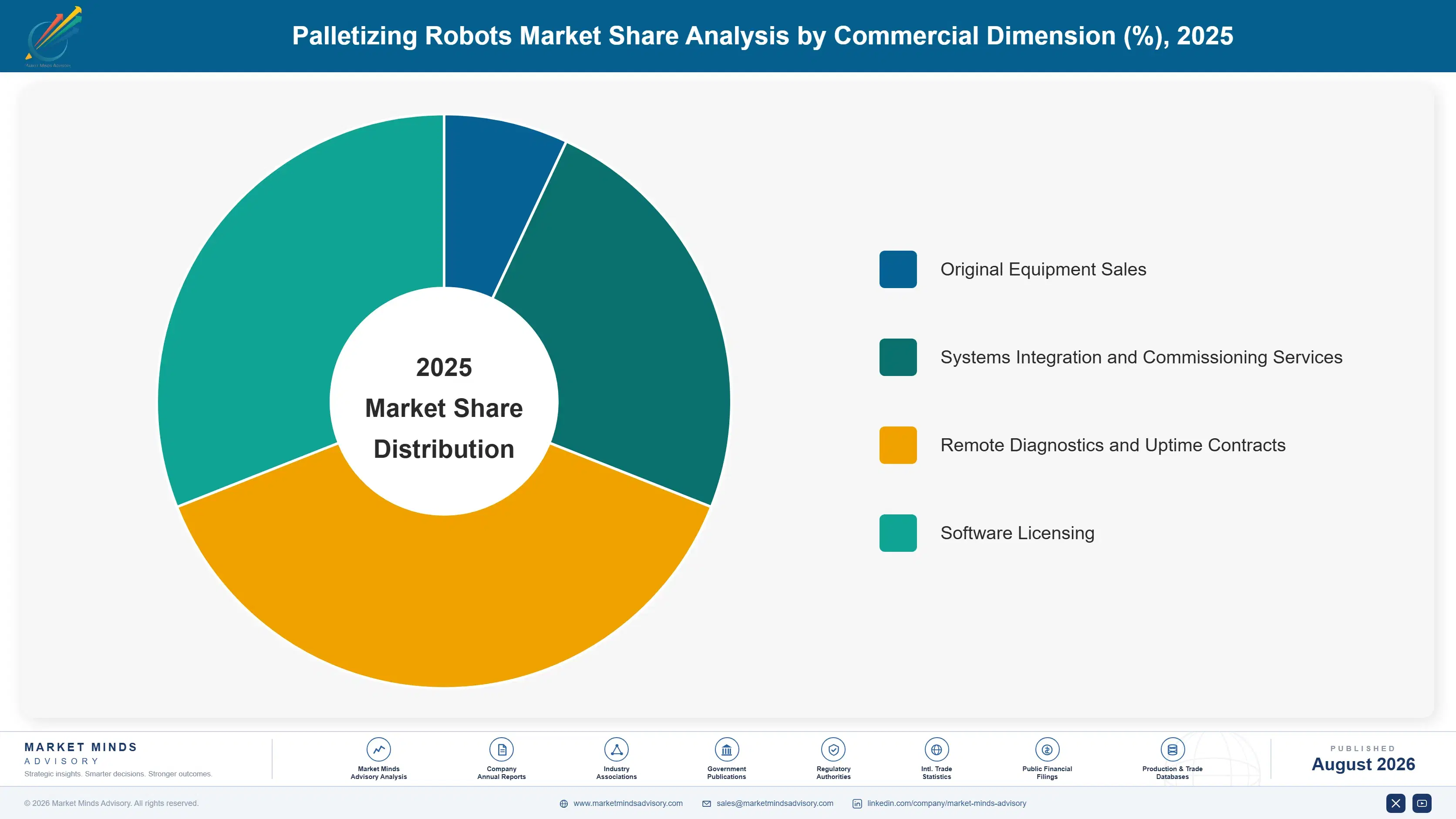
palletizing-robots-market-market-share-analysis-1787300528316

Collaborative (Cobot) Palletizers

Collaborative palletizers are the fastest-growing configuration, expanding at an estimated 15.2% CAGR against a market average of 10.8%, roughly 1.41 times the overall pace. Growth tracks directly with small and mid-sized warehouse automation adoption, as facilities that previously found traditional articulated-arm integration cost prohibitive gain access to pre-configured cells requiring far less on-site programming expertise. Universal Robots and Doosan Robotics currently lead on shipped cobot palletizing volume, though Chinese entrants are closing the technology gap faster in this segment than in traditional arm categories, since cobot design rewards software usability and safety certification more than deep mechanical engineering scale. Continued adoption depends on cobots closing the remaining payload and mixed-SKU capability gap against traditional arms.
CAGR 15.2%

Mobile (AMR-Integrated) Palletizers

Mobile, autonomous-mobile-robot-integrated palletizers rank second-fastest, growing at an estimated 13.6% CAGR as facilities combine palletizing arms with mobile bases that can reposition between multiple pallet-building stations without fixed conveyor infrastructure. The segment benefits from warehouses retrofitting automation into existing building footprints where installing fixed conveyor lines is costly or physically impractical, letting operators add throughput capacity without a full facility redesign. Adoption still trails fixed-base configurations by a wide margin, since mobile platforms carry a meaningful cost premium and remain less proven at very high daily throughput volumes. Growth is concentrated among suppliers including KUKA and several mobile robotics specialists that have released dedicated palletizing-application mobile platforms within the past two years.
CAGR 13.6%
Full segment breakdown across 5 segments available in the complete report.

Regional Architecture and Country Demand Map

Palletizing robot demand concentrates where manufacturing robotics scale and warehouse labor scarcity overlap. East Asia leads on both robot manufacturing capacity and its own expanding logistics automation base, North America follows on e-commerce fulfillment capital spending, and South Asia and Pacific grows fastest as warehousing formalizes across the region.

North America

E-commerce fulfillment capital spending anchors North America's palletizing robot demand, as large third-party logistics providers race to offset seasonal warehouse labor volatility around peak shopping periods. The US Bureau of Labor Statistics has tracked persistent warehouse worker shortages across major fulfillment hubs including the Inland Empire, Dallas-Fort Worth, and Atlanta, pushing operators toward automation regardless of near-term capital cost pressure. Grocery and cold-chain distribution centers add a second demand pool, since sustained low temperatures make manual palletizing even less attractive to available labor than standard ambient conditions. Canada contributes a smaller, steadier share tied to its grocery and general merchandise distribution network, while Mexico's contribution grows fastest of the three as nearshoring-driven manufacturing pulls new distribution capacity into the country.
Share: 23% | CAGR: 11.6% (2026 to 2036)

Western Europe

Regulation and demographics, not e-commerce growth alone, shape Western Europe's palletizing robot demand. Germany and the Netherlands lead on installed base, reflecting deep existing industrial robotics supply chains and warehouse operators facing an aging workforce that is shrinking the pool of manual labor willing to perform repetitive lifting. France and the UK are expanding automation more gradually, constrained by capital availability at small and mid-sized logistics operators compared to larger German and Dutch counterparts. Strict workplace safety and manual handling regulations across the European Union add a compliance-driven demand layer beyond labor cost economics alone. Growth here trails the global average, reflecting a more mature, already-automated large-facility base than markets earlier in their adoption curve.
Share: 19% | CAGR: 9.3% (2026 to 2036)
Regional intelligence for 5 additional markets available in the complete report: East Asia, South Asia and Pacific, Latin America, Middle East and Africa, Eastern Europe. Contact sales@marketmindsadvisory.com.
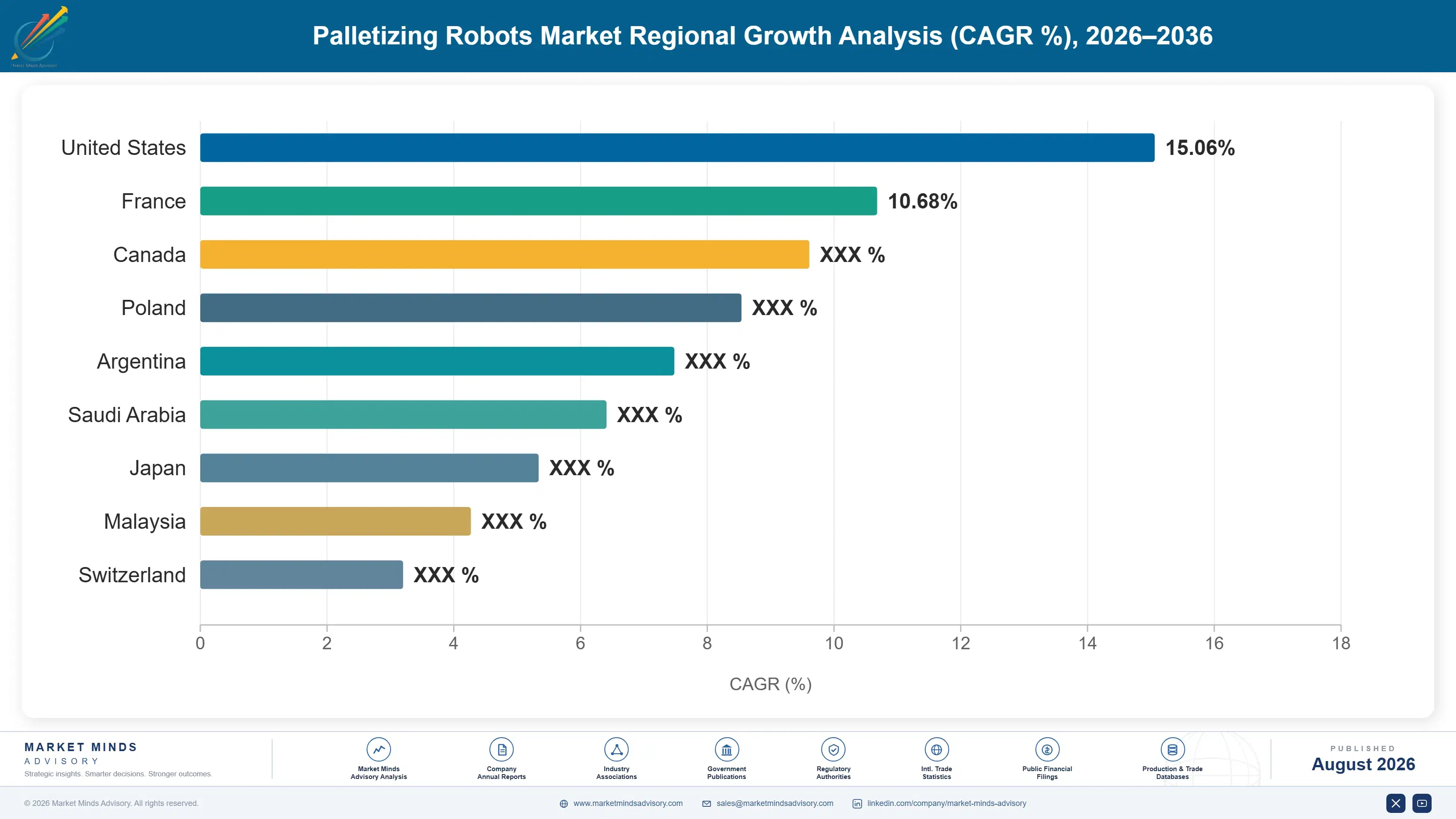
palletizing-robots-market-country-cagr-analysis-1787300528825

Where Palletizing Robot Margin Concentrates Next

Four commercial moves separate suppliers capturing outsized margin from those competing purely on cell price. Each depends on shifting revenue toward service, software, integration expertise, or mobile-platform product lines that current unit shipment volume does not yet fully reflect, particularly as cobot pricing keeps compressing hard at the low end of the product range.

Remote Diagnostics and Uptime Guarantee Program

Suppliers that bundle remote diagnostics monitoring and contractual uptime guarantees with cell sales are converting a one-time hardware transaction into a recurring service relationship. Uptime guarantee contracts typically carry annual fees of 8 to 15% of original cell price, a meaningful margin layer on top of the underlying hardware sale, and operators increasingly require these guarantees for mission-critical palletizing lines where downtime halts an entire distribution flow. Suppliers without a compelling diagnostics offering increasingly lose large fulfillment contracts to rivals whose service packages reduce downtime risk across their operating fleet.
Market Impact: Adds 8 to 15% of cell price annually

Mixed-SKU Vision Software Licensing Fee Program

Suppliers with proprietary mixed-SKU vision and load-stability software are charging separate ongoing licensing fees rather than bundling that capability into hardware price, capturing value that a growing share of distribution centers need as order profiles diversify beyond single-SKU pallets. A mixed-SKU vision software license typically adds $8,000 to $25,000 annually per cell depending on order profile complexity, on top of the recurring element revenue that follows. This shift matters most for e-commerce fulfillment and grocery distribution customers running highly variable order profiles that basic pattern-based palletizing software cannot handle reliably, and the licensing model is spreading quickly among established suppliers.
Market Impact: Software licensing adds $8,000 to $25,000 per year

Systems Integration and Commissioning Fee Structure

Suppliers capable of full-scope systems integration, including conveyor interfacing, safety fencing design, and facility-specific programming, are charging separate integration fees rather than folding that work into cell price, capturing value that used to be given away to win volume orders. A qualified integration project can carry a fee of $30,000 to $150,000 depending on facility complexity, in addition to the recurring cell and service revenue that follows. Suppliers that formalize integration as a distinct revenue line report materially higher project margins than those still bundling it into hardware pricing across their portfolio.
Market Impact: Integration fees add $30,000 to $150,000 per project

Mobile Platform Retrofit Expansion Investment Program

Suppliers expanding into mobile, AMR-integrated palletizing platforms are capturing a segment growing faster than the fixed-base core, at gross margins comparable to fixed installations despite added mobile hardware cost, because retrofit projects avoid the facility redesign expense fixed conveyor installations require. A single mobile retrofit project can carry 20 to 40% more software and integration revenue per cell than a comparable fixed installation, letting suppliers capture more total contract value from facilities that cannot accommodate fixed infrastructure. Suppliers still concentrated purely on fixed-base units risk ceding this faster-growing segment to rivals with mature mobile platforms already qualified with large operators.
Market Impact: Mobile retrofits add 20 to 40% more contract value

Who Controls the Margin Pool

The top five suppliers hold an estimated 58% of global palletizing robot shipment volume, a moderate concentration reflecting decades of installed base and integration expertise among established industrial robot makers. FANUC and ABB lead on breadth, global service networks, and integration depth, while a wide second tier of Chinese and cobot-focused suppliers competes mainly on price and ease of deployment.
Current competitive activity centers on three fronts. Cobot palletizing launches are redrawing the small-facility tier, with Universal Robots, Doosan Robotics, and Techman Robot racing to add mixed-SKU capability. Mixed-SKU vision software is becoming a genuine differentiator among established suppliers targeting large fulfillment centers. And several Chinese manufacturers are pursuing Western certification and distributor partnerships to move beyond export pricing into branded competition.

Emerging pressure comes from Chinese suppliers moving up the value chain into mixed-SKU vision capability and mobile-integrated platforms once dominated by Japanese and European incumbents, aided by domestic servo motor and gearing supply that keeps their input costs consistently lower. If Chinese suppliers close the service and integration expertise gap further, expect share to shift meaningfully, particularly in Latin America and South Asia where price sensitivity runs higher than in North America.
palletizing-robots-market-company-positioning-matrix-1787300529352

Competitive Moat and Risk Dimensions

FANUC CORPORATION

Moat: Integration Depth and Service Network

FANUC built a global systems integrator and service network over decades that smaller cobot entrants cannot replicate quickly, and its deep installed base across manufacturing and logistics customers gives it cross-selling access into palletizing upgrades that pure-play cobot suppliers still lack, reinforcing its lead in large-facility deployments.
FANUC CORPORATION

Risk: Slower Move Into Cobot Segment

FANUC's traditional strength in large, engineered installations leaves it exposed at the small-facility end of the market, where cobot specialists have moved faster with pre-configured, easy-to-commission products that better fit operators without dedicated automation engineering staff, a gap FANUC is still closing through its own newer cobot line.
ABB LTD

Moat: Broad Automation Platform Cross-Sell

ABB's palletizing robots sell alongside its much broader industrial automation, motor, and drive systems portfolio, letting it bundle palletizing into larger facility automation contracts that pure-play robot suppliers cannot match, giving it access to procurement relationships built across multiple product categories and long-standing customer accounts.
ABB LTD

Risk: Palletizing Share of Broader Portfolio

Palletizing remains a modest piece of ABB's much larger automation business, so capital allocation and product development attention compete against higher-volume categories, leaving room for palletizing-focused specialists to out-innovate ABB on application-specific software and gripper design despite ABB's scale advantage and global reach across many industries.

Key Players

ABB Ltd
FANUC Corporation
Yaskawa Electric Corporation
KUKA AG
Kawasaki Heavy Industries

Others

Universal Robots (Teradyne)
Mitsubishi Electric Corporation
Kion Group (Dematic)
Honeywell Intelligrated
Columbia Machine Inc.
Brenton (Pro Mach)
Premier Tech
Krones AG
Schneider Packaging Equipment
BEUMER Group
Bastian Solutions
Fives Group
Vanderlande Industries
Doosan Robotics
Hanwha Robotics

Recent Developments

JANUARY 2025

FANUC Launches Mixed-SKU Vision Software Update for Large-Facility Cells

FANUC Corporation released a mixed-SKU vision and load-stability software update for its large-payload palletizing cells, enabling real-time carton sequencing for irregular order profiles that previously required manual palletizing intervention. The update followed twelve months of field testing with several large North American grocery distribution customers ahead of general release.
Signal: Signals mixed-SKU capability becoming the primary competitive differentiator among large-facility palletizing suppliers industry-wide over this planning cycle.
AUGUST 2024

Doosan Robotics Opens North American Assembly Facility

Doosan Robotics commissioned a new cobot assembly and integration facility in the United States dedicated to palletizing application kits for the North American market, reducing shipping lead times and easing service response for regional customers across the country. The facility complements Doosan's existing South Korean manufacturing base.
Signal: Signals cobot suppliers localizing production to compete more directly on service response time and delivered cost.
APRIL 2025

KUKA Acquires Mobile Robotics Integration Startup

KUKA AG acquired a mobile robotics integration startup to strengthen its AMR-integrated palletizing platform, aiming to compete more directly with suppliers already active in mobile-base palletizing applications across major logistics markets, expanding its addressable customer base. The acquisition adds roughly sixty engineering staff to KUKA's existing product development team.
Signal: Signals established suppliers accelerating mobile-platform investment as a distinct growth avenue beyond fixed-base cells alone industry-wide.

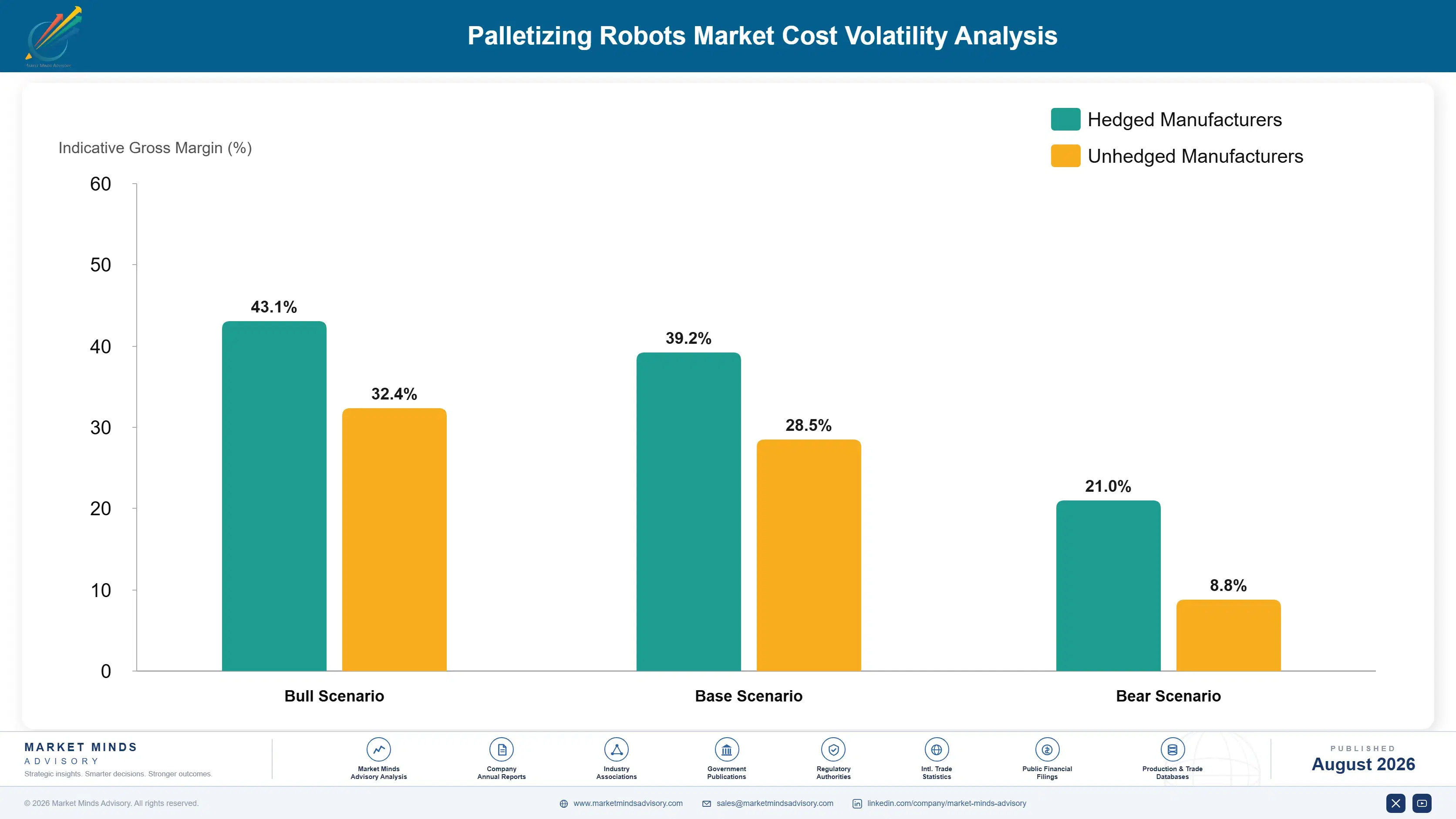
Servo Motor and Precision Gearing Cost Exposure

Servo motors and precision gearing components together account for roughly 31% of cost of goods sold in palletizing robot manufacturing, with high-precision gearing supply concentrated among a handful of Japanese and German specialists. Control electronics and vision system components add a further meaningful share, sourced predominantly from a mix of Asian and North American semiconductor and camera module suppliers.
Precision gearing prices and lead times spiked sharply during the 2021 to 2022 global semiconductor and component shortage, with several robot manufacturers reporting order backlogs extending past nine months in their respective 2022 annual reports. The METI supply chain review of Japan's robotics industry flagged precision gearing as a persistent concentration risk given the small number of manufacturers capable of the tolerances palletizing robots require.

Smaller regional suppliers without long-term gearing allocation agreements absorbed the 2022 shortage hardest, losing shipment volume to larger suppliers including FANUC and Yaskawa that had negotiated priority allocation with domestic Japanese gearing manufacturers. Chinese suppliers with closer domestic component relationships weathered the shortage somewhat better than suppliers dependent on the same constrained Japanese and German gearing supply pool, a durable cost and supply advantage that persists in tighter allocation cycles.
palletizing-robots-market-cost-volatility-analysis-1787300529548

Multi-Year Gearing Allocation Agreements

Larger suppliers are locking multi-year precision gearing supply agreements directly with manufacturers, trading some pricing flexibility for guaranteed allocation priority that protects production continuity during future shortage cycles, an increasingly standard practice among the top five suppliers following the 2022 shortage. Smaller suppliers increasingly pool orders through distributors to gain similar priority treatment on comparable terms.

Dual-Sourcing Critical Precision Components

Suppliers are qualifying second and third gearing and servo motor sources for critical components, reducing single-manufacturer dependence even though dual-sourcing raises design complexity and qualification cost, a tradeoff most suppliers now consider worthwhile after 2022's shortage exposed the risk of relying on one primary supplier. Qualification typically takes six to nine months per new source.

In-House Vision System Software Development

Several larger suppliers are bringing vision and load-stability software development in-house rather than licensing from third parties, cutting exposure to external software pricing and improving integration consistency across product lines at meaningfully higher fixed engineering cost upfront. Smaller suppliers instead negotiate longer-term licensing agreements with software vendors to achieve broadly similar cost predictability over time.

Portfolio Architecture for Margin Defence

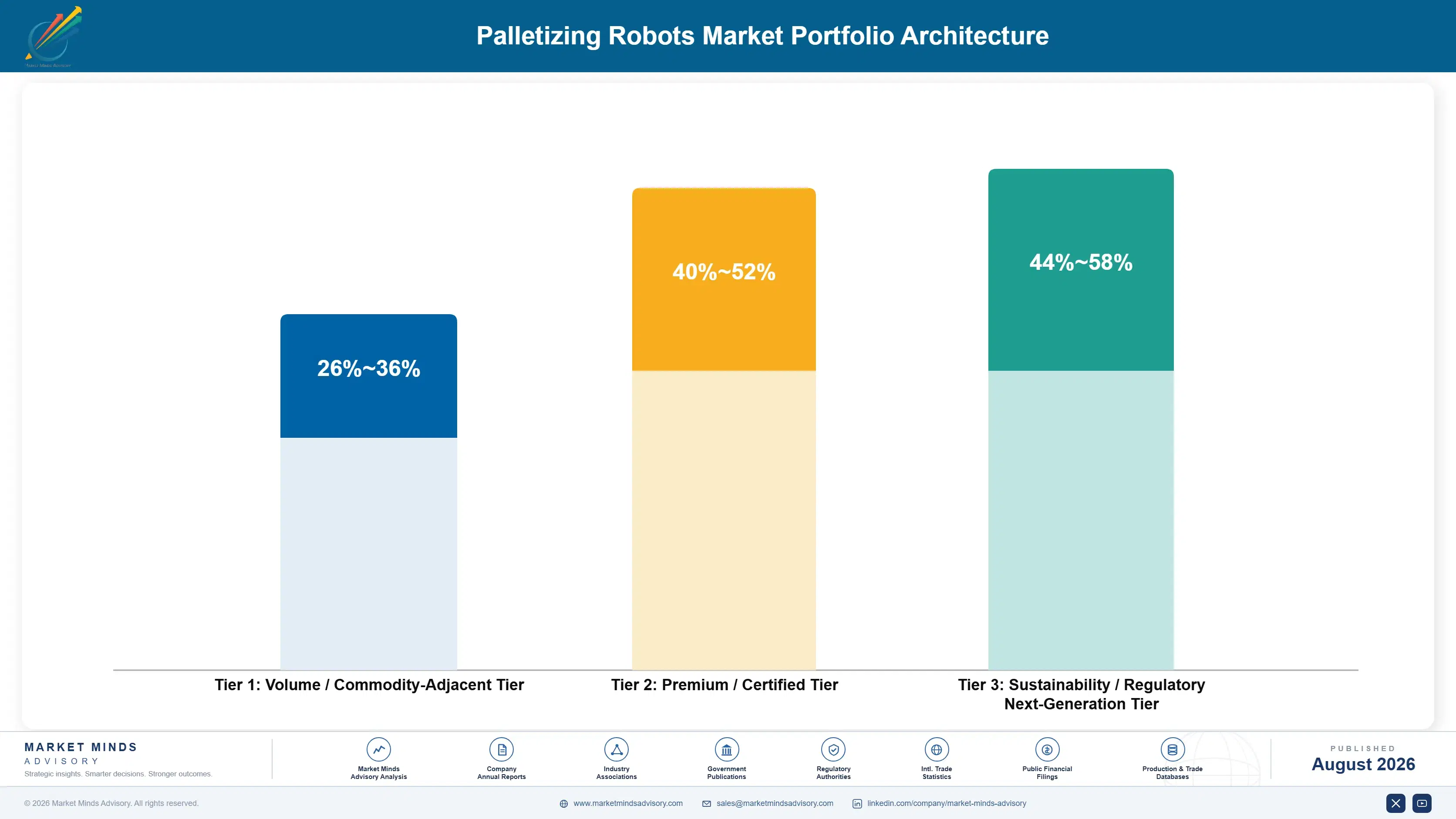
Palletizing robot portfolios split across three tiers with meaningfully different margin economics. The volume tier, standard single-SKU articulated arm and basic cobot cells, competes largely on price against Chinese entrants and delivers gross margins in the 26 to 36% range. Premium certified cells bundling mixed-SKU vision software and multi-year service contracts command materially higher margins, reflecting software and integration expertise layered on top of hardware.
The tension between volume and premium tiers shapes product development priorities across the industry. Volume cell capacity is easiest to scale and fastest to fund, but Chinese price competition keeps margin pressure constant in that tier. Premium and mobile-platform capacity requires deeper software investment and slower qualification cycles, but rewards patient capital with margins that hold up even as volume-tier pricing keeps eroding.

High-value margin pools concentrate in mixed-SKU vision software, mobile-integrated platforms, and the service and diagnostics layer that increasingly separates established suppliers from commodity hardware sellers. These pools remain a modest share of total shipment volume today, but they are growing faster than the standard hardware base and are where most supplier research and development spending is now directed.

Volume / Commodity-Adjacent Tier

Standard single-SKU articulated arm and basic cobot cells sold primarily on unit price, facing the heaviest direct competition from Chinese entrants. These units carry the thinnest margins in the portfolio and depend on manufacturing scale rather than software differentiation to stay profitable.
Gross Margin: 26-36%

Premium / Certified Tier

Large-facility cells bundling mixed-SKU vision software, extended service contracts, and dedicated integration support that fulfillment operators pay a premium to access. This tier generates the steadiest repeat business, since certified customers rarely switch away from a platform their staff already know.
Gross Margin: 40-52%

Sustainability / Regulatory / Next-Generation Tier

Mobile-integrated and workplace-safety-driven cobot platforms tied to warehouse labor regulation and repetitive-injury liability reduction. This tier draws the heaviest research spending, since mobile firmware and cobot safety certification both require sustained engineering investment to defend against fast-moving entrants.
Gross Margin: 44-58%
palletizing-robots-market-portfolio-architecture-1787300530040

High-value Sub-segments and Strategic Watch-out

Collaborative (Cobot) Palletizers

The fastest-growing, highest-margin pool in the market, driven by small and mid-sized warehouse adoption that rewards suppliers with mature safety certification and easy-commissioning software already proven in the field. Suppliers without that capability risk losing the fastest-growing accounts to specialists that moved earlier in the product cycle.
Gross Margin: 44-56%

Mobile AMR-Integrated Palletizers

A smaller but rapidly scaling high-value pool as mobile platforms open retrofit opportunities in facilities that cannot accommodate fixed conveyor infrastructure, gated by qualification cycles with large logistics operators. Suppliers that secure early qualification tend to hold that relationship for years, since switching platforms is costly.
Gross Margin: 42-54%

Standard Articulated Arm Cells

The volume core of the market, serving large established distribution centers where Chinese price competition keeps margins under the most sustained pressure of any product tier. This segment still generates the largest absolute shipment volume, and defending share funds the research spending that premium tiers require.
Gross Margin: 28-38%

Unbranded Chinese Low-Cost Imports

A strategic watch-out segment where rapidly expanding low-cost, limited-service-network units could pull volume-tier pricing down faster than integration expertise can defend branded margins. Suppliers without a genuine service or software advantage against these entrants should expect continued price erosion across the entire volume tier over time.
Gross Margin: 16-26%

The Service Relationship as the Moat

Palletizing robot economics increasingly resemble a platform business built around the integration and service relationship rather than a simple hardware sale. Remote diagnostics subscriptions, uptime guarantee contracts, and software licensing generate recurring engagement with fulfillment operators that persists well beyond the initial cell purchase, and suppliers that own that relationship can forecast expansion and replacement demand with more confidence than pure hardware competitors.
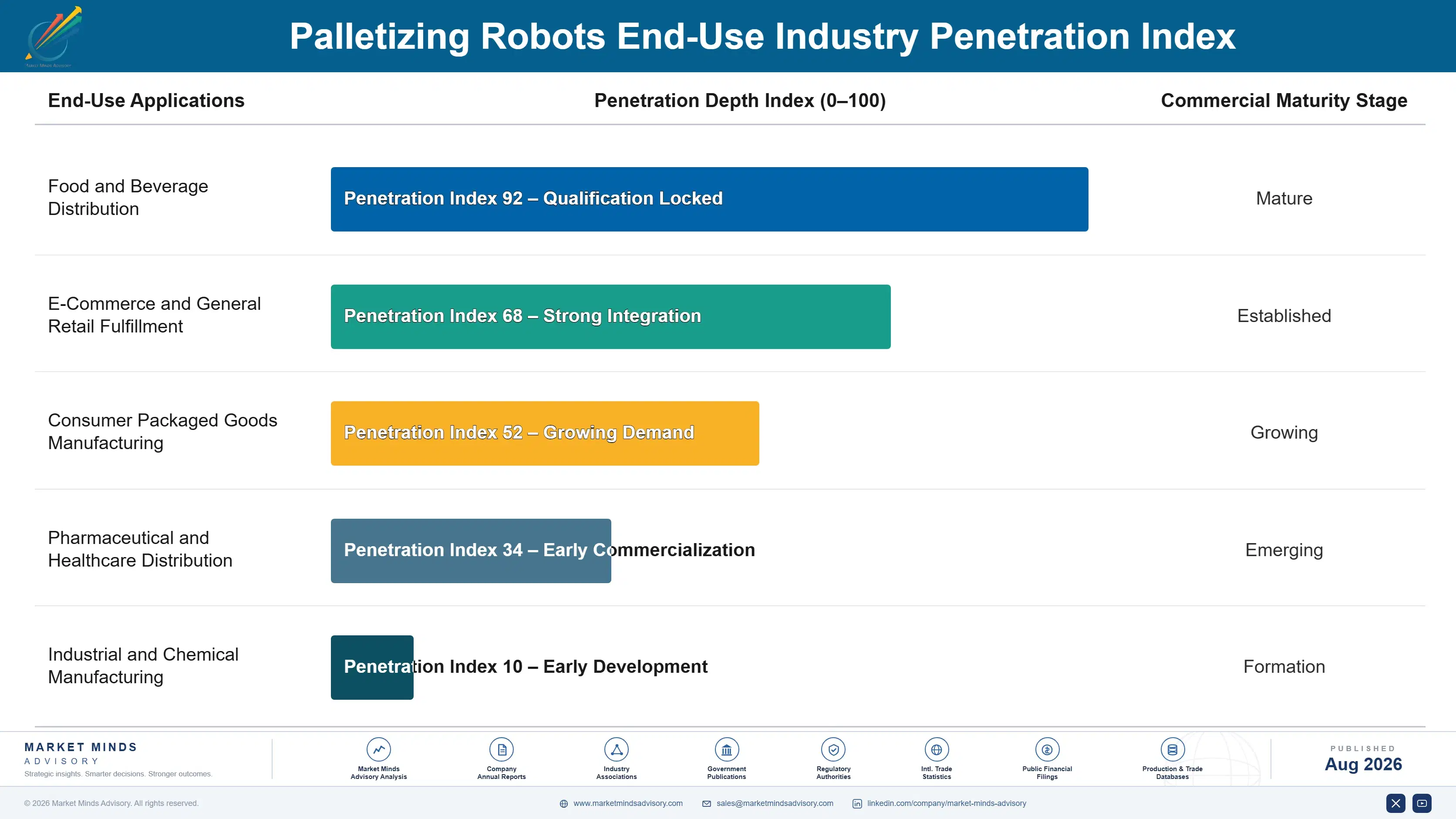
Adoption depth varies by end-use vertical. Large e-commerce and grocery distribution operators, once qualified on a supplier's integration approach and safety protocols, rarely switch given the cost and risk of requalifying an entire facility's automation workflow. Smaller manufacturing end-of-line applications show shallower stickiness so far, since cobot platforms are newer and buyers in that segment have not yet standardized as heavily around a single supplier.

A generational shift in buyer profiles is underway as operations and safety officers, rather than pure procurement, increasingly co-sign large automation decisions given repetitive-injury liability exposure. These buyers weight service reliability and safety certification alongside upfront cost, a shift that favors suppliers with proven uptime records over those competing purely on hardware price. The trend is uneven across facility sizes but favors service-capable suppliers.
palletizing-robots-market-end-use-penetration-index-1787300530529

Where MMA Sees the Opportunity

These are among the four positions where our research anticipates prominent divergence between winners and laggards over the coming forecast period. Each is grounded in the demand model, the regulatory perimeter, and the announced capacity pipeline.
01 / COBOT SEGMENT INVESTMENT

Prioritize cobot safety certification over incremental payload gains

Collaborative palletizers are growing roughly 1.41 times faster than the overall market, driven by small and mid-sized warehouse adoption that shows no sign of slowing given persistent labor shortages across mature logistics markets. Suppliers still competing purely on traditional articulated-arm hardware risk ceding the fastest-growing, highest-margin small-facility accounts to specialists that built safety certification and easy-commissioning software earlier. Capital directed toward cobot software and certification now should pay back faster than incremental payload expansion on standard arms facing constant Chinese price pressure.
02 / SERVICE RELATIONSHIP BUILD-OUT

Treat uptime guarantees as a core competitive moat investment

Suppliers that still compete purely on cell price and basic warranty terms are leaving significant value on the table that remote diagnostics, uptime guarantees, and integration service investment are already capturing for established brands. These service relationships carry materially higher switching costs than the underlying hardware sale, locking operators into renewal patterns that price-only competitors struggle to break. Building this capability now, before Chinese entrants close the service network gap further, is worth more than matching a rival's price cut for cut.
03 / PRECISION COMPONENT HEDGING

Lock multi-year precision gearing allocation agreements now

Servo motor and gearing input costs already run close to 31% of cost of goods sold, and the 2022 shortage showed manufacturer allocation constraints can extend supplier lead times past nine months without warning. Suppliers without multi-year allocation agreements risk losing shipment volume to better-hedged rivals during the next constrained cycle, damaging customer trust built over years in a single sharp shortage. Locking allocation now, even at a premium to spot pricing, protects production continuity and the customer confidence that scaled growth depends on.
04 / REGIONAL CAPACITY POSITIONING

Weigh Chinese cost scale against Japanese integration trust carefully

East Asia now holds the largest manufacturing base for palletizing robot production and continues adding capacity faster than most other regions, making cost leadership there increasingly difficult for Western suppliers to contest on hardware price. Japanese and European suppliers still hold a genuine advantage in integration expertise, service network depth, and reliability trust that Chinese entrants have not yet fully closed. The sounder strategy is not chasing Chinese manufacturing scale directly, but doubling down on the integration and service capability Chinese competitors still cannot replicate.

Engagement Snapshot From the Field

A live engagement with an industry participant carrying material or product regulatory and market exposure ahead of a defining policy shift, showing how our research translates into a defensible multi-year portfolio strategy.
MARKET MINDS ADVISORY · CLIENT ENGAGEMENT SUMMARY
Palletizing Robots Producer Strategic Portfolio Review and Transition Roadmap 2026·Investment Scenario on Palletizing Robots Exposure Evaluation 2025-26
CLIENT PROFILE
The client is a regional grocery distribution operator running four distribution centers across the US Midwest, handling roughly 1,800 pallet moves daily across ambient, refrigerated, and frozen storage zones. The company had automated only its largest facility and needed an independent assessment of whether extending palletizing robots to its three smaller centers would justify the capital investment given lower per-facility throughput volumes (client-reported, unverified by MMA).
STRATEGIC CHALLENGE
The operator needed to decide whether extending robotic palletizing to smaller facilities with lower daily throughput would generate acceptable payback, against persistent difficulty recruiting and retaining warehouse labor willing to perform repetitive cold-chain lifting work at those same smaller sites, which its largest facility no longer needed to address after automating.
MMA APPROACH
MMA conducted a facility-by-facility total cost of ownership assessment comparing continued manual palletizing against cobot and traditional arm automation scenarios at each of the three smaller centers, benchmarking labor turnover cost, injury claim history, and realistic payback periods against the operator's own experience automating its largest facility two years earlier.
KEY FINDINGS
  1. Labor turnover at the three smaller facilities ran nearly twice the rate seen at the already-automated largest facility, driven by cold-chain lifting conditions that made those roles especially difficult to staff consistently.
  2. Cobot palletizing cells showed a projected payback period of nineteen months at the two mid-sized facilities, once turnover and recruiting costs were fully priced into the comparison alongside throughput gains.
  3. The smallest facility's daily throughput fell below the volume where even cobot automation clearly justified capital cost, suggesting a phased approach starting with the two larger of the three sites made more financial sense.
  4. Injury claims tied to repetitive palletizing lifting at the three facilities ran meaningfully higher than at the already-automated site, a liability cost the initial analysis had not fully captured until MMA incorporated claims data.
CLIENT PROFILE
The client is a regional grocery distribution operator running four distribution centers across the US Midwest, handling roughly 1,800 pallet moves daily across ambient, refrigerated, and frozen storage zones. The company had automated only its largest facility and needed an independent assessment of whether extending palletizing robots to its three smaller centers would justify the capital investment given lower per-facility throughput volumes (client-reported, unverified by MMA).
STRATEGIC CHALLENGE
The operator needed to decide whether extending robotic palletizing to smaller facilities with lower daily throughput would generate acceptable payback, against persistent difficulty recruiting and retaining warehouse labor willing to perform repetitive cold-chain lifting work at those same smaller sites, which its largest facility no longer needed to address after automating.
MMA APPROACH
MMA conducted a facility-by-facility total cost of ownership assessment comparing continued manual palletizing against cobot and traditional arm automation scenarios at each of the three smaller centers, benchmarking labor turnover cost, injury claim history, and realistic payback periods against the operator's own experience automating its largest facility two years earlier.
KEY FINDINGS
  1. Labor turnover at the three smaller facilities ran nearly twice the rate seen at the already-automated largest facility, driven by cold-chain lifting conditions that made those roles especially difficult to staff consistently.
  2. Cobot palletizing cells showed a projected payback period of nineteen months at the two mid-sized facilities, once turnover and recruiting costs were fully priced into the comparison alongside throughput gains.
  3. The smallest facility's daily throughput fell below the volume where even cobot automation clearly justified capital cost, suggesting a phased approach starting with the two larger of the three sites made more financial sense.
  4. Injury claims tied to repetitive palletizing lifting at the three facilities ran meaningfully higher than at the already-automated site, a liability cost the initial analysis had not fully captured until MMA incorporated claims data.
RECOMMENDED STRATEGY
Phase 1: Phase 1 (Months 1 to 5): Deploy cobot palletizing cells at the two mid-sized facilities showing a clear nineteen-month projected payback period. Phase 2: Phase 2 (Months 6 to 12): Monitor throughput growth at the smallest facility to determine when automation becomes clearly justified. Phase 3: Phase 3 (Months 13 to 18): Extend automation to the smallest facility once throughput or labor conditions cross the identified threshold.
OUTCOME
The operator deployed cobot palletizing cells at the two mid-sized facilities in early 2026, ahead of its original three-facility simultaneous rollout plan. Early data through mid-2026 showed labor turnover declining at both automated sites, though full payback confirmation awaits a complete operating year (client-reported, unverified by MMA).

Frequently Asked Questions

Foundational context covering the market sizes, CAGR, scope, country, region and competition that inform every finding below. This section is provided to cover basics and most often pre-purchase conversations, answered from the MMA Primary Research Dataset.

What is the current size of the Palletizing Robots Market?

The global palletizing robots market reached an estimated $3.4 billion in 2025. Growth concentrates in warehouse and distribution center automation where persistent labor shortages make robotic deployment increasingly necessary rather than optional.

How large will the Palletizing Robots Market be by 2036?

MMA forecasts the market reaching approximately $10.52 billion by 2036, nearly three times its 2026 value. Collaborative cobot palletizers are expected to drive the largest share of that incremental growth.

What is the CAGR for the Palletizing Robots Market 2026 to 2036?

The base case CAGR is 10.8% across the forecast period, with a bull case near 12.0% and a bear case near 9.5% depending on warehouse labor trends and logistics capital spending cycles.

Which segment is growing fastest?

Collaborative (cobot) palletizers are the fastest-growing segment, expanding at roughly 15.2% CAGR, about 1.41 times the overall market pace, driven by small and mid-sized warehouse adoption.

Who are the major companies in the Palletizing Robots Market?

Leading suppliers include ABB, FANUC, Yaskawa Electric, KUKA, and Kawasaki Heavy Industries. The top five hold an estimated 58% of global shipment volume on a moderately concentrated basis.

Which country is growing fastest?

Japan leads growth in absolute manufacturing volume, but India is expanding fastest in percentage terms, driven by rapidly formalizing warehousing infrastructure and persistent urban labor shortages.

Report Segmentation Architecture

The full report scope spans multiple orthogonal segmentation dimensions, with cross-tabulated demand data provided for each dimension pair. Coverage extends further to regional breakdowns, trend trajectories, and the competitive detail needed to support segment-level decision-making.

By Robot Configuration Type

  • Articulated Arm Palletizers
  • Cartesian/Gantry Palletizers
  • Collaborative (Cobot) Palletizers
  • Delta/Parallel Palletizers
  • Mobile (AMR-Integrated) Palletizers

By End-Use Industry

  • Food and Beverage Distribution
  • E-Commerce and General Retail Fulfillment
  • Consumer Packaged Goods Manufacturing
  • Pharmaceutical and Healthcare Distribution
  • Industrial and Chemical Manufacturing

By Commercial Dimension

  • Original Equipment Sales
  • Systems Integration and Commissioning Services
  • Remote Diagnostics and Uptime Contracts
  • Software Licensing

By Region

  • North America
  • Western Europe
  • East Asia
  • South Asia and Pacific
  • Latin America
  • Middle East and Africa
  • Eastern Europe

Scope, Methodology, and Coverage

Every figure in this report is reproducible from documented input assumptions. The scope below maps the historical period, the forecast horizon, the segmentation dimensions, and the countries covered, alongside the underlying primary and qualitative methodology.
Historical Period
2020 to 2025
Forecast Period
2026 to 2036
Base Year
2025 (USD billions; MMA Primary Research Dataset, August 2026)
Market Definition
The palletizing robots market covers robotic systems designed to stack, arrange, and depalletize goods onto or from pallets in warehouse, distribution, and manufacturing end-of-line applications, including the robot arm, end-of-arm tooling, and associated control software sold as an integrated palletizing cell. It excludes conventional non-robotic mechanical palletizers, general-purpose industrial robots deployed outside palletizing tasks, and standalone warehouse management software sold without robotic hardware.
Quantitative Units
USD billions (current prices); unit shipment volume in thousands of cells where disclosed
Segmentation Dimensions
By Robot Configuration Type; By End-Use Industry; By Commercial Dimension; By Region
Regions Covered
North America, Western Europe, East Asia, South Asia and Pacific, Latin America, Middle East and Africa, Eastern Europe
Countries Covered
USA, China, Germany, France, UK, Japan, South Korea, India, Australia, Canada, Brazil, Mexico, Indonesia, Vietnam, Thailand, Malaysia, UAE, Saudi Arabia, South Africa, Nigeria, Turkey, Poland, Netherlands, Italy, Spain, Sweden, Switzerland, Argentina, Colombia, Singapore, and additional markets relevant to this sector
Key Companies Profiled
ABB Ltd, FANUC Corporation, Yaskawa Electric Corporation, KUKA AG, Kawasaki Heavy Industries, Universal Robots (Teradyne), Mitsubishi Electric Corporation, Kion Group (Dematic), Honeywell Intelligrated, Columbia Machine Inc., Brenton (Pro Mach), Premier Tech, Krones AG, Schneider Packaging Equipment, BEUMER Group, Bastian Solutions, Fives Group, Vanderlande Industries, Doosan Robotics, Hanwha Robotics
Quantitative Methodology
Primary survey, n=3,800 respondents, Q4 2025, six countries; demand-side model with trade association cross-validation
Qualitative Methodology
47 expert interviews, Q4 2025; applied to validate demand model assumptions, identify emerging dynamics, and assess competitive positioning
Report Format
PDF and XLSX data workbook (Word format preview document)
Publisher
Market Minds Advisory
Report Code
MMA-2026-CON-158
Published
August 2026
Contact
sales@marketmindsadvisory.com | www.marketmindsadvisory.com

Purchase the full Palletizing Robots Market Report (2026 to 2036).

The full Palletizing Robots Market report delivers a comprehensive assessment of robot configuration technology, competitive positioning, and regional demand through 2036. It includes detailed segmentation by configuration type, end-use industry, and commercial dimension, alongside profiles of all twenty companies covered in this summary. The report quantifies regional market size and growth across all seven world regions, with country-level detail for the thirty-plus markets MMA tracks. Buyers receive access to MMA's underlying primary survey dataset and expert interview transcripts, enabling further custom analysis. A dedicated chapter benchmarks precision component cost exposure and mitigation strategies across supplier types.
Configuration-level segmentation across five product technology categories
Profiles of twenty leading palletizing robot suppliers worldwide
Regional sizing and forecasts across all seven world regions
Precision component cost exposure and mitigation strategy chapter
Primary survey dataset access covering 3,800 respondent interviews
Competitive development tracking with dated corporate event log

Built For The People Who Decide

From boardroom strategy to bench-side execution, this report is read cover-to-cover by leaders shaping the next decade of their industry, turning demand scenarios, market dynamics and valuation benchmarks into decisions.
CXOs/ Presidents/ VPs/ Managers
M&A and Corporate Development
Strategy Teams and R&D Heads
Procurement and Product Directors
Regulatory and Compliance Leaders
Investor Relations and Equity Analysts