Market Minds Advisory
Pallet Wrap Industry in Korea

Pallet Wrap Industry in Korea: E-Commerce Logistics Growth and Nano-Film Adoption

Korean logistics operators are switching from hand-applied stretch wrap to machine-applied and nano-gauge film as e-commerce fulfillment volume climbs and warehouse operators chase both labor savings and thinner-film cost efficiency.

Lead Analyst

Bilal Shaikh

Published

September 2026

Make Smarter Decisions with Customized Research Insights

Request a free sample report and evaluate market opportunities, growth trends, and competitive dynamics relevant to your business needs.

2025 MARKET VALUE$0.2BMarket Size 2025
2036 FORECAST VALUE$0.5BBase Case , 2026 to 2036
CAGR 2026 TO 20366.0 %Bull 7.2% / Bear 4.8%
INCREMENTAL OPPORTUNITY$0.2BNet 10- year value creation
EXPANSION MULTIPLE1.79x2036 value over 2026 base
Strategic Levers
M&A Pipeline
Regional Outlook
Country Rankings
Competitive Intelligence
Segmental Deep-dive
Call-Us : 91 93563 13602

Executive Snapshot and Market Trajectory

Korean warehouse and fulfillment operators are shifting pallet wrapping from manual hand-applied stretch film to machine-applied and nano-gauge alternatives as e-commerce order volume climbs faster than most logistics planners had projected just two years ago, and labor availability in distribution centers keeps tightening nationwide and across every major hub.
Rising e-commerce fulfillment throughput is the dominant demand catalyst, while nano and high-performance stretch film posts the fastest volume growth as operators chase thinner-gauge cost savings without sacrificing load containment force across every major distribution channel. Demand concentrates overwhelmingly within Korea itself, with a modest and growing export tail into neighboring East Asian logistics markets adopting comparable film specifications and warehouse automation standards of their own.
Five converters hold 48% of domestic revenue, a concentration that reflects the capital intensity of cast film extrusion lines few smaller producers can justify installing at competitive gauge and clarity levels. Rising resin costs and tightening warehouse automation requirements are pushing smaller regional converters to specialize narrowly in hand-wrap commodity grades rather than compete broadly across the full pallet wrap portfolio available in the market today, ceding ground steadily to larger, better-capitalized rivals nationwide.
Market Definition
The pallet wrap industry in Korea covers cast and blown stretch film products used to secure and stabilize palletized goods for warehousing, transport, and logistics applications within South Korea, including hand-applied, machine-applied, and pre-stretched formats. It excludes shrink film, strapping and banding materials, and corrugated pallet packaging not based on stretch film technology.
Base Year Value
$0.2B in 2025 (MMA Primary Research Dataset, August 2026)
Forecast Period
2026 to 2036, eleven discrete annual values
CAGR
6.0% base case. Bull 7.2%. Bear 4.8%.
Fastest Growth Segment
Nano and High-Performance Stretch Film: 9.5% CAGR
Fastest Growth Country
South Korea: 6.0% CAGR
Fastest Growth Region
South Asia and Pacific: 8.0% CAGR
Largest Region
East Asia: 82% of 2025 global value
Market Leaders
Samhwa Netlon Co Ltd, Handong Chemical Co Ltd, KOREX Co Ltd, Samwon Global Packaging Co Ltd, Berry Global Group Inc. Source: MMA Analysis based on company annual reports.
Primary Survey
n=3,800 procurement and R&D decision-makers, Q4 2025, six countries
Methodology
Demand-side build-up, cross-validated against public data, 47 expert interviews

Pallet Wrap Industry in Korea Market Forecast Scenarios

pallet-wrap-industry-in-korea-size-forecast-scenario-1787312189766
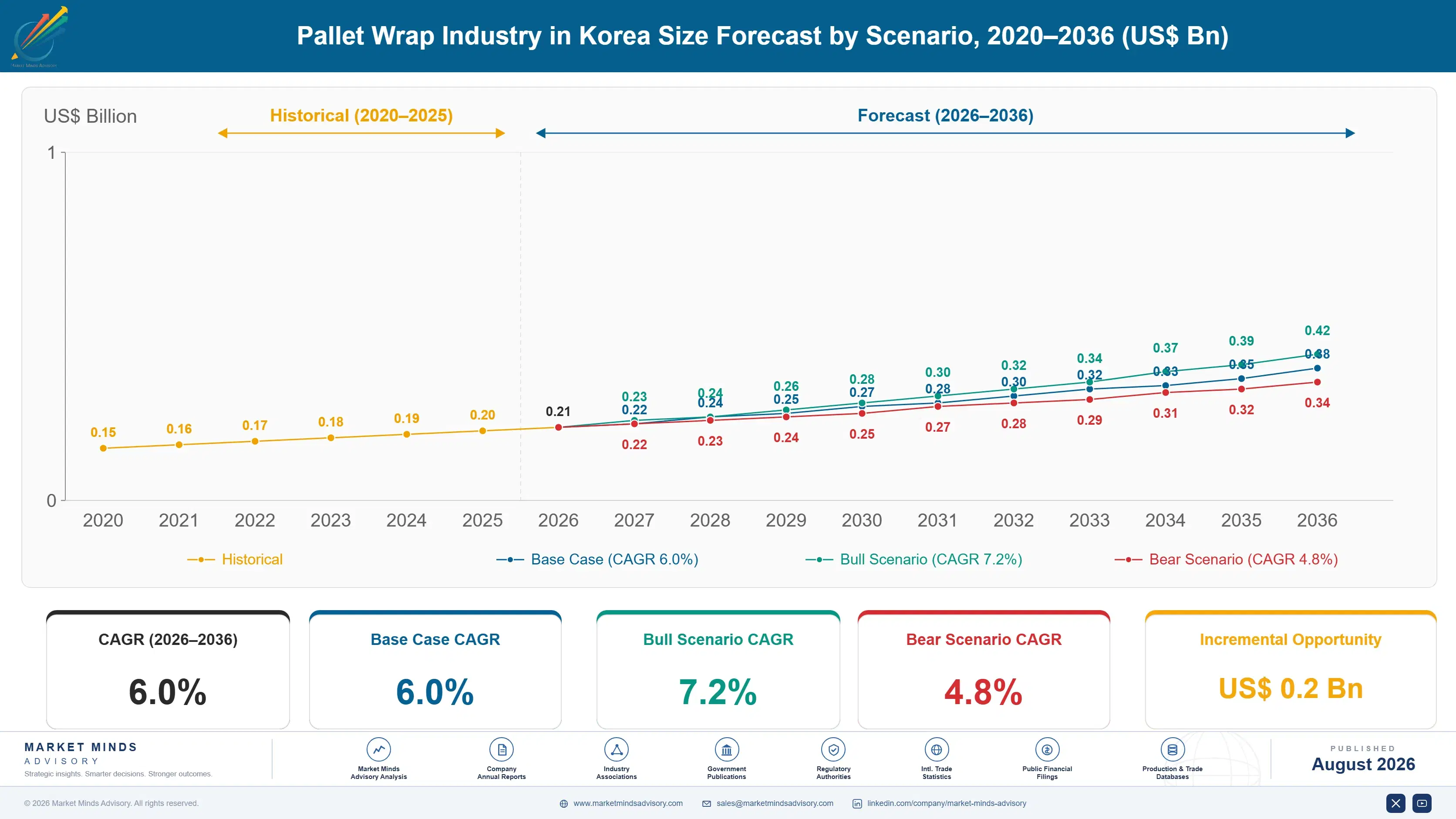
Korea's pallet wrap industry grew at an estimated 5.2% annually between 2020 and 2025, a period shaped by pandemic-driven e-commerce fulfillment demand followed by resin cost volatility that pressured converter margins before warehouse automation investment accelerated again across the back half of that five-year window and into the following recovery year as capacity utilization normalized.
The base case assumes 6.0% annual growth through 2036, resting on three mechanisms: continued e-commerce fulfillment center expansion across the country lifting machine-applied stretch wrap volume nationwide, warehouse operators upgrading to nano-gauge film to capture material cost savings per pallet without sacrificing load containment force, and converters investing in pre-stretch and high-performance film capability to capture premium pricing rather than competing purely on commodity resin cost alone across their product lines.
The bull case centers on faster-than-expected automation of Korean distribution centers driving machine-applied and nano-film adoption well above trend across every major logistics hub and fulfillment network. The bear case centers on resin cost volatility squeezing smaller converters out of the market before demand growth can offset rising input costs across the domestic supply chain and its regional sourcing base.

Warehouse Automation and the Nano-Film Cost Advantage

Korea's pallet wrap industry sits squarely inside the country's broader logistics automation push, where machine-applied and nano-gauge film increasingly replace hand-wrapping across e-commerce fulfillment centers, cold-chain warehouses, and manufacturing distribution hubs nationwide. Converters that invested early in nano-gauge extrusion capability are capturing outsized share of this efficiency wave, while converters still running standard-gauge commodity lines watch margin compress as buyers
MARKET CONCENTRATIONCR5 48%domestic revenue share held by the five leading converters
AVERAGE SELLING PRICE$2.40/kgwholesale price point for a standard machine-grade film
DOMESTIC PRODUCTION SHARE84% of consumptionshare of Korean demand met by domestic converter output
CAPACITY UTILIZATION80%share of nameplate cast film extrusion capacity running
MACHINE-APPLIED FILM SHARE58% of volumeshare of pallet wrap volume applied by automated equipment
RESIN INPUT COST SHARE52% of COGSshare of production cost represented by polymer resin
The industry's economics hinge on cast film extrusion line capacity, a capital asset few new entrants can justify building given the industry's modest overall size relative to the investment required for competitive gauge and clarity performance. This capital intensity keeps the market meaningfully more concentrated than Korea's broader flexible packaging sector, and it explains why incumbent converters can sustain premium pricing on nano and high-performance grades without immediate new capacity threatening that pricing power.
The next decade will be shaped by continued e-commerce fulfillment center expansion driving machine-applied film adoption, steady warehouse automation investment lifting nano-gauge film specification across major logistics operators, and gradually expanding export opportunity as neighboring East Asian logistics markets adopt comparable film efficiency standards of their own.
"The warehouse still hand-wrapping pallets with standard-gauge film in 2029 is paying for labor it doesn't need to pay for. Machine-applied nano-film has stopped being a cost-saving option and become the default specification for any distribution center processing serious e-commerce volume."
Director, Packaging and Logistics Materials Practice · MMA Stretch Film Packagin

Market Trends

E-Commerce Fulfillment Centers Drive Machine-Applied Wrap Adoption

Korea's rapidly expanding e-commerce fulfillment sector is installing automated rotary and turntable stretch wrapping equipment at a pace that has outstripped the growth of hand-wrap-only distribution centers across the country's major logistics hubs. Machine-applied film delivers more consistent load containment force and faster pallet throughput than manual wrapping, letting fulfillment operators process meaningfully higher order volume per labor hour during peak shopping periods. Converters supplying pre-qualified machine-grade film to the largest fulfillment operators are securing multi-year preferred supply positions as those operators standardize specification across their expanding warehouse network nationwide.
Market Impact: Adds 80% capacity utilization press

Nano-Gauge Film Cuts Material Cost Without Sacrificing Containment

Converters are commercializing nano and high-performance stretch film formulated with advanced polymer blends that deliver equivalent or superior load containment force at meaningfully thinner gauge than standard commodity film, directly reducing material cost per pallet wrapped. Warehouse operators calculating total wrapping cost per shipment increasingly favor nano-gauge film even at a per-kilogram price premium, since the thinner gauge uses substantially less material to achieve the same containment result across a typical pallet load. Adoption is accelerating fastest among the largest logistics operators with the analytical capability to model total cost per pallet rather than comparing film purely on unit price.
Market Impact: Adds 6.0% CAGR in cold-chain segmen

Market Opportunities and Growth Drivers

Warehouse Labor Shortages Accelerate Automated Wrapping Investment

Korean logistics and fulfillment operators report sustained difficulty staffing manual pallet-wrapping positions during peak e-commerce shopping periods, a labor availability challenge documented in Ministry of Commerce Korea logistics sector employment reporting covering major distribution hub regions and their surrounding metropolitan labor markets nationwide and across every province. Each automated wrapping line installed typically displaces several manual wrapping positions while improving pallet throughput consistency, and operators facing the tightest local labor markets are moving fastest to convert from hand-wrap to machine-applied film even where the payback period exceeds their traditional capital investment hurdle rate.
Market Impact: Adds 52% resin cost exposure

Cold-Chain and Perishable Distribution Expansion Lifts Volume

Korea's expanding cold-chain logistics infrastructure for fresh food, pharmaceutical, and perishable goods distribution is driving incremental pallet wrap demand as temperature-controlled warehouses require reliable film performance across a wider range of operating conditions than ambient distribution centers, a shift documented in Ministry of Commerce Korea cold-chain infrastructure reporting across major metropolitan and regional facilities. Each new cold-chain facility commissioned represents meaningful incremental film demand, and converters holding proven cold-chain film performance credentials are securing durable supply positions with major perishable goods distributors ahead of smaller rivals still qualifying comparable formulations.
Market Impact: Raises entry costs by 28%

Market Restraints and Challenges

Rising Resin Costs Compress Smaller Converter Margins

Linear low-density polyethylene resin, the primary input for stretch film production, has faced meaningful price volatility as global petrochemical feedstock costs swing with crude oil and natural gas pricing, a cost pressure that disproportionately affects smaller Korean converters without the scale purchasing power or vertical integration into resin production that larger competitors hold today. Smaller converters often lack the balance sheet flexibility to absorb sustained resin price spikes without passing costs through to buyers, risking volume loss to larger competitors able to smooth pricing across a broader product portfolio. Converters are increasingly negotiating resin-indexed pricing contracts to reduce exposure.
Market Impact: Adds 58% machine-applied film share

Nano-Film Formulation Complexity Raises Entry Barriers

Producing nano-gauge stretch film that maintains competitive load containment force at meaningfully thinner gauge demands specialized polymer blending expertise and extrusion equipment precision that smaller regional converters often struggle to justify given their limited production scale relative to the research and development investment involved. This dynamic is steadily consolidating premium film supply toward converters large enough to amortize formulation investment across substantial volume, squeezing out smaller regional producers unable to compete for nano-gauge contracts. Some smaller converters are responding by specializing narrowly in standard-gauge commodity grades where formulation complexity does not apply.
Market Impact: Adds 9.5% segment CAGR
4 additional market trends, 3 additional growth drivers, and 3 additional restraints and challenges are covered in the full report. Contact sales@marketmindsadvisory.com to access the complete intelligence.

Segment CAGR and Growth Architecture

Korea's pallet wrap industry segments by application method and film technology, the classification that determines equipment compatibility, material efficiency, and capital investment far more than film color or gauge alone, shaping nearly every converter's extrusion line investment, research priorities, and long-term product roadmap across the industry and its largest logistics accounts and export relationships.
pallet-wrap-industry-in-korea-market-share-analysis-1787312190315

Nano and High-Performance Stretch Film

Nano and high-performance stretch film, formulated with advanced polymer blends to deliver equivalent load containment force at meaningfully thinner gauge than standard commodity film, is the fastest-growing segment as warehouse operators optimize total material cost per pallet wrapped across their expanding fulfillment networks. Converters holding proven nano-gauge formulation expertise are capturing disproportionate volume growth as the largest logistics operators model total cost per pallet rather than comparing film purely on unit price alone. The segment carries meaningfully higher average selling prices per kilogram than standard-gauge film, rewarding converters that invested early in polymer blending research and extrusion precision well ahead of competitors still running exclusively standard-gauge commodity production lines across their installed capacity.
CAGR 9.5%

Machine-Applied Stretch Wrap

Machine-applied stretch wrap, designed for automated rotary and turntable wrapping equipment rather than manual application, grows faster than the broader market as Korea's expanding e-commerce fulfillment and distribution center network converts from hand-wrap to automated wrapping lines across every major metropolitan hub. The segment benefits from more consistent load containment performance and faster pallet throughput than hand-applied film, giving converters supplying pre-qualified machine-grade film a meaningful specification advantage as operators standardize equipment and film sourcing together across their warehouse network. Established machine-grade film suppliers with proven equipment compatibility hold considerable pricing power, since switching film suppliers requires requalification testing most fulfillment operators prefer to avoid interrupting active operations to conduct.
CAGR 8.0%
Full segment breakdown across 6 segments available in the complete report.

Regional Architecture and Country Demand Map

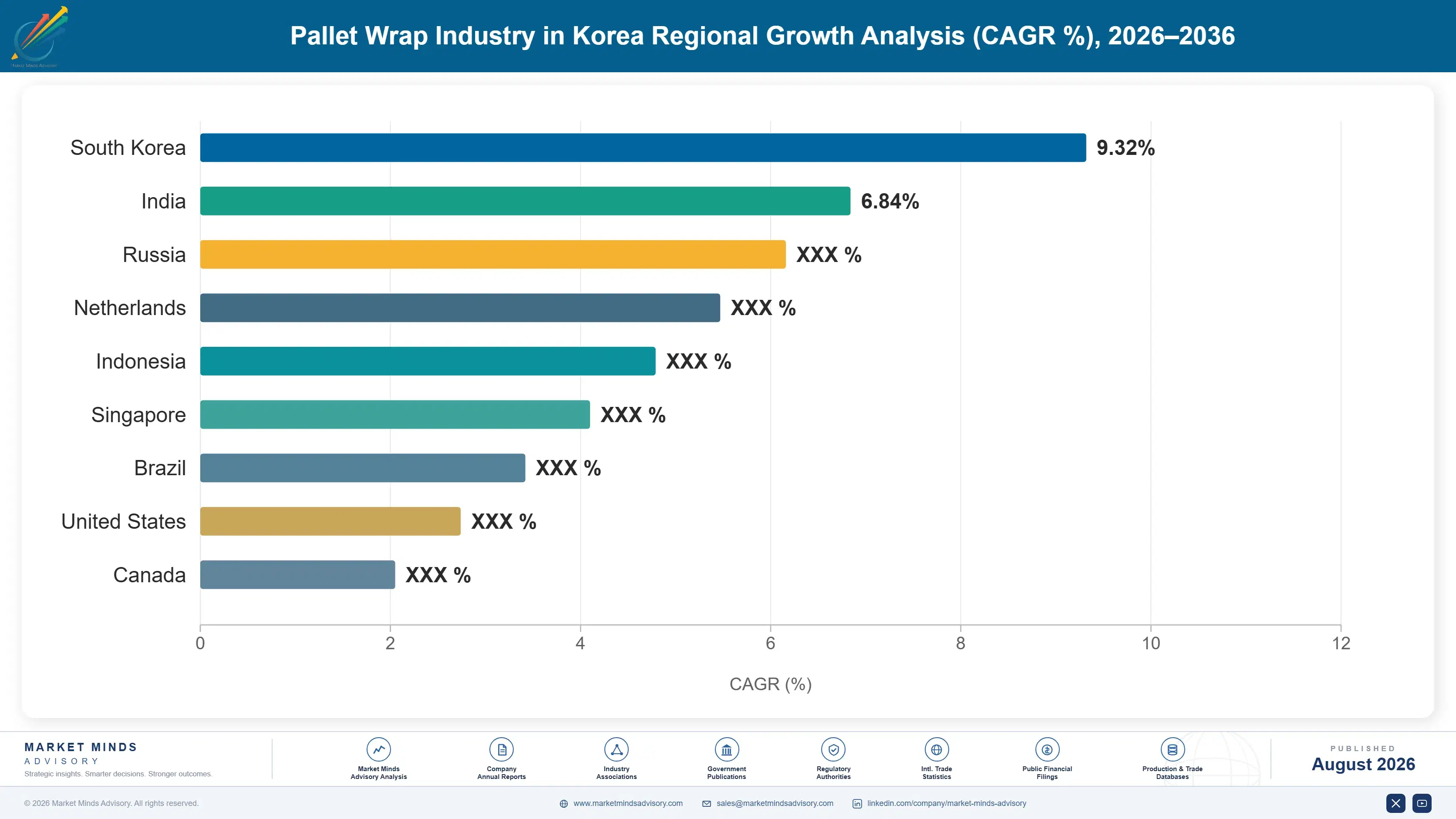
This report is scoped to Korea's domestic pallet wrap industry, so East Asia carries the overwhelming majority of both production and consumption, with modest and growing export volume reaching neighboring Asian logistics markets and smaller shipments further afield across other developed and emerging economies worldwide.

North America

North America receives a modest slice of Korean converter export volume, concentrated in nano and high-performance film shipped to specialty logistics equipment distributors along the US West Coast where shorter transpacific shipping lead times give Korean converters a logistics advantage over European stretch film suppliers. Volume here remains small in absolute terms since the region is served predominantly by domestic North American and European converters with established local distribution networks and long-standing warehouse operator relationships that Korean exporters have only begun building. Growth tracks steadily as specialty logistics equipment distributors expand their Korean-sourced product lines gradually. This regional share sits well below the Part 2.3 band because this report is Korea-scoped.
Share: 6% | CAGR: 6.0% (2026 to 2036)

Western Europe

Western Europe represents a small export destination for Korean pallet wrap, since the region is home to well-established stretch film producers including German and Nordic converters that dominate European logistics operator relationships built up over many decades of supply continuity and technical trust. Korean exports into the region concentrate in niche nano-gauge grades and price-sensitive commodity applications where European converter pricing runs comparatively higher than competitive Korean alternatives available at similar performance levels. Growth here remains modest and opportunistic rather than strategic, reflecting the region's limited addressable share within this Korea-scoped industry analysis and its deeply established domestic supply base. This regional share sits well below the standard Part 2.3 band because of that Korea-specific scope.
Share: 5% | CAGR: 4.5% (2026 to 2036)
Regional intelligence for 5 additional markets available in the complete report: East Asia, South Asia and Pacific, Latin America, Middle East and Africa, Eastern Europe. Contact sales@marketmindsadvisory.com.
pallet-wrap-industry-in-korea-country-cagr-analysis-1787312190987

Converting Automation Fit Into Pricing Power

Korean converters have several concrete paths to lift revenue per kilogram beyond raw volume growth, spanning nano-gauge premium pricing, machine-grade qualification programs, cold-chain film development services, and long-term supply agreements layered on top of standard commodity film sales across their warehouse and logistics customer base built over many years of steady continuity and trust.

Nano-Gauge Film Premium Pricing Program Strategy

Converters price nano and high-performance stretch film at a 15% to 22% premium per kilogram over standard-gauge commodity film, a gap warehouse operators increasingly accept once total material cost per pallet, not per kilogram, becomes the metric procurement teams actually track. This premium captures a meaningful share of the material efficiency value converters create for logistics customers optimizing total wrapping cost across their fulfillment operations. Converters investing early in nano-gauge formulation are capturing outsized share of this premium pool before smaller competitors can qualify comparable production lines of their own.
Market Impact: Adds a 15 to 22% price premium over

Machine-Grade Equipment Qualification and Supply Programs

Converters qualifying film for the largest automated wrapping equipment manufacturers capture recurring machine-grade supply contracts worth considerably more per kilogram than unqualified hand-wrap film, typically commanding a 12% to 18% premium reflecting the equipment compatibility testing and consistent performance logistics operators require from their film suppliers before signing any long-term agreement or multi-facility contract of significant scale. This qualification process creates a meaningful moat, since fulfillment operators rarely switch machine-grade film suppliers once a validated equipment-film relationship is established and running reliably across multiple warehouse locations and shift patterns and staffing rotations.
Market Impact: Adds a 12 to 18% price premium over

Cold-Chain Film Development and Testing Support Services

Converters increasingly offer cold-chain film development services, including temperature-performance testing, custom formulation support, and on-site trial coordination, to accelerate qualification for perishable goods distributors evaluating film suppliers for temperature-controlled warehouse operations, a service investment typically worth 4% to 7% of incremental contract value annually across the engagement and its full testing timeline, validation cycle, and follow-up support period. These development programs meaningfully shorten the distributor qualification timeline for new cold-chain accounts, letting converters capture premium volume faster than competitors relying purely on price competitiveness alone to win new distributor relationships.
Market Impact: Adds 4 to 7% of contract value over

Long-Term Volume Supply Agreements With Major Fulfillment Operators

Converters winning long-term volume supply agreements with Korea's largest e-commerce fulfillment and logistics operators secure multi-year predictable order volume across the operator's full warehouse network rather than competing for individual regional facility orders repeatedly, typically locking in 3 to 5 years of guaranteed minimum volume commitments at pre-negotiated resin-indexed pricing terms and conditions negotiated well in advance. This account continuity meaningfully reduces the cost of ongoing sales pursuit and gives converters forward visibility into capacity utilization planning that spot-market commodity sales never provide at comparable forecasting reliability across the converter's broader production schedule.
Market Impact: Secures 3 to 5 years of order volum

Who Controls the Margin Pool

Five converters hold 48% of domestic revenue, with Samhwa Netlon and Handong Chemical forming the clearest leading pair on scale and nano-gauge formulation breadth, creating a meaningful gap over the next tier of challengers including KOREX, Samwon Global Packaging, and Berry Global's Korean operations, none of which currently matches their combined machine-grade and nano-gauge certification portfolio across every major film category tracked in this report and its underlying data.
Current competitive activity centers on three dimensions: racing to qualify nano-gauge film formulations ahead of accelerating warehouse automation adoption, expanding machine-grade equipment compatibility testing to capture fulfillment center conversion volume across major logistics hubs, and building cold-chain film development relationships with perishable goods distributors demanding reliable temperature-range performance.

Emerging pressure comes from smaller regional converters specializing narrowly in hand-wrap commodity grades where automation compatibility does not apply directly, gaining share in price-sensitive segments the larger certified converters increasingly deprioritize. Rankings among the five leading converters remain broadly stable, but the mid-tier standard-gauge segment is consolidating quickly as smaller producers lacking capital for nano-gauge formulation either specialize narrowly or exit certain product lines entirely within coming years and budget cycles.
pallet-wrap-industry-in-korea-company-positioning-matrix-1787312191818

Competitive Moat and Risk Dimensions

SAMHWA NETLON CO LTD

Moat: Scale and Nano-Gauge Expertise

Samhwa Netlon's larger production scale and its early investment in nano-gauge polymer blending research give it a cost and formulation advantage that smaller regional converters cannot easily replicate, particularly across the machine-grade contracts major logistics operators increasingly require of qualified film suppliers today and in coming years.
SAMHWA NETLON CO LTD

Risk: Standard-Gauge Volume Exposure

A meaningful share of Samhwa Netlon's existing volume still comes from lower-margin standard-gauge commodity film facing rising competition from smaller specialized converters, creating pressure to shift its product mix toward nano-gauge and machine-grade formats faster than capacity conversion economics might otherwise favor across its installed lines.
HANDONG CHEMICAL CO LTD

Moat: Early Machine-Grade Qualification

Handong Chemical's early investment in machine-grade equipment compatibility testing gave it a head start in automated wrapping equipment supply relationships that newer entrants to this segment have not yet matched, since fulfillment operators rarely switch validated film suppliers once a compliance history is established and trusted across multiple facilities.
HANDONG CHEMICAL CO LTD

Risk: Export Market Concentration Risk

Handong Chemical's export growth strategy concentrates heavily on Japanese buyers, leaving it more exposed than diversified competitors to any slowdown in Japanese e-commerce fulfillment automation adoption or to renewed competitive pressure from established domestic Japanese stretch film producers defending their home market share aggressively and consistently.

Players Tracked

Prominent Players

Samhwa Netlon Co Ltd
Handong Chemical Co Ltd
KOREX Co Ltd
Samwon Global Packaging Co Ltd
Berry Global Group Inc

Other Key Players

Trioplast Industrier AB
RKW Group
Novolex Holdings LLC
Signode Industrial Group LLC
Intertape Polymer Group Inc
AEP Industries Inc
Inteplast Group Ltd
Polyking Co Ltd
DaeSung Packaging Co Ltd
Kyungdo Chemical Co Ltd
Sam Young Chemical Industrial Co Ltd
Woosung Industries Co Ltd
Lotte Chemical Corporation
Hyosung TNC Corporation
Nefab Group

Recent Developments

FEBRUARY 2026

Samhwa Netlon Completes Nano-Gauge Extrusion Line Expansion

Samhwa Netlon completed an expansion of its nano-gauge stretch film production line at its domestic facility to meet rising demand from logistics operators converting away from standard-gauge film. The expansion added meaningful qualified capacity ahead of anticipated order growth as additional fulfillment operators complete equipment requalification.
Signal: Nano-gauge capacity investment is concentr
SEPTEMBER 2025

Handong Chemical Signs Multi-Year Fulfillment Supply Agreement

Handong Chemical signed a multi-year supply agreement with a major Korean e-commerce fulfillment operator for machine-grade stretch film across the operator's national warehouse footprint, locking in predictable volume across multiple distribution facilities. The agreement was a supply contract, not a joint venture, merger, or acquisition of any kind.
Signal: Long-term fulfillment supply agreements ar
APRIL 2025

KOREX Expands Export Distribution Into Vietnam

KOREX established a new distribution partnership covering Vietnam and neighboring Southeast Asian markets, targeting logistics operators adopting warehouse automation similar to Korea's own regulatory and operational framework across major metropolitan hubs. The partnership was a distribution agreement, not an acquisition or equity investment of any kind.
Signal: Export distribution partnerships are expan

Polyethylene Resin Cost Exposure

Linear low-density polyethylene resin represents 48% to 56% of cost of goods sold for stretch film production, sourced primarily from South Korean, Middle Eastern, and Southeast Asian petrochemical producers, while specialty additives and slip agents represent a smaller but meaningful 6% to 10% share as converters balance load containment performance against tightening gauge reduction targets across their product portfolio.
Global linear low-density polyethylene pricing spiked sharply during 2021 and 2022 as pandemic-disrupted petrochemical production and freight bottlenecks tightened supply faster than converters could adjust sourcing, a dynamic documented in Korea Petrochemical Industry Association market reports tracking domestic and imported resin pricing trends across major supplying countries throughout the affected period and into the following partial recovery year as production capacity gradually normalized and freight rates eased.

Smaller Korean converters without long-term resin supply contracts or scale purchasing power carry considerably greater exposure to price volatility than the five largest domestic producers, since spot market purchases leave them fully exposed to short-term price spikes that larger converters can smooth through diversified sourcing and contracted volume commitments negotiated well in advance across multiple supplying regions and long-standing supplier relationships.
pallet-wrap-industry-in-korea-cost-volatility-analysis-1787312192124

Multi-Region Resin Sourcing Diversification

Korean converters increasingly source linear low-density polyethylene resin from multiple supplier regions across South Korea, the Middle East, and Southeast Asia simultaneously, reducing exposure to any single region's production disruptions or currency-driven pricing swings that periodically tighten resin markets without warning across the broader industry and its established supplier base each year, particularly during periods of regional trade disruption.

Long-Term Indexed Resin Supply Contracts

Larger converters negotiate multi-year resin supply contracts with pricing indexed to published regional petrochemical benchmarks rather than negotiated case by case, smoothing cost volatility and giving converters greater production cost predictability across multi-year capacity planning and capital investment cycles they depend on heavily each budgeting period and forecasting round conducted by finance and procurement teams together.

Gauge Reduction and Formulation Efficiency Investment

Converters are investing in gauge reduction research and polymer formulation efficiency to lower material consumption per pallet wrapped without sacrificing load containment performance, reducing overall resin exposure per unit of film sold while preserving the quality standards logistics operators require of every qualified supplier and formulation across the full product line and export portfolio.

Portfolio Architecture for Margin Defence

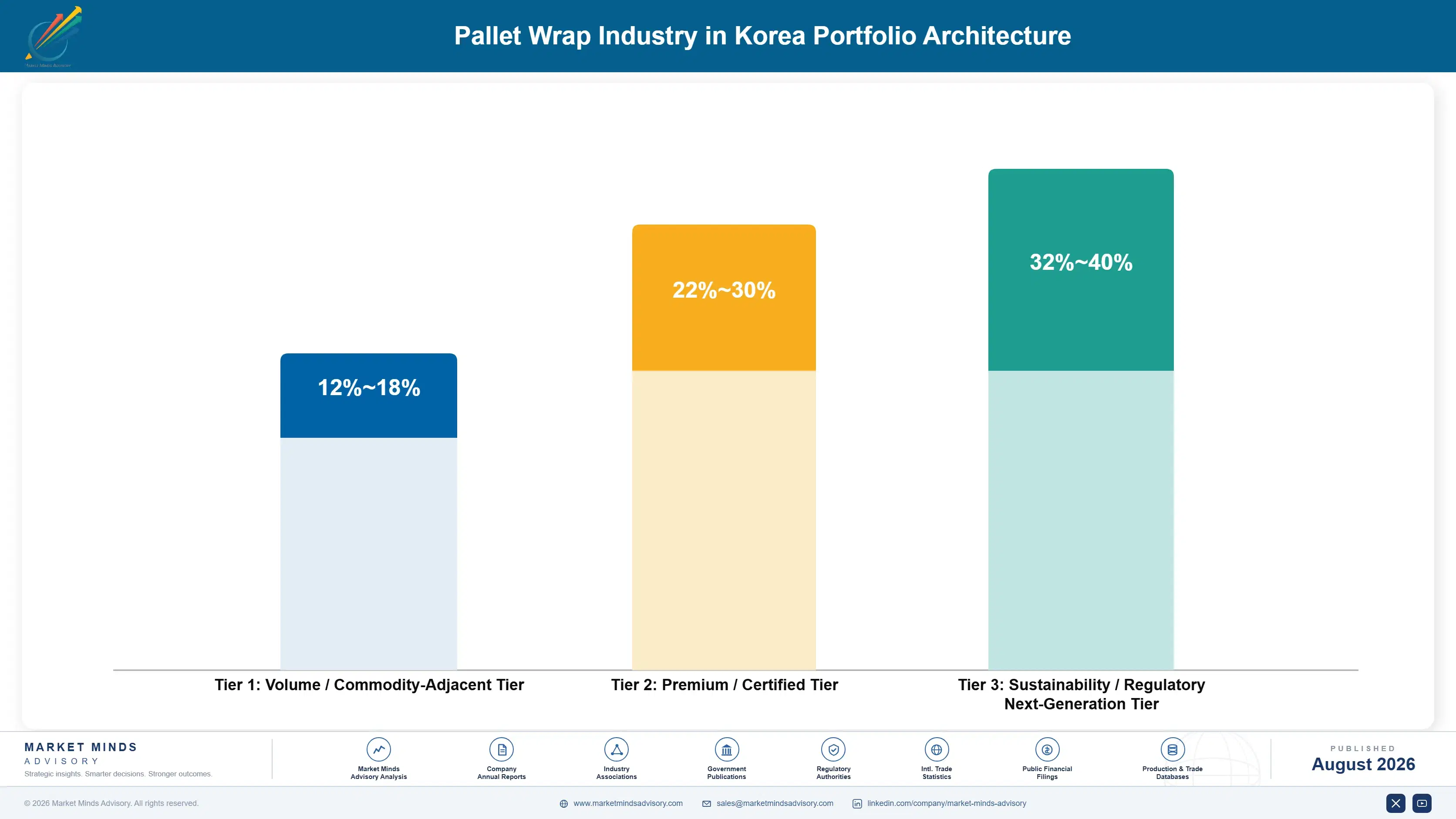
Korea's pallet wrap portfolio organizes into three tiers separated by film gauge and application technology rather than color or clarity alone, with gross margins widening considerably from the standard-gauge commodity tier through to the nano-gauge and machine-grade next-generation tier that logistics operators increasingly require. Capital allocation across the industry is following this margin gradient, with converters directing new investment toward premium extrusion tooling.
Standard-gauge commodity grades face steady margin pressure as nano-gauge and machine-grade film increasingly become the default specification for automated fulfillment operations, pushing converters to defend commodity volume through resin cost advantages rather than price competition with premium suppliers holding stronger relationships. Machine-grade certified grades occupy the profitable middle ground most Korean logistics operators now specify by default, absorbing the largest share of new capital as converters race to qualify lines.

The highest-value profit pools concentrate in nano-gauge film serving automated fulfillment operations, where converters capture both a formulation premium and a recurring supply relationship premium across long-term warehouse operator agreements that rarely face competitive re-bidding once established. Volume versus premium tension defines strategic choice: converters chasing tonnage growth alone increasingly find themselves squeezed on price, while others prioritizing premium mix capture disproportionate margin at modest volume.

Volume / Commodity-Adjacent Tier

Standard-gauge hand-applied stretch film sold on unit price to buyers without automation or nano-gauge performance requirements driving their purchasing specifications and limited budget constraints today and in the near term.
Gross Margin: 12-18%

Premium / Certified Tier

Machine-grade stretch film qualified for automated rotary and turntable wrapping equipment specified by logistics operators converting away from manual hand-wrap operations across their entire warehouse network and fulfillment centers nationwide.
Gross Margin: 22-30%

Sustainability / Regulatory / Next-Generation Tier

Nano-gauge stretch film bundled with formulation support and total-cost-per-pallet consulting for automated fulfillment operations requiring the highest material efficiency and performance standards available in the market today and going forward.
Gross Margin: 32-40%
pallet-wrap-industry-in-korea-portfolio-architecture-1787312192997

High-value Sub-segments and Strategic Watch-out

Nano and High-Performance Stretch Film

The fastest-growing, highest-margin volume segment as warehouse operators pursue total material cost optimization per pallet wrapped, drawing converter capital investment fastest across the entire product category today and over the coming several years across every major logistics hub, fulfillment center, warehouse network, and distribution region.
Gross Margin: 32-40%

Machine-Grade Equipment-Qualified Film

A steadier, high-margin segment tied to warehouse automation adoption rather than any single regulatory catalyst, rewarding converters holding validated equipment-compatible film formulations that rarely face competitive re-bidding once approved and trusted across renewal cycles, ongoing quality audits, and periodic supplier reviews conducted regularly and thoroughly.
Gross Margin: 22-30%

Standard-Gauge Hand-Applied Film

The volume core of the market today, still generating meaningful absolute tonnage despite compressing margins, as buyers without automation requirements continue purchasing largely on unit price alone across most commodity accounts and long-standing supplier relationships built over many years of steady, reliable continuity and trust.
Gross Margin: 12-18%

Legacy Thick-Gauge Commodity Grades

A strategic watch-out segment facing accelerating buyer migration toward nano-gauge alternatives and probable phase-out across automated fulfillment channels within the coming several years, creating both meaningful formulation investment risk and genuine long-term opportunity for faster-moving converters willing to convert early and secure durable customer share.
Gross Margin: 9-14%

Recurring Fulfillment Contract Economics

Pallet wrap demand behaves like an annuity for converters holding qualified supply agreements with major e-commerce fulfillment and logistics operators, since consumption volume tracks predictable warehouse throughput and expanding distribution network growth rather than discretionary purchasing decisions that vary meaningfully year to year across most buyer categories, giving qualified converters unusually stable forward revenue visibility.
Adoption depth varies considerably by end-use channel. Large e-commerce fulfillment operators have converted the large majority of their wrapping specification to machine-grade and nano-gauge film given direct labor and material cost pressure, while smaller regional distributors and manufacturers adopt automated wrapping more selectively, reserving it for high-volume facilities rather than every distribution point across their network. Cold-chain distributors, once qualified for a specific film formulation, rarely revisit that packaging decision.

A generational shift in buyer profiles is underway as logistics automation and procurement officers increasingly replace warehouse managers who once evaluated film purely on unit cost, accelerating premium format adoption faster than labor economics alone would otherwise require across many fulfillment and distribution accounts. Younger buying committees also weigh supplier formulation track record more heavily than legacy price benchmarks alone.
pallet-wrap-industry-in-korea-end-use-penetration-index-1787312193839

Where Korean Converters Should Focus Capital

These are among the four positions where our research anticipates prominent divergence between winners and laggards over the coming forecast period. Each is grounded in the demand model, the regulatory perimeter, and the announced capacity pipeline.
01 / NANO-GAUGE FORMULATION FOCUS

Prioritize nano-gauge development over standard-gauge expansion

Converters still expanding standard-gauge commodity capacity are building toward a shrinking addressable market, since warehouse operators pursuing total-cost-per-pallet optimization widen the premium versus standard gap every year across additional fulfillment categories nationwide and across every major logistics hub and warehouse network. The payback horizon on new standard-gauge capacity now extends past the point where most large operators will have completed nano-gauge conversion entirely, well before automation adoption fully matures. That timing mismatch leaves fresh commodity capital largely stranded before it fully depreciates.
02 / MACHINE-GRADE ACCOUNT STRATEGY

Secure fulfillment operator supply agreements before rivals qualify

Converters that qualify machine-grade equipment compatibility and secure long-term fulfillment operator supply agreements lock in recurring premium revenue that rarely faces competitive re-bidding once a validated relationship is established and trusted across multiple procurement and equipment audit cycles conducted throughout each contract term. Fulfillment operators strongly prefer supplier continuity given the operational risk of switching film sources mid-cycle, and requalifying a new supplier can take months to complete. That timeline makes early qualification the single most defensible account strategy converters can pursue.
03 / EXPORT MARKET POSITIONING

Build Southeast Asian distribution ahead of regional automation adoption

Southeast Asian markets are beginning to adopt warehouse automation standards similar to Korea's own logistics modernization, and converters establishing distribution relationships now, rather than waiting for demand to fully materialize, stand to capture disproportionate early share of that emerging opportunity before competitors reposition their own export strategies and local partnerships. Waiting risks ceding these markets to European suppliers already exploring the same opportunity through established regional trading houses. Certification credibility and buyer trust both take considerable time to establish properly, favoring converters that move first.
04 / RESIN COST MANAGEMENT STRATEGY

Invest in gauge reduction research to defend commodity margin

Converters defending standard-gauge volume against rising competitive pressure should invest in gauge reduction and formulation efficiency aggressively, since this lowers input cost exposure without requiring the full capital investment nano-gauge development demands across other product categories entirely and across every major facility they operate today. This strategy preserves commodity segment profitability even as premium grades capture a growing share of overall industry volume year after year. It also buys time for smaller converters to decide whether nano-gauge investment eventually makes commercial sense for their production footprint.

Engagement Snapshot From the Field

A live engagement with an industry participant carrying material or product regulatory and market exposure ahead of a defining policy shift, showing how our research translates into a defensible multi-year portfolio strategy.
MARKET MINDS ADVISORY · CLIENT ENGAGEMENT SUMMARY
Pallet Wrap Industry in Korea Producer Strategic Portfolio Review and Transition Roadmap 2026·Investment Scenario on Pallet Wrap Industry in Korea Exposure Evaluation 2025-26
CLIENT PROFILE
The client operates twelve fulfillment centers across South Korea, generating an estimated $340 million in annual revenue (client-reported, unverified by MMA), with pallet wrapping representing a meaningful share of its packaging operating cost exposed to both labor shortages and rising resin prices across its national distribution network, regional hubs, seasonal staffing plans, and peak-volume operating windows.
STRATEGIC CHALLENGE
The client faced escalating labor costs and inconsistent load containment quality from its manual hand-wrap operations during peak e-commerce shopping periods, and needed to identify qualified machine-grade film suppliers capable of supporting automated wrapping equipment installation without disrupting daily fulfillment center operations or exceeding its annual capital budget for equipment upgrades.
MMA APPROACH
MMA conducted a supplier capability audit across four candidate converters, benchmarked machine-grade film pricing and equipment compatibility against the client's planned automation rollout, and modeled total wrapping cost impact per pallet to build a phased conversion business case for client leadership and its operations committee to formally approve and fund.
KEY FINDINGS
  1. Only two of four converters evaluated could supply machine-grade film compatible with the client's selected automated wrapping equipment within the required installation timeline.
  2. Converting to nano-gauge machine-grade film reduced material cost per pallet by an estimated 18%, more than offsetting the higher per-kilogram film price.
  3. Facility-level trials showed automated wrapping increasing pallet throughput per labor hour by a meaningful margin during peak shopping period volume surges and holiday demand spikes.
  4. Delaying automation investment would have risked continued peak-season labor shortages and inconsistent load containment quality affecting shipment damage and customer complaint rates.
CLIENT PROFILE
The client operates twelve fulfillment centers across South Korea, generating an estimated $340 million in annual revenue (client-reported, unverified by MMA), with pallet wrapping representing a meaningful share of its packaging operating cost exposed to both labor shortages and rising resin prices across its national distribution network, regional hubs, seasonal staffing plans, and peak-volume operating windows.
STRATEGIC CHALLENGE
The client faced escalating labor costs and inconsistent load containment quality from its manual hand-wrap operations during peak e-commerce shopping periods, and needed to identify qualified machine-grade film suppliers capable of supporting automated wrapping equipment installation without disrupting daily fulfillment center operations or exceeding its annual capital budget for equipment upgrades.
MMA APPROACH
MMA conducted a supplier capability audit across four candidate converters, benchmarked machine-grade film pricing and equipment compatibility against the client's planned automation rollout, and modeled total wrapping cost impact per pallet to build a phased conversion business case for client leadership and its operations committee to formally approve and fund.
KEY FINDINGS
  1. Only two of four converters evaluated could supply machine-grade film compatible with the client's selected automated wrapping equipment within the required installation timeline.
  2. Converting to nano-gauge machine-grade film reduced material cost per pallet by an estimated 18%, more than offsetting the higher per-kilogram film price.
  3. Facility-level trials showed automated wrapping increasing pallet throughput per labor hour by a meaningful margin during peak shopping period volume surges and holiday demand spikes.
  4. Delaying automation investment would have risked continued peak-season labor shortages and inconsistent load containment quality affecting shipment damage and customer complaint rates.
RECOMMENDED STRATEGY
Phase 1: Phase 1 (Months 1 to 2): Audit candidate film suppliers and benchmark pricing, equipment compatibility, and delivery reliability across options. Phase 2: Phase 2 (Months 3 to 5): Pilot automated wrapping and nano-gauge film across three fulfillment centers to validate throughput and cost savings before scaling further. Phase 3: Phase 3 (Months 6 to 9): Complete national rollout across all remaining fulfillment centers and finalize long-term converter supply agreements on favorable terms.
OUTCOME
Within nine months the client completed automation and nano-gauge film conversion across all twelve fulfillment centers, reporting a 16% net material cost reduction per pallet alongside measurably improved pallet throughput during peak periods (client-reported, unverified by MMA), securing a three-year supply agreement with its preferred qualified converter.

Frequently Asked Questions

Foundational context covering the market sizes, CAGR, scope, country, region and competition that inform every finding below. This section is provided to cover basics and most often pre-purchase conversations, answered from the MMA Primary Research Dataset.

What is the current size of the Pallet Wrap Industry in Korea?

Korea's pallet wrap industry is valued at $0.24 billion in 2025, MMA's designated base year for this analysis. This figure covers cast and blown stretch film products used for palletized goods across warehousing, transport, and logistics applications.

How large will the Pallet Wrap Industry in Korea be by 2036?

MMA projects the industry will reach $0.4556 billion by 2036 under the base case scenario. That represents a 1.79 times expansion over the 2026 starting value across the ten-year forecast window.

What is the CAGR for the Pallet Wrap Industry in Korea 2026 to 2036?

The base case CAGR is 6.0% annually, with a bull case of 7.2% and a bear case of 4.8%. E-commerce fulfillment growth and resin cost volatility are the primary swing factors between scenarios.

Which segment is growing fastest?

Nano and high-performance stretch film leads at a 9.5% CAGR, roughly 1.58 times the overall industry rate. Warehouse operator demand for total material cost optimization per pallet is the primary driver behind this growth.

Who are the major companies in the Pallet Wrap Industry in Korea?

Samhwa Netlon Co Ltd, Handong Chemical Co Ltd, KOREX Co Ltd, Samwon Global Packaging Co Ltd, and Berry Global Group Inc lead the industry. Together these five converters hold an estimated 48% of domestic revenue.

Which country is growing fastest?

Since this report is scoped specifically to Korea's domestic industry, South Korea itself represents the entire market at a 6.0% CAGR. Export growth into Southeast Asian markets is expanding fastest among external destinations.

Report Segmentation Architecture

The full report scope spans multiple orthogonal segmentation dimensions, with cross-tabulated demand data provided for each dimension pair. Coverage extends further to regional breakdowns, trend trajectories, and the competitive detail needed to support segment-level decision-making.

By Application Method and Film Technology

  • Hand-Applied Stretch Wrap
  • Machine-Applied Stretch Wrap
  • Pre-Stretched Film
  • Nano and High-Performance Stretch Film
  • Colored and UV-Protective Film
  • Airflow and Ventilated Stretch Film

By End-Use Industry

  • E-Commerce and Fulfillment Logistics
  • Cold-Chain and Perishable Distribution
  • Manufacturing and Industrial Distribution
  • Retail and Consumer Goods Distribution
  • Export and Freight Forwarding

By Commercial Dimension

  • Direct Fulfillment Operator Supply Agreements
  • Equipment Manufacturer Partnerships
  • Distributor and Converter Channels
  • Export Distribution Partnerships

By Region

  • North America
  • Western Europe
  • East Asia
  • South Asia and Pacific
  • Latin America
  • Middle East and Africa
  • Eastern Europe

Scope, Methodology, and Coverage

Every figure in this report is reproducible from documented input assumptions. The scope below maps the historical period, the forecast horizon, the segmentation dimensions, and the countries covered, alongside the underlying primary and qualitative methodology.
Historical Period
2020 to 2025
Forecast Period
2026 to 2036
Base Year
2025 (USD billions; MMA Primary Research Dataset, August 2026)
Market Definition
The pallet wrap industry in Korea covers cast and blown stretch film products used to secure and stabilize palletized goods for warehousing, transport, and logistics applications within South Korea, including hand-applied, machine-applied, and pre-stretched formats. It excludes shrink film, strapping and banding materials, and corrugated pallet packaging not based on stretch film technology.
Quantitative Units
USD billions (current prices); production volume in thousands of tonnes
Segmentation Dimensions
By Application Method and Film Technology; By End-Use Industry; By Commercial Dimension; By Region
Regions Covered
North America, Western Europe, East Asia, South Asia and Pacific, Latin America, Middle East and Africa, Eastern Europe
Countries Covered
South Korea, Japan, China, Vietnam, Indonesia, Thailand, USA, Germany, France, UK, India, Australia, Canada, Brazil, Mexico, Malaysia, UAE, Saudi Arabia, South Africa, Nigeria, Turkey, Poland, Netherlands, Italy, Spain, Sweden, Switzerland, Argentina, Colombia, Singapore, and additional markets relevant to this sector
Key Companies Profiled
Samhwa Netlon Co Ltd, Handong Chemical Co Ltd, KOREX Co Ltd, Samwon Global Packaging Co Ltd, Berry Global Group Inc, Trioplast Industrier AB, RKW Group, Novolex Holdings LLC, Signode Industrial Group LLC, Intertape Polymer Group Inc, AEP Industries Inc, Inteplast Group Ltd, Polyking Co Ltd, DaeSung Packaging Co Ltd, Kyungdo Chemical Co Ltd, Sam Young Chemical Industrial Co Ltd, Woosung Industries Co Ltd, Lotte Chemical Corporation, Hyosung TNC Corporation, Nefab Group
Quantitative Methodology
Primary survey, n=3,800 respondents, Q4 2025, six countries; demand-side model with trade association cross-validation
Qualitative Methodology
47 expert interviews, Q4 2025; applied to validate demand model assumptions, identify emerging dynamics, and assess competitive positioning
Report Format
PDF and XLSX data workbook (Word format preview document)
Publisher
Market Minds Advisory
Report Code
MMA-2026-PAC-103
Published
August 2026
Contact
sales@marketmindsadvisory.com | www.marketmindsadvisory.com

Purchase the full Pallet Wrap Industry in Korea Report (2026 to 2036).

The full report delivers a complete analysis of Korea's pallet wrap industry, covering sizing and forecasts across all seven regions and six application and technology segments through 2036. It profiles twenty companies with verified moat and risk assessments for the two category leaders, Samhwa Netlon and Handong Chemical, across their nano-gauge and machine-grade positioning. The report includes detailed input cost analysis, portfolio margin benchmarking, and a primary-research-backed warehouse automation outlook. Buyers receive full access to underlying data tables and methodology notes supporting every figure presented in the analysis.
Seven-region sizing and forecast data tables
Six-segment MECE application breakdown and analysis
Twenty-company competitive profiles and full rankings
Input cost exposure and mitigation analysis
Portfolio tier margin benchmarking data included
Warehouse automation adoption timeline and outlook

Built For The People Who Decide

From boardroom strategy to bench-side execution, this report is read cover-to-cover by leaders shaping the next decade of their industry, turning demand scenarios, market dynamics and valuation benchmarks into decisions.
CXOs/ Presidents/ VPs/ Managers
M&A and Corporate Development
Strategy Teams and R&D Heads
Procurement and Product Directors
Regulatory and Compliance Leaders
Investor Relations and Equity Analysts