Market Minds Advisory
Pallet Wrap Industry in Japan

Pallet Wrap Industry in Japan: Containment Force, Driver Shortage and the Film Nobody Measures Until a Load Falls

Japan's logistics workforce is shrinking faster than its freight volume, and the stretch film wrapped around a pallet by hand is one of the first jobs anybody tries to automate away.

Lead Analyst

Bilal Shaikh

Published

September 2026

Make Smarter Decisions with Customized Research Insights

Request a free sample report and evaluate market opportunities, growth trends, and competitive dynamics relevant to your business needs.

2025 MARKET VALUE$0.4BMarket Size 2025
2036 FORECAST VALUE$0.7BBase Case , 2026 to 2036
CAGR 2026 TO 20364.3 %Bull 5.5% / Bear 3.1%
INCREMENTAL OPPORTUNITY$0.2BNet 10- year value creation
EXPANSION MULTIPLE1.52x2036 value over 2026 base
Strategic Levers
M&A Pipeline
Regional Outlook
Country Rankings
Competitive Intelligence
Segmental Deep-dive
Call-Us : 91 93563 13602

Executive Snapshot and Market Trajectory

Japan wraps fewer pallets than its economy suggests, because so much domestic freight still moves as hand-stacked cases rather than unitised loads. What is changing is that there are no longer enough people to stack them. Unitisation is arriving by necessity rather than by choice.
High-performance thin-gauge machine film compounds at 6.45%, exactly 1.50 times the market, as wrapping shifts from hand rolls to automatic machines. Resin runs near 66% of converter cost, and Japan imports most of its polyethylene, so exchange rate movement flows into film pricing quickly. Concentration sits at 58%. Machine film already covers 61% of volume, and the remaining hand-wrapped share sits with mid-sized operators now installing wrappers for the first time.
Containment force is what actually holds a load, and almost nobody measures it. Buyers compare film thickness and price per roll, which are the two properties least connected to whether a pallet arrives intact at the far end of a distribution route. A 12 micrometre high-performance film routinely beats a 20 micrometre commodity one, and no gauge comparison will ever reveal that. Measuring on the customer's own wrapper is what changes the purchase criterion entirely.
Market Definition
The market covers polyethylene stretch and pallet wrapping films consumed in Japan, spanning cast machine stretch film, blown machine stretch film, hand-applied stretch rolls, high-performance thin-gauge machine film, pre-stretched and specialty films, and stretch hood and netting films. Shrink wrap and shrink bundling films, strapping and banding, pallets themselves, and the wrapping machinery are excluded.
Base Year Value
$0.4B in 2025 (MMA Primary Research Dataset, August 2026)
Forecast Period
2026 to 2036, eleven discrete annual values
CAGR
4.3% base case. Bull 5.5%. Bear 3.1%.
Fastest Growth Segment
High-Performance Thin-Gauge Machine Film: 6.5% CAGR
Fastest Growth Country
Japan: 4.3% CAGR
Fastest Growth Region
South Asia and Pacific: 6.3% CAGR
Largest Region
East Asia: 71% of 2025 global value
Market Leaders
Okura Industrial, Mitsui Chemicals Tohcello, Sekisui Film, C-I Kasei, Futamura Chemical. Source: MMA Analysis based on company annual reports.
Primary Survey
n=3,800 procurement and R&D decision-makers, Q4 2025, six countries
Methodology
Demand-side build-up, cross-validated against public data, 47 expert interviews

Pallet Wrap Industry in Japan Market Forecast Scenarios

pallet-wrap-industry-in-japan-size-forecast-scenario-1787308636774
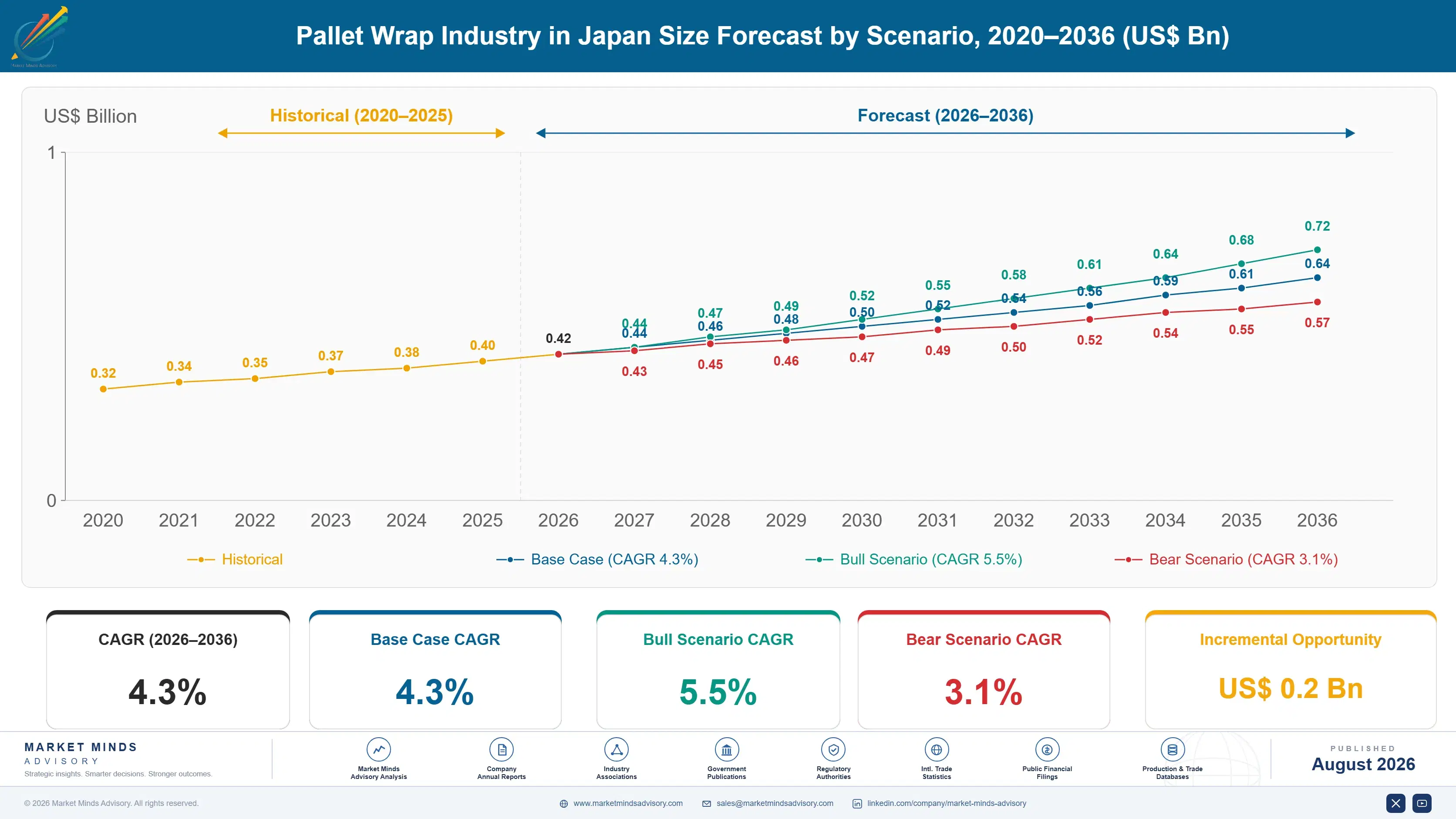
Growth ran at an implied 3.4% across 2020 to 2025 and volume mattered less than mix. Total wrapped pallet counts grew slowly with a flat domestic economy, while the shift from hand rolls to machine film accelerated as distribution centres automated. Resin import costs swung with both polymer markets and the yen, and converters recovered them unevenly.
The base case at 4.3% rests on three mechanisms. Logistics labour scarcity keeps pushing operations from hand wrapping to automatic machines, which changes the film specification entirely. Working hour restrictions on drivers keep forcing consolidation into unitised loads. And distribution centre automation continues across grocery, pharmaceutical and parcel networks that have no alternative source of labour. Thin-gauge machine film compounds at 6.45% against a market at 4.3%, and pre-stretched construction takes a further share among operators wrapping with reduced staff.
The bull case at 5.5% assumes unitisation accelerates as labour scarcity bites harder and more freight converts from loose case handling to wrapped pallets. The bear case at 3.1% follows from continued industrial output decline reducing total freight volume, alongside downgauging cutting film consumed per pallet faster than pallet counts rise to compensate. Both turn on unitisation rather than on film itself.

Fewer Hands, More Machines

Japan's pallet wrap market is small relative to the economy for a reason that has nothing to do with packaging. A large share of domestic freight still moves as individually handled cases, loaded and unloaded by people, rather than as unitised pallets. That practice was viable when labour was available. It is becoming untenable now that the logistics workforce has fallen around 14% since 2015.
TOP FIVE CONCENTRATION58%Combined share held by the five largest domestic film converters
TARGET CONTAINMENT FORCE9 kilogramsHolding force required to secure a typical distribution load
RESIN COST SHARE66% of COGSPolyethylene as a proportion of the converter cost base
MACHINE FILM PENETRATION61%Share of volume applied by automatic wrappers rather than hand
TYPICAL FILM GAUGE12 micrometresThickness now standard where high-performance resin allows downgauging
LOGISTICS WORKFORCE DECLINE14% since 2015Reduction in available drivers and warehouse labour nationally
The response is automation, and automatic wrapping machines demand a completely different film. Hand rolls are forgiving: an operator adjusts tension by feel and walks slower if the load looks unstable. A machine applies a programmed pre-stretch and wrap pattern, and the film either performs at that setting or it fails. High-performance thin-gauge machine film compounds at 6.45% on exactly that transition.
What almost nobody measures is containment force, which is the actual holding force the wrapped film applies to the load and typically needs to reach around nine kilograms for distribution. Buyers compare gauge and price per roll instead. A 12 micrometre high-performance film frequently outperforms a 20 micrometre commodity one, and the buyer comparing thickness will pick the wrong product every time.
"I have watched a distribution manager reject a thinner film on principle, then spend the afternoon explaining to a customer why three pallets arrived on their side. The gauge number told him nothing at all."
Director, Stretch Films and Transit Packaging Practice · MMA Flexible Packaging

Market Trends

Logistics Labour Scarcity Forces Wrapping Automation

Japan's logistics workforce has contracted around 14% since 2015 and the decline is demographic rather than cyclical. Distribution centres cannot staff hand wrapping and are installing automatic wrappers, which changes the film requirement completely: machine film runs at programmed pre-stretch with no operator judgement available to compensate. Machine film penetration has reached 61% of volume and continues climbing. High-performance thin-gauge film compounds at 6.45% against a market at 4.3% on that shift. Once a wrapper is installed, the film specification is effectively fixed by what the machine can run reliably.
Market Impact: Machine film at 61% share

Driver Hour Limits Push Freight Into Unitised Loads

Working hour restrictions on commercial drivers have made loading and unloading time commercially expensive in a way it was not before, since hours spent handling cases are hours not spent driving. That pushes shippers toward unitised pallet loads that a forklift moves in seconds. Every conversion from loose case handling to a wrapped pallet creates film demand that did not previously exist, and the mechanism is regulatory rather than economic, which makes it considerably more reliable. Those conversions are permanent, because nobody reverts to hand loading once a dock is laid out around forklift handling.
Market Impact: Containment reaching 9 kilograms fo

Market Opportunities and Growth Drivers

Distribution Centre Automation Reaches Smaller Operators

Automatic wrapping equipment has historically been justified only at high-throughput sites, and falling equipment costs alongside acute labour scarcity have brought it within reach of mid-sized distribution operations across grocery, pharmaceutical and parcel networks. Each installation converts hand roll consumption into machine film consumption at a higher performance specification. Machine film already accounts for 61% of volume, and the remaining hand-wrapped share is concentrated in exactly the smaller operators now installing equipment for the first time. Commissioning is when specification is genuinely open. Nobody is defending an incumbent film at that point.
Market Impact: Gauge falling to 12 micrometres

Load Damage Costs Exceed Any Film Saving Immediately

A pallet that shifts in transit damages product, delays a delivery and occasionally injures somebody unloading it. Against that, the difference between a competent film and a cheap one is measured in yen per pallet. Containment force near nine kilograms is what prevents the failure, and it correlates poorly with the gauge and price buyers actually compare. Converters who measure containment force on a customer's own loads convert a commodity purchase into a technical specification. Load failures are attributed to handling or route conditions rather than to film, which is why the specification never changes on its own.
Market Impact: Gauge reduced toward 12 micrometres

Market Restraints and Challenges

Buyers Compare Gauge and Price Rather Than Performance

Stretch film is purchased on micrometres and price per roll, and neither number predicts whether a load arrives intact. The root cause is that failures happen in transit, away from the buyer, and get attributed to handling or driving rather than to film specification. Converters mitigate by measuring containment force on the customer's actual loads and wrapping equipment, which reframes the purchase entirely, and by demonstrating that a 12 micrometre high-performance film can outperform a 20 micrometre commodity one. Measurement equipment on site settles it in an afternoon. Almost no converter offers to do it.
Market Impact: Workforce down 14% since 2015

Downgauging Reduces Film Volume Faster Than Pallets Rise

High-performance resins allow thinner film at equal or better containment, which cuts the tonnage consumed per pallet even as pallet counts grow. The root cause is that converters sell an improvement that shrinks their own volume. Mitigation runs through pricing on performance rather than weight, since a thin high-performance film commands a considerably better price per kilogram, and through capturing the machine film conversion that downgauging enables in the first place. Converters who resist the shift simply lose accounts to competitors willing to sell less material at a materially better rate per kilogram.
Market Impact: Containment force targeting 9 kilog
2 additional market trends, 4 additional growth drivers, and 3 additional restraints and challenges are covered in the full report. Contact sales@marketmindsadvisory.com to access the complete intelligence.

Segment CAGR and Growth Architecture

Segmentation follows application method and film performance class, because those together decide the containment achievable, the gauge required and whether an operator or a machine is applying the wrap. A distribution centre installing automatic wrappers is changing film category rather than merely changing supplier. Six classes sit here, separated by application method and containment delivered.
pallet-wrap-industry-in-japan-market-share-analysis-1787308637307

High-Performance Thin-Gauge Machine Film

Thin-gauge machine film compounds at 6.45%, exactly 1.50 times the market, on wrapping automation driven by a logistics workforce that has fallen around 14% since 2015. Multilayer cast construction with metallocene resins delivers containment force near nine kilograms at 12 micrometres, where commodity film needs considerably more thickness for the same result. The commercial catch is that it reduces the tonnage a converter sells per pallet, which is why some producers have been slow to push it. Price per kilogram is substantially higher and the performance argument reaches distribution operations rather than procurement, provided somebody actually measures containment force rather than comparing the gauge printed on the box. Very few buyers do.
CAGR 6.5%

Pre-Stretched and Specialty Films

Pre-stretched films grow at 5.4% by moving the stretching operation from the customer's site to the converter's line. The film arrives already elongated, so a hand operator or a simple wrapper achieves consistent containment without the tension control that stretching properly requires. That suits operations installing basic equipment or still wrapping by hand with reduced staff, which describes a large part of the Japanese mid-market. Specialty variants add ultraviolet stabilisation for outdoor storage, coloured film for load identification and vented construction for produce requiring airflow. Cost per pallet runs above standard machine film, and the buyers accepting that are the ones who cannot rely on operator skill any longer. That describes most of the mid-market now.
CAGR 5.4%
Full segment breakdown across 6 segments available in the complete report.

Regional Architecture and Country Demand Map

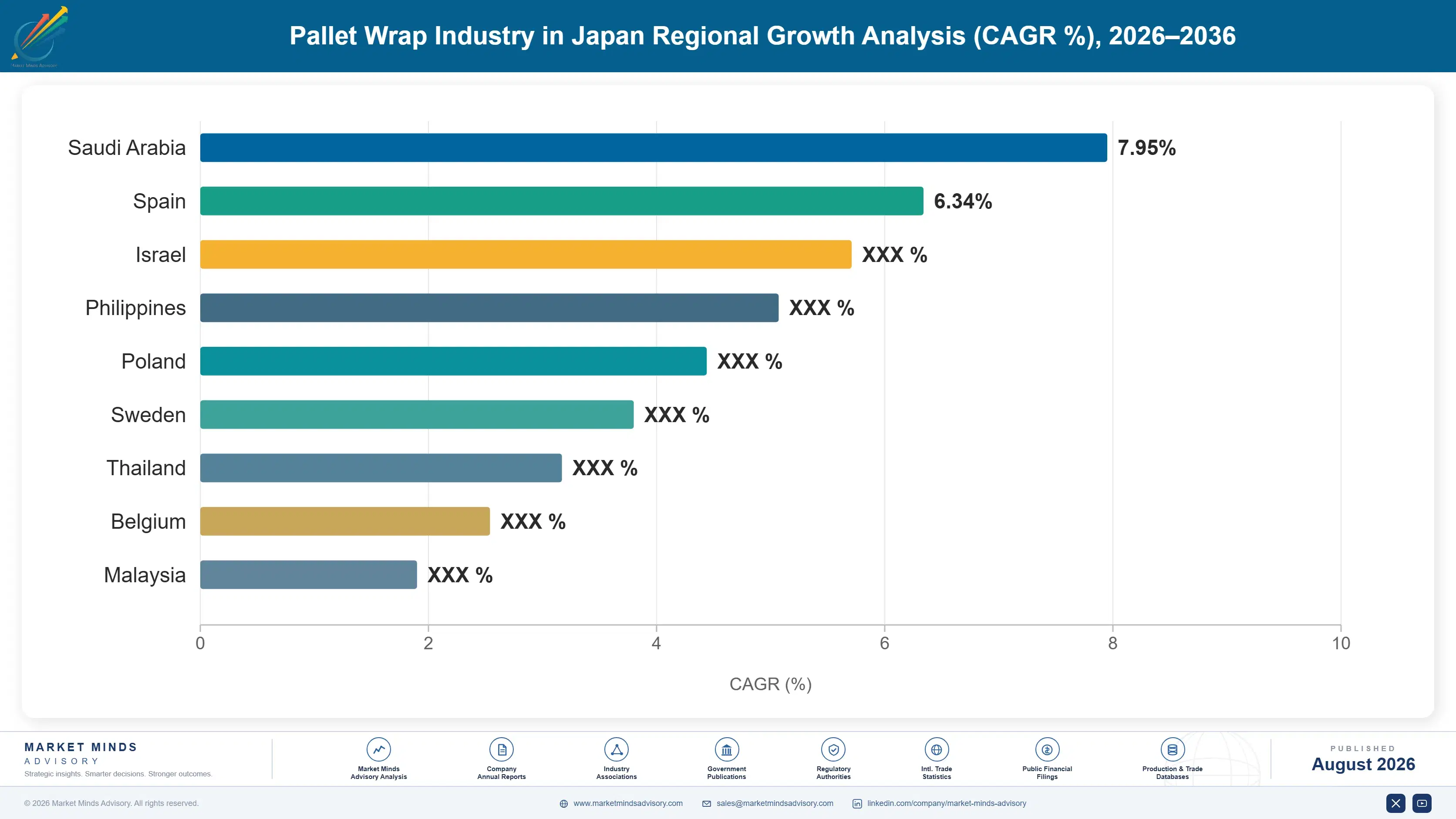
Although the market is defined as Japan, regional shares below describe the geography of the freight being wrapped, allocating domestic distribution and export-bound palletised volume across the seven standard regions by destination. Domestic distribution dominates by a very wide margin. Export freight accounts for the remainder.

East Asia

East Asia accounts for 71% of the demand described here. Note: this is far outside the standard band because the market is defined as Japanese pallet wrap consumption, and the overwhelming majority of that film wraps freight moving within Japan itself rather than crossing any border. Grocery and convenience store distribution is the single largest application, running dense networks with high delivery frequency. Pharmaceutical and medical distribution follows, with the tightest requirements on load integrity. Parcel and e-commerce fulfilment has grown quickly. Palletised trade with China, Korea and Taiwan adds the remainder of this regional figure. Automation is furthest advanced in grocery and parcel networks, where labour scarcity bites hardest.
Share: 71% | CAGR: 4.8% (2026 to 2036)

North America

North America represents 8% of the demand described. Note: this reflects Japanese palletised export freight bound for North American ports rather than any film consumed regionally. Machinery components, automotive parts and precision equipment carry most of the volume, and those loads demand containment performance well beyond domestic distribution norms because sea transit involves vessel motion, humidity change and handling nobody controls. Wrapping specification for export freight is typically set by the exporter's logistics function rather than by a packaging buyer, which makes containment force a genuine discussion rather than a price comparison. Containment retention over weeks rather than initial force is what these buyers actually specify. Failures on this route are expensive and slow to remedy.
Share: 8% | CAGR: 3.8% (2026 to 2036)
Regional intelligence for 5 additional markets available in the complete report: Western Europe, South Asia and Pacific, Latin America, Middle East and Africa, Eastern Europe. Contact sales@marketmindsadvisory.com.
pallet-wrap-industry-in-japan-country-cagr-analysis-1787308637829

Measuring What the Buyer Ignores

Japanese stretch film is bought on gauge and price per roll by distribution operations losing the labour that used to compensate for weak film. Every position worth holding starts with measuring containment force. Four qualify, and the automation transition is what makes all of them possible now. Two of them reach distribution operations rather than purchasing.

Measure Containment Force on Customer Loads Directly

Containment force near nine kilograms is what holds a pallet together, and buyers compare gauge and price instead because neither failure nor its cause is visible from the purchasing desk. Converters who bring measurement equipment to a customer's wrapper and record actual containment across their real load profiles convert a commodity purchase into a technical specification. A 12 micrometre high-performance film frequently beats a 20 micrometre commodity one, and no gauge comparison will ever show that. An afternoon on site settles what a year of quotations never will. Load profiles differ enough that generic data persuades nobody.
Market Impact: Containment measured against a 9 ki

Follow Wrapping Machine Installations Into Mid-Sized Sites

Every automatic wrapper installed converts hand roll consumption into machine film at a higher specification, and falling equipment costs are bringing wrappers into mid-sized distribution operations that never justified them before. Machine film already covers 61% of volume, and the remaining hand-wrapped share sits with exactly those operators. Converters who work alongside equipment suppliers reach the site during commissioning, when film specification is being set for the first time rather than defended by an incumbent. Equipment suppliers rarely have a film preference of their own. Their interest is that the machine runs reliably.
Market Impact: Machine film already reaching 61% o

Price Thin-Gauge Film on Performance Not Weight

Downgauging cuts the tonnage sold per pallet, which is why some converters have been slow to promote it despite the demand. Pricing per kilogram rather than per roll captures the value: high-performance film at 12 micrometres commands a substantially better rate than commodity resin at 20, and total revenue per pallet frequently holds even as weight falls. Converters who resist the transition simply lose the accounts to competitors willing to sell less material at a better price. Total revenue per pallet frequently holds even as tonnage falls. The arithmetic works and the sales conversation is harder.
Market Impact: Gauge falling toward 12 micrometres

Specify Export Freight Against Transit Conditions

Export loads face vessel motion, humidity change, temperature extremes and handling nobody controls, and containment retention over weeks matters more than initial force. Japanese exporters set wrapping specification through logistics rather than packaging procurement, which is a technical audience willing to discuss film properties seriously. Ultraviolet-stabilised construction and higher containment specification both sell here on merit, and load values are high enough that failure cost overwhelms any film saving completely. Around 9 kilograms at the start of a five week voyage is a different specification from nine kilograms on a delivery route, and the retained figure is what matters.
Market Impact: Transit requiring 9 kilogram contai

Who Controls the Margin Pool

Five converters hold 58% of the Japanese market measured on stretch film revenue, the basis used throughout this section. Concentration is high by international standards, reflecting a domestic supply structure where long customer relationships and consistent quality matter more than price aggression. Okura Industrial and Mitsui Chemicals Tohcello lead, and the gap to the challenger group is narrow on commodity film and wider on high-performance construction.
Competition runs on three dimensions. Metallocene multilayer capability decides who can supply thin-gauge machine film at the containment levels automation requires. Technical service into distribution operations decides who can demonstrate performance rather than quote gauge. And resin procurement position decides who absorbs least when the yen moves against imported polyethylene. Extrusion capacity by itself qualifies nobody for the automated sites.

Two pressures are moving position. Wrapping automation rewards converters with high-performance film capability and steadily excludes commodity producers from new installations. Meanwhile imported film from Korean, Taiwanese and Southeast Asian producers competes hard on commodity gauge. Rankings will shift toward converters pairing thin-gauge capability with genuine on-site measurement service. Producers treating downgauging as a threat to tonnage rather than a repricing opportunity will hand those accounts over.
pallet-wrap-industry-in-japan-company-positioning-matrix-1787308638349

Competitive Moat and Risk Dimensions

OKURA INDUSTRIAL

Moat: Domestic distribution relationship depth

Okura Industrial holds long-standing supply relationships across Japanese grocery, convenience and industrial distribution, where continuity and consistent quality carry more weight than pricing. Those relationships give early visibility of wrapping automation projects, which is when film specification is genuinely open rather than defended, and that access is difficult for any newer entrant to replicate.
OKURA INDUSTRIAL

Risk: Imported commodity film pricing

Korean, Taiwanese and Southeast Asian producers compete aggressively on commodity gauge film where technical differentiation is minimal and freight to Japan is short. A domestic producer carrying local cost structure cannot match that on price, which steadily erodes the standard machine and hand roll volume underpinning plant utilisation.
MITSUI CHEMICALS TOHCELLO

Moat: Metallocene multilayer film capability

Multilayer cast construction with metallocene resins is what delivers containment force near nine kilograms at 12 micrometres, and Mitsui Chemicals Tohcello holds both the resin access and the extrusion capability to produce it consistently. As wrapping automation spreads, that combination becomes the qualifying requirement rather than an option, and commodity extruders cannot follow quickly.
MITSUI CHEMICALS TOHCELLO

Risk: On-site measurement service reach

Demonstrating containment force requires bringing measurement equipment to a customer's wrapper and working through their real load profiles, which is field service rather than materials science. Converters who have built that capability change the purchase criterion before any material comparison happens, and a materials-led producer can lose on ground it never contested.

Players Tracked

Prominent Players

Okura Industrial
Mitsui Chemicals Tohcello
Sekisui Film
C-I Kasei
Futamura Chemical

Other Key Players

Toyobo
Gunze
Asahi Kasei
Kohjin Film and Chemicals
Tosoh Corporation
Achilles Corporation
Shin-Etsu Polymer
Sumitomo Chemical
JSP Corporation
Daiwa Gravure
Nihon Matai
Meiwa Pax
Sanko Gosei
Kyodo Printing
Ube Film

Recent Developments

APRIL 2025

Driver working hour limits reshape loading practice across logistics

Tightened working hour restrictions on commercial drivers made case-by-case loading commercially costly, pushing shippers toward unitised pallet loads that move in seconds. This was regulatory implementation rather than any commercial development among film converters themselves. Shippers rebuilt loading practice around forklift handling rather than manual case work.
Signal: Regulation converting loose freight into w
AUGUST 2025

Mid-sized distribution centres install automatic wrapping equipment

Falling wrapper equipment costs combined with acute warehouse labour scarcity brought automatic wrapping into mid-sized distribution operations that had always wrapped by hand. This reflects equipment economics and labour conditions rather than developments among the film suppliers involved. Film specification at those sites was set during commissioning rather than inherited.
Signal: Commissioning is the one moment when film
DECEMBER 2025

Yen movement raises imported polyethylene cost for domestic converters

Exchange rate movement raised the landed cost of imported polyethylene resin, which represents around 66% of converter cost of goods, against customer contracts written in yen at fixed prices. This reflects currency and polymer market conditions rather than any transaction among converters. Converters holding adjustment clauses recovered it far sooner.
Signal: Resin at 66% of cost means currency moveme

Imported Resin and a Moving Yen

Polyethylene resin accounts for roughly 66% of converter cost of goods, and Japan imports the majority of it, which layers currency exposure on top of polymer market movement. Metallocene grades used in high-performance thin-gauge film cost substantially more than commodity linear low-density polyethylene. Extrusion energy adds around 11%, with converting labour, core costs and winding making up most of the remainder.
Imported resin landed costs rose through 2021 and 2022 on polymer market movement, then again in 2025 as exchange rates moved, and converters absorbed much of both because customer contracts are written annually in yen. Company annual reports across the Japanese film and chemical groups disclose the resulting converting margin pressure. International Energy Agency reporting on petrochemical feedstock costs documents the underlying polymer movement across the period.

Exposure divides by resin access and by product mix. Converters within chemical groups holding polyethylene positions see cost early and secure supply through tight periods. Independent film producers buy landed imported resin at whatever the market and currency deliver. Thin-gauge high-performance work carries metallocene exposure that moves separately, and it also uses less resin per pallet, which cuts the absolute exposure considerably.
pallet-wrap-industry-in-japan-cost-volatility-analysis-1787308638545

Build currency and resin adjustment into annual contracts

Annual yen contracts against imported resin priced in dollars transfer both polymer and currency movement onto the converter. A combined adjustment clause referencing a published resin index and an exchange rate band, reset quarterly, matches pass-through to actual exposure. Customers accept it more readily than converters expect once the mechanism is explained plainly. Most contracts still lack one.

Shift mix toward thin-gauge to cut absolute resin exposure

High-performance film at 12 micrometres uses considerably less resin per pallet than commodity construction, which reduces the absolute cost exposure even though metallocene grades price higher per kilogram. Weighting the order book toward thin-gauge work therefore hedges resin volatility while also capturing the automation transition, which is a rare case of both objectives aligning.

Qualify domestic and regional resin sources against imports

Landed imported resin carries freight, currency and lead time exposure that domestic or short-haul regional supply avoids. Qualifying alternate grades from Korean or Taiwanese producers, tested to the same containment performance, takes one trial cycle and creates a live alternative to negotiate against whenever imported pricing moves adversely. Having the alternative matters more than using it.

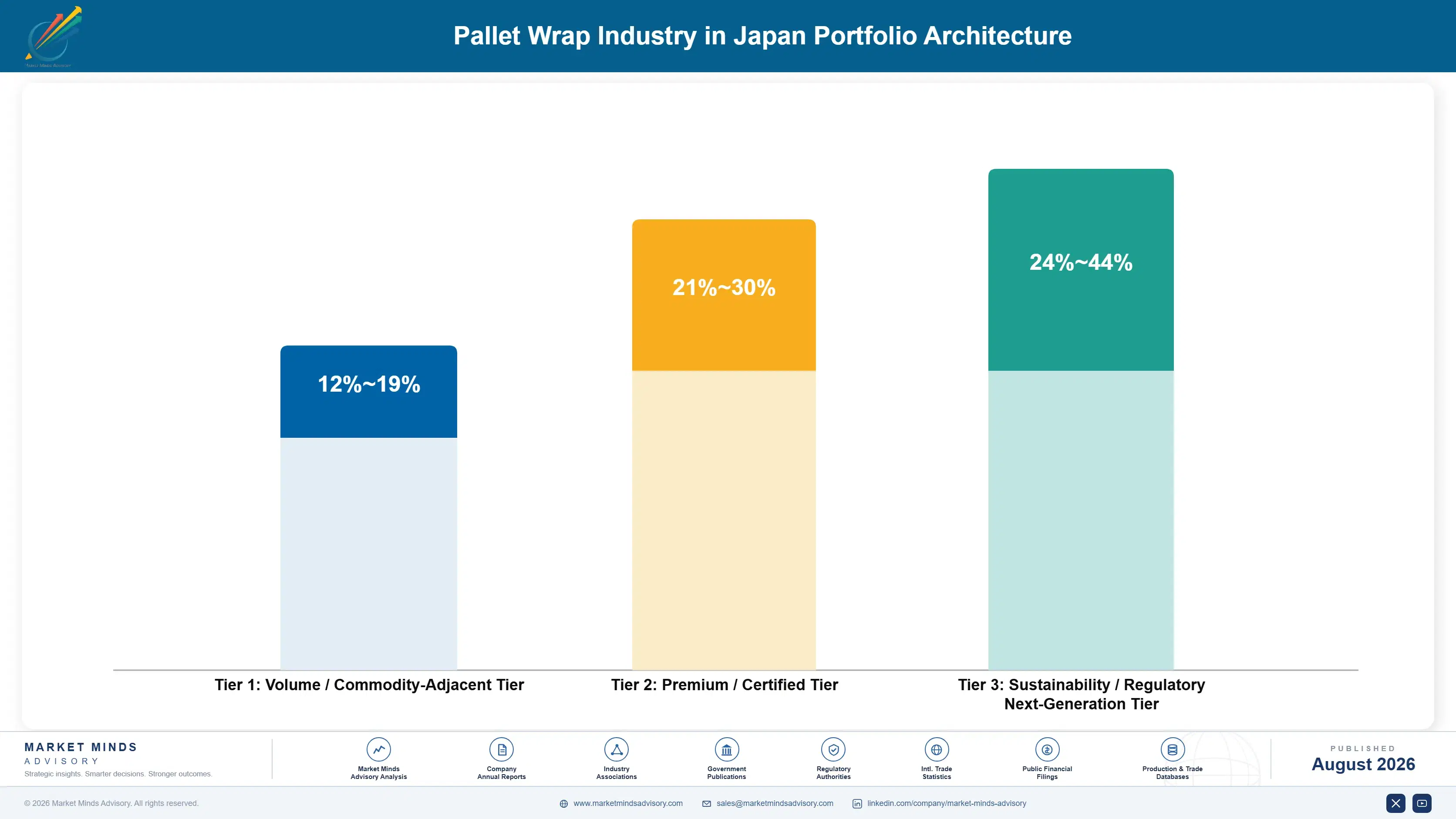
Portfolio Architecture for Margin Defence

The portfolio separates on who applies the film and how hard the load is to hold. Hand rolls are commodity extrusion competing against imports. Standard cast and blown machine film carries volume at modest differentiation. High-performance thin-gauge film adds resin and multilayer capability. Pre-stretched and specialty construction adds process work at the converter rather than at the customer. Stretch hood and netting sit apart, serving load geometries that conventional wrapping handles badly.
The tension is uncomfortable for converters. The fastest-growing product uses less material per pallet than the one it replaces, so a producer succeeding commercially can watch tonnage fall. Pricing per kilogram rather than per roll resolves it arithmetically, and getting there requires a sales organisation that talks about containment force rather than about metres on a roll.

High-value pools concentrate where performance is measurable and failure is expensive. Thin-gauge machine film for automated sites, export freight specification and pre-stretched product for operations without operator skill all qualify, and none of them is won on gauge comparison. What they share is a buyer in distribution operations rather than purchasing, and that group will discuss containment force where purchasing never would.

Volume / Commodity-Adjacent Tier

Hand-applied stretch rolls and standard blown machine film sold on gauge and price per roll. Imported film from Korean and Southeast Asian producers competes directly here, and domestic cost structure makes it a difficult contest to win.
Gross Margin: 12-19%

Premium / Certified Tier

Standard cast machine film and pre-stretched construction for operations running automatic wrappers or reduced-skill hand wrapping. Consistency at machine speed qualifies the supplier, and pre-stretch shifts process work to the converter.
Gross Margin: 21-30%

Sustainability / Regulatory / Next-Generation Tier

High-performance thin-gauge metallocene film and recycled-content construction responding to material reduction commitments. The wide margin range separates converters with genuine multilayer resin capability from those reselling standard grades as premium product.
Gross Margin: 24-44%
pallet-wrap-industry-in-japan-portfolio-architecture-1787308639045

High-value Sub-segments and Strategic Watch-out

High-Performance Thin-Gauge Machine Film

Compounding at 6.45% as wrapping automation spreads through a labour market that has lost 14% of its logistics workforce. Containment near nine kilograms at 12 micrometres is the specification, and commodity extruders cannot produce it. Repricing per kilogram rather than per roll is what makes it work commercially.
Gross Margin: 28-44%

Pre-Stretched and Specialty Films

Growing at 5.4% by moving the stretching operation to the converter, which suits operations wrapping with reduced staff or basic equipment. Cost per pallet runs higher and the buyers accepting it cannot rely on operator skill. It also removes tension control from the customer entirely.
Gross Margin: 24-34%

Hand-Applied Stretch Rolls

The volume core at 2.1% and declining as a share, sold on gauge and price against imported film. It sustains extrusion utilisation while automation steadily removes the application it serves from Japanese distribution centres. Imported film sets the price and domestic cost cannot match it.
Gross Margin: 12-19%

Recycled Content Stretch Films

The strategic watch-out. Material reduction commitments will reach stretch film, and post-consumer polyethylene consistent enough for thin-gauge containment performance is not available domestically at the required quality. Domestic post-consumer polyethylene of the required consistency is not available at scale, and importing it defeats the argument the commitment was made for.
Gross Margin: 16-38%

Consumed With Every Pallet Shipped

This is consumption-linked annuity revenue in its simplest form. Film is used up with every pallet wrapped, so volumes track a distribution centre's throughput exactly and reorder against a schedule nobody negotiates. Forecasting is straightforward from shipment counts. The incumbent holds the wrapper settings, containment data and load profiles that a competitor would have to establish from nothing, and switching disrupts a working operation.
Depth varies by load difficulty and automation level. Grocery and convenience distribution buys the largest volumes, running dense networks with high delivery frequency and mixed load profiles. Pharmaceutical distribution buys smaller volumes with the tightest integrity requirements. Export shippers buy premium specification on transit conditions. Manufacturing and industrial sites buy steadily, with the widest range of load geometries of any group. Load geometry variation is what makes industrial sites difficult to serve well.

The buying population is shifting from purchasing toward distribution operations. Stretch film was a purchasing commodity compared on price per roll, and wrapping automation has moved specification to the people running the equipment, who can see a load fail and who care about wrapper settings. That group will discuss containment force, which purchasing never would.
pallet-wrap-industry-in-japan-end-use-penetration-index-1787308639534

Where Film Converters Win in Japan

These are among the four positions where our research anticipates prominent divergence between winners and laggards over the coming forecast period. Each is grounded in the demand model, the regulatory perimeter, and the announced capacity pipeline.
01 / CONTAINMENT FORCE MEASUREMENT

Gauge is the number least connected to load integrity

Containment force near nine kilograms is what actually holds a pallet, and buyers compare micrometres and price per roll because transit failures happen out of sight and get blamed on handling. Converters who bring measurement equipment to a customer's wrapper and record real containment across live load profiles change the purchase criterion completely. A 12 micrometre high-performance film beating a 20 micrometre commodity one is invisible in any gauge comparison, which is precisely why the measurement service wins accounts that price never could.
02 / AUTOMATION COMMISSIONING ACCESS

Specification is open once, during equipment installation

Every automatic wrapper installed converts hand roll consumption into machine film at a higher specification, and falling equipment costs are bringing wrappers into mid-sized operations that never justified them. Machine film already covers 61% of volume with the remainder sitting exactly where those installations are happening. Working alongside equipment suppliers puts a converter on site during commissioning, when nobody is yet defending an incumbent film, and the specification set then tends to hold for the working life of the machine.
03 / WEIGHT TO PERFORMANCE REPRICING

Selling less material at a better rate per kilogram

Downgauging to 12 micrometres cuts the tonnage sold per pallet, which is why some converters have been slow to promote the product their customers increasingly need. Pricing per kilogram rather than per roll captures the value, since metallocene film commands a substantially better rate than commodity resin does. Converters resisting the transition lose the accounts outright to competitors willing to sell less material at higher value, and the customer needs the thinner product whether or not the incumbent wants to supply it.
04 / EXPORT TRANSIT SPECIFICATION

Weeks at sea are a different problem from a delivery route

Export loads face vessel motion, humidity swing, temperature extremes and handling nobody controls, so containment retention over weeks matters more than the force achieved on day one. Japanese exporters set wrapping specification through logistics rather than packaging procurement, which is a technical audience willing to discuss film properties properly. Load values on those routes make any containment failure vastly more expensive than the film ever was, and that audience will pay for retention rather than arguing about the price per roll.

Engagement Snapshot From the Field

A live engagement with an industry participant carrying material or product regulatory and market exposure ahead of a defining policy shift, showing how our research translates into a defensible multi-year portfolio strategy.
MARKET MINDS ADVISORY · CLIENT ENGAGEMENT SUMMARY
Pallet Wrap Industry in Japan Producer Strategic Portfolio Review and Transition Roadmap 2026·Investment Scenario on Pallet Wrap Industry in Japan Exposure Evaluation 2025-26
CLIENT PROFILE
A grocery and convenience distribution operator running six regional centres and around 2,400 outbound pallets daily across dense urban delivery networks, with roughly JPY 180 billion in annual revenue (client-reported, unverified by MMA). Stretch film was purchased on gauge and price per roll across three suppliers, with no containment specification written anywhere. Wrapper settings had not been reviewed since commissioning.
STRATEGIC CHALLENGE
Load shift and collapse incidents had risen through the year following the installation of automatic wrappers at four of the six centres, which was the opposite of what the automation project had promised. Operations attributed it to delivery route conditions and to driver handling, and had begun rewrapping loads manually at two sites.
MMA APPROACH
MMA measured containment force on wrapped pallets at all six centres across the load profiles actually shipped, comparing automatic and hand-wrapped output. Film from all three suppliers was tested at the wrapper settings in use, and incident records were matched against centre, film supplier and load type. Batch-to-batch variation was measured across each supplier's recent deliveries.
KEY FINDINGS
  1. Containment force on automatically wrapped pallets averaged 5.8 kilograms against roughly nine required for these load profiles, while hand-wrapped output at the two remaining centres measured considerably higher.
  2. The wrappers had been commissioned using settings suited to a heavier commodity film, and nobody had reset pre-stretch or wrap count when the purchased film changed the following year.
  3. One supplier's film varied by more than 20% in containment force between production batches, and incidents clustered on the centres and weeks where that film was in use.
  4. Manual rewrapping at two sites was consuming labour the automation project had been justified on eliminating, which had gone unrecorded against the project.
CLIENT PROFILE
A grocery and convenience distribution operator running six regional centres and around 2,400 outbound pallets daily across dense urban delivery networks, with roughly JPY 180 billion in annual revenue (client-reported, unverified by MMA). Stretch film was purchased on gauge and price per roll across three suppliers, with no containment specification written anywhere. Wrapper settings had not been reviewed since commissioning.
STRATEGIC CHALLENGE
Load shift and collapse incidents had risen through the year following the installation of automatic wrappers at four of the six centres, which was the opposite of what the automation project had promised. Operations attributed it to delivery route conditions and to driver handling, and had begun rewrapping loads manually at two sites.
MMA APPROACH
MMA measured containment force on wrapped pallets at all six centres across the load profiles actually shipped, comparing automatic and hand-wrapped output. Film from all three suppliers was tested at the wrapper settings in use, and incident records were matched against centre, film supplier and load type. Batch-to-batch variation was measured across each supplier's recent deliveries.
KEY FINDINGS
  1. Containment force on automatically wrapped pallets averaged 5.8 kilograms against roughly nine required for these load profiles, while hand-wrapped output at the two remaining centres measured considerably higher.
  2. The wrappers had been commissioned using settings suited to a heavier commodity film, and nobody had reset pre-stretch or wrap count when the purchased film changed the following year.
  3. One supplier's film varied by more than 20% in containment force between production batches, and incidents clustered on the centres and weeks where that film was in use.
  4. Manual rewrapping at two sites was consuming labour the automation project had been justified on eliminating, which had gone unrecorded against the project.
RECOMMENDED STRATEGY
Phase 1: Phase 1 (months 1 to 3): Reset wrapper pre-stretch and wrap patterns against measured containment force at all four automated centres. Phase 2: Phase 2 (months 3 to 9): Write a containment force specification into supply agreements and test incoming batches against it. Phase 3: Phase 3 (months 9 to 16): Move to high-performance thin-gauge film across all six centres once wrapper settings are verified.
OUTCOME
Load shift incidents fell by roughly 78% within four months of resetting wrapper parameters, before any film change had been made (client-reported, unverified by MMA). Manual rewrapping ceased at both sites. Film spend rose roughly 14% on conversion to thin-gauge product while total tonnage purchased fell (client-reported, unverified by MMA). Containment force now sits in the purchase specification alongside gauge.

Frequently Asked Questions

Foundational context covering the market sizes, CAGR, scope, country, region and competition that inform every finding below. This section is provided to cover basics and most often pre-purchase conversations, answered from the MMA Primary Research Dataset.

What is the current size of the Pallet Wrap Industry in Japan?

The Japanese market was worth USD 0.42 billion in 2025, reaching USD 0.44 billion in 2026. Domestic distribution accounts for the overwhelming majority of that demand.

How large will the Pallet Wrap Industry in Japan be by 2036?

MMA forecasts USD 0.66 billion by 2036, an expansion multiple of 1.52 times the 2026 base. That represents roughly USD 0.22 billion of incremental value.

What is the CAGR for the Pallet Wrap Industry in Japan 2026 to 2036?

The base case compounds at 4.3% annually, with a bull case of 5.5% and a bear case of 3.1%. Historical growth from 2020 to 2025 ran at 3.4%.

Which segment is growing fastest?

High-performance thin-gauge machine film compounds at 6.45%, exactly 1.50 times the market rate. Wrapping automation driven by logistics labour scarcity is what drives that growth.

Who are the major companies in the Pallet Wrap Industry in Japan?

Okura Industrial, Mitsui Chemicals Tohcello, Sekisui Film, C-I Kasei and Futamura Chemical hold a combined 58%. Long domestic relationships and consistent quality sustain those positions.

Which country is growing fastest?

Japan is the defined market and compounds at 4.3% overall. Wrapping automation and freight unitisation rather than volume growth drive most of that expansion forward.

Report Segmentation Architecture

The full report scope spans multiple orthogonal segmentation dimensions, with cross-tabulated demand data provided for each dimension pair. Coverage extends further to regional breakdowns, trend trajectories, and the competitive detail needed to support segment-level decision-making.

By Application Method and Performance Class

  • Cast Machine Stretch Film
  • Blown Machine Stretch Film
  • Hand-Applied Stretch Rolls
  • High-Performance Thin-Gauge Machine Film
  • Pre-Stretched and Specialty Films
  • Stretch Hood and Netting Films

By End-Use Industry

  • Grocery and Convenience Distribution
  • Pharmaceutical and Medical Distribution
  • Manufacturing and Industrial Shipping
  • Parcel and E-Commerce Fulfilment
  • Agriculture and Fresh Produce

By Commercial Dimension

  • Direct Supply to Distribution Operators
  • Packaging Distributor Channel
  • Wrapping Equipment Supplier Partnerships
  • Third-Party Logistics Provider Programmes

By Region

  • North America
  • Western Europe
  • East Asia
  • South Asia and Pacific
  • Latin America
  • Middle East and Africa
  • Eastern Europe

Scope, Methodology, and Coverage

Every figure in this report is reproducible from documented input assumptions. The scope below maps the historical period, the forecast horizon, the segmentation dimensions, and the countries covered, alongside the underlying primary and qualitative methodology.
Historical Period
2020 to 2025
Forecast Period
2026 to 2036
Base Year
2025 (USD billions; MMA Primary Research Dataset, August 2026)
Market Definition
The market covers polyethylene stretch and pallet wrapping films consumed within Japan, spanning cast machine stretch film, blown machine stretch film, hand-applied stretch rolls, high-performance thin-gauge machine film, pre-stretched and specialty films, and stretch hood and netting films, together with the containment measurement and specification services supplied alongside them. Shrink wrap and shrink bundling films, strapping and banding, edge protectors and corner boards, pallets themselves, and the wrapping machinery are excluded. Sizing is measured at converter revenue in current prices.
Quantitative Units
USD billions (current prices); film tonnage, gauge in micrometres and containment force in kilograms where applicable
Segmentation Dimensions
By Application Method and Performance Class; By End-Use Industry; By Commercial Dimension; By Region
Regions Covered
North America, Western Europe, East Asia, South Asia and Pacific, Latin America, Middle East and Africa, Eastern Europe
Countries Covered
Japan (primary market), with export destination coverage across China, South Korea, Taiwan, Thailand, Indonesia, Vietnam, India, Australia, USA, Canada, Mexico, Brazil, Chile, Germany, France, UK, Netherlands, Italy, Spain, Poland, Czech Republic, UAE, Saudi Arabia, Qatar, Egypt, South Africa, Turkey, Singapore, Malaysia, Philippines, and additional markets relevant to this sector
Key Companies Profiled
Okura Industrial, Mitsui Chemicals Tohcello, Sekisui Film, C-I Kasei, Futamura Chemical, Toyobo, Gunze, Asahi Kasei, Kohjin Film and Chemicals, Tosoh Corporation, Achilles Corporation, Shin-Etsu Polymer, Sumitomo Chemical, JSP Corporation, Daiwa Gravure, Nihon Matai, Meiwa Pax, Sanko Gosei, Kyodo Printing, Ube Film
Quantitative Methodology
Primary survey, n=3,800 respondents, Q4 2025, six countries; demand-side model with trade association cross-validation
Qualitative Methodology
47 expert interviews, Q4 2025; applied to validate demand model assumptions, identify emerging dynamics, and assess competitive positioning
Report Format
PDF and XLSX data workbook (Word format preview document)
Publisher
Market Minds Advisory
Report Code
MMA-2026-PAC-871
Published
August 2026
Contact
sales@marketmindsadvisory.com | www.marketmindsadvisory.com

Purchase the full Pallet Wrap Industry in Japan Report (2026 to 2036).

The full report sizes Japanese pallet wrap across six application and performance classes, three commercial dimensions and seven destination regions, with annual forecasts to 2036 under base, bull and bear scenarios. Containment force performance is compared across gauge and resin construction at real wrapper settings, which is the measurement that predicts load integrity and that almost no buyer records. Wrapping automation installation rates are tracked by distribution sector and operator size. Imported resin cost and currency exposure are modelled across converter types. Twenty converters are profiled on a consistent stretch film revenue basis.
Containment force compared across gauge and resin construction
Wrapping automation installation tracked by sector and operator size
Imported resin and currency exposure modelled across converter types
Downgauging impact quantified against tonnage and revenue per pallet
Export transit conditions mapped against containment retention requirements
Load failure incidence correlated with measured containment force levels

Built For The People Who Decide

From boardroom strategy to bench-side execution, this report is read cover-to-cover by leaders shaping the next decade of their industry, turning demand scenarios, market dynamics and valuation benchmarks into decisions.
CXOs/ Presidents/ VPs/ Managers
M&A and Corporate Development
Strategy Teams and R&D Heads
Procurement and Product Directors
Regulatory and Compliance Leaders
Investor Relations and Equity Analysts