Market Minds Advisory
PAG Compressor Oil Market

PAG Compressor Oil Market: Electrical Resistivity, Service Incompatibility and Gas Dilution Economics to 2036       

Putting the electric motor inside the refrigerant circuit made electrical resistivity a lubricant specification for the very first time, and conventional product conducts far too well to be used there.

Lead Analyst

Bilal Shaikh

Published

September 2026

Make Smarter Decisions with Customized Research Insights

Request a free sample report and evaluate market opportunities, growth trends, and competitive dynamics relevant to your business needs.

2025 MARKET VALUE$0.9BMarket Size 2025
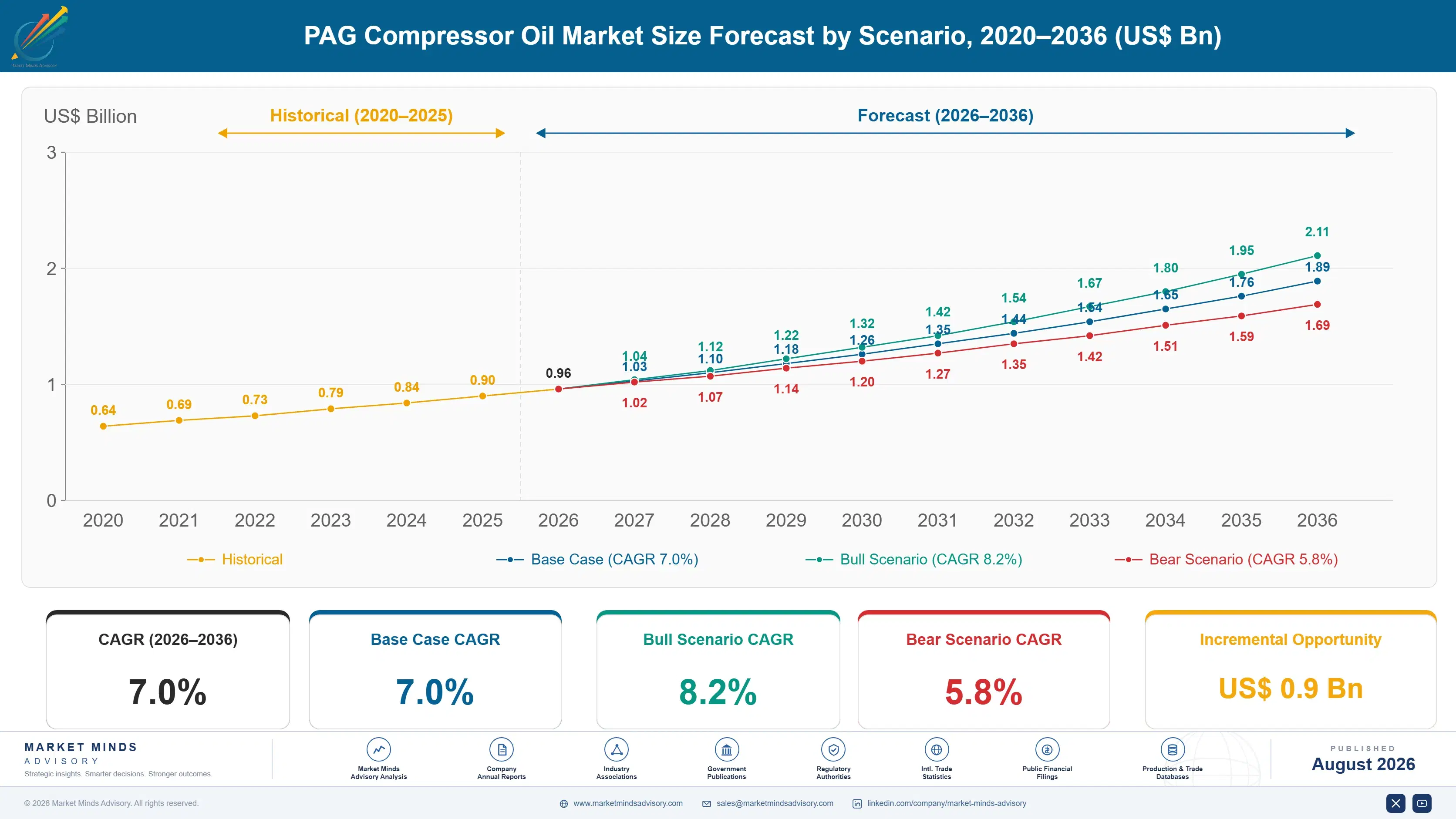
2036 FORECAST VALUE$1.8BBase Case , 2026 to 2036
CAGR 2026 TO 20367.0 %Bull 8.2% / Bear 5.8%
INCREMENTAL OPPORTUNITY$0.9BNet 10- year value creation
EXPANSION MULTIPLE1.97x2036 value over 2026 base
Strategic Levers
M&A Pipeline
Regional Outlook
Country Rankings
Competitive Intelligence
Segmental Deep-dive
Call-Us : 91 93563 13602

Executive Snapshot and Market Trajectory

An electric air conditioning compressor places its motor inside the refrigerant circuit, which puts the lubricant in direct contact with motor windings. Insulation resistance above roughly ten gigaohms becomes a specification, and ordinary polyalkylene glycol conducts far too readily to meet it. Conventional product is simply excluded.
That single requirement makes conventional product unsuitable for the fastest growing part of its own largest application, and it created a premium grade class almost overnight. Electric vehicle compressor lubricants grow at 10.5%, half again the market rate of 7.0%, while conventional automotive fill grows at 2.8% attached to a declining engine population. Compressor manufacturers specify during vehicle programme development, so the decision holds for a platform's entire production life.
The service hazard is the other thing this product is defined by. It absorbs water around five times faster than polyolester and is incompatible with both polyolester and mineral oil, and roughly 78% of systems fail once incompatible lubricants have been mixed during a service operation. Workshops treat these oils as interchangeable grades when they are chemically distinct fluids. Failures get blamed on the lubricant rather than the practice. Correct suppliers take the blame anyway.
Market Definition
This report covers polyalkylene glycol based compressor lubricants, spanning automotive air conditioning for conventional vehicles, electric vehicle compressor lubricants, industrial gas compression, air compressor lubricants, refrigeration and heat pump systems, and service and aftermarket fill. Value is measured at producer level on tonnage of finished lubricant supplied. Excluded are polyolester and mineral oil compressor lubricants, polyalkylene glycol base fluids sold to blenders, gear and hydraulic oils using the same chemistry, refrigerants themselves, and compressor hardware or service labour.
Base Year Value
$0.9B in 2025 (MMA Primary Research Dataset, August 2026)
Forecast Period
2026 to 2036, eleven discrete annual values
CAGR
7.0% base case. Bull 8.2%. Bear 5.8%.
Fastest Growth Segment
Electric Vehicle Compressor Lubricants: 10.5% CAGR
Fastest Growth Country
China: 11.2% CAGR
Fastest Growth Region
South Asia and Pacific: 9.0% CAGR
Largest Region
East Asia: 36% of 2025 global value
Market Leaders
Dow, Shell, Idemitsu Kosan, FUCHS and Clariant lead the market. Source: MMA Primary Research Dataset, July 2026.
Primary Survey
n=3,800 procurement and R&D decision-makers, Q4 2025, six countries
Methodology
Demand-side build-up, cross-validated against public data, 47 expert interviews

PAG Compressor Oil Market Forecast Scenarios

pag-compressor-oil-market-trends-size-forecast-scenario-1787559652257
Growth ran at 5.6% between 2020 and 2025 and vehicle air conditioning dominated it throughout, as refrigerant transition from older chemistry to newer low warming potential fluids preserved the requirement for miscible glycol lubricants. Industrial gas compression grew steadily on maintenance economics that had nothing to do with vehicles. Electric compressor lubricants barely registered until the final years of the period.
The 7.0% base case rests on three mechanisms. Electric vehicle compressor lubricants at 10.5% as resistivity requirements create a distinct premium grade class. Refrigeration and heat pump systems at 8.6% on building electrification and commercial cooling. And Chinese growth at 11.2%, the fastest of any country, on electric vehicle production volumes that exceed the rest of the world combined by a wide margin. Only the first of the three depends on any vehicle programme decision at all.
The 8.2% bull case is heat pump deployment accelerating across buildings, which uses the same lubricant chemistry as vehicle systems and grows independently of any transport decision. The 5.8% bear case is carbon dioxide refrigerant systems taking a larger share of vehicle air conditioning, since those use polyolester rather than glycol and would remove volume permanently.

When Resistivity Became A Specification

A belt-driven air conditioning compressor keeps its drive outside the refrigerant circuit, and the lubricant inside needs only to lubricate. An electric compressor places the motor itself within the circuit, which puts the oil in continuous contact with motor windings and makes electrical insulation resistance a lubricant property that must be specified and tested. The threshold sits around ten gigaohms, and conventional polyalkylene glycol conducts far too readily to reach it. That single engineering change rendered ordinary product unsuitable for the fastest growing part of its own largest application.
TOP-FIVE CONCENTRATION46%Combined position across supply held by the leading lubricant producers
ELECTRICAL RESISTIVITY REQUIREMENT10 GohmInsulation threshold a motor inside the refrigerant circuit demands
MOISTURE ABSORPTION RATE5xWater uptake relative to a comparable polyolester lubricant
AUTOMOTIVE APPLICATION SHARE42%Portion of volume consumed in vehicle air conditioning systems
CROSS-CONTAMINATION FAILURE RATE78%Systems failing after incompatible lubricants are mixed in service
HYDROCARBON DILUTION RESISTANCE94%Viscosity retained compressing gas that dissolves mineral oil
The other defining property is far older and considerably more dangerous in service. This chemistry absorbs atmospheric moisture roughly five times faster than polyolester, which means an opened container degrades quickly, and it is incompatible with both polyolester and mineral oil to the extent that around 78% of systems fail once those have been mixed during a repair. Viscosity grade and chemistry specification are therefore reliability requirements rather than manufacturer preferences, though workshops routinely treat them as interchangeable.
Away from vehicles, industrial gas compression uses this chemistry for a completely unrelated reason. It does not dissolve in hydrocarbon gas, retaining around 94% of viscosity where mineral oil thins and fails.
"The moment the motor went inside the refrigerant loop, this stopped being a lubricant question and became an electrical insulation question. Most of the industry is still selling viscosity grades to people who now need to measure resistivity, and the two conversations barely overlap at all."
Director, Synthetic Lubricants and Thermal Systems Practice · MMA Chemicals and Materials Practice · August 2026

Market Trends

Motor placement inside the circuit creates a new grade class

Electric air conditioning compressors position the motor within the refrigerant circuit, which puts the lubricant in continuous contact with windings and makes insulation resistance above roughly ten gigaohms a specification requirement rather than a desirable property. Conventional polyalkylene glycol conducts far too readily. Growth at 10.5% in these grades follows electric vehicle production directly. Commercially this created a distinct premium product class within a mature lubricant category, and producers still selling conventional viscosity grades into that application will find their product designed out rather than merely outcompeted. Producers selling viscosity grades are answering the wrong question.
Market Impact: Chinese demand compounds at 11.2%
Heat pump deployment carries the chemistry beyond transport

Building electrification is driving heat pump installation across residential and commercial property, and those systems use compressor lubricant chemistry closely related to vehicle air conditioning while growing on entirely different drivers. The segment compounds at 8.6% and depends on building policy and energy prices rather than on any decision made in a vehicle programme. Commercially this diversifies a product family heavily exposed to automotive cycles and refrigerant choices, and producers weighted toward vehicles alone are missing the demand that does not care what happens to cars. Formulation work transfers across from vehicle systems readily.
Market Impact: Retains 94% of viscosity under gas

Market Opportunities and Growth Drivers

Chinese electric vehicle output exceeds everywhere else combined

Chinese growth at 11.2% leads every country in this market, driven by electric vehicle production volumes exceeding the rest of the world together and each of those vehicles carrying an electric compressor requiring high resistivity lubricant. Domestic lubricant producers are developing those grades alongside international suppliers, and compressor manufacturers specify them during vehicle programme development rather than afterwards. Commercially this makes early qualification with Chinese compressor makers considerably more valuable than distribution reach, because specification decisions are made once per platform. Platform specification decisions are taken once and never revisited.
Market Impact: Mixing fails 78% of systems

Hydrocarbon gas compression rewards dilution resistance directly

Mineral oil dissolves into hydrocarbon gas during compression, thinning until it no longer protects bearings, while polyalkylene glycol remains largely separate and retains around 94% of its viscosity through the same duty. That converts into extended drain intervals and avoided compressor damage rather than into any lubricant performance claim. Growth at 7.4% follows natural gas processing and petrochemical compression activity. Commercially this is a maintenance economics argument made to a reliability engineer rather than a specification argument made to a purchasing department. Drain interval extension and avoided compressor damage are the numbers that persuade.
Market Impact: Conventional fill grows at 2.8%

Market Restraints and Challenges

Service cross-contamination destroys systems and reputations

This chemistry is incompatible with both polyolester and mineral oil, and roughly 78% of systems fail after those lubricants have been mixed during a repair or top-up. The root cause is that workshops treat compressor oils as interchangeable viscosity grades when they are chemically distinct fluids. Commercially the failures are attributed to the lubricant rather than to the service practice, which damages producers who supplied correctly specified product. Manufacturers are investing in workshop training and clearer container identification, neither of which reaches every independent garage. Independent garages are numerous and difficult to reach.
Market Impact: Requires above 10 gigaohm resistance

Conventional vehicle fill declines with the engine population

Belt-driven air conditioning compressors depend on an engine turning them, and that population is declining slowly rather than suddenly, which leaves conventional automotive fill growing at only 2.8%. The root cause is straightforward vehicle parc turnover rather than any competitive displacement. Commercially this is the largest single segment shrinking in relative terms while the market grows around it. Producers are redirecting toward electric compressor grades and heat pump applications, which requires resistivity capability rather than merely a different label. Resistivity capability rather than a different label is what redirecting toward electric compressor grades actually requires from a producer.
Market Impact: Segment compounds at 8.6% annually
4 additional market trends, 3 additional growth drivers, and 2 additional restraints and challenges are covered in the full report. Contact sales@marketmindsadvisory.com to access the complete intelligence.

Segment CAGR and Growth Architecture

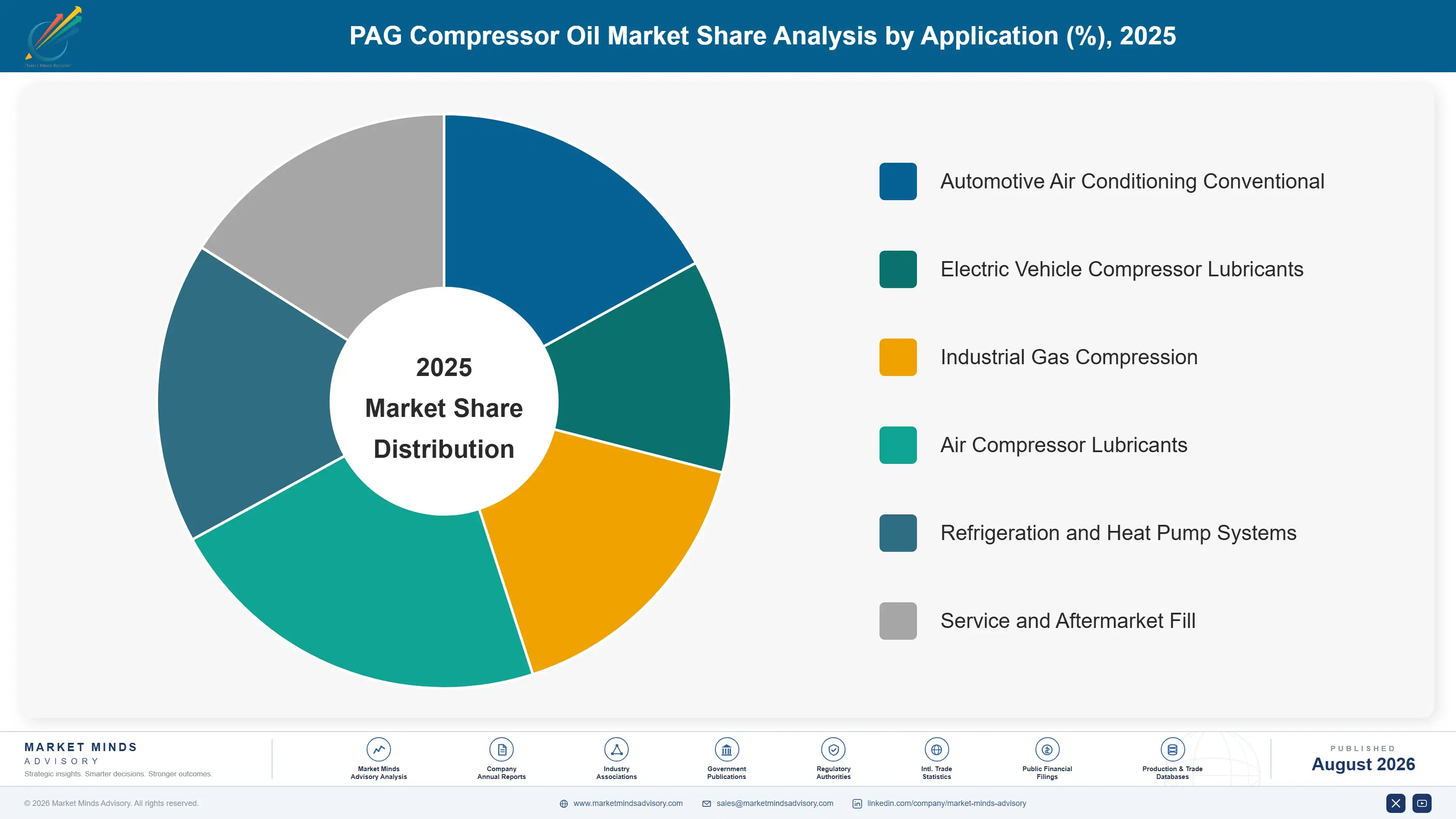
Volume is classified here by application, since the property that actually matters differs completely between a vehicle compressor requiring electrical insulation and a gas compressor requiring dilution resistance. Viscosity grade, base fluid structure and supply channel are each handled separately in the framework below, because one chemistry family serves applications with quite different critical requirements.
pag-compressor-oil-market-trends-market-share-analysis-1787559652784

Electric Vehicle Compressor Lubricants

Growing at 10.5%, half again the market rate, these grades exist because an electric air conditioning compressor places its motor inside the refrigerant circuit, putting the lubricant in continuous contact with windings and making insulation resistance above roughly ten gigaohms a hard specification. Conventional polyalkylene glycol conducts far too readily and causes motor insulation failure over time. Formulating for resistivity while retaining refrigerant miscibility and lubricity is genuinely difficult, which narrows the qualified supplier field considerably. Compressor manufacturers specify during vehicle programme development, so qualification happens once per platform and holds for that platform's entire production life. Arriving after that decision means waiting years for the next programme. Platform life is measured in years.
CAGR 10.5%

Refrigeration and Heat Pump Systems

Building electrification is driving heat pump installation across residential and commercial property, and those compressors use lubricant chemistry closely related to vehicle systems while responding to entirely different demand drivers. Growth at 8.6% follows building policy, energy prices and construction activity rather than anything decided in a vehicle programme. Commercial refrigeration adds steady volume with demanding requirements around moisture control, since a hygroscopic lubricant in a system opened for service creates problems that appear months later rather than immediately. Building policy and energy prices drive this demand rather than anything decided inside a vehicle programme. Commercial refrigeration adds steady volume with demanding moisture control requirements, since a hygroscopic lubricant in a system opened for service creates problems appearing months later.
CAGR 8.6%
Full segment breakdown across 6 segments available in the complete report.

Regional Architecture and Country Demand Map

East Asia holds 36% of value, above the standard band, because vehicle production and electric compressor manufacture both concentrate in the region at volumes that nowhere else in the world approaches. North America follows at 22% while Western Europe sits at 19%, on vehicle and industrial demand together.

East Asia

At 36% this region sits above the standard band, because vehicle production and electric compressor manufacture both concentrate here at volumes nothing elsewhere approaches. Chinese growth at 11.2% leads every country in this market on electric vehicle output exceeding the rest of the world combined, and each of those vehicles carries a compressor requiring high resistivity lubricant. Japanese producers including Idemitsu hold deep formulation capability developed alongside domestic compressor manufacturers. Korean electronics and vehicle manufacturing consume both automotive and industrial grades. Growth at 8.0% reflects electric compressor demand more than any conventional application. Regional compressor manufacturers specify locally during development, which makes early relationships there more valuable than distribution. Japanese formulation depth is unmatched.
Share: 36% | CAGR: 8.0% (2026 to 2036)

North America

Vehicle air conditioning remains the largest application, with a substantial conventional fleet supporting service demand alongside electric compressor grades entering through domestic vehicle assembly investment. Industrial gas compression is proportionally significant given natural gas processing and petrochemical activity, and that application values dilution resistance rather than any refrigerant property. Workshop cross-contamination is a persistent problem across a large independent service sector. Heat pump installation is expanding under building electrification incentives. Growth at 6.4% sits below the market rate on a mature vehicle base. Independent workshops are numerous and cross-contamination during service is a persistent problem the producers cannot easily reach. Gas compression demand is proportionally significant given regional processing activity across the sector.
Share: 22% | CAGR: 6.4% (2026 to 2036)
Regional intelligence for 5 additional markets available in the complete report: Western Europe, South Asia and Pacific, Latin America, Middle East and Africa, Eastern Europe. Contact sales@marketmindsadvisory.com.
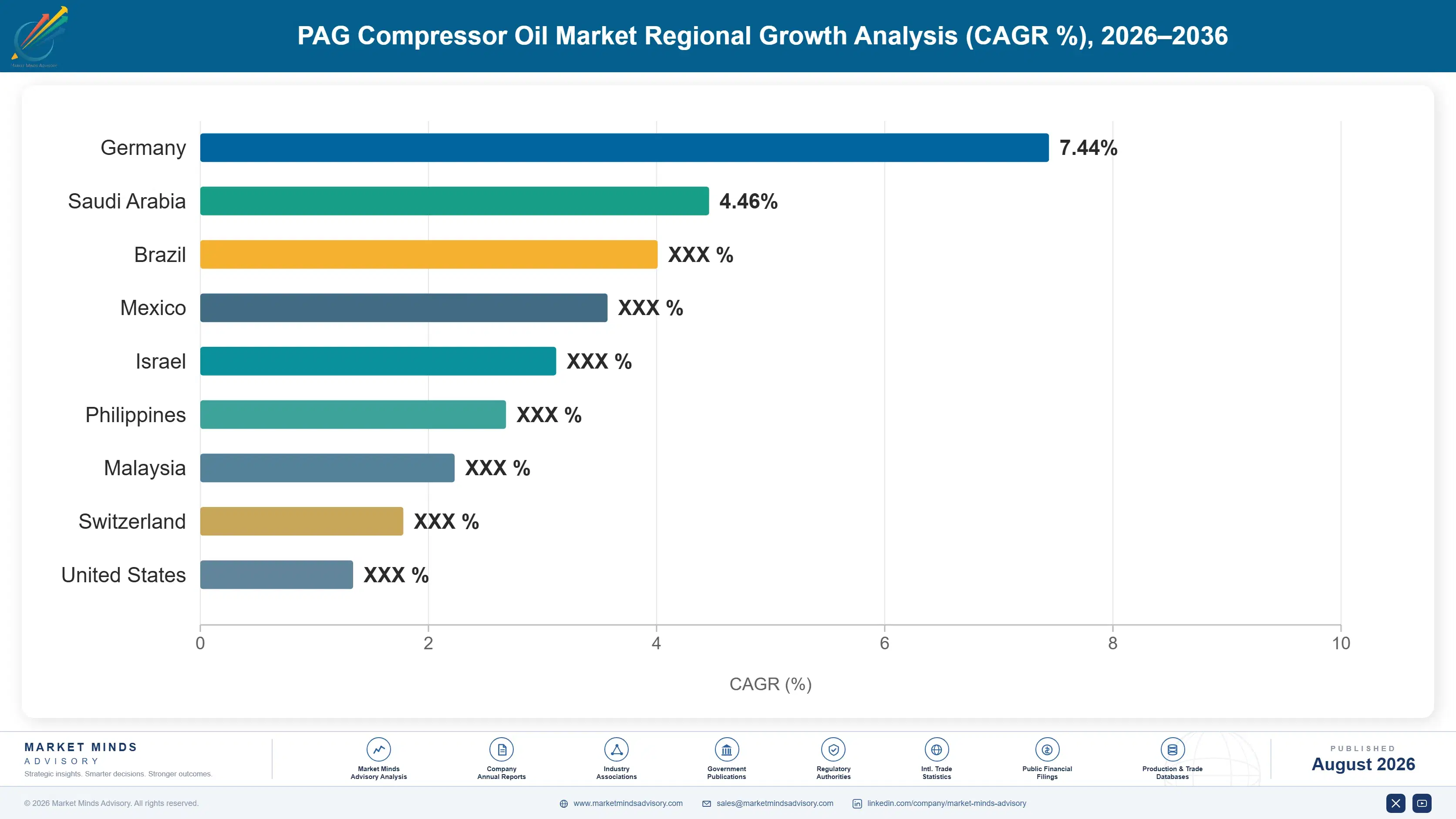
pag-compressor-oil-market-trends-country-cagr-analysis-1787559653302

Where Compressor Lubricant Value Moves

Four quite separate moves matter here, for a lubricant whose largest application is being redesigned around an electrical property it was never formulated to deliver at all. Two concern qualifying into the new specification before platforms close, and two concern the applications and service problems determining what the rest of the portfolio is worth.

Qualify resistivity grades during platform development

Electric compressors place the motor inside the refrigerant circuit, making insulation resistance above roughly ten gigaohms a specification that conventional product cannot meet. Compressor manufacturers select lubricants during vehicle programme development, and that decision holds for the platform's entire production life. Qualification therefore happens once and lasts years, which makes early engagement worth far more than any distribution investment. A producer arriving after specification is complete waits for the next programme entirely. Two vehicle programmes freezing inside eighteen months are worth more than any amount of distribution investment made afterwards. Two programmes freezing within 18 months is the whole opportunity.
Market Impact: Meets a 10 gigaohm minimum on insulation resistance

Sell dilution resistance to reliability engineers

Mineral oil dissolves into hydrocarbon gas during compression and thins until it stops protecting bearings, while this chemistry retains around 94% of viscosity through identical duty. That converts into extended drain intervals and avoided compressor damage rather than into any lubricant specification claim. The argument belongs with a reliability engineer counting downtime rather than a purchasing department comparing litre prices, and producers who reach the wrong function lose an application their product genuinely wins on merit. Purchasing departments comparing litre prices never reach the argument. Drain interval extension is the measurable outcome.
Market Impact: Retains 94% of viscosity right through gas duty

Fund workshop training against cross-contamination failures

Around 78% of systems fail after incompatible lubricants are mixed during service, and those failures are attributed to the lubricant rather than to the practice that caused them. That damages producers who supplied correctly specified product and had no involvement in the repair. Workshop training and unmistakable container identification reduce the incidence and, more usefully, build the relationship with independent garages that determines what gets poured into a system nobody is supervising. Nobody supervises what a garage actually pours in. Container identification is the cheapest part of the answer. Reach matters more than message here.
Market Impact: Prevents failures across 78% of the mixed systems

Build heat pump demand that vehicles cannot affect

Building electrification drives heat pump installation growing at 8.6% on policy, energy prices and construction activity, using lubricant chemistry closely related to vehicle systems and responding to none of the same drivers. For a producer heavily exposed to automotive cycles and to refrigerant choices made by vehicle manufacturers, that diversification is genuinely valuable rather than merely additional. The formulation work largely transfers, which makes entry cheaper than the segment's growth rate would suggest. Entry is cheaper than the growth rate suggests. Vehicle programme decisions do not touch it. Formulation largely transfers across.
Market Impact: Serves demand that is growing at 8.6% yearly

Who Controls the Margin Pool

Five producers hold 46% of this market, measured on tonnage of finished lubricant supplied, the basis used throughout this section. Concentration reflects formulation capability and original equipment qualification rather than base fluid manufacture, since compressor lubricants are specified into compressor and vehicle programmes and those approvals take years to obtain and hold for a platform's production life. Approvals take years and hold for a platform's life.
Competition runs on four dimensions. Resistivity formulation capability, which decides participation in the fastest growing application entirely rather than merely competitively. Original equipment qualification depth across compressor and vehicle manufacturers, obtained during development. Industrial application knowledge for gas compression, where the argument is maintenance economics rather than any specification. And service channel reach, since cross-contamination in workshops damages reputations earned somewhere else.

Rankings shift toward producers with qualified resistivity grades and toward those holding heat pump positions independent of vehicle cycles entirely. Japanese producers hold formulation depth developed alongside compressor manufacturers over decades. European producers hold industrial and heat pump positions built on different arguments. Chinese producers are qualifying resistivity grades quickly alongside domestic vehicle programmes that specify locally.
pag-compressor-oil-market-trends-company-positioning-matrix-1787559653821

Competitive Moat and Risk Dimensions

IDEMITSU KOSAN

Moat: Compressor manufacturer formulation depth

The company developed compressor lubricant formulation alongside Japanese compressor manufacturers over decades, which produced qualification relationships and application knowledge that arrive with a vehicle programme rather than being sold into one afterwards. Resistivity formulation for electric compressors builds directly on that position, and specification decisions taken during programme development hold for the platform's whole production life.
IDEMITSU KOSAN

Risk: Chinese qualification moving quickly

Chinese electric vehicle production exceeds the rest of the world combined and domestic lubricant producers are qualifying resistivity grades alongside those programmes, with specification decisions being made locally during development. Established Japanese relationships do not automatically transfer into Chinese vehicle programmes. Volume growth at 11.2% sits where local qualification is being decided rather than where historic formulation depth resides.
FUCHS

Moat: Industrial and heat pump breadth

The company holds strong industrial compression and refrigeration positions where the argument is maintenance economics rather than original equipment specification, and those applications respond to reliability engineers counting downtime rather than to vehicle programme timetables. Heat pump demand growing at 8.6% on building policy also diversifies away from automotive cycles that dominate this chemistry family.
FUCHS

Risk: Electric vehicle qualification position

Electric compressor lubricants grow at 10.5% and require resistivity formulation qualified during vehicle programme development, where compressor manufacturers rather than fleet operators make the selection. Industrial application strength does not transfer into that process. Producers with established compressor manufacturer relationships are being specified into platforms that will run for years without reopening the decision.

Players Tracked

Prominent Players

Dow
Shell
Idemitsu Kosan
FUCHS
Clariant

Other Key Players

BASF
TotalEnergies
ExxonMobil
Chevron
Croda
Sanyo Chemical Industries
NOF Corporation
Kluber Lubrication
CPI Fluid Engineering
Nye Lubricants
Petro-Canada Lubricants
ENEOS
Repsol
Kyodo Yushi
Valvoline

Recent Developments

FEBRUARY 2025

A compressor manufacturer specified resistivity limits for electric programmes

An air conditioning compressor manufacturer set minimum electrical insulation resistance requirements for lubricants used in electric compressor programmes, following motor winding failures traced to lubricant conductivity in field returns. This was an engineering specification rather than any commercial transaction with suppliers. Field returns had identified the mechanism.
Signal: Resistivity is now a specified property rather than an incidental one, which excludes conventional product entirely
JUNE 2025

A gas processor extended compressor drain intervals on synthetic fill

A natural gas processing operator extended compressor oil drain intervals substantially after converting to glycol-based lubricant, citing viscosity retention under hydrocarbon dilution that mineral oil could not match. This was an operational decision rather than any commercial arrangement with a lubricant producer. Bearing condition was monitored throughout.
Signal: Dilution resistance converts directly into maintenance savings, which is a reliability argument rather than a lubricant one
OCTOBER 2025

A producer launched a workshop identification and training programme

A lubricant producer introduced clearer container identification alongside independent workshop training aimed at reducing cross-contamination between incompatible compressor oils during service. This was a commercial and technical support initiative rather than any transaction between market participants. Distributor networks carried the material. Independent garages were the specific target.
Signal: Service failures are attributed to lubricants rather than to practice, which makes workshop reach a reputational necessity

What Sets Lubricant Cost

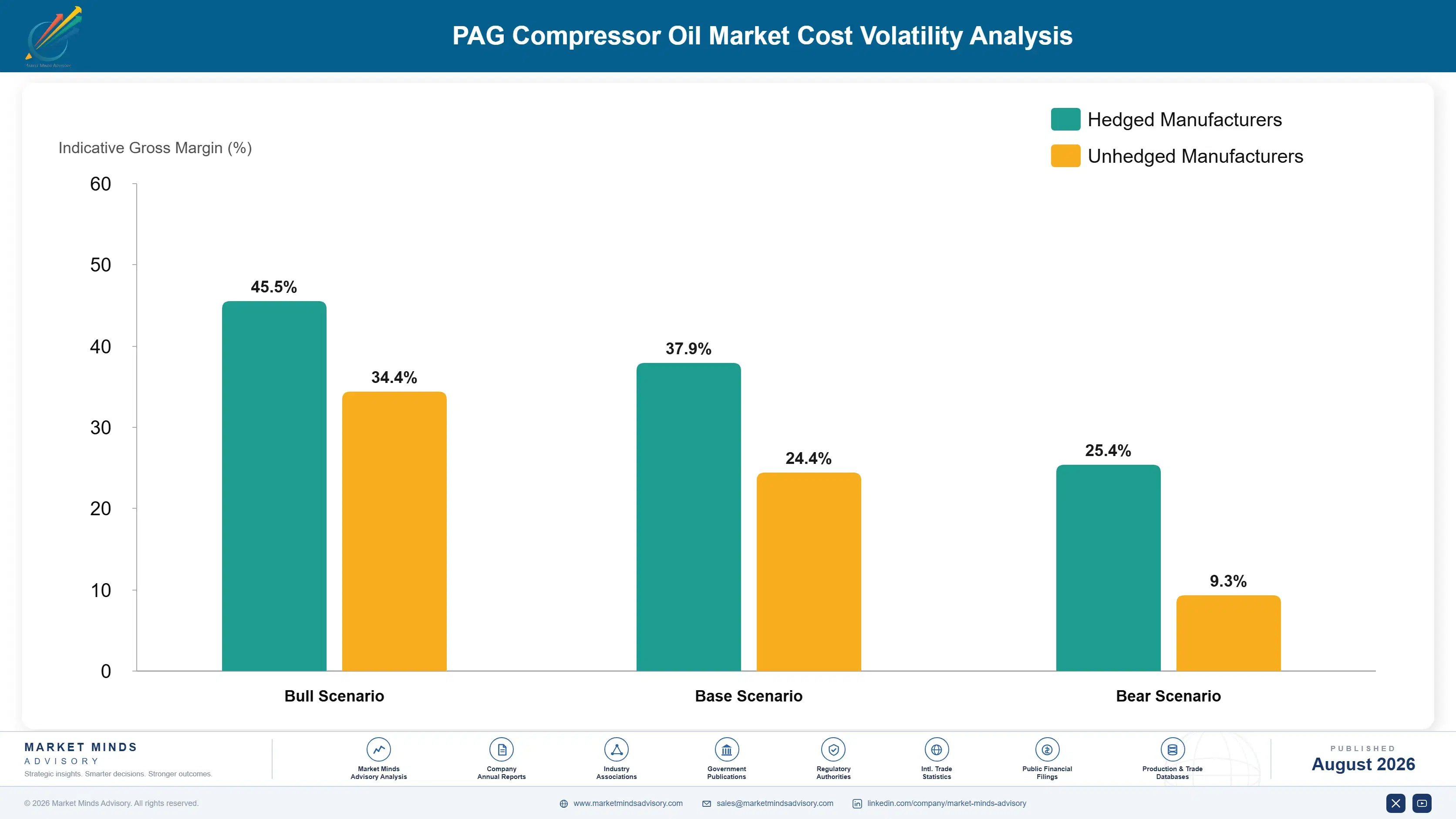
Polyalkylene glycol base fluid accounts for roughly 61% of finished lubricant cost, and it follows propylene and ethylene oxide markets rather than anything happening in lubricants. Additive packages add around 18%, rising considerably for resistivity-formulated grades where the chemistry is more demanding. Blending, packaging and quality testing take about 14%, with moisture control adding cost that conventional lubricants do not incur at all.
Propylene oxide costs moved sharply through 2022 as petrochemical feedstock followed crude and European energy prices climbed far above Asian levels, with IEA data showing that gap persisting well afterwards. Dow noted raw material and energy cost pressure across its industrial intermediates operations in its Annual Report 2022. Producers on annual original equipment contracts absorbed most of it, since vehicle programme pricing is agreed in advance and rarely reopened.

The disadvantage falls on producers without resistivity formulation capability, and it operates through application access rather than through unit cost. Electric compressor grades require formulation work that conventional blending does not develop, and the qualification window closes when a vehicle platform freezes its specification. A producer lacking the capability is not competing at higher cost in that application; it is not competing in it at all.
pag-compressor-oil-market-trends-cost-volatility-analysis-1787559654016

Develop resistivity formulation before platform specifications freeze

Electric compressor lubricants require insulation resistance above roughly ten gigaohms while retaining refrigerant miscibility and lubricity, which conventional formulation does not deliver. Compressor manufacturers specify during programme development and the decision holds for the platform's production life. A producer developing the capability after specification closes waits for the next programme entirely. The window closes without warning.

Control moisture through packaging and handling discipline

This chemistry absorbs atmospheric water roughly five times faster than polyolester, which means an opened or poorly sealed container degrades before it reaches the system. Packaging specification and handling guidance protect product quality that blending alone cannot. Failures caused by moisture pickup are attributed to the lubricant regardless of where the water was absorbed.

Index original equipment pricing to published oxide benchmarks

Base fluid at roughly 61% of finished cost follows propylene and ethylene oxide markets entirely unrelated to lubricant demand, and vehicle programme pricing agreed in advance transfers that exposure to the producer. Indexed reset against published benchmarks moves it back. Vehicle manufacturers resist, which makes this a negotiation rather than a formality. Programme pricing is agreed well in advance.

Portfolio Architecture for Margin Defence

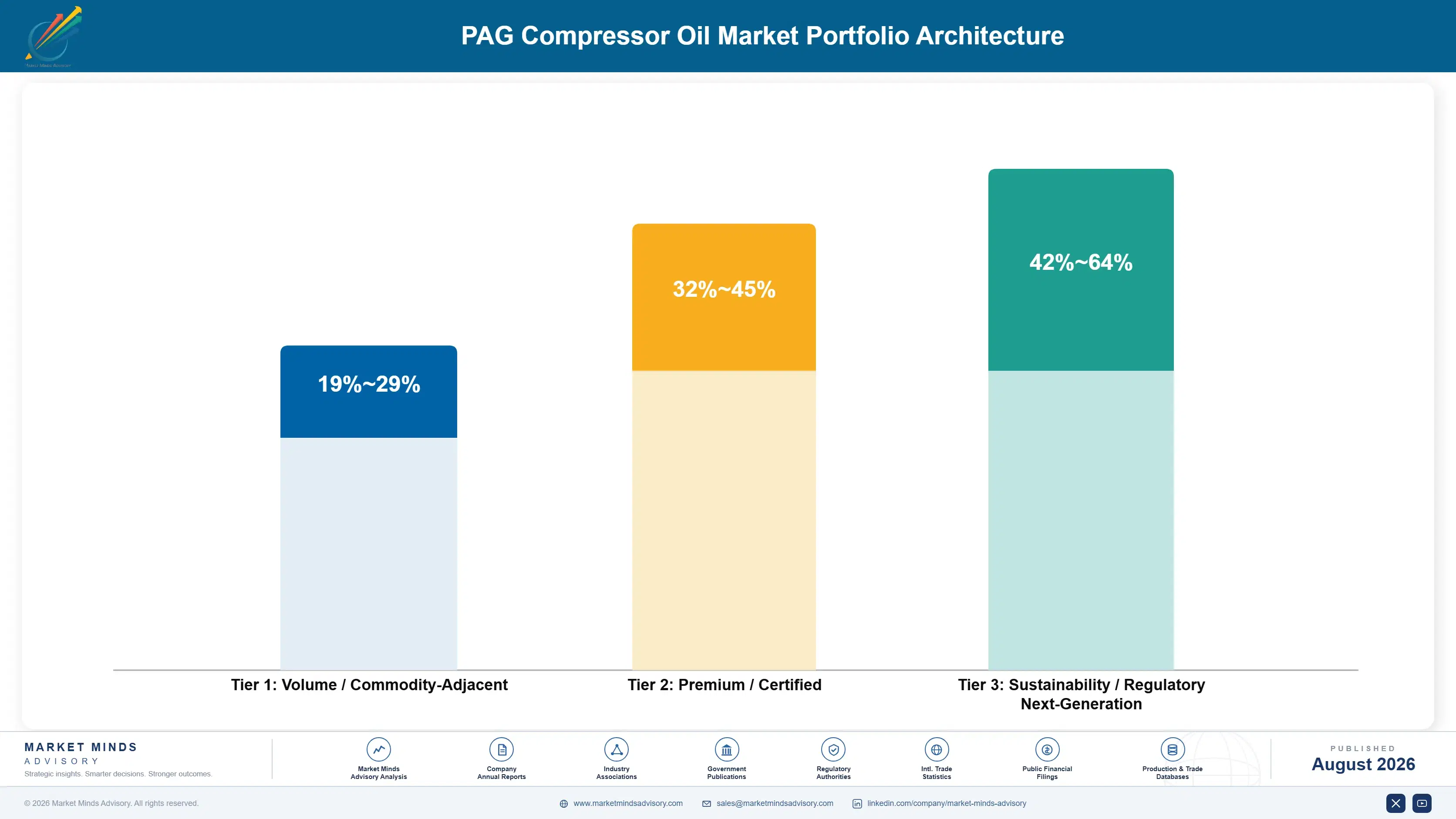
Margin separates on qualification depth and formulation difficulty rather than on blending scale, which follows from these lubricants being specified into equipment rather than selected by a user. Service and aftermarket fill runs at gross margins in the low twenties against many suppliers offering nominally equivalent viscosity grades. Conventional automotive original fill runs lower still on programme pricing. Industrial gas compression runs considerably better on maintenance economics. Electric compressor grades run highest, because resistivity formulation narrows the qualified field severely.
The tension is that conventional automotive volume is both the largest position and the one attached to a declining engine population, while the resistivity grades replacing it require formulation capability rather than a relabelled product. Producers weighted toward conventional fill face a segment growing at 2.8% inside a market growing at 7.0%, and closing that gap means qualifying into platforms whose specification windows are already closing.

High-value pools sit in electric compressor grades, industrial gas compression and heat pump applications. Conventional automotive fill and aftermarket service supply are where the volume sits and where the growth has already left. Specification windows close quietly and reopen only with the next platform generation.

Volume / Commodity-Adjacent

Service and aftermarket fill plus conventional automotive original supply competing on viscosity grade and price. The ten-point range separates producers with base fluid integration from blenders buying glycol on merchant terms each quarter.
Gross Margin: 19%-29%

Premium / Certified

Industrial gas compression and air compressor lubricants sold on maintenance economics and drain interval extension. The thirteen-point spread reflects application knowledge and reliability engineering access rather than any formulation advantage.
Gross Margin: 32%-45%

Sustainability / Regulatory / Next-Generation

Electric compressor resistivity grades and heat pump system lubricants with original equipment qualification. The twenty-two-point range is wide because formulation difficulty and qualification depth vary considerably between platforms and compressor manufacturers.
Gross Margin: 42%-64%
pag-compressor-oil-market-trends-portfolio-architecture-1787559654516

High-value Sub-segments and Strategic Watch-out

Resistivity Formulated Grades

Compounding at 10.5% where insulation resistance above ten gigaohms is a hard specification conventional product cannot meet. Qualification happens once per platform and holds for its entire production life. Miscibility and lubricity must survive the reformulation. Very few producers manage all three. Qualification holds for years.
Gross Margin: 46%-64%

Heat Pump System Lubricants

Growing at 8.6% on building electrification policy and energy prices rather than on anything decided in a vehicle programme. Formulation work transfers, making entry cheaper than the growth rate suggests. Moisture control matters more here, since systems opened for service admit water. Policy drives the demand.
Gross Margin: 40%-54%

Gas Compression Applications

Retaining around 94% of viscosity where mineral oil dilutes and fails, which converts into drain interval extension. The argument belongs with reliability engineers rather than with any purchasing function. Downtime rather than litre price is the currency in this conversation. Mineral oil simply thins away.
Gross Margin: 34%-48%

Conventional Automotive Fill

The volume base, growing at 2.8% and attached to a declining engine population while the market grows around it. Manage this for base fluid cost rather than for any recovery. Programme pricing leaves very little room to manoeuvre anyway. The engine parc keeps shrinking. Base fluid cost decides it.
Gross Margin: 19%-29%

How Lubricant Demand Renews

Demand renews in two quite different ways that producers regularly conflate. Original equipment fill renews with vehicle and compressor production, arriving as an annuity attached to a platform that runs for years once specification closes. Service fill renews when a system is opened for repair, which happens unpredictably and through a channel the producer does not control. The first is forecastable and the second is not, and treating them as one number produces planning that suits neither.
Stickiness at original equipment is close to absolute during a platform's life, because changing a specified lubricant mid-programme requires requalification nobody funds for a component costing a few dollars per vehicle. Service fill has essentially no stickiness at all, since a workshop pours whatever the distributor supplied and frequently whatever is nearest to hand, which is exactly how cross-contamination failures happen in the first place.

The buyer differs completely between them and producers organised around one serve the other badly. Original fill is specified by compressor and vehicle engineers evaluating resistivity, miscibility and lubricity during development. Service fill is bought by distributors and independent workshops on price and availability, by people who mostly do not know the chemistries are incompatible with each other.
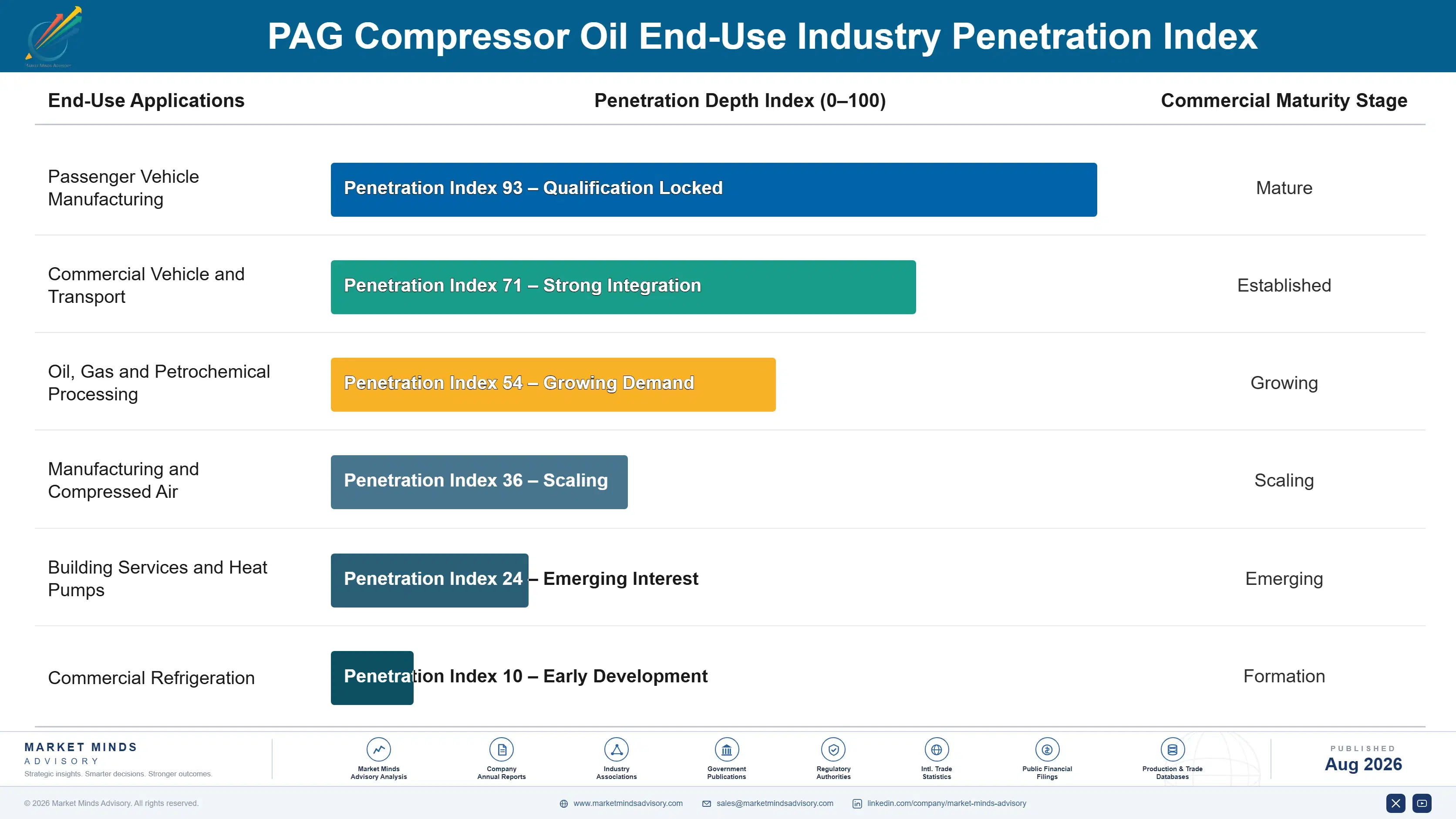
pag-compressor-oil-market-trends-end-use-penetration-index-1787559655002

Where To Place The Bet

These are among the four positions where our research anticipates prominent divergence between winners and laggards over the coming forecast period. Each is grounded in the demand model, the regulatory perimeter, and the announced capacity pipeline.
01 / PLATFORM QUALIFICATION TIMING

Qualify before the specification window closes

Electric air conditioning compressors place the motor inside the refrigerant circuit, which makes insulation resistance above roughly ten gigaohms a hard specification requirement that conventional polyalkylene glycol cannot meet at all. Compressor manufacturers select lubricants during vehicle programme development, and that decision then holds for the entire production life of the platform without being reopened. Qualification therefore happens only once and then lasts for years, which makes early engagement worth considerably more than any distribution investment a producer could otherwise make.
02 / RELIABILITY CHANNEL SELLING

Talk to the engineer counting downtime hours

Mineral oil dissolves into hydrocarbon gas during compression and thins progressively until it no longer protects bearings, while this chemistry remains largely separate and retains around 94% of its viscosity through exactly the same duty cycle. That difference converts into extended drain intervals and avoided compressor damage rather than into any lubricant specification claim anybody would recognise. The argument belongs with a reliability engineer counting downtime rather than a purchasing department comparing prices per litre, and producers reaching the wrong function lose applications their product wins on merit.
03 / SERVICE PRACTICE INVESTMENT

Train the workshops that ruin your reputation

This chemistry is incompatible with both polyolester and mineral oil, and roughly 78% of systems fail once those have been mixed during a repair or a routine top-up in an independent workshop. Those failures are almost always attributed to the lubricant rather than to the service practice that actually caused them, which damages producers who supplied correctly specified product and had no involvement whatever in the repair. Workshop training and unmistakable container identification reduce incidence and build the relationships determining what actually goes into unsupervised systems.
04 / BUILDING SECTOR DIVERSIFICATION

Grow the demand vehicles cannot take away

Building electrification is driving heat pump installation growing at 8.6% on policy decisions, energy prices and construction activity, using compressor lubricant chemistry closely related to vehicle systems while responding to none of the same underlying drivers at all. For a producer heavily exposed to automotive cycles and to refrigerant choices made unilaterally by vehicle manufacturers, that diversification is genuinely valuable rather than merely additional volume. The formulation work largely transfers across, which makes entry considerably cheaper than the segment's growth rate would suggest.

Engagement Snapshot From the Field

A live engagement with an industry participant carrying material or product regulatory and market exposure ahead of a defining policy shift, showing how our research translates into a defensible multi-year portfolio strategy.
MARKET MINDS ADVISORY · CLIENT ENGAGEMENT SUMMARY
PAG Compressor Oil Producer Strategic Portfolio Review and Transition Roadmap 2026·Investment Scenario on PAG Compressor Oil Exposure Evaluation 2025-26
CLIENT PROFILE
A European specialty lubricant blender with annual revenue around EUR 78 million (client-reported, unverified by MMA), supplying compressor lubricants to vehicle manufacturers, industrial operators and aftermarket distributors. No resistivity formulation capability existed. Conventional automotive fill represented most of the original equipment volume supplied. Volume had begun declining. Aftermarket volume was substantial. No resistivity work existed.
STRATEGIC CHALLENGE
Original equipment volume had begun declining as vehicle programmes shifted to electric compressors, and management assumed the same product would carry across with minor reformulation. Nobody had established what the electric compressor specification actually required or whether the client could meet it. The specification had never been read carefully. Nobody had checked.
MMA APPROACH
MMA obtained compressor manufacturer specifications for electric programmes and compared them against the client's product properties directly. Formulation development requirements and timelines were costed against the vehicle programme calendar. Industrial and heat pump application potential was sized within existing distribution reach. Competitor qualifications were checked. Timelines were mapped. Heat pump demand was sized.
KEY FINDINGS
  1. Electric compressor specifications required insulation resistance the client's products missed by a wide margin, and no minor reformulation would have closed that gap in any timeframe.
  2. Two vehicle programmes within the client's existing customer base were freezing specification within eighteen months, after which the opportunity would close for that platform's whole life.
  3. Heat pump lubricant requirements were reachable with the client's existing formulation capability, and regional demand was growing on building policy entirely independent of vehicle decisions.
  4. Industrial gas compression demand within distribution reach was being served by suppliers selling on price rather than on the dilution resistance argument the application actually rewards.
CLIENT PROFILE
A European specialty lubricant blender with annual revenue around EUR 78 million (client-reported, unverified by MMA), supplying compressor lubricants to vehicle manufacturers, industrial operators and aftermarket distributors. No resistivity formulation capability existed. Conventional automotive fill represented most of the original equipment volume supplied. Volume had begun declining. Aftermarket volume was substantial. No resistivity work existed.
STRATEGIC CHALLENGE
Original equipment volume had begun declining as vehicle programmes shifted to electric compressors, and management assumed the same product would carry across with minor reformulation. Nobody had established what the electric compressor specification actually required or whether the client could meet it. The specification had never been read carefully. Nobody had checked.
MMA APPROACH
MMA obtained compressor manufacturer specifications for electric programmes and compared them against the client's product properties directly. Formulation development requirements and timelines were costed against the vehicle programme calendar. Industrial and heat pump application potential was sized within existing distribution reach. Competitor qualifications were checked. Timelines were mapped. Heat pump demand was sized.
KEY FINDINGS
  1. Electric compressor specifications required insulation resistance the client's products missed by a wide margin, and no minor reformulation would have closed that gap in any timeframe.
  2. Two vehicle programmes within the client's existing customer base were freezing specification within eighteen months, after which the opportunity would close for that platform's whole life.
  3. Heat pump lubricant requirements were reachable with the client's existing formulation capability, and regional demand was growing on building policy entirely independent of vehicle decisions.
  4. Industrial gas compression demand within distribution reach was being served by suppliers selling on price rather than on the dilution resistance argument the application actually rewards.
RECOMMENDED STRATEGY
Phase 1: Phase one: commit resistivity formulation development immediately, since two customer platforms freeze specification within eighteen months and the opportunity closes with them. Phase 2: Phase two: enter heat pump applications using existing formulation capability, which diversifies away from vehicle programme decisions the client cannot influence. Phase 3: Phase three: rebuild the industrial gas compression proposition around dilution resistance and drain interval extension rather than around price per litre.
OUTCOME
Resistivity development is underway and one platform qualification is proceeding ahead of its specification freeze. Heat pump volume has begun contributing without any new formulation investment. Industrial repositioning has recovered two accounts, and the client reports the original equipment decline offset (client-reported, unverified by MMA).

Frequently Asked Questions

Foundational context covering the market sizes, CAGR, scope, country, region and competition that inform every finding below. This section is provided to cover basics and most often pre-purchase conversations, answered from the MMA Primary Research Dataset.

What is the current size of the PAG Compressor Oil Market?

The market was valued at USD 0.86 billion in 2025, rising to an estimated USD 0.92 billion in 2026. East Asia holds the largest regional share at 36% of value.

How large will the PAG Compressor Oil Market be by 2036?

MMA forecasts USD 1.81 billion by 2036 under the base case, an expansion multiple of 1.97 times the 2026 value. That represents USD 0.89 billion of incremental value.

What is the CAGR for the PAG Compressor Oil Market 2026 to 2036?

The base case runs at 7.0% compound annual growth between 2026 and 2036, with a bull case at 8.2% and a bear case at 5.8%. Historical growth from 2020 to 2025 was 5.6%.

Which segment is growing fastest?

Electric vehicle compressor lubricants lead at 10.5%, half again the market rate, because motors inside the refrigerant circuit require high resistivity. Heat pump systems follow at 8.6%.

Who are the major companies in the PAG Compressor Oil Market?

Dow, Shell, Idemitsu Kosan, FUCHS and Clariant hold 46% of supply between them. Formulation capability and equipment qualification rather than blending scale sustain those positions.

Which country is growing fastest?

China leads at 11.2%, driven by electric vehicle production volumes exceeding the rest of the world combined, each vehicle requiring a high resistivity compressor lubricant.

Report Segmentation Architecture

The full report scope spans multiple orthogonal segmentation dimensions, with cross-tabulated demand data provided for each dimension pair. Coverage extends further to regional breakdowns, trend trajectories, and the competitive detail needed to support segment-level decision-making.

By Application

  • Automotive Air Conditioning Conventional
  • Electric Vehicle Compressor Lubricants
  • Industrial Gas Compression
  • Air Compressor Lubricants
  • Refrigeration and Heat Pump Systems
  • Service and Aftermarket Fill

By End-Use Industry

  • Passenger Vehicle Manufacturing
  • Commercial Vehicle and Transport
  • Oil, Gas and Petrochemical Processing
  • Manufacturing and Compressed Air
  • Building Services and Heat Pumps
  • Commercial Refrigeration

By Grade and Channel

  • Standard Viscosity Grades
  • High Resistivity Formulations
  • Industrial Gas Duty Grades
  • Original Equipment Fill Supply
  • Distributor and Workshop Channel

By Region

  • North America
  • Western Europe
  • East Asia
  • South Asia and Pacific
  • Latin America
  • Middle East and Africa
  • Eastern Europe

Scope, Methodology, and Coverage

Every figure in this report is reproducible from documented input assumptions. The scope below maps the historical period, the forecast horizon, the segmentation dimensions, and the countries covered, alongside the underlying primary and qualitative methodology.
Historical Period
2020 to 2025
Forecast Period
2026 to 2036
Base Year
2025 (USD billions; MMA Primary Research Dataset, August 2026)
Market Definition
The market comprises polyalkylene glycol based compressor lubricants supplied in standard viscosity, high resistivity and industrial gas duty grades, across automotive air conditioning for conventional vehicles, electric vehicle compressor lubricants, industrial gas compression, air compressor lubricants, refrigeration and heat pump systems, and service and aftermarket fill, reaching customers through original equipment and distributor channels. Value is measured at producer level on tonnage of finished lubricant supplied. Polyolester and mineral oil compressor lubricants, base fluids sold to blenders, gear and hydraulic oils, refrigerants, and compressor hardware or service labour fall outside scope.
Quantitative Units
USD billions (current prices); thousand tonnes of finished lubricant; USD per tonne by grade and application
Segmentation Dimensions
By Application; By End-Use Industry; By Grade and Channel; By Region
Regions Covered
North America, Western Europe, East Asia, South Asia and Pacific, Latin America, Middle East and Africa, Eastern Europe
Countries Covered
China, Japan, South Korea, Taiwan, India, Thailand, Indonesia, Vietnam, Australia, United States, Canada, Mexico, Brazil, Argentina, Colombia, Germany, France, Italy, Spain, Netherlands, United Kingdom, Sweden, Poland, Czechia, Slovakia, Hungary, Saudi Arabia, United Arab Emirates, Qatar, South Africa
Key Companies Profiled
Dow, Shell, Idemitsu Kosan, FUCHS, Clariant, BASF, TotalEnergies, ExxonMobil, Chevron, Croda, Sanyo Chemical Industries, NOF Corporation, Kluber Lubrication, CPI Fluid Engineering, Nye Lubricants, Petro-Canada Lubricants, ENEOS, Repsol, Kyodo Yushi, Valvoline
Quantitative Methodology
Primary survey, n=3,800 respondents, Q4 2025, six countries; demand-side model with trade association cross-validation
Qualitative Methodology
47 expert interviews, Q4 2025; applied to validate demand model assumptions, identify emerging dynamics, and assess competitive positioning
Report Format
PDF and XLSX data workbook (Word format preview document)
Publisher
Market Minds Advisory
Report Code
MMA-2026-CHM-800
Published
August 2026
Contact
sales@marketmindsadvisory.com | www.marketmindsadvisory.com

Purchase the full PAG Compressor Oil Market Report (2026 to 2036).

The full report sizes the global polyalkylene glycol compressor lubricant market to 2036 across six applications and seven regions, measured on finished lubricant tonnage at producer level. It treats electrical resistivity as the specification redefining the largest application, and separates original equipment fill from service demand throughout because they renew on entirely different clocks. Competitive analysis covers 20 producers on one consistent tonnage basis, with moat and risk assessment for the two leaders. Platform qualification windows are mapped against vehicle programme calendars. Four quantified revenue levers close the analysis.
Six-application segment sizing with individual growth rates
Electrical resistivity requirements mapped against conventional product capability
Original equipment and service demand separated by renewal clock
Cross-contamination failure incidence quantified across service channels
Twenty-producer competitive map on one finished tonnage basis
Four quantified revenue levers with commercial impact ranges

Built For The People Who Decide

From boardroom strategy to bench-side execution, this report is read cover-to-cover by leaders shaping the next decade of their industry, turning demand scenarios, market dynamics and valuation benchmarks into decisions.
CXOs/ Presidents/ VPs/ Managers
M&A and Corporate Development
Strategy Teams and R&D Heads
Procurement and Product Directors
Regulatory and Compliance Leaders
Investor Relations and Equity Analysts