Market Minds Advisory
Padding Bags Market

Padding Bags Market: Protective Mailer Materials and the Recyclability Transition

E-commerce parcel volume keeps expanding while retailers face mounting pressure to swap laminate bubble mailers for curbside-recyclable, mono-material padded packaging without raising damage-in-transit rates or shipping cost per parcel across their fulfillment networks.

Lead Analyst

Bilal Shaikh

Published

September 2026

Make Smarter Decisions with Customized Research Insights

Request a free sample report and evaluate market opportunities, growth trends, and competitive dynamics relevant to your business needs.

2025 MARKET VALUE$4.1BMarket Size 2025
2036 FORECAST VALUE$9.1BBase Case , 2026 to 2036
CAGR 2026 TO 20367.5 %Bull 8.7% / Bear 6.3%
INCREMENTAL OPPORTUNITY$4.7BNet 10- year value creation
EXPANSION MULTIPLE2.06x2036 value over 2026 base
Strategic Levers
M&A Pipeline
Regional Outlook
Country Rankings
Competitive Intelligence
Segmental Deep-dive
Call-Us : 91 93563 13602

Executive Snapshot and Market Trajectory

Retailers are replacing laminate bubble mailers with curbside-recyclable, paper-based padded bags faster than most packaging converters expected just two years ago, reshaping purchasing specifications across the entire sector this year as compliance deadlines approach across several major regulated markets simultaneously and without much warning.
Parcel carriers penalize oversized and poorly protected shipments, pushing brands toward right-sized padded mailers that cut void fill and damage claims simultaneously across their entire fulfillment operation. Electronics, cosmetics, and jewelry categories drive the fastest unit growth industry-wide, concentrated among e-commerce fulfillment centers across North America and East Asia's dense parcel corridors, where damage sensitivity and shipment volume both run at their highest levels globally today.
Competition centers on five converters holding just over a third of global revenue, none dominant enough to set pricing alone across the broader fragmented field of regional and national suppliers competing hard for share. Extended producer responsibility rules across the European Union and several US states are forcing rapid reformulation away from mixed-material laminates toward mono-material and all-paper constructions that pass recycling stream sorting tests reliably at commercial scale under real operating conditions faced daily.
Market Definition
The padding bags market covers cushioned mailer packaging, including bubble-lined poly mailers, foam-padded pouches, kraft paper padded mailers, air pillow mailers, and mono-material recyclable padded bags used to protect goods in transit. It excludes rigid corrugated boxes, standard non-padded poly mailers, and pallet-level protective packaging.
Base Year Value
$4.1B in 2025 (MMA Primary Research Dataset, August 2026)
Forecast Period
2026 to 2036, eleven discrete annual values
CAGR
7.5% base case. Bull 8.7%. Bear 6.3%.
Fastest Growth Segment
Recyclable Mono-Material Padded Mailers: 12.0% CAGR
Fastest Growth Country
India: 9.5% CAGR
Fastest Growth Region
South Asia and Pacific: 9.5% CAGR
Largest Region
East Asia: 29% of 2025 global value
Market Leaders
Sealed Air Corporation, Storopack Hans Reichenecker GmbH, Ranpak Holdings Corp, Smurfit WestRock plc, Mondi plc. Source: MMA Analysis based on company annual reports.
Primary Survey
n=3,800 procurement and R&D decision-makers, Q4 2025, six countries
Methodology
Demand-side build-up, cross-validated against public data, 47 expert interviews

Padding Bags Market Forecast Scenarios

padding-bags-market-size-forecast-scenario-1787312182579
Padding bag demand grew at an estimated 6.5% annually between 2020 and 2025, propelled by pandemic-era e-commerce acceleration that never fully receded once initial lockdown-driven volume spikes subsided in most markets, and by steady category expansion into cosmetics, apparel accessories, and small electronics shipping across nearly every major consumer market MMA tracks worldwide throughout that five-year period.
The base case assumes 7.5% annual growth through 2036, resting on three mechanisms: continued double-digit e-commerce parcel volume growth across South Asia and Latin America as fulfillment infrastructure matures rapidly, mandatory recyclability reformulation across regulated markets that meaningfully lifts average selling prices over time, and fulfillment centers standardizing on fewer, better-optimized mailer sizes to cut shipping cost per unit across their entire distribution networks over the coming decade of expansion.
The bull case centers on automated right-sizing packaging lines reaching mid-market fulfillment operations faster than expected, lifting unit volume well above trend across nearly every regional market MMA covers in this report. The bear case centers instead on a prolonged e-commerce growth slowdown across mature Western markets compressing parcel counts industry-wide and delaying reformulation capital investment broadly across the converter base.

Protective Mailer Demand and the Recyclability Transition

Padding bags sit at the intersection of e-commerce logistics economics and packaging regulation, a position that makes the category unusually sensitive to policy changes most packaging segments never have to price in. Fulfillment operators want the lightest, cheapest protective format that survives parcel network handling without generating damage claims, while regulators increasingly restrict the laminate constructions that made lightweight cushioning affordable and widely available in the firs
MARKET CONCENTRATIONCR5 38%revenue share held collectively by the top five converters
AVERAGE SELLING PRICE$0.09/unitwholesale price point for a standard mid-size mailer
TOP PRODUCING COUNTRYChina 31% shareshare of global converting capacity and export volume
CAPACITY UTILIZATION76%share of nameplate converting capacity running currently today
TRADE INTENSITY24% cross-bordershare of output shipped across national borders yearly
RECYCLED CONTENT SHARE34% averageaverage post-consumer content across recyclable mailer formats sold
Converters are responding with mono-material paper and recyclable film formats that pass municipal recycling stream tests, though these formats still carry a meaningful price premium over legacy bubble laminate that many small shippers resist absorbing without a regulatory mandate forcing the switch outright. Larger brand customers facing direct fee exposure are converting fastest, while smaller shippers lag until compliance costs or carrier incentives make delay more expensive than conversion.
The next decade will be shaped by extended producer responsibility fee schedules spreading to additional jurisdictions, carrier-side dimensional weight pricing that rewards right-sizing over generic formats, and automated on-demand mailer sizing equipment spreading from large fulfillment centers down into regional distribution operations that previously lacked the capital to invest in it.
"The mailer that wins shelf space in 2030 will be the one that survives a recycling stream sorter, not the one that survives a drop test. Converters still designing purely for cushioning performance are optimizing for the wrong constraint."
Director, Packaging and Materials Practice · MMA Packaging / Protective Mailers

Market Trends

Extended Producer Responsibility Fees Reshape Material Choice

Extended producer responsibility programs now active across eight European Union member states and California, Oregon, Colorado, and Maine assess per-kilogram eco-modulation fees on packaging that fails recyclability thresholds, adding as much as 40% to landed cost for mixed-material laminate mailers that cannot be mechanically separated. Converters are reformulating toward mono-material kraft paper and single-polymer film constructions specifically to qualify for reduced fee tiers. Brand owners shipping into regulated states report reformulation timelines compressed from a normal three-year product cycle down to twelve to eighteen months to avoid fee exposure at scale.
Market Impact: Adds 110 billion parcels by 2032

Carrier Dimensional Weight Pricing Rewards Right-Sizing

Major parcel carriers now price a large share of e-commerce shipments on dimensional weight rather than actual weight, meaning an oversized padded mailer can cost a shipper 25% to 35% more per parcel than a correctly sized one carrying identical contents. This has pushed large fulfillment operators to install automated mailer-sizing equipment that selects from a matrix of ten or more padded bag dimensions per order, cutting average void space by roughly a third. Converters supplying multi-size product lines compatible with automated sizing equipment are capturing share from single-format legacy suppliers unable to match that flexibility.
Market Impact: Cuts damage claims 30 to 45%

Market Opportunities and Growth Drivers

Global E-Commerce Parcel Volume Keeps Compounding

Global e-commerce parcel volume is projected to exceed 300 billion shipments annually by the early 2030s, up from roughly 190 billion in 2024, according to national postal and courier association data across major markets. Every incremental parcel containing apparel accessories, cosmetics, consumer electronics, or jewelry represents a candidate for padded protective packaging rather than a standard flat poly mailer. Fulfillment centers in South Asia and Latin America are adding parcel sorting capacity at double-digit annual rates, directly lifting padded mailer unit demand in markets where protective packaging penetration remains well below levels seen in North America and Western Europe today.
Market Impact: Adds a 15 to 25% premium

Damage Claim Reduction Justifies Premium Formats

Retailers report that switching fragile categories from flat mailers to padded formats cuts damage-in-transit claims by 30% to 45%, a reduction large enough to offset the higher per-unit material cost within a single shipping season for high-value categories like consumer electronics and glass cosmetics packaging. Return processing costs tied to damaged goods routinely exceed the incremental packaging spend needed to prevent the damage in the first place, a calculation more finance teams are running explicitly as e-commerce return rates climb across nearly every product category tracked by major carriers and retailers alike.
Market Impact: Affects 45% of target disposal mark

Market Restraints and Challenges

Recyclable Formats Carry a Persistent Price Premium

Mono-material recyclable padded mailers cost 15% to 25% more per unit than legacy laminate bubble mailers, a gap rooted in lower production volumes, more expensive paper-based cushioning inserts, and immature supply chains for compatible recyclable adhesives and closures. Small and mid-size shippers without regulatory exposure or brand sustainability commitments often continue purchasing legacy laminate formats simply because procurement teams optimize on unit cost alone. Converters are pursuing scale-driven cost reduction through dedicated recyclable-format production lines and are lobbying for broader extended producer responsibility coverage that would narrow the price gap by raising legacy format costs instead.
Market Impact: Adds 40% cost to noncompliant forma

Recycling Infrastructure Gaps Undercut Claimed Recyclability

Many municipal recycling programs, particularly across South Asia, Latin America, and parts of Eastern Europe, lack the sorting infrastructure to actually process paper-based padded mailers even when the format is technically recyclable, undermining the environmental case converters use to justify premium pricing in those markets. This mismatch between design intent and real-world processing capability draws increasing scrutiny from regulators pursuing greenwashing enforcement action across several jurisdictions. Converters are responding by funding regional recycling infrastructure partnerships and shifting marketing claims toward verified, third-party certified recyclability rather than generic recyclable labeling that regulators now challenge more frequently and more aggressively.
Market Impact: Cuts shipping cost 25 to 35%
3 additional market trends, 3 additional growth drivers, and 3 additional restraints and challenges are covered in the full report. Contact sales@marketmindsadvisory.com to access the complete intelligence.

Segment CAGR and Growth Architecture

Padding bags segment by construction and material technology, the classification that determines both cushioning performance and recyclability status, the two variables now driving nearly every converter product roadmap and retailer procurement specification decision made across the industry's largest fulfillment accounts and most heavily regulated brand relationships today and well into the next several years.
padding-bags-market-market-share-analysis-1787312183643

Recyclable Mono-Material Padded Mailers

Mono-material padded mailers built from a single recyclable polymer or an all-paper construction with honeycomb or crinkle paper cushioning are the fastest-growing format, expanding as extended producer responsibility fee schedules make legacy laminate mailers progressively more expensive to ship. Major e-commerce platforms and consumer brands with public sustainability targets are converting entire product lines to this format even where it costs more per unit, treating the switch as a compliance necessity rather than a discretionary upgrade. Converter capacity for mono-material formats remains constrained relative to demand, creating a supply gap that is pulling average selling prices upward across the segment and drawing new capital investment from both established converters and material science startups.
CAGR 12.0%

Kraft Paper Padded Mailers

All-paper padded mailers using layered kraft paper with crinkle or honeycomb cushioning inserts appeal to shippers wanting curbside recyclability without the material science complexity of engineered mono-material polymer films. Adoption concentrates among direct-to-consumer apparel and cosmetics brands marketing sustainability credentials directly to end consumers on the package itself and across their broader marketing campaigns and retail storytelling efforts. The format's cushioning performance lags foam and bubble alternatives for heavier or more fragile items, limiting its addressable share to lighter-weight categories, but converters are steadily improving paper cushioning geometry to close that performance gap and extend the format into moderately fragile product categories previously reserved for laminate or foam constructions entirely.
CAGR 10.0%
Full segment breakdown across 6 segments available in the complete report.

Regional Architecture and Country Demand Map

East Asia leads on converting capacity and export volume, North America follows closely behind on e-commerce parcel intensity and carrier pricing sophistication, and South Asia and Pacific posts the fastest regional growth of any market tracked, off a considerably smaller existing installed converter and fulfillment base today.

North America

The United States accounts for the large majority of regional demand, driven by the world's most mature dimensional-weight parcel pricing regime, which rewards fulfillment centers for adopting right-sized padded mailers over generic flat mailers or oversized boxes shipped with excess void fill. Extended producer responsibility laws now active in California, Oregon, Colorado, and Maine are forcing rapid reformulation toward mono-material and all-paper constructions ahead of similar rules likely to spread to additional states within the next several years. Canada contributes steady incremental demand tied to its own growing e-commerce fulfillment network, often served by the same converters supplying comparable formats south of the border, with similar recyclability expectations increasingly shaping specification decisions across both national markets.
Share: 27% | CAGR: 7.8% (2026 to 2036)

Western Europe

Germany, France, and the United Kingdom drive most regional demand, anchored by the European Union's Packaging and Packaging Waste Regulation, which sets recyclability and recycled content minimums that are pushing converters away from mixed-material laminate mailers faster than almost anywhere else in the world today. This is why the region carries a growth rate below the global average: the market has already converted a larger share of volume to compliant mono-material formats than most other regions, leaving comparatively less room for incremental reformulation-driven growth going forward. Nordic markets show the highest per-capita recyclable mailer adoption globally, reflecting both regulatory pressure and strong consumer preference for visibly sustainable packaging among e-commerce shoppers there.
Share: 20% | CAGR: 6.0% (2026 to 2036)
Regional intelligence for 5 additional markets available in the complete report: East Asia, South Asia and Pacific, Latin America, Middle East and Africa, Eastern Europe. Contact sales@marketmindsadvisory.com.
padding-bags-market-country-cagr-analysis-1787312184493

Converting Sustainability Compliance Into Margin

Converters have several concrete paths to lift revenue per account beyond raw unit volume growth, spanning recyclable format premiums, automated sizing equipment placement, private-label formulation services, and regulatory compliance documentation support layered onto regulated brand customers across their largest accounts, multi-year contracts, and every subsequent renewal cycle each converter pursues consistently year after year.

Recyclable Format Premium Pricing Programs Offered

Converters price mono-material recyclable padded mailers at a 15% to 25% premium over legacy laminate formats, a gap customers increasingly accept as extended producer responsibility fee schedules make noncompliant formats progressively more expensive to ship at scale across regulated jurisdictions. This premium captures a meaningful share of the compliance value converters create for brand customers facing direct regulatory fee exposure across regulated states and European Union member markets simultaneously. Converters investing early in mono-material production capacity are capturing outsized share of this premium pool before competitors scale comparable capacity of their own.
Market Impact: Adds roughly a 15 to 25% price prem

Automated Long-Term Mailer-Sizing Equipment Placement Contracts

Converters increasingly place automated mailer-sizing equipment directly inside large fulfillment centers under long-term supply agreements, locking in exclusive mailer volume worth 20% to 30% more per account than standard wholesale distribution relationships carry over a comparable contract term. This equipment placement model mirrors razor-and-blade economics: the equipment itself is a minor capital outlay relative to the recurring mailer stock revenue it locks in over a multi-year contract term with the fulfillment operator. Fulfillment operators favor this arrangement because it removes the capital burden of purchasing sizing equipment outright while guaranteeing consistent supply continuity.
Market Impact: Adds roughly a 20 to 30% revenue pr

Private-Label Formulation and Custom Branding Services

Converters offer private-label formulation, custom printing, and brand-specific sustainability messaging services layered on top of the base mailer sale, typically worth an incremental 8% to 12% of underlying contract value for mid-size and large e-commerce brand customers across their portfolio of shipped product lines and seasonal campaigns. These services deepen account relationships considerably beyond a commodity supply arrangement, since private-label tooling and formulation work creates meaningful switching costs that discourage brands from re-bidding contracts to competing converters purely on unit price alone once a formulation relationship is firmly established and running smoothly.
Market Impact: Adds an incremental 8 to 12% of con

Regulatory Compliance Documentation Support Programs Offered

Converters increasingly bundle extended producer responsibility compliance documentation and third-party recyclability certification support with mailer supply contracts, a service brand customers value highly given the complexity of navigating differing eco-modulation fee schedules across multiple regulated states and European Union member countries simultaneously each reporting year and audit cycle. This documentation support, worth roughly 5% to 8% of contract value annually, extends converter relationships well beyond the physical product sale and gives converters early visibility into upcoming reformulation needs before competitors identify the same account opportunity for themselves and act on it first.
Market Impact: Adds an incremental 5 to 8% of cont

Who Controls the Margin Pool

Five converters hold 38% of global revenue, a fragmented structure that reflects the industry's relatively low capital barriers to entry compared with more automation-intensive packaging categories, leaving Sealed Air and Storopack as the clearest leaders without either commanding decisive pricing power over the broader field of regional and national converters competing across nearly every major market segment and geography served today.
Current competitive activity centers on three dimensions: racing to scale mono-material recyclable production capacity ahead of tightening extended producer responsibility deadlines across regulated markets, placing automated sizing equipment directly inside large fulfillment centers to lock in exclusive volume for years at a time, and expanding private-label formulation services to deepen brand customer account relationships considerably beyond simple commodity pricing arrangements.

Emerging pressure comes from regional Asian converters offering lower-cost laminate and increasingly credible mono-material formats at prices established multinational suppliers struggle to match outside their home markets. Rankings among global leaders remain broadly stable, but the mid-market regional tier is consolidating quickly as smaller converters lacking capital for mono-material conversion get acquired outright or steadily lose share to better-capitalized regional rivals with greater reformulation capacity.
padding-bags-market-company-positioning-matrix-1787312185458

Competitive Moat and Risk Dimensions

SEALED AIR CORPORATION

Moat: Scale and Formulation Depth

Sealed Air's decades of protective packaging material science experience and its global manufacturing footprint give it formulation and scale advantages that smaller regional converters cannot easily replicate, particularly in engineering mono-material recyclable constructions that still meet cushioning performance specifications under real-world shipping and handling conditions.
SEALED AIR CORPORATION

Risk: Legacy Laminate Revenue Exposure

A meaningful share of Sealed Air's existing padded mailer revenue still comes from laminate formats facing rising extended producer responsibility fee exposure, creating pressure to cannibalize established product lines faster than the company might otherwise choose, purely to stay ahead of regulatory cost curves across key regulated markets.
STOROPACK HANS REICHENECKER GMBH

Moat: European Regulatory Positioning

Storopack's early investment in mono-material and paper-based cushioning formats positioned it well ahead of European Union packaging regulation timelines, giving it credibility with sustainability-focused brand customers that newer entrants to the recyclable format category have not yet established with comparable buyers across similarly regulated accounts.
STOROPACK HANS REICHENECKER GMBH

Risk: Limited Scale Outside Europe

Storopack's manufacturing footprint and brand recognition remain concentrated in Europe relative to global leaders like Sealed Air, limiting its ability to win large multinational fulfillment contracts that require consistent supply across North America and Asia simultaneously without relying heavily on third-party distribution partners in those regions.

Players Tracked

Prominent Players

Sealed Air Corporation
Storopack Hans Reichenecker GmbH
Ranpak Holdings Corp
Smurfit WestRock plc
Mondi plc

Other Key Players

International Paper Company
DS Smith plc
Pregis LLC
Sonoco Products Company
ProAmpac LLC
Novolex Holdings LLC
Coveris Holdings SA
Signode Industrial Group LLC
Intertape Polymer Group Inc
Polybags Ltd
Macfarlane Group plc
Innovative Packaging Group Inc
Salazar Packaging Inc
Duni Group AB
RanpakUSA LLC

Recent Developments

MARCH 2026

Sealed Air Launches All-Paper Padded Mailer Line

Sealed Air officially launched a curbside-recyclable, all-paper padded mailer line using crinkle paper cushioning designed to replace laminate bubble mailers across e-commerce fulfillment accounts nationwide. The launch targeted large apparel and cosmetics brand customers first, with broader retail distribution planned across the following fiscal year.
Signal: All-paper cushioning formats are becoming
OCTOBER 2025

Storopack Expands Mono-Material Film Production Capacity

Storopack completed an expansion of mono-material recyclable film production capacity at its German manufacturing facility to meet rising demand from brand customers facing extended producer responsibility fee exposure across regulated markets. The expansion added meaningful converting capacity ahead of tightening 2027 regulatory deadlines across the European Union.
Signal: Capacity investment is concentrating in re
JUNE 2025

Ranpak Signs Automated Sizing Equipment Supply Agreement

Ranpak signed a multi-year automated mailer-sizing equipment supply agreement with a major North American fulfillment operator, placing sizing systems across several of its largest distribution centers nationwide. The agreement was an equipment and materials supply contract, not a joint venture, merger, or acquisition of any kind.
Signal: Equipment placement contracts are becoming

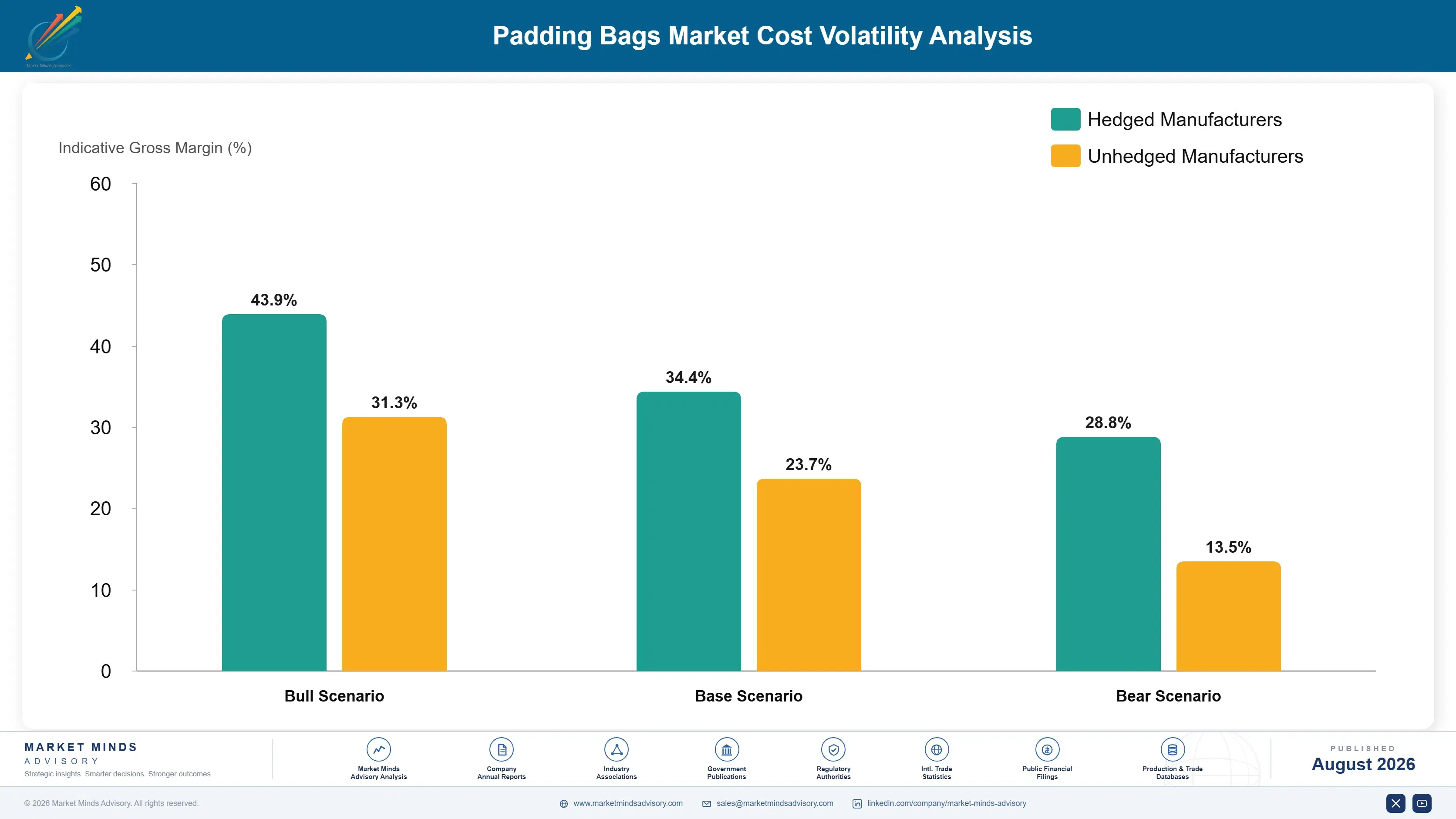
Paper Pulp and Resin Cost Exposure

Kraft paper and recycled paper pulp represent 35% to 45% of cost of goods sold for paper-based padded mailers, sourced primarily from North American and Scandinavian pulp mills, while polyethylene resin represents a comparable 30% to 40% share of cost for laminate and film-based formats, sourced largely from Gulf Coast and Middle Eastern petrochemical crackers operating at considerable scale year-round across multiple facilities.
Kraft paper pricing rose sharply during 2024 as North American pulp mill capacity closures tightened supply faster than demand adjusted across the affected regions, a dynamic documented in United States Department of Agriculture forest products market reports tracking regional pulp and paper pricing trends across major producing states throughout the affected period and well into the following fiscal year as mills gradually restarted idled capacity.

Converters relying heavily on paper-based formats carry greater exposure to pulp price volatility than those with diversified film and paper product portfolios spanning both material categories, since paper cushioning inserts cannot easily switch back to petrochemical alternatives once a brand customer has specified a recyclable format for regulatory compliance reasons across its entire supply chain and vendor base.
padding-bags-market-cost-volatility-analysis-1787312185765

Multi-Region Pulp Sourcing Diversification

Converters increasingly source kraft paper from multiple regional pulp mills across North America, Scandinavia, and South America all simultaneously, reducing exposure to any single region's capacity closures or weather-related supply disruptions that periodically tighten regional paper markets without warning across the entire converter supply chain and its largest, most price-sensitive customer accounts each year.

Index-Linked Long-Term Supply Contracts

Large converters negotiate multi-year paper and resin supply contracts with pricing indexed to published pulp and petrochemical benchmarks rather than negotiated case by case with each individual customer account, smoothing cost volatility considerably and giving brand customers far greater pricing predictability across multi-year mailer supply agreements they depend on heavily each annual budget cycle.

Recycled Fiber and Resin Content Expansion

Converters are expanding recycled fiber and post-consumer resin content across both paper and film formats simultaneously, reducing dependence on virgin pulp and petrochemical inputs considerably while simultaneously improving recyclability credentials that regulators and brand customers alike increasingly demand across nearly every regulated packaging market worldwide today and across the several fiscal years immediately ahead as well.

Portfolio Architecture for Margin Defence

Padding bag portfolios organize into three tiers separated primarily by material sophistication and regulatory positioning rather than by cushioning performance alone, with gross margins widening considerably from the commodity-adjacent volume tier through to the sustainability-focused top tier that regulated brand customers increasingly require across their entire packaging supply chain and vendor qualification process.
Volume tier laminate mailers face mounting margin pressure as extended producer responsibility fees steadily erode their cost advantage over compliant alternatives, pushing converters to defend existing volume through manufacturing scale rather than through price competition alone. Premium certified formats occupy the profitable middle ground that most large brand customers now specify by default across their standard purchasing programs, leaving the commodity tier increasingly reserved for smaller shippers without regulatory fee exposure of their own.

The highest-value profit pools concentrate in mono-material recyclable formats serving regulated brand customers facing direct fee exposure, where converters capture both a material premium and a compliance documentation service premium simultaneously across the same customer relationship and multi-year contract term, a combination that is proving considerably more durable and harder to displace than either premium captured in isolation.

Volume / Commodity-Adjacent Tier

Standard laminate bubble mailers sold primarily on unit price to small and mid-size shippers without direct regulatory fee exposure or sustainability commitments actively driving specification changes across their day-to-day purchasing programs and vendor relationships.
Gross Margin: 18-24%

Premium / Certified Tier

Kraft paper and certified recyclable formats specified by mid-size and large consumer brands seeking compliance headroom ahead of tightening regulatory deadlines across regulated markets and their rapidly expanding e-commerce fulfillment networks worldwide.
Gross Margin: 28-36%

Sustainability / Regulatory / Next-Generation Tier

Mono-material recyclable formats bundled together with compliance documentation and third-party certification support for brand customers facing direct extended producer responsibility fee exposure across regulated states, provinces, and countries operating today.
Gross Margin: 38-48%
padding-bags-market-portfolio-architecture-1787312186565

High-value Sub-segments and Strategic Watch-out

Mono-Material Recyclable Mailers

The fastest-growing, highest-margin segment in the entire portfolio, as extended producer responsibility fee schedules widen the cost gap against noncompliant laminate formats, drawing converter capital investment fastest across the whole product category today and well into the following several fiscal years as regulation tightens further.
Gross Margin: 38-48%

Automated Sizing Equipment Placement

A moderate-growth, high-margin service layer that locks in exclusive multi-year mailer volume from large fulfillment operators through automated equipment placement contracts rather than through standard wholesale distribution relationships alone, giving converters considerably more predictable, forecastable revenue visibility across each individual account relationship and its renewal cycle.
Gross Margin: 30-40%

Standard Laminate Bubble Mailers

The volume core of the market today, still generating the largest absolute revenue despite steadily compressing margins, as small and mid-size shippers without direct regulatory exposure continue purchasing largely on unit price alone across most of their existing accounts and product lines shipped annually nationwide.
Gross Margin: 18-24%

Legacy Multi-Material Laminate Formats

A strategic watch-out segment facing accelerating regulatory fee exposure and probable phase-out across regulated markets within the coming several years, creating both meaningful reformulation risk and a genuine reformulation revenue opportunity for well-positioned, faster-moving converters able to act early, decisively, and well ahead of rivals.
Gross Margin: 15-20%

Recurring Fulfillment Contract Economics

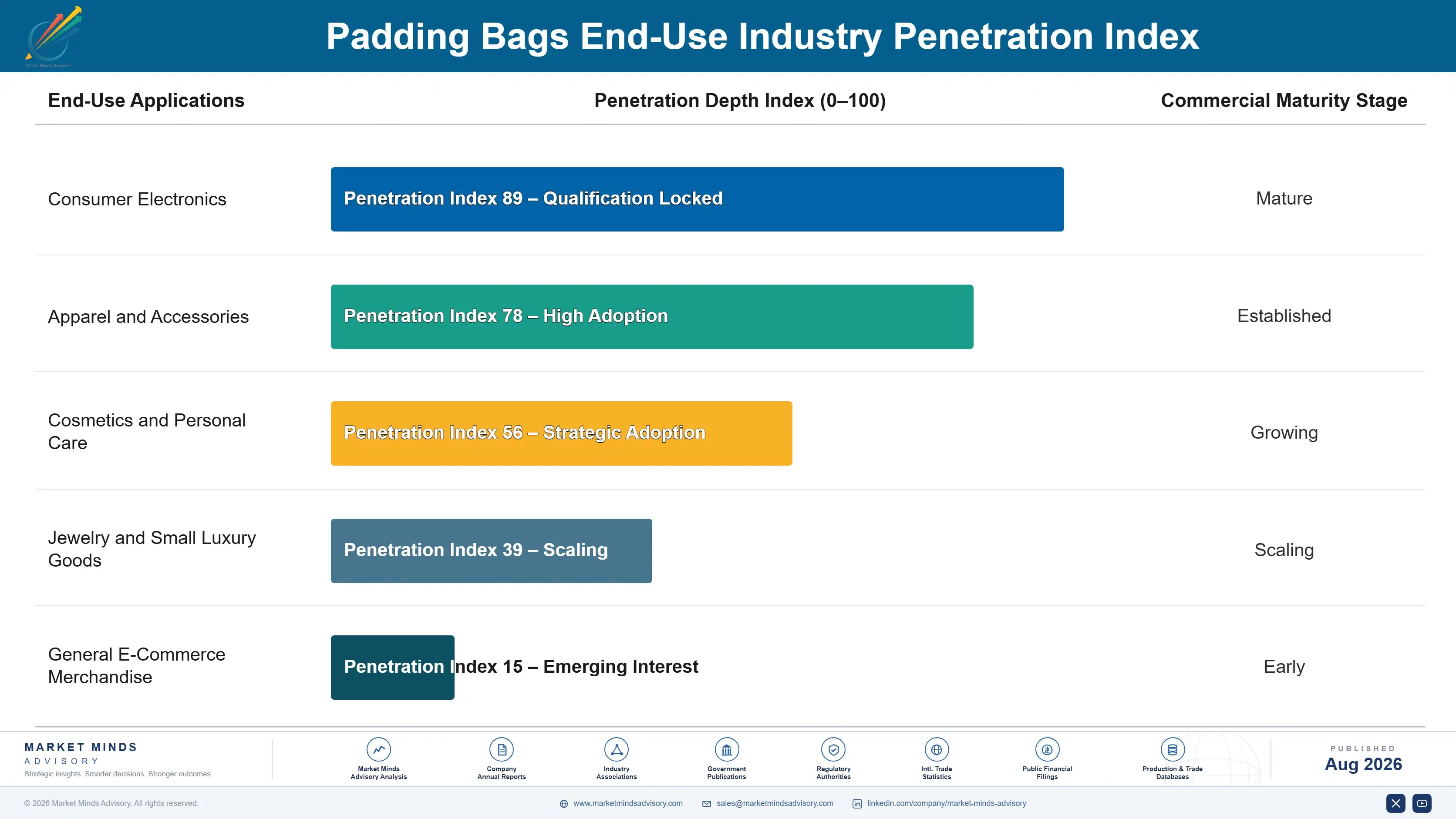
Padding bag demand behaves like an annuity for converters holding fulfillment center supply contracts, since parcel volume grows predictably year over year and mailer specifications rarely change mid-contract once a fulfillment operator standardizes equipment and sourcing around a particular format and supplier relationship it trusts. Switching suppliers mid-contract requires requalifying packaging against carrier handling standards, a friction that favors incumbents holding existing account rel
Adoption depth varies considerably by end-use vertical. Consumer electronics and cosmetics brands specify padded formats for nearly all shipments given high damage sensitivity and correspondingly high unit values, while apparel and general merchandise categories use padded mailers more selectively, reserving them for accessories and smaller fragile items rather than full product lines shipped in bulk. Jewelry and luxury goods brands show the deepest penetration of all, treating protective packaging as inseparable from the unboxing experience.

A generational shift in buyer profiles is underway as sustainability-focused procurement managers increasingly replace purchasing teams that once optimized purely on unit cost, accelerating recyclable format adoption faster than regulation alone would otherwise require across many brand accounts. Younger sourcing executives increasingly treat packaging sustainability credentials as a board-level reporting metric rather than a discretionary preference, reshaping vendor selection criteria.
padding-bags-market-end-use-penetration-index-1787312187103

Where Converters Should Place Capital Now

These are among the four positions where our research anticipates prominent divergence between winners and laggards over the coming forecast period. Each is grounded in the demand model, the regulatory perimeter, and the announced capacity pipeline.
01 / CAPACITY INVESTMENT FOCUS

Prioritize mono-material production capacity over laminate expansion

Converters still expanding legacy laminate capacity are building toward a shrinking compliant addressable market, since extended producer responsibility fee schedules widen each year across a growing list of jurisdictions worldwide. The payback horizon on new laminate lines now extends past the point where several major markets are expected to impose still stricter recyclability minimums, a timing mismatch that matters more than most capital plans currently acknowledge. That mismatch leaves fresh laminate capital largely stranded well before it fully depreciates, a risk few converter boards should be willing to underwrite today.
02 / ACCOUNT STRATEGY PRIORITY

Bundle equipment placement with recyclable material contracts

Converters that pair automated sizing equipment placement with recyclable material supply agreements lock in exclusive multi-year volume at premium pricing, a combination proving far stickier than either offering sold separately across comparable accounts. Fulfillment operators rarely re-bid equipment-anchored contracts purely on unit price once installed, since switching costs extend well beyond the mailer itself into the sizing hardware and its deep integration with warehouse management systems. That durability makes bundled contracts the single most defensible account strategy available to converters today.
03 / REGULATORY POSITIONING PATH

Build certification documentation capability ahead of enforcement

Brand customers increasingly value converters who can supply third-party recyclability certification and compliance documentation directly, not simply compliant material on its own, particularly across accounts spanning multiple regulated jurisdictions and fee schedules at once. Converters building this capability now are positioned to capture disproportionate share of large regulated brand accounts before competitors recognize documentation as a sellable service rather than a cost center. That recognition gap has already begun reshaping vendor scorecards across several of the largest regulated packaging markets worldwide.
04 / GEOGRAPHIC EXPANSION FOCUS

Expand converting capacity toward South Asia's fulfillment buildout

South Asia and Pacific is expanding parcel sorting infrastructure faster than any other region MMA tracks in this report, off a considerably smaller existing installed base than East Asia or North America carry today. Converters establishing local converting capacity now, rather than relying purely on East Asian export volume, stand to capture disproportionate share of that growth before rivals reposition. Waiting risks ceding the region to converters who move first, since rising import tariffs and logistics costs will steadily erode the economics of serving the market purely from offshore production.

Engagement Snapshot From the Field

A live engagement with an industry participant carrying material or product regulatory and market exposure ahead of a defining policy shift, showing how our research translates into a defensible multi-year portfolio strategy.
MARKET MINDS ADVISORY · CLIENT ENGAGEMENT SUMMARY
Padding Bags Producer Strategic Portfolio Review and Transition Roadmap 2026·Investment Scenario on Padding Bags Exposure Evaluation 2025-26
CLIENT PROFILE
The client operates a mid-market third-party fulfillment network serving roughly 40 e-commerce brand customers across North America, shipping an estimated 60 million parcels annually (client-reported, unverified by MMA), with electronics accessories and cosmetics representing its two largest damage-sensitive product categories requiring dedicated protective packaging formats across nearly every account it serves today across its distribution network.
STRATEGIC CHALLENGE
The client faced rising damage claim costs alongside new extended producer responsibility fee exposure across two major shipping states, and needed to reformulate its mailer specifications without disrupting existing brand customer contracts or absorbing unsustainable cost increases across its broader packaging supply chain and vendor base over the following year.
MMA APPROACH
MMA conducted a mailer specification audit across the client's twelve largest brand accounts, benchmarked converter pricing and capacity availability for mono-material formats, and modeled dimensional weight pricing savings against reformulation cost to build a phased conversion business case for client leadership and its board of directors to formally approve and fund.
KEY FINDINGS
  1. Roughly 55% of shipped parcels used oversized mailers relative to contents, creating avoidable dimensional weight pricing penalties across nearly every brand account served.
  2. Switching electronics accessories to padded mono-material mailers cut modeled damage claims by 38%, more than offsetting the format's higher unit cost within two shipping quarters.
  3. Only three of twelve converters evaluated could supply mono-material volume at the client's required scale within the client's target conversion timeline of fourteen months.
  4. Extended producer responsibility fee exposure across the two states analyzed would have added 12% to packaging spend absent reformulation action before the compliance deadline.
CLIENT PROFILE
The client operates a mid-market third-party fulfillment network serving roughly 40 e-commerce brand customers across North America, shipping an estimated 60 million parcels annually (client-reported, unverified by MMA), with electronics accessories and cosmetics representing its two largest damage-sensitive product categories requiring dedicated protective packaging formats across nearly every account it serves today across its distribution network.
STRATEGIC CHALLENGE
The client faced rising damage claim costs alongside new extended producer responsibility fee exposure across two major shipping states, and needed to reformulate its mailer specifications without disrupting existing brand customer contracts or absorbing unsustainable cost increases across its broader packaging supply chain and vendor base over the following year.
MMA APPROACH
MMA conducted a mailer specification audit across the client's twelve largest brand accounts, benchmarked converter pricing and capacity availability for mono-material formats, and modeled dimensional weight pricing savings against reformulation cost to build a phased conversion business case for client leadership and its board of directors to formally approve and fund.
KEY FINDINGS
  1. Roughly 55% of shipped parcels used oversized mailers relative to contents, creating avoidable dimensional weight pricing penalties across nearly every brand account served.
  2. Switching electronics accessories to padded mono-material mailers cut modeled damage claims by 38%, more than offsetting the format's higher unit cost within two shipping quarters.
  3. Only three of twelve converters evaluated could supply mono-material volume at the client's required scale within the client's target conversion timeline of fourteen months.
  4. Extended producer responsibility fee exposure across the two states analyzed would have added 12% to packaging spend absent reformulation action before the compliance deadline.
RECOMMENDED STRATEGY
Phase 1: Phase 1 (Months 1 to 3): Audit mailer specifications across all major brand accounts and identify oversized, poorly protective formats in current use. Phase 2: Phase 2 (Months 4 to 8): Pilot mono-material reformulation with the three qualified converters across two of the largest brand accounts. Phase 3: Phase 3 (Months 9 to 14): Scale reformulation across all remaining accounts and renegotiate converter supply contracts on improved terms overall.
OUTCOME
Within fourteen months the client reformulated packaging across nine of twelve target brand accounts, reporting an estimated 9% reduction in total packaging and damage claim spend alongside full compliance ahead of both states' enforcement deadlines (client-reported, unverified by MMA), with remaining accounts scheduled for conversion the following year.

Frequently Asked Questions

Foundational context covering the market sizes, CAGR, scope, country, region and competition that inform every finding below. This section is provided to cover basics and most often pre-purchase conversations, answered from the MMA Primary Research Dataset.

What is the current size of the Padding Bags Market?

The global padding bags market is valued at $4.1 billion in 2025, MMA's designated base year for this analysis. This figure covers bubble-lined, foam-padded, kraft paper, and mono-material recyclable mailer formats worldwide.

How large will the Padding Bags Market be by 2036?

MMA projects the market will reach $9.084 billion by 2036 under the base case scenario. That represents a 2.06 times expansion over the 2026 starting value across the ten-year forecast window.

What is the CAGR for the Padding Bags Market 2026 to 2036?

The base case CAGR is 7.5% annually, with a bull case of 8.7% and a bear case of 6.3%. E-commerce parcel growth and regulatory reformulation are the primary swing factors between scenarios.

Which segment is growing fastest?

Recyclable mono-material padded mailers lead at a 12.0% CAGR, roughly 1.6 times the overall market rate. Extended producer responsibility fee schedules are the primary driver pulling brand customers toward this format.

Who are the major companies in the Padding Bags Market?

Sealed Air Corporation, Storopack Hans Reichenecker GmbH, Ranpak Holdings Corp, Smurfit WestRock plc, and Mondi plc lead the market. Together these five converters hold an estimated 38% of global revenue.

Which country is growing fastest?

India leads country-level growth at an estimated 9.5% CAGR, driven by rapid e-commerce fulfillment infrastructure expansion off a comparatively low existing base. Indonesia and Vietnam follow closely behind.

Report Segmentation Architecture

The full report scope spans multiple orthogonal segmentation dimensions, with cross-tabulated demand data provided for each dimension pair. Coverage extends further to regional breakdowns, trend trajectories, and the competitive detail needed to support segment-level decision-making.

By Product and Material Type

  • Bubble-Lined Poly Mailers
  • Recyclable Mono-Material Padded Mailers
  • Foam-Padded Poly Mailers
  • Kraft Paper Padded Mailers
  • Air Pillow Padded Mailers
  • Custom-Fit Molded Padding Bags

By End-Use Industry

  • Consumer Electronics
  • Apparel and Accessories
  • Cosmetics and Personal Care
  • Jewelry and Small Luxury Goods
  • General E-Commerce Merchandise

By Commercial Dimension

  • Direct-to-Brand Supply
  • Third-Party Fulfillment Operators
  • Retail and Distributor Channels
  • Private-Label Formulation Services

By Region

  • North America
  • Western Europe
  • East Asia
  • South Asia and Pacific
  • Latin America
  • Middle East and Africa
  • Eastern Europe

Scope, Methodology, and Coverage

Every figure in this report is reproducible from documented input assumptions. The scope below maps the historical period, the forecast horizon, the segmentation dimensions, and the countries covered, alongside the underlying primary and qualitative methodology.
Historical Period
2020 to 2025
Forecast Period
2026 to 2036
Base Year
2025 (USD billions; MMA Primary Research Dataset, August 2026)
Market Definition
The padding bags market covers cushioned mailer packaging, including bubble-lined poly mailers, foam-padded pouches, kraft paper padded mailers, air pillow mailers, and mono-material recyclable padded bags used to protect goods in transit. It excludes rigid corrugated boxes, standard non-padded poly mailers, and pallet-level protective packaging.
Quantitative Units
USD billions (current prices); unit volume in billions of mailers
Segmentation Dimensions
By Product and Material Type; By End-Use Industry; By Commercial Dimension; By Region
Regions Covered
North America, Western Europe, East Asia, South Asia and Pacific, Latin America, Middle East and Africa, Eastern Europe
Countries Covered
USA, China, Germany, France, UK, Japan, South Korea, India, Australia, Canada, Brazil, Mexico, Indonesia, Vietnam, Thailand, Malaysia, UAE, Saudi Arabia, South Africa, Nigeria, Turkey, Poland, Netherlands, Italy, Spain, Sweden, Switzerland, Argentina, Colombia, Singapore, and additional markets relevant to this sector
Key Companies Profiled
Sealed Air Corporation, Storopack Hans Reichenecker GmbH, Ranpak Holdings Corp, Smurfit WestRock plc, Mondi plc, International Paper Company, DS Smith plc, Pregis LLC, Sonoco Products Company, ProAmpac LLC, Novolex Holdings LLC, Coveris Holdings SA, Signode Industrial Group LLC, Intertape Polymer Group Inc, Polybags Ltd, Macfarlane Group plc, Innovative Packaging Group Inc, Salazar Packaging Inc, Duni Group AB, RanpakUSA LLC
Quantitative Methodology
Primary survey, n=3,800 respondents, Q4 2025, six countries; demand-side model with trade association cross-validation
Qualitative Methodology
47 expert interviews, Q4 2025; applied to validate demand model assumptions, identify emerging dynamics, and assess competitive positioning
Report Format
PDF and XLSX data workbook (Word format preview document)
Publisher
Market Minds Advisory
Report Code
MMA-2026-PAC-101
Published
August 2026
Contact
sales@marketmindsadvisory.com | www.marketmindsadvisory.com

Purchase the full Padding Bags Market Report (2026 to 2036).

The full report delivers a complete analysis of the global padding bags market, covering sizing and forecasts across all seven regions and six product segments through 2036. It profiles twenty converters with verified moat and risk assessments for the two category leaders, Sealed Air and Storopack. The report includes detailed input cost analysis, portfolio margin benchmarking, and a primary-research-backed regulatory reformulation outlook covering extended producer responsibility timelines. Buyers receive full access to underlying data tables and methodology notes supporting every figure presented throughout the analysis.
Seven-region sizing and forecast data tables
Six-segment MECE market breakdown and analysis
Twenty-company competitive profiles and rankings included
Input cost exposure and mitigation analysis
Portfolio tier margin benchmarking data included
Regulatory reformulation timeline and full outlook

Built For The People Who Decide

From boardroom strategy to bench-side execution, this report is read cover-to-cover by leaders shaping the next decade of their industry, turning demand scenarios, market dynamics and valuation benchmarks into decisions.
CXOs/ Presidents/ VPs/ Managers
M&A and Corporate Development
Strategy Teams and R&D Heads
Procurement and Product Directors
Regulatory and Compliance Leaders
Investor Relations and Equity Analysts