Market Minds Advisory
Packing Belt Market

Packing Belt Market: Retained Tension, the Retreat of Steel and a Feedstock the Bottle Industry Took Back

Steel does not stretch, so when a load settles in transit the strap goes slack and the pallet shifts. Polyester follows the load down and keeps holding, which is the whole argument in this category.

Lead Analyst

Bilal Shaikh

Published

September 2026

Make Smarter Decisions with Customized Research Insights

Request a free sample report and evaluate market opportunities, growth trends, and competitive dynamics relevant to your business needs.

2025 MARKET VALUE$5.6BMarket Size 2025
2036 FORECAST VALUE$10.0BBase Case , 2026 to 2036
CAGR 2026 TO 20365.4 %Bull 6.6% / Bear 4.2%
INCREMENTAL OPPORTUNITY$4.1BNet 10- year value creation
EXPANSION MULTIPLE1.69x2036 value over 2026 base
Strategic Levers
M&A Pipeline
Regional Outlook
Country Rankings
Competitive Intelligence
Segmental Deep-dive
Call-Us : 91 93563 13602

Executive Snapshot and Market Trajectory

A timber bundle or a paper reel loses moisture in transit and physically shrinks. Steel strapping cannot follow it, so the tension disappears and the load starts to move. Polyester recovers elastically and stays tight, which is why it has been taking steel volume for twenty years.
Polyester strapping compounds at 8.1%, exactly 1.50 times the market, on that retained tension argument and on a safety case operators make loudly: steel under load releases with enough energy to injure. East Asia holds 30% of demand, and it also operates the world's largest polyester extrusion base. Chinese steel, appliance and building materials output between them consume more strapping than any other region by a wide margin.
Concentration is low at 33% for the top five, and the reason is that strap is bulky, low in value per pallet and awkward to ship far. Regional extruders compete effectively. Recycled polyester flake, long the industry's cheap feedstock, is now contested by bottle-to-bottle recycling mandates. Bottle producers pay food-grade prices that strapping economics were never built to absorb, and the thresholds rise further toward 2030. Nobody outside the industry knows that.
Market Definition
The market covers strapping and banding materials used to unitise, bundle and secure loads for transit and storage, spanning polypropylene, polyester, steel, composite and corded, woven and bonded textile, and paper or fibre-based straps, together with the seals and joints used to close them. Strapping tools and machines, stretch and shrink film, adhesive tapes, and pallets or dunnage are excluded.
Base Year Value
$5.6B in 2025 (MMA Primary Research Dataset, August 2026)
Forecast Period
2026 to 2036, eleven discrete annual values
CAGR
5.4% base case. Bull 6.6%. Bear 4.2%.
Fastest Growth Segment
Polyester Strapping: 8.1% CAGR
Fastest Growth Country
India: 8.2% CAGR
Fastest Growth Region
South Asia and Pacific: 7.4% CAGR
Largest Region
East Asia: 30% of 2025 global value
Market Leaders
Signode Industrial Group, Mosca, FROMM Group, Samuel Son and Co, Cyklop International. Source: MMA Analysis based on company annual reports.
Primary Survey
n=3,800 procurement and R&D decision-makers, Q4 2025, six countries
Methodology
Demand-side build-up, cross-validated against public data, 47 expert interviews

Packing Belt Market Forecast Scenarios

packing-belt-market-size-forecast-scenario-1787308614217
Growth ran at an implied 4.4% across 2020 to 2025, and the composition mattered more than the total. Steel volume declined steadily throughout while polyester grew fast enough to more than replace it in value terms, then recycled polyester flake pricing rose sharply from 2023 as bottle recycling mandates began competing for the same material stream. Mix moved far more than volume did.
The base case at 5.4% rests on three mechanisms. Steel substitution continues wherever retained tension or operator safety matters, and both arguments strengthen rather than fade with use. Composite and corded straps keep taking heavy-duty container and cargo securing work from chain and wire. And paper strapping is opening in categories where a customer wants the whole outer pack recyclable in one stream. All three mechanisms operate independently of packaging volume growth.
The bull case at 6.6% assumes steel substitution accelerates as safety policies harden across construction materials, metals and timber, categories where steel still holds meaningful share. The bear case at 4.2% follows from recycled polyester feedstock costs staying elevated as bottle-to-bottle mandates tighten, which would erode the delivered cost advantage polyester currently holds over steel. Neither scenario turns on extrusion efficiency.

Why a Strap That Stretches Beats One That Cannot

The physics of this category are unusually simple and almost nobody outside it knows them. A load settles in transit. Timber and paper lose moisture and shrink, cartons compress, drums nest closer together. Steel strapping applied at correct tension has no elastic reserve at all, so once the load contracts the strap is simply loose, and a loose strap does nothing whatsoever.
TOP FIVE CONCENTRATION33%Combined share held by the five largest global producers
ELASTIC RECOVERY RETAINED68% of tensionTension polyester holds after a load settles in transit
RECYCLED FEEDSTOCK SHARE61% of polyesterRecycled flake content in polyester strap production globally
FLAKE PRICE MOVEMENT34% increaseRecycled feedstock cost rise since bottle mandates took effect
METRES PER KILOGRAM SPREAD2.3 timesVariation between strap grades sold at similar weight prices
STEEL SHARE EROSION1.9 points annuallyVolume transferring from steel strapping to polymer alternatives
Polyester behaves differently. Applied under tension it stretches, and as the load contracts it recovers, retaining roughly 68% of the original tension where steel retains almost none. That single property has driven twenty years of substitution, reinforced by a safety argument operators raise themselves: a steel strap under load releases with enough stored energy to cause serious injury when it fails.
The commercial trap in this market is the unit. Strap is quoted by weight and consumed by length, and grades vary by up to 2.3 times in metres per kilogram at similar weight prices. A buyer negotiating a lower price per kilogram frequently receives a heavier, shorter strap and pays more per pallet secured, without anything in the purchasing record showing it.
"I have watched procurement teams congratulate themselves on a strapping price reduction that increased their cost per pallet by a fifth. Nobody was lying to them. They asked for a price per kilo and that is exactly what they were given."
Director, Transit Packaging and Load Securing Practice · MMA Transit and Unitisi

Market Trends

Bottle Recycling Mandates Take Back the Strapping Industry's Feedstock

Polyester strapping has for decades been the largest single outlet for recycled polyester flake, absorbing material that bottle-to-bottle recycling could not use. European Union rules requiring 25% recycled content in beverage bottles from 2025, rising to 30% by 2030, changed that entirely. Bottle producers now bid for the same flake and food-grade requirements let them pay more. Feedstock costs have risen roughly 34% since the mandates took effect, and strapping producers have moved toward lower grades and mixed inputs in response. Process capability now decides who can run them. Priority claims do not exist.
Market Impact: Polyester retaining 68% of tension
Operator Safety Policy Removes Steel Faster Than Cost Ever Did

Steel strapping under tension stores substantial energy and releases it violently when cut incorrectly or when it fails, and lacerations and eye injuries from recoil are well documented across timber, metals and construction materials handling. A growing number of industrial operators have banned steel on safety policy grounds regardless of any cost comparison, which removes the decision from procurement entirely. Steel share erodes at roughly 1.9 points annually, and safety-driven conversions rarely reverse because reinstating a banned material requires a formal case nobody wants to make. Procurement is not consulted.
Market Impact: Paper strapping growing at 7.6%

Market Opportunities and Growth Drivers

Retained Tension Solves a Problem Steel Cannot Address

Loads settle. Timber and paper lose moisture and contract measurably in transit, cartons compress under stacking, and drums and coils nest closer as vibration works through a pallet. Steel applied at correct tension holds no elastic reserve, so contraction leaves it slack. Polyester retains roughly 68% of applied tension through that settlement, which converts directly into fewer damaged loads and fewer rejected deliveries. Timber, paper reel and building materials shippers have converted fastest because their loads move the most during distribution. Damage claims fall as a direct consequence. Their loads simply move the most.
Market Impact: Grades varying 2.3 times per kilogr

Single-Stream Recyclability Opens Paper Strapping Applications

Brands and retailers pursuing packaging recyclability increasingly want an entire outer pack to enter one waste stream, and a polymer strap around a corrugated case prevents that. Paper and fibre-based straps allow the whole unit to go into paper recycling without separation, which matters in categories where the recipient is a consumer or a small retailer rather than a waste-sorting operation. Tensile performance limits application to lighter bundling rather than heavy palletising, but the addressable range keeps widening as constructions improve. Multi-ply and reinforced constructions have improved performance considerably, though heavy palletising remains beyond reach.
Market Impact: Recycled flake at 61% of input

Market Restraints and Challenges

Weight-Based Purchasing Obscures Actual Cost Per Pallet

Strap is quoted by the kilogram and consumed by the metre, and grades differ by up to 2.3 times in metres per kilogram at similar weight prices. The root cause is that a heavier, thicker strap of lower-grade polymer weighs more per metre and therefore looks cheaper on a per-kilogram basis while delivering fewer pallets per coil. Producers of higher-grade material mitigate by quoting cost per pallet secured and by demonstrating it on the customer's own line, which requires a technical sale procurement functions often resist. The demonstration takes a day.
Market Impact: Feedstock cost up 34% since mandate

Feedstock Competition Erodes the Polyester Cost Advantage

Recycled polyester flake supplies 61% of polyester strap production and its cost has risen roughly 34% since bottle recycling mandates took effect. The root cause is a genuine supply conflict: bottle-to-bottle recyclers need the same material and food-grade requirements let them pay above what strapping economics support. That narrows the delivered cost gap against steel in price-sensitive applications. Producers mitigate by qualifying mixed and lower-grade flake inputs and by competing on retained tension rather than on delivered price. Qualification of alternative inputs is genuine process development rather than a purchasing decision.
Market Impact: Steel losing 1.9 points annually
3 additional market trends, 4 additional growth drivers, and 2 additional restraints and challenges are covered in the full report. Contact sales@marketmindsadvisory.com to access the complete intelligence.

Segment CAGR and Growth Architecture

Segmentation follows strap material and construction, because material determines the tension behaviour, the joint method, the tool required and the loads it can secure. A steel band and a paper strap secure different things by different mechanisms, and no customer evaluates them against each other directly. Tool and joint compatibility follows from the material choice as well.
packing-belt-market-market-share-analysis-1787308614797

Polyester Strapping

Polyester compounds at 8.1%, exactly 1.50 times the market rate, on two arguments that have both strengthened over time. It retains roughly 68% of applied tension as a load settles, where steel retains almost none, which converts directly into fewer shifted pallets and fewer damage claims. And it fails safely rather than releasing stored energy, which has led many industrial operators to ban steel on policy grounds regardless of cost. Friction-weld joints remove the metal seal entirely, simplifying the tool and the consumable. The pressure point is feedstock: recycled flake supplies 61% of production and now competes directly with bottle-to-bottle recycling for the same material at prices strapping economics were never built to absorb.
CAGR 8.1%

Paper and Fibre-Based Strapping

Paper strapping grows at 7.6% on a recyclability argument rather than a performance one. A corrugated case bound with polymer strap cannot enter paper recycling without separation, and where the recipient is a consumer or a small retailer that separation simply does not happen. Paper and fibre straps let the whole unit go into one stream. Tensile strength and moisture sensitivity limit application to lighter bundling, print and mailing work rather than heavy palletising, and humid distribution conditions remain a genuine constraint. Construction has improved considerably through multi-ply and reinforced designs, and the addressable range widens each year, though it will not reach the loads polyester routinely secures. Moisture remains the binding limit.
CAGR 7.6%
Full segment breakdown across 6 segments available in the complete report.

Regional Architecture and Country Demand Map

Demand follows heavy manufacturing and distribution volume rather than consumption, since strapping is applied where goods are unitised. Material mix varies sharply between regions, driven by safety policy and by how much steel-intensive industry each one still operates. Safety policy in particular varies far more than economics would predict.

East Asia

East Asia holds 30% of global demand, the largest regional share, on the sheer weight of industry that needs unitising. Chinese steel coil, appliance, building materials, textile and paper production between them consume more strapping than any other region by a wide margin, and domestic extruders serve that volume at delivered costs international producers cannot match. China also operates the world's largest polyester strapping extrusion base and exports substantially. Steel strapping retains a higher share of the regional mix than in Western markets, since safety policy conversion has moved more slowly. Japanese and Korean demand is smaller, higher in specification and weighted toward polyester and composite. Regional growth of 6.4% tracks industrial output more closely than any packaging trend.
Share: 30% | CAGR: 6.4% (2026 to 2036)

South Asia and Pacific

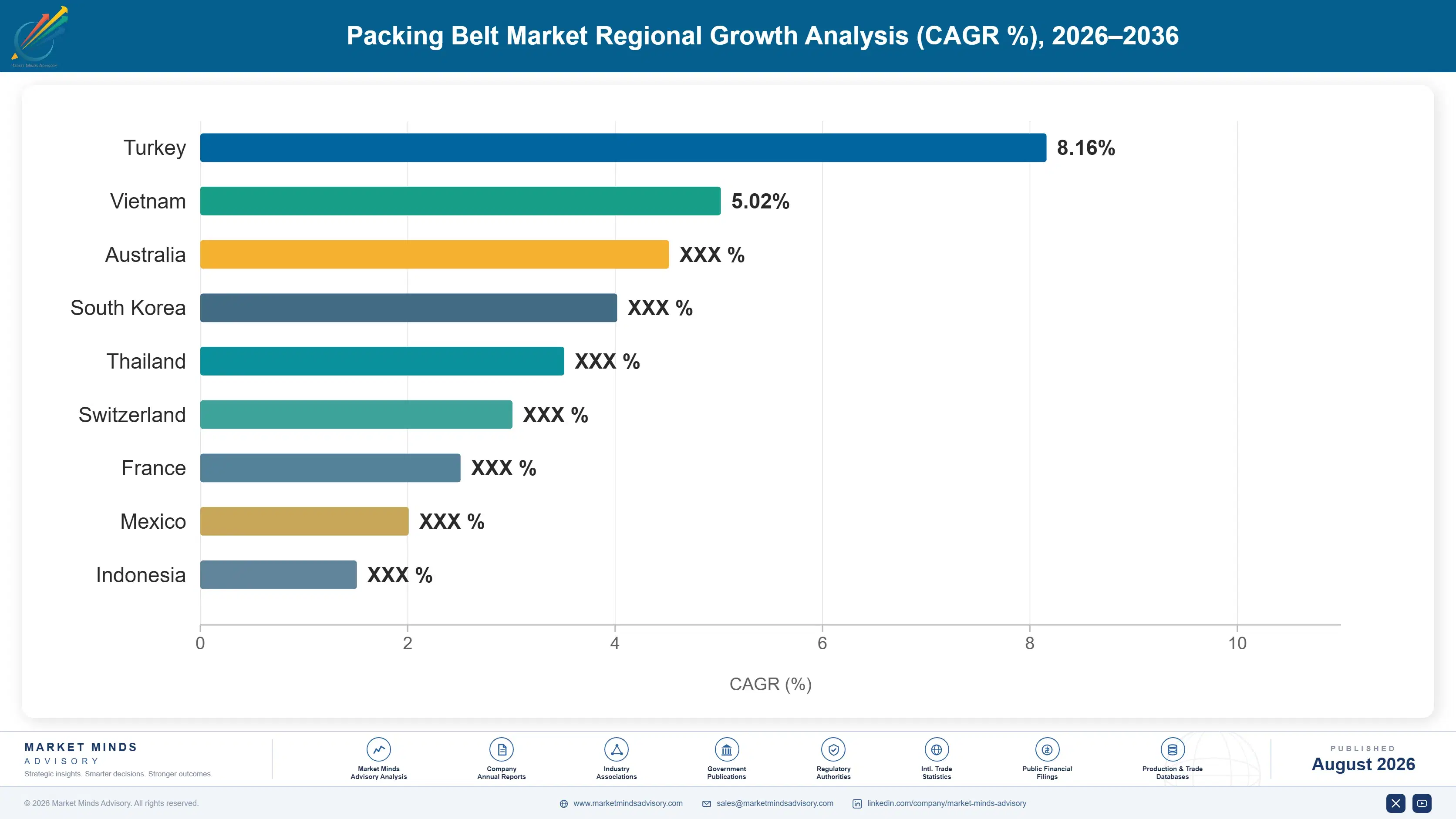
The fastest growing region at 7.4%, with India compounding at 8.2%, South Asia and Pacific accounts for 12% of demand. Indian construction materials, steel, textile and agricultural output all require unitising at growing volume, and organised logistics is displacing informal handling in ways that make consistent strapping a requirement rather than an option. Domestic extrusion capacity has expanded considerably, though higher-grade polyester and composite straps are still imported. Australian demand is smaller and closely resembles Western European material mix and safety policy. Southeast Asian growth follows manufacturing relocation, particularly across Vietnam and Indonesia, where new plants specify polymer strapping from commissioning rather than converting from steel. Higher-grade material remains largely imported.
Share: 12% | CAGR: 7.4% (2026 to 2036)
Regional intelligence for 5 additional markets available in the complete report: North America, Western Europe, Latin America, Middle East and Africa, Eastern Europe. Contact sales@marketmindsadvisory.com.
packing-belt-market-country-cagr-analysis-1787308615306

Selling Metres When Buyers Ask for Kilograms

Strapping is bought by weight, consumed by length and judged by whether the pallet arrived intact, and those three things point in different directions. The positions worth holding are the ones where a producer can move the conversation off price per kilogram and onto something the customer can actually measure. Price per kilogram measures none of it.

Quote Cost Per Pallet Rather Than Price Per Kilogram

Grades vary by up to 2.3 times in metres per kilogram at similar weight prices, so a buyer negotiating a lower price per kilogram routinely receives a heavier, shorter strap and pays more per pallet secured. Producers of higher-grade material that quote cost per pallet, and demonstrate it by running both straps on the customer's own line, win business that a weight-based tender would have lost. The demonstration costs a day of application engineering and reframes the purchase permanently, because the customer cannot unsee the arithmetic afterwards. Procurement resistance is the only obstacle.
Market Impact: Metres per kilogram varying by 2.3

Convert Steel Users on Safety Policy Rather Than Cost

Steel under tension releases with enough stored energy to cause serious injury, and lacerations and eye injuries from recoil are well documented across timber, metals and construction handling. A growing number of operators have banned it outright on that basis, which removes procurement from the decision entirely. Steel erodes at roughly 1.9 points annually and those conversions almost never reverse, because reinstating a banned material requires a formal safety case nobody wants to write. Reaching the safety function rather than the buyer is a different commercial motion and a far more durable one.
Market Impact: Steel share now eroding 1.9 points

Secure Recycled Flake Supply Ahead of Bottle Competition

Recycled polyester flake supplies 61% of polyester strap production, and its cost has risen roughly 34% since bottle recycling mandates began competing for the same material at food-grade prices. That pressure will intensify as thresholds rise toward 2030. Producers holding contracted flake supply, or qualifying mixed and lower-grade inputs that bottle recyclers cannot use, hold a cost position spot buyers cannot match. Qualification work on lower-grade inputs is genuine process development rather than purchasing, and it is where the durable advantage in polyester strapping now sits. Purchasing scale does not solve it.
Market Impact: Contracted flake covering 61% of th

Build Composite Capability for Cargo Securing Work

Composite and corded straps have been taking container cargo securing and heavy bundling work from chain and wire, growing at 7.0% on a combination of high break strength, no recoil hazard and no damage to the goods they contact. Shipping line and cargo insurer acceptance has been the gating factor rather than any technical limitation, and it has broadened considerably. These straps carry gross margins roughly 12 to 19 points above polypropylene, sell through industrial rather than packaging channels, and require lashing engineering support most strapping producers do not hold.
Market Impact: Composite straps carrying 12 to 19

Who Controls the Margin Pool

The five largest producers hold 33% of the market measured on strapping material revenue, the basis applied consistently through this section. Fragmentation reflects freight economics, since strap is bulky and low in value per pallet, so regional extruders compete effectively within their own radius. Signode Industrial Group and Mosca lead from different positions. Neither leads on extrusion cost. Regional density beats global reach in most quotations.
Competition operates on three dimensions. Extrusion cost and feedstock access decide who can compete on polypropylene and standard polyester volume. Tool and consumable system integration decides who holds an account beyond a single tender, since a customer running one supplier's tools rarely changes strap alone. And application engineering decides who can make the cost per pallet argument credibly. All three outlast any individual tender.

Two pressures are reshaping position. Recycled flake competition from bottle recycling favours producers with contracted supply or the process capability to run lower grades. Against that, Chinese and Indian extruders compete aggressively on standard grades wherever freight permits. Rankings will move toward whoever pairs feedstock security with genuine tool system positions at end users. Very few hold both today.
packing-belt-market-company-positioning-matrix-1787308615822

Competitive Moat and Risk Dimensions

SIGNODE INDUSTRIAL GROUP

Moat: Tool and consumable system breadth

Signode supplies strapping, seals, tools and automated strapping machines as an integrated system, which matters because a customer running its tools across a plant rarely changes strap supplier alone. That installed tool base converts into consumable demand that renews without being retendered, and the breadth of application coverage lets the company serve heavy industrial and general distribution from one relationship.
SIGNODE INDUSTRIAL GROUP

Risk: Recycled feedstock cost exposure

Polyester volume depends on recycled flake that bottle-to-bottle recyclers now bid for at food-grade prices, and the cost has risen roughly 34% since mandates took effect. Scale in extrusion does not solve a raw material supply conflict. Producers with contracted flake positions or the process capability to run lower grades hold an advantage that purchasing volume alone cannot replicate.
MOSCA

Moat: Machine-led application engineering

Mosca comes to the customer through automated strapping machinery rather than through material supply, which places it in the line design conversation where strap specification is actually decided. That position supports the cost per pallet argument directly, since the company can demonstrate throughput and consumable consumption together on the customer's own equipment rather than quoting a material price.
MOSCA

Risk: Limited extrusion cost position

A machine-led model competes for material volume against extruders with lower delivered costs, particularly in standard polypropylene grades where application engineering adds little the customer values. Where a plant already runs automated equipment and simply reorders consumables, the original machinery advantage does not renew itself, and regional extruders can undercut on the recurring material spend.

Players Tracked

Prominent Players

Signode Industrial Group
Mosca
FROMM Group
Samuel Son and Co
Cyklop International

Other Key Players

Teufelberger
Titan Umreifungstechnik
Strapack
Dynaric
PAC Strapping Products
Polychem Corporation
Scientex Berhad
Yongsheng Advanced Materials
Hangzhou Youngsun Intelligent Equipment
Nichiban
Greif
Cordstrap
Bandall
Linder GmbH
Plastic Extruders Limited

Recent Developments

FEBRUARY 2025

Bottle recycled content thresholds tighten polyester flake supply

The 25% recycled content requirement for beverage bottles took effect across European Union member states, intensifying competition for recycled polyester flake that strapping production has historically absorbed. This was a regulatory threshold rather than a commercial development between suppliers. Strapping producers hold no priority claim on that material.
Signal: A packaging regulation aimed at bottles ha
JUNE 2025

Industrial safety policies extend bans on steel strapping

Further timber, metals and construction materials operators adopted policies prohibiting steel strapping on handling safety grounds, citing recoil injury risk during cutting and failure. These were internal safety decisions rather than regulatory actions, and they remove material selection from procurement entirely. Cost comparison plays no part in the decision.
Signal: Safety policy converts faster than cost co
OCTOBER 2025

Composite strapping acceptance widens in container cargo securing

Shipping lines and cargo insurers broadened acceptance of composite and corded strapping for container load securing applications previously requiring chain or wire, reflecting accumulated performance evidence. This was acceptance practice change rather than any corporate transaction. Chain and wire are losing work they held for decades.
Signal: Insurer acceptance rather than technical c

Flake, Resin and Extrusion Energy

Polymer feedstock accounts for roughly 57% of cost of goods, dominated by recycled polyester flake and virgin polypropylene resin purchased regionally. Steel coil for the declining steel segment carries its own quite separate cost structure. Extrusion and orientation energy runs a further 19%, and packaging, coring and freight make up most of the remainder given how bulky the finished product is.
Recycled polyester flake has risen roughly 34% since European bottle recycled content mandates took effect, as bottle-to-bottle recyclers bid for the same material at prices food-grade applications support and strapping economics do not. European extrusion energy costs rose in parallel through the 2022 disruption that International Energy Agency reporting documents. Company annual reports covering industrial packaging segments disclose the resulting margin compression across that period.

Exposure divides by feedstock position rather than by scale. Producers holding contracted flake supply, or the process capability to run mixed and lower-grade inputs that bottle recyclers cannot use, carry materially lower cost than spot buyers. That gap is widening as thresholds rise toward 2030. Steel strapping producers face a different problem entirely, since their volume is declining regardless of what steel coil costs in any given quarter.
packing-belt-market-cost-volatility-analysis-1787308616016

Qualify lower-grade and mixed flake inputs for strapping

Bottle-to-bottle recycling needs food-grade clear flake and cannot use coloured, mixed or lightly contaminated material that strapping tolerates with the right process control. Qualifying those inputs is genuine process development rather than a purchasing decision, and it moves a producer out of direct competition for the material bottle recyclers will always outbid them for.

Contract flake supply on multi-year terms with collectors

Recycled flake availability is regional and increasingly contested, so relationships with collection and sorting operators matter more than purchasing scale. Multi-year agreements secure both price stability and volume, and they matter more each year as bottle content thresholds rise toward 2030 and pull further material out of the open market. Collector relationships matter more than purchasing volume.

Site extrusion close to consuming industrial clusters

Finished strap is bulky and low in value per pallet, so freight erodes delivered value quickly with distance. Extruding near heavy industrial clusters cuts that cost and creates a regional position distant competitors cannot contest on delivered price regardless of their own extrusion efficiency or feedstock advantage. Proximity is a defensible position rather than merely a cost saving.

Portfolio Architecture for Margin Defence

The portfolio separates on whether the customer is buying a commodity band or a load securing outcome. Polypropylene strapping is extruded polymer sold by weight, and regional producers compete hard inside their freight radius. Polyester sells on retained tension and safety. Composite and corded straps sell into cargo securing where a failure is a claim rather than an inconvenience, and paper sells on single-stream recyclability. What the customer is buying draws the ladder.
The tension is that polypropylene carries the volume, the extrusion utilisation and the distributor relationships from which higher-value work follows. A producer that abandons it to chase polyester and composite margin loses shelf presence at the distributors who reach the mid-sized industrial accounts. Most successful operators run it deliberately as channel access rather than as a profit centre. Access and margin are separate objectives here.

High-value pools concentrate where a load actually moves, where a safety policy applies, or where a failure carries a claim. Composite cargo securing, polyester for settling loads and paper for consumer-facing outer packs all qualify, and none is decided on price per kilogram. Each reaches a different budget holder entirely.

Volume / Commodity-Adjacent Tier

Polypropylene strapping and standard seals for general bundling and light palletising, sold by weight through packaging distribution. Regional extruders compete effectively inside their freight radius, and the material itself carries no meaningful differentiation between suppliers.
Gross Margin: 19-27%

Premium / Certified Tier

Polyester strapping and friction-weld joint systems sold on retained tension and operator safety into applications where loads settle in transit. Application engineering and demonstrated cost per pallet rather than material price decide most awards here.
Gross Margin: 31-43%

Sustainability / Regulatory / Next-Generation Tier

Composite and corded cargo securing straps plus paper and fibre-based strapping for single-stream recyclable outer packs. The wide margin range reflects the gap between established cargo securing positions and paper constructions still limited by tensile and moisture performance.
Gross Margin: 34-56%
packing-belt-market-portfolio-architecture-1787308616514

High-value Sub-segments and Strategic Watch-out

Polyester Load Securing Strapping

Compounding at 8.1% on retained tension of roughly 68% where steel holds almost none, reinforced by safety policies removing steel entirely. Feedstock competition from bottle recycling is the pressure point, and producers without contracted flake face a widening cost disadvantage. Safety policy accelerates the conversion.
Gross Margin: 35-43%

Composite and Corded Cargo Straps

Growing at 7.0% by taking container securing work from chain and wire on break strength, absence of recoil hazard and no damage to contacted goods. Insurer acceptance rather than technical capability was the constraint, and it has broadened considerably. Lashing engineering support is required. Industrial channels reach it.
Gross Margin: 40-56%

Polypropylene Bundling Strapping

The volume core at 4.8%, sold by weight through distribution with regional extruders competing hard inside their freight radius. Run for extrusion utilisation and distributor shelf presence rather than margin, since abandoning it costs access to mid-sized industrial accounts. Extrusion lines have to be filled.
Gross Margin: 19-27%

Paper and Fibre Strapping

The watch-out and the opportunity together. Single-stream recyclability is a genuine argument where the recipient will not separate materials, but tensile strength and moisture sensitivity confine it to lighter bundling well below what polyester routinely secures. Construction keeps improving steadily. Humid distribution remains the binding constraint on adoption.
Gross Margin: 30-52%

Tools Hold the Consumable Position

Recurring revenue here rests on tools rather than on contracts. A plant running one supplier's tensioners, sealers and automated strapping machines cannot simply change strap, because joint geometry, seal dimensions and machine settings are matched to the material. The consumable renews without being retendered for as long as the equipment runs, which is why producers give tool support far more attention than the equipment revenue alone would justify. Equipment holds the consumable in place.
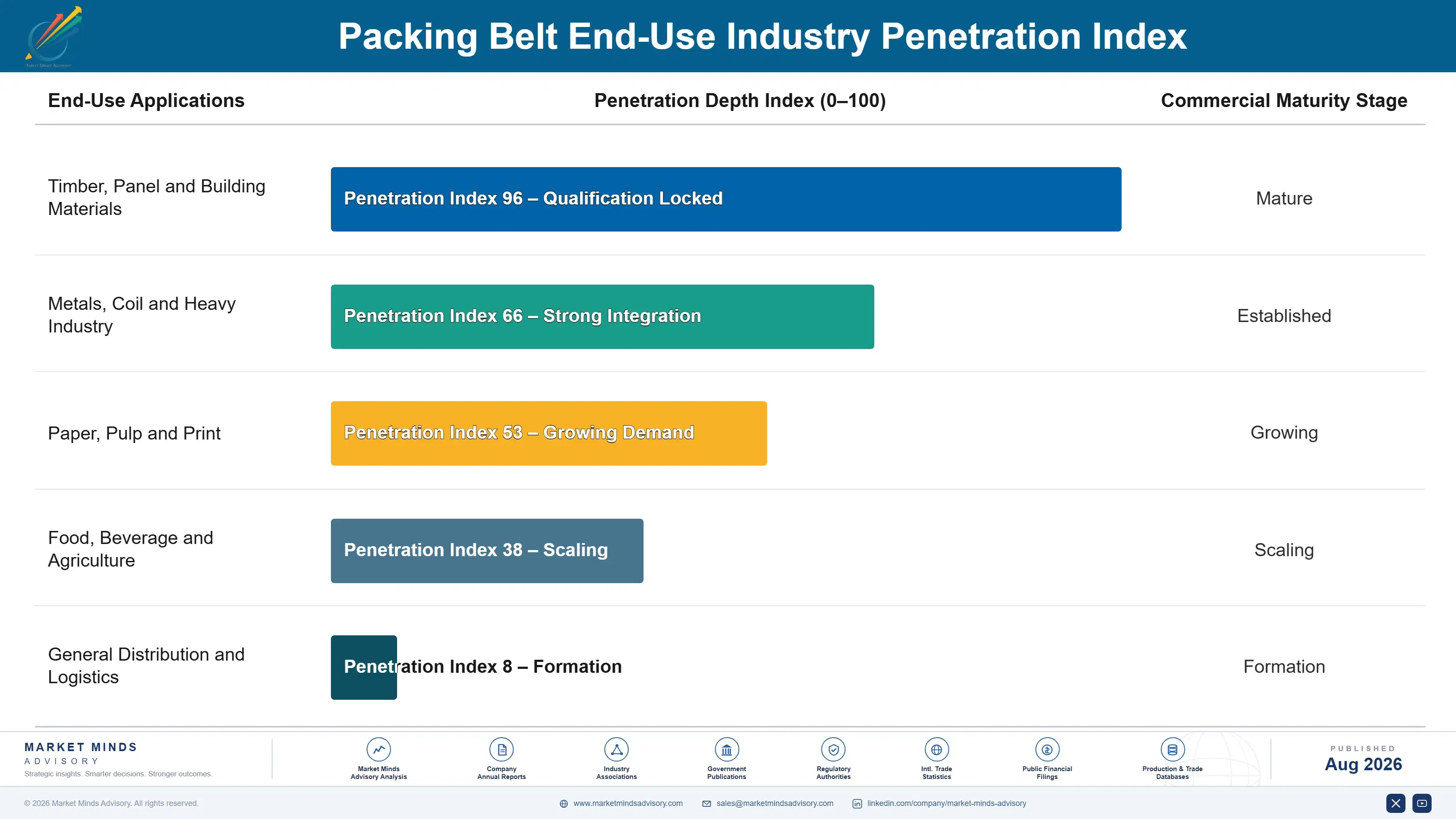
Depth varies sharply by load type. Cargo securing and heavy industrial users buy deepest, involving suppliers in lashing calculations and treating a failure as a claim rather than a nuisance. Timber, paper and building materials shippers buy on retained tension because their loads genuinely move. General distribution buys on delivered price through distributors. Contract packers sit shallowest, switching whenever a coil price changes. Load behaviour rather than customer size sets depth.

The deciding population has shifted in one specific way. Material selection historically sat with packaging or procurement functions balancing cost and performance. Steel substitution moved a substantial part of it to health and safety functions, and that participant does not evaluate cost per kilogram at all.
packing-belt-market-end-use-penetration-index-1787308616998

Where Strapping Producers Win

These are among the four positions where our research anticipates prominent divergence between winners and laggards over the coming forecast period. Each is grounded in the demand model, the regulatory perimeter, and the announced capacity pipeline.
01 / UNIT OF SALE REFRAMING

Quoting by weight loses money for whoever asked for it

Strap is quoted by the kilogram and consumed by the metre, and grades vary by up to 2.3 times in metres per kilogram at similar weight prices. A buyer negotiating a lower price per kilogram routinely receives a heavier, shorter strap and pays more per pallet secured, with nothing in the purchasing record revealing it. Producers that demonstrate cost per pallet secured on the customer's own line reframe the purchase permanently, because that arithmetic simply cannot be unseen once it has been shown.
02 / SAFETY POLICY CONVERSION

Steel is being removed by a function that ignores price entirely

Steel strapping under tension stores substantial energy and releases it violently on incorrect cutting or on failure, with recoil lacerations and eye injuries well documented right across timber, metals and construction materials handling. Operators banning it on policy grounds remove the material decision from procurement completely, and steel share consequently erodes at roughly 1.9 points every year. Those conversions almost never reverse, because reinstating a banned material requires a formal safety case that nobody inside an operation wants to write.
03 / FEEDSTOCK POSITION SECURITY

The bottle industry took back the flake this category depended on

Recycled polyester flake supplies 61% of all polyester strap production, and its cost has risen roughly 34% since European bottle recycled content mandates began competing directly for the same material. Bottle-to-bottle recyclers pay food-grade prices that strapping economics were never built to absorb, and the mandated thresholds are set to rise further again toward 2030 from where they now stand. Producers that qualify coloured, mixed and lower-grade inputs which bottle recyclers cannot use move out of that competition altogether rather than losing it.
04 / TOOL INSTALLED BASE

The consumable follows the equipment and renews without a tender

Joint geometry, seal dimensions and machine settings are all matched to the strap itself, so a plant running one supplier's tensioners, sealers and automated equipment cannot change the strap material independently of those tools at all. That consumable stream then renews for as long as the equipment keeps operating, and it rarely passes through a competitive tender at all. That is precisely why producers support tools and machines far beyond anything the equipment revenue on its own would ever justify commercially.

Engagement Snapshot From the Field

A live engagement with an industry participant carrying material or product regulatory and market exposure ahead of a defining policy shift, showing how our research translates into a defensible multi-year portfolio strategy.
MARKET MINDS ADVISORY · CLIENT ENGAGEMENT SUMMARY
Packing Belt Producer Strategic Portfolio Review and Transition Roadmap 2026·Investment Scenario on Packing Belt Exposure Evaluation 2025-26
CLIENT PROFILE
A timber and engineered panel producer operating eleven mills across Europe and North America with roughly EUR 2.3 billion in revenue (client-reported, unverified by MMA). Strapping spend ran near EUR 19 million annually (client-reported, unverified by MMA), split between steel and polypropylene, with material specified and purchased mill by mill through regional distributors. No group specification or shared performance data existed.
STRATEGIC CHALLENGE
Transit damage claims had risen for three consecutive years and two customers had raised formal quality concerns about shifted loads on delivery. Procurement had responded by tendering strapping on price per kilogram and had achieved a reported saving. Operations argued that the damage and the saving were the same event viewed from different angles.
MMA APPROACH
MMA measured load settlement across a sample of shipments by product type and distribution route, then correlated retained strap tension on arrival against damage claim incidence. Purchasing records were rebuilt from price per kilogram onto cost per pallet secured, and steel handling incident records were reviewed across all eleven mills.
KEY FINDINGS
  1. Panel and dried timber loads contracted enough in transit that steel strapping arrived measurably slack on most long routes, and every claim examined involved a load secured with steel rather than polymer.
  2. The tendered saving on price per kilogram had increased cost per pallet secured by roughly 14%, because the awarded polypropylene grade delivered substantially fewer metres per kilogram than the material it replaced.
  3. Steel handling incidents were recorded at eight of the eleven mills over three years, and two mills had already banned steel locally without any group policy or procurement involvement.
  4. No mill measured retained tension on arrival, and no mechanism existed to connect damage claims back to the strapping specification that had caused them.
CLIENT PROFILE
A timber and engineered panel producer operating eleven mills across Europe and North America with roughly EUR 2.3 billion in revenue (client-reported, unverified by MMA). Strapping spend ran near EUR 19 million annually (client-reported, unverified by MMA), split between steel and polypropylene, with material specified and purchased mill by mill through regional distributors. No group specification or shared performance data existed.
STRATEGIC CHALLENGE
Transit damage claims had risen for three consecutive years and two customers had raised formal quality concerns about shifted loads on delivery. Procurement had responded by tendering strapping on price per kilogram and had achieved a reported saving. Operations argued that the damage and the saving were the same event viewed from different angles.
MMA APPROACH
MMA measured load settlement across a sample of shipments by product type and distribution route, then correlated retained strap tension on arrival against damage claim incidence. Purchasing records were rebuilt from price per kilogram onto cost per pallet secured, and steel handling incident records were reviewed across all eleven mills.
KEY FINDINGS
  1. Panel and dried timber loads contracted enough in transit that steel strapping arrived measurably slack on most long routes, and every claim examined involved a load secured with steel rather than polymer.
  2. The tendered saving on price per kilogram had increased cost per pallet secured by roughly 14%, because the awarded polypropylene grade delivered substantially fewer metres per kilogram than the material it replaced.
  3. Steel handling incidents were recorded at eight of the eleven mills over three years, and two mills had already banned steel locally without any group policy or procurement involvement.
  4. No mill measured retained tension on arrival, and no mechanism existed to connect damage claims back to the strapping specification that had caused them.
RECOMMENDED STRATEGY
Phase 1: Phase 1 (months 1 to 6): Convert steel-strapped product lines to polyester on the routes showing the greatest load settlement and highest claim incidence. Phase 2: Phase 2 (months 6 to 15): Retender all strapping on cost per pallet secured rather than price per kilogram, with metres per kilogram declared. Phase 3: Phase 3 (months 15 to 26): Adopt a group steel strapping policy and consolidate tool platforms across the mill network.
OUTCOME
Transit damage claims fell by roughly 46% within a year of conversion (client-reported, unverified by MMA). Strapping spend rose by approximately EUR 1.2 million against claims and rework savings near EUR 5.4 million. Steel handling incidents ceased at converted mills (client-reported, unverified by MMA). A group steel policy was adopted across all eleven mills.

Frequently Asked Questions

Foundational context covering the market sizes, CAGR, scope, country, region and competition that inform every finding below. This section is provided to cover basics and most often pre-purchase conversations, answered from the MMA Primary Research Dataset.

What is the current size of the Packing Belt Market?

The global market was worth USD 5.6 billion in 2025, reaching USD 5.9 billion in 2026. East Asia holds the largest regional share at 30% of demand.

How large will the Packing Belt Market be by 2036?

MMA forecasts USD 9.99 billion by 2036, an expansion multiple of 1.69 times the 2026 base. That represents roughly USD 4.09 billion of incremental value.

What is the CAGR for the Packing Belt Market 2026 to 2036?

The base case compounds at 5.4% annually, with a bull case of 6.6% and a bear case of 4.2%. Historical growth from 2020 to 2025 ran at 4.4%.

Which segment is growing fastest?

Polyester strapping compounds at 8.1%, exactly 1.50 times the market rate. It retains roughly 68% of applied tension as a load settles, where steel retains almost none.

Who are the major companies in the Packing Belt Market?

Signode Industrial Group, Mosca, FROMM Group, Samuel Son and Co and Cyklop International hold a combined 33% of the market. Fragmentation is high because strap is bulky and expensive to ship far.

Which country is growing fastest?

India compounds at 8.2%, ahead of every other national market. Construction materials, steel and textile output are all rising while organised logistics steadily displaces informal handling.

Report Segmentation Architecture

The full report scope spans multiple orthogonal segmentation dimensions, with cross-tabulated demand data provided for each dimension pair. Coverage extends further to regional breakdowns, trend trajectories, and the competitive detail needed to support segment-level decision-making.

By Strap Material and Construction

  • Polypropylene Strapping
  • Polyester Strapping
  • Steel Strapping
  • Composite and Corded Strapping
  • Woven and Bonded Textile Strapping
  • Paper and Fibre-Based Strapping

By End-Use Industry

  • Timber, Panel and Building Materials
  • Metals, Coil and Heavy Industry
  • Paper, Pulp and Print
  • Food, Beverage and Agriculture
  • General Distribution and Logistics

By Commercial Dimension

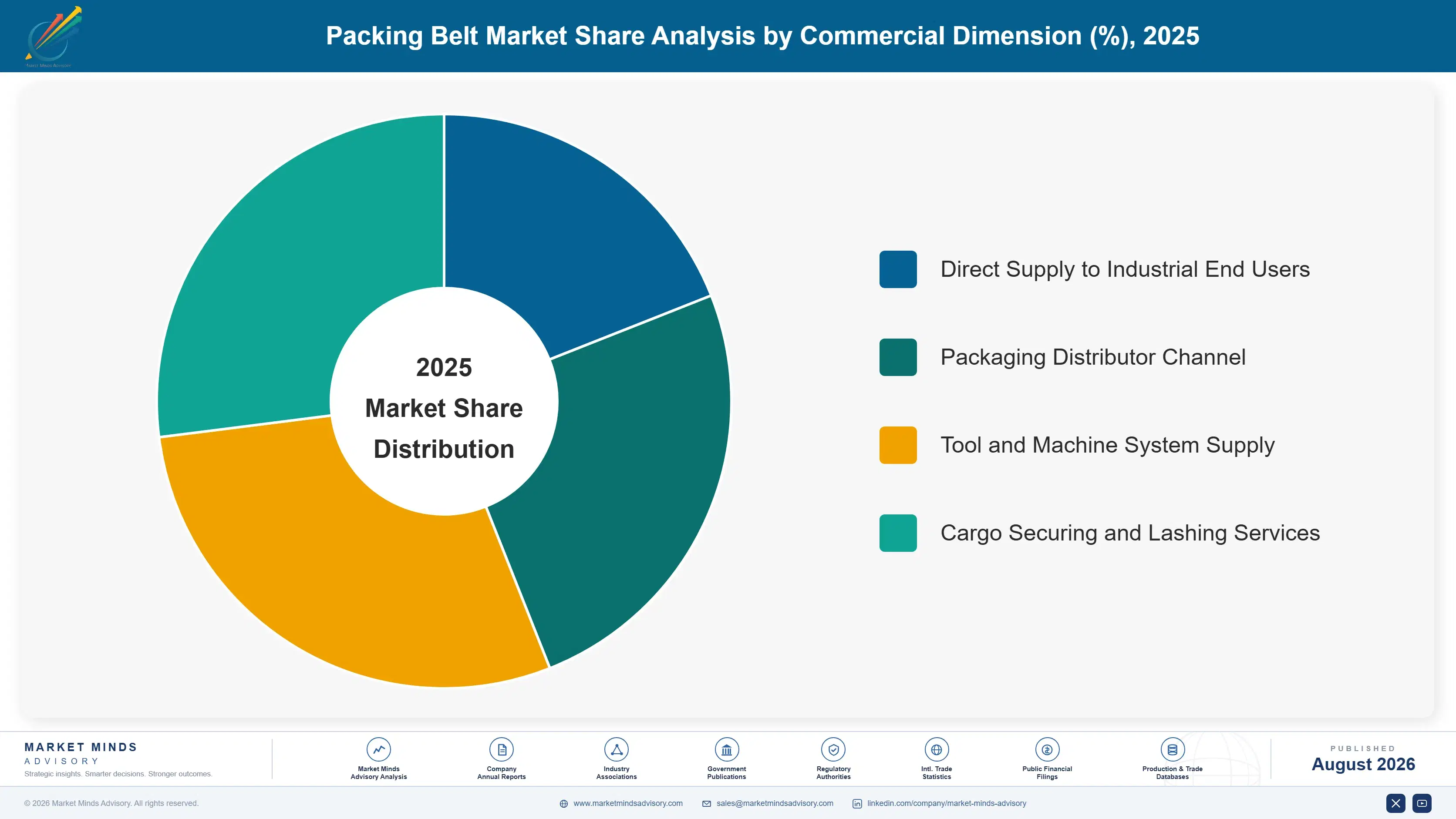
  • Direct Supply to Industrial End Users
  • Packaging Distributor Channel
  • Tool and Machine System Supply
  • Cargo Securing and Lashing Services

By Region

  • North America
  • Western Europe
  • East Asia
  • South Asia and Pacific
  • Latin America
  • Middle East and Africa
  • Eastern Europe

Scope, Methodology, and Coverage

Every figure in this report is reproducible from documented input assumptions. The scope below maps the historical period, the forecast horizon, the segmentation dimensions, and the countries covered, alongside the underlying primary and qualitative methodology.
Historical Period
2020 to 2025
Forecast Period
2026 to 2036
Base Year
2025 (USD billions; MMA Primary Research Dataset, August 2026)
Market Definition
The market covers strapping and banding materials used to unitise, bundle and secure loads for transit and storage, spanning polypropylene, polyester, steel, composite and corded, woven and bonded textile, and paper or fibre-based straps, together with the seals, buckles and joints used to close them. Strapping tools, tensioners and automated strapping machines, stretch and shrink film, adhesive tapes, pallets, dunnage and airbags are excluded. Sizing is measured at producer revenue in current prices.
Quantitative Units
USD billions (current prices); tonnes of strap and metres per kilogram where applicable
Segmentation Dimensions
By Strap Material and Construction; By End-Use Industry; By Commercial Dimension; By Region
Regions Covered
North America, Western Europe, East Asia, South Asia and Pacific, Latin America, Middle East and Africa, Eastern Europe
Countries Covered
USA, China, Germany, France, UK, Japan, South Korea, India, Australia, Canada, Brazil, Mexico, Indonesia, Vietnam, Thailand, Malaysia, UAE, Saudi Arabia, South Africa, Nigeria, Turkey, Poland, Netherlands, Italy, Spain, Sweden, Switzerland, Argentina, Colombia, Singapore, and additional markets relevant to this sector
Key Companies Profiled
Signode Industrial Group, Mosca, FROMM Group, Samuel Son and Co, Cyklop International, Teufelberger, Titan Umreifungstechnik, Strapack, Dynaric, PAC Strapping Products, Polychem Corporation, Scientex Berhad, Yongsheng Advanced Materials, Hangzhou Youngsun Intelligent Equipment, Nichiban, Greif, Cordstrap, Bandall, Linder GmbH, Plastic Extruders Limited
Quantitative Methodology
Primary survey, n=3,800 respondents, Q4 2025, six countries; demand-side model with trade association cross-validation
Qualitative Methodology
47 expert interviews, Q4 2025; applied to validate demand model assumptions, identify emerging dynamics, and assess competitive positioning
Report Format
PDF and XLSX data workbook (Word format preview document)
Publisher
Market Minds Advisory
Report Code
MMA-2026-PAC-724
Published
August 2026
Contact
sales@marketmindsadvisory.com | www.marketmindsadvisory.com

Purchase the full Packing Belt Market Report (2026 to 2036).

The full report sizes packing belts across six material constructions, three commercial dimensions and seven regions, with annual forecasts to 2036 under base, bull and bear scenarios. Cost per pallet secured is modelled against price per kilogram by grade, exposing the gap that weight-based purchasing conceals across most industrial tenders. Recycled polyester flake competition from bottle recycling mandates is quantified by region and threshold timetable. Steel substitution is tracked by end-use industry and by whether safety policy or cost drove each conversion. Twenty producers are profiled on a consistent strapping material revenue basis.
Cost per pallet modelled against price per kilogram
Recycled flake competition quantified by region and threshold timetable
Steel substitution tracked by industry and conversion driver
Load settlement and retained tension measured by product type
Tool installed base positions mapped across major industrial accounts
Composite cargo securing acceptance assessed by shipping line and insurer

Built For The People Who Decide

From boardroom strategy to bench-side execution, this report is read cover-to-cover by leaders shaping the next decade of their industry, turning demand scenarios, market dynamics and valuation benchmarks into decisions.
CXOs/ Presidents/ VPs/ Managers
M&A and Corporate Development
Strategy Teams and R&D Heads
Procurement and Product Directors
Regulatory and Compliance Leaders
Investor Relations and Equity Analysts