Market Minds Advisory
Packaging Testing Services Market

Packaging Testing Services Market: Sustainable Material Certification Rewrites Lab Demand

Recyclability and compostability regulation are pulling accredited lab demand toward sustainable material certification testing, forcing testing providers built for transit simulation protocols to scale novel material validation capacity across major markets.

Lead Analyst

Bilal Shaikh

Published

September 2026

Make Smarter Decisions with Customized Research Insights

Request a free sample report and evaluate market opportunities, growth trends, and competitive dynamics relevant to your business needs.

2025 MARKET VALUE$2.4BMarket Size 2025
2036 FORECAST VALUE$5.7BBase Case , 2026 to 2036
CAGR 2026 TO 20368.2 %Bull 9.4% / Bear 6.9%
INCREMENTAL OPPORTUNITY$3.1BNet 10- year value creation
EXPANSION MULTIPLE2.20x2036 value over 2026 base
Strategic Levers
M&A Pipeline
Regional Outlook
Country Rankings
Competitive Intelligence
Segmental Deep-dive
Call-Us : 91 93563 13602

Executive Snapshot and Market Trajectory

Packaging testing demand is splitting between two distinct businesses: transit simulation testing that competes on turnaround time, and sustainable material certification testing that brand owners pay real premiums for. That split keeps widening fast. Providers betting only on transit protocols now face real competitive exposure. Investors have noticed too.
Sustainable material certification testing grows fastest as recyclability and compostability regulation expands, followed closely by regulatory compliance and validation testing for pharmaceutical and biologics packaging. North America holds the largest share on concentrated accredited lab infrastructure and FDA-driven compliance demand. That infrastructure advantage keeps compounding as testing providers expand certification capability. That infrastructure advantage keeps deepening as providers expand certification capability further nationwide. That trend shows no sign of reversing soon.
Competitive intensity concentrates among diversified testing, inspection, and certification companies with broad accreditation portfolios, while specialist packaging testing labs defend narrower, technically demanding positions in novel material validation. Sustainability regulation is reshaping which providers can actually compete, forcing labs without accredited certification protocols to compete for a shrinking pool of standard transit testing business. Providers without accredited certification protocols increasingly find themselves excluded from compliance-driven contracts entirely.
Market Definition
The packaging testing services market covers third-party and accredited laboratory testing, validation, and certification services for packaging performance, including transit and distribution simulation testing, barrier and permeation testing, shelf-life testing, sustainable material certification, regulatory compliance validation, and child-resistant testing. It excludes in-house testing performed by packaging manufacturers themselves, packaging design and engineering consulting services not involving physical testing, and general product testing unrelated to packaging performance.
Base Year Value
$2.4B in 2025 (MMA Primary Research Dataset, August 2026)
Forecast Period
2026 to 2036, eleven discrete annual values
CAGR
8.2% base case. Bull 9.4%. Bear 6.9%.
Fastest Growth Segment
Sustainable Material Certification Testing: 14.5% CAGR
Fastest Growth Country
India: 12.5% CAGR
Fastest Growth Region
South Asia and Pacific: 10.2% CAGR
Largest Region
North America: 30% of 2025 global value
Market Leaders
SGS SA, Intertek Group plc, Bureau Veritas SA, Eurofins Scientific SE, TUV SUD AG. Source: MMA Analysis based on company annual reports.
Primary Survey
n=3,800 procurement and R&D decision-makers, Q4 2025, six countries
Methodology
Demand-side build-up, cross-validated against public data, 47 expert interviews

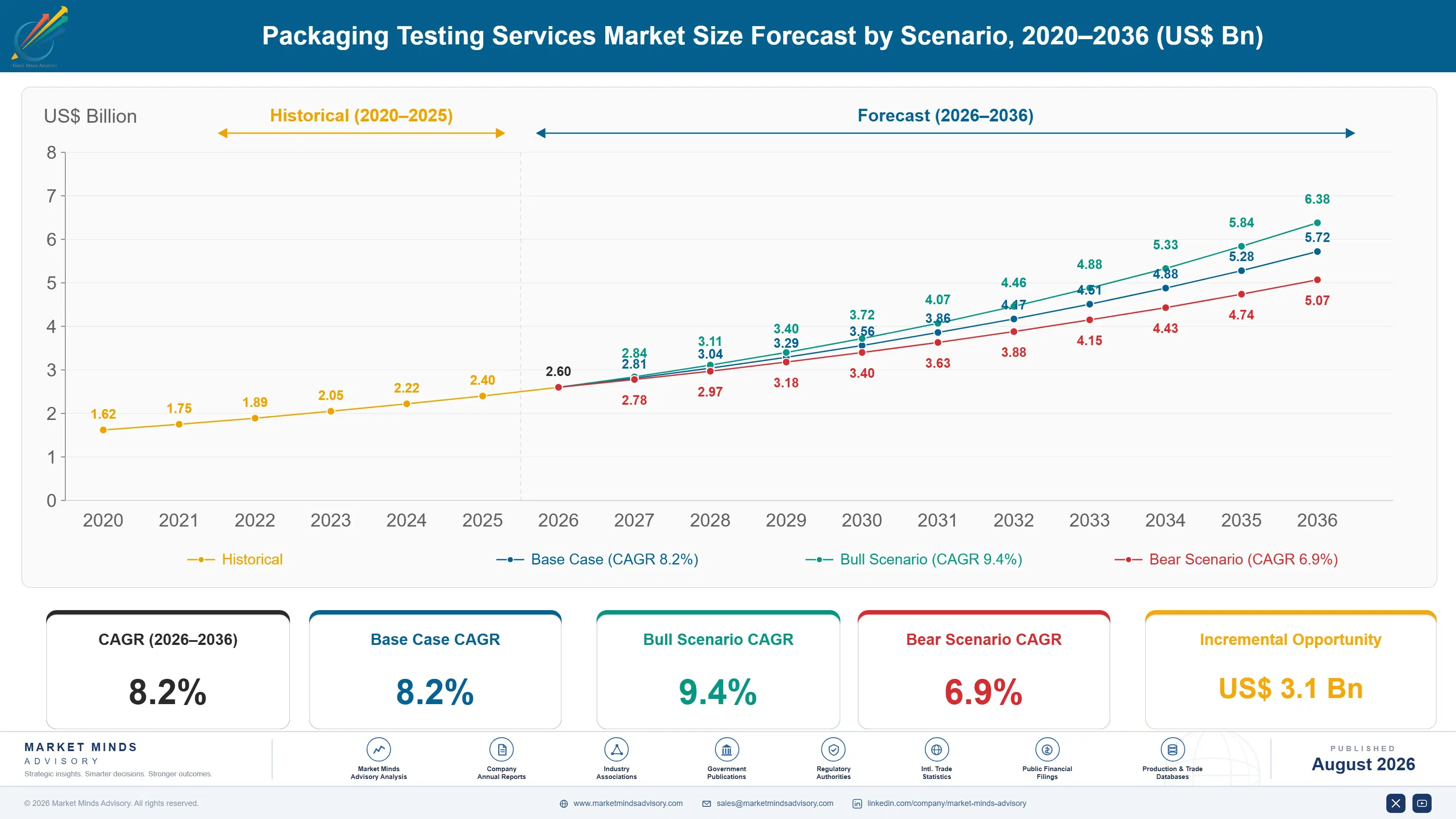
Packaging Testing Services Market Forecast Scenarios

packaging-testing-services-market-size-forecast-scenario-1787308430388
Between 2020 and 2025 the market grew at roughly 7.0% a year, accelerating as e-commerce distribution simulation testing volume expanded and early sustainable material certification demand began reshaping accredited lab investment priorities toward the end of the period. That acceleration caught several labs without certification accreditation scrambling to catch up. That scramble reshaped how quickly providers justified certification accreditation investment industry-wide.
The base case carries the market to an 8.2% CAGR on three mechanisms. First, recyclability and compostability regulation keeps expanding across additional jurisdictions, forcing brand owners toward certification testing on regulatory rather than purely voluntary timelines. Second, pharmaceutical and biologics packaging validation requirements keep expanding as biologics approval volume continues growing globally. Third, e-commerce distribution simulation testing keeps growing as online retail volume continues expanding beyond traditional retail distribution patterns. These three mechanisms reinforce each other steadily across most major testing categories.
The bull case reaches 9.4% if additional jurisdictions adopt recyclability certification mandates faster than currently scheduled, accelerating testing demand industry-wide. The bear case falls to 6.9% if accredited lab capacity constraints meaningfully slow testing throughput relative to the pace regulatory deadlines actually require. That divergence rests largely on lab capacity expansion timing. Timing matters most here.

Certification Accreditation Is Setting the Category's Growth Pace

Three forces converge on this market at once. Recyclability and compostability regulation keeps expanding on fixed compliance schedules, pharmaceutical and biologics packaging validation requirements keep expanding as approval volume grows, and e-commerce distribution simulation testing keeps growing alongside continued online retail expansion. Testing providers without accredited certification protocols risk losing bidding access to brand owners facing compliance deadlines. Testing providers un
MARKET CONCENTRATION (CR5)22%Top five providers hold a modest, fragmented share
AVERAGE TESTING FEE$8,400/programmeCertification testing commands a premium over transit simulation
TOP PRODUCING COUNTRY SHARE19%United States leads installed accredited lab testing capacity
CAPACITY UTILISATION82%Accredited certification lines run near full continuous schedules
TRADE INTENSITY14%Most testing volume completes at domestic accredited facilities
LABOR COST SHARE52% of COGSCertified technician and engineering labor dominates service cost
Commercially, the market splits between standard transit and distribution simulation testing, priced competitively and sold largely on turnaround time and cost against basic protective packaging validation, and sustainable material certification and regulatory validation testing, priced at meaningful premium and sold on accreditation credibility brand owners need for regulatory compliance. That certification category commands disproportionate growth relative to its unit volume share of the overall market. That margin gap widens as customers increasingly prioritize documented certification readiness.
Over the next decade the defining question is whether sustainable material certification testing becomes a mandatory gate for most packaging launches globally, or whether testing protocol standardization lags material innovation enough to keep certification concentrated in the specific jurisdictions with binding regulatory mandates rather than becoming the universal validation step everywhere.
"This industry used to be a quiet corner of quality assurance where a drop test and a vibration table satisfied nearly every customer. Now a brand owner cannot launch a compostable pouch in some European markets without documented certification testing from an accredited lab, and that single requirement has quietly reordered who gets invited to bid on the largest sustainability-driven testing contracts."
Director, Packaging Testing and Certification Practice · MMA Packaging / Testing

Market Trends

Sustainable Material Certification Demand Surges Amid Regulation

A growing number of jurisdictions, including the European Union's packaging and packaging waste regulation and an expanding number of American states, now require documented compostability or recyclability certification before brand owners can make packaging sustainability claims, forcing brand owners to secure accredited testing relationships years ahead of product launch rather than treating certification as an afterthought. SGS and Intertek have both expanded sustainable material certification capacity specifically targeting this regulatory conversion wave. Testing providers without accredited certification protocols risk losing bidding access to brand owners facing regulatory compliance requirements entirely.
Market Impact: Adds 5 to 8 standards yearly
E-Commerce Testing Expands Beyond Traditional ISTA Protocols

Continued e-commerce parcel volume growth keeps expanding demand for distribution simulation testing that reflects genuine last-mile delivery conditions rather than traditional retail distribution patterns, a testing category distinct from standard ISTA protocols developed decades before e-commerce became the dominant distribution channel. Bureau Veritas and several specialist testing labs have expanded e-commerce-specific simulation testing capacity specifically targeting online retail brand customers. Brand owners increasingly evaluate testing providers on e-commerce-specific protocol depth alongside pure ISTA compliance, giving specialized labs a genuine advantage. That protocol depth increasingly determines which providers win multi-year e-commerce testing contracts.
Market Impact: Adds 15% to 22% validation volume

Market Opportunities and Growth Drivers

Recyclability Regulation Drives Certification Testing Demand

Recyclability and compostability regulation, tracked across an expanding list of jurisdictions requiring documented certification before packaging sustainability claims can be made, creates genuinely fixed-timeline demand for accredited testing that brand owners cannot indefinitely defer the way voluntary sustainability initiatives often get deprioritized during budget pressure. Each newly enacted certification requirement represents recurring, multi-year testing demand tied directly to that jurisdiction's packaging launch volume, giving accredited testing providers a regulatory-anchored growth driver considerably more predictable than categories dependent purely on voluntary brand commitment alone. That regulatory anchor gives providers unusually reliable multi-year capacity planning visibility.
Market Impact: Limits standardized coverage to 55-

Biologics Packaging Validation Requirements Expand Volume

Biologics and cell and gene therapies, an expanding share of new drug approvals tracked by national regulatory agencies, require extensive packaging validation testing covering thermal performance, sterility barrier integrity, and shelf-life stability that conventional pharmaceutical packaging testing protocols were not originally designed to address at this scale. Each newly approved biologic therapy represents recurring validation testing demand tied directly to that drug's commercial packaging qualification and ongoing stability monitoring requirements. Testing providers serving these pharmaceutical accounts increasingly build regulatory credibility that strengthens their position when additional biologics manufacturers evaluate testing partner options.
Market Impact: Extends backlogs 25% to 40% longer

Market Restraints and Challenges

Test Protocols Lag Behind Novel Material Innovation

Standardized testing protocols for novel sustainable packaging materials, including seaweed-based films and advanced recyclable mono-material laminates, remain underdeveloped relative to the pace of material innovation, and the root cause is that standards development organizations require lengthy consensus-building processes that move considerably slower than individual material developers can commercialize new formulations. This protocol gap creates genuine uncertainty for brand owners seeking certification for genuinely novel materials, forcing testing providers to develop custom validation approaches that lack the credibility of established standardized protocols. Industry associations are mitigating the gap through accelerated standards development working groups specifically targeting novel sustainable material categories.
Market Impact: Covers 30+ certification standards

Lab Capacity Constraints Create Testing Backlogs

Accredited testing lab capacity remains meaningfully constrained relative to expanding certification and validation demand across most major markets, and the root cause is that building genuinely accredited testing infrastructure requires lengthy certification processes and specialized equipment investment that cannot scale as quickly as underlying customer demand growth. This capacity constraint creates real scheduling backlogs during peak certification periods, delaying brand owner product launches tied to testing completion timelines. Testing providers are mitigating the constraint through capacity expansion investment and simplified scheduling systems specifically designed to reduce backlog during peak demand periods.
Market Impact: Volume rose 20% to 28%
3 additional market trends, 4 additional growth drivers, and 3 additional restraints and challenges are covered in the full report. Contact sales@marketmindsadvisory.com to access the complete intelligence.

Segment CAGR and Growth Architecture

Segmentation follows test category and technical methodology, a single classification logic distinguishing how each service validates packaging performance. End-use industry and distribution channel are treated as separate commercial dimensions, not parallel segments here. Accreditation scope and technical methodology vary meaningfully across these categories, shaping which providers can credibly compete for each testing category today.
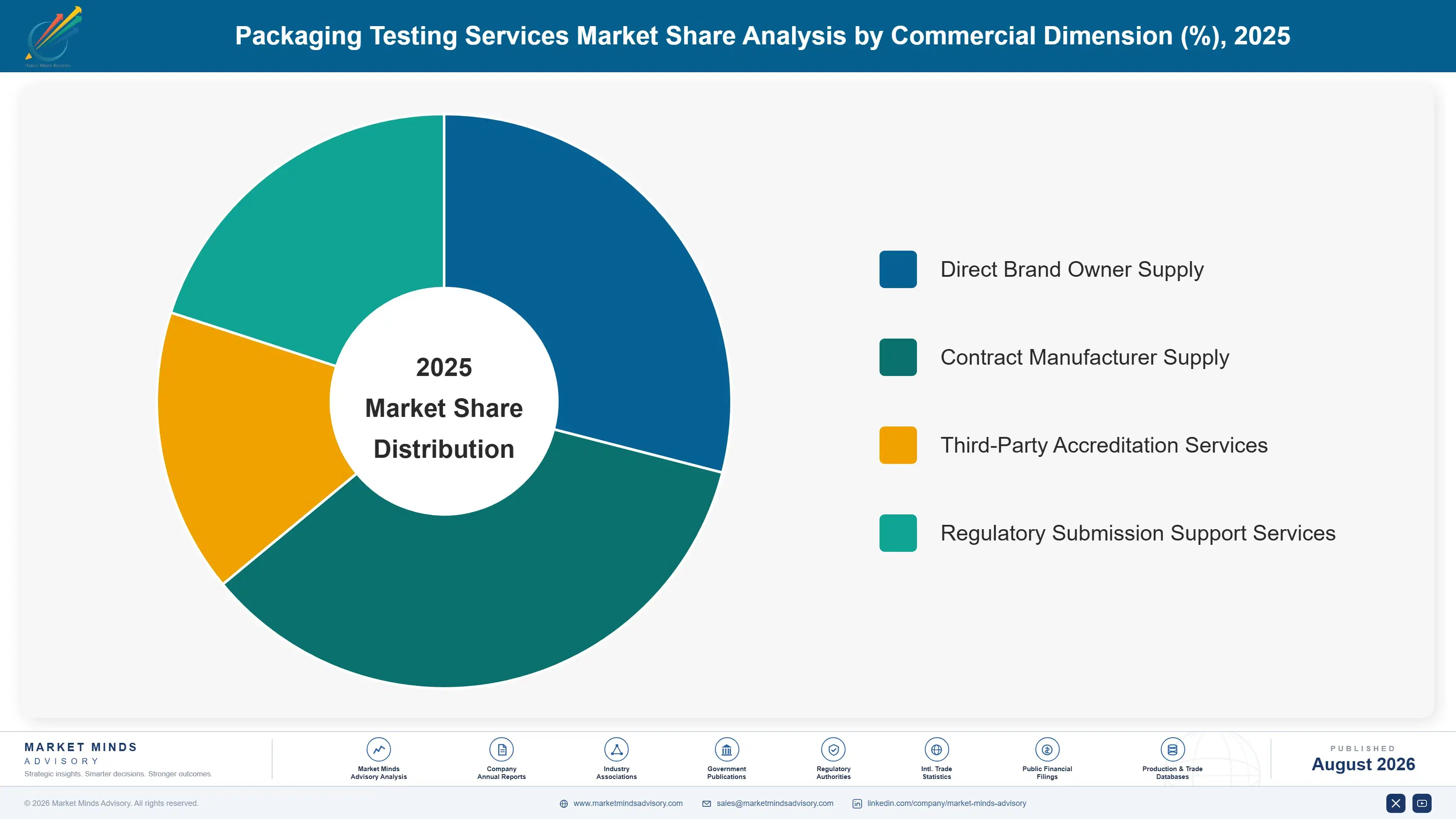
packaging-testing-services-market-market-share-analysis-1787308430953

Sustainable Material Certification Testing

Sustainable material certification testing grows fastest at 14.5%, about 1.77 times the overall rate, as recyclability and compostability regulation expands across an increasing number of jurisdictions, forcing brand owners to secure accredited certification before making packaging sustainability claims. This category commands substantial premium pricing over standard transit testing that reflects genuine accreditation complexity and the regulatory compliance value brand owners pay for directly. SGS leads commercial capacity expansion, having invested heavily in sustainable material certification infrastructure since 2023 specifically targeting this regulatory conversion wave. Adoption is fastest among brand owners in jurisdictions with binding certification mandates, while voluntary certification in markets without mandates continues growing more gradually alongside broader sustainability positioning.
CAGR 14.5%

Regulatory Compliance and Validation Testing

Regulatory compliance and validation testing, covering pharmaceutical, medical device, and biologics packaging qualification, grows at 11.8%, the second-fastest category, as expanding biologics approval volume and increasingly stringent regulatory scrutiny both drive demand for documented validation testing beyond basic transit performance. This category commands meaningful premium pricing over standard testing, reflecting genuine regulatory documentation complexity and the compliance value pharmaceutical manufacturers specifically pay for. Eurofins Scientific maintains substantial pharmaceutical packaging validation capacity serving both branded and generic drug manufacturer customers directly. Growth here reflects genuine regulatory-driven expansion within pharmaceutical packaging testing rather than pure substitution from adjacent categories. Providers without proven regulatory documentation depth increasingly struggle to win multi-year pharmaceutical contracts against established incumbents with longer track records.
CAGR 11.8%
Full segment breakdown across 6 segments available in the complete report.

Regional Architecture and Country Demand Map

North America leads on concentrated accredited lab infrastructure and FDA-driven compliance demand, Western Europe follows on established sustainability certification frameworks, and East Asia grows fastest among major regions. Latin America and the Middle East grow steadily off smaller bases, while Eastern Europe trails the regional average.

North America

The United States hosts the world's largest concentration of accredited packaging testing laboratories, with FDA regulatory requirements for pharmaceutical and medical device packaging driving substantial validation testing demand that grows in direct proportion to biologics approval volume tracked by national drug regulators. SGS and Intertek both run substantial domestic testing capacity, serving pharmaceutical, e-commerce, and consumer goods customers from accredited facilities across the country. Canada's smaller but stable testing market follows similar regulatory-driven demand patterns, though generally trailing American biologics approval volume specifically. Growth trails East Asia and South Asia and Pacific because the region's accredited lab infrastructure is already extensively built out, leaving certification depth rather than capacity expansion as the primary driver going forward.
Share: 30% | CAGR: 7.6% (2026 to 2036)

Western Europe

The European Union's packaging and packaging waste regulation has driven the most comprehensive sustainable material certification testing framework globally, with binding recyclability and compostability documentation requirements already reshaping brand owner testing budgets across member states simultaneously. Germany and France both maintain the region's most developed accredited testing infrastructure, with Bureau Veritas's substantial European operations anchoring regional supply serving both domestic and export markets across the continent. The United Kingdom's post-Brexit regulatory framework has largely maintained comparable sustainability certification targets, sustaining consistent regional demand for compliant testing. Growth trails East Asia and South Asia and Pacific as the region's regulatory-driven testing demand is already substantially mature relative to faster-growing emerging markets.
Share: 25% | CAGR: 6.7% (2026 to 2036)
Regional intelligence for 5 additional markets available in the complete report: East Asia, South Asia and Pacific, Latin America, Middle East and Africa, Eastern Europe. Contact sales@marketmindsadvisory.com.
packaging-testing-services-market-country-cagr-analysis-1787308431466

Where Testing Providers Can Defend Margin

Four commercial moves separate providers capturing durable regulatory-driven growth from those competing purely on commodity transit testing pricing: accreditation investment timing, novel material protocol development, brand partnership depth, and capacity diversification strategy. Each move converts a technical or timing advantage into a defensible commercial position competitors without matching accreditation or protocol depth cannot easily replicate quickly.

Secure Certification Accreditation Ahead of Regulatory Deadlines

Brand owners facing binding certification deadlines need testing providers who can actually deliver accredited results, and providers securing certification accreditation ahead of confirmed mandate enforcement dates capture disproportionate share of the conversion wave as customers lock in testing relationships well before their own compliance deadlines force urgent decisions. This is a genuine accreditation race, and providers who wait for mandates to fully materialize before investing risk losing accounts to competitors already accredited and ready. Providers investing ahead of deadlines typically capture 30% to 45% of the resulting certification demand before competitors fully mobilize accreditation.
Market Impact: Early movers capture 30% to 45% of

Develop Novel Material Protocols to Close Standardization Gaps

Standardized protocol gaps for novel sustainable materials represent a genuine barrier to broader certification testing adoption, and providers investing in custom validation methodology development that closes this gap while maintaining testing credibility capture business competitors without comparable protocol development capability cannot serve. This methodology investment differentiates beyond pure capacity and pricing competition, addressing the specific validation gap that otherwise limits addressable novel material testing range meaningfully. Providers with proven novel material protocols report expanding their addressable testing range by 20% to 30% relative to competitors without comparable capability. That methodology advantage compounds as material innovation accelerates further.
Market Impact: Expands addressable testing range b

Build Deep Brand Partnership Relationships for Premium Positioning

Brand owners pursuing multi-year sustainability and compliance commitments increasingly seek testing partners who can support broader packaging strategy conversations rather than pure transactional testing relationships, and providers building this deeper partnership capability capture premium certification business that transactional competitors cannot access as easily. This partnership approach also builds switching costs, since a brand owner's packaging specification and certification documentation often becomes tied to the specific testing provider relationship over time. Providers building this partnership depth report commanding 20% to 30% pricing premiums over competitors offering purely transactional testing relationships. That switching cost compounds over multi-year certification renewal cycles.
Market Impact: Commands 20% to 30% premium for par

Diversify Lab Capacity to Manage Backlog Volatility

Accredited lab capacity constraints create genuine scheduling risk for providers dependent on single-facility or concentrated regional testing capacity, and providers building diversified capacity across multiple accredited facilities in different regions weather demand volatility with meaningfully less backlog disruption than competitors dependent on concentrated capacity facing the same peak demand periods. Providers pursuing diversified capacity report reducing scheduling backlogs by 25% to 35% during peak periods relative to competitors dependent on single-facility concentrated testing capacity that leaves them fully exposed when demand spikes sharply. That resilience compounds as competing providers face overlapping peak demand periods simultaneously.
Market Impact: Reduces backlog delays by 25% to 35

Who Controls the Margin Pool

Concentration sits at a low CR5 of 22%, with a genuinely fragmented field of diversified testing companies rather than a gap between dominant leaders and challengers. SGS and Intertek compete on global accreditation scale and testing network breadth, while Bureau Veritas and Eurofins Scientific anchor strong positions in sustainability certification and pharmaceutical validation respectively. Numerous smaller regional and specialist labs compete for narrower technical niches.
Current competitive activity runs along three lines: certification accreditation building, where providers race to secure sustainable material testing credentials ahead of regulatory deadlines; novel material protocol development, increasingly central to serving genuinely new packaging material innovation; and brand partnership building, as providers compete for durable, higher-margin certification demand beyond standard transit testing. All participants are assessed on one consistent basis, annual revenue from packaging testing services.

Pressure is building from two directions. Providers with strong certification accreditation are capturing disproportionate sustainability-driven share, a dynamic slower-moving competitors cannot easily counter through pricing alone. Meanwhile regional Asian testing providers are scaling both price-competitive and increasingly technically capable capacity, pressuring Western incumbents in cost-sensitive standard transit testing segments. Rankings over the next five years will shift toward providers combining accreditation speed with genuine novel material protocol depth.
packaging-testing-services-market-company-positioning-matrix-1787308431986

Competitive Moat and Risk Dimensions

SGS SA

Moat: Broadest global accreditation network

SGS's global network of accredited testing facilities and certification credentials spanning transit, sustainability, and regulatory validation testing let it serve multinational brand owners as a single-vendor relationship few narrower competitors can match, particularly valuable as brand owners increasingly consolidate testing vendor relationships across regions. That network breadth compounds as brand owners increasingly prefer fewer, more capable global testing partnerships.
SGS SA

Risk: Standard testing commoditization pressure

SGS faces continued price competition from smaller regional testing labs whose lower overhead cost structures can undercut pricing for standard transit and distribution testing lacking specialized certification requirements, exposing SGS's commodity-adjacent business to price competition that its sustainability certification business does not face to the same degree.
EUROFINS SCIENTIFIC SE

Moat: Deep pharmaceutical validation expertise

Eurofins Scientific's decades of pharmaceutical and biologics testing relationships, built through extensive regulatory validation experience across major drug regulatory jurisdictions, give it a defensible core business generating stable cash flow that funds expansion into faster-growing biologics packaging validation categories few narrower competitors can match. That regulatory expertise compounds as biologics approval volume continues expanding globally.
EUROFINS SCIENTIFIC SE

Risk: Narrow pharmaceutical category concentration

Eurofins Scientific's revenue concentration in pharmaceutical and life sciences testing, while highly defensible, leaves it more exposed than diversified competitors to any sustained shift in pharmaceutical regulatory testing requirements or alternative validation approach adoption within that specific narrow category over the coming decade. That concentration risk could meaningfully slow Eurofins' growth if pharmaceutical testing requirements shift unexpectedly.

Players Tracked

Prominent Players

SGS SA
Intertek Group plc
Bureau Veritas SA
Eurofins Scientific SE
TUV SUD AG

Other Key Players

Westpak Inc.
Element Materials Technology
DEKRA SE
UL Solutions Inc.
Pace Analytical Services LLC
Smithers plc
Packaging Technologies and Inspection LLC
STAMAR Packaging Inc.
Packaging Compliance Labs LLC
Applied Technical Services Inc.
Weiss Technik North America Inc.
TUV Rheinland Group
ALS Limited
Merieux NutriSciences Corporation
SATRA Technology Centre

Recent Developments

APRIL 2025

SGS expands sustainable material certification capacity

SGS commissioned expanded sustainable material certification testing capacity specifically targeting brand owners facing binding European Union recyclability and compostability compliance deadlines. This was an organic capacity expansion funded from existing capital, not an acquisition or partnership, reflecting sustained demand growth from brand owners seeking accredited certification testing.
Signal: Continued capacity investment in sustainab
OCTOBER 2024

Eurofins signs testing agreement with major biologics manufacturer

Eurofins Scientific signed a multi-year testing agreement with a major biologics manufacturer to provide packaging validation and stability testing across its global product portfolio. This was a commercial testing services agreement, not a joint venture or acquisition, securing recurring testing volume tied to expanding biologics production.
Signal: Large pharmaceutical testing agreements sh
JANUARY 2025

Bureau Veritas acquires novel material testing laboratory

Bureau Veritas completed the acquisition of a privately held laboratory specializing in novel sustainable packaging material characterization and certification testing methodology. This was an acquisition, not a joint venture or minority investment, giving Bureau Veritas full ownership and control of the acquired technology and technical staff.
Signal: Continued acquisition activity in novel ma

Certified Technician Labor Drives Service Cost

Certified technician and engineering labor accounts for roughly fifty-two percent of production COGS, concentrated among specialized testing personnel based in North America, Western Europe, and increasingly China, where technical training infrastructure has expanded steadily since 2020. Specialized testing equipment and calibration costs add a further meaningful cost layer sensitive to precision instrumentation pricing. Certification lab accreditation renewal fees add a further modest layer spe
The clearest recent volatility event traces to 2022 and 2023, when specialized technician labor costs rose meaningfully across the industry broadly, documented by national labor statistics agencies, as post-pandemic demand for accredited testing services outpaced available certified technician supply across most major testing markets. Several testing providers reported meaningful cost pass-through delays during this period, as fixed-price customer contracts limited their ability to immediately adjust pricing to reflect rapidly rising labor costs.

Exposure varies by provider scale and workforce relationships. Larger providers with structured technician training programmes and diversified geographic workforce sourcing weathered the labor cost pressure with meaningfully less disruption than smaller providers dependent on regional labor markets alone. Providers serving customers under fixed multi-year contracts faced particular pressure to maintain pricing commitments despite rising labor costs across the category.
packaging-testing-services-market-cost-volatility-analysis-1787308432185

Invest in Structured Technician Training Programmes

Providers are increasingly building internal technician training and certification programmes, reducing dependency on external labor market supply and securing a pipeline of qualified testing personnel ahead of demand growth. This training investment increasingly mirrors workforce development discipline already standard across other specialized technical service categories facing comparable talent scarcity. That pipeline reduces long-term staffing risk meaningfully.

Index Long-Term Customer Contracts to Labor Cost Benchmarks

More providers now write labor cost pass-through clauses directly into multi-year brand owner testing agreements, tying service pricing to published technical labor benchmark indices rather than negotiating each adjustment separately after cost increases have already occurred. Customers generally accept these clauses now, having watched competitors absorb painful losses without comparable protection previously. That protection now shapes vendor selection.

Invest in Testing Automation to Reduce Labor Intensity

Some providers are investing in automated testing equipment and data collection systems that reduce the technician labor hours required per testing programme while maintaining accuracy and documentation quality, cutting labor cost exposure per unit even as automation investment requires meaningful upfront capital. That efficiency gain increasingly favors providers with strong automation engineering expertise over those relying on manual testing protocols.

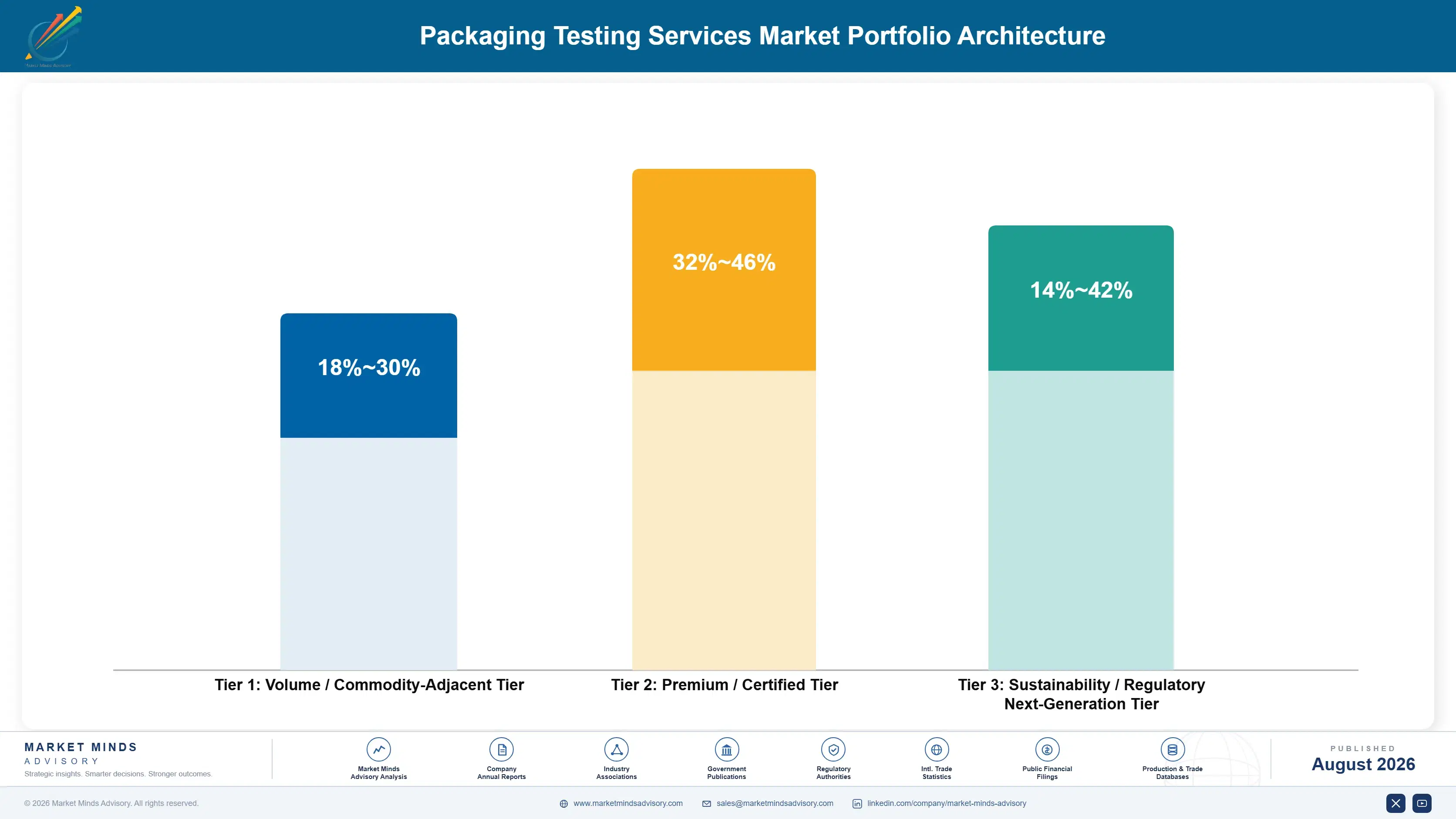
Portfolio Architecture for Margin Defence

The portfolio splits into three tiers with real margin separation. Standard transit and distribution testing competes largely on price and turnaround time against basic protective packaging validation, earning modest margins defended through testing throughput scale. Sustainable material certification and regulatory validation testing earn substantially more because customers pay for accreditation credibility and regulatory compliance value standard testing alone cannot deliver. That gap widens
The tension between standard testing volume and premium certification positioning shapes provider strategy directly: standard testing keeps facilities running and builds broad customer relationships, but providers that let standard volume crowd out certification accreditation investment risk losing the fastest-growing, highest-margin category to more capability-focused competitors. Providers that manage this balance well capture both broad customer presence and premium margin.

High-value pools concentrate in sustainable material certification and pharmaceutical regulatory validation testing, where accreditation credibility and regulatory compliance value justify premium economics few commodity-focused competitors can match. The emerging novel material protocol tier currently earns unevenly as providers absorb methodology development cost against still-developing commercial adoption. That unevenness should ease as protocols mature and gain broader industry validation.

Volume / Commodity-Adjacent Tier

Standard transit and distribution simulation testing sold on price and turnaround time to mainstream consumer goods and industrial customers, where testing throughput scale determines acceptable margin. Testing throughput scale and turnaround reliability together determine acceptable margin here.
Gross Margin: 18-30%

Premium / Certified Tier

Sustainable material certification and regulatory validation testing commanding premium pricing from customers prioritizing accreditation credibility and regulatory compliance, who pay durable premiums for documented certification rather than risk noncompliance penalties.
Gross Margin: 32-46%

Sustainability / Regulatory / Next-Generation Tier

Novel material protocol development and next-generation testing methodology still absorbing development investment against developing commercial adoption, where providers are betting research capital on protocols they expect regulators to standardize broadly within several years.
Gross Margin: 14-42%
packaging-testing-services-market-portfolio-architecture-1787308432693

High-value Sub-segments and Strategic Watch-out

Regulatory-Mandated Certification Testing

High value and high growth as binding recyclability and compostability certification mandates expand across jurisdictions, commanding durable premium pricing once compliance timelines force accredited testing decisions industry-wide. Providers with the strongest accreditation readiness increasingly win contracts competitors slower to invest simply cannot secure. That gap widens further each additional quarter.
Gross Margin: 36-48%

Biologics Packaging Validation Testing

High value with strong current growth as biologics approval volume expands, priced above standard pharmaceutical testing while remaining accessible to established manufacturer budgets. Adoption is broadening steadily beyond early biologics leaders into mainstream pharmaceutical manufacturer testing programmes. Momentum keeps building steadily as biologics approval volume continues expanding.
Gross Margin: 34-46%

Standard Transit and Distribution Testing

The volume core, sold on price and turnaround time to mainstream consumer goods customers, defended mainly through testing throughput scale and thin per-programme margin discipline across facilities. Competitive pressure here concentrates on scheduling efficiency and cost rather than the certification differentiation reshaping premium tiers overall today.
Gross Margin: 18-30%

Legacy Uncertified Testing Protocols

The strategic watch-out, facing mounting obsolescence pressure as accredited certification protocols increasingly become the standard expectation for sustainability and regulatory claims. Providers still dependent on this declining tier should be actively redirecting investment toward accreditation rather than defending protocols increasingly failing brand owner credibility requirements.
Gross Margin: 6-18%

How Testing Demand Actually Recurs

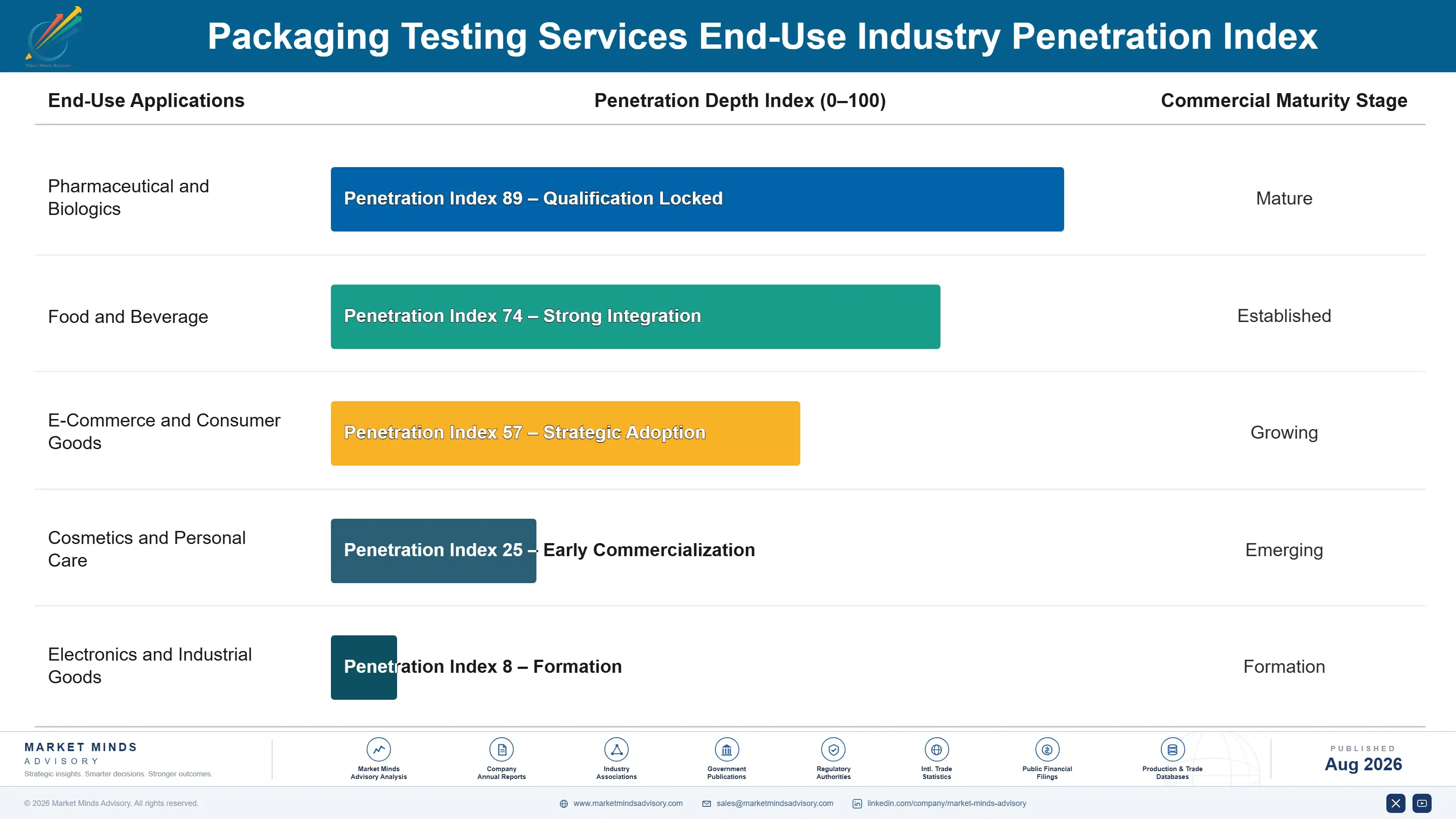
Demand here runs on continuous consumption tied directly to brand owner product launch and packaging renewal volume rather than discrete purchase events. A brand owner qualified on a provider's certification programme consumes matched testing services with every new packaging launch, making a single accreditation relationship worth years of recurring volume rather than a standalone transaction. That recurring pattern gives providers unusually predictable, multi-year revenue visibility once a tes
Adoption depth varies sharply by customer type. Pharmaceutical and biologics manufacturers integrate validated testing partners deeply into regulatory-approved product development pathways once qualified, making supplier switching costly and rare absent a compelling performance or regulatory reason. Consumer goods and e-commerce brand owners, by contrast, evaluate testing providers more flexibly based on cost and turnaround time, creating more frequent switching opportunities between competing providers.

Buyer profiles are shifting generationally as younger packaging and sustainability procurement professionals, trained on data-driven and compliance-first specification frameworks, increasingly treat accredited certification testing as a baseline requirement rather than a differentiator requiring special justification. Older procurement teams trained primarily on cost-first specification are adapting more gradually, but that generational shift is accelerating as regulatory deadlines force testing decisions across the industry.
packaging-testing-services-market-end-use-penetration-index-1787308433190

Where Testing Services Value Concentrates Next

These are among the four positions where our research anticipates prominent divergence between winners and laggards over the coming forecast period. Each is grounded in the demand model, the regulatory perimeter, and the announced capacity pipeline.
01 / CERTIFICATION ACCREDITATION INVESTMENT

Build accredited testing capability ahead of deadline pressure

Brand owners facing binding certification deadlines need providers ready to deliver accredited results on schedule, and providers investing ahead of confirmed regulatory enforcement dates capture the conversion wave before competitors catch up. This is a genuine accreditation race with real consequences for companies that wait too long to commit capital. Providers moving decisively now will own the relationships that regulatory deadlines are about to make urgently valuable across an expanding list of jurisdictions., a race with real consequences for companies that hesitate too long.
02 / NOVEL MATERIAL PROTOCOL DEVELOPMENT

Close the standardization gap before it becomes a category ceiling

Standardized protocol gaps for novel sustainable materials genuinely cap addressable certification market range, and providers investing in methodology development that closes this gap capture testing volume competitors cannot serve credibly. This methodology investment differentiates beyond pure capacity and pricing competition. Companies treating protocol development as secondary to raw capacity expansion are underestimating how directly it determines total addressable market size as material innovation accelerates., and that ceiling grows more consequential each year as material innovation accelerates across additional sustainable packaging categories and regions.
03 / BRAND PARTNERSHIP DEVELOPMENT

Build partnerships beyond transactional testing relationships

Brand owners pursuing multi-year sustainability commitments increasingly seek testing partners for broader packaging strategy conversations, not pure transactional testing, and providers building this deeper capability capture premium business transactional competitors cannot access. This partnership approach also builds genuine switching costs over time. Companies still selling purely on price and turnaround sheets are missing the relationship depth that increasingly determines premium account retention long-term., and companies still selling purely on price and turnaround sheets are missing the relationship depth that increasingly determines premium account retention over multi-year certification cycles.
04 / CAPACITY DIVERSIFICATION STRATEGY

Diversify capacity before the next demand spike cycle

Accredited lab capacity constraints are a persistent feature of a category dependent on lengthy certification buildout timelines outside provider control, and providers still dependent on concentrated single-facility capacity remain exposed to backlog disruption every time demand spikes sharply. Diversifying capacity now, rather than reactively after the next backlog crisis, protects service reliability durably. This is a defensive priority every provider serving fixed-timeline brand owner contracts should treat as non-negotiable given how exposed unprotected capacity becomes., a defensive discipline that increasingly separates resilient providers from exposed ones.

Engagement Snapshot From the Field

A live engagement with an industry participant carrying material or product regulatory and market exposure ahead of a defining policy shift, showing how our research translates into a defensible multi-year portfolio strategy.
MARKET MINDS ADVISORY · CLIENT ENGAGEMENT SUMMARY
Packaging Testing Services Producer Strategic Portfolio Review and Transition Roadmap 2026·Investment Scenario on Packaging Testing Services Exposure Evaluation 2025-26
CLIENT PROFILE
A mid-size beverage brand launching a compostable packaging line across European markets approached MMA while planning to secure accredited certification testing ahead of a binding regulatory compliance deadline. The client reported roughly USD 1.8 million in planned annual testing spending across its certification and validation programme, with no prior accredited certification testing relationship established (client-reported, unverified by MMA).
STRATEGIC CHALLENGE
Management needed to select a testing provider capable of delivering accredited certification results in time to support the planned European launch date, without disrupting the broader product development timeline the marketing team had already committed to publicly. The board wanted a defensible provider decision before the certification testing window arrived.
MMA APPROACH
MMA benchmarked accreditation scope and certification testing capacity across four qualified testing providers against the client's specific compliance requirements and launch timeline, modeled total cost of certification including potential delay risk, and assessed each provider's track record delivering comparable-scale sustainable material certifications for other beverage brands. We also interviewed the client's regulatory affairs team to confirm submission constraints the model could not capture.
KEY FINDINGS
  1. Only two of four benchmarked providers could credibly commit to delivering accredited certification results within the client's compliance timeline given current testing backlog.
  2. The total certification cost was meaningfully lower than the client's initial internal estimate once the testing scope was properly negotiated against a multi-year certification partnership.
  3. One provider's prior experience certifying a comparably positioned beverage brand's compostable packaging provided a proven certification playbook that reduced projected delay risk considerably.
  4. Sequencing the certification testing by market rather than attempting a single simultaneous pan-European submission reduced launch risk while still meeting the compliance deadline comfortably (client-reported, unverified by MMA).
CLIENT PROFILE
A mid-size beverage brand launching a compostable packaging line across European markets approached MMA while planning to secure accredited certification testing ahead of a binding regulatory compliance deadline. The client reported roughly USD 1.8 million in planned annual testing spending across its certification and validation programme, with no prior accredited certification testing relationship established (client-reported, unverified by MMA).
STRATEGIC CHALLENGE
Management needed to select a testing provider capable of delivering accredited certification results in time to support the planned European launch date, without disrupting the broader product development timeline the marketing team had already committed to publicly. The board wanted a defensible provider decision before the certification testing window arrived.
MMA APPROACH
MMA benchmarked accreditation scope and certification testing capacity across four qualified testing providers against the client's specific compliance requirements and launch timeline, modeled total cost of certification including potential delay risk, and assessed each provider's track record delivering comparable-scale sustainable material certifications for other beverage brands. We also interviewed the client's regulatory affairs team to confirm submission constraints the model could not capture.
KEY FINDINGS
  1. Only two of four benchmarked providers could credibly commit to delivering accredited certification results within the client's compliance timeline given current testing backlog.
  2. The total certification cost was meaningfully lower than the client's initial internal estimate once the testing scope was properly negotiated against a multi-year certification partnership.
  3. One provider's prior experience certifying a comparably positioned beverage brand's compostable packaging provided a proven certification playbook that reduced projected delay risk considerably.
  4. Sequencing the certification testing by market rather than attempting a single simultaneous pan-European submission reduced launch risk while still meeting the compliance deadline comfortably (client-reported, unverified by MMA).
RECOMMENDED STRATEGY
Phase 1: Phase 1 (0 to 2 months): Finalize the testing agreement with the selected provider and begin certification scope and documentation planning. Phase 2: Phase 2 (2 to 5 months): Execute the phased market-by-market certification testing, prioritizing the market with the earliest regulatory deadline. Phase 3: Phase 3 (5 to 8 months): Complete certification across all remaining markets and evaluate performance against the original launch timeline benchmark.
OUTCOME
The beverage brand began Phase 1 implementation on schedule, reporting that the negotiated certification scope kept the total testing cost within the client's original approved budget. The brand also reported that the accredited certification strengthened its marketing claims credibility with European retail partners (client-reported, unverified by MMA).

Frequently Asked Questions

Foundational context covering the market sizes, CAGR, scope, country, region and competition that inform every finding below. This section is provided to cover basics and most often pre-purchase conversations, answered from the MMA Primary Research Dataset.

What is the current size of the Packaging Testing Services Market?

The packaging testing services market was valued at USD 2.4 billion in 2025. Growth is driven by recyclability certification regulation, biologics packaging validation demand, and e-commerce distribution testing growth.

How large will the Packaging Testing Services Market be by 2036?

The market is projected to reach USD 5.712 billion by 2036 under the base case scenario. That reflects an expansion multiple of roughly 2.20 times the 2026 value.

What is the CAGR for the Packaging Testing Services Market 2026 to 2036?

The base case CAGR is 8.2%, with a bull case of 9.4% and a bear case of 6.9%. Certification mandate expansion and lab capacity constraints are the main swing factors.

Which segment is growing fastest?

Sustainable material certification testing grows fastest at 14.5% CAGR, roughly 1.77 times the overall market rate. Regulatory compliance and validation testing follows as the second-fastest segment at 11.8%.

Who are the major companies in the Packaging Testing Services Market?

Leading providers include SGS SA, Intertek Group plc, Bureau Veritas SA, Eurofins Scientific SE, and TUV SUD AG. The top five hold a combined 22% of the market.

Which country is growing fastest?

India is the fastest-growing country at 12.5% CAGR, driven by expanding pharmaceutical export testing demand and accelerating regulatory compliance requirements. Domestic testing providers anchor much of that growth.

Report Segmentation Architecture

The full report scope spans multiple orthogonal segmentation dimensions, with cross-tabulated demand data provided for each dimension pair. Coverage extends further to regional breakdowns, trend trajectories, and the competitive detail needed to support segment-level decision-making.

By Test Category and Methodology

  • Transit and Distribution Simulation Testing
  • Barrier and Permeation Testing
  • Shelf-Life and Stability Testing
  • Sustainable Material Certification Testing
  • Regulatory Compliance and Validation Testing
  • Child-Resistant and Tamper-Evident Testing

By End-Use Industry

  • Pharmaceutical and Biologics
  • Food and Beverage
  • E-Commerce and Consumer Goods
  • Cosmetics and Personal Care
  • Electronics and Industrial Goods

By Commercial Dimension

  • Direct Brand Owner Supply
  • Contract Manufacturer Supply
  • Third-Party Accreditation Services
  • Regulatory Submission Support Services

By Region

  • North America
  • Western Europe
  • East Asia
  • South Asia and Pacific
  • Latin America
  • Middle East and Africa
  • Eastern Europe

Scope, Methodology, and Coverage

Every figure in this report is reproducible from documented input assumptions. The scope below maps the historical period, the forecast horizon, the segmentation dimensions, and the countries covered, alongside the underlying primary and qualitative methodology.
Historical Period
2020 to 2025
Forecast Period
2026 to 2036
Base Year
2025 (USD billions; MMA Primary Research Dataset, August 2026)
Market Definition
The packaging testing services market comprises third-party and accredited laboratory testing, validation, and certification services for packaging performance, including transit and distribution simulation testing, barrier and permeation testing, shelf-life testing, sustainable material certification, regulatory compliance validation, and child-resistant testing. In-house testing performed by packaging manufacturers themselves, packaging design and engineering consulting services not involving physical testing, and general product testing unrelated to packaging performance are excluded.
Quantitative Units
USD billions (current prices); testing programme volume where applicable
Segmentation Dimensions
By Test Category and Methodology; By End-Use Industry; By Commercial Dimension; By Region
Regions Covered
North America, Western Europe, East Asia, South Asia and Pacific, Latin America, Middle East and Africa, Eastern Europe
Countries Covered
USA, China, Germany, France, UK, Japan, South Korea, India, Australia, Canada, Brazil, Mexico, Indonesia, Vietnam, Thailand, Malaysia, UAE, Saudi Arabia, South Africa, Nigeria, Turkey, Poland, Netherlands, Italy, Spain, Sweden, Switzerland, Argentina, Colombia, Singapore, and additional markets relevant to this sector
Key Companies Profiled
SGS SA, Intertek Group plc, Bureau Veritas SA, Eurofins Scientific SE, TUV SUD AG, Westpak Inc., Element Materials Technology, DEKRA SE, UL Solutions Inc., Pace Analytical Services LLC, Smithers plc, Packaging Technologies and Inspection LLC, STAMAR Packaging Inc., Packaging Compliance Labs LLC, Applied Technical Services Inc., Weiss Technik North America Inc., TUV Rheinland Group, ALS Limited, Merieux NutriSciences Corporation, SATRA Technology Centre
Quantitative Methodology
Primary survey, n=3,800 respondents, Q4 2025, six countries; demand-side model with trade association cross-validation
Qualitative Methodology
47 expert interviews, Q4 2025; applied to validate demand model assumptions, identify emerging dynamics, and assess competitive positioning
Report Format
PDF and XLSX data workbook (Word format preview document)
Publisher
Market Minds Advisory
Report Code
MMA-2026-PAC-901
Published
August 2026
Contact
sales@marketmindsadvisory.com | www.marketmindsadvisory.com

Purchase the full Packaging Testing Services Market Report (2026 to 2036).

The full MMA Packaging Testing Services Market report sizes demand across six test category and methodology categories, five end-use industries, four commercial dimensions, and seven regions through 2036. It profiles twenty companies on a consistent revenue basis, scoring each on accreditation breadth, novel material protocol depth, and brand partnership strength. Scenario models quantify how certification regulation expansion and lab capacity constraints move both demand and realizable pricing. The report includes delivered-cost modeling by test category and a provider capability-readiness screen built for brand owner and pharmaceutical manufacturer procurement teams.
Testing cost-curve modeling across major test categories
Certification mandate tracking and compliance deadline database by jurisdiction
Testing demand forecasts by country and test type
Accreditation and novel material protocol benchmarking across providers
Labor cost exposure modeling by provider scale
Regulatory certification scenarios under bull and bear cases

Built For The People Who Decide

From boardroom strategy to bench-side execution, this report is read cover-to-cover by leaders shaping the next decade of their industry, turning demand scenarios, market dynamics and valuation benchmarks into decisions.
CXOs/ Presidents/ VPs/ Managers
M&A and Corporate Development
Strategy Teams and R&D Heads
Procurement and Product Directors
Regulatory and Compliance Leaders
Investor Relations and Equity Analysts