Market Minds Advisory
Packaging Laminates Market

Packaging Laminates Market: Engineered Never to Separate, Now Required to Come Apart

The entire technical purpose of a laminate is adhesion strong enough that the layers never separate. Design for recycling asks for precisely the opposite, and nobody has resolved that contradiction yet.

Lead Analyst

Bilal Shaikh

Published

September 2026

Make Smarter Decisions with Customized Research Insights

Request a free sample report and evaluate market opportunities, growth trends, and competitive dynamics relevant to your business needs.

2025 MARKET VALUE$42.6BMarket Size 2025
2036 FORECAST VALUE$80.9BBase Case , 2026 to 2036
CAGR 2026 TO 20366.0 %Bull 7.2% / Bear 4.8%
INCREMENTAL OPPORTUNITY$35.7BNet 10- year value creation
EXPANSION MULTIPLE1.79x2036 value over 2026 base
Strategic Levers
M&A Pipeline
Regional Outlook
Country Rankings
Competitive Intelligence
Segmental Deep-dive
Call-Us : 91 93563 13602

Executive Snapshot and Market Trajectory

A laminate exists so that its layers never come apart. Bond strength must survive filling, retort, distribution, and two years on a shelf. Recyclability requires those same layers to separate cleanly, and nobody in this industry has reconciled the two demands yet. Sixty years of development went the other way.
Growth comes from barrier substitution rather than from more packed product. Transparent oxide barrier laminates grow fastest at 9.0%, exactly 1.50 times the market rate, because oxide-coated film delivers usable barrier inside a structure that existing sorting can actually recognise. Polyolefin mono-material follows at 8.2% on the same logic. East Asia holds the largest share, while South Asia and Pacific sits well above its framework band on the strength of Indian converting volume.
Concentration reaches only 24% across the top five measured on annual laminate volume converted, since regional converters serve brand owners nearby and finished reel freight is expensive. Substrate carries 71% of cost, which makes this a toll conversion business with a thin margin. Only 22% of current structures are compatible with existing polyolefin sorting. The remainder needs requalifying against dated brand commitments, and most converters have not started.
Market Definition
This market covers multi-layer flexible packaging laminates produced by adhesive or extrusion lamination, spanning aluminium foil, metallised film, transparent oxide barrier, polyolefin mono-material, paper-based, and standard non-barrier structures. Scope is measured at converter realised prices for laminated reel and converted formats. Base film and foil production, monolayer films, rigid packaging, lamination adhesive manufacture, pouch filling and sealing equipment, and printing plate and cylinder supply are excluded.
Base Year Value
$42.6B in 2025 (MMA Primary Research Dataset, August 2026)
Forecast Period
2026 to 2036, eleven discrete annual values
CAGR
6.0% base case. Bull 7.2%. Bear 4.8%.
Fastest Growth Segment
Transparent Oxide Barrier Laminates: 9.0% CAGR
Fastest Growth Country
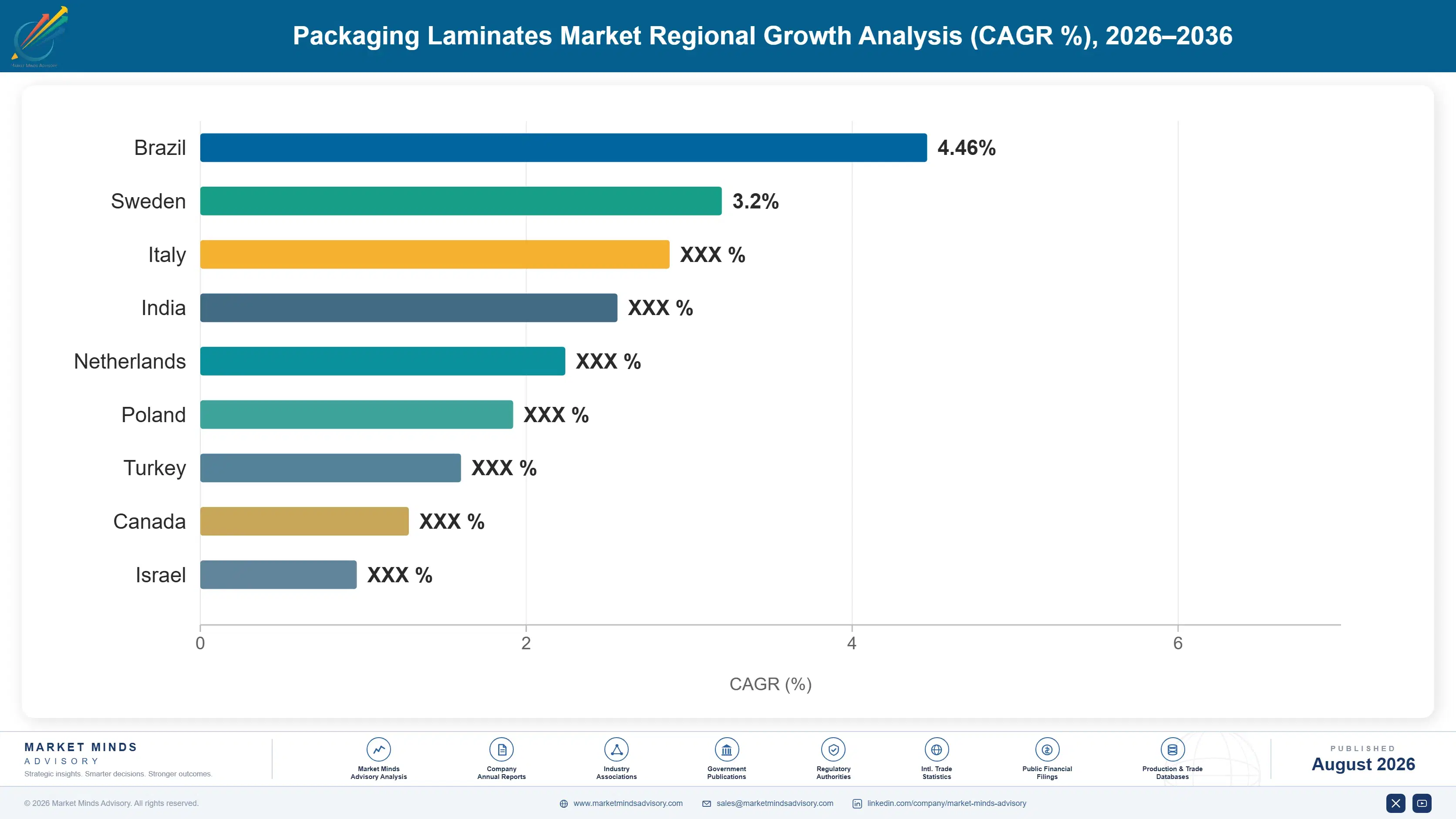
India: 10.2% CAGR
Fastest Growth Region
South Asia and Pacific: 8.2% CAGR
Largest Region
East Asia: 30% of 2025 global value
Market Leaders
Amcor. Huhtamaki. Constantia Flexibles. Sealed Air. Berry Global. Source: MMA Analysis based on company annual reports.
Primary Survey
n=3,800 procurement and R&D decision-makers, Q4 2025, six countries
Methodology
Demand-side build-up, cross-validated against public data, 47 expert interviews

Packaging Laminates Market Forecast Scenarios

packaging-laminates-market-size-forecast-scenario-1787299422290
The 2020 to 2025 period combined a demand surge with a regulatory turn. Packaged food and household product volumes rose sharply through 2020 and 2021 and settled above prior levels, while European packaging rules began targeting exactly the multi-material structures that deliver the best barrier. Film and resin prices swung hard throughout. A 4.9% historical rate averages genuine volume growth against substrate pricing that moved in both directions repeatedly.
Three mechanisms carry the 6.0% base case. Barrier substitution is the largest, moving aluminium foil and metallised structures toward oxide-coated and mono-material alternatives that sorting systems can identify. Asian packaged food volume is the second, particularly across India and Southeast Asia where sachet and pouch formats keep expanding. And retort and high-barrier premium structures are the third, commanding around 34% above ambient equivalents on a premium that has not eroded.
The 7.2% bull case rests on transparent oxide barrier reaching cost and performance parity with metallised film, which would let brand owners meet recyclability requirements without any shelf life compromise. The 4.8% bear case is design-for-recycling rules arriving faster than alternatives mature, forcing brands into structures that fail on shelf life and pushing product back into rigid packaging entirely.

The Contradiction at the Centre

Lamination is a bonding problem and everything else follows from it. The adhesive has to hold two dissimilar films together through filling stresses, through retort at wet heat if the product requires it, through distribution abuse, and through two years of shelf life without delaminating at a seal or a fold. Design for recycling asks the same structure to separate cleanly at end of life. Nobody has reconciled those requirements.
TOP FIVE CONCENTRATION24%Fragmented across regional converters serving local brand owners
SUBSTRATE COST SHARE71%Films and foils as a proportion of finished laminate cost
SOLVENTLESS LAMINATION SHARE68%Capacity running adhesive systems without any solvent recovery
ADHESIVE CURE WINDOW48 hoursRequired before a solventless laminate can be slit safely
RECYCLABLE STRUCTURE SHARE22%Laminates compatible with existing polyolefin sorting and reprocessing
RETORT STRUCTURE PREMIUM34%Price above ambient equivalent for sterilisation-capable laminate constructions
The economics are equally unforgiving. Substrate carries 71% of laminate cost, which makes converters toll processors with a thin conversion margin and very little purchasing advantage, since everybody buys film off similar indices. What separates converters is adhesive technology, print quality, and increasingly whether they can supply a structure a sorting system will recognise at all.
Two forces shape the next decade. Only 22% of current structures are compatible with existing polyolefin sorting, and the barrier ladder that fixes that runs from foil through metallised film to transparent oxide coatings at rising cost. And solventless lamination now covers 68% of capacity, trading a drying oven for a 48-hour cure window. Neither force originated inside this industry at all.
"We are asking an industry that spent sixty years perfecting bonds that never fail to now build bonds that fail on demand, in a recycling plant, but nowhere else. That is not an incremental development brief. Half the structures on shelf today have no compliant successor that holds the same shelf life."
Director. Flexible Packaging and Converting Practice · MMA Packaging and Flexibl

Market Trends

Transparent Oxide Barrier Replaces Metallised Film Steadily

Aluminium foil delivers absolute barrier and cannot be sorted or recycled in a polyolefin stream. Metallised film is lighter and cheaper but reads as metal to sorting equipment and pinholes when flexed. Silicon and aluminium oxide coatings applied to polyester or polypropylene give usable oxygen and moisture barrier while remaining transparent and sortable as plastic. Coating cost is higher and barrier performance still trails foil, which restricts application to products with moderate rather than extreme shelf life requirements. Growth runs at 9.0% against a market rate of 6.0%. Brand owners can also show the product through it.
Market Impact: India grows at 10.2% annually

Solventless Lamination Trades Drying Ovens For Cure Racks

Solventless adhesive systems now cover around 68% of laminating capacity, having removed solvent recovery plant, volatile emissions abatement, and the drying oven from the process entirely. They also run faster and use less energy. What they introduce is a cure window of roughly 48 hours before the laminate can be slit without delamination risk, which ties up floor space in cure racks and complicates production scheduling considerably. Primary aromatic amine migration limits govern that window, since food contact compliance requires the adhesive to be fully reacted. Cure racks tie up floor space and working capital.
Market Impact: Commands 34% price premium

Market Opportunities and Growth Drivers

Asian Sachet And Pouch Volumes Keep Expanding Rapidly

Single-serve sachets and stand-up pouches dominate packaged food, personal care, and household product sales across India. Indonesia, the Philippines, and much of Africa, because they match how consumers with limited cash actually purchase. Each sachet is a small laminate area but the unit counts are enormous, and the format continues taking share from larger pack sizes rather than losing it. India contributes the fastest national growth rate in this forecast at 10.2%. Converting capacity has grown alongside, and Indian converters now export laminate into Africa and the Middle East. Unit counts here are enormous even at small areas.
Market Impact: Only 22% are currently sortable

Retort Structures Command A Substantial And Durable Premium

Laminates that survive sterilisation at wet heat require adhesive and film combinations that most structures cannot deliver, since ordinary polyurethane bonds soften and delaminate under retort conditions. Ready meals, pet food, and shelf-stable prepared products all need them. That technical barrier supports a price premium around 34% above ambient equivalents and restricts the qualified converter set considerably. Demand grows as shelf-stable convenience formats displace canned and frozen products, and the premium has held steady rather than eroding as capability spread. Validation with a food customer runs several months, which restricts the qualified converter set structurally.
Market Impact: Ties up stock for 48 hours

Market Restraints and Challenges

Only A Fifth Of Structures Survive Existing Sorting Systems

Around 22% of laminate structures currently on shelf are compatible with polyolefin sorting and reprocessing, and the remainder either read as the wrong material or contaminate the stream they enter. The root cause is that barrier performance historically required combining dissimilar polymers and metals, which is precisely what defeats identification and separation. Commercial impact is regulatory exposure across the great majority of a converter's portfolio. Participants are working on oxide barrier coatings, polyolefin mono-material structures, and adhesive systems designed to release under specific recycling conditions. Barrier historically required combining dissimilar polymers and metals.
Market Impact: Growing at 9.0% annually

Cure Windows Consume Floor Space And Scheduling Flexibility

Solventless laminates need roughly 48 hours before slitting, during which reels occupy cure racks and cannot be converted, shipped, or invoiced. The root cause is adhesive chemistry: polyurethane systems must fully react before primary aromatic amine migration falls within food contact limits. Commercial impact is working capital tied up in cured stock and an inability to respond quickly to short-notice orders. Mitigation runs through faster-curing adhesive chemistries, cure room temperature control, production scheduling that batches by cure requirement, and selective retention of solvent-based capacity. Short-notice orders become genuinely difficult to accept.
Market Impact: Covers 68% of laminating capacity
3 additional market trends, 2 additional growth drivers, and 4 additional restraints and challenges are covered in the full report. Contact sales@marketmindsadvisory.com to access the complete intelligence.

Segment CAGR and Growth Architecture

Segmentation follows laminate structure and barrier system, because that combination determines shelf life delivered, sorting compatibility, cost per square metre, and which brand applications the structure can serve. End-use industry and pack format both cut across every structure rather than separating them, so neither functions as a primary dimension here. Six structures result, and they sort very differently.
packaging-laminates-market-market-share-analysis-1787299422821

Transparent Oxide Barrier Laminates

The fastest structure at 9.0%, exactly 1.50 times the market rate, and the only barrier route that keeps a laminate visible to sorting equipment as plastic. Silicon oxide and aluminium oxide coatings a few nanometres thick, applied to polyester or polypropylene film, deliver oxygen and moisture barrier well above uncoated substrate while remaining transparent. That transparency matters commercially as well as technically, since brand owners can show the product. Coating adds cost and barrier still trails aluminium foil by a wide margin, which restricts application to moderate shelf life requirements. Flex-crack resistance is the technical weakness, since the coating is brittle and a fold can compromise it. A fold can compromise the coating entirely.
CAGR 9.0%

Polyolefin Mono-Material Laminates

Second fastest at 8.2%, built entirely from polyethylene or entirely from polypropylene so that the whole structure enters a single recycling stream without contaminating it. Achieving usable stiffness and sealing performance from one polymer family requires oriented and unoriented grades of the same material laminated together, which is considerably harder than it sounds because their processing windows overlap uncomfortably. Barrier comes from oxide coating or from ethylene vinyl alcohol at low enough content to remain tolerable. Heat resistance is the persistent limitation, since a polyethylene structure softens near its own sealing temperature and the process window narrows to something operators find genuinely difficult. Barrier comes from oxide coating or low ethylene vinyl alcohol.
CAGR 8.2%
Full segment breakdown across 6 segments available in the complete report.

Regional Architecture and Country Demand Map

Converting sits close to the brand owner because printed laminate is made to order and reel freight is expensive. South Asia and Pacific sits well above its framework band on Indian converting volume, and every other region falls inside band. Printed laminate is made to order for one pack.

East Asia

Thirty percent, the largest pool, and Chinese converting capacity carries most of it across food, personal care, and household categories at enormous unit volume. Chinese converters have moved decisively to solventless lamination under domestic emissions rules, faster than the global average would suggest. Japanese and Korean demand is smaller and technically exacting, with retort structures for shelf-stable meals particularly well developed and specified to standards other markets rarely match. Domestic film production supplies most substrate needs. Growth at 7.0% runs above the global rate on packaged food volume and on barrier structure upgrading across mid-tier brands. Domestic film production supplies most substrate requirements locally, which keeps converting costs low, Barrier structure upgrading is spreading across mid-tier brands.
Share: 30% | CAGR: 7.0% (2026 to 2036)

South Asia and Pacific

Fourteen percent against a framework band of seven to twelve, and the breach reflects genuine converting volume rather than any estimation choice. Indian single-serve sachet consumption across food, personal care, and household categories runs at unit counts no other market approaches, and the format keeps taking share rather than losing it. India contributes the fastest national growth rate in this forecast at 10.2%. Indian converters now export laminate into Africa and the Middle East, which the consumption figures understate. Growth at 8.2% is the highest of any region, driven by unit volume rather than by structure upgrading. Sachet formats match how cash-constrained consumers actually purchase, and keep taking share rather than losing it.
Share: 14% | CAGR: 8.2% (2026 to 2036)
Regional intelligence for 5 additional markets available in the complete report: North America, Western Europe, Latin America, Middle East and Africa, Eastern Europe. Contact sales@marketmindsadvisory.com.
packaging-laminates-market-country-cagr-analysis-1787299423343

Where Laminate Converters Find Margin

Substrate is 71% of cost and every converter buys film off similar indices, so purchasing settles nothing at all. Margin comes from completing solventless conversion, from qualifying sortable barrier structures early, from holding retort capability, and from indexing substrate separately in contracts. Four levers follow, and two of them are contractual, rather than technical in any way.

Complete Solventless Conversion And Reclaim The Oven Space

Solventless lamination already covers 68% of capacity industry-wide, and converters still running solvent-based lines carry solvent recovery plant, emissions abatement, and a drying oven that a solventless machine does not need. Conversion frees floor space, removes an emissions permit, and cuts energy consumption by roughly 35% on the laminating step. The 48-hour cure window is the trade, and it is manageable with scheduling discipline. Retaining a single solvent line for retort and short-notice work is sensible; retaining several is simply deferred capital expenditure. An emissions permit disappears alongside the oven.
Market Impact: Cuts laminating step energy by roughly 35% overall

Qualify Sortable Barrier Structures Before Rules Take Effect

Only 22% of current structures survive existing polyolefin sorting, and brand owners facing recyclability targets need compliant alternatives that hold the same shelf life. Qualifying oxide barrier and mono-material constructions across representative product categories costs roughly 3 million dollars in trials, shelf life testing, and machinability work. Converters holding qualified structures when brands are forced to move will be quoting into a market where competitors are still running trials. Shelf life evidence rather than the structure itself is what customers actually need. Competitors will still be running trials at that point.
Market Impact: Qualification costs roughly 3 million dollars in total

Build Retort Capability Rather Than Contest Ambient Structures

Retort laminates survive sterilisation at wet heat, which ordinary polyurethane adhesive systems cannot, and they command roughly 34% above ambient equivalents with a premium that has held steady rather than eroding. Qualified converters remain few because the adhesive and film combinations are demanding and validation with a food customer takes months. Shelf-stable prepared meals and pet food keep displacing canned and frozen formats. Competing on ambient laminate against every regional converter is a considerably harder way to make the same money. Shelf-stable formats keep displacing canned and frozen products, and the qualified field stays narrow.
Market Impact: Premium holds steady at 34% above ambient structures

Index Substrate Content Separately Within Converting Contracts

Film and foil carry 71% of laminate cost and move on petrochemical and aluminium cycles the converter does not control, while conversion cost is stable and largely labour and energy. Contracts written as a single price per square metre expose the converter to the whole substrate swing inside fixed terms. Splitting the price into an indexed substrate element and a fixed conversion element removes that exposure entirely. Brand owners accept this far more readily than converters expect, because it also makes their own cost movements explicable. It also makes their own cost movements explicable internally.
Market Impact: Substrate carries 71% of the total laminate cost

Who Controls the Margin Pool

Concentration reaches only 24% across the top five measured on annual laminate volume converted, and printed reel is made to order for a specific brand and pack, which keeps converting regional. The leaders are multinational flexible packaging groups serving global brand owners across several continents, and their advantage lies in supplying one qualified structure everywhere rather than in any converting cost position. Converting cost position matters far less than reach here.
Competition runs on three fronts. Sortable barrier qualification is the first and it will decide the next several years of structure transfers. Retort capability is the second, restricting the bidder set on the highest-premium work. Print quality and colour consistency is the third, which brand owners audit relentlessly and converters treat as table stakes. Brand owners audit print quality relentlessly and endlessly.

Pressure builds from two directions. Indian and Chinese converters now supply structures at quality Western brand owners accept, at prices European and American converters cannot match. And recyclability rules threaten the majority of every converter's existing structure portfolio simultaneously. Both pressures hit the whole portfolio rather than parts, which is what makes them serious.
packaging-laminates-market-company-positioning-matrix-1787299423850

Competitive Moat and Risk Dimensions

AMCOR

Moat: Global structure qualification and reach

A multinational brand owner wanting one qualified structure supplied identically across three continents has very few options, and matching that means plants, quality systems, and audited change control in every relevant market. Structure qualification applies across the whole footprint at once. That reach exceeds any converting cost advantage.
AMCOR

Risk: Portfolio exposed to sorting rules

Global scale means global exposure, and the majority of any large converter's structure portfolio fails existing polyolefin sorting criteria today. Requalifying compliant alternatives across many customers and jurisdictions simultaneously is a far larger undertaking than it would be for a regional converter holding fewer structures.
HUHTAMAKI

Moat: Emerging market converting footprint

Substantial converting capacity across India, Southeast Asia, and Africa places the company exactly where sachet and pouch volume grows fastest and where multinational brands need local supply. That footprint took decades to build and cannot be assembled quickly, since converting must sit near the filling operation itself.
HUHTAMAKI

Risk: Emerging market price competition

The same markets that offer volume growth contain hundreds of local converters competing hard on price for structures that are not technically demanding. Sachet laminates in particular are widely produced and margin there is thin. Holding position requires either technical differentiation that most sachet applications do not need or a cost base matching operators with considerably lower overhead structures.

Players Tracked

Prominent Players

Amcor
Huhtamaki
Constantia Flexibles
Sealed Air
Berry Global

Other Key Players

Mondi
ProAmpac
Coveris
Sonoco
UFlex
Winpak
Toppan
Dai Nippon Printing
Toyo Seikan
Wipak
Schur Flexibles
Cosmo Films
Jindal Poly Films
Taghleef Industries
Klockner Pentaplast

Recent Developments

JANUARY 2025

European converter qualifies oxide barrier structure for dry food category

A flexible packaging converter completed shelf life and machinability qualification of a transparent oxide barrier laminate for a dry food category previously packed in metallised structures. The work was a technical programme with a brand customer rather than any joint venture, and commercial supply follows a packaging line trial.
Signal: Shelf life evidence rather than the structure itself is what brand owners actually need before they will move
APRIL 2025

Indian converter commissions additional solventless laminating capacity

An Indian flexible packaging manufacturer commissioned further solventless laminating capacity aimed at domestic sachet and pouch volume, replacing older solvent-based machines. The investment was organic capital expenditure funded internally rather than any partnership with an adhesive supplier or equipment builder. Capacity figures were not disclosed publicly.
Signal: Emerging market converters are skipping the solvent-based generation entirely rather than converting away from it later
AUGUST 2025

Brand owner sets mono-material target across flexible packaging portfolio

An international consumer goods company committed to converting the majority of its flexible packaging portfolio to recycling-compatible structures on a dated timetable, applying the requirement across all supplying converters globally. The commitment was an internal corporate decision rather than any regulatory obligation in most of the markets affected.
Signal: Brand commitments are propagating European recyclability requirements into markets where no such rule yet exists at all

Film. Foil, and Adhesive

Substrate dominates completely. Base films including polyester, oriented polypropylene, polyamide, and polyethylene together with aluminium foil run about 71% of laminate cost, bought from film producers on published indices. Lamination adhesive adds roughly nine percent, printing inks and solvents around eight percent, and conversion energy, labour, and waste make up the remainder across a fairly capital-intensive process.
Film pricing was the volatility that mattered and aluminium was the second. Polyester and polypropylene film prices moved sharply on resin and energy costs through the recent period, and EIA reporting on the underlying petrochemical markets documents the scale of those movements. Aluminium foil moved separately on metal pricing and conversion premiums. Converters holding fixed price contracts with brand owners absorbed both, and several regional operators exited rather than continue.

The competitive disadvantage mechanism runs through contract structure rather than purchasing skill. A converter with substrate indexed separately in its brand contracts passes film movements through automatically, while one quoting a single price per square metre absorbs the entire swing on 71% of its cost base. Integrated converters producing their own film avoid part of it, while small independents buying film on spot carry the worst position available.
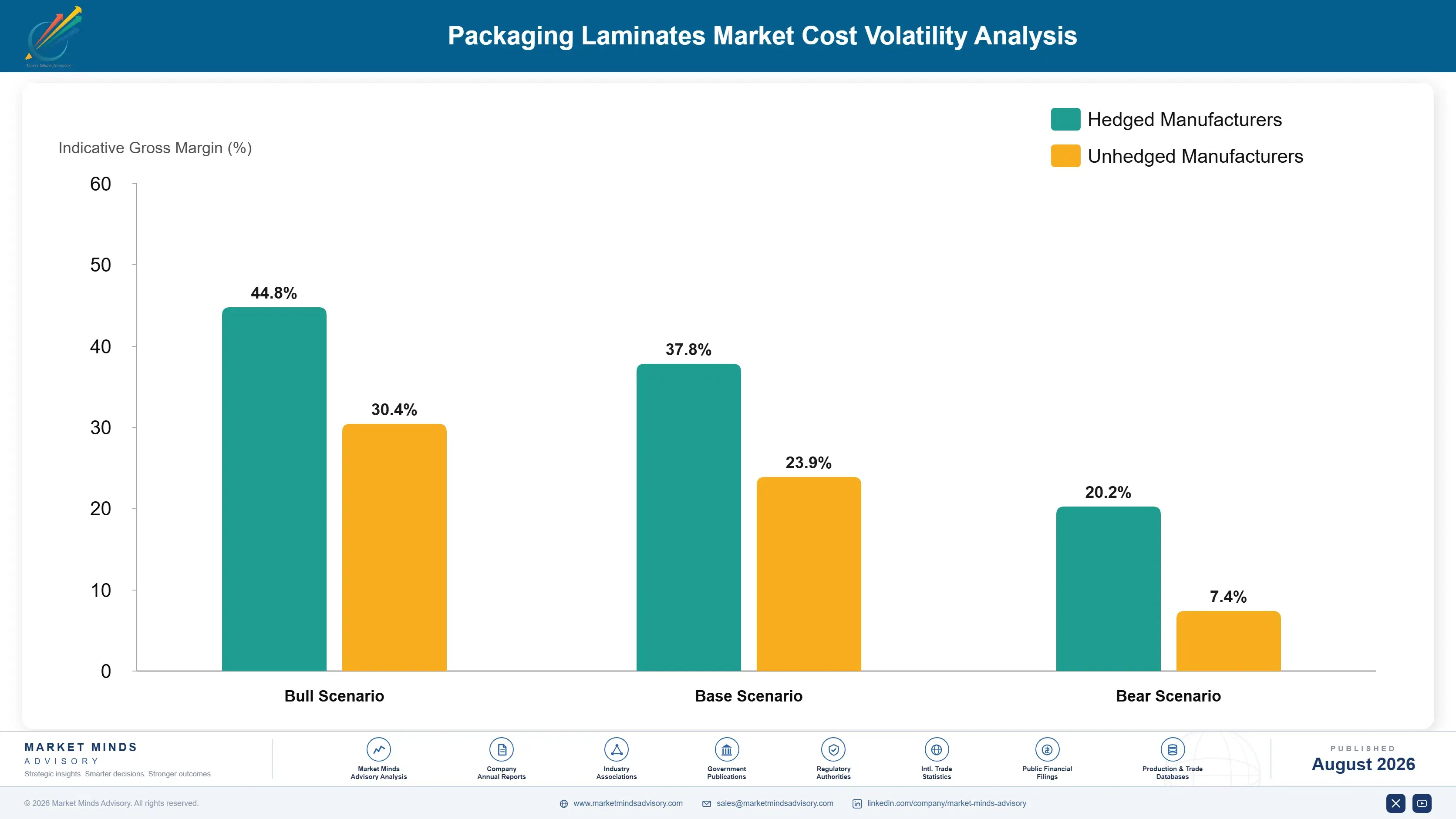
packaging-laminates-market-cost-volatility-analysis-1787299424045

Split converting contracts into indexed substrate and fixed conversion

Film and foil move on cycles that a converter cannot influence at all while its own conversion cost stays broadly stable, and a single price per square metre exposes the converter to the whole swing on 71% of its cost base. Splitting that price removes the exposure entirely and costs nothing beyond negotiating effort.

Contract base film volumes annually with quarterly index review

Buying polyester and polypropylene film on spot through a volatile resin cycle exposes a converter to movements it cannot pass through inside fixed brand contracts. Annual volume commitments with quarterly index-linked review convert that into a known exposure. Film producers offer these readily because they value the volume certainty, and converters routinely fail to ask for them.

Reduce structure weight before negotiating substrate price

Downgauging a laminate by even a few microns across each layer cuts substrate consumption directly on the input carrying 71% of cost, and most structures were specified with margin that was never revisited. Machinability and shelf life both need retesting, which takes months of work. The saving is permanent and compounds against every subsequent price movement, unlike a negotiated discount.

Portfolio Architecture for Margin Defence

Three tiers describe this business and the margin spread reflects technical difficulty rather than material content. Standard non-barrier and simple barrier structures sit at the bottom, competing on price against every regional converter and increasingly against Asian imports. Retort and high-barrier constructions sit considerably higher, protected by adhesive technology and validation. And recycling-compatible structures with proven shelf life occupy a third tier where very few converters can
The tension is that commodity structures fill the laminators. A laminating machine running below capacity converts at a cost that destroys the margin advantage premium structures carry, and printed reel campaigns are short. Several converters moved toward retort and barrier work exclusively and found their machines idle between runs, with unit conversion cost rising across everything they made. Printed reel campaigns are short by their nature.

High-value pools concentrate where the converter solves a problem the brand owner cannot solve alone. Retort validation and recyclability evidence both do exactly that, and neither is available from a commodity supplier. Neither is available from a commodity supplier anywhere, which is what protects the position.

Volume / Commodity-Adjacent Tier

Standard non-barrier and simple metallised structures for dry goods, confectionery, and household products. Thin margin under regional and Asian price competition, and the volume that keeps laminating machines loaded between premium campaigns.
Gross Margin: 13-20%

Premium / Certified Tier

Retort-capable, high-barrier, and technically demanding structures validated with the brand owner for specific products. Margin reflects adhesive technology and validation depth rather than any difference in the films being laminated together.
Gross Margin: 24-34%

Sustainability / Regulatory / Next-Generation Tier

Transparent oxide barrier, polyolefin mono-material, and recycling-compatible structures supplied with shelf life evidence. Best margin because very few converters can supply them today and brand owners face dated commitments they must meet.
Gross Margin: 29-41%
packaging-laminates-market-portfolio-architecture-1787299424546

High-value Sub-segments and Strategic Watch-out

Recycling-Compatible Barrier Structures

Best margin and fastest growth at 9.0%, since only 22% of current structures survive existing sorting and brand owners face dated commitments. Shelf life evidence rather than the structure itself is what customers are actually buying here. Very few converters can supply them at all today.
Gross Margin: 29-41%

Retort And High-Barrier Constructions

Strong margin holding steady at 34% above ambient equivalents, protected by adhesive systems that survive sterilisation at wet heat where ordinary polyurethane bonds simply fail outright. Validation with a food customer takes many months of work, which keeps the qualified converter set genuinely small indeed.
Gross Margin: 24-34%

Standard And Simple Barrier Structures

The volume core at thin margin under both regional and Asian price competition, and the loading that makes laminating machine economics work at all. Converters who chased premium work exclusively found their machines standing idle between short printed campaigns, with conversion cost rising across everything.
Gross Margin: 13-20%

Aluminium Foil Laminate Structures

The strategic watch-out, delivering absolute barrier that nothing else can match while remaining invisible to sorting equipment and unrecyclable in any polyolefin stream. Products depending on it currently have no compliant successor holding equivalent shelf life anywhere, at any price and on any timescale that matters.
Gross Margin: 18-27%

Why Structures Outlast Contracts

A laminate structure runs for the commercial life of the product it packs, because shelf life is established against that specific construction and changing it means fresh stability and machinability work. Contracts run one to three years and renew on price, but the structure decision was made at launch and rarely revisited. Printed reel is made to order against forecast, so demand tracks the brand's own sales directly. What ends a relationship is a quality failure or a structure change.
Depth of relationship varies enormously by customer type. Multinational brand owners qualify structures centrally and apply them globally, holding converters across decades through specification. Regional food producers buy locally on price with short commitments. Contract packers change structures with every client they win. Private label suppliers to retail sit between the two, specified by the retailer rather than by themselves, which makes the retailer the actual decision maker.

Buyer profiles are shifting as sustainability functions take over structure decisions packaging technologists used to own. Recyclability compatibility now appears at concept stage rather than after a structure has already been running. Packaging technologists are being consulted rather than deciding, and converter sales teams have not adjusted.
packaging-laminates-market-end-use-penetration-index-1787299425037

What We Would Tell a Board

These are among the four positions where our research anticipates prominent divergence between winners and laggards over the coming forecast period. Each is grounded in the demand model, the regulatory perimeter, and the announced capacity pipeline.
01 / SORTABILITY QUALIFICATION RACE

Qualify compliant structures while competitors run trials

Only 22% of laminate structures currently on shelf survive existing polyolefin sorting, and brand owners facing dated recyclability commitments need alternatives that hold the same shelf life rather than merely the same barrier claim. Qualifying oxide barrier and mono-material constructions across representative product categories costs roughly 3 million dollars in trials and shelf life work. Converters holding that evidence when brands are finally forced to move will be quoting into a market where competitors cannot yet supply anything at all.
02 / RETORT CAPABILITY POSITIONING

Compete where adhesive chemistry keeps the field small

Retort laminates survive sterilisation at wet heat that ordinary polyurethane adhesive systems simply cannot withstand at all, and they command roughly 34% above ambient equivalents with a premium that has not eroded as capability spread. Validation with a food customer takes many months of work, which restricts the qualified converter set structurally rather than merely temporarily. Contesting ambient structures against every regional converter and every Asian importer is a considerably harder route to precisely the same revenue at rather worse margin.
03 / CONTRACT STRUCTURE DISCIPLINE

Index the substrate; you cannot absorb seventy-one percent

Film and foil carry 71% of laminate cost and move on petrochemical and aluminium cycles no converter influences, while conversion cost is stable and largely labour and energy. Contracts written as a single price per square metre expose the converter to the entire substrate swing inside fixed terms, which is how regional operators have exited during every recent price cycle. Brand owners accept split indexing far more readily than converters expect, largely because it also explains their own cost movements internally.
04 / MACHINE LOADING BALANCE

Premium structures alone will not fill a laminator

Laminating machines carry high fixed cost and printed reel campaigns are short by nature, so a converter chasing only retort and barrier work finds its assets idle between runs and conversion cost per square metre rising across everything it produces. Several operators premiumised hard and then watched their unit economics deteriorate despite materially better prices on every individual job. The pattern that works uses commodity structures to hold machine loading steady while premium work anchors both the schedule and the margin.

Engagement Snapshot From the Field

A live engagement with an industry participant carrying material or product regulatory and market exposure ahead of a defining policy shift, showing how our research translates into a defensible multi-year portfolio strategy.
MARKET MINDS ADVISORY · CLIENT ENGAGEMENT SUMMARY
Packaging Laminates Producer Strategic Portfolio Review and Transition Roadmap 2026·Investment Scenario on Packaging Laminates Exposure Evaluation 2025-26
CLIENT PROFILE
A European flexible packaging converter with approximately 480 million dollars in annual revenue (client-reported, unverified by MMA), running printing and laminating capacity across three plants serving food and household product brand owners. The company quoted all work at a single price per square metre, held no qualified recycling-compatible barrier structures, and had lost two brand programmes to competitors offering compliant alternatives with shelf life data.
STRATEGIC CHALLENGE
Gross margin had fallen through two film price cycles despite stable volumes, and brand customers were beginning to ask for recyclability-compatible structures the company could not supply with evidence. Management proposed capital investment in additional laminating capacity. The board wanted an independent view on where the actual problem sat before approving it.
MMA APPROACH
We reconstructed margin by contract against film price movement to separate substrate absorption from pricing losses, audited the structure portfolio against published sorting compatibility criteria, and reviewed both lost programmes against what the winning converters had supplied. Brand owner sustainability and packaging functions were interviewed across seven accounts on how structure decisions were now being made.
KEY FINDINGS
  1. Substrate absorption under single-price contracts accounted for the clear majority of margin decline, concentrated precisely in the quarters when film prices moved most sharply against the client.
  2. Only 19% of the client's active structure portfolio satisfied existing polyolefin sorting criteria, against a brand customer base with commitments falling due inside four years.
  3. Both lost programmes had turned on shelf life evidence for compliant structures rather than on price, which had never been discussed in either competitive process.
  4. Sustainability functions rather than packaging technologists were deciding structure selection at five of seven accounts, and the client's commercial team had never met any of them.
CLIENT PROFILE
A European flexible packaging converter with approximately 480 million dollars in annual revenue (client-reported, unverified by MMA), running printing and laminating capacity across three plants serving food and household product brand owners. The company quoted all work at a single price per square metre, held no qualified recycling-compatible barrier structures, and had lost two brand programmes to competitors offering compliant alternatives with shelf life data.
STRATEGIC CHALLENGE
Gross margin had fallen through two film price cycles despite stable volumes, and brand customers were beginning to ask for recyclability-compatible structures the company could not supply with evidence. Management proposed capital investment in additional laminating capacity. The board wanted an independent view on where the actual problem sat before approving it.
MMA APPROACH
We reconstructed margin by contract against film price movement to separate substrate absorption from pricing losses, audited the structure portfolio against published sorting compatibility criteria, and reviewed both lost programmes against what the winning converters had supplied. Brand owner sustainability and packaging functions were interviewed across seven accounts on how structure decisions were now being made.
KEY FINDINGS
  1. Substrate absorption under single-price contracts accounted for the clear majority of margin decline, concentrated precisely in the quarters when film prices moved most sharply against the client.
  2. Only 19% of the client's active structure portfolio satisfied existing polyolefin sorting criteria, against a brand customer base with commitments falling due inside four years.
  3. Both lost programmes had turned on shelf life evidence for compliant structures rather than on price, which had never been discussed in either competitive process.
  4. Sustainability functions rather than packaging technologists were deciding structure selection at five of seven accounts, and the client's commercial team had never met any of them.
RECOMMENDED STRATEGY
Phase 1: Phase 1 (months one to six): renegotiate the contract book onto indexed substrate with fixed conversion pricing, starting with the largest accounts. Phase 2: Phase 2 (months six to twenty-four): qualify oxide barrier and polyolefin mono-material structures with shelf life testing across representative product categories. Phase 3: Phase 3 (months twenty-four to thirty-six): build direct relationships with brand sustainability functions and defer any additional laminating capacity investment.
OUTCOME
The client deferred the capacity investment and renegotiated indexing across most of its contract book within three quarters. Margin recovered close to prior levels without any price increase (client-reported, unverified by MMA), and the first qualified oxide barrier structure won back one of the two lost brand programmes.

Frequently Asked Questions

Foundational context covering the market sizes, CAGR, scope, country, region and competition that inform every finding below. This section is provided to cover basics and most often pre-purchase conversations, answered from the MMA Primary Research Dataset.

What is the current size of the Packaging Laminates Market?

The market is valued at USD 42.6 billion in 2025, rising to USD 45.16 billion in 2026. Substrate carries roughly 71% of finished laminate cost.

How large will the Packaging Laminates Market be by 2036?

MMA forecasts USD 80.87 billion by 2036, an increase of USD 35.71 billion over the 2026 base. That represents an expansion multiple of 1.79 times.

What is the CAGR for the Packaging Laminates Market 2026 to 2036?

The base case CAGR is 6.0%, with a bull case of 7.2% and a bear case of 4.8%. The historical rate from 2020 to 2025 was 4.9%.

Which segment is growing fastest?

Transparent oxide barrier laminates at 9.0%, exactly 1.50 times the market rate. Oxide coatings give usable barrier inside a structure that sorting equipment can recognise as plastic.

Who are the major companies in the Packaging Laminates Market?

Amcor, Huhtamaki, Constantia Flexibles, Sealed Air, and Berry Global lead on annual laminate volume converted. The top five hold only 24% because printed reel is made to order regionally.

Which country is growing fastest?

India at 10.2%, driven by single-serve sachet consumption at unit counts no other market approaches across food, personal care, and household categories. Indian converters now export laminate widely.

Report Segmentation Architecture

The full report scope spans multiple orthogonal segmentation dimensions, with cross-tabulated demand data provided for each dimension pair. Coverage extends further to regional breakdowns, trend trajectories, and the competitive detail needed to support segment-level decision-making.

By Laminate Structure

  • Aluminium Foil Laminates
  • Metallised Film Laminates
  • Transparent Oxide Barrier Laminates
  • Polyolefin Mono-Material Laminates
  • Paper-Based Laminate Structures
  • Standard Non-Barrier Laminates

By End-Use Industry

  • Packaged Food And Confectionery
  • Beverage And Liquid Products
  • Personal Care And Household Products
  • Pet Food And Animal Nutrition
  • Pharmaceutical And Nutraceutical Packaging

By Commercial Model

  • Brand Qualified Structure Supply
  • Open Tender Commodity Laminate Supply
  • Development And Shelf Life Testing Services
  • Contract Packer And Private Label Supply

By Region

  • East Asia
  • South Asia and Pacific
  • North America
  • Western Europe
  • Latin America
  • Middle East and Africa
  • Eastern Europe

Scope, Methodology, and Coverage

Every figure in this report is reproducible from documented input assumptions. The scope below maps the historical period, the forecast horizon, the segmentation dimensions, and the countries covered, alongside the underlying primary and qualitative methodology.
Historical Period
2020 to 2025
Forecast Period
2026 to 2036
Base Year
2025 (USD billions; MMA Primary Research Dataset, August 2026)
Market Definition
This market comprises multi-layer flexible packaging laminates produced through adhesive lamination, extrusion lamination, or coating, measured at converter realised prices for printed and unprinted laminated reel and converted flexible formats. Structure coverage spans aluminium foil laminates, metallised film laminates, transparent oxide barrier constructions, polyolefin mono-material laminates, paper-based laminate structures, and standard non-barrier laminates across all end-use industries. Base film and foil production sold as substrate, monolayer films, rigid and semi-rigid packaging, lamination adhesive and ink manufacture, pouch filling and sealing machinery, and printing plate and cylinder supply fall outside scope.
Quantitative Units
USD billions (current prices); million square metres converted; realised price per square metre
Segmentation Dimensions
By Laminate Structure; By End-Use Industry; By Commercial Model; By Region
Regions Covered
East Asia, South Asia and Pacific, North America, Western Europe, Latin America, Middle East and Africa, Eastern Europe
Countries Covered
China, Japan, South Korea, Taiwan, India, Indonesia, Vietnam, Thailand, Philippines, Australia, USA, Canada, Mexico, Brazil, Argentina, Colombia, Germany, Italy, France, Spain, UK, Netherlands, Poland, Turkey, Egypt, Nigeria, South Africa, Saudi Arabia, UAE, and additional markets relevant to this sector
Key Companies Profiled
Amcor, Huhtamaki, Constantia Flexibles, Sealed Air, Berry Global, Mondi, ProAmpac, Coveris, Sonoco, UFlex, Winpak, Toppan, Dai Nippon Printing, Toyo Seikan, Wipak, Schur Flexibles, Cosmo Films, Jindal Poly Films, Taghleef Industries, Klockner Pentaplast
Quantitative Methodology
Primary survey, n=3,800 respondents, Q4 2025, six countries; demand-side model with trade association cross-validation
Qualitative Methodology
47 expert interviews, Q4 2025; applied to validate demand model assumptions, identify emerging dynamics, and assess competitive positioning
Report Format
PDF and XLSX data workbook (Word format preview document)
Publisher
Market Minds Advisory
Report Code
MMA-2026-PAC-329
Published
August 2026
Contact
sales@marketmindsadvisory.com | www.marketmindsadvisory.com

Purchase the full Packaging Laminates Market Report (2026 to 2036).

The full report sizes packaging laminates across six structures, five end-use industries, four commercial models, and seven regions, with country detail for the twenty largest national markets. Sorting compatibility is assessed structure by structure against published recyclability criteria, alongside the shelf life each construction actually delivers. Barrier performance is documented across foil, metallised, and oxide-coated routes at comparable cost points. Competitive profiling covers twenty converters on annual laminate volume. Solventless conversion status and cure window management practice are tracked by converter and by region throughout the analysis.
Sorting compatibility assessed structure by structure against published criteria
Barrier performance documented across foil, metallised, and oxide routes
Shelf life delivered by construction at comparable cost points
Solventless conversion status tracked by converter and region
Substrate indexation practice benchmarked across contract types
Retort qualification status and premium sustainability by market

Built For The People Who Decide

From boardroom strategy to bench-side execution, this report is read cover-to-cover by leaders shaping the next decade of their industry, turning demand scenarios, market dynamics and valuation benchmarks into decisions.
CXOs/ Presidents/ VPs/ Managers
M&A and Corporate Development
Strategy Teams and R&D Heads
Procurement and Product Directors
Regulatory and Compliance Leaders
Investor Relations and Equity Analysts