Market Minds Advisory
Packaged Currants Market

Packaged Currants Market: Greek Sourcing, Clean-Label, and Regional Demand to 2036

British and Commonwealth baking traditions keep dried currants a staple fruitcake and scone ingredient even as clean-label and organic certification demands reshape sourcing, while Greek harvest volatility and shifting sulfur dioxide preservative rules pressure packers.

Lead Analyst

Lisa Gevelber

Published

September 2026

Make Smarter Decisions with Customized Research Insights

Request a free sample report and evaluate market opportunities, growth trends, and competitive dynamics relevant to your business needs.

2025 MARKET VALUE$1.4BMarket Size 2025
2036 FORECAST VALUE$2.4BBase Case , 2026 to 2036
CAGR 2026 TO 20365.2 %Bull 6.4% / Bear 3.9%
INCREMENTAL OPPORTUNITY$1.0BNet 10- year value creation
EXPANSION MULTIPLE1.66x2036 value over 2026 base
Strategic Levers
M&A Pipeline
Regional Outlook
Country Rankings
Competitive Intelligence
Segmental Deep-dive
Call-Us : 91 93563 13602

Executive Snapshot and Market Trajectory

Packaged currant demand has moved from a purely seasonal baking commodity into a year-round snacking and clean-label ingredient category, as retailers and bakery ingredient buyers increasingly specify organic-certified, sulfur-dioxide-free formats over conventional bulk currants sold primarily around Christmas and holiday baking seasons.
Organic certified currants are growing fastest as health-conscious consumers and clean-label bakery brands shift away from conventional sulfur-dioxide-treated currants toward certified organic formats free of synthetic preservatives, pulling volume toward premium retail packaging over bulk ingredient sales. Western Europe's deep-rooted fruitcake and Christmas pudding baking traditions absorb the largest share of global demand, even as Greek growers retain deep currant drying and grading expertise built over generations of near-monopoly production.
Competition sits between diversified dried fruit packers offering broad product portfolios across multiple dried fruit categories and specialty currant processors competing on Greek sourcing relationships and grading expertise. Rising demand for organic and additive-free formats is accelerating reformulation away from sulfur dioxide preservation, while Greek harvest volatility periodically disrupts global supply. Tightening documentation requirements from major retailers are pushing smaller regional packers without certified traceability infrastructure toward consolidation or exit from premium channels. today.
Market Definition
Packaged currants are dried Zante currants, small seedless dried grapes primarily grown in Greece, sold in retail and bulk ingredient packaging for baking, snacking, and confectionery applications. The market excludes fresh currants, blackcurrants and redcurrants (unrelated berry species), and other dried fruit categories such as raisins or sultanas sold separately.
Base Year Value
$1.4B in 2025 (MMA Primary Research Dataset, August 2026)
Forecast Period
2026 to 2036, eleven discrete annual values
CAGR
5.2% base case. Bull 6.4%. Bear 3.9%.
Fastest Growth Segment
Organic Certified Currants: 7.5% CAGR
Fastest Growth Country
Australia: 7.0% CAGR
Fastest Growth Region
South Asia and Pacific: 7.2% CAGR
Largest Region
Western Europe: 26% of 2025 global value
Market Leaders
Whitworths Ltd, Sun-Maid Growers of California, Traina Foods, Angas Park, and Mariani Packing Company lead the field. Source: MMA Analysis based on company annual reports.
Primary Survey
n=3,800 procurement and R&D decision-makers, Q4 2025, six countries
Methodology
Demand-side build-up, cross-validated against public data, 47 expert interviews

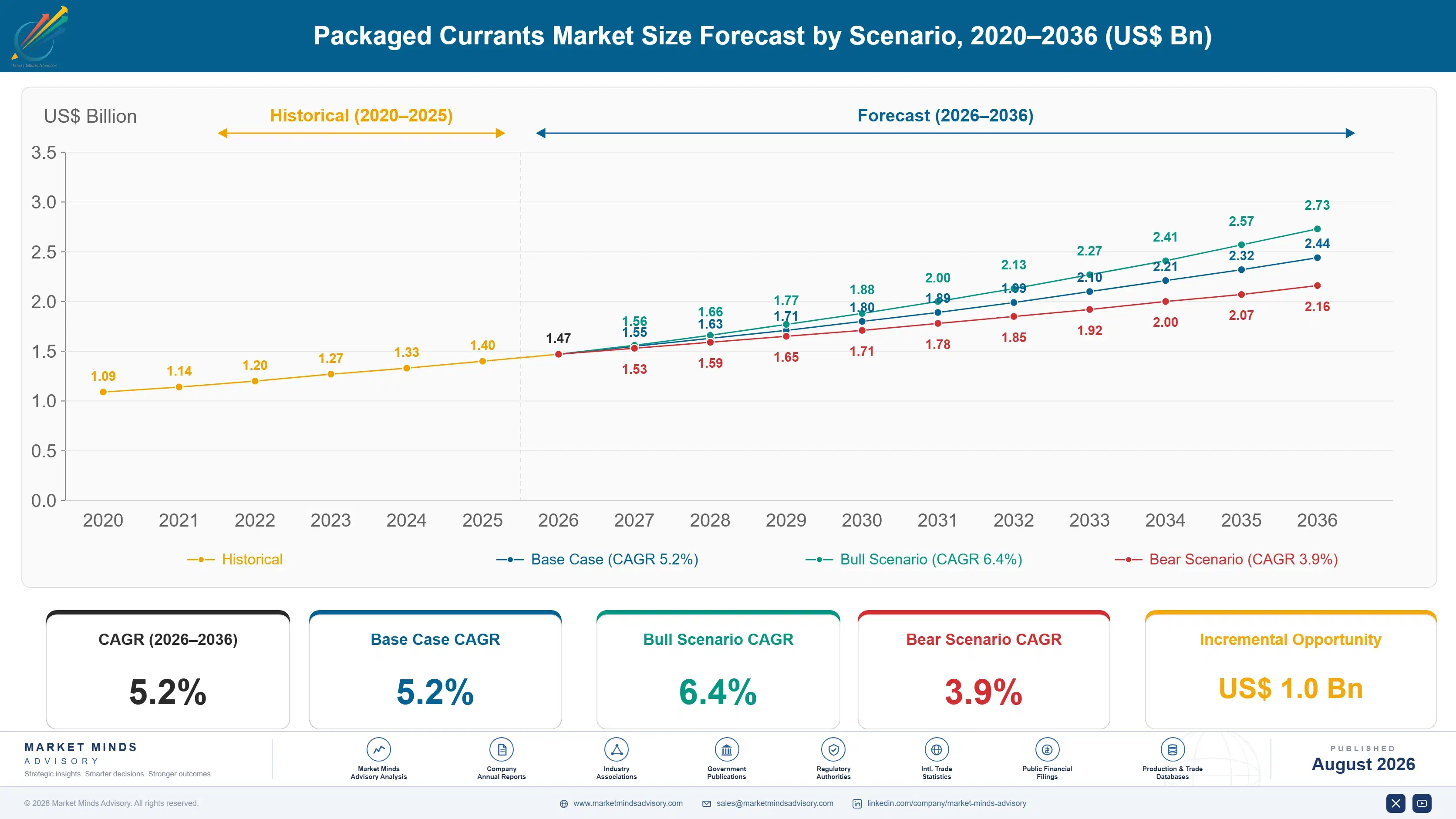
Packaged Currants Market Forecast Scenarios

packaged-currants-market-trends-size-forecast-scenario-1787559965788
Between 2020 and 2025 packaged currant demand grew at roughly 4.6 percent a year, held back early by pandemic-era foodservice and baking disruption before accelerating as home baking activity surged and clean-label snacking trends extended currant consumption beyond traditional holiday baking seasons. Greek harvest volatility during 2021 and 2022 pushed global currant prices sharply higher, temporarily compressing packer margins.
The base case assumes continued growth as three mechanisms compound: clean-label and organic certification demand pushing packers to reformulate away from conventional sulfur-dioxide-treated currants toward certified organic and additive-free formats; snacking occasion expansion extending currant consumption into year-round trail mix and snack formats; and Commonwealth market baking traditions in Australia, Canada, and South Africa sustaining steady replacement demand even as younger consumers show less familiarity with currants. Retail seasonality data increasingly confirms this shift.
The bull case turns on faster-than-expected organic and clean-label reformulation pulling premium-tier volume well ahead of current forecasts. The bear case centers on a sustained Greek harvest shortfall, which has historically compressed global supply and pushed packers toward higher-cost emergency sourcing, a pattern last seen during the 2017 Greek currant harvest shortfall. Emergency sourcing during shortfalls has periodically strained smaller packers without diversified grower agreements.

Greek Sourcing Concentration and Clean-Label Reformulation Economics

Packaged currants sit at the intersection of near-monopoly Greek production geography, shifting clean-label consumer preferences, and seasonal baking demand patterns extending into year-round snacking. As health-conscious consumers and bakery brands scrutinise preservative content, packers increasingly compete on organic certification and sulfur-dioxide-free formulation rather than price alone, even where certified organic currants carry a meaningful premium over conventional bulk supply. That premium reflects growing scrutiny of ingredient sourcing.
MARKET CONCENTRATIONCR5: 26%Ownership stays fragmented across many regional packers today
AVERAGE SELLING PRICE$2,850 per tonnePricing tracks Greek harvest volume and grading quality
CAPACITY UTILISATION71%Packing plants run moderately below full rated capacity
TOP PRODUCER SHARETop 3 countries: 82%Production concentrates overwhelmingly near Greek growing regions today
TRADE INTENSITY64% cross-borderNearly all packaged currants ship internationally from Greece
ORGANIC CERTIFIED SHARE18% of volumeCertified organic formats remain a growing minority category
Commercially the category splits between diversified dried fruit packers offering broad portfolios across raisins, sultanas, and currants together and specialty currant processors competing on direct Greek sourcing relationships and grading expertise. Diversified packers compete on distribution breadth and retail relationships, while specialty processors win on sourcing quality and traceability, since premium bakery and organic retail customers increasingly demand documented Greek origin and grading certification.
The next decade will be shaped by continued clean-label reformulation away from sulfur dioxide preservation, snacking occasion expansion beyond traditional holiday baking, and Greek supply concentration that keeps the category exposed to single-origin harvest risk. Packers that can pair certified organic sourcing with diversified supply beyond Greece stand to capture share from competitors still selling conventional currants without broader sourcing resilience.
"Nobody thinks about currants until Christmas, but the brands that win now are the ones selling them as a year-round clean snack, and that repositioning is worth more to margin than anything happening on the Greek harvest side."
Director, Dried Fruit and Bakery Ingredients Practice · MMA Agriculture and Food Ingredients Practice · August 2026

Market Trends

Clean-Label Reformulation Shifts Away From Sulfur Dioxide

Bakery brands and retailers across major consuming markets are increasingly specifying sulfur-dioxide-free and organic-certified currants over conventional formulations, responding to consumer demand for additive-free ingredient labels across packaged baked goods and snack products. Sulfur dioxide, traditionally used to preserve currant color and extend shelf life during drying and storage, has become a target ingredient for clean-label reformulation even though regulatory limits remain largely unchanged. Reformulation requires packers to adjust drying and storage processes to maintain acceptable color and shelf life without sulfur treatment, a process some smaller processors find technically challenging at commercial scale.
Market Impact: Adds 4 percent volume from organic

Snacking Occasion Expansion Extends Currants Beyond Holiday Baking

Retailers and snack brands are increasingly positioning packaged currants as a year-round healthy snacking ingredient in trail mix, cereal toppings, and standalone snack packs, extending consumption occasions well beyond the traditional Christmas and holiday baking season that historically drove the large majority of annual currant sales volume. This repositioning has required packers to invest in smaller, more convenient retail packaging formats distinct from the bulk baking-oriented packaging that dominated the category historically. Brands that have successfully repositioned currants report meaningfully more stable, less seasonally concentrated sales patterns than competitors selling primarily into holiday baking windows.
Market Impact: Sustains 3 percent baseline demand

Market Opportunities and Growth Drivers

Clean-Label Demand Drives Organic Certification Premium Growth

Health-conscious consumers and bakery brands increasingly scrutinise ingredient labels for synthetic preservatives, and organic-certified currants free of sulfur dioxide treatment command a meaningful price premium over conventional formulations as a direct result of this preference shift across major consuming markets. Organic certification requires documented supply chain traceability back to certified Greek growing regions, creating a meaningful barrier for packers without established direct grower relationships capable of supporting certification documentation requirements. Packers that have invested in certified organic supply chains report faster retail listing growth than competitors selling conventional formulations, since retailers increasingly dedicate shelf space to certified organic categories.
Market Impact: Adds up to 22 percent cost

Commonwealth Baking Traditions Sustain Steady Replacement Demand

Baking traditions in the United Kingdom, Australia, Canada, and South Africa, including fruitcake, scones, and Christmas pudding, sustain steady currant replacement demand even as overall home baking frequency has declined gradually across younger consumer generations in these markets. Seasonal holiday baking remains the largest single demand driver within these markets, though year-round snacking repositioning is gradually reducing the category's historical seasonal concentration. Packers with established retail relationships in these Commonwealth markets benefit from decades of consumer brand recognition that newer entrants from outside these traditional baking cultures find difficult to replicate quickly across unfamiliar consumer markets.
Market Impact: Cuts baking-driven demand 8 percent

Market Restraints and Challenges

Greek Harvest Concentration Creates Single-Origin Supply Risk

Global currant production concentrates overwhelmingly in Greece, particularly the Corinth region, meaning weather-driven harvest shortfalls or labor availability disruptions in this single geographic area can meaningfully constrain global supply with no readily available alternative sourcing region of comparable scale. Root causes include the specific climate and soil conditions the currant grape variety requires, historically limiting cultivation to a narrow band within Greece. When harvests fall short, packers absorb costs or pass them through, compressing category volume. Larger packers are mitigating exposure through multi-year forward purchasing agreements with Greek growers. Larger packers mitigate exposure through forward agreements.
Market Impact: Commands 25 percent organic premium

Declining Home Baking Frequency Among Younger Consumers

Younger consumer generations across major Western markets show measurably lower home baking frequency than previous generations, reducing the traditional baking-driven demand base that historically sustained the majority of currant category volume across these markets. The root cause is a broader generational shift toward convenience food purchasing and away from scratch baking, a trend that predates and extends beyond any currant-specific factor. Brands are managing the risk by repositioning currants as a snacking ingredient rather than a baking-only product, extending the category's relevance to consumers who bake infrequently but snack regularly.
Market Impact: Shifts 15 percent volume to snacking
3 additional market trends, 4 additional growth drivers, and 3 additional restraints and challenges are covered in the full report. Contact sales@marketmindsadvisory.com to access the complete intelligence.

Segment CAGR and Growth Architecture

Packaged currants segment most usefully by product format, since bulk ingredient-grade, retail snack-packaged, organic certified, and flavored formats carry distinct margin structures, retail positioning, and consumer occasions. This framework mirrors how packers organise product lines and how retailers merchandise currants across bakery aisle and snack aisle categories respectively. That structure guides retail merchandising decisions industry-wide.
packaged-currants-market-trends-market-share-analysis-1787559966368

Organic Certified Currants

Organic certified currants are the fastest-growing segment as health-conscious consumers and clean-label bakery brands shift away from conventional sulfur-dioxide-treated currants toward certified formats free of synthetic preservatives. Organic certification requires documented supply chain traceability back to certified Greek growing regions, creating a meaningful barrier for packers without established direct grower relationships capable of supporting certification documentation. Growth concentrates among packers who have invested in certified organic supply chains and can command premium retail shelf placement in dedicated natural and organic food sections increasingly common across major grocery retailers. Growth is fastest in Western Europe and North America, where organic food retail penetration is most developed and consumers show the strongest willingness to pay a premium for certified, additive-free food ingredients.
CAGR 7.5%

Retail-Packaged Snack Currants

Retail-packaged snack currants form the second-fastest-growing segment, benefiting from the broader repositioning of currants from a purely seasonal baking ingredient into a year-round healthy snacking product sold in convenient, portion-controlled retail packaging. Brands increasingly market currants alongside other dried fruit and nut snacking products, emphasising natural sweetness and nutritional content rather than positioning the product purely as a baking ingredient. Growth is fastest in markets where health-conscious snacking trends are most developed, particularly North America and Australia, where retailers have expanded dedicated healthy snacking sections that provide currant brands new distribution channels beyond traditional bakery aisle placement during holiday baking seasons specifically. Producers with established retail relationships hold a durable advantage as this segment expands further.
CAGR 6.8%
Full segment breakdown across 6 segments available in the complete report.

Regional Architecture and Country Demand Map

Packaged currant demand concentrates where Commonwealth and European baking traditions are most established. Western Europe's deep-rooted fruitcake and Christmas baking culture accounts for the largest share of global demand, while East Asia represents a comparatively small demand base given currants' limited role in regional culinary traditions.

Western Europe

The United Kingdom's deep-rooted fruitcake, scone, and Christmas pudding baking traditions make it the single largest packaged currant consuming market globally, with per-capita consumption exceeding most other major markets by a wide margin given currants' central role in traditional British baking recipes passed down across generations. Ireland shows similar baking-driven demand patterns tied to shared culinary traditions with the UK. France and Germany contribute smaller but meaningful demand from specialty bakery and confectionery applications rather than everyday home baking. Growth trails the fastest-growing regions because the region's baking-driven demand base is mature, with expansion coming mostly from organic reformulation and snacking repositioning rather than new consumption occasions. Regional demand growth trails the fastest-expanding Commonwealth markets by a margin.
Share: 26% | CAGR: 3.8% (2026 to 2036)

North America

The United States dried fruit and healthy snacking sector, among the most developed globally, drives substantial demand for currants positioned as a snacking ingredient rather than purely a baking product, reflecting broader American consumer preference for convenient, portable snack formats. Canada's baking traditions, closely tied to British Commonwealth culinary heritage, sustain steady seasonal holiday baking demand alongside growing snacking category volume. Organic and clean-label retail penetration, among the most developed globally, supports premium-tier currant sales across the region's grocery retail channels. Growth is supported by continued snacking category expansion offsetting gradually declining traditional home baking frequency. Sports nutrition and functional snacking brands add further steady demand across the region's consumer market.
Share: 24% | CAGR: 5.8% (2026 to 2036)
Regional intelligence for 5 additional markets available in the complete report: East Asia, South Asia and Pacific, Latin America, Middle East and Africa, Eastern Europe. Contact sales@marketmindsadvisory.com.
packaged-currants-market-trends-country-cagr-analysis-1787559966873

Organic Premiumisation and Snacking Repositioning

Packers can grow revenue per tonne even where baking volume growth is modest by shifting customers toward organic formats, repositioning currants as year-round snacking, and securing direct Greek grower relationships. The most durable gains come from capturing premium clean-label demand rather than competing purely on bulk commodity price. across the full calendar year rather than just holiday windows.

Converting Conventional Buyers To Certified Organic Formats

Packers investing in certified organic supply chains and direct Greek grower relationships capture a price premium of roughly 25 to 35 percent over conventional sulfur-dioxide-treated currants, reflecting the documentation, traceability, and premium retail shelf placement organic certification supports. This certification requires substantial upfront investment in grower relationship development and supply chain documentation, but the investment pays back through durable premium retail listings once achieved, since major retailers rarely delist an established organic supplier absent a serious quality failure. The approach works best for packers already serving natural and organic retail channels with comparable documentation infrastructure.
Market Impact: Commands 25 to 35 percent price premium overall

Repositioning Currants Into Year-Round Snacking Packaging

Packers introducing smaller, portion-controlled retail packaging positioned for year-round snacking rather than bulk baking use are capturing revenue from an entirely new consumption occasion, extending sales beyond the traditional holiday baking season that historically concentrated the large majority of annual category volume. This repositioning approach commands meaningfully higher per-unit margins than bulk baking packaging, and brands that have successfully repositioned report considerably more stable, less seasonally concentrated sales patterns worth an estimated 20 percent smoother annual revenue distribution than baking-only competitors. Suppliers report this repositioning delivers meaningfully stronger year-over-year retail performance than bulk baking sales alone.
Market Impact: Smooths seasonal revenue by roughly 20 percent overall

Securing Multi-Year Direct Greek Grower Supply Agreements

Packers signing multi-year direct supply agreements with Greek currant growers secure volume and pricing stability that provides meaningfully more predictable procurement costs than competitors reliant entirely on open-market spot purchasing during periodic harvest shortfalls. These direct relationships also support the traceability documentation increasingly required for organic and premium retail certification, creating a dual benefit beyond simple cost stability alone. Packers with established direct grower relationships report procurement cost volatility roughly 30 percent lower than competitors purchasing through open-market intermediary channels, reflecting the stability direct grower relationships provide during periods of harvest uncertainty.
Market Impact: Cuts procurement volatility by roughly 30 percent yearly

Bundling Retail Merchandising Support With Supply Contracts

Packers offering dedicated retail merchandising support, including seasonal display materials and year-round snacking category placement guidance, alongside supply contracts are capturing shelf space that previously went to competitors offering supply alone without merchandising partnership. This bundled approach commands meaningfully higher margins than commodity supply contracts, and retailers increasingly prefer suppliers who can guarantee coordinated seasonal and year-round merchandising support over managing category strategy independently, particularly as retailers seek to smooth the category's seasonal sales pattern, worth roughly 12 percent more retail revenue annually. Retailers increasingly favor suppliers offering this coordinated support over independent category management.
Market Impact: Lifts retail contract value 12 percent every year

Who Controls the Margin Pool

The packaged currant market is fragmented, with an estimated CR5 near 26 percent, reflecting a category where Greek sourcing relationships and retail distribution reach matter more than manufacturing scale in the conventional industrial sense. Whitworths and Sun-Maid lead on combined retail brand recognition and sourcing scale, but the gap to specialty regional packers is narrower on bulk baking-grade supply than on premium organic retail formats.
Competitive activity centers on three fronts: organic certification and clean-label reformulation aimed at capturing premium retail shelf space, snacking category repositioning to reduce seasonal demand concentration, and direct Greek grower relationship development to secure supply stability and traceability documentation. Acquisitions of specialty organic dried fruit brands have picked up as diversified packers seek to close clean-label capability gaps organically.

Emerging pressure comes from private-label retail brands increasingly offering organic-certified currants at prices below established branded competitors, threatening branded packers on the fastest-growing premium organic segment specifically. Specialty snacking brands are also pushing into the category from outside traditional dried fruit packaging, threatening to disintermediate established bakery-focused packers on the year-round snacking occasion. Rankings could shift meaningfully if a major private-label retailer achieves organic certification scale comparable to established branded suppliers.
packaged-currants-market-trends-company-positioning-matrix-1787559967391

Competitive Moat and Risk Dimensions

WHITWORTHS LTD

Moat: Deep UK Retail Brand Recognition

Whitworths' decades-long presence in UK baking aisles gives it brand recognition and retail shelf relationships that newer entrants cannot easily replicate, particularly during the concentrated holiday baking season when consumer brand familiarity strongly influences purchasing decisions. That established position lets Whitworths command premium shelf placement and pricing power that smaller regional competitors struggle to match during peak seasonal demand periods.
WHITWORTHS LTD

Risk: Slower Snacking Category Repositioning

Whitworths' deep association with traditional baking use makes it comparatively slower to reposition its brand toward year-round snacking occasions than newer entrants without established baking-only brand positioning to overcome. This has cost Whitworths share among younger, snacking-focused consumers who associate competing brands more readily with everyday healthy snacking rather than seasonal baking specifically.
SUN-MAID GROWERS OF CALIFORNIA

Moat: Broad Dried Fruit Distribution Scale

Sun-Maid's extensive distribution relationships across broader dried fruit categories, built primarily around its raisin business, give it retail shelf access and grocery buyer relationships that smaller currant-only specialists cannot easily replicate. That distribution scale helps Sun-Maid win broad category placement agreements covering multiple dried fruit products simultaneously rather than negotiating currant listings in isolation.
SUN-MAID GROWERS OF CALIFORNIA

Risk: Limited Greek Sourcing Depth

Sun-Maid's primary sourcing base in California raisins gives it comparatively less direct Greek currant grower relationship depth than specialty European competitors with decades of established Corinth region sourcing history. Sun-Maid has occasionally faced higher procurement costs during Greek harvest shortfalls than competitors with more established direct grower relationships and forward purchasing agreements already in place.

Players Tracked

Prominent Players

Whitworths Ltd
Sun-Maid Growers of California
Traina Foods
Angas Park
Mariani Packing Company

Other Key Players

National Raisin Company
Sunsweet Growers
Ocean Spray Cranberries
Paramount Farms
Del Monte Foods
Community Foods Ltd
Bakels Group
Puratos
Corbion
AAK AB
Rank Hovis
Kyknos S.A.
Diamond Foods
Colorado Mills
Meridian Foods

Recent Developments

MARCH 2026

Whitworths Launches Certified Organic Currant Snacking Line

Whitworths introduced a new certified organic currant snacking line in portion-controlled retail packaging, targeting health-conscious consumers seeking clean-label snacking options beyond the company's traditional baking-focused product range, positioning the launch as part of a broader year-round category repositioning strategy. The launch follows growing retail demand for year-round clean-label snacking options.
Signal: Signals established baking-focused brands prioritising snacking category expansion over traditional seasonal baking positioning alone. across the broader dried fruit category.
SEPTEMBER 2025

Sun-Maid Signs Multi-Year Direct Greek Grower Supply Agreement

Sun-Maid announced a multi-year direct supply agreement with a consortium of Greek currant growers in the Corinth region, securing volume and pricing stability ahead of the open market while supporting traceability documentation increasingly required for premium organic retail certification programmes. The agreement follows retailer demand for documented organic sourcing.
Signal: Confirms direct Greek grower relationships are becoming a standard competitive requirement among major dried fruit packers.
JANUARY 2026

Traina Foods Acquires Regional Organic Dried Fruit Brand

Traina Foods acquired a regional organic dried fruit brand with established natural food retail relationships and organic certification infrastructure, extending Traina's premium organic product portfolio and securing retail shelf access ahead of anticipated organic category growth. The acquisition strengthens Traina's position ahead of anticipated organic category growth.
Signal: Marks continued consolidation of specialty organic brands as diversified packers seek clean-label capability. across the wider organic snacking segment.

Greek Currant Harvest Cost Exposure

Raw currant procurement from Greek growers accounts for roughly 55 percent of cost of goods sold across most packaged currant manufacturing, with packaging, processing, and quality testing costs making up most of the remainder. Currant procurement concentrates almost entirely in Greece's Corinth region, tying production costs directly to a single geographic area's harvest volume and weather conditions.
Adverse weather during the 2017 Greek harvest season pushed global currant prices up by more than 35 percent within several months, according to European Commission agricultural market reporting on Greek dried fruit production, forcing packers with fixed-price retail contracts signed before the shortfall to absorb significant margin compression. Packers without multi-year forward purchasing agreements faced the sharpest impact, and several smaller regional packers reported delayed deliveries while sourcing alternative supply at workable prices.

Exposure varies sharply by player type: larger packers like Whitworths, with established multi-year forward purchasing agreements with Greek growers, weather harvest shortfalls with meaningfully less margin disruption than smaller packers reliant on open-market spot purchases. Geographic exposure differs less than in most other food categories, since virtually all packers depend on the same concentrated Greek growing region, meaning shortfalls affect the entire industry simultaneously rather than varying by sourcing geography.
packaged-currants-market-trends-cost-volatility-analysis-1787559967588

Securing Multi-Year Forward Purchasing Agreements With Growers

Packers are increasingly signing multi-year forward purchasing agreements directly with Greek currant growers, locking in volume and pricing ahead of harvest uncertainty rather than relying on open-market spot purchasing during periods of potential shortfall. This approach requires financial commitment most smaller packers cannot easily establish, reinforcing a cost advantage for scale players during Greek harvest volatility.

Diversifying Sourcing Into Emerging Currant Growing Regions

A small number of packers are exploring currant cultivation in emerging growing regions outside Greece, seeking to reduce single-origin concentration risk even though these emerging regions currently represent a small fraction of total global supply. This diversification remains limited by the specific climate requirements currant cultivation demands, functioning as a modest long-term hedge rather than a near-term solution.

Maintaining Strategic Currant Inventory Buffers

Larger packers maintain strategic inventory buffers sized to bridge multiple months of potential Greek harvest shortfall, accepting additional inventory carrying cost in exchange for reduced exposure to sudden procurement price spikes during shortage periods. This approach requires working capital most smaller packers cannot commit, reinforcing a durable resilience advantage for scale players during periods of harvest uncertainty.

Portfolio Architecture for Margin Defence

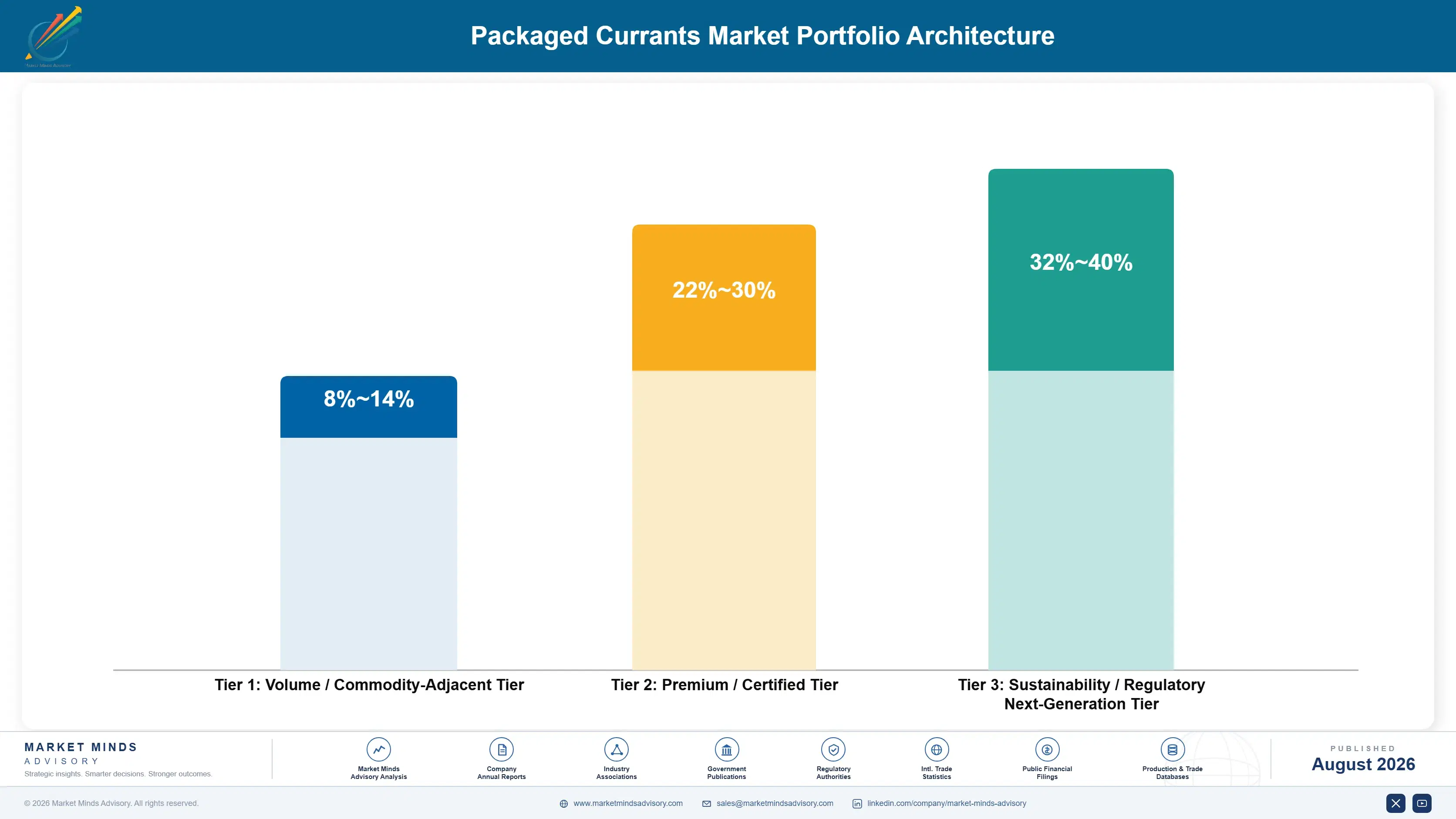
Packaged currants organise into three commercial tiers running from standard bulk baking-grade supply through certified organic retail formats to next-generation year-round snacking and premium merchandised products. Gross margins widen sharply moving up the tiers, since bulk baking-grade supply competes largely on price and delivery reliability, while organic and snacking-repositioned products capture value from certification documentation, brand positioning, and retail merchandising support rather than raw commodity cost alone.
The tension between bulk baking volume and premium retail revenue shapes packer strategy: bulk baking-grade supply generates the sourcing scale that supports grower relationship depth, but organic and snacking-repositioned products generate the margin that justifies continued brand and certification investment. Packers overweighted toward bulk-only sales face intensifying price competition from lower-cost regional competitors, while premium-forward packers carry steadier, higher-margin profitability less exposed to seasonal baking demand concentration.

High-value pools concentrate among organic certified currants sold through premium natural food retail channels, and among year-round snacking formats sold through dedicated healthy snacking retail sections. Both pools reward packers who can pair certified sourcing with smart retail repositioning rather than competing purely on bulk baking-grade commodity price. Both approaches require sustained investment in sourcing and brand positioning.

Volume / Commodity-Adjacent Tier

Standard bulk baking-grade currants sold largely on price and delivery reliability, competing on proximity to bakery ingredient distributors, serving cost-sensitive commercial baking applications broadly. Buyers here rarely pay for documentation beyond basic quality specifications.
Gross Margin: 8-14%

Premium / Certified Tier

Certified organic retail formats backed by documented Greek sourcing traceability, sold at a meaningful premium to natural and organic food retailers requiring formal certification documentation. These retailers typically require annual traceability audits and certification renewal.
Gross Margin: 22-30%

Sustainability / Regulatory / Next-Generation Tier

Year-round snacking and premium merchandised products sold through dedicated healthy snacking retail sections, priced on brand positioning and packaging innovation rather than raw commodity cost. Adoption concentrates among packers already serving natural food retail channels.
Gross Margin: 32-40%
packaged-currants-market-trends-portfolio-architecture-1787559968092

High-value Sub-segments and Strategic Watch-out

Certified Organic Currants For Premium Retail Channels

Certified organic currants sold through premium natural food retail channels command the category's highest margins and fastest growth, concentrated among packers with documented Greek grower traceability and certification infrastructure supporting rigorous retail qualification requirements. Packers compete primarily on traceability documentation and certified grower relationships. today.
Gross Margin: 36-44%

Year-Round Snacking Format Repositioning

Portion-controlled snacking formats sold through dedicated healthy snacking retail sections carry strong margins tied to brand positioning, though growth is more moderate than organic certification since adoption depends on individual packer repositioning investment and retail placement success. Adoption is strongest among brands already investing in dedicated snacking packaging.
Gross Margin: 28-36%

Standard Bulk Baking-Grade Currants

Bulk baking-grade currants remain the largest volume category by far, generating steady seasonal revenue across cost-sensitive commercial and home baking applications, even as growth increasingly shifts toward organic and snacking formats elsewhere in the portfolio. Volume stays large even as unit economics gradually erode over time.
Gross Margin: 8-13%

Greek Single-Origin Harvest Concentration Risk

Global currant supply's near-total dependence on Greek harvest volume represents a meaningful ongoing risk, since a single severe weather event could constrain global supply industry-wide with no comparable alternative sourcing region that packers dependent on Greek supply must monitor closely. Diversified packers weather this risk better than Greece-only dependents.
Gross Margin: n/a

Seasonal-To-Year-Round Demand Transition

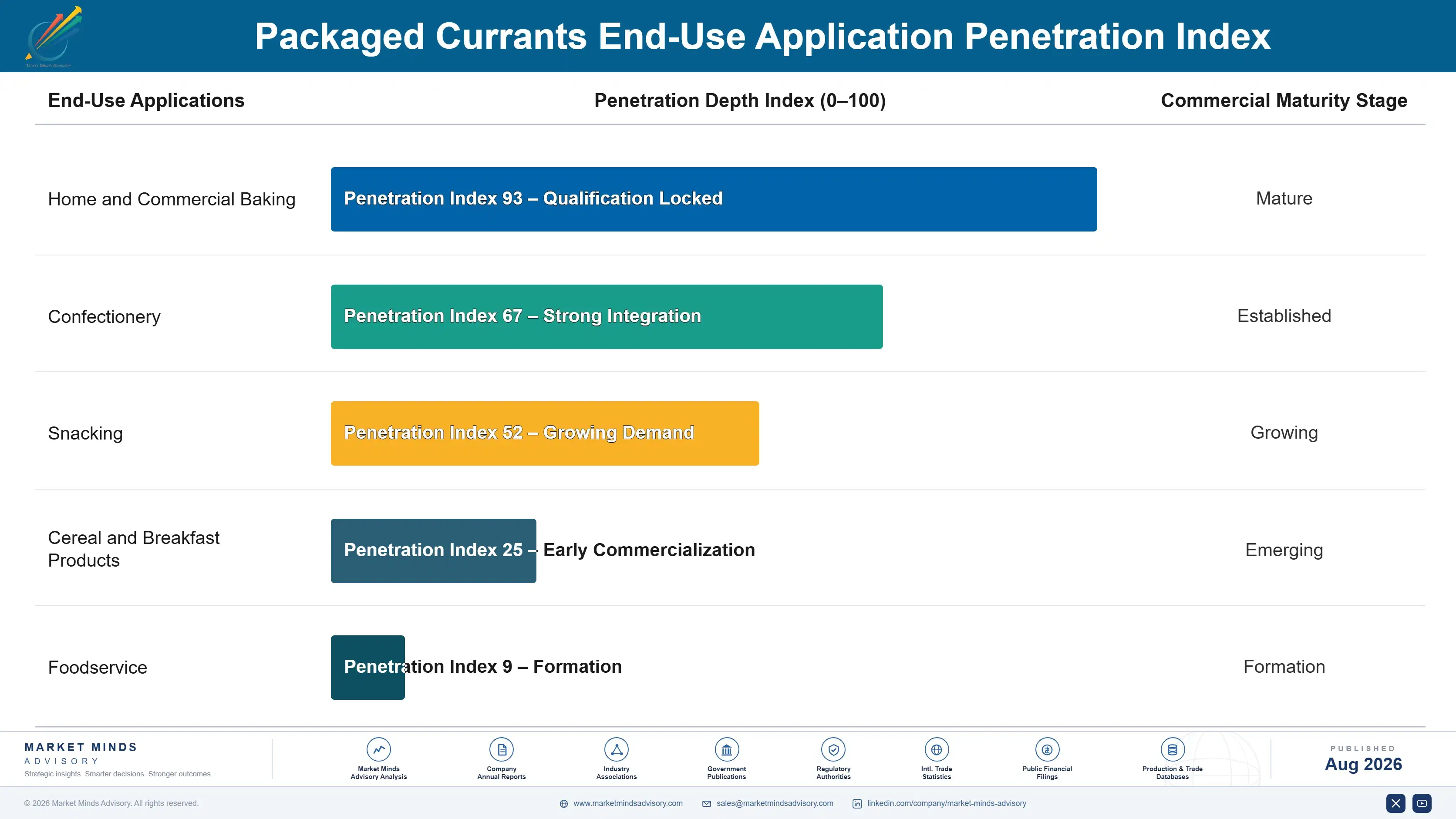
Packaged currant demand has historically behaved as a sharply seasonal category concentrated around holiday baking, but snacking repositioning is gradually building a more annuity-like, year-round demand base as brands establish currants in everyday snacking occasions beyond traditional seasonal baking windows. That transition shapes how packers plan production scheduling and inventory across the calendar year. That transition compounds gradually across successive category planning cycles.
Adoption depth varies sharply by consumer segment: traditional Commonwealth baking households penetrate deepest into seasonal holiday purchasing patterns largely unchanged for generations, while younger, snacking-oriented consumers adopt more selectively through year-round retail channels with less awareness of currants' traditional baking heritage. Commercial bakery customers sit between the two, with purchasing patterns tracking closely to institutional seasonal production schedules. Foodservice buyers show a similar mid-tier pattern.

A generational shift in buyer profiles is underway as younger retail buyers and category managers, increasingly focused on clean-label credentials and year-round category performance, demand documented organic sourcing and snacking repositioning strategy before expanding a supplier's shelf placement, replacing an older generation that selected suppliers primarily on seasonal baking category relationships. Packers slow to adapt risk losing shelf space to repositioning-forward competitors. Suppliers slow to adapt risk losing shelf space.
packaged-currants-market-trends-end-use-penetration-index-1787559968581

Where To Focus Capital Next

These are among the four positions where our research anticipates prominent divergence between winners and laggards over the coming forecast period. Each is grounded in the demand model, the regulatory perimeter, and the announced capacity pipeline.
01 / ORGANIC CERTIFICATION INVESTMENT

Prioritise Organic Certified Supply Over Conventional Bulk Volume

Organic certified currants are growing fastest and carry the category's widest margins, driven by health-conscious consumers and clean-label bakery brands shifting away from conventional sulfur-dioxide-treated formulations across most major consuming markets. Packers that invest in certified Greek grower relationships and traceability documentation are capturing this premium demand at a faster rate than competitors still selling conventional formulations without comparable certification. Capital allocated toward organic certification infrastructure and grower relationship development will likely generate better returns than bulk capacity expansion over the next several years.
02 / SNACKING CATEGORY REPOSITIONING

Reposition Currants Into Year-Round Snacking Ahead Of Rivals

Snacking category repositioning is opening a substantial addressable market beyond the traditional holiday baking season that historically concentrated the large majority of annual category volume, and packers moving first into this repositioning capture retail shelf space before competitors recognise the opportunity clearly. Portion-controlled snacking packaging commands meaningfully higher per-unit margins than bulk baking formats sold primarily during concentrated holiday periods. Packers that delay this repositioning risk ceding the fastest-growing consumption occasion entirely to more aggressive competitors already establishing year-round retail placement.
03 / DIRECT GREEK GROWER RELATIONSHIPS

Secure Direct Greek Grower Agreements Ahead Of Harvest Volatility

Greek harvest concentration creates meaningful single-origin supply risk, and packers who secure multi-year direct grower relationships ahead of the next harvest shortfall gain meaningfully more stable procurement costs than competitors reliant on open-market spot purchasing during periods of scarcity. These direct relationships also support the traceability documentation increasingly required for organic and premium retail certification simultaneously. Packers that delay building these relationships risk facing the sharpest procurement cost disruption during the next inevitable Greek harvest shortfall event, a dual-purpose advantage early movers are already establishing across major producing regions.
04 / COMMONWEALTH MARKET BRAND INVESTMENT

Defend Commonwealth Baking Brand Positions While Building Snacking

Commonwealth baking traditions in the United Kingdom, Australia, and South Africa remain the category's demand foundation, and packers with established brand recognition in these markets hold a meaningful advantage extending that trust into new snacking occasions rather than starting from zero with unfamiliar consumers elsewhere. Brand investment in these core markets requires balancing continued seasonal baking marketing against new snacking-focused positioning simultaneously. Packers that neglect core Commonwealth brand relationships while chasing snacking growth risk losing the seasonal baking foundation that still generates the majority of category revenue today.

Engagement Snapshot From the Field

A live engagement with an industry participant carrying material or product regulatory and market exposure ahead of a defining policy shift, showing how our research translates into a defensible multi-year portfolio strategy.
MARKET MINDS ADVISORY · CLIENT ENGAGEMENT SUMMARY
Packaged Currants Producer Strategic Portfolio Review and Transition Roadmap 2026·Investment Scenario on Packaged Currants Exposure Evaluation 2025-26
CLIENT PROFILE
The client is a mid-sized UK dried fruit packer with an established currant brand historically positioned almost entirely around seasonal holiday baking, representing approximately 8,500 tonnes of annual currant volume (client-reported, unverified by MMA). The packer faced declining year-over-year holiday baking season volume as younger UK consumers showed reduced home baking frequency compared with previous generations.
STRATEGIC CHALLENGE
Marketing and product leadership needed to evaluate whether repositioning the brand toward year-round snacking would offset declining seasonal baking volume, but lacked data comparing repositioning investment cost against realistic snacking category revenue potential and retail placement feasibility. Leadership also needed board-level sign-off given the scale of the affected annual revenue base across the brand's core product line.
MMA APPROACH
MMA analysts benchmarked the packer's seasonal volume trends against documented snacking repositioning outcomes from comparable dried fruit brands, modeling expected revenue smoothing and retail placement cost across representative repositioning scenarios. The engagement combined primary interviews with retail buyers, competitor repositioning case analysis, and analysis against MMA's broader dataset of dried fruit category repositioning outcomes.
KEY FINDINGS
  1. Comparable brands that repositioned toward snacking showed modeled annual revenue smoothing of roughly 20 percent, based on benchmarked competitor data (client-reported, unverified by MMA).
  2. The packer's existing packaging format was poorly suited to snacking retail sections, requiring a dedicated new packaging investment beyond simple rebranding alone.
  3. Retailers showed greater willingness to expand snacking shelf placement during scheduled category review cycles than through off-cycle placement requests. within the retailer's planning calendar.
  4. Two of three benchmarked competitor brands successfully repositioned within eighteen months using phased packaging and marketing investment rather than a single simultaneous relaunch.
CLIENT PROFILE
The client is a mid-sized UK dried fruit packer with an established currant brand historically positioned almost entirely around seasonal holiday baking, representing approximately 8,500 tonnes of annual currant volume (client-reported, unverified by MMA). The packer faced declining year-over-year holiday baking season volume as younger UK consumers showed reduced home baking frequency compared with previous generations.
STRATEGIC CHALLENGE
Marketing and product leadership needed to evaluate whether repositioning the brand toward year-round snacking would offset declining seasonal baking volume, but lacked data comparing repositioning investment cost against realistic snacking category revenue potential and retail placement feasibility. Leadership also needed board-level sign-off given the scale of the affected annual revenue base across the brand's core product line.
MMA APPROACH
MMA analysts benchmarked the packer's seasonal volume trends against documented snacking repositioning outcomes from comparable dried fruit brands, modeling expected revenue smoothing and retail placement cost across representative repositioning scenarios. The engagement combined primary interviews with retail buyers, competitor repositioning case analysis, and analysis against MMA's broader dataset of dried fruit category repositioning outcomes.
KEY FINDINGS
  1. Comparable brands that repositioned toward snacking showed modeled annual revenue smoothing of roughly 20 percent, based on benchmarked competitor data (client-reported, unverified by MMA).
  2. The packer's existing packaging format was poorly suited to snacking retail sections, requiring a dedicated new packaging investment beyond simple rebranding alone.
  3. Retailers showed greater willingness to expand snacking shelf placement during scheduled category review cycles than through off-cycle placement requests. within the retailer's planning calendar.
  4. Two of three benchmarked competitor brands successfully repositioned within eighteen months using phased packaging and marketing investment rather than a single simultaneous relaunch.
RECOMMENDED STRATEGY
Phase 1: Phase 1 (Months 1 to 6): Launch a pilot snacking packaging format in a limited number of retail partner stores to validate consumer response. Phase 2: Phase 2 (Months 7 to 14): Expand snacking placement nationally timed to the retailer's next scheduled category review cycle. across all regions. Phase 3: Phase 3 (Months 15 to 18): Introduce organic certified snacking variants to capture premium retail shelf space and pricing. to capture margin.
OUTCOME
The packer launched its pilot snacking format and expanded placement following the retailer's category review cycle within eighteen months. Early snacking sales showed meaningful revenue smoothing within the first year (client-reported, unverified by MMA), and marketing leadership credited the phased approach with building retailer confidence before full national rollout.

Frequently Asked Questions

Foundational context covering the market sizes, CAGR, scope, country, region and competition that inform every finding below. This section is provided to cover basics and most often pre-purchase conversations, answered from the MMA Primary Research Dataset.

What is the current size of the Packaged Currants Market?

The global packaged currants market was valued at approximately $1.4 billion in 2025. Demand is concentrated in Commonwealth and European markets with strong traditional fruitcake and baking cultures.

How large will the Packaged Currants Market be by 2036?

MMA forecasts the market will reach approximately $2.44 billion by 2036, roughly 1.66 times its 2026 value. Growth is driven by organic certification demand and year-round snacking repositioning.

What is the CAGR for the Packaged Currants Market 2026 to 2036?

The market is projected to grow at a compound annual growth rate of 5.2 percent between 2026 and 2036. Bull and bear scenarios range from roughly 3.9 to 6.4 percent depending on Greek harvest volatility.

Which segment is growing fastest?

Organic certified currants are the fastest-growing segment, expanding at approximately 7.5 percent annually, driven by health-conscious consumers shifting away from sulfur-dioxide-treated conventional formulations broadly. today.

Who are the major companies in the Packaged Currants Market?

Leading packers include Whitworths Ltd, Sun-Maid Growers of California, Traina Foods, Angas Park, and Mariani Packing Company. Competition centers on Greek sourcing relationships, organic certification, and snacking repositioning.

Which country is growing fastest?

Australia is the fastest-growing major market, driven by its strong Commonwealth baking traditions combined with rapidly developing healthy snacking retail categories extending currant consumption beyond seasonal baking.

Report Segmentation Architecture

The full report scope spans multiple orthogonal segmentation dimensions, with cross-tabulated demand data provided for each dimension pair. Coverage extends further to regional breakdowns, trend trajectories, and the competitive detail needed to support segment-level decision-making.

By Product Format

  • Bulk Ingredient-Grade Currants
  • Retail-Packaged Snack Currants
  • Organic Certified Currants
  • Flavored and Infused Currants
  • Currant-Based Snack Blends

By End-Use Application

  • Home and Commercial Baking
  • Confectionery
  • Snacking
  • Cereal and Breakfast Products
  • Foodservice

By Commercial Dimension

  • Bulk Ingredient Supply
  • Branded Retail Packaging
  • Private Label Supply
  • Direct Grower Sourced Premium

By Region

  • North America
  • Western Europe
  • East Asia
  • South Asia and Pacific
  • Latin America
  • Middle East and Africa
  • Eastern Europe

Scope, Methodology, and Coverage

Every figure in this report is reproducible from documented input assumptions. The scope below maps the historical period, the forecast horizon, the segmentation dimensions, and the countries covered, alongside the underlying primary and qualitative methodology.
Historical Period
2020 to 2025
Forecast Period
2026 to 2036
Base Year
2025 (USD billions; MMA Primary Research Dataset, August 2026)
Market Definition
The packaged currants market covers dried Zante currants, small seedless dried grapes primarily grown in Greece, sold in retail and bulk ingredient packaging for baking, snacking, and confectionery applications. It excludes fresh currants, blackcurrants and redcurrants, and other dried fruit categories such as raisins or sultanas.
Quantitative Units
USD billions (current prices); volume in metric tonnes where cited
Segmentation Dimensions
By Product Format; By End-Use Application; By Commercial Dimension; By Region
Regions Covered
North America, Western Europe, East Asia, South Asia and Pacific, Latin America, Middle East and Africa, Eastern Europe
Countries Covered
USA, China, Germany, France, UK, Japan, South Korea, India, Australia, Canada, Brazil, Mexico, Indonesia, Vietnam, Thailand, Malaysia, UAE, Saudi Arabia, South Africa, Nigeria, Turkey, Poland, Netherlands, Italy, Spain, Sweden, Switzerland, Argentina, Colombia, Singapore, and additional markets relevant to this sector
Key Companies Profiled
Whitworths Ltd, Sun-Maid Growers of California, Traina Foods, Angas Park, Mariani Packing Company, National Raisin Company, Sunsweet Growers, Ocean Spray Cranberries, Paramount Farms, Del Monte Foods, Community Foods Ltd, Bakels Group, Puratos, Corbion, AAK AB, Rank Hovis, Kyknos S.A., Diamond Foods, Colorado Mills, Meridian Foods
Quantitative Methodology
Primary survey, n=3,800 respondents, Q4 2025, six countries; demand-side model with trade association cross-validation
Qualitative Methodology
47 expert interviews, Q4 2025; applied to validate demand model assumptions, identify emerging dynamics, and assess competitive positioning
Report Format
PDF and XLSX data workbook (Word format preview document)
Publisher
Market Minds Advisory
Report Code
MMA-2026-AGR-103
Published
August 2026
Contact
sales@marketmindsadvisory.com | www.marketmindsadvisory.com

Purchase the full Packaged Currants Market Report (2026 to 2036).

The full report provides a complete quantitative and qualitative assessment of the global packaged currants market through 2036, including detailed regional sizing across all seven MMA-tracked geographies and format-level segmentation covering bulk, retail, organic, and snacking currant categories. It profiles twenty leading and emerging packers, benchmarking Greek sourcing relationships, organic certification infrastructure, and snacking repositioning strategy across the competitive landscape. The report includes primary survey findings from 3,800 respondents and 47 expert interviews conducted in the fourth quarter of 2025, alongside detailed input cost and Greek harvest supply chain risk analysis. Buyers receive segment-level revenue models, editable data tables, and a structured framework for evaluating packer and market entry decisions.
Seven-region market sizing with format-level revenue breakdowns
Twenty-company competitive profiles with moat and risk analysis
Primary survey data from 3,800 respondents across six countries
Forty-seven expert interviews on organic and snacking trends
Editable data tables for custom scenario and sensitivity modeling
Greek harvest cost and supply chain risk assessment

Built For The People Who Decide

From boardroom strategy to bench-side execution, this report is read cover-to-cover by leaders shaping the next decade of their industry, turning demand scenarios, market dynamics and valuation benchmarks into decisions.
CXOs/ Presidents/ VPs/ Managers
M&A and Corporate Development
Strategy Teams and R&D Heads
Procurement and Product Directors
Regulatory and Compliance Leaders
Investor Relations and Equity Analysts