Market Minds Advisory
Oxo-biodegradable Bags Market

Oxo-biodegradable Bags Market: Regulatory divergence, cost arbitrage and the recycling contradiction to 2036

The same product is prohibited by law across one large economic bloc and required by law across another, and no commercial or performance factor explains any part of that split.

Lead Analyst

Bilal Shaikh

Published

September 2026

Make Smarter Decisions with Customized Research Insights

Request a free sample report and evaluate market opportunities, growth trends, and competitive dynamics relevant to your business needs.

2025 MARKET VALUE$0.9BMarket Size 2025
2036 FORECAST VALUE$1.9BBase Case , 2026 to 2036
CAGR 2026 TO 20366.4 %Bull 7.6% / Bear 5.2%
INCREMENTAL OPPORTUNITY$0.9BNet 10- year value creation
EXPANSION MULTIPLE1.86x2036 value over 2026 base
Strategic Levers
M&A Pipeline
Regional Outlook
Country Rankings
Competitive Intelligence
Segmental Deep-dive
Call-Us : 91 93563 13602

Executive Snapshot and Market Trajectory

European single-use plastics rules prohibit this product outright, on the conclusion that it fragments rather than biodegrades. Several Gulf states require the same additive by law. Around 41% of demand comes from jurisdictions mandating it and 19% of world plastics demand sits where it is banned.
The reason it persists is arithmetic rather than science. A pro-oxidant additive adds roughly 1% to resin cost while certified compostable film costs about 3.2 times conventional polyethylene. For a government wanting visible action on plastic waste at minimal cost to domestic industry, that gap is decisive and the technical dispute is secondary. The industry disputes the European assessment, though both regulatory positions are settled.
The contradiction nobody in the mandating markets has resolved is recycling. Pro-oxidant content above roughly 5% degrades recyclate properties, so as Gulf and Asian collection infrastructure develops the mandate works directly against the recycling ambition those same governments keep announcing. Those two policies will not both survive a serious review, and the resolution will arrive as a policy decision rather than through any technical development at all. Converters weighted toward carrier bags carry that exposure.
Market Definition
This report covers bags, sacks and films manufactured from conventional polyolefins containing pro-oxidant additive packages marketed as oxo-biodegradable, spanning retail and grocery carrier bags, refuse and bin liners, agricultural and mulch films, food service and takeaway packaging, industrial and construction sheeting, and hygiene and medical waste bags. Value is measured at converter level on tonnage of treated film supplied. Excluded are certified compostable bioplastics, conventional untreated polyolefin film, paper and fibre-based bags, reusable woven bags, and pro-oxidant masterbatch sold as a chemical.
Base Year Value
$0.9B in 2025 (MMA Primary Research Dataset, August 2026)
Forecast Period
2026 to 2036, eleven discrete annual values
CAGR
6.4% base case. Bull 7.6%. Bear 5.2%.
Fastest Growth Segment
Agricultural and Mulch Films: 9.6% CAGR
Fastest Growth Country
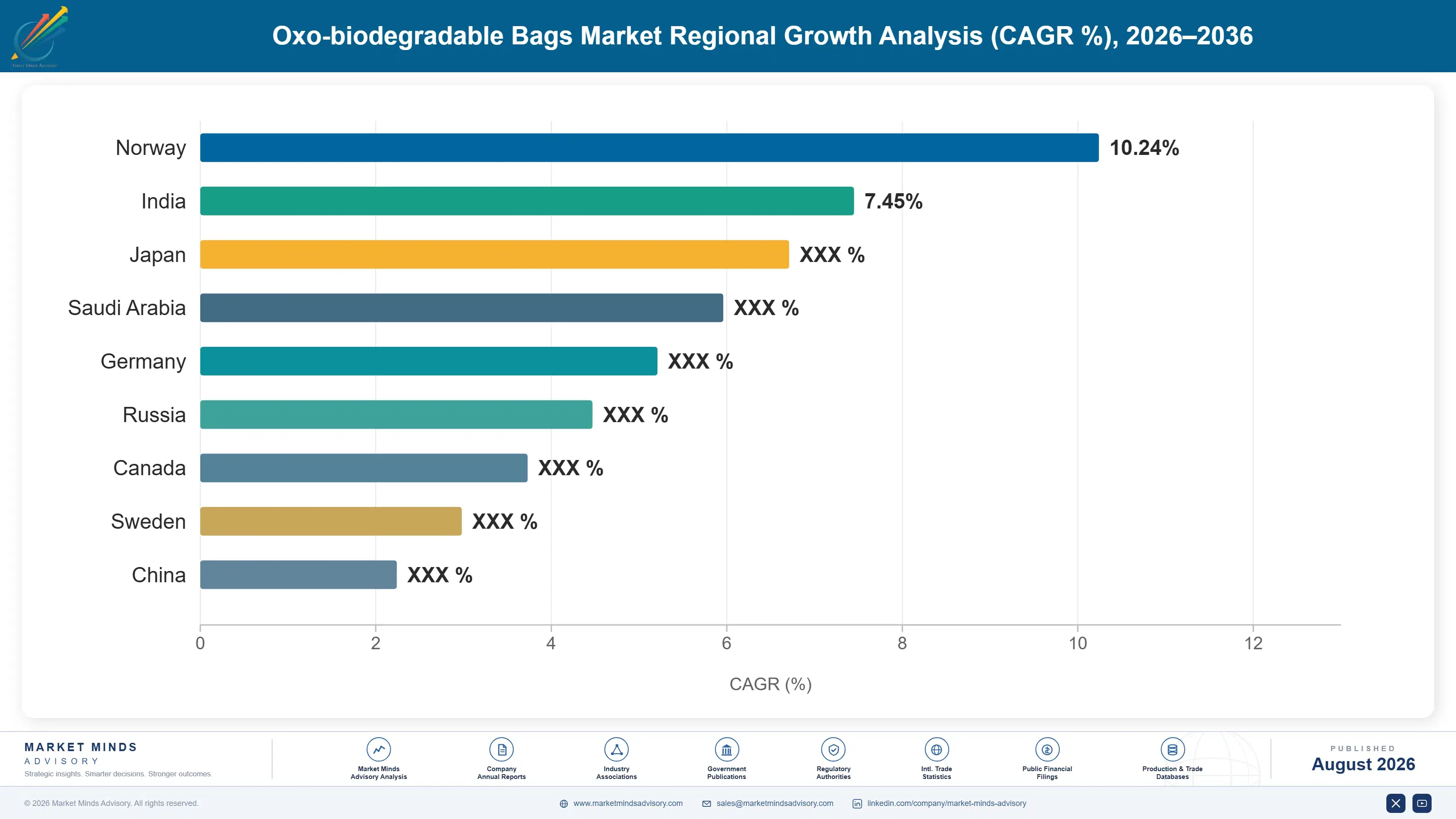
Saudi Arabia: 9.4% CAGR
Fastest Growth Region
South Asia and Pacific: 8.4% CAGR
Largest Region
Middle East and Africa: 34% of 2025 global value
Market Leaders
Symphony Environmental Technologies, Wells Plastics, Willow Ridge Plastics, EPI Environmental Products and Add-X Biotech lead the market. Source: MMA Primary Research Dataset, July 2026.
Primary Survey
n=3,800 procurement and R&D decision-makers, Q4 2025, six countries
Methodology
Demand-side build-up, cross-validated against public data, 47 expert interviews

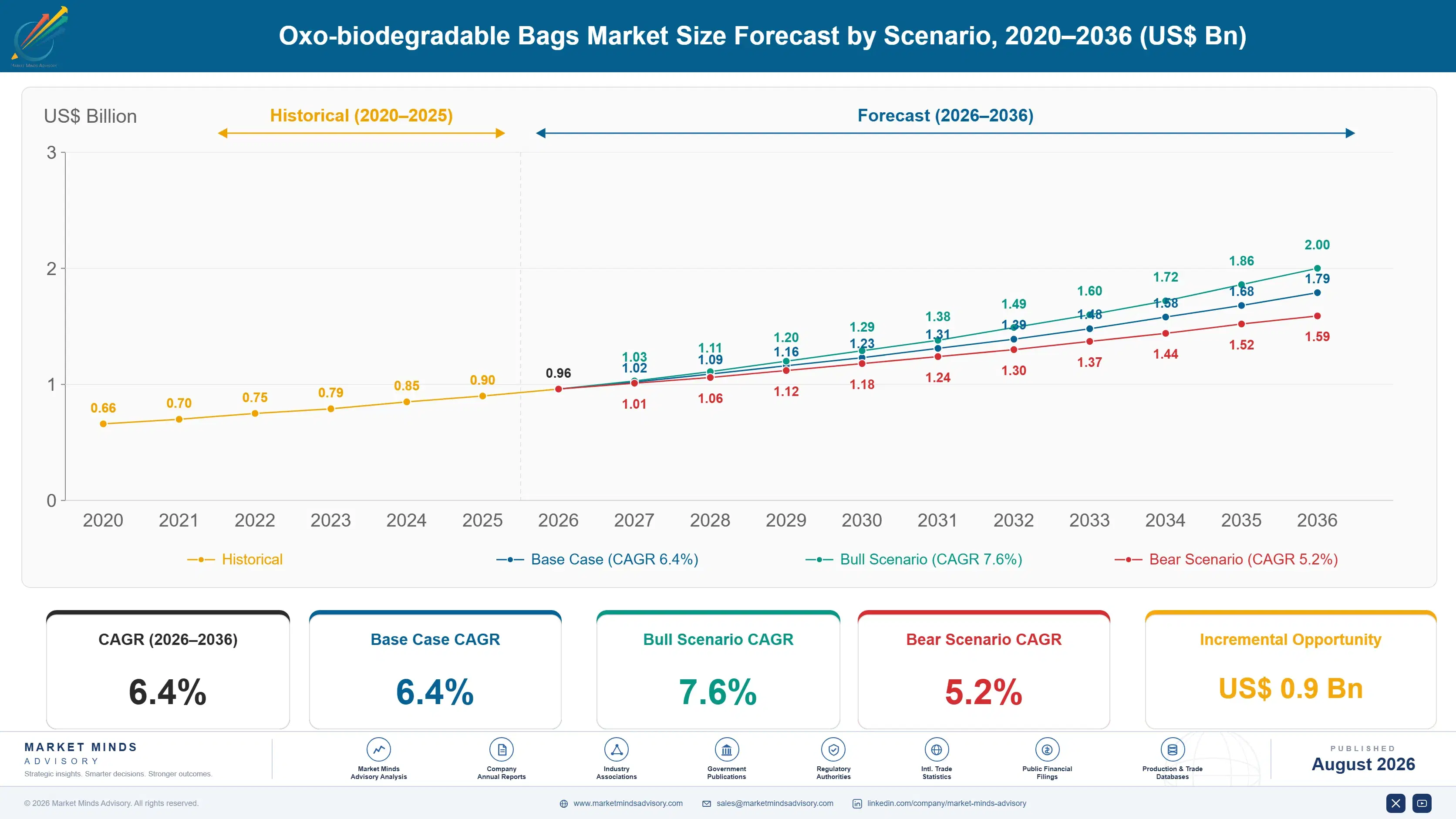
Oxo-biodegradable Bags Market Forecast Scenarios

oxo-biodegradable-bags-market-size-forecast-scenario-1787559596319
Growth ran at 5.0% between 2020 and 2025 across a period in which the market's geography was redrawn entirely by regulation. European demand collapsed as the single-use plastics prohibition took effect, while Gulf mandates expanded across additional product categories and several South Asian and African markets adopted similar requirements. Total volume grew because the mandating markets grew faster than the prohibited ones shrank.
The 6.4% base case rests on three mechanisms. Agricultural and mulch films at 9.6%, the one application where fragmentation addresses a genuine problem since film left in a field cannot practically be collected. Hygiene and medical waste bags at 8.2% on healthcare expansion. And Saudi growth at 9.4%, the fastest of any country, on mandate scope widening alongside packaged goods consumption. None of the three rests on the scientific argument being resolved either way.
The 7.6% bull case is further jurisdictions adopting the Gulf regulatory model, which costs domestic industry almost nothing and produces visible policy action. The 5.2% bear case is mandating governments confronting the recycling contradiction, since pro-oxidant content degrades recyclate and the collection infrastructure those countries are funding cannot accommodate both objectives. Collection systems cannot accommodate both objectives at once.

Banned Here, Required There

There are very few products where the market map is drawn entirely by regulatory disagreement, and this is one of them. European single-use plastics rules prohibit oxo-degradable plastic outright, on the Commission's conclusion that it fragments into microplastics rather than biodegrading in any meaningful sense. Several Gulf states require precisely the same additive by law across broad product categories. The industry disputes the European finding and cites its own testing, and the scientific argument continues, but the regulatory positions are settled and they point in opposite directions.
TOP-FIVE CONCENTRATION22%Combined position held by leading additive and converting participants
ADDITIVE COST PREMIUM1%Cost added to conventional resin by the pro-oxidant package
COMPOSTABLE ALTERNATIVE COST3.2xPrice of certified compostable film relative to treated polyethylene
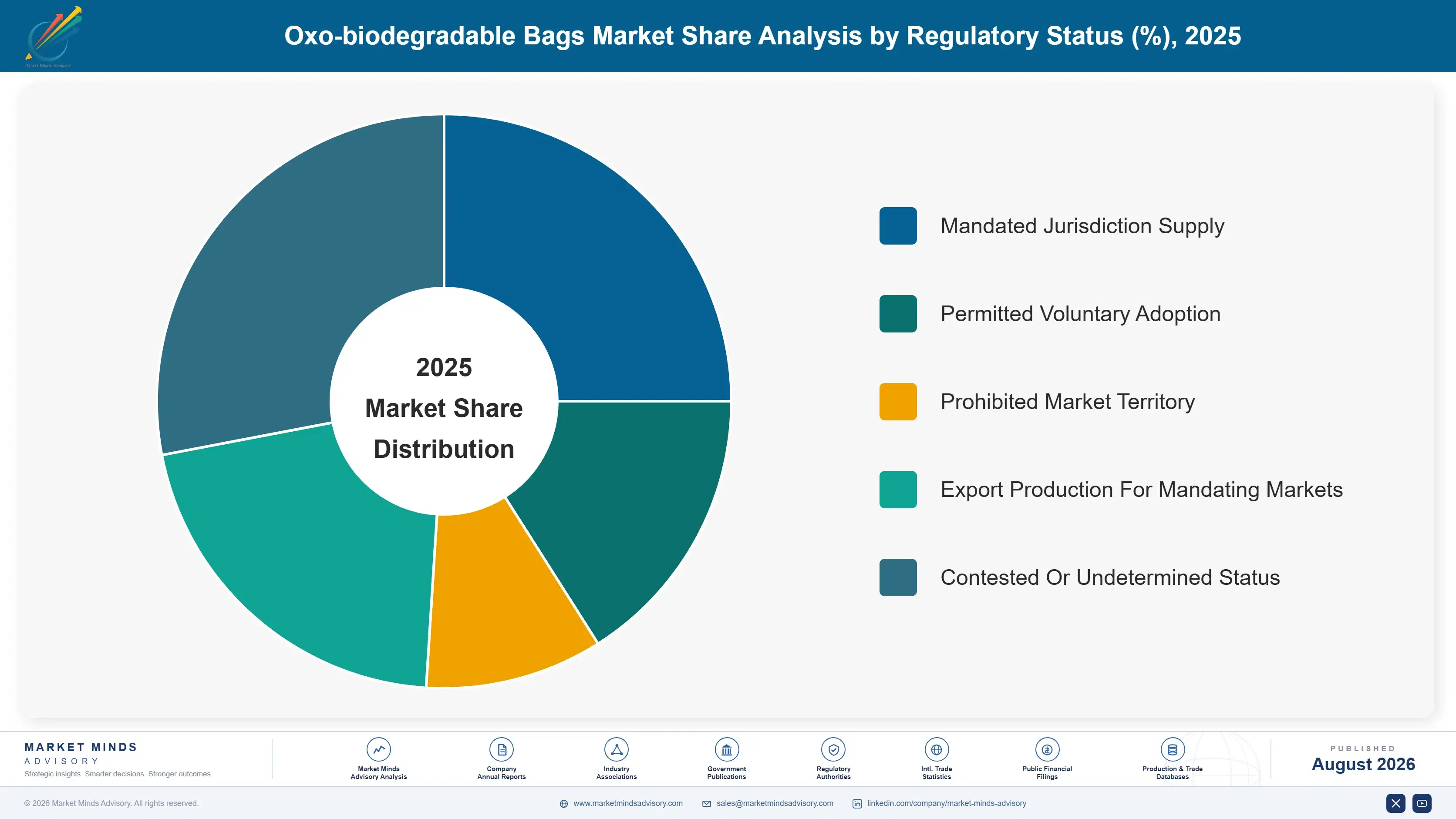
MANDATING JURISDICTION SHARE41%Portion of demand from markets requiring the additive by law
PROHIBITED MARKET SHARE19%Share of world plastics demand where the product is banned
RECYCLATE CONTAMINATION THRESHOLD5%Additive content above which recycled polymer properties degrade
What sustains the technology commercially is a cost gap that has nothing to do with either position. A pro-oxidant additive package adds roughly 1% to conventional resin cost, while certified compostable film runs around 3.2 times conventional polyethylene. A government seeking visible action on plastic waste without imposing meaningful cost on domestic converters or consumers finds the oxo route extraordinarily attractive, and that arithmetic explains the mandates far better than any technical assessment does.
The unresolved problem sits downstream. Pro-oxidant content above roughly 5% in a recycling stream degrades the properties of the recyclate, which puts the mandates in direct conflict with recycling infrastructure those same governments are building.
"I have never covered another product that is illegal in one place and compulsory in another with no commercial explanation in between. Anybody forecasting this market is forecasting policy copying, not packaging, and the recycling contradiction inside the mandating countries is the thing that eventually resolves it."
Director, Packaging Materials and Environmental Policy Practice · MMA Packaging and Converting Materials Practice · August 2026

Market Trends

Regulatory divergence rather than commerce sets the market map

Roughly 41% of demand originates in jurisdictions that require pro-oxidant additives by law, while about 19% of world plastics demand sits in markets prohibiting the product entirely, and no performance or cost factor explains the split. Forecasting therefore means forecasting which regulatory model additional countries copy rather than analysing any commercial dynamic. Commercially this makes policy monitoring the single most valuable capability a participant can hold, and it makes conventional market analysis of substitution and pricing very largely beside the point. Policy monitoring outranks every commercial capability here. Commercial analysis explains almost nothing about it.
Market Impact: Compostables cost 3.2 times more
Recycling infrastructure development contradicts existing mandates

Pro-oxidant content above roughly 5% in a recycling stream degrades the mechanical properties of the resulting recyclate, which recyclers object to on straightforward technical grounds. The governments mandating the additive are simultaneously funding collection and recycling infrastructure, and those two policies cannot both succeed. Commercially this is the clearest medium-term risk in the market, and it will be resolved by a policy decision rather than by any technical development. Participants concentrated in mandating markets carry that exposure without much visibility of when it arrives. Timing of that decision is the thing nobody can see.
Market Impact: Saudi demand compounds at 9.4%

Market Opportunities and Growth Drivers

Cost gap against compostables sustains the whole technology

A pro-oxidant additive package adds roughly 1% to conventional resin cost, while certified compostable film runs around 3.2 times conventional polyethylene and requires industrial composting infrastructure that most mandating markets do not have. For a government seeking visible action on plastic waste without imposing real cost on converters or consumers, the choice is straightforward. Commercially this cost gap is what has kept the technology alive through sustained scientific criticism, and it will keep doing so wherever compostable infrastructure remains absent. Compostable infrastructure is absent across most mandating markets. The technology survives criticism on cost alone.
Market Impact: Bans cover 19% of plastics demand

Gulf mandate scope widens across additional product categories

Saudi growth at 9.4% leads every country in this market, driven by mandate scope extending across additional product categories rather than by any change in underlying packaging consumption. Regional standards bodies have progressively added applications requiring the additive, and compliance is enforced through import controls that make the requirement genuinely binding on foreign suppliers as well as domestic ones. Commercially this makes regulatory relationships more valuable than customer relationships, since scope decisions determine demand more directly than any purchasing conversation. Regulatory relationships accordingly matter more than customer relationships, since scope decisions determine volume more directly than purchasing conversations ever do.
Market Impact: Additive premium stays near 1%

Market Restraints and Challenges

European prohibition removed a market and set a precedent

European single-use plastics rules prohibit oxo-degradable plastic outright, removing what had been a substantial market and establishing a regulatory precedent other jurisdictions consult when forming their own positions. The root cause is a scientific assessment the industry disputes and continues to contest, though the regulatory outcome stands regardless. Commercially the precedent matters more than the lost volume, since countries drafting plastics legislation frequently adopt European definitions wholesale. Participants are pursuing markets forming their own assessments rather than copying, which is a narrowing set. Countries drafting legislation frequently adopt those definitions directly.
Market Impact: Mandates drive 41% of demand

Recyclers object on measurable recyclate property grounds

Pro-oxidant additive entering a mechanical recycling stream degrades the polymer it contaminates, with measurable property loss appearing above roughly 5% content in the feed. The root cause is that the additive is designed to promote oxidative chain scission, which is exactly what a recycler is trying to avoid. Commercially this puts the product in conflict with recycling systems wherever they develop. Participants are pursuing detection and sorting approaches, though separating treated from untreated polyethylene at scale remains genuinely difficult. Separating treated from untreated polyethylene at scale remains genuinely difficult, which leaves the objection unresolved rather than merely inconvenient for anybody.
Market Impact: Degradation begins above 5% content
4 additional market trends, 3 additional growth drivers, and 2 additional restraints and challenges are covered in the full report. Contact sales@marketmindsadvisory.com to access the complete intelligence.

Segment CAGR and Growth Architecture

Volume is classified here by end application, since whether fragmentation solves a genuine problem or merely satisfies a legal requirement differs completely between an agricultural mulch film and a grocery carrier bag. Additive chemistry, converting route and regulatory status are each handled separately in the framework below, because one film specification serves several applications unchanged.
oxo-biodegradable-bags-market-market-share-analysis-1787559596849

Agricultural and Mulch Films

Growing at 9.6%, half again the market rate, agricultural mulch film is the one application where fragmentation addresses a problem that genuinely exists. Film laid across a field to suppress weeds and retain moisture cannot practically be collected afterwards, and conventional polyethylene left in soil accumulates indefinitely, so any degradation pathway is an improvement on the alternative of doing nothing at all. Growth follows protected cultivation expanding across Gulf, North African and South Asian agriculture. The scientific dispute over complete biodegradation matters less here than elsewhere, because the comparison is against untreated film remaining in the soil rather than against a recycling stream. Growers adopt it for practical reasons rather than for compliance.
CAGR 9.6%

Hygiene and Medical Waste Bags

Healthcare and hygiene waste bags grow at 8.2% on hospital and clinic expansion across mandating markets, where the additive requirement applies to these categories alongside consumer packaging. These bags are incinerated or landfilled rather than recycled in almost all cases, which means the recyclate contamination objection that applies elsewhere does not arise for this application at all. Specification requirements around strength, puncture resistance and colour coding are more demanding than for consumer carriers. Procurement runs through hospital and municipal tendering, which rewards converters with compliance documentation and consistent quality rather than lowest unit price. Compliance documentation and consistent quality decide these tenders far more than any unit price comparison does, which suits a serious converter and disadvantages opportunistic ones considerably.
CAGR 8.2%
Full segment breakdown across 6 segments available in the complete report.

Regional Architecture and Country Demand Map

Middle East and Africa holds 34% of value, far above its usual band, because several Gulf states mandate the additive by law and enforce it through import controls. South Asia and Pacific follows at 24% on comparable requirements, while Western Europe sits at 3% having prohibited the product entirely.

Middle East and Africa

At 34% this region sits far above its usual band and leads the market outright, because several Gulf states require pro-oxidant additives by law across broad product categories and enforce that through import controls binding on foreign suppliers as well as domestic converters. Saudi growth at 9.4% leads every country here as mandate scope extends further. Regional converters including Napco National, Takween and Al Bayader hold substantial positions built on those requirements. African adoption is patchy and follows individual national decisions rather than any regional framework. The recycling contradiction is most acute here as collection infrastructure develops. Import controls make the requirement binding on foreign suppliers as well as domestic converters, which shapes who can compete.
Share: 34% | CAGR: 6.8% (2026 to 2036)

South Asia and Pacific

At 24% this region sits far above its usual band, because several South Asian markets adopted requirements resembling the Gulf model rather than the European one, and agricultural mulch film consumption across the region is genuinely substantial. Pakistani and Indian regulations have varied by state and province, producing an uneven picture that converters navigate carefully. Protected cultivation expansion drives mulch film demand independently of any packaging requirement. Regional converting capacity is extensive and additive masterbatch is widely available. Growth at 8.4% is the second fastest regional rate on mandates and agriculture together. Provincial and state variation produces an uneven picture that converters navigate carefully rather than uniformly across the region.
Share: 24% | CAGR: 8.4% (2026 to 2036)
Regional intelligence for 5 additional markets available in the complete report: North America, Western Europe, East Asia, Latin America, Eastern Europe. Contact sales@marketmindsadvisory.com.
oxo-biodegradable-bags-market-country-cagr-analysis-1787559597360

Where Regulatory Divergence Creates Value

Four quite separate moves matter here, for a single product line whose entire market geography is drawn by regulatory disagreement rather than by anything a customer ever decided. Two concern serving mandating jurisdictions properly while those mandates persist, and two concern the applications and risks that will outlast however the policy argument eventually settles.

Track regulatory scope decisions, not customer demand

Roughly 41% of demand originates in jurisdictions mandating the additive by law, and scope extensions across additional product categories create volume more directly than any commercial conversation ever will. Saudi growth at 9.4% comes from mandate widening rather than packaging consumption. A participant who monitors standards bodies and consultation processes sees demand arriving before competitors do, and can position converting capacity accordingly. Conventional market analysis of pricing and substitution is very largely beside the point here. Conventional substitution analysis is beside the point here. Standards consultations are public documents. Reading them costs nothing.
Market Impact: Serves the 41% of demand created by mandates

Build agricultural film position that survives policy change

Mulch film is the one application where fragmentation addresses a genuine problem, since film laid across a field cannot practically be collected and untreated polyethylene accumulates in soil indefinitely. The comparison is against doing nothing rather than against a recycling stream, which is why this application faces the least objection. Growth at 9.6% leads the market. A position built here is considerably more durable than one resting on carrier bag mandates that a recycling policy decision could remove. Growers adopt it because collecting field film is impractical rather than because any rule requires it.
Market Impact: Serves a segment now growing at 9.6% yearly

Prepare for the recycling contradiction before it resolves

Pro-oxidant content above roughly 5% degrades recyclate properties, and the governments mandating the additive are simultaneously funding collection infrastructure that cannot accommodate it. Those policies will not both survive. Participants concentrated in mandating markets carry that exposure with little visibility of timing, and developing detection, sorting or alternative additive capability now costs far less than discovering the decision has been made. Waiting for clarity means competing for a transition everybody else started earlier. Optionality is cheap and commitment is not. Timing is entirely outside a converter's control. Waiting for clarity is expensive.
Market Impact: Anticipates a 5% limit on recyclate contamination levels

Serve non-recycled waste streams where objections do not apply

Hygiene and medical waste bags are incinerated or landfilled rather than recycled in almost every case, which means the recyclate contamination objection simply does not arise for that application. Growth at 8.2% follows healthcare expansion across mandating markets. Positions in waste streams that never reach a recycler are insulated from the argument that threatens carrier bags and consumer packaging, and procurement there rewards compliance documentation rather than lowest unit price. Tender procurement in these categories rewards documentation and consistency rather than the lowest unit price, which suits a converter willing to maintain certification properly.
Market Impact: Serves applications that grow at 8.2% each year

Who Controls the Margin Pool

Five participants hold 22% of this market, measured on tonnage of treated film supplied at converter level, the basis used throughout this section. Concentration is low because the additive is a masterbatch that any competent converter can incorporate, so the technology barrier is minimal and the participants divide between additive developers holding intellectual property and regional converters holding customer relationships. Barriers sit in documentation rather than in technology.
Competition runs on four dimensions. Regulatory relationships in mandating jurisdictions, which shape demand considerably more than any commercial activity does. Additive formulation alongside the testing data supporting its performance claims. Converting scale and cost within the regions where mandates actually apply. And compliance documentation, since import controls make certification genuinely binding on foreign suppliers rather than merely advisable.

Rankings shift toward regional converters inside mandating markets and away from additive developers whose European home base has been closed to them entirely. Gulf and South Asian converters hold the volume and the customer relationships. British and American additive companies hold formulation intellectual property and increasingly sell into markets they are not permitted to serve at home, which is an awkward commercial position.
oxo-biodegradable-bags-market-company-positioning-matrix-1787559597883

Competitive Moat and Risk Dimensions

SYMPHONY ENVIRONMENTAL TECHNOLOGIES

Moat: Additive formulation and testing data

The company holds additive formulation intellectual property alongside the testing programmes supporting its performance claims, which matters in mandating jurisdictions where standards bodies require documented compliance rather than accepting any pro-oxidant package. Regulatory relationships built across Gulf and South Asian markets over years give it visibility of scope decisions before those decisions become public.
SYMPHONY ENVIRONMENTAL TECHNOLOGIES

Risk: Home market closed entirely

European prohibition removed the company's domestic market outright and established a precedent other jurisdictions consult when drafting their own legislation. Revenue now depends on markets forming independent assessments, which is a narrowing set. Regional converters in mandating markets hold the customer relationships and face none of the reputational difficulty that European prohibition creates for an additive developer.
NAPCO NATIONAL

Moat: Gulf converting scale and compliance

The company operates substantial converting capacity inside the mandating jurisdictions with compliance documentation that import controls make genuinely binding on any competitor supplying from outside. Regional customer relationships across retail, hospital and municipal procurement are established, and those buyers value certification and consistency considerably more than they value the lowest available unit price.
NAPCO NATIONAL

Risk: Exposure to the recycling contradiction

Pro-oxidant content degrades recyclate above roughly 5%, and the governments mandating the additive are funding collection infrastructure that cannot accommodate both objectives simultaneously. A converter concentrated in those markets carries the full exposure to whichever way that resolves. Participants with agricultural film positions or non-recycled waste stream volume face considerably less of that risk.

Players Tracked

Prominent Players

Symphony Environmental Technologies
Wells Plastics
Willow Ridge Plastics
EPI Environmental Products
Add-X Biotech

Other Key Players

Polymateria
BioSphere Plastic
Ampacet
Clariant
Avient
Tosaf
Astra Polymers
Gulf Packaging Industries
Napco National
Takween Advanced Industries
Obeikan
Al Bayader International
Harwal Group
Plastiblends India
Zhejiang Hangzhou Xinfu

Recent Developments

MARCH 2025

A Gulf standards body extended additive requirements to further categories

A regional standards authority extended pro-oxidant additive requirements to additional plastic product categories, enforced through import controls applying equally to foreign suppliers and domestic converters. This was a regulatory scope decision rather than any commercial transaction between participants in the market. Domestic converters had no advance notice.
Signal: Mandate scope extension creates demand far more directly than any commercial activity a supplier could ever undertake
JULY 2025

A recycler documented recyclate property loss from treated feedstock

A mechanical recycler published measurements showing polymer property degradation where pro-oxidant treated material entered the feedstock above low contamination levels, submitting the findings to a regional waste policy consultation. This was a technical submission rather than any commercial action against suppliers. Contamination levels were measured directly.
Signal: The recycling objection is measurable and is now entering policy consultations inside the mandating jurisdictions themselves
NOVEMBER 2025

A grower group adopted treated mulch film across protected cultivation

An agricultural producer group adopted pro-oxidant treated mulch film across protected cultivation operations, citing the impracticality of collecting film from fields and the accumulation of untreated polyethylene in soil. This was a purchasing decision rather than any regulatory requirement being applied. Soil accumulation was the stated concern.
Signal: Mulch film adoption rests on a genuine problem rather than compliance, which makes it durable through policy change

What Drives Converted Cost

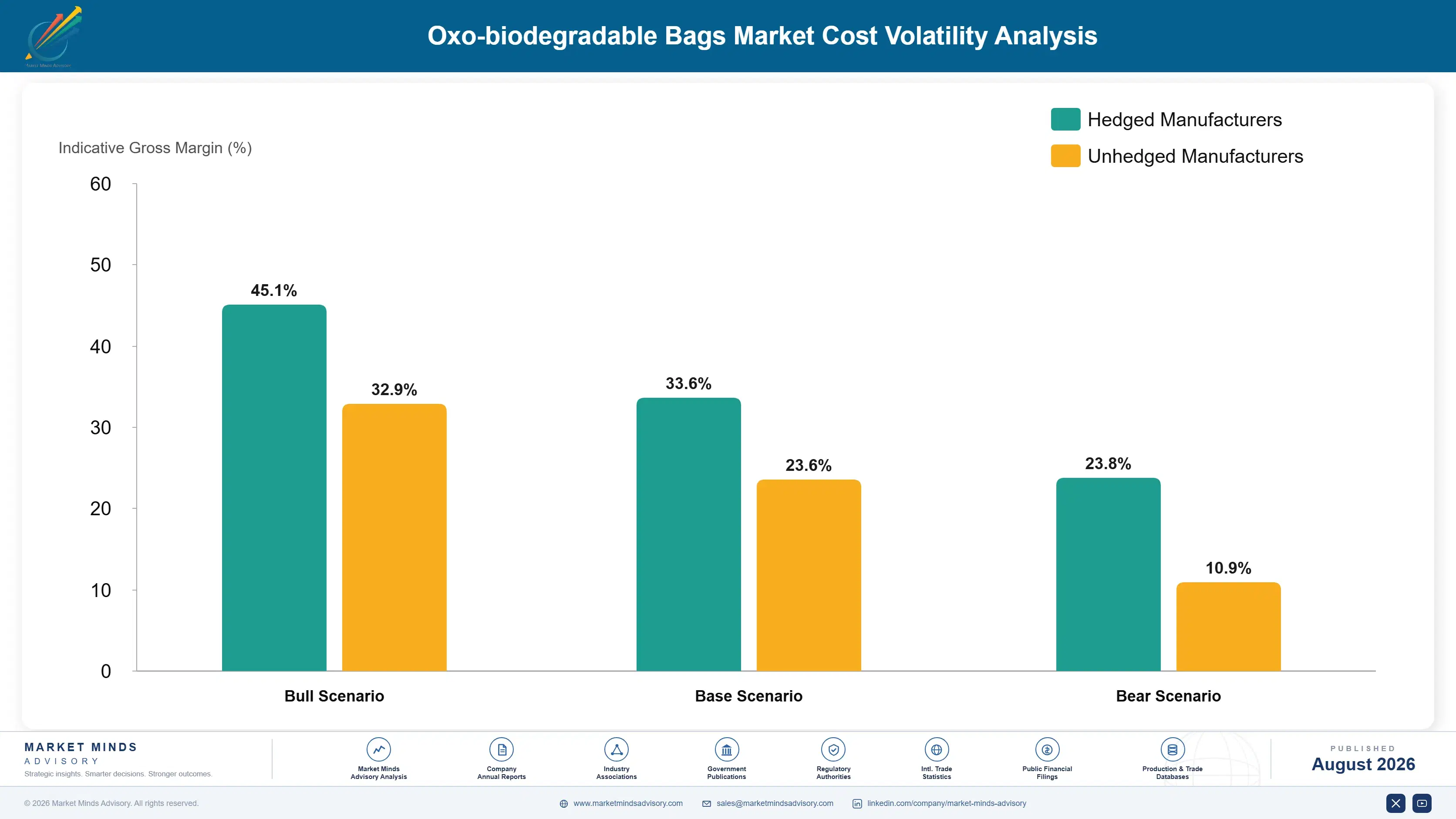
Polyethylene resin accounts for roughly 68% of converted film cost, which is entirely conventional since the product is ordinary polyolefin with an additive in it. The pro-oxidant masterbatch adds around 1% to that resin cost, which is the whole commercial argument for the technology. Extrusion, printing and conversion take about 22%. Compliance testing and certification are modest but required continuously in mandating jurisdictions.
Polyethylene prices moved sharply through 2022 as petrochemical feedstock followed crude and freight disruption compounded delivery uncertainty across importing markets. Symphony Environmental noted trading conditions and market access constraints across its operations in its Annual Report 2022. Converters on annual retail and municipal contracts absorbed most of the resin movement, since the additive itself is too small a cost line to matter in any negotiation.

The disadvantage falls on converters supplying mandating markets from outside them, and it operates through compliance rather than through cost. Import controls make certification genuinely binding, which means a foreign converter must hold documentation and testing that domestic producers maintain routinely. That requirement is not expensive in itself and it is easy to fail, and failing it removes market access entirely rather than merely raising the price of entry.
oxo-biodegradable-bags-market-cost-volatility-analysis-1787559598078

Maintain compliance documentation continuously rather than per shipment

Import controls in mandating jurisdictions make certification binding on foreign suppliers, and documentation gaps remove market access rather than merely delaying a shipment. Maintaining testing and certification continuously costs little and prevents the disruption that per-shipment scrambling produces. Domestic converters in those markets maintain it as routine, which is part of their advantage. Domestic converters treat it as routine.

Index converting contracts to published polyethylene benchmarks

Resin at roughly 68% of converted cost passes petrochemical movement straight through, and the additive at around 1% is too small to matter in any negotiation. Annual fixed pricing on retail and municipal contracts transfers the resin exposure entirely to the converter. Indexed pricing with quarterly reset addresses it. The resin cost is transparent, which makes it easy to explain.

Develop capability for whichever additive policy eventually survives

The recycling contradiction inside mandating jurisdictions will be resolved by a policy decision rather than by any technical development, and the outcome is genuinely uncertain. Building capability across compostable, recyclable mono-material and treated conventional film costs far less than being committed to whichever option loses. Optionality is cheap here and commitment is not. Nobody knows which way it goes.

Portfolio Architecture for Margin Defence

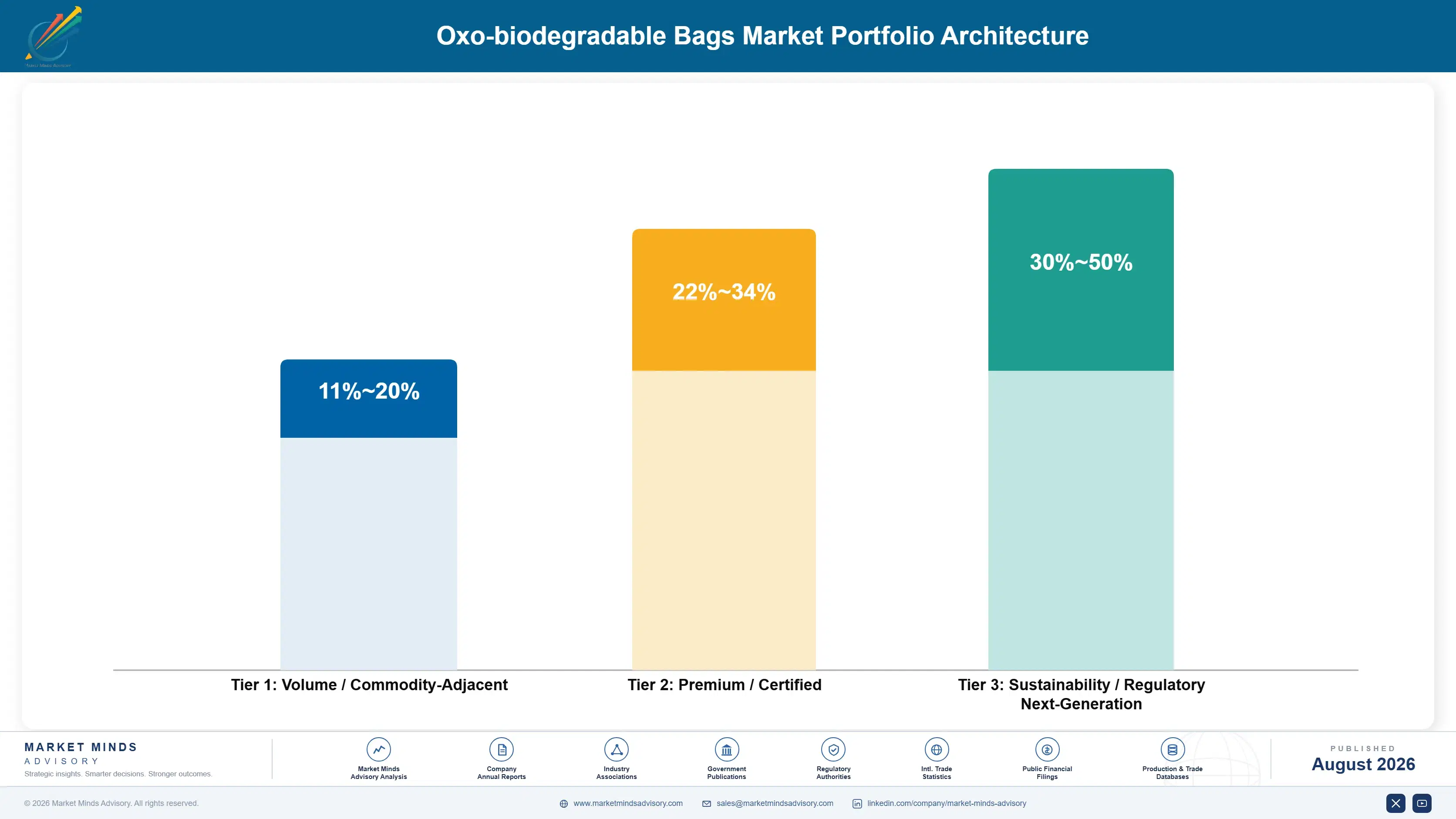
Margin separates on regulatory position rather than on manufacturing capability, which follows from the additive being a masterbatch any competent converter can incorporate. Retail carrier bags run at gross margins in the low teens against converters competing on resin pass-through and conversion cost alone. Refuse liners run similarly. Industrial sheeting runs modestly better on specification. Agricultural mulch film runs better again on genuine functional value. Hygiene and medical waste bags run highest, because tender procurement rewards compliance and consistency over unit price.
The tension is that consumer carrier bag volume is both the largest position and the most exposed to the recycling contradiction, since those bags are precisely what a collection system aims to capture. Converters weighted there carry policy risk they cannot influence and cannot easily see coming. Agricultural film and non-recycled waste streams face far less of that exposure, and building weight there is cheap insurance against a decision that will be made by somebody else entirely.

High-value pools sit in agricultural mulch film, hospital and municipal tender supply, and additive formulation with documented testing. Consumer carrier bags are where the volume sits and where the policy argument will eventually be settled.

Volume / Commodity-Adjacent

Retail carrier bags and refuse liners competing on resin pass-through and conversion cost against any converter able to add a masterbatch. The nine-point range separates converters with scale and resin purchasing from smaller regional operators buying at market.
Gross Margin: 11%-20%

Premium / Certified

Industrial sheeting and specified film where strength, thickness and durability requirements narrow the field beyond price competition. The twelve-point spread reflects converting capability and specification consistency rather than any additive advantage.
Gross Margin: 22%-34%

Sustainability / Regulatory / Next-Generation

Agricultural mulch film, hospital and municipal tender supply, and additive formulation with documented testing data. The twenty-point range is wide because functional value and compliance documentation depth vary enormously between applications and participants.
Gross Margin: 30%-50%
oxo-biodegradable-bags-market-portfolio-architecture-1787559598573

High-value Sub-segments and Strategic Watch-out

Agricultural Mulch Film

Compounding at 9.6% in the one application where fragmentation addresses a genuine problem, since field film cannot practically be collected. The comparison is against untreated polyethylene accumulating in soil rather than any recycling stream. Growers adopt it without any mandate requiring them to. Policy change barely touches it.
Gross Margin: 32%-46%

Non-Recycled Waste Streams

Hygiene and medical waste bags growing at 8.2% and incinerated or landfilled rather than recycled, which means the recyclate contamination objection never arises. Tender procurement rewards documentation over unit price. Healthcare expansion across mandating markets drives the volume steadily. Incineration removes the objection entirely from these applications.
Gross Margin: 34%-50%

Additive Formulation Rights

Standards bodies in mandating jurisdictions require documented compliance rather than accepting any pro-oxidant package, which gives formulation and testing data genuine value beyond the masterbatch itself. Testing programmes take years to assemble and cannot be bought quickly. Documentation is the barrier. Standards bodies require it.
Gross Margin: 36%-54%

Consumer Carrier Bags

The volume position and the one most exposed to the recycling contradiction, since these bags are precisely what collection systems aim to capture. Manage this for resin cost rather than for any policy certainty. Policy risk here cannot be influenced and is hard to see coming.
Gross Margin: 11%-20%

How Mandated Demand Renews

Demand renews with consumption in the mandating markets, which produces an annuity in the ordinary way while the mandate persists and nothing at all the moment it does not. That is a genuinely different risk profile from a normal packaging business, where demand declines gradually if a product falls out of favour. Here it can stop by administrative decision on a stated date, as European converters discovered when the prohibition took effect and their volume disappeared rather than eroded.
Stickiness runs through compliance documentation rather than through customer relationship. A converter holding certification recognised by a mandating jurisdiction's standards authority is difficult to displace, because a competitor must obtain the same documentation before it can supply anything at all. Retail and municipal buyers otherwise switch readily on price, since a carrier bag from one compliant converter is indistinguishable from another.

The buyer that matters is not the customer at all in most of this market. Standards authorities and regulatory bodies decide what must contain the additive and enforce it through import controls, which means scope decisions generate demand that no commercial activity could produce. Participants organised around customer relationships rather than regulatory relationships are watching the wrong conversation entirely.
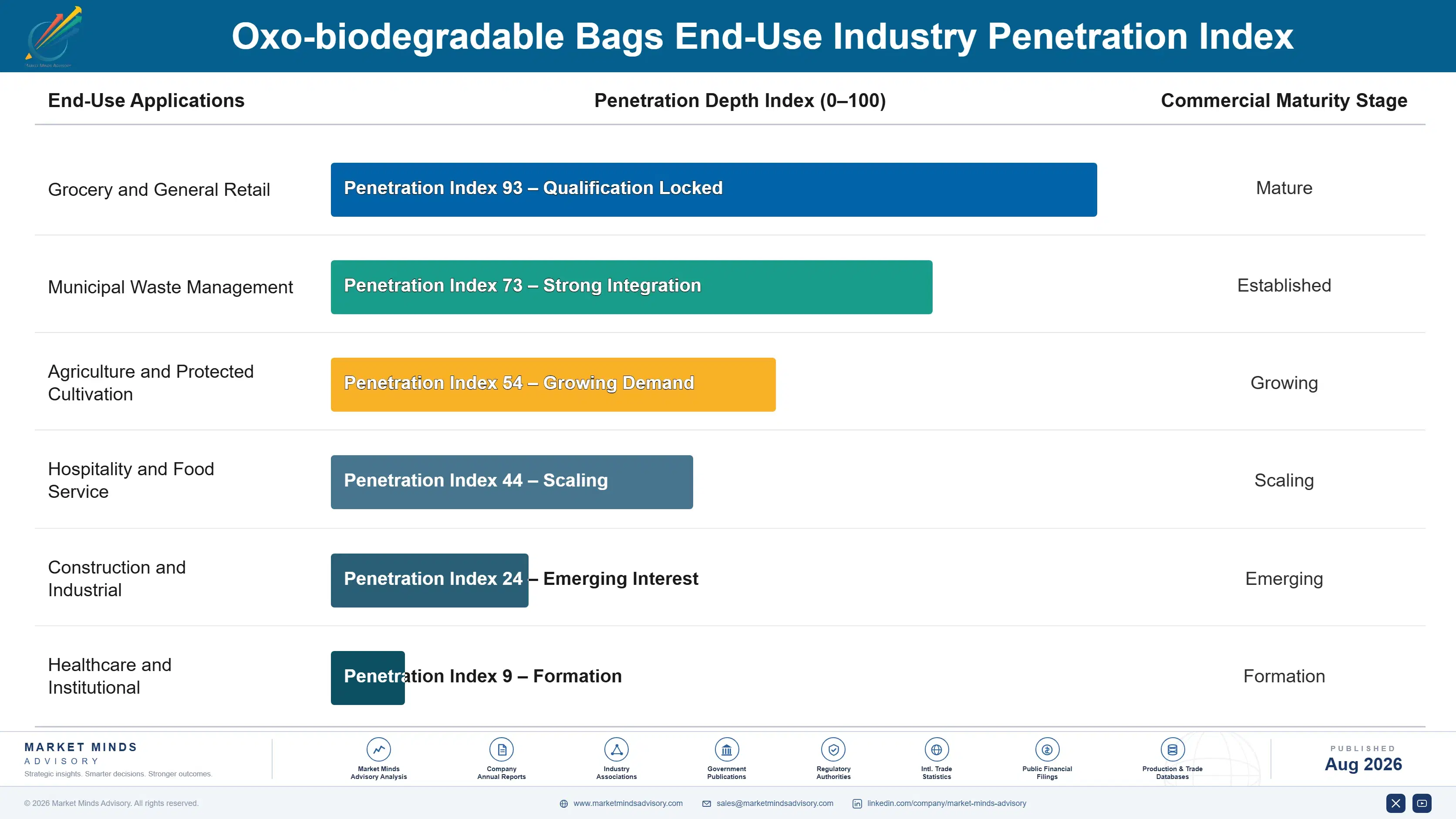
oxo-biodegradable-bags-market-end-use-penetration-index-1787559599060

Where To Place The Bet

These are among the four positions where our research anticipates prominent divergence between winners and laggards over the coming forecast period. Each is grounded in the demand model, the regulatory perimeter, and the announced capacity pipeline.
01 / REGULATORY SCOPE MONITORING

Watch standards bodies, not purchasing departments

Roughly 41% of demand in this market originates in jurisdictions that mandate pro-oxidant additives by law, and scope extensions across additional product categories generate volume far more directly than any commercial conversation with a customer ever could. Saudi country growth at 9.4% leads the market because mandate scope keeps widening rather than because packaging consumption is rising unusually fast there. Participants monitoring standards bodies and consultation processes see demand arriving before competitors and position converting capacity accordingly, which conventional market analysis simply cannot replicate.
02 / FUNCTIONAL APPLICATION WEIGHTING

Build where the product solves a real problem

Agricultural mulch film is the single application where fragmentation addresses something genuinely difficult, because film laid across a field cannot practically be collected afterwards and untreated polyethylene accumulates in the soil indefinitely instead. The comparison there is against doing nothing rather than against a functioning recycling stream, which is precisely why this application attracts the least objection from anybody. Growth at 9.6% leads the market, and a position built here is considerably more durable than one resting entirely on carrier bag mandates.
03 / RECYCLING CONTRADICTION PREPARATION

The mandate and the recycling plan cannot both survive

Pro-oxidant content above roughly 5% measurably degrades recyclate properties, and the same governments mandating the additive across consumer packaging are simultaneously funding the collection and recycling infrastructure that cannot accommodate it at scale. Those two policies will not both survive a serious review, and the resolution will come as a policy decision rather than through any technical development. Building detection, sorting or alternative additive capability now costs far less than discovering afterwards that the decision has already been taken without warning.
04 / NON-RECYCLED STREAM FOCUS

Serve waste that never reaches a recycler

Hygiene and medical waste bags are incinerated or sent to landfill in almost every case rather than entering any mechanical recycling stream, which means the recyclate contamination objection that threatens consumer carrier bags simply does not arise for that application at all. Growth at 8.2% follows healthcare and clinic expansion across the mandating markets. Procurement runs through hospital and municipal tendering that rewards compliance documentation and consistent specification rather than the lowest available unit price, which suits a serious converter.

Engagement Snapshot From the Field

A live engagement with an industry participant carrying material or product regulatory and market exposure ahead of a defining policy shift, showing how our research translates into a defensible multi-year portfolio strategy.
MARKET MINDS ADVISORY · CLIENT ENGAGEMENT SUMMARY
Oxo-biodegradable Bags Producer Strategic Portfolio Review and Transition Roadmap 2026·Investment Scenario on Oxo-biodegradable Bags Exposure Evaluation 2025-26
CLIENT PROFILE
A Gulf packaging converter with annual output around 62,000 tonnes of treated film (client-reported, unverified by MMA), supplying retail carrier bags, refuse liners and industrial sheeting across several mandating jurisdictions. Agricultural film volume was minimal. No compostable or alternative capability existed anywhere in the business. Exposure had not been assessed. Alternatives were absent. Volumes were concentrated.
STRATEGIC CHALLENGE
A national recycling infrastructure programme had been announced in the client's principal market while the additive mandate remained in force, and management assumed both policies would simply coexist. Nobody had examined whether pro-oxidant treated film could actually pass through the collection system being built. Coexistence had simply been assumed. Nobody had checked.
MMA APPROACH
MMA assessed recyclate property data against the contamination levels the planned collection system would produce, then reviewed policy consultation submissions to establish whether the contradiction had been raised. The client's volume was decomposed by exposure to collection-bound waste streams. Alternative capability options were costed against transition timelines. Consultation timing was mapped.
KEY FINDINGS
  1. Consumer carrier bags and refuse liners together represented most of the client's volume and were precisely the streams the collection programme was designed to capture, placing them fully in the contradiction.
  2. Recycler submissions raising recyclate degradation had already entered the policy consultation, which meant the contradiction was visible to regulators rather than merely latent in the technical literature.
  3. Agricultural mulch film and hospital waste bag volumes faced almost none of that exposure, and the client's position in both was negligible despite regional demand growing quickly.
  4. Building alternative capability across compostable and mono-material recyclable film cost far less than the revenue at risk, and required no decision about which policy would eventually prevail.
CLIENT PROFILE
A Gulf packaging converter with annual output around 62,000 tonnes of treated film (client-reported, unverified by MMA), supplying retail carrier bags, refuse liners and industrial sheeting across several mandating jurisdictions. Agricultural film volume was minimal. No compostable or alternative capability existed anywhere in the business. Exposure had not been assessed. Alternatives were absent. Volumes were concentrated.
STRATEGIC CHALLENGE
A national recycling infrastructure programme had been announced in the client's principal market while the additive mandate remained in force, and management assumed both policies would simply coexist. Nobody had examined whether pro-oxidant treated film could actually pass through the collection system being built. Coexistence had simply been assumed. Nobody had checked.
MMA APPROACH
MMA assessed recyclate property data against the contamination levels the planned collection system would produce, then reviewed policy consultation submissions to establish whether the contradiction had been raised. The client's volume was decomposed by exposure to collection-bound waste streams. Alternative capability options were costed against transition timelines. Consultation timing was mapped.
KEY FINDINGS
  1. Consumer carrier bags and refuse liners together represented most of the client's volume and were precisely the streams the collection programme was designed to capture, placing them fully in the contradiction.
  2. Recycler submissions raising recyclate degradation had already entered the policy consultation, which meant the contradiction was visible to regulators rather than merely latent in the technical literature.
  3. Agricultural mulch film and hospital waste bag volumes faced almost none of that exposure, and the client's position in both was negligible despite regional demand growing quickly.
  4. Building alternative capability across compostable and mono-material recyclable film cost far less than the revenue at risk, and required no decision about which policy would eventually prevail.
RECOMMENDED STRATEGY
Phase 1: Phase one: build agricultural mulch film and hospital waste bag volume, since both face minimal exposure to the recycling contradiction and both are growing faster than the client's core business. Phase 2: Phase two: develop compostable and mono-material recyclable capability as optionality rather than as a bet, since the policy outcome is genuinely uncertain and commitment is expensive. Phase 3: Phase three: engage the policy consultation directly rather than assuming coexistence, so that the timing of any decision is visible rather than arriving as a surprise.
OUTCOME
Agricultural and hospital volumes are growing and now represent a materially larger share of output. Alternative capability is established at pilot scale without committing to any single route. Policy engagement has given the client visibility of consultation timing, and management reports the exposure understood rather than assumed away (client-reported, unverified by MMA).

Frequently Asked Questions

Foundational context covering the market sizes, CAGR, scope, country, region and competition that inform every finding below. This section is provided to cover basics and most often pre-purchase conversations, answered from the MMA Primary Research Dataset.

What is the current size of the Oxo-biodegradable Bags Market?

The market was valued at USD 0.94 billion in 2025, rising to an estimated USD 1.00 billion in 2026. Middle East and Africa holds the largest regional share at 34% of value.

How large will the Oxo-biodegradable Bags Market be by 2036?

MMA forecasts USD 1.86 billion by 2036 under the base case, an expansion multiple of 1.86 times the 2026 value. That represents USD 0.86 billion of incremental value.

What is the CAGR for the Oxo-biodegradable Bags Market 2026 to 2036?

The base case runs at 6.4% compound annual growth between 2026 and 2036, with a bull case at 7.6% and a bear case at 5.2%. Historical growth from 2020 to 2025 was 5.0%.

Which segment is growing fastest?

Agricultural and mulch films lead at 9.6%, half again the market rate, since field film cannot practically be collected. Hygiene and medical waste bags follow at 8.2%.

Who are the major companies in the Oxo-biodegradable Bags Market?

Symphony Environmental, Wells Plastics, Willow Ridge, EPI Environmental and Add-X Biotech hold 22% between them. The additive is a masterbatch, so converting barriers are minimal.

Which country is growing fastest?

Saudi Arabia leads at 9.4%, driven by mandate scope extending across additional product categories rather than by any change in the underlying level of packaging consumption.

Report Segmentation Architecture

The full report scope spans multiple orthogonal segmentation dimensions, with cross-tabulated demand data provided for each dimension pair. Coverage extends further to regional breakdowns, trend trajectories, and the competitive detail needed to support segment-level decision-making.

By Application

  • Retail and Grocery Carrier Bags
  • Refuse and Bin Liners
  • Agricultural and Mulch Films
  • Food Service and Takeaway Packaging
  • Industrial and Construction Sheeting
  • Hygiene and Medical Waste Bags

By End-Use Industry

  • Grocery and General Retail
  • Municipal Waste Management
  • Agriculture and Protected Cultivation
  • Hospitality and Food Service
  • Construction and Industrial
  • Healthcare and Institutional

By Regulatory Status

  • Mandated Jurisdiction Supply
  • Permitted Voluntary Adoption
  • Prohibited Market Territory
  • Export Production For Mandating Markets
  • Contested Or Undetermined Status

By Region

  • North America
  • Western Europe
  • East Asia
  • South Asia and Pacific
  • Latin America
  • Middle East and Africa
  • Eastern Europe

Scope, Methodology, and Coverage

Every figure in this report is reproducible from documented input assumptions. The scope below maps the historical period, the forecast horizon, the segmentation dimensions, and the countries covered, alongside the underlying primary and qualitative methodology.
Historical Period
2020 to 2025
Forecast Period
2026 to 2036
Base Year
2025 (USD billions; MMA Primary Research Dataset, August 2026)
Market Definition
The market comprises bags, sacks and films manufactured from conventional polyolefins containing pro-oxidant additive packages marketed as oxo-biodegradable, across retail and grocery carrier bags, refuse and bin liners, agricultural and mulch films, food service and takeaway packaging, industrial and construction sheeting, and hygiene and medical waste bags, supplied into mandated, permitted, prohibited, export and contested regulatory territories. Value is measured at converter level on tonnage of treated film supplied. Certified compostable bioplastics, conventional untreated polyolefin film, paper and fibre-based bags, reusable woven bags, and pro-oxidant masterbatch sold as a chemical fall outside scope.
Quantitative Units
USD billions (current prices); thousand tonnes of treated film; USD per tonne by application and territory
Segmentation Dimensions
By Application; By End-Use Industry; By Regulatory Status; By Region
Regions Covered
North America, Western Europe, East Asia, South Asia and Pacific, Latin America, Middle East and Africa, Eastern Europe
Countries Covered
Saudi Arabia, United Arab Emirates, Qatar, Oman, Bahrain, Kuwait, Egypt, Nigeria, Kenya, South Africa, India, Pakistan, Bangladesh, Indonesia, Malaysia, Thailand, Australia, China, Japan, Vietnam, Brazil, Colombia, Mexico, Chile, United States, Canada, United Kingdom, Germany, Turkey, Poland
Key Companies Profiled
Symphony Environmental Technologies, Wells Plastics, Willow Ridge Plastics, EPI Environmental Products, Add-X Biotech, Polymateria, BioSphere Plastic, Ampacet, Clariant, Avient, Tosaf, Astra Polymers, Gulf Packaging Industries, Napco National, Takween Advanced Industries, Obeikan, Al Bayader International, Harwal Group, Plastiblends India, Zhejiang Hangzhou Xinfu
Quantitative Methodology
Primary survey, n=3,800 respondents, Q4 2025, six countries; demand-side model with trade association cross-validation
Qualitative Methodology
47 expert interviews, Q4 2025; applied to validate demand model assumptions, identify emerging dynamics, and assess competitive positioning
Report Format
PDF and XLSX data workbook (Word format preview document)
Publisher
Market Minds Advisory
Report Code
MMA-2026-PAC-223
Published
August 2026
Contact
sales@marketmindsadvisory.com | www.marketmindsadvisory.com

Purchase the full Oxo-biodegradable Bags Market Report (2026 to 2036).

The full report sizes the global oxo-biodegradable bag and film market to 2036 across six applications and seven regions, measured at converter level on treated film tonnage. It maps demand by regulatory status rather than by commercial factors, since prohibition and mandate rather than performance or price determine where this product exists at all. Competitive analysis covers 20 participants on one consistent tonnage basis, with moat and risk assessment for the two leaders. The recycling contradiction inside mandating jurisdictions is assessed as the principal medium-term risk. Four quantified revenue levers close the analysis.
Six-application segment sizing with individual growth rates
Demand mapped by regulatory status rather than commercial factors
Recycling contradiction assessed as the principal medium-term risk
Mandate scope extensions tracked across jurisdictions and categories
Twenty-participant competitive map on one treated tonnage basis
Four quantified revenue levers with commercial impact ranges

Built For The People Who Decide

From boardroom strategy to bench-side execution, this report is read cover-to-cover by leaders shaping the next decade of their industry, turning demand scenarios, market dynamics and valuation benchmarks into decisions.
CXOs/ Presidents/ VPs/ Managers
M&A and Corporate Development
Strategy Teams and R&D Heads
Procurement and Product Directors
Regulatory and Compliance Leaders
Investor Relations and Equity Analysts