Market Minds Advisory
Over-The-Air Software Update Market

Over-The-Air Software Update Market: Remote Software Deployment Infrastructure for Connected Vehicles.

Regulatory cybersecurity mandates and the software-defined vehicle transition are pushing OTA update capability from a Tesla-specific novelty into a baseline automaker requirement, rewarding vendors who orchestrate full-vehicle updates over those still patching infotainment alone.

Lead Analyst

Published

September 2026

Make Smarter Decisions with Customized Research Insights

Request a free sample report and evaluate market opportunities, growth trends, and competitive dynamics relevant to your business needs.

2025 MARKET VALUE$4.2BMarket Size 2025
2036 FORECAST VALUE$23.6BBase Case , 2026 to 2036
CAGR 2026 TO 203617.0 %Bull 18.4% / Bear 15.6%
INCREMENTAL OPPORTUNITY$18.7BNet 10- year value creation
EXPANSION MULTIPLE4.81x2036 value over 2026 base
Strategic Levers
M&A Pipeline
Regional Outlook
Country Rankings
Competitive Intelligence
Segmental Deep-dive
Call-Us : 91 93563 13602

Executive Snapshot and Market Trajectory.

Over-the-air software update infrastructure has moved from a Tesla-specific novelty into a baseline automaker requirement, as regulatory mandates and software-defined vehicle architectures make remote update capability essential rather than a premium differentiator reserved for a handful of leading brands anymore across the broader industry.
Regulatory mandates and software-defined vehicle architecture transition are the two dominant commercial forces, concentrating volume in East Asia, where Chinese electric vehicle manufacturers ship continuous feature updates at a pace that outpaces most other regions of the world. Full-vehicle domain controller OTA updates for software-defined vehicles absorb a rapidly growing share of spend, since consolidated vehicle computing architectures increasingly require coordinated multi-domain update orchestration rather than isolated single-module patches across the entire vehicle platform.
Competitive intensity spans established automotive supplier OTA platforms alongside specialized software update vendors competing on update reliability and rollback safety, a dynamic reshaping vendor selection criteria across automaker platform decisions worldwide today. Falling implementation cost from standardized update frameworks is pulling OTA capability into mid-market and budget vehicle segments that previously could not justify the engineering investment at all across their broader model lineups and regional markets.
Market Definition
The Over-The-Air Software Update Market covers infrastructure, platforms, and services that deliver remote software updates to vehicle electronic control units, infotainment systems, and domain controllers without requiring a dealership visit. It excludes in-vehicle infotainment hardware, telematics control unit manufacturing, and general connected car data services sold separately from update delivery.
Base Year Value
$4.2B in 2025 (MMA Primary Research Dataset, September 2026)
Forecast Period
2026 to 2036, eleven discrete annual values
CAGR
17.0% base case. Bull 18.4%. Bear 15.6%.
Fastest Growth Segment
Full-Vehicle Domain Controller OTA Updates for Software-Defined Vehicles: 24.0% CAGR
Fastest Growth Country
China: 21.0% CAGR
Fastest Growth Region
South Asia and Pacific: 19.0% CAGR
Largest Region
East Asia: 29% of 2025 global value
Market Leaders
Harman International, Continental AG, Airbiquity, BlackBerry QNX, and Aptiv lead the global Over-The-Air Software Update Market. Source: MMA Primary Research Dataset, July 2026, and company disclosures.
Primary Survey
n=3,800 procurement and R&D decision-makers, Q4 2025, six countries
Methodology
Demand-side build-up, cross-validated against public data, 47 expert interviews

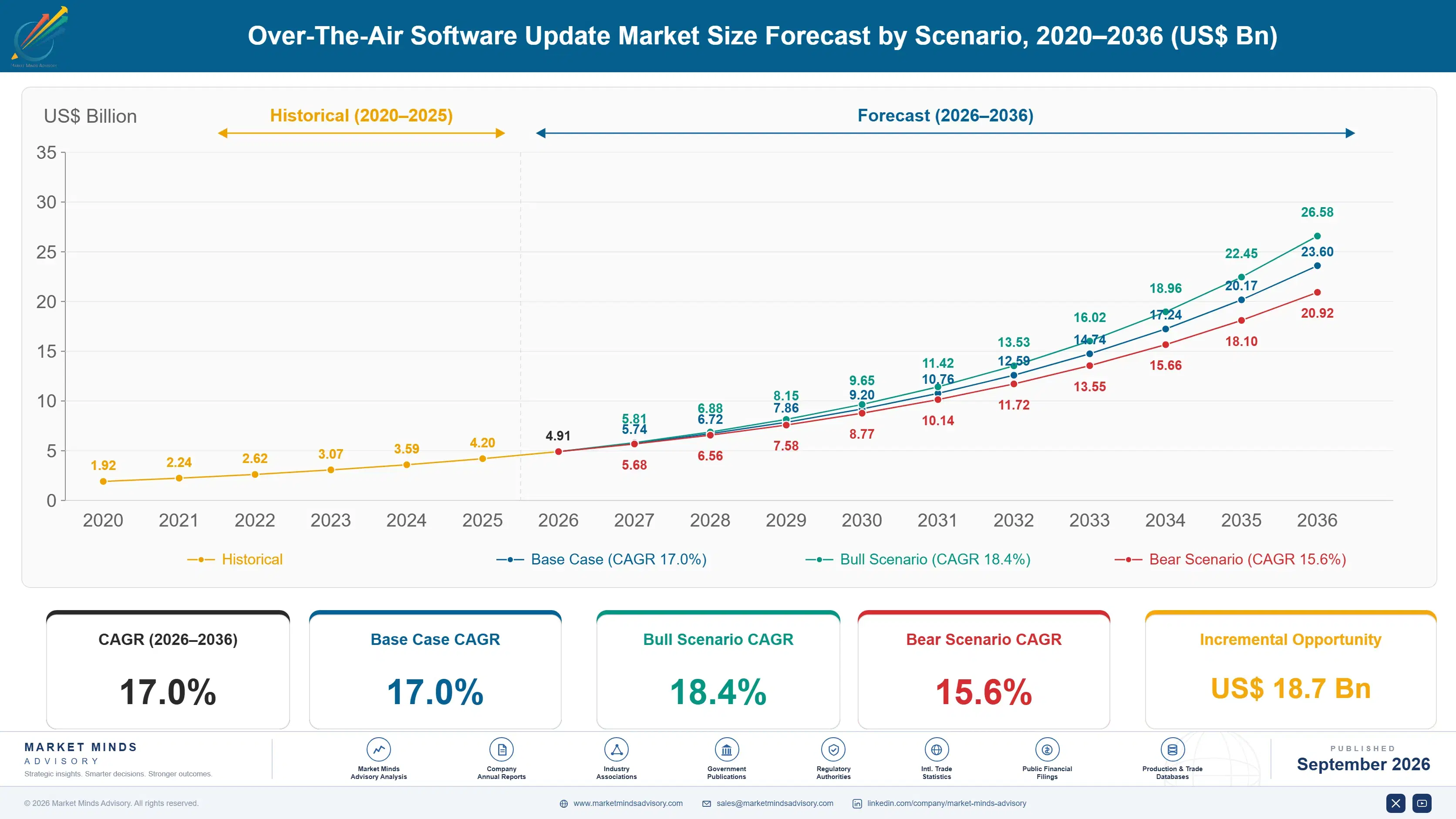
Over-The-Air Software Update Market Forecast Scenarios

over-the-air-software-update-market-size-forecast-scenario-1790007640111
OTA software update adoption accelerated sharply across 2020 to 2025, as regulatory mandates in Europe and Japan requiring cybersecurity and software update management systems pushed automakers toward standardized OTA infrastructure well beyond the handful of electric vehicle pioneers that had led early adoption, forcing even traditional legacy automakers to accelerate their own software platform investment considerably faster than planned.
The base case assumes continued regulatory mandate expansion across additional markets, accelerating software-defined vehicle architecture adoption favoring centralized domain controllers over distributed electronic control units, and gradual migration from single-module updates toward full-vehicle orchestrated deployment. These three mechanisms together sustain strong double-digit growth even as mature markets approach saturation in basic infotainment update capability, shifting incremental spend toward safety-critical domain controller updates that command considerably higher pricing per vehicle platform.
A bull scenario centers on accelerated software-defined vehicle architecture adoption pulling full-vehicle OTA orchestration demand well beyond current automaker roadmaps across multiple vehicle segments and price tiers. A bear scenario centers on high-profile OTA update failures triggering regulatory backlash or automaker caution that slows deployment of safety-critical update capability across the broader industry over the coming years.

Regulatory Mandates Turn OTA Into Baseline

OTA update demand now tracks vehicle software complexity more than raw unit shipment volume, since a single software-defined vehicle with consolidated domain controllers requires far more sophisticated update orchestration than a legacy vehicle architecture with dozens of isolated electronic control units. This complexity shift is reordering how suppliers price and structure their platform contracts, favoring orchestration depth over the simple per-module update counts that once determined most vendor selection decisions.
MARKET CONCENTRATIONCR5 44%Moderately concentrated among a handful of established automotive suppliers
AVERAGE SELLING PRICE$15-$85Priced per vehicle annually rather than flat license
TOP PRODUCING COUNTRYChina 32%Volume concentrated among electric vehicle manufacturers shipping updates continuously
CAPACITY UTILIZATION70-80%Cloud infrastructure scales with fleet size and update frequency
INPUT COST SHARE30% of COGSCloud hosting and cybersecurity certification dominate total cost
REPLACEMENT CYCLE4-6 YearsPlatforms typically refreshed as vehicle computing architecture keeps evolving
Commercial character has shifted from an optional infotainment convenience feature toward regulatory-mandated safety infrastructure, where cybersecurity certification and rollback reliability increasingly determine which platforms automakers trust with safety-critical domain controller updates. Suppliers unable to demonstrate proven rollback safety increasingly lose platform contracts to rivals who can, regardless of how polished their update user interface otherwise appears.
Expanding regulatory mandate coverage, accelerating software-defined vehicle architecture adoption, and growing electric vehicle market share will shape OTA update demand through the next decade, with vendors solving full-vehicle orchestration best positioned to capture the largest automaker platform contracts across every major regional market where regulatory frameworks and electric vehicle adoption continue advancing at meaningfully different paces from one country to the next.
"A recall used to mean a letter and a dealership appointment. Now it can mean a software push that fixes the problem before most owners even notice anything was wrong."
Director, Connected Vehicle and Automotive Software Practice · MMA Automotive Practice · September 2026

Market Trends

Full-Vehicle Update Orchestration Replaces Single-Module Approaches

Automakers increasingly deploy full-vehicle OTA orchestration platforms capable of coordinating updates across dozens of domain controllers simultaneously, moving beyond earlier single-module update approaches that treated infotainment and powertrain systems as entirely separate update pathways. This shift reflects the consolidation of vehicle computing architecture around centralized domain controllers that software-defined vehicle designs increasingly favor over distributed electronic control unit architectures. Several leading automakers have disclosed plans to standardize full-vehicle orchestration across their entire next-generation vehicle platform lineup within the next several product cycles across their combined global vehicle lineup spanning multiple price and size segments.
Market Impact: Software platform investment up 30% yearly

Regulatory Cybersecurity Mandates Expand Beyond Europe and Japan

Additional national markets are adopting cybersecurity and software update management system regulations modeled on the original European and Japanese frameworks, directly expanding the addressable regulatory-driven OTA market beyond its original geographic origin. This regulatory expansion reflects growing government recognition that connected vehicle cybersecurity requires mandatory technical standards rather than voluntary automaker best practices alone. Several additional national markets have disclosed plans to introduce comparable cybersecurity certification requirements within the coming several years as connected vehicle penetration continues rising steadily across most major automotive markets globally, well beyond the original handful of pioneering regulatory jurisdictions.
Market Impact: EV OTA update frequency up 25%

Market Opportunities and Growth Drivers

Software-Defined Vehicle Transition Drives Platform Investment

The broader automotive industry transition toward software-defined vehicle architecture, centralizing computing around a handful of powerful domain controllers rather than dozens of distributed electronic control units, directly increases the strategic importance and technical complexity of OTA update infrastructure. Automakers increasingly view software update capability as core platform differentiation rather than a commodity feature purchased from the lowest-cost supplier. Several major automakers have disclosed multi-billion dollar software platform investment programs specifically citing OTA capability as a central, non-negotiable component of their overall competitive strategy going forward into the next decade of vehicle platform development.
Market Impact: Safety-critical OTA lags by 3 years

Electric Vehicle Market Share Growth Sustains OTA Demand

Continued electric vehicle market share growth sustains OTA update demand, since electric vehicle manufacturers have generally led OTA adoption and continue shipping more frequent feature and safety updates than traditional internal combustion vehicle manufacturers. Multiple electric vehicle manufacturers have disclosed plans to ship monthly or more frequent software updates across their vehicle fleets, directly sustaining recurring OTA platform revenue independent of new vehicle sales volume alone across their existing installed fleet base of vehicles already on the road today, not merely those sold going forward from this point in the model cycle.
Market Impact: Retrofit addressable market under 5%

Market Restraints and Challenges

Update Failure Risk Creates Safety and Liability Concerns

Automakers remain cautious about deploying OTA updates to safety-critical systems, whose root cause traces to documented incidents where software updates introduced unexpected vehicle behavior or bricked systems entirely, creating genuine safety and liability exposure for the automaker. The commercial impact slows deployment of OTA capability to the most safety-critical domain controllers despite clear technical feasibility. Vendors are pursuing mitigation through extensive staged rollout testing and reliable automatic rollback capability that limits exposure if unexpected problems emerge during any phase of the deployment cycle across the affected vehicle fleet and its geographic distribution.
Market Impact: Full-vehicle OTA adoption up 40% yearly

Legacy Vehicle Architecture Limits Retrofit Opportunities

Vehicles built on legacy electronic architectures without adequate compute power or network bandwidth cannot support full OTA update capability, whose root cause lies in hardware constraints designed years before OTA became a standard requirement, making retrofit economically impractical for most existing vehicle fleets. The commercial impact limits the addressable market largely to new vehicle sales rather than the much larger existing vehicle parc. Automakers are pursuing mitigation by accelerating next-generation platform rollout specifically designed with OTA capability built directly into the vehicle architecture from the earliest possible design stage of development.
Market Impact: Regulated markets expanded 35% since 2023
3 additional market trends, 3 additional growth drivers, and 3 additional restraints and challenges are covered in the full report. Contact sales@marketmindsadvisory.com to access the complete intelligence.

Segment CAGR and Growth Architecture

The Over-The-Air Software Update Market segments by update scope and vehicle system, since infotainment, telematics, and safety-critical domain controller updates carry distinct reliability, regulatory, and rollback requirements that shape how automakers specify and purchase OTA capability, rather than by underlying vehicle powertrain type or manufacturer origin alone, which matters comparatively little to the engineers actually specifying the platform.
over-the-air-software-update-market-market-share-analysis-1790007640697

Full-Vehicle Domain Controller OTA Updates for Software-Defined Vehicles

Full-vehicle domain controller OTA updates coordinate simultaneous deployment across powertrain, chassis, and advanced driver assistance domain controllers within software-defined vehicle architectures, requiring far more sophisticated orchestration than earlier single-module update approaches. Demand here grows fastest because automakers increasingly consolidate vehicle computing around centralized domain controllers, directly increasing the technical complexity and strategic importance of coordinated update capability. Vendors with proven full-vehicle orchestration and rollback safety credentials increasingly capture platform-wide automaker contracts over competitors offering only isolated single-module update capability lacking genuine cross-domain coordination and rollback safety validated repeatedly across multiple vehicle generations and real-world fleet deployment conditions spanning diverse climates, driving patterns, network coverage areas, and years of continuous production use.
CAGR 24.0%

Infotainment and Telematics OTA Update Platforms

Infotainment and telematics OTA update platforms deliver feature enhancements, map updates, and connectivity improvements to vehicle entertainment and navigation systems, representing the category's most mature and widely deployed update segment. This segment grows steadily as automakers continue expanding connected services and feature-on-demand offerings that require regular software refresh to remain competitive against smartphone-native user expectations. Vendors with proven consumer-facing update experience and broad infotainment platform compatibility increasingly win contracts across mainstream vehicle segments beyond the premium tier that historically led adoption, extending steadily into mid-market and budget vehicle categories that previously relied entirely on periodic dealership visits for even minor software refreshes and routine map or feature updates delivered only during scheduled maintenance appointments.
CAGR 14.0%
Full segment breakdown across 6 segments available in the complete report.

Regional Architecture and Country Demand Map

OTA update demand concentrates wherever electric vehicle production scale and regulatory mandate coverage intersect, with East Asia leading on electric vehicle manufacturing volume while North America and Western Europe anchor substantial regulatory-driven adoption worldwide today across nearly every automaker platform and vehicle price tier competing today.

North America

North American demand centers on Tesla's continued OTA leadership alongside traditional automakers accelerating their own software-defined vehicle platform investment to compete. United States regulatory attention to vehicle cybersecurity, combined with growing electric vehicle market share, sustains strong OTA platform investment across both legacy automakers and newer electric vehicle entrants. Canadian automotive suppliers also contribute meaningful OTA platform engineering capacity serving the broader North American automotive supply chain and its deeply integrated cross-border manufacturing and software engineering base spanning both countries and the deeply interconnected automotive supply relationships that bind them closely together across shared production platforms, joint supplier certifications, and cross-border logistics networks refined over decades of tightly integrated cross-border trade and manufacturing cooperation.
Share: 27% | CAGR: 17.5% (2026 to 2036)

Western Europe

Western European demand draws heavily on the region's pioneering regulatory framework requiring cybersecurity and software update management systems, which originated in European vehicle type approval regulations before spreading to other markets. Germany's major automakers continue investing heavily in software-defined vehicle architecture to compete with newer entrants, while France and the United Kingdom add meaningful regulatory compliance-driven demand across their domestic automotive manufacturing base and their extensive associated tier-one and tier-two supplier networks across the continent's largest and most technically sophisticated automotive manufacturing hubs and their surrounding supplier clusters, engineering centers, and dedicated research facilities that have anchored the region's global automotive leadership position for multiple consecutive generations of vehicle engineering talent now.
Share: 24% | CAGR: 15.0% (2026 to 2036)
Regional intelligence for 5 additional markets available in the complete report: East Asia, South Asia and Pacific, Latin America, Middle East and Africa, Eastern Europe. Contact sales@marketmindsadvisory.com.
over-the-air-software-update-market-country-cagr-analysis-1790007641221

How OTA Vendors Actually Capture Margin

OTA software update vendors capture value beyond baseline per-vehicle licensing through four commercial mechanisms that reward safety certification and platform depth over one-time integration fees. Cybersecurity certification premium pricing, full-vehicle orchestration upsells, feature-on-demand revenue sharing, and long-term automaker platform contracts all matter considerably more here than initial integration pricing ever really did across this entire industry.

Charging Premium Pricing for Cybersecurity Certification

Vendors that achieve formal cybersecurity and software update management certification compliant with international regulatory standards capture premium pricing that uncertified competitors cannot access, since automakers specifically require this certification for regulatory compliance. This certification typically commands 25 to 35% higher pricing than uncertified platforms, reflecting the specialized testing and documentation investment involved. Vendors with established certification credentials increasingly capture nearly all new automaker platform contracts over uncertified competitors still working through their own lengthy certification and multi-stage testing process at that same point in their own internal product development and certification roadmap.
Market Impact: Certified platforms command 25 to 35% price premiums

Upselling Full-Vehicle Orchestration Beyond Single-Module Updates

Vendors that upsell automakers from single-module update capability toward full-vehicle orchestration platforms capture substantially higher per-vehicle revenue tied to the increased technical complexity of coordinating updates across multiple domain controllers simultaneously. This upgrade typically generates 40 to 60% more revenue per vehicle than basic infotainment-only update capability, reflecting the additional engineering and testing investment required. Vendors with proven full-vehicle orchestration track records increasingly win platform-wide contracts over point-solution competitors offering only isolated infotainment update capability without any genuine cross-domain coordination capability built directly into their underlying software architecture and platform design whatsoever.
Market Impact: Full-vehicle orchestration adds 40 to 60% more revenue

Sharing Revenue From Feature-On-Demand Activation Sales

Vendors that enable feature-on-demand activation, letting automakers sell software-unlocked features like enhanced driver assistance or performance modes post-purchase, capture revenue share from these transactions beyond the underlying platform licensing fee. This revenue sharing arrangement typically generates 8 to 15% of feature activation revenue for the platform vendor, creating a meaningful additional income stream tied directly to consumer purchasing behavior. Vendors with proven feature-on-demand infrastructure increasingly win contracts from automakers pursuing this increasingly popular software monetization business model across their broader vehicle lineup and multiple international markets simultaneously, each with its own regulatory and consumer expectations.
Market Impact: Feature-on-demand sharing adds 8 to 15% more revenue

Securing Long-Term Automaker Platform Standardization Contracts

Vendors that win long-term platform standardization contracts covering an automaker's entire vehicle lineup capture predictable, large-scale revenue tied to multi-year vehicle platform cycles rather than competing model-by-model for individual program wins. These contracts typically span 5 to 8 years aligned with vehicle platform development cycles, providing vendors revenue visibility that program-by-program competitors lack entirely. This approach favors vendors with dedicated automaker account teams over smaller rivals competing purely on individual program pricing without any long-term account relationship or forward volume commitment of any meaningful kind whatsoever from the automaker's side of the relationship.
Market Impact: Platform contracts typically span 5 to 8 years

Who Controls the Margin Pool

Five firms hold roughly 44% of global OTA software update revenue, a moderately concentrated market structure reflecting the diversity of automaker approaches spanning in-house development and third-party platform licensing. Harman and Continental lead through established automotive supplier relationships and platform scale, while the gap to specialized OTA-native vendors remains narrower than in more consolidated automotive technology categories, since automakers frequently mix in-house and third-party capability across different vehicle systems.
Current competitive activity centers on full-vehicle orchestration platform development, cybersecurity certification expansion, and feature-on-demand infrastructure buildout, as vendors race to capture the software-defined vehicle transition. Some large automakers increasingly develop OTA capability entirely in-house rather than licensing third-party platforms, directly competing with the specialized vendors that historically served this function across the industry, particularly among the largest and best-capitalized automaker platform builders.

Emerging pressure comes from automakers building in-house OTA capability as a strategic differentiator rather than a licensed commodity, potentially disintermediating traditional platform vendors on the largest automaker accounts over time. Rankings shift fastest in full-vehicle orchestration, where vendors with genuine multi-domain coordination expertise increasingly out-compete rivals still offering only single-module update capability lacking any genuine cross-domain integration depth.
over-the-air-software-update-market-company-positioning-matrix-1790007641750

Competitive Moat and Risk Dimensions

HARMAN INTERNATIONAL

Moat: Deep Automaker Platform Relationships

Harman's decades-long relationships with major global automakers across infotainment and connected services give it privileged access to platform decisions years before competitive tenders open, letting it shape technical requirements around its own OTA architecture and integration methodology from the earliest planning stage, well before competing vendors even learn a tender is being considered.
HARMAN INTERNATIONAL

Risk: Slower Pure-Play Innovation Pace

Harman's position within Samsung's broader corporate structure and its diversified automotive electronics portfolio have made it somewhat slower to iterate on specialized OTA orchestration features than nimbler pure-play competitors focused exclusively on software update technology and entirely unencumbered by broader corporate parent portfolio priorities and internal resource competition.
AIRBIQUITY

Moat: Specialized OTA Orchestration Expertise

Airbiquity's exclusive focus on OTA update technology and connected vehicle data services gives it product depth and engineering specialization that diversified automotive suppliers extending into OTA cannot easily match, particularly around rollback safety and staged rollout capability that automakers increasingly prioritize above nearly every other platform selection criterion today.
AIRBIQUITY

Risk: Limited Scale Versus Tier-One Suppliers

Airbiquity's smaller overall scale relative to diversified tier-one automotive suppliers limits its ability to compete for the largest global platform contracts, risking share loss to larger rivals able to bundle OTA capability with broader infotainment and connectivity hardware sales across a single combined procurement relationship.

Players Tracked

Prominent Players

Harman International
Continental AG
Airbiquity
BlackBerry QNX
Aptiv

Other Key Players

Bosch
Excelfore
Sibros
Wind River
Luxoft
Elektrobit
Garmin
NNG (iGO Navigation)
Sonatus
Movimento (Airbiquity Legacy)
OTAmatic (BlackBerry Legacy)
Green Hills Software
Vector Informatik
Blaize
Renesas Electronics

Recent Developments

JANUARY 2026

Harman Announces Full-Vehicle Orchestration Platform Expansion

Harman announced an expanded full-vehicle OTA orchestration platform capable of coordinating simultaneous updates across powertrain, chassis, and infotainment domain controllers, targeting automakers transitioning to consolidated software-defined vehicle computing architectures across their next-generation vehicle platforms currently under active development and slated for release across multiple global markets over the coming year.
Signal: Signals established suppliers continue investing further in orchestration depth ahead of expected future automaker platform demand.
AUGUST 2025

Continental Forms Strategic Partnership With Major Automaker

Continental entered a strategic partnership with a major global automaker covering OTA platform standardization across the automaker's entire next-generation vehicle lineup, including committed multi-year platform licensing terms tied to disclosed production volume targets spanning multiple consecutive vehicle model years and several key international markets combined.
Signal: Signals automakers are increasingly standardizing OTA platform relationships across their entire vehicle lineup and market footprint.
APRIL 2025

Airbiquity Acquires Feature-On-Demand Software Startup

Airbiquity completed the acquisition of a feature-on-demand software startup with established post-purchase feature activation technology, adding this monetization capability to its broader OTA platform serving automakers pursuing increasingly popular software-driven revenue models across their entire vehicle lineup and several key international markets going forward from this point.
Signal: Signals OTA platform vendors are expanding into adjacent software monetization capabilities well beyond basic update delivery.

Cloud Infrastructure and Certification Drive Cost

Cloud hosting infrastructure and cybersecurity certification testing together account for roughly 30% of OTA platform vendor operating cost, sourced primarily from major cloud infrastructure providers and specialized automotive cybersecurity testing laboratories concentrated in a handful of countries. This dependence on cloud provider pricing and certification laboratory availability means most vendors, regardless of customer geography, face similar underlying cost structures.
A documented cybersecurity certification laboratory capacity constraint during 2024 extended certification timelines by roughly 30% for several vendors, according to industry analyst reporting referenced in company annual disclosures, as expanding regulatory mandate coverage across additional markets increased demand for limited certification testing capacity worldwide. Several vendors delayed platform launches as a direct consequence, straining relationships with automaker customers awaiting regulatory clearance for their next model year.

Smaller OTA platform vendors face a genuine competitive disadvantage here since they lack the customer volume needed to negotiate preferential cloud infrastructure pricing and priority certification lab scheduling, unlike larger vendors like Continental with enterprise-scale infrastructure agreements. This dynamic favors vendors with substantial existing scale, while smaller specialized vendors increasingly pursue shared certification testing arrangements as mitigation against recurring cost pressure.
over-the-air-software-update-market-cost-volatility-analysis-1790007641946

Negotiating Multi-Year Reserved Cloud Capacity Agreements

Larger OTA platform vendors are negotiating reserved cloud capacity agreements across multiple infrastructure providers, securing preferential pricing compared to on-demand consumption that smaller vendors without comparable committed spend cannot access on similar favorable terms during periods of tightening capacity across the broader cloud infrastructure market overall, particularly during periods of simultaneous demand from multiple industries.

Building Internal Cybersecurity Testing Capability

Some larger vendors are building internal cybersecurity certification testing capability rather than relying entirely on third-party testing laboratories, reducing dependence on constrained external capacity while accelerating their own product certification timelines considerably during peak demand periods when external laboratory capacity runs scarcest across the entire automotive cybersecurity testing industry during peak regulatory filing seasons.

Scheduling Certification Testing Well Ahead of Launch

Vendors are scheduling cybersecurity certification testing considerably further in advance of planned product launches, building buffer time into their development roadmaps to absorb potential laboratory capacity constraints without directly delaying committed automaker platform delivery schedules across their broader product portfolio and multiple simultaneous vehicle program launches spanning several different regional markets and their respective regulatory jurisdictions.

Portfolio Architecture for Margin Defence

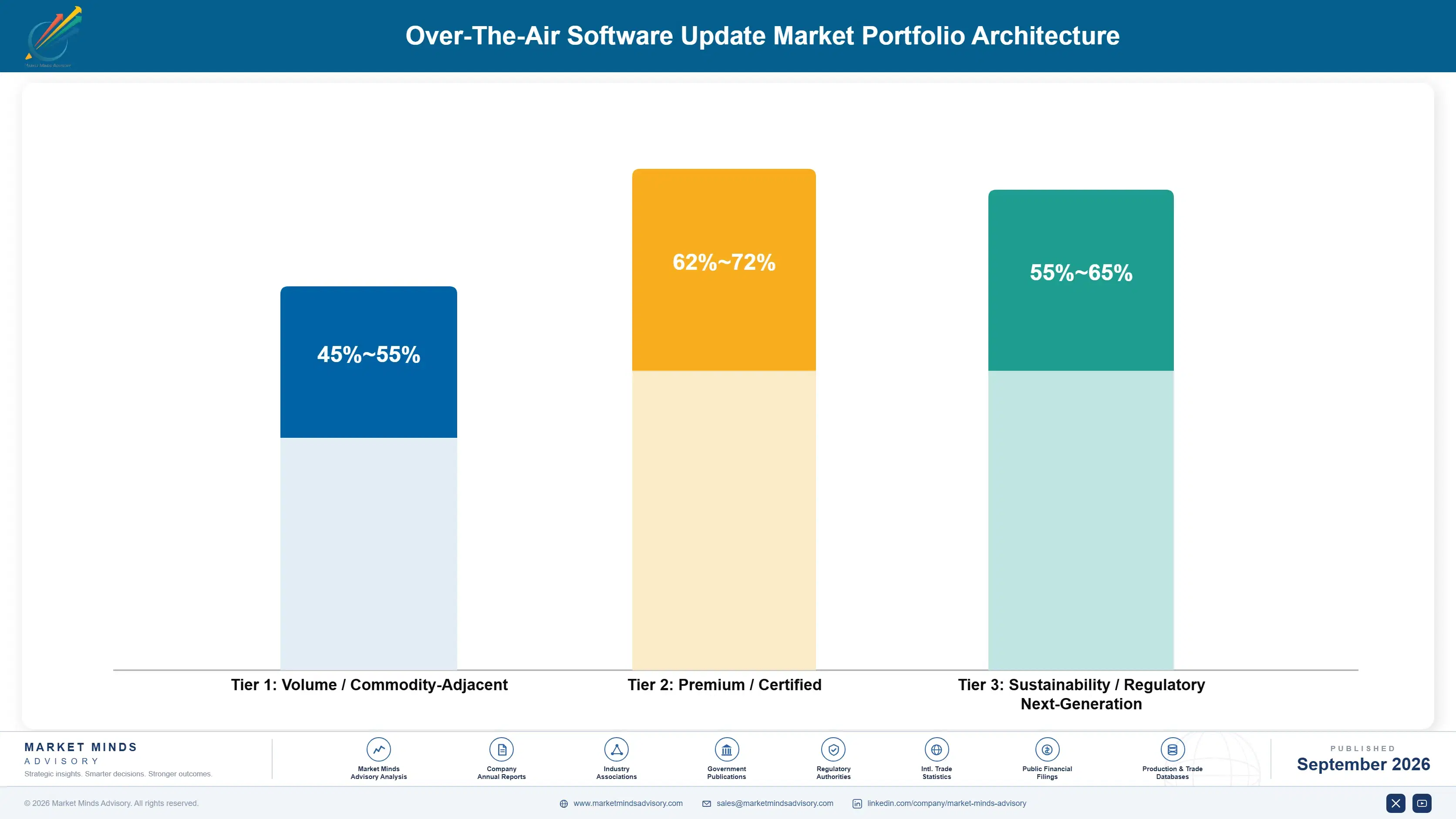
Margin architecture in OTA software updates splits between commoditized infotainment-only update tiers and premium full-vehicle orchestration products. Basic infotainment update platforms run thin margins given competitive bidding among many established vendors, while full-vehicle orchestration and safety-critical domain controller updates command substantially richer margins tied to certification depth and rollback safety credentials that only established vendors with genuine certification depth and rollback engineering rigor can consistently deliver at scale.
Volume infotainment-only subscriptions still generate meaningful revenue today, but margin economics increasingly favor premium orchestration and feature-on-demand tiers as automakers standardize technology procurement around software-defined vehicle architecture. Vendors positioned only in commoditized infotainment tiers face genuine margin pressure as automakers push for full-vehicle capability, forcing many smaller vendors to pursue orchestration development as a defensive necessity rather than a pure growth choice they might otherwise have deferred for several more years.

High-value margin pools concentrate in full-vehicle orchestration, cybersecurity certification premium pricing, and feature-on-demand revenue sharing, where certification depth and platform breadth command premium pricing that basic infotainment competitors simply cannot match today. Vendors building genuine certification depth alongside full-vehicle orchestration expertise increasingly capture the richest margin pools within the entire OTA software update industry.

Volume / Commodity-Adjacent

Basic infotainment-only OTA update platforms for feature and map updates, priced competitively among many established vendors with limited differentiation beyond delivery reliability, unit price, and basic user interface polish overall.
Gross Margin: 45-55%

Premium / Certified

Full-vehicle orchestration and cybersecurity-certified domain controller update platforms priced for certification depth and rollback safety credentials that smaller vendors lacking equivalent testing infrastructure cannot easily match at comparable reliability or scale.
Gross Margin: 62-72%

Sustainability / Regulatory / Next-Generation

Feature-on-demand activation and safety-critical domain controller update tiers positioned ahead of expanding regulatory mandate coverage, commanding premium early-mover pricing before wider competitive entry compresses these margins across the broader industry.
Gross Margin: 55-65%
over-the-air-software-update-market-portfolio-architecture-1790007642457

High-value Sub-segments and Strategic Watch-out

Full-Vehicle Domain Controller OTA Updates for Software-Defined Vehicles

The fastest-growing and highest-value segment, combining a 24.0% forecast CAGR with premium margins tied to orchestration complexity. Vendors with proven multi-domain coordination capture the richest growth and margin combination across the entire OTA market today, well ahead of every other application category tracked across the entire connected vehicle software industry.
Gross Margin: 65-73%

Infotainment and Telematics OTA Update Platforms

A mature segment growing at 14.0% annually, tied to continued connected services expansion across mainstream vehicle segments. Margin economics here trail full-vehicle orchestration though overall deployment volume remains the largest across the entire OTA update category, sustained by continued feature-on-demand monetization growth across nearly every mainstream vehicle segment.
Gross Margin: 48-56%

Basic Feature and Map Update Delivery Platforms

The volume core of the market, generating steady revenue through routine feature and navigation map updates, though intensifying vendor competition is compressing segment margins toward the market's lower end over the coming forecast period across most vehicle segments and price tiers found throughout the global automotive market.
Gross Margin: 38-46%

Legacy Dealership-Only Software Update Processes

A strategic watch-out segment where vehicles still requiring dealership visits for software updates face gradual displacement as OTA capability becomes standard across nearly every new vehicle platform launch worldwide, a category facing gradual but steady decline relative to the broader, rapidly expanding OTA-enabled vehicle market worldwide.
Gross Margin: 30-38%

Why OTA Revenue Recurs for Years

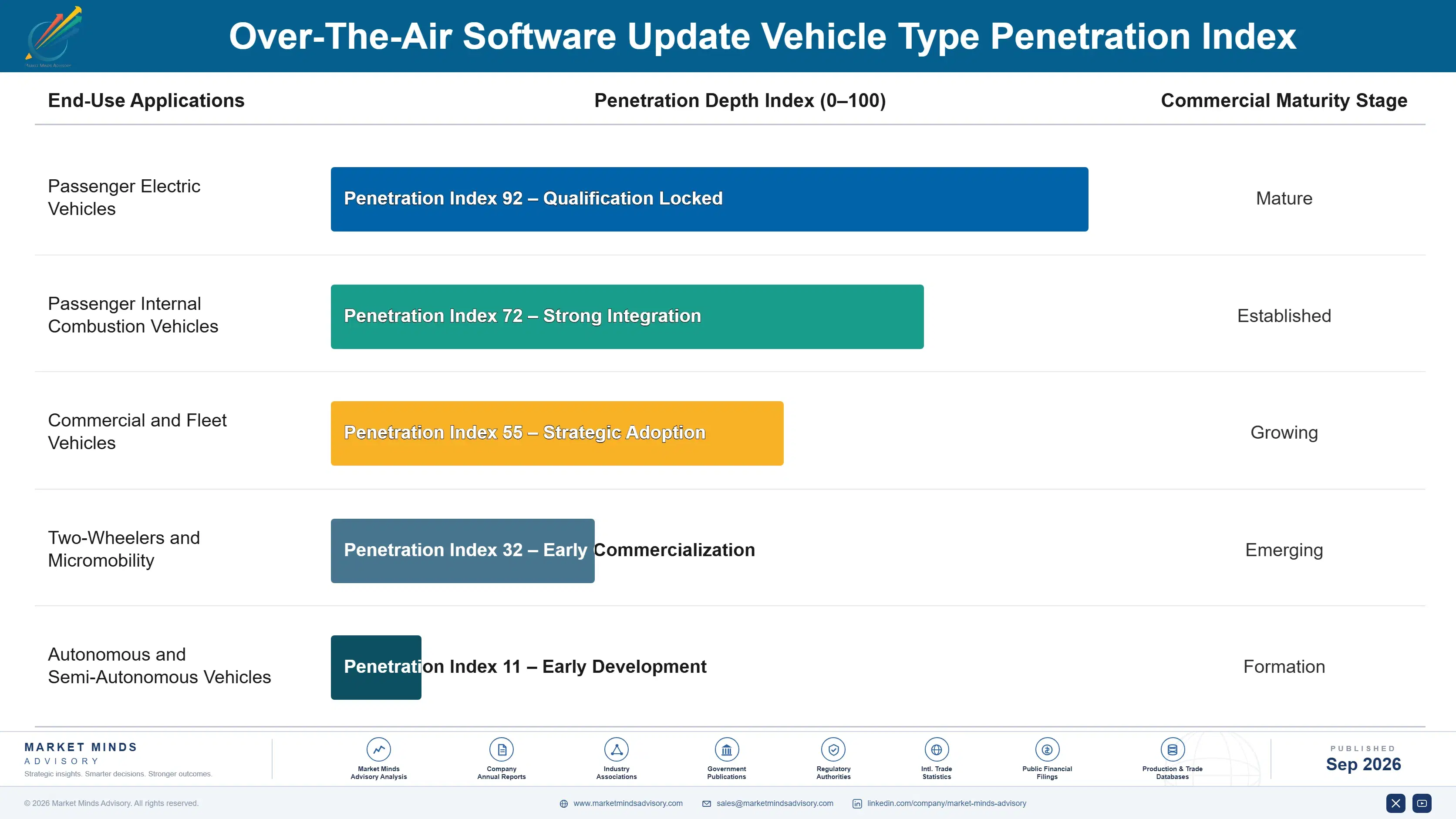
OTA software update revenue builds annuity-like characteristics through multi-year platform standardization contracts and feature-on-demand revenue sharing, rather than through one-time integration fees. Automakers rarely switch OTA platform vendors mid-vehicle-generation once initial architecture decisions are made, since replacing an established vendor requires re-certifying cybersecurity compliance and rollback safety across the entire vehicle lineup at real cost, engineering risk, and potential regulatory re-approval delay across every affected market.
Adoption stickiness varies meaningfully by end-use vertical: safety-critical domain controller updates show the deepest lock-in, since certified rollback safety infrastructure cannot tolerate vendor transition risk once deployed, while infotainment-only updates show comparatively shallower stickiness given more standardized formats and multiple qualified alternative suppliers. Feature-on-demand platforms sit in between, with switching costs tied closely to consumer purchase history integration.

A generational shift in buyer profile is underway as software platform and cybersecurity engineering teams, not just traditional infotainment product managers, increasingly drive OTA vendor selection decisions. These newer buyers evaluate vendors on certification depth and orchestration capability rather than pure feature checklists, reshaping how vendors must position, sell, and structure ongoing account relationships with automaker software and engineering leadership teams.
over-the-air-software-update-market-end-use-penetration-index-1790007642952

Where to Compete in OTA Updates

These are among the four positions where our research anticipates prominent divergence between winners and laggards over the coming forecast period. Each is grounded in the demand model, the regulatory perimeter, and the announced capacity pipeline.
01 / FULL-VEHICLE ORCHESTRATION DEPTH

Build multi-domain coordination before it becomes baseline

Full-vehicle domain controller OTA updates are growing at 24.0% annually, nearly one and a half times the market's average pace, yet many mid-tier vendors still offer only single-module update capability. Vendors that invest in genuine multi-domain orchestration now will capture disproportionate share as software-defined vehicle architecture becomes the industry standard over the next several years. Waiting until orchestration becomes table stakes cedes this position to already-invested competitors that moved first and now hold established automaker relationships built up over multiple platform generations.
02 / CYBERSECURITY CERTIFICATION DEPTH

Pursue formal certification ahead of expanding mandate coverage

Regulatory cybersecurity mandates are expanding beyond Europe and Japan into additional national markets, yet many vendors still lack formal certification credentials. Vendors that achieve certification now capture premium pricing and nearly automatic access to new automaker platform contracts requiring regulatory compliance across every covered market they intend to sell into. Firms without certification should prioritize this investment immediately, before automakers fully standardize procurement exclusively around already-certified suppliers across every regulated market they currently compete in and plan to expand into.
03 / FEATURE-ON-DEMAND MONETIZATION INFRASTRUCTURE

Build monetization infrastructure beyond basic update delivery

Feature-on-demand activation infrastructure lets automakers sell software-unlocked features post-purchase, capturing revenue share that basic update-only vendors offering no monetization capability whatsoever cannot access. Vendors building this monetization infrastructure now will capture disproportionate value as automakers increasingly pursue software-driven revenue models across their entire vehicle lineup and their entire international market footprint spanning multiple continents. Vendors still offering only basic update delivery should prioritize this development before competitors establish exclusive automaker partnerships that would be considerably harder to unwind, replace, or displace later on.
04 / LONG-TERM PLATFORM CONTRACTS

Convert program wins into multi-year platform standardization deals

Vendors that win long-term platform standardization contracts capture revenue visibility spanning 5 to 8 years that program-by-program competitors bidding project-by-project simply cannot match or replicate. These contracts favor vendors with dedicated automaker account teams over smaller rivals competing purely on individual program pricing. Firms still selling purely program-by-program should prioritize building dedicated, deeply embedded long-term account relationships starting immediately, before rivals establish exclusive platform-wide agreements across the same automaker accounts every single competitor currently active in the broader market is targeting right now.

Engagement Snapshot From the Field

A live engagement with an industry participant carrying material or product regulatory and market exposure ahead of a defining policy shift, showing how our research translates into a defensible multi-year portfolio strategy.
MARKET MINDS ADVISORY · CLIENT ENGAGEMENT SUMMARY
Over-The-Air Software Update Producer Strategic Portfolio Review and Transition Roadmap 2026·Investment Scenario on Over-The-Air Software Update Exposure Evaluation 2025-26
CLIENT PROFILE
The client is a global automaker transitioning several vehicle platforms toward software-defined architecture, with annual software platform investment reportedly exceeding $500 million (client-reported, unverified by MMA). The client's existing OTA capability covered only infotainment updates and had not yet extended to safety-critical domain controllers across its vehicle lineup, leaving safety-critical systems dependent entirely on traditional dealership service visits.
STRATEGIC CHALLENGE
The client faced pressure to accelerate its software-defined vehicle transition after competitors announced full-vehicle orchestration capability ahead of schedule, threatening to leave the client's next-generation platform without comparable update capability. Leadership needed an objective evaluation of vendors capable of delivering certified full-vehicle orchestration within a significantly accelerated development timeline relative to typical vendor selection cycles.
MMA APPROACH
MMA conducted a structured vendor capability assessment across six candidate OTA platform providers, evaluating full-vehicle orchestration maturity, cybersecurity certification status, and disclosed rollback safety track records. The engagement combined primary interviews with the client's software engineering and procurement teams alongside comparative capability scoring against the client's accelerated timeline and technical requirements.
KEY FINDINGS
  1. Only two of six candidate vendors demonstrated production-proven full-vehicle orchestration capability meeting the client's aggressive timeline requirements across every evaluated technical dimension.
  2. Vendors with existing cybersecurity certification could compress the client's development timeline by roughly 30% compared to uncertified alternatives evaluated during the same assessment period.
  3. Integration complexity with the client's existing infotainment platform favored vendors offering backward-compatible architecture over entirely new replacement systems requiring complete infotainment platform migration.
  4. The selected vendor's proven rollback safety track record across other automaker deployments reduced the client's perceived deployment risk considerably during the vendor evaluation and selection process.
CLIENT PROFILE
The client is a global automaker transitioning several vehicle platforms toward software-defined architecture, with annual software platform investment reportedly exceeding $500 million (client-reported, unverified by MMA). The client's existing OTA capability covered only infotainment updates and had not yet extended to safety-critical domain controllers across its vehicle lineup, leaving safety-critical systems dependent entirely on traditional dealership service visits.
STRATEGIC CHALLENGE
The client faced pressure to accelerate its software-defined vehicle transition after competitors announced full-vehicle orchestration capability ahead of schedule, threatening to leave the client's next-generation platform without comparable update capability. Leadership needed an objective evaluation of vendors capable of delivering certified full-vehicle orchestration within a significantly accelerated development timeline relative to typical vendor selection cycles.
MMA APPROACH
MMA conducted a structured vendor capability assessment across six candidate OTA platform providers, evaluating full-vehicle orchestration maturity, cybersecurity certification status, and disclosed rollback safety track records. The engagement combined primary interviews with the client's software engineering and procurement teams alongside comparative capability scoring against the client's accelerated timeline and technical requirements.
KEY FINDINGS
  1. Only two of six candidate vendors demonstrated production-proven full-vehicle orchestration capability meeting the client's aggressive timeline requirements across every evaluated technical dimension.
  2. Vendors with existing cybersecurity certification could compress the client's development timeline by roughly 30% compared to uncertified alternatives evaluated during the same assessment period.
  3. Integration complexity with the client's existing infotainment platform favored vendors offering backward-compatible architecture over entirely new replacement systems requiring complete infotainment platform migration.
  4. The selected vendor's proven rollback safety track record across other automaker deployments reduced the client's perceived deployment risk considerably during the vendor evaluation and selection process.
RECOMMENDED STRATEGY
Phase 1: Phase 1 (Selection): Finalize vendor selection and begin integration engineering work within the first two months of the engagement, prioritizing speed without sacrificing rigor. Phase 2: Phase 2 (Certification): Complete cybersecurity certification testing in parallel with ongoing platform integration development work to compress the overall timeline meaningfully. Phase 3: Phase 3 (Rollout): Deploy full-vehicle orchestration capability starting with the client's flagship next-generation vehicle platform launch scheduled for the following model year.
OUTCOME
The client selected a vendor and completed integration within the accelerated timeline as recommended. The next-generation platform launched with full-vehicle orchestration capability reportedly six months ahead of the original internal roadmap (client-reported, unverified by MMA), closing the competitive gap identified at the engagement's outset entirely.

Frequently Asked Questions

Foundational context covering the market sizes, CAGR, scope, country, region and competition that inform every finding below. This section is provided to cover basics and most often pre-purchase conversations, answered from the MMA Primary Research Dataset.

What is the current size of the Over-The-Air Software Update Market?

The Over-The-Air Software Update Market reached $4.2 billion in 2025, driven by regulatory mandates and accelerating software-defined vehicle architecture adoption across major automotive markets worldwide.

How large will the Over-The-Air Software Update Market be by 2036?

The market is projected to reach $23.6 billion by 2036, roughly 4.81 times its 2026 level, as full-vehicle orchestration becomes standard automaker infrastructure across most vehicle segments.

What is the CAGR for the Over-The-Air Software Update Market 2026 to 2036?

The market is forecast to grow at a 17.0% compound annual rate between 2026 and 2036, with full-vehicle orchestration growing considerably faster than infotainment-only categories.

Which segment is growing fastest?

Full-vehicle domain controller OTA updates for software-defined vehicles lead at 24.0% CAGR, roughly 1.41 times the overall market's average growth pace through the forecast period.

Who are the major companies in the Over-The-Air Software Update Market?

Harman International, Continental AG, Airbiquity, BlackBerry QNX, and Aptiv lead the market, together holding roughly 44% of global OTA update revenue across all major categories.

Which country is growing fastest?

China leads country-level growth at roughly 21.0% CAGR, driven by aggressive electric vehicle manufacturers shipping continuous software feature updates across their large domestic vehicle fleet.

Report Segmentation Architecture

The full report scope spans multiple orthogonal segmentation dimensions, with cross-tabulated demand data provided for each dimension pair. Coverage extends further to regional breakdowns, trend trajectories, and the competitive detail needed to support segment-level decision-making.

By Update Scope

  • Infotainment and Telematics Updates
  • Full-Vehicle Domain Controller Updates
  • Safety-Critical System Updates
  • Feature-On-Demand Activation
  • Map and Navigation Updates
  • Others

By Vehicle Type

  • Passenger Electric Vehicles
  • Passenger Internal Combustion Vehicles
  • Commercial and Fleet Vehicles
  • Two-Wheelers and Micromobility
  • Autonomous and Semi-Autonomous Vehicles

By Commercial Dimension

  • Direct Automaker Licensing
  • Systems Integration Partners
  • Managed Platform Services
  • Aftermarket Retrofit Providers

By Region

  • North America
  • Western Europe
  • East Asia
  • South Asia and Pacific
  • Latin America
  • Middle East and Africa
  • Eastern Europe

Scope, Methodology, and Coverage

Every figure in this report is reproducible from documented input assumptions. The scope below maps the historical period, the forecast horizon, the segmentation dimensions, and the countries covered, alongside the underlying primary and qualitative methodology.
Historical Period
2020 to 2025
Forecast Period
2026 to 2036
Base Year
2025 (USD billions; MMA Primary Research Dataset, September 2026)
Market Definition
The Over-The-Air Software Update Market covers infrastructure, platforms, and services that deliver remote software updates to vehicle electronic control units, infotainment systems, and domain controllers without requiring a dealership visit. It excludes in-vehicle infotainment hardware, telematics control unit manufacturing, and general connected car data services sold separately from update delivery.
Quantitative Units
USD billions (current prices); connected vehicle fleet count where applicable
Segmentation Dimensions
By Update Scope; By Vehicle Type; By Commercial Dimension; By Region
Regions Covered
North America, Western Europe, East Asia, South Asia and Pacific, Latin America, Middle East and Africa, Eastern Europe
Countries Covered
USA, China, Germany, France, UK, Japan, South Korea, India, Australia, Canada, Brazil, Mexico, Indonesia, Vietnam, Thailand, Malaysia, UAE, Saudi Arabia, South Africa, Nigeria, Turkey, Poland, Netherlands, Italy, Spain, Sweden, Switzerland, Argentina, Colombia, Singapore, and additional markets relevant to this sector
Key Companies Profiled
Harman International, Continental AG, Airbiquity, BlackBerry QNX, Aptiv, Bosch, Excelfore, Sibros, Wind River, Luxoft, Elektrobit, Garmin, NNG (iGO Navigation), Sonatus, Movimento (Airbiquity Legacy), OTAmatic (BlackBerry Legacy), Green Hills Software, Vector Informatik, Blaize, Renesas Electronics
Quantitative Methodology
Primary survey, n=3,800 respondents, Q4 2025, six countries; demand-side model with trade association cross-validation
Qualitative Methodology
47 expert interviews, Q4 2025; applied to validate demand model assumptions, identify emerging dynamics, and assess competitive positioning
Report Format
PDF and XLSX data workbook (Word format preview document)
Publisher
Market Minds Advisory
Report Code
MMA-2026-AUT-108
Published
September 2026
Contact
sales@marketmindsadvisory.com | www.marketmindsadvisory.com

Purchase the full Over-The-Air Software Update Market Report (2026 to 2036).

This report delivers a comprehensive analysis of the global Over-The-Air Software Update Market, covering sizing, segmentation, regional dynamics, and competitive positioning through 2036. It profiles the twenty leading OTA platform vendors. The analysis examines cybersecurity certification barriers shaping vendor economics, and it quantifies input cost exposure tied to cloud infrastructure concentration across the industry's global operations. Readers gain access to detailed regional demand mechanisms across all seven global regions, alongside forward-looking scenario analysis spanning bull, base, and bear growth cases through the full ten-year 2026 to 2036 forecast period covered in this report.
Ten-year market sizing and forecast model
Twenty-company competitive benchmarking and profiling analysis
Seven-region demand and CAGR breakdown tables
Cybersecurity certification barrier and compliance analysis
Input cost and cloud infrastructure risk assessment
Revenue lever and margin architecture framework

Built For The People Who Decide

From boardroom strategy to bench-side execution, this report is read cover-to-cover by leaders shaping the next decade of their industry, turning demand scenarios, market dynamics and valuation benchmarks into decisions.
CXOs/ Presidents/ VPs/ Managers
M&A and Corporate Development
Strategy Teams and R&D Heads
Procurement and Product Directors
Regulatory and Compliance Leaders
Investor Relations and Equity Analysts