Market Minds Advisory
Outdoor Toys Market

Outdoor Toys Market: Outdoor Toys Market. Water Toy Innovation and Playset Premiumization Drive Category Expansion

Rising water toy and inflatable innovation, expanding backyard playset premiumization, and growing safety certification standards are reshaping outdoor toy purchasing across mass, specialty, and direct-to-consumer retail channels worldwide. each buying season.

Lead Analyst

Published

September 2026

Make Smarter Decisions with Customized Research Insights

Request a free sample report and evaluate market opportunities, growth trends, and competitive dynamics relevant to your business needs.

2025 MARKET VALUE$12.4BMarket Size 2025
2036 FORECAST VALUE$24.8BBase Case , 2026 to 2036
CAGR 2026 TO 20366.5 %Bull 7.8% / Bear 5.2%
INCREMENTAL OPPORTUNITY$11.6BNet 10- year value creation
EXPANSION MULTIPLE1.88x2036 value over 2026 base
Strategic Levers
M&A Pipeline
Regional Outlook
Country Rankings
Competitive Intelligence
Segmental Deep-dive
Call-Us : 91 93563 13602

Executive Snapshot and Market Trajectory.

Water toys and inflatables are reshaping the market fastest right now, propelled by rising backyard pool ownership and social media driven discovery of novel inflatable designs. Manufacturers are launching innovative inflatable products at meaningfully higher price points. Adoption continues broadening across most tracked markets. today.
Commercial momentum concentrates around playset premiumization, safety certification standards, and rising direct-to-consumer brand competition, with North America and Western Europe together anchoring the largest share of global purchasing across nearly every retail channel tracked this year. Retailers report the strongest growth within premium playset and water toy categories rather than basic plastic ride-on toys favored by earlier generations of parents. Retailers report the strongest interest among younger families upgrading their backyard equipment.
The competitive field spans established toy conglomerates and independent specialty manufacturers, with build quality and safety credibility increasingly separating brands more than basic price competition alone within a category facing tightening regulatory scrutiny. These smaller brands move faster on design trends, though they lack compliance budgets supporting the strongest certification claims. Consumers increasingly compare warranty terms before committing to a premium purchase. today across most established retail markets.
Market Definition
The Outdoor Toys Market covers trampolines, playsets, water toys, ride-on equipment, and outdoor sports toys designed for residential outdoor play. It excludes indoor toys, sporting goods for organized athletics, and playground equipment for commercial installations.
Base Year Value
$12.4B in 2025 (MMA Primary Research Dataset, September 2026)
Forecast Period
2026 to 2036, eleven discrete annual values
CAGR
6.5% base case. Bull 7.8%. Bear 5.2%.
Fastest Growth Segment
Water Toys and Inflatables: 10.0% CAGR
Fastest Growth Country
India: 8.5% CAGR
Fastest Growth Region
South Asia and Pacific: 8.5% CAGR
Largest Region
North America: 28% of 2025 global value
Market Leaders
Little Tikes, Radio Flyer, Mattel, Intex, and Backyard Discovery lead the global competitive field. Source: MMA Analysis, company annual reports and investor filings, 2025.
Primary Survey
n=3,800 procurement and R&D decision-makers, Q4 2025, six countries
Methodology
Demand-side build-up, cross-validated against public data, 47 expert interviews

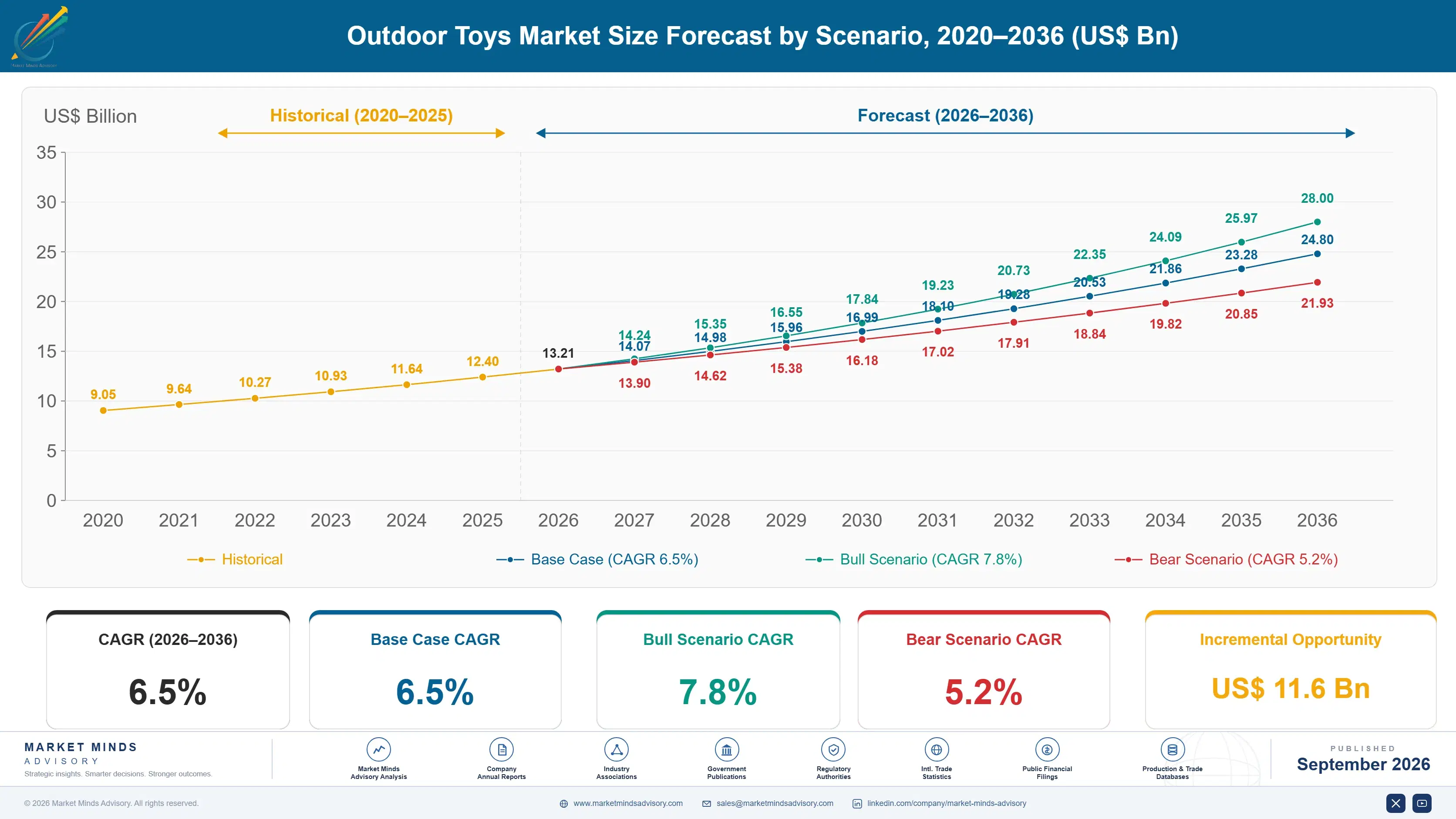
Outdoor Toys Market Forecast Scenarios

outdoor-toys-market-size-forecast-scenario-1790021985316
Between 2020 and 2025, the market grew at an estimated 5.5 percent annually, a period shaped by a pandemic-driven surge in backyard equipment purchasing followed by sustained momentum as families continued prioritizing outdoor recreation spending. Independent specialty brands captured disproportionate share of this sustained demand as online distribution proved more effective at communicating design and safety quality than traditional big-box retail displays.
The base case assumes 6.5 percent annual growth through 2036, driven by three commercial mechanisms: expanding water toy and inflatable innovation, rising playset premiumization replacing basic entry-level equipment, and tightening safety certification standards pushing consumers toward established compliant brands. Established toy conglomerates are responding by expanding their own premium playset and water toy product lines, though independent challenger brands retain a meaningful design credibility advantage among younger parents who prioritize aesthetics and novelty.
The bull case, at 7.8 percent, assumes accelerated water toy innovation and faster premium playset adoption than currently modeled. The bear case, at 5.2 percent, assumes continued category maturity limits growth to replacement purchasing and gifting occasions alone across most tracked markets. Currency and raw material cost volatility could also meaningfully affect realized growth in either direction across major retail markets.

Water Toy Innovation Redefines Category Value

Manufacturing remains heavily concentrated in China, which supplies the majority of global outdoor toys even as final branding and packaging happen closer to end markets. Several brands have begun qualifying secondary assembly partners in Vietnam and Mexico to reduce single-country dependency, though specialized plastic resin molding remains heavily concentrated regardless of final assembly location chosen. Tariff exposure on imported components remains a meaningful cost consideration for manufacturers serving multiple regional markets simultaneously.
MARKET CONCENTRATION26% CR5Fragmented field spread across conglomerate and independent brands
AVERAGE SELLING PRICE$58.00Blended price across water toys, playsets, and ride-on categories
TOP PRODUCING COUNTRYChina 46%Leads global manufacturing output across component and assembly stages
DIRECT-TO-CONSUMER PENETRATION22%Share of sales flowing through owned online brand channels
REPLACEMENT CYCLE LENGTH3 yearsAverage time between routine household replacement purchase transactions
RAW MATERIAL COST SHARE38% of COGSPlastic resin, PVC vinyl, and steel frame component costs combined
Direct-to-consumer channels continue expanding steadily, particularly among independent brands whose social media driven customer acquisition strategies bypass traditional big-box retail entirely. Traditional big-box retailers are responding by expanding in-store demonstration displays and staff training to help consumers understand safety and durability differences they may not have previously considered essential when shopping for a basic replacement.
Replacement cycle length varies meaningfully by product category. Water toys and inflatables get replaced more frequently due to sun and chlorine exposure, while playsets and trampolines last considerably longer. Manufacturers increasingly design modular playset components that can be expanded or replaced independently of the core structure, extending the useful life of the primary investment beyond what a single fixed design could otherwise support.
"Outdoor toys used to be seasonal impulse buys with thin margins. Premium playsets and safety-certified trampolines turned this into a category families research and budget for months in advance."
Director, Toys and Recreational Products Practice · MMA Trampolines Practice · September 2026

Market Trends

Water Toy Innovation Expands Beyond Basic Floats

Inflatable water toys featuring elaborate designs, integrated games, and social media friendly aesthetics are capturing share from basic pool floats and simple sprinkler toys that dominated the category for decades without meaningful design evolution. Manufacturers building shareable, photogenic products report meaningfully stronger conversion among younger parents who discover products through social media content rather than traditional retail browsing behavior. Retailers report water toy sales climbing considerably faster than the broader category average, with continued growth expected as design innovation and viral marketing continue accelerating across most tracked consumer demographics globally.
Market Impact: Expands addressable base by 16 percent
Safety Certification Standards Reshape Product Design

Tightening safety regulation around trampoline netting, playset structural stability, and choking hazard disclosure is reshaping product design across the category, requiring manufacturers to invest in compliance testing well ahead of retailer certification requirements that vary meaningfully across regional markets. Brands securing early compliance certification report meaningfully stronger retail placement negotiating position, since major toy retailers increasingly favor certified suppliers when allocating limited shelf space during peak seasonal buying periods. Manufacturers slower to invest in compliance testing risk losing shelf placement to certified competitors as retailer safety requirements continue tightening. today.
Market Impact: Raises order value by 17 percent

Market Opportunities and Growth Drivers

Rising Backyard Investment Expands Category Demand

Growing residential backyard investment across most developed markets, driven by expanding home renovation spending and social media outdoor living content, continues sustaining demand for outdoor toys as households complete their broader backyard recreation setup rather than purchasing toys as an isolated decision. Consumers investing in pools, patios, and landscaping increasingly complete their outdoor space with matching playsets and water toys rather than treating toy purchases as unrelated to broader home improvement spending. Retailers report meaningfully higher basket sizes among consumers purchasing outdoor toys alongside other backyard equipment in the same transaction.
Market Impact: Limits large-format adoption by 12 percent

Gift and Holiday Purchasing Sustains Premium Demand

Outdoor toys including premium playsets and trampolines increasingly appear on holiday and birthday gift lists, expanding demand beyond direct personal purchases into gift-driven transactions that typically favor premium safety-certified equipment over basic entry-level alternatives available at lower price points. This gifting dynamic meaningfully increases average transaction value, since gift-givers often purchase premium sets rather than basic single toys that a recipient family might otherwise choose for themselves when shopping independently on a budget. Retailers report meaningfully higher basket sizes among gift-driven purchases compared to routine purchases outside gifting occasions. today.
Market Impact: Raises input costs by 12 percent

Market Restraints and Challenges

Limited Yard Space Constrains Urban Adoption

Shrinking average residential yard sizes in dense urban and suburban markets are limiting the addressable base for larger outdoor toys like trampolines and playsets, constraining volume growth in exactly the markets where disposable income for premium purchases often runs highest. The root cause traces to broader housing density trends well beyond the category's direct control, since smaller lots and denser residential construction reflect land cost and zoning decisions unrelated to toy marketing or product design considerations. Manufacturers are responding by developing compact, foldable, and space-efficient product designs specifically suited to smaller residential outdoor spaces.
Market Impact: Lifts segment growth to 10.0 percent

Plastic Resin Cost Volatility Pressures Margins

Plastic resin and PVC vinyl prices have experienced meaningful volatility tied to petrochemical feedstock swings and specialty manufacturing capacity constraints, squeezing manufacturer margins particularly among smaller brands lacking long-term supply contracts with established chemical suppliers. Larger manufacturers with locked-in supplier agreements have weathered this volatility with comparatively less margin disruption, widening the competitive gap between scaled and boutique brands operating in the category. Several smaller manufacturers have begun passing a portion of these cost increases directly through to retail pricing. Store-brand style budget alternatives have also emerged, competing for shelf space at meaningfully lower price points.
Market Impact: Adds 13 percent compliance costs
3 additional market trends, 4 additional growth drivers, and 2 additional restraints and challenges are covered in the full report. Contact sales@marketmindsadvisory.com to access the complete intelligence.

Segment CAGR and Growth Architecture

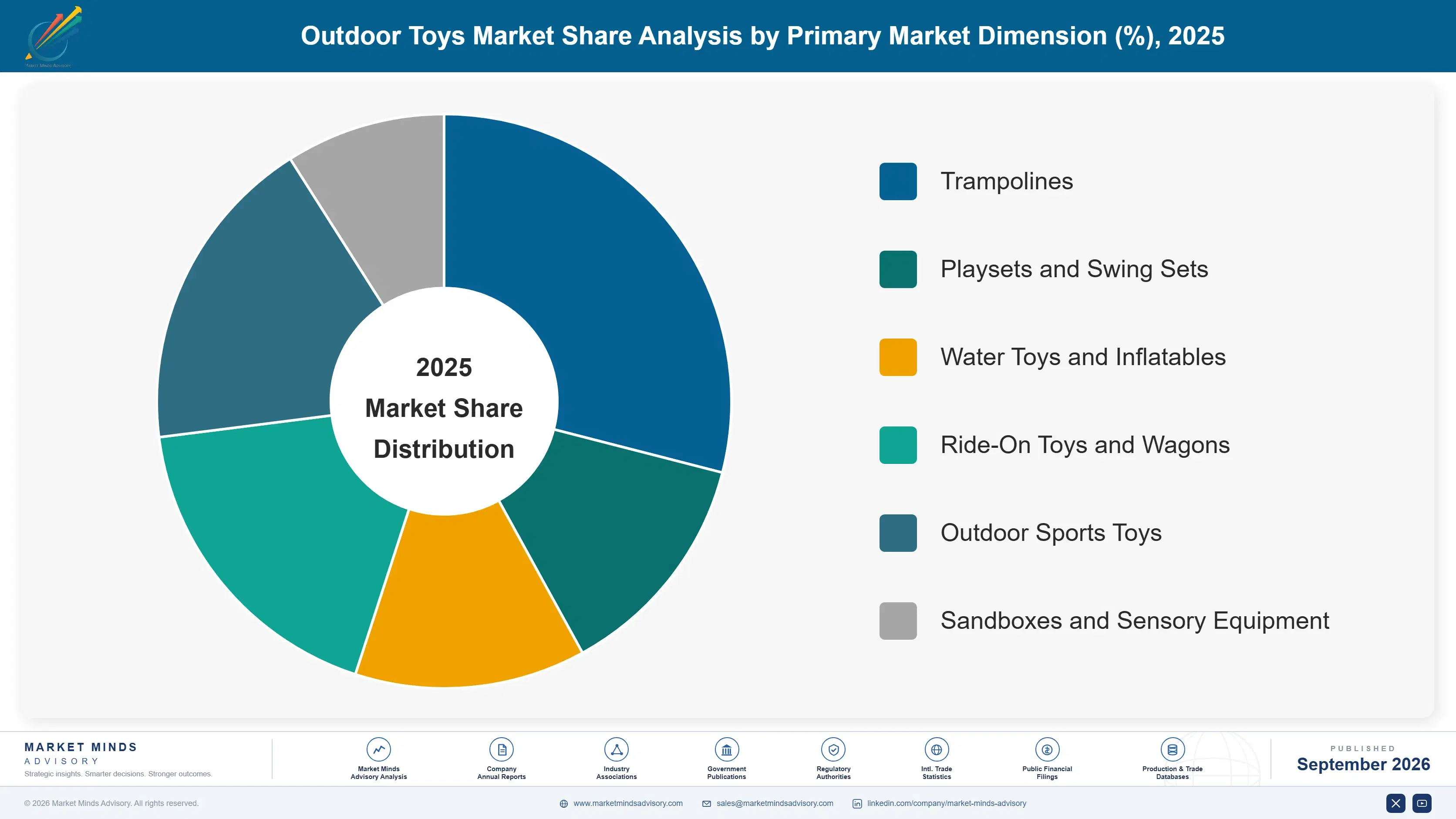
Outdoor toys segment cleanly by product type, spanning trampolines, playsets and swing sets, water toys and inflatables, ride-on toys, outdoor sports toys, and sandbox and sensory equipment. Water toys and ride-on categories currently lead category growth, reflecting design innovation demand. This split reflects distinct consumer motivations tied to design innovation and family mobility rather than a single uniform demand driver.
outdoor-toys-market-market-share-analysis-1790021985881

Water Toys and Inflatables

Water toys and inflatables have moved from a basic seasonal category into one of the fastest-growing segments in the entire market, driven by elaborate design innovation and social media friendly aesthetics that basic pool floats and sprinkler toys could not previously offer to increasingly design-conscious younger parents. Independent direct-to-consumer brands built around shareable product design have captured disproportionate share from legacy manufacturers slower to invest in comparable design development budgets. Manufacturing capacity constraints emerged briefly during peak summer demand periods, leading several brands to introduce waitlists for popular designs before scaling production further to meet accelerating seasonal demand. Retailers report growing consumer awareness of these designs driving trial across most tracked retail markets.
CAGR 10.0%

Ride-On Toys and Wagons

Ride-on toys and wagons benefit from strong crossover appeal between traditional outdoor play and growing outdoor family activity culture, since these products address a widely recognized need for mobile outdoor recreation equipment spanning multiple age groups within a single household. This segment commands meaningfully higher average selling prices than basic outdoor toys, reflecting both battery-powered feature complexity and genuine consumer willingness to pay for durability across multiple growing children within a family. Manufacturers increasingly design adjustable and modular ride-on toys that accommodate a wider age range within one product purchase. Growth here tracks broader family outdoor activity trends more closely than general seasonal purchasing, making it somewhat less volatile than water toy categories overall.
CAGR 8.0%
Full segment breakdown across 6 segments available in the complete report.

Regional Architecture and Country Demand Map

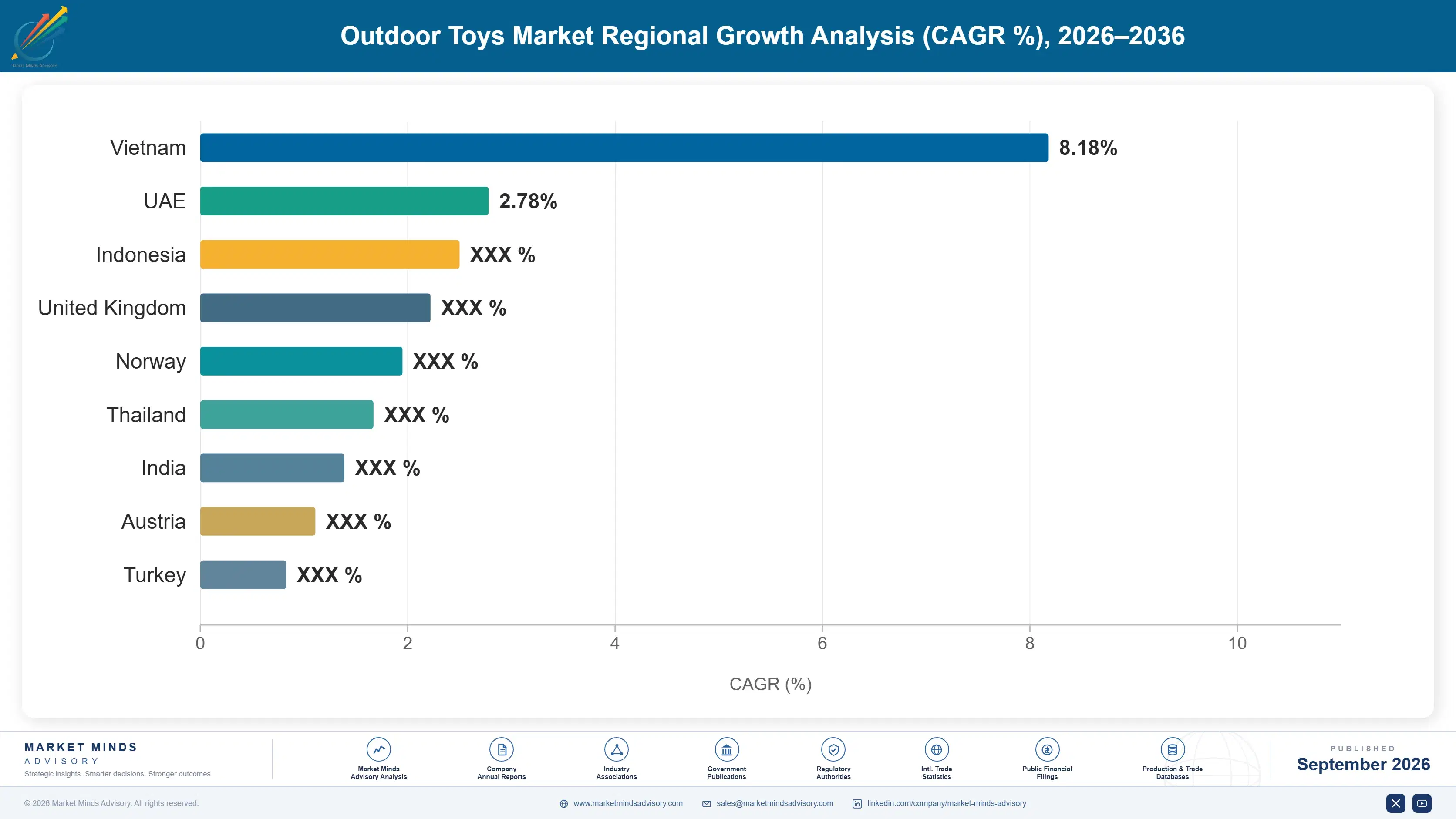
North America leads global outdoor toy demand, anchored by suburban yard space and dense big-box toy retail infrastructure, while South Asia and Pacific accelerates fastest on rising disposable income. Manufacturers increasingly tailor materials and pricing regionally rather than applying one uniform global product assortment strategy.

North America

North America holds the largest regional share, supported by widespread suburban yard ownership and a dense network of big-box and specialty toy retailers sustaining both gift-driven and direct household purchasing behavior. The United States accounts for the overwhelming majority of regional demand, driven by strong backyard investment culture and growing direct-to-consumer subscription adoption among younger households. Canada contributes a smaller but steadily growing share, particularly within premium water toy categories favored by design-conscious urban consumers. Retailers report the deepest bench of loyal repeat premium buyers anywhere in the world. Brand loyalty programs and subscription discounts are becoming increasingly common across major specialty toy retail chains nationwide. Retailers increasingly bundle extended warranty coverage with premium purchases to reduce buyer hesitation.
Share: 28% | CAGR: 7.0% (2026 to 2036)

Western Europe

Western Europe combines a long-standing outdoor recreation tradition, particularly strong in Germany and the United Kingdom, with growing regulatory attention to trampoline and playset safety certification that increasingly favors compliant suppliers across the region. Germany's strong safety-conscious consumer base supports premium brand adoption specifically tied to certified equipment, while the United Kingdom shows particularly strong seasonal water toy demand during summer months. Growth trails North America somewhat as market penetration among established households is already comparatively mature. Several specialty chains are now expanding dedicated certified equipment sections. The United Kingdom's specialty toy retail sector has consolidated meaningfully over the past several years amid rising rents and shifting habits. Independent challenger brands are gradually gaining specialty shelf space despite this consolidation.
Share: 23% | CAGR: 5.0% (2026 to 2036)
Regional intelligence for 5 additional markets available in the complete report: East Asia, South Asia and Pacific, Latin America, Middle East and Africa, Eastern Europe. Contact sales@marketmindsadvisory.com.
outdoor-toys-market-country-cagr-analysis-1790021986404

Premium Trade-Up and Registry Playbook

Manufacturers capture disproportionate margin by trading consumers up from basic entry-level toys toward premium water toy and playset tiers, by bundling outdoor toys with matching backyard equipment, by building gift registry partnerships, and by expanding direct-to-consumer channels to capture wholesale markup. Execution discipline across these four levers determines which manufacturers convert rising demand into durable margin over time.

Building Structured Premium Trade-Up Demonstration Programs

Manufacturers running structured trade-up programs, showcasing premium water toy and playset benefits through in-store demonstrations and online comparison videos, report meaningfully higher conversion into the higher-margin premium category than passive shelf placement alone ever achieves among comparable customers. This approach works because most consumers have never directly experienced the durability difference between basic and premium construction, making a hands-on demonstration considerably more persuasive than product descriptions or marketing claims alone. Manufacturers running these structured programs report conversion rates near 18 percent within the first six months of program launch across participating retail locations.
Market Impact: Lifts premium conversion rate by roughly 18 percent

Bundling Outdoor Toys With Matching Backyard Equipment

Selling outdoor toys bundled with matching backyard equipment like storage sheds, patio furniture, and safety padding increases average order value and introduces customers to a broader product range they might not otherwise discover through single-item browsing behavior at retail or online. Bundled offerings also reduce per-unit marketing spend relative to individual product campaigns while increasing the likelihood that a customer sources their entire backyard setup from one brand rather than mixing in competitor products purchased elsewhere. Manufacturers report bundle attach rates reaching roughly 25 percent among first-time premium tier buyers within the first purchase cycle.
Market Impact: Raises bundled average order value by 25 percent

Building Direct Gift Registry Platform Partnerships

Establishing direct partnerships with baby and wedding registry platforms to secure featured placement provides a steadier, higher-margin demand channel than relying primarily on discretionary individual consumer purchases alone across most retail seasons throughout the year. This channel also generates valuable brand exposure, since registry visibility introduces prospective gift-givers to premium product tiers they might not otherwise encounter during a standard budget-conscious shopping trip. Manufacturers with strong registry partnerships report gift-driven channel volume growing roughly 19 percent faster than direct consumer channels. Manufacturers investing early in these relationships report meaningfully stronger brand exposure among first-time registry-browsing gift-givers researching options.
Market Impact: Grows registry-channel volume by roughly 19 percent overall

Expanding Fully Owned Direct-to-Consumer Sales Channels

Manufacturers selling directly through owned e-commerce channels capture meaningfully higher margin per unit than those relying primarily on wholesale distribution through big-box and department store retailers, since they avoid multiple layers of markup entirely while also owning the full customer relationship and repeat purchase data. This direct relationship also lets manufacturers test limited product configurations and pricing without retailer negotiation delays slowing the process considerably. Manufacturers that shifted more than half of total sales to owned channels report gross margins running roughly 13 percentage points above wholesale-dependent competitors. This advantage compounds meaningfully over a manufacturer's full customer relationship lifecycle.
Market Impact: Lifts gross margin by roughly 13 percentage points

Who Controls the Margin Pool

Little Tikes, Radio Flyer, Mattel, Intex, and Backyard Discovery together account for roughly 26 percent of global outdoor toy revenue, a fragmented concentration level typical of a category spanning both established toy conglomerates and independent specialty manufacturers. The gap between the top two revenue leaders and the third-ranked player is narrow, since brand loyalty concentrates more within specific product categories than across the market broadly.
Competitive activity currently centers on water toy design innovation, safety certification investment, and direct-to-consumer channel expansion rather than aggressive price competition alone. Several brands have pursued gift registry platform partnerships to secure featured placement, while others have launched matching backyard equipment sets to capture share within categories established manufacturers address less directly through single-item product lines. These investments generate credible content that resonates more with skeptical consumers than advertising alone.

Rankings could shift meaningfully as independent direct-to-consumer brands continue capturing share from established manufacturers slower to build strong social media and design-forward presence. A brand that successfully bridges manufacturing scale with genuine design credibility stands a real chance of overtaking incumbents that have not modernized their product development approach within the next several years.
outdoor-toys-market-company-positioning-matrix-1790021986929

Competitive Moat and Risk Dimensions

LITTLE TIKES

Moat: Category-Defining Brand Recognition

Little Tikes holds category-defining brand recognition built over decades of market presence in ride-on and playset categories specifically, giving it shelf placement leverage and consumer trust among generational buyers that newer independent entrants cannot easily replicate. This heritage advantage remains difficult for smaller, focused competitors to replicate even with comparable material quality and manufacturing standards.
LITTLE TIKES

Risk: Slower Design Innovation Pace

Little Tikes's large-scale manufacturing infrastructure, optimized for existing product formulations, makes rapid design innovation toward trending aesthetics more operationally complex than for smaller, more agile competitors built around design innovation from inception. The company has responded with dedicated design investment aimed at closing this innovation gap over the coming several years.
INTEX

Moat: Dominant Inflatable Manufacturing Scale

Intex controls manufacturing infrastructure at a scale few dedicated water toy specialists can match, giving it cost advantages on bulk production and established distribution relationships across both mature and emerging markets that smaller competitors struggle to replicate. This scale advantage supports continued cost leadership that smaller, narrowly focused competitors struggle to match on comparable production budgets.
INTEX

Risk: Limited Premium Design Differentiation

Intex's manufacturing scale advantage sometimes comes at the expense of the design differentiation that smaller, design-focused competitors use to capture premium pricing among aesthetically conscious younger consumers seeking distinctive products. Intex has responded by establishing dedicated design partnerships to close this differentiation gap over recent product cycles.

Players Tracked

Prominent Players

Little Tikes
Radio Flyer
Mattel
Intex
Backyard Discovery

Other Key Players

Bestway
Gorilla Playsets
Lifetime Products
JumpKing
Skywalker Trampolines
Springfree Trampoline
KidKraft
Costway
Sportspower
Blue Rabbit
Plum Play
TP Toys
International Leisure Products
Franklin Sports
Spin Master

Recent Developments

MARCH 2025

Little Tikes Launches Premium Playset Collection

Little Tikes launched a new premium playset collection featuring enhanced safety certification and modular expansion components, targeting design-conscious parents and marking a deliberate expansion beyond the brand's traditional entry-level product range into premium categories. Company disclosures suggest broader rollout across additional product categories should follow within the coming collection cycle.
Signal: Signals continued mass-market investment in premium playset formulation credibility as component costs continue falling industry-wide overall
JULY 2025

Intex Signs Social Media Design Partnership

Intex signed an expanded partnership with a social media content creator network to co-develop shareable inflatable designs, extending its reach into younger consumer segments beyond its traditional retail channel. Industry observers view the partnership as a meaningful test of whether design credibility translates into broader commercial demand.
Signal: Reflects growing manufacturer investment in social media driven design credibility as manufacturers pursue design-driven differentiation strategies
DECEMBER 2025

Radio Flyer Expands Safety Certification Program

Radio Flyer completed an expanded safety certification program across its ride-on toy lineup, strengthening its competitive position against smaller brands by addressing longstanding retailer concerns about aftermarket certification consistency standards. The certification expansion is expected to strengthen Radio Flyer's competitive position against smaller brands directly.
Signal: Indicates intensifying manufacturer investment in quality certification credibility as certification becomes a genuine differentiator overall today

Plastic Resin and Steel Frame Exposure

Plastic resin, PVC vinyl for inflatables, and galvanized steel frame components together represent roughly 38 percent of cost of goods sold across outdoor toy manufacturers, with resin sourced from petrochemical processors and steel sourced from regional mills supplying the broader consumer goods and construction industries. Manufacturers with vertically integrated molding production maintain somewhat more predictable input costs than those purchasing finished components from third-party specialty suppliers.
Plastic resin prices experienced meaningful volatility during 2025 amid petrochemical feedstock swings, according to EIA commentary on plastics and resin pricing trends, squeezing margins particularly among smaller manufacturers lacking the long-term supply agreements that larger, scaled competitors had already secured well ahead of the tightening market. Some manufacturers responded by reformulating toward more readily available resin blends, partially offsetting the exposure that narrow supplier dependency otherwise carried through the disruption period.

Smaller independent brands without locked-in supplier agreements face a distinct competitive disadvantage, since they absorb spot-market resin price swings directly into product cost while larger, vertically integrated competitors maintain comparatively stable input pricing. This gap widens during sustained volatility, occasionally forcing smaller brands to delay new product launches entirely. Acquisition of smaller distressed brands sometimes follows this pressure.
outdoor-toys-market-cost-volatility-analysis-1790021987125

Long-Term Resin Supply Contracts

Larger manufacturers are negotiating multi-year fixed-price resin supply contracts directly with petrochemical processors, reducing exposure to spot-market volatility that smaller competitors without comparable purchasing scale cannot easily replicate through their own procurement relationships. Manufacturers that locked in pricing before the 2025 disruption report meaningfully steadier margins than competitors still exposed to spot-market resin pricing.

Alternative Bio-Based Resin Research

Several manufacturers are researching bio-based resin alternatives derived from renewable feedstocks, aiming to reduce dependence on volatile petrochemical markets while supporting broader sustainability marketing claims consumers increasingly expect. Early testing suggests bio-based alternatives perform comparably in durability, though costs remain modestly higher than conventional resin for now. Broader commercial rollout remains a few years away for most manufacturers.

Diversified Regional Steel Sourcing

Manufacturers are qualifying secondary steel and resin suppliers across multiple regions to reduce dependence on any single geography, spreading trade policy and production disruption risk more broadly across their manufacturing and supplier networks. This diversification adds modest logistics complexity but meaningfully reduces the risk that any single region's disruption halts production entirely. Lead times lengthened modestly during qualification.

Portfolio Architecture for Margin Defence

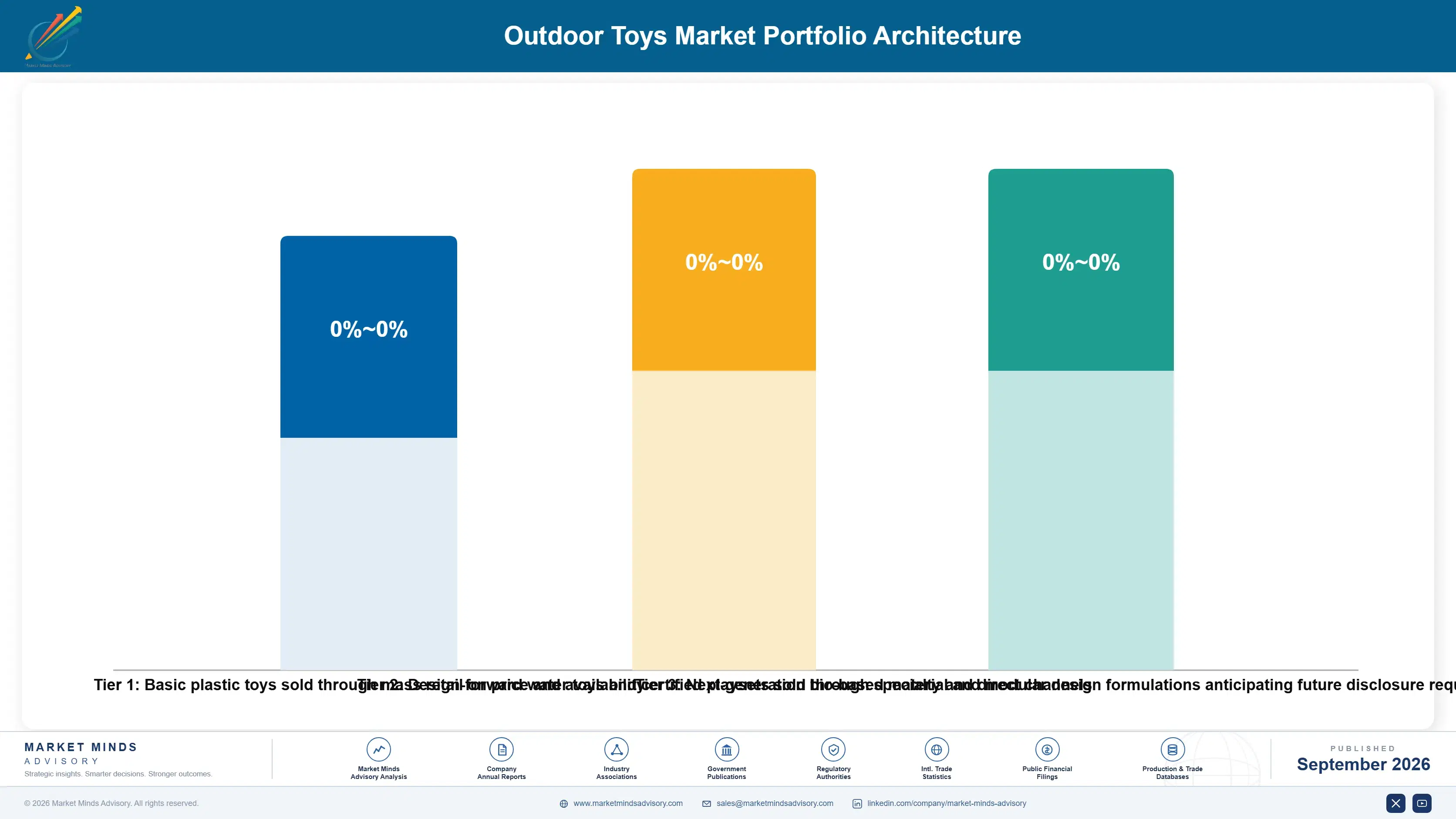
Outdoor toy portfolios split across three tiers with meaningfully different margin economics. Volume-tier basic plastic toys compete on price and mass retail availability, while premium water toys and certified playsets command higher margins from consumers willing to pay for design innovation and safety credentials across the product lineup. Manufacturers that misjudge which tier a customer segment actually values often overinvest in premium features that budget-focused buyers never intended to pay for.
The tension between volume and premium positioning plays out differently across manufacturers. Mass-market brands chasing volume risk commoditization as basic plastic toys flood budget retail channels, while brands pushing premium tiers benefit from genuinely differentiated demand that budget competitors have not yet meaningfully penetrated across specialty and gift retail channels. Manufacturers straddling both tiers tend to protect revenue better through demand cycles than single-tier specialists.

High-value margin pools concentrate in design-forward water toys and safety-certified playsets, where design credibility and compliance support pricing that basic alternatives cannot match. Brands positioned at this intersection of technical differentiation and gift-worthy presentation capture the strongest pricing power across the category today, a position likely to persist. through the medium term as gift-driven purchasing continues expanding across the broader toy category.

Basic plastic toys sold through mass retail on price and availability

Basic plastic outdoor toys sold through mass retail channels, where price and basic function matter more than design innovation or safety certification features. Margins here remain thinnest as private-label competition intensifies across major mass retail channels each year.
Gross Margin: 16 to 24 percent

Design-forward water toys and certified playsets sold through specialty and direct channels

Design-forward water toys and safety-certified playsets sold through specialty retail and direct-to-consumer channels at a meaningful price premium over basic alternatives. Buyers in this tier increasingly research safety credentials and material quality before committing to a purchase.
Gross Margin: 32 to 42 percent

Next-generation bio-based material and modular design formulations anticipating future disclosure requirements

Next-generation bio-based material formulations and modular expandable designs anticipating tightening material disclosure requirements, commanding the highest margins among an early adopter base. Adoption remains concentrated among sustainability-conscious buyers willing to pay ahead of broader mainstream norms.
Gross Margin: 38 to 48 percent
outdoor-toys-market-portfolio-architecture-1790021987622

High-value Sub-segments and Strategic Watch-out

Water Toys and Inflatables

The fastest-growing and highest-value segment, driven by design innovation demand that continues supporting strong pricing power for brands with credible aesthetic differentiation and marketing. Demand here continues outpacing supply of design-forward products, giving early movers meaningful pricing leverage over the next several years. each year.
Gross Margin: 36 to 44 percent

Ride-On Toys and Wagons

High-value segment tied closely to family outdoor activity trends, appealing to buyers willing to pay for durability across multiple children over lowest available price. Growth here tracks broader family outdoor activity trends more closely than general seasonal purchasing across most tracked retail markets. overall today.
Gross Margin: 32 to 40 percent

Standard Playsets and Swing Sets

The volume core of the category, sold at competitive pricing through mass retail channels where brand differentiation matters less than consistent availability and affordable everyday pricing. Consistent volume here anchors overall brand revenue even as margin growth increasingly concentrates elsewhere within the broader category. broadly.
Gross Margin: 22 to 30 percent

Private-Label Budget Toys

A strategic watch-out segment facing intensifying margin compression as retailers expand private-label offerings, leaving branded budget-tier toys exposed to continued share loss. Brands still dependent on this segment should diversify toward premium tiers before pricing pressure intensifies meaningfully further. across channels. indeed truly. over time.
Gross Margin: 14 to 20 percent

Replacement Cycle and Gifting Economics

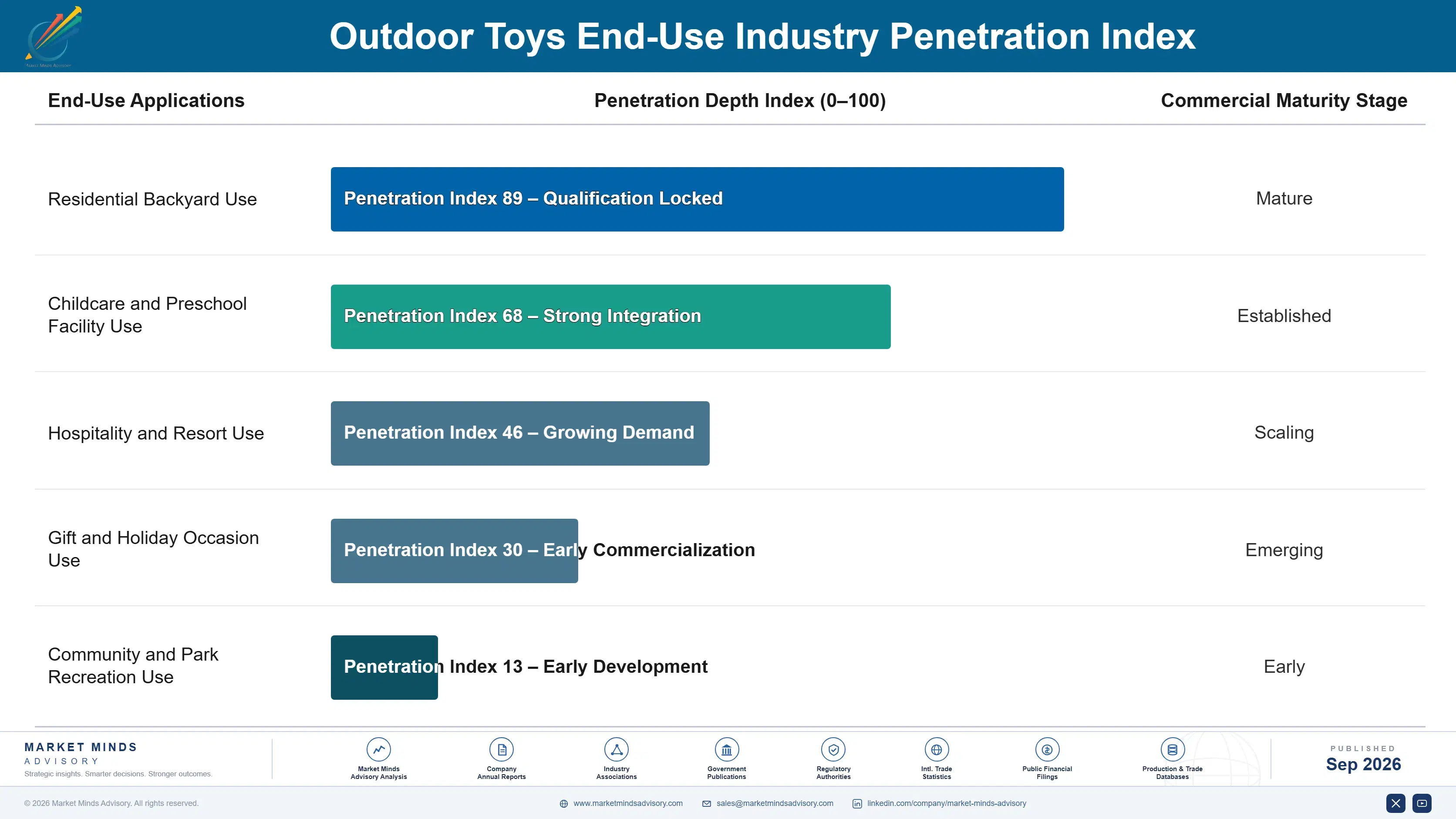
Outdoor toy demand carries distinct replacement timing tied to product durability, seasonal wear, and gifting occasions rather than pure consumption annuity, since a functioning playset or trampoline often sees years of use before a household considers replacement absent damage or a child outgrowing it. Brands with strong gift-registry positioning capture durable loyalty extending well beyond that initial purchase. This initial purchase decision often shapes brand loyalty across subsequent replacement occasions as well.
Adoption depth and stickiness vary meaningfully by end-use vertical. Frequent outdoor families develop strong brand loyalty tied to durability and safety credentials, while occasional users treat the category more interchangeably, purchasing whatever budget-appropriate tool is conveniently available at the time of need. Rental and event businesses sit between these extremes, prioritizing durability and bulk purchasing efficiency over brand prestige.

Buyer profiles are shifting generationally as younger parents, introduced to premium outdoor toys through social media content rather than inherited habits from their own parents, increasingly favor brands with strong design aesthetics over legacy brands built purely on decades of big-box shelf presence. Manufacturers lacking credible social media presence risk losing relevance among this generation. Regular design-forward content increasingly matters as much as material quality itself.
outdoor-toys-market-end-use-penetration-index-1790021988118

Where Outdoor Toy Brands Win

These are among the four positions where our research anticipates prominent divergence between winners and laggards over the coming forecast period. Each is grounded in the demand model, the regulatory perimeter, and the announced capacity pipeline.
01 / WATER TOY INNOVATION PRIORITY

Scale design innovation before demand outstrips manufacturing supply

Water toys and inflatables are growing at 10.0 percent annually, well ahead of the category's 6.5 percent overall CAGR, and brands offering credible design innovation have already captured meaningful share from legacy basic float competitors. Brands still limited to basic designs risk losing this fast-growing segment entirely to more innovation-credible competitors within the next several years as consumer expectations shift. MMA recommends design investment take priority over incremental manufacturing scale expansion for brands still meaningfully under-indexed in this fast-growing segment relative to overall category demand.
02 / SAFETY CERTIFICATION INVESTMENT PRIORITY

Invest in certification ahead of tightening regulatory requirements

Brands securing early compliance certification consistently report meaningfully stronger retail placement negotiating position as major toy retailers increasingly favor certified suppliers when allocating limited shelf space during peak seasonal buying periods. Brands without certified programs risk losing shelf placement entirely to competitors as retailer safety requirements continue tightening across most major developed and emerging markets. MMA advises prioritizing certification investment over incremental design refinements wherever limited budget forces a sequencing decision between the two competing priorities facing leadership this year.
03 / BUNDLING AND CROSS-SELL PRIORITY

Bundle toys with backyard equipment for higher order value

Brands successfully bundling outdoor toys with matching backyard equipment consistently report bundle attach rates reaching roughly 25 percent among first-time premium tier buyers, meaningfully increasing average order value beyond single-item purchase behavior. Brands that ignore this bundling opportunity risk lower basket sizes and slower category cross-sell than competitors already capturing this incremental revenue across every channel tracked. MMA recommends bundling investment take priority over standalone product marketing for brands still competing primarily on single-item purchase behavior rather than curated sets.
04 / NORTH AMERICAN ANCHOR STRATEGY

Defend the North American base while South Asia accelerates

North America currently holds by far the largest single regional share at 28 percent, anchored by widespread suburban yard ownership and a dense network of toy retailers sustaining purchasing behavior today. South Asia and Pacific is expanding fastest at 8.5 percent annually, offering the strongest incremental growth opportunity available anywhere in the category today. Brands should defend the North American base while building early distribution relationships across South Asian urban markets starting well ahead of most competitors currently active there.

Engagement Snapshot From the Field

A live engagement with an industry participant carrying material or product regulatory and market exposure ahead of a defining policy shift, showing how our research translates into a defensible multi-year portfolio strategy.
MARKET MINDS ADVISORY · CLIENT ENGAGEMENT SUMMARY
Outdoor Toys Producer Strategic Portfolio Review and Transition Roadmap 2026·Investment Scenario on Outdoor Toys Exposure Evaluation 2025-26
CLIENT PROFILE
The client is an independent water toy brand generating annual revenue in the tens of millions of dollars, built primarily through social media marketing and direct-to-consumer online sales (client-reported, unverified by MMA). The brand had achieved strong online growth but lacked physical retail presence heading into peak summer selling season. it sought to enter for the first time.
STRATEGIC CHALLENGE
The client needed to determine which big-box retail partners would accept its premium pricing without demanding steep margin concessions, while managing limited internal sales resources and avoiding a retail partnership that could dilute its design-forward brand positioning. The client's small internal team also lacked prior experience negotiating big-box retail placement agreements of this scale.
MMA APPROACH
MMA conducted a structured retail partner assessment across five candidate big-box and specialty toy chains, evaluating shelf placement terms, margin expectations, and existing premium water toy assortment fit. The engagement combined retail buyer interviews and comparative benchmarking against the client's existing direct-to-consumer pricing structure. Findings were validated against the client's brand positioning guidelines before final recommendations reached leadership for approval.
KEY FINDINGS
  1. Two of the five candidate retailers offered shelf placement terms that preserved the client's target margin without significant concessions. This finding significantly narrowed the client's final partner shortlist.
  2. Retailers with existing premium toy sections converted new brand trial at meaningfully higher rates than general seasonal aisles. This insight directly informed the final partnership recommendation approach.
  3. A phased regional rollout proved more effective than a broader simultaneous launch across all candidate retail partners nationwide. This phased approach reduced execution risk considerably for the team.
  4. In-store product demonstrations meaningfully improved first-time buyer conversion compared to standard shelf placement alone (client-reported, unverified by MMA). This finding validated the overall retail expansion strategy chosen.
CLIENT PROFILE
The client is an independent water toy brand generating annual revenue in the tens of millions of dollars, built primarily through social media marketing and direct-to-consumer online sales (client-reported, unverified by MMA). The brand had achieved strong online growth but lacked physical retail presence heading into peak summer selling season. it sought to enter for the first time.
STRATEGIC CHALLENGE
The client needed to determine which big-box retail partners would accept its premium pricing without demanding steep margin concessions, while managing limited internal sales resources and avoiding a retail partnership that could dilute its design-forward brand positioning. The client's small internal team also lacked prior experience negotiating big-box retail placement agreements of this scale.
MMA APPROACH
MMA conducted a structured retail partner assessment across five candidate big-box and specialty toy chains, evaluating shelf placement terms, margin expectations, and existing premium water toy assortment fit. The engagement combined retail buyer interviews and comparative benchmarking against the client's existing direct-to-consumer pricing structure. Findings were validated against the client's brand positioning guidelines before final recommendations reached leadership for approval.
KEY FINDINGS
  1. Two of the five candidate retailers offered shelf placement terms that preserved the client's target margin without significant concessions. This finding significantly narrowed the client's final partner shortlist.
  2. Retailers with existing premium toy sections converted new brand trial at meaningfully higher rates than general seasonal aisles. This insight directly informed the final partnership recommendation approach.
  3. A phased regional rollout proved more effective than a broader simultaneous launch across all candidate retail partners nationwide. This phased approach reduced execution risk considerably for the team.
  4. In-store product demonstrations meaningfully improved first-time buyer conversion compared to standard shelf placement alone (client-reported, unverified by MMA). This finding validated the overall retail expansion strategy chosen.
RECOMMENDED STRATEGY
Phase 1: Phase one: launch with the two highest-fit retail partners in a limited regional test before broader commitment. No broader commitment should occur before test results are reviewed. Phase 2: Phase two: expand to additional regions based on sell-through performance data from the initial retail partnership cohort. Underperforming regions should be deprioritized quickly to conserve resources. Phase 3: Phase three: negotiate improved shelf placement and marketing co-investment terms once proven sell-through performance is established. Terms should be reserved for the strongest performing partnerships only.
OUTCOME
The client successfully launched big-box retail distribution across two regional chains within four months and reported meaningful incremental revenue beyond its existing direct-to-consumer base (client-reported, unverified by MMA). The brand has since expanded to three additional retail partners. Retail-driven customers also showed encouraging early repeat purchase behavior.

Frequently Asked Questions

Foundational context covering the market sizes, CAGR, scope, country, region and competition that inform every finding below. This section is provided to cover basics and most often pre-purchase conversations, answered from the MMA Primary Research Dataset.

What is the current size of the Outdoor Toys Market?

The Outdoor Toys Market reached an estimated 12.4 billion dollars in 2025. This figure reflects global revenue across trampolines, playsets, water toys, and ride-on equipment.

How large will the Outdoor Toys Market be by 2036?

MMA projects the market will reach approximately 24.79 billion dollars by 2036. That represents a 1.88 times expansion from the 2026 base value over the ten-year forecast window.

What is the CAGR for the Outdoor Toys Market 2026 to 2036?

The market is projected to grow at a 6.5 percent compound annual growth rate between 2026 and 2036. This reflects rising water toy innovation and playset premiumization.

Which segment is growing fastest?

Water Toys and Inflatables is the fastest-growing segment, expanding at roughly 10.0 percent annually. That is well ahead of the category's overall 6.5 percent CAGR.

Who are the major companies in the Outdoor Toys Market?

Leading companies include Little Tikes, Radio Flyer, Mattel, Intex, and Backyard Discovery. Together these five companies hold roughly 26 percent of global category revenue combined.

Which country is growing fastest?

India leads global growth at an estimated 8.5 percent annually, driven by expanding suburban housing construction and rising disposable income. This builds on the country's rapidly growing middle-class consumer base.

Report Segmentation Architecture

The full report scope spans multiple orthogonal segmentation dimensions, with cross-tabulated demand data provided for each dimension pair. Coverage extends further to regional breakdowns, trend trajectories, and the competitive detail needed to support segment-level decision-making.

By Primary Market Dimension

  • Trampolines
  • Playsets and Swing Sets
  • Water Toys and Inflatables
  • Ride-On Toys and Wagons
  • Outdoor Sports Toys
  • Sandboxes and Sensory Equipment

By End-Use Industry

  • Residential Backyard Use
  • Childcare and Preschool Facility Use
  • Hospitality and Resort Use
  • Gift and Holiday Occasion Use
  • Community and Park Recreation Use

By Commercial Dimension

  • Mass and Big-Box Retail Channels
  • Specialty Toy Retail
  • Direct-to-Consumer Online Sales
  • Gift Registry Platform Distribution

By Region

  • North America
  • Western Europe
  • East Asia
  • South Asia and Pacific
  • Latin America
  • Middle East and Africa
  • Eastern Europe

Scope, Methodology, and Coverage

Every figure in this report is reproducible from documented input assumptions. The scope below maps the historical period, the forecast horizon, the segmentation dimensions, and the countries covered, alongside the underlying primary and qualitative methodology.
Historical Period
2020 to 2025
Forecast Period
2026 to 2036
Base Year
2025 (USD billions; MMA Primary Research Dataset, September 2026)
Market Definition
The Outdoor Toys Market covers trampolines, playsets, water toys, ride-on equipment, and outdoor sports toys designed for residential outdoor play. It excludes indoor toys, sporting goods for organized athletics, and playground equipment for commercial installations.
Quantitative Units
USD billions (current prices); unit shipment volume where applicable
Segmentation Dimensions
By Primary Market Dimension; By End-Use Industry; By Commercial Dimension; By Region
Regions Covered
North America, Western Europe, East Asia, South Asia and Pacific, Latin America, Middle East and Africa, Eastern Europe
Countries Covered
USA, China, Germany, France, UK, Japan, South Korea, India, Australia, Canada, Brazil, Mexico, Indonesia, Vietnam, Thailand, Malaysia, UAE, Saudi Arabia, South Africa, Nigeria, Turkey, Poland, Netherlands, Italy, Spain, Sweden, Switzerland, Argentina, Colombia, Singapore, and additional markets relevant to this sector
Key Companies Profiled
Little Tikes, Radio Flyer, Mattel, Intex, Backyard Discovery, Bestway, Gorilla Playsets, Lifetime Products, JumpKing, Skywalker Trampolines, Springfree Trampoline, KidKraft, Costway, Sportspower, Blue Rabbit, Plum Play, TP Toys, International Leisure Products, Franklin Sports, Spin Master
Quantitative Methodology
Primary survey, n=3,800 respondents, Q4 2025, six countries; demand-side model with trade association cross-validation
Qualitative Methodology
47 expert interviews, Q4 2025; applied to validate demand model assumptions, identify emerging dynamics, and assess competitive positioning
Report Format
PDF and XLSX data workbook (Word format preview document)
Publisher
Market Minds Advisory
Report Code
MMA-2026-CON-347
Published
September 2026
Contact
sales@marketmindsadvisory.com | www.marketmindsadvisory.com

Purchase the full Outdoor Toys Market Report (2026 to 2036).

This report delivers a complete assessment of the Outdoor Toys Market, covering historical performance, ten-year forecasts, and segment-level growth trajectories across trampolines, playsets, and water toy categories. It profiles the twenty most significant brands, evaluated consistently on global revenue, alongside detailed regional demand analysis across all seven regions worldwide. The report also includes portfolio economics, input cost exposure, and a strategic verdict section translating findings into actionable brand recommendations. An anonymized client case study illustrates practical application within a real retail expansion decision. today overall.
Ten-year revenue forecasts by segment and region
Competitive benchmarking across twenty profiled brands
Regional demand analysis across seven global regions
Input cost exposure and mitigation pathway assessment
Portfolio tier economics and margin benchmarking
Strategic verdict with actionable brand recommendations

Built For The People Who Decide

From boardroom strategy to bench-side execution, this report is read cover-to-cover by leaders shaping the next decade of their industry, turning demand scenarios, market dynamics and valuation benchmarks into decisions.
CXOs/ Presidents/ VPs/ Managers
M&A and Corporate Development
Strategy Teams and R&D Heads
Procurement and Product Directors
Regulatory and Compliance Leaders
Investor Relations and Equity Analysts