Market Minds Advisory
Outdoor Payment Terminal Market

Outdoor Payment Terminal Market: Outdoor Payment Terminal Market. EV Charging Integration Reshapes Unattended Payment Hardware Demand

Fuel retailers replacing aging pumps and EV charging networks racing to deploy compliant hardware are colliding as payment terminal manufacturers scale weatherproof, contactless-capable devices built to survive years of unattended outdoor operation.

Lead Analyst

Published

September 2026

Make Smarter Decisions with Customized Research Insights

Request a free sample report and evaluate market opportunities, growth trends, and competitive dynamics relevant to your business needs.

2025 MARKET VALUE$3.4BMarket Size 2025
2036 FORECAST VALUE$9.2BBase Case , 2026 to 2036
CAGR 2026 TO 20369.5 %Bull 10.8% / Bear 8.2%
INCREMENTAL OPPORTUNITY$5.5BNet 10- year value creation
EXPANSION MULTIPLE2.48x2036 value over 2026 base
Strategic Levers
M&A Pipeline
Regional Outlook
Country Rankings
Competitive Intelligence
Segmental Deep-dive
Call-Us : 91 93563 13602

Executive Snapshot and Market Trajectory.

Fuel retailers replacing aging card readers ahead of looming compliance deadlines and EV charging networks racing to deploy contactless-capable hardware are colliding as manufacturers scale weatherproof terminals built to survive years of unattended outdoor operation across every major climate zone and geography across most active retail networks nationwide today.
EV charging payment terminals are scaling fastest, as charging network operators deploy hardware that must satisfy both payment card industry security standards and increasingly strict public charging accessibility regulations simultaneously across multiple jurisdictions. Drive-through and curbside payment terminals are close behind, driven by quick-service restaurants and retailers expanding contactless payment acceptance points beyond traditional indoor checkout counters and cash registers. Vendors on both sides are racing to close certification gaps quickly.
Established payment terminal giants, fuel dispenser manufacturers, and specialized EV charging hardware makers all compete for deployment volume, with fuel dispenser incumbents increasingly bundling payment hardware directly into complete dispenser units rather than selling terminals as standalone components separately in the open market. Independent terminal manufacturers are responding by building deeper multi-application flexibility that bundled offerings genuinely cannot match today, defending premium positioning through specialized capability.
Market Definition
This report covers weatherproof, unattended payment terminal hardware deployed at fuel dispensers, EV charging stations, parking facilities, vending machines, and transit fare systems, measured on a global vendor revenue basis. It excludes indoor point-of-sale terminals and payment software platforms sold without dedicated outdoor-rated hardware.
Base Year Value
$3.4B in 2025 (MMA Primary Research Dataset, September 2026)
Forecast Period
2026 to 2036, eleven discrete annual values
CAGR
9.5% base case. Bull 10.8%. Bear 8.2%.
Fastest Growth Segment
EV Charging Payment Terminals: 18.0% CAGR
Fastest Growth Country
India: 16.0% CAGR
Fastest Growth Region
South Asia and Pacific: 11.5% CAGR
Largest Region
North America: 32% of 2025 global value
Market Leaders
Verifone, Ingenico, Gilbarco Veeder-Root, PAX Technology, Castles Technology
Primary Survey
n=3,800 procurement and R&D decision-makers, Q4 2025, six countries
Methodology
Demand-side build-up, cross-validated against public data, 47 expert interviews

Outdoor Payment Terminal Market Forecast Scenarios

outdoor-payment-terminal-market-size-forecast-scenario-1788423024751
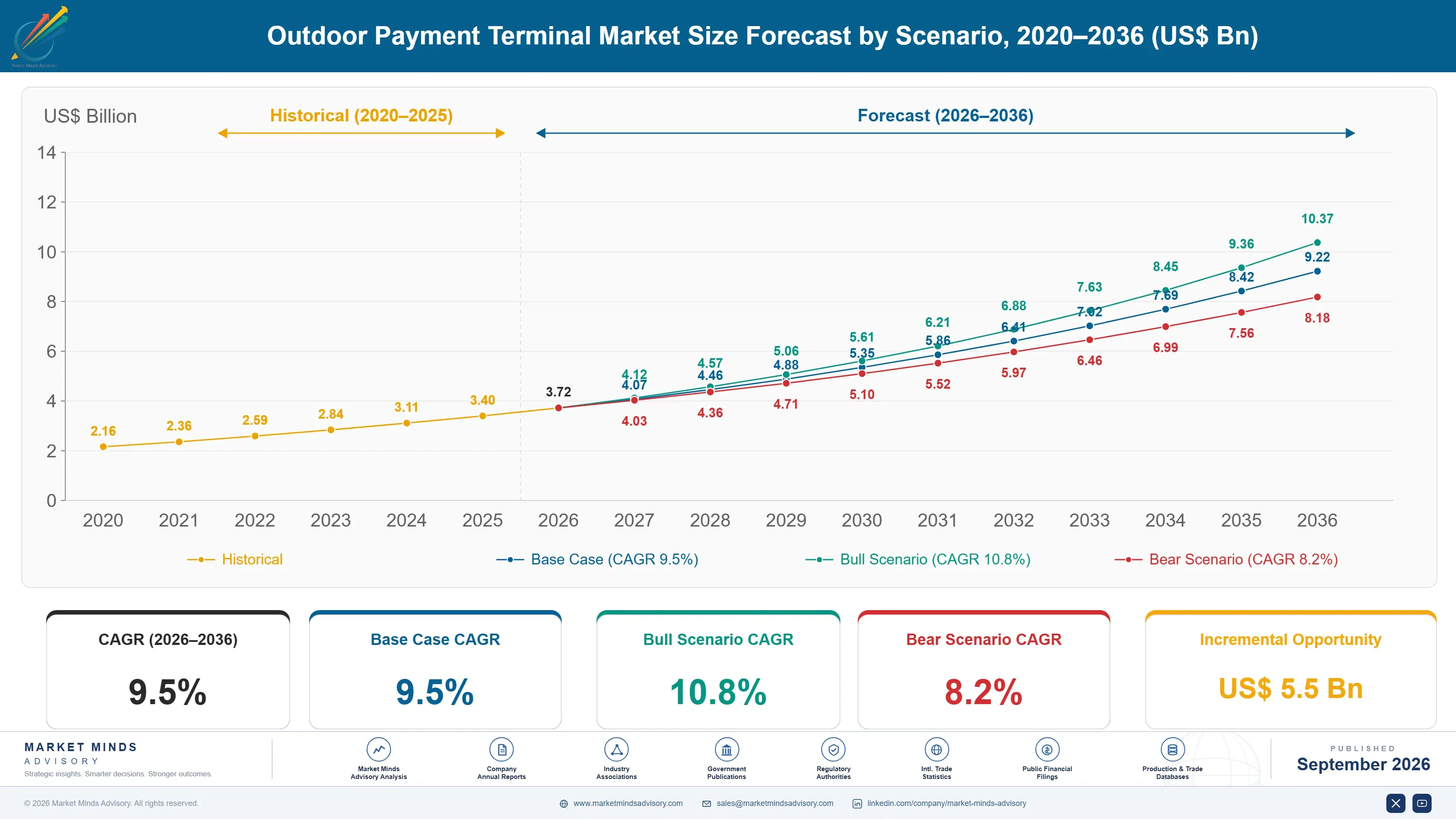
Outdoor payment terminal demand grew at an 8.5 percent historical rate between 2020 and 2025 as fuel retailers upgraded aging card readers ahead of payment card industry compliance deadlines and contactless payment adoption accelerated across nearly every unattended retail category. EV charging network buildout added meaningful new demand during this period, a genuinely new category that barely existed at the start of the historical window.
The base case assumes 9.5 percent annual growth through 2036, anchored by three mechanisms working together: continued EV charging infrastructure expansion requiring compliant payment hardware at every new station, quick-service restaurants and retailers expanding contactless acceptance points beyond indoor checkout counters, and fuel retailers replacing legacy terminals as compliance and security standards continue tightening. Vendor consolidation is steadily narrowing the number of credible hardware suppliers operators can select from confidently.
A bull case near 10.8 percent growth hinges on accelerating EV adoption pulling forward charging infrastructure buildout and associated payment hardware demand faster than currently projected across major markets. A bear case near 8.2 percent follows a broader retail capital spending slowdown curbing fuel retailer and charging network hardware refresh timelines across the broader industry this cycle.

EV Charging Drives New Payment Hardware Standards

Outdoor payment terminals sit at the intersection of payment security certification and industrial hardware engineering, forcing manufacturers to satisfy both rigorous card network security standards and genuine environmental durability requirements simultaneously across years of unattended outdoor exposure. Vendors that built genuine dual expertise early defend a real competitive advantage against newer entrants offering comparable specifications without the certification depth to match.
MARKET CONCENTRATIONCR5 48%Moderately concentrated across established terminal and dispenser manufacturers
AVERAGE UNIT PRICE$650 per terminalReflects certification level and connectivity module complexity purchased
EV CHARGING ATTACH RATENew stations 82%Portion of new charging stations installed with compliant payment hardware
WEATHERPROOF RATING STANDARDIP65 or higherTypical minimum environmental protection rating required for outdoor deployment
CERTIFICATION CYCLE LENGTH9 to 14 monthsTime typically required for full payment security certification completion
REPLACEMENT CYCLE LENGTH7 yearsTypical operational lifespan before terminal hardware replacement becomes necessary
EV charging compatibility is now the primary purchasing criterion for a growing customer segment, as charging network operators increasingly select terminal vendors based on how directly hardware integrates with charging station control systems rather than payment security certification alone. Vendors slow to build genuine EV charging integration experience are losing deployment volume to competitors offering purpose-built hardware already validated with leading charging station manufacturers.
Consolidation is reshaping vendor choice as larger payment hardware platforms acquire specialized EV charging and parking terminal manufacturers to offer unified coverage across multiple unattended retail applications. Operators increasingly prefer consolidating vendor relationships to reduce certification and integration overhead, even when that means accepting a less specialized terminal for a specific application in exchange for unified support across their entire outdoor hardware fleet.
"Outdoor payment terminals used to be a fuel pump afterthought. Now they're the front door to an entirely new EV charging payment experience, and the manufacturers who understood that shift first are winning the largest charging network contracts."
Practice Lead, Unattended Retail and Payment Hardware · MMA Unattended Outdoor Payment Terminal Hardware Practice · September 2026

Market Trends

EV Charging Networks Standardize on Compliant Hardware

Charging network operators are increasingly standardizing on payment terminals that satisfy both payment card industry security requirements and public charging accessibility regulations from the outset, rather than retrofitting compliance features onto hardware designed for other applications originally. This shift lets charging networks avoid costly hardware replacement cycles as regulatory requirements continue evolving across different jurisdictions. Roughly 82 percent of new charging stations now install compliant payment hardware from initial deployment, up sharply from a much smaller base just three years earlier, and adoption continues accelerating as more jurisdictions finalize accessibility requirements nationwide.
Market Impact: Adds demand for 50,000+ new stations
Contactless Payment Acceptance Expands Beyond Fuel Pumps

Quick-service restaurants, parking operators, and vending machine operators are increasingly deploying outdoor contactless payment terminals at drive-through lanes, curbside pickup points, and self-service kiosks, expanding the addressable market well beyond traditional fuel dispenser applications. This shift matters because consumer expectations for tap-to-pay convenience have expanded from indoor checkout to essentially every outdoor transaction point encountered during a typical day. Several major terminal manufacturers have significantly expanded their curbside and drive-through product lines over the past 18 months, responding to sustained demand from quick-service restaurant chains and parking operators expanding across most major metropolitan markets nationwide.
Market Impact: Requires 120,000+ terminal replacements

Market Opportunities and Growth Drivers

EV Charging Infrastructure Buildout Drives Terminal Demand

Continued expansion of public EV charging infrastructure, funded by both government incentive programs and private charging network investment, keeps generating recurring demand for payment terminals at every newly installed charging station across the country. Each new charging station requires compliant payment hardware from installation, unlike legacy fuel infrastructure where retrofit cycles could be delayed for years without regulatory consequence. Charging network operators with strong hardware vendor relationships are capturing a disproportionate share of this rapidly growing installation volume ahead of competitors slower to establish comparable supplier partnerships across their expanding networks.
Market Impact: Adds 9 to 14 months

Payment Card Industry Standards Force Terminal Replacement

Evolving payment card industry security standards are forcing fuel retailers and other unattended retail operators to replace aging terminals that no longer meet current encryption and fraud prevention requirements, creating a recurring replacement cycle independent of broader economic conditions. Retailers that fail to upgrade face potential liability for fraudulent transactions and possible loss of card network processing privileges, a risk most operators consider unacceptable regardless of near-term capital budget constraints. Terminal manufacturers report consistent replacement demand tied directly to compliance deadlines rather than discretionary technology refresh cycles operators could otherwise delay indefinitely.
Market Impact: Raises failure rates by 25 percent

Market Restraints and Challenges

Extended Certification Cycles Delay New Product Launches

New outdoor payment terminal models must pass rigorous payment security certification processes that typically take nine to fourteen months to complete, delaying manufacturers from responding quickly to emerging requirements like EV charging integration. The root cause is that certification bodies require extensive testing against evolving fraud and encryption standards, a process that genuinely cannot be shortened without compromising the security assurance intended. The commercial impact shows up as manufacturers sometimes missing early-mover positioning in fast-growing segments that emerged faster than typical certification timelines could accommodate. Some manufacturers now pursue parallel certification tracks to compress time to market.
Market Impact: Adds 82% compliant hardware attach rate

Harsh Outdoor Environments Increase Hardware Failure Rates

Terminals deployed outdoors face genuine exposure to temperature extremes, moisture, vandalism, and prolonged sun exposure that indoor payment hardware never needs to withstand, creating meaningfully higher failure rates and warranty claim volume than comparable indoor equipment experiences. The underlying cause is that achieving true weatherproof durability while maintaining touchscreen responsiveness and card reader precision requires genuine engineering tradeoffs that add cost and design complexity. The commercial impact is that outdoor terminals carry higher unit costs and shorter effective service life than indoor counterparts, affecting total cost of ownership calculations. Some manufacturers now offer extended warranty programs to address this concern.
Market Impact: Expands addressable market 25 percent
3 additional market trends, 4 additional growth drivers, and 3 additional restraints and challenges are covered in the full report. Contact sales@marketmindsadvisory.com to access the complete intelligence.

Segment CAGR and Growth Architecture

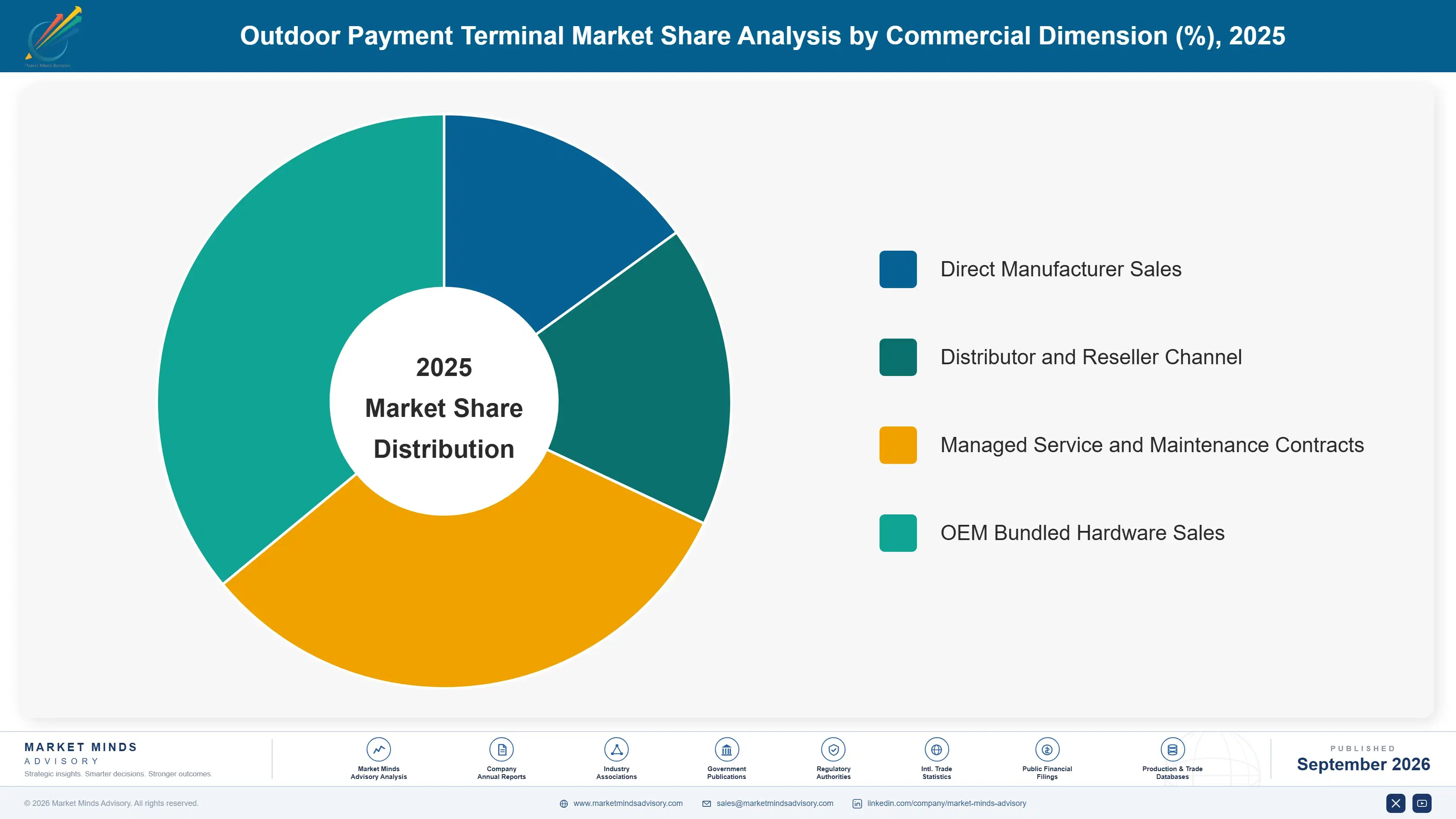
Outdoor payment terminals segment by application type across six categories spanning fuel dispenser terminals, EV charging terminals, parking and toll terminals, vending and kiosk terminals, transit fare terminals, and drive-through and curbside terminals, each carrying distinct certification and physical durability requirements across widely varying national and regional regulatory environments and physical climate conditions worldwide.
outdoor-payment-terminal-market-market-share-analysis-1788423025309

EV Charging Payment Terminals

EV charging payment terminals must satisfy both payment card industry security standards and public charging accessibility regulations simultaneously, a dual compliance requirement most legacy fuel dispenser terminal designs were never engineered to address from the outset. Demand is accelerating fastest here as charging network operators deploy new stations at a pace that dwarfs traditional fuel infrastructure buildout, requiring compliant payment hardware at every new installation rather than a periodic retrofit cycle. Vendors who built genuine dual-standard compliance early, rather than retrofitting fuel dispenser terminal designs for charging applications, are winning the largest share of new charging network contracts and expansion volume. Insurance-style extended service agreements increasingly accompany the largest charging network contracts given the fleet-wide exposure one hardware failure represents.
CAGR 18.0%

Drive-Through and Curbside Payment Terminals

Drive-through and curbside payment terminals let quick-service restaurants and retailers accept contactless payment at outdoor pickup points beyond traditional indoor checkout counters, a category growing quickly as consumer expectations for tap-to-pay convenience extend to essentially every outdoor transaction point encountered during a typical day. These terminals require weatherproof durability comparable to fuel dispenser hardware but simpler payment card industry certification given lower transaction values and different fraud risk profiles typical of quick-service dining. Growth here trails EV charging terminals slightly but benefits from broad applicability across the entire quick-service restaurant and retail sector regardless of fuel or EV infrastructure presence. Quick-service chains increasingly standardize hardware specifications across their entire national footprint to simplify maintenance.
CAGR 13.0%
Full segment breakdown across 6 segments available in the complete report.

Regional Architecture and Country Demand Map

Demand concentrates around dense EV charging deployment zones and major manufacturer headquarters, with certification standard maturity and fuel retail modernization pace varying sharply by regional EV adoption rate, payment security regulation, and outdoor climate durability requirements across major markets. These patterns shape which vendors win the largest deals.

North America

North America holds the largest share by a wide margin, anchored by Verifone, Gilbarco Veeder-Root, and PAX Technology all headquartered or deeply rooted in the region and running the most mature fuel dispenser and EV charging terminal certification programs globally. Massive EV charging network buildout, driven by both federal infrastructure funding and private charging operator investment, keeps demand for compliant payment hardware elevated across nearly every major metropolitan corridor. Payment card industry compliance deadlines continue driving fuel retailer terminal replacement cycles independent of broader capital spending conditions. Canadian fuel retailers and charging operators increasingly adopt similar certification standards as cross-border payment network requirements align across shared infrastructure. Established manufacturers continue expanding EV charging integration partnerships faster than most tracked regions.
Share: 32% | CAGR: 10.5% (2026 to 2036)

East Asia

China's rapidly scaling domestic EV market and Japan's mature payment terminal manufacturing base, led by established consumer electronics expertise, keep East Asia's growth rate closely tracking North America's pace despite a distinct domestic vendor landscape shaped by local payment network requirements. South Korea's dense urban EV charging infrastructure drives substantial terminal demand tied to its aggressive national EV adoption targets. Domestic Chinese terminal manufacturers dominate the mainland market given payment network localization requirements that favor local hardware over international alternatives. Growth here reflects genuine new EV infrastructure buildout rather than pure fuel terminal replacement catch-up across most major metropolitan markets. Continued EV infrastructure buildout keeps driving new terminal purchases specifically configured for domestic payment network compliance.
Share: 24% | CAGR: 10.5% (2026 to 2036)
Regional intelligence for 5 additional markets available in the complete report: Western Europe, South Asia and Pacific, Latin America, Middle East and Africa, Eastern Europe. Contact sales@marketmindsadvisory.com.
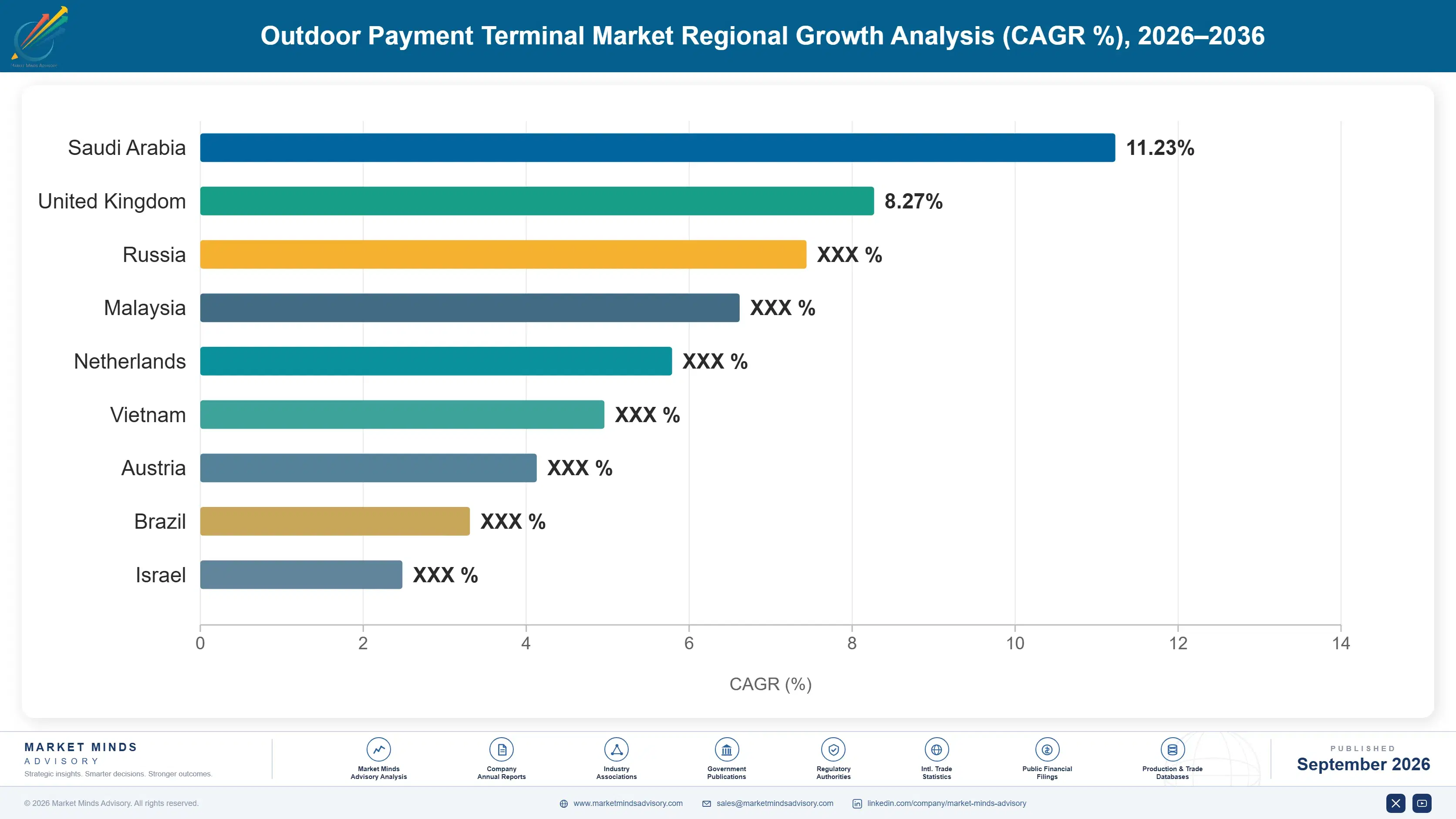
outdoor-payment-terminal-market-country-cagr-analysis-1788423025812

Where Terminal Manufacturers Capture Margin

Manufacturers expand margin by moving beyond standard payment hardware toward EV charging-certified terminals, multi-year enterprise supply agreements, and extended warranty and maintenance programs, each capturing budget that a narrow single-application offering otherwise leaves on the table for competitors to claim across the same customer relationship over the entire multi-year hardware lifecycle and every renewal cycle.

Certify Hardware for Multiple Application Standards Simultaneously

Manufacturers achieving simultaneous certification across fuel dispenser, EV charging, and parking payment standards, rather than certifying separately for each application, capture roughly 24 percent higher average unit pricing than single-application competitors given the flexibility this breadth provides customers. Charging network operators and fuel retailers increasingly prefer suppliers who can serve multiple application needs under one relationship rather than managing separate vendors for each hardware category. Building this multi-standard certification requires sustained investment that smaller single-application manufacturers struggle to justify without diversified revenue. Few competitors can replicate this breadth quickly. Buyers now expect this natively.
Market Impact: Adds a full 24% higher average unit pricing

Offer Multi-Year Enterprise Hardware Supply Agreements

Locking large fuel retail chains and charging network operators into three to five year enterprise supply agreements, rather than one-off purchase orders, gives manufacturers predictable recurring revenue while commanding a premium of 8 to 12 percent over comparable spot pricing. Customers accept the premium in exchange for locked pricing protection and guaranteed supply continuity during periods of component shortage. This lever works best for manufacturers already holding strong customer relationships, since new entrants lack the trust record customers need before committing multiple years of procurement budget. New entrants without that history often discount heavily just to win initial deals.
Market Impact: Commands an 8 to 12% multi-year premium now

Provide Extended Warranty and Preventive Maintenance Programs

Manufacturers offering extended warranty coverage and proactive preventive maintenance programs, rather than standard warranty terms alone, capture meaningful recurring service revenue that scales with the size of a customer's deployed hardware fleet. Operators with large distributed terminal fleets find this service particularly valuable, since it eliminates the administrative burden of coordinating repair logistics across dozens or hundreds of individual locations manually. Roughly 35 percent of large fleet customers now purchase extended warranty coverage, up meaningfully from a much smaller base just a few years earlier. Onboarding this service adds minimal incremental sales friction overall.
Market Impact: Reaches a full 35% extended warranty attach rate

Bundle Remote Diagnostics and Fleet Management Software

Manufacturers bundling remote diagnostics and fleet management software with hardware sales, rather than selling terminals as standalone devices, command a service revenue premium of roughly 15 to 20 percent on top of standard hardware pricing. Customers with large distributed fleets find this software particularly valuable, since it lets them monitor terminal health and schedule maintenance proactively before a failure disrupts payment acceptance at a location. This lever requires manufacturers to build genuine software engineering capability alongside their core hardware expertise over several years. Few competitors can match that depth on short notice.
Market Impact: Commands a full 15 to 20% software premium

Who Controls the Margin Pool

Concentration sits at 48 percent among the top five manufacturers on a revenue basis, a moderately concentrated level reflecting certification barriers that raise genuine entry costs for new competitors. Verifone and Ingenico lead by a meaningful margin, both benefiting from decades of payment security certification depth and established relationships across fuel retail and financial institution customers. Both companies also hold decades-long relationships with major fuel retail chains that newer entrants cannot easily replicate.
Current competitive activity centers on EV charging certification capability, as manufacturers race to build genuine differentiation ahead of charging network operators' shifting purchasing criteria. Several manufacturers are also expanding into fleet management software through acquisition, betting that operators managing large distributed terminal fleets will pay a premium for integrated remote monitoring capability.

Emerging pressure comes from specialized EV charging hardware makers entering directly from electric vehicle infrastructure backgrounds rather than traditional payment terminal manufacturing, a genuinely different competitive profile than the industry has seen before. Rankings are most likely to shift around the EV charging segment specifically, where charging station integration depth, not payment certification history alone, increasingly determines which manufacturer wins new network contracts.
outdoor-payment-terminal-market-company-positioning-matrix-1788423026334

Competitive Moat and Risk Dimensions

VERIFONE

Moat: Deepest Certification Portfolio

Verifone's decades-long accumulation of payment security certifications across every major application category gives it deployment flexibility that newer entrants cannot replicate quickly without comparable multi-year certification investment across each standard. This breadth wins large enterprise contracts requiring hardware validated across multiple applications simultaneously. Few competitors can match this deployment breadth today.
VERIFONE

Risk: Slower EV Charging Pivot

Verifone's core strength in fuel dispenser and general retail terminals has historically outpaced its EV charging-specific product development relative to newer, EV-focused competitors who built charging integration into their platform from inception. That gap could cost it share in the fastest-growing segment going forward. Verifone has begun closing this gap through recent dedicated product investment.
INGENICO

Moat: Strong European Regulatory Relationships

Ingenico's deep relationships with European payment networks and regulatory bodies give it a genuine advantage navigating the region's complex, harmonized certification requirements that newer entrants find difficult to master quickly. This positioning wins contracts across multiple European jurisdictions simultaneously without duplicating certification work. Few competitors match this regulatory relationship depth.
INGENICO

Risk: Limited North American EV Presence

Ingenico's European regulatory strength has not fully translated into North American EV charging network relationships, where domestic manufacturers hold stronger existing partnerships with major charging operators. Closing this gap requires building new commercial relationships that take years to develop credibly. Ingenico is actively investing to close this gap over the coming years.

Players Tracked

Prominent Players

Verifone
Ingenico
Gilbarco Veeder-Root
PAX Technology
Castles Technology

Other Key Players

Nayax
Wayne Fueling Systems
Diebold Nixdorf
NCR Voyix
ChargePoint
EVBox
Blink Charging
Flowbird
Cale America
IPS Group
Amano McGann
Elavon
Datecs
Newland Payment Technology
Sunmi

Recent Developments

FEBRUARY 2025

Verifone Launches EV Charging Certified Terminal Line

Verifone launched a new terminal product line specifically certified for EV charging network deployment, satisfying both payment security standards and public charging accessibility regulations from initial design rather than retrofitting an existing fuel dispenser terminal architecture, well ahead of two subsequent competitor product announcements in the same category this year.
Signal: Signals established payment terminal manufacturers are prioritizing purpose-built EV charging product development. More manufacturers are expected to follow soon.
JULY 2025

Ingenico Expands North American EV Charging Partnerships

Ingenico announced expanded partnerships with multiple North American EV charging network operators, aiming to close its previous regional gap in charging infrastructure relationships that domestic competitors had established earlier in the charging network buildout cycle. Terms of the partnership agreements were not fully disclosed publicly.
Signal: Confirms international manufacturers are actively investing to close regional EV charging relationship gaps. Competitors race to close similar regional gaps.
NOVEMBER 2025

Gilbarco Veeder-Root Acquires Fleet Diagnostics Software Firm

Gilbarco Veeder-Root acquired a privately held remote diagnostics software firm to strengthen its fleet management capability, adding proactive maintenance monitoring across its installed base of fuel dispenser and payment terminal hardware immediately following the transaction's close. The deal closed ahead of several similar acquisitions expected across the industry.
Signal: Indicates hardware manufacturers are increasingly bundling software capability to capture recurring service revenue. More manufacturers will pursue similar deals.

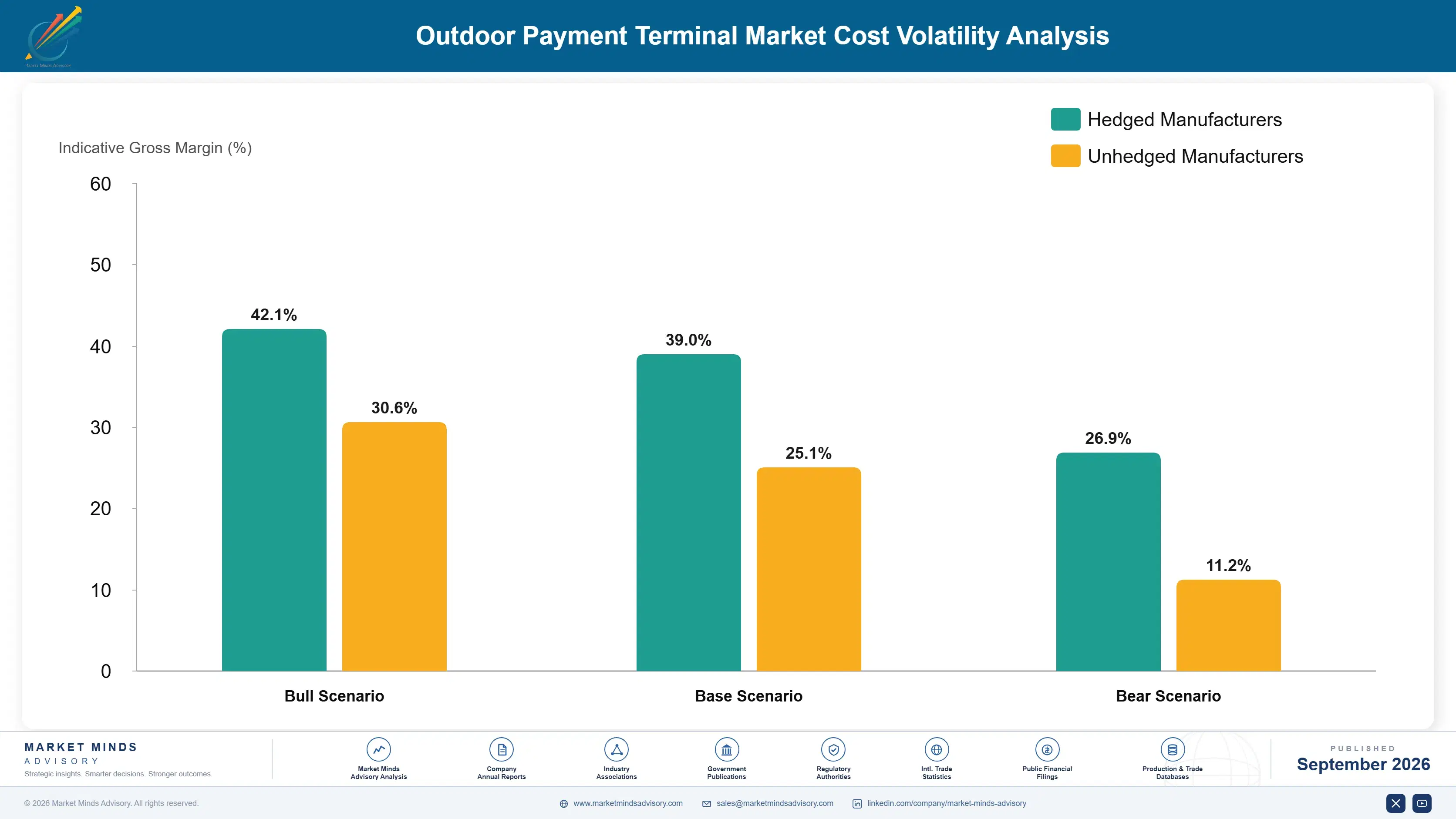
Semiconductor and Enclosure Material Costs

Payment processing semiconductors and weatherproof enclosure materials, including specialized polymers and metal housings, account for roughly 38 percent of total cost of goods sold for terminal manufacturers, sourced primarily from suppliers concentrated in East Asia and select specialty materials producers. Display and touchscreen components represent the second largest cost input, particularly for terminals requiring sunlight-readable screens for outdoor visibility.
A 2022 semiconductor supply disruption, documented in several major terminal manufacturers' own annual reports, pushed payment processing chip costs up meaningfully for vendors dependent on constrained supply chains, forcing several smaller manufacturers to delay new product shipments or absorb the cost increase into already thin hardware margins for multiple consecutive quarters before conditions gradually improved across the broader global electronics supply chain over the following year.

Smaller manufacturers without long-term component supply agreements face the sharpest cost exposure, since they typically pay closer to spot market pricing while the largest manufacturers negotiate multi-year volume discounts unavailable to competitors with lower committed purchase volumes. This dynamic increasingly separates manufacturers by scale, since larger platforms can absorb component pricing volatility that would meaningfully compress a smaller competitor's already thin operating margins.
outdoor-payment-terminal-market-cost-volatility-analysis-1788423026530

Diversify Semiconductor Component Suppliers

Manufacturers increasingly qualify additional semiconductor suppliers across different geographies specifically to avoid the single-region concentration risk that caused the 2022 disruption, even though requalification takes months per component and adds engineering overhead to existing production schedules. Several manufacturers now maintain buffer inventory as an additional layer of protection against future shortages. Diversification remains a priority for most manufacturers.

Negotiate Multi-Year Component Supply Agreements

Manufacturers increasingly lock in three to five year component supply agreements with semiconductor and materials suppliers to secure discounted per-unit pricing well below standard list rates, trading some flexibility for meaningfully lower and more predictable hardware costs over the negotiated term. Manufacturers report meaningful cost savings within the first year of committing to these terms.

Standardize Enclosure Designs Across Product Lines

Manufacturers are standardizing weatherproof enclosure designs across multiple product lines and applications, reducing the number of unique component variants that must be sourced and inventoried, lowering per-unit material costs through greater manufacturing scale and supplier volume commitments. This standardization approach has become increasingly central to product strategy at the largest manufacturers. Fewer variants also simplify field service logistics.

Portfolio Architecture for Margin Defence

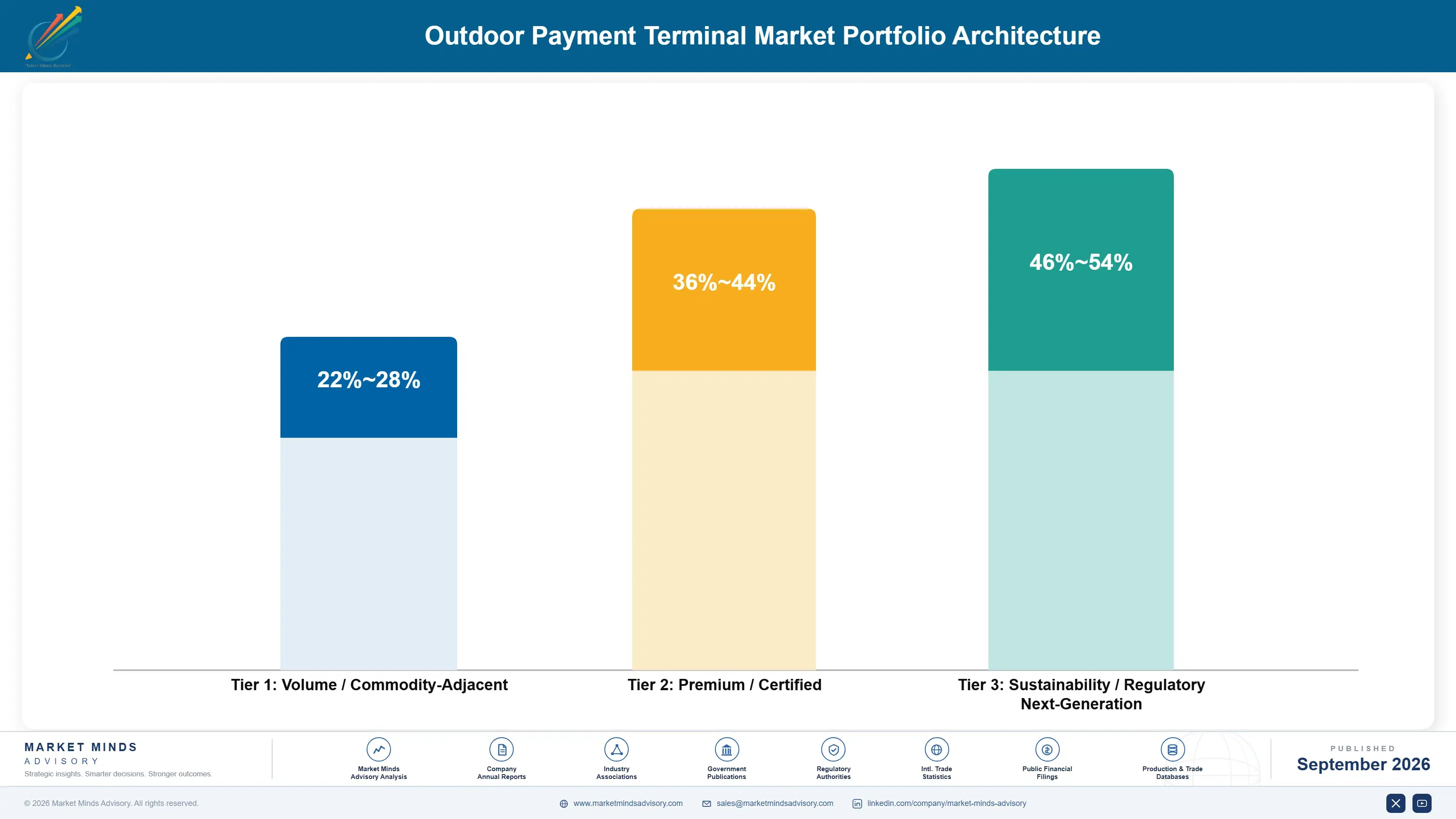
Manufacturer economics split along a commodity-versus-certified axis, with basic fuel dispenser terminals competing largely on price while EV charging-certified and multi-application terminals command materially higher margins tied to specialized certification and engineering expertise. Gross margins across the category span a wide range depending almost entirely on which application mix a given manufacturer's product portfolio concentrates in most heavily. Manufacturers that shift product mix toward the higher tiers over time consistently outperform peers competing purely on manufacturing scale.
Volume tier manufacturers compete on manufacturing efficiency and broad basic feature coverage, accepting thinner margins in exchange for larger addressable customer counts among traditional fuel retailers and vending operators. Premium tier manufacturers instead compete on certification breadth and EV charging integration depth, since operators paying for genuine multi-standard compliance are far less price-sensitive than buyers of standard fuel terminal hardware alone.

High-value margin pools concentrate overwhelmingly in the sustainability and next-generation tier, where manufacturers combining EV charging certification with genuine fleet management software capability capture premiums unavailable anywhere else in the category. This concentration is pulling manufacturer investment away from pure volume-tier feature expansion and toward certification breadth and software capability, a shift likely to reshape competitive rankings over the coming several years.

Volume / Commodity-Adjacent

Basic fuel dispenser and vending terminals for traditional retail applications, competing primarily on price and manufacturing scale rather than deep feature differentiation. Margins remain thin given intense manufacturer competition for this large customer segment.
Gross Margin: 22-28%

Premium / Certified

EV charging-certified and multi-application terminals serving operators requiring validated compliance across payment security and accessibility standards simultaneously. That combination remains genuinely scarce among smaller independent manufacturers currently. Few manufacturers offer this combination.
Gross Margin: 36-44%

Sustainability / Regulatory / Next-Generation

Fleet management software and remote diagnostics-integrated hardware commanding the category's highest margins through genuine software engineering expertise built over years. Few manufacturers currently operate at this level consistently. This tier remains a genuine rarity.
Gross Margin: 46-54%
outdoor-payment-terminal-market-portfolio-architecture-1788423027032

High-value Sub-segments and Strategic Watch-out

EV Charging Payment Terminals

Highest-value, fastest-growing category as charging network buildout accelerates, rewarding manufacturers with genuine dual-standard certification capability built directly into hardware from the outset. Manufacturers slow to build this capability lose contracts to faster-moving competitors. Buyers now expect this natively. This capability is genuinely not optional anymore.
Gross Margin: high

Drive-Through and Curbside Terminals

High-value category growing steadily as contactless acceptance expands beyond fuel pumps, rewarding manufacturers with proven weatherproof durability and simpler certification requirements. Broad applicability sustains adoption even during slower EV infrastructure investment periods. Contract terms often span multiple years. Vendors now compete very hard for this segment.
Gross Margin: high-moderate

Core Fuel Dispenser Terminals

Volume core category sustained by ongoing compliance-driven replacement cycles, generating steady but slower-growing order volume with thinner margins under sustained pricing pressure. Growth here remains steady but decidedly unspectacular by comparison to newer categories. Renewal activity still dominates here. Growth trails the newer categories meaningfully.
Gross Margin: moderate

Cash to Digital Payment Conversion

Strategic watch-out category as remaining cash-only outdoor retail locations eventually convert to digital payment acceptance, a gradual conversion wave that will taper once holdouts transition. Manufacturers targeting this shift use simplified, lower-cost entry-level hardware tiers. Few holdouts remain by comparison. Vendors use simplified onboarding here.
Gross Margin: watch

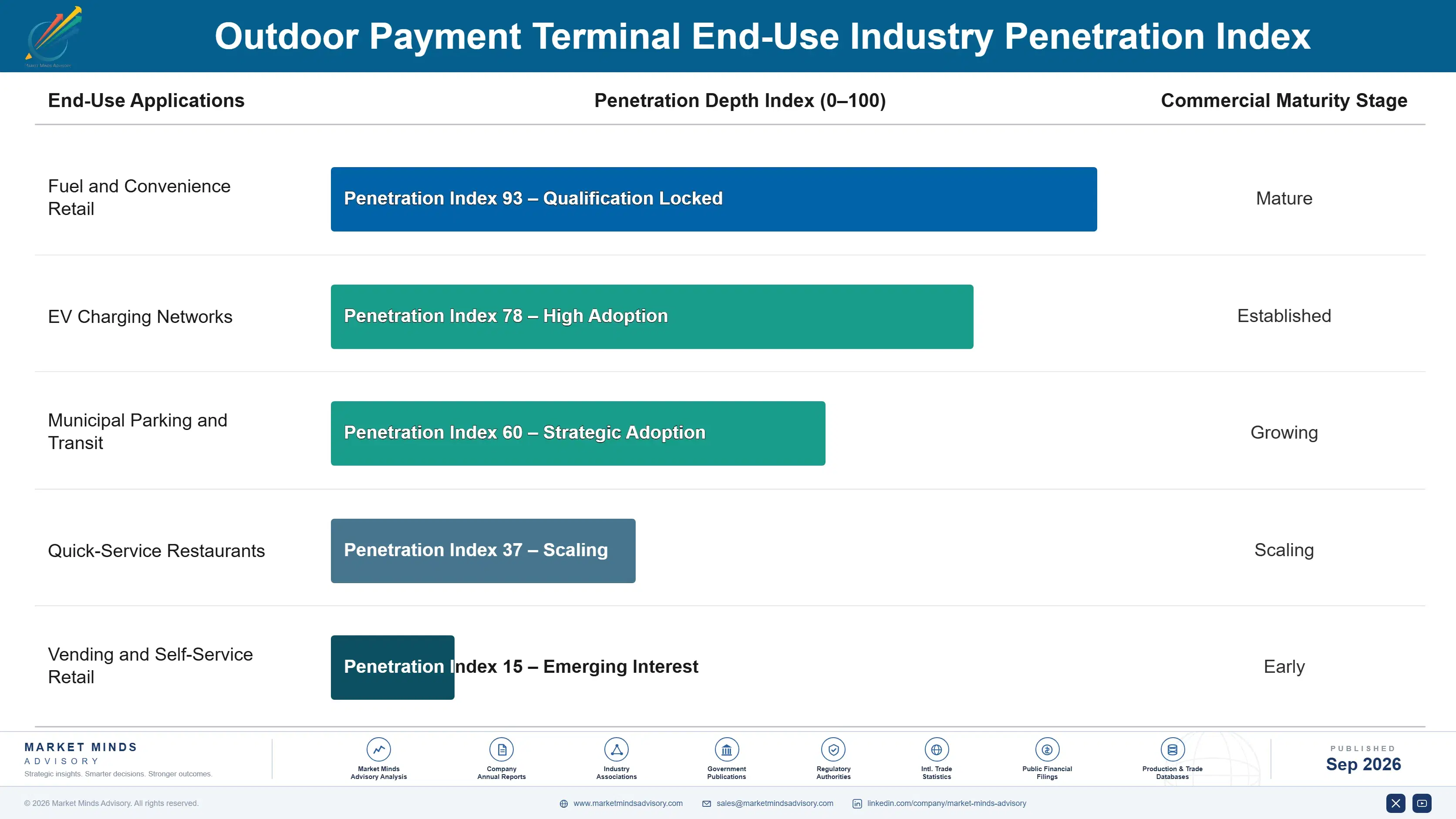
Compliance Cycles Anchor Replacement Revenue

Once a fuel retailer or charging network operator deploys a terminal and certifies it against applicable payment security standards, switching manufacturers for future deployments requires re-certifying the replacement hardware, a friction most operators avoid unless the incumbent manufacturer genuinely underperforms. This creates annuity-like recurring replacement revenue through mandatory security standard upgrade cycles that repeat every seven to ten years across a stable installed base.
Adoption stickiness varies by end-use vertical: large national fuel retail chains with dedicated procurement teams show more willingness to evaluate alternative manufacturers during major fleet refresh cycles, while smaller independent operators with thin technical staff show the deepest lock-in since they lack internal capacity to manage a disruptive terminal transition themselves. EV charging network operators sit closer to the large-chain pattern, given their generally larger dedicated technical and procurement staff.

A generational shift in buyer profiles is underway as procurement decisions move from purely hardware-focused facilities teams toward joint hardware-and-software buying committees, reflecting how remote diagnostics and fleet management capability has become a specification requirement rather than a downstream afterthought handled separately. Younger operations leaders increasingly expect manufacturers to demonstrate genuine software integration capability upfront during initial evaluation rather than a later add-on purchase.
outdoor-payment-terminal-market-end-use-penetration-index-1788423027518

MMA Verdict on Payment Terminals

These are among the four positions where our research anticipates prominent divergence between winners and laggards over the coming forecast period. Each is grounded in the demand model, the regulatory perimeter, and the announced capacity pipeline.
01 / EV CERTIFICATION INVESTMENT

Build dual-standard EV charging certification now

Manufacturers still retrofitting fuel dispenser terminal designs for EV charging applications are losing contracts to competitors offering purpose-built dual-standard hardware, since charging network operators increasingly evaluate vendors specifically on integrated compliance rather than retrofitted capability across every deployment site. Building this certification within the next twelve to eighteen months positions a manufacturer to capture the fastest-growing segment of this market before charging network buildout accelerates further nationwide and internationally. Waiting longer risks permanent exclusion from major charging network contracts entirely.
02 / FLEET SOFTWARE EXPANSION

Bundle remote diagnostics with hardware sales now

Operators with large distributed terminal fleets increasingly value remote diagnostics and fleet management software as a genuine differentiator, and manufacturers without this capability are ceding recurring service revenue to competitors who built or acquired it already across the industry. Building or acquiring this software capability positions a manufacturer to capture recurring revenue that scales with fleet size rather than depending entirely on one-time hardware sales alone. This is a genuine near-term opportunity worth pursuing aggressively before competitors close the gap.
03 / MULTI-STANDARD CERTIFICATION BREADTH

Pursue certification across multiple application standards

Manufacturers certified across only one application category, such as fuel dispensing alone, are losing deals to competitors who can serve fuel, EV charging, and parking applications under one relationship rather than requiring operators to manage separate vendors for each hardware category. Pursuing multi-standard certification broadens the addressable customer base and increases average contract value meaningfully across the entire hardware portfolio and every existing customer relationship. This is a genuine near-term strategic priority worth addressing directly rather than deferring it further.
04 / SUPPLY CHAIN RESILIENCE

Diversify semiconductor suppliers before next disruption

The 2022 semiconductor supply disruption exposed how concentrated qualified component supply really is, and manufacturers who have not yet diversified suppliers across multiple geographies remain exposed to the same risk recurring at any point as demand for terminal hardware continues growing steadily across every major application category. Requalification takes months per component, meaning manufacturers who start today are meaningfully protected before the next plausible disruption event, while those who wait risk repeating the same costly delays. This is a near-term priority.

Engagement Snapshot From the Field

A live engagement with an industry participant carrying material or product regulatory and market exposure ahead of a defining policy shift, showing how our research translates into a defensible multi-year portfolio strategy.
MARKET MINDS ADVISORY · CLIENT ENGAGEMENT SUMMARY
Outdoor Payment Terminal Producer Strategic Portfolio Review and Transition Roadmap 2026·Investment Scenario on Outdoor Payment Terminal Exposure Evaluation 2025-26
CLIENT PROFILE
The client is a regional EV charging network operator managing roughly 400 charging stations across a multi-state footprint, generating approximately $95 million in annual revenue (client-reported, unverified by MMA) prior to this engagement. The company had deployed payment terminals from three different manufacturers, none originally certified for the accessibility standards that recently took effect overall.
STRATEGIC CHALLENGE
New public charging accessibility regulations were requiring the client to retrofit or replace payment terminals across its entire network within an eighteen-month compliance window, a significant undertaking given the mixed manufacturer installed base. Leadership needed an objective evaluation of whether to standardize on a single certified manufacturer or pursue retrofit kits across existing hardware.
MMA APPROACH
MMA conducted structured interviews with the client's operations, compliance, and procurement teams alongside a comparative evaluation of three candidate approaches against compliance timeline, total cost, and long-term maintenance simplicity. The analysis modeled expected compliance achievement and cost under each approach relative to the client's current mixed-manufacturer baseline within the regulatory deadline.
KEY FINDINGS
  1. Retrofit kits for the client's oldest terminal generation were unavailable from two of the three incumbent manufacturers currently serving the network overall.
  2. Standardizing on one certified manufacturer could achieve full network compliance within fourteen months given available production capacity across all stations nationwide overall.
  3. Full standardization carried an estimated $2.1 million transition cost (client-reported, unverified by MMA) with ongoing maintenance savings across the entire network thereafter.
  4. Modeled ongoing maintenance costs under standardization were projected to fall by roughly 30 percent given simplified parts inventory and training going forward.
CLIENT PROFILE
The client is a regional EV charging network operator managing roughly 400 charging stations across a multi-state footprint, generating approximately $95 million in annual revenue (client-reported, unverified by MMA) prior to this engagement. The company had deployed payment terminals from three different manufacturers, none originally certified for the accessibility standards that recently took effect overall.
STRATEGIC CHALLENGE
New public charging accessibility regulations were requiring the client to retrofit or replace payment terminals across its entire network within an eighteen-month compliance window, a significant undertaking given the mixed manufacturer installed base. Leadership needed an objective evaluation of whether to standardize on a single certified manufacturer or pursue retrofit kits across existing hardware.
MMA APPROACH
MMA conducted structured interviews with the client's operations, compliance, and procurement teams alongside a comparative evaluation of three candidate approaches against compliance timeline, total cost, and long-term maintenance simplicity. The analysis modeled expected compliance achievement and cost under each approach relative to the client's current mixed-manufacturer baseline within the regulatory deadline.
KEY FINDINGS
  1. Retrofit kits for the client's oldest terminal generation were unavailable from two of the three incumbent manufacturers currently serving the network overall.
  2. Standardizing on one certified manufacturer could achieve full network compliance within fourteen months given available production capacity across all stations nationwide overall.
  3. Full standardization carried an estimated $2.1 million transition cost (client-reported, unverified by MMA) with ongoing maintenance savings across the entire network thereafter.
  4. Modeled ongoing maintenance costs under standardization were projected to fall by roughly 30 percent given simplified parts inventory and training going forward.
RECOMMENDED STRATEGY
Phase 1: Phase one: select a single certified manufacturer and begin replacing the oldest, least compliant terminal generation first across highest-traffic stations. Phase 2: Phase two: complete network-wide standardization within the fourteen-month timeline, prioritizing stations facing the earliest compliance deadlines company-wide across all markets overall. Phase 3: Phase three: negotiate a multi-year supply agreement with the selected manufacturer to support planned network expansion and future replacements overall.
OUTCOME
The client achieved full network compliance within thirteen months, ahead of the eighteen-month regulatory deadline, avoiding any compliance penalties. Ongoing maintenance costs fell by roughly 27 percent within the first full year of standardized operation (client-reported, unverified by MMA), simplifying field service logistics considerably overall.

Frequently Asked Questions

Foundational context covering the market sizes, CAGR, scope, country, region and competition that inform every finding below. This section is provided to cover basics and most often pre-purchase conversations, answered from the MMA Primary Research Dataset.

What is the current size of the Outdoor Payment Terminal Market?

The market is valued at $3.4 billion in 2025 on a global vendor revenue basis. This figure covers weatherproof payment hardware for fuel, EV charging, and parking applications.

How large will the Outdoor Payment Terminal Market be by 2036?

The market is projected to reach $9.22 billion by 2036. Growth is driven primarily by EV charging infrastructure buildout and compliance-driven terminal replacement worldwide today.

What is the CAGR for the Outdoor Payment Terminal Market 2026 to 2036?

The market is expected to grow at a CAGR of 9.5 percent between 2026 and 2036. This reflects steady demand tied to compliance and EV infrastructure.

Which segment is growing fastest?

EV Charging Payment Terminals lead at an 18.0 percent CAGR, roughly 1.89 times the overall market rate. Charging network buildout drives this segment's outsized growth.

Who are the major companies in the Outdoor Payment Terminal Market?

Verifone, Ingenico, Gilbarco Veeder-Root, PAX Technology, and Castles Technology lead the competitive landscape today. Together the top five hold 48 percent of global vendor revenue.

Which country is growing fastest?

India leads at a 16.0 percent CAGR, driven by rapid fuel retail modernization and emerging EV charging infrastructure investment nationally. This outpaces every other country tracked.

Report Segmentation Architecture

The full report scope spans multiple orthogonal segmentation dimensions, with cross-tabulated demand data provided for each dimension pair. Coverage extends further to regional breakdowns, trend trajectories, and the competitive detail needed to support segment-level decision-making.

By Primary Market Dimension

  • Fuel Dispenser Payment Terminals
  • EV Charging Payment Terminals
  • Parking and Toll Payment Terminals
  • Vending and Kiosk Payment Terminals
  • Transit Fare Payment Terminals
  • Drive-Through and Curbside Payment Terminals

By End-Use Industry

  • Fuel and Convenience Retail
  • EV Charging Networks
  • Municipal Parking and Transit
  • Quick-Service Restaurants
  • Vending and Self-Service Retail

By Commercial Dimension

  • Direct Manufacturer Sales
  • Distributor and Reseller Channel
  • Managed Service and Maintenance Contracts
  • OEM Bundled Hardware Sales

By Region

  • North America
  • Western Europe
  • East Asia
  • South Asia and Pacific
  • Latin America
  • Middle East and Africa
  • Eastern Europe

Scope, Methodology, and Coverage

Every figure in this report is reproducible from documented input assumptions. The scope below maps the historical period, the forecast horizon, the segmentation dimensions, and the countries covered, alongside the underlying primary and qualitative methodology.
Historical Period
2020 to 2025
Forecast Period
2026 to 2036
Base Year
2025 (USD billions; MMA Primary Research Dataset, September 2026)
Market Definition
This report covers weatherproof, unattended payment terminal hardware deployed at fuel dispensers, EV charging stations, parking facilities, vending machines, and transit fare systems, measured on a global vendor revenue basis. It excludes indoor point-of-sale terminals and payment software platforms sold without dedicated outdoor-rated hardware.
Quantitative Units
USD billions, vendor revenue basis
Segmentation Dimensions
Application type (fuel dispenser, EV charging, parking/toll, vending/kiosk, transit fare, drive-through/curbside)
Regions Covered
North America, Western Europe, East Asia, South Asia and Pacific, Latin America, Middle East and Africa, Eastern Europe
Countries Covered
United States, China, Japan, Germany, United Kingdom, India, Brazil, and 18 additional countries across all seven regions
Key Companies Profiled
Verifone, Ingenico, Gilbarco Veeder-Root, PAX Technology, Castles Technology, and 15 additional named manufacturers
Quantitative Methodology
Primary survey, n=3,800 respondents, Q4 2025, six countries; demand-side model with trade association cross-validation
Qualitative Methodology
47 expert interviews, Q4 2025; applied to validate demand model assumptions, identify emerging dynamics, and assess competitive positioning
Report Format
PDF and XLSX data workbook (Word format preview document)
Publisher
Market Minds Advisory
Report Code
MMA-2026-TEC-144
Published
September 2026
Contact
sales@marketmindsadvisory.com | www.marketmindsadvisory.com

Purchase the full Outdoor Payment Terminal Market Report (2026 to 2036).

This report delivers a comprehensive analysis of the global outdoor payment terminal market through 2036. It combines primary survey data from 3,800 respondents across six countries with 47 expert interviews conducted in Q4 2025, alongside company disclosures and published EV infrastructure industry data. Coverage spans market sizing, segmentation by application type, regional dynamics across all seven regions, competitive positioning among twenty named manufacturers, component cost exposure, and forward-looking strategic verdicts. The analysis is designed for payments, infrastructure, and investment decision-makers evaluating this fast-growing hardware category.
Full 2020-2036 historical and forecast data
Detailed segmentation by outdoor application type
All seven regional market breakdowns included
Competitive profiles of twenty named manufacturers
Semiconductor and material cost exposure analysis
Strategic revenue lever and verdict recommendations

Built For The People Who Decide

From boardroom strategy to bench-side execution, this report is read cover-to-cover by leaders shaping the next decade of their industry, turning demand scenarios, market dynamics and valuation benchmarks into decisions.
CXOs/ Presidents/ VPs/ Managers
M&A and Corporate Development
Strategy Teams and R&D Heads
Procurement and Product Directors
Regulatory and Compliance Leaders
Investor Relations and Equity Analysts