Market Minds Advisory
Orthokeratology Market

Orthokeratology Market: Myopia Control Adoption and Custom-Fit Lens Innovation

Parents and eye care practitioners are converting overnight corneal reshaping lenses from a niche vision-correction alternative into a pediatric myopia control therapy, as axial length data gives clinicians evidence to prescribe ortho-K ahead of glasses.

Lead Analyst

Alice Ballenger

Published

August 2026

Make Smarter Decisions with Customized Research Insights

Request a free sample report and evaluate market opportunities, growth trends, and competitive dynamics relevant to your business needs.

2025 MARKET VALUE$1.4BMarket Size 2025
2036 FORECAST VALUE$4.2BBase Case , 2026 to 2036
CAGR 2026 TO 203610.5 %Bull 11.8% / Bear 9.2%
INCREMENTAL OPPORTUNITY$2.7BNet 10- year value creation
EXPANSION MULTIPLE2.72x2036 value over 2026 base
Strategic Levers
M&A Pipeline
Regional Outlook
Country Rankings
Competitive Intelligence
Segmental Deep-dive
Call-Us : 91 93563 13602

Executive Snapshot and Market Trajectory

Orthokeratology is shifting from an elective overnight vision-correction alternative into a clinically evidenced pediatric myopia control therapy, as accumulating axial length data finally gives practitioners the confidence to prescribe ortho-K ahead of single-vision glasses for progressing children. That shift accelerated faster than most contact lens specialists expected.
Custom-fit diagnostic ortho-K lenses lead every other category on growth as practitioners chase precision fitting that generic designs cannot match for irregular corneas. China has become the fastest-growing single country, anchored by a severe pediatric myopia epidemic and supportive government screening programs, while East Asia still commands the largest share of spending given its myopia prevalence and fitting expertise. Overnight lenses remain the largest product category by volume across nearly every market tracked here.
Competitive character remains fragmented among a handful of established specialty lens manufacturers and a broader field of regional fitting laboratories competing on custom design software and practitioner training depth. Regulatory pressure cuts in the industry's favor here: expanding regulatory approval of myopia control indications and tightening pediatric eye care screening requirements are pushing practitioners toward validated lens designs well ahead of typical prescribing habit change.
Market Definition
The orthokeratology market covers overnight corneal reshaping contact lenses, custom-fit diagnostic lenses, lens care solutions, corneal topography and fitting systems, and companion digital fitting software used to correct refractive error and control myopia progression. It excludes standard daytime-wear soft and rigid gas-permeable lenses not designed for overnight corneal reshaping and excludes surgical refractive correction procedures such as LASIK.
Base Year Value
$1.4B in 2025 (MMA Primary Research Dataset, August 2026)
Forecast Period
2026 to 2036, eleven discrete annual values
CAGR
10.5% base case. Bull 11.8%. Bear 9.2%.
Fastest Growth Segment
Custom-Fit Diagnostic Ortho-K Lenses: 14.5% CAGR
Fastest Growth Country
China: 15.5% CAGR
Fastest Growth Region
South Asia and Pacific: 12.6% CAGR
Largest Region
East Asia: 30% of 2025 global value
Market Leaders
Alcon Inc., EssilorLuxottica SA, Menicon Co., Ltd., Bausch + Lomb Corporation, CooperVision, Inc. Source: MMA Analysis based on company annual reports.
Primary Survey
n=3,800 procurement and R&D decision-makers, Q4 2025, six countries
Methodology
Demand-side build-up, cross-validated against public data, 47 expert interviews

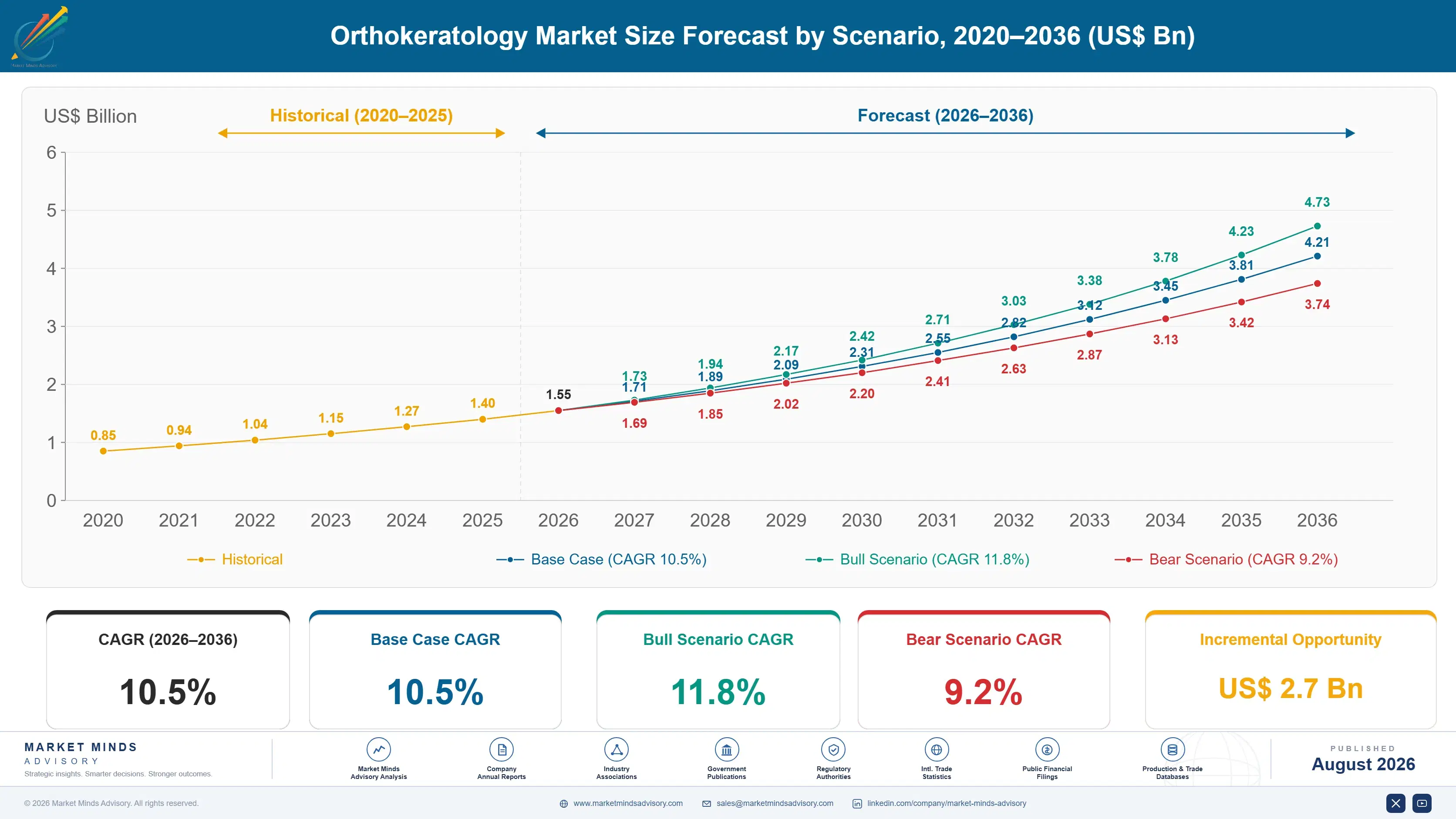
Orthokeratology Market Forecast Scenarios

orthokeratology-market-size-forecast-scenario-1787304007396
Orthokeratology demand grew steadily but unevenly between 2020 and 2025. Pandemic-era vision clinic closures briefly slowed new fittings through 2021, then a surge in pediatric screen time and documented rising myopia incidence accelerated demand as practitioners resumed elective fitting appointments, lifting historical growth to an estimated 9.2% compound rate. That resumption took longer to translate into fitting volume than practitioners initially expected.
The base case assumes 10.5% annual growth through 2036, anchored on three mechanisms. First, expanding published axial length evidence keeps converting practitioner skepticism into active myopia control prescribing. Second, rising childhood myopia prevalence, particularly across East Asia, keeps expanding the diagnosed patient pool eligible for intervention. Third, custom-fit diagnostic lens technology keeps improving first-fit success rates, reducing the chair time barrier that historically discouraged smaller practices from offering ortho-K services.
A bull case builds if additional regulatory approvals for myopia control indications accelerate faster than currently expected, pushing growth toward 11.8%. The bear risk is practitioner adoption friction: if the specialized fitting expertise ortho-K requires continues limiting which practices can offer the service, growth could stall below expectations, capping growth near 9.2% across the forecast period. Either outcome depends heavily on how quickly practitioner training capacity expands.

From Elective Vision Correction to Myopia Control Standard

Orthokeratology remains a specialized fraction of the broader contact lens category by current revenue, but the market is undergoing a genuine, lasting shift as published myopia control evidence converts elective vision correction into a clinically justified pediatric intervention. Fitting accuracy still matters enormously, but published progression-control evidence and practitioner training depth increasingly decide which lens design a practice specifies for new patients.
MARKET CONCENTRATION42% CR5Five manufacturers hold well under half of category revenue
AVERAGE SELLING PRICE$740 per fitted lens pairBlended price across standard and custom-fit diagnostic lenses
LEADING PRODUCT CATEGORY SHAREOvernight lenses, 46%One product category still dominates total prescribed volume
PRACTITIONER ADOPTION RATE31% of eye care practicesMost practices still do not offer ortho-K fitting services
MYOPIA CONTROL EFFICACY43% slower axial progressionPublished data shows meaningful progression slowing versus glasses
INPUT COST SHARE27% of lens COGSSpecialized gas-permeable polymer materials dominate production cost overall
Manufacturers compete less on base lens material alone than on demonstrated myopia control efficacy and fitting support depth: practitioners specify lens designs with documented axial length outcomes rather than switching for marginal material cost advantages on unproven designs. Manufacturing remains concentrated in Japan, the United States, and the Netherlands, while China's domestic fitting laboratory base is expanding rapidly to serve its own severe pediatric myopia burden.
The next decade will be shaped by two forces pulling in the same direction: expanding published myopia control evidence justifying earlier intervention, and custom-fit diagnostic technology finally lowering the fitting expertise barrier that kept smaller practices from offering ortho-K. Both push investment toward validated, evidence-backed lens designs even as practitioner training capacity constraints keep broader adoption more gradual than diagnosed myopia prevalence alone would suggest.
"Parents used to ask for ortho-K because their kid hated glasses. Now they ask because their optometrist showed them an axial length chart."
Director, Ophthalmic Devices and Vision Care Practice · MMA Medical Devices Prac

Market Trends

Published Axial Length Evidence Drives Prescribing Confidence

A growing body of multi-year clinical studies documenting axial length elongation slowing among children wearing overnight corneal reshaping lenses, compared with single-vision glasses controls, is converting practitioner skepticism into active first-line myopia control prescribing across major eye care markets. This is pushing practitioners who previously reserved ortho-K for cosmetic or convenience reasons to actively recommend it for progressing pediatric patients meeting specific clinical criteria. Manufacturers with the strongest published efficacy data are capturing disproportionate share of new practitioner adoption as this evidence base continues expanding across additional patient populations and follow-up durations.
Market Impact: Adds 6.8 million newly diagnosed ch
Custom-Fit Diagnostic Technology Lowers the Fitting Barrier

Corneal topography-driven custom lens design software, generating a precisely fitted lens from a single diagnostic scan rather than relying on trial-lens iteration, is converting ortho-K fitting from a time-intensive specialty skill into a more accessible service smaller practices can realistically offer. This is expanding the practitioner base willing to add ortho-K services, since custom-fit technology meaningfully reduces the chair time and repeat-visit burden that historically discouraged broader practice adoption. Manufacturers with validated custom-fit software platforms are capturing disproportionate share of this expanding practitioner base as the fitting barrier continues lowering across the industry.
Market Impact: Adds 22 percent screening-driven re

Market Opportunities and Growth Drivers

Rising Global Childhood Myopia Prevalence Sustains Demand

Childhood myopia prevalence continues rising across nearly every major market tracked in this report, driven by increased near-work activity and reduced outdoor time, sustaining ortho-K as the category's largest and most durable demand driver regardless of any single manufacturer's specific lens design or fitting technology. Screening programs identifying myopia earlier in a child's development are expanding the diagnosed population eligible for intervention before progression becomes severe. Manufacturers investing in practitioner education and pediatric screening partnership programs are capturing disproportionate share of this expanding diagnosed population as awareness continues improving across primary eye care settings.
Market Impact: Limits qualified practitioners to 3

Government Myopia Screening Programs Expand Diagnosed Volume

Government-backed school vision screening programs, particularly across East Asian markets facing severe pediatric myopia burdens, are identifying substantially more children as candidates for intervention earlier than family-initiated eye examinations alone would achieve, expanding the diagnosed patient pool available for ortho-K prescribing. This screening infrastructure is converting myopia control from a family-driven decision into a public health referral pathway in several major markets, meaningfully accelerating diagnosis timing relative to prior generations. Manufacturers partnering directly with government screening initiatives are capturing disproportionate share of this expanding referral pipeline as screening program coverage continues broadening across participating regions.
Market Impact: Reduces retention by 18 percentage

Market Restraints and Challenges

Specialized Fitting Expertise Limits Practitioner Availability

Ortho-K fitting requires specialized training and accumulated clinical experience that many general eye care practitioners have not invested in developing, limiting how many practices can realistically offer the service regardless of underlying patient demand growth. The root cause is that fitting complexity, while easing with custom-fit diagnostic technology, still requires meaningful hands-on training investment that busy general practices often deprioritize against other clinical service lines. Some manufacturers are mitigating this by expanding structured certification training programs and remote fitting support services that lower the practical barrier to entry for interested practitioners.
Market Impact: Adds 29% to myopia control prescrip

Patient Compliance Requirements Constrain Broader Adoption

Overnight ortho-K wear requires consistent nightly compliance and careful lens hygiene that some pediatric patients and families struggle to maintain reliably, creating genuine dropout risk that limits how confidently practitioners can recommend the therapy for every eligible candidate. The underlying cause is that the therapy's overnight wear schedule and hygiene requirements demand a level of family engagement that varies considerably across different household circumstances and patient maturity levels. Practitioners are mitigating this by front-loading compliance education during initial fitting consultations rather than discovering compliance gaps only after dropout has already occurred.
Market Impact: Lifts first-fit success rate 26 per
3 additional market trends, 4 additional growth drivers, and 2 additional restraints and challenges are covered in the full report. Contact sales@marketmindsadvisory.com to access the complete intelligence.

Segment CAGR and Growth Architecture

MMA segments the market by product and technology type, the classification practitioners use when specifying lenses and comparing manufacturer capability across competing fitting decisions. This avoids blending upstream polymer material technology with the downstream fitting application categories that define how a given lens is actually prescribed and reimbursed across every major practice decision made today.
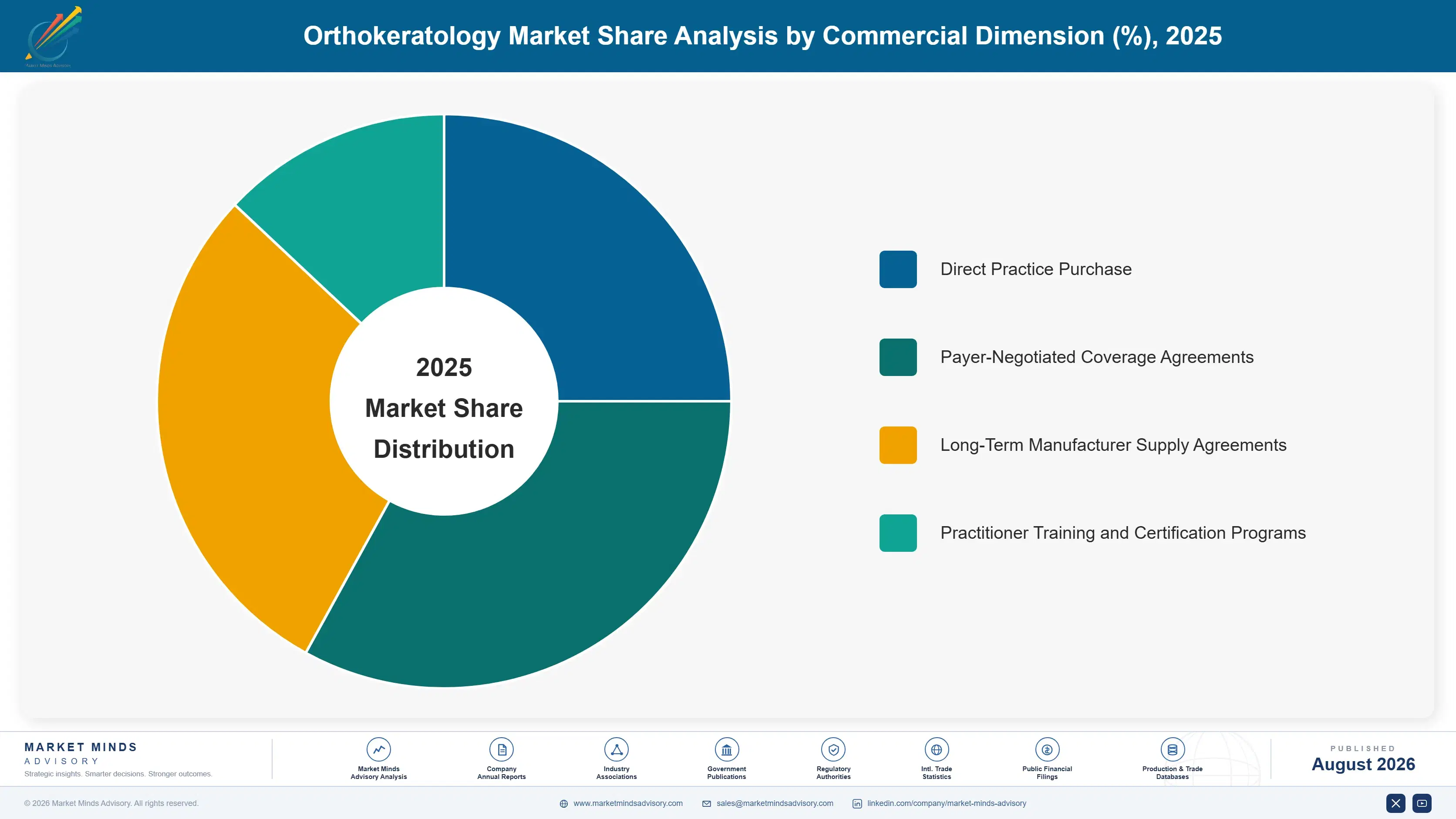
orthokeratology-market-market-share-analysis-1787304007960

Custom-Fit Diagnostic Ortho-K Lenses

Custom-fit diagnostic ortho-K lenses, designed directly from corneal topography scans rather than standard trial-lens fitting sets, remain the fastest-growing category as practitioners chase precision fitting for irregular corneas and higher-prescription patients that generic designs cannot reliably serve. Growth concentrates wherever topography-driven fitting technology intersects with practitioner willingness to invest in diagnostic equipment, particularly across East Asia and increasingly North America's expanding myopia control practice base. Menicon and CooperVision have each expanded custom-fit software capability substantially, recognizing that first-fit success rate, not raw lens material specification alone, decides which manufacturer captures a practice's long-term prescribing relationship. At a 14.5% forecast CAGR, roughly 1.4 times the market average, this segment is pulling capital investment toward fitting technology faster than any other category.
CAGR 14.5%

Myopia Control Software and Digital Fitting Platforms

Myopia control software and digital fitting platforms, tracking axial length progression and supporting remote fitting adjustment decisions, track practitioner adoption expansion more directly than any other segment, making outcome tracking capability a disproportionate growth driver for this category specifically. Alcon and EssilorLuxottica lead on integrated digital platform depth, while newer software-first entrants increasingly compete on cross-lens compatibility rather than proprietary hardware lock-in alone. Demand here is tied more closely to practitioner adoption of structured myopia control protocols than to overall lens volume alone, since software subscriptions renew independently of underlying lens replacement timing. This segment's growth trajectory now depends heavily on how quickly practitioners complete their broader digital myopia management transition.
CAGR 13.0%
Full segment breakdown across 6 segments available in the complete report.

Regional Architecture and Country Demand Map

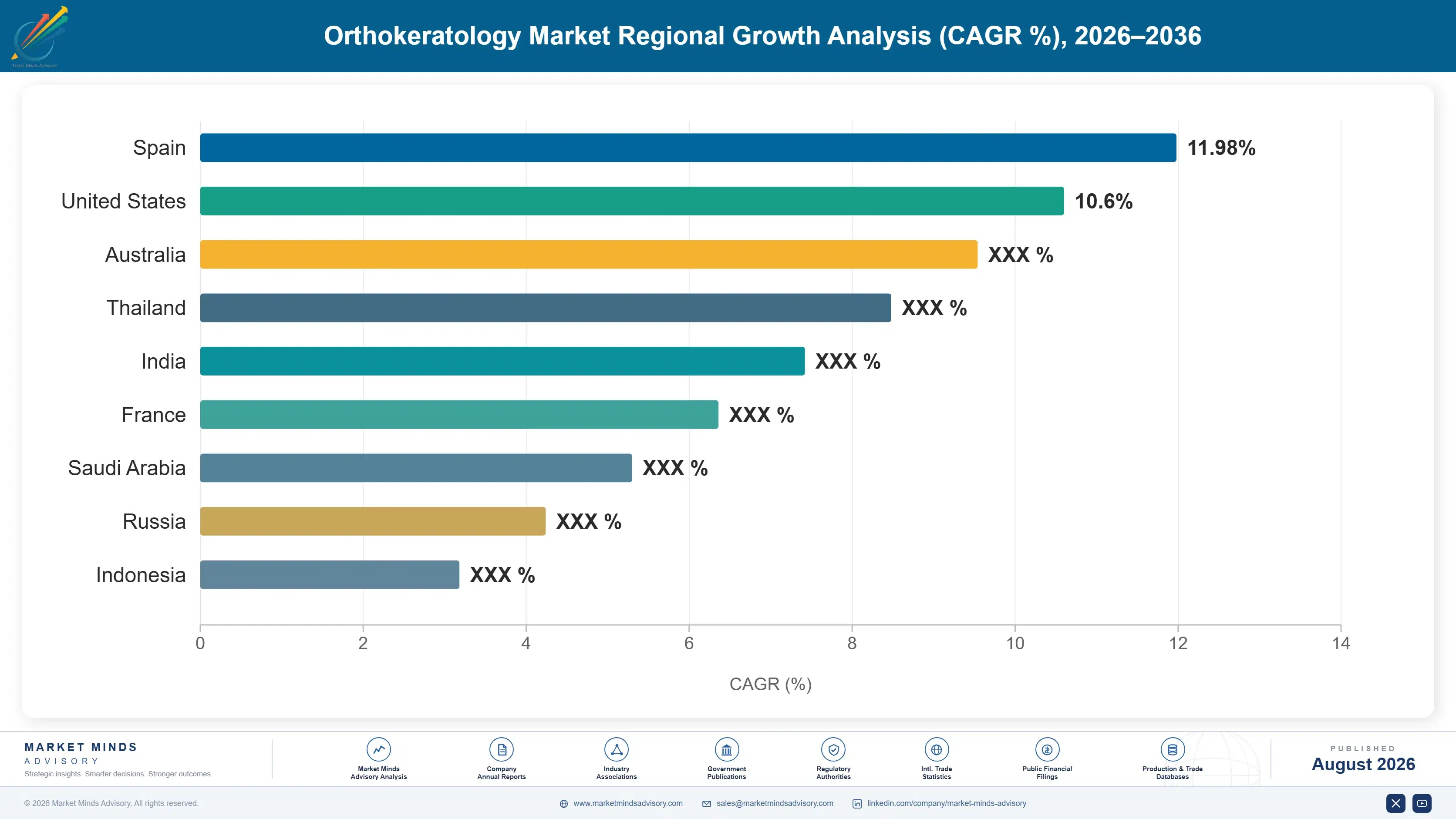
East Asia commands the largest share of spending given its severe pediatric myopia prevalence and established fitting expertise, while China's screening programs and South Asia and Pacific's expanding practitioner base anchor the fastest-growing regional pipelines. North America and Western Europe contribute steady, more gradually expanding demand of their own.

North America

The United States anchors regional demand through its concentration of specialty contact lens practitioners and comparatively strong consumer willingness to pay for elective pediatric myopia control services. Canada contributes a smaller, steadily growing demand base benefiting from proximity to the same manufacturers and a favorable environment for practitioner training expansion. Higher per-capita eye care spending and stronger practitioner training infrastructure give the region durable spending power even as unit growth moderates relative to faster-growing emerging markets. Growth stays healthy but trails East Asia and South Asia and Pacific because the region's largest practices have already completed much of their initial ortho-K service line adoption. Mexico's growing cross-border referral relationships add further regional momentum worth tracking closely each year.
Share: 26% | CAGR: 9.8% (2026 to 2036)

Western Europe

Germany anchors both regional lens manufacturing depth and fitting demand, home to established specialty contact lens practices increasingly specifying custom-fit diagnostic lenses ahead of broader myopia control guideline adoption. France and the United Kingdom follow with steady demand tied to national eye care systems increasingly recognizing myopia control as a legitimate pediatric intervention category. Regulatory pressure compounds adoption directly: European regulatory bodies expanding approved myopia control indications are pushing practitioners toward validated lens designs regardless of any cost premium involved relative to standard vision correction. Growth trails East Asia and South Asia and Pacific because the region's practitioner training base is expanding more slowly than newer market entrants. Spain and Italy contribute smaller, steadily growing demand of their own.
Share: 20% | CAGR: 8.9% (2026 to 2036)
Regional intelligence for 5 additional markets available in the complete report: East Asia, South Asia and Pacific, Latin America, Middle East and Africa, Eastern Europe. Contact sales@marketmindsadvisory.com.
orthokeratology-market-country-cagr-analysis-1787304008470

Where Orthokeratology Manufacturers Capture Margin

Standard overnight lens sales increasingly compete on price alone as more manufacturers enter the category, so the manufacturers protecting margin monetize the evidence and service layer: published efficacy data, practitioner training programs, and long-term fitting support agreements. The four levers below reflect where prescribing practitioners show sustained willingness to pay a premium across every major decision.

Published Myopia Control Efficacy Evidence Generation

Practitioners increasingly require documented axial length control evidence before recommending a specific lens design for pediatric myopia intervention, and manufacturers that invest in extensive longitudinal studies are converting what used to be a purely material-based purchasing decision into an evidence-driven relationship commanding meaningful premium pricing over less-validated alternatives. This is becoming the primary differentiator in practitioner lens selection, where buyers increasingly select designs based on documented progression control rather than material cost alone, and MMA interviews suggest manufacturers with the strongest published evidence capture roughly 31% higher prescribing share among newly diagnosed pediatric patients across the category overall.
Market Impact: Adds 31 percent higher prescribing

Practitioner Certification and Fitting Training Programs

Manufacturers increasingly bundle structured certification training and ongoing fitting support alongside lens sales rather than selling product as a standalone material purchase, since fitting confidence and consistent technique meaningfully affect practice-reported outcomes and continued prescribing volume. Manufacturers offering integrated training programs capture meaningfully higher lifetime account value than material-only suppliers, worth roughly 27% more per practice relationship over a prescribing relationship's operational life, since training investment builds fitting confidence that pure material specification cannot replicate. Adoption of these bundled training programs continues accelerating as more practices add ortho-K services each quarter.
Market Impact: Adds 27 percent higher lifetime acc

Long-Term Practice Supply and Support Agreements

Practices increasingly sign multi-year lens supply and clinical support agreements guaranteeing manufacturer technical availability and predictable replacement lens pricing throughout a patient's treatment course, converting what used to be a series of individual purchase orders into predictable recurring revenue worth roughly 24% of a manufacturer's forward account revenue across an extended practice relationship. Manufacturers offering these agreements gain visibility into future replacement lens revenue that supports continued technical investment, while practices gain protection against supply disruption and pricing volatility on lenses purchased at meaningful patient volume across their network of locations.
Market Impact: Locks in supply revenue for 4 to 6

Parent and Patient Compliance Support Programs

Manufacturers offering embedded compliance support, including reminder programs and structured follow-up communication during a patient's treatment course, capture recurring engagement value while simultaneously deepening practitioner relationships that make competitive displacement more difficult for rivals without comparable support infrastructure available today. For practices managing pediatric patients through multi-year treatment courses, the value proposition is measurably higher compliance and retention rates, translating directly into better clinical outcomes the practitioner can point to when recommending treatment. Early adopters report compliance program attach rates approaching 26% among newly fitted patients, growing steadily each year.
Market Impact: Reaches nearly 26 percent complianc

Who Controls the Margin Pool

CR5 sits at 42%, reflecting a category fragmented among established specialty lens manufacturers and regional fitting laboratories, evaluated here on a revenue basis across lenses, solutions, and diagnostic equipment combined. Alcon and Menicon lead on prescribing revenue scale, with a meaningful gap separating them from smaller challengers, including EssilorLuxottica and Bausch + Lomb, each strong in specific regional markets rather than universally. Smaller manufacturers increasingly struggle
Current activity centers on three dimensions: published myopia control efficacy evidence generation, practitioner certification and training program depth, and long-term practice supply agreement structuring for large multi-location practice customers. Manufacturers lacking published evidence depth are increasingly partnering with academic optometry programs for independent validation studies rather than losing prescribing decisions on limited-evidence grounds alone across the industry.

Emerging pressure comes from Asian fitting laboratories expanding aggressively into custom-fit diagnostic capability historically dominated by Western and Japanese manufacturers. If Asian manufacturers continue converting domestic scale into export competitiveness, expect rankings among the next several challengers to shift by 2030, as newly capable entrants displace slower-moving incumbents across specific practitioner segments worldwide. Established leaders have limited time to respond before meaningful share shifts occur across the category.
orthokeratology-market-company-positioning-matrix-1787304008993

Competitive Moat and Risk Dimensions

ALCON INC.

Moat: Broadest Myopia Control Evidence Base

Alcon's extensive multi-year longitudinal studies documenting axial length control outcomes give it prescriber trust and clinical credibility that narrower, less-studied competitors cannot easily replicate across major eye care markets. That combined evidence depth makes Alcon the default reference point for practitioners evaluating myopia control lens selection decisions.
ALCON INC.

Risk: Premium Pricing Competitive Exposure

Alcon's premium pricing position leaves it more exposed than lower-cost competitors to practice budget pressure, particularly among smaller practices evaluating lens costs against constrained patient payment capacity. Managing this requires balancing continued premium positioning against broader market accessibility across the full range of practice sizes.
MENICON CO., LTD.

Moat: Deep Japanese Fitting Expertise Legacy

Menicon's decades of accumulated ortho-K fitting expertise, developed within Japan's early-adopting myopia control market, give it design refinement depth that newer entrants cannot quickly replicate regardless of technical investment made in lens development. That accumulated fitting knowledge increasingly functions as a competitive moat in its own right for complex fitting cases specifically.
MENICON CO., LTD.

Risk: Geographic Concentration Risk

Menicon's revenue remains meaningfully concentrated in East Asian markets relative to more geographically diversified competitors, leaving it more exposed than global rivals to any single regional regulatory or reimbursement disruption affecting its core market base. Diversifying requires sustained investment in new-region practitioner relationships competing directly with continued Asian market expansion.

Players Tracked

Prominent Players

Alcon Inc.
EssilorLuxottica SA
Menicon Co., Ltd.
Bausch + Lomb Corporation
CooperVision, Inc.

Other Key Players

Euclid Systems Corporation
GP Specialists, Inc.
Contex, Inc.
Visioneering Technologies, Inc.
SEED Co., Ltd.
Procornea Nederland B.V.
Art Optical Contact Lens, Inc.
Acuity Polymers, Inc.
Capricornia Contact Lens
No7 Contact Lenses Ltd.
Valley Contax, Inc.
X-Cel Specialty Contacts
Blanchard Contact Lens, Inc.
Lentechs, LLC
Ovitz Corporation

Recent Developments

FEBRUARY 2025

Menicon Publishes Extended Axial Length Control Study Results

Menicon announced publication of extended five-year axial length control study results for its overnight corneal reshaping lens, demonstrating sustained myopia progression slowing across a broad pediatric patient cohort and multiple clinical sites. The publication targets practitioners evaluating long-term myopia control evidence ahead of treatment recommendation decisions specifically.
Signal: Signals Menicon prioritizing long-term evi
JUNE 2025

Alcon Launches Expanded Custom-Fit Diagnostic Software Platform

Alcon announced the commercial launch of an expanded custom-fit diagnostic software platform supporting automated lens design generation from corneal topography scans, targeting practices seeking reduced chair time and improved first-fit success rates. The launch addresses practitioner demand following favorable fitting efficiency data published recently across several markets.
Signal: Signals Alcon prioritizing fitting technol
OCTOBER 2025

CooperVision Signs Distribution Agreement With Chinese Eye Care Network

CooperVision signed a distribution agreement with a major Chinese eye care network operator, securing access to established practitioner relationships ahead of continued domestic myopia screening program expansion. The agreement covers lens supply and practitioner training access across the network's growing practice portfolio nationwide this year.
Signal: Signals established manufacturers actively

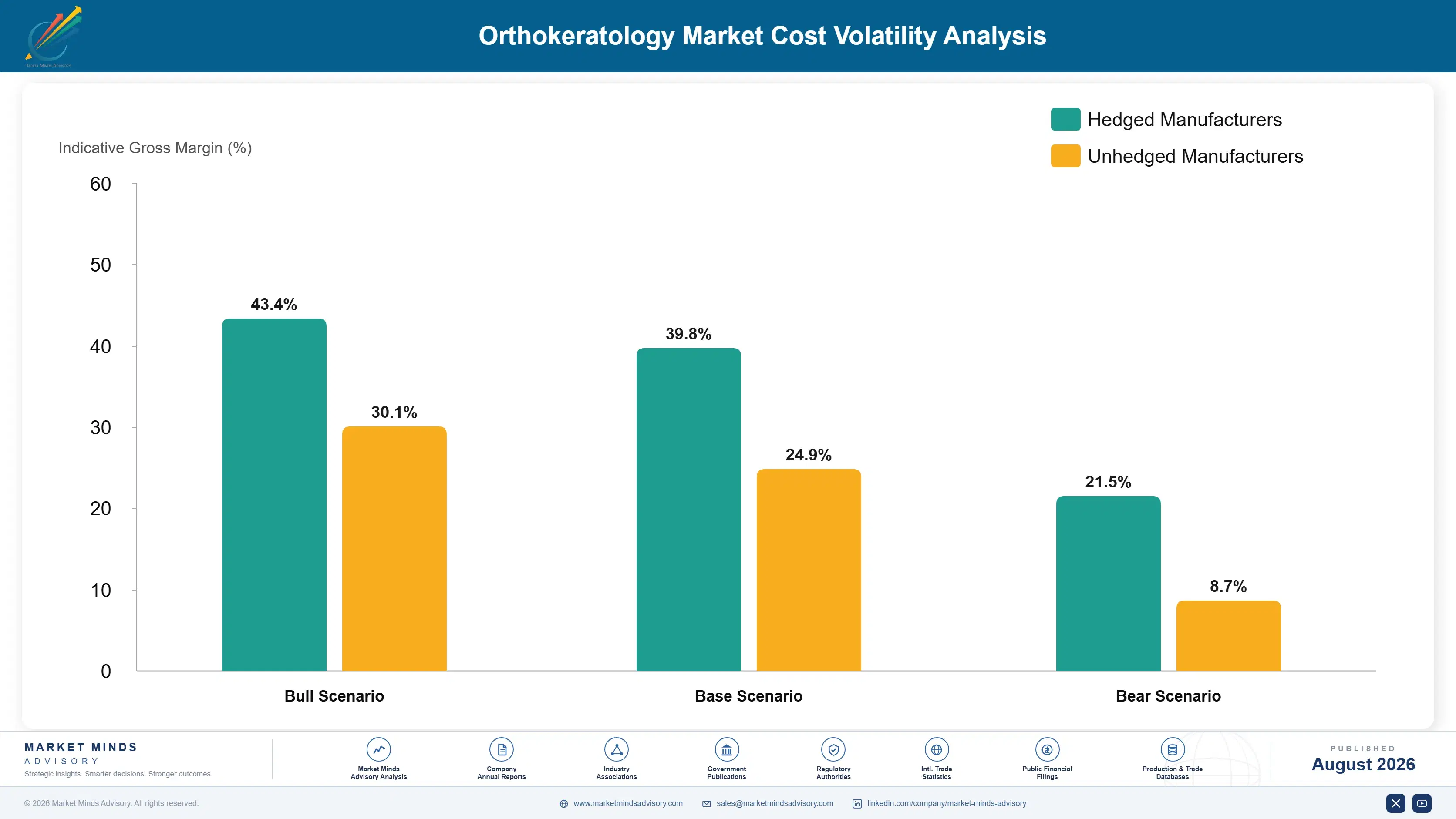
Specialized Gas-Permeable Polymer Material Costs

Specialized gas-permeable polymer materials account for roughly 27% of orthokeratology lens cost of goods sold, making these inputs the dominant cost driver in the category ahead of general fabrication and quality control labor. Lens-grade polymer materials require specialized oxygen permeability engineering and biocompatibility certification, with cost structure varying by required permeability specification and the underlying specialty chemical sourcing availability.
Specialized polymer material costs spiked through 2022 as broader specialty plastics industry demand absorbed available specialized fabrication capacity faster than new capacity could be added, according to company disclosures citing constrained raw material supplier availability. Manufacturers without long-term material supply agreements or in-house formulation capability saw costs rise faster than they could pass through to fixed-price practice contract pricing signed before the spike occurred across the industry.

Smaller manufacturers without established polymer supplier relationships or long-term material supply agreements absorb input cost volatility directly into thin margins, while larger players like Alcon and Menicon use existing specialty chemical supply chain relationships to insulate margins from material price swings. Manufacturers newly entering the category without comparable established supply relationships carry meaningfully greater cost exposure than incumbents who capture more of the polymer value chain themselves across the category.
orthokeratology-market-cost-volatility-analysis-1787304009189

Long-Term Polymer Material Supply Agreements

The largest manufacturers are locking multi-year specialized polymer material supply agreements directly with chemical fabrication partners rather than competing for spot capacity, securing priority access and more predictable pricing across major production programs and forecast cycles ahead, reinforcing scale advantages already present across the category. This requires sustained capital commitment smaller manufacturers cannot easily match.

Vertical Integration Into Polymer Formulation

Larger manufacturers are investing directly in in-house polymer formulation and testing capability rather than relying entirely on third-party material suppliers, capturing more of the value chain and reducing exposure to specialty material price swings across the category's highest-volume lens production lines currently underway across the industry today. This trend continues strengthening as demand grows steadily each year.

Material Sourcing Diversification Strategies

Manufacturers are diversifying polymer material sourcing across multiple fabrication partners rather than depending on a single supplier, reducing exposure to specific fabrication capacity disruptions that have affected particular material categories during recent volatility episodes across multiple production regions simultaneously and consistently. This diversification strategy has become increasingly common among the largest manufacturers operating today.

Portfolio Architecture for Margin Defence

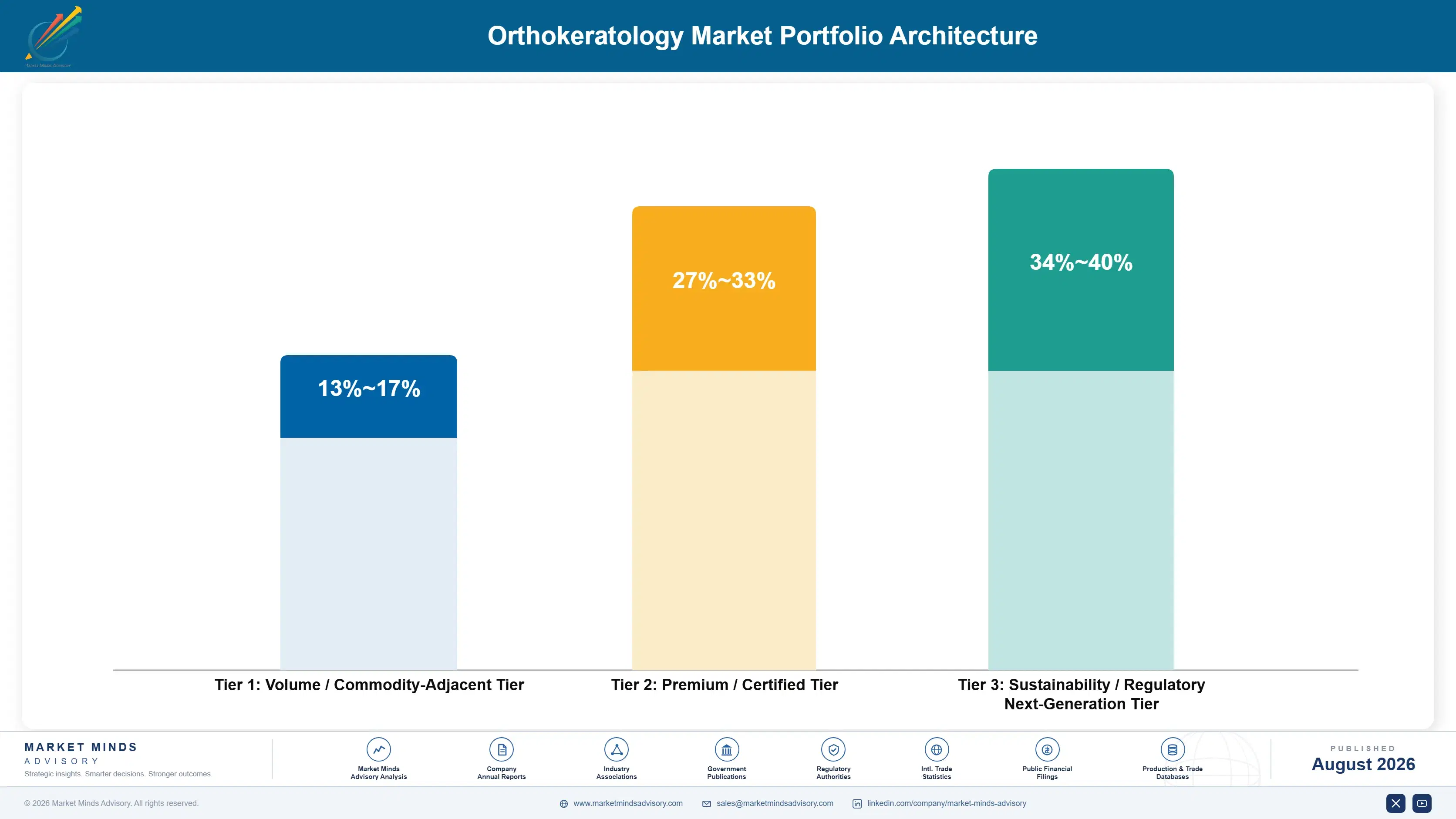
MMA's tier architecture separates the category into three margin bands. Volume and commodity-adjacent standard overnight lens designs compete on price against widely available fitting-set-based alternatives and carry thin margin, premium and certified custom-fit and evidence-backed lens designs carry higher margin on documented myopia control outcomes and fitting technology capability, and sustainability-linked next-generation platforms, including integrated digital tracking and combination ther
The tension between volume and premium plays out most visibly among smaller independent practices, who want custom-fit capability at closer to standard lens pricing. That up-tier migration remains slow given how cautiously smaller practices evaluate service line investment against uncertain patient volume. Manufacturers that fail to bundle these services risk losing share to more capable rivals.

High-value margin pools concentrate in large multi-location practice relationships bundled with evidence support, practitioner training, and long-term supply agreements, where recurring service and compliance-attach revenue increasingly outweighs the margin earned on any individual lens sale alone. That concentration is pulling investment steadily toward evidence generation and practitioner support rather than incremental material manufacturing capacity expansion alone across the category.

Volume / Commodity-Adjacent Tier

Standard overnight lens designs sold primarily on price against widely available fitting-set-based alternatives, serving cost-sensitive practices and smaller clinics where gross margin stays thin and competition is driven almost entirely by landed cost.
Gross Margin: 13%-17%

Premium / Certified Tier

Custom-fit and evidence-backed lens designs specified by practitioners requiring documented myopia control outcomes, fitting technology capability, and long-term supply agreements, commanding meaningfully higher margin on demonstrated performance achieved across the category's fastest-growing certified segment overall today.
Gross Margin: 27%-33%

Sustainability / Regulatory / Next-Generation Tier

Integrated digital tracking and combination therapy protocols positioned for practices chasing outcome differentiation and premium positioning, where evidence depth and technology integration support the category's highest margin overall across most major markets today.
Gross Margin: 34%-40%
orthokeratology-market-portfolio-architecture-1787304009685

Practice Fitting Economics and Adoption Depth

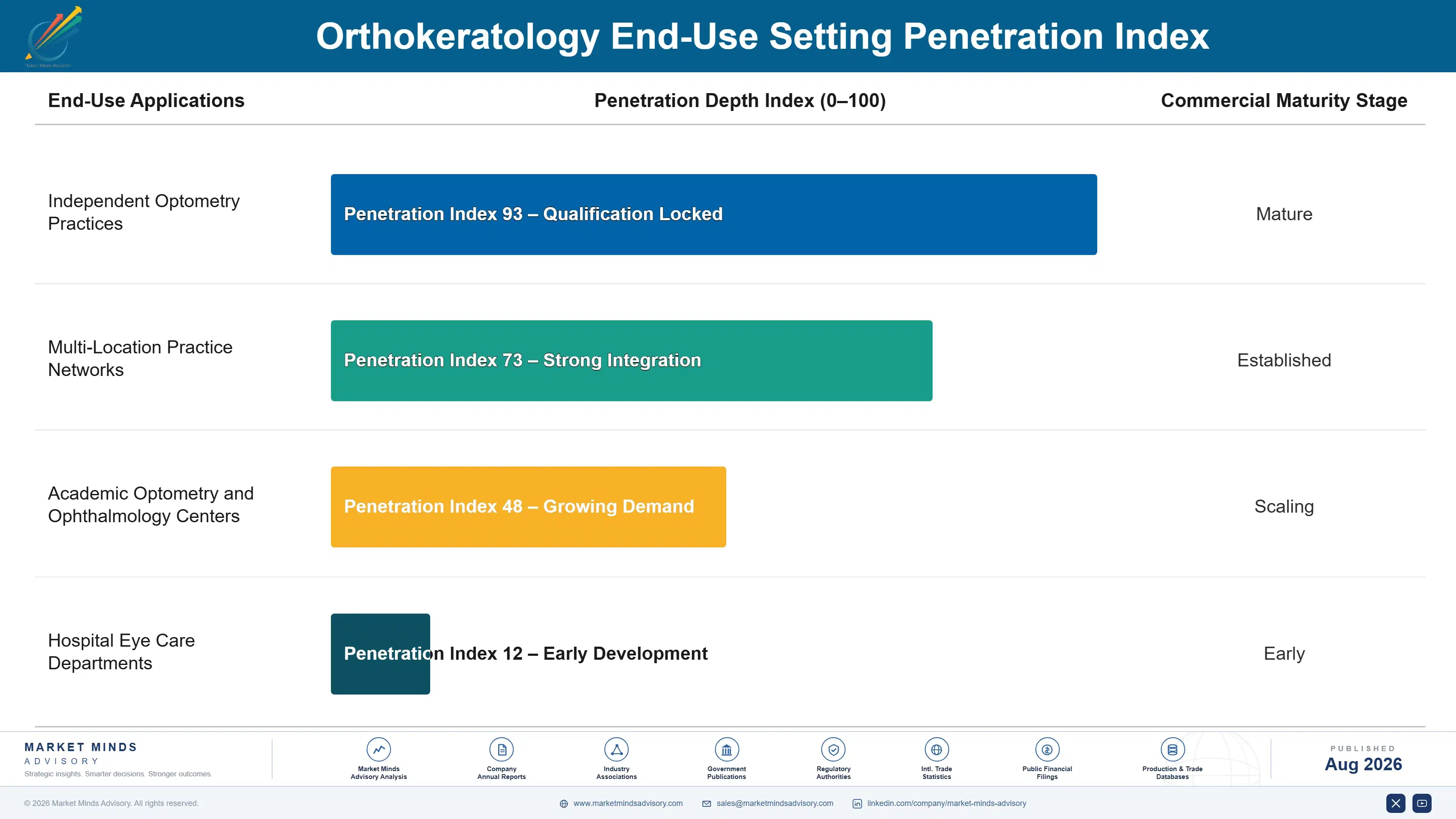
A lens sale is rarely a single transaction for the largest practice accounts. Evidence support, training programs, and long-term supply contracts convert what used to be a one-time material purchase into a relationship spanning a patient's treatment course across multiple years. Manufacturers that capture the evidence and training attachment at first sale retain more lifetime value per practice than those competing on material price alone.
Adoption depth varies sharply by practice type. Large multi-location practice networks convert fastest and most completely, standardizing an entire fitting protocol onto certified, evidence-backed manufacturers once a pilot relationship proves out, making them the highest-value account type despite competitive pricing. Smaller independent practices convert more slowly, often relying on referral to specialty fitting centers for years before adopting in-house fitting capability.

A generational shift in optometrists is compounding the certification-driven shift. Younger practitioners entering practice increasingly expect published myopia control evidence and digital tracking capability as standard prescribing justification, a clinical expectation an older generation of practitioners, who trained primarily on conventional vision correction fitting alone, rarely required as rigorously. That shift is accelerating premium-tier adoption even among practices that have not yet faced direct competitive pressure from evidence-driven rivals nearby.
orthokeratology-market-end-use-penetration-index-1787304010180

What Matters Most Through 2036

These are among the four positions where our research anticipates prominent divergence between winners and laggards over the coming forecast period. Each is grounded in the demand model, the regulatory perimeter, and the announced capacity pipeline.
01 / MYOPIA CONTROL EVIDENCE INVESTMENT

Build extensive longitudinal evidence before prescribing habits solidify

Published axial length control evidence is converting practitioner prescribing decisions from a purely material-based comparison into an evidence-driven relationship, and manufacturers with established validated evidence are already capturing disproportionate share of new prescribing decisions ahead of broader market maturation. Manufacturers that invest in longitudinal evidence generation now will secure preferred-vendor status with major practices before competitors catch up on the clinical study investment required to compete credibly. Continuing to treat evidence generation as a future concern risks ceding the fastest-growing, most differentiated segment to competitors already building extensive validated evidence.
02 / CUSTOM-FIT TECHNOLOGY DEPTH

Deepen diagnostic fitting capability ahead of the next adoption wave

Custom-fit diagnostic technology increasingly decides which manufacturer captures a practice's long-term prescribing relationship, and manufacturers that deepen validated fitting software will capture disproportionate share of practitioner adoption as smaller practices seek reduced fitting complexity. Manufacturers that invest in fitting technology now will build switching costs that protect prescribing relationships better than competitors relying on material specification alone. This technology investment requires sustained development spending years before any single adoption cycle fully rewards that patient positioning across every practice segment and region.
03 / RECURRING PRACTICE REVENUE CAPTURE

Bundle training and evidence into every large practice supply quote

Practitioner training and long-term supply agreements already generate meaningfully higher recurring revenue than standard material sales, yet many manufacturers still sell these as separate negotiations rather than a default part of every quote presented to large practice buyers. Manufacturers that make training and evidence attachment the default, requiring buyers to actively opt out rather than opt in, will capture materially more lifetime value per practice than competitors treating these services as an afterthought. This remains underexploited by every manufacturer outside the two largest players active in the category.
04 / PRACTITIONER TRAINING CAPACITY EXPANSION

Scale certification training ahead of continued demand growth

Specialized fitting expertise continues limiting how many practices can realistically offer ortho-K services, and manufacturers overly dependent on a narrow certified practitioner base face real growth ceiling risk across the forecast period covered in this report if training capacity does not expand meaningfully. Manufacturers that invest in scalable certification training programs now will expand their addressable practitioner base faster than competitors continuing to rely primarily on traditional apprenticeship-style fitting education. This capacity investment requires sustained training infrastructure commitment well before broader practitioner availability fully materializes across each affected market.

Engagement Snapshot From the Field

A live engagement with an industry participant carrying material or product regulatory and market exposure ahead of a defining policy shift, showing how our research translates into a defensible multi-year portfolio strategy.
MARKET MINDS ADVISORY · CLIENT ENGAGEMENT SUMMARY
Orthokeratology Producer Strategic Portfolio Review and Transition Roadmap 2026·Investment Scenario on Orthokeratology Exposure Evaluation 2025-26
CLIENT PROFILE
The client is a regional optometry practice group operating 12 locations across two states, with a stated goal of launching a structured myopia control service line built around evidence-backed ortho-K prescribing. Annual specialty lens and diagnostic equipment procurement spend exceeds $7 million (client-reported, unverified by MMA), concentrated primarily across standard vision correction with limited prior ortho-K experience. The group had no dedicated myopia control protocol at the engagement's outset.
STRATEGIC CHALLENGE
The client faced a service line launch decision with limited internal practitioner expertise in ortho-K fitting and uncertainty about which manufacturer's evidence base and training program would best support a credible myopia control offering. Leadership needed a structured evaluation framework balancing training investment cost against projected patient demand and long-term practice differentiation value.
MMA APPROACH
MMA conducted a structured evaluation of three candidate manufacturer partnerships against the client's patient demographic profile and practitioner training readiness, benchmarked vendor-reported efficacy claims against MMA's proprietary myopia control evidence database, and facilitated reference site visits with comparable practice group deployments. The engagement combined primary interviews with practicing optometrists alongside independent outcome data verification across multiple practice types.
KEY FINDINGS
  1. Two of three evaluated manufacturers could not provide sufficient practitioner training capacity to support the client's twelve-location rollout timeline without meaningful delay.
  2. The client's specific patient demographic profile meaningfully affected which manufacturer's lens design portfolio was most clinically appropriate across its broader patient base and geography.
  3. Selecting a manufacturer with structured training support reduced projected practitioner ramp-up time by an estimated 28% relative to self-directed learning approaches across locations.
  4. Parent compliance education emerged as a more decisive factor in patient retention than initial lens fitting quality alone had suggested during early evaluation.
CLIENT PROFILE
The client is a regional optometry practice group operating 12 locations across two states, with a stated goal of launching a structured myopia control service line built around evidence-backed ortho-K prescribing. Annual specialty lens and diagnostic equipment procurement spend exceeds $7 million (client-reported, unverified by MMA), concentrated primarily across standard vision correction with limited prior ortho-K experience. The group had no dedicated myopia control protocol at the engagement's outset.
STRATEGIC CHALLENGE
The client faced a service line launch decision with limited internal practitioner expertise in ortho-K fitting and uncertainty about which manufacturer's evidence base and training program would best support a credible myopia control offering. Leadership needed a structured evaluation framework balancing training investment cost against projected patient demand and long-term practice differentiation value.
MMA APPROACH
MMA conducted a structured evaluation of three candidate manufacturer partnerships against the client's patient demographic profile and practitioner training readiness, benchmarked vendor-reported efficacy claims against MMA's proprietary myopia control evidence database, and facilitated reference site visits with comparable practice group deployments. The engagement combined primary interviews with practicing optometrists alongside independent outcome data verification across multiple practice types.
KEY FINDINGS
  1. Two of three evaluated manufacturers could not provide sufficient practitioner training capacity to support the client's twelve-location rollout timeline without meaningful delay.
  2. The client's specific patient demographic profile meaningfully affected which manufacturer's lens design portfolio was most clinically appropriate across its broader patient base and geography.
  3. Selecting a manufacturer with structured training support reduced projected practitioner ramp-up time by an estimated 28% relative to self-directed learning approaches across locations.
  4. Parent compliance education emerged as a more decisive factor in patient retention than initial lens fitting quality alone had suggested during early evaluation.
RECOMMENDED STRATEGY
Phase 1: Phase 1 (Months 1 to 4): Complete manufacturer evaluation and certify practitioners at the three highest-volume locations for structured myopia control fitting. Phase 2: Phase 2 (Months 5 to 10): Launch the myopia control service line while closely tracking fitting outcomes and patient compliance against baseline metrics. Phase 3: Phase 3 (Months 11 to 18): Expand certified fitting capability across remaining locations pending validated results from the initial launch phase.
OUTCOME
The client's initial three locations achieved strong early patient enrollment and measurable compliance rates within eight months of service line launch (client-reported, unverified by MMA), supporting the network-wide expansion plan that had originally motivated the manufacturer evaluation engagement. The remaining nine locations are scheduled for phased certification over the following year.

Frequently Asked Questions

Foundational context covering the market sizes, CAGR, scope, country, region and competition that inform every finding below. This section is provided to cover basics and most often pre-purchase conversations, answered from the MMA Primary Research Dataset.

What is the current size of the Orthokeratology Market?

MMA estimates the global orthokeratology market at $1.4 billion in 2025. Growth concentrates in custom-fit diagnostic lenses and digital fitting platforms, driven by myopia control evidence and screening program expansion.

How large will the Orthokeratology Market be by 2036?

MMA forecasts the market reaching $4.21 billion by 2036, up from $1.55 billion in 2026. That represents roughly a 2.72 times expansion over the full ten-year forecast period covered.

What is the CAGR for the Orthokeratology Market 2026 to 2036?

MMA's base case forecasts a 10.5% compound annual growth rate, with a bull case of 11.8% and a bear case of 9.2% depending on practitioner training capacity expansion timing.

Which segment is growing fastest?

Custom-fit diagnostic ortho-K lenses lead at a 14.5% CAGR, roughly 1.4 times the overall market rate, as practitioners chase precision fitting technology for irregular corneas and higher-prescription patients.

Who are the major companies in the Orthokeratology Market?

Alcon, EssilorLuxottica, Menicon, Bausch + Lomb, and CooperVision lead the category, together holding an estimated 42% combined share on a revenue basis across lenses and diagnostic equipment worldwide.

Which country is growing fastest?

China leads at an estimated 15.5% CAGR, outpacing the global average given its severe pediatric myopia burden and supportive government screening programs continuing to expand faster than any comparable economy.

Report Segmentation Architecture

The full report scope spans multiple orthogonal segmentation dimensions, with cross-tabulated demand data provided for each dimension pair. Coverage extends further to regional breakdowns, trend trajectories, and the competitive detail needed to support segment-level decision-making.

By Product and Technology Type

  • Overnight Ortho-K Lenses
  • Custom-Fit Diagnostic Ortho-K Lenses
  • Lens Care and Cleaning Solutions
  • Corneal Topography and Fitting Systems
  • Myopia Control Software and Digital Fitting Platforms
  • Replacement and Accessory Lens Kits

By End-Use Setting

  • Independent Optometry Practices
  • Multi-Location Practice Networks
  • Academic Optometry and Ophthalmology Centers
  • Hospital Eye Care Departments

By Commercial Dimension

  • Direct Practice Purchase
  • Payer-Negotiated Coverage Agreements
  • Long-Term Manufacturer Supply Agreements
  • Practitioner Training and Certification Programs

By Region

  • North America
  • Western Europe
  • East Asia
  • South Asia and Pacific
  • Latin America
  • Middle East and Africa
  • Eastern Europe

Scope, Methodology, and Coverage

Every figure in this report is reproducible from documented input assumptions. The scope below maps the historical period, the forecast horizon, the segmentation dimensions, and the countries covered, alongside the underlying primary and qualitative methodology.
Historical Period
2020 to 2025
Forecast Period
2026 to 2036
Base Year
2025 (USD billions; MMA Primary Research Dataset, August 2026)
Market Definition
The orthokeratology market covers overnight corneal reshaping contact lenses, custom-fit diagnostic lenses, lens care solutions, corneal topography and fitting systems, and companion digital fitting software used to correct refractive error and control myopia progression. It excludes standard daytime-wear soft and rigid gas-permeable lenses not designed for overnight corneal reshaping and excludes surgical refractive correction procedures such as LASIK.
Quantitative Units
USD billions (current prices); fitted patient volume and prescribed lens pairs where applicable
Segmentation Dimensions
By Product and Technology Type; By End-Use Setting; By Commercial Dimension; By Region
Regions Covered
North America, Western Europe, East Asia, South Asia and Pacific, Latin America, Middle East and Africa, Eastern Europe
Countries Covered
USA, China, Germany, France, UK, Japan, South Korea, India, Australia, Canada, Brazil, Mexico, Indonesia, Vietnam, Thailand, Malaysia, UAE, Saudi Arabia, South Africa, Nigeria, Turkey, Poland, Netherlands, Italy, Spain, Sweden, Switzerland, Argentina, Colombia, Singapore, and additional markets relevant to this sector
Key Companies Profiled
Alcon Inc., EssilorLuxottica SA, Menicon Co., Ltd., Bausch + Lomb Corporation, CooperVision, Inc., Euclid Systems Corporation, GP Specialists, Inc., Contex, Inc., Visioneering Technologies, Inc., SEED Co., Ltd., Procornea Nederland B.V., Art Optical Contact Lens, Inc., Acuity Polymers, Inc., Capricornia Contact Lens, No7 Contact Lenses Ltd., Valley Contax, Inc., X-Cel Specialty Contacts, Blanchard Contact Lens, Inc., Lentechs, LLC, Ovitz Corporation
Quantitative Methodology
Primary survey, n=3,800 respondents, Q4 2025, six countries; demand-side model with trade association cross-validation
Qualitative Methodology
47 expert interviews, Q4 2025; applied to validate demand model assumptions, identify emerging dynamics, and assess competitive positioning
Report Format
PDF and XLSX data workbook (Word format preview document)
Publisher
Market Minds Advisory
Report Code
MMA-2026-MED-101
Published
August 2026
Contact
sales@marketmindsadvisory.com | www.marketmindsadvisory.com

Purchase the full Orthokeratology Market Report (2026 to 2036).

The full Orthokeratology Market report delivers granular five-year and ten-year forecasts across all six product segments, myopia control evidence tracking by region, and manufacturer benchmarking drawn from MMA's proprietary specialty lens performance database. It includes detailed profiles of all twenty companies covered here, extended regional analysis across every major eye care market, and a clinical evidence tracker spanning major longitudinal myopia control studies. Subscribers receive quarterly data refreshes through the full forecast period. Buyers also gain direct analyst access for engagement-specific questions throughout the subscription term.
Myopia control evidence tracker by region and study
Ten-year segment-level forecasts across all products
Manufacturer benchmarking data across lenses and software
Practitioner training capacity tracking module worldwide
Twenty-company competitive profiles with moat analysis
Quarterly data refresh access throughout subscription

Built For The People Who Decide

From boardroom strategy to bench-side execution, this report is read cover-to-cover by leaders shaping the next decade of their industry, turning demand scenarios, market dynamics and valuation benchmarks into decisions.
CXOs/ Presidents/ VPs/ Managers
M&A and Corporate Development
Strategy Teams and R&D Heads
Procurement and Product Directors
Regulatory and Compliance Leaders
Investor Relations and Equity Analysts