Market Minds Advisory
Orthobiologics Market

Orthobiologics Market: The reimbursement split, a standardisation failure and autograft displacement to 2036

Payers decline to cover much of this market because the trials disagree, and the trials disagree because two systems bearing the same product name do not actually produce the same thing.

Lead Analyst

Alice Ballenger

Published

September 2026

Make Smarter Decisions with Customized Research Insights

Request a free sample report and evaluate market opportunities, growth trends, and competitive dynamics relevant to your business needs.

2025 MARKET VALUE$6.8BMarket Size 2025
2036 FORECAST VALUE$16.9BBase Case , 2026 to 2036
CAGR 2026 TO 20368.6 %Bull 9.8% / Bear 7.4%
INCREMENTAL OPPORTUNITY$9.5BNet 10- year value creation
EXPANSION MULTIPLE2.28x2036 value over 2026 base
Strategic Levers
M&A Pipeline
Regional Outlook
Country Rankings
Competitive Intelligence
Segmental Deep-dive
Call-Us : 91 93563 13602

Executive Snapshot and Market Trajectory

Roughly 31% of this market is paid directly by patients because payers judge the evidence insufficient. That judgement is usually read as a verdict on the biology. It is not. It is a verdict on standardisation, and the difference matters enormously to anybody investing here.
Preparation systems bearing the same product name produce outputs varying up to eightfold in platelet concentration, with different leukocyte content and different activation. Around 74% of published studies therefore use non-comparable protocols, which makes meta-analysis meaningless and leaves payers with nothing they can act on. A manufacturer defining its own preparation precisely and trialling that specific product would hold evidence no competitor could contest or borrow through any pooled analysis.
Platelet-rich plasma systems grow at 12.9%, half again the market rate of 8.6%, on patients paying directly for anything that might delay a knee replacement. North America holds 44% of value on spinal fusion volume and a cash-pay culture in sports medicine that no other health system reproduces. Bone graft substitutes take 38% of volume in spinal fusion, competing against the patient's own bone, which is free and leaves 21% with persistent donor site pain.
Market Definition
This report covers orthobiologic products used to support musculoskeletal healing, spanning bone graft substitutes and ceramics, demineralised bone matrix and allograft, growth factor and bone morphogenetic protein products, platelet-rich plasma systems, cell-based and marrow concentrate products, and viscosupplementation and injectables. Value is measured at manufacturer level on product revenue. Excluded are orthopaedic implants and instrumentation, autograft harvested and used within a procedure, systemic osteoporosis pharmaceuticals, physical therapy and rehabilitation services, and veterinary orthobiologic products.
Base Year Value
$6.8B in 2025 (MMA Primary Research Dataset, August 2026)
Forecast Period
2026 to 2036, eleven discrete annual values
CAGR
8.6% base case. Bull 9.8%. Bear 7.4%.
Fastest Growth Segment
Platelet-Rich Plasma Systems: 12.9% CAGR
Fastest Growth Country
India: 12.4% CAGR
Fastest Growth Region
South Asia and Pacific: 10.8% CAGR
Largest Region
North America: 44% of 2025 global value
Market Leaders
Medtronic, Stryker, Zimmer Biomet, Johnson and Johnson MedTech and Enovis lead the market. Source: MMA Primary Research Dataset, July 2026.
Primary Survey
n=3,800 procurement and R&D decision-makers, Q4 2025, six countries
Methodology
Demand-side build-up, cross-validated against public data, 47 expert interviews

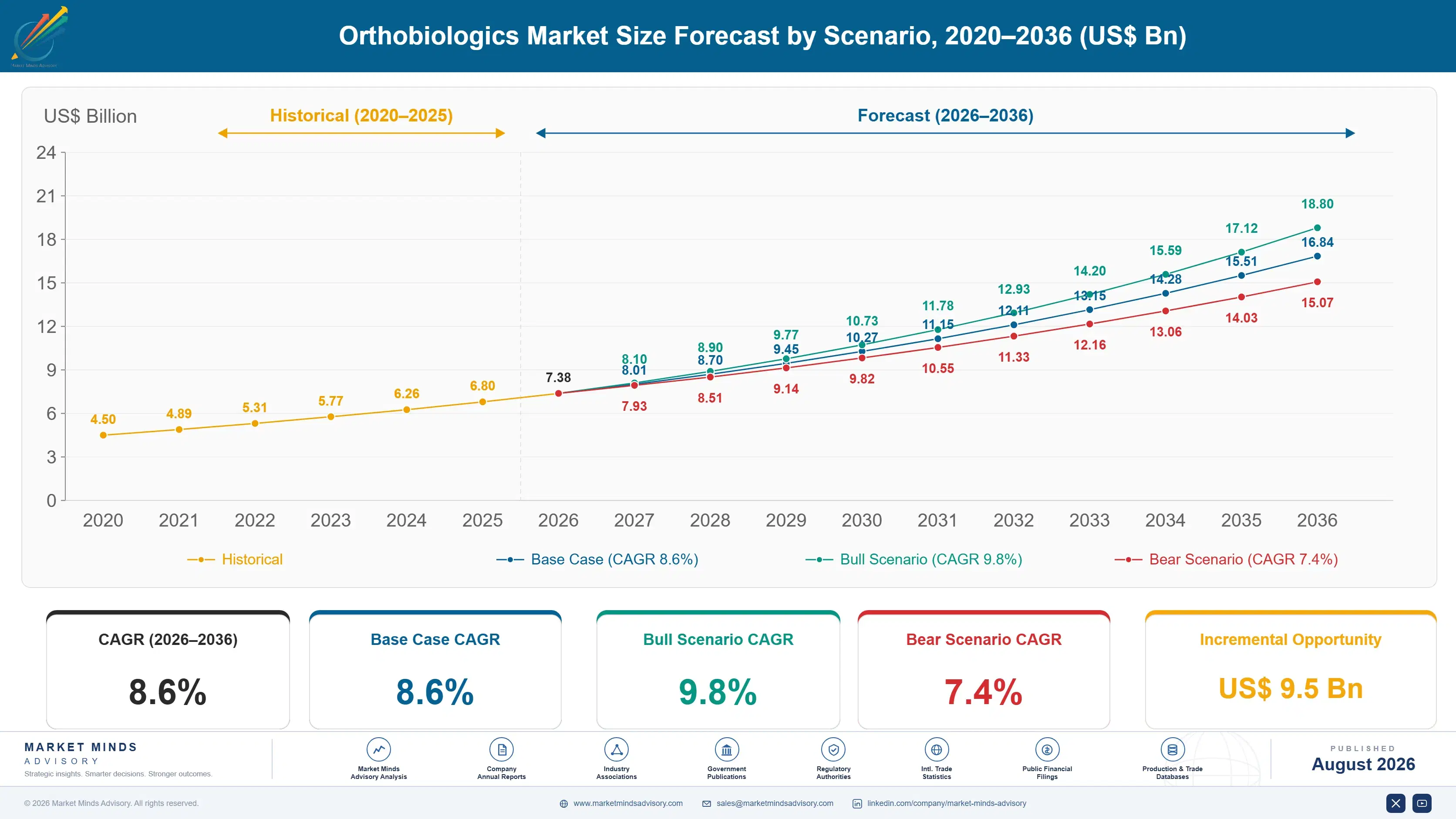
Orthobiologics Market Forecast Scenarios

orthobiologics-market-size-forecast-scenario-1787559557801
Growth ran at 7.4% between 2020 and 2025 across a period that reshaped the market considerably. Elective procedure volumes collapsed and recovered, while regulatory enforcement on minimally manipulated tissue products ended a period of tolerance and closed a large number of clinics operating outside the rules. That was painful for the sector and healthy for it, consolidating demand toward companies holding proper regulatory pathways.
The 8.6% base case rests on three mechanisms. Platelet-rich plasma at 12.9% on cash-paying patients seeking anything that might postpone joint replacement. Cell-based and marrow concentrate products at 10.4% within compliant regulatory pathways. And Indian growth at 12.4%, the fastest of any country, on orthopaedic procedure volumes expanding rapidly alongside a private payment culture that suits cash-pay products. None of the three requires a payer coverage decision to change at all.
The 9.8% bull case is a manufacturer standardising its own preparation and running trials on that specific standardised product, which could cross the reimbursement line while competitors remain cash-pay. The 7.4% bear case is payer scrutiny extending to segments currently covered, since the evidence problem is not confined to the products already excluded from reimbursement.

A Standardisation Problem, Not Biology

The most consequential fact about this market is usually misread. Around 31% of value is paid directly by patients because major payers decline coverage on grounds of insufficient evidence, and that is widely interpreted as a judgement that the biology does not work. It is nothing of the sort. Two platelet-rich plasma systems carrying the same product description can produce preparations differing eightfold in platelet concentration, with quite different leukocyte content and activation state, which means they are not the same intervention at all.
TOP-FIVE CONCENTRATION42%Combined position across supply held by the leading device manufacturers
CASH PAY SEGMENT SHARE31%Portion of value paid directly by patients without reimbursement
PLATELET CONCENTRATION VARIANCE8xSpread in output between different preparation systems on market
SPINAL FUSION APPLICATION SHARE38%Portion of volume consumed in vertebral fusion procedures
AUTOGRAFT DONOR SITE COMPLICATION21%Patients reporting persistent pain where their own bone was harvested
TRIAL HETEROGENEITY INDEX74%Share of published studies using non-comparable preparation protocols
The consequence follows directly. Roughly 74% of published studies use preparation protocols that cannot be compared with one another, so pooling them produces a meta-analysis that answers no question anybody asked and payers are left with an evidence base they cannot act on. The failure is one of standardisation rather than of underlying biology, and it is fixable by a manufacturer willing to define its own preparation precisely and trial that specific product rather than the category.
The reimbursed half of the market behaves entirely differently. Bone graft substitutes take 38% of volume in spinal fusion, competing against the patient's own bone, which costs nothing and leaves around 21% with persistent donor site pain.
"Everybody in this field treats the reimbursement problem as an evidence problem, and it is really a manufacturing consistency problem wearing an evidence problem's clothes. Standardise your own preparation, trial that, and you are the only product with a clean answer while everybody else argues about pooled data."
Director, Musculoskeletal Devices and Biologics Practice · MMA Medical Devices and Pharmaceutical Packaging Practice · August 2026

Market Trends

Preparation variance keeps the evidence base uninterpretable

Platelet-rich plasma systems sold under the same general description produce preparations differing by up to eightfold in platelet concentration, with different leukocyte content and activation, which means published trials are studying materially different interventions under one name. Around 74% of studies use non-comparable protocols. Commercially this keeps payers from covering the category and confines roughly 31% of market value to direct patient payment, and it also means a manufacturer who standardises its own preparation and trials that specific product holds evidence nobody else can claim. That evidence would be uncontestable rather than merely favourable.
Market Impact: Complications affect 21% of patients

Regulatory enforcement consolidated the market toward compliant pathways

Enforcement on minimally manipulated tissue products ended a long period of tolerance and closed a considerable number of clinics operating cell-based treatments outside any recognised regulatory pathway. That removed capacity and revenue from the sector abruptly. Commercially it consolidated demand toward manufacturers holding proper clearances and clinical evidence, which was uncomfortable at the time and considerably improved the market's foundations. Cell-based and marrow concentrate products now grow at 10.4% within compliant pathways rather than around them, which is a far more investable position. Regulatory positioning proved to be a commercial asset.
Market Impact: Cash pay holds 31% of value

Market Opportunities and Growth Drivers

Donor site pain is the clinical argument against autograft

Bone graft substitutes compete against autograft, the patient's own bone harvested during the same procedure, which is free of product cost and biologically ideal. Around 21% of patients report persistent pain at the harvest site afterwards, and that complication is the commercial argument for a substitute. It is a clinical outcome argument rather than an economic one, which matters because a surgeon weighing graft options responds to patient morbidity in a way that no cost comparison against free bone could ever achieve on its own. Operating time is the second criterion surgeons actually weigh.
Market Impact: Payers exclude 31% of value

Untreatable knee osteoarthritis sustains direct patient payment

Knee osteoarthritis affects an enormous and ageing population with no disease-modifying treatment available at all, and the alternative on offer is eventually a joint replacement that patients would prefer to postpone. That produces genuine willingness to pay directly for anything that might help, which sustains cash-pay demand regardless of what the evidence base does or does not establish. Commercially this is why platelet-rich plasma grows at 12.9% while remaining largely unreimbursed, and the demand is driven by an absent alternative rather than by proven benefit. Willingness to pay rests on an absent alternative rather than on demonstrated benefit.
Market Impact: Fusion applications take 38% of volume

Market Restraints and Challenges

Payer coverage stays withheld across most injectable segments

Major payers decline coverage for platelet-rich plasma and most cell-based orthobiologics on evidence grounds, which confines roughly 31% of market value to patients paying directly from their own funds. The root cause is uninterpretable pooled evidence rather than any demonstrated absence of effect. Commercially this caps volume at whatever patients will fund personally and makes demand sensitive to economic conditions in a way reimbursed products are not. Manufacturers are pursuing product-specific trials on standardised preparations, which is slow, expensive and the only route that works. Demand becomes sensitive to economic conditions as a result.
Market Impact: Studies vary across 8 times concentration

Autograft remains free and biologically ideal for surgeons

The patient's own bone carries no product cost, contains living cells and growth factors in the correct proportions, and requires no regulatory clearance or supplier relationship at all. The root cause of the competitive difficulty is simply that the alternative is genuinely excellent. Commercially this means a substitute must justify itself on donor site morbidity and operating time rather than on any biological superiority claim. Manufacturers are focusing evidence on harvest site complication rates and procedure duration, which are the arguments a surgeon actually weighs. Biological superiority claims against it persuade nobody in theatre.
Market Impact: Compliant products grow at 10.4%
4 additional market trends, 3 additional growth drivers, and 2 additional restraints and challenges are covered in the full report. Contact sales@marketmindsadvisory.com to access the complete intelligence.

Segment CAGR and Growth Architecture

Value is classified here by product technology, since reimbursement status, evidence requirements and the competitive alternative all differ enormously between a ceramic bone void filler and an autologous injectable. Clinical application, care setting and payment route are each handled separately in the framework below, because most of these technologies serve several different procedures at once.
orthobiologics-market-market-share-analysis-1787559558331

Platelet-Rich Plasma Systems

Growing at 12.9%, half again the market rate and faster than anything else here, platelet-rich plasma is sustained almost entirely by patients paying directly for something that might postpone a joint replacement they would rather avoid. Preparation systems differ eightfold in platelet concentration with different leukocyte content, which means products sharing a name are not the same intervention and roughly 74% of trials cannot be compared with one another. That keeps payers away and leaves the segment dependent on personal spending. A manufacturer standardising its own preparation and trialling that specific product would hold evidence no competitor could match or contest. Nobody has yet completed that programme anywhere. The position remains genuinely open.
CAGR 12.9%

Cell-Based and Marrow Concentrate

Bone marrow aspirate concentrate and related cell-based products grow at 10.4% within compliant regulatory pathways, following a period in which enforcement closed a considerable number of clinics operating outside any recognised framework. That consolidation was uncomfortable and left the segment on far better foundations, since remaining participants hold clearances and evidence rather than operating on tolerance. Preparation variability affects this segment as it affects platelet products, though the cell populations involved are harder to characterise, which makes standardisation a more demanding problem and the eventual evidence correspondingly more valuable to whoever solves it. Enforcement removed capacity abruptly and left remaining participants holding clearances rather than operating on tolerance, which is a considerably more investable foundation than the sector previously had.
CAGR 10.4%
Full segment breakdown across 6 segments available in the complete report.

Regional Architecture and Country Demand Map

North America holds 44% of value, far above the standard band, because spinal fusion volume per capita exceeds anywhere else and a cash-paying sports medicine culture supports injectable products that no other health system funds. Western Europe follows well behind at 21% on considerably more selective public funding.

North America

At 44% this region sits far above the standard band for two distinct reasons operating together. Spinal fusion procedure volume per capita substantially exceeds every other health system, which drives bone graft substitute demand at a scale nowhere else approaches. Alongside that, a sports medicine and orthopaedic culture in which patients pay directly for unreimbursed injections supports a cash-pay segment no other country reproduces at meaningful scale. Regulatory enforcement on tissue products reshaped the sector here more than anywhere. Growth at 8.0% sits close to the market rate on a very large established base. Value analysis committees add a second decision layer above surgeon preference. Enforcement reshaped the sector here.
Share: 44% | CAGR: 8.0% (2026 to 2036)

Western Europe

Health systems here fund orthobiologics far more selectively than American practice, with bone graft substitutes covered in appropriate surgical indications while injectable products are largely unreimbursed and consequently much smaller. Spinal fusion rates per capita are considerably lower, reflecting different clinical thresholds rather than different disease prevalence. Cash-pay culture is limited, so unreimbursed products struggle to establish volume. Regulatory frameworks for advanced therapy products are demanding and slow. Growth at 7.0% is the weakest on this table and reflects selective funding rather than any clinical scepticism. Advanced therapy product frameworks are demanding and slow, which delays cell-based products considerably relative to American and Japanese pathways. Cash-pay culture is genuinely limited.
Share: 21% | CAGR: 7.0% (2026 to 2036)
Regional intelligence for 5 additional markets available in the complete report: East Asia, South Asia and Pacific, Latin America, Middle East and Africa, Eastern Europe. Contact sales@marketmindsadvisory.com.
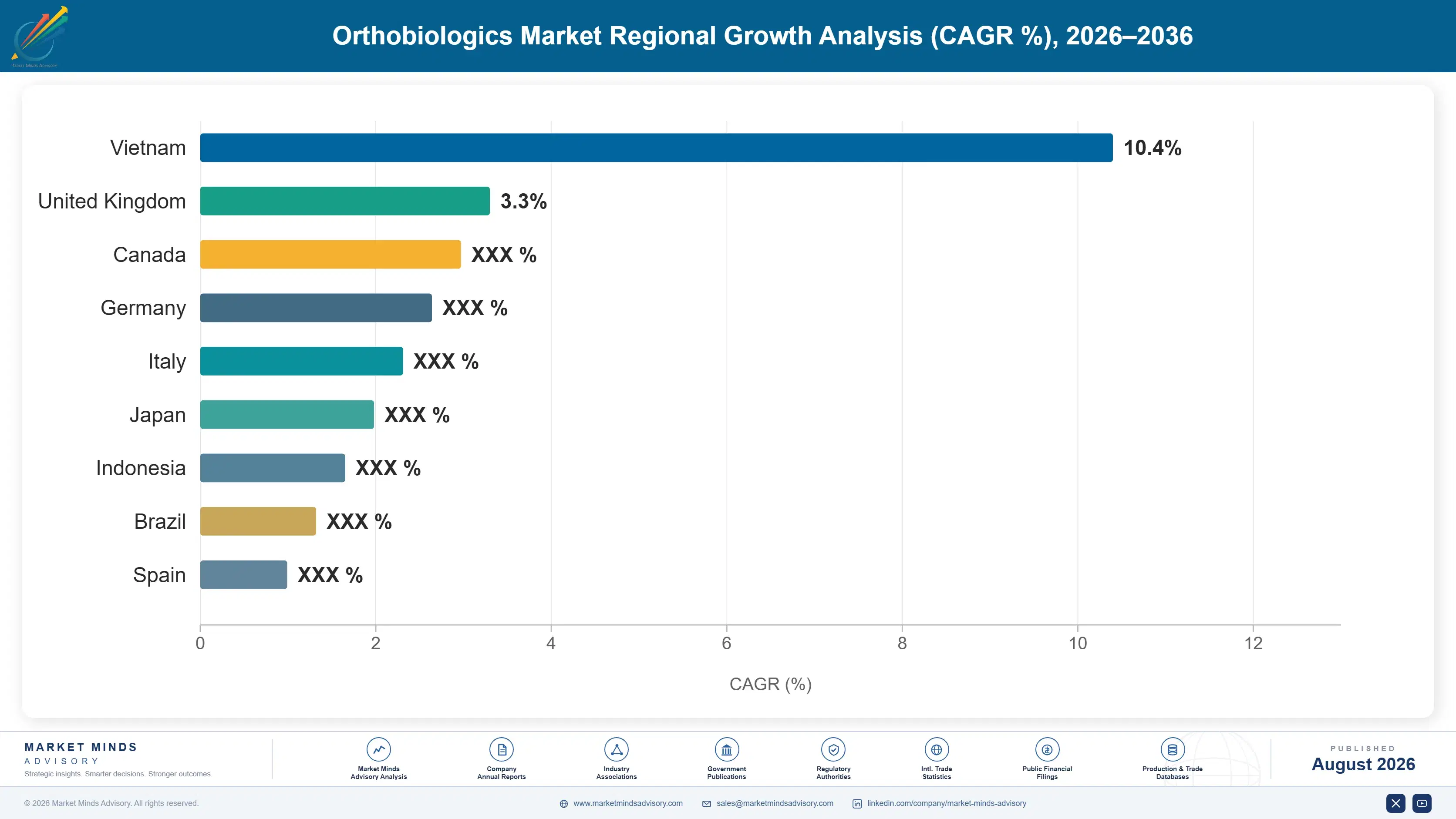
orthobiologics-market-country-cagr-analysis-1787559558850

Where Orthobiologic Value Actually Divides

Four quite separate moves matter here, in a market split down the middle by reimbursement, where the exclusion rests on a standardisation failure rather than on any finding about the underlying biology at all. Two concern crossing that divide deliberately, and two concern competing properly within the reimbursed half against an alternative costing nothing.

Standardise the preparation and trial that product

Systems differing eightfold in platelet concentration produce evidence that cannot be pooled, which is why roughly 74% of studies are non-comparable and payers have nothing to act on. A manufacturer who defines its own preparation precisely and runs adequately powered trials on that specific standardised product holds evidence no competitor can contest or borrow. Crossing into reimbursement while others remain cash-pay would reset the competitive position of a segment worth 31% of the market entirely. Nobody has yet completed that programme, which means the position is open. Meta-analysis cannot dilute it.
Market Impact: Resolves 74% of trials that prove non-comparable today

Sell donor site morbidity, not biological equivalence

Autograft is free, biologically ideal and requires no supplier at all, so arguing biological superiority against it is an argument nobody wins. Around 21% of patients report persistent pain at the harvest site and the procedure adds operating time. Those are the two things a surgeon actually weighs when choosing, and evidence directed at harvest complication rates and procedure duration reaches the decision being made rather than the one a marketing department would prefer to have. Free and biologically ideal is a difficult competitor to argue against on anything else.
Market Impact: Targets a 21% rate of donor site complication

Build in markets where patients already pay directly

Cash-pay products depend on personal willingness to fund treatment, which is culturally established in American sports medicine and equally so across Indian and Brazilian private healthcare where patients are accustomed to paying for care generally. Indian growth at 12.4% leads this market for exactly that reason. Manufacturers organised around reimbursement negotiation reach none of that demand, and the regulatory burden in those markets is frequently lighter than in systems that fund nothing anyway. Patients accustomed to funding care generally raise no separate objection to funding this. Regulatory burden is often lighter as well.
Market Impact: Serves demand that is growing at 12.4% yearly

Hold clearances rather than operating on tolerance

Enforcement on minimally manipulated tissue products closed a considerable number of clinics and removed revenue abruptly from participants operating outside recognised pathways. Compliant cell-based products now grow at 10.4% on far better foundations. Manufacturers with proper clearances inherited that demand rather than losing it, and the episode demonstrated that regulatory positioning in this sector is a commercial asset rather than an administrative cost centre. Enforcement removed revenue abruptly from participants operating outside recognised pathways, and compliant manufacturers inherited that demand rather than losing any of it. The episode is worth remembering.
Market Impact: Serves compliant products that now grow at 10.4%

Who Controls the Margin Pool

Five manufacturers hold 42% of this market, measured on product revenue at manufacturer level, the basis used throughout this section. Concentration follows surgical channel access rather than any technology advantage, since the large orthopaedic companies already sell implants and instrumentation into the same operating theatres and can place biologics alongside them without building a new commercial relationship. That channel overlap is the whole reason concentration sits where it does.
Competition runs on four dimensions. Surgical channel access, which decides whether a product is even considered in the operating theatre at all. Clinical evidence specific to a standardised preparation rather than to a broad product category. Regulatory clearance depth across jurisdictions with quite different frameworks and expectations. And cash-pay channel capability, a consumer-facing discipline the large surgical companies have generally never needed to build.

Rankings shift toward whoever standardises preparation and generates product-specific evidence, and toward participants strong in markets where patients pay directly. Large orthopaedic companies hold the theatre access that decides consideration. Specialist biologics companies hold the injectable positions alongside the evidence problem. Tissue banks hold allograft supply that nobody else can readily replicate at scale.
orthobiologics-market-company-positioning-matrix-1787559559370

Competitive Moat and Risk Dimensions

MEDTRONIC

Moat: Spinal channel and evidence depth

The company holds deep spinal surgical channel access alongside the most substantial clinical evidence base for growth factor products in fusion, which matters because bone graft applications take 38% of volume and surgeons choose on clinical outcome data rather than price. Selling biologics beside implants into the same procedure requires no separate commercial relationship at all.
MEDTRONIC

Risk: Limited cash-pay channel capability

Platelet-rich plasma grows at 12.9% and cell-based products at 10.4%, both sustained substantially by patients paying directly, which is a consumer-facing commercial discipline quite unlike surgical selling. Specialist companies hold those positions. A manufacturer organised entirely around hospital procurement and surgeon relationships reaches very little of the fastest growing demand.
ARTHREX

Moat: Sports medicine practice relationships

The company holds unusually deep relationships with sports medicine and orthopaedic practices where cash-pay injectable products are actually used, which is a different channel entirely from hospital spinal surgery and one the large implant companies have not built. Practice-level relationships also support the direct patient payment model that sustains roughly 31% of market value.
ARTHREX

Risk: Evidence problem constrains the segment

Cash-pay demand is capped by what patients will fund personally and remains sensitive to economic conditions in a way reimbursed products are not. The route out is product-specific evidence on a standardised preparation, which is slow and expensive. Whoever completes that trial first converts a cash-pay position into a reimbursed one and leaves competitors where they were.

Players Tracked

Prominent Players

Medtronic
Stryker
Zimmer Biomet
Johnson and Johnson MedTech
Enovis

Other Key Players

Smith and Nephew
Globus Medical
Orthofix
Arthrex
Bioventus
Anika Therapeutics
Kuros Biosciences
Terumo
Regen Lab
Isto Biologics
Xtant Medical
Berkeley Advanced Biomaterials
LifeNet Health
MTF Biologics
Vericel

Recent Developments

FEBRUARY 2025

A manufacturer began trials on a standardised platelet preparation

An orthobiologics manufacturer commenced adequately powered clinical trials on a precisely specified platelet preparation rather than on the product category, aiming to generate evidence that pooled analyses of heterogeneous protocols cannot provide. This was a clinical programme rather than any commercial transaction. Enrolment began in two countries.
Signal: Product-specific evidence on a precisely defined preparation is the only available route across the reimbursement divide
JUNE 2025

A surgical group published harvest site complication comparison data

A spinal surgical group published comparative data on donor site pain and operating time between autograft harvest and substitute use, framing the choice around patient morbidity rather than around any biological performance claim. This was a research publication rather than a commercial arrangement with manufacturers.
Signal: Harvest complication rates and operating time are the arguments surgeons actually weigh when choosing graft options
OCTOBER 2025

A private hospital group standardised orthobiologic protocols

An Indian private hospital group standardised orthobiologic use across its orthopaedic practices with defined patient payment pathways, treating the products as an established private care option rather than an experimental adjunct. This was an operational decision rather than any manufacturer transaction. Payment pathways were defined explicitly.
Signal: Markets where patients already pay for care directly remove the reimbursement obstacle that constrains these products elsewhere

What Drives Product Economics

Clinical evidence generation and regulatory affairs account for roughly 24% of the cost base across this market, which is high even for medical devices and reflects that evidence rather than manufacturing is the binding commercial requirement. Biological raw material and tissue processing add around 27% for allograft products and considerably less for synthetic ceramics. Disposable preparation kits carry conventional device manufacturing economics throughout.
Tissue processing and sterility assurance costs rose through 2021 and 2022 as regulatory expectations tightened and donor screening requirements expanded following enforcement action across the sector. Stryker noted regulatory and quality investment across its orthopaedic operations in its Annual Report 2022. Manufacturers absorbed most of it, since hospital contracts are negotiated annually and evidence requirements do not scale down for smaller participants in any way at all.

The disadvantage falls hardest on smaller specialists, and it operates through evidence cost rather than through manufacturing. A product-specific trial on a standardised preparation costs the same whether a company sells widely or narrowly, which means the fixed cost of crossing into reimbursement is prohibitive below a certain revenue base. That is why the evidence problem persists despite everybody understanding the solution perfectly well.
orthobiologics-market-cost-volatility-analysis-1787559559565

Define the preparation specification before designing any trial

Trials on a loosely specified preparation produce results that cannot be attributed to a particular product and add to the pool of non-comparable evidence rather than resolving it. Specifying platelet concentration, leukocyte content and activation precisely before enrolment makes the resulting evidence attach to one product. That specificity is the entire commercial value of the exercise.

Partner on evidence generation where scale is insufficient

A product-specific trial costs the same regardless of how widely a company sells, which puts reimbursement out of reach below a certain revenue base. Partnering with a larger manufacturer or a clinical consortium spreads that fixed cost. The alternative is remaining cash-pay indefinitely while somebody with more scale eventually crosses the line first. Somebody with scale will cross first.

Direct evidence spending at surgeon decision criteria

Surgeons choosing between autograft and a substitute weigh donor site morbidity and operating time rather than biological equivalence claims, since autograft is free and biologically ideal. Evidence on harvest complication rates addresses the actual decision. Research demonstrating biological performance against the patient's own bone answers a question nobody in theatre is asking. Nobody in theatre asks that question.

Portfolio Architecture for Margin Defence

Margin separates on reimbursement status and evidence position rather than on manufacturing content, which is unusual even among medical devices. Basic synthetic bone void fillers run at gross margins in the high forties against commoditised ceramic competition. Allograft and demineralised matrix run better on tissue processing barriers. Growth factor products with substantial fusion evidence run considerably higher. Cash-pay injectables run highest of all in percentage terms, though on volumes constrained by what patients will personally fund.
The tension is that cash-pay products carry the growth while reimbursed products carry the volume and the predictability, and crossing between them requires clinical evidence rather than any commercial or manufacturing investment. Manufacturers holding cash-pay positions face demand sensitive to economic conditions and capped by personal spending capacity. That ceiling only lifts through a trial nobody has yet completed on a properly standardised preparation.

High-value pools sit in standardised preparations with product-specific evidence, growth factor products in fusion, and cash-pay markets where patients fund care generally. Commodity ceramic fillers are where synthetic competition has already settled the outcome for everybody. That ceiling lifts only through evidence, which is why the trial matters more than any commercial initiative.

Volume / Commodity-Adjacent

Synthetic ceramic bone void fillers and basic substitutes competing on hospital contract pricing against commoditised alternatives. The twelve-point range separates manufacturers with surgical channel access from those selling through distribution into procurement processes.
Gross Margin: 44%-56%

Premium / Certified

Allograft, demineralised bone matrix and viscosupplementation products where tissue processing capability and clearance depth create genuine barriers. The fourteen-point spread reflects donor supply access and regulatory position rather than any manufacturing advantage.
Gross Margin: 58%-72%

Sustainability / Regulatory / Next-Generation

Growth factor products with fusion evidence, standardised cell and platelet preparations, and cash-pay injectables. The eighteen-point range is wide because evidence position and reimbursement status vary enormously between individual products.
Gross Margin: 68%-86%
orthobiologics-market-portfolio-architecture-1787559560060

High-value Sub-segments and Strategic Watch-out

Standardised Preparation Evidence

Whoever specifies platelet concentration, leukocyte content and activation precisely and trials that product holds evidence competitors cannot contest. Crossing into reimbursement would reset a segment worth 31% of the market. No competitor has yet committed to the same route. The position is genuinely open. Timing decides it.
Gross Margin: 70%-86%

Growth Factor Fusion Products

Serving 38% of volume in spinal fusion where surgeons choose on clinical outcome rather than price. Substantial evidence bases here took years to build and are correspondingly difficult to challenge. Surgeon familiarity compounds the barrier further still, since handling preference resists change. Evidence took years to build.
Gross Margin: 66%-80%

Direct Payment Markets

Indian and Brazilian private healthcare where patients already fund care and the reimbursement obstacle simply does not arise. Growth at 12.4% leads the market and regulatory burden is frequently lighter. Reimbursement negotiation capability reaches none of this demand at all. A coverage decision never arises at all.
Gross Margin: 62%-78%

Commodity Ceramic Fillers

The hospital contract volume, competing against synthetic alternatives on procurement pricing with limited differentiation available. Manage this for surgical channel access rather than for any margin improvement. Differentiation is limited and procurement decides the outcome. Channel access is the only lever. Margin will not improve.
Gross Margin: 44%-56%

How Orthobiologic Demand Renews

Demand renews per procedure rather than per patient, which makes this a business attached to surgical and clinic volume rather than to any chronic treatment relationship. A spinal fusion consumes graft material once and the patient does not return for more. Injectables differ slightly, since a knee patient may return for repeat courses, though the relationship sits with the practice.
Stickiness runs through surgeon preference and hospital contracting rather than through any patient loyalty. A surgeon who has used a particular graft product across hundreds of procedures and knows how it handles will resist changing for reasons that have nothing to do with price or evidence. Hospital value analysis committees create a second layer, since a product removed from a formulary cannot be used regardless of surgeon preference.

The buyer differs completely between the market's two halves, which is where manufacturers organised around one of them consistently fail in the other. Reimbursed products are bought through hospital procurement and value analysis committees weighing evidence and contract price. Cash-pay products are effectively sold to a patient by a clinician, which is a consumer conversation the surgical companies have almost no experience conducting.
orthobiologics-market-end-use-penetration-index-1787559560548

Where To Place The Bet

These are among the four positions where our research anticipates prominent divergence between winners and laggards over the coming forecast period. Each is grounded in the demand model, the regulatory perimeter, and the announced capacity pipeline.
01 / PREPARATION STANDARDISATION PRIORITY

Define the product, then trial that exact thing

Systems sharing a product description produce preparations differing by up to eightfold in platelet concentration with quite different leukocyte content and activation state, which means roughly 74% of published studies are examining materially different interventions under a single name. Pooling that evidence answers nothing and leaves payers unable to act on any of it. A manufacturer defining its own preparation precisely and running adequately powered trials on that specific product holds evidence no competitor can contest, borrow or dilute through meta-analysis.
02 / MORBIDITY BASED SELLING

Argue harvest complications, never biological equivalence

Autograft costs nothing in product terms, contains living cells and growth factors in exactly the right proportions, and requires no supplier relationship or regulatory clearance of any kind whatsoever. Arguing biological superiority against the patient's own bone is a contest nobody wins on the merits. Around 21% of patients report persistent pain at the harvest site and the procedure adds operating time, and those two facts are precisely what a surgeon weighs when deciding, which makes them the only evidence worth funding.
03 / DIRECT PAYMENT MARKETS

Sell where reimbursement was never the question

Cash-pay orthobiologics depend on patients willing to fund treatment personally, which is culturally established in American sports medicine and equally so across Indian and Brazilian private healthcare where patients pay for care as a matter of routine anyway. Indian country growth at 12.4% leads this market for precisely that reason rather than any clinical difference. Manufacturers organised around reimbursement negotiation reach none of that demand, and the regulatory burdens there are frequently lighter than in the systems funding nothing anyway.
04 / CLEARANCE POSITION VALUE

Hold the pathway rather than the tolerance

Regulatory enforcement on minimally manipulated tissue products ended a long period of tolerance and abruptly closed a considerable number of clinics operating cell-based treatments outside any recognised framework, removing revenue from the whole sector more or less overnight. Compliant cell-based products now compound at 10.4% on considerably better foundations than before. Manufacturers holding proper clearances inherited that demand rather than losing it, which demonstrated conclusively that regulatory positioning in this sector is a commercial asset rather than merely an administrative cost centre.

Engagement Snapshot From the Field

A live engagement with an industry participant carrying material or product regulatory and market exposure ahead of a defining policy shift, showing how our research translates into a defensible multi-year portfolio strategy.
MARKET MINDS ADVISORY · CLIENT ENGAGEMENT SUMMARY
Orthobiologics Producer Strategic Portfolio Review and Transition Roadmap 2026·Investment Scenario on Orthobiologics Exposure Evaluation 2025-26
CLIENT PROFILE
An orthobiologics specialist with annual revenue around USD 96 million (client-reported, unverified by MMA), selling platelet preparation systems and bone void fillers through orthopaedic and sports medicine practices. Injectable products were entirely cash-pay. Clinical evidence covered the category rather than any specific preparation the company actually sold. Growth had slowed noticeably. Evidence was category level.
STRATEGIC CHALLENGE
Injectable revenue growth had slowed as economic conditions reduced patient willingness to pay directly, and management proposed increasing practice-level marketing spending. Nobody had established why the products remained unreimbursed or what specifically would be required to change that position. The stated grounds for exclusion had never once been read carefully.
MMA APPROACH
MMA analysed payer coverage decisions to establish the stated grounds for exclusion rather than assuming the biology had been rejected. Published trial protocols were compared against the client's own preparation specification. Evidence generation cost was modelled against the reimbursed revenue that coverage would open up. Competitor programmes were checked. Costs were modelled.
KEY FINDINGS
  1. Payer exclusions cited evidence heterogeneity rather than absence of effect, which meant the obstacle was standardisation and comparability rather than any judgement about whether the biology worked.
  2. The client's own preparation specification was looser than its marketing implied, so a trial conducted on it would have added to the non-comparable pool rather than resolving anything.
  3. Product-specific trial cost was substantial but well below the reimbursed revenue that coverage would open, and no competitor had yet committed to the same programme.
  4. Practice marketing spending was competing for a cash-pay patient pool that economic conditions were shrinking, which meant more spending against a smaller addressable population.
CLIENT PROFILE
An orthobiologics specialist with annual revenue around USD 96 million (client-reported, unverified by MMA), selling platelet preparation systems and bone void fillers through orthopaedic and sports medicine practices. Injectable products were entirely cash-pay. Clinical evidence covered the category rather than any specific preparation the company actually sold. Growth had slowed noticeably. Evidence was category level.
STRATEGIC CHALLENGE
Injectable revenue growth had slowed as economic conditions reduced patient willingness to pay directly, and management proposed increasing practice-level marketing spending. Nobody had established why the products remained unreimbursed or what specifically would be required to change that position. The stated grounds for exclusion had never once been read carefully.
MMA APPROACH
MMA analysed payer coverage decisions to establish the stated grounds for exclusion rather than assuming the biology had been rejected. Published trial protocols were compared against the client's own preparation specification. Evidence generation cost was modelled against the reimbursed revenue that coverage would open up. Competitor programmes were checked. Costs were modelled.
KEY FINDINGS
  1. Payer exclusions cited evidence heterogeneity rather than absence of effect, which meant the obstacle was standardisation and comparability rather than any judgement about whether the biology worked.
  2. The client's own preparation specification was looser than its marketing implied, so a trial conducted on it would have added to the non-comparable pool rather than resolving anything.
  3. Product-specific trial cost was substantial but well below the reimbursed revenue that coverage would open, and no competitor had yet committed to the same programme.
  4. Practice marketing spending was competing for a cash-pay patient pool that economic conditions were shrinking, which meant more spending against a smaller addressable population.
RECOMMENDED STRATEGY
Phase 1: Phase one: redirect the proposed marketing spending toward tightening the preparation specification so that any trial evidence attaches to one defined product. Phase 2: Phase two: commit a product-specific trial programme on that standardised preparation, since payers cite heterogeneity rather than absence of effect as the barrier. Phase 3: Phase three: build presence in private payment markets where reimbursement never arises, since those grow faster and require no coverage decision at all.
OUTCOME
Marketing spending was redirected and the preparation specification is now tightly defined. A product-specific trial programme is enrolling with no competitor pursuing the same route. Private market entry has begun in two countries, and the client reports injectable revenue stabilising (client-reported, unverified by MMA). No competitor is pursuing it.

Frequently Asked Questions

Foundational context covering the market sizes, CAGR, scope, country, region and competition that inform every finding below. This section is provided to cover basics and most often pre-purchase conversations, answered from the MMA Primary Research Dataset.

What is the current size of the Orthobiologics Market?

The market was valued at USD 6.8 billion in 2025, rising to an estimated USD 7.38 billion in 2026. North America holds the largest regional share at 44% of value.

How large will the Orthobiologics Market be by 2036?

MMA forecasts USD 16.85 billion by 2036 under the base case, an expansion multiple of 2.28 times the 2026 value. That represents USD 9.47 billion of incremental value.

What is the CAGR for the Orthobiologics Market 2026 to 2036?

The base case runs at 8.6% compound annual growth between 2026 and 2036, with a bull case at 9.8% and a bear case at 7.4%. Historical growth from 2020 to 2025 was 7.4%.

Which segment is growing fastest?

Platelet-rich plasma systems lead at 12.9%, half again the market rate, on patients paying directly to postpone a joint replacement. Cell-based products follow at 10.4%.

Who are the major companies in the Orthobiologics Market?

Medtronic, Stryker, Zimmer Biomet, Johnson and Johnson MedTech and Enovis hold 42% of the market. Surgical channel access rather than any technology advantage sustains those positions.

Which country is growing fastest?

India leads at 12.4%, driven by orthopaedic procedure volumes expanding rapidly alongside a largely private payment culture that happens to suit cash-pay products unusually well.

Report Segmentation Architecture

The full report scope spans multiple orthogonal segmentation dimensions, with cross-tabulated demand data provided for each dimension pair. Coverage extends further to regional breakdowns, trend trajectories, and the competitive detail needed to support segment-level decision-making.

By Product Technology

  • Bone Graft Substitutes and Ceramics
  • Demineralised Bone Matrix and Allograft
  • Growth Factor and Bone Morphogenetic Products
  • Platelet-Rich Plasma Systems
  • Cell-Based and Marrow Concentrate
  • Viscosupplementation and Injectables

By End-Use Industry

  • Spinal Fusion Surgery
  • Trauma and Fracture Repair
  • Sports Medicine and Soft Tissue
  • Joint Reconstruction and Arthroplasty
  • Osteoarthritis Management
  • Dental and Craniomaxillofacial

By Payment Route

  • Reimbursed Hospital Procurement
  • Direct Patient Payment
  • Private Insurance Coverage
  • Public Health System Funding
  • Clinical Trial and Research Supply

By Region

  • North America
  • Western Europe
  • East Asia
  • South Asia and Pacific
  • Latin America
  • Middle East and Africa
  • Eastern Europe

Scope, Methodology, and Coverage

Every figure in this report is reproducible from documented input assumptions. The scope below maps the historical period, the forecast horizon, the segmentation dimensions, and the countries covered, alongside the underlying primary and qualitative methodology.
Historical Period
2020 to 2025
Forecast Period
2026 to 2036
Base Year
2025 (USD billions; MMA Primary Research Dataset, August 2026)
Market Definition
The market comprises orthobiologic products used to support musculoskeletal healing, including bone graft substitutes and ceramics, demineralised bone matrix and allograft, growth factor and bone morphogenetic protein products, platelet-rich plasma systems, cell-based and marrow concentrate products, and viscosupplementation and injectables, supplied through reimbursed procurement, direct patient payment, private insurance, public funding and research channels. Value is measured at manufacturer level on product revenue. Orthopaedic implants and instrumentation, autograft harvested within a procedure, systemic osteoporosis pharmaceuticals, rehabilitation services, and veterinary orthobiologic products fall outside scope.
Quantitative Units
USD billions (current prices); procedures served and units supplied; USD per unit by product technology
Segmentation Dimensions
By Product Technology; By End-Use Industry; By Payment Route; By Region
Regions Covered
North America, Western Europe, East Asia, South Asia and Pacific, Latin America, Middle East and Africa, Eastern Europe
Countries Covered
United States, Canada, Mexico, Brazil, Argentina, Colombia, Chile, Germany, France, United Kingdom, Italy, Spain, Netherlands, Switzerland, Sweden, Poland, Czechia, Hungary, Japan, China, South Korea, Taiwan, India, Thailand, Singapore, Australia, United Arab Emirates, Saudi Arabia, Turkey, South Africa
Key Companies Profiled
Medtronic, Stryker, Zimmer Biomet, Johnson and Johnson MedTech, Enovis, Smith and Nephew, Globus Medical, Orthofix, Arthrex, Bioventus, Anika Therapeutics, Kuros Biosciences, Terumo, Regen Lab, Isto Biologics, Xtant Medical, Berkeley Advanced Biomaterials, LifeNet Health, MTF Biologics, Vericel
Quantitative Methodology
Primary survey, n=3,800 respondents, Q4 2025, six countries; demand-side model with trade association cross-validation
Qualitative Methodology
47 expert interviews, Q4 2025; applied to validate demand model assumptions, identify emerging dynamics, and assess competitive positioning
Report Format
PDF and XLSX data workbook (Word format preview document)
Publisher
Market Minds Advisory
Report Code
MMA-2026-MED-109
Published
August 2026
Contact
sales@marketmindsadvisory.com | www.marketmindsadvisory.com

Purchase the full Orthobiologics Market Report (2026 to 2036).

The full report sizes the global orthobiologics market to 2036 across six product technologies and seven regions, measured at manufacturer level on product revenue. It treats the reimbursement divide as a standardisation failure rather than a verdict on biology, and quantifies the preparation variance keeping the evidence base uninterpretable. Competitive analysis covers 20 manufacturers on one consistent revenue basis, with moat and risk assessment for the two leaders. Cash-pay and reimbursed halves are sized separately by region throughout. Four quantified revenue levers close the analysis.
Six product technology segments with individual growth rates
Cash-pay and reimbursed market halves sized separately by region
Preparation variance quantified against published trial comparability
Autograft competition modelled on donor site morbidity rates
Twenty-manufacturer competitive map on one consistent revenue basis
Four quantified revenue levers with commercial impact ranges

Built For The People Who Decide

From boardroom strategy to bench-side execution, this report is read cover-to-cover by leaders shaping the next decade of their industry, turning demand scenarios, market dynamics and valuation benchmarks into decisions.
CXOs/ Presidents/ VPs/ Managers
M&A and Corporate Development
Strategy Teams and R&D Heads
Procurement and Product Directors
Regulatory and Compliance Leaders
Investor Relations and Equity Analysts