Market Minds Advisory
Organic Yeast Market

Organic Yeast Market: Substrate scarcity, ingredient classification and the extract value multiple to 2036

Supply here is capped by a by-product of a crop nobody grows for this purpose, so demand can rise as fast as it likes and the growing medium simply cannot respond to it.

Lead Analyst

Lisa Gevelber

Published

September 2026

Make Smarter Decisions with Customized Research Insights

Request a free sample report and evaluate market opportunities, growth trends, and competitive dynamics relevant to your business needs.

2025 MARKET VALUE$0.5BMarket Size 2025
2036 FORECAST VALUE$1.1BBase Case , 2026 to 2036
CAGR 2026 TO 20368.2 %Bull 9.4% / Bear 7.0%
INCREMENTAL OPPORTUNITY$0.6BNet 10- year value creation
EXPANSION MULTIPLE2.20x2036 value over 2026 base
Strategic Levers
M&A Pipeline
Regional Outlook
Country Rankings
Competitive Intelligence
Segmental Deep-dive
Call-Us : 91 93563 13602

Executive Snapshot and Market Trajectory

Yeast is propagated on molasses, and organic molasses is roughly 2% of world supply because it emerges from refining organic sugar rather than from anything anybody does deliberately. Substrate is 54% of production cost. Demand cannot pull more of it into existence. Paying more obtains nothing extra.
The constraint then compounds, because organic substrate cannot be supplemented with the synthetic nitrogen sources conventional propagation relies on, and fermentation yield runs about 12% lower as a result. Less substrate exists and each tonne of it produces less yeast, which is an unusually unhelpful combination for anybody planning capacity. Capacity planning here depends on organic sugar acreage rather than on any food market forecast anybody produces.
Organic yeast extract grows at 12.3%, half again the market rate of 8.2%, selling at roughly seven times baker's yeast because it gives an organic ready meal savoury depth without a non-organic flavouring. Western Europe holds 38% of value, where a classification decision rather than consumer preference created most of the demand. European rules count yeast toward the organic content threshold, so a bakery recipe using conventional yeast can fail certification outright.
Market Definition
This report covers yeast produced on certified organic substrate, spanning organic baker's yeast, organic yeast extract, organic nutritional and inactive yeast, organic brewing and distilling yeast, organic wine yeast, and organic yeast-based nutrients and cultures. Value is measured at producer level on tonnage supplied on a dry solids basis. Excluded are conventional yeast in all forms, yeast used in industrial fermentation for fuel or chemicals, bacterial and mould cultures, enzymes derived from yeast fermentation, and organic molasses or substrate sold as such.
Base Year Value
$0.5B in 2025 (MMA Primary Research Dataset, August 2026)
Forecast Period
2026 to 2036, eleven discrete annual values
CAGR
8.2% base case. Bull 9.4%. Bear 7.0%.
Fastest Growth Segment
Organic Yeast Extract: 12.3% CAGR
Fastest Growth Country
Brazil: 11.0% CAGR
Fastest Growth Region
South Asia and Pacific: 10.4% CAGR
Largest Region
Western Europe: 38% of 2025 global value
Market Leaders
Lesaffre, Lallemand, Angel Yeast, AB Mauri and Agrano lead the market. Source: MMA Primary Research Dataset, July 2026.
Primary Survey
n=3,800 procurement and R&D decision-makers, Q4 2025, six countries
Methodology
Demand-side build-up, cross-validated against public data, 47 expert interviews

Organic Yeast Market Forecast Scenarios

organic-yeast-market-trends-forecast-size-forecast-scenario-1787559539521
Growth ran at 7.2% between 2020 and 2025 and European regulation drove most of it. Rules treating yeast as an agricultural ingredient in organic content calculations meant bakery recipes using conventional yeast risked failing the threshold, which converted European organic bakery far faster than any consumer preference would have. Substrate availability constrained supply throughout, and it never eased.
The 8.2% base case rests on three mechanisms. Organic yeast extract at 12.3%, where the savoury flavour derivative sells at roughly seven times baker's yeast and serves organic prepared foods that need depth without a conventional flavouring. Nutritional yeast at 10.6% on plant-based eating. And Brazilian growth at 11.0%, the fastest of any country, on organic sugarcane giving domestic producers substrate access nobody else has. Substrate rather than demand governs how much of any of it can be supplied.
The 9.4% bull case is organic sugar acreage expanding enough to loosen molasses supply, since that is the only thing that raises the ceiling on this entire market. The 7.0% bear case is substrate competition from organic ethanol and animal feed, both of which bid for the same scarce molasses and neither of which cares what yeast producers would prefer.

Capped By Somebody Else's Crop

Every constraint in this market runs back to a single fact about how yeast is made. Yeast is propagated on molasses, molasses is what remains after sugar is crystallised out of cane or beet juice, and organic molasses therefore exists only in proportion to how much organic sugar somebody refines. That is roughly 2% of world molasses supply, and no amount of yeast demand changes it, because nobody plants organic sugarcane in order to produce molasses. Substrate represents 54% of production cost and it is the one input a producer genuinely cannot obtain more of by paying more.
TOP-FIVE CONCENTRATION62%Combined position across supply held by the leading yeast producers
ORGANIC MOLASSES SUPPLY SHARE2%Portion of world molasses arising from certified organic refining
SUBSTRATE COST SHARE54%Portion of production cost attributable to the growing medium
AGRICULTURAL INGREDIENT CLASSIFICATION95%Recipe threshold that yeast counts toward under European rules
YEAST EXTRACT VALUE PREMIUM7xPrice above baker's yeast for the savoury flavour derivative
FERMENTATION YIELD GAP12%Output shortfall growing on organic rather than conventional substrate
The constraint then compounds in a way that is easy to miss. Conventional yeast propagation supplements molasses with synthetic nitrogen and phosphate sources to drive fermentation efficiency, and organic production cannot use them, so yield runs around 12% lower per tonne of substrate. Less molasses exists, and each tonne of it yields less yeast. For anybody planning capacity against a growing organic food market, that is an unhelpful pair of facts.
What created the demand was not consumer preference but a classification decision. European rules count yeast as an agricultural ingredient toward the 95% organic content threshold.
"This is the only ingredient I follow where the ceiling is set by a by-product of a crop grown for a completely different reason. You cannot buy your way past it, you cannot ferment your way past it, and the honest answer to a customer asking for more is frequently that there is not any."
Director, Fermentation Ingredients and Organic Supply Practice · MMA Food and Agriculture Ingredients Practice · August 2026

Market Trends

Substrate scarcity compounds through a lower fermentation yield

Organic molasses represents roughly 2% of world supply because it arises from refining organic sugar rather than from any deliberate production, and organic propagation cannot use the synthetic nitrogen and phosphate supplements that drive conventional fermentation efficiency, so yield runs about 12% lower per tonne of substrate. Both constraints operate at once. Commercially this means capacity planning depends on organic sugar acreage rather than on any food market forecast, and producers who model demand without modelling substrate availability are planning against a number that cannot be supplied. Both constraints operate simultaneously and neither responds to price.
Market Impact: Counts toward a 95% content threshold

Extract derivatives capture the value from constrained substrate

Organic yeast extract sells at roughly seven times baker's yeast and grows at 12.3%, because it delivers savoury depth to organic prepared foods that would otherwise need a conventional flavouring and break the recipe. Since substrate is the binding constraint, directing scarce organic molasses toward the derivative with the highest value per tonne is straightforward arithmetic rather than a strategic insight. Commercially this is reshaping how producers allocate limited capacity, and baker's yeast increasingly receives whatever substrate the higher value products do not require. Baker's yeast now receives whatever substrate remains available.
Market Impact: Brazilian demand compounds at 11.0%

Market Opportunities and Growth Drivers

Ingredient classification decides whether recipes qualify at all

European rules count yeast as an agricultural ingredient in the calculation determining whether a product reaches the 95% organic content threshold, which means a bakery recipe using conventional yeast can fail certification outright rather than merely carrying a slightly weaker claim. That converted European organic bakery to organic yeast faster and more completely than consumer preference ever would have managed. Commercially this makes a technical classification decision the single largest demand driver in this market, and manufacturers discover it during certification rather than during product development. Certification teams find this during audit rather than development.
Market Impact: Substrate is 54% of cost

Brazilian organic sugarcane gives producers substrate access

Brazilian growth at 11.0% leads every country in this market, and the reason sits upstream rather than in demand. Brazil refines substantial certified organic sugar, which means organic molasses is available domestically at a cost and reliability nobody importing it can match. Domestic organic food retail is also growing quickly from a modest base. Commercially this is the clearest example of substrate access determining where production sits, and it applies equally to any country expanding certified sugar acreage rather than merely consuming organic food. Any country expanding certified sugar acreage acquires the same advantage automatically.
Market Impact: Yield runs 12% below conventional

Market Restraints and Challenges

Molasses competition comes from buyers who outbid yeast producers

Organic molasses is bought by organic ethanol producers, animal feed compounders and other fermentation users who compete for the same 2% of world supply, and several of them tolerate higher input costs than a yeast producer selling into food ingredients can. The root cause is that a scarce by-product is allocated by price across unrelated industries. Commercially this means substrate availability moves on markets nobody in yeast tracks. Producers are contracting multi-season supply directly with organic sugar refiners, which is the only mechanism that reliably works. Nobody in yeast tracks the markets that set the price.
Market Impact: Substrate is 2% of world molasses

Organic propagation cannot use conventional yield supplements

Conventional yeast fermentation is supplemented with synthetic nitrogen and phosphate sources that raise output per tonne of substrate considerably, and organic certification prohibits them, leaving yield around 12% lower. The root cause is that the efficiency gains conventional propagation depends on come from inputs organic rules exclude by definition. Commercially this reduces effective supply below what molasses availability alone suggests. Producers are pursuing organic-permitted nutrient sources and strain selection for substrate efficiency, both of which help incrementally without closing the gap. Strain selection and permitted nutrients narrow the gap without closing it.
Market Impact: Extract earns 7 times more
4 additional market trends, 3 additional growth drivers, and 2 additional restraints and challenges are covered in the full report. Contact sales@marketmindsadvisory.com to access the complete intelligence.

Segment CAGR and Growth Architecture

Value is classified here by product type, since value per tonne of scarce substrate differs enormously between a baker's yeast block and a savoury extract, and that ratio governs how a constrained producer allocates capacity. Substrate origin, application sector and supply arrangement are handled separately in the framework below, because one fermentation serves several derivative products.
organic-yeast-market-trends-forecast-market-share-analysis-1787559540054

Organic Yeast Extract

Growing at 12.3%, half again the market rate, organic yeast extract is the savoury flavour derivative that lets an organic prepared food carry depth and umami without a conventional flavouring that would break its certification. It sells at roughly seven times baker's yeast per tonne, which matters enormously in a market where substrate is the binding constraint rather than capacity or demand. Directing scarce organic molasses toward the highest value derivative is simple arithmetic, and producers increasingly do exactly that. Clean label reformulation across organic ready meals, soups and sauces drives the demand, since removing added flavour enhancers leaves a savoury gap that has to be filled somehow. Substrate allocation increasingly follows this arithmetic.
CAGR 12.3%

Organic Nutritional and Inactive Yeast

Nutritional yeast reaches consumers directly rather than through a manufacturer, sold as flakes and powders for its savoury cheese-like flavour and as a vitamin B12 source in plant-based diets where that vitamin is otherwise difficult to obtain. Growth at 10.6% follows plant-based eating rather than any development in fermentation. Pricing sits well above baker's yeast though below extract, and the product tolerates the organic premium easily because the consumer buying it is already paying for a speciality item. Fortification practice varies by market, which complicates label claims for producers selling across multiple jurisdictions. Retail brand positioning matters more here than in any other segment, since the consumer selects the product directly rather than a manufacturer specifying it into a recipe.
CAGR 10.6%
Full segment breakdown across 6 segments available in the complete report.

Regional Architecture and Country Demand Map

Western Europe holds 38% of value, well above the standard band, because rules counting yeast as an agricultural ingredient converted organic bakery and wine to certified yeast far faster than any preference would have. North America follows at 24% on organic bakery and nutritional yeast together.

Western Europe

At 38% this region sits well above the standard band and leads the market, because European rules count yeast as an agricultural ingredient toward the organic content threshold, which means a bakery or wine product using conventional yeast risks failing certification rather than merely weakening its claim. That converted the region's organic bakery and winemaking to certified yeast comprehensively. Lesaffre, Lallemand and Agrano all hold their principal positions here and developed organic propagation capability in response to that regulation. Organic bread penetration across German, French and Austrian retail is the highest anywhere. Growth at 6.6% is the weakest here on a converted base. Substrate is imported almost entirely, which is becoming a growing disadvantage.
Share: 38% | CAGR: 6.6% (2026 to 2036)

North America

Organic bakery and the direct-to-consumer nutritional yeast category together drive most regional demand, with nutritional yeast unusually prominent given the scale of plant-based eating in American retail. Certification rules treat yeast differently from European practice, which means the compliance pressure that converted European bakery does not apply in the same way and conversion follows commercial preference instead. Organic yeast extract demand is growing with organic prepared food reformulation. Substrate is largely imported since domestic organic sugar production is limited. Growth at 8.8% sits above the market rate. Substrate is largely imported since domestic certified sugar refining is limited, which places producers here at a cost disadvantage against Brazilian capacity. Extract demand is rising.
Share: 24% | CAGR: 8.8% (2026 to 2036)
Regional intelligence for 5 additional markets available in the complete report: East Asia, South Asia and Pacific, Latin America, Middle East and Africa, Eastern Europe. Contact sales@marketmindsadvisory.com.
organic-yeast-market-trends-forecast-country-cagr-analysis-1787559540572

Where Constrained Substrate Earns Most

Four moves matter for a producer whose output is capped by a by-product of a crop grown for something else entirely, and whose fermentation yields materially less than the conventional equivalent. Two concern allocating scarce substrate toward its highest value use, and two concern getting hold of more of it in the first place.

Allocate substrate by value per tonne, not by order book

Organic yeast extract sells at roughly seven times baker's yeast per tonne and grows at 12.3%, while substrate rather than capacity or demand is what actually limits output. Directing scarce organic molasses toward the highest value derivative is arithmetic rather than strategy, yet producers frequently allocate by historical customer relationship instead. Baker's yeast should receive whatever substrate the higher value products do not need, and customers should be told that clearly rather than discovering it during a shortage. Telling customers the allocation basis in advance avoids a worse conversation later.
Market Impact: Directs substrate toward a 7 times value premium

Contract organic sugar refiners across multiple seasons

Organic molasses is roughly 2% of world supply and is bid for by organic ethanol producers, feed compounders and other fermentation users who frequently tolerate higher input cost than a food ingredient producer can. Spot purchasing therefore exposes a producer to markets nobody in yeast follows. Multi-season contracts placed directly with organic sugar refiners are the only mechanism that reliably secures supply, and they need signing before a tight season rather than during one. Contracts signed during a shortage secure nothing at all, because the refiner has already committed the season to somebody who asked earlier.
Market Impact: Secures part of 2% of world molasses supply

Site capacity where organic sugar is actually refined

Brazilian growth at 11.0% leads this market because Brazil refines substantial certified organic sugar and molasses is available domestically rather than shipped in. Indian and Argentine organic sugar production offers the same advantage and is similarly under-exploited by certified yeast capacity. Substrate at 54% of production cost makes proximity to it more consequential than proximity to customers, which is the reverse of how most food ingredient capacity decisions get made. Freight and origin premium on substrate are material rather than marginal, and no fermentation improvement closes that gap for an importing producer.
Market Impact: Addresses the full 54% share of production cost

Improve substrate efficiency through strain and nutrient work

Organic propagation cannot use the synthetic nitrogen and phosphate supplements conventional fermentation relies on, leaving yield around 12% below conventional per tonne of substrate. Strain selection for substrate efficiency and organic-permitted nutrient sources both narrow that gap incrementally. In a market where substrate is the binding constraint, a yield improvement converts directly into output that no amount of purchasing effort could otherwise obtain, which makes this research unusually well rewarded. A yield point is output that purchasing simply cannot obtain. Substrate efficiency research pays back unusually well here. No purchasing effort substitutes for it.
Market Impact: Attacks a 12% gap in the fermentation yield

Who Controls the Margin Pool

Five producers hold 62% of this market, measured on tonnage supplied on a dry solids basis, the basis used throughout this section. Yeast production is concentrated globally for reasons of fermentation scale and technical capability, and organic production concentrates further because certified substrate access is genuinely scarce and the producers who secured it early hold positions newcomers cannot easily assemble. Newcomers face a substrate market already committed.
Competition runs on four dimensions. Certified substrate access, which is the binding constraint and largely determines who can supply anything at all in a given season. Derivative capability across extract and nutritional products, since value per tonne of substrate varies by roughly sevenfold. Fermentation efficiency on organic media without conventional supplements. And regulatory understanding across jurisdictions where yeast classification differs materially from one to the next.

Rankings shift toward producers with substrate positions near certified sugar refining and toward those weighted to derivatives rather than baker's yeast. European producers hold the deepest organic capability, built directly in response to ingredient classification rules. Producers near Brazilian and Indian organic sugar hold an advantage they have not yet developed anywhere close to fully.
organic-yeast-market-trends-forecast-company-positioning-matrix-1787559541093

Competitive Moat and Risk Dimensions

LESAFFRE

Moat: Organic substrate contracting depth

The company built organic propagation capability in response to European ingredient classification rules and secured certified substrate relationships early, which matters because organic molasses is roughly 2% of world supply and contracted positions cannot be assembled quickly. Derivative capability also directs scarce substrate toward the highest value output available.
LESAFFRE

Risk: European growth ceiling reached

Western European organic bakery is largely converted and the region grows at 6.6%, the weakest on this table, while substrate advantage increasingly sits with producers near Brazilian and Indian organic sugar refining. European capacity depends on imported certified molasses at costs domestic producers in those regions do not face. Proximity to substrate is becoming more consequential than proximity to customers.
ANGEL YEAST

Moat: Fermentation scale and derivative range

The company operates fermentation at a scale very few participants match and holds derivative capability across extract and nutritional products, which allows scarce certified substrate to be directed toward output worth several times baker's yeast per tonne. Cost position in conventional yeast also supports competitive organic pricing where substrate can be obtained at all.
ANGEL YEAST

Risk: Import dependence for certified substrate

East Asian organic sugar refining is minimal, so certified molasses must be imported at a cost and reliability disadvantage against producers sited near Brazilian or Indian refining capacity. Substrate is 54% of production cost, which makes that disadvantage difficult to overcome through fermentation efficiency alone. Regional demand growth at 9.4% cannot be served from substrate that is not available.

Players Tracked

Prominent Players

Lesaffre
Lallemand
Angel Yeast
AB Mauri
Agrano

Other Key Players

Novonesis
Kerry Group
Ohly
Leiber
DSM-Firmenich
Alltech
Sensient Technologies
Titan Biotech
Associated British Foods
Bruggeman
Pakmaya
Oriental Yeast
Nutreco
Synergy Flavours
Gumpert

Recent Developments

MARCH 2025

A producer contracted Brazilian organic molasses across several seasons

A yeast producer signed multi-season certified organic molasses contracts with Brazilian sugar refiners, securing substrate against competing demand from organic ethanol and feed users bidding for the same scarce supply. This was a supply agreement rather than any equity transaction between the parties. Volumes extend across several seasons.
Signal: Multi-season substrate contracts are the only mechanism that reliably secures supply before a tight season arrives
JULY 2025

A manufacturer reformulated organic ready meals around yeast extract

An organic prepared food manufacturer reformulated a soup and sauce range around certified yeast extract, replacing a conventional flavouring that had been limiting how the products could be labelled under organic content rules. This was a formulation decision rather than any commercial transaction. Savoury depth had been the specific gap.
Signal: Yeast extract fills the savoury gap that removing conventional flavourings leaves behind in organic prepared foods
NOVEMBER 2025

A producer commissioned certified capacity beside organic sugar refining

A fermentation producer commissioned certified yeast capacity sited adjacent to organic sugar refining, citing substrate proximity at 54% of production cost as the determining factor rather than any customer location. This was organic capital investment rather than an acquisition arrangement. Customer proximity was explicitly set aside in the decision.
Signal: Proximity to certified substrate now outweighs proximity to the customer in capacity siting decisions almost everywhere

What Governs Fermentation Cost

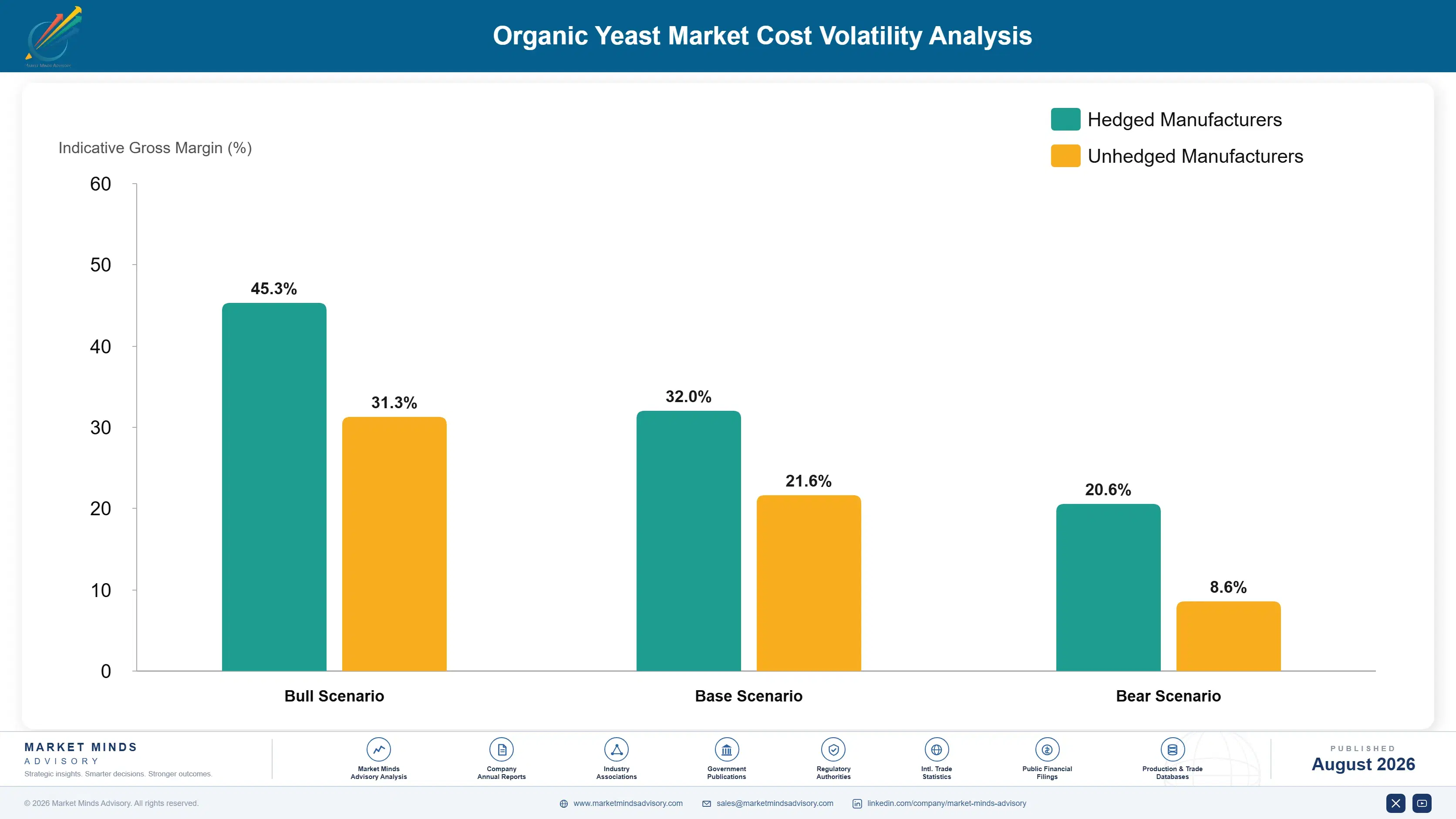
Certified organic molasses accounts for roughly 54% of production cost, which is high even for a fermentation product and reflects both the premium over conventional substrate and the yield penalty organic propagation carries. Fermentation energy and utilities add around 18%, since propagation requires continuous aeration, cooling and agitation. Drying and packaging take about 12%. Certification administration is modest but continuous.
Organic sugar and molasses prices rose through 2022 and 2023 as certified acreage failed to expand alongside demand and competing fermentation users bid for the same supply. Lesaffre noted raw material availability and cost pressure across its operations in its Annual Report 2023. Producers on annual contracts absorbed most of it, and several allocated substrate toward higher value derivatives rather than raising baker's yeast prices.

The disadvantage falls on producers importing certified substrate, and it shows as both cost and availability. Substrate at 54% of production cost makes freight and origin premium material rather than marginal, and a producer competing against one sited beside Brazilian or Indian organic sugar refining faces a gap that fermentation efficiency cannot close. Proximity to substrate now matters more than proximity to customers, which reverses conventional food ingredient siting logic.
organic-yeast-market-trends-forecast-cost-volatility-analysis-1787559541305

Contract substrate directly with certified sugar refiners

Organic molasses is roughly 2% of world supply and organic ethanol producers and feed compounders bid for the same material, frequently tolerating higher input costs than a food ingredient producer can. Spot purchasing exposes a producer to markets nobody in yeast follows at all. Multi-season contracts signed before a tight season are the only reliable mechanism available.

Direct scarce substrate toward the highest value derivative

Yeast extract sells at roughly seven times baker's yeast per tonne of substrate consumed, and substrate rather than capacity limits output. Allocating by historical customer relationship rather than by value per tonne leaves margin on the table every single season. Customers should be told the allocation basis clearly rather than discovering it during a shortage.

Fund strain selection for organic substrate efficiency

Organic propagation forgoes the synthetic nitrogen and phosphate supplements conventional fermentation uses, leaving yield roughly 12% lower per tonne. Strain selection and organic-permitted nutrient sources narrow that gap incrementally. Where substrate is the binding constraint, a yield improvement produces output that no purchasing effort could otherwise obtain at any price. The research is unusually well rewarded here.

Portfolio Architecture for Margin Defence

Margin separates on value extracted per tonne of substrate rather than on manufacturing efficiency, which is unusual and follows directly from substrate being the binding constraint. Organic baker's yeast runs at gross margins in the low twenties, since bakery customers compare it against conventional yeast whose price they know precisely. Brewing and wine yeast run better on specification requirements and smaller volumes. Nutritional yeast runs considerably higher on direct consumer positioning. Yeast extract runs highest of all, at roughly seven times baker's yeast per tonne consumed.
The tension is that baker's yeast carries the volume and the customer relationships while extract earns the return on scarce substrate, and a producer cannot simply abandon bakery customers who have been supplied for decades. Several have managed the transition by allocating growth rather than existing volume, which is slower but preserves relationships. Producers who allocate purely by order book rather than by value per tonne are leaving substantial margin unclaimed every season.

High-value pools sit in yeast extract, nutritional yeast and any position near certified sugar refining. Organic baker's yeast is where a scarce input is converted into the lowest value output this market offers.

Volume / Commodity-Adjacent

Organic baker's yeast supplied to bakery manufacturers comparing it directly against conventional yeast pricing. The ten-point range separates producers with contracted substrate near certified refining from those importing molasses at premium and freight cost.
Gross Margin: 20%-30%

Premium / Certified

Brewing, distilling and wine yeast where strain specification, fermentation performance and small batch consistency matter beyond price. The fourteen-point spread reflects strain library depth and technical support rather than any substrate advantage.
Gross Margin: 32%-46%

Sustainability / Regulatory / Next-Generation

Organic yeast extract and nutritional yeast products carrying several times the value per tonne of substrate consumed. The twenty-four-point range is wide because derivative processing capability and consumer brand positioning vary enormously between producers.
Gross Margin: 44%-68%
organic-yeast-market-trends-forecast-portfolio-architecture-1787559541904

High-value Sub-segments and Strategic Watch-out

Organic Yeast Extract

Compounding at 12.3% at roughly seven times baker's yeast per tonne of scarce substrate consumed. Clean label reformulation in organic prepared foods leaves a savoury gap that has to be filled somehow. Allocation should follow this rather than order history. Prepared food reformulation drives it.
Gross Margin: 48%-68%

Nutritional Yeast Products

Growing at 10.6% on plant-based eating and vitamin B12 positioning, reaching consumers directly rather than through manufacturers. Speciality pricing absorbs the organic premium without any resistance at all. Fortification practice varies by market, which complicates labels across jurisdictions. Consumers select this product themselves. Speciality pricing absorbs it.
Gross Margin: 44%-58%

Substrate-Proximate Capacity

Positions beside Brazilian, Indian or Argentine organic sugar refining, where substrate at 54% of cost is available without import premium. This advantage remains substantially under-exploited by certified capacity. Freight and origin premium disappear entirely for producers sited correctly. Certified capacity has not followed the substrate.
Gross Margin: 34%-50%

Organic Baker's Yeast

The volume base, converting a scarce input into the lowest value output available while bakery customers compare it against conventional pricing. Allocate growth away from it rather than existing supply. Bakery customers compare directly against conventional yeast pricing they know. Allocate growth away from it.
Gross Margin: 20%-30%

How Yeast Demand Renews

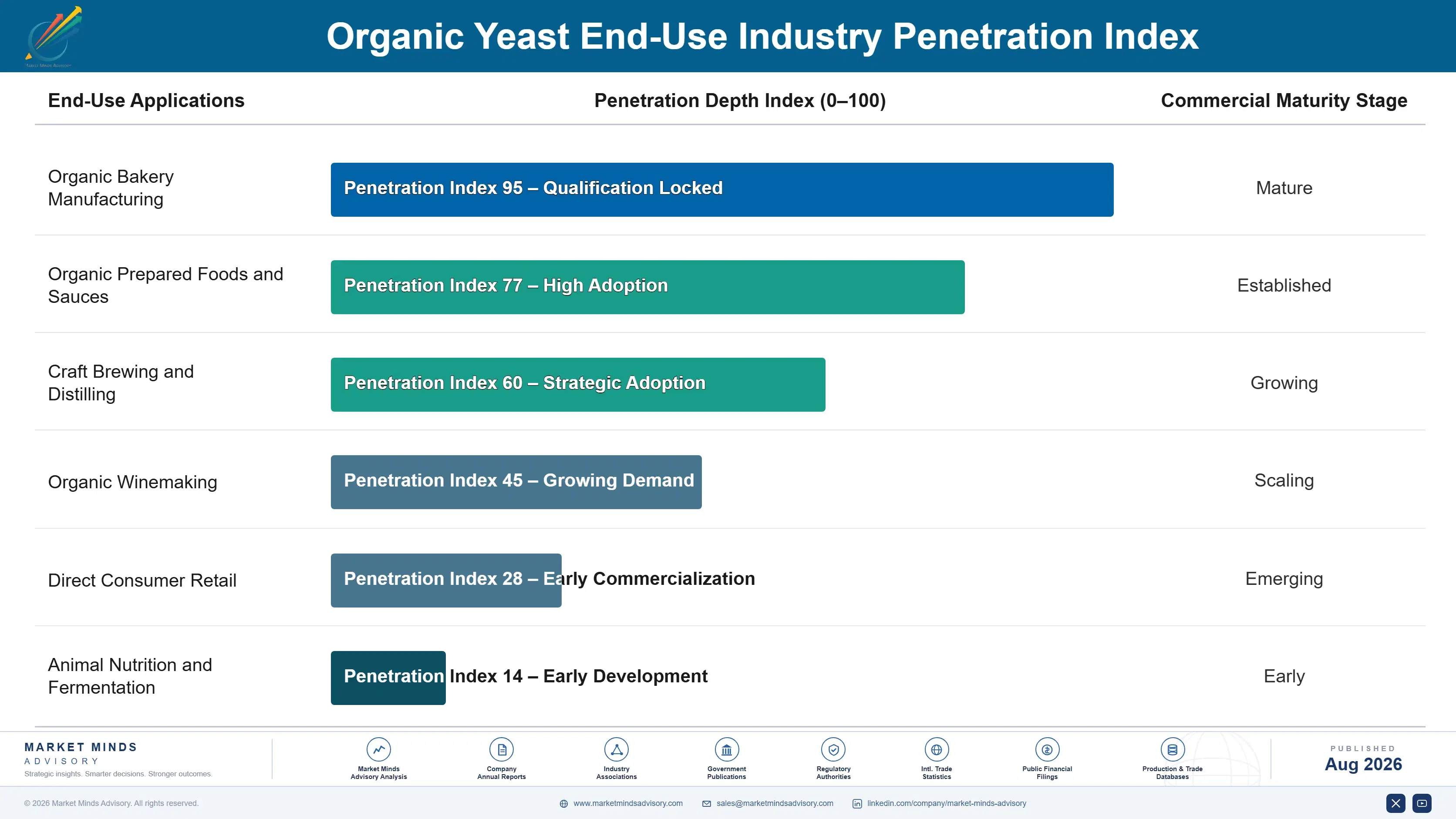
Demand renews continuously with production, since yeast is consumed in every batch and reordered on a short cycle, which normally produces a dependable annuity. The complication here is that supply rather than demand governs the relationship. Where substrate caps output the producer is rationing rather than selling, which inverts a normal ingredient relationship.
Stickiness varies by how much the yeast affects the finished product. A brewing or wine customer running a specific strain that shapes the flavour of their product cannot change supplier without changing what they make, which makes those relationships extremely durable. Bakery customers switch on price and availability, since one certified baker's yeast performs much like another. Extract customers sit between the two, tied by flavour profile matching in a finished recipe. Extract customers sit between the two on flavour profile matching.

The buyer has broadened from production and purchasing toward regulatory and certification functions, particularly in Europe. Yeast was bought on price and performance by a production manager. Ingredient classification rules mean certification teams now check whether the yeast in a recipe threatens the organic claim, and they specify certified supply regardless of what a purchasing comparison suggests.
organic-yeast-market-trends-forecast-end-use-penetration-index-1787559542402

Where To Place The Bet

These are among the four positions where our research anticipates prominent divergence between winners and laggards over the coming forecast period. Each is grounded in the demand model, the regulatory perimeter, and the announced capacity pipeline.
01 / SUBSTRATE ALLOCATION DISCIPLINE

Ration by value per tonne, not by history

Organic yeast extract sells at roughly seven times baker's yeast per tonne of substrate consumed and compounds at 12.3%, while certified molasses rather than fermentation capacity or customer demand is what genuinely limits total output across this whole market. Directing scarce substrate toward the highest value derivative is straightforward arithmetic rather than any kind of strategic insight. Producers who continue allocating by historical customer relationship leave substantial margin unclaimed every single season, and their customers discover the constraint during a shortage anyway.
02 / REFINER CONTRACT SECURITY

Sign before the season, not during it

Certified organic molasses is roughly 2% of world supply and organic ethanol producers, animal feed compounders and other fermentation users bid for exactly the same material, several of them tolerating input costs a food ingredient producer simply cannot support. Spot purchasing therefore exposes a yeast producer to price movements in markets nobody in the industry monitors at all. Multi-season contracts placed directly with certified sugar refiners are the only mechanism that reliably works, and they must be signed ahead of a tight season.
03 / SUBSTRATE PROXIMATE SITING

Build beside the refinery, not the customer

Brazilian country growth at 11.0% leads this entire market because Brazil refines substantial certified organic sugar and molasses is therefore available domestically rather than being shipped in at premium and freight cost from elsewhere. Indian and Argentine certified sugar production offers precisely the same advantage and remains similarly under-exploited by anybody building certified yeast capacity. With substrate at 54% of production cost, proximity to it outweighs proximity to customers, which straightforwardly reverses how food ingredient capacity decisions are normally made anywhere.
04 / YIELD EFFICIENCY RESEARCH

A yield point is supply nobody can purchase

Organic propagation cannot use the synthetic nitrogen and phosphate supplements that conventional fermentation depends on for efficiency, which leaves yield running around 12% below conventional for every tonne of substrate processed. Strain selection for substrate efficiency and organic-permitted nutrient sources both narrow that gap incrementally rather than closing it. In a market where substrate is the genuine binding constraint, a yield improvement converts directly into output that no amount of purchasing effort could ever obtain at any price in a tight season.

Engagement Snapshot From the Field

A live engagement with an industry participant carrying material or product regulatory and market exposure ahead of a defining policy shift, showing how our research translates into a defensible multi-year portfolio strategy.
MARKET MINDS ADVISORY · CLIENT ENGAGEMENT SUMMARY
Organic Yeast Producer Strategic Portfolio Review and Transition Roadmap 2026·Investment Scenario on Organic Yeast Exposure Evaluation 2025-26
CLIENT PROFILE
A European organic yeast producer with certified capacity around 9,000 tonnes on a dry solids basis (client-reported, unverified by MMA), supplying bakery, brewing and food manufacturers across Europe. Substrate was purchased on annual terms from traders. Extract capability existed at small scale. Allocation followed historical customer volumes. Substrate had been short for two seasons. Trader purchasing dominated.
STRATEGIC CHALLENGE
Substrate had been short for two consecutive seasons and management proposed expanding fermentation capacity to serve unmet demand. Nobody had established whether more capacity would help when substrate rather than fermentation was the binding constraint on output. The distinction between substrate and capacity had never been examined at all, and it changes the answer completely.
MMA APPROACH
MMA modelled output against substrate availability rather than against fermentation capacity, then compared realised margin per tonne of substrate across the client's product range. Substrate sourcing was benchmarked against producers contracting directly with refiners. Extract capacity expansion was costed against the value per tonne differential. Refiner contracting was benchmarked. Allocation was remodelled.
KEY FINDINGS
  1. Fermentation capacity was not the constraint at all, since substrate availability had limited output in both short seasons and additional capacity would simply have stood idle.
  2. Margin per tonne of substrate varied by a factor of six across the range, while allocation followed historical customer volumes and directed most substrate toward the lowest value output.
  3. Annual trader purchasing had cost the client substrate in both tight seasons, while producers contracting directly with certified refiners across multiple seasons had been supplied throughout.
  4. Extract capacity expansion cost a fraction of the proposed fermentation investment and would have converted the same substrate into considerably more revenue and margin.
CLIENT PROFILE
A European organic yeast producer with certified capacity around 9,000 tonnes on a dry solids basis (client-reported, unverified by MMA), supplying bakery, brewing and food manufacturers across Europe. Substrate was purchased on annual terms from traders. Extract capability existed at small scale. Allocation followed historical customer volumes. Substrate had been short for two seasons. Trader purchasing dominated.
STRATEGIC CHALLENGE
Substrate had been short for two consecutive seasons and management proposed expanding fermentation capacity to serve unmet demand. Nobody had established whether more capacity would help when substrate rather than fermentation was the binding constraint on output. The distinction between substrate and capacity had never been examined at all, and it changes the answer completely.
MMA APPROACH
MMA modelled output against substrate availability rather than against fermentation capacity, then compared realised margin per tonne of substrate across the client's product range. Substrate sourcing was benchmarked against producers contracting directly with refiners. Extract capacity expansion was costed against the value per tonne differential. Refiner contracting was benchmarked. Allocation was remodelled.
KEY FINDINGS
  1. Fermentation capacity was not the constraint at all, since substrate availability had limited output in both short seasons and additional capacity would simply have stood idle.
  2. Margin per tonne of substrate varied by a factor of six across the range, while allocation followed historical customer volumes and directed most substrate toward the lowest value output.
  3. Annual trader purchasing had cost the client substrate in both tight seasons, while producers contracting directly with certified refiners across multiple seasons had been supplied throughout.
  4. Extract capacity expansion cost a fraction of the proposed fermentation investment and would have converted the same substrate into considerably more revenue and margin.
RECOMMENDED STRATEGY
Phase 1: Phase one: withdraw the fermentation capacity proposal, since substrate rather than fermentation limits output and additional capacity would stand idle. Phase 2: Phase two: expand extract capability and reallocate substrate by value per tonne, communicating the allocation basis to bakery customers before the next tight season arrives. Phase 3: Phase three: contract substrate directly with certified sugar refiners across multiple seasons, rather than continuing to purchase annually through traders.
OUTCOME
The capacity proposal was withdrawn before commitment. Extract capacity is expanded and substrate is now allocated by value per tonne, with bakery customers informed in advance. Direct refiner contracts covered the following season, and the client reports margin improving materially on unchanged substrate volume (client-reported, unverified by MMA).

Frequently Asked Questions

Foundational context covering the market sizes, CAGR, scope, country, region and competition that inform every finding below. This section is provided to cover basics and most often pre-purchase conversations, answered from the MMA Primary Research Dataset.

What is the current size of the Organic Yeast Market?

The market was valued at USD 0.46 billion in 2025, rising to an estimated USD 0.50 billion in 2026. Western Europe holds the largest regional share at 38% of value.

How large will the Organic Yeast Market be by 2036?

MMA forecasts USD 1.09 billion by 2036 under the base case, an expansion multiple of 2.20 times the 2026 value. That represents USD 0.59 billion of incremental value.

What is the CAGR for the Organic Yeast Market 2026 to 2036?

The base case runs at 8.2% compound annual growth between 2026 and 2036, with a bull case at 9.4% and a bear case at 7.0%. Historical growth from 2020 to 2025 was 7.2%.

Which segment is growing fastest?

Organic yeast extract leads at 12.3%, half again the market rate, selling at roughly seven times baker's yeast per tonne. Nutritional yeast follows at 10.6%.

Who are the major companies in the Organic Yeast Market?

Lesaffre, Lallemand, Angel Yeast, AB Mauri and Agrano hold 62% of supply between them. Certified substrate access rather than fermentation capability sustains that unusual concentration.

Which country is growing fastest?

Brazil leads at 11.0%, because it refines substantial certified organic sugar and organic molasses is therefore available domestically rather than shipped in at a premium.

Report Segmentation Architecture

The full report scope spans multiple orthogonal segmentation dimensions, with cross-tabulated demand data provided for each dimension pair. Coverage extends further to regional breakdowns, trend trajectories, and the competitive detail needed to support segment-level decision-making.

By Product Type

  • Organic Baker's Yeast
  • Organic Yeast Extract
  • Organic Nutritional and Inactive Yeast
  • Organic Brewing and Distilling Yeast
  • Organic Wine Yeast
  • Organic Yeast-Based Nutrients and Cultures

By End-Use Industry

  • Organic Bakery Manufacturing
  • Organic Prepared Foods and Sauces
  • Craft Brewing and Distilling
  • Organic Winemaking
  • Direct Consumer Retail
  • Animal Nutrition and Fermentation

By Substrate and Supply

  • Domestic Certified Molasses
  • Imported Certified Molasses
  • Alternative Organic Substrates
  • Direct Refiner Contract Supply
  • Trader and Merchant Substrate

By Region

  • North America
  • Western Europe
  • East Asia
  • South Asia and Pacific
  • Latin America
  • Middle East and Africa
  • Eastern Europe

Scope, Methodology, and Coverage

Every figure in this report is reproducible from documented input assumptions. The scope below maps the historical period, the forecast horizon, the segmentation dimensions, and the countries covered, alongside the underlying primary and qualitative methodology.
Historical Period
2020 to 2025
Forecast Period
2026 to 2036
Base Year
2025 (USD billions; MMA Primary Research Dataset, August 2026)
Market Definition
The market comprises yeast produced on certified organic substrate, including organic baker's yeast, organic yeast extract, organic nutritional and inactive yeast, organic brewing and distilling yeast, organic wine yeast, and organic yeast-based nutrients and cultures, produced on domestic certified molasses, imported certified molasses or alternative organic substrates. Value is measured at producer level on tonnage supplied on a dry solids basis. Conventional yeast in all forms, yeast used in industrial fermentation for fuel or chemicals, bacterial and mould cultures, enzymes derived from yeast fermentation, and organic molasses or substrate sold as such fall outside scope.
Quantitative Units
USD billions (current prices); thousand tonnes dry solids; USD per tonne by product type
Segmentation Dimensions
By Product Type; By End-Use Industry; By Substrate and Supply; By Region
Regions Covered
North America, Western Europe, East Asia, South Asia and Pacific, Latin America, Middle East and Africa, Eastern Europe
Countries Covered
Germany, France, Austria, Italy, Netherlands, Belgium, Denmark, Sweden, Spain, United Kingdom, United States, Canada, Mexico, Brazil, Argentina, Paraguay, Colombia, China, Japan, South Korea, Taiwan, India, Thailand, Australia, New Zealand, Poland, Czechia, Romania, Turkey, South Africa
Key Companies Profiled
Lesaffre, Lallemand, Angel Yeast, AB Mauri, Agrano, Novonesis, Kerry Group, Ohly, Leiber, DSM-Firmenich, Alltech, Sensient Technologies, Titan Biotech, Associated British Foods, Bruggeman, Pakmaya, Oriental Yeast, Nutreco, Synergy Flavours, Gumpert
Quantitative Methodology
Primary survey, n=3,800 respondents, Q4 2025, six countries; demand-side model with trade association cross-validation
Qualitative Methodology
47 expert interviews, Q4 2025; applied to validate demand model assumptions, identify emerging dynamics, and assess competitive positioning
Report Format
PDF and XLSX data workbook (Word format preview document)
Publisher
Market Minds Advisory
Report Code
MMA-2026-AGR-168
Published
August 2026
Contact
sales@marketmindsadvisory.com | www.marketmindsadvisory.com

Purchase the full Organic Yeast Market Report (2026 to 2036).

The full report sizes the global organic yeast market to 2036 across six product types and seven regions, measured on dry solids tonnage at producer level. It models output against certified substrate availability rather than against fermentation capacity, which is the correction anybody planning investment in this market most needs. Competitive analysis covers 20 producers on one consistent tonnage basis, with moat and risk assessment for the two leaders. Value per tonne of substrate is quantified across every derivative product. Four quantified revenue levers close the analysis.
Six product type segments with individual growth rates
Output modelled against certified substrate rather than fermentation capacity
Value per tonne of substrate quantified across all derivatives
Ingredient classification rules mapped by regulatory jurisdiction
Twenty-producer competitive map on one dry solids basis
Four quantified revenue levers with commercial impact ranges

Built For The People Who Decide

From boardroom strategy to bench-side execution, this report is read cover-to-cover by leaders shaping the next decade of their industry, turning demand scenarios, market dynamics and valuation benchmarks into decisions.
CXOs/ Presidents/ VPs/ Managers
M&A and Corporate Development
Strategy Teams and R&D Heads
Procurement and Product Directors
Regulatory and Compliance Leaders
Investor Relations and Equity Analysts