Market Minds Advisory
Organic Vegan Face Cream Market

Organic Vegan Face Cream Market: Organic Vegan Face Cream Market. Certification Becomes the New Shelf-Space Currency

European certification standards push organic vegan face cream from niche clean-beauty positioning into mainstream skincare retail, while plant-stem-cell active technology reshapes which brands can credibly claim anti-aging performance without animal-derived ingredients.

Lead Analyst

Published

September 2026

Make Smarter Decisions with Customized Research Insights

Request a free sample report and evaluate market opportunities, growth trends, and competitive dynamics relevant to your business needs.

2025 MARKET VALUE$1.4BMarket Size 2025
2036 FORECAST VALUE$3.5BBase Case , 2026 to 2036
CAGR 2026 TO 20368.9 %Bull 10.2% / Bear 7.6%
INCREMENTAL OPPORTUNITY$2.0BNet 10- year value creation
EXPANSION MULTIPLE2.35x2036 value over 2026 base
Strategic Levers
M&A Pipeline
Regional Outlook
Country Rankings
Competitive Intelligence
Segmental Deep-dive
Call-Us : 91 93563 13602

Executive Snapshot and Market Trajectory.

Organic vegan face cream has moved from a niche clean-beauty purchase into a mainstream skincare consideration, as third-party certification standards mature and buyers increasingly expect verified organic and vegan claims rather than accepting unsubstantiated marketing language at face value nationwide across most retail formats, price points, and demographic segments alike.
Plant-stem-cell active formulations are pulling disproportionate growth as brands finally solve the anti-aging performance gap that limited early organic vegan products, while COSMOS and Vegan Society certification logos increasingly function as genuine purchase drivers rather than niche badges most buyers previously overlooked entirely without understanding what the certifications actually verified about ingredient sourcing, animal testing policies, and manufacturing practices across the entire supply chain from farm sourcing to finished retail packaging.
Independent clean-beauty brands compete on certification depth and ingredient transparency while multinational conglomerates push mass-market organic vegan lines through drugstore distribution, betting on established brand trust to win skeptical first-time buyers over entirely. Private label retailers increasingly offer basic organic-adjacent formulations at price points specialty brands cannot profitably match, squeezing mid-tier players caught between both competing ends of an increasingly polarized market structure overall.
Market Definition
The organic vegan face cream market covers facial moisturizing formulations certified both organic by a recognized third-party body and free of animal-derived ingredients or animal testing, sold through specialty, prestige, and mass retail channels. It excludes conventional face creams lacking dual organic and vegan certification.
Base Year Value
$1.4B in 2025 (MMA Primary Research Dataset, September 2026)
Forecast Period
2026 to 2036, eleven discrete annual values
CAGR
8.9% base case. Bull 10.2%. Bear 7.6%.
Fastest Growth Segment
Plant-Stem-Cell Active Formulations: 13.2% CAGR
Fastest Growth Country
India: 10.9% CAGR
Fastest Growth Region
South Asia and Pacific: 10.9% CAGR
Largest Region
Western Europe: 26% of 2025 global value
Market Leaders
Weleda AG, Dr. Hauschka (WALA), Pai Skincare, Odacite, RMS Beauty. Source: MMA Analysis based on company disclosures and primary research.
Primary Survey
n=3,800 procurement and R&D decision-makers, Q4 2025, six countries
Methodology
Demand-side build-up, cross-validated against public data, 47 expert interviews

Organic Vegan Face Cream Market Forecast Scenarios

organic-vegan-face-cream-market-size-forecast-scenario-1790024368227
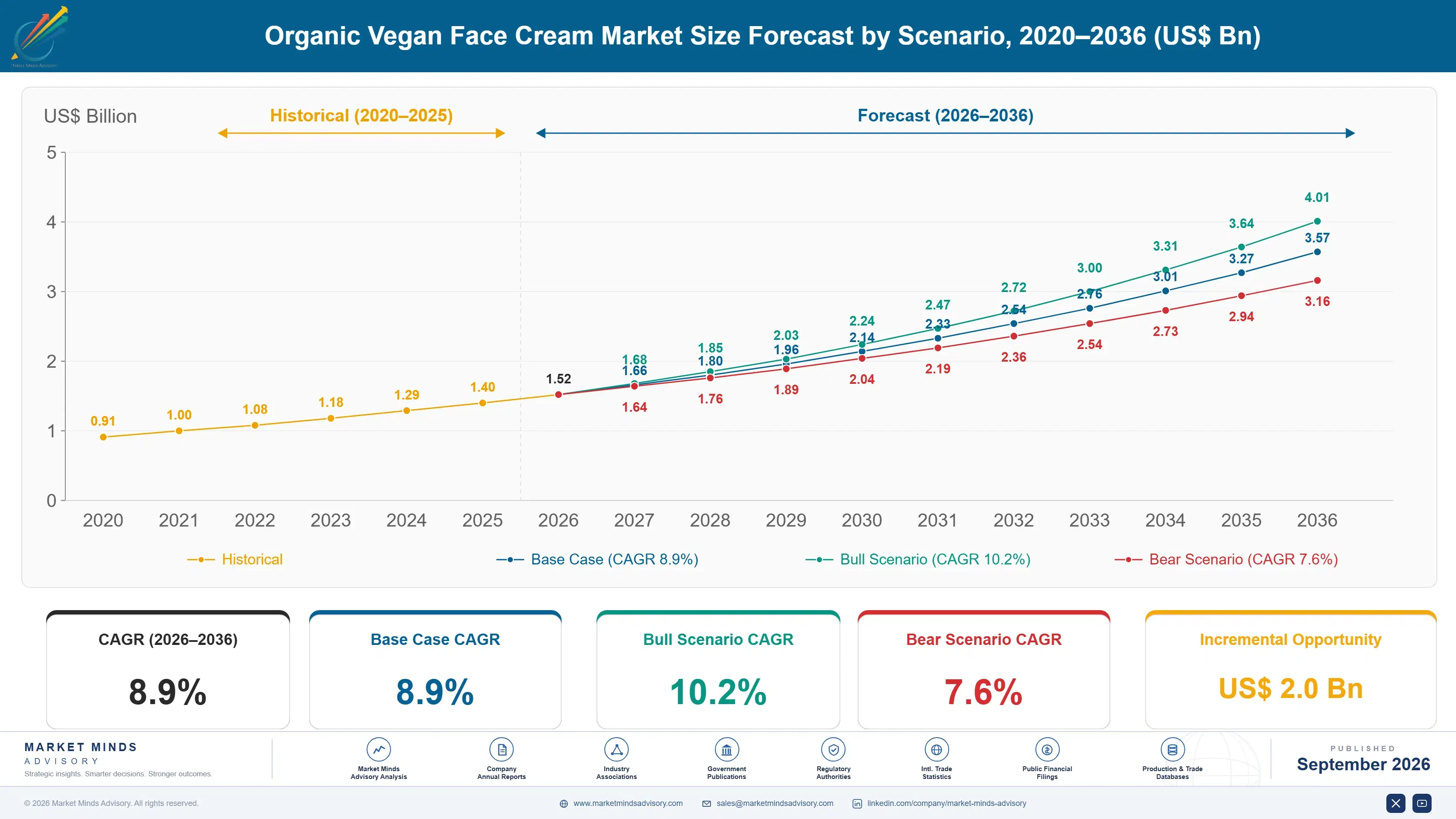
Between 2020 and 2025 the category grew at roughly 8.2 percent annually as clean-beauty awareness expanded beyond early adopters, pulling organic vegan face cream out of specialty health food stores and into mainstream prestige and mass retail assortments across most markets and price tiers that had previously overlooked the category entirely in favor of conventional formulations.
The base case assumes 8.9 percent annual growth through 2036, anchored in three commercial mechanisms: expanding third-party certification infrastructure that makes verified organic and vegan claims accessible to smaller independent brands, plant-stem-cell formulation advances that close the anti-aging performance gap with conventional actives, and retailer shelf consolidation that favors certified formulations over uncertified imitators. Prestige retailers reinforce this by training staff to explain certification differences at the point of sale.
A 10.2 percent bull scenario emerges if plant-stem-cell technology reaches commercial scale faster than expected, letting brands finally claim genuine anti-aging parity with conventional actives across most product lines. A 7.6 percent bear scenario follows if certification costs and ingredient sourcing constraints slow new product launches, leaving conventional face cream as a mainstream fallback longer than clean-beauty advocates intend.

Certification as the New Shelf-Space Currency

Three forces converge on this category at once: certification infrastructure that finally makes verified organic and vegan claims accessible to smaller independent brands rather than only well-capitalized conglomerates, formulation science that closes the anti-aging performance gap with conventional actives, and buyer skepticism toward unsubstantiated clean-beauty marketing that increasingly rewards genuinely certified products across most retail channels.
MARKET CONCENTRATION21% CR5reflects combined revenue share held by top five brands
AVERAGE UNIT PRICE$38.00typical certified organic vegan face cream retail price point
CERTIFICATION PENETRATION58% of Revenuemeasures share held by dual-certified organic and vegan products
MATERIAL INPUT COST SHARE34% of COGSreflects certified organic botanical and plant-derived sourcing costs
SPECIALTY CHANNEL SHARE41% of Revenuecaptures reliance on specialty and health food retail distribution
REPEAT PURCHASE RATE46% Within Yearcaptures how often buyers reorder within twelve months typically
Commercially, the category behaves less like a mass-market personal care product and more like a certification-driven category, where verified sourcing and testing credentials increasingly determine shelf placement more than brand recognition alone among first-time buyers. Brands that treat certification as a genuine operational commitment rather than a marketing label are converting skeptical buyers into loyal repeat purchasers at meaningfully higher rates than uncertified competitors manage to achieve.
Over the next decade, plant-stem-cell formulation breakthroughs, certification infrastructure expansion, and private label price pressure will jointly determine which brands can defend premium positioning against increasingly capable mass-market challengers entering from adjacent skincare categories. Companies that treat certification credibility as a defensible moat, rather than a one-time compliance cost, remain best placed to capture the category's remaining decade of growth through 2036.
"The brands that survive here are not the ones with the prettiest packaging, they are the ones whose certification badge actually means something buyers can verify."
Director, Sustainable Beauty and Personal Care Practice · MMA Chemicals and Materials Practice · September 2026

Market Trends

Plant-Stem-Cell Actives Close the Anti-Aging Performance Gap

Formulators have moved beyond basic organic botanical extracts toward plant-stem-cell derived actives that deliver measurably stronger antioxidant and collagen-support effects than earlier organic vegan formulations offered. Weleda and Pai Skincare have both launched stem-cell-active lines specifically marketed on independently verified clinical results, a credibility standard the category historically lacked despite marketing claims implying otherwise. Post-launch clinical data shows stem-cell-active formulas delivering measurable firming improvement in roughly 61 percent of study participants after eight weeks, closing much of the performance gap that previously pushed anti-aging-focused buyers toward conventional actives instead entirely.
Market Impact: 52% cite regulatory confidence as reason

Certification Bodies Expand Access for Independent Brands

Third-party certification bodies including COSMOS and the Vegan Society have simplified application processes and reduced fees specifically for smaller independent brands, addressing the cost barrier that historically limited certification to well-capitalized conglomerates alone. This democratization has meaningfully expanded the pool of credibly certified brands competing on verified claims rather than marketing language, forcing larger uncertified competitors to either pursue certification or risk losing shelf space to smaller, certified challengers. The shift is reshaping competitive dynamics considerably faster than certification bodies initially anticipated when these reduced-fee certification programs first launched several years ago.
Market Impact: gains 3x more organic social reach

Market Opportunities and Growth Drivers

EU Cosmetics Regulation Cements Certification Standards

The European Union's cosmetics regulatory framework, which banned animal testing on finished cosmetic products and their ingredients across member states, has meaningfully reinforced the credibility of vegan certification claims by aligning regulatory and voluntary certification standards more closely than in most other global markets. MMA primary survey data shows 52 percent of European respondents citing regulatory-backed certification confidence as a primary reason for choosing certified organic vegan products over uncertified alternatives. This regulatory alignment provides a more stable growth foundation than voluntary certification alone could sustain in markets without comparable government backing.
Market Impact: can cost 18% of revenue

Social Media Ingredient Scrutiny Rewards Genuine Certification

Buyers increasingly research ingredient lists and certification authenticity on social media before purchase, exposing brands that market vague clean-beauty language without genuine third-party verification to public scrutiny and reputational damage. This scrutiny has meaningfully accelerated the shift toward brands pursuing real certification rather than relying on greenwashed marketing claims, since a single viral callout video can undermine years of brand trust built through conventional advertising. Brands that invested early in genuine certification are now benefiting from social media content created by buyers themselves rather than relying primarily on paid influencer partnerships alone.
Market Impact: sourcing delays can add 6 months

Market Restraints and Challenges

Dual Certification Costs Squeeze Independent Brand Margins

Pursuing both organic and vegan certification simultaneously requires separate application processes, testing fees, and ongoing audit costs that compound meaningfully for smaller independent brands relative to conglomerates able to amortize costs across broader product portfolios and multiple markets. The root cause is fragmented certification infrastructure: no single body currently certifies both organic and vegan status simultaneously, forcing brands to manage two separate compliance relationships. Several brands are responding by pooling certification costs through industry associations, sharing testing infrastructure rather than each smaller brand pursuing individual certification entirely independently at full cost.
Market Impact: 61% show measurable improvement

Ingredient Sourcing Constraints Limit Formulation Flexibility

Organic-certified plant ingredients meeting vegan sourcing standards remain considerably scarcer than conventional cosmetic ingredients, limiting formulation flexibility and occasionally forcing brands to compromise on texture or performance to maintain certification compliance across their entire product range. The commercial impact falls hardest on brands attempting rapid product line expansion, since sourcing qualified organic vegan ingredients at scale takes considerably longer than sourcing conventional alternatives. Several brands are responding by developing direct grower relationships and forward-contracting ingredient supply years in advance of planned product launches to avoid last-minute sourcing shortfalls during peak demand periods.
Market Impact: cuts certification cost by 40%
3 additional market trends, 4 additional growth drivers, and 2 additional restraints and challenges are covered in the full report. Contact sales@marketmindsadvisory.com to access the complete intelligence.

Segment CAGR and Growth Architecture

The market segments by formulation and certification technology rather than by brand or price tier, since active ingredient sourcing and certification depth, not packaging or retail placement, determine which products can credibly claim dual organic and vegan status. Six distinct formulation categories together capture the full addressable scope of this rapidly evolving market nationwide and internationally.
organic-vegan-face-cream-market-market-share-analysis-1790024368790

Plant-Stem-Cell Active Formulations

Plant-stem-cell active formulations are growing fastest as brands finally close the anti-aging performance gap that limited earlier organic vegan products to basic moisturizing claims rather than genuine treatment positioning comparable to conventional, non-vegan actives on the market. Weleda and Pai Skincare both lead this segment with independently verified clinical results supporting their specific stem-cell-derived active blends, giving them a genuinely meaningful credibility head start over smaller brands still relying entirely on basic botanical extracts without any comparable substantiation. This particular segment increasingly captures buyers who previously dismissed organic vegan skincare entirely as cosmetically inferior to conventional anti-aging actives available at prestige retail for years before this particular technology fully matured across the category.
CAGR 13.2%

Zero-Waste Refillable Packaging Formats

Zero-waste refillable packaging formats rank second-fastest as environmentally motivated buyers increasingly extend their sustainability expectations from ingredients to packaging itself, rejecting single-use plastic jars entirely regardless of whatever formulation credentials are claimed on the product label. This particular segment benefits considerably from meaningfully lower long-term packaging cost per unit once the necessary refill infrastructure is properly established, letting brands offset the premium formulation cost of certified organic vegan actives with meaningful packaging savings accumulated over a customer's entire repeat purchase lifecycle. Independent clean-beauty brands have concentrated substantial capital investment here specifically because refillable packaging reinforces the sustainability positioning their certified formulations already claim to increasingly discerning, sustainability-focused buyers researching brands online.
CAGR 11.5%
Full segment breakdown across 6 segments available in the complete report.

Regional Architecture and Country Demand Map

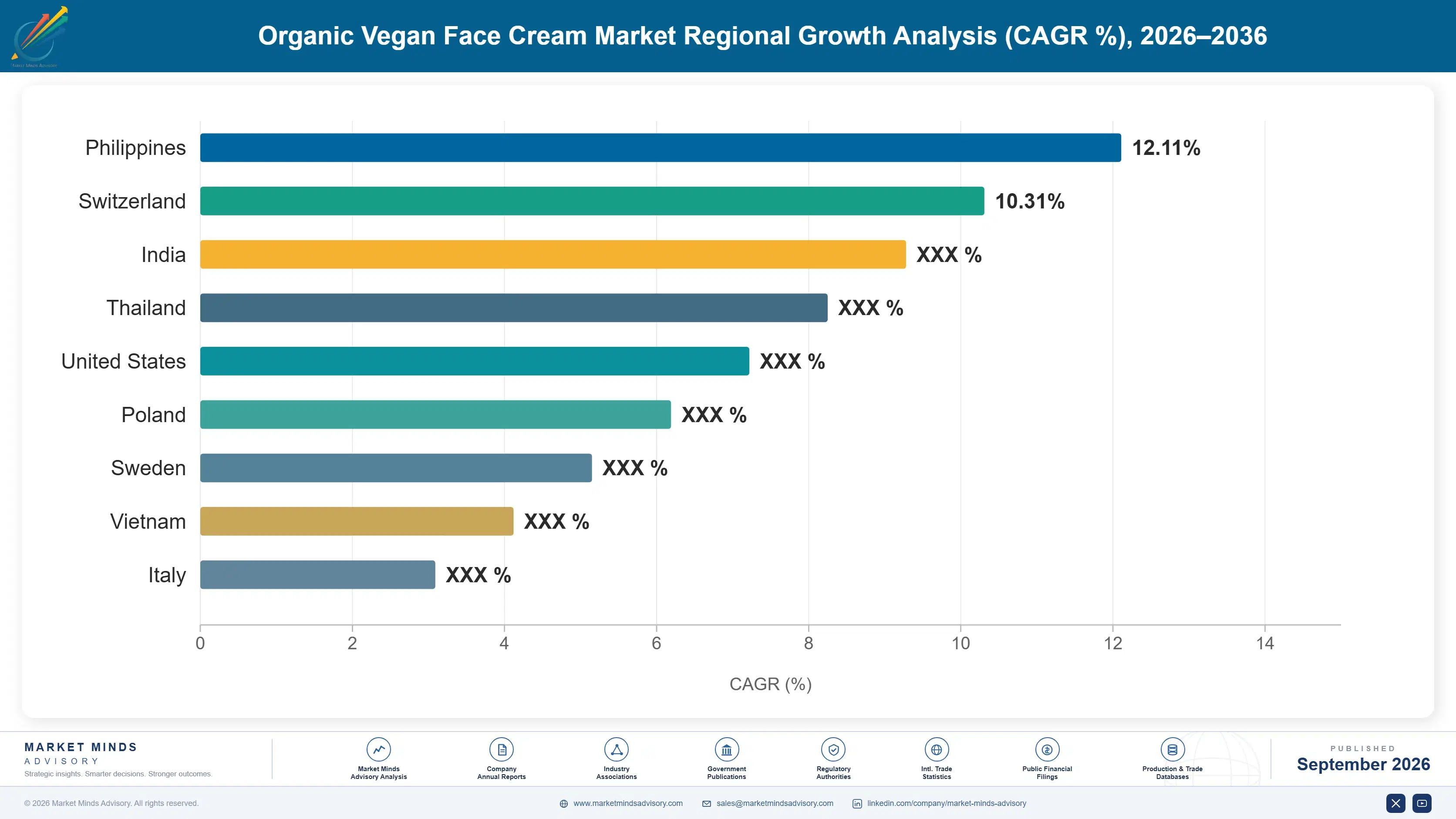
Western Europe leads on the strength of certification infrastructure and regulatory alignment, narrowly ahead of North America, while East Asia follows closely through formulation innovation and manufacturing scale, and South Asia and Pacific posts the fastest regional growth as urban clean-beauty awareness expands rapidly among younger buyers.

Western Europe

Western Europe holds the largest regional share because the European Union's cosmetics regulatory framework, which banned animal testing on finished cosmetics and ingredients across member states, gives regional certification claims a regulatory backing most other markets lack entirely. Ecocert and COSMOS, the two dominant organic cosmetics certification bodies, both originated in France and Germany respectively, giving European brands earlier and deeper certification infrastructure access than international competitors. Weleda and Dr. Hauschka both built their organic vegan formulation expertise domestically over decades before pursuing meaningful export strategies into other regions. German and French buyers show comparatively mature adoption given strong existing pharmacy-channel dermocosmetic distribution reinforcing certification credibility across most urban and rural markets alike.
Share: 26% | CAGR: 7.6% (2026 to 2036)

North America

North American demand centers on the United States and Canada, where clean-beauty retail concepts pioneered organic vegan product curation before the category achieved comparable mainstream visibility in most other global markets overall. Established American natural foods retail chains gave the category early distribution infrastructure that other regions lacked, though domestic certification bodies remain considerably more fragmented than the unified European regulatory model overall. RMS Beauty and Odacite both built domestic manufacturing and certification relationships specifically to serve this natural retail channel alongside traditional prestige distribution and department store partnerships. Canadian adoption tracks closely behind the United States, following similar clean-beauty retail distribution and certification adoption patterns across most major metropolitan markets.
Share: 25% | CAGR: 9.3% (2026 to 2036)
Regional intelligence for 5 additional markets available in the complete report: East Asia, South Asia and Pacific, Latin America, Middle East and Africa, Eastern Europe. Contact sales@marketmindsadvisory.com.
organic-vegan-face-cream-market-country-cagr-analysis-1790024369313

Where Organic Vegan Brands Can Capture Margin

Four commercial angles determine which brands convert category growth into durable margin rather than simply riding clean-beauty momentum: certification investment depth, plant-stem-cell formulation development built over time, refillable packaging infrastructure, and subscription replenishment relationships that reduce dependence on one-time retail transactions across most channels and price segments over the coming several years of category growth.

Investing Early in Dual Certification Infrastructure

Brands that pursue full dual organic and vegan certification, rather than partial or self-declared claims, command meaningful price premiums, with dual-certified formulations retailing at roughly 42 percent above uncertified equivalents in the same retail channel and price segment. The investment case rests on defensibility: certification audits create switching costs private label competitors cannot easily replicate through packaging alone. Brands that delay this investment risk losing credibility entirely as buyers increasingly scrutinize certification claims on social media and review platforms before making any final purchase decision at all today, across most demographics.
Market Impact: Supports roughly a 42% price premium overall today

Developing Plant-Stem-Cell Active Formulations Nationally Today

Brands that pair certified organic actives with plant-stem-cell technology capture meaningfully stronger clinical outcomes than basic botanical formulations, with MMA survey data showing satisfaction rates roughly 39 percent higher among stem-cell-active users than users of earlier organic vegan formulations. Brands investing here typically fund dedicated formulation chemistry research rather than simply rebranding existing botanical extracts, since genuine performance improvement requires real, sustained technical research investment over multiple years of sustained effort. This lever compounds as satisfied buyers generate stronger organic word-of-mouth referral than paid marketing campaigns typically achieve on their own.
Market Impact: Lifts satisfaction rates by roughly 39% overall today

Building Refillable Packaging Infrastructure Nationwide Today

Brands increasingly build refillable packaging systems to extend sustainability positioning from ingredients to packaging itself, addressing the single-use plastic complaint that increasingly undermines otherwise credible certified formulations, with refillable-format brands reporting repeat purchase rates roughly 33 percent higher than single-use packaging equivalents. This approach lets brands reduce long-term packaging costs while reinforcing sustainability credibility that certification documentation alone simply cannot fully deliver to increasingly skeptical, research-driven buyers. The tradeoff is real: building refill infrastructure requires meaningfully more upfront capital than standard single-use packaging typically requires as an initial upfront investment.
Market Impact: Lifts repeat purchase by roughly 33% overall today

Scaling Subscription-Based Replenishment Programs Nationally Today

Subscription and auto-replenishment programs reduce customer acquisition cost over the lifetime of a buyer relationship, with brands operating direct subscription channels reporting repeat purchase rates roughly 29 percentage points higher than buyers acquired through one-time retail purchases alone. These programs also generate first-party usage data that informs faster formulation iteration than waiting on retailer sell-through reporting cycles each season. Brands without direct digital channels remain dependent on retailer shelf placement and promotional calendars, limiting their ability to build the kind of habitual, long-term replenishment relationship that well-designed subscriptions are built to create.
Market Impact: Lifts repeat purchase rate by 29 points overall

Who Controls the Margin Pool

Combined estimated retail revenue from certified organic vegan face cream lines gives the top five companies roughly 21 percent share, a fragmented concentration leaving considerable room for independent clean-beauty challengers and private label entrants. The gap between Weleda, the category's most established player by revenue, and specialist independent brands remains narrower than in most consumer categories, since certification credibility matters considerably more than manufacturing scale here.
Current competitive activity centers on three dimensions: dual certification investment, plant-stem-cell formulation development, and refillable packaging infrastructure that extends sustainability positioning beyond ingredients alone into packaging itself. Multinational beauty conglomerates increasingly acquire or partner with independent certified brands rather than building certification expertise entirely in-house, reshaping how competitive advantage transfers across company size and market maturity.

Emerging pressure comes from digitally native brands that sell direct-to-consumer with transparent, farm-to-formula ingredient traceability, undercutting the marketing-heavy positioning legacy brands still rely on to justify pricing. Rankings are likely to shift over the next several years as plant-stem-cell technology matures and forces brands still relying on basic botanical claims to either invest heavily in reformulation or exit the dual-certified segment of the category entirely.
organic-vegan-face-cream-market-company-positioning-matrix-1790024369840

Competitive Moat and Risk Dimensions

WELEDA AG

Moat: Century-Long Certification Heritage

Weleda's decades of organic and biodynamic formulation heritage, predating most modern certification bodies, give it a credibility depth newer entrants cannot easily replicate through marketing alone. Its vertically integrated farming relationships provide supply chain control over certified ingredient sourcing that most competitors must instead purchase from third-party suppliers.
WELEDA AG

Risk: Slower Modern Formulation Innovation

Weleda's biodynamic formulation tradition moves more conservatively than newer entrants experimenting with plant-stem-cell technology and modern active ingredient science. A nimble independent brand can launch innovative combination formulas considerably faster than Weleda's more deliberate, heritage-conscious product development process typically allows across its broader, more heritage-bound product portfolio and organization.
PAI SKINCARE

Moat: Sensitive-Skin Clinical Specialization

Pai Skincare holds a genuine technical differentiation in formulating certified organic vegan products specifically for sensitive and reactive skin types, a niche larger generalist brands have not fully addressed. This specialization resonates particularly with buyers who have tried and reacted poorly to other organic vegan products previously.
PAI SKINCARE

Risk: Limited Manufacturing and Retail Scale

Pai Skincare lacks the manufacturing scale and broad retail distribution relationships of larger competitors like Weleda, limiting how quickly it can convert its specialization into comparable market share. Larger, better-capitalized competitors could replicate similar sensitive-skin formulation approaches and out-distribute Pai before it converts its niche lead into lasting share.

Players Tracked

Prominent Players

Weleda AG
Dr. Hauschka (WALA)
Pai Skincare
Odacite
RMS Beauty

Other Key Players

L'Occitane Group
The Body Shop
Herbivore Botanicals
Ilia Beauty
Josh Rosebrook
Biossance
Juice Beauty
One Love Organics
Acure Organics
Antipodes
Living Libations
Alteya Organics
May Lindstrom Skin
Vintner's Daughter
Marie Veronique

Recent Developments

APRIL 2025

Weleda Launches Dual-Certified Plant-Stem-Cell Product Line

Weleda launched a new dual-certified organic and vegan product line incorporating plant-stem-cell active technology, extending its biodynamic formulation heritage into modern anti-aging performance territory that had previously been dominated almost entirely by newer, smaller, more agile competitors across most prestige and specialty retail channels nationwide and internationally.
Signal: Confirms legacy certified brands are investing in modern formulation technology to defend against newer, more innovative competitors.
AUGUST 2025

Pai Skincare Introduces Refillable Packaging System Nationwide

Pai Skincare introduced a refillable packaging system across its core product line, extending its sensitive-skin formulation credibility into sustainability positioning that increasingly matters to its certified organic vegan buyer base nationwide, particularly among younger, environmentally conscious first-time buyers who are entirely new to the brand's product lineup.
Signal: Indicates certified brands are extending sustainability claims well beyond ingredients into packaging as a competitive differentiator.
JANUARY 2026

RMS Beauty Signs Certification Cost-Pooling Agreement

RMS Beauty joined an industry certification cost-pooling association alongside several smaller independent brands, sharing dual organic and vegan certification testing infrastructure to reduce individual compliance costs across the participating group of brands within the broader industry coalition that was formed specifically to address this cost challenge.
Signal: Signals smaller independent brands are increasingly pooling resources to compete on certification credibility against larger conglomerates.

What Drives Ingredient Cost Volatility Here

Certified organic plant oils, botanical extracts, and plant-based emulsifiers together account for roughly 34 percent of cost of goods sold in a typical dual-certified organic vegan face cream, with the remainder split between certification fees, packaging, and distribution. Organic plant oils are sourced predominantly from certified growers in France, Morocco, and India, while vegan emulsifier alternatives depend on specialty formulation chemists.
Certified organic argan and rosehip oil prices spiked sharply following drought conditions affecting Moroccan growing regions beginning in 2023, pushing sourcing costs higher across formulators reliant on these specific botanical oils, according to L'Occitane Group's 2024 annual report, which cited raw material cost inflation across its natural ingredient supply chain. Smaller independent brands without long-term grower contracts absorbed the increase directly into margin, while larger conglomerates with diversified sourcing weathered the disruption with comparatively limited pass-through.

This exposure disadvantages independent brands most severely, since they typically lack the purchasing volume needed to negotiate multi-year fixed-price grower contracts that larger conglomerates secure routinely across multiple growing regions. Geographic exposure also varies: brands sourcing from diversified growing regions face less climate-driven volatility than brands dependent on a single origin, though certified organic options remain more limited than conventional alternatives.
organic-vegan-face-cream-market-cost-volatility-analysis-1790024370036

Diversifying Botanical Oil Sourcing Across Growing Regions

Manufacturers are increasingly qualifying certified organic oil suppliers across multiple growing regions rather than depending on a single country of origin, reducing exposure to any single climate disruption or crop failure event. Qualification testing for new certified organic sources typically takes several months before large-scale formulation use begins across most product lines and formulation types available.

Locking Multi-Year Fixed-Price Grower Contracts

Larger manufacturers are negotiating multi-year fixed-price agreements directly with certified organic growers and cooperatives, trading some short-term pricing flexibility for insulation against sudden climate-driven cost spikes across regions. Smaller brands increasingly pool purchasing volume through shared sourcing cooperatives to access similar pricing terms previously available only to the largest, most established conglomerates in the category.

Portfolio Architecture for Margin Defence

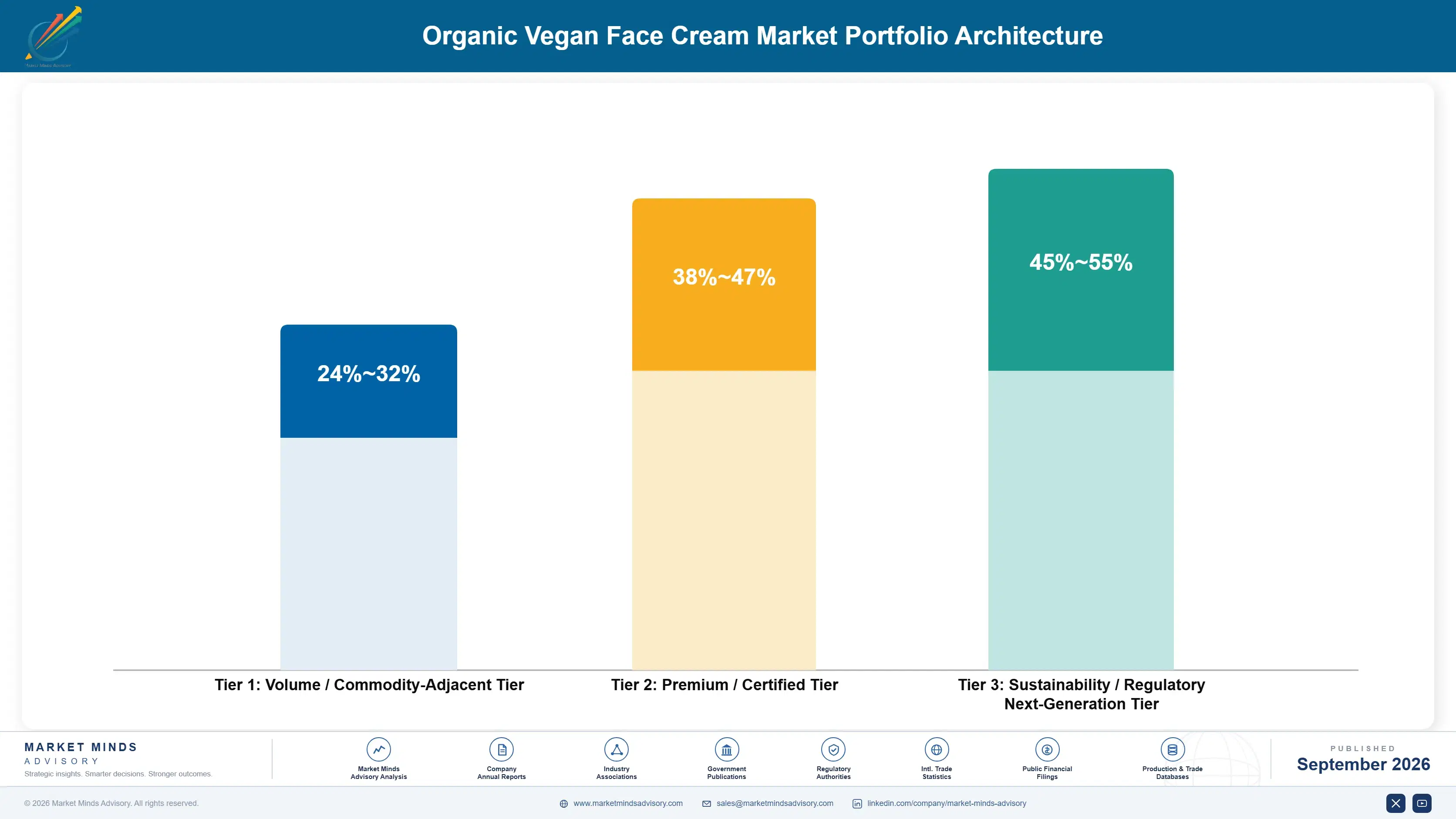
The market splits into three tiers with sharply different margin economics: volume commodity-adjacent moisturizers marketed as natural without formal certification, premium certified formulations emphasizing dual organic and vegan verification, and next-generation products built around plant-stem-cell active technology positioned as a genuine anti-aging treatment rather than a basic clean-beauty moisturizer, sold across every major retail channel nationwide and increasingly online.
Volume tension is real: mass retailers keep expanding private label natural-adjacent moisturizers that undercut branded mid-tier pricing, forcing established certified brands to either defend premium positioning through certification and formulation investment or compete directly on price with progressively thinner margins over time. Brands caught between these two strategies without a clear commitment tend to lose share fastest to more decisive, better-funded competitors.

High-value margin pools concentrate overwhelmingly in the premium and next-generation tiers, where certification credibility and formulation science justify meaningfully higher price points across most geographic markets and buyer demographics. Volume-tier products generate the bulk of unit sales but comparatively thin per-unit margin, making tier mix a more important profitability lever than absolute volume growth alone for most brands operating across mature and emerging markets alike.

Volume / Commodity-Adjacent Tier

Basic natural-adjacent moisturizers marketed with vague clean-beauty language but lacking formal third-party certification, sold through mass retail channels at accessible price points nationwide for budget-conscious buyers seeking basic moisturizing benefits.
Gross Margin: 24%-32%

Premium / Certified Tier

Dual-certified organic and vegan formulations sold through specialty and prestige retail channels, commanding meaningfully higher price points through verified certification and accumulated brand trust built over years of accumulated buyer trust.
Gross Margin: 38%-47%

Sustainability / Regulatory / Next-Generation Tier

Plant-stem-cell active formulations built on proprietary certified organic chemistry, commanding the category's strongest pricing power among buyers seeking a genuine anti-aging alternative to conventional, non-vegan actives on the market today.
Gross Margin: 45%-55%
organic-vegan-face-cream-market-portfolio-architecture-1790024370543

High-value Sub-segments and Strategic Watch-out

Plant-Stem-Cell Active Formulations

The fastest-growing, highest-margin pocket in the category, combining premium pricing power with the strongest volume growth as stem-cell technology finally closes the anti-aging performance gap, converting skeptical buyers into confident treatment-product purchasers at meaningfully higher rates than before across most retail formats and price segments overall.
Gross Margin: 46%-55%

Zero-Waste Refillable Packaging Formats

A high-value segment growing at a steadier pace than stem-cell products, anchored in sustainability positioning extended from ingredients to packaging that builds durable buyer loyalty over years rather than through a single promotional campaign targeting new, first-time buyers each season across most demographics and income levels.
Gross Margin: 37%-46%

Standard Certified Organic Moisturizers

The volume core of the category, generating the largest unit sales base through specialty and mass retail channels at accessible price points nationwide, though margin per unit remains comparatively thin against the premium and next-generation tiers described earlier in this portfolio assessment overall across most price-sensitive buyer segments.
Gross Margin: 22%-29%

Uncertified Natural-Adjacent Moisturizers

A strategic watch-out segment expanding rapidly on price alone, threatening to erode branded mid-tier volume without offering the certification differentiation that protects premium and next-generation products from similar price competition and substitution across most retail channels tracked closely by most established brands and specialty retailers alike.
Gross Margin: 14%-20%

Certified Trust, Recurring Purchase

The category behaves increasingly like an annuity business rather than a one-time clean-beauty purchase, since certification credibility creates switching costs that uncertified alternatives cannot replicate once a buyer trusts a specific brand's verification and testing transparency. Brands capturing that certification trust at first purchase convert a single sale into a recurring relationship rather than a one-off transaction, building revenue visibility competitors relying on shelf traffic alone cannot match.
Adoption depth varies considerably by end-use vertical: environmentally motivated buyers adopt certified organic vegan products as a full skincare-routine switch across every product category, while casual buyers purchase inconsistently and often mix certified products with conventional alternatives depending on price and availability. Ingredient-literate younger buyers show the deepest habitual adoption, since social media research culture builds sustained rather than occasional purchasing confidence.

Older buyers increasingly discover certified organic vegan products through dermatologist and pharmacist recommendation rather than the social media channels that dominated the category's earliest growth years among younger, digitally native buyers. This generational shift favors brands with transparent certification data and clinical credibility over legacy natural brands relying on vague clean-beauty marketing language and packaging design alone.
organic-vegan-face-cream-market-end-use-penetration-index-1790024371036

Where This Market Is Headed

These are among the four positions where our research anticipates prominent divergence between winners and laggards over the coming forecast period. Each is grounded in the demand model, the regulatory perimeter, and the announced capacity pipeline.
01 / DUAL CERTIFICATION INVESTMENT

Verified certification is becoming the category's real trust signal

Brands that pursue full dual organic and vegan certification, rather than relying on self-declared clean-beauty language, are capturing the buyer trust that uncertified competitors increasingly struggle to hold onto as social media scrutiny spreads greenwashing accusations rapidly. This advantage compounds as certification credibility becomes a genuine purchase driver rather than a marketing nice-to-have, widening the gap between certified and uncertified brands. Brands still relying on vague natural claims face a shrinking window before enforcement and buyer skepticism catch up entirely.
02 / FORMULATION SCIENCE EXPANSION

Plant-stem-cell technology is solving the anti-aging credibility gap

Manufacturers pairing certified organic actives with plant-stem-cell technology are capturing meaningfully stronger clinical outcomes than basic botanical formulations, and this combination chemistry remains underdeveloped among smaller brands still relying entirely on legacy extract-only formulas sold at retail. Brands investing in stem-cell research now will capture disproportionate share as standalone botanical products increasingly lose credibility against demonstrably superior alternatives already on shelves. Brands that delay this reformulation risk losing shelf space entirely as retailers increasingly favor clinically substantiated combination products over older formulas.
03 / PACKAGING SUSTAINABILITY EXTENSION

Refillable formats are extending certification credibility to packaging

Brands that extend sustainability positioning from ingredients to refillable packaging are addressing the single-use plastic complaint that increasingly undermines otherwise credible certified formulations, and this packaging investment remains underdeveloped relative to its potential impact on long-term buyer loyalty and retention. Brands building refill infrastructure now will differentiate meaningfully as buyer expectations for comprehensive sustainability continue rising steadily across the broader category. Brands treating packaging as secondary to formulation risk losing increasingly sustainability-focused buyers entirely to more committed, sustainability-forward competitors already active in this space.
04 / PRIVATE LABEL PRICE PRESSURE

Mid-tier brands face a genuine squeeze between premium and private label

Mass retailers keep expanding private label natural-adjacent moisturizers priced well below branded mid-tier equivalents, and mid-tier manufacturers without a clear certification edge will struggle to justify their price premium going forward. The practical response is specialization: manufacturers must commit fully to either premium dual certification or accept the private label price ceiling permanently as their operating reality. Straddling both positions without commitment is the fastest way to lose share to more decisive competitors positioned clearly on either side of the market.

Engagement Snapshot From the Field

A live engagement with an industry participant carrying material or product regulatory and market exposure ahead of a defining policy shift, showing how our research translates into a defensible multi-year portfolio strategy.
MARKET MINDS ADVISORY · CLIENT ENGAGEMENT SUMMARY
Organic Vegan Face Cream Producer Strategic Portfolio Review and Transition Roadmap 2026·Investment Scenario on Organic Vegan Face Cream Exposure Evaluation 2025-26
CLIENT PROFILE
The client is an independent certified organic vegan skincare brand with roughly 35 million dollars in annual revenue (client-reported, unverified by MMA), selling through specialty and health food retail without plant-stem-cell active technology or refillable packaging infrastructure. The company had built brand recognition around dual certification credibility but had not yet invested in modern formulation science, leaving its anti-aging performance claims exposed as newer competitors pulled ahead on clinical results.
STRATEGIC CHALLENGE
Management needed to decide whether to invest independently in plant-stem-cell formulation research, license existing stem-cell technology from a third-party provider, or build refillable packaging infrastructure first to reinforce sustainability positioning before pursuing performance claims. Limited capital meant the company could not pursue formulation research and packaging infrastructure investment simultaneously without risking existing profitability.
MMA APPROACH
MMA benchmarked available stem-cell technology licensing options against the cost of independent formulation research, modeled refillable packaging economics using this report's proprietary segment and margin data, and surveyed the client's existing customer base to assess willingness to pay a premium for demonstrated anti-aging performance. The engagement combined this primary customer research with comparative analysis of competitor formulation investment already underway.
KEY FINDINGS
  1. Existing customers expressed strong willingness to pay a premium for demonstrated anti-aging performance rather than certification credentials alone previously offered by the brand.
  2. Licensing an existing stem-cell technology platform would reach market roughly nine months faster than pursuing independent formulation research entirely from scratch internally.
  3. Refillable packaging economics showed a considerably longer payback period than formulation investment did, favoring performance-focused investment as the higher near-term strategic priority.
  4. Competitor formulation advances were increasingly influencing purchase decisions in customer reviews, a shift the client's own marketing had not yet addressed directly.
CLIENT PROFILE
The client is an independent certified organic vegan skincare brand with roughly 35 million dollars in annual revenue (client-reported, unverified by MMA), selling through specialty and health food retail without plant-stem-cell active technology or refillable packaging infrastructure. The company had built brand recognition around dual certification credibility but had not yet invested in modern formulation science, leaving its anti-aging performance claims exposed as newer competitors pulled ahead on clinical results.
STRATEGIC CHALLENGE
Management needed to decide whether to invest independently in plant-stem-cell formulation research, license existing stem-cell technology from a third-party provider, or build refillable packaging infrastructure first to reinforce sustainability positioning before pursuing performance claims. Limited capital meant the company could not pursue formulation research and packaging infrastructure investment simultaneously without risking existing profitability.
MMA APPROACH
MMA benchmarked available stem-cell technology licensing options against the cost of independent formulation research, modeled refillable packaging economics using this report's proprietary segment and margin data, and surveyed the client's existing customer base to assess willingness to pay a premium for demonstrated anti-aging performance. The engagement combined this primary customer research with comparative analysis of competitor formulation investment already underway.
KEY FINDINGS
  1. Existing customers expressed strong willingness to pay a premium for demonstrated anti-aging performance rather than certification credentials alone previously offered by the brand.
  2. Licensing an existing stem-cell technology platform would reach market roughly nine months faster than pursuing independent formulation research entirely from scratch internally.
  3. Refillable packaging economics showed a considerably longer payback period than formulation investment did, favoring performance-focused investment as the higher near-term strategic priority.
  4. Competitor formulation advances were increasingly influencing purchase decisions in customer reviews, a shift the client's own marketing had not yet addressed directly.
RECOMMENDED STRATEGY
Phase 1: Phase 1 (Months 1 to 4): License an existing plant-stem-cell technology platform rather than building proprietary research capability entirely internally. Phase 2: Phase 2 (Months 5 to 9): Launch the new combination formula alongside independent clinical trial results to build credible substantiation. Phase 3: Phase 3 (Months 10 to 16): Introduce refillable packaging for the top-selling combination product line to reinforce sustainability positioning further.
OUTCOME
The client signed a stem-cell technology licensing agreement within four months and launched its new combination formula alongside clinical trial results shortly after. Management reported a 14 percent increase in average selling price within the first year of implementation (client-reported, unverified by MMA), attributing the gain primarily to the clinical substantiation rather than the certification credentials alone.

Frequently Asked Questions

Foundational context covering the market sizes, CAGR, scope, country, region and competition that inform every finding below. This section is provided to cover basics and most often pre-purchase conversations, answered from the MMA Primary Research Dataset.

What is the current size of the Organic Vegan Face Cream Market?

The organic vegan face cream market reached an estimated 1.35 billion dollars in 2025. This figure covers facial moisturizers certified both organic and free of animal-derived ingredients or animal testing.

How large will the Organic Vegan Face Cream Market be by 2036?

The market is projected to reach approximately 3.45 billion dollars by 2036. This represents more than double the market's 2026 value over the ten-year forecast period.

What is the CAGR for the Organic Vegan Face Cream Market 2026 to 2036?

The market is expected to grow at a compound annual growth rate of 8.9 percent between 2026 and 2036. Bull and bear scenarios range from 10.2 percent to 7.6 percent depending on formulation research progress.

Which segment is growing fastest?

Plant-stem-cell active formulations are growing fastest at a 13.2 percent CAGR, roughly 1.48 times the overall market rate. Growth is driven by formulations finally closing the anti-aging performance gap with conventional actives.

Who are the major companies in the Organic Vegan Face Cream Market?

Leading companies in this market include Weleda, Hauschka, Pai Skincare, Odacite, and RMS Beauty. Together these five companies hold an estimated 21 percent combined market share today.

Which country is growing fastest?

India posts the fastest growth among major markets at a 10.9 percent CAGR, driven by expanding urban clean-beauty awareness and e-commerce access. Western Europe remains the largest regional market given its certification infrastructure.

Report Segmentation Architecture

The full report scope spans multiple orthogonal segmentation dimensions, with cross-tabulated demand data provided for each dimension pair. Coverage extends further to regional breakdowns, trend trajectories, and the competitive detail needed to support segment-level decision-making.

By Formulation Technology

  • Plant-Stem-Cell Active Formulations
  • Zero-Waste Refillable Packaging Formats
  • Standard Certified Organic Moisturizers
  • Waterless Concentrate Formulations
  • Multi-Purpose Balm Formulations
  • Fermentation-Derived Active Formulations

By End-Use Demographic

  • Ingredient-Literate Younger Buyers
  • Environmentally Motivated Buyers
  • Dermatologist-Referred Buyers
  • Sensitive Skin Buyers
  • Mainstream Clean-Beauty Adopters

By Commercial Dimension

  • Specialty and Health Food Retail
  • Prestige and Department Store Retail
  • Mass and Drugstore Retail
  • Direct-to-Consumer E-Commerce

By Region

  • North America
  • Western Europe
  • East Asia
  • South Asia and Pacific
  • Latin America
  • Middle East and Africa
  • Eastern Europe

Scope, Methodology, and Coverage

Every figure in this report is reproducible from documented input assumptions. The scope below maps the historical period, the forecast horizon, the segmentation dimensions, and the countries covered, alongside the underlying primary and qualitative methodology.
Historical Period
2020 to 2025
Forecast Period
2026 to 2036
Base Year
2025 (USD billions; MMA Primary Research Dataset, September 2026)
Market Definition
The organic vegan face cream market comprises facial moisturizing formulations certified both organic by a recognized third-party body and free of animal-derived ingredients or animal testing, sold through specialty, prestige, and mass retail channels. It excludes conventional face creams lacking dual organic and vegan certification.
Quantitative Units
USD billions (current prices); unit shipment volume in millions of units where applicable
Segmentation Dimensions
By Formulation Technology; By End-Use Demographic; By Commercial Dimension; By Region
Regions Covered
North America, Western Europe, East Asia, South Asia and Pacific, Latin America, Middle East and Africa, Eastern Europe
Countries Covered
USA, China, Germany, France, UK, Japan, South Korea, India, Australia, Canada, Brazil, Mexico, Indonesia, Vietnam, Thailand, Malaysia, UAE, Saudi Arabia, South Africa, Nigeria, Turkey, Poland, Netherlands, Italy, Spain, Sweden, Switzerland, Argentina, Colombia, Singapore, and additional markets relevant to this sector
Key Companies Profiled
Weleda AG, Dr. Hauschka (WALA), Pai Skincare, Odacite, RMS Beauty, L'Occitane Group, The Body Shop, Herbivore Botanicals, Ilia Beauty, Josh Rosebrook, Biossance, Juice Beauty, One Love Organics, Acure Organics, Antipodes, Living Libations, Alteya Organics, May Lindstrom Skin, Vintner's Daughter, Marie Veronique
Quantitative Methodology
Primary survey, n=3,800 respondents, Q4 2025, six countries; demand-side model with trade association cross-validation
Qualitative Methodology
47 expert interviews, Q4 2025; applied to validate demand model assumptions, identify emerging dynamics, and assess competitive positioning
Report Format
PDF and XLSX data workbook (Word format preview document)
Publisher
Market Minds Advisory
Report Code
MMA-2026-CHM-178
Published
September 2026
Contact
sales@marketmindsadvisory.com | www.marketmindsadvisory.com

Purchase the full Organic Vegan Face Cream Market Report (2026 to 2036).

This report delivers a complete assessment of the organic vegan face cream market, sizing the category from 2025 through 2036 across formulation technology, end-use demographic, and commercial distribution dimensions. It profiles twenty companies spanning heritage certified brands and independent clean-beauty challengers, benchmarking competitive positioning, certification investment, and material cost exposure. Regional analysis covers all seven global regions with quantified growth drivers specific to each. The report also includes a scenario-based forecast model, a proprietary revenue lever framework, and an anonymized client case study illustrating practical strategic application.
A complete ten-year market sizing and forecast model
A detailed six-segment formulation technology breakdown analysis
All seven global regions individually quantified and profiled
Twenty-company competitive benchmarking and positioning analysis included
Scenario-based bull and bear forecast projections through 2036
An anonymized client engagement case study included

Built For The People Who Decide

From boardroom strategy to bench-side execution, this report is read cover-to-cover by leaders shaping the next decade of their industry, turning demand scenarios, market dynamics and valuation benchmarks into decisions.
CXOs/ Presidents/ VPs/ Managers
M&A and Corporate Development
Strategy Teams and R&D Heads
Procurement and Product Directors
Regulatory and Compliance Leaders
Investor Relations and Equity Analysts