Market Minds Advisory
Organic Trace Minerals Market

Organic Trace Minerals Market: Bioavailability Economics in Modern Livestock Feed

Livestock producers are switching from inorganic to chelated organic trace minerals to cut excretion waste and lift feed conversion efficiency, a shift regulators reward as environmental mineral runoff limits tighten across major exporting regions.

Lead Analyst

Lisa Gevelber

Published

September 2026

Make Smarter Decisions with Customized Research Insights

Request a free sample report and evaluate market opportunities, growth trends, and competitive dynamics relevant to your business needs.

2025 MARKET VALUE$1.8BMarket Size 2025
2036 FORECAST VALUE$3.7BBase Case , 2026 to 2036
CAGR 2026 TO 20366.8 %Bull 8.0% / Bear 5.6%
INCREMENTAL OPPORTUNITY$1.8BNet 10- year value creation
EXPANSION MULTIPLE1.93x2036 value over 2026 base
Strategic Levers
M&A Pipeline
Regional Outlook
Country Rankings
Competitive Intelligence
Segmental Deep-dive
Call-Us : 91 93563 13602

Executive Snapshot and Market Trajectory

Feed formulators are replacing inorganic sulfate and oxide trace minerals with chelated organic forms to cut manure mineral excretion and improve absorption efficiency, a shift accelerating as runoff regulation tightens across major livestock-producing regions and premium meat buyers demand documented feed efficiency gains from every supplier.
Organic selenium is growing fastest as poultry and dairy operators pursue antioxidant and immune-function benefits documented in peer-reviewed trials, expanding at roughly 12.4 percent annually against the category's 6.8 percent baseline. North America leads on the strength of large-scale integrated poultry and dairy operations feeding decades of adoption, while South Asia and Pacific grows fastest as India's expanding commercial livestock sector adopts chelated minerals at scale for the first time in its modern feed history.
Competitive intensity centers on chelation technology patents and third-party bioavailability certification, with leading suppliers investing heavily in peer-reviewed trial data to defend premium pricing against lower-cost inorganic and generic organic alternatives competing largely on price. Regulatory pressure on mineral runoff in the European Union and parts of North America is reshaping formulation requirements faster than in most other animal nutrition input categories this report tracks.
Market Definition
The organic trace minerals market covers chelated, proteinated, and complexed forms of zinc, selenium, manganese, copper, iron, and chromium used as feed additives in livestock, poultry, and aquaculture nutrition. It excludes inorganic mineral salts, human dietary mineral supplements, and soil or crop fertilizer mineral applications.
Base Year Value
$1.8B in 2025 (MMA Primary Research Dataset, August 2026)
Forecast Period
2026 to 2036, eleven discrete annual values
CAGR
6.8% base case. Bull 8.0%. Bear 5.6%.
Fastest Growth Segment
Organic Selenium: 12.4% CAGR
Fastest Growth Country
India: 11.5% CAGR
Fastest Growth Region
South Asia and Pacific: 8.9% CAGR
Largest Region
North America: 28% of 2025 global value
Market Leaders
Zinpro Corporation, Alltech, Inc., Novus International, Kemin Industries, and Balchem Corporation lead by production capacity and feed industry revenue. Source: MMA Analysis based on company annual reports and industry participation data.
Primary Survey
n=3,800 procurement and R&D decision-makers, Q4 2025, six countries
Methodology
Demand-side build-up, cross-validated against public data, 47 expert interviews

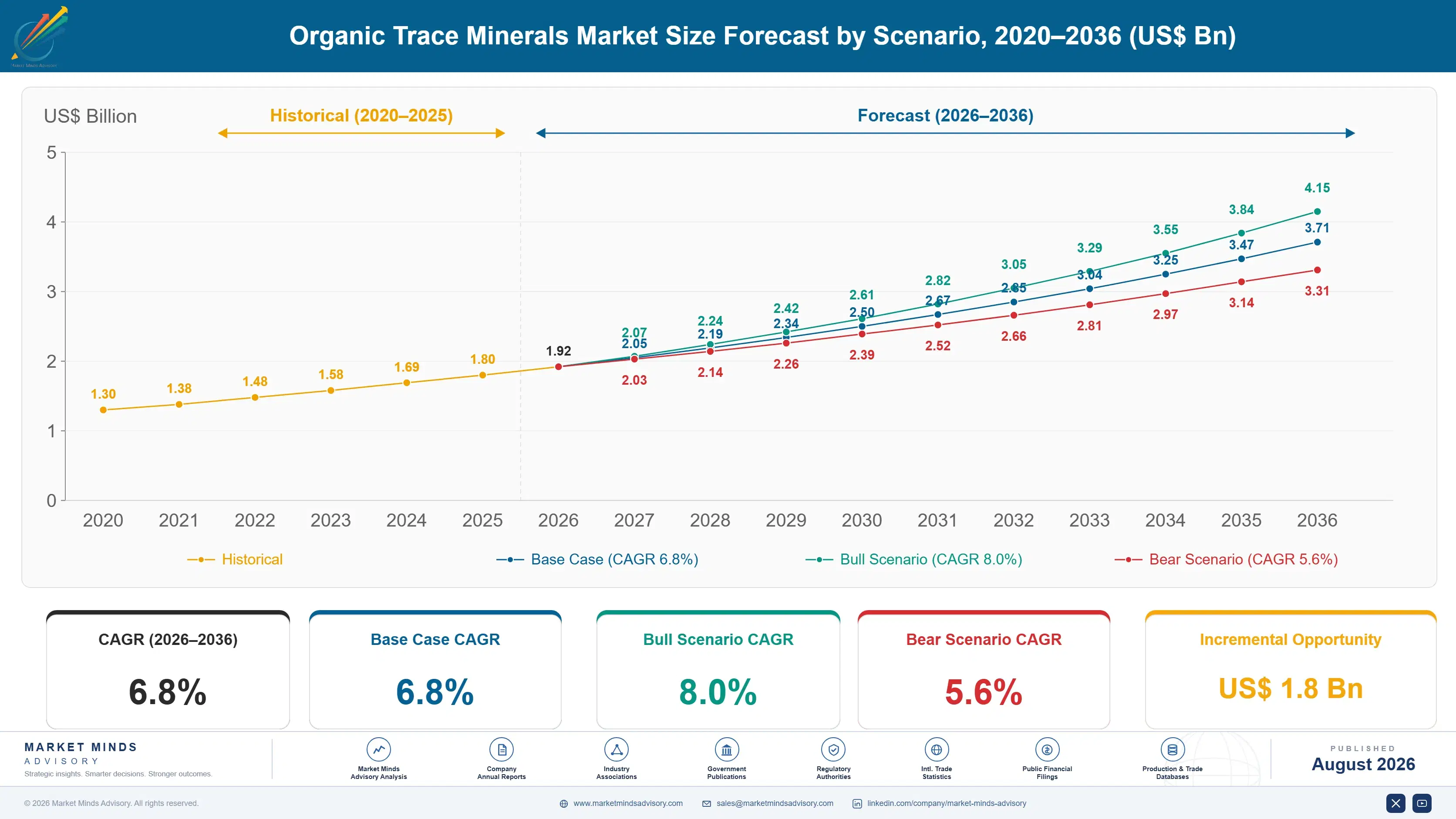
Organic Trace Minerals Market Forecast Scenarios

organic-trace-minerals-market-trends-size-forecast-scenario-1787375084505
Between 2020 and 2025, organic trace mineral adoption accelerated as large integrated poultry and dairy operators documented measurable feed conversion and mineral excretion reductions, shifting purchasing away from cheaper inorganic sulfates. Peer-reviewed trial publication volume roughly doubled across the period. The category posted an estimated 5.8 percent historical CAGR, trailing the forecast rate as adoption broadens into mid-sized farms.
MMA's base case projects 6.8 percent annual growth through 2036, anchored in three commercial mechanisms. First, environmental mineral runoff regulation in the European Union and select United States states is making organic forms a compliance requirement rather than an optional efficiency upgrade for large operations. Second, premium meat and dairy buyers increasingly specify documented feed efficiency practices in supplier contracts, pushing adoption down through the supply chain. Third, aquaculture's rapid expansion is adding a new demand channel for chelated minerals beyond traditional livestock applications.
The bull case rests on mandatory mineral runoff limits spreading beyond the European Union into major exporting nations, which would force rapid inorganic-to-organic conversion across entire national herds. The principal bear risk is persistent price sensitivity among smaller independent producers, who may defer conversion if feed margins stay compressed and chelated minerals remain priced above inorganic alternatives.

Bioavailability Economics and the Runoff Compliance Curve

Mineral nutrition economics have shifted from a pure cost-per-ton calculation toward a documented efficiency return calculation. Large integrated poultry and dairy operators now track feed conversion ratio improvements against chelated mineral cost premiums with the same rigor once reserved for genetics and vaccination programs, a discipline that smaller independent farms are only beginning to adopt as nutritionists standardize the underlying methodology across regional extension networks and cooperative advisory services.
MARKET CONCENTRATIONCR5 38%top five suppliers hold considerable combined production capacity
AVERAGE PRICE PREMIUM2.4x inorganicchelated forms command a substantial sustained price premium
POULTRY END-USE SHARE44%poultry feed remains the single largest application segment
FEED CONVERSION GAIN3-6%documented efficiency improvement drives most purchasing decisions today
TRIAL PUBLICATION VOLUME210+ studiespeer-reviewed research underpins nearly every premium pricing claim
INTEGRATED OPERATOR PENETRATION61%large integrated producers adopted chelated minerals well before smaller peers
Regulatory pressure has become a genuine commercial force rather than a background compliance cost. Mineral runoff limits tied to nutrient management plans in the European Union and several United States states are pushing organic forms from an efficiency upgrade toward an operating requirement for permitted large-scale livestock facilities seeking to renew environmental permits without costly manure management infrastructure investment on top of routine feed budget increases.
Over the next decade, aquaculture adoption and mid-sized farm conversion will matter as much as regulatory tightening in developed markets. Suppliers that can prove bioavailability at accessible price points for smaller independent operators, rather than only large integrated accounts, stand to capture disproportionate share as the addressable market broadens well beyond its current large-operator core toward a genuinely mass commodity livestock input.
"Nobody buys organic selenium because it sounds better. They buy it because a nutritionist can show the feed conversion math on a spreadsheet, and the spreadsheet wins the argument every time."
Director, Agriculture and Animal Nutrition Practice · MMA Agriculture and Animal Nutrition Practice · August 2026

Market Trends

Mineral Runoff Regulation Converts Efficiency Upgrade to Requirement

Nutrient management plans tied to environmental permits in the European Union and several United States states now cap total mineral excretion per animal unit, pushing large-scale poultry and dairy operations toward organic forms that reduce excreted mineral load by a documented 20 to 40 percent relative to inorganic sulfates. Operators renewing environmental permits increasingly find organic mineral adoption cheaper than manure management infrastructure upgrades required to stay compliant under inorganic formulations. Roughly 1,400 large confined animal feeding operations across the two regions have converted core mineral programs since early 2023.
Market Impact: Requires compliance from 2,200 growers
Aquaculture Expansion Opens an Entirely New Demand Channel

Global aquaculture production has grown steadily as wild fisheries plateau, and farmed shrimp and finfish operations are adopting chelated trace minerals to address the immune-function and shell-quality issues that inorganic forms handle poorly in aquatic feed formulations. Feed conversion economics in aquaculture differ meaningfully from terrestrial livestock, favoring organic selenium and zinc specifically for their water stability advantages over inorganic salts that leach before consumption. Southeast Asian aquaculture operators have driven most of the early adoption, with several major feed millers now offering organic mineral premixes as a standard formulation option rather than a specialty add-on.
Market Impact: Cuts sales cycle by 6 months

Market Opportunities and Growth Drivers

Premium Meat and Dairy Buyers Specify Feed Efficiency Practices

Major branded meat and dairy processors have begun including documented feed conversion and mineral management practices within supplier contracts, particularly for premium and export-oriented product lines sold into markets with sustainability-conscious retail buyers. This contractual pressure pushes adoption down through the supply chain from large integrators to the independent contract growers who supply them, since failing to meet documented efficiency benchmarks risks contract non-renewal. Several major poultry processors now require organic trace mineral use as a standard contract growing term, a requirement that barely existed five years ago and has reshaped supplier negotiations industry-wide.
Market Impact: Excludes 34% of smaller farm operations

Peer-Reviewed Bioavailability Research Base Keeps Expanding

University and industry-funded research documenting organic trace mineral bioavailability advantages has expanded substantially over the past decade, giving nutritionists and feed formulators the peer-reviewed evidence base needed to justify premium pricing to cost-conscious farm operators. Roughly 210 peer-reviewed studies now support organic mineral efficacy claims across species, up from under 80 a decade earlier. This growing evidence base has shortened the sales cycle for suppliers introducing new chelated forms, since nutritionists no longer need to commission independent trials before recommending adoption to skeptical farm management teams weighing several competing supplier proposals at once.
Market Impact: Adds 18% compliance cost for exporters

Market Restraints and Challenges

Price Premium Slows Adoption Among Smaller Independent Producers

Organic trace minerals typically cost two to three times more per unit than inorganic equivalents, a premium that large integrated operators absorb readily given documented efficiency returns but that smaller independent farms operating on thin commodity margins often cannot justify without direct buyer pressure. The root cause is the more complex chelation manufacturing process required to bond minerals to amino acids or proteins rather than simple sulfate compounding. Several suppliers are piloting lower-cost proteinate formulations and volume-tiered pricing specifically aimed at mid-sized farm adoption to address this affordability gap directly.
Market Impact: Adds 1,400 converted operations since 2023

Inconsistent Global Regulatory Definitions Complicate Trade

Countries define and certify organic trace minerals differently, with the European Union, United States, and China applying distinct bioavailability and labeling standards that complicate cross-border feed additive trade and force suppliers to maintain multiple formulation and documentation versions. The root cause is the absence of a single global feed additive standard-setting body with binding authority comparable to pharmaceutical regulation. Industry trade associations are lobbying for mutual recognition agreements, though progress has been slow given differing agricultural policy priorities across major exporting nations and their respective domestic feed industries and regulatory bodies.
Market Impact: Adds 4.8% category demand from aquaculture
3 additional market trends, 3 additional growth drivers, and 4 additional restraints and challenges are covered in the full report. Contact sales@marketmindsadvisory.com to access the complete intelligence.

Segment CAGR and Growth Architecture

Mineral type is the dimension that determines chelation chemistry, target species application, and pricing tier, so MMA segments the market by specific trace mineral rather than by species or delivery form. Six minerals span the category, from high-volume zinc and copper through faster-growing selenium and chromium niches steadily gaining share every single reporting year.
organic-trace-minerals-market-trends-market-share-analysis-1787375085052

Organic Selenium

Organic selenium is the fastest-growing mineral segment because peer-reviewed research increasingly links it to measurable immune function and antioxidant benefits in poultry and dairy cattle, advantages inorganic sodium selenite cannot replicate at comparable inclusion rates. Regulatory caps on total selenium inclusion in several markets favor organic forms specifically, since their higher bioavailability lets formulators hit target tissue selenium levels at lower total inclusion, staying safely within mandated ceilings. Dairy operators have driven much of the recent growth, using organic selenium to address reproductive performance and somatic cell count issues that carry direct milk quality payment consequences. Roughly 1.8 times the category's overall growth rate, this segment now commands the steepest price premium of any organic mineral form sold.
CAGR 12.4%

Organic Zinc

Organic zinc remains the largest single mineral by volume and its second-fastest-growing segment, anchored in well-documented hoof health, immune function, and reproductive performance benefits across swine, poultry, and dairy applications. Adoption has broadened beyond large integrated operators into mid-sized independent farms as generic organic zinc formulations have brought price premiums down from early specialty pricing levels. Swine operations have emerged as a particularly strong growth channel, since zinc's role in post-weaning digestive health has taken on new commercial importance following regulatory restrictions on therapeutic antibiotic use in several major pork-exporting countries worldwide. Suppliers increasingly bundle zinc with copper in combination premixes to simplify farmer purchasing decisions and encourage broader adoption across smaller, less specialized operations.
CAGR 10.2%
Full segment breakdown across 6 segments available in the complete report.

Regional Architecture and Country Demand Map

North America leads on large-scale integrated poultry and dairy operations with mature chelated mineral adoption, while South Asia and Pacific grows fastest as India's expanding commercial livestock sector adopts organic minerals at scale for the very first time in its long modern feed history overall.

North America

Large-scale integrated poultry and dairy operations anchor demand here more than in any other region, with roughly six in ten major producers already running full chelated mineral programs across their core herds and flocks. Environmental permitting requirements tied to nutrient management plans in states with concentrated livestock production have accelerated conversion among mid-sized operators seeking to renew operating permits without costly manure infrastructure investment. Premium branded meat and dairy processors increasingly specify documented feed efficiency practices in supplier contracts, pushing adoption further down through independent contract grower networks. Canada's dairy sector has followed a similar trajectory, though at a smaller absolute scale than the United States poultry and swine complex.
Share: 28% | CAGR: 7.2% (2026 to 2036)

Western Europe

Regulatory pressure shapes this region's growth path more directly than anywhere else, as European Union nutrient management directives cap mineral excretion per animal unit across member states with intensive livestock production. Germany, France, and the Netherlands lead regional adoption, reflecting their concentrated dairy and swine operations operating under some of the strictest environmental permitting regimes globally. Growth has slowed somewhat as adoption among large operators approaches saturation, shifting the region's remaining opportunity toward mid-sized farms still transitioning from inorganic formulations. Organic certification standards for livestock products have created an additional adjacent demand driver unique to this region's retail landscape, particularly across Nordic and Alpine premium dairy export markets that command notable price premiums abroad.
Share: 22% | CAGR: 5.3% (2026 to 2036)
Regional intelligence for 5 additional markets available in the complete report: East Asia, South Asia and Pacific, Latin America, Middle East and Africa, Eastern Europe. Contact sales@marketmindsadvisory.com.
organic-trace-minerals-market-trends-country-cagr-analysis-1787375085611

Turning Bioavailability Proof Into Margin

Four commercial levers separate suppliers earning premium chelated pricing from those trapped in commodity mineral competition: peer-reviewed trial investment, compliance-linked positioning, mid-market affordability formats, and combination premix bundling that simplifies farmer purchasing decisions, each requiring sustained upfront investment before margin gains become clearly visible on a quarterly income statement or in supplier contract renewals.

Commission Independent Species-Specific Bioavailability Trial Programs

Suppliers that fund independent, peer-reviewed feed conversion trials for specific species and production systems gain defensible efficacy claims that nutritionists can cite directly when recommending premium pricing to skeptical farm operators evaluating several competing product lines. The upfront cost, typically 200 thousand to 600 thousand dollars per trial program, is significant but suppliers with a strong trial portfolio report price premiums roughly 35 percent above generic organic competitors lacking equivalent documentation. Universities increasingly partner directly with suppliers on this research, lowering costs and accelerating publication timelines considerably for participating companies and their extension networks.
Market Impact: Supports a 35% price premium over generic rivals

Position Products Against Nutrient Runoff Compliance

Suppliers that explicitly market organic minerals as a permitting compliance solution, rather than purely a performance upgrade, tap budget lines large operators reserve for environmental compliance rather than discretionary feed spending. This reframing has helped several suppliers roughly double their addressable market among operators facing permit renewal deadlines within the next 2 to 3 years across several major livestock-producing states and provinces. Building this positioning requires genuine regulatory expertise and direct relationships with environmental permitting consultants that smaller suppliers often lack the resources to develop fully internally without outside advisory support.
Market Impact: Doubles addressable market near 3-year permit renewal deadlines

Build Affordable Proteinate Lines for Mid-Sized Farms

Suppliers developing lower-cost proteinate formulations, priced closer to inorganic alternatives than premium chelates, are capturing the roughly 34 percent of independent farm operations currently excluded by price from full chelated adoption. Margins per unit run thinner than premium chelate lines, but volume potential is substantially larger given how much of the addressable market remains untapped at current premium price points across most producing regions. Early movers in this format are building distribution relationships with regional cooperatives that premium-focused suppliers have historically underserved and largely ignored in favor of larger, higher-margin integrated accounts.
Market Impact: Opens up 34% of currently excluded farm operations

Bundle Combination Premixes to Simplify Purchasing

Suppliers offering pre-blended combination premixes covering zinc, copper, manganese, and selenium in a single product reduce the formulation complexity that smaller farm operators without dedicated nutritionists often find overwhelming when purchasing individual minerals separately across multiple supplier relationships. Bundled products report roughly 22 percent higher repeat purchase rates than single-mineral SKUs sold to the same customer segment, since farmers value the simplicity as much as the underlying mineral performance itself. This approach works best in mid-sized and smaller farm channels where dedicated nutrition expertise is genuinely scarce and purchasing decisions fall to generalist farm managers.
Market Impact: Lifts repeat purchase rate by 22 points nationwide

Who Controls the Margin Pool

The top five suppliers hold a combined 38 percent of category production capacity, a moderate-to-high concentration reflecting the specialized chelation chemistry expertise required to compete credibly at scale. The gap between the leading supplier and the fifth-ranked player is meaningful, since chelation patents and trial portfolios built over decades are genuinely difficult for challengers to replicate quickly.
Current competitive activity centers on three fronts: leading suppliers expanding peer-reviewed trial portfolios to defend premium pricing, mid-tier players developing affordable proteinate lines to capture price-sensitive mid-sized farms, and several companies pursuing capacity expansion in Asia to serve rapidly consolidating regional livestock sectors. Combination premix bundling has also intensified as suppliers compete for simplified purchasing relationships with smaller, less specialized farm operators nationwide.

Emerging pressure is coming from regional Chinese and Indian manufacturers offering lower-cost organic mineral formulations backed by growing domestic trial data, challenging the historical dominance of Western chelation technology leaders across several fast-growing export markets. Rankings are most likely to shift among mid-tier suppliers lacking either the trial budget of category leaders or the cost structure of regional low-cost entrants, leaving them squeezed from both directions at once.
organic-trace-minerals-market-trends-company-positioning-matrix-1787375086145

Competitive Moat and Risk Dimensions

ZINPRO CORPORATION

Moat: Deep chelation patent portfolio

Zinpro holds one of the industry's broadest chelation technology patent portfolios, built over more than four decades of proprietary amino acid complex research, giving it a defensible technical moat that smaller suppliers cannot easily replicate. This patent depth also underpins one of the category's largest peer-reviewed trial libraries, reinforcing premium positioning across species.
ZINPRO CORPORATION

Risk: Premium pricing limits reach

Zinpro's premium pricing strategy limits its penetration among price-sensitive mid-sized and smaller farm operators who represent a growing share of total addressable demand as adoption broadens beyond large integrators. Lower-cost proteinate challengers are increasingly targeting exactly this underserved price-sensitive segment that Zinpro has been slower to address directly.
ALLTECH, INC.

Moat: Broad species trial library

Alltech has built one of the industry's most extensive cross-species peer-reviewed trial libraries, spanning poultry, dairy, swine, and aquaculture applications, giving its sales team documentation to support nearly any customer conversation. This breadth differentiates Alltech from narrower competitors focused on a single species or mineral type.
ALLTECH, INC.

Risk: Complex multi-division cost structure

Alltech's diversified structure spanning multiple animal nutrition categories beyond trace minerals creates coordination complexity and overhead costs that more focused single-category competitors avoid entirely. This can slow decision-making on trace-mineral-specific pricing and product launches relative to more nimble specialist rivals with a narrower, more focused product portfolio.

Players Tracked

Prominent Players

Zinpro Corporation
Alltech, Inc.
Novus International, Inc.
Kemin Industries, Inc.
Balchem Corporation

Other Key Players

Phibro Animal Health Corporation
Nutreco N.V. (Trouw Nutrition)
Adisseo France SAS
DSM-Firmenich AG
Cargill, Incorporated
Archer-Daniels-Midland Company
Bluestar Adisseo Company
Pancosma SA
Nutrafeed International, Inc.
Innovad Group NV
Selko (Trouw Nutrition)
Vitalac Nutrition B.V.
Anpario plc
Biochem Zusatzstoffe GmbH
Micronutrients USA LLC

Recent Developments

MAY 2025

Zinpro Expands Organic Selenium Production Capacity

Zinpro announced a capacity expansion at its primary organic selenium production facility to meet rising dairy and poultry demand across North America and East Asia, adding roughly 15 percent to its total annual selenium output capacity by early 2026 according to company disclosures, its largest single capacity investment in years.
Signal: Signals suppliers betting heavily on selenium's continued fast growth trajectory across every major livestock market segment
NOVEMBER 2024

Alltech Publishes New Aquaculture Bioavailability Trial Results

Alltech published peer-reviewed trial results documenting organic zinc and selenium bioavailability advantages in farmed shrimp, extending its trial portfolio into the fast-growing aquaculture segment that traditional terrestrial livestock-focused suppliers have been notably slower to enter with comparable documented research, a gap it is now working to close.
Signal: Confirms aquaculture is becoming a genuine, well-documented new demand channel for major established global mineral suppliers
FEBRUARY 2025

Novus International Launches Affordable Proteinate Line

Novus International launched a lower-cost proteinate mineral line specifically targeting mid-sized independent farm operators previously excluded from full chelated adoption by premium chelate pricing, expanding its addressable market beyond large integrated accounts significantly across several core producing regions and independent farm cooperative networks nationwide this quarter.
Signal: Shows category leaders chasing mid-market affordability rather than ceding that ground entirely to regional entrants outright

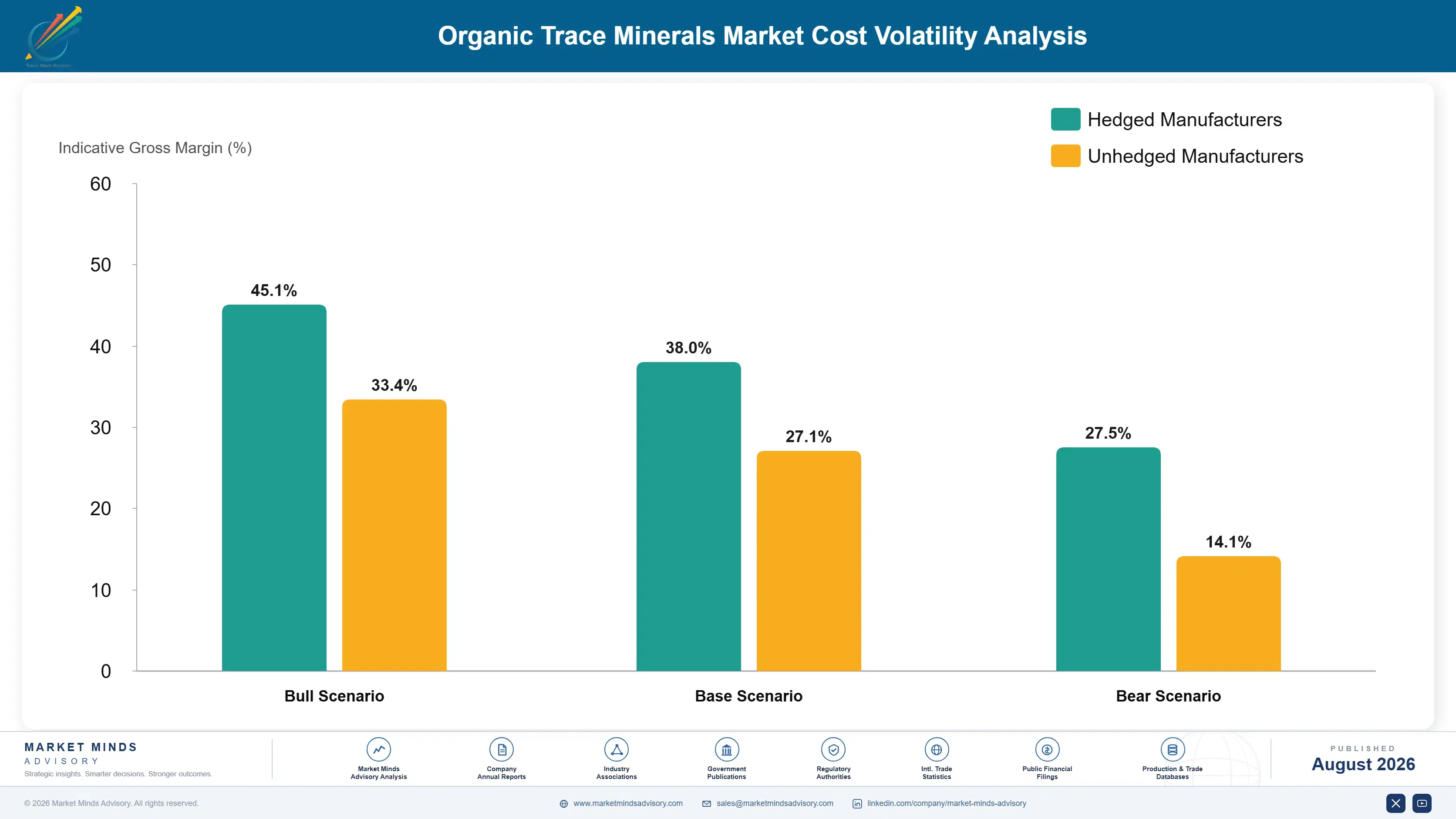
Amino Acid Feedstock Sets the Cost Floor

Amino acids and specialty proteins used in chelation, along with the base mineral salts themselves, together represent roughly 44 percent of cost of goods sold, sourced primarily from Chinese amino acid manufacturers and global mineral trading houses with concentrated supply. Energy costs for the chelation manufacturing process add a further meaningful cost layer that has grown volatile in recent years across most producing regions.
Amino acid prices rose sharply in 2023 after Chinese fermentation capacity disruptions tightened global supply, an event the International Energy Agency's broader industrial input tracking and several suppliers' annual reports both referenced when explaining margin compression that year. Selenium-based chelates faced additional pressure from mining supply constraints, since selenium is primarily produced as a byproduct of copper refining rather than mined directly, leaving supply tied to unrelated copper market cycles.

Exposure varies sharply by player type: suppliers with in-house amino acid production or long-term supply agreements absorbed volatility more easily than smaller manufacturers dependent on spot market purchasing, who faced steeper margin compression. Vertically integrated leaders used scale purchasing agreements and geographic supply diversification to smooth cost swings that hit smaller regional competitors much harder across the same period.
organic-trace-minerals-market-trends-cost-volatility-analysis-1787375086342

Dual-Source Amino Acid Supply Across Geographies

Leading suppliers now qualify amino acid sources across China, Europe, and North America to reduce exposure to any single country's fermentation capacity disruption. This adds modest qualification cost but has prevented supply interruptions during recent volatility, and several suppliers report the investment paid for itself within two years of initial qualification spend, well ahead of schedule.

Lock Multi-Year Mineral and Amino Acid Contracts

Multi-year fixed-price contracts with mineral and amino acid suppliers protect gross margin against short-term spot volatility, though they require accurate demand forecasting to avoid overcommitment. Several large suppliers have expanded this practice since 2023, locking pricing through 2027 for their highest-volume mineral lines and freeing up working capital previously reserved for spot market purchases entirely.

Invest in Byproduct Selenium Recovery Partnerships

Some suppliers are forming direct partnerships with copper refiners to secure selenium byproduct streams ahead of open market sale, reducing exposure to the tightest mineral supply category. Early movers report both cost stability and supply security benefits from this vertically-integrated sourcing approach, alongside meaningfully improved forecasting accuracy for future production planning cycles across multiple fiscal years.

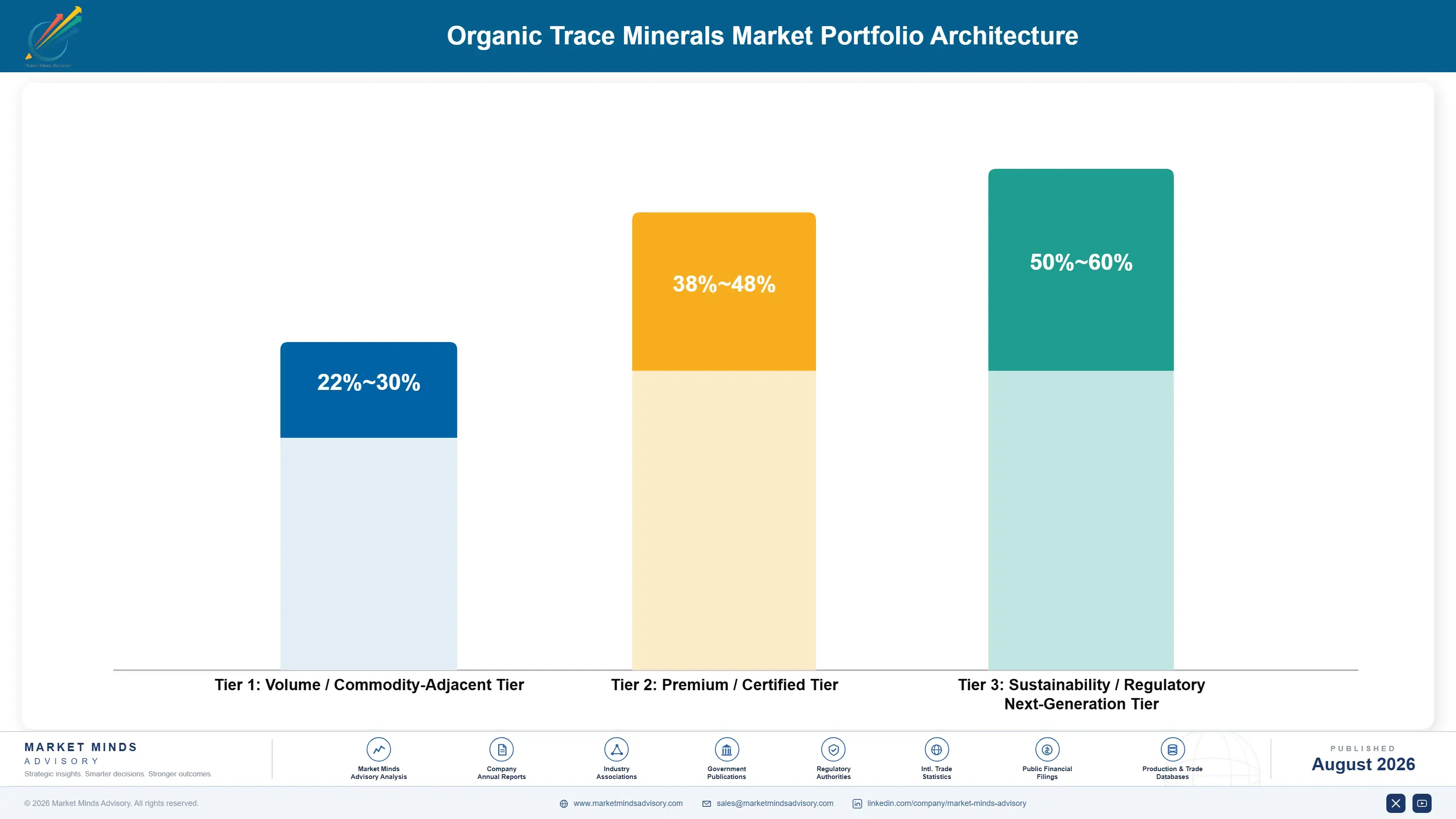
Portfolio Architecture for Margin Defence

Three tiers structure this category's margin economics. Volume proteinates compete on price against inorganic alternatives with thin margins, premium chelated formulas earn a meaningful markup on documented bioavailability and peer-reviewed trial data, and next-generation species-specific and compliance-linked products command the steepest prices by solving a named operational or regulatory problem operators actively budget around each fiscal year without exception.
Tension between volume and premium tiers is intensifying as large integrators push toward documented premium chelates while independent mid-sized farms increasingly adopt affordable proteinate lines still well ahead of inorganic alternatives. Suppliers straddling both tiers face difficult manufacturing and R&D allocation choices that pull in genuinely different directions and rarely reward companies trying to excel at both simultaneously across every single product line in their entire catalog.

High-value margin pools concentrate in organic selenium and species-specific formulas addressing documented immune function, reproductive performance, and compliance requirements, where operators show the least price sensitivity. Aquaculture-specific formulations represent the fastest-growing high-value pool as this historically underserved application segment finally gets dedicated supplier manufacturing and marketing attention from both established category leaders and well-funded regional challengers entering the space.

Volume / Commodity-Adjacent Tier

Proteinate and lower-cost organic mineral formulations sold primarily to mid-sized farms competing against inorganic alternatives chiefly on price, shelf availability, and cooperative distribution relationships rather than documented performance claims, with the thinnest margins in the category.
Gross Margin: 22-30%

Premium / Certified Tier

Chelated formulations with documented bioavailability and peer-reviewed trial support sold to large integrated poultry and dairy operators willing to pay a clear premium for measurable, well-documented feed conversion and reproductive performance gains.
Gross Margin: 38-48%

Sustainability / Regulatory / Next-Generation Tier

Species-specific and compliance-linked formulations addressing runoff regulation and aquaculture applications with the strongest bioavailability documentation, increasingly required for continued operating permits at large-scale integrated livestock facilities across major exporting nations worldwide.
Gross Margin: 50-60%
organic-trace-minerals-market-trends-portfolio-architecture-1787375086837

High-value Sub-segments and Strategic Watch-out

Organic Selenium for Dairy and Poultry Immunity

This segment combines the category's highest growth rate with its richest margins, as documented immune function and reproductive performance benefits justify premium pricing that operators readily pay given measurable production gains and milk quality payment consequences tied directly to it across most major dairy cooperative contracts.
Gross Margin: 55-62%

Aquaculture-Specific Chelated Formulations

Growing fast but still building margin scale, this segment benefits from solving water-stability problems inorganic minerals cannot address, though formulation costs currently compress near-term profitability relative to terrestrial livestock lines as the format matures across the industry and production volumes scale further across major exporting aquaculture nations.
Gross Margin: 42-50%

Organic Zinc and Copper Combination Premixes

The category's volume anchor, combination premixes retain the largest revenue base even as growth slows relative to newer formats, sustaining category cash flow while margins stay comparatively thin against premium selenium lines across most producing regions tracked in this report's underlying primary survey dataset overall.
Gross Margin: 28-35%

Generic Proteinate Private-Label Formulations

Regional manufacturers are expanding generic proteinate lines to capture margin from price-sensitive operators, a watch-out for branded suppliers as quality gaps narrow and buyer negotiating leverage grows across mid-sized farm accounts heading into future purchasing and contract renewal cycles across most major producing nations worldwide.
Gross Margin: 18-25%

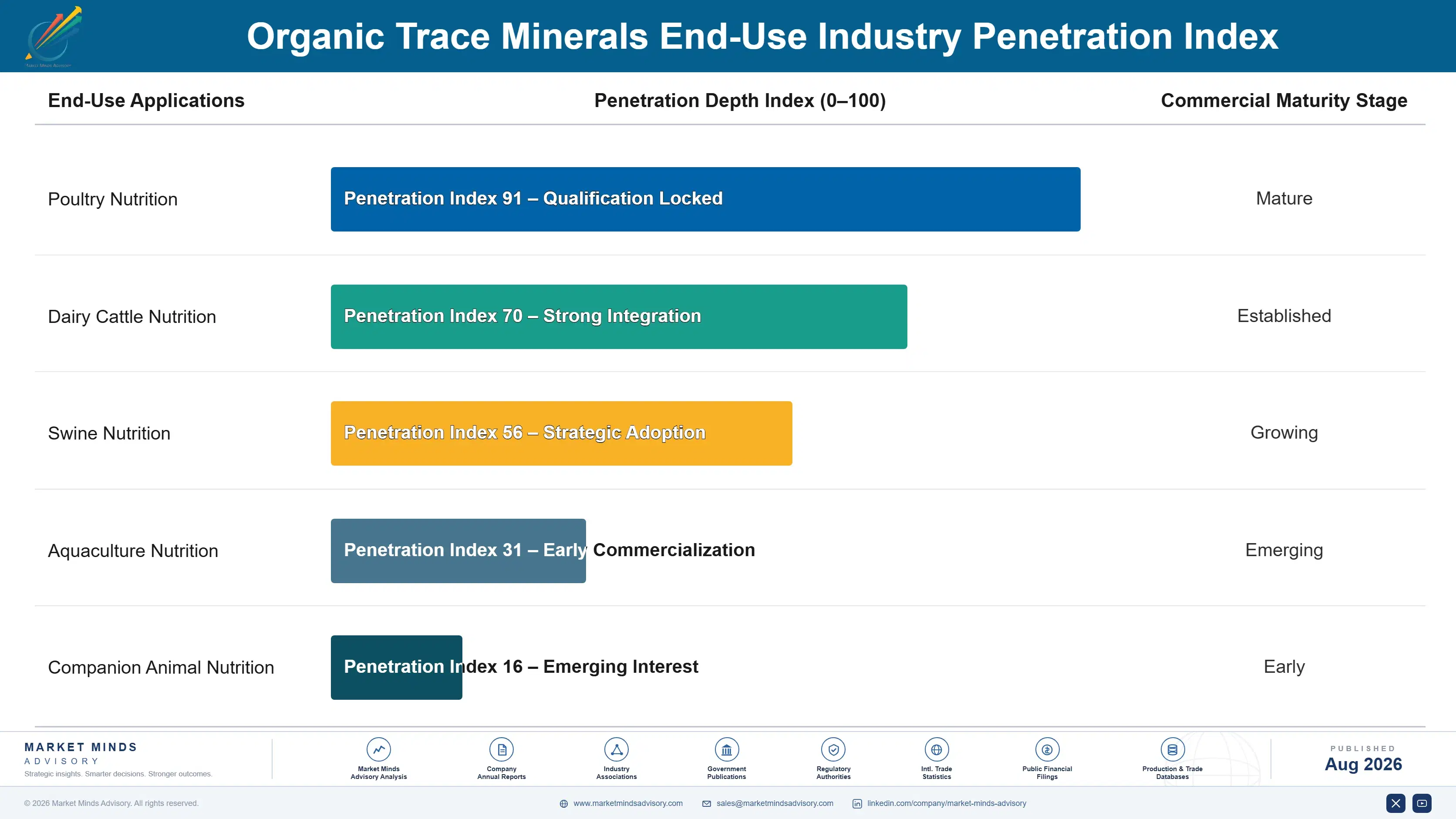
Recurring Feed Program Economics

Organic trace minerals behave like an annuity once a large operator commits to a chelated feed program, since switching mineral suppliers requires nutritionist-supervised transition and disrupts feed conversion benchmarks operators track continuously, making incumbent suppliers difficult to dislodge from established accounts once trust is built across multiple production cycles and herd health outcomes documented over years of accumulated data.
Adoption depth varies meaningfully by vertical: poultry and dairy show near-universal trial among large integrators but slower penetration among independent operators, while aquaculture and swine see lower overall trial rates paired with strong daily usage once an operation formally commits to a chelated program across its core herds and production facilities nationwide, rarely reverting to inorganic formulations once converted.

Younger farm operators and professionally trained nutritionists entering management roles research chelation science far more actively than the generation they are replacing, accelerating conversion decisions that previously took years of gradual persuasion. This generational shift rewards suppliers investing early in accessible, well-documented trial data over those relying on legacy relationships alone, reshaping which companies capture the next full decade of adoption growth across every major producing region.
organic-trace-minerals-market-trends-end-use-penetration-index-1787375087327

Where MMA Sees Category Momentum Building

These are among the four positions where our research anticipates prominent divergence between winners and laggards over the coming forecast period. Each is grounded in the demand model, the regulatory perimeter, and the announced capacity pipeline.
01 / TRIAL INVESTMENT PRIORITY

Fund species-specific bioavailability trials before scaling volume

Nutritionists increasingly demand peer-reviewed, species-specific data before recommending premium pricing to farm operators, and this evidence bar will keep rising as competition intensifies across every major mineral category tracked in this report. Suppliers still competing purely on price without a documented trial portfolio risk ceding ground to better-documented rivals within the next several purchasing cycles across major integrated accounts and independent cooperatives alike. MMA views trial investment as the single highest-leverage capital allocation decision facing mid-tier suppliers in this category today.
02 / COMPLIANCE POSITIONING URGENCY

Reframe organic minerals as regulatory compliance infrastructure

Environmental permitting pressure on nutrient runoff is broadening beyond early-adopter states and countries, and suppliers positioning organic minerals as compliance infrastructure rather than pure performance upgrades are capturing budget lines competitors overlook entirely at large integrated operations. This reframing requires genuine regulatory expertise that smaller suppliers often lack the resources to build internally without external permitting consulting partnerships in place already. MMA expects this positioning advantage to widen meaningfully over the next several permit renewal cycles across major exporting regions worldwide.
03 / MID-MARKET AFFORDABILITY PUSH

Build proteinate lines priced for independent farm adoption

The roughly one-third of farm operations currently excluded from chelated adoption by price represents the category's largest remaining volume opportunity, and suppliers building genuinely affordable proteinate lines are capturing this segment ahead of premium-only competitors still focused on large integrators. Margins per unit run meaningfully thinner, but the addressable volume more than compensates for well-positioned early movers building the right cooperative distribution relationships early. MMA recommends this as a defensive necessity given how quickly regional low-cost entrants are scaling into the same underserved space.
04 / AQUACULTURE CHANNEL DEVELOPMENT

Build dedicated aquaculture trial and formulation capacity now

Aquaculture represents the category's newest and least contested demand channel, and suppliers building dedicated species-specific trial data and formulations today will establish the credibility advantage that is difficult for later entrants to replicate once customer relationships genuinely form. Terrestrial livestock-focused suppliers have been notably slow to enter this channel with comparable documentation despite its clear growth trajectory across most major producing regions tracked in this report. MMA advises building this capacity now rather than waiting for aquaculture adoption to mature and competition to intensify further.

Engagement Snapshot From the Field

A live engagement with an industry participant carrying material or product regulatory and market exposure ahead of a defining policy shift, showing how our research translates into a defensible multi-year portfolio strategy.
MARKET MINDS ADVISORY · CLIENT ENGAGEMENT SUMMARY
Organic Trace Minerals Producer Strategic Portfolio Review and Transition Roadmap 2026·Investment Scenario on Organic Trace Minerals Exposure Evaluation 2025-26
CLIENT PROFILE
The client operates a regional poultry integrator with roughly 40 contract grower operations across the southeastern United States, generating approximately 180 million dollars (client-reported, unverified by MMA) in annual feed and mineral program spending across its full network. The integrator sought to evaluate full conversion to organic trace minerals ahead of an upcoming environmental permit renewal cycle.
STRATEGIC CHALLENGE
Feed conversion performance had plateaued despite steady genetics improvement, and environmental compliance staff flagged mineral runoff levels approaching permit thresholds at several large facilities within the network. Management lacked a clear framework for evaluating which mineral program changes would deliver the strongest combined performance and compliance return on investment across all sites.
MMA APPROACH
MMA conducted a structured audit of current mineral spending against documented bioavailability benchmarks, cross-referencing findings against primary survey data from comparable integrators in the client's core operating region and several adjacent states. The engagement produced a phased conversion roadmap balancing cost, performance, and compliance timing considerations across every facility in the network.
KEY FINDINGS
  1. Only 18 percent of the client's mineral program relied on organic forms, well below comparable regional integrators facing similar permit pressure and deadlines.
  2. Feed conversion modeling suggested a full organic conversion could improve feed efficiency by roughly 4 percent across core contract grower operations network-wide.
  3. Two of the client's largest facilities faced permit renewal within eighteen months, creating clear timing urgency for the broader compliance business case.
  4. Comparable integrators that converted earlier reported measurable manure management cost reductions alongside the documented feed efficiency gains cited above throughout this analysis.
CLIENT PROFILE
The client operates a regional poultry integrator with roughly 40 contract grower operations across the southeastern United States, generating approximately 180 million dollars (client-reported, unverified by MMA) in annual feed and mineral program spending across its full network. The integrator sought to evaluate full conversion to organic trace minerals ahead of an upcoming environmental permit renewal cycle.
STRATEGIC CHALLENGE
Feed conversion performance had plateaued despite steady genetics improvement, and environmental compliance staff flagged mineral runoff levels approaching permit thresholds at several large facilities within the network. Management lacked a clear framework for evaluating which mineral program changes would deliver the strongest combined performance and compliance return on investment across all sites.
MMA APPROACH
MMA conducted a structured audit of current mineral spending against documented bioavailability benchmarks, cross-referencing findings against primary survey data from comparable integrators in the client's core operating region and several adjacent states. The engagement produced a phased conversion roadmap balancing cost, performance, and compliance timing considerations across every facility in the network.
KEY FINDINGS
  1. Only 18 percent of the client's mineral program relied on organic forms, well below comparable regional integrators facing similar permit pressure and deadlines.
  2. Feed conversion modeling suggested a full organic conversion could improve feed efficiency by roughly 4 percent across core contract grower operations network-wide.
  3. Two of the client's largest facilities faced permit renewal within eighteen months, creating clear timing urgency for the broader compliance business case.
  4. Comparable integrators that converted earlier reported measurable manure management cost reductions alongside the documented feed efficiency gains cited above throughout this analysis.
RECOMMENDED STRATEGY
Phase 1: Phase 1 (Months 1-4): Convert mineral programs at the two facilities facing the nearest permit renewal deadlines first and immediately. Phase 2: Phase 2 (Months 5-10): Roll out organic mineral conversion across all remaining contract grower operations by facility tier priority order. Phase 3: Phase 3 (Months 11-14): Document feed conversion and compliance outcomes fully to support formal permit renewal applications going forward each cycle.
OUTCOME
Within fourteen months of implementation, the client reported (client-reported, unverified by MMA) a 3.6 percent improvement in feed conversion ratio across converted facilities and successfully renewed both priority environmental permits without additional infrastructure investment. Management adopted the phased framework as its standard approach for future facility conversions.

Frequently Asked Questions

Foundational context covering the market sizes, CAGR, scope, country, region and competition that inform every finding below. This section is provided to cover basics and most often pre-purchase conversations, answered from the MMA Primary Research Dataset.

What is the current size of the Organic Trace Minerals Market?

The organic trace minerals market was valued at approximately $1.8 billion in 2025. Growth is driven by environmental runoff regulation and rising documented feed efficiency demand.

How large will the Organic Trace Minerals Market be by 2036?

MMA projects the market will reach approximately $3.71 billion by 2036, up from $1.92 billion in 2026. This represents an incremental opportunity of roughly $1.79 billion over the forecast period.

What is the CAGR for the Organic Trace Minerals Market 2026 to 2036?

The market is projected to grow at a 6.8 percent compound annual growth rate between 2026 and 2036. Bull and bear scenarios range from 5.6 to 8.0 percent annually.

Which segment is growing fastest?

Organic selenium is growing fastest at 12.4 percent annually, roughly 1.8 times the category average, driven by documented immune function and reproductive performance benefits in dairy and poultry.

Who are the major companies in the Organic Trace Minerals Market?

Zinpro, Alltech, Novus International, Kemin Industries, and Balchem lead the category. Together the top five hold a moderate-to-high combined share, reflecting the specialized expertise required to compete.

Which country is growing fastest?

India leads country-level growth at 11.5 percent annually as its commercial poultry and dairy sectors formalize and adopt chelated minerals at scale for the first time.

Report Segmentation Architecture

The full report scope spans multiple orthogonal segmentation dimensions, with cross-tabulated demand data provided for each dimension pair. Coverage extends further to regional breakdowns, trend trajectories, and the competitive detail needed to support segment-level decision-making.

By Mineral Type

  • Organic Zinc
  • Organic Selenium
  • Organic Manganese
  • Organic Copper
  • Organic Iron
  • Organic Chromium

By End-Use Industry

  • Poultry Nutrition
  • Dairy Cattle Nutrition
  • Swine Nutrition
  • Aquaculture Nutrition
  • Companion Animal Nutrition

By Commercial Dimension

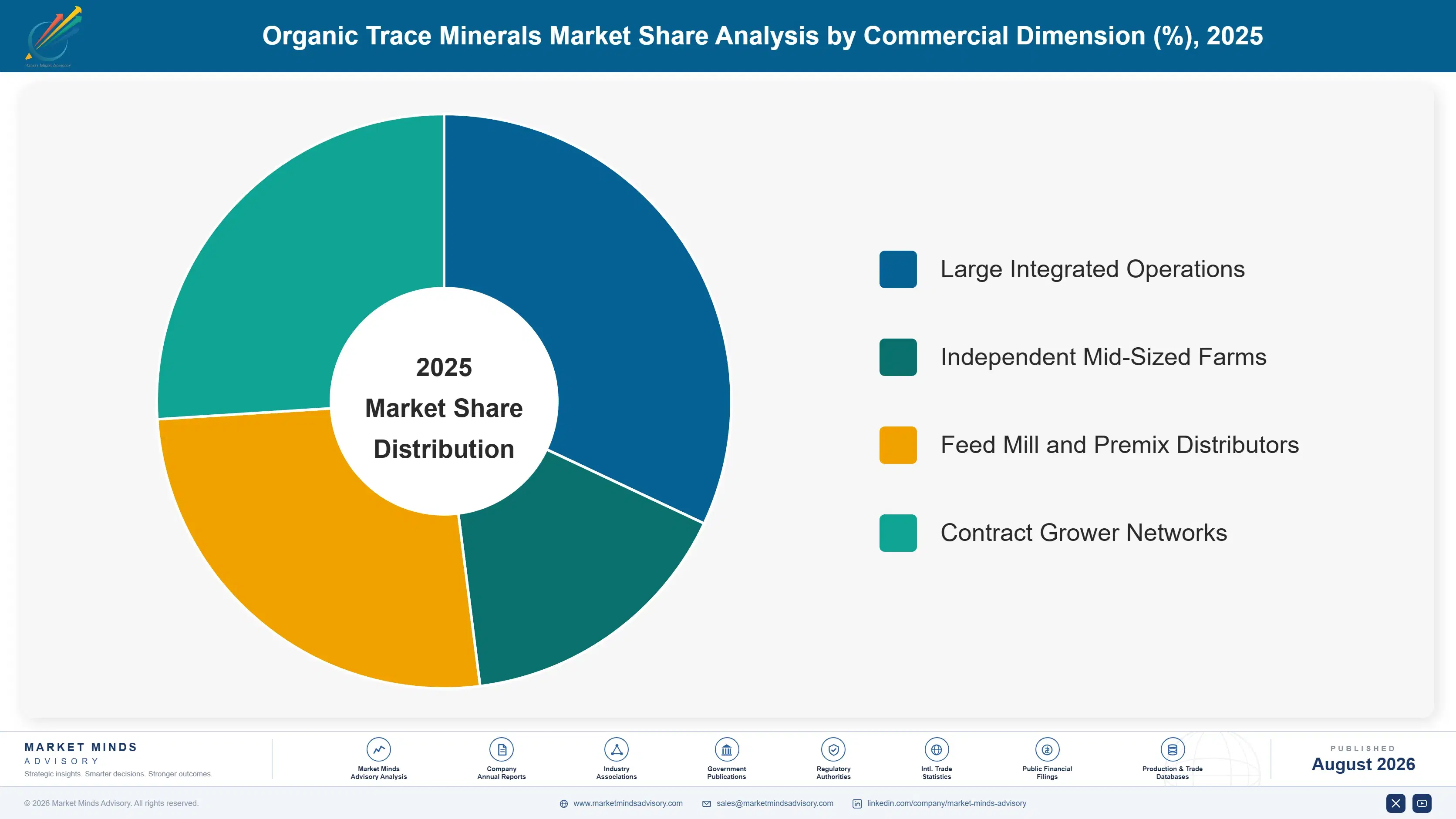
  • Large Integrated Operations
  • Independent Mid-Sized Farms
  • Feed Mill and Premix Distributors
  • Contract Grower Networks

By Region

  • North America
  • Western Europe
  • East Asia
  • South Asia and Pacific
  • Latin America
  • Middle East and Africa
  • Eastern Europe

Scope, Methodology, and Coverage

Every figure in this report is reproducible from documented input assumptions. The scope below maps the historical period, the forecast horizon, the segmentation dimensions, and the countries covered, alongside the underlying primary and qualitative methodology.
Historical Period
2020 to 2025
Forecast Period
2026 to 2036
Base Year
2025 (USD billions; MMA Primary Research Dataset, August 2026)
Market Definition
This report covers chelated, proteinated, and complexed forms of zinc, selenium, manganese, copper, iron, and chromium used as feed additives in livestock, poultry, and aquaculture nutrition. It excludes inorganic mineral salts, human dietary mineral supplements, and soil or crop fertilizer mineral applications.
Quantitative Units
USD billions (current prices); volume in metric tons where applicable
Segmentation Dimensions
By Mineral Type; By End-Use Industry; By Commercial Dimension; By Region
Regions Covered
North America, Western Europe, East Asia, South Asia and Pacific, Latin America, Middle East and Africa, Eastern Europe
Countries Covered
USA, China, Germany, France, UK, Japan, South Korea, India, Australia, Canada, Brazil, Mexico, Indonesia, Vietnam, Thailand, Malaysia, UAE, Saudi Arabia, South Africa, Nigeria, Turkey, Poland, Netherlands, Italy, Spain, Sweden, Switzerland, Argentina, Colombia, Singapore, and additional markets relevant to this sector
Key Companies Profiled
Zinpro Corporation, Alltech, Inc., Novus International, Inc., Kemin Industries, Inc., Balchem Corporation, Phibro Animal Health Corporation, Nutreco N.V. (Trouw Nutrition), Adisseo France SAS, DSM-Firmenich AG, Cargill, Incorporated, Archer-Daniels-Midland Company, Bluestar Adisseo Company, Pancosma SA, Nutrafeed International, Inc., Innovad Group NV, Selko (Trouw Nutrition), Vitalac Nutrition B.V., Anpario plc, Biochem Zusatzstoffe GmbH, Micronutrients USA LLC
Quantitative Methodology
Primary survey, n=3,800 respondents, Q4 2025, six countries; demand-side model with trade association cross-validation
Qualitative Methodology
47 expert interviews, Q4 2025; applied to validate demand model assumptions, identify emerging dynamics, and assess competitive positioning
Report Format
PDF and XLSX data workbook (Word format preview document)
Publisher
Market Minds Advisory
Report Code
MMA-2026-AGR-111
Published
August 2026
Contact
sales@marketmindsadvisory.com | www.marketmindsadvisory.com

Purchase the full Organic Trace Minerals Market Report (2026 to 2036).

The full report delivers a comprehensive 200-plus page analysis of the global organic trace minerals market, including detailed segmentation by mineral type, end-use industry, and commercial dimension across all seven world regions tracked in this study. It provides company profiles for twenty key and emerging suppliers, benchmarked against a consistent production capacity basis throughout. Buyers receive access to MMA's underlying primary survey dataset spanning 3,800 respondents and 47 expert interviews conducted in Q4 2025. Custom data cuts and direct analyst inquiry access are available for enterprise licensees upon request.
Twenty detailed company profiles with moat and risk analysis
Seven-region market sizing data through 2036
Primary survey dataset, n equals 3,800 respondents
Forty-seven expert interview transcript summary excerpts
Mineral-level CAGR and regional share breakdowns
Quarterly market update subscription add-on option

Built For The People Who Decide

From boardroom strategy to bench-side execution, this report is read cover-to-cover by leaders shaping the next decade of their industry, turning demand scenarios, market dynamics and valuation benchmarks into decisions.
CXOs/ Presidents/ VPs/ Managers
M&A and Corporate Development
Strategy Teams and R&D Heads
Procurement and Product Directors
Regulatory and Compliance Leaders
Investor Relations and Equity Analysts