

Market Minds Advisory
Organic Tea Market

Organic Tea Market: Certification Cost, Estate Traceability and Matcha Demand That Rewrote Green Tea Economics

Whole-leaf matcha consumption made pesticide residue a technical problem rather than a preference, while three-year conversion periods keep certified supply scarce enough that estate traceability now carries the entire premium.

Lead Analyst

Lisa Gevelber

Published

September 2026

Make Smarter Decisions with Customized Research Insights

Request a free sample report and evaluate market opportunities, growth trends, and competitive dynamics relevant to your business needs.

2025 MARKET VALUE$1.9BMarket Size 2025
2036 FORECAST VALUE$4.0BBase Case , 2026 to 2036
CAGR 2026 TO 20367.0 %Bull 8.2% / Bear 5.9%
INCREMENTAL OPPORTUNITY$2.0BNet 10- year value creation
EXPANSION MULTIPLE1.97x2036 value over 2026 base
Strategic Levers
M&A Pipeline
Regional Outlook
Country Rankings
Competitive Intelligence
Segmental Deep-dive
Call-Us : 91 93563 13602

Executive Snapshot and Market Trajectory

Matcha changed the economics of organic tea and very few people saw it coming. When you consume the whole leaf rather than infusing it, pesticide residue stops being a values question and becomes a technical one that buyers can measure. The pricing followed within about four years of that.
Single-origin estate teas carry the growth on traceability that supports pricing blended organic has never held. Matcha and powdered green tea grow nearly as fast on that whole-leaf argument. East Asia holds the largest share on Chinese and Japanese production and consumption together, which is the only region where growing, processing and drinking the product all happen at genuine scale in the same place.
Concentration reads at 26% for the top five, which is genuinely low and reflects how fragmented tea production remains despite a century of consolidation attempts. The three-year organic conversion period keeps certified supply scarce, which is what sustains premiums that would otherwise erode. Estate capacity is fixed by geography and nobody is making more Darjeeling. Group certification schemes are the only route anybody has found into smallholder supply at any scale at all.
Market Definition
This market covers tea produced under organic certification, spanning single-origin and estate-identified teas, organic matcha and powdered green tea, certified black and oolong teas, herbal and botanical infusions grown organically, and bulk certified leaf supplied for blending. Conventionally grown tea of any kind, ready-to-drink bottled tea beverages, tea extracts sold as supplement ingredients, and uncertified speciality tea are excluded.
Base Year Value
$1.9B in 2025 (MMA Primary Research Dataset, August 2026)
Forecast Period
2026 to 2036, eleven discrete annual values
CAGR
7.0% base case. Bull 8.2%. Bear 5.9%.
Fastest Growth Segment
Single-Origin and Estate-Identified Organic Tea: 10.5% CAGR
Fastest Growth Country
India: 9.8% CAGR
Fastest Growth Region
South Asia and Pacific: 9.3% CAGR
Largest Region
East Asia: 33% of 2025 global value
Market Leaders
Unilever, Tata Consumer Products, Associated British Foods, Hain Celestial and Yamamotoyama lead on organic tea revenue. Source: MMA Primary Research Dataset, July 2026.
Primary Survey
n=3,800 procurement and R&D decision-makers, Q4 2025, six countries
Methodology
Demand-side build-up, cross-validated against public data, 47 expert interviews

Organic Tea Market Forecast Scenarios

organic-tea-market-trends-forecast-size-forecast-scenario-1787375325543
Growth ran at 6.1% annually between 2020 and 2025, and the composition of that growth shifted considerably partway through. Early expansion came from conventional organic positioning in Western retail, which slowed as the category matured. What replaced it was matcha demand through cafe chains and food service, a channel that barely existed commercially a decade earlier and now drives most incremental volume.
The base case at 7.0% rests on three mechanisms. Matcha and powdered green tea demand keeps expanding through food service as cafe chains add it to permanent menus rather than treating it as a seasonal item. Single-origin estate positioning continues supporting premiums that blended organic cannot reach. And Indian domestic consumption grows as middle-class households trade up from commodity loose leaf into certified and branded products for the first time.
The bull case at 8.2% turns on organic certification becoming a de facto requirement for premium matcha, which would convert a large share of Japanese and Chinese speciality supply. The bear case at 5.9% reflects conversion economics deterring growers, since three years of organic practice without organic pricing is a difficult proposition on a smallholding with no financial buffer.

Whole Leaf Consumption Changed Everything Here

The interesting shift in organic tea came from a preparation method rather than from a values argument. Matcha is consumed as whole ground leaf, not infused and discarded, which means anything applied to that leaf ends up in the cup. Buyers who had treated organic as a preference started treating it as a specification, and that is a considerably harder position to argue against.
TOP FIVE CONCENTRATION26%Low, reflecting how fragmented tea production genuinely remains
ORGANIC PRICE PREMIUM84%Certified leaf advantage over comparable conventional grades typically
CONVERSION PERIOD3 yearsTime before land qualifies for full organic certification status
CERTIFIED AREA SHARE9%Portion of world tea growing area under organic certification
FOOD SERVICE SHARE31%Portion of value moving through cafes and catering channels
CERTIFICATION COST SHARE11% of COGSAudit and compliance contribution to certified leaf production cost
Supply scarcity does the rest. Organic certification requires three years of compliant practice before the land qualifies, during which a grower farms organically and sells conventionally, which is a genuinely difficult proposition on a smallholding without a financial buffer. Roughly 9% of world tea area is certified as a result, and the premium near 84% over conventional grades reflects that constraint rather than any processing cost.
Estate identification is where the premium concentrates. A buyer paying multiples of commodity pricing wants to know which garden, which flush and which slope, and blended organic tea cannot answer that. Certified estates in Darjeeling, Uji and the Chinese mountain regions have capacity fixed by geography rather than by investment decisions. Nobody is making more Darjeeling, which is the entire commercial argument in one sentence.
"The organic tea business spent twenty years selling a moral argument to people who mostly did not want one. Matcha turned it into a residue specification in about four years, and the pricing followed immediately."
Director, Beverages and Agricultural Commodities Practice · MMA Food and Beverage Practice · August 2026

Market Trends

Whole Leaf Matcha Consumption Turns Organic Into A Specification

Infused tea leaves most of what was applied to the leaf in the pot, while matcha is ground and consumed entirely, which means residue reaches the cup rather than the compost. That converted organic from a values preference into a measurable technical requirement, and buyers argue about specifications far more readily than they argue about ethics. Japanese and Chinese speciality producers have converted acreage in response. The segment grows at 9.1% annually, well ahead of the broader organic tea category. Buyers argue about a number far more comfortably than about ethics.
Market Impact: Estate segment grows at 10.5%
Food Service Channels Overtake Retail As The Growth Engine

Cafe chains added matcha lattes and green tea preparations to permanent menus rather than running them as seasonal items, and roughly 31% of organic tea value now moves through food service and catering. That channel buys differently from retail: volumes are contracted, specifications are technical, and shelf competition does not exist. Chains also standardise across hundreds of outlets, so a single listing decision carries volume no retail account matches. Winning one takes months of trials and considerable technical support. Preparation consistency across varied equipment and staff is what those trials actually test.
Market Impact: India grows at 9.8% annually

Market Opportunities and Growth Drivers

Estate Scarcity Supports Premiums That Blended Organic Never Reached

Certified single-origin estates in Darjeeling, Uji and the Chinese mountain regions have capacity fixed by geography rather than by any investment decision, which makes the supply genuinely inelastic in a way most agricultural products are not. Buyers paying multiples of commodity pricing want the garden, the flush and the slope identified, and blended organic tea cannot answer that. Nobody is planting more Darjeeling. That scarcity supports growth of 10.5% annually in the estate-identified segment. Buyers holding forward agreements with those estates hold something competitors cannot simply bid for at any auction.
Market Impact: Certified area covers just 9%

Indian Domestic Consumption Trades Up From Commodity Loose Leaf

India grows and drinks more tea than anywhere else, and until recently almost all domestic consumption was unbranded commodity loose leaf bought by weight. Middle-class households are now trading up into branded and certified products, which creates domestic demand for organic leaf that previously moved entirely into export. Indian demand grows near 9.8% annually as a result. Domestic certified supply exists already, which means the growth requires distribution and marketing rather than any agricultural conversion at all. Certified leaf that once moved entirely into export now has a domestic buyer competing for it.
Market Impact: Costs run 11% of production

Market Restraints and Challenges

Three-Year Conversion Deters Growers Without Financial Buffers

Organic certification requires three years of compliant practice before land qualifies, during which a grower accepts lower yields and organic input costs while still selling into conventional markets at conventional prices. The root cause is that certification measures practice over time rather than testing the product, which is defensible and expensive. Commercially this keeps certified area near 9% of world tea acreage and holds supply tight. Participants are responding with conversion financing, guaranteed offtake agreements, and premiums paid during the transition period itself. Certified leaf pricing reflects that constraint rather than any processing cost.
Market Impact: Segment grows at 9.1% annually

Certification Costs Fall Hardest On Smallholder Producers

Audit, documentation and compliance run around 11% of certified leaf production cost, and much of that is fixed per holding rather than per kilogram, which means a two-hectare grower carries proportionally several times what an estate does. The root cause is that certification systems were designed around auditable commercial operations. Commercially this excludes exactly the producers whose practices were already closest to organic. Participants are responding with group certification schemes, cooperative audit structures, and buyer-funded compliance support programmes. The growers excluded are frequently the ones already farming closest to organic practice.
Market Impact: Food service carries 31% of value
3 additional market trends, 4 additional growth drivers, and 2 additional restraints and challenges are covered in the full report. Contact sales@marketmindsadvisory.com to access the complete intelligence.

Segment CAGR and Growth Architecture

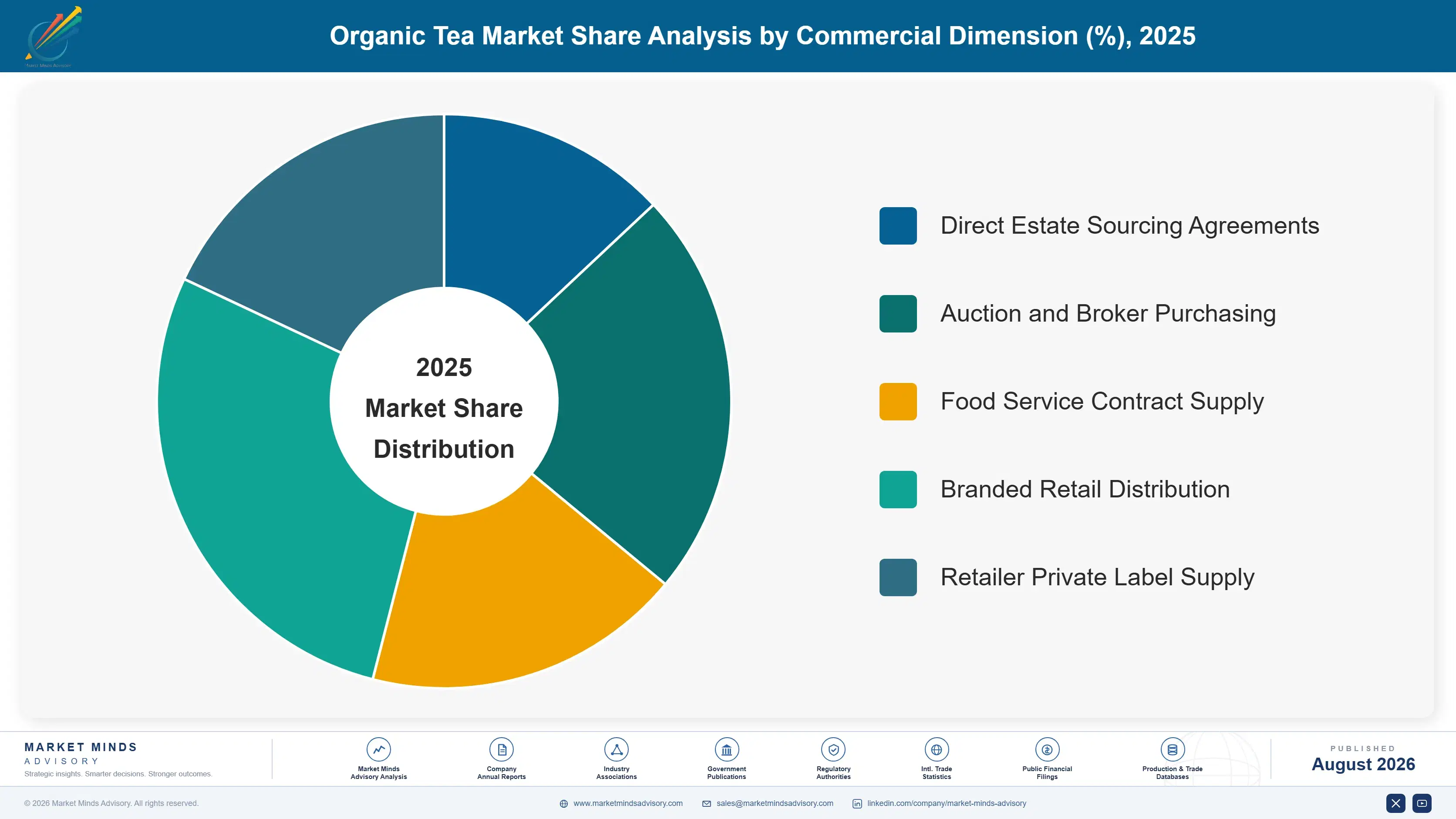
Five product types divide this market on how the tea is identified and presented to the buyer rather than on the plant variety or growing region. That reflects how pricing actually works, since a buyer pays for traceability, preparation format and certification status rather than for a botanical distinction that most purchasers could not name.
organic-tea-market-trends-forecast-market-share-analysis-1787375326101

Single-Origin and Estate-Identified Organic Tea

Growing at 10.5% and the fastest part of this market. Single-origin and estate-identified organic teas carry the name of a specific garden rather than a blend number, which is what lets a brand charge a premium that blended organic tea has never sustained. Traceability is the commercial mechanism rather than the flavour, because a buyer paying four times commodity pricing wants to know which slope the leaf came from and who picked it. Certified estates in Darjeeling, Uji and the Chinese mountain regions supply most of the volume, and their capacity is genuinely fixed by geography. That scarcity is the whole basis of the pricing, and it is not going to change.
CAGR 10.5%

Organic Matcha and Powdered Green Tea

Growing at 9.1% on organic matcha and powdered green tea, where the whole leaf is consumed rather than infused and pesticide residue therefore matters far more to buyers than it does in leaf tea. That single technical fact has done more for organic conversion in this segment than any marketing argument. Japanese Uji and Nishio production holds the quality reference position while Chinese and increasingly Kenyan supply serves the volume end. Ceremonial grade commands multiples of culinary grade and the two barely compete. Food service demand through cafe chains has grown faster than retail, which is where most of the recent volume has actually gone. Grinding method matters as much as origin.
CAGR 9.1%
Full segment breakdown across 5 segments available in the complete report.

Regional Architecture and Country Demand Map

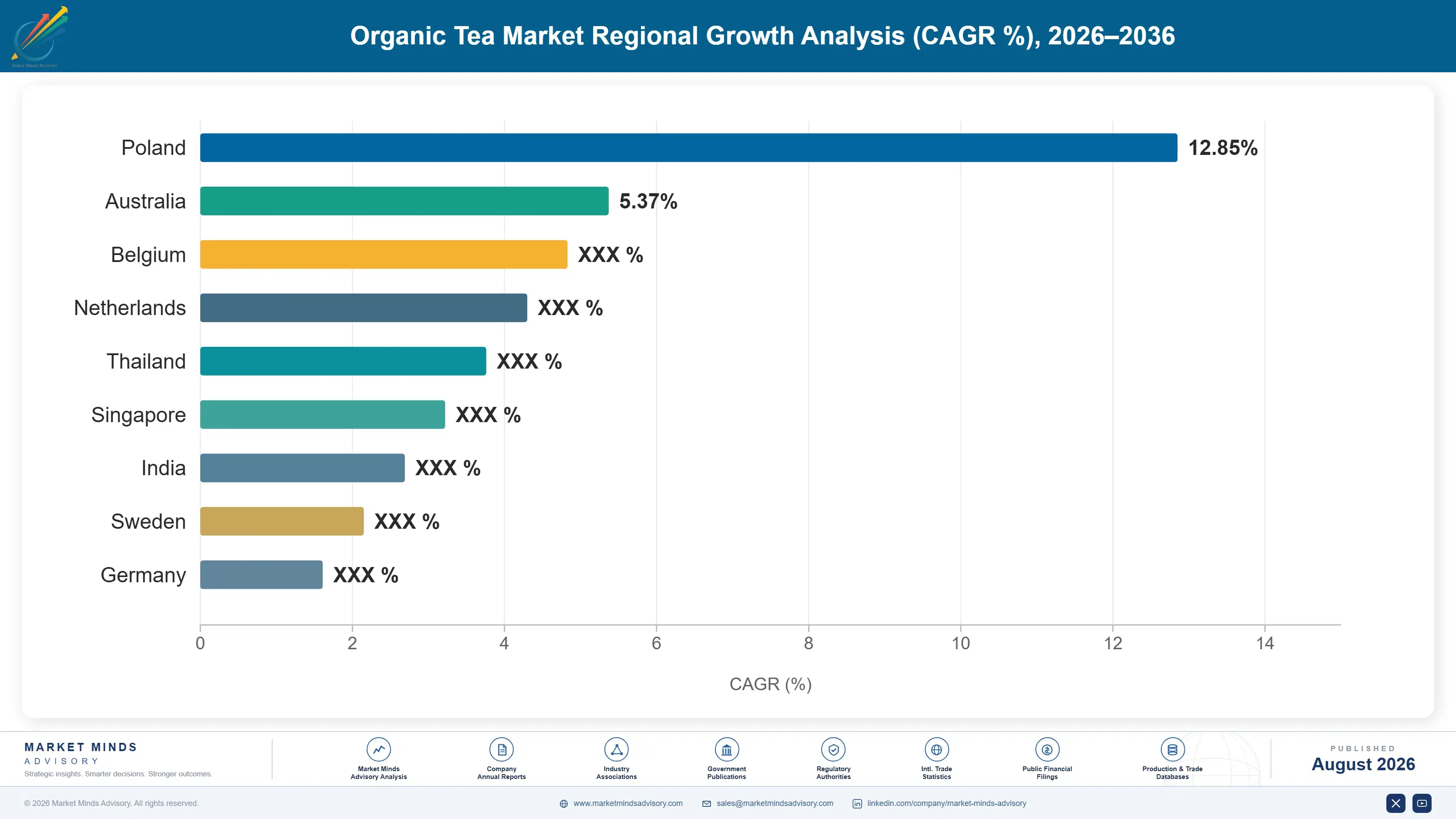
East Asia holds 33% of global value because it is the only region where growing, processing and drinking organic tea all happen at genuine scale together. South Asia and Pacific follows at 18% on Indian production and rising domestic consumption, and grows fastest of all.

East Asia

Note: East Asia sits above the standard share band and South Asia and Pacific below it because tea is one of the few categories where production and consumption concentrate in the same places, and no allocation reflecting the real market avoids that. China and Japan grow, process and drink organic tea at scale simultaneously. Japanese Uji and Nishio matcha production holds the global quality reference position, and domestic ceremonial demand supports pricing no export market matches. Chinese mountain region estates supply both premium single-origin export and a large domestic premium market that has developed quickly. Korean consumption is smaller and weighted toward imported speciality product. Domestic premium demand there developed remarkably quickly.
Share: 33% | CAGR: 8.1% (2026 to 2036)

South Asia and Pacific

Note: this region sits above the standard band because India grows and drinks more tea than anywhere on earth, and a Western-weighted allocation would misrepresent where the product actually is. Indian production spans Assam, Darjeeling and the Nilgiris with certified estates in all three, and Darjeeling in particular carries a scarcity premium nothing else in tea approaches. Domestic consumption is trading up from unbranded commodity loose leaf into branded and certified products for the first time at scale. Sri Lankan Ceylon estates hold established certified positions serving export. Indonesian and Vietnamese production is growing and competes mainly on cost rather than on origin identity. Darjeeling capacity has not expanded and will not.
Share: 18% | CAGR: 9.3% (2026 to 2036)
Regional intelligence for 5 additional markets available in the complete report: North America, Western Europe, Latin America, Middle East and Africa, Eastern Europe. Contact sales@marketmindsadvisory.com.
organic-tea-market-trends-forecast-country-cagr-analysis-1787375326620

Where Organic Tea Margin Actually Sits

Four positions separate businesses earning real returns from those trading certified leaf on a thin spread: securing estate supply under long agreements, winning food service chain listings, funding grower conversion before competitors do, and building group certification structures that bring smallholder supply into reach. Only the first of those depends on scarcity nobody can manufacture.

Secure Estate Supply Under Multi-Year Agreements

Certified estate capacity in Darjeeling, Uji and the Chinese mountain regions is fixed by geography and nobody is planting more of it, which makes forward supply agreements considerably more valuable than they look on a spreadsheet. Buyers holding multi-year estate arrangements realise 30% to 38% higher margin than those buying at auction, because the scarcity works for them rather than against them. Estates prefer committed offtake, which means the terms are usually available to anybody who asks early enough. Auction bidding is what everybody else in the market is left doing.
Market Impact: Realises as much as 38% higher sourcing margin

Win Food Service Chain Listings Rather Than Retail Shelf

Cafe chains buy on contracted volume against a technical specification with no shelf competition involved at any point, and a single listing standardises across hundreds of outlets. Roughly 31% of category value now moves this way, and it is where nearly all incremental growth has gone. Winning a chain takes months of trials and real technical support on preparation consistency. Suppliers holding chain listings carry volume predictability that retail distribution has never offered anybody in this category. Retail promotion against private label is the alternative, and it has largely stopped working.
Market Impact: Reaches the 31% of value in food service

Fund Grower Conversion Before Competitors Reach Them

Three years of organic practice sold at conventional prices is an unaffordable proposition for most smallholders, which is precisely why certified area sits near 9% of world tea acreage. Buyers funding conversion through transition premiums and guaranteed offtake secure supply at costs 20% to 26% below post-certification market rates and lock in relationships competitors cannot displace afterwards. The capital at risk is modest per hectare, and the alternative is bidding against everybody else for the same scarce certified leaf. The relationship tends to outlast the financing by a very considerable margin.
Market Impact: Secures leaf as much as 26% below market

Build Group Certification Structures For Smallholder Supply

Certification cost runs around 11% of production and much of it is fixed per holding, which means a two-hectare grower carries several times what an estate does per kilogram and is effectively excluded regardless of practice. Group certification and cooperative audit structures cut that burden by 40% to 55% per producer and bring supply into reach that no competitor buying at auction can access. The administrative work is real, and it buys a supply base rather than a transaction. Auction buyers simply cannot reach these growers on any terms at all.
Market Impact: Cuts certification burden by as much as 55%

Who Controls the Margin Pool

Concentration reads at 26% for the top five measured on organic tea revenue, the basis used throughout this section, and that is genuinely low for a packaged food category. Unilever and Tata hold scale positions built on conventional tea businesses. Associated British Foods and Hain Celestial bring branded speciality and herbal ranges. Yamamotoyama holds a Japanese matcha position that Western companies have not replicated.
Competition runs on three fronts. Estate supply access is the first and increasingly the decisive one, since certified capacity is fixed and forward agreements determine who can offer what. Food service listings are the second, and they carry volume that retail shelf never delivered. Group certification capability is the third, because it determines who can reach smallholder supply at all.

Pressure arrives from two directions. Japanese matcha specialists hold quality reference positions that scale alone does not overcome, and Western companies have found the category harder to enter than expected. Separately, Kenyan certified production is taking the volume end of powdered green tea at prices Japanese supply cannot approach. Rankings will shift toward participants holding estate agreements and chain listings together.
organic-tea-market-trends-forecast-company-positioning-matrix-1787375327146

Competitive Moat and Risk Dimensions

UNILEVER

Moat: Sourcing scale and estate relationships

Decades of direct sourcing relationships across Indian, Kenyan and Sri Lankan growing regions give the group access to certified supply and conversion partnerships that a buyer entering at auction cannot assemble at any price. Global distribution reach also means a certified lot can be placed across several markets rather than depending on demand in any single one.
UNILEVER

Risk: Limited matcha category position

Japanese matcha specialists hold quality reference positions built on processing tradition and regional supply that corporate scale does not overcome, and matcha is where the growth has gone. Building credibility in a category where buyers scrutinise origin and grinding method is not something a large branded business achieves through distribution alone.
TATA CONSUMER PRODUCTS

Moat: Indian production and domestic reach

Owned and contracted estate capacity across Assam, Darjeeling and the Nilgiris combines with the distribution reach to serve Indian households trading up from unbranded commodity leaf, which is where domestic growth is actually happening. Holding both the supply and the route to market in the fastest growing consumption market is a position no importer can construct.
TATA CONSUMER PRODUCTS

Risk: Concentration in Indian supply

Heavy weighting toward Indian production leaves the business exposed to monsoon variability, Darjeeling labour disputes and domestic policy in ways that a geographically spread sourcing base would moderate. Japanese and Chinese premium segments where matcha growth concentrates also sit largely outside the group's supply footprint and relationships.

Players Tracked

Prominent Players

Unilever
Tata Consumer Products
Associated British Foods
Hain Celestial
Yamamotoyama

Other Key Players

Bettys and Taylors of Harrogate
Ito En
Kusmi Tea
Numi Organic Tea
Pukka Herbs
Rishi Tea
Traditional Medicinals
Wissotzky Tea
Dilmah
Marukyu Koyamaen
Aiya Company
Kenya Tea Development Agency
Goodricke Group
Harney and Sons
Ronnefeldt

Recent Developments

JANUARY 2025

Cafe chain adds organic matcha to permanent menu nationwide

A national cafe chain moved organic matcha preparations from seasonal promotion onto its permanent menu across every outlet, converting what had been intermittent purchasing into contracted annual volume and requiring a supply agreement with specification consistency across hundreds of stores. Volume commitments now run on an annual basis.
Signal: Permanent menu placement converts seasonal buying into contracted volume no retail listing has ever managed to match
MAY 2025

Conversion financing programme launched for smallholder tea growers

A tea buyer launched a conversion financing programme paying transition premiums and guaranteeing offtake for smallholders through the three-year organic certification period, addressing the funding gap that has kept certified area near a tenth of world acreage. Offtake is guaranteed across the full three-year transition period.
Signal: Buyers are funding conversion because bidding for scarce certified leaf costs considerably more than financing it
SEPTEMBER 2025

Kenyan certified matcha capacity commissioned for volume supply

A Kenyan producer commissioned certified organic matcha processing capacity aimed at the volume end of food service demand, competing on delivered cost against Japanese supply that has held the category on quality reference rather than on price. Ceremonial grade remains well outside the intended commercial positioning.
Signal: African certified capacity is entering matcha at the volume end where Japanese pricing cannot realistically hope to compete

What Drives Certified Tea Cost

Green leaf accounts for roughly 46% of certified tea cost, reflecting the yield penalty organic practice carries alongside the premium growers are paid. Labour for plucking and field work adds around 21%, which is high because organic weed and pest management is largely manual. Certification, audit and documentation contribute about 11%, processing and drying energy roughly 9%, and packaging and freight close to 13%.
Indian and Kenyan green leaf pricing moved sharply through 2023 and 2024 on monsoon variability and labour cost increases, with United States Department of Agriculture and national statistical office data both showing the movement, while Darjeeling supply was further constrained by garden closures and labour disputes. Japanese matcha leaf pricing rose separately on domestic demand outrunning available certified acreage across consecutive harvest years. Both moves fed into export pricing.

The disadvantage mechanism is certification cost spread across holding size, and it separates smallholders from estates absolutely. Audit and documentation are largely fixed per holding, so a two-hectare grower carries several times an estate's burden per kilogram whatever their practices look like. Exposure also varies by origin, since Japanese matcha producers face fixed acreage against rising demand while Kenyan and Indian producers can still convert additional land.
organic-tea-market-trends-forecast-cost-volatility-analysis-1787375327342

Contract green leaf on multi-year committed offtake terms

Green leaf is close to half of certified tea cost and prices on harvest conditions no buyer influences, which makes auction exposure uncomfortable across a season. Multi-year offtake secures both supply and predictable cost while giving growers the certainty they need to stay certified. The commitment carries volume risk when demand softens, which is the honest price of security.

Organise smallholder supply through group certification schemes

Certification cost is largely fixed per holding rather than per kilo, which excludes small growers whose practices were already closest to organic. Group schemes and cooperative audit structures cut that burden substantially and open supply auction buyers cannot reach. The administrative work is genuine and ongoing, and it buys a durable supply base rather than a single season.

Diversify origin between fixed and convertible acreage

Japanese matcha acreage is effectively fixed against rising demand while Kenyan and Indian growers can still convert additional land, and those two positions carry entirely different price trajectories. Holding both origins moderates exposure to either. Each origin requires its own quality qualification and buyer acceptance, since ceremonial and volume grades are not interchangeable in the applications that pay best.

Portfolio Architecture for Margin Defence

Portfolio economics here divide on traceability and channel rather than on leaf grade. Bulk certified leaf sold into blending competes on price per kilogram against every other certified origin, and the buyer treats it as interchangeable because without an estate name attached that is exactly what it is. Auction conditions set the price and nobody downstream influences them at all.
The middle tier is branded certified retail product. Certification supports a premium near 84% over conventional grades and consumers recognise the label, though retail promotional pressure and private label competition both cap what is actually realised. Margins reach the low thirties and depend on shelf position holding, which in a slow-growing Western category is not guaranteed. Private label certified product matches the positioning at lower shelf pricing.

Above both sits estate-identified and ceremonial grade product. A named garden, flush and slope supports pricing that blended organic has never sustained, capacity is fixed by geography, and food service chains contract volume against technical specification rather than buying on promotion. Margins reach the high forties. The position requires estate relationships built over years, which is why newcomers bid at auction instead and earn considerably less.

Volume / Commodity-Adjacent

Bulk certified leaf sold into blending without origin identification. The range reflects harvest conditions and auction pricing rather than commercial skill, and buyers treat the material as fully interchangeable between origins.
Gross Margin: 14 to 22%

Premium / Certified

Branded certified retail product carrying recognised organic labelling. The range reflects promotional depth and private label pressure, which vary considerably between markets and between retail accounts within them. Shelf position is not guaranteed.
Gross Margin: 28 to 36%

Sustainability / Regulatory / Next-Generation

Estate-identified and ceremonial grade product supplied to speciality retail and contracted food service. The wide range reflects whether estate relationships are held directly or the leaf was bought at auction.
Gross Margin: 43 to 53%
organic-tea-market-trends-forecast-portfolio-architecture-1787375327837

High-value Sub-segments and Strategic Watch-out

Estate-Identified Single-Origin Tea

High value and high growth together. Fixed geographic capacity and buyer demand for garden-level traceability support pricing blended organic never reached. The wide range reflects whether estate relationships are held directly or leaf is bought at auction. Newcomers bid at auction instead and earn considerably less.
Gross Margin: 43 to 53%

Ceremonial Grade Matcha Supply

High value on strong growth with Japanese acreage effectively fixed against rising demand. The range reflects origin and grinding quality, since ceremonial and culinary grades barely compete and command entirely different pricing from buyers. Japanese acreage cannot expand to meet that demand on any timescale.
Gross Margin: 41 to 50%

Food Service Contract Volume

The volume core of recent growth and where nearly all incremental demand has gone. The range reflects whether the supplier holds a chain listing directly or supplies through a distributor taking margin between them. Trials take months and require genuine technical support all the way through.
Gross Margin: 30 to 38%

Bulk Certified Blending Leaf

The strategic watch-out. Volumes are real but the material is interchangeable between origins, pricing follows auction conditions, and no relationship protects the position. The range reflects harvest outcomes rather than any commercial decision. No relationship protects this position when a cheaper origin appears at auction.
Gross Margin: 14 to 22%

How Organic Tea Demand Repeats

Two repeat mechanisms operate here and they behave nothing alike. A food service chain listing repeats as contracted volume for as long as the item stays on the menu, which is now measured in years since matcha moved from seasonal promotion to permanent placement. Retail purchase repeats on consumer habit, which in tea is unusually durable once formed but takes a long time to form at all.
Stickiness varies sharply by position. Ceremonial matcha buyers hold best, because origin, grinding and flavour profile are genuinely difficult to substitute and a change is immediately noticeable in the cup. Estate-identified buyers hold well for similar reasons. Branded retail holds moderately and moves on promotion more than the category likes to admit. Bulk blending leaf holds worst of all, switching between origins on price without any hesitation.

The buyer profile has broadened considerably. Early organic tea demand came from older consumers making a values choice and accepting a compromised product to make it. Today's growth comes from cafe customers who mostly do not know the tea is certified, and from Indian households trading up from unbranded commodity leaf for reasons of quality and convenience rather than any organic argument at all.
organic-tea-market-trends-forecast-end-use-penetration-index-1787375328326

Where To Compete And Why

These are among the four positions where our research anticipates prominent divergence between winners and laggards over the coming forecast period. Each is grounded in the demand model, the regulatory perimeter, and the announced capacity pipeline.
01 / ESTATE RELATIONSHIP BUILDING

Nobody is planting more Darjeeling

Certified estate capacity in Darjeeling, Uji and the Chinese mountain regions is fixed by geography rather than by investment, which makes forward supply agreements far more valuable than they look on any spreadsheet. Buyers holding multi-year estate arrangements realise 30% to 38% higher margin than those bidding at auction, because scarcity works for them instead of against them. Estates generally prefer committed offtake, so the terms are usually available to whoever thinks to ask early enough, which surprisingly few buyers ever do.
02 / FOOD SERVICE LISTING FOCUS

Menus contract, shelves promote

Cafe chains buy contracted volume against a technical specification with no shelf competition and no promotional cycle involved, and a single listing standardises across hundreds of outlets at once. Roughly 31% of category value moves this way and it is where nearly all incremental growth has gone since matcha reached permanent menus. Winning a chain takes months of trials and genuine technical support on preparation consistency across varied equipment and staff, which is where most suppliers actually end up falling down.
03 / CONVERSION FINANCING PROVISION

Three unpaid years stops growers

Organic certification requires three years of compliant practice sold at conventional prices, which is simply unaffordable for most smallholders and is why certified area sits near 9% of world tea acreage. Buyers funding transition premiums and guaranteeing offtake secure leaf at 20% to 26% below post-certification market rates while building relationships competitors cannot displace. The capital at risk per hectare is modest against the cost of bidding at auction for the scarce certified supply that everybody else wants as well.
04 / GROUP CERTIFICATION ORGANISING

Audit cost excludes the best growers

Certification runs around 11% of production cost and is largely fixed per holding, so a two-hectare grower carries several times an estate's burden per kilogram regardless of how their practices actually compare. Group and cooperative audit structures cut that by 40% to 55% per producer and open supply no auction buyer can reach at all. The administrative work is genuine and continuing, and what it buys is a supply base rather than a single transaction that ends with the season.

Engagement Snapshot From the Field

A live engagement with an industry participant carrying material or product regulatory and market exposure ahead of a defining policy shift, showing how our research translates into a defensible multi-year portfolio strategy.
MARKET MINDS ADVISORY · CLIENT ENGAGEMENT SUMMARY
Organic Tea Producer Strategic Portfolio Review and Transition Roadmap 2026·Investment Scenario on Organic Tea Exposure Evaluation 2025-26
CLIENT PROFILE
A European speciality tea importer and brand with annual revenue near $64 million (client-reported, unverified by MMA), roughly 71% of it from branded certified retail across five countries with the balance in bulk trading. The business held good retail listings and consumer recognition, but bought almost all leaf at auction and held no direct estate relationships whatsoever.
STRATEGIC CHALLENGE
Retail growth had stalled in a mature European category while matcha demand grew through food service the client did not serve at all. Auction pricing for certified leaf had risen faster than shelf pricing across two seasons. Management needed to decide between defending retail, entering food service, or building direct estate sourcing.
MMA APPROACH
MMA modelled realised margin by sourcing route and channel across four years of the client's own purchase and sales data, benchmarked auction pricing against direct estate agreements held by competitors, and assessed food service listing requirements with chain buyers. Twenty expert interviews with estate managers, cafe chain procurement leads and certification bodies tested each route.
KEY FINDINGS
  1. Competitors holding direct estate agreements were paying roughly 24% less for comparable certified leaf than the client paid at auction, and had done so consistently across every season examined.
  2. Cafe chain buyers required preparation consistency support across varied equipment and staff, which the client could supply readily but had never been asked about because it had never approached them.
  3. Retail promotional depth had risen for six consecutive quarters without moving volume, since private label certified product was matching the client's positioning at materially lower shelf pricing.
  4. Two Sri Lankan estates the client already bought from at auction were willing to discuss multi-year offtake directly, which nobody at the client had ever tested or even enquired about.
CLIENT PROFILE
A European speciality tea importer and brand with annual revenue near $64 million (client-reported, unverified by MMA), roughly 71% of it from branded certified retail across five countries with the balance in bulk trading. The business held good retail listings and consumer recognition, but bought almost all leaf at auction and held no direct estate relationships whatsoever.
STRATEGIC CHALLENGE
Retail growth had stalled in a mature European category while matcha demand grew through food service the client did not serve at all. Auction pricing for certified leaf had risen faster than shelf pricing across two seasons. Management needed to decide between defending retail, entering food service, or building direct estate sourcing.
MMA APPROACH
MMA modelled realised margin by sourcing route and channel across four years of the client's own purchase and sales data, benchmarked auction pricing against direct estate agreements held by competitors, and assessed food service listing requirements with chain buyers. Twenty expert interviews with estate managers, cafe chain procurement leads and certification bodies tested each route.
KEY FINDINGS
  1. Competitors holding direct estate agreements were paying roughly 24% less for comparable certified leaf than the client paid at auction, and had done so consistently across every season examined.
  2. Cafe chain buyers required preparation consistency support across varied equipment and staff, which the client could supply readily but had never been asked about because it had never approached them.
  3. Retail promotional depth had risen for six consecutive quarters without moving volume, since private label certified product was matching the client's positioning at materially lower shelf pricing.
  4. Two Sri Lankan estates the client already bought from at auction were willing to discuss multi-year offtake directly, which nobody at the client had ever tested or even enquired about.
RECOMMENDED STRATEGY
Phase 1: Phase one: convert auction purchasing to direct multi-year offtake with the estates already supplying the client, since the relationships exist and only the contracting is missing. Phase 2: Phase two: approach cafe chains with a preparation consistency support offer, entering a channel that contracts volume rather than promoting against private label. Phase 3: Phase three: narrow the retail range to lines where estate identification supports a premium private label cannot match on any terms.
OUTCOME
The client signed direct offtake with three estates within ten months and cut certified leaf cost by roughly 19% (client-reported, unverified by MMA). Two cafe chain listings were won, food service reached 21% of volume from nothing, and blended gross margin improved by about nine points while the retail range was cut by a third.

Frequently Asked Questions

Foundational context covering the market sizes, CAGR, scope, country, region and competition that inform every finding below. This section is provided to cover basics and most often pre-purchase conversations, answered from the MMA Primary Research Dataset.

What is the current size of the Organic Tea Market?

The global organic tea market was valued at $1.90 billion in 2025, reaching an estimated $2.03 billion in 2026. That covers tea produced under organic certification across retail, food service and bulk channels.

How large will the Organic Tea Market be by 2036?

MMA forecasts the market reaching $3.99 billion by 2036, an increase of $1.96 billion over the 2026 base. That represents an expansion multiple of 1.97 times across the forecast period.

What is the CAGR for the Organic Tea Market 2026 to 2036?

The base case compound annual growth rate is 7.0%, with a bull case of 8.2% and a bear case of 5.9%. Historical growth between 2020 and 2025 ran at 6.1% annually.

Which segment is growing fastest?

Single-origin and estate-identified organic tea grows at 10.5%, a full 1.50 times the market rate, on capacity fixed by geography. Organic matcha and powdered green tea follows at 9.1%.

Who are the major companies in the Organic Tea Market?

Unilever, Tata Consumer Products, Associated British Foods, Hain Celestial and Yamamotoyama lead on organic tea revenue. Together they account for roughly 26%, which is genuinely low for packaged food.

Which country is growing fastest?

India grows fastest at 9.8% annually, driven by middle-class households trading up from unbranded commodity loose leaf into branded certified products. China follows on domestic premium demand.

Report Segmentation Architecture

The full report scope spans multiple orthogonal segmentation dimensions, with cross-tabulated demand data provided for each dimension pair. Coverage extends further to regional breakdowns, trend trajectories, and the competitive detail needed to support segment-level decision-making.

By Product Type

  • Single-Origin and Estate-Identified Organic Tea
  • Organic Matcha and Powdered Green Tea
  • Certified Black and Oolong Teas
  • Organic Herbal and Botanical Infusions
  • Bulk Certified Leaf for Blending

By End-Use Industry

  • Speciality Tea Retail
  • Grocery and Supermarket Retail
  • Cafe Chains and Coffee Shops
  • Hotels, Restaurants and Catering
  • Food and Beverage Manufacturing
  • Institutional and Workplace Supply

By Commercial Dimension

  • Direct Estate Sourcing Agreements
  • Auction and Broker Purchasing
  • Food Service Contract Supply
  • Branded Retail Distribution
  • Retailer Private Label Supply

By Region

  • North America
  • Western Europe
  • East Asia
  • South Asia and Pacific
  • Latin America
  • Middle East and Africa
  • Eastern Europe

Scope, Methodology, and Coverage

Every figure in this report is reproducible from documented input assumptions. The scope below maps the historical period, the forecast horizon, the segmentation dimensions, and the countries covered, alongside the underlying primary and qualitative methodology.
Historical Period
2020 to 2025
Forecast Period
2026 to 2036
Base Year
2025 (USD billions; MMA Primary Research Dataset, August 2026)
Market Definition
This report covers tea produced under recognised organic certification, spanning single-origin and estate-identified teas, organic matcha and powdered green tea, certified black and oolong teas, organic herbal and botanical infusions, and bulk certified leaf supplied for blending, across direct estate sourcing, auction, food service, branded retail and private label channels. Conventionally grown tea of any kind, ready-to-drink bottled tea beverages, tea extracts and polyphenols sold as supplement ingredients, yerba mate, and uncertified speciality tea are excluded from the sizing.
Quantitative Units
USD billions at brand and supplier realised value; volume in thousand tonnes; realised pricing in USD per kilogram.
Segmentation Dimensions
By product type; by end-use industry; by commercial dimension; by region.
Regions Covered
North America, Western Europe, East Asia, South Asia and Pacific, Latin America, Middle East and Africa, Eastern Europe
Countries Covered
China, Japan, South Korea, India, Sri Lanka, Indonesia, Vietnam, Australia, United States, Canada, Brazil, Argentina, United Kingdom, Germany, France, Netherlands, Poland, Turkey, Kenya, Saudi Arabia.
Key Companies Profiled
Unilever, Tata Consumer Products, Associated British Foods, Hain Celestial, Yamamotoyama, Ito En, Kusmi Tea, Numi Organic Tea, Pukka Herbs, Rishi Tea, Dilmah, Marukyu Koyamaen, Kenya Tea Development Agency, Goodricke Group and others.
Quantitative Methodology
Primary survey, n=3,800 respondents, Q4 2025, six countries; demand-side model with trade association cross-validation
Qualitative Methodology
47 expert interviews, Q4 2025; applied to validate demand model assumptions, identify emerging dynamics, and assess competitive positioning
Report Format
PDF and XLSX data workbook (Word format preview document)
Publisher
Market Minds Advisory
Report Code
MMA-2026-AGR-131
Published
August 2026
Contact
sales@marketmindsadvisory.com | www.marketmindsadvisory.com

Purchase the full Organic Tea Market Report (2026 to 2036).

The full report sizes the organic tea market across five product types, six end-use categories and seven regions, with tonnage and per kilogram pricing detail behind every value estimate. It profiles twenty companies on estate sourcing position, food service listings and matcha capability. Regional chapters cover certified acreage, conversion rates and consumption patterns by market. Cost analysis quantifies green leaf, labour and certification exposure by holding size and origin. Certification analysis maps standards, group schemes and conversion economics across the major producing regions in detail.
Tonnage and per kilogram pricing by product type
Certified acreage and conversion rates by producing region
Estate sourcing agreements and auction pricing compared directly
Food service listing structures and chain requirements analysed
Competitive position assessments across twenty companies
Group certification schemes and smallholder economics assessed

Built For The People Who Decide

From boardroom strategy to bench-side execution, this report is read cover-to-cover by leaders shaping the next decade of their industry, turning demand scenarios, market dynamics and valuation benchmarks into decisions.
CXOs/ Presidents/ VPs/ Managers
M&A and Corporate Development
Strategy Teams and R&D Heads
Procurement and Product Directors
Regulatory and Compliance Leaders
Investor Relations and Equity Analysts