Market Minds Advisory
Organic Condiments Market

Organic Condiments Market: Multi-ingredient certification burden, own-label pressure and premium-base economics to 2036

Certifying a single ingredient is straightforward. Certifying a recipe with a dozen of them means every spice, vinegar and thickener has to qualify, and one that does not blocks the entire product.

Lead Analyst

Lisa Gevelber

Published

September 2026

Make Smarter Decisions with Customized Research Insights

Request a free sample report and evaluate market opportunities, growth trends, and competitive dynamics relevant to your business needs.

2025 MARKET VALUE$3.9BMarket Size 2025
2036 FORECAST VALUE$8.7BBase Case , 2026 to 2036
CAGR 2026 TO 20367.6 %Bull 8.8% / Bear 6.4%
INCREMENTAL OPPORTUNITY$4.5BNet 10- year value creation
EXPANSION MULTIPLE2.08x2036 value over 2026 base
Strategic Levers
M&A Pipeline
Regional Outlook
Country Rankings
Competitive Intelligence
Segmental Deep-dive
Call-Us : 91 93563 13602

Executive Snapshot and Market Trajectory

Organic milk needs one certified input. An organic condiment needs 95% of a recipe certified, which means every spice, vinegar, sweetener and thickener in it, and a single uncertified ingredient blocks the claim entirely. The premium compounds across all of them. Every one of them carries a premium.
The shopper then compares that shelf price on a product they buy a few times a year and use by the spoonful, which is why category penetration sits near 6% while single-ingredient organic categories run several times higher. Retailer own labels already hold 42% of the certified volume that does exist. Retailers can source identical certified inputs without carrying any brand-building cost at all, which makes price competition against them straightforwardly unwinnable for a brand.
Organic hot sauces and chilli condiments grow at 11.4%, half again the market rate of 7.6%, because the base product is already premium and the organic premium is therefore a small absolute sum rather than a doubling. North America holds 34% of value on the largest organic food spending anywhere. Western Europe follows at 30% on higher per capita penetration across a smaller total market.
Market Definition
This report covers certified organic condiments and table sauces, spanning organic ketchup and tomato condiments, organic mustard and vinegar-based products, organic mayonnaise and emulsified sauces, organic hot sauces and chilli condiments, organic Asian and ethnic sauces, and organic relishes pickles and chutneys. Value is measured at manufacturer level across retail and foodservice sales. Excluded are cooking sauces and meal bases, salad dressings sold as such, conventional condiments carrying non-organic natural claims, organic ingredients sold to formulators, and seasonings or dry spice blends.
Base Year Value
$3.9B in 2025 (MMA Primary Research Dataset, August 2026)
Forecast Period
2026 to 2036, eleven discrete annual values
CAGR
7.6% base case. Bull 8.8%. Bear 6.4%.
Fastest Growth Segment
Organic Hot Sauces and Chilli Condiments: 11.4% CAGR
Fastest Growth Country
China: 10.8% CAGR
Fastest Growth Region
South Asia and Pacific: 9.8% CAGR
Largest Region
North America: 34% of 2025 global value
Market Leaders
Kraft Heinz, Unilever, General Mills, Conagra Brands and Develey Senfmanufaktur lead the market. Source: MMA Primary Research Dataset, July 2026.
Primary Survey
n=3,800 procurement and R&D decision-makers, Q4 2025, six countries
Methodology
Demand-side build-up, cross-validated against public data, 47 expert interviews

Organic Condiments Market Forecast Scenarios

organic-condiments-market-size-forecast-scenario-1787559516488
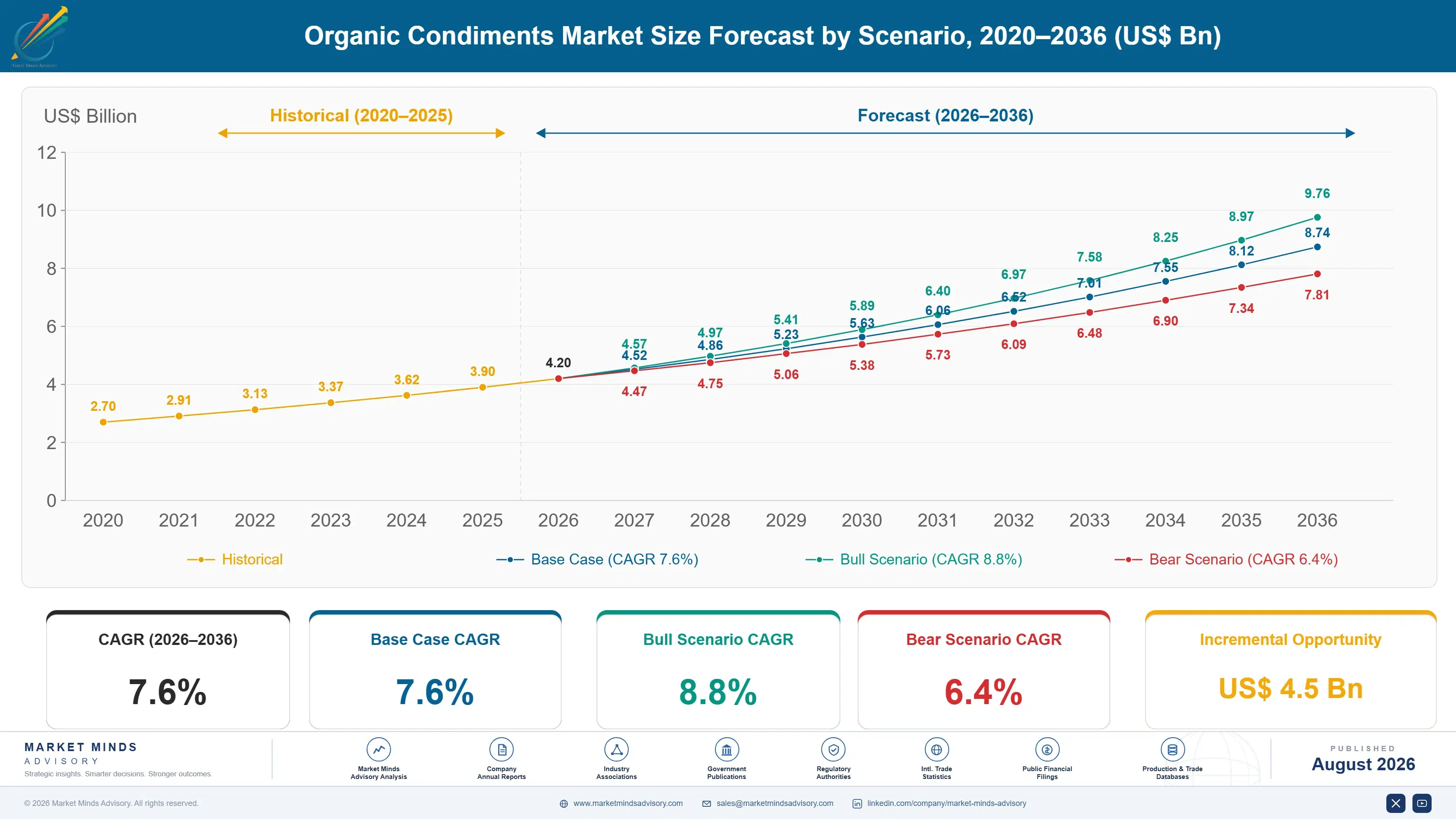
Growth ran at 6.6% between 2020 and 2025, driven by home cooking during the early period and by premium condiment categories expanding afterwards. Organic ketchup grew more slowly than the category average throughout, constrained by organic processing tomato availability and by a price comparison shoppers make readily against a conventional bottle they know the price of.
The 7.6% base case rests on three mechanisms. Organic hot sauces and chilli condiments at 11.4%, where a premium base price makes the organic increment small in absolute terms. Organic Asian and ethnic sauces at 9.6% as those categories premiumise generally. And Chinese growth at 10.8%, the fastest of any country, on urban food safety concern driving organic demand across packaged food. None of the three depends on mainstream ketchup conversion improving at all.
The 8.8% bull case is organic ingredient supply widening enough that multi-ingredient certification stops being the binding constraint on new product development. The 6.4% bear case is clean label claims continuing to convert better than organic at lower cost, since a shopper wanting no additives is served by a cheaper claim that requires no certification at all.

Certifying Every Single Ingredient

Organic conversion is far harder in a formulated product than in a single-ingredient one, and a condiment sits at the difficult end of that range. A recipe must be at least 95% certified organic ingredients to carry the claim, which covers not only the obvious tomatoes or mustard seed but every vinegar, sweetener, spice and thickener in the bottle. One ingredient without a certified supply chain blocks the entire product, and the organic premium on each certified input compounds through the recipe rather than applying to a single line.
TOP-FIVE CONCENTRATION24%Combined position across supply held by the leading brand owners
CERTIFIED INGREDIENT REQUIREMENT95%Portion of a recipe that must carry certification
ORGANIC CATEGORY PENETRATION6%Share of condiment volume carrying an organic certification claim
PRIVATE LABEL ORGANIC SHARE42%Portion of certified volume sold under retailer own brands
FOODSERVICE ORGANIC PENETRATION1%Certified share of sachet and bulk dispensing consumption
ORGANIC TOMATO YIELD GAP28%Harvest shortfall against conventional processing crop per hectare
The shopper then encounters that accumulated premium on a shelf beside a conventional bottle whose price they know perfectly well, for a product they purchase a few times a year and consume by the spoonful. The claim is worth little against that price gap, which is why penetration sits near 6% while single-ingredient categories run several times higher. Retailers understood this early and own labels now hold 42% of the certified volume.
Where organic does work is where the base product already carries a premium. A small-batch hot sauce is expensive before anybody certifies anything, so the organic increment is a modest absolute sum.
"Everybody models organic penetration as a single curve moving through the food aisle, and it simply does not work that way. In a bottle with twelve ingredients you need twelve certified supply chains, and the shopper compares the price against something they buy twice a year. The maths defeats it in the mainstream and works beautifully at the premium end."
Director, Packaged Foods and Organic Categories Practice · MMA Food and Agriculture Ingredients Practice · August 2026

Market Trends

Premium base products absorb the organic increment far better

Organic certification adds a percentage to input cost, which becomes a large absolute sum on a cheap product and a modest one on an expensive product already selling well above commodity pricing. Small-batch hot sauces, speciality Asian sauces and artisan condiments therefore convert to organic far more readily than mainstream ketchup does, and hot sauces grow at 11.4% against a category rate of 7.6%. Commercially this means organic growth follows premiumisation rather than leading it, and brands seeking organic volume should be looking at where premium condiment categories are already forming.
Market Impact: Chinese demand compounds at 10.8%

Own labels take certified volume before brands establish it

Retailers can source certified ingredients and place their own name on a bottle without any of the brand-building investment an independent organic manufacturer requires, and in condiments the brand carries less weight than in snacks or beverages anyway. Own labels consequently hold 42% of certified volume, which is high for a category still at 6% penetration. Commercially this means a branded organic condiment faces own-label competition from the outset rather than after establishing the category, which changes the economics of category development entirely. Retailers understood the category arithmetic earlier than most brands did.
Market Impact: Segment compounds at 9.6% annually

Market Opportunities and Growth Drivers

Chinese urban food safety concern drives organic packaged demand

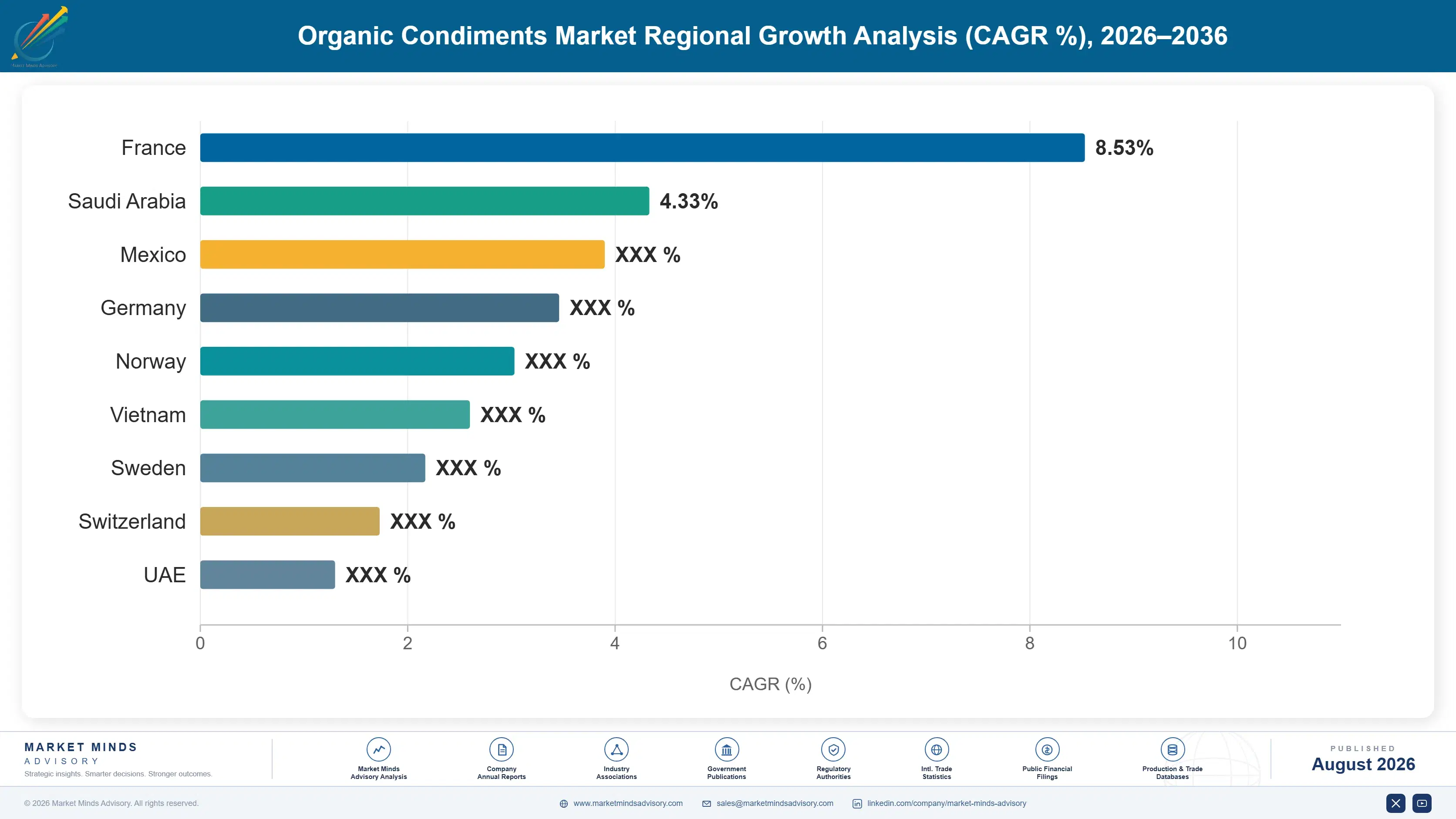
Chinese growth at 10.8% leads every country in this market, driven by urban household concern about food safety and adulteration rather than by the environmental motivations that built organic demand in Western markets. That produces a different purchase logic, since a shopper buying reassurance about what is in the bottle values certification differently from one buying farming practice. Imported certified brands carry a premium that domestic shoppers accept, and online channels rather than grocery retail carry most of the volume across the country. Certification means something different to that shopper entirely.
Market Impact: Recipes need 95% certified content

Ethnic and Asian sauce categories premiumise across Western retail

Asian, Latin American and Middle Eastern sauces have moved from speciality aisles into mainstream Western grocery over the past decade, and they arrived carrying premium positioning rather than commodity pricing. Growth at 9.6% in organic versions follows that premiumisation directly, since the base price already supports a certification increment. Commercially these categories also carry ingredient lists that shoppers scrutinise more closely than they scrutinise ketchup, which makes the organic claim carry more weight per bottle than it does in established categories. Shelf positioning arrived alongside premium pricing rather than after it.
Market Impact: Foodservice penetration sits at 1%

Market Restraints and Challenges

Multi-ingredient certification blocks products on a single input

A condiment requires 95% of its recipe to be certified organic, and a manufacturer developing a product frequently finds one spice, stabiliser or acidulant with no certified supply available at commercial volume. The root cause is that organic supply chains developed around high-volume commodity crops rather than around minor ingredients used in small quantities. Commercially this blocks entire recipes on a single line item and forces reformulation that changes the product. Manufacturers are working with ingredient suppliers to certify minor inputs, which is slow and rarely commercially attractive to the supplier.
Market Impact: Hot sauces compound at 11.4% yearly

Foodservice volume stays almost entirely uncertified

Sachets, bulk dispensers and catering packs account for a large share of total condiment consumption and organic penetration there sits near 1%, because purchasing is driven almost purely by cost per portion with no shopper present to value a claim. The root cause is that nobody sees the label on a sachet before using it. Commercially this caps overall category penetration well below what retail figures alone would suggest. Manufacturers are pursuing premium casual dining where the menu can reference the claim, which is a small subset of foodservice volume.
Market Impact: Own label holds 42% of volume
4 additional market trends, 3 additional growth drivers, and 2 additional restraints and challenges are covered in the full report. Contact sales@marketmindsadvisory.com to access the complete intelligence.

Segment CAGR and Growth Architecture

Value is classified here by condiment type, since base price level, ingredient complexity and certification difficulty all differ enormously between a tomato ketchup and a fermented chilli sauce. Certification standard, distribution channel and pack format are each handled separately in the framework below, because most product types reach shoppers through several routes at once.
organic-condiments-market-market-share-analysis-1787559517018

Organic Hot Sauces and Chilli Condiments

Growing at 11.4%, half again the market rate and faster than anything else here, hot sauces convert to organic readily for a reason that has nothing to do with the chilli. The base product already sells at a premium to commodity condiments, so the certification increment is a modest absolute sum rather than a doubling of shelf price, and the shopper buying a small-batch sauce is already paying for provenance and craft. Ingredient lists are also short, frequently chillies, vinegar, salt and a little garlic, which makes 95% certified content genuinely achievable rather than a development obstacle requiring reformulation around a missing certified input. The shopper was already paying for provenance before certification appeared.
CAGR 11.4%

Organic Asian and Ethnic Sauces

Asian, Latin American and Middle Eastern sauces moved from speciality aisles into mainstream Western grocery over the past decade and arrived carrying premium positioning rather than commodity pricing, which supports a certification increment comfortably. Growth at 9.6% follows that premiumisation rather than driving it. Shoppers also scrutinise ingredient lists in these categories more closely than in established ones, so the organic claim carries more weight per bottle. Certification is harder here than in hot sauces, since fermented soy, speciality vinegars and regional spices frequently lack certified supply at commercial volume. That sourcing difficulty is what limits how quickly the segment can expand, rather than any hesitation among shoppers about paying the premium involved.
CAGR 9.6%
Full segment breakdown across 6 segments available in the complete report.

Regional Architecture and Country Demand Map

North America holds 34% of value, above the standard band, because organic food spending there exceeds any other market by a wide margin and organic condiments are largely an American retail phenomenon. Western Europe follows at 30% on higher per capita penetration across a smaller total market.

North America

At 34% this region sits above the standard band, because American organic food spending exceeds every other market by a considerable margin and organic condiments established themselves in mainstream grocery here earlier than anywhere else. Natural channel retailers built the category before conventional grocery adopted it, which gave brands a route to scale that European markets did not offer in the same way. Private label penetration is correspondingly advanced, with major grocers holding substantial certified ranges. Organic processing tomato supply concentrates in California and constrains ketchup volume directly. Growth at 6.8% sits below the market rate on an established base. Natural channel retailers built the category before conventional grocery adopted it.
Share: 34% | CAGR: 6.8% (2026 to 2036)

Western Europe

At 30% this region sits above the standard band, with per capita organic penetration in Danish, Austrian, Swiss and German retail exceeding American rates even though total market value is smaller. Organic condiments here often reach shoppers through dedicated organic retail chains alongside conventional grocery, which is a distribution structure with no real American equivalent. German mustard and Italian tomato traditions both support strong certified positions among specialist manufacturers. Organic processing tomato supply concentrates in Italy and Spain. Growth at 6.0% is the weakest here and reflects a mature and well-penetrated market. Dedicated organic retail chains provide a distribution structure with no real American equivalent, which reaches committed organic households directly.
Share: 30% | CAGR: 6.0% (2026 to 2036)
Regional intelligence for 5 additional markets available in the complete report: East Asia, South Asia and Pacific, Latin America, Middle East and Africa, Eastern Europe. Contact sales@marketmindsadvisory.com.
organic-condiments-market-country-cagr-analysis-1787559517534

Where Organic Condiment Value Works

Four moves matter in a category where certification cost compounds across every ingredient and the shopper compares a shelf price on something bought a few times a year. Two concern choosing the categories where the arithmetic actually works, and two concern the supply and channel problems that decide whether a product can exist at all.

Certify where the base price is already premium

Organic certification adds a percentage to input cost, which is a large absolute sum on a cheap bottle and a modest one on a product already selling well above commodity pricing. Hot sauces grow at 11.4% and Asian sauces at 9.6% for exactly that reason, while mainstream ketchup struggles against a price the shopper knows. Brands seeking organic growth should follow premiumisation rather than trying to convert the categories where the percentage lands hardest on the shelf. Premiumisation is already happening and organic can follow it. The categories are already forming.
Market Impact: Serves categories that are growing at 11.4% yearly

Design recipes around available certified ingredients

A condiment needs 95% certified content and development frequently stalls on one spice, stabiliser or acidulant that has no certified supply at commercial volume. Designing the recipe from what is certifiably available, rather than certifying an existing recipe, avoids the reformulation that changes a product after development has already committed to it. Short ingredient lists are also easier, which is another reason hot sauces convert so much more readily than complex emulsified sauces do. Short lists are why hot sauces convert so readily. Complex emulsified sauces are the hardest case.
Market Impact: Meets a 95% threshold on certified recipe content

Contract organic tomato supply across multiple origins

Organic processing tomatoes yield around 28% less per hectare than conventional crop and production concentrates in California, Italy and Spain, which makes supply genuinely tight and regionally exposed to a poor season. Ketchup is the volume driver in condiments and its organic availability is capped by that crop rather than by demand. Multi-origin contracting spreads weather and yield exposure, and manufacturers relying on a single growing region discover the constraint in exactly the season they can least afford it. A poor season in one region is a supply failure rather than a price event.
Market Impact: Manages a 28% yield gap on organic tomatoes

Compete with own label on provenance, not on price

Retailer own labels hold 42% of certified volume and can source the same ingredients without brand-building cost, which makes price competition against them unwinnable in a category where the brand already carries limited weight. Provenance, farm relationships and production method are what an own label cannot readily replicate, and shoppers paying an organic premium are the ones most receptive to that story. Brands defending shelf position on price are competing on the only ground where they cannot win. Shoppers paying a premium are the most receptive audience for it. Own label cannot buy a farm relationship.
Market Impact: Counters a 42% own label share of volume

Who Controls the Margin Pool

Five brand owners hold 24% of this market, measured on retail and foodservice sales value at manufacturer level, the basis used throughout this section. Concentration is low because organic condiments are populated by small specialist manufacturers alongside retailer own labels, and the large packaged food companies participate through acquired brands rather than through converted mainstream ranges. Acquisition rather than conversion is how the majors participate.
Competition runs on four dimensions. Certified ingredient sourcing depth, since a single missing minor input blocks an entire recipe rather than merely raising its cost. Category selection, because the arithmetic works comfortably at premium price points and fails at commodity ones. Provenance storytelling, which is precisely what a retailer own label cannot replicate. And organic tomato supply access for anybody serious about ketchup volume at all.

Rankings shift toward specialists in premium categories and away from brands attempting mainstream conversion against own label pricing they cannot match. American brands hold the largest established positions built through natural channel retail. European specialist manufacturers hold the deepest certified supply relationships anywhere. Retailers hold 42% of certified volume and show no sign whatever of giving any of it back.
organic-condiments-market-company-positioning-matrix-1787559518055

Competitive Moat and Risk Dimensions

KRAFT HEINZ

Moat: Tomato supply and distribution scale

The company holds contracted organic processing tomato supply across multiple growing regions, which matters disproportionately because organic tomato yields run around 28% below conventional and the crop concentrates geographically. Distribution reach across mainstream grocery also places certified products beside conventional equivalents rather than confining them to natural channels where volume is limited.
KRAFT HEINZ

Risk: Mainstream price comparison exposure

Organic ketchup sits beside a conventional bottle whose price shoppers know precisely, which makes the certification premium highly visible on a product bought a few times a year. Own labels hold 42% of certified volume at lower prices. Brands in premium categories where the base price already absorbs the increment face no comparable comparison at all.
DEVELEY SENFMANUFAKTUR

Moat: Certified supply chain depth

The company holds long-standing certified ingredient relationships across mustard seed, vinegar and spice supply built through decades of European organic production, which matters because a single uncertified minor input blocks an entire recipe. That sourcing depth lets it develop products competitors cannot formulate at all, rather than merely producing them at better cost.
DEVELEY SENFMANUFAKTUR

Risk: European market growth ceiling

Western European organic penetration is already high and the region grows at 6.0%, the weakest on this table, while Chinese demand grows at 10.8% on entirely different purchase motivations. European certified sourcing depth transfers imperfectly to Asian ingredient categories. Specialists in premium and ethnic categories reach growth that mustard and vinegar heritage does not.

Players Tracked

Prominent Players

Kraft Heinz
Unilever
General Mills
Conagra Brands
Develey Senfmanufaktur

Other Key Players

Nestle
McCormick
Kikkoman
Ajinomoto
Hain Celestial
Amy's Kitchen
Eden Foods
Rapunzel Naturkost
Zwergenwiese
Byodo Naturkost
Biona Organic
Meridian Foods
Alnatura
Bionaturae
Woodstock Foods

Recent Developments

MARCH 2025

A retailer expanded organic condiments across its own label range

A grocery retailer extended certified organic condiments across its own label range at price points substantially below branded equivalents, sourcing certified ingredients directly rather than through any branded manufacturer. This was a private label programme rather than any transaction between condiment brands themselves. Pricing sat well below branded equivalents.
Signal: Own label enters certified categories before brands establish them, which changes the category development economics completely
JULY 2025

A hot sauce brand converted its full range to certified organic

A premium hot sauce manufacturer converted its entire range to certified organic, citing short ingredient lists making the certification threshold achievable and a base price that already absorbed the input cost increase comfortably. This was a product decision rather than any commercial transaction. The full range converted at once.
Signal: Short recipes and premium base prices together are what make organic conversion economically viable in condiments
NOVEMBER 2025

An ingredient supplier certified minor spice inputs for formulators

An ingredient supplier completed organic certification across a range of minor spices and acidulants used in small quantities, addressing the single missing inputs that had been blocking condiment recipes from reaching the certified content threshold. This was a supplier investment rather than any partnership. Commercial volumes are now available.
Signal: Minor ingredient certification unblocks recipes that were failing on one line item rather than on cost

What Sets Manufactured Cost

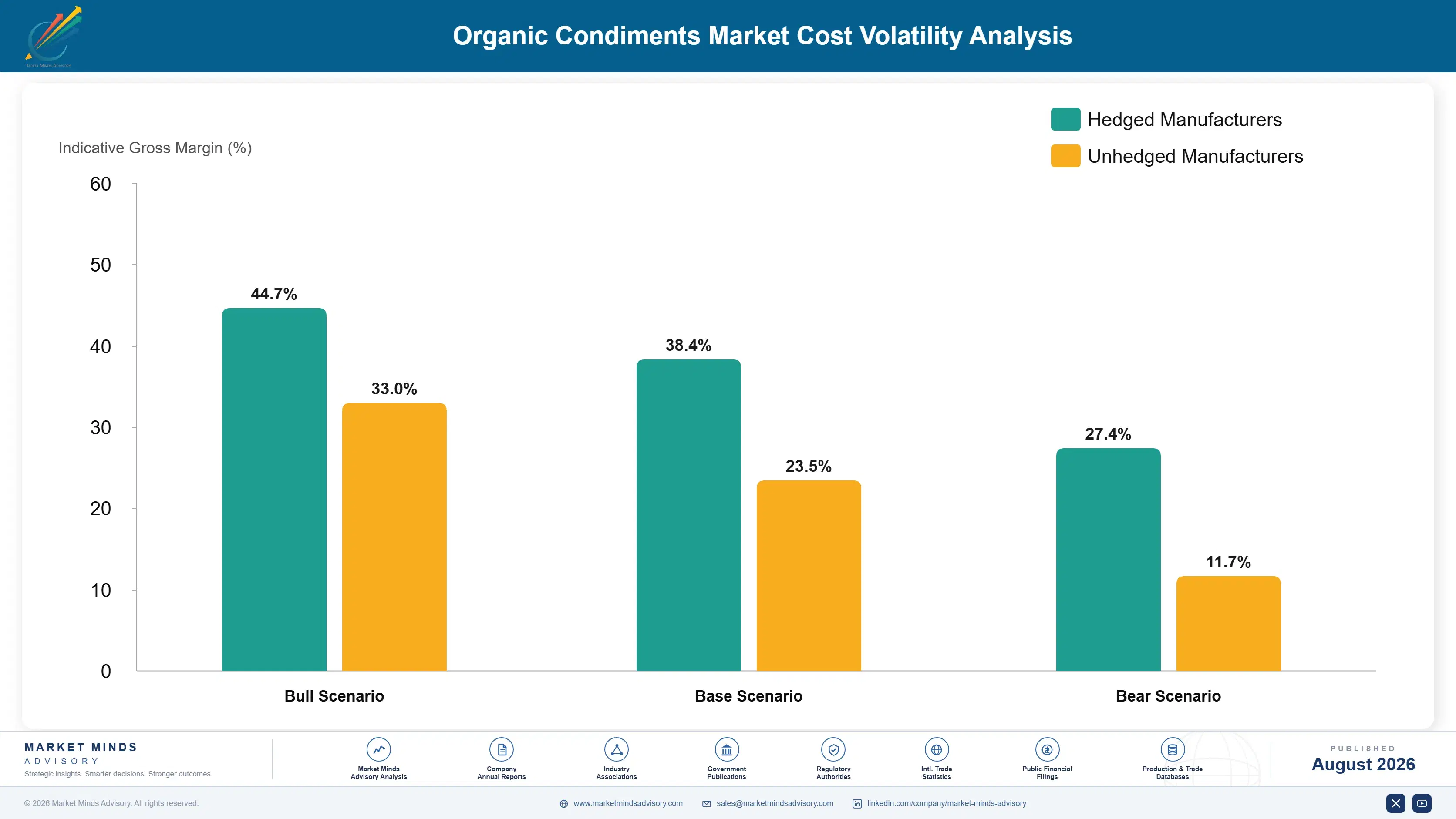
Certified organic ingredients account for roughly 47% of manufactured cost, considerably above the conventional equivalent because the premium applies across every input rather than to a single headline one. Packaging adds around 21% and is broadly the same as conventional. Certification, audit and traceability administration take about 6%, and it has to be maintained continuously rather than achieved once and then forgotten.
Organic ingredient costs rose through 2022 alongside conventional agriculture, and organic processing tomato supply tightened further after a poor Californian season concentrated the shortfall in a crop already yielding around 28% below conventional. Kraft Heinz noted commodity and ingredient cost pressure across its operations in its Annual Report 2022. Manufacturers on annual retail pricing absorbed most of it, since organic shelf prices were already at the limit of what shoppers would compare favourably.

The disadvantage falls on brands without certified sourcing depth, and it appears as product availability rather than as cost. A recipe needs 95% certified content and a single unavailable minor input stops the product entirely, which is a different problem from paying more. Manufacturers with established certified relationships across minor ingredients can formulate products competitors cannot make.
organic-condiments-market-cost-volatility-analysis-1787559518250

Build certified relationships across minor ingredients deliberately

A recipe needs 95% certified content and development stalls on single spices, acidulants and stabilisers that have no certified commercial supply. Working with ingredient suppliers to certify those minor inputs takes time and is rarely attractive to the supplier alone. Manufacturers who fund or commit volume to that certification can formulate products competitors simply cannot make.

Contract organic tomato supply across separate growing regions

Organic processing tomatoes yield around 28% below conventional crop and production concentrates in a small number of regions, which makes a poor season in one of them a genuine supply problem rather than a price event. Multi-origin contracting spreads that exposure. The premium for geographic diversification is modest against the cost of missing a production season.

Select categories where the premium lands as a small absolute sum

Certification adds a percentage that becomes a large absolute figure on a cheap bottle and a modest one on a premium product. Choosing categories with premium base prices rather than converting commodity ranges puts the increment where shoppers accept it. This is a portfolio decision rather than a cost reduction, and it determines margin more than any sourcing improvement.

Portfolio Architecture for Margin Defence

Margin separates on base price level rather than on certification cost, which follows directly from the premium applying as a percentage across every ingredient. Organic ketchup and mainstream tomato condiments run at gross margins in the low twenties against own label priced well below them. Mustard and vinegar-based products run modestly better on heritage positioning. Emulsified sauces run better again on formulation difficulty. Premium hot sauces and speciality ethnic sauces run highest, because the base price absorbs the increment without the shopper noticing it much.
The tension is that mainstream categories carry the volume while premium categories earn the returns, and moving between them is a portfolio decision rather than an operational one. Brands weighted toward mainstream organic face own label at 42% of certified volume and a shopper making a direct price comparison against a conventional bottle. That position does not improve with scale, because own label has the same ingredient access and none of the brand cost.

High-value pools sit in premium hot sauces, speciality ethnic categories and any product whose certified ingredient supply competitors cannot assemble. Mainstream organic ketchup is where the arithmetic works against everybody except the retailer.

Volume / Commodity-Adjacent

Organic ketchup and mainstream tomato condiments priced against own label equivalents and conventional bottles on the same shelf. The ten-point range separates brands with contracted tomato supply from those buying certified paste on annual merchant terms.
Gross Margin: 20%-30%

Premium / Certified

Mustard, vinegar-based and emulsified organic sauces where heritage positioning and formulation difficulty support differentiation. The fourteen-point spread reflects certified ingredient sourcing depth rather than any manufacturing advantage over competitors. Heritage carries real weight here.
Gross Margin: 32%-46%

Sustainability / Regulatory / Next-Generation

Premium hot sauces, speciality ethnic sauces and provenance-led artisan condiments. The twenty-point range is wide because base price levels and provenance credibility vary enormously between brands and individual product lines.
Gross Margin: 44%-64%
organic-condiments-market-portfolio-architecture-1787559518749

High-value Sub-segments and Strategic Watch-out

Premium Hot Sauce Conversion

Compounding at 11.4% because short ingredient lists make the 95% threshold achievable and premium base pricing absorbs the increment. The shopper is already buying provenance before certification enters the decision. Ingredient lists are short enough to certify without reformulation at all. Premium pricing absorbs it.
Gross Margin: 46%-64%

Speciality Ethnic Categories

Growing at 9.6% on premiumisation that arrived with the categories rather than being added later. Certified supply for fermented soy and regional spices is the genuine development constraint here. Shoppers scrutinise these ingredient lists more closely than established ones. Certified soy supply is the constraint.
Gross Margin: 42%-56%

Certified Minor Ingredient Access

Recipes fail on a single uncertified spice or acidulant rather than on cost, so sourcing depth lets a manufacturer formulate products competitors cannot make at all rather than merely make cheaper. Suppliers rarely certify minor inputs without a manufacturer committing volume. Volume commitment opens it up.
Gross Margin: 38%-52%

Mainstream Organic Ketchup

The volume base, sitting beside a conventional bottle whose price shoppers know and an own label at 42% of certified volume. Manage this for tomato supply security rather than for any margin improvement. Scale does not help, since own label has identical ingredient access. Hold margin instead.
Gross Margin: 20%-30%

How Organic Demand Renews

Demand renews on a purchase cycle measured in months rather than days, because a condiment bottle lasts a household a long time and the buying decision is therefore infrequent and deliberate rather than habitual. That works against organic specifically, since the shopper reconsiders at every purchase and never builds the automatic repeat behaviour carrying organic milk through a weekly shop.
Stickiness varies sharply by why the shopper converted. Somebody buying organic across their whole basket on principle continues regardless of category economics, and those households drive most of the mainstream organic condiment volume that exists. Somebody buying a premium hot sauce for flavour and finding it happens to be organic has no organic loyalty at all, which is fine because they were never buying certification in the first place.

The buyer has broadened from a committed organic household toward a premium condiment shopper who accepts certification as part of a package. That second group is larger and growing faster, and it responds to provenance, craft and flavour rather than to farming practice. Brands marketing certification as the proposition are addressing the smaller and slower-growing audience.
organic-condiments-market-end-use-penetration-index-1787559519235

Where To Place The Bet

These are among the four positions where our research anticipates prominent divergence between winners and laggards over the coming forecast period. Each is grounded in the demand model, the regulatory perimeter, and the announced capacity pipeline.
01 / PREMIUM CATEGORY SELECTION

Convert where the increment is a small sum

Organic certification adds a percentage to ingredient cost, which becomes a large and visible absolute figure on a cheap bottle and a modest one on a product already selling well above commodity pricing on the same shelf. Hot sauces grow at 11.4% and speciality ethnic sauces at 9.6% for precisely that reason, while mainstream ketchup fights a price comparison the shopper makes instantly. Brands seeking organic growth should follow premiumisation into categories where it is already happening rather than converting the ranges where the arithmetic lands hardest.
02 / RECIPE FIRST DEVELOPMENT

Formulate from certified availability, not the reverse

A condiment requires 95% certified organic content and product development frequently stalls on a single spice, acidulant or stabiliser with no certified supply available at any commercial volume whatsoever. Designing a recipe from what is certifiably available avoids the late reformulation that changes a product after development has already committed to its flavour profile. Short ingredient lists are also considerably easier to certify, which is another reason hot sauces convert so much more readily than complex emulsified sauces manage to.
03 / TOMATO ORIGIN DIVERSIFICATION

Spread the crop risk across growing regions

Organic processing tomatoes yield roughly 28% less per hectare than conventional crop and production concentrates heavily in California, Italy and Spain, which makes a single poor season a genuine supply failure rather than merely a price movement. Ketchup drives condiment volume and its organic availability is capped by that crop rather than by any level of consumer demand. Multi-origin contracting spreads weather and yield exposure at a premium far smaller than the cost of missing an entire production season would ever be.
04 / PROVENANCE LED DIFFERENTIATION

Fight own label on story, never on shelf price

Retailer own labels already hold 42% of certified condiment volume and can source identical ingredients without carrying any brand-building cost, which makes direct price competition unwinnable in a category where brands already carry limited weight with shoppers. Provenance, named farm relationships and production method are precisely what an own label cannot readily replicate at scale. Shoppers paying an organic premium are also the audience most receptive to that story, which makes provenance the only genuinely defensible ground available to a branded manufacturer.

Engagement Snapshot From the Field

A live engagement with an industry participant carrying material or product regulatory and market exposure ahead of a defining policy shift, showing how our research translates into a defensible multi-year portfolio strategy.
MARKET MINDS ADVISORY · CLIENT ENGAGEMENT SUMMARY
Organic Condiments Producer Strategic Portfolio Review and Transition Roadmap 2026·Investment Scenario on Organic Condiments Exposure Evaluation 2025-26
CLIENT PROFILE
A North American organic condiment brand with annual revenue around USD 58 million (client-reported, unverified by MMA), selling organic ketchup, mustard and relishes through natural and conventional grocery channels. No premium hot sauce or ethnic sauce range existed. Certified tomato paste was purchased on annual merchant terms. Volume had declined for two years running. Ethnic sauces were absent.
STRATEGIC CHALLENGE
Organic ketchup volume had declined for two years against retailer own label priced substantially below it, and management proposed a price reduction to defend shelf position. Nobody had established whether a branded organic ketchup could ever compete against an own label with identical ingredient access. That question had never once been posed.
MMA APPROACH
MMA compared the client's landed cost against own label shelf pricing to establish whether price competition was arithmetically possible. Category growth was decomposed by base price level rather than by product type. Certified ingredient availability was mapped against recipes the client could develop but had not attempted to formulate. Recipe options were assessed.
KEY FINDINGS
  1. Price matching own label was impossible without abandoning brand investment entirely, since the retailer had identical certified ingredient access and carried none of the marketing cost.
  2. All meaningful category growth sat in premium base price segments the client did not participate in, while its entire range competed in the segments growing slowest.
  3. Certified ingredient availability supported several premium sauce recipes the client had never developed, with short ingredient lists making the certification threshold straightforward.
  4. Single-origin tomato paste purchasing had left the client exposed during a poor Californian season, costing more in lost production than multi-origin contracting would have cost in premium.
CLIENT PROFILE
A North American organic condiment brand with annual revenue around USD 58 million (client-reported, unverified by MMA), selling organic ketchup, mustard and relishes through natural and conventional grocery channels. No premium hot sauce or ethnic sauce range existed. Certified tomato paste was purchased on annual merchant terms. Volume had declined for two years running. Ethnic sauces were absent.
STRATEGIC CHALLENGE
Organic ketchup volume had declined for two years against retailer own label priced substantially below it, and management proposed a price reduction to defend shelf position. Nobody had established whether a branded organic ketchup could ever compete against an own label with identical ingredient access. That question had never once been posed.
MMA APPROACH
MMA compared the client's landed cost against own label shelf pricing to establish whether price competition was arithmetically possible. Category growth was decomposed by base price level rather than by product type. Certified ingredient availability was mapped against recipes the client could develop but had not attempted to formulate. Recipe options were assessed.
KEY FINDINGS
  1. Price matching own label was impossible without abandoning brand investment entirely, since the retailer had identical certified ingredient access and carried none of the marketing cost.
  2. All meaningful category growth sat in premium base price segments the client did not participate in, while its entire range competed in the segments growing slowest.
  3. Certified ingredient availability supported several premium sauce recipes the client had never developed, with short ingredient lists making the certification threshold straightforward.
  4. Single-origin tomato paste purchasing had left the client exposed during a poor Californian season, costing more in lost production than multi-origin contracting would have cost in premium.
RECOMMENDED STRATEGY
Phase 1: Phase one: stop defending organic ketchup on price against an own label with identical ingredient access, and hold margin while accepting the volume decline. Phase 2: Phase two: develop a premium hot sauce and ethnic sauce range where base pricing absorbs the certification increment and growth is demonstrably concentrated. Phase 3: Phase three: contract certified tomato paste across separate growing regions, accepting a modest premium against the cost of another lost production season.
OUTCOME
Ketchup volume declined as expected while gross margin held. The premium sauce range launched and now contributes disproportionately to profit on modest volume. Tomato sourcing is diversified across two regions, and the client reports overall margin improving on lower total volume (client-reported, unverified by MMA).

Frequently Asked Questions

Foundational context covering the market sizes, CAGR, scope, country, region and competition that inform every finding below. This section is provided to cover basics and most often pre-purchase conversations, answered from the MMA Primary Research Dataset.

What is the current size of the Organic Condiments Market?

The market was valued at USD 3.9 billion in 2025, rising to an estimated USD 4.20 billion in 2026. North America holds the largest regional share at 34% of value.

How large will the Organic Condiments Market be by 2036?

MMA forecasts USD 8.73 billion by 2036 under the base case, an expansion multiple of 2.08 times the 2026 value. That represents USD 4.53 billion of incremental value.

What is the CAGR for the Organic Condiments Market 2026 to 2036?

The base case runs at 7.6% compound annual growth between 2026 and 2036, with a bull case at 8.8% and a bear case at 6.4%. Historical growth from 2020 to 2025 was 6.6%.

Which segment is growing fastest?

Organic hot sauces and chilli condiments lead at 11.4%, half again the market rate, because premium base pricing absorbs the certification increment. Ethnic sauces follow at 9.6%.

Who are the major companies in the Organic Condiments Market?

Kraft Heinz, Unilever, General Mills, Conagra Brands and Develey hold 24% of the market. Fragmentation reflects specialist manufacturers and retailer own labels holding most certified volume.

Which country is growing fastest?

China leads at 10.8%, driven by urban household food safety concern rather than by the environmental motivations that originally built organic demand across Western markets.

Report Segmentation Architecture

The full report scope spans multiple orthogonal segmentation dimensions, with cross-tabulated demand data provided for each dimension pair. Coverage extends further to regional breakdowns, trend trajectories, and the competitive detail needed to support segment-level decision-making.

By Condiment Type

  • Organic Ketchup and Tomato Condiments
  • Organic Mustard and Vinegar-Based
  • Organic Mayonnaise and Emulsified Sauces
  • Organic Hot Sauces and Chilli Condiments
  • Organic Asian and Ethnic Sauces
  • Organic Relishes, Pickles and Chutneys

By End-Use Industry

  • Household Grocery Consumption
  • Premium and Speciality Retail
  • Restaurant and Casual Dining
  • Quick Service and Catering
  • Online and Subscription Grocery
  • Gift and Artisan Retail

By Certification and Format

  • North American Certified Standard
  • European Certified Standard
  • Multiple Standard Equivalency
  • Retail Bottle and Jar Formats
  • Foodservice Bulk and Portion Packs

By Region

  • North America
  • Western Europe
  • East Asia
  • South Asia and Pacific
  • Latin America
  • Middle East and Africa
  • Eastern Europe

Scope, Methodology, and Coverage

Every figure in this report is reproducible from documented input assumptions. The scope below maps the historical period, the forecast horizon, the segmentation dimensions, and the countries covered, alongside the underlying primary and qualitative methodology.
Historical Period
2020 to 2025
Forecast Period
2026 to 2036
Base Year
2025 (USD billions; MMA Primary Research Dataset, August 2026)
Market Definition
The market comprises certified organic condiments and table sauces, including organic ketchup and tomato condiments, organic mustard and vinegar-based products, organic mayonnaise and emulsified sauces, organic hot sauces and chilli condiments, organic Asian and ethnic sauces, and organic relishes pickles and chutneys, supplied under North American, European and equivalency certification standards in retail and foodservice formats. Value is measured at manufacturer level across retail and foodservice sales. Cooking sauces and meal bases, salad dressings sold as such, conventional condiments carrying non-organic natural claims, organic ingredients sold to formulators, and dry seasonings or spice blends fall outside scope.
Quantitative Units
USD billions (current prices); million litres and units sold; USD per unit by condiment type and channel
Segmentation Dimensions
By Condiment Type; By End-Use Industry; By Certification and Format; By Region
Regions Covered
North America, Western Europe, East Asia, South Asia and Pacific, Latin America, Middle East and Africa, Eastern Europe
Countries Covered
United States, Canada, Mexico, Brazil, Argentina, Chile, Colombia, Germany, Austria, Switzerland, Denmark, Sweden, France, Italy, Spain, Netherlands, United Kingdom, Poland, Czechia, Hungary, China, Japan, South Korea, Taiwan, India, Thailand, Australia, New Zealand, United Arab Emirates, South Africa
Key Companies Profiled
Kraft Heinz, Unilever, General Mills, Conagra Brands, Develey Senfmanufaktur, Nestle, McCormick, Kikkoman, Ajinomoto, Hain Celestial, Amy's Kitchen, Eden Foods, Rapunzel Naturkost, Zwergenwiese, Byodo Naturkost, Biona Organic, Meridian Foods, Alnatura, Bionaturae, Woodstock Foods
Quantitative Methodology
Primary survey, n=3,800 respondents, Q4 2025, six countries; demand-side model with trade association cross-validation
Qualitative Methodology
47 expert interviews, Q4 2025; applied to validate demand model assumptions, identify emerging dynamics, and assess competitive positioning
Report Format
PDF and XLSX data workbook (Word format preview document)
Publisher
Market Minds Advisory
Report Code
MMA-2026-AGR-161
Published
August 2026
Contact
sales@marketmindsadvisory.com | www.marketmindsadvisory.com

Purchase the full Organic Condiments Market Report (2026 to 2036).

The full report sizes the global organic condiment market to 2036 across six condiment types and seven regions, measured at manufacturer level across retail and foodservice. It treats multi-ingredient certification as the binding development constraint rather than as an administrative cost, and models why organic conversion succeeds at premium price points and fails at commodity ones. Competitive analysis covers 20 brand owners on one consistent revenue basis, with moat and risk assessment for the two leaders. Private label penetration and organic tomato supply are quantified separately by region. Four quantified revenue levers close the analysis.
Six condiment type segments with individual growth rates
Multi-ingredient certification modelled as a development constraint
Organic conversion economics compared across base price levels
Private label penetration and tomato supply quantified by region
Twenty-brand competitive map on one consistent revenue basis
Four quantified revenue levers with commercial impact ranges

Built For The People Who Decide

From boardroom strategy to bench-side execution, this report is read cover-to-cover by leaders shaping the next decade of their industry, turning demand scenarios, market dynamics and valuation benchmarks into decisions.
CXOs/ Presidents/ VPs/ Managers
M&A and Corporate Development
Strategy Teams and R&D Heads
Procurement and Product Directors
Regulatory and Compliance Leaders
Investor Relations and Equity Analysts