Market Minds Advisory
Organic Cheese Market

Organic Cheese Market: Certification Premiums and Artisanal Trust in Modern Dairy

Consumers are paying sustained premiums for certified organic cheese as pasture-based dairy practices become a purchase criterion, pushing processors to convert lines even as certification costs and raw milk supply constraints limit capacity.

Lead Analyst

Lisa Gevelber

Published

September 2026

Make Smarter Decisions with Customized Research Insights

Request a free sample report and evaluate market opportunities, growth trends, and competitive dynamics relevant to your business needs.

2025 MARKET VALUE$7.4BMarket Size 2025
2036 FORECAST VALUE$16.6BBase Case , 2026 to 2036
CAGR 2026 TO 20367.6 %Bull 8.9% / Bear 6.3%
INCREMENTAL OPPORTUNITY$8.6BNet 10- year value creation
EXPANSION MULTIPLE2.08x2036 value over 2026 base
Strategic Levers
M&A Pipeline
Regional Outlook
Country Rankings
Competitive Intelligence
Segmental Deep-dive
Call-Us : 91 93563 13602

Executive Snapshot and Market Trajectory

Organic cheese has moved from a niche health-food aisle product into a mainstream premium category, as retailers expand dedicated organic dairy sets and consumers treat certification labeling as a baseline trust signal rather than an optional upgrade when selecting everyday cheese purchases across most major grocery channels this year.
Specialty and artisanal aged varieties are growing fastest as consumers trade up from commodity organic cheddar toward small-batch, terroir-driven products, expanding at roughly 13.8 percent annually against the category's 7.6 percent baseline. North America leads on the strength of mature organic dairy certification infrastructure built over three decades, while South Asia and Pacific grows fastest as Australia's organic dairy conversion accelerates to meet both domestic and export demand.
Competitive intensity centers on raw milk supply security and certification credibility, with leading producers locking long-term contracts with certified organic dairy farms to defend against the persistent supply constraints that limit how quickly conventional processors can convert existing capacity. Private label organic cheese has expanded faster than branded competitors in several key markets tracked this year, compressing margins across the mid-tier of the category and forcing branded players to justify their price gap more explicitly.
Market Definition
The organic cheese market covers cheese products manufactured from milk certified under recognized organic dairy farming standards, spanning fresh, semi-hard, hard, and aged cheese formats. It excludes conventional cheese, plant-based cheese alternatives, and processed cheese products blended with non-organic ingredients.
Base Year Value
$7.4B in 2025 (MMA Primary Research Dataset, August 2026)
Forecast Period
2026 to 2036, eleven discrete annual values
CAGR
7.6% base case. Bull 8.9%. Bear 6.3%.
Fastest Growth Segment
Specialty and Artisanal Aged Varieties: 13.8% CAGR
Fastest Growth Country
Australia: 11.8% CAGR
Fastest Growth Region
South Asia and Pacific: 9.7% CAGR
Largest Region
North America: 29% of 2025 global value
Market Leaders
Organic Valley, Danone S.A. (Vermont Creamery), Arla Foods amba, Cabot Creamery Cooperative, and Emmi AG lead by certified production volume. Source: MMA Analysis based on company annual reports and certification body data.
Primary Survey
n=3,800 procurement and R&D decision-makers, Q4 2025, six countries
Methodology
Demand-side build-up, cross-validated against public data, 47 expert interviews

Organic Cheese Market Forecast Scenarios

organic-cheese-market-trends-size-forecast-scenario-1787375066399
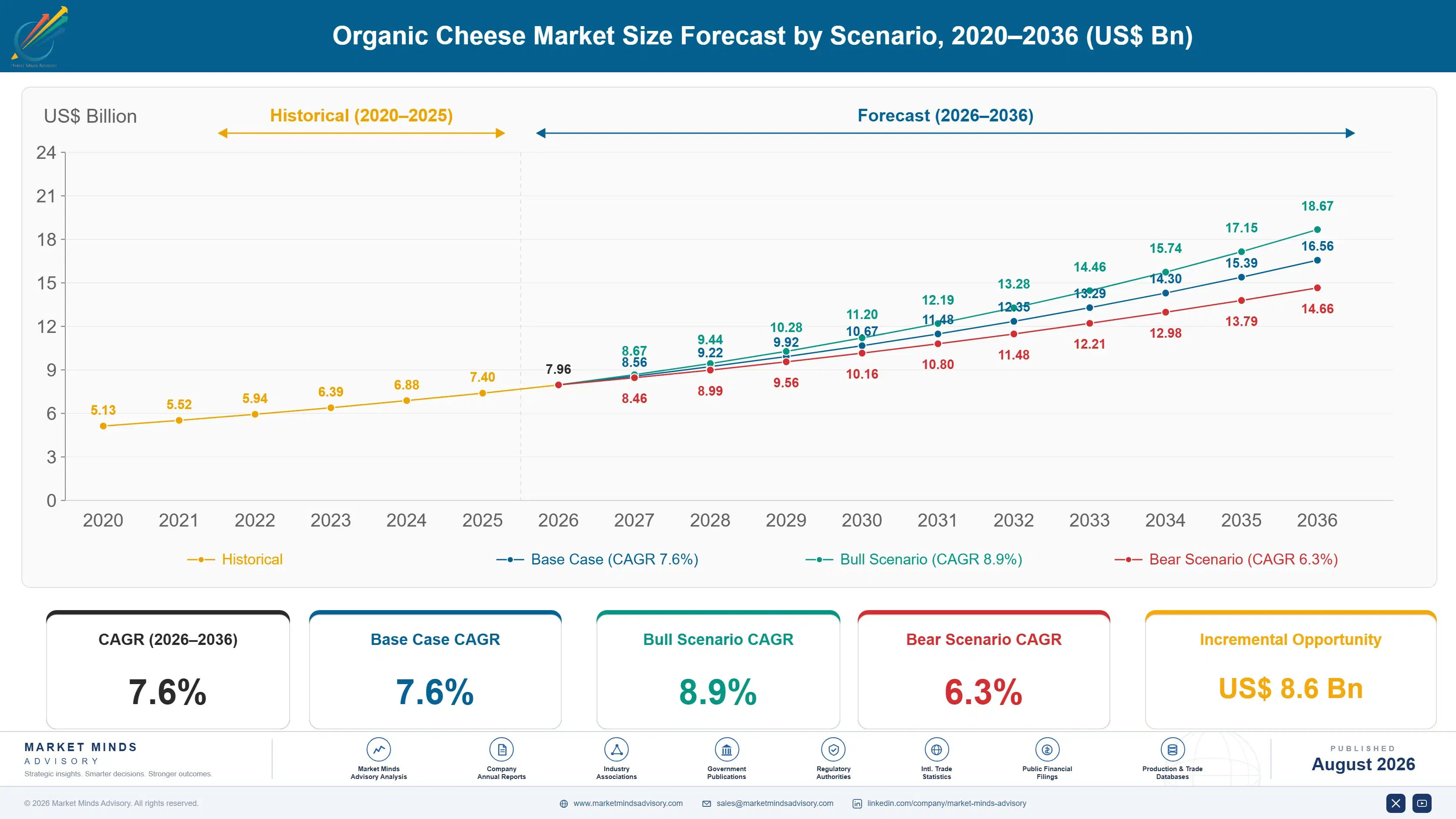
Between 2020 and 2025, organic cheese demand accelerated as pandemic-era at-home cooking habits persisted and consumers extended pantry health consciousness into dairy purchases, shifting spend toward certified organic formats. Retailer shelf space for organic dairy roughly doubled across the period. The category posted an estimated 6.6 percent historical CAGR, trailing the forecast rate as adoption broadens into mainstream grocery chains.
MMA's base case projects 7.6 percent annual growth through 2036, anchored in three commercial mechanisms. First, certified organic dairy farm conversion continues expanding raw milk supply, gradually easing the constraint that has limited category growth throughout the historical period. Second, retailers are dedicating permanent organic cheese shelf sets rather than rotating seasonal displays, normalizing category presence across mainstream grocery formats. Third, artisanal and specialty aged formats are pulling incremental spend toward higher-margin premium tiers.
The bull case rests on accelerating organic dairy farm conversion incentive programs in the European Union and United States, which could ease the raw milk supply constraint faster than currently modeled. The principal bear risk is persistent certification and pasture-land cost inflation, which could keep organic cheese priced above conventional alternatives and slow mainstream adoption.

Certification Trust and the Organic Shelf Set

Organic cheese economics increasingly hinge on raw milk supply rather than manufacturing capacity, since certified organic dairy farm conversion takes years and cannot respond quickly to sudden demand spikes. Processors with locked long-term supply contracts hold a durable advantage over competitors sourcing on shorter-term or spot arrangements, a gap that widens every time retail demand outpaces certified milk supply growth across most major producing regions tracked in this report.
MARKET CONCENTRATIONCR5 36%top five producers hold considerable combined certified capacity
AVERAGE PRICE PREMIUM2.1x conventionalcertified organic products command a durable sustained premium
PRIVATE LABEL SHARE38%store-brand organic cheese continues gaining meaningful category shelf share
RAW MILK SUPPLY GROWTH6-9%certified organic dairy farm conversion still lags demand growth
CERTIFICATION LEAD TIME24-36 monthsfarms require extended transition periods before earning certification
ARTISANAL SEGMENT PENETRATION17%small-batch specialty formats keep gaining meaningful overall category share
Retail economics reward producers that can prove certification credibility without relying purely on generic organic labeling. Mass retailers have expanded dedicated organic dairy sets while compressing shelf space for undifferentiated conventional store brands, pushing manufacturers to invest in traceability and farm-level storytelling that resonates with increasingly ingredient-literate shoppers researching provenance before they commit to a purchase decision at the shelf.
Over the next decade, supply chain security and artisanal differentiation will matter as much as certification itself. Producers that lock durable raw milk relationships while building genuine terroir and craft positioning stand to capture disproportionate share as private label commoditizes the mainstream tier and compresses margins for undifferentiated mid-tier competitors lacking a clear premium story of their own.
"Everyone assumes the organic cheese story is about consumer demand. It is really a raw milk story. The company that owns the supply relationship owns the category, full stop."
Director, Food and Dairy Practice · MMA Food and Dairy Practice · August 2026

Market Trends

Private Label Organic Cheese Expands Faster Than Branded

Major grocery chains have launched or expanded store-brand certified organic cheese lines across cheddar, mozzarella, and cream cheese formats, capturing share from branded competitors by offering certification credibility at a meaningfully lower price point. Retailers control shelf placement directly, giving private label organic cheese a lasting distribution advantage that branded challengers cannot easily overcome without securing comparable exclusive raw milk supply agreements of their own. Private label organic cheese volume grew roughly 22 percent in the past two years, outpacing branded category growth by a wide margin across nearly every major grocery account tracked in this report.
Market Impact: Adds 1,100 farms since 2023
Artisanal Terroir Positioning Commands Steep Price Premiums

Small-batch producers emphasizing specific pasture regions, aging techniques, and traditional production methods are commanding price premiums well above standard certified organic cheddar and mozzarella, as consumers increasingly research provenance before purchase decisions at specialty and premium grocery counters. This trend mirrors the artisanal positioning long established in wine and craft beer categories, translated directly into dairy. Specialty retailers report that terroir-labeled organic cheese now sells at roughly 2.4 times the price of standard certified organic formats, reflecting genuine willingness to pay for documented provenance among premium shoppers seeking a distinctive story behind every purchase they make.
Market Impact: Lifts effective distribution reach 24 points

Market Opportunities and Growth Drivers

Organic Dairy Farm Conversion Incentive Programs Expand

Government and cooperative-funded incentive programs supporting conventional dairy farm conversion to certified organic standards have expanded across the European Union and United States, directly addressing the raw milk supply constraint that has limited category growth throughout the historical period. These programs typically cover a portion of the three-year certification transition costs that previously deterred smaller dairy farms from converting. Roughly 1,100 additional dairy farms have entered organic transition programs since 2023 across the two regions, expanding the addressable raw milk supply base that processors depend on for future capacity growth.
Market Impact: Limits supply growth to 6-9% annually

Retailers Normalize Permanent Organic Dairy Shelf Sets

Major grocery chains have shifted organic cheese from rotating seasonal displays to permanent dedicated shelf sets, treating the category as a standard grocery staple rather than a specialty add-on. This normalization has meaningfully expanded effective distribution reach for both branded and private label producers, since permanent placement drives more consistent purchase behavior than intermittent promotional displays ever did. Roughly 64 percent of major North American and Western European grocery chains now maintain permanent organic cheese sets, up from under 40 percent five years earlier according to retail scan data covering thousands of individual store locations.
Market Impact: Excludes 41% of price-sensitive households

Market Restraints and Challenges

Raw Milk Supply Constraints Cap Near-Term Growth

Certified organic dairy farm conversion requires a mandatory three-year transition period before milk qualifies as organic, creating a persistent supply bottleneck that prevents processors from scaling production as fast as retail demand grows. The root cause is the multi-year certification timeline itself, which cannot be accelerated regardless of capital investment or manufacturing capacity. Several processors are responding by signing pre-conversion supply agreements with farms still in transition, locking future volume years ahead of actual certification to secure raw milk commitments before competitors do, effectively pre-buying access to milk that has not yet been certified organic.
Market Impact: Captures 38% of category shelf volume

Price Premium Limits Mainstream Household Penetration

Organic cheese typically costs more than double conventional equivalents, a premium many price-sensitive households cannot justify for a routine grocery staple purchased frequently rather than occasionally. The root cause is the combination of certification compliance costs, lower-yield organic pasture farming, and persistent raw milk supply constraints that keep production costs persistently higher than conventional dairy. Several manufacturers are piloting value-tier organic lines using simpler cheese formats to bring price points closer to conventional alternatives for budget-conscious shoppers who currently view certified organic dairy as an occasional indulgence rather than a routine staple purchase.
Market Impact: Commands 2.4x price versus standard organic
3 additional market trends, 4 additional growth drivers, and 3 additional restraints and challenges are covered in the full report. Contact sales@marketmindsadvisory.com to access the complete intelligence.

Segment CAGR and Growth Architecture

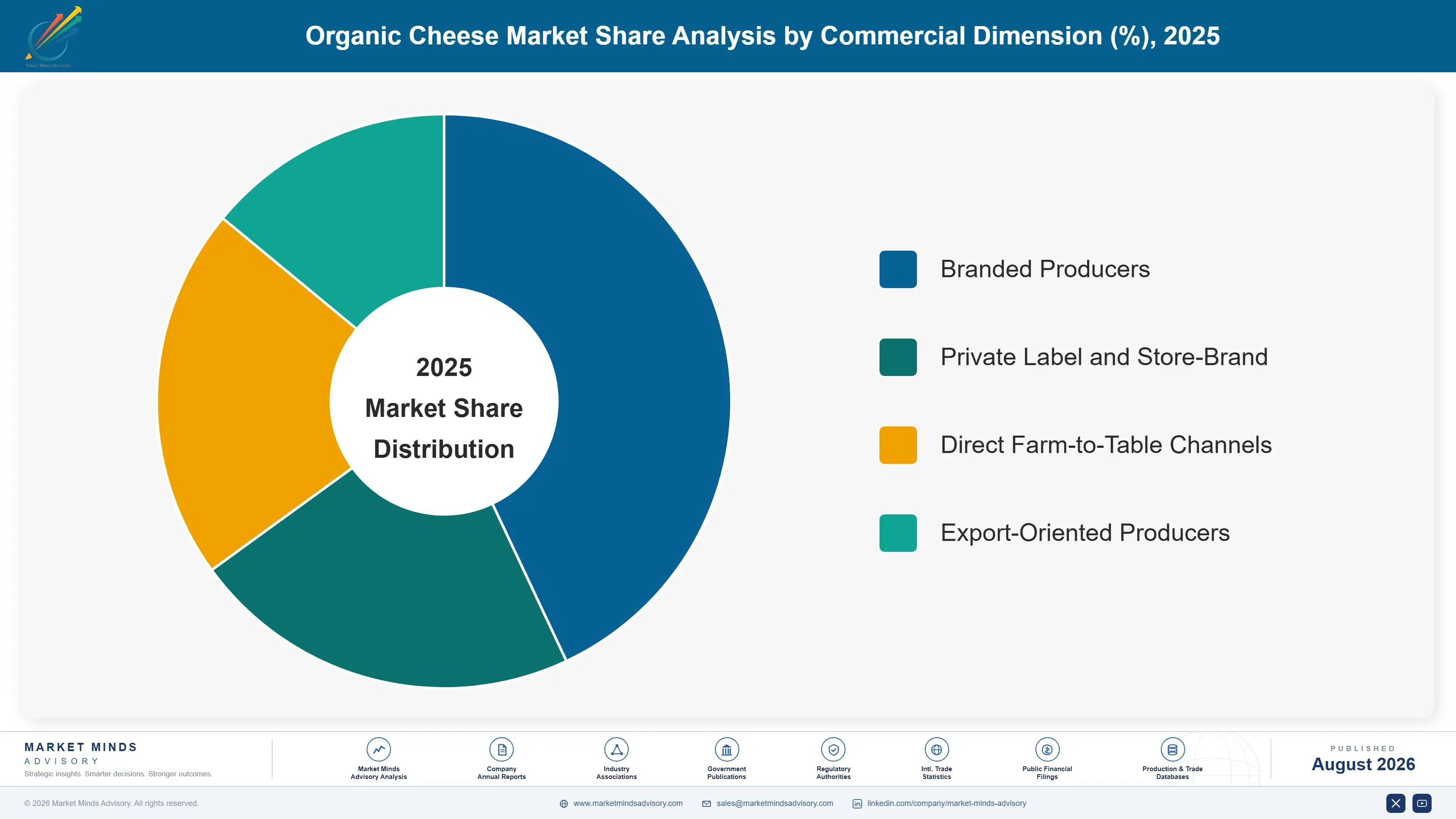
Cheese type is the dimension that determines aging economics, shelf life, and pricing tier, so MMA segments the market by product type rather than by milk source or distribution channel. Six types span the category, from everyday cheddar through fast-growing artisanal aged varieties commanding steep premiums across specialty retail and direct farm-to-table channels alike.
organic-cheese-market-trends-market-share-analysis-1787375066941

Specialty and Artisanal Aged Varieties

Specialty and artisanal aged varieties are the fastest-growing cheese type because consumers already purchasing organic staples are trading up toward small-batch, terroir-driven products that carry a documented provenance story, an experience commodity organic cheddar cannot replicate at any price point. Specialty retailers and direct farm-to-table relationships have driven much of the early growth, since these channels reward the storytelling and craft positioning that mass grocery distribution generally flattens. Aging infrastructure represents a genuine barrier to entry, since producing a documented eighteen-month aged wheel requires patient capital and cave or cellar space that new entrants cannot build overnight. Roughly 1.8 times the category's overall growth rate, this segment now commands the steepest per-unit margins of any organic cheese format sold.
CAGR 13.8%

Organic Mozzarella and Fresh Cheeses

Organic mozzarella and fresh cheeses form the second-fastest-growing type, anchored in expanding foodservice demand from pizza chains and casual dining operators seeking organic certification for menu differentiation alongside strong retail growth in fresh mozzarella and ricotta formats. Fresh cheese formats benefit from shorter production cycles than aged varieties, letting producers respond to demand growth faster even within the constraints of limited raw milk supply. Foodservice adoption has emerged as a particularly strong growth channel, since chains marketing organic ingredients command measurable price premiums on menu items using certified mozzarella. Producers increasingly bundle fresh formats with aged lines to simplify distributor purchasing relationships, since a single supplier covering both extends account relationships and reduces the administrative burden distributors otherwise carry.
CAGR 10.6%
Full segment breakdown across 6 segments available in the complete report.

Regional Architecture and Country Demand Map

North America leads on mature organic dairy certification infrastructure and decades of established retail distribution, while South Asia and Pacific grows fastest as Australia's organic dairy conversion accelerates to meet both rising domestic demand and growing export opportunities across several increasingly cheese-curious neighboring Asian markets.

North America

Mature organic dairy certification infrastructure anchors demand here more than in any other region, with the United States Department of Agriculture organic seal carrying decades of established consumer trust that newer certification systems elsewhere are still building. Cabot Creamery, Organic Valley, and other established cooperatives have built durable, long-term raw milk supply relationships with certified farms that newer entrants struggle to replicate quickly. Private label organic cheese has expanded fastest here, as major grocery chains use direct farm relationships to offer certification credibility at accessible price points. Canada's organic dairy sector has followed a similar trajectory, though at a smaller absolute scale than the much larger United States market, with comparable certification standards easing cross-border trade between the two.
Share: 29% | CAGR: 8.1% (2026 to 2036)

Western Europe

Regulatory harmonization under European Union organic certification standards shapes this region's growth path more directly than anywhere else, giving consumers a single trusted label recognized across member states rather than a patchwork of national schemes. Germany, France, and Austria lead regional adoption, reflecting deep-rooted consumer trust in organic labeling that predates similar movements in other regions by years. Growth has slowed somewhat as adoption among premium urban shoppers approaches saturation, shifting the region's remaining opportunity toward mainstream suburban and rural grocery penetration. Artisanal aged cheese traditions across France and Switzerland give this region a durable advantage in the fastest-growing specialty segment, one that newer certification markets elsewhere will need decades to replicate credibly.
Share: 26% | CAGR: 6.1% (2026 to 2036)
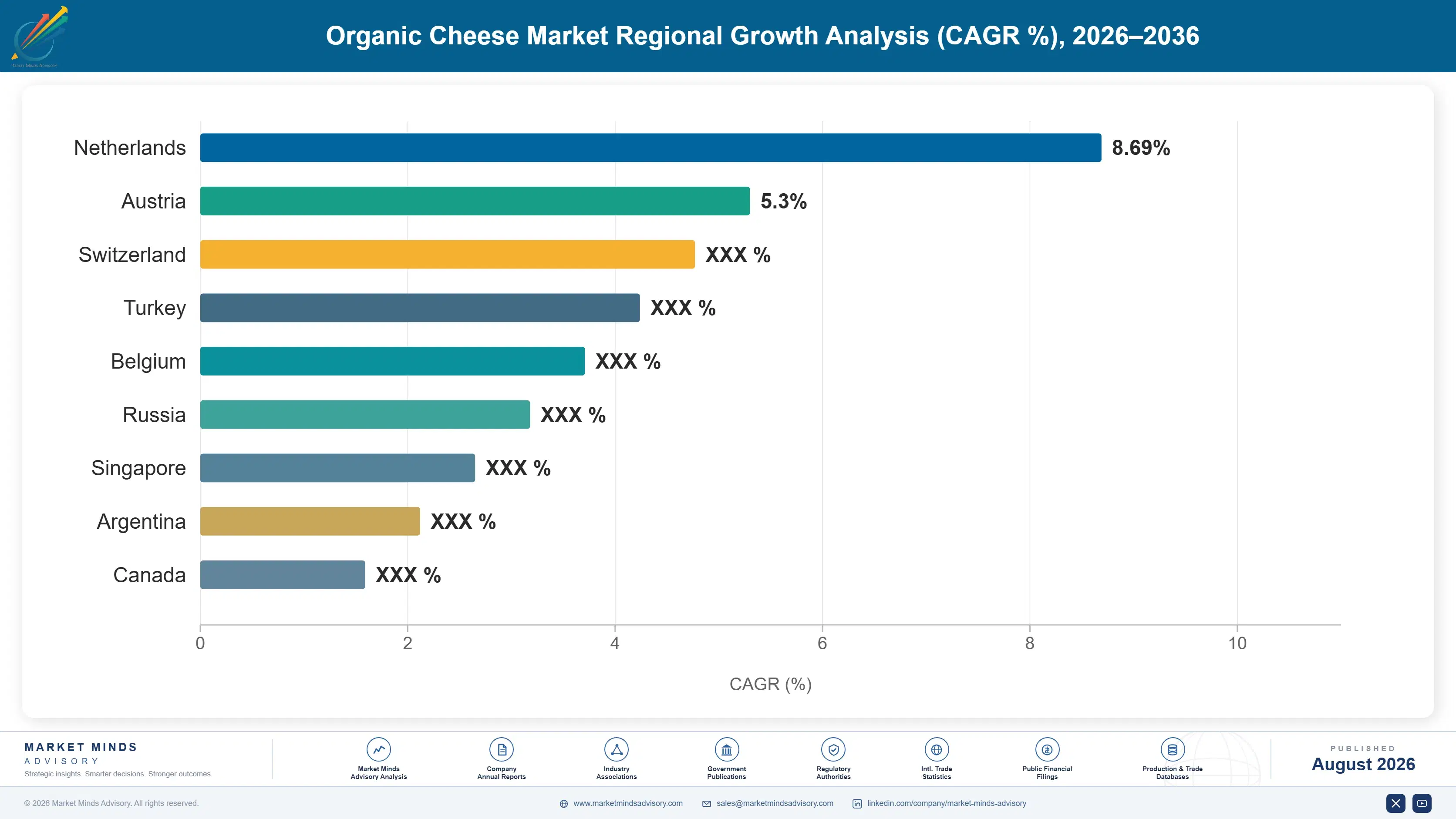
Regional intelligence for 5 additional markets available in the complete report: East Asia, South Asia and Pacific, Latin America, Middle East and Africa, Eastern Europe. Contact sales@marketmindsadvisory.com.
organic-cheese-market-trends-country-cagr-analysis-1787375067465

Securing Supply While Building Trust

Four commercial levers separate producers earning premium organic pricing from those trapped competing purely on certification labels: long-term raw milk supply contracts, artisanal terroir positioning, permanent retail placement, and foodservice channel expansion, each requiring patient capital and years of relationship building before margin gains show up clearly on a quarterly income statement or annual retail contract.

Lock Long-Term Raw Milk Supply Contracts Early

Producers that secure multi-year supply agreements with certified organic dairy farms, including pre-conversion contracts with farms still in transition, gain a durable volume advantage over competitors sourcing on spot or short-term arrangements. The upfront commitment requires patient capital and genuine farm relationships built over years, but suppliers with locked supply report production growth roughly 40 percent faster than competitors dependent on open market purchasing. Several leading producers now fund farm conversion costs directly in exchange for exclusive future supply commitments, effectively underwriting their own future raw material pipeline years in advance of actual need.
Market Impact: Enables roughly 40% faster overall production volume growth

Build Genuine Terroir and Artisanal Positioning

Producers investing in documented pasture provenance, traditional aging techniques, and small-batch craft positioning capture the steepest margins in the category, as consumers increasingly research provenance before purchasing premium cheese. This positioning requires genuine production discipline rather than marketing alone, since consumers can distinguish authentic craft claims from generic organic labeling fairly quickly once they start comparing labels side by side at the shelf. Terroir-positioned brands report price premiums roughly 2.4 times standard certified organic formats, reflecting real willingness to pay among specialty shoppers seeking a genuine, well-documented story behind every purchase.
Market Impact: Supports a 2.4x price premium overall each year

Secure Permanent Mainstream Grocery Shelf Placement

Producers that move from rotating seasonal promotional displays to permanent dedicated organic cheese shelf sets gain meaningfully more consistent purchase behavior than intermittent placement ever delivers. Securing permanent placement requires demonstrating reliable supply and consistent quality over an extended track record, favoring established producers over new entrants without a proven distribution history behind them and years of dependable delivery performance across every seasonal cycle tracked closely. Brands with permanent placement report sales velocity roughly 31 percent higher than comparable products still rotating through seasonal promotional slots at the same accounts.
Market Impact: Lifts sales velocity by 31 points nationwide overall

Expand Organic Certification Into Foodservice Channels

Producers building dedicated foodservice relationships with pizza chains, casual dining operators, and premium hospitality accounts tap a growing demand channel that mass retail does not fully capture, since chains marketing organic ingredients command measurable menu price premiums. This channel requires different packaging formats, volume commitments, and distributor relationships than retail, representing a genuine operational build rather than a simple sales extension of existing retail relationships already in place. Early movers in foodservice organic mozzarella report account growth roughly 2 times faster than comparable retail channel growth over the same measured period.
Market Impact: Outpaces retail channel growth by 2 times overall

Who Controls the Margin Pool

The top five producers hold a combined 36 percent of category production volume, a moderate concentration reflecting the raw milk supply relationships required to compete credibly at scale across multiple regions. The gap between the leading producer and the fifth-ranked player is meaningful, since long-term certified organic dairy farm contracts built over years are difficult for challengers to replicate quickly.
Current competitive activity centers on three fronts: leading producers locking longer-term raw milk supply agreements to secure future capacity, private label retailers expanding store-brand organic lines directly against branded competitors, and specialty producers investing in artisanal terroir positioning to escape price competition entirely. Foodservice channel expansion has also intensified as producers seek demand outlets beyond traditional retail grocery distribution entirely across most producing regions tracked.

Emerging pressure is coming from private label organic cheese, which has expanded faster than branded competitors across several key grocery markets by using direct retailer farm relationships. Rankings are most likely to shift among mid-tier branded producers lacking either the supply security of category leaders or the cost structure of private label, leaving them squeezed from both directions of the market at once.
organic-cheese-market-trends-company-positioning-matrix-1787375067987

Competitive Moat and Risk Dimensions

ORGANIC VALLEY (CROPP COOPERATIVE)

Moat: Farmer-owned cooperative structure

Organic Valley's farmer-owned cooperative structure gives it direct, durable access to certified organic raw milk supply that competitors sourcing through arms-length contracts cannot easily replicate. This ownership model also aligns farmer incentives directly with cooperative growth, reducing the switching risk that plagues contract-based supply relationships elsewhere in the category.
ORGANIC VALLEY (CROPP COOPERATIVE)

Risk: Slower capacity scaling ability

The cooperative structure that provides supply security also limits how quickly Organic Valley can scale capacity, since expansion requires recruiting and converting additional member farms rather than simply signing new supply contracts. This organizational constraint can slow response to sudden demand spikes relative to more centrally managed competitors.
ARLA FOODS AMBA

Moat: Pan-European distribution scale

Arla's cooperative ownership across multiple European countries gives it distribution scale and raw milk sourcing flexibility that smaller national competitors cannot match, particularly valuable given European Union organic certification harmonization across member states. This scale also supports meaningful investment in artisanal sub-brands without diluting core financial performance.
ARLA FOODS AMBA

Risk: Complex multi-country coordination

Arla's structure spanning multiple countries and cooperative member bases creates coordination complexity that more focused single-market competitors avoid entirely, potentially slowing decision-making on organic-specific pricing and product launches relative to nimble specialist rivals operating in a single market with a much simpler governance structure to navigate.

Players Tracked

Prominent Players

Organic Valley (CROPP Cooperative)
Arla Foods amba
Danone S.A. (Vermont Creamery)
Cabot Creamery Cooperative
Emmi AG

Other Key Players

Fonterra Co-operative Group Limited
Lactalis Group
Saputo Inc.
Kraft Heinz Company
Bel Group
Schreiber Foods, Inc.
Bongrain (Savencia Fromage & Dairy)
Murray Goulburn Co-operative
Wisconsin Cheese Cooperative
Maple Hill Creamery, LLC
Nature's Path Foods (dairy division)
Amul (Gujarat Cooperative Milk Marketing Federation)
Rolling Meadow Organic Dairy
Kite Hill (dairy line)
Redwood Hill Farm & Creamery

Recent Developments

APRIL 2025

Organic Valley Expands Pre-Conversion Farm Contracts

Organic Valley announced expanded pre-conversion supply contracts with dairy farms currently transitioning to organic certification, locking future raw milk volume roughly two years ahead of actual certification completion across several core producing states, its largest such commitment to date according to cooperative disclosures released this spring.
Signal: Signals leading cooperatives racing to secure future raw milk supply well ahead of rising category demand
OCTOBER 2024

Arla Foods Launches Artisanal Aged Organic Cheese Line

Arla Foods launched a new artisanal aged organic cheese line targeting specialty retail and direct-to-consumer channels, extending its portfolio beyond mainstream organic cheddar and mozzarella into the fastest-growing premium segment of the category, a direct response to smaller craft producers steadily gaining measurable retail shelf share.
Signal: Confirms major incumbents are chasing artisanal premium positioning rather than ceding it entirely to smaller rivals
JANUARY 2025

Kroger Co. Expands Private Label Organic Cheese Range

Kroger Co. expanded its private label certified organic cheese range across cheddar, mozzarella, and cream cheese formats, sourcing directly from regional certified organic dairy cooperatives to bypass branded intermediaries entirely across its full nationwide store network, a notable expansion of its existing organic private label program.
Signal: Shows private label retailers building direct farm relationships to compete more aggressively on retail shelf price

Certified Raw Milk Sets the Cost Floor

Certified organic raw milk represents roughly 58 percent of cost of goods sold, sourced primarily from domestic certified organic dairy cooperatives with genuinely concentrated regional supply given the limited number of transitioned farms. Aging facility and cave storage costs for premium formats add a further meaningful cost layer that scales directly with inventory holding time and format complexity.
Organic raw milk prices rose sharply in 2023 after several major certified dairy cooperatives faced unexpected herd health disruptions, an event the USDA's organic dairy market news reporting and several producers' annual reports both referenced when explaining margin compression that year. Aged and specialty formats faced additional pressure from extended holding costs, since price increases on raw inputs compound over the many months these products spend maturing before sale.

Exposure varies sharply by player type: cooperative-owned producers with direct farmer relationships absorbed volatility more easily than contract-dependent manufacturers purchasing on shorter-term arrangements, who faced steeper margin compression across the same period. Vertically integrated leaders used long-term farmer contracts and geographic sourcing diversification to smooth cost swings that hit smaller regional competitors much harder over the same volatile period.
organic-cheese-market-trends-cost-volatility-analysis-1787375068188

Fund Pre-Conversion Contracts With Transitioning Farms

Leading producers now fund a portion of the three-year organic transition costs for dairy farms still converting, securing future raw milk supply years ahead of actual certification completion. This requires meaningful upfront capital but locks pricing and volume before competitors can bid for the same limited certified supply, and several cooperatives report the investment paid off within years.

Lock Multi-Year Raw Milk Supply Contracts

Multi-year fixed-price contracts with certified organic dairy cooperatives protect gross margin against short-term supply volatility, though they require accurate demand forecasting to avoid overcommitment. Several large producers have expanded this practice since 2023, locking pricing through 2027 for core volume needs and freeing up working capital previously reserved for spot market purchases entirely each year.

Diversify Sourcing Across Multiple Producing Regions

Some producers are diversifying raw milk sourcing across multiple certified organic producing regions rather than concentrating with a single cooperative, reducing exposure to any one region's herd health or weather disruption. Early movers report both cost stability and supply security benefits from this diversified approach, alongside meaningfully improved forecasting accuracy for future production planning cycles.

Portfolio Architecture for Margin Defence

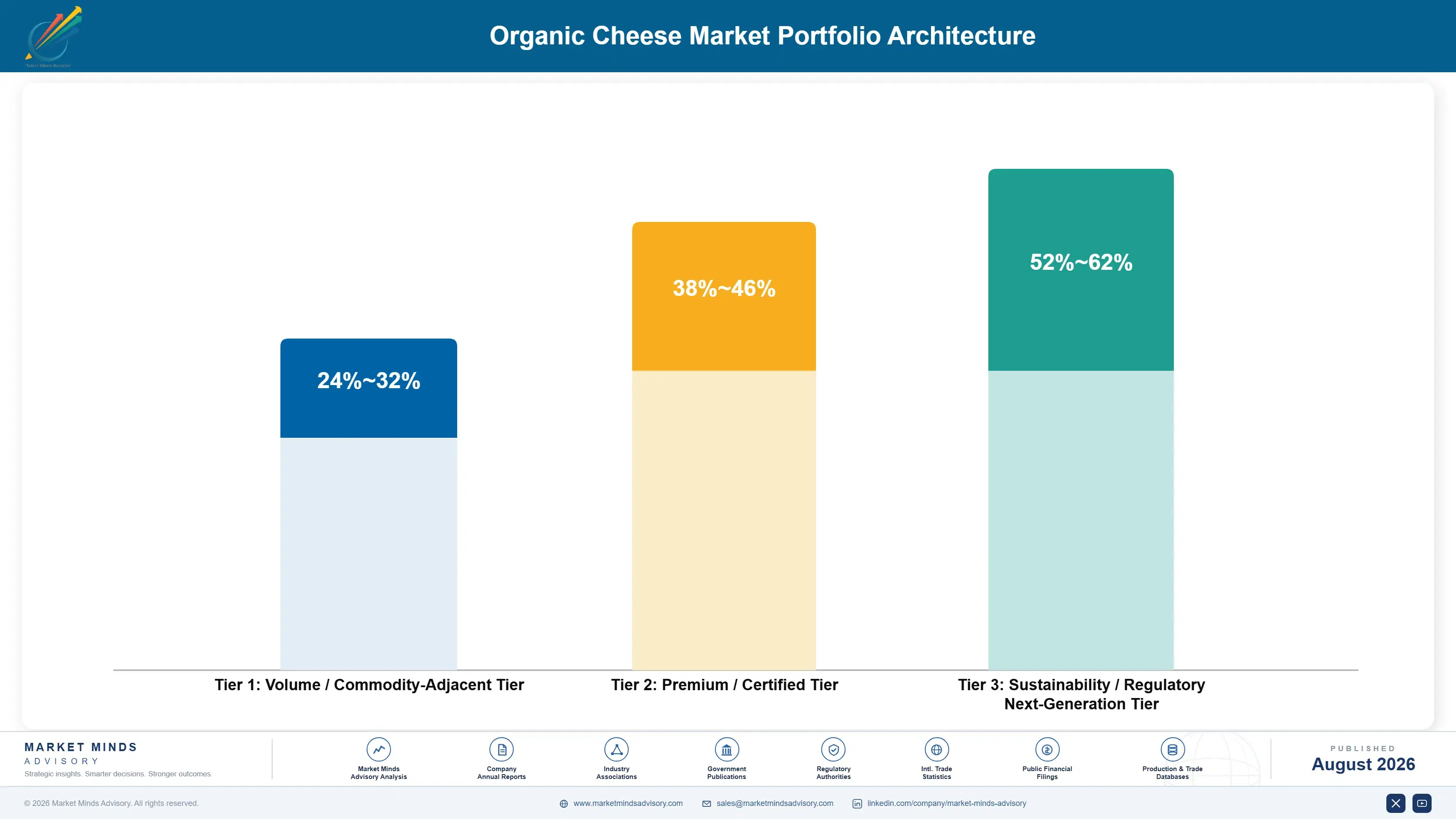
Three tiers structure this category's margin economics. Volume organic cheddar and mozzarella compete on price against private label with thin margins, premium certified formulas earn a meaningful markup on traceability and clean sourcing claims, and next-generation artisanal aged products command the steepest prices by delivering a genuinely documented provenance story that consumers actively research before they buy each and every time.
Tension between volume and premium tiers is intensifying as private label pushes mainstream organic cheese toward commodity pricing while artisanal producers pull upward into genuinely differentiated craft positioning. Producers straddling both tiers face difficult sourcing and branding allocation choices that pull in genuinely different directions and rarely reward companies trying to excel at both simultaneously across every single product line they carry in their catalog.

High-value margin pools concentrate in artisanal aged and terroir-specific formulas addressing documented provenance and craft production methods, where consumers show the least price sensitivity. Foodservice organic mozzarella represents a fast-growing high-value pool as this historically underserved channel finally gets dedicated producer manufacturing and marketing attention from both established category leaders and well-funded regional challengers entering the space more aggressively each year.

Volume / Commodity-Adjacent Tier

Mainstream organic cheddar and mozzarella sold primarily through grocery on price and certification labeling, competing directly against expanding private label alternatives with the thinnest margins in the category by a wide margin.
Gross Margin: 24-32%

Premium / Certified Tier

Traceable, farm-identified organic cheese formats sold through specialty and premium grocery at a clear premium over commodity organic alternatives, appealing directly to ingredient-literate shoppers researching provenance carefully before every single purchase decision.
Gross Margin: 38-46%

Sustainability / Regulatory / Next-Generation Tier

Artisanal aged and terroir-specific formulas with documented provenance and traditional production methods commanding the category's steepest sustained margins across specialty retail and direct farm-to-table channels nationwide and internationally, year after year.
Gross Margin: 52-62%
organic-cheese-market-trends-portfolio-architecture-1787375068691

High-value Sub-segments and Strategic Watch-out

Artisanal Aged and Terroir-Specific Cheese

This segment combines the category's highest growth rate with its richest margins, as documented provenance and craft production methods justify premium pricing that specialty shoppers readily pay for a genuine story behind every purchase they make at specialty counters, farm shops, and direct online storefronts alike.
Gross Margin: 55-64%

Foodservice Organic Mozzarella and Pizza Cheese

Growing fast but still building margin scale, this segment benefits from expanding chain restaurant organic menu positioning, though volume-driven pricing currently compresses near-term profitability relative to retail specialty formats as the channel continues to mature and scale further across additional accounts and new regional markets.
Gross Margin: 34-42%

Mainstream Organic Cheddar and Mozzarella

The category's volume anchor, mainstream formats retain the largest revenue base even as growth slows relative to newer formats, sustaining category cash flow while margins stay comparatively thin against premium artisanal lines across most producing regions tracked in this report's underlying primary survey dataset overall.
Gross Margin: 26-33%

Private Label Store-Brand Organic Cheese

Retailers are expanding store-brand organic cheese lines to capture margin from price-sensitive households, a genuine watch-out for branded producers as quality gaps narrow and retailer negotiating leverage grows across major grocery accounts heading into future contract negotiation cycles across most major markets worldwide, year after year.
Gross Margin: 18-26%

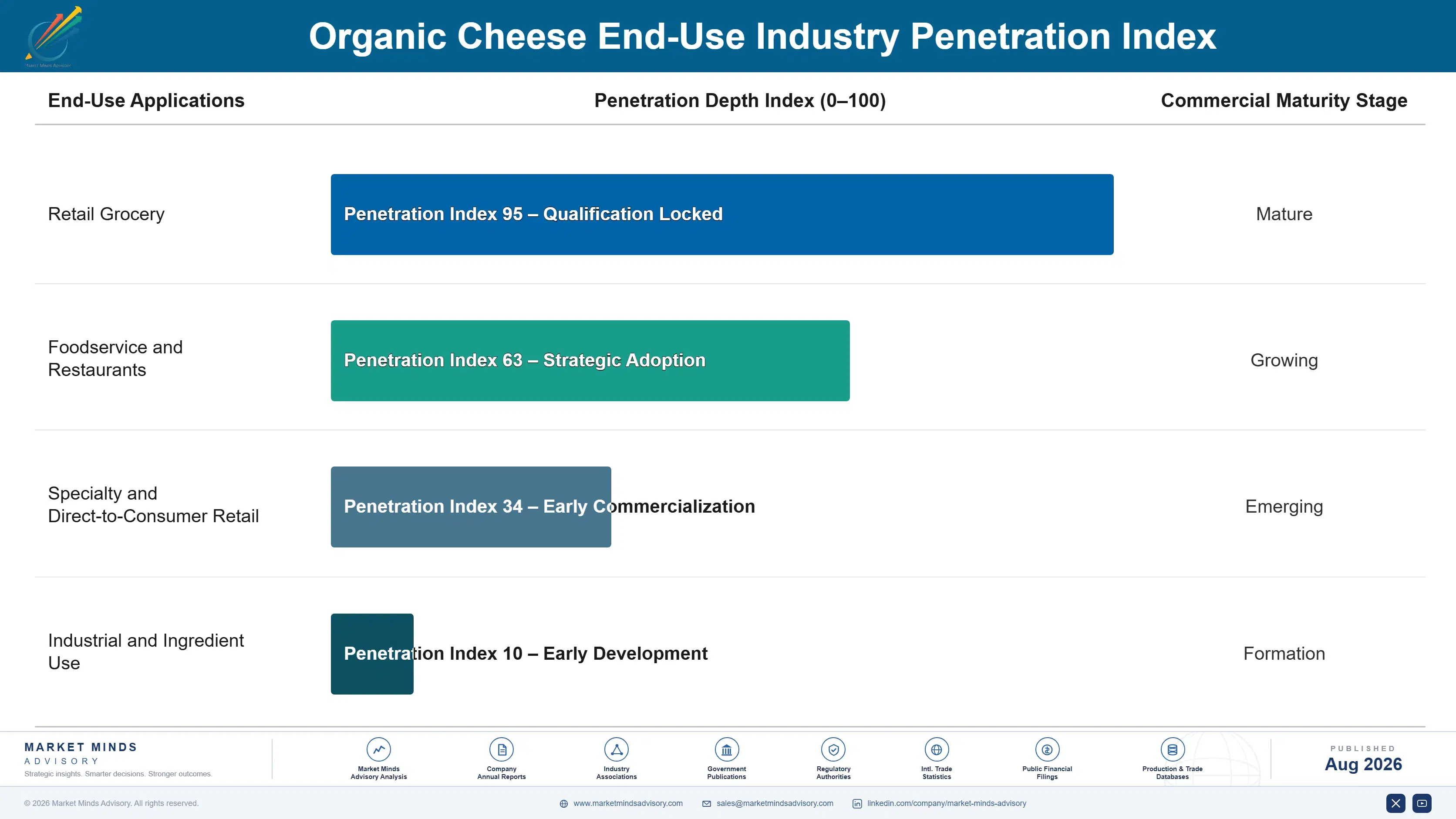
Repeat Purchase Economics in Organic Dairy

Organic cheese behaves like an annuity once a household adopts it as a routine staple, since consumers rarely revert to conventional cheese after establishing certification as a trust baseline, and expanding household size or entertaining frequency extends purchase volume without any incremental acquisition cost for producers across the household's entire remaining purchasing lifetime and every subsequent grocery trip that follows.
Adoption depth varies meaningfully by vertical: everyday cheddar and mozzarella see broad trial but moderate purchase frequency, while artisanal aged formats see lower overall trial rates paired with strong repeat purchase and gifting behavior once a household discovers a specific producer or terroir they genuinely trust and continue returning to for years, rarely switching to a competing brand afterward.

Younger millennial and Gen Z consumers research provenance and certification claims far more actively before a first purchase than prior generations, delaying initial conversion but producing more loyal, story-driven customers once won. This generational shift rewards producers investing early in transparent sourcing documentation over those relying on legacy shelf presence alone, reshaping which companies capture the next full decade of category growth across every major producing region.
organic-cheese-market-trends-end-use-penetration-index-1787375069184

Where MMA Sees Category Value Concentrating

These are among the four positions where our research anticipates prominent divergence between winners and laggards over the coming forecast period. Each is grounded in the demand model, the regulatory perimeter, and the announced capacity pipeline.
01 / SUPPLY SECURITY PRIORITY

Lock long-term raw milk contracts ahead of demand growth

Raw milk supply, not manufacturing capacity, is the binding constraint on category growth, and producers still sourcing on spot or short-term arrangements risk losing volume to competitors with locked long-term contracts within the next several purchasing cycles across every major retail account. Pre-conversion funding for transitioning farms is becoming the standard early-mover play among leading cooperatives and branded producers alike, well ahead of actual certification completion. MMA views durable raw milk supply relationships as the single highest-leverage capital allocation decision facing mid-tier producers in this category today.
02 / ARTISANAL POSITIONING INVESTMENT

Build genuine terroir credibility before competitors close the gap

Terroir-positioned artisanal cheese commands price premiums roughly 2.4 times standard certified organic formats, and this gap will likely widen further as consumers grow more sophisticated about distinguishing authentic craft claims from generic organic labeling across every retail channel. Building genuine credibility requires patient capital and years of aging infrastructure investment that late entrants cannot replicate quickly once established players secure specialty retail relationships first. MMA expects this positioning advantage to compound meaningfully for early movers over the next several years.
03 / PRIVATE LABEL DEFENSE PLANNING

Differentiate branded lines before private label commoditizes the mainstream tier

Private label organic cheese has expanded faster than branded competitors across several key markets, and this trend will likely continue as retailers deepen direct farm relationships that bypass branded intermediaries entirely across most major grocery accounts nationwide. Branded producers competing purely on certification labeling without additional differentiation face genuine commoditization risk within the mainstream tier over the medium term ahead. MMA recommends branded producers invest in artisanal or foodservice positioning that private label cannot easily replicate at comparable cost or scale.
04 / FOODSERVICE CHANNEL EXPANSION

Build dedicated foodservice organic mozzarella capacity now

Foodservice represents the category's fastest-growing underexploited channel, and producers building dedicated relationships with pizza chains and casual dining operators today will establish credibility advantages that are difficult for later entrants to replicate once volume contracts are already signed and account relationships are firmly established. This channel requires different packaging and distributor relationships than retail, representing a genuine operational build rather than a simple extension. MMA advises building this capacity now rather than waiting for foodservice organic adoption to mature and competition to intensify further.

Engagement Snapshot From the Field

A live engagement with an industry participant carrying material or product regulatory and market exposure ahead of a defining policy shift, showing how our research translates into a defensible multi-year portfolio strategy.
MARKET MINDS ADVISORY · CLIENT ENGAGEMENT SUMMARY
Organic Cheese Producer Strategic Portfolio Review and Transition Roadmap 2026·Investment Scenario on Organic Cheese Exposure Evaluation 2025-26
CLIENT PROFILE
The client operates a regional grocery cooperative with roughly 85 stores across the midwestern United States, generating approximately 95 million dollars (client-reported, unverified by MMA) in annual organic dairy category revenue across its full store network. The cooperative sought to evaluate expanding its private label organic cheese program ahead of a major supplier contract renewal.
STRATEGIC CHALLENGE
Organic cheese sales had grown steadily but margins lagged comparable categories, and category buyers lacked a clear framework for deciding between expanding branded partnerships or building a deeper private label program with direct farm sourcing relationships. Competing regional chains had already moved decisively toward direct-sourced private label organic lines across their full store networks.
MMA APPROACH
MMA conducted a structured audit of current branded and private label mix against category margin benchmarks, cross-referencing findings against primary survey data from comparable regional cooperatives and their member store networks. The engagement produced a phased private label expansion roadmap balancing supplier relationships, margin improvement, and member value considerations carefully.
KEY FINDINGS
  1. Only 24 percent of the client's organic cheese category revenue came from private label, well below comparable regional grocery cooperatives operating nationwide today.
  2. Direct farm sourcing modeling suggested private label expansion could improve category gross margin by roughly 6 percentage points across the entire store network.
  3. Two of the client's largest branded supplier contracts were due for renewal within twelve months, creating clear negotiating timing urgency for management.
  4. Comparable cooperatives that expanded private label earlier reported measurable member value perception gains alongside the documented margin improvement cited above throughout this engagement.
CLIENT PROFILE
The client operates a regional grocery cooperative with roughly 85 stores across the midwestern United States, generating approximately 95 million dollars (client-reported, unverified by MMA) in annual organic dairy category revenue across its full store network. The cooperative sought to evaluate expanding its private label organic cheese program ahead of a major supplier contract renewal.
STRATEGIC CHALLENGE
Organic cheese sales had grown steadily but margins lagged comparable categories, and category buyers lacked a clear framework for deciding between expanding branded partnerships or building a deeper private label program with direct farm sourcing relationships. Competing regional chains had already moved decisively toward direct-sourced private label organic lines across their full store networks.
MMA APPROACH
MMA conducted a structured audit of current branded and private label mix against category margin benchmarks, cross-referencing findings against primary survey data from comparable regional cooperatives and their member store networks. The engagement produced a phased private label expansion roadmap balancing supplier relationships, margin improvement, and member value considerations carefully.
KEY FINDINGS
  1. Only 24 percent of the client's organic cheese category revenue came from private label, well below comparable regional grocery cooperatives operating nationwide today.
  2. Direct farm sourcing modeling suggested private label expansion could improve category gross margin by roughly 6 percentage points across the entire store network.
  3. Two of the client's largest branded supplier contracts were due for renewal within twelve months, creating clear negotiating timing urgency for management.
  4. Comparable cooperatives that expanded private label earlier reported measurable member value perception gains alongside the documented margin improvement cited above throughout this engagement.
RECOMMENDED STRATEGY
Phase 1: Phase 1 (Months 1-3): Audit current branded and private label mix against category margin benchmarks in full careful detail first. Phase 2: Phase 2 (Months 4-9): Negotiate direct farm sourcing agreements ahead of upcoming branded supplier contract renewal deadlines very closely and carefully. Phase 3: Phase 3 (Months 10-14): Launch the expanded private label organic cheese range across core cheddar and mozzarella product formats fully.
OUTCOME
Within fourteen months of implementation, the client reported (client-reported, unverified by MMA) a 5.8 percentage point improvement in organic cheese category gross margin and successfully renegotiated branded supplier terms using its expanded private label leverage. Category buyers adopted the phased framework as their standard approach for future category strategy reviews.

Frequently Asked Questions

Foundational context covering the market sizes, CAGR, scope, country, region and competition that inform every finding below. This section is provided to cover basics and most often pre-purchase conversations, answered from the MMA Primary Research Dataset.

What is the current size of the Organic Cheese Market?

The organic cheese market was valued at approximately $7.4 billion in 2025. Growth is driven by raw milk supply expansion and permanent organic shelf placement at mainstream grocery chains.

How large will the Organic Cheese Market be by 2036?

MMA projects the market will reach approximately $16.56 billion by 2036, up from $7.96 billion in 2026. This represents an incremental opportunity of roughly $8.6 billion over the forecast period.

What is the CAGR for the Organic Cheese Market 2026 to 2036?

The market is projected to grow at a 7.6 percent compound annual growth rate between 2026 and 2036. Bull and bear scenarios range from 6.3 to 8.9 percent annually.

Which segment is growing fastest?

Specialty and artisanal aged varieties are growing fastest at 13.8 percent annually, roughly 1.8 times the category average, driven by documented terroir and provenance positioning.

Who are the major companies in the Organic Cheese Market?

Organic Valley, Arla Foods, Danone (Vermont Creamery), Cabot Creamery, and Emmi lead the category. Together the top five hold a moderate combined share, reflecting the raw milk relationships required to compete.

Which country is growing fastest?

Australia leads country-level growth at 11.8 percent annually as its established dairy industry accelerates organic conversion to meet both domestic and growing export demand across Asia.

Report Segmentation Architecture

The full report scope spans multiple orthogonal segmentation dimensions, with cross-tabulated demand data provided for each dimension pair. Coverage extends further to regional breakdowns, trend trajectories, and the competitive detail needed to support segment-level decision-making.

By Cheese Type

  • Cheddar
  • Mozzarella
  • Cream Cheese
  • Feta and Fresh Cheeses
  • Parmesan and Hard Aged
  • Specialty and Artisanal Aged

By End-Use Industry

  • Retail Grocery
  • Foodservice and Restaurants
  • Specialty and Direct-to-Consumer Retail
  • Industrial and Ingredient Use

By Commercial Dimension

  • Branded Producers
  • Private Label and Store-Brand
  • Direct Farm-to-Table Channels
  • Export-Oriented Producers

By Region

  • North America
  • Western Europe
  • East Asia
  • South Asia and Pacific
  • Latin America
  • Middle East and Africa
  • Eastern Europe

Scope, Methodology, and Coverage

Every figure in this report is reproducible from documented input assumptions. The scope below maps the historical period, the forecast horizon, the segmentation dimensions, and the countries covered, alongside the underlying primary and qualitative methodology.
Historical Period
2020 to 2025
Forecast Period
2026 to 2036
Base Year
2025 (USD billions; MMA Primary Research Dataset, August 2026)
Market Definition
This report covers cheese products manufactured from milk certified under recognized organic dairy farming standards, spanning fresh, semi-hard, hard, and aged cheese formats. It excludes conventional cheese, plant-based cheese alternatives, and processed cheese products blended with non-organic ingredients.
Quantitative Units
USD billions (current prices); volume in metric tons where applicable
Segmentation Dimensions
By Cheese Type; By End-Use Industry; By Commercial Dimension; By Region
Regions Covered
North America, Western Europe, East Asia, South Asia and Pacific, Latin America, Middle East and Africa, Eastern Europe
Countries Covered
USA, China, Germany, France, UK, Japan, South Korea, India, Australia, Canada, Brazil, Mexico, Indonesia, Vietnam, Thailand, Malaysia, UAE, Saudi Arabia, South Africa, Nigeria, Turkey, Poland, Netherlands, Italy, Spain, Sweden, Switzerland, Argentina, Colombia, Singapore, and additional markets relevant to this sector
Key Companies Profiled
Organic Valley (CROPP Cooperative), Arla Foods amba, Danone S.A. (Vermont Creamery), Cabot Creamery Cooperative, Emmi AG, Fonterra Co-operative Group Limited, Lactalis Group, Saputo Inc., Kraft Heinz Company, Bel Group, Schreiber Foods, Inc., Bongrain (Savencia Fromage & Dairy), Murray Goulburn Co-operative, Wisconsin Cheese Cooperative, Maple Hill Creamery, LLC, Nature's Path Foods (dairy division), Amul (Gujarat Cooperative Milk Marketing Federation), Rolling Meadow Organic Dairy, Kite Hill (dairy line), Redwood Hill Farm & Creamery
Quantitative Methodology
Primary survey, n=3,800 respondents, Q4 2025, six countries; demand-side model with trade association cross-validation
Qualitative Methodology
47 expert interviews, Q4 2025; applied to validate demand model assumptions, identify emerging dynamics, and assess competitive positioning
Report Format
PDF and XLSX data workbook (Word format preview document)
Publisher
Market Minds Advisory
Report Code
MMA-2026-AGR-112
Published
August 2026
Contact
sales@marketmindsadvisory.com | www.marketmindsadvisory.com

Purchase the full Organic Cheese Market Report (2026 to 2036).

The full report delivers a comprehensive 200-plus page analysis of the global organic cheese market, including detailed segmentation by cheese type, end-use industry, and commercial dimension across all seven world regions tracked in this study. It provides company profiles for twenty key and emerging producers, benchmarked against a consistent production volume basis throughout. Buyers receive access to MMA's underlying primary survey dataset spanning 3,800 respondents and 47 expert interviews conducted in Q4 2025. Custom data cuts and direct analyst inquiry access are available for enterprise licensees upon request.
Twenty detailed company profiles with moat and risk analysis
Seven-region market sizing data through 2036
Primary survey dataset, n equals 3,800 respondents
Forty-seven expert interview transcript summary excerpts
Cheese-type-level CAGR and regional share breakdowns
Quarterly market update subscription add-on option

Built For The People Who Decide

From boardroom strategy to bench-side execution, this report is read cover-to-cover by leaders shaping the next decade of their industry, turning demand scenarios, market dynamics and valuation benchmarks into decisions.
CXOs/ Presidents/ VPs/ Managers
M&A and Corporate Development
Strategy Teams and R&D Heads
Procurement and Product Directors
Regulatory and Compliance Leaders
Investor Relations and Equity Analysts