Market Minds Advisory
Organic Cane Sugar Market

Organic Cane Sugar Market: Certified Mill Capacity, Ingredient Qualification and a Premium Built on Conversion Scarcity

A single brand reformulation consumes more certified tonnage than years of retail bag sales, and mill-level certification rather than field conversion is the constraint deciding who can actually supply that volume.

Lead Analyst

Lisa Gevelber

Published

September 2026

Make Smarter Decisions with Customized Research Insights

Request a free sample report and evaluate market opportunities, growth trends, and competitive dynamics relevant to your business needs.

2025 MARKET VALUE$2.2BMarket Size 2025
2036 FORECAST VALUE$4.0BBase Case , 2026 to 2036
CAGR 2026 TO 20365.6 %Bull 6.8% / Bear 4.4%
INCREMENTAL OPPORTUNITY$1.7BNet 10- year value creation
EXPANSION MULTIPLE1.72x2036 value over 2026 base
Strategic Levers
M&A Pipeline
Regional Outlook
Country Rankings
Competitive Intelligence
Segmental Deep-dive
Call-Us : 91 93563 13602

Executive Snapshot and Market Trajectory

One reformulation decision by a large beverage or confectionery brand consumes more certified organic cane sugar than years of retail bag sales, which is why the interesting commercial activity in this market happens in a procurement office rather than a supermarket aisle. That is worth keeping in mind.
Certified ingredient grade carries the growth on exactly that mechanism, with qualified sugar repeating for as long as the formulation is produced. Unrefined speciality sugars grow nearly as fast on colour and molasses content that buyers treat as the product rather than as a defect. Latin America holds the largest share because Brazil and Paraguay grow and mill most of the world's certified organic cane between them.
Concentration reads at 44% for the top five, which reflects mill certification rather than field conversion. A certified mill must segregate organic cane through crushing, clarification and crystallisation without contamination, and that capital requirement rather than any shortage of organic cane is what genuinely limits supply. Premiums near 61% over conventional raw sugar follow directly from it. Growers can convert far faster than mills are willing to commit the capital for it.
Market Definition
This market covers sugar produced from certified organic sugarcane, spanning certified ingredient grade sugar, unrefined and speciality cane sugars, retail packaged organic sugar, organic liquid sugar and syrups, and certified organic molasses sold as a food ingredient. Conventional cane sugar, all beet sugar whether certified or not, high fructose corn syrup and other caloric sweeteners, and non-nutritive sweeteners are excluded.
Base Year Value
$2.2B in 2025 (MMA Primary Research Dataset, August 2026)
Forecast Period
2026 to 2036, eleven discrete annual values
CAGR
5.6% base case. Bull 6.8%. Bear 4.4%.
Fastest Growth Segment
Certified Ingredient Grade Cane Sugar: 8.4% CAGR
Fastest Growth Country
India: 8.9% CAGR
Fastest Growth Region
South Asia and Pacific: 7.9% CAGR
Largest Region
Latin America: 34% of 2025 global value
Market Leaders
Native Alimentos, Wholesome Sweeteners, Nordzucker, Tereos and Jaggery Organics lead on certified organic cane sugar revenue. Source: MMA Primary Research Dataset, July 2026.
Primary Survey
n=3,800 procurement and R&D decision-makers, Q4 2025, six countries
Methodology
Demand-side build-up, cross-validated against public data, 47 expert interviews

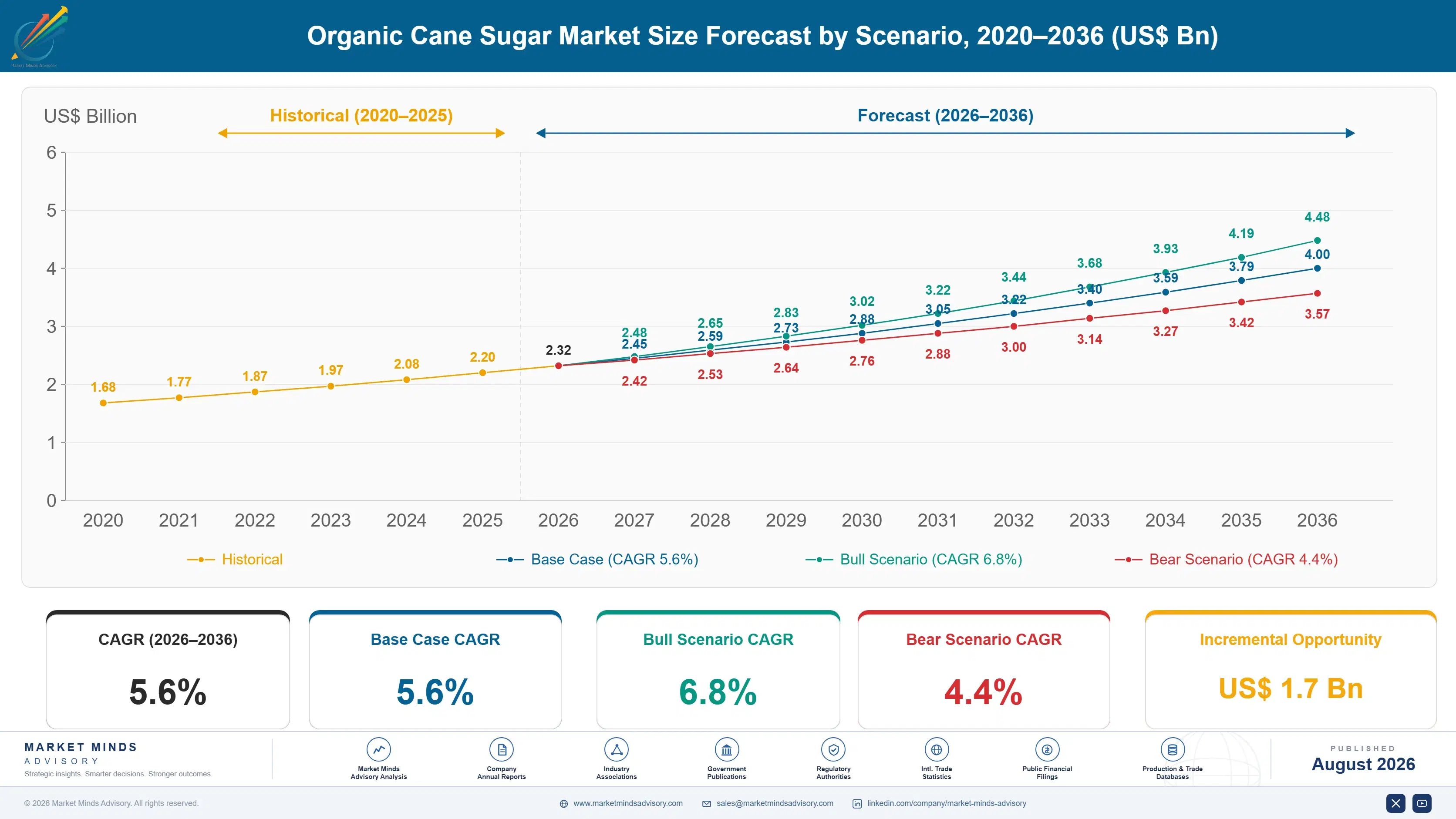
Organic Cane Sugar Market Forecast Scenarios

organic-cane-sugar-market-trends-size-forecast-scenario-1787375306026
Growth ran at 4.7% annually between 2020 and 2025, and the pattern was lumpier than any smooth average suggests. Individual brand reformulation decisions moved tonnage in steps rather than curves, with a single beverage launch capable of absorbing a mill's annual certified output. Retail bag volume grew steadily and slowly underneath that, contributing far less than its shelf presence implies.
The base case at 5.6% rests on three mechanisms. Ingredient reformulation continues as brands convert established products to certified organic rather than launching new ones, which delivers volume in meaningful blocks. Unrefined speciality sugars keep taking share from refined organic on colour and flavour positioning. And Indian domestic demand grows as branded packaged sugar displaces unbranded loose supply and certified jaggery and khandsari find an organised retail market. None of the three needs a rule change.
The bull case at 6.8% turns on certified mill capacity expanding in Brazil and Paraguay, which would relieve the constraint that currently caps supply regardless of field conversion. The bear case at 4.4% reflects brands reversing organic reformulations under cost pressure, since a certified sweetener at a 61% premium is among the easier line items to reconsider when margins tighten.

Mill Certification Not Field Conversion Limits Supply

The constraint in organic cane sugar is not the field, which surprises people. Plenty of growers could convert. The binding limitation is that a mill must segregate certified cane through crushing, clarification, evaporation and crystallisation without any contact with conventional cane, and that means either dedicated runs or dedicated equipment. Roughly 38 mills worldwide do it properly.
TOP FIVE CONCENTRATION44%Moderate, reflecting certified mill capacity rather than field ownership
ORGANIC PRICE PREMIUM61%Certified cane advantage over comparable conventional raw sugar grades
INGREDIENT CHANNEL SHARE57%Portion of value supplied into manufactured food and beverage
CERTIFIED MILL COUNT38 millsNumber of mills worldwide segregating certified cane through full processing
QUALIFICATION CYCLE10 monthsTypical time to qualify a supplier into a manufactured formulation
CANE COST SHARE52% of COGSCertified cane contribution to finished sugar manufactured cost
That scarcity supports a premium near 61% over conventional raw sugar, which is high for what is chemically the same disaccharide. Buyers pay it because certification is binary: a product either carries the label or it does not, and a brand that has committed to organic positioning cannot substitute halfway. The premium reflects mill capital and segregation cost rather than any difference in the sugar itself.
Ingredient supply is where the volume sits, at roughly 57% of value. A single reformulation by a large beverage or confectionery brand absorbs tonnage that retail bag sales take years to match, and once qualified into a formulation the volume repeats annually for as long as the product is made. Qualification takes around ten months of documentation, colour testing and audit, after which nobody revisits it casually.
"Everyone assumes this market is limited by how much organic cane gets grown. It is actually limited by how many mills will stop, clean down and run a segregated campaign, which is a capital decision rather than an agricultural one."
Director, Food Ingredients and Agricultural Commodities Practice · MMA Food Ingredients Practice · August 2026

Market Trends

Brand Reformulation Moves Tonnage In Blocks Rather Than Curves

A single decision to convert an established beverage or confectionery product to certified organic sweetener absorbs more tonnage than a mill produces in a year, which makes demand in this market genuinely lumpy rather than smoothly growing. Suppliers plan capacity around individual customer decisions rather than around market forecasts. Roughly 57% of value now moves through ingredient supply, and once qualified into a formulation the volume repeats annually. Losing one of those accounts hurts far more than winning a retail listing helps. Winning one account can double a mill's certified programme.
Market Impact: Only 38 mills segregate properly
Unrefined Speciality Sugars Turn Processing Residue Into Product

Demerara, muscovado and panela carry colour and molasses content that refining exists to remove, and buyers who read ingredient lists closely treat that content as the point rather than as a defect. Realised pricing runs well above refined organic sugar for material that is less processed rather than more. Colombian, Indian and Filipino producers hold strong positions built on traditional methods that suit organic certification naturally. The segment grows at 7.1% annually on that positioning. Manufactured food buyers still find the batch variability difficult to formulate around at any real scale.
Market Impact: India grows at 8.9% annually

Market Opportunities and Growth Drivers

Certified Mill Segregation Capital Decides Who Can Actually Supply

Running certified cane through a mill requires segregation across crushing, clarification, evaporation and crystallisation with no contact with conventional cane, which means either dedicated campaigns with full cleandown or dedicated equipment entirely. Roughly 38 mills worldwide do this properly. That capital requirement rather than any shortage of convertible fields is what limits world supply, and it supports the premium near 61% over conventional raw sugar. Growers can convert far faster than mills can commit. A conventional campaign interrupted for a segregated run costs the mill genuine money in lost downtime.
Market Impact: Premium sits at 61% over conventional

Indian Packaged Sugar Displaces Unbranded Loose Domestic Supply

India produces and consumes enormous quantities of sugar and almost all domestic consumption has historically been unbranded loose product sold by weight from open sacks. Branded packaged sugar is displacing that steadily as organised retail expands, and certified organic jaggery and khandsari have found a genuine domestic market for the first time. Indian demand grows near 8.9% annually as a result, and the certified supply base already exists domestically rather than requiring conversion. Certified jaggery and khandsari reach organised retail through the same distribution that branded white sugar already built.
Market Impact: Caps roughly 30% of ingredient use

Market Restraints and Challenges

Premium Reversal Risk When Brand Margins Come Under Pressure

A certified sweetener carrying a 61% premium over conventional raw sugar is among the easier line items for a brand to reconsider when margins tighten, particularly since the sugar itself is chemically identical. The root cause is that organic sweetener rarely appears in the product name or the consumer proposition, which makes it quietly removable. Commercially this puts qualified ingredient volume at risk in exactly the periods suppliers can least afford. Participants are responding with multi-year contracts, blended positioning and volume-tiered pricing. The sugar never appears in the product name.
Market Impact: Ingredient channel holds 57% of value

Batch Variability Limits Speciality Sugar Use At Manufacturing Scale

Molasses content, moisture and colour all vary between batches of unrefined speciality sugar in ways manufactured food buyers find genuinely difficult to work with, since a formulation calibrated to one batch behaves differently against the next. The root cause is that minimal processing preserves exactly the variability refining removes. Commercially this keeps speciality sugars weighted toward retail and artisan use. Participants are responding with tighter specification bands, batch blending before despatch, and technical support for manufacturers absorbing the variation. Bakery and artisan users absorb that variation considerably more comfortably than manufacturers.
Market Impact: Speciality segment grows at 7.1%
3 additional market trends, 4 additional growth drivers, and 2 additional restraints and challenges are covered in the full report. Contact sales@marketmindsadvisory.com to access the complete intelligence.

Segment CAGR and Growth Architecture

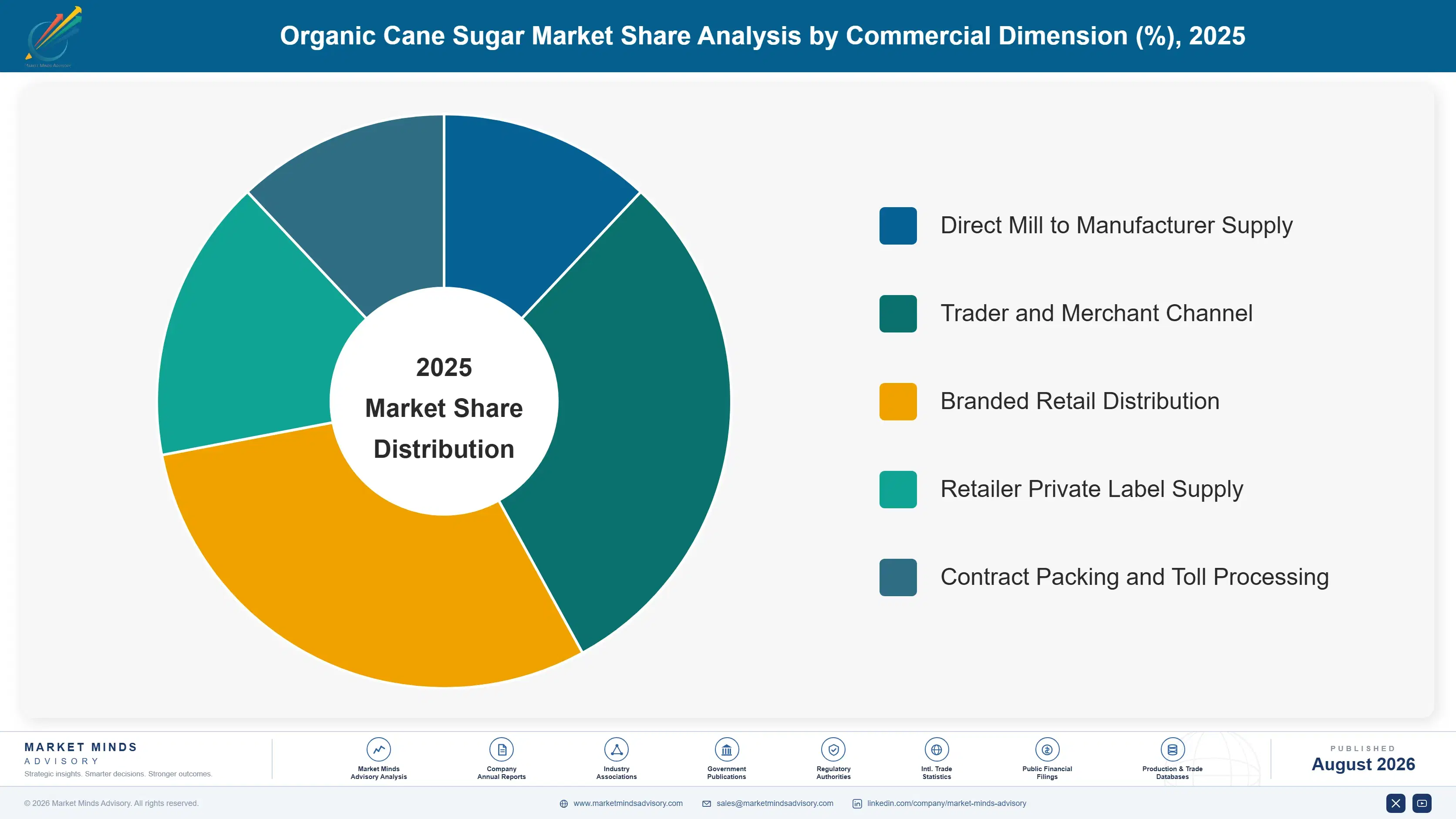
Five product forms divide this market on processing level and delivery format rather than on growing origin. That reflects how buyers actually purchase, since a beverage manufacturer specifies liquid sugar at a colour standard while a bakery buys unrefined crystals for their molasses content, and origin barely enters either conversation at all. Origin barely enters the specification at all.
organic-cane-sugar-market-trends-market-share-analysis-1787375306572

Certified Ingredient Grade Cane Sugar

Growing at 8.4% and the fastest part of this market. Certified organic cane sugar supplied as an ingredient into manufactured food and beverage is where the volume actually moves, because a single reformulation by a large brand consumes more tonnage than years of retail bag sales. Buyers here are procurement and technical teams who care about certification documentation, colour consistency and delivered cost per tonne, not about the sustainability story on a pack. Paraguayan and Brazilian certified mills supply most of it. What makes the segment commercially interesting is that once an organic sugar is qualified into a formulation the volume repeats for as long as the product is made, which is rarely true of retail sugar.
CAGR 8.4%

Unrefined and Speciality Cane Sugars

Growing at 7.1% on unrefined and minimally processed organic cane sugars sold as demerara, muscovado, panela and similar specialities where colour and molasses content are the product rather than defects to be removed. These carry considerably higher realised pricing than refined organic sugar and appeal to buyers who read an ingredient list closely. Colombian, Indian and Filipino producers hold strong positions built on traditional processing that happens to suit organic certification well. The commercial constraint is consistency, since molasses content and moisture both vary between batches in ways manufactured food buyers find genuinely difficult to work with at scale. Bakery and artisan buyers absorb the variation far better than manufacturers do.
CAGR 7.1%
Full segment breakdown across 5 segments available in the complete report.

Regional Architecture and Country Demand Map

Latin America holds 34% of global value because Brazil and Paraguay grow and mill most of the world's certified organic cane between them, which puts five regions outside the standard bands. North America follows at 24% on ingredient demand, and South Asia and Pacific grows fastest.

Latin America

Note: Latin America sits far above the standard share band because Brazil and Paraguay grow and mill most of the world's certified organic cane between them, and no allocation reflecting the real market avoids that. Brazilian certified mills in São Paulo state hold the largest segregated capacity anywhere and supply ingredient buyers across North America and Europe directly. Paraguayan production is smaller but proportionally more organic than any other country's, having built around certified cane deliberately rather than converting from conventional. Colombian panela producers hold the traditional unrefined position. Argentine and Peruvian capacity is modest. Domestic consumption of certified sugar across the region remains small relative to the production base.
Share: 34% | CAGR: 6.4% (2026 to 2036)

North America

Ingredient demand rather than production drives this region and there is essentially no certified organic cane grown here at all outside a small Hawaiian and Louisiana presence. Beverage, confectionery and bakery reformulation absorbs the tonnage, and a single brand decision can consume a supplying mill's annual certified output entirely. Retail packaged organic sugar is well developed and consumers recognise certification, though the volume is small against ingredient supply. National Organic Program equivalence arrangements govern imported certified sugar and are generally straightforward. Import dependence means Brazilian and Paraguayan supply decisions feed directly into North American ingredient availability without any domestic buffer. Certified availability here depends entirely on decisions taken at South American mills.
Share: 24% | CAGR: 5.9% (2026 to 2036)
Regional intelligence for 5 additional markets available in the complete report: Western Europe, East Asia, South Asia and Pacific, Middle East and Africa, Eastern Europe. Contact sales@marketmindsadvisory.com.
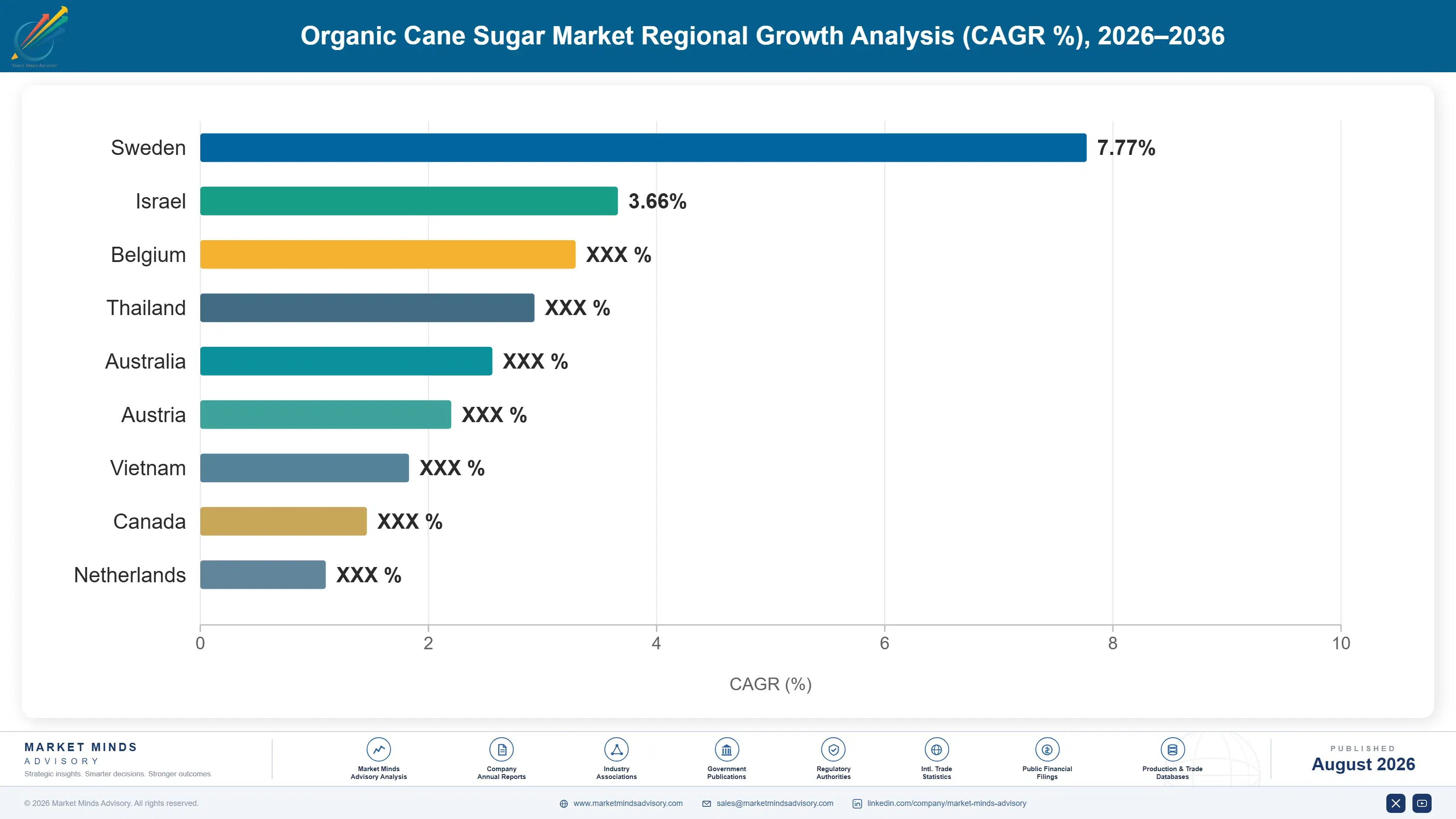
organic-cane-sugar-market-trends-country-cagr-analysis-1787375307096

Where Certified Sugar Margin Is Won

Four positions separate suppliers earning durable returns from those trading certified tonnage on a thin spread: committing mill segregation capacity, qualifying into manufactured formulations, contracting reformulation volume across multiple years, and building specification consistency that lets speciality sugars enter manufacturing at all. Only the first of those is closed to any newcomer without serious capital.

Commit Mill Segregation Capacity Ahead Of Demand

Running certified cane requires segregation through crushing, clarification, evaporation and crystallisation with no conventional contact, which means dedicated campaigns with full cleandown or dedicated equipment. Roughly 38 mills worldwide manage it, and that capital decision rather than field conversion is what limits world supply. Mills committing capacity realise 25% to 32% higher margin on certified runs than on conventional tonnage, and the scarcity holds because most operators will not stop a conventional campaign to do it. Committing capacity is a board decision rather than a commercial one, which is why so few have made it.
Market Impact: Realises up to 32% higher margin per run

Qualify Into Manufactured Formulations Before Competitors Do

Qualification with a food or beverage manufacturer takes around ten months of documentation, colour testing, audit and trial runs, and once a sugar is inside a formulation nobody revisits it without a reason. The volume then repeats annually for as long as the product is made. Qualified suppliers realise 20% to 27% higher pricing than those quoting spot certified tonnage, on volumes predictable enough to plan mill campaigns against, which is the whole point. Every unqualified tonne gets retendered annually, with no switching cost protecting the supplier at all in that process.
Market Impact: Realises 27% higher pricing once the formulation qualifies

Contract Reformulation Volume Across Multiple Years

A certified sweetener at a 61% premium is among the easier line items for a brand to reconsider when margins tighten, because the sugar is chemically identical and rarely appears in the consumer proposition. Multi-year supply agreements with volume-tiered pricing make reversal commercially awkward rather than merely inconvenient, and suppliers holding them retain 30% to 40% more volume through brand cost reviews than those on annual terms. The tiering is what makes the customer defend it internally. Annual arrangements give a procurement team nothing at all to argue with internally when the review comes.
Market Impact: Retains up to 40% more volume through reviews

Build Specification Consistency For Speciality Sugar Manufacturing

Molasses content, moisture and colour vary between batches of unrefined sugar in ways manufactured food buyers genuinely struggle with, which keeps roughly 30% of potential ingredient use closed to speciality grades. Batch blending before despatch and tighter specification bands open that volume at pricing well above refined organic sugar. The work is process discipline and inventory management rather than capital, and it converts a retail speciality into an ingredient a manufacturer can actually formulate around. Manufacturers will pay well above refined organic pricing once they can rely on the specification holding.
Market Impact: Opens roughly 30% of the potential ingredient use

Who Controls the Margin Pool

Concentration reads at 44% for the top five measured on certified organic cane sugar revenue, the basis used throughout this section, and it reflects mill segregation capacity rather than land ownership. Grupo Balbo holds the largest certified milling position anywhere. ASR Group brings North American refining and distribution reach. Wholesome Sweeteners, Azucarera Paraguaya and Manuelita hold origin and speciality positions respectively.
Competition runs on three fronts. Certified mill capacity is the first and by far the most decisive, since a supplier without segregated milling is trading somebody else's tonnage on a spread. Formulation qualification is the second, and it converts spot supply into repeating annual volume. Specification consistency is the third, and it determines whether speciality grades reach manufacturing at all. Owning neither is the weakest position available.

Pressure arrives from two directions. Large conventional sugar groups can commit segregation capacity whenever demand justifies it, which caps how far scarcity premiums can run before capacity answers them. Separately, Indian certified supply is growing quickly on a domestic base that needed no conversion. Rankings will shift toward participants holding both certified milling and qualified formulation positions rather than either alone.
organic-cane-sugar-market-trends-company-positioning-matrix-1787375307616

Competitive Moat and Risk Dimensions

GRUPO BALBO

Moat: Largest certified milling capacity

Dedicated organic milling capacity built deliberately rather than converted from conventional campaigns gives the group segregated volume at a scale competitors cannot match without committing comparable capital. Decades of certified cane agronomy across owned and contracted land also produce yield and quality consistency that newer certified operations spend years trying to reach.
GRUPO BALBO

Risk: Single origin concentration exposure

Concentration in Brazilian production leaves the business exposed to regional weather, cane disease and currency movement with no geographic diversification to offset any of it. Buyers are also increasingly asking for second-origin supply as a matter of policy, which pushes qualified volume toward suppliers able to offer more than one certified source.
ASR GROUP

Moat: Refining and distribution reach

North American refining capacity combined with established ingredient distribution puts the group in front of the beverage, confectionery and bakery buyers whose reformulation decisions move tonnage in blocks. Handling conventional and certified volume through the same commercial relationships also means a customer converting a product does not have to change supplier to do it.
ASR GROUP

Risk: Dependent on imported certified cane

Certified raw sugar arrives almost entirely from Brazilian and Paraguayan mills the group does not control, which places the upstream position in somebody else's hands during any period of tight certified supply. Origin producers moving downstream into direct ingredient supply also compress the refining and distribution spread the business operates within.

Players Tracked

Prominent Players

Grupo Balbo
ASR Group
Wholesome Sweeteners
Azucarera Paraguaya
Manuelita

Other Key Players

Tereos
Südzucker
Nordzucker
Cosan
Raízen
Louis Dreyfus Company
Cargill
Tate and Lyle
Ingredion
Incauca
Mitr Phol
EID Parry
Shree Renuka Sugars
Bundaberg Sugar
Nordic Sugar

Recent Developments

FEBRUARY 2025

Beverage brand converts flagship range to certified organic sweetener

A large beverage manufacturer converted a flagship product range to certified organic cane sugar, absorbing tonnage equivalent to a supplying mill's full annual certified output and requiring a multi-year supply agreement to secure availability before the reformulation was announced publicly. Volumes run across a five-year term.
Signal: Single reformulation decisions move more certified tonnage than years of retail bag sales could ever manage
JUNE 2025

Brazilian mill commits dedicated segregated organic crushing capacity

A Brazilian sugar group committed dedicated crushing and crystallisation capacity to certified organic cane rather than running periodic segregated campaigns, removing the cleandown cost and scheduling friction that had limited how much certified tonnage the mill could realistically produce. Capacity comes on stream for the 2026 harvest.
Signal: Dedicated capacity rather than campaign scheduling is what expands the world certified sugar supply in any meaningful way
OCTOBER 2025

Speciality sugar blending programme opens manufacturing applications

A speciality sugar supplier introduced pre-despatch batch blending and tighter specification bands for unrefined organic grades, addressing the molasses and moisture variability that had kept these sugars largely confined to retail and artisan rather than manufactured use. Two manufacturing customers qualified the blended grades shortly afterwards.
Signal: Consistency rather than price is what has kept speciality sugars out of manufactured food applications almost entirely

What Drives Certified Sugar Cost

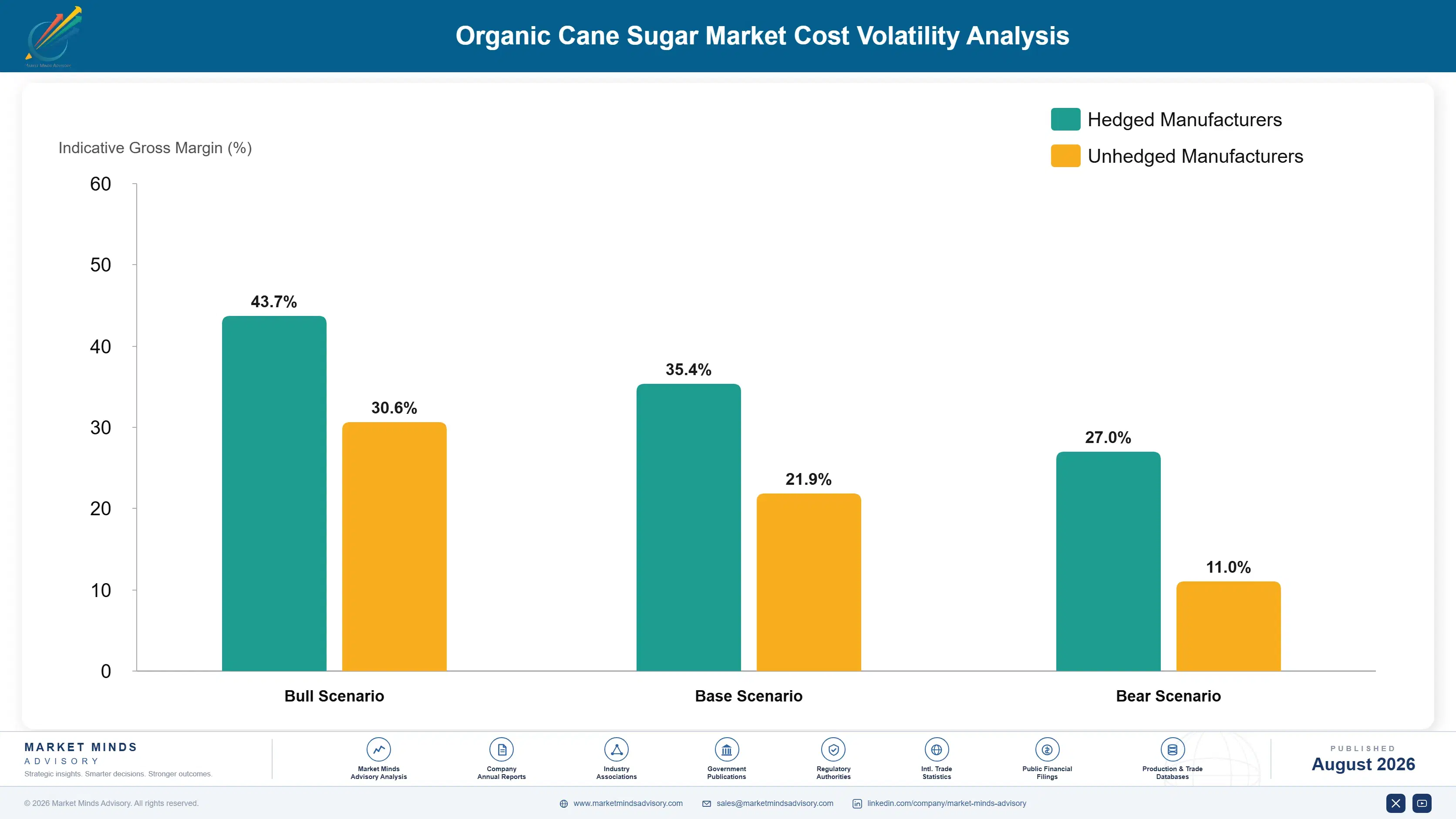
Certified cane accounts for roughly 52% of manufactured cost and carries both a grower premium and the yield penalty organic practice imposes in the field. Milling energy contributes around 14%, though bagasse cogeneration offsets much of it at integrated operations. Segregation, cleandown and campaign scheduling add about 9%, certification and audit roughly 6%, and packaging, storage and freight close to 15% given the distances certified sugar travels.
World raw sugar pricing moved sharply through 2023 and 2024 on Indian export restrictions and Brazilian weather, with United States Department of Agriculture sugar and sweetener data showing the movement clearly, and certified premiums moved with the underlying rather than independently of it. Freight costs from South American origins rose in parallel, which mattered disproportionately because almost all certified cane sugar crosses an ocean. Certified buyers absorbed both.

The disadvantage mechanism is segregation cost spread across campaign length, and it falls hardest on mills running certified cane occasionally. A dedicated certified operation carries no cleandown penalty and schedules freely; a conventional mill running periodic organic campaigns absorbs both. Exposure also varies by integration, since groups owning cane control the largest cost line while merchant millers buying certified cane at a premium do not.
organic-cane-sugar-market-trends-cost-volatility-analysis-1787375307812

Commit dedicated capacity rather than periodic segregated campaigns

Cleandown and scheduling friction make occasional certified campaigns considerably more expensive per tonne than a dedicated operation, and that gap widens as certified volume grows. Committing equipment removes the penalty entirely and frees campaign timing. The capital is substantial and only pays above a volume threshold, which is exactly why so few mills worldwide have made the commitment so far.

Contract certified cane on multi-year grower agreements

Certified cane is over half of manufactured cost and growers need certainty to keep land in organic practice beyond the compliance period. Multi-year agreements secure both supply and predictable pricing while giving the grower a reason to stay certified. The commitment carries volume risk when demand softens, which in a market driven by individual brand decisions is a genuine concern.

Position certified stock closer to ingredient buyers

Almost all certified cane sugar crosses an ocean, and freight plus storage runs near 15% of delivered cost from South American origins into North American and European manufacturers. Holding certified stock in destination warehousing shortens lead times that ingredient buyers increasingly weigh alongside price. Working capital and storage cost are the trade, and both need volume behind them to justify.

Portfolio Architecture for Margin Defence

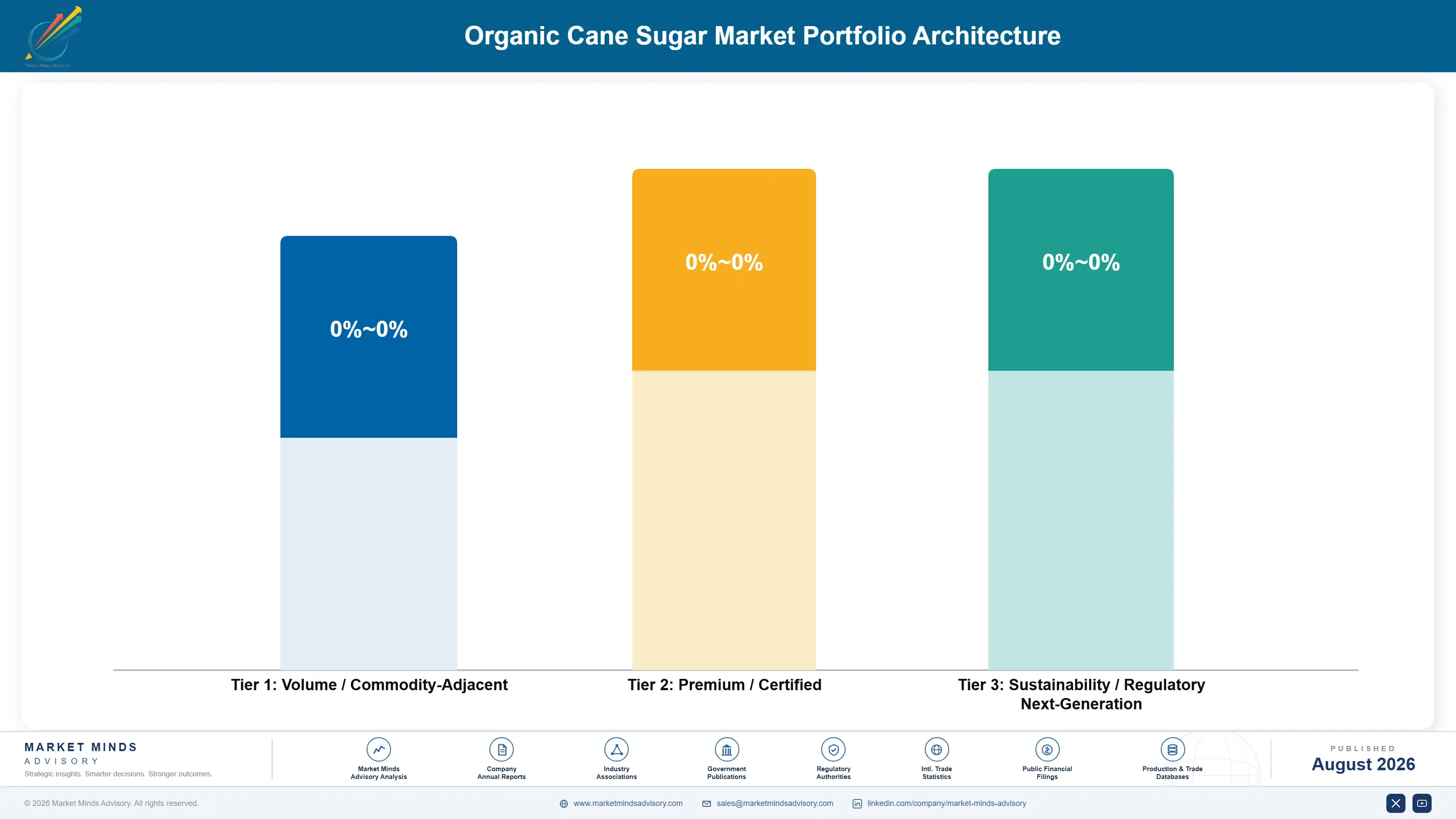
Portfolio economics here divide on milling position and qualification status rather than on sugar grade. Trading certified tonnage bought from somebody else's mill puts a business between a scarce supply and a demanding buyer with no control over either, and the spread reflects exactly that lack of control. Origin mills now moving downstream directly compress that spread even further each year.
The middle tier is certified sugar qualified into manufactured formulations. Ten months of documentation, colour testing and audit produce a position nobody revisits casually, and the volume repeats annually for as long as the product is made. Realised pricing runs 20% to 27% above spot certified tonnage, and margins reach the low thirties on volume predictable enough to plan against. Requalification costs the buyer time and returns nothing.

Above both sits dedicated certified milling supplying qualified formulations directly. Owning segregation capacity removes the cleandown penalty, controls the largest cost line and captures the scarcity premium rather than paying it to somebody else. Margins reach the mid forties. The position requires committed capital that most mill operators have declined to spend, which is precisely why only around 38 mills worldwide do this properly.

Volume / Commodity-Adjacent

Traded certified tonnage bought from third-party mills without qualification. The range reflects world raw sugar pricing and freight rather than commercial skill, and the trader controls neither the supply nor the buyer.
Gross Margin: 8 to 15%

Premium / Certified

Certified sugar qualified into named manufactured formulations. The range reflects how deep the technical relationship runs and whether a second certified origin sits qualified alongside in the same product. Revisiting is rare.
Gross Margin: 27 to 35%

Sustainability / Regulatory / Next-Generation

Dedicated certified milling supplying qualified formulations directly. The wide range reflects whether cane is owned or bought and whether segregation runs on dedicated equipment or scheduled campaigns. Very few operators have committed.
Gross Margin: 40 to 50%
organic-cane-sugar-market-trends-portfolio-architecture-1787375308313

High-value Sub-segments and Strategic Watch-out

Dedicated Certified Milling Supply

High value and high growth together, and the position that actually captures the scarcity premium. The wide range reflects whether cane is owned or purchased and whether segregation runs on dedicated equipment or on scheduled campaign cleandowns. Most mill operators have simply declined to spend that capital.
Gross Margin: 40 to 50%

Qualified Ingredient Formulation Volume

High value on strong growth and the most defensible ordinary position here. Ten months of qualification produces volume that repeats annually. The range reflects technical relationship depth and whether a second certified origin is qualified alongside. Requalification costs the buyer time and delivers them nothing at all.
Gross Margin: 27 to 35%

Speciality Unrefined Sugar Supply

A genuinely premium pool where colour and molasses content are the product rather than defects. The range reflects specification consistency, since batch variability keeps much of the potential manufacturing volume closed to these grades. Bakery and artisan users absorb that variation far more readily than manufacturers do.
Gross Margin: 24 to 33%

Traded Certified Commodity Tonnage

The strategic watch-out. Volumes are real but the trader owns neither supply nor buyer, pricing follows world raw sugar, and origin producers moving downstream compress the spread further. The range reflects freight and market conditions alone. Owning neither end of the chain is the problem here.
Gross Margin: 8 to 15%

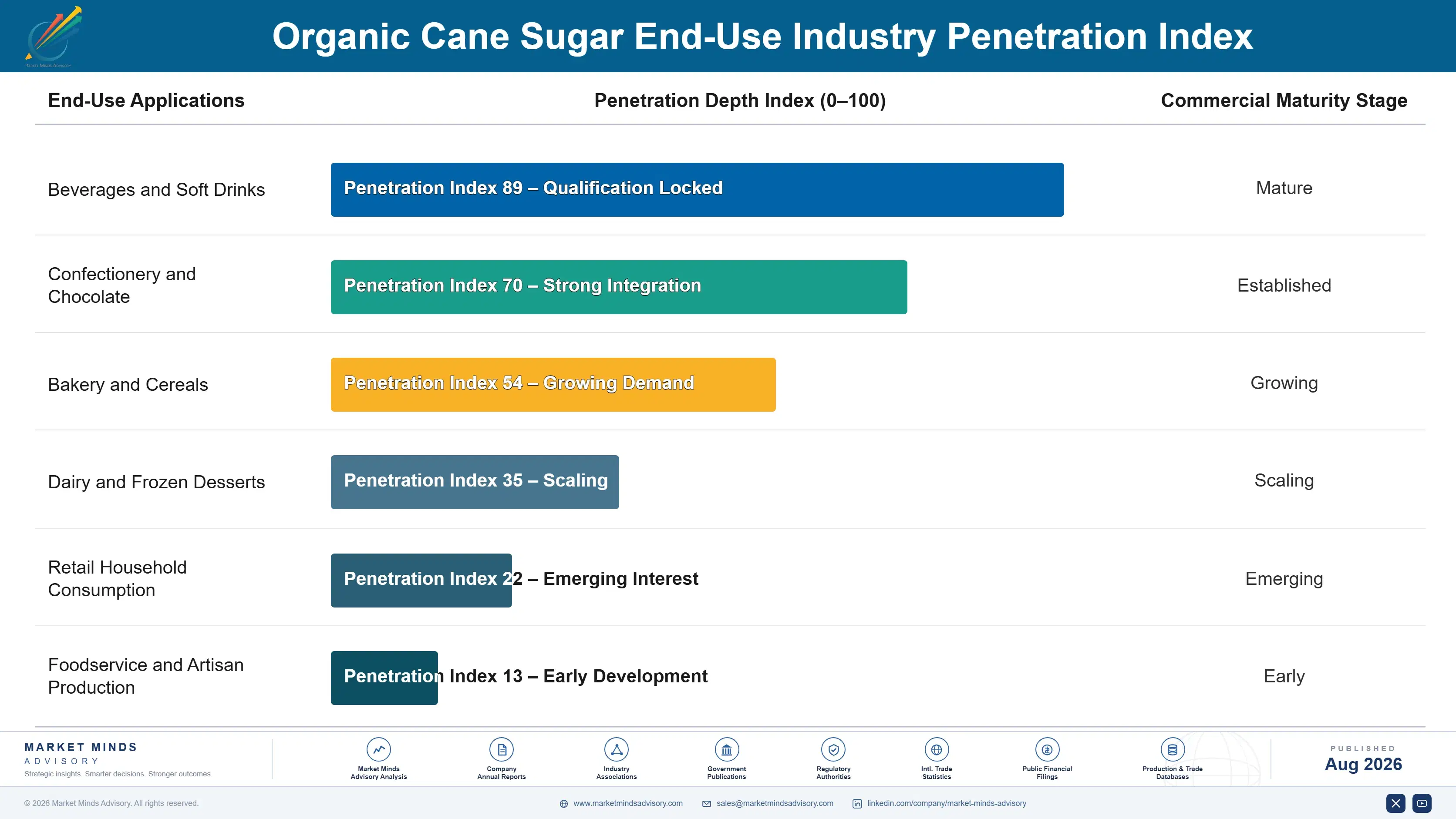
How Certified Sugar Demand Repeats

Demand here repeats in a way that looks smooth in aggregate and is genuinely lumpy underneath. A qualified formulation generates the same tonnage every year for as long as the product is manufactured, which is often a decade, because requalification costs the buyer time and delivers nothing. But the decision that created that volume was a single reformulation, and the next one might go the other way entirely.
Stickiness varies sharply by position. Qualified ingredient supply holds best, since a certified sugar named in a specification and validated through trials is not swapped casually. Speciality unrefined grades hold well where a bakery has built a product character around the molasses content. Retail packaged sugar holds moderately on brand habit. Traded commodity tonnage holds worst of all, moving between origins on delivered price without hesitation.

The buyer profile has shifted considerably. Early certified demand came from natural food brands and retail consumers making a values purchase and accepting the premium to make it. Today's meaningful buyer is a procurement and technical team at a large manufacturer, assessing certification documentation, colour consistency and delivered cost per tonne, and treating the organic label as a specification requirement rather than a statement.
organic-cane-sugar-market-trends-end-use-penetration-index-1787375308803

Where To Compete And Why

These are among the four positions where our research anticipates prominent divergence between winners and laggards over the coming forecast period. Each is grounded in the demand model, the regulatory perimeter, and the announced capacity pipeline.
01 / MILL SEGREGATION COMMITMENT

Fields convert faster than mills do

Running certified cane requires segregation through crushing, clarification, evaporation and crystallisation with no conventional contact, which means dedicated equipment or campaigns with full cleandown between runs. Roughly 38 mills worldwide manage it properly, and that capital decision rather than any shortage of convertible fields is what genuinely limits world supply. Mills committing capacity realise 25% to 32% higher margin on certified runs, and the scarcity holds because most operators simply will not stop a conventional campaign to do it, whatever the premium looks like.
02 / FORMULATION QUALIFICATION TIMING

Ten months buys a decade

Qualification with a food or beverage manufacturer takes around ten months of documentation, colour testing, audit and trial runs, after which nobody revisits the decision without a specific reason to do so. The volume then repeats annually for as long as the product is manufactured, which is frequently a decade or more. Qualified suppliers realise 20% to 27% higher pricing than spot certified tonnage on volumes predictable enough to plan mill campaigns against properly, while unqualified tonnage is simply retendered every year.
03 / REVERSAL RISK CONTRACTING

Identical sugar, removable premium

A certified sweetener at a 61% premium is among the easiest line items for a brand to reconsider under margin pressure, because the sugar is chemically identical and rarely appears anywhere in the consumer proposition. Multi-year agreements with volume-tiered pricing make reversal commercially awkward rather than merely inconvenient for the customer. Suppliers holding those terms retain 30% to 40% more volume through brand cost reviews than competitors trading on annual arrangements instead, which give a procurement team nothing at all to argue against internally.
04 / SPECIALITY CONSISTENCY BUILDING

Variability closes manufacturing to specialities

Molasses content, moisture and colour vary between batches of unrefined organic sugar in ways manufactured food buyers genuinely struggle to formulate around, which keeps roughly 30% of potential ingredient use closed to these grades entirely. Batch blending before despatch and tighter specification bands open that volume at pricing well above refined organic sugar. The work is process discipline and inventory management rather than capital investment, which makes it unusually good value against the volume it opens up for the supplier concerned.

Engagement Snapshot From the Field

A live engagement with an industry participant carrying material or product regulatory and market exposure ahead of a defining policy shift, showing how our research translates into a defensible multi-year portfolio strategy.
MARKET MINDS ADVISORY · CLIENT ENGAGEMENT SUMMARY
Organic Cane Sugar Producer Strategic Portfolio Review and Transition Roadmap 2026·Investment Scenario on Organic Cane Sugar Exposure Evaluation 2025-26
CLIENT PROFILE
A European certified organic sugar trading and supply business with annual revenue near $96 million (client-reported, unverified by MMA), buying certified raw sugar from South American mills and supplying food manufacturers across seven countries. The business held good customer relationships and origin knowledge, but owned no milling capacity and held almost no qualified formulation positions.
STRATEGIC CHALLENGE
Certified raw sugar had tightened for two consecutive seasons while the client's customers demanded firm forward supply it could not commit to. Origin mills were beginning to supply European manufacturers directly. Management needed to decide between investing upstream, pursuing formulation qualification, or accepting a narrowing trading spread and competing on service.
MMA APPROACH
MMA modelled realised margin by customer and supply route across four years of the client's own data, benchmarked spread against origin producers selling direct, and assessed formulation qualification requirements with the client's largest manufacturing customers. Twenty-one expert interviews with mill managers, ingredient procurement leads and certification bodies tested each available route.
KEY FINDINGS
  1. Origin mills selling directly to European manufacturers were realising roughly 22% more per tonne than the client, and two of the client's largest customers had already been approached.
  2. None of the client's volume sat inside a qualified formulation position, which meant every tonne was retendered annually and no customer relationship carried any switching cost at all.
  3. Manufacturing customers valued firm forward supply commitments above delivered price within a reasonable band, and the client could not offer them without controlling milling capacity.
  4. A minority equity position in a Paraguayan certified mill was available and would have secured allocation at a capital commitment well below building dedicated capacity outright.
CLIENT PROFILE
A European certified organic sugar trading and supply business with annual revenue near $96 million (client-reported, unverified by MMA), buying certified raw sugar from South American mills and supplying food manufacturers across seven countries. The business held good customer relationships and origin knowledge, but owned no milling capacity and held almost no qualified formulation positions.
STRATEGIC CHALLENGE
Certified raw sugar had tightened for two consecutive seasons while the client's customers demanded firm forward supply it could not commit to. Origin mills were beginning to supply European manufacturers directly. Management needed to decide between investing upstream, pursuing formulation qualification, or accepting a narrowing trading spread and competing on service.
MMA APPROACH
MMA modelled realised margin by customer and supply route across four years of the client's own data, benchmarked spread against origin producers selling direct, and assessed formulation qualification requirements with the client's largest manufacturing customers. Twenty-one expert interviews with mill managers, ingredient procurement leads and certification bodies tested each available route.
KEY FINDINGS
  1. Origin mills selling directly to European manufacturers were realising roughly 22% more per tonne than the client, and two of the client's largest customers had already been approached.
  2. None of the client's volume sat inside a qualified formulation position, which meant every tonne was retendered annually and no customer relationship carried any switching cost at all.
  3. Manufacturing customers valued firm forward supply commitments above delivered price within a reasonable band, and the client could not offer them without controlling milling capacity.
  4. A minority equity position in a Paraguayan certified mill was available and would have secured allocation at a capital commitment well below building dedicated capacity outright.
RECOMMENDED STRATEGY
Phase 1: Phase one: pursue formulation qualification with the three largest manufacturing customers, since it converts retendered tonnage into repeating annual volume without any capital. Phase 2: Phase two: take the available minority position in certified milling capacity to secure allocation and enable the firm forward commitments customers want. Phase 3: Phase three: build destination warehousing to shorten lead times, using the secured allocation to justify the working capital it requires.
OUTCOME
The client qualified into five formulations within fourteen months and completed the mill equity investment (client-reported, unverified by MMA). Retendered tonnage fell from 88% to 41% of volume, realised margin per tonne improved by roughly 18%, and both customers approached by origin producers were retained on multi-year terms.

Frequently Asked Questions

Foundational context covering the market sizes, CAGR, scope, country, region and competition that inform every finding below. This section is provided to cover basics and most often pre-purchase conversations, answered from the MMA Primary Research Dataset.

What is the current size of the Organic Cane Sugar Market?

The global organic cane sugar market was valued at $2.20 billion in 2025, reaching an estimated $2.32 billion in 2026. That covers sugar produced from certified organic sugarcane across ingredient and retail channels.

How large will the Organic Cane Sugar Market be by 2036?

MMA forecasts the market reaching $4.00 billion by 2036, an increase of $1.68 billion over the 2026 base. That represents an expansion multiple of 1.72 times across the forecast period.

What is the CAGR for the Organic Cane Sugar Market 2026 to 2036?

The base case compound annual growth rate is 5.6%, with a bull case of 6.8% and a bear case of 4.4%. Historical growth between 2020 and 2025 ran at 4.7% annually.

Which segment is growing fastest?

Certified ingredient grade cane sugar grows at 8.4%, a full 1.50 times the market rate, on brand reformulation moving tonnage in blocks. Unrefined and speciality cane sugars follow at 7.1%.

Who are the major companies in the Organic Cane Sugar Market?

Grupo Balbo, ASR Group, Wholesome Sweeteners, Azucarera Paraguaya and Manuelita lead on certified organic cane sugar revenue. Together they account for roughly 44% of global value.

Which country is growing fastest?

India grows fastest at 8.9% annually as branded packaged sugar displaces unbranded loose product and certified jaggery finds an organised retail market. Brazil follows on export demand.

Report Segmentation Architecture

The full report scope spans multiple orthogonal segmentation dimensions, with cross-tabulated demand data provided for each dimension pair. Coverage extends further to regional breakdowns, trend trajectories, and the competitive detail needed to support segment-level decision-making.

By Product Form

  • Certified Ingredient Grade Cane Sugar
  • Unrefined and Speciality Cane Sugars
  • Retail Packaged Organic Sugar
  • Organic Liquid Sugar and Syrups
  • Certified Organic Molasses

By End-Use Industry

  • Beverages and Soft Drinks
  • Confectionery and Chocolate
  • Bakery and Cereals
  • Dairy and Frozen Desserts
  • Retail Household Consumption
  • Foodservice and Artisan Production

By Commercial Dimension

  • Direct Mill to Manufacturer Supply
  • Trader and Merchant Channel
  • Branded Retail Distribution
  • Retailer Private Label Supply
  • Contract Packing and Toll Processing

By Region

  • North America
  • Western Europe
  • East Asia
  • South Asia and Pacific
  • Latin America
  • Middle East and Africa
  • Eastern Europe

Scope, Methodology, and Coverage

Every figure in this report is reproducible from documented input assumptions. The scope below maps the historical period, the forecast horizon, the segmentation dimensions, and the countries covered, alongside the underlying primary and qualitative methodology.
Historical Period
2020 to 2025
Forecast Period
2026 to 2036
Base Year
2025 (USD billions; MMA Primary Research Dataset, August 2026)
Market Definition
This report covers sugar produced from certified organic sugarcane, spanning certified ingredient grade sugar, unrefined and speciality cane sugars including demerara, muscovado and panela, retail packaged organic sugar, organic liquid sugar and syrups, and certified organic molasses sold as a food ingredient, across direct mill supply, trading, retail and private label channels. Conventional cane sugar, all beet sugar whether certified or not, high fructose corn syrup and other caloric sweeteners, non-nutritive sweeteners, and molasses sold for fermentation or animal feed are excluded from the sizing.
Quantitative Units
USD billions at supplier realised value; volume in thousand tonnes; realised pricing in USD per tonne.
Segmentation Dimensions
By product form; by end-use industry; by commercial dimension; by region.
Regions Covered
North America, Western Europe, East Asia, South Asia and Pacific, Latin America, Middle East and Africa, Eastern Europe
Countries Covered
Brazil, Paraguay, Colombia, Argentina, Peru, Mexico, United States, Canada, Germany, United Kingdom, Netherlands, France, Italy, Poland, India, Philippines, Thailand, Australia, Japan, Mauritius.
Key Companies Profiled
Grupo Balbo, ASR Group, Wholesome Sweeteners, Azucarera Paraguaya, Manuelita, Tereos, Südzucker, Nordzucker, Cosan, Louis Dreyfus Company, Cargill, Tate and Lyle, Incauca, EID Parry and others.
Quantitative Methodology
Primary survey, n=3,800 respondents, Q4 2025, six countries; demand-side model with trade association cross-validation
Qualitative Methodology
47 expert interviews, Q4 2025; applied to validate demand model assumptions, identify emerging dynamics, and assess competitive positioning
Report Format
PDF and XLSX data workbook (Word format preview document)
Publisher
Market Minds Advisory
Report Code
MMA-2026-AGR-138
Published
August 2026
Contact
sales@marketmindsadvisory.com | www.marketmindsadvisory.com

Purchase the full Organic Cane Sugar Market Report (2026 to 2036).

The full report sizes the organic cane sugar market across five product forms, six end-use categories and seven regions, with tonnage and per tonne pricing detail behind every value estimate. It profiles twenty companies on certified milling capacity, formulation qualification and origin position. Regional chapters cover certified acreage, mill capacity and consumption patterns by market. Cost analysis quantifies cane, segregation and freight exposure by integration position. Certified mill analysis maps segregation capability, dedicated capacity and campaign scheduling across every one of the producing origins in detail.
Tonnage and per tonne pricing by product form
Certified mill capacity and segregation capability mapped globally
Formulation qualification requirements and cycle benchmarking
Certified acreage and conversion rates by producing origin
Competitive position assessments across twenty companies
Freight, segregation and integration cost economics compared

Built For The People Who Decide

From boardroom strategy to bench-side execution, this report is read cover-to-cover by leaders shaping the next decade of their industry, turning demand scenarios, market dynamics and valuation benchmarks into decisions.
CXOs/ Presidents/ VPs/ Managers
M&A and Corporate Development
Strategy Teams and R&D Heads
Procurement and Product Directors
Regulatory and Compliance Leaders
Investor Relations and Equity Analysts