Market Minds Advisory
Organic Beef Market

Organic Beef Market: Convenience Formats Meet Certified Grass-Fed Supply Constraints

Processed and snack-format demand is pulling organic beef volume away from traditional fresh cut retail, forcing producers to defend legacy butcher case contracts while chasing certified value-added processing capacity investment.

Lead Analyst

Lisa Gevelber

Published

September 2026

Make Smarter Decisions with Customized Research Insights

Request a free sample report and evaluate market opportunities, growth trends, and competitive dynamics relevant to your business needs.

2025 MARKET VALUE$8.5BMarket Size 2025
2036 FORECAST VALUE$17.0BBase Case , 2026 to 2036
CAGR 2026 TO 20366.5 %Bull 7.8% / Bear 5.2%
INCREMENTAL OPPORTUNITY$7.9BNet 10- year value creation
EXPANSION MULTIPLE1.88x2036 value over 2026 base
Strategic Levers
M&A Pipeline
Regional Outlook
Country Rankings
Competitive Intelligence
Segmental Deep-dive
Call-Us : 91 93563 13602

Executive Snapshot and Market Trajectory

Organic beef has stopped being purely a fresh butcher case product across most retail formats. Processed formats now carry the certification premium as much as raw cuts do, and that shift is quietly reshaping how ranchers and processors plan their organic certification investments across the entire supply chain.
JBS and Tyson Foods continue supplying the bulk fresh and ground organic beef that retail grocery chains have relied on for years, since cost-per-pound economics still govern most general retail applications regardless of premiumization trends elsewhere in the category and its evolving product lines. Processed and value-added organic beef products are capturing disproportionate growth as consumers specify convenience formats that traditional fresh cuts cannot deliver within busy household routines and modern lifestyles.
Applegate Farms and Niman Ranch are investing specifically in processing capacity for value-added organic beef formats, betting that convenience and snacking demand sustains premium pricing for years across most product categories and end markets served today and beyond. Producers without processing capability increasingly find themselves confined to price-competitive fresh cut contracts rather than the higher-margin value-added programs retailers increasingly prefer for new product line investment.
Market Definition
The organic beef market covers fresh, ground, frozen, offal and variety meats, processed and value-added products, and jerky and dried snack products derived from cattle raised under certified organic standards. It excludes conventional beef, natural or antibiotic-free beef lacking formal organic certification, and plant-based beef alternatives sold through separate supply chains.
Base Year Value
$8.5B in 2025 (MMA Primary Research Dataset, August 2026)
Forecast Period
2026 to 2036, eleven discrete annual values
CAGR
6.5% base case. Bull 7.8%. Bear 5.2%.
Fastest Growth Segment
Processed and Value-Added Organic Beef Products: 9.0% CAGR
Fastest Growth Country
China: 8.5% CAGR
Fastest Growth Region
South Asia and Pacific: 8.5% CAGR
Largest Region
North America: 28% of 2025 global value
Market Leaders
JBS S.A., Tyson Foods, Cargill Protein, Applegate Farms, Niman Ranch. Source: MMA Analysis based on company annual reports.
Primary Survey
n=3,800 procurement and R&D decision-makers, Q4 2025, six countries
Methodology
Demand-side build-up, cross-validated against public data, 47 expert interviews

Organic Beef Market Forecast Scenarios

organic-beef-market-trends-forecast-size-forecast-scenario-1787558463497
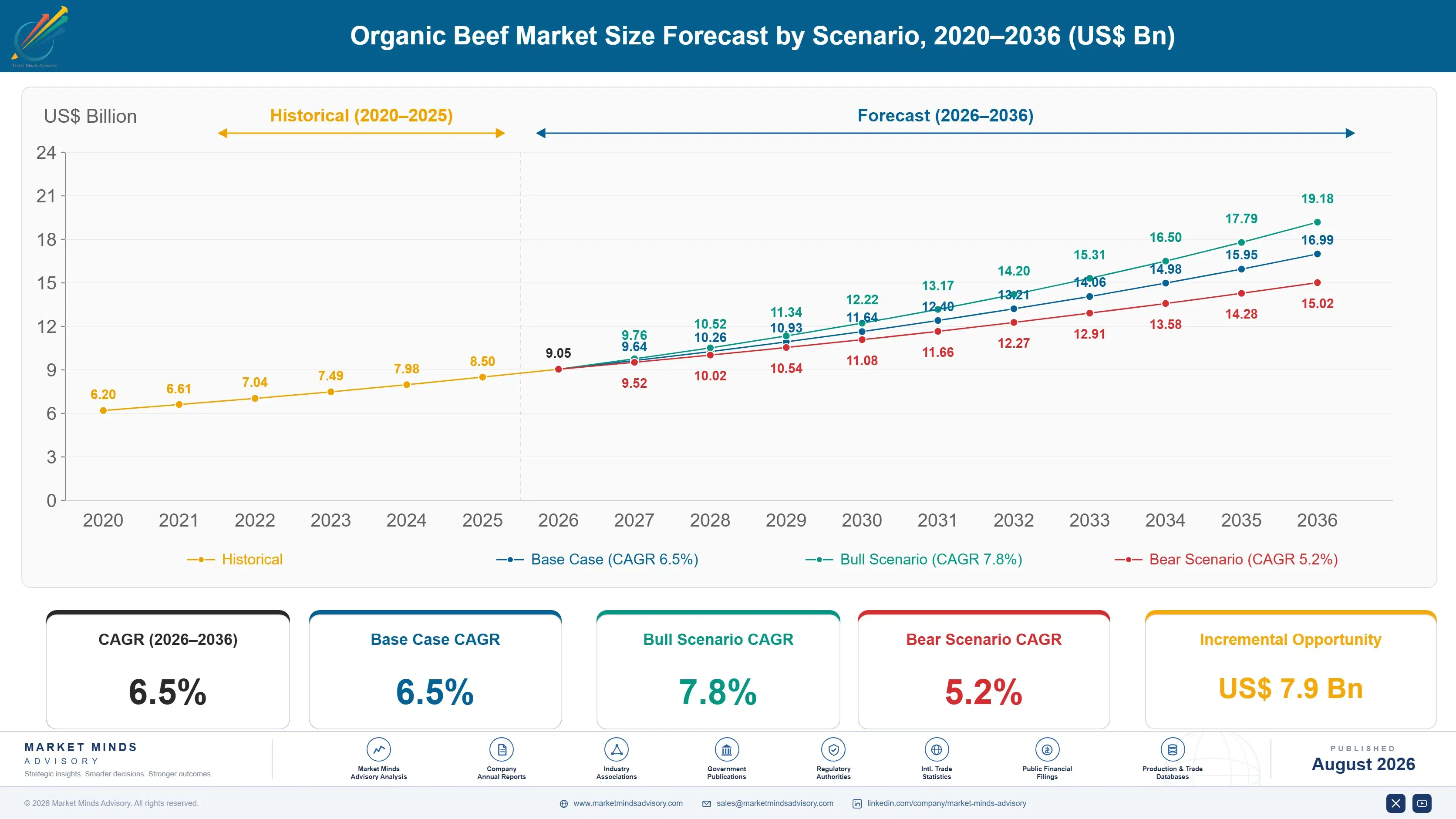
Between 2020 and 2025 the market grew at roughly 5.5 percent a year, as steady consumer premiumization combined with early processed format adoption to lift overall volume modestly above the flat growth pattern conventional beef had shown through most of the previous decade, setting the stage for the acceleration now underway across most product categories today.
The base case assumes 6.5 percent annual growth to 2036, built on three mechanisms: processed and value-added product manufacturers scaling convenience format demand as busy households seek premium protein options globally and across most developed consumer markets and demographics, snack-format organic jerky products expanding as protein snacking trends accelerate across most demographics and age groups worldwide, and emerging market consumption rising steadily as premium food adoption spreads among growing middle-class populations specifically over the coming decade.
A bull case near 7.8 percent depends on premiumization trends accelerating faster than currently planned across major consumer markets worldwide and beyond current projections and forecasts. The bear case near 5.2 percent assumes discretionary premium food spending softens amid economic pressure, delaying organic beef demand and pressuring producers reliant on that premium channel specifically each quarter.

Certification Economics and Premium Demand Dynamics

Organic beef sits at the intersection of animal welfare regulation, land-use certification, and a premium consumer willing to pay meaningfully above conventional beef prices. Retailers have expanded dedicated organic meat cases well beyond specialty grocers, and foodservice operators now list certified organic beef on menus as a differentiator, pulling volume through channels that barely existed a decade ago. Independent certifiers report growing willingness among consumers to verify claims directly.
MARKET CONCENTRATION (CR5)32%Top five certified organic beef processors together hold this share
AVERAGE SELLING PRICE$14.50/kg retailReflects premium certified organic retail price positioning nationwide
TOP PRODUCING COUNTRY SHAREAustralia 24%Largest single national source of certified organic cattle
FEEDSTOCK COST SHARE58%Certified organic feed and grazing land costs dominate
CERTIFICATION CONVERSION CYCLE36 monthsTime required for pastureland and herd certification process
TRADE INTENSITY22% cross-borderShare of output moving through international premium export channels
Commercially, the category behaves less like commodity beef and more like a certified ingredient business: margin sits in traceability, feed sourcing, and pasture documentation rather than slaughter throughput alone. Processors that control certified supply chains end to end capture materially better economics than those buying certified cattle on the open market, which keeps consolidation pressure aimed at vertically integrated operators and drives recent acquisition activity aimed at securing dedicated organic cattle supply.
Over the next decade, certification cost compression, expanding retail private-label organic lines, and growing scrutiny of regenerative grazing claims will reshape who wins share. Buyers increasingly expect verifiable pasture data alongside the certification label itself, and that shift favors processors already investing in traceability infrastructure over those relying on paperwork alone as retailers tighten sourcing standards.
"The certification label gets the shopper to the shelf, but pasture data and traceability keep them coming back. Processors treating organic beef as commodity beef with a sticker are the ones losing shelf space fastest."
Director, Agriculture and Protein Practice · MMA Agriculture Practice · August 2026

Market Trends

Retail Private-Label Organic Beef Line Expansion

Major grocery chains across North America and Western Europe have launched dedicated private-label certified organic beef lines since 2023, expanding shelf allocation by roughly 18 percent in leading retail banners. This shift pulls volume away from branded organic labels while simultaneously growing total category square footage, forcing branded processors to compete on traceability depth and pasture story rather than shelf placement alone. Store-brand penetration has climbed fastest in the premium grocery banners that built dedicated organic meat sets over the past three years, and several chains have signaled plans to extend that footprint into mainstream banners by 2027.
Market Impact: Raises audit frequency 35% industry-wide
Regenerative Grazing Certification Layered on Organic

Third-party regenerative agriculture certifications are increasingly layered on top of baseline organic certification, with over 4,200 US ranches now holding both marks as of 2025. This dual-certification trend commands a further retail price premium above standard organic beef and is reshaping procurement specifications among premium foodservice buyers seeking verifiable carbon and soil-health claims beyond the organic label itself. Buyers evaluating supplier contracts increasingly ask for third-party audited grazing data rather than self-reported practice summaries, and processors able to supply that documentation are winning preferred supplier status with major foodservice accounts ahead of competitors relying on the baseline organic mark alone.
Market Impact: Lifts premium-seeking share to 41%

Market Opportunities and Growth Drivers

USDA National Organic Program Enforcement Tightening

USDA's Strengthening Organic Enforcement rule, fully effective since March 2024, mandates certification for previously exempt handlers and has increased audit frequency across the organic beef supply chain by roughly 35 percent. This closes loopholes that previously let uncertified beef enter organic-labeled channels, protecting price premiums for compliant processors and raising the credibility bar the entire category now competes on. Enforcement resources have been redirected toward import verification specifically, since a disproportionate share of prior violations originated in beef entering domestic organic channels from overseas suppliers with weaker chain-of-custody documentation, tightening certified supply further.
Market Impact: Delays supply response by 36 months

Rising Grass-Fed and Pasture-Raised Consumer Demand

MMA's primary survey found 41 percent of premium grocery shoppers now actively seek pasture-raised claims alongside the organic label when purchasing beef, up from roughly 27 percent five years earlier. That shift is pulling incremental volume toward processors that can document grazing practices in detail, and is prompting several major retailers to expand dedicated organic and grass-fed beef sets nationwide. Retailers have responded by expanding dedicated organic and grass-fed beef merchandising sets in flagship locations first, then rolling the format out to secondary markets once sell-through data confirms sustained demand, a pattern now visible across most major grocery banners.
Market Impact: Adds 65-90% feed cost premium

Market Restraints and Challenges

Extended Land and Herd Certification Timelines

Converting conventional pastureland to certified organic status takes 36 months under USDA and EU standards, during which ranchers absorb organic-level input costs without earning the organic price premium. The root cause is the mandatory transition period designed to clear residual synthetic inputs from soil, and it discourages smaller operators from converting at all. Larger processors are mitigating this by pre-financing transition-period costs for contracted ranch partners in exchange for long-term supply commitments. Some state agricultural extension programs have begun offering transition-cost cost-sharing grants to ease the burden on smaller ranch operators specifically.
Market Impact: Adds 18% retail shelf allocation

Certified Organic Feed Grain Cost Volatility

Certified organic feed grain trades at a persistent 65 to 90 percent premium over conventional feed, and that spread widened further during the 2022 to 2023 drought cycle across major grain-growing regions. The underlying driver is a persistently smaller organic grain acreage base relative to demand, which limits supply elasticity when weather disrupts a harvest. Some integrated processors are responding by contracting organic grain acreage directly rather than buying on the spot market. Processors are also exploring longer-dated forward contracts with organic grain cooperatives to smooth input cost volatility across multiple harvest cycles.
Market Impact: Commands 4,200-ranch dual-certified premium
3 additional market trends, 3 additional growth drivers, and 4 additional restraints and challenges are covered in the full report. Contact sales@marketmindsadvisory.com to access the complete intelligence.

Segment CAGR and Growth Architecture

MMA segments the organic beef market by product form, the classification buyers and retailers actually use for procurement, merchandising, and pricing decisions across fresh, frozen, processed, and value-added categories, rather than mixing in distribution channel or end-use logic. This lens keeps upstream production logic, processing format, and downstream retail merchandising decisions cleanly separated throughout the analysis.
organic-beef-market-trends-forecast-market-share-analysis-1787558464060

Processed and Value-Added Organic Beef Products

This segment covers pre-marinated cuts, ready-to-cook organic beef meal kits, and branded processed formats sold through retail and foodservice channels. Growth here outpaces every other segment because busy premium households increasingly want organic quality without the preparation time conventional fresh cuts require, and retailers earn materially better margin per square foot on packaged value-added formats than on standard fresh case items. Foodservice operators have also expanded organic burger patties and pre-formed products onto menus as a differentiated premium offering, pulling additional volume through channels that barely touched organic beef five years ago. Processors investing in dedicated value-added lines are capturing share from competitors still selling unprocessed cuts, since the format commands a premium that partially offsets rising certified feed costs.
CAGR 9.0%

Organic Beef Jerky and Dried Snack Products

Organic jerky and dried snack formats have expanded well beyond specialty outdoor retailers into mainstream grocery and convenience channels, driven by broader protein-snacking habits among health-conscious consumers. Shelf-stable format economics are attractive to processors because dried products carry lower cold-chain logistics costs than fresh or frozen organic beef while still commanding a strong retail premium. Several branded organic jerky makers have secured national distribution agreements with major retail chains since 2024, materially expanding available shelf space. This segment also benefits from direct-to-consumer e-commerce channels that fresh and frozen organic beef formats cannot easily use, giving smaller organic jerky producers a viable route to national reach without needing traditional cold-chain distribution infrastructure.
CAGR 8.0%
Full segment breakdown across 6 segments available in the complete report.

Regional Architecture and Country Demand Map

North America leads on retail infrastructure and per-capita spending, while South Asia and Pacific and East Asia post the fastest growth as premium food adoption spreads among expanding urban middle-class populations and export demand accelerates. Western Europe holds the second-largest position. Smaller regions anchor the remaining category volume worldwide.

North America

Grocery chains have built out dedicated organic meat cases across most major metro markets, and USDA certification enforcement gives American consumers confidence the label means something specific. Canada's smaller but fast-growing certified herd base supplements US supply during peak demand periods. Foodservice adoption is accelerating too, with premium burger chains now listing certified organic beef as a menu upgrade option nationwide, and per-capita organic meat spending here remains the highest of any region tracked in this report by a meaningful margin. Vertically integrated processors here have also begun offering ranchers multi-year supply contracts that cover part of the certification transition cost, a practice spreading from larger operators to mid-sized regional processors seeking to lock in certified supply ahead of demand.
Share: 28% | CAGR: 6.0% (2026 to 2036)

Western Europe

German, French, and UK retailers have run dedicated organic beef programs for over a decade, and EU organic regulation harmonization since 2022 has made cross-border certified trade considerably simpler for processors. Consumer willingness to pay a premium for animal welfare credentials runs higher here than in most other regions, and several major retailers have committed to expanding organic meat shelf space further through 2028. Discount grocery chains entering the organic segment are also widening the addressable buyer base beyond traditional premium shoppers. Animal welfare labeling requirements introduced across several member states have further blurred the line between organic and premium conventional beef, pushing processors to differentiate primarily on certified pasture documentation and carbon-footprint disclosure rather than the organic label alone.
Share: 24% | CAGR: 5.0% (2026 to 2036)
Regional intelligence for 5 additional markets available in the complete report: East Asia, South Asia and Pacific, Latin America, Middle East and Africa, Eastern Europe. Contact sales@marketmindsadvisory.com.
organic-beef-market-trends-forecast-country-cagr-analysis-1787558464577

Certification Depth and Channel Expansion Priorities

Processors seeking margin expansion beyond volume growth are pursuing four commercial levers: deeper certification tiers, value-added product formats, direct foodservice contracts, and export-grade supply agreements that command premiums unavailable in standard domestic retail channels. These levers matter most for mid-sized processors competing against integrated majors, since certification depth increasingly determines which suppliers buyers choose.

Dual Organic and Regenerative Certification Stacking

Processors adding regenerative grazing certification on top of baseline organic status are capturing an additional 8 to 12 percent retail price premium from buyers seeking verifiable soil-health and carbon claims beyond the standard organic label. This dual-certification approach requires upfront audit investment but locks in preferred-supplier status with premium foodservice accounts and specialty grocery chains that increasingly specify regenerative sourcing in procurement contracts, a requirement now written into supply agreements at several major North American and European retail chains. Smaller ranch partners lacking capital for dual certification increasingly enter revenue-sharing arrangements with processors financing audit costs upfront for exclusive supply.
Market Impact: Adds 8 to 12 percent retail price premium

Direct Foodservice Contract Development and Expansion Strategy

Processors bypassing traditional distributor markups by contracting directly with premium restaurant groups and institutional foodservice buyers are capturing 15 to 20 percent better margin per unit than through wholesale distribution channels. This requires dedicated account management and reliable certified supply volume, which favors larger vertically integrated processors, but mid-sized operators are increasingly forming cooperative supply pools to meet volume commitments large foodservice accounts require without sacrificing certification integrity. Several regional cooperatives have formed specifically to aggregate certified volume from smaller ranches, letting them collectively meet the minimum supply commitments large foodservice accounts typically require before signing a direct contract.
Market Impact: Improves per-unit margin by 15 to 20 percent

Export-Grade Certification for Premium Asian Buyers

Australian and North American processors certifying supply chains to meet both domestic organic standards and Chinese or Japanese import requirements simultaneously are accessing export price premiums running 20 to 30 percent above domestic wholesale rates. Dual certification demands additional documentation and periodic third-party audits acceptable to importing-country regulators, a cost smaller processors often cannot absorb alone, which is pushing consolidation among export-focused certified beef suppliers specifically. Processors that have already secured dual certification report meaningfully shorter sales cycles when negotiating with Japanese and Korean import buyers, who increasingly treat documented compliance as a baseline requirement rather than a differentiator.
Market Impact: Captures 20 to 30 percent export price premium

Value-Added Product Format Line Extension Strategy

Processors extending into pre-marinated cuts, ready-to-cook meal kits, and branded jerky formats are capturing gross margins running 10 to 15 percentage points above standard fresh-cut organic beef sales. This lever requires processing infrastructure investment beyond basic slaughter and packing capacity, but it insulates processors from raw commodity beef price swings since value-added formats retain pricing power even when underlying cattle input costs fluctuate seasonally across major production regions. Retailers have responded favorably to expanded value-added assortments, allocating additional shelf space to processors that can supply a full range of formats rather than fresh cuts alone, reinforcing this margin advantage.
Market Impact: Lifts gross margin by 10 to 15 points

Who Controls the Margin Pool

The top five certified organic beef processors hold roughly 32 percent combined share, a moderate concentration level that leaves meaningful room for regional and specialty players. JBS and Tyson operate at a scale challengers cannot easily match, but the gap between the leading tier and mid-sized certified specialists is narrower here than in conventional beef, since certification credibility matters as much as raw throughput.
Competitive activity currently centers on three dimensions: expanding direct ranch-partner networks to secure certified cattle supply, layering regenerative grazing certification on top of baseline organic status, and building value-added product lines that carry better margin than fresh cuts alone. Processors are also racing to lock in multi-year retail private-label contracts before competitors can secure that shelf space. That land grab is happening fastest in export-oriented markets.

Emerging pressure is coming from specialty regional processors like Panorama Meats and Thousand Hills, which compete on traceability transparency rather than scale, and from Australian and New Zealand exporters expanding into North American and European markets directly. Rankings could shift meaningfully over the next several years if these challengers continue converting share from processors slower to adopt verifiable pasture documentation standards.
organic-beef-market-trends-forecast-company-positioning-matrix-1787558465102

Competitive Moat and Risk Dimensions

JBS S.A.

Moat: Integrated Global Scale

JBS operates certified organic processing facilities across three continents and controls dedicated ranch-partner networks that smaller competitors cannot replicate quickly. This scale lets it absorb certification transition costs for contracted ranchers, locking in supply years ahead of demand and giving it negotiating leverage with major retail chains that competitors of similar size in the specialty segment simply lack.
JBS S.A.

Risk: Brand Trust Deficit

JBS carries reputational baggage from past environmental and labor controversies in its conventional beef operations, which makes premium organic consumers, who research brands more closely than conventional shoppers, more skeptical of its organic claims specifically. This forces JBS to spend disproportionately on third-party certification transparency to overcome brand trust gaps competitors like Applegate do not face.
APPLEGATE FARMS

Moat: Premium Brand Trust

Applegate built its brand specifically around transparency and animal welfare long before organic certification became mainstream, giving it a trust advantage with premium shoppers that larger integrated processors struggle to replicate quickly. Its focus on traceability messaging resonates particularly well with the demographic driving fastest category growth, letting it command premium pricing despite lacking JBS's production scale.
APPLEGATE FARMS

Risk: Limited Supply Scale

Applegate's smaller certified supply base limits its ability to win large retail private-label contracts that require guaranteed volume commitments larger integrated processors can meet more easily. This constrains its growth ceiling relative to scale players and leaves it more exposed to any single ranch-partner disruption than diversified competitors with broader sourcing networks.

Players Tracked

Prominent Players

JBS S.A.
Tyson Foods
Cargill Protein
Applegate Farms
Niman Ranch

Other Key Players

Perdue Farms
Coleman Natural Foods
Panorama Meats
Thousand Hills Lifetime Grazed
White Oak Pastures
Painted Hills Natural Beef
Meyer Natural Foods
American Grassfed Beef
Grass Run Farms
Verde Farms
Organic Prairie
Teys Australia
Australian Agricultural Company
Marfrig Global Foods
Minerva Foods

Recent Developments

MARCH 2025

JBS Expands Certified Ranch-Partner Financing Program

JBS announced an expanded financing program covering certification transition costs for contracted ranch partners across the United States and Australia, aiming to lock in certified cattle supply years ahead of expected demand growth. The program offers multi-year supply agreements in exchange for upfront capital support.
Signal: Signals majors are racing to secure certified upstream supply years ahead of anticipated demand. Rivals are expected to respond.
SEPTEMBER 2024

Applegate Farms Launches Regenerative-Certified Product Line

Applegate Farms introduced a new product line carrying both USDA organic and third-party regenerative grazing certification, targeting premium retail and foodservice accounts seeking verifiable soil-health claims. The launch expanded Applegate's premium shelf presence across major natural grocery chains nationwide. Retail buyers expanded shelf commitments within weeks of launch.
Signal: Confirms dual-certification stacking is moving from niche positioning to mainstream premium strategy. Expect rapid imitation across the branded segment.
JANUARY 2025

Cargill Protein Signs Australian Export Supply Agreement

Cargill Protein signed a multi-year supply agreement with a consortium of Australian certified organic cattle producers to secure export-grade beef meeting both US and Asian import certification requirements. The agreement is a long-term supply contract, not an acquisition or joint venture, though analysts called it unusually large.
Signal: Shows export-grade dual certification becoming a standard procurement requirement for major buyers. Supply security now outweighs price in sourcing decisions.

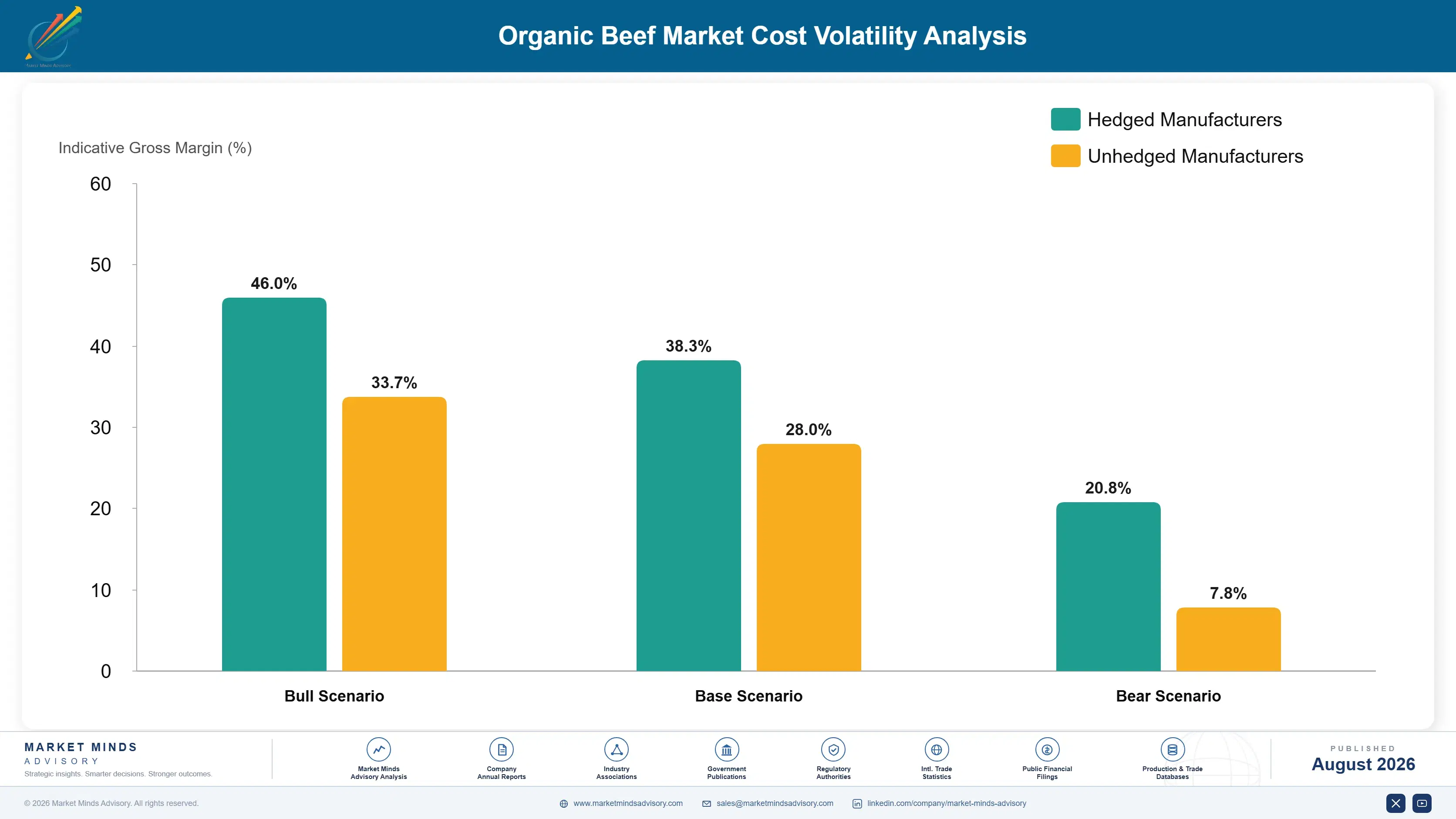
Feed and Certification Cost Pressure

Certified organic feed grain represents roughly 58 percent of processor cost of goods sold, sourced primarily from dedicated organic grain acreage in the US Midwest, Argentina, and Eastern Europe. Certified pastureland leasing and third-party audit fees add a further meaningful slice of total input cost that conventional beef processors simply do not carry, and these fees keep rising each certification cycle.
The 2022 to 2023 North American drought cycle pushed organic feed grain prices up roughly 40 percent year over year according to USDA data, forcing several smaller processors to absorb margin compression rather than pass costs through to price-sensitive retail buyers. IEA-tracked diesel and fertilizer cost spikes during the same period compounded pressure on organic grain producers specifically, since organic farming relies more heavily on mechanical cultivation.

Exposure varies considerably by player type: vertically integrated processors that contract organic grain acreage directly are materially better insulated than those buying on the spot market, and this gap has widened since the 2022 drought. Smaller regional processors lacking scale to negotiate multi-year grain contracts face a durable cost disadvantage against JBS and Tyson that is difficult to close without external financing support.
organic-beef-market-trends-forecast-cost-volatility-analysis-1787558465298

Multi-Year Organic Grain Supply Contracts

Processors are increasingly signing three to five year fixed-price contracts directly with organic grain cooperatives, smoothing input cost volatility across multiple harvest cycles rather than buying on the spot market season to season. This approach has become standard among mid-sized processors that lack the balance sheet to acquire dedicated organic grain acreage outright but still need predictable input costs.

Ranch-Partner Transition Cost Financing

Larger processors are pre-financing certification transition costs for contracted ranch partners, securing supply commitments years ahead of demand while spreading capital outlay across a longer repayment window than ranchers could manage alone. In exchange, ranchers commit exclusively to the financing processor for a multi-year period, giving the processor certainty over future certified cattle volume it can plan around.

Vertical Integration into Organic Grain Production

Several major processors have acquired or leased dedicated organic grain acreage directly, removing exposure to spot market volatility entirely for a meaningful share of total feed requirements going forward. This strategy demands significant upfront capital but has proven especially attractive to the largest processors already operating integrated supply chains across multiple countries. Payback periods run three to four years typically.

Portfolio Architecture for Margin Defence

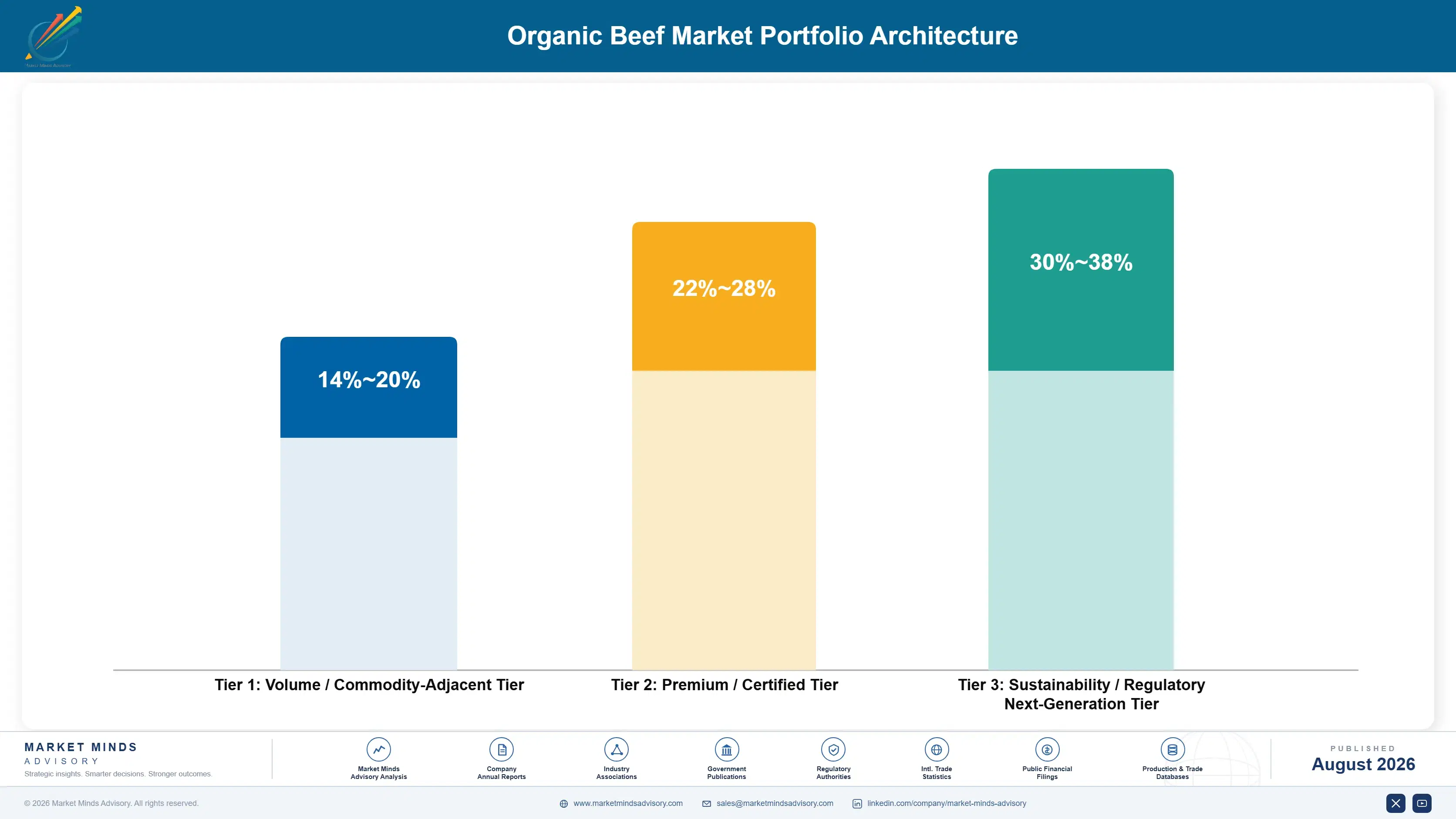
MMA's three-tier portfolio architecture separates commodity-adjacent organic beef from certified premium and next-generation regenerative formats, with gross margins ranging from the mid-teens for volume cuts to well above 30 percent for dual-certified premium products. Processors positioned across all three tiers capture more total margin than single-tier specialists. Segment-level margin data is drawn from MMA Estimate, derived from primary survey data covering 47 expert interviews conducted in Q4 2025.
The tension between volume and premium is built into how the category operates: chasing volume growth through mainstream retail expansion tends to compress margin per unit, while premium and certification-heavy formats sacrifice total addressable volume for materially better unit economics. Mid-sized processors attempting to serve both ends simultaneously often end up under-resourced in each, losing volume-tier price competitiveness while failing to match premium-tier certification depth.

High-value margin pools concentrate in dual-certified regenerative products and direct foodservice contracts, both of which command premiums the standard retail organic channel cannot match. Processors that under-invest in these pools risk ceding the most profitable share of the category to smaller, more nimble specialists. Building dedicated certification and account teams requires patient capital, which favors larger integrated processors.

Volume / Commodity-Adjacent Tier

Standard certified organic fresh and frozen cuts sold through mainstream retail, competing primarily on price relative to other organic offerings rather than on differentiated certification depth or traceability messaging. Retail buyers select primarily on price within this tier.
Gross Margin: 14-20%

Premium / Certified Tier

Branded organic beef carrying strong pasture-to-plate traceability and premium retail or foodservice positioning, commanding a meaningful step-up in both shelf price and gross margin over commodity-adjacent formats. Branded marketing investment matters considerably here.
Gross Margin: 22-28%

Sustainability / Regulatory / Next-Generation Tier

Dual-certified regenerative and carbon-verified organic beef targeting the most demanding premium buyers, commanding the category's highest margins but requiring the deepest certification and audit investment. Buyer volume commitments remain comparatively modest for now.
Gross Margin: 30-38%
organic-beef-market-trends-forecast-portfolio-architecture-1787558465806

High-value Sub-segments and Strategic Watch-out

Dual-Certified Regenerative Beef

The highest-margin, fastest-growing pool in the category, combining organic and regenerative grazing certification to command premiums no single-certification competitor can match, though volume remains small relative to the broader category today. Investment here is expected to accelerate meaningfully over the coming several years. Buyer awareness is rising too.
Gross Margin: 32-38%

Export-Grade Certified Beef

A high-value pool growing at a moderate but steady pace, driven by Asian import demand for dual-certified supply meeting both domestic and destination-market organic standards, with margin well above standard domestic wholesale rates. Processors without export certification risk losing this growth entirely to better-positioned rivals.
Gross Margin: 24-30%

Standard Retail Fresh Cuts

The volume core of the category, carrying the thinnest margins but the largest absolute revenue base, and the segment most processors depend on to fund investment into higher-margin premium and export product lines. Efficiency gains here matter more than premium positioning for most participants. Scale is decisive here.
Gross Margin: 14-18%

Private-Label Organic Programs

A strategic watch-out segment: retailer private-label organic beef programs are expanding shelf space faster than branded lines, and processors that lose private-label contracts to competitors risk losing volume they cannot easily replace elsewhere. Building direct retailer relationships is now a defensive necessity for branded processors.
Gross Margin: 12-16%

Repeat Purchase and Loyalty Dynamics

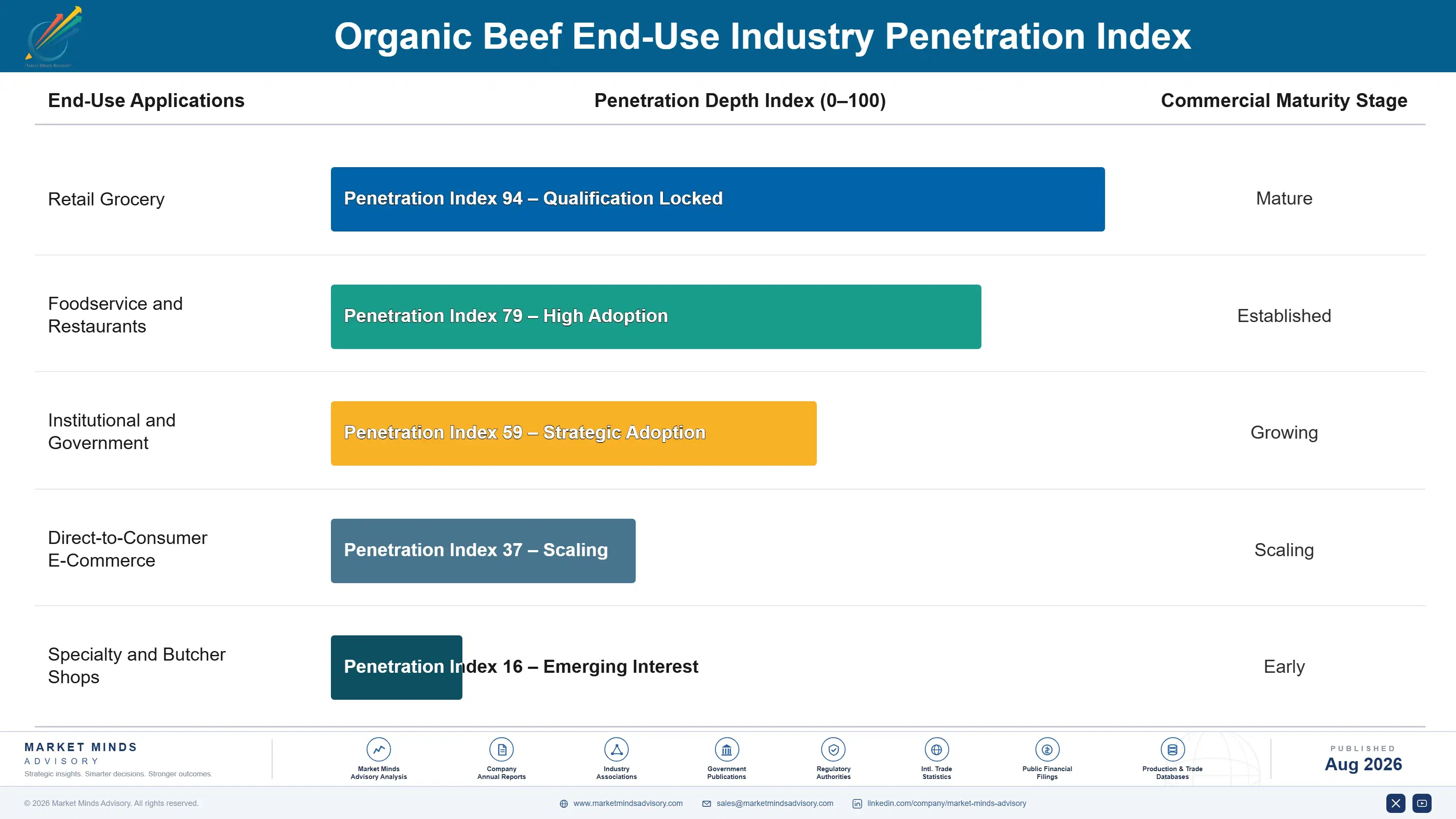
Organic beef behaves closer to an annuity business than a one-time purchase category: once a household commits to certified organic meat, repeat purchase rates run considerably higher than in conventional beef, since the switching decision was already made and reinforced by trust in the brand chosen initially. MMA's primary survey found repeat purchase intent running meaningfully above conventional beef benchmarks. That gap has widened rather than narrowed in recent years.
Adoption depth varies meaningfully by end-use vertical. Premium foodservice accounts that commit to certified organic beef rarely revert to conventional supply given menu positioning and customer expectations, while price-sensitive institutional buyers such as school foodservice programs remain far more transactional, switching suppliers whenever price gaps widen. Hospital cafeteria programs sit between these extremes, often committing partially as a wellness differentiator.

Generational shifts favor the category further: younger household buyers entering peak spending years show meaningfully higher willingness to pay for certified organic meat than prior generations did at the same life stage, and that cohort is expected to keep expanding the addressable premium buyer base. Retailers are designing loyalty programs specifically to capture this shift ahead of competitors. Establishing that relationship first carries lasting competitive value.
organic-beef-market-trends-forecast-end-use-penetration-index-1787558466298

Where Certified Beef Value Concentrates

These are among the four positions where our research anticipates prominent divergence between winners and laggards over the coming forecast period. Each is grounded in the demand model, the regulatory perimeter, and the announced capacity pipeline.
01 / CERTIFICATION INVESTMENT PRIORITY

Fund dual regenerative certification before scaling volume

Processors chasing volume growth without deepening certification are ceding the category's most profitable share to smaller specialists willing to invest in regenerative audits and traceability infrastructure first. Dual certification commands a meaningful retail premium that standard organic labeling alone cannot match, and that gap is widening rather than closing as buyers grow more discerning. The processors winning preferred-supplier status with premium foodservice accounts today are overwhelmingly those that made this investment early, well ahead of when it became a competitive necessity.
02 / SUPPLY SECURITY STRATEGY

Lock in certified ranch-partner supply years ahead of demand

The 36-month organic conversion timeline means processors cannot respond quickly to sudden demand spikes, which makes upstream supply security a strategic priority rather than a purely operational concern. Financing certification transition costs for contracted ranch partners, as JBS has done, locks in supply and pricing years ahead of competitors still buying certified cattle on the open spot market and exposed to its swings. Processors without a dedicated ranch-partner strategy risk losing supply access entirely during periods of tight certified cattle availability.
03 / CHANNEL DIVERSIFICATION FOCUS

Build direct foodservice contracts to escape distributor margin compression

Wholesale distribution margins have compressed as retail private-label programs expand and squeeze branded processor pricing power at the shelf across most major grocery banners. Direct foodservice contracts bypass that compression entirely, delivering materially better per-unit economics for processors with the account management capacity to service large institutional buyers directly and reliably. Mid-sized processors forming cooperative supply pools to meet the volume commitments large foodservice buyers require are proving this strategy is not limited to the largest integrated players alone, even without their scale advantage.
04 / EXPORT MARKET POSITIONING

Pursue dual certification to capture premium Asian import demand

Chinese and Japanese import buyers increasingly treat dual organic and destination-market certification as a baseline procurement requirement rather than a differentiator worth paying extra for. Processors without that documentation risk exclusion from the fastest-growing import channel entirely, ceding hard-won ground to better-prepared competitors already positioned for the shift. Australian and North American exporters that secured dual certification early are already capturing export premiums well above domestic wholesale rates, and that advantage compounds each additional year rivals delay pursuing certification of their own.

Engagement Snapshot From the Field

A live engagement with an industry participant carrying material or product regulatory and market exposure ahead of a defining policy shift, showing how our research translates into a defensible multi-year portfolio strategy.
MARKET MINDS ADVISORY · CLIENT ENGAGEMENT SUMMARY
Organic Beef Producer Strategic Portfolio Review and Transition Roadmap 2026·Investment Scenario on Organic Beef Exposure Evaluation 2025-26
CLIENT PROFILE
The client is a mid-sized regional organic beef processor operating primarily across the US Midwest, with annual revenue of approximately $340 million (client-reported, unverified by MMA). The company had built a solid regional retail presence over the past decade but had not yet pursued regenerative grazing certification or established direct foodservice contracts, relying instead almost entirely on wholesale distribution through regional grocery chains and traditional broadline distributors.
STRATEGIC CHALLENGE
The client faced compressing wholesale margins as larger competitors expanded private-label organic programs into its core retail markets, and leadership needed to determine whether to invest in dual certification, build direct foodservice relationships, or pursue both simultaneously given limited available capital. Management also worried about losing certified ranch-partner supply to better-capitalized national competitors expanding aggressively into the same sourcing region.
MMA APPROACH
MMA conducted primary interviews with the client's ranch partners, regional foodservice buyers, and retail category managers to map where certification investment would generate the fastest payback. The engagement combined MMA's proprietary primary survey data with a detailed margin analysis across each potential certification and channel pathway, benchmarked against comparable mid-sized processors already pursuing similar strategies elsewhere in the country.
KEY FINDINGS
  1. Dual certification would command a retail premium of 8 to 12 percent above the client's current organic pricing within roughly eighteen months of launch.
  2. Three regional foodservice groups expressed strong willingness to sign direct multi-year contracts provided certified volume could be guaranteed reliably each quarter without disruption.
  3. Two key ranch partners were at meaningful risk of switching to a national competitor already absorbing certification transition costs on their behalf.
  4. Value-added product formats represented a materially underexploited margin opportunity given the client's existing processing infrastructure and unused packaging capacity already sitting idle on site.
CLIENT PROFILE
The client is a mid-sized regional organic beef processor operating primarily across the US Midwest, with annual revenue of approximately $340 million (client-reported, unverified by MMA). The company had built a solid regional retail presence over the past decade but had not yet pursued regenerative grazing certification or established direct foodservice contracts, relying instead almost entirely on wholesale distribution through regional grocery chains and traditional broadline distributors.
STRATEGIC CHALLENGE
The client faced compressing wholesale margins as larger competitors expanded private-label organic programs into its core retail markets, and leadership needed to determine whether to invest in dual certification, build direct foodservice relationships, or pursue both simultaneously given limited available capital. Management also worried about losing certified ranch-partner supply to better-capitalized national competitors expanding aggressively into the same sourcing region.
MMA APPROACH
MMA conducted primary interviews with the client's ranch partners, regional foodservice buyers, and retail category managers to map where certification investment would generate the fastest payback. The engagement combined MMA's proprietary primary survey data with a detailed margin analysis across each potential certification and channel pathway, benchmarked against comparable mid-sized processors already pursuing similar strategies elsewhere in the country.
KEY FINDINGS
  1. Dual certification would command a retail premium of 8 to 12 percent above the client's current organic pricing within roughly eighteen months of launch.
  2. Three regional foodservice groups expressed strong willingness to sign direct multi-year contracts provided certified volume could be guaranteed reliably each quarter without disruption.
  3. Two key ranch partners were at meaningful risk of switching to a national competitor already absorbing certification transition costs on their behalf.
  4. Value-added product formats represented a materially underexploited margin opportunity given the client's existing processing infrastructure and unused packaging capacity already sitting idle on site.
RECOMMENDED STRATEGY
Phase 1: Phase 1 (Months 1 to 6): Secure ranch-partner loyalty through co-financed regenerative certification transition agreements structured carefully over multiple years. Phase 2: Phase 2 (Months 7 to 14): Launch the dual-certified product line and negotiate direct multi-year contracts with each identified foodservice group. Phase 3: Phase 3 (Months 15 to 24): Expand value-added processing capacity meaningfully and pursue selective export certification for premium Asian import buyers.
OUTCOME
Within eighteen months of implementing the phased strategy, the client reported securing two long-term foodservice contracts and retaining both at-risk ranch partners through co-financed certification agreements (client-reported, unverified by MMA). Overall revenue from dual-certified and value-added product lines grew to represent roughly 22 percent of total sales, meaningfully ahead of the client's original eighteen-month target (client-reported, unverified by MMA).

Frequently Asked Questions

Foundational context covering the market sizes, CAGR, scope, country, region and competition that inform every finding below. This section is provided to cover basics and most often pre-purchase conversations, answered from the MMA Primary Research Dataset.

What is the current size of the Organic Beef Market?

The global organic beef market was valued at approximately $8.5 billion in 2025. Growth is driven by rising premium consumer demand and expanding certified retail infrastructure worldwide.

How large will the Organic Beef Market be by 2036?

MMA projects the market will reach approximately $17.0 billion by 2036. This reflects sustained expansion in certified retail shelf space and foodservice adoption across most major consumer markets worldwide.

What is the CAGR for the Organic Beef Market 2026 to 2036?

The market is projected to grow at a 6.5 percent compound annual growth rate through 2036. Base case assumptions bracket a bull scenario near 7.8 percent and a bear scenario near 5.2 percent.

Which segment is growing fastest?

Processed and Value-Added Organic Beef Products lead at a 9.0 percent CAGR, roughly 1.38 times the overall market rate. Growth is driven by convenience-format demand among premium households.

Who are the major companies in the Organic Beef Market?

Leading companies include JBS S.A., Tyson Foods, Cargill Protein, Applegate Farms, and Niman Ranch. These five processors hold a combined 32 percent share of the global market.

Which country is growing fastest?

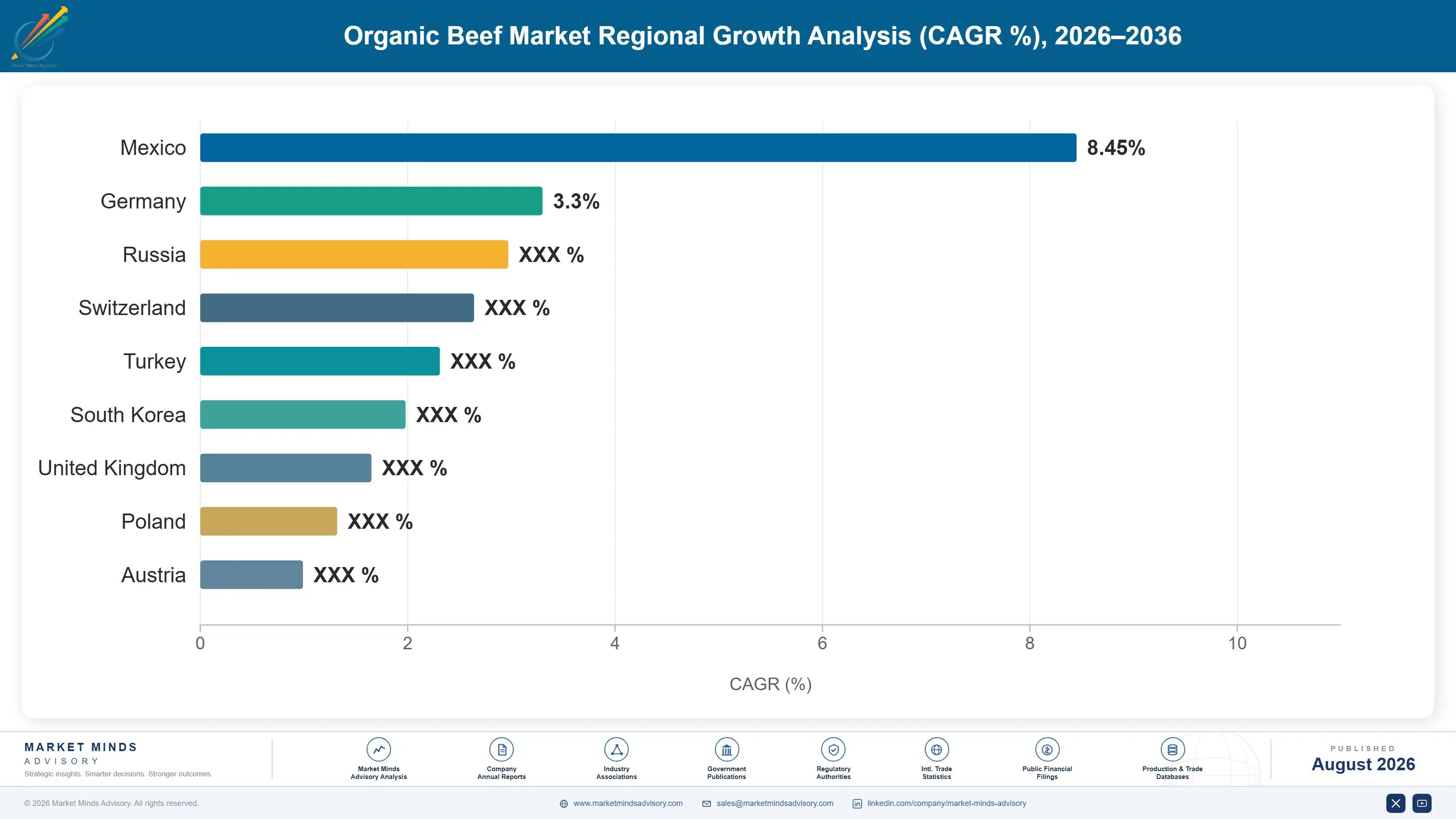
China leads at an 8.5 percent CAGR, driven by rising urban middle-class demand for imported certified organic beef. Import volumes from Australia and New Zealand have risen sharply to meet this demand.

Report Segmentation Architecture

The full report scope spans multiple orthogonal segmentation dimensions, with cross-tabulated demand data provided for each dimension pair. Coverage extends further to regional breakdowns, trend trajectories, and the competitive detail needed to support segment-level decision-making.

By Product Form

  • Fresh Organic Beef Cuts
  • Ground Organic Beef
  • Frozen Organic Beef Cuts
  • Organic Beef Offal and Variety Meats
  • Processed and Value-Added Organic Beef Products
  • Organic Beef Jerky and Dried Snack Products

By End-Use Industry

  • Retail Grocery
  • Foodservice and Restaurants
  • Institutional and Government
  • Direct-to-Consumer E-Commerce
  • Specialty and Butcher Shops

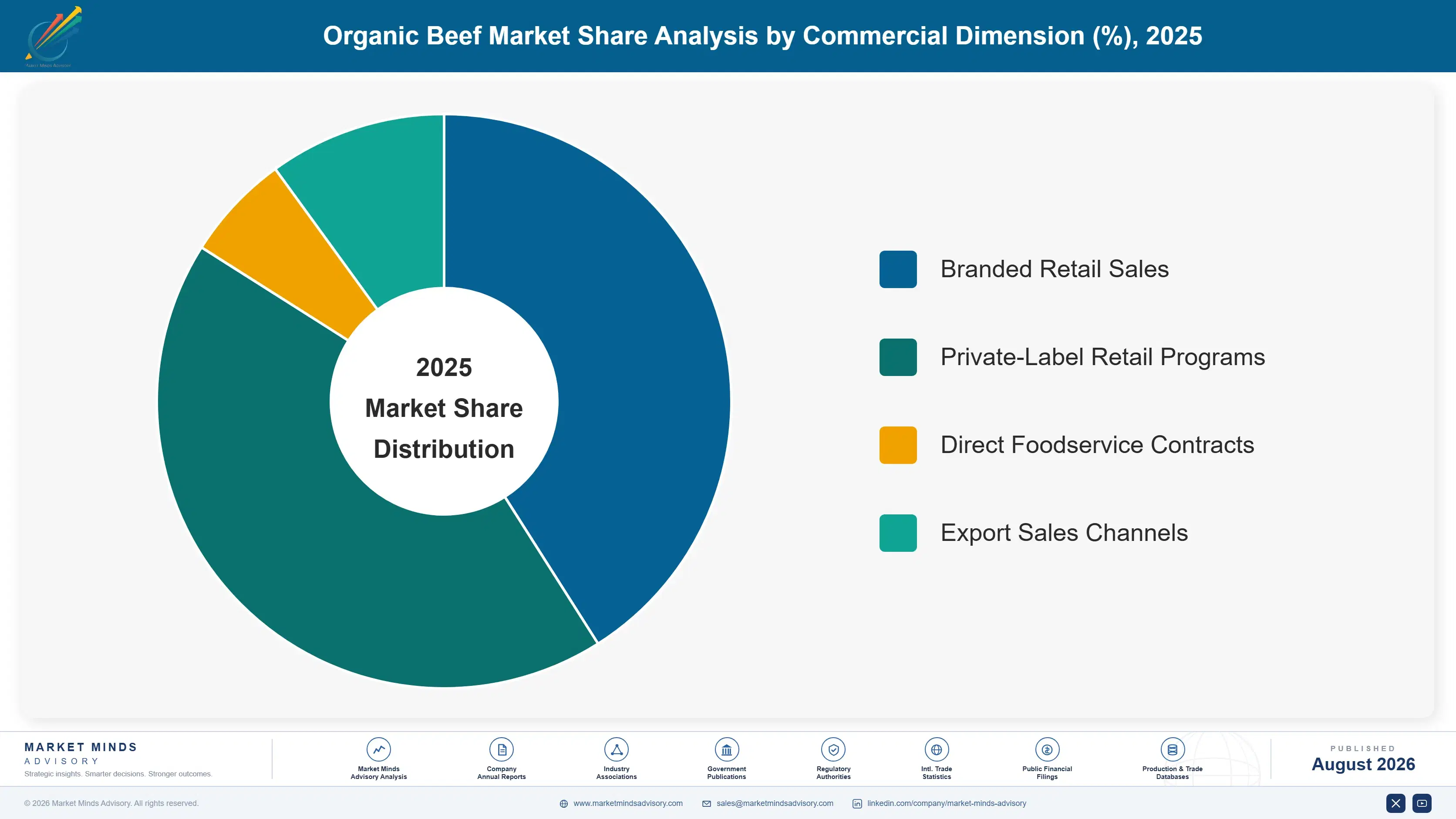
By Commercial Dimension

  • Branded Retail Sales
  • Private-Label Retail Programs
  • Direct Foodservice Contracts
  • Export Sales Channels

By Region

  • North America
  • Western Europe
  • East Asia
  • South Asia and Pacific
  • Latin America
  • Middle East and Africa
  • Eastern Europe

Scope, Methodology, and Coverage

Every figure in this report is reproducible from documented input assumptions. The scope below maps the historical period, the forecast horizon, the segmentation dimensions, and the countries covered, alongside the underlying primary and qualitative methodology.
Historical Period
2020 to 2025
Forecast Period
2026 to 2036
Base Year
2025 (USD billions; MMA Primary Research Dataset, August 2026)
Market Definition
This report covers certified organic beef, meaning cattle raised and processed under USDA National Organic Program or equivalent international organic certification standards, sold as fresh, frozen, processed, or value-added retail and foodservice products. It excludes conventional beef, grass-fed beef lacking organic certification, and plant-based beef alternatives.
Quantitative Units
USD billions (current prices); metric tons where cited for volume context
Segmentation Dimensions
By Product Form; By End-Use Industry; By Commercial Dimension; By Region
Regions Covered
North America, Western Europe, East Asia, South Asia and Pacific, Latin America, Middle East and Africa, Eastern Europe
Countries Covered
USA, China, Germany, France, UK, Japan, South Korea, India, Australia, Canada, Brazil, Mexico, Indonesia, Vietnam, Thailand, Malaysia, UAE, Saudi Arabia, South Africa, Nigeria, Turkey, Poland, Netherlands, Italy, Spain, Sweden, Switzerland, Argentina, Colombia, Singapore, and additional markets relevant to this sector
Key Companies Profiled
JBS S.A., Tyson Foods, Cargill Protein, Applegate Farms, Niman Ranch, Perdue Farms, Coleman Natural Foods, Panorama Meats, Thousand Hills Lifetime Grazed, White Oak Pastures, Painted Hills Natural Beef, Meyer Natural Foods, American Grassfed Beef, Grass Run Farms, Verde Farms, Organic Prairie, Teys Australia, Australian Agricultural Company, Marfrig Global Foods, Minerva Foods
Quantitative Methodology
Primary survey, n=3,800 respondents, Q4 2025, six countries; demand-side model with trade association cross-validation
Qualitative Methodology
47 expert interviews, Q4 2025; applied to validate demand model assumptions, identify emerging dynamics, and assess competitive positioning
Report Format
PDF and XLSX data workbook (Word format preview document)
Publisher
Market Minds Advisory
Report Code
MMA-2026-AGR-102
Published
August 2026
Contact
sales@marketmindsadvisory.com | www.marketmindsadvisory.com

Purchase the full Organic Beef Market Report (2026 to 2036).

The full Organic Beef Market report delivers a complete quantitative and qualitative assessment spanning market sizing, six-segment product-form analysis, and all seven regional markets in detail. It includes competitive profiling of twenty companies, input cost and certification risk analysis, and a portfolio margin framework covering volume, premium, and next-generation regenerative tiers. Buyers also receive the underlying primary survey and expert interview datasets referenced throughout the analysis. Analysts also receive access to segment-level margin benchmarks and regional demand mechanisms drawn directly from company disclosures and MMA's proprietary primary research program.
Detailed six-segment product-form market breakdown and analysis
All seven regional markets sized with growth rates
Twenty-company competitive profiling and positioning assessment
Certification cost structure and volatility risk analysis
Three-tier portfolio margin framework and watch segments
Primary survey and expert interview datasets included

Built For The People Who Decide

From boardroom strategy to bench-side execution, this report is read cover-to-cover by leaders shaping the next decade of their industry, turning demand scenarios, market dynamics and valuation benchmarks into decisions.
CXOs/ Presidents/ VPs/ Managers
M&A and Corporate Development
Strategy Teams and R&D Heads
Procurement and Product Directors
Regulatory and Compliance Leaders
Investor Relations and Equity Analysts