Market Minds Advisory
Orbital Tissue Expander Market

Orbital Tissue Expander Market: A Deadline Set By Bone Growth, Not By Disease

Around 90% of orbital bone growth finishes by age five. A child not reached inside that window carries facial asymmetry for life, and no adult surgery fully corrects it afterwards.

Lead Analyst

Alice Ballenger

Published

September 2026

Make Smarter Decisions with Customized Research Insights

Request a free sample report and evaluate market opportunities, growth trends, and competitive dynamics relevant to your business needs.

2025 MARKET VALUE$0.1BMarket Size 2025
2036 FORECAST VALUE$0.3BBase Case , 2026 to 2036
CAGR 2026 TO 20367.2 %Bull 8.4% / Bear 6.0%
INCREMENTAL OPPORTUNITY$0.1BNet 10- year value creation
EXPANSION MULTIPLE2.00x2036 value over 2026 base
Strategic Levers
M&A Pipeline
Regional Outlook
Country Rankings
Competitive Intelligence
Segmental Deep-dive
Call-Us : 91 93563 13602

Executive Snapshot and Market Trajectory

A child born without a functioning eye needs the socket expanded while the skull is still growing, and roughly 90% of orbital bone growth is already finished by the age of five. Miss that window and the asymmetry is permanent. The market reaches USD 0.14 billion in 2025.
Self-inflating hydrogel expanders grow fastest at 10.8%, exactly 1.50 times the market rate, because they enlarge the socket without repeated surgery in a patient who cannot safely tolerate very many anaesthetics at all. South Asia and Pacific holds 24% of value, well above the band this framework applies, on the largest affected birth cohort found anywhere. Middle East and Africa takes 7% of value on consanguinity-driven incidence.
Concentration reaches 56% across the top five, and very few manufacturers have ever chosen to serve a condition affecting so few children anywhere in the world. Competition turns on expansion predictability, on sizing across an orbit that keeps growing, and on whether a supplier reaches the specialist at all. Trained ocularists number perhaps one for every three million people alive, and a device without one is of no use whatever to anybody.
Market Definition
The orbital tissue expander market covers devices used to enlarge the bony orbit and surrounding soft tissue in children with congenital anophthalmia, severe microphthalmia, or early enucleation, spanning self-inflating hydrogel expanders, injectable silicone expanders, serial conformers, custom paediatric ocular prosthetics, and orbital implants used within the expansion pathway. Adult ocular prosthetics fitted after skeletal maturity, orbital fracture repair implants, breast and skin tissue expanders, intraocular lenses, and craniofacial distraction devices are excluded.
Base Year Value
$0.1B in 2025 (MMA Primary Research Dataset, August 2026)
Forecast Period
2026 to 2036, eleven discrete annual values
CAGR
7.2% base case. Bull 8.4%. Bear 6.0%.
Fastest Growth Segment
Self-Inflating Hydrogel Expanders: 10.8% CAGR
Fastest Growth Country
India: 10.4% CAGR
Fastest Growth Region
South Asia and Pacific: 9.2% CAGR
Largest Region
South Asia and Pacific: 24% of 2025 global value
Market Leaders
Osmed, FCI Ophthalmics, Oculo-Plastik, Gulden Ophthalmics, Stryker. Source: MMA Primary Research Dataset, July 2026.
Primary Survey
n=3,800 procurement and R&D decision-makers, Q4 2025, six countries
Methodology
Demand-side build-up, cross-validated against public data, 47 expert interviews

Orbital Tissue Expander Market Forecast Scenarios

orbital-tissue-expander-market-size-forecast-scenario-1787297946400
Between 2020 and 2025 access widened faster than the affected population changed. Self-inflating hydrogel expanders spread from a handful of European centres into paediatric ophthalmology across several new countries, and Indian and Middle Eastern specialist units began managing these children locally rather than referring abroad. Elective paediatric surgery paused through 2020. A 6.1% historical CAGR reflects capability spreading rather than incidence moving at all.
Three mechanisms carry the 7.2% base case. Specialist capacity is the largest, since every new paediatric oculoplastic unit and every trained ocularist converts children who would otherwise go untreated. Antenatal detection is the second, because ultrasound identifying microphthalmia before birth lets a treatment plan begin in the first weeks of life. And hydrogel adoption is the third, replacing repeated surgical expansion with a device that works between visits. Incidence itself is not going to change.
The 8.4% bull case rests on ocularist training programmes expanding in South Asia and Africa, where affected births are numerous and fitting capability is almost absent. The 6.0% bear case is that specialist scarcity simply persists, since a condition affecting three births in ten thousand competes badly for training places and health system attention against anything measured in percentages.

The Skull Will Not Wait

The eye drives orbital growth. Without one the bony socket stays small, the surrounding face develops asymmetrically, and the difference becomes visible and permanent within a few years. Roughly 90% of orbital volume is achieved by age five, which sets a deadline no clinician can negotiate and no later surgery fully undoes. That is unusual in medicine and it shapes everything about this market.
TOP FIVE CONCENTRATION56%Very few manufacturers serve a condition affecting so few children
BIRTH INCIDENCE3 in 10,000Newborns presenting with absent or severely underdeveloped eyes
EXPANSION WINDOW5 yearsAge by which most orbital bone growth has already occurred
DEVICES PER PATIENT7Expanders and conformers replaced across a full treatment course
OCULARIST RATIO1 per 3 millionTrained specialists available relative to the general population
TREATMENT COURSE COSTUSD 18,000Total device and prosthetic spend across childhood orbital management
Treatment therefore starts in the first weeks of life and continues through childhood, with conformers and expanders replaced perhaps seven times over as the socket enlarges. Self-inflating hydrogel devices absorb fluid and expand steadily between appointments, which matters enormously in a patient population where every single intervention needs a general anaesthetic and nobody wants to give a child many of those.
The binding constraint is not the device. Fitting a paediatric conformer accurately is a craft skill held by ocularists who number perhaps one per three million people, and they are concentrated in exactly the countries with the fewest affected births. A child born in Uttar Pradesh or northern Nigeria is far more likely to reach five years old untreated than one born in Munich.
"Parents are usually told there is time. There is not. The orbit is most of the way finished before the child starts school, and everything after that is managing a result somebody could have prevented."
Director, Ophthalmic Devices Practice · MMA Medical Devices Practice &midd

Market Trends

Hydrogel Expansion Replaces Repeated Surgical Enlargement

Self-inflating hydrogel devices absorb tissue fluid and enlarge steadily over weeks after a single placement, which removes most of the repeated surgical enlargement that earlier approaches required. In a patient under five that matters far beyond convenience, since every procedure carries an anaesthetic risk families and anaesthetists both weigh carefully. Expansion is predictable enough that a surgeon can size the device against the volume deficit rather than escalating stepwise. The segment grows at 10.8% against a market at 7.2%, and adoption follows surgeon familiarity rather than any cost argument. Cost barely enters the discussion at all.
Market Impact: Units serve 40 patients yearly
Antenatal Detection Moves Planning Before Birth

Second-trimester ultrasound now identifies severe microphthalmia and anophthalmia in a growing share of pregnancies, particularly where anomaly scanning is routine and sonographers are trained to look. That lets a paediatric oculoplastic team meet the family before delivery, plan the first conformer within days of birth, and start expansion at the point where the orbit is growing fastest. Detection rates vary enormously between health systems, and where scanning is routine the treatment window opens months earlier than it otherwise would. A plan prepared before delivery starts expansion weeks earlier. That difference compounds across the whole growth period.
Market Impact: Consanguinity doubles incidence to 6

Market Opportunities and Growth Drivers

Specialist Unit Expansion Converts Untreated Children

Paediatric oculoplastic surgery requires a surgeon, an ocularist, and a paediatric anaesthetic service in the same building, and until recently that combination existed almost entirely in Europe, North America, and a handful of Asian centres. Indian tertiary eye hospitals, Gulf specialist centres, and several Latin American units have built the capability within the past decade. Each new unit converts a local population of children who would previously have gone untreated or travelled abroad. Capacity rather than incidence determines how much of this market is reachable. Each unit takes referrals from a very wide catchment.
Market Impact: One ocularist per 3 million people

Consanguinity Raises Incidence Across Several Regions

Congenital anophthalmia and microphthalmia have a substantial genetic component, and incidence runs measurably higher in populations with high rates of consanguineous marriage across parts of the Middle East, North Africa, and South Asia. Those same regions have large birth cohorts, which compounds the effect. Genetic counselling services in Gulf states have begun identifying at-risk families before conception. The clinical burden is therefore concentrated well away from where treatment capability has historically been built. Those regions also carry the largest birth cohorts anywhere. Burden and capability sit in almost opposite places.
Market Impact: Around 40,000 affected births yearly

Market Restraints and Challenges

Ocularist Scarcity Limits Absolutely Everything Downstream

An expander or conformer only works if somebody can fit it accurately to a socket that changes shape every few months, and that is a craft skill taught through apprenticeship rather than through any formal degree pathway. Trained ocularists number perhaps one per three million people worldwide and cluster in wealthy countries. The root cause is that the profession is tiny, ageing, and has no scalable training route. Participants are mitigating through digital scanning, three-dimensional printed conformers, and regional training partnerships that shorten apprenticeship considerably. No device solves a shortage of the person fitting it.
Market Impact: Reduces procedures from 5 to 2

Patient Numbers Deter Serious Commercial Investment

Three affected births in ten thousand produces a global incident population of perhaps forty thousand children a year, of whom only a fraction reach treatment, which is not enough to justify a dedicated commercial organisation anywhere. The root cause is simple rarity. Commercially it leaves products adapted from adjacent applications, limited sizing ranges, and very little investment in fitting technology. Participants are mitigating by attaching this population to broader ophthalmic or craniofacial businesses and by working through the small number of centres that see most of the patients. Rarity supports rare-disease economics and nothing more.
Market Impact: Detection reaches 55% antenatally
3 additional market trends, 2 additional growth drivers, and 4 additional restraints and challenges are covered in the full report. Contact sales@marketmindsadvisory.com to access the complete intelligence.

Segment CAGR and Growth Architecture

Segmentation follows the device type, because what is being placed determines the surgical burden, how often it must be replaced, who is qualified to fit it, and what a family or health system will actually pay for. Patient age, underlying diagnosis, and care setting are handled in the framework and commentary rather than being treated as segments here.
orbital-tissue-expander-market-market-share-analysis-1787297946924

Self-Inflating Hydrogel Expanders

Hydrogel expanders grow fastest at 10.8%, exactly 1.50 times the market rate, and anaesthetic burden rather than device cost explains the adoption. A hydrogel pellet placed in the socket absorbs tissue fluid and enlarges steadily across several weeks, achieving in one procedure what stepwise surgical enlargement needed several to accomplish. In a child under five where every intervention requires a general anaesthetic, halving the number of procedures is a clinical argument families understand immediately. Expansion is predictable enough for a surgeon to size against measured volume deficit. Adoption spreads through surgeon familiarity rather than through any purchasing decision. It remains a single placement per child, which caps what the device itself is ever worth.
CAGR 10.8%

Custom Paediatric Ocular Prosthetics

Custom prosthetics grow at 8.4%, fitted once the socket has been expanded and replaced repeatedly as the child grows through to skeletal maturity. Each one is individually made and painted to match the fellow eye, which is craft work rather than manufacturing and depends entirely on ocularist availability. A child typically progresses through several across childhood, and the cumulative spend exceeds the expander that made fitting possible. Digital scanning and printed shells have begun shortening production time, though the painting and finishing remain manual and the apprenticeship pathway remains the binding constraint everywhere. Cumulative spend across a childhood exceeds every surgical device combined. Continuity with the family decides who captures it.
CAGR 8.4%
Full segment breakdown across 5 segments available in the complete report.

Regional Architecture and Country Demand Map

Regional shares here follow affected births weighted by whether a specialist unit exists within any reasonable reach of the family. Incidence is broadly similar everywhere except where consanguinity raises it, while treatment capability has historically been built almost entirely away from where the children are actually born.

South Asia and Pacific

South Asia and Pacific holds 24% of value against a 12% ceiling in this framework, and birth numbers explain the breach entirely. India records more affected births each year than any other country by a wide margin, with Pakistan, Bangladesh, and Indonesia adding substantially, and consanguinity raises incidence further across several of those populations. Indian tertiary eye hospitals have built genuine paediatric oculoplastic capability over the past decade and now manage children who previously travelled abroad or went untreated. Ocularist numbers remain the binding constraint rather than surgical skill. Growth at 9.2% is the fastest anywhere, driven by capability catching up with burden. Surgical capability now exceeds fitting capability across the region.
Share: 24% | CAGR: 9.2% (2026 to 2036)

Middle East and Africa

Middle East and Africa takes 7% of value against a 6% ceiling in this framework, and consanguinity-driven incidence explains the breach. Rates of consanguineous marriage across the Gulf, the Levant, and North Africa raise congenital anophthalmia and microphthalmia measurably above the global baseline, and Gulf health systems fund treatment to international standards for their citizen populations. Genetic counselling services have begun identifying at-risk families before conception. Across sub-Saharan Africa the affected birth numbers are very large and specialist capability is almost absent. Growth at 7.4% exceeds the global rate, carried by Gulf funding. Two entirely different situations share one regional figure. Gulf funding carries almost all of the recorded value. Sub-Saharan burden is very large and almost wholly unaddressed.
Share: 7% | CAGR: 7.4% (2026 to 2036)
Regional intelligence for 5 additional markets available in the complete report: North America, East Asia, Western Europe, Latin America, Eastern Europe. Contact sales@marketmindsadvisory.com.
orbital-tissue-expander-market-country-cagr-analysis-1787297947440

Where Orbital Expansion Money Actually Sits

Forty thousand affected births a year worldwide, most of them never reaching treatment, is not a market anybody builds a sales organisation around. Value comes from the repeated prosthetic replacements across a childhood, from removing the fitting skill bottleneck, and from being present in the very few centres that see most of the patients.

Follow The Child Through Every Replacement

An expander is placed once and a growing socket needs conformers and prosthetics replaced perhaps seven times before skeletal maturity, at a cumulative course cost near USD 18,000. Suppliers focused on the initial device capture a fraction of that and hand the rest to whoever is nearest when the next fitting is due. Building continuity with the family and the fitting service converts one procedure into fifteen years of replacements, which is the whole economics of this condition. The fitter rather than the manufacturer holds that relationship today. Most suppliers never even try to hold it.
Market Impact: Course spend reaches 18,000 dollars for each child

Attack The Fitting Skill Bottleneck Directly

Ocularists number roughly one per three million people and are trained through apprenticeships lasting years, which caps how many children can be treated regardless of how many devices exist anywhere. Digital scanning and printed conformer shells shorten the manual work substantially and let a less experienced fitter reach an acceptable result, cutting fitting time by around 60%. Suppliers investing in that toolset expand their own addressable population rather than competing for a fixed one, and no competitor is doing it seriously today. The apprenticeship pathway will not scale on its own.
Market Impact: Digital scanning cuts fitting time by 60 percent

Concentrate On The Centres Seeing The Patients

Perhaps 200 units worldwide manage the majority of these children, each seeing forty patients a year at most, and they take referrals nationally rather than locally. Reaching those centres directly costs very little relative to any conventional field organisation and covers most of the treatable population in one exercise. Suppliers spreading effort across general ophthalmology are calling on clinicians who will see one of these children in an entire career, which is expensive attention aimed at almost nothing at all. Referral patterns make each account genuinely national. One exercise covers the treatable population.
Market Impact: Around 200 units see most of the patients

Who Controls the Margin Pool

Concentration reaches 56% across the top five measured on orbital expansion device revenue, which is high in a category where almost nobody has built a genuinely dedicated business. Osmed developed and still leads self-inflating hydrogel expansion, the product that changed how these children are managed everywhere. FCI Ophthalmics, Oculo-Plastik, and Gulden supply conformers, prosthetic shells, and orbital implants, and Stryker contributes through craniofacial reconstruction.
Competition currently turns on sizing range across a growing orbit, on expansion predictability from one placement, and on whether a supplier reaches the handful of centres that actually see these patients at all. Price is barely discussed anywhere, because the device cost is small against the whole treatment course and the alternative outcome is a permanently asymmetric face.

Pressure comes from three-dimensional printing, which now lets a well-equipped centre produce conformer shells locally rather than ordering them from abroad, and from regional manufacturers in India and China supplying domestic units at a fraction of imported cost. Rankings will shift toward whoever addresses the fitting bottleneck, since that determines how many children are treatable at all rather than how the existing ones get divided.
orbital-tissue-expander-market-company-positioning-matrix-1787297947961

Competitive Moat and Risk Dimensions

OSMED

Moat: Hydrogel expansion technology and evidence

Osmed developed self-inflating hydrogel expanders for orbital use and holds the published clinical series that paediatric oculoplastic surgeons cite when justifying the approach. In a field where each surgeon may manage a handful of these children a year, following a documented protocol from the company that established it carries far more weight than any product comparison would.
OSMED

Risk: Single technology in tiny market

The business rests on one device type serving a condition affecting a few thousand treated children annually, which leaves no room to absorb a competitive or regulatory setback. Three-dimensional printing is also making locally produced alternatives credible at leading centres, and a company this size cannot outspend that trend on development.
FCI OPHTHALMICS

Moat: Breadth across oculoplastic product range

FCI supplies conformers, orbital implants, lacrimal devices, and related oculoplastic products, which lets a specialist unit source most of what it needs from one relationship rather than from several tiny suppliers. In a subspecialty where purchasing volumes are small and administrative effort per order is high, that consolidation is worth more than any individual product advantage.
FCI OPHTHALMICS

Risk: Expansion technology held elsewhere

The self-inflating expander that has changed paediatric orbital management is not FCI's product, which leaves the company supplying everything around the intervention that actually determines the outcome. As hydrogel expansion becomes standard practice, the supplier of the expander is the one the surgeon engages with first and most often.

Players Tracked

Prominent Players

Osmed
FCI Ophthalmics
Oculo-Plastik
Gulden Ophthalmics
Stryker

Other Key Players

Techno-Med
Modern Plastics
Innovia Medical
Katena Products
Beaver-Visitec International
Rumex International
Bausch and Lomb
ASICO
Duckworth and Kent
Malosa Medical
Altomed
Geuder
Medicel
Ocular Instruments
Optima Ophthalmics

Recent Developments

FEBRUARY 2025

Indian eye hospital opened dedicated paediatric orbital service

A large Indian tertiary eye hospital opened a dedicated paediatric orbital and ocularistry service, combining oculoplastic surgery with in-house prosthetic fitting under one roof. Families in that catchment had previously travelled to distant cities or gone entirely without treatment during the years when expansion would have worked.
Signal: Local capability converts the children who would otherwise pass right through the treatment window entirely untreated.
AUGUST 2024

Centre produced conformer shells by three-dimensional printing

A specialist centre began producing paediatric conformer shells from digital socket scans using three-dimensional printing, cutting out much of the manual fabrication that ocularist apprenticeship has traditionally covered. Painting and final finishing still required an ocularist, but throughput per fitter improved substantially across the year.
Signal: Digital fabrication directly attacks the apprenticeship bottleneck that currently caps how many children can be fitted.
NOVEMBER 2024

Gulf genetic programme identified at-risk families before conception

A Gulf genetic counselling programme began identifying families carrying the variants associated with anophthalmia and microphthalmia well before conception, following consanguinity-linked incidence measured far above the global baseline everywhere. Affected pregnancies were then managed with a full treatment plan already prepared and agreed before delivery.
Signal: Preconception identification is the earliest possible intervention here, and it precedes any device decision at all.

Hydrogel, Silicone, And Hand Finishing

Medical grade hydrogel and silicone carry roughly 20% to 28% of cost of goods, both drawn from a narrow field of suppliers qualified for long-term implantation in children. Acrylic and pigments for prosthetic shells add 12% to 18%. Skilled hand finishing dominates the remainder for prosthetics, since each shell is individually shaped and painted, and no manufacturing scale reduces that labour at all.
Implantable-grade silicone and hydrogel precursor pricing rose through 2021 and 2022 as medical polymer demand competed with wider healthcare supply, and European Commission energy statistics record industrial electricity roughly doubling at the 2022 peak. Small manufacturers in this field carry no purchasing power whatever against suppliers serving far larger customers. Price increases were absorbed rather than passed on, since health system contracts for paediatric devices are rarely reopened mid-term.

Exposure divides by whether a supplier sells devices or fitted prosthetics. Device manufacturers buy polymer at modest volumes and face pricing that reflects how little they buy. Prosthetic fitters carry almost no material exposure at all, since their cost is overwhelmingly skilled labour, and their constraint is finding people rather than buying anything. Those are entirely different businesses that this market reports as one.
orbital-tissue-expander-market-cost-volatility-analysis-1787297948156

Buy implantable polymer through larger aggregating partners

Volumes in this field are far too small to negotiate anything, and suppliers price accordingly for customers ordering in kilograms. Purchasing through a larger ophthalmic or craniofacial group with genuine polymer demand secures both pricing and priority during any shortage. It requires a commercial relationship the small specialists in this field have generally not built.

Move prosthetic fabrication toward digital workflows

Hand shaping and painting dominate prosthetic cost and cannot be reduced by buying anything more cheaply. Digital socket scanning and printed shell production shift a substantial share of that labour to equipment, leaving the ocularist to finish rather than to build from nothing. Painting quality remains the differentiator and stays manual for the foreseeable future.

Standardise conformer sizing across a defined growth series

Bespoke conformers at every stage multiply tooling, inventory, and fabrication time for a patient population too small to justify any of it. A defined size series covering the growth range serves most children with individual fitting reserved for the unusual sockets. Clinicians resist standardisation until somebody shows the fit is comparable. Comparative fit data is what eventually settles it.

Portfolio Architecture for Margin Defence

Margin here tracks skill far more than it tracks materials. A hydrogel expander is inexpensive to manufacture and priced against a permanently asymmetric face, which is a favourable comparison in any market anywhere. A custom prosthetic costs almost nothing in acrylic and everything in the hours of a person who took years to train, and it earns accordingly wherever such a person exists at all.
The volume tension is between devices and the fitting service around them. Expanders are placed once per child and represent a small fraction of the whole treatment course. Prosthetics and conformers are replaced repeatedly across fifteen years and carry most of the spend, but they require a trained fitter and cannot simply be shipped as a product. A supplier holding only one side of that has half the patient's lifetime.

High-value pools sit in three places. Repeated prosthetic replacement across a childhood, digital fitting tools that expand how many children a scarce ocularist can serve, and hydrogel expansion where the clinical argument about anaesthetic count is already won. All three are worth more than the initial surgical device that everybody focuses on.

Volume / Commodity-Adjacent Tier

Stock conformers, standard shells, and general oculoplastic disposables supplied against catalogue sizing. Regional manufacturers compete on price, and the range reflects how differently imported and locally produced items carry equivalent specification.
Gross Margin: 24-34%

Premium / Certified Tier

Custom fitted paediatric prosthetics and orbital implants supplied with sizing support to specialist units. Fitting craft and clinical relationship rather than any material cost sustain the margin across repeated replacements.
Gross Margin: 40-54%

Sustainability / Regulatory / Next-Generation Tier

Self-inflating hydrogel expanders, digital scanning and printed shell systems, and integrated fitting workflows. The wide range reflects genuinely different economics between an implanted device and equipment sold into a fitting service.
Gross Margin: 52-68%
orbital-tissue-expander-market-portfolio-architecture-1787297948652

High-value Sub-segments and Strategic Watch-out

Repeated Prosthetic Replacement

Seven or more fittings across a childhood at cumulative course cost near eighteen thousand dollars, which dwarfs the expander that made any of it possible. Continuity with the family and the fitting service is what captures it. Nothing else in this condition earns as much across a lifetime.
Gross Margin: 44-58%

Digital Fitting And Printed Shells

Attacking the apprenticeship bottleneck that currently caps how many children any one very scarce ocularist can serve within a single working year. It expands the addressable patient population rather than competing for a fixed one, and almost nobody at all is investing seriously here yet.
Gross Margin: 54-70%

Stock Conformers And Shells

Catalogue-sized conformers and shells, competed extremely hard by the regional manufacturers wherever any local production capability happens to exist at all today. They cover the straightforward sockets and provide the entry point into exactly those units that later need custom fitting work done for them.
Gross Margin: 24-34%

Hydrogel Expander Placement

Growing at 10.8% on an anaesthetic argument that families and anaesthetists both accept immediately. The watch-out is that it is a single placement per child, which caps lifetime value however good the clinical case. Lifetime value stays capped whatever the clinical case. Everything after it belongs to the fitter.
Gross Margin: 52-68%

What Follows The First Placement

This condition generates a fifteen-year relationship rather than a procedure. An expander placed in infancy is followed by conformers and prosthetics replaced repeatedly as the orbit grows, at a cumulative course cost near eighteen thousand dollars against a device that cost a fraction of it. Suppliers thinking in terms of the surgical event are capturing the smallest part of what each child eventually represents commercially.
Stickiness runs through the fitting service rather than the product. A family returns to the ocularist who made the first prosthetic because the colour match and the fit are known, the child is comfortable, and starting again elsewhere means several appointments to reach the same place. That relationship survives any procurement exercise the hospital runs, and it is why the fitter rather than the manufacturer holds the patient.

Buyer profiles split across the pathway. The oculoplastic surgeon chooses the expander and sees the child a handful of times. The ocularist fits everything afterwards and sees them for fifteen years. Health systems fund some of it and families fund the rest in most of the world. A supplier organised around the surgeon is reaching the person with the least contact with the patient.
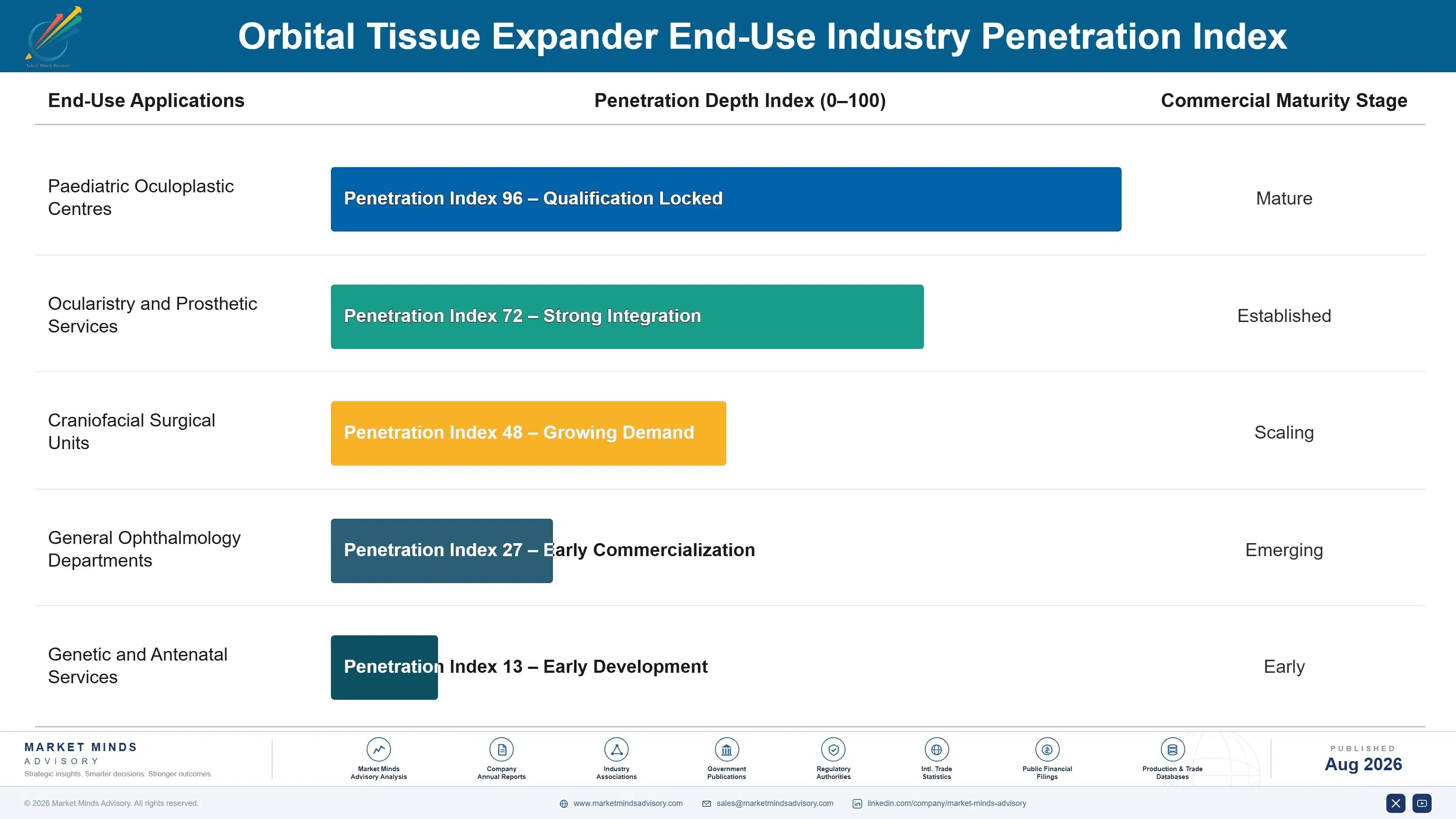
orbital-tissue-expander-market-end-use-penetration-index-1787297949138

Where To Compete Here

These are among the four positions where our research anticipates prominent divergence between winners and laggards over the coming forecast period. Each is grounded in the demand model, the regulatory perimeter, and the announced capacity pipeline.
01 / LIFETIME RELATIONSHIP CAPTURE

The expander is the smallest part

A hydrogel expander is placed once, while conformers and prosthetics are replaced perhaps seven times across a childhood at a cumulative course cost approaching eighteen thousand dollars. Suppliers who focus on the surgical device capture a fraction of that and hand the remainder to whichever fitting service happens to be nearest to the family. Building continuity with the family and the ocularist converts a single procedure into fifteen years of replacements, which is where the entire economics of this condition actually lives.
02 / FITTING CAPACITY EXPANSION

Fix the bottleneck, expand your own market

Ocularists number roughly one per three million people, train through apprenticeships lasting years, and cluster in exactly the countries recording the fewest affected births, which caps how many children can be treated regardless of how many devices anybody manufactures. Digital scanning and printed shells shift much of that manual work onto equipment instead, and let a considerably less experienced fitter achieve an acceptable result. A supplier investing there grows its own addressable population rather than fighting over a fixed one.
03 / SPECIALIST CENTRE FOCUS

Two hundred units see most of the children

Paediatric orbital expansion happens in perhaps two hundred units worldwide, each managing at most forty patients a year and taking referrals nationally rather than locally from their own city. Reaching those centres directly costs very little against any conventional field organisation and covers most of the treatable population in a single exercise. Suppliers spreading effort across general ophthalmology are calling on clinicians who may see one such child in an entire career, which is expensive attention aimed at almost nothing.
04 / BURDEN GEOGRAPHY REALISM

Build where the children are being born

India, Pakistan, Indonesia, Nigeria, and the Gulf states between them account for far more affected births than Europe and North America combined, with consanguinity raising incidence further across several of those populations. Treatment capability was built almost entirely elsewhere, so the majority of affected children pass right through the expansion window without ever being treated at all. Suppliers supporting specialist unit development and ocularist training across those regions are creating a market for themselves rather than dividing an existing one.

Engagement Snapshot From the Field

A live engagement with an industry participant carrying material or product regulatory and market exposure ahead of a defining policy shift, showing how our research translates into a defensible multi-year portfolio strategy.
MARKET MINDS ADVISORY · CLIENT ENGAGEMENT SUMMARY
Orbital Tissue Expander Producer Strategic Portfolio Review and Transition Roadmap 2026·Investment Scenario on Orbital Tissue Expander Exposure Evaluation 2025-26
CLIENT PROFILE
An ophthalmic device manufacturer with annual revenue of near USD 180 million (client-reported, unverified by MMA) supplying orbital implants and conformers across both European and North American specialist centres. Sales into paediatric orbital expansion had been entirely flat for five consecutive years, despite management believing the underlying clinical need was substantial and still growing globally.
STRATEGIC CHALLENGE
The commercial team had proposed expanding field coverage across several additional European countries, on the assumption that under-penetration of existing markets explained the flat performance. Nobody had examined whether the children were actually there at all, or whether the treatable population across the client's served geographies was already essentially fully reached.
MMA APPROACH
MMA estimated affected births by country from published incidence figures adjusted for local consanguinity rates, then mapped those against specialist unit locations and ocularist availability. The treated fraction was then estimated for each country separately. The client's own account coverage was then compared against where untreated children were actually concentrated geographically.
KEY FINDINGS
  1. Affected births across the client's served markets were essentially fully reached already, which explained flat sales far better than any competitive loss did (client-reported, unverified by MMA).
  2. South Asian and sub-Saharan African affected births exceeded the client's entire served population several times over, with treated fractions estimated below one fifth.
  3. Ocularist availability rather than any surgical capability gap proved to be the binding constraint across every under-treated geography examined during the work.
  4. Two Indian tertiary centres were already performing this surgery and importing all their own conformers individually, at considerable cost and considerable delay.
CLIENT PROFILE
An ophthalmic device manufacturer with annual revenue of near USD 180 million (client-reported, unverified by MMA) supplying orbital implants and conformers across both European and North American specialist centres. Sales into paediatric orbital expansion had been entirely flat for five consecutive years, despite management believing the underlying clinical need was substantial and still growing globally.
STRATEGIC CHALLENGE
The commercial team had proposed expanding field coverage across several additional European countries, on the assumption that under-penetration of existing markets explained the flat performance. Nobody had examined whether the children were actually there at all, or whether the treatable population across the client's served geographies was already essentially fully reached.
MMA APPROACH
MMA estimated affected births by country from published incidence figures adjusted for local consanguinity rates, then mapped those against specialist unit locations and ocularist availability. The treated fraction was then estimated for each country separately. The client's own account coverage was then compared against where untreated children were actually concentrated geographically.
KEY FINDINGS
  1. Affected births across the client's served markets were essentially fully reached already, which explained flat sales far better than any competitive loss did (client-reported, unverified by MMA).
  2. South Asian and sub-Saharan African affected births exceeded the client's entire served population several times over, with treated fractions estimated below one fifth.
  3. Ocularist availability rather than any surgical capability gap proved to be the binding constraint across every under-treated geography examined during the work.
  4. Two Indian tertiary centres were already performing this surgery and importing all their own conformers individually, at considerable cost and considerable delay.
RECOMMENDED STRATEGY
Phase 1: Phase one: stop expanding European field coverage, since the treatable population there was already essentially fully served by somebody else. Phase 2: Phase two: establish direct supply and sizing support with the Indian and Gulf centres already performing this surgery without reliable device access. Phase 3: Phase three: co-fund ocularist training partnerships in those regions, since fitting capacity rather than device supply determines how many children get treated.
OUTCOME
The client redirected field investment away from Europe and established supply relationships with six specialist centres across South Asia and the Gulf, reporting unit volumes into those markets exceeding its entire European growth over the previous five years within eighteen months (client-reported, unverified by MMA). Two ocularist training partnerships were funded alongside.

Frequently Asked Questions

Foundational context covering the market sizes, CAGR, scope, country, region and competition that inform every finding below. This section is provided to cover basics and most often pre-purchase conversations, answered from the MMA Primary Research Dataset.

What is the current size of the Orbital Tissue Expander Market?

The market reached USD 0.14 billion in 2025 and is forecast at USD 0.15 billion for 2026. Most of that value sits in repeated prosthetic replacement rather than in the expander itself.

How large will the Orbital Tissue Expander Market be by 2036?

MMA forecasts USD 0.30 billion by 2036, an increase of USD 0.15 billion over 2026. That represents an expansion multiple of 2.00 times across the forecast period.

What is the CAGR for the Orbital Tissue Expander Market 2026 to 2036?

The base case CAGR is 7.2%, with a bull case at 8.4% and a bear case at 6.0%. The bull case depends on ocularist training expanding across South Asia and Africa.

Which segment is growing fastest?

Self-inflating hydrogel expanders grow fastest at 10.8%, exactly 1.50 times the market rate. They halve the number of general anaesthetics a child under five must undergo.

Who are the major companies in the Orbital Tissue Expander Market?

Osmed, FCI Ophthalmics, Oculo-Plastik, Gulden Ophthalmics, and Stryker lead the market. The top five hold roughly 56% of revenue, which is high because almost nobody has built a dedicated business in a condition this rare.

Which country is growing fastest?

India grows fastest at 10.4%, because it records more affected births than any other country and tertiary eye hospitals have built paediatric orbital capability within the past decade. Ocularist numbers remain the constraint.

Report Segmentation Architecture

The full report scope spans multiple orthogonal segmentation dimensions, with cross-tabulated demand data provided for each dimension pair. Coverage extends further to regional breakdowns, trend trajectories, and the competitive detail needed to support segment-level decision-making.

By Device Type

  • Self-Inflating Hydrogel Expanders
  • Custom Paediatric Ocular Prosthetics
  • Injectable Silicone Expanders
  • Serial Conformers
  • Orbital Implants and Spheres

By End-Use Industry

  • Paediatric Oculoplastic Centres
  • Ocularistry and Prosthetic Services
  • Craniofacial Surgical Units
  • General Ophthalmology Departments
  • Genetic and Antenatal Services

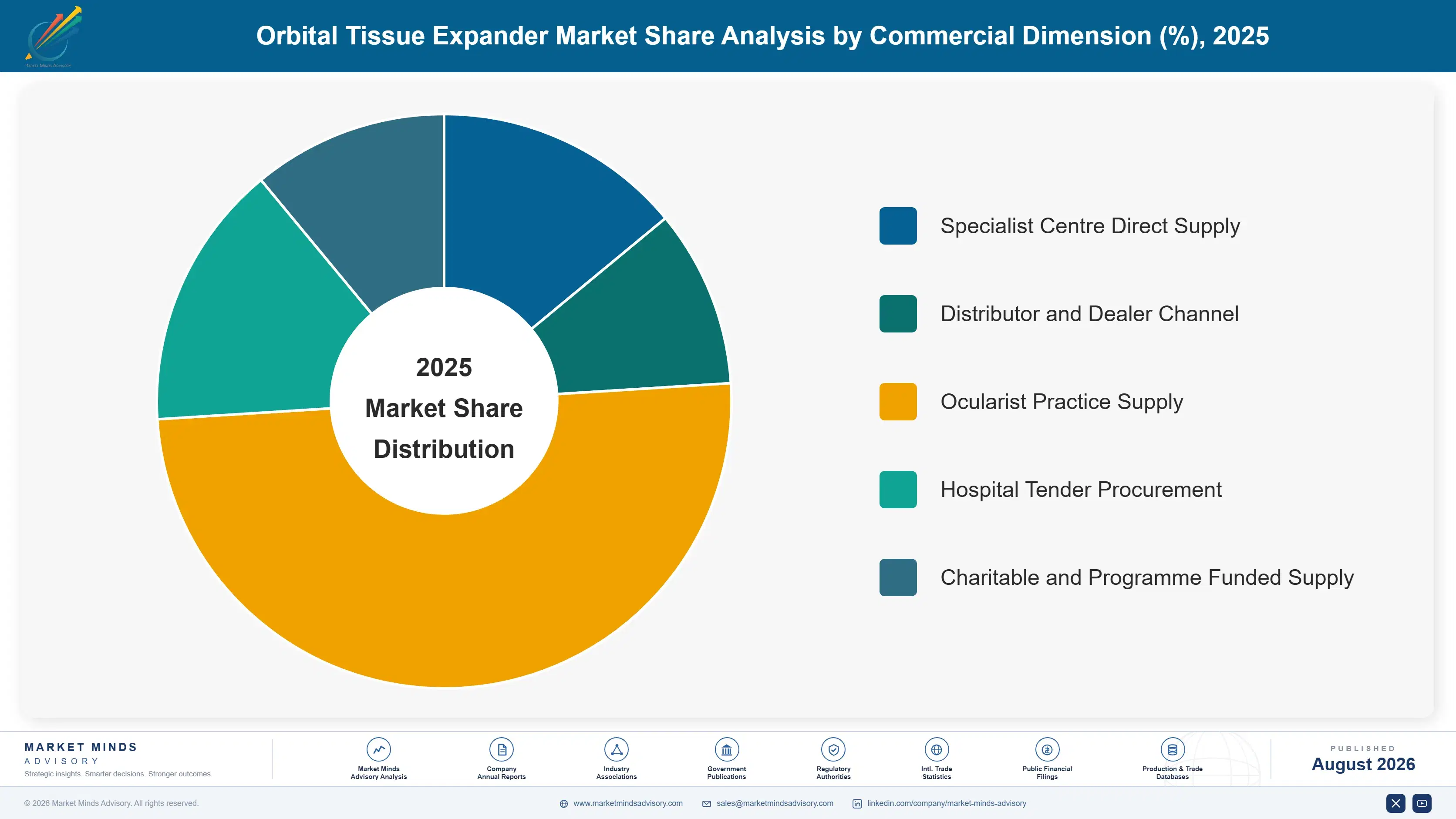
By Commercial Dimension

  • Specialist Centre Direct Supply
  • Distributor and Dealer Channel
  • Ocularist Practice Supply
  • Hospital Tender Procurement
  • Charitable and Programme Funded Supply

By Region

  • South Asia and Pacific
  • Middle East and Africa
  • North America
  • East Asia
  • Western Europe
  • Latin America
  • Eastern Europe

Scope, Methodology, and Coverage

Every figure in this report is reproducible from documented input assumptions. The scope below maps the historical period, the forecast horizon, the segmentation dimensions, and the countries covered, alongside the underlying primary and qualitative methodology.
Historical Period
2020 to 2025
Forecast Period
2026 to 2036
Base Year
2025 (USD billions; MMA Primary Research Dataset, August 2026)
Market Definition
The orbital tissue expander market comprises devices used to enlarge the bony orbit and surrounding soft tissue in children with congenital anophthalmia, severe microphthalmia, or enucleation performed before skeletal maturity, valued at supplier selling prices to paediatric oculoplastic centres, ocularistry practices, craniofacial units, and hospital procurement. It spans self-inflating hydrogel expanders, injectable and inflatable silicone expanders, serial conformers, custom paediatric ocular prosthetics fitted during the growth period, and orbital implants and spheres used within the expansion pathway, together with the sizing support, digital scanning, and fitting services supplied alongside them. Adult ocular prosthetics fitted after skeletal maturity, orbital fracture and decompression implants, breast, scalp, and other soft tissue expanders, intraocular lenses and cataract devices, craniofacial distraction hardware, and ophthalmic surgical instruments sold for general use are excluded.
Quantitative Units
USD billions (current prices); volume in devices and prosthetics supplied
Segmentation Dimensions
By Device Type; By End-Use Industry; By Commercial Dimension; By Region
Regions Covered
South Asia and Pacific, Middle East and Africa, North America, East Asia, Western Europe, Latin America, Eastern Europe
Countries Covered
India, Pakistan, Bangladesh, Indonesia, Philippines, Australia, China, Japan, South Korea, Taiwan, USA, Canada, Mexico, Brazil, Argentina, Colombia, Chile, Germany, Netherlands, UK, France, Italy, Spain, Sweden, Switzerland, Poland, Czechia, Hungary, Romania, Saudi Arabia, United Arab Emirates, Egypt, Nigeria, Kenya, South Africa, Morocco, and additional markets relevant to this sector
Key Companies Profiled
Osmed, FCI Ophthalmics, Oculo-Plastik, Gulden Ophthalmics, Stryker, Techno-Med, Modern Plastics, Innovia Medical, Katena Products, Beaver-Visitec International, Rumex International, Bausch and Lomb, ASICO, Duckworth and Kent, Malosa Medical, Altomed, Geuder, Medicel, Ocular Instruments, Optima Ophthalmics
Quantitative Methodology
Primary survey, n=3,800 respondents, Q4 2025, six countries; demand-side model with trade association cross-validation
Qualitative Methodology
47 expert interviews, Q4 2025; applied to validate demand model assumptions, identify emerging dynamics, and assess competitive positioning
Report Format
PDF and XLSX data workbook (Word format preview document)
Publisher
Market Minds Advisory
Report Code
MMA-2026-MED-736
Published
August 2026
Contact
sales@marketmindsadvisory.com | www.marketmindsadvisory.com

Purchase the full Orbital Tissue Expander Market Report (2026 to 2036).

The full report examines orbital tissue expander demand across seven regions and five device types, with particular attention to a treatment window closed by bone growth rather than by disease progression. It quantifies affected births against specialist unit and ocularist availability to size the untreated population by country. Competitive analysis covers twenty participants assessed on orbital expansion device revenue, including how three-dimensional printing is changing where conformer shells get produced. Regional chapters separate incidence, including consanguinity effects, from treatment capability, which sit in very different places.
Seven-region affected births and capability mapping
Five device type segmentation with growth rates
Twenty participant competitive assessment and channel positioning
Untreated population sizing by country and treated fraction
Ocularist availability and fitting capacity constraint analysis
Lifetime treatment course value against initial device spend

Built For The People Who Decide

From boardroom strategy to bench-side execution, this report is read cover-to-cover by leaders shaping the next decade of their industry, turning demand scenarios, market dynamics and valuation benchmarks into decisions.
CXOs/ Presidents/ VPs/ Managers
M&A and Corporate Development
Strategy Teams and R&D Heads
Procurement and Product Directors
Regulatory and Compliance Leaders
Investor Relations and Equity Analysts