Market Minds Advisory
Orange Terpenes Market

Orange Terpenes Market: Trends and Forecast 2026 to 2036

Green chemistry mandates are pulling orange terpenes into industrial solvent and cleaning product formulations as manufacturers replace petroleum-based ingredients, even as citrus greening disease threatens the peel byproduct supply this entire market depends on.

Lead Analyst

Bilal Shaikh

Published

September 2026

Make Smarter Decisions with Customized Research Insights

Request a free sample report and evaluate market opportunities, growth trends, and competitive dynamics relevant to your business needs.

2025 MARKET VALUE$0.7BMarket Size 2025
2036 FORECAST VALUE$1.4BBase Case , 2026 to 2036
CAGR 2026 TO 20366.8 %Bull 8.0% / Bear 5.6%
INCREMENTAL OPPORTUNITY$0.7BNet 10- year value creation
EXPANSION MULTIPLE1.93x2036 value over 2026 base
Strategic Levers
M&A Pipeline
Regional Outlook
Country Rankings
Competitive Intelligence
Segmental Deep-dive
Call-Us : 91 93563 13602

Executive Snapshot and Market Trajectory

Orange terpene demand is shifting from traditional flavor and fragrance applications toward green solvent and cleaning product formulations as manufacturers respond to consumer and regulatory pressure to replace petroleum-based ingredients, reshaping procurement patterns and formal formulation standards across chemical supply chains worldwide today and increasingly.
Commercial pressure now concentrates on feedstock supply security, since orange terpenes exist entirely as a byproduct of orange juice processing rather than a dedicated agricultural crop, tying supply directly to citrus harvest volumes and juice industry economics. Green and bio-based solvents are the fastest-growing application, driven by manufacturer reformulation away from petroleum-based cleaning products. Latin America and North America together account for the largest share of global demand, reflecting concentrated citrus processing capacity nationwide.
Competitive intensity concentrates among a handful of large-scale citrus processors holding integrated orange juice and terpene extraction operations, leaving smaller formulators dependent on spot market purchasing from processors prioritizing their own downstream product lines and business units nationwide. Citrus greening disease adds further complexity, since declining orange harvest yields in key producing regions directly constrain terpene byproduct availability regardless of rising downstream demand across formulation industries.
Market Definition
The Orange Terpenes Market covers d-limonene and related terpene compounds extracted as a byproduct of orange juice processing, used as solvents, fragrance ingredients, and cleaning product components. It excludes synthetic limonene, terpenes derived from other citrus or plant sources, and finished consumer cleaning products themselves.
Base Year Value
$0.7B in 2025 (MMA Primary Research Dataset, August 2026)
Forecast Period
2026 to 2036, eleven discrete annual values
CAGR
6.8% base case. Bull 8.0%. Bear 5.6%.
Fastest Growth Segment
Green/Bio-Based Solvents and Cleaning Products: 9.5% CAGR
Fastest Growth Country
India: 10.5% CAGR
Fastest Growth Region
South Asia and Pacific: 9.0% CAGR
Largest Region
Latin America: 26% of 2025 global value
Market Leaders
Leading participants include Citrosuco, Cutrale, Florida Chemical Company, Louis Dreyfus Company, and Citrus and Allied Essences. Source: MMA Primary Research Dataset, July 2026.
Primary Survey
n=3,800 procurement and R&D decision-makers, Q4 2025, six countries
Methodology
Demand-side build-up, cross-validated against public data, 47 expert interviews

Orange Terpenes Market Forecast Scenarios

orange-terpenes-market-trends-size-forecast-scenario-1787559024746
Between 2020 and 2025 the market grew at an estimated 5.9% annual pace, held back by citrus greening disease reducing Florida and Brazilian orange harvest yields even as downstream demand for green solvent applications began accelerating. Traditional flavor and fragrance applications dominated the period, since green solvent reformulation remained an early-stage trend limited by supply availability and cost considerations relative to conventional alternatives.
The base case assumes 6.8% annual growth to 2036, driven by three mechanisms: manufacturers reformulating industrial cleaning and degreasing products away from petroleum-based solvents toward bio-based alternatives, personal care and cosmetics brands specifying natural citrus-derived ingredients to meet clean-label consumer demand, and pharmaceutical and nutraceutical applications expanding as terpene bioactivity research matures. Traditional flavor and fragrance applications retain steady baseline demand, but their share of total terpene consumption is declining as green solvent applications expand faster across industrial categories.
The bull case centers on green solvent reformulation accelerating faster than current manufacturer adoption timelines suggest, pushing growth toward 8.0%. The bear risk is citrus greening disease continuing to erode orange harvest yields in key producing regions, which would constrain terpene byproduct supply below rising downstream demand, holding growth closer to 5.6% through the forecast window.

Byproduct Economics Shape Terpene Supply

The Orange Terpenes Market sits entirely downstream of orange juice processing economics, where terpene byproduct availability follows citrus harvest volumes and juice extraction decisions more than dedicated agricultural production. Green solvent formulators and personal care manufacturers together represent the fastest-growing buyer categories, each imposing increasingly specific purity and consistency requirements as they scale procurement volumes.
MARKET CONCENTRATION48%Share held by five largest citrus processors combined
AVERAGE SELLING PRICE$2.20 per kgTypical cost formulators pay per kilogram of terpenes
TOP PRODUCING COUNTRY45%Current share of global terpene output from Brazil
CAPACITY UTILIZATION66%Average operating rate across terpene extraction facilities currently
FEEDSTOCK COST SHARE30%Portion of production cost from orange peel collection
PURITY GRADE RANGE94% to 99.5%Typical concentration range across industrial and premium formats
Standard flavor and fragrance grade terpenes remain the largest volume category, prized for established formulation relationships and proven performance across food and beverage applications worldwide. Green solvent and personal care grade terpenes carry a meaningful price premium tied to additional purification requirements, yet formulators in these categories are specifying higher purity fast enough that processors are investing in dedicated purification equipment ahead of confirmed long-term volume commitments from industrial customers.
Producer concentration remains moderate to high, with a handful of large-scale citrus processors holding integrated juice and terpene extraction operations that smaller independent extractors cannot easily replicate at comparable scale or cost. Capacity utilization runs tighter during peak citrus harvest seasons than during off-season periods, reflecting the fundamentally byproduct-driven nature of terpene supply tied directly to orange juice production schedules.
"Nobody plants an orange grove to make solvent. Every drop of this market exists because someone wanted juice, which means supply follows citrus economics, not chemical demand."
Senior Analyst, Specialty Chemicals and Natural Ingredients Practice · MMA Chemicals and Materials Practice · August 2026

Market Trends

Green Solvent Reformulation Accelerates Across Industrial Cleaning

Industrial cleaning and degreasing product manufacturers are converting from petroleum-based solvents to orange terpene formulations as corporate sustainability commitments and consumer demand for bio-based ingredients reshape product development priorities across the cleaning products industry. Formulators report green solvent orders tied to new product launches growing meaningfully faster than orders tied to established petroleum-based product lines nearing end of their development cycle. The shift is concentrated among large consumer product manufacturers with the capital to reformulate entire product lines, while smaller manufacturers continue relying on conventional solvents until terpene costs decline further, creating a two-speed adoption pattern across the industry.
Market Impact: Solvent replacement adds 14% demand
Personal Care Brands Specify Natural Citrus-Derived Ingredients

Personal care and cosmetics brands are increasingly specifying natural citrus-derived terpenes as fragrance and functional ingredients, responding to consumer demand for clean-label and naturally-sourced formulations even in categories previously dominated by synthetic alternatives and legacy formulations across the broader industry entirely. These natural ingredient formulations command a meaningful price premium over synthetic limonene that brands and consumers increasingly accept given growing ingredient transparency expectations and demands. Adoption is concentrated among premium and natural personal care brands, while mass-market manufacturers continue using lower-cost synthetic alternatives at comparable functional performance and cost.
Market Impact: Nutraceutical research supports 6% growth

Market Opportunities and Growth Drivers

Petroleum Solvent Replacement Mandates Drive Terpene Demand

Regulatory and corporate sustainability pressure to reduce petroleum-based ingredient use in cleaning and industrial products is directly increasing demand for orange terpenes as a bio-based solvent alternative capable of meeting both performance and environmental requirements simultaneously across product lines and manufacturing operations nationwide and increasingly abroad as well. Manufacturers unable to demonstrate bio-based ingredient sourcing risk losing shelf space and corporate procurement contracts favoring sustainable alternatives, pushing capital toward terpene-based reformulation faster than overall cleaning product market growth alone would otherwise justify economically across their expanding product portfolios and categories.
Market Impact: Disease reduces Florida harvest yields 40%

Growing Nutraceutical Research Sustains Pharmaceutical Application Demand

Expanding scientific research into terpene bioactive properties, including potential anti-inflammatory and antimicrobial applications, is sustaining pharmaceutical and nutraceutical industry interest in orange terpenes as a functional ingredient beyond traditional flavor and solvent applications across multiple therapeutic areas and emerging product categories worldwide today and quite consistently. This research-driven demand gives terpene suppliers a diversification opportunity beyond cyclical industrial solvent demand, since pharmaceutical applications tend to command premium pricing and longer-term supply relationships. Suppliers serving pharmaceutical customers benefit from this demand diversification across different economic and regulatory cycles and market conditions.
Market Impact: Byproduct structure caps supply growth 5%

Market Restraints and Challenges

Citrus Greening Disease Threatens Feedstock Supply Availability

Citrus greening disease, also known as huanglongbing, continues to reduce orange harvest yields across Florida and increasingly Brazilian growing regions, directly constraining the peel byproduct supply that terpene production depends on entirely, since terpenes cannot be produced independent of juice processing volumes. For terpene buyers without long-term supply contracts, this constraint creates real commercial risk when disease-affected harvest shortfalls coincide with rising downstream demand from green solvent formulators. Some processors are addressing this by diversifying citrus sourcing across additional growing regions, though disease spread continues to threaten supply security industry-wide.
Market Impact: Green solvent orders gain 8 points

Byproduct Supply Structure Limits Independent Production Scaling

Orange terpenes exist entirely as a byproduct of orange juice processing rather than a dedicated agricultural commodity, meaning terpene producers cannot simply scale production to meet rising demand independent of juice market economics and consumer beverage consumption trends and preferences. This inherent constraint limits how quickly the industry can respond to demand growth, since expanding terpene supply requires expanding orange juice production capacity that juice processors may not prioritize based on beverage market economics alone. Industry associations are exploring dedicated terpene extraction investment, though economics remain challenging without juice production as the primary revenue driver.
Market Impact: Natural ingredient demand grows 10% annually
3 additional market trends, 4 additional growth drivers, and 2 additional restraints and challenges are covered in the full report. Contact sales@marketmindsadvisory.com to access the complete intelligence.

Segment CAGR and Growth Architecture

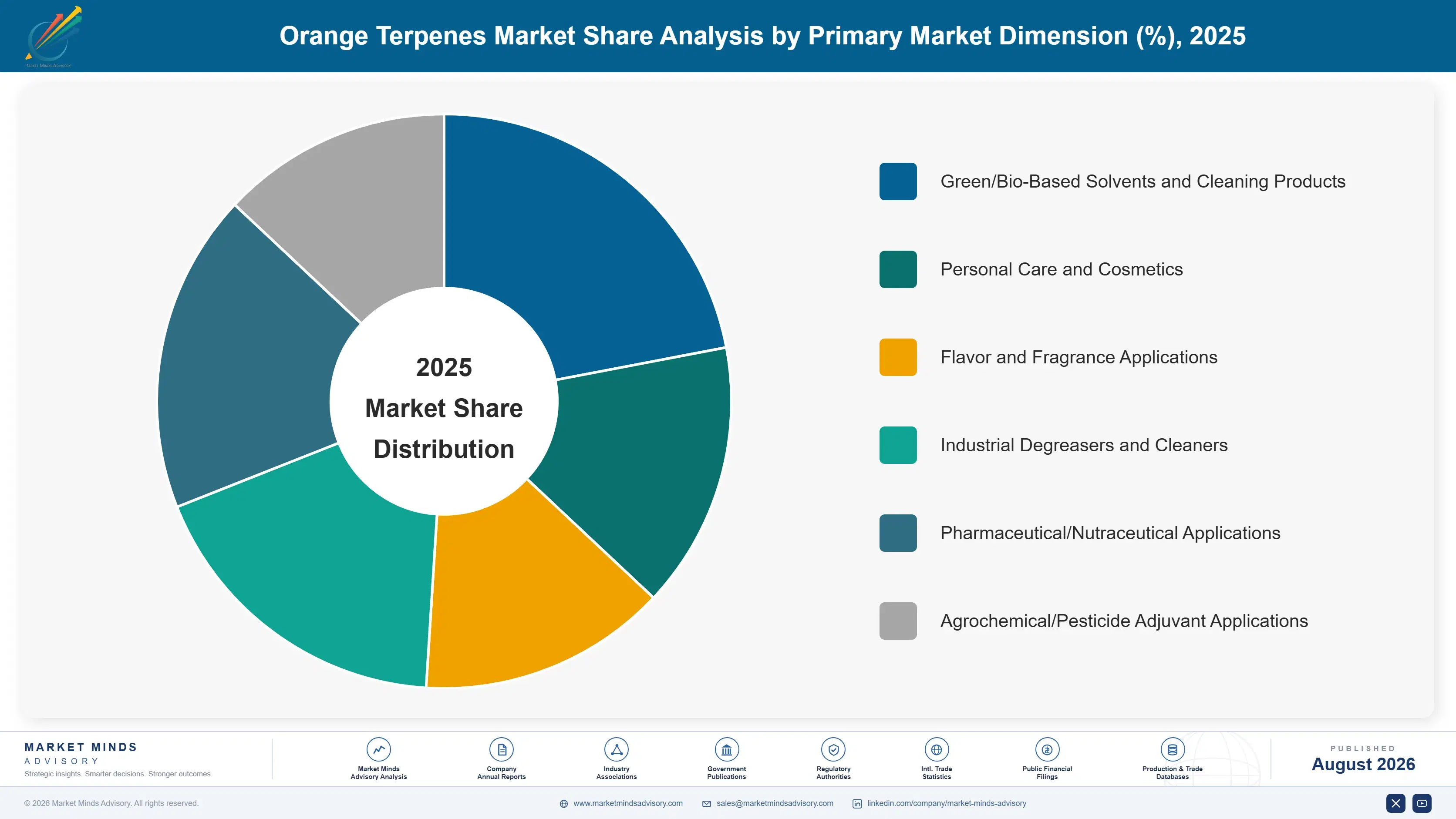
The market divides into six application-based segments spanning industrial and consumer end uses across global chemical formulation markets. Green solvents and personal care applications serve growth-oriented premium demand, while flavor and fragrance, industrial degreasers, pharmaceutical and nutraceutical, and agrochemical adjuvant applications serve broader established commercial uses across diverse chemical formulation customer segments worldwide today.
orange-terpenes-market-trends-market-share-analysis-1787559025279

Green/Bio-Based Solvents and Cleaning Products

Green and bio-based solvents are converting fastest as industrial cleaning and degreasing manufacturers replace petroleum-based ingredients under corporate sustainability commitments and tightening consumer expectations for environmentally responsible product formulations across their entire product portfolios and manufacturing operations nationwide and internationally. This application demands consistent purity and solvency performance that generic flavor-grade terpenes were not originally optimized to deliver at the scale industrial reformulation requires across multiple manufacturing facilities and production lines. Processor investment in dedicated purification capacity has accelerated well ahead of confirmed long-term volume commitments, reflecting expectations that petroleum solvent replacement mandates across additional industries will pull demand significantly higher across the coming decade and well beyond that point.
CAGR 9.5%

Personal Care and Cosmetics

Personal care and cosmetics applications are the second-fastest-growing segment, driven by consumer demand for natural, clean-label ingredient sourcing over synthetic alternatives across skincare, haircare, and fragrance product categories and formulations worldwide and quite consistently over recent years and decades. These formulations require higher purity specifications and documented natural sourcing credentials than industrial-grade terpenes, commanding a meaningful price premium that brands increasingly accept given consumer willingness to pay for natural positioning and transparency and authenticity. Cost sensitivity limits natural terpene penetration into mass-market personal care formulations, but premium and natural beauty brands are increasingly specifying citrus-derived terpenes as a standard differentiation strategy across their expanding product portfolios and marketing positioning and campaigns.
CAGR 8.0%
Full segment breakdown across 6 segments available in the complete report.

Regional Architecture and Country Demand Map

Regional demand tracks orange juice processing concentration rather than population or income levels alone. Latin America dominates given Brazil's outsized position in global orange juice production, while North America and East Asia sustain demand through downstream green solvent and personal care formulation industries and manufacturers.

North America

United States industrial cleaning and personal care manufacturers drive substantial regional demand for orange terpenes, with Florida's historically significant citrus processing industry providing a domestic feedstock source despite ongoing citrus greening disease pressures reducing available harvest volumes each season. Canada's growing green chemistry manufacturing sector contributes secondary regional demand tied to cleaning product reformulation trends and sustainability commitments across major consumer brands. Mexico's citrus processing sector, though smaller than Brazil's, adds meaningful regional feedstock and finished terpene supply capacity to the broader North American market. Domestic content preferences among some manufacturers are supporting continued Florida-sourced terpene demand even as Brazilian imports increasingly fill the growing supply gap left by declining domestic harvest yields.
Share: 22% | CAGR: 6.0% (2026 to 2036)

Western Europe

Germany and France's substantial industrial cleaning and personal care manufacturing base anchors Western European demand, importing the majority of terpene feedstock given the region's limited domestic citrus growing capacity relative to overall manufacturing demand and consumption levels nationwide and quite consistently. The United Kingdom's green chemistry sector, driven by corporate sustainability commitments, contributes meaningful demand for bio-based solvent alternatives across cleaning product categories and industrial applications. Spain and Italy's smaller domestic citrus industries provide limited regional feedstock supplementing imported Brazilian terpenes across formulation supply chains and networks. Regulatory pressure toward sustainable ingredient sourcing is more advanced here than in most other regions, supporting premium natural terpene pricing and formulator investment.
Share: 18% | CAGR: 5.2% (2026 to 2036)
Regional intelligence for 5 additional markets available in the complete report: East Asia, South Asia and Pacific, Latin America, Middle East and Africa, Eastern Europe. Contact sales@marketmindsadvisory.com.
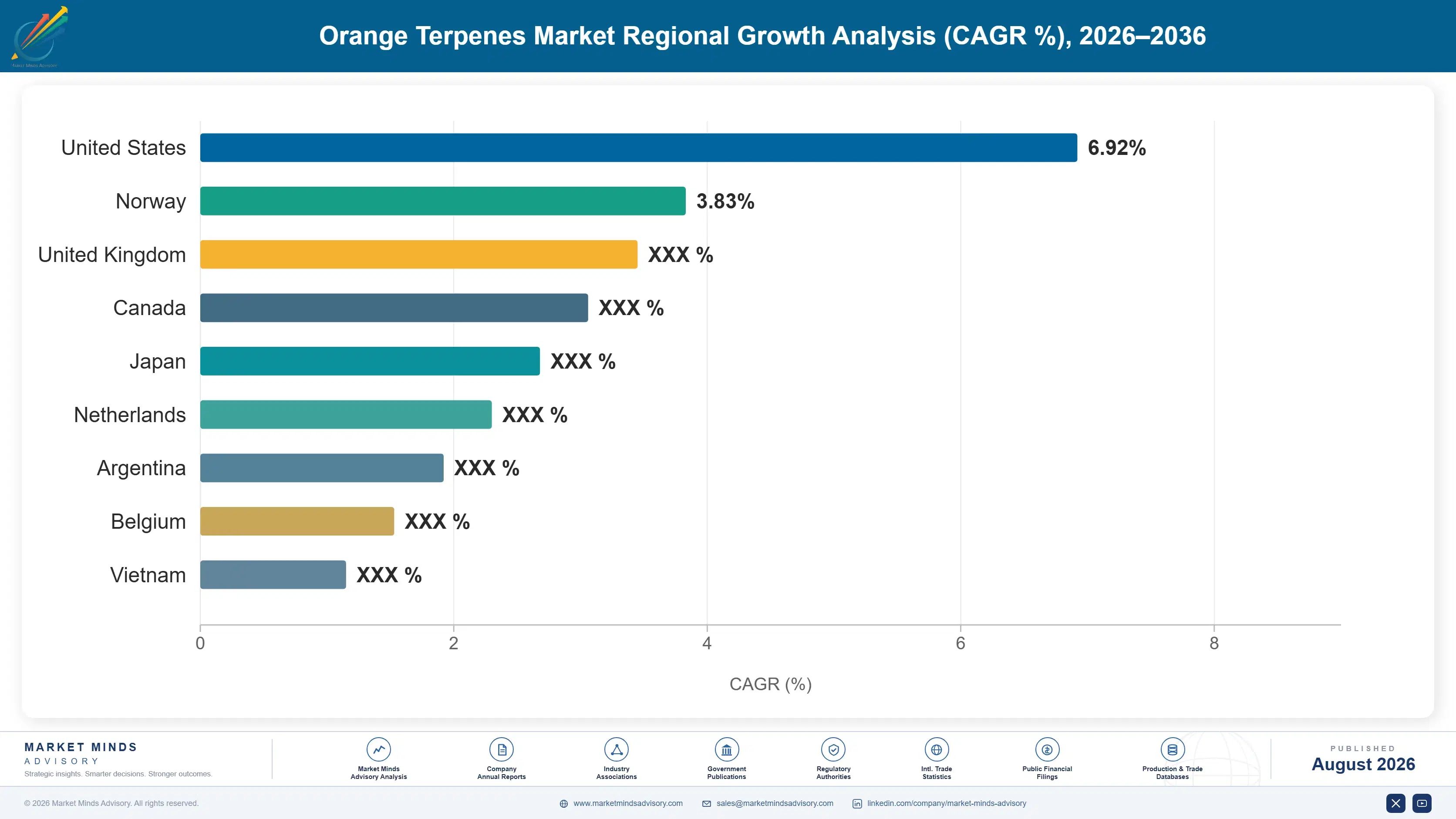
orange-terpenes-market-trends-country-cagr-analysis-1787559025798

Where Processors Can Capture Purity Margin

Processors face a widening gap between standard flavor-grade terpene pricing and the purification, natural certification, and feedstock diversification capabilities that green solvent and personal care manufacturers now demand. Four levers stand out for capturing margin above baseline byproduct extraction economics: high-purity distillation, natural sourcing certification, feedstock diversification, and direct formulator contract structuring across supply chains.

High-Purity Distillation for Industrial Solvent Applications

Processors investing in high-purity distillation capacity can charge a premium averaging 22 to 30% above standard flavor-grade terpenes, since green solvent and personal care manufacturers require purity specifications that standard citrus byproduct processing cannot reliably achieve without dedicated equipment investment. Building this capability requires meaningful capital investment in specialized distillation infrastructure, but processors who achieve it gain access to a higher-margin customer base largely inaccessible to generic terpene suppliers. Processors lacking purification capability increasingly compete only on price for traditional flavor and fragrance applications, ceding the highest-margin premium business entirely.
Market Impact: High-purity distillation adds 22 to 30% pricing power

Natural Sourcing Certification for Personal Care Brands

Processors holding documented natural sourcing certification can capture a premium averaging 18 to 25% above uncertified material, since personal care brands increasingly require traceable, naturally-derived ingredient credentials to satisfy consumer transparency demand and regulatory labeling requirements across major retail markets and jurisdictions worldwide and consistently. This capability requires sustained investment in supply chain documentation and certification audits, but processors who build it gain access to premium personal care contracts largely inaccessible to uncertified competitors. Processors without certification are effectively excluded from this expanding premium segment regardless of underlying product quality.
Market Impact: Natural certification adds 18 to 25% pricing power

Feedstock Diversification Beyond Florida and Brazil

Processors diversifying feedstock sourcing beyond traditional Florida and Brazilian citrus growing regions can capture an estimated 12 to 18% premium through supply security guarantees, since buyers increasingly value diversified sourcing that reduces exposure to citrus greening disease concentrated in these two dominant growing regions worldwide and quite consistently indeed today and reliably. This diversification requires meaningful investment in qualifying secondary growing regions, but processors who build it gain access to buyers seeking supply resilience largely inaccessible to single-region-dependent competitors. Competitors without diversified sourcing remain exposed to concentrated disease and weather risk.
Market Impact: Feedstock diversification adds 12 to 18% pricing power

Direct Formulator Contract Structuring and Negotiation

Processors negotiating multi-year direct contracts with major green solvent and personal care manufacturers, bypassing distributors entirely, can improve gross margin by roughly 8 to 12 percentage points by eliminating distributor markup while offering manufacturers price stability and firm supply continuity guarantees over the full multi-year contract term itself and consistently. These direct arrangements typically require minimum volume commitments spanning two to four years, favoring larger processors with the balance sheet capacity to guarantee uninterrupted supply that smaller regional competitors cannot credibly match given more limited production capacity and working capital.
Market Impact: Direct contracts improve margin by 8 to 12 points

Who Controls the Margin Pool

Concentration remains moderate: the top five producers hold 48% combined share on a revenue basis, evaluated consistently across producers regardless of whether they compete primarily in commodity flavor-grade material or purified industrial chemistry. Citrosuco leads on scale and integrated orange juice and terpene extraction operations, followed by Florida Chemical Company, whose specialty purification expertise gives it access to premium industrial and personal care contracts that generic byproduct sellers cannot easily replicate.
Competitive activity currently centers on high-purity distillation capacity investment, as processors race to meet green solvent and personal care formulator specifications ahead of continued reformulation demand. Several mid-tier processors have announced new natural sourcing certification programmes, while others are pursuing feedstock diversification instead, betting that supply security will prove more durable than purity alone as a differentiator.

Emerging pressure comes from smaller Brazilian and Mexican processors who have scaled terpene extraction capacity rapidly and are now underpricing established competitors on generic flavor-grade material. Rankings could shift meaningfully if major formulators standardize purity and certification specifications around a smaller set of approved suppliers, since that would commoditize a capability several mid-tier processors currently treat as differentiated, accelerating consolidation among processors lacking sufficient feedstock scale.
orange-terpenes-market-trends-company-positioning-matrix-1787559026313

Competitive Moat and Risk Dimensions

CITROSUCO

Moat: Integrated Juice and Terpene Extraction

Citrosuco controls orange juice processing and terpene extraction under one integrated operation, giving it feedstock cost and supply certainty that terpene-only extractors purchasing byproduct from third parties cannot match. This integration also gives Citrosuco direct visibility into harvest volumes and juice production schedules, letting it plan terpene supply commitments more reliably than competitors dependent on external byproduct purchasing arrangements.
CITROSUCO

Risk: Exposure to Citrus Greening Disease

Citrosuco's terpene supply remains entirely dependent on Brazilian orange harvest volumes, exposing it directly to citrus greening disease and weather disruption risks that geographically diversified competitors sourcing feedstock from multiple countries can better absorb. A severe disease outbreak could disrupt Citrosuco's supply more significantly than competitors with feedstock relationships spread across Florida, Mexico, and other growing regions.
FLORIDA CHEMICAL COMPANY

Moat: Specialty Purification and Chemistry Expertise

Florida Chemical Company has built deep specialty purification expertise that lets it win premium industrial and personal care contracts based on demonstrated purity and formulation capability rather than price alone, a specialization generic byproduct sellers cannot replicate. This expertise creates genuine customer stickiness, since formulators who have validated Florida Chemical's material face real switching costs in requalifying an alternative supplier.
FLORIDA CHEMICAL COMPANY

Risk: Smaller Feedstock Scale Than Citrosuco

Florida Chemical Company operates at meaningfully smaller feedstock scale than Citrosuco's integrated Brazilian operations, limiting its ability to compete on price for large-volume commodity contracts where scale economics matter more than purification expertise. This scale disadvantage could widen if Brazilian competitors continue expanding purification capability faster than Florida Chemical's more measured growth strategy.

Players Tracked

Prominent Players

Citrosuco
Cutrale
Florida Chemical Company
Louis Dreyfus Company
Citrus and Allied Essences

Other Key Players

Symrise
Givaudan
dsm-firmenich
Robertet Group
Vigon International
Elan Chemical Company
Sensient Technologies
Kerry Group
Archer Daniels Midland
Treatt PLC
International Flavors & Fragrances
Bell Flavors & Fragrances
Mane SA
Corbion
Wilmar International

Recent Developments

MARCH 2025

Citrosuco commissioned an expanded high-purity distillation facility in São Paulo, adding dedicated capacity for industrial solvent grade terpenes meeting rising green chemistry manufacturer specifications across multiple product categories. The expansion responds to increasing qualification requests from cleaning product formulators seeking documented traceable, sustainably-sourced material and supply chains.
Signal: Signals accelerating producer investment in purification capacity well ahead of confirmed long-term industrial demand nationwide and abroad.
SEPTEMBER 2025

Florida Chemical Company signed a multi-year supply agreement with a major personal care manufacturer to provide certified natural terpenes across its expanding premium product lines and multiple international export markets nationwide and abroad, securing volume commitments that support continued purification investment through the manufacturer's reformulation pipeline.
Signal: Confirms personal care brands locking in certified natural terpene supply well ahead of clean-label reformulation deadlines.
JUNE 2025

Cutrale acquired a specialty terpene distillation business in Mexico to diversify its feedstock sourcing beyond Brazilian citrus operations, extending its geographic footprint into a market where citrus greening disease resistance increasingly determines long-term supply reliability and continuity across the broader regional supply chain network and infrastructure.
Signal: Shows processors diversifying feedstock geography to reduce single-region citrus disease exposure and broader risk more consistently.

Orange Peel Feedstock Cost Exposure

Orange peel byproduct accounts for roughly 30% of production cost across terpene formulations, with processing and purification equipment operation contributing the remainder given the extraction and distillation infrastructure required across most manufacturing facilities. Feedstock cost tracks orange juice processing volumes directly, since terpenes cannot be produced independent of juice extraction economics and citrus harvest availability.
Orange peel feedstock availability tightened notably during 2022 and 2023 as citrus greening disease reduced Florida orange harvest yields to historic lows, a volatility event documented in USDA citrus fruits summary reports. Processors without diversified feedstock sourcing absorbed availability constraints directly, while those holding relationships across multiple growing regions maintained more stable supply, illustrating how sourcing diversification shapes resilience during feedstock disruptions across the broader terpene supply chain.

Smaller regional extractors lacking scale to secure reliable feedstock relationships face a real competitive disadvantage against integrated players like Citrosuco, who control both juice processing and terpene extraction internally and consistently. This exposure varies by geography too: Florida-dependent producers face more acute citrus greening disease exposure than Brazilian competitors, though Brazilian growing regions are increasingly experiencing similar disease pressure over recent years.
orange-terpenes-market-trends-cost-volatility-analysis-1787559026509

Long-Term Feedstock Supply Agreements With Growers

Processors increasingly negotiate multi-year feedstock supply agreements directly with citrus growers and juice processors that include volume guarantees, reducing exposure to spot market availability constraints during disease or weather-related harvest shortfalls across major growing regions. This reduces earnings volatility for processors lacking the balance sheet to absorb sudden supply disruptions without passing them through to customers immediately.

Diversifying Citrus Sourcing Across Growing Regions

Several processors are expanding feedstock relationships beyond traditional Florida and Brazilian sourcing into Mexican and Argentine citrus growing regions, reducing dependence on any single region facing disease or weather disruption and supply chain uncertainty. This diversification lowers single-source risk and improves negotiating position during periodic supply relationship renewal cycles across multiple growing regions and countries.

Disease-Resistant Citrus Variety Research Partnerships

Processors are partnering with agricultural research institutions to develop and support disease-resistant citrus varieties that could stabilize long-term feedstock availability against continuing citrus greening disease pressure across major producing regions worldwide. This approach requires sustained research investment, but positions processors favorably as growers seek partners to fund resistant variety development and broader industry adoption.

Portfolio Architecture for Margin Defence

Portfolio economics split sharply along a commodity-versus-purified axis across the industry. Standard flavor and fragrance grade terpenes compete on established relationships and cost stability, with gross margins compressed by feedstock availability volatility and thin differentiation among processors. Green solvent and personal care grade formats carry meaningfully higher margins, reflecting purification investment, natural certification, and the qualification-required status these formats now hold among industrial and consumer product manufacturers.
The tension between commodity and purified formats is intensifying as green chemistry mandates and personal care demand pull volume toward specialized formats faster than purification capacity can scale industry-wide across most processor networks. Processors over-indexed on standard flavor-grade material face margin erosion as that segment shrinks toward a smaller, price-sensitive core, while those who invested early in purification and certification are capturing a disproportionate share of the industry's expanding premium revenue pool relative to overall production volume.

High-value margin pools concentrate in high-purity terpenes serving green solvent manufacturers and certified natural terpenes serving personal care brands, where purification barriers and certification requirements limit competitive entry from smaller regional extractors. A second, smaller pool sits in feedstock diversification services serving buyers seeking supply security that single-region-dependent processors cannot provide.

Standard flavor and fragrance grade terpenes sold primarily on established relationships and cost stability to food and beverage customers, where thin margins reflect limited differentiation and intense price competition among regional processors serving cost-sensitive accounts.
Gross Margin

Green solvent and personal care grade formats commanding qualification-required status among industrial and consumer product manufacturers, where purification investment and natural certification support meaningfully higher margins than standard flavor-grade alternatives.
Gross Margin

Emerging disease-resistant feedstock partnerships and next-generation extraction technologies still scaling commercially, commanding the highest margins as processors price in scarcity value ahead of broader industry-wide adoption and formal certification qualification.
Gross Margin
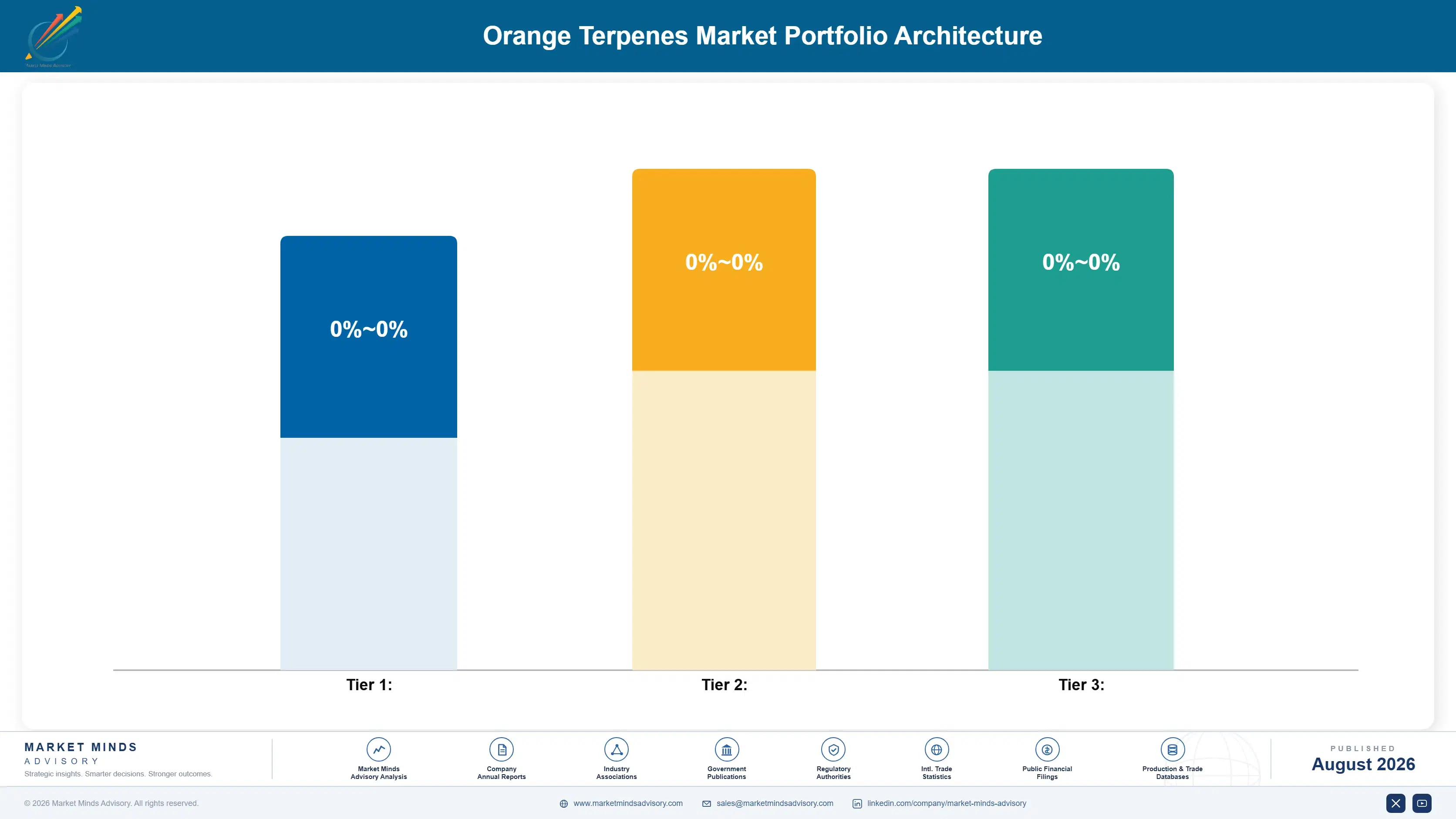
orange-terpenes-market-trends-portfolio-architecture-1787559027010

High-value Sub-segments and Strategic Watch-out

High-Purity Terpenes for Green Solvent Manufacturers

High-purity terpenes serving green solvent manufacturers combine the fastest segment growth with the highest margins in the portfolio, driven by qualification-required status limiting new entrant competition industry-wide today. Processors holding early purification capability are best positioned to capture this expanding high-value pool consistently and reliably.

Certified Natural Terpenes for Personal Care Brands

Certified natural terpenes serving personal care brands combine strong growth with above-average margins tied to sustained certification and traceability investment over time and consistently. This segment benefits from rising consumer transparency demand expanding faster than certified production capacity across most processor networks currently and consistently.

Standard Flavor and Fragrance Grade Terpenes

Standard flavor and fragrance grade terpenes remain the volume core of the market, serving cost-sensitive food and beverage customers not yet driving premium format demand. Growth is slow and margins are thin, but the segment still represents the largest single share of total unit volume shipped across the industry.

Agrochemical and Pesticide Adjuvant Applications

Agrochemical and pesticide adjuvant applications serve a specialized niche within broader chemical formulation categories, facing steady but modest demand growth tied to crop protection industry trends. Processors should monitor whether this format retains relevance as green solvent and personal care formats capture growing customer and formulator attention.

Recurring Demand From Formulation Contracts

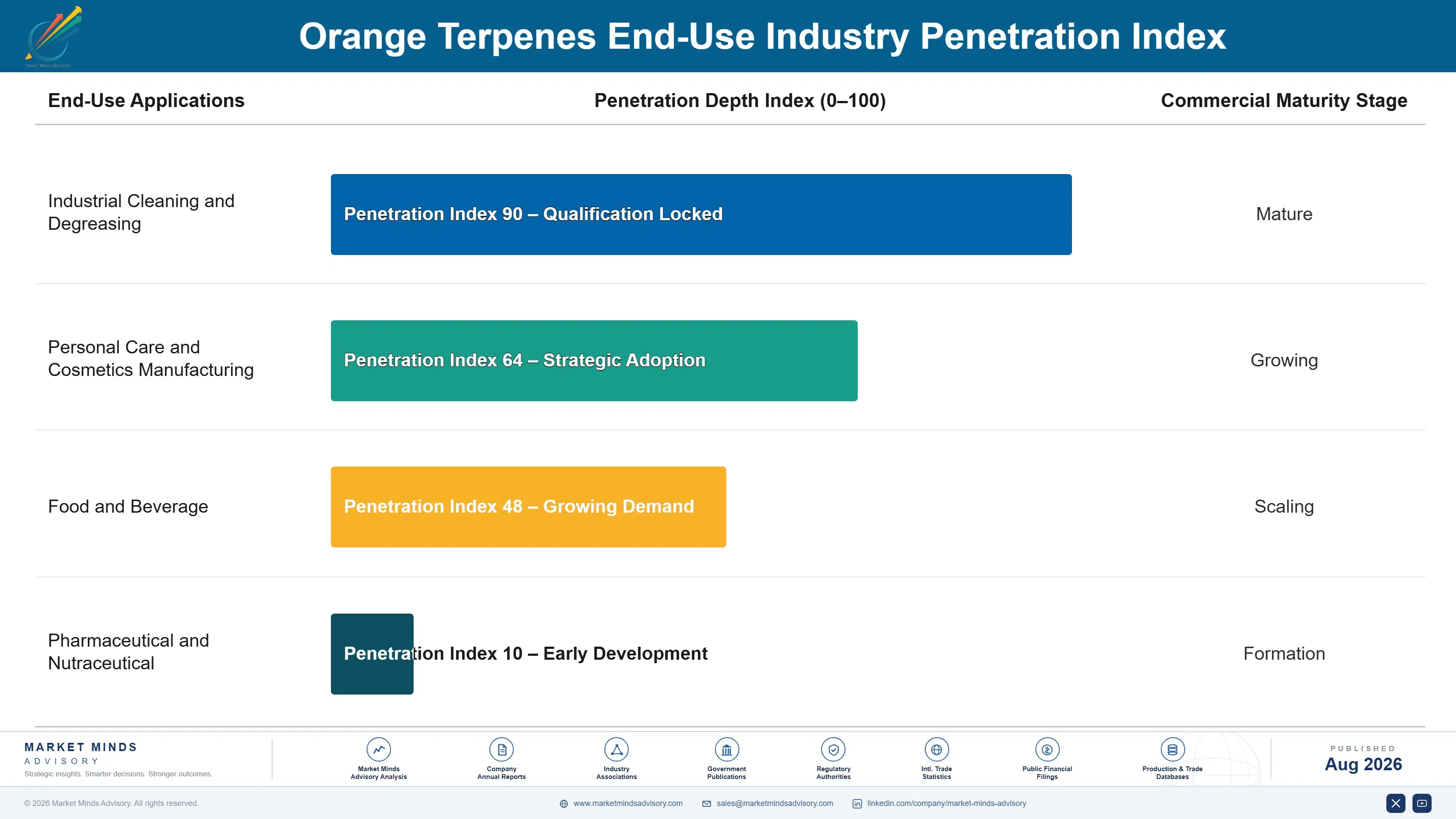
Orange terpene demand behaves like an annuity for processors holding qualified supplier status with major formulators, since customers rarely requalify terpene suppliers once a formulation is validated against specific purity and performance specifications across their product lines. Multi-year supply agreements, once established, tend to persist through a formulator's product lifecycle, giving incumbent processors durable, recurring revenue streams across their qualified customer base.
Stickiness varies meaningfully by end-use vertical: personal care manufacturers rarely switch suppliers mid-product-cycle given the extensive reformulation and safety testing required, while flavor and fragrance customers switch more readily based on price and availability. Green solvent manufacturers sit between these extremes, valuing consistency but willing to test new suppliers when new cleaning product formulations require different purity specifications across their broader product portfolio.

Buyer profiles are shifting generationally as procurement decisions move from purchasing agents focused purely on unit cost toward sustainability officers weighing natural sourcing credentials alongside price. This generational shift favors processors who can speak credibly to feedstock traceability and purification consistency rather than cost alone, reshaping which sales relationships and technical capabilities matter most in winning and retaining large formulator accounts.
orange-terpenes-market-trends-end-use-penetration-index-1787559027491

MMA Verdict on Processor Priorities

These are among the four positions where our research anticipates prominent divergence between winners and laggards over the coming forecast period. Each is grounded in the demand model, the regulatory perimeter, and the announced capacity pipeline.
01 / PURIFICATION INVESTMENT PRIORITY

Invest in High-Purity Distillation Before Formulators Move On

Processors without high-purity distillation capability are losing new green solvent and personal care contracts to competitors who invested early, not in some future qualification cycle several years away from today's reformulation reality. The premium purified processors command, averaging 22 to 30% above standard flavor-grade material, will only widen as green chemistry mandates expand through 2030 and beyond, rewarding early movers substantially. Delaying purification investment past 2027 risks permanent exclusion from the fastest-growing and highest-margin segment of the entire market for years to come.
02 / NATURAL CERTIFICATION PRIORITY

Secure Natural Sourcing Certification Ahead of Retail Deadlines

Processors without natural sourcing certification are ceding premium personal care contracts to competitors who invested in traceability documentation ahead of confirmed retailer sourcing requirements across major consumer brand customers nationwide and increasingly internationally. This capability commands a premium averaging 18 to 25% above uncertified material, rewarding processors who build certification capability ahead of tightening consumer transparency trends across the broader industry. Processors who invest now will capture volume that uncertified competitors cannot economically match going forward into the next decade.
03 / FEEDSTOCK DIVERSIFICATION EXPANSION

Diversify Feedstock Sourcing to Reduce Disease Exposure

Processors dependent on single-region citrus sourcing face growing supply risk as citrus greening disease continues spreading across major growing regions, and processors who invest in diversified feedstock relationships are capturing meaningful pricing premiums while raising supply security for existing customer accounts substantially. This capability gap is currently underexploited by all but the largest processors serving this fragmented and still-consolidating industry landscape today, leaving real margin on the table. Building diversified feedstock relationships now positions processors ahead of competitors exposed to concentrated disease risk.
04 / MEXICAN SOURCING EXPANSION PRIORITY

Expand Feedstock Relationships in Mexico Ahead of Disruption

Mexico represents a meaningful feedstock diversification opportunity as Florida and Brazilian citrus operations face mounting disease pressure, and processors without meaningful Mexican sourcing relationships are ceding supply security advantages to competitors positioned closer to this emerging feedstock base and its steadily growing capacity. Early movers securing feedstock relationships and processing partnerships in Mexico now will hold a durable cost and supply advantage over competitors entering once regional sourcing consolidation is further along. This window will likely close within several years.

Engagement Snapshot From the Field

A live engagement with an industry participant carrying material or product regulatory and market exposure ahead of a defining policy shift, showing how our research translates into a defensible multi-year portfolio strategy.
MARKET MINDS ADVISORY · CLIENT ENGAGEMENT SUMMARY
Orange Terpenes Producer Strategic Portfolio Review and Transition Roadmap 2026·Investment Scenario on Orange Terpenes Exposure Evaluation 2025-26
CLIENT PROFILE
The client is a global cleaning products manufacturer developing a new industrial degreaser line targeting petroleum-free positioning, sourcing high-purity orange terpenes as the primary bio-based solvent for an estimated 15 product formulations. Facing corporate sustainability commitments and retailer sourcing requirements, the manufacturer's procurement team needed an independent assessment of certified terpene suppliers ahead of a major product launch decision.
STRATEGIC CHALLENGE
The manufacturer faced a choice between continuing to source from a single established Brazilian supplier or diversifying across multiple certified processors to reduce supply concentration risk given citrus greening disease affecting major growing regions. Internal sustainability and procurement teams disagreed on timing, and the manufacturer lacked independent data comparing processor capabilities and true multi-year cost and supply reliability impact.
MMA APPROACH
MMA conducted processor capability benchmarking across five high-purity terpene suppliers, modeled three-year cost and supply reliability scenarios under different citrus disease progression assumptions, and interviewed sustainability officers at two comparable cleaning product manufacturers regarding their own sourcing diversification experience. The engagement combined primary survey data with direct processor interviews to produce a supplier diversification framework.
KEY FINDINGS
  1. Diversifying across three certified processors would add an estimated 7% to blended procurement cost initially, expected to narrow within two years (client-reported, unverified by MMA).
  2. Two of five benchmarked processors already held high-purity certification meeting the manufacturer's degreaser formulation specifications, while the other three still required additional testing.
  3. Supply concentration modeling showed a meaningful disruption risk emerging within twelve months if the manufacturer delayed diversification past its product launch timeline.
  4. Sustainability officers at both interviewed comparable manufacturers indicated diversification reduced supply disruption incidents meaningfully during their own product launch periods and cycles.
CLIENT PROFILE
The client is a global cleaning products manufacturer developing a new industrial degreaser line targeting petroleum-free positioning, sourcing high-purity orange terpenes as the primary bio-based solvent for an estimated 15 product formulations. Facing corporate sustainability commitments and retailer sourcing requirements, the manufacturer's procurement team needed an independent assessment of certified terpene suppliers ahead of a major product launch decision.
STRATEGIC CHALLENGE
The manufacturer faced a choice between continuing to source from a single established Brazilian supplier or diversifying across multiple certified processors to reduce supply concentration risk given citrus greening disease affecting major growing regions. Internal sustainability and procurement teams disagreed on timing, and the manufacturer lacked independent data comparing processor capabilities and true multi-year cost and supply reliability impact.
MMA APPROACH
MMA conducted processor capability benchmarking across five high-purity terpene suppliers, modeled three-year cost and supply reliability scenarios under different citrus disease progression assumptions, and interviewed sustainability officers at two comparable cleaning product manufacturers regarding their own sourcing diversification experience. The engagement combined primary survey data with direct processor interviews to produce a supplier diversification framework.
KEY FINDINGS
  1. Diversifying across three certified processors would add an estimated 7% to blended procurement cost initially, expected to narrow within two years (client-reported, unverified by MMA).
  2. Two of five benchmarked processors already held high-purity certification meeting the manufacturer's degreaser formulation specifications, while the other three still required additional testing.
  3. Supply concentration modeling showed a meaningful disruption risk emerging within twelve months if the manufacturer delayed diversification past its product launch timeline.
  4. Sustainability officers at both interviewed comparable manufacturers indicated diversification reduced supply disruption incidents meaningfully during their own product launch periods and cycles.
RECOMMENDED STRATEGY
Phase 1: Phase one: qualify two additional certified processors within six months, prioritizing suppliers with proven Mexican and Florida sourcing capacity nationwide. Phase 2: Phase two: shift 35% of procurement volume to the newly qualified processors within twelve months, reducing overall single-supplier concentration risk. Phase 3: Phase three: renegotiate all processor contracts at eighteen months to capture competitive pricing as diversified sourcing strengthens overall negotiating position.
OUTCOME
The client diversified across three certified processors within ten months, ahead of its original product launch timeline, and reported a lower-than-expected 4% blended cost increase as processor competition intensified across the newly qualified supplier base spanning multiple countries and continents worldwide (client-reported, unverified by MMA).

Frequently Asked Questions

Foundational context covering the market sizes, CAGR, scope, country, region and competition that inform every finding below. This section is provided to cover basics and most often pre-purchase conversations, answered from the MMA Primary Research Dataset.

What is the current size of the Orange Terpenes Market?

The Orange Terpenes Market is valued at $0.68 billion in 2025. This figure reflects global demand across flavor, fragrance, green solvent, personal care, and pharmaceutical applications.

How large will the Orange Terpenes Market be by 2036?

The market is projected to reach $1.4 billion by 2036. Growth is driven primarily by manufacturers steadily replacing petroleum-based solvents with bio-based orange terpene alternatives.

What is the CAGR for the Orange Terpenes Market 2026 to 2036?

The market is forecast to grow at a 6.8% compound annual growth rate between 2026 and 2036. Bull and bear scenarios range from 8.0% to 5.6% depending on citrus harvest conditions.

Which segment is growing fastest?

Green and bio-based solvents are the fastest-growing segment, expanding at a 9.5% CAGR, well above the overall market rate. Petroleum solvent replacement mandates are the primary driver of this growth.

Who are the major companies in the Orange Terpenes Market?

Leading participants include Citrosuco, Cutrale, Florida Chemical Company, Louis Dreyfus Company, and Citrus and Allied Essences. Together these five producers hold approximately 48% of global market share.

Which country is growing fastest?

India is the fastest-growing country market, expanding at a 10.5% CAGR. Expanding personal care and industrial cleaning manufacturing sectors are accelerating natural terpene demand domestically.

Report Segmentation Architecture

The full report scope spans multiple orthogonal segmentation dimensions, with cross-tabulated demand data provided for each dimension pair. Coverage extends further to regional breakdowns, trend trajectories, and the competitive detail needed to support segment-level decision-making.

By Primary Market Dimension

  • Green/Bio-Based Solvents and Cleaning Products
  • Personal Care and Cosmetics
  • Flavor and Fragrance Applications
  • Industrial Degreasers and Cleaners
  • Pharmaceutical/Nutraceutical Applications
  • Agrochemical/Pesticide Adjuvant Applications

By End-Use Industry

  • Industrial Cleaning and Degreasing
  • Personal Care and Cosmetics Manufacturing
  • Food and Beverage
  • Pharmaceutical and Nutraceutical

By Commercial Dimension

  • Direct Formulator Contracts
  • Distributor and Wholesale Channel
  • Certification Consulting Bundled Services

By Region

  • North America
  • Western Europe
  • East Asia
  • South Asia and Pacific
  • Latin America
  • Middle East and Africa
  • Eastern Europe

Scope, Methodology, and Coverage

Every figure in this report is reproducible from documented input assumptions. The scope below maps the historical period, the forecast horizon, the segmentation dimensions, and the countries covered, alongside the underlying primary and qualitative methodology.
Historical Period
2020 to 2025
Forecast Period
2026 to 2036
Base Year
2025 (USD billions; MMA Primary Research Dataset, August 2026)
Market Definition
The Orange Terpenes Market covers d-limonene and related terpene compounds extracted as a byproduct of orange juice processing, used as solvents, fragrance ingredients, and cleaning product components. It excludes synthetic limonene, terpenes derived from other citrus or plant sources, and finished consumer cleaning products themselves.
Quantitative Units
USD billions (current prices); metric tons for volume-referenced segment discussion where applicable
Segmentation Dimensions
By Primary Market Dimension; By End-Use Industry; By Commercial Dimension; By Region
Regions Covered
North America, Western Europe, East Asia, South Asia and Pacific, Latin America, Middle East and Africa, Eastern Europe
Countries Covered
USA, Canada, Mexico, Germany, France, UK, Spain, Italy, China, Japan, South Korea, India, Australia, Thailand, Indonesia, Brazil, Argentina, UAE, Saudi Arabia, South Africa, Egypt, Poland, Hungary, Czech Republic, Romania, and additional markets relevant to this sector
Key Companies Profiled
Citrosuco, Cutrale, Florida Chemical Company, Louis Dreyfus Company, Citrus and Allied Essences, Symrise, Givaudan, dsm-firmenich, Robertet Group, Vigon International, Elan Chemical Company, Sensient Technologies, Kerry Group, Archer Daniels Midland, Treatt PLC, International Flavors & Fragrances, Bell Flavors & Fragrances, Mane SA, Corbion, Wilmar International
Quantitative Methodology
Primary survey, n=3,800 respondents, Q4 2025, six countries; demand-side model with trade association cross-validation
Qualitative Methodology
47 expert interviews, Q4 2025; applied to validate demand model assumptions, identify emerging dynamics, and assess competitive positioning
Report Format
PDF and XLSX data workbook (Word format preview document)
Publisher
Market Minds Advisory
Report Code
MMA-2026-CHM-234
Published
August 2026
Contact
sales@marketmindsadvisory.com | www.marketmindsadvisory.com

Purchase the full Orange Terpenes Market Report (2026 to 2036).

This report provides a comprehensive ten-year forecast of the global Orange Terpenes Market. Coverage spans flavor and fragrance, green solvent, personal care, industrial degreaser, and pharmaceutical applications across all seven world regions. Deliverables include segment-level and regional sizing to 2036, competitive benchmarking of twenty profiled processors on a consistent revenue basis, and feedstock cost exposure analysis. A strategic verdict identifies where processors should concentrate purification and certification investment over the coming decade. The report draws on primary survey data, expert interviews, and company disclosures rather than secondary aggregation.
Ten-year market sizing across seven world regions
Segment-level CAGR and market share benchmarking
Competitive profiling of twenty leading processors
Green solvent and natural certification pathway analysis
Feedstock cost exposure and mitigation strategies
Strategic verdict on capital allocation priorities

Built For The People Who Decide

From boardroom strategy to bench-side execution, this report is read cover-to-cover by leaders shaping the next decade of their industry, turning demand scenarios, market dynamics and valuation benchmarks into decisions.
CXOs/ Presidents/ VPs/ Managers
M&A and Corporate Development
Strategy Teams and R&D Heads
Procurement and Product Directors
Regulatory and Compliance Leaders
Investor Relations and Equity Analysts