Market Minds Advisory
Opioid Use Disorder Treatment Market

Opioid Use Disorder Treatment Market: The Shift Toward Long-Acting Formulations

Growing adoption of long-acting injectable formulations and digital recovery platforms is pulling treatment spend away from daily oral dosing, forcing legacy medication makers to build extended-release capability or cede patient volume to better-equipped competing programs.

Lead Analyst

Alice Ballenger

Published

August 2026

Make Smarter Decisions with Customized Research Insights

Request a free sample report and evaluate market opportunities, growth trends, and competitive dynamics relevant to your business needs.

2025 MARKET VALUE$6.8BMarket Size 2025
2036 FORECAST VALUE$17.2BBase Case , 2026 to 2036
CAGR 2026 TO 20368.8 %Bull 10.0% / Bear 7.6%
INCREMENTAL OPPORTUNITY$9.8BNet 10- year value creation
EXPANSION MULTIPLE2.32x2036 value over 2026 base
Strategic Levers
M&A Pipeline
Regional Outlook
Country Rankings
Competitive Intelligence
Segmental Deep-dive
Call-Us : 91 93563 13602

Executive Snapshot and Market Trajectory

Opioid use disorder treatment demand is shifting from daily oral medication dosing toward long-acting injectable and implant formulations as adherence data mounts, converting a category once defined by daily clinic visits into one increasingly shaped by monthly dosing convenience and reduced diversion risk.
Long-acting injectable and implant formulations are growing fastest, at roughly 13.8% annually, as prescribers adopt monthly buprenorphine injections that eliminate daily dosing burden and reduce diversion risk compared to sublingual formulations that require frequent clinic visits. North America holds the largest single regional share given the opioid epidemic's overwhelming domestic concentration and its position as the largest treatment market globally, while digital therapeutics and recovery support platforms represent the second-fastest segment as telehealth expands access.
Competitive intensity concentrates around formulation differentiation and treatment retention data rather than medication pricing alone, since payers and treatment programs increasingly require documented adherence outcomes before expanding formulary coverage across their patient populations and clinic networks. Established medication makers are expanding injectable and digital platform capability to defend franchise positions, while specialized digital therapeutics developers compete for payer contracts where treatment retention, not medication cost, ultimately determines the winning bid.
Market Definition
The opioid use disorder treatment market covers pharmacological and behavioral therapies used to treat opioid addiction, including medication-assisted treatment drugs such as buprenorphine, methadone, and naltrexone, along with digital therapeutics, telehealth prescribing platforms, and behavioral counseling services. It excludes general pain management medications, harm reduction supplies such as naloxone distribution, and inpatient detoxification services sold independently of ongoing medication-assisted treatment.
Base Year Value
$6.8B in 2025 (MMA Primary Research Dataset, August 2026)
Forecast Period
2026 to 2036, eleven discrete annual values
CAGR
8.8% base case. Bull 10.0%. Bear 7.6%.
Fastest Growth Segment
Long-Acting Injectable and Implant Formulations: 13.8% CAGR
Fastest Growth Country
China: 11.6% CAGR
Fastest Growth Region
South Asia and Pacific: 10.6% CAGR
Largest Region
North America: 32% of 2025 global value
Market Leaders
Indivior plc, Alkermes plc, Braeburn Inc., Camurus AB, Orexo AB. Source: MMA Analysis based on company annual reports and investor filings.
Primary Survey
n=3,800 procurement and R&D decision-makers, Q4 2025, six countries
Methodology
Demand-side build-up, cross-validated against public data, 47 expert interviews

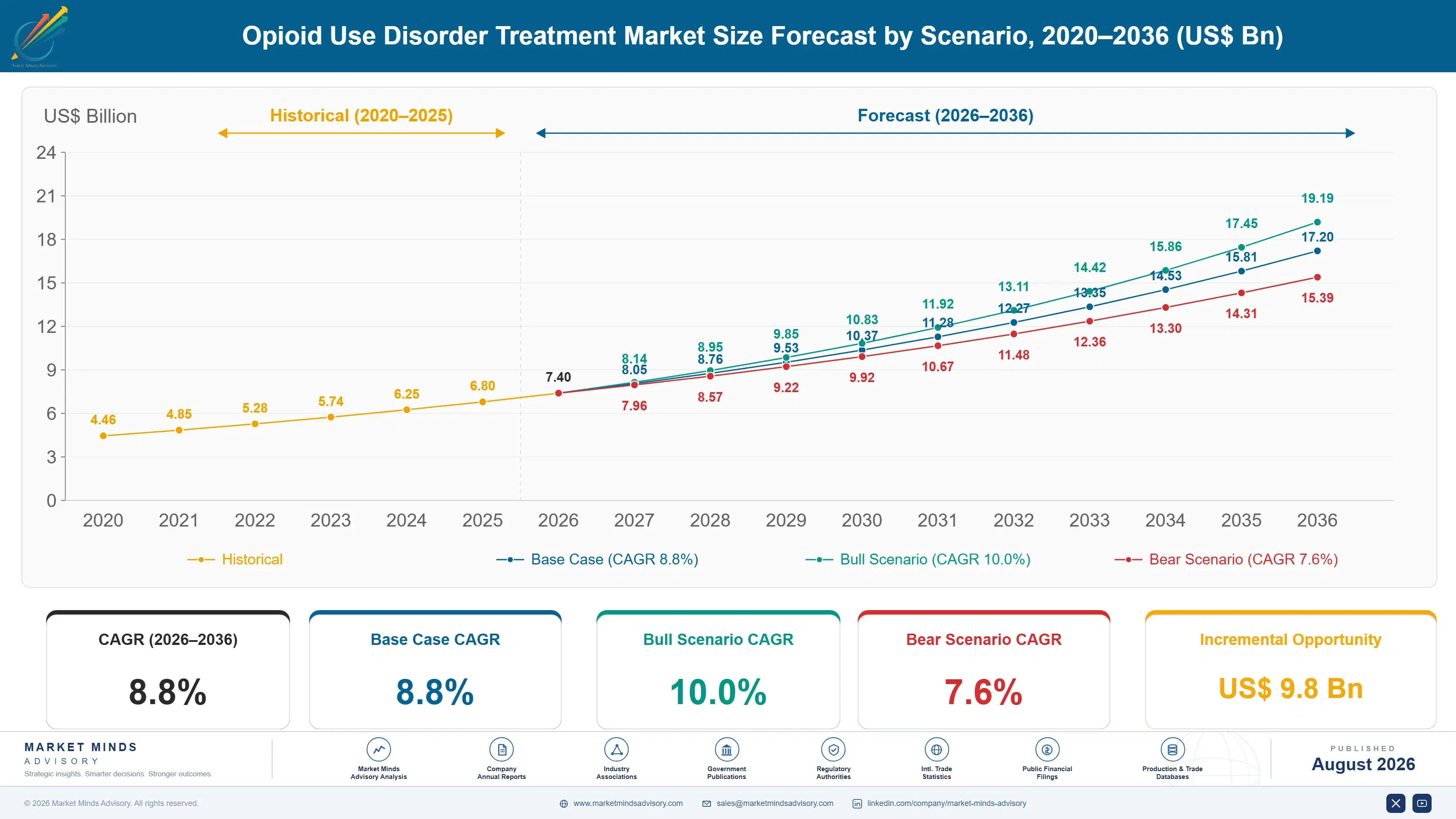
Opioid Use Disorder Treatment Market Forecast Scenarios

opioid-use-disorder-treatment-market-size-forecast-scenario-1787297569060
Opioid use disorder treatment demand accelerated from 2020 as fentanyl-driven overdose deaths surged nationally, prompting expanded federal funding for medication-assisted treatment access and telehealth prescribing flexibility during pandemic-era regulatory changes. Growth continued through 2023 and 2024 as long-acting injectable adoption widened across treatment programs. The market grew at a historical rate of roughly 7.9% annually across the 2020 to 2025 period.
The base case assumes growth driven by three mechanisms: expanding adoption of long-acting injectable formulations that improve treatment retention over daily oral dosing regimens; growing telehealth and digital therapeutics access that extends medication-assisted treatment into underserved rural and suburban markets; and rising insurance coverage mandates requiring parity between substance use disorder and general medical treatment benefits. Replacement demand from ongoing methadone and buprenorphine program enrollment at established treatment centers adds a steady secondary growth layer.
The bull case rests on faster-than-expected telehealth prescribing flexibility extensions pulling forward digital therapeutics adoption across multiple underserved markets simultaneously. The bear case centers on federal funding uncertainty, echoing past public health budget cycles, that would slow treatment program expansion and stretch medication access timelines while established treatment center operating budgets remain comparatively constrained and limited.

Treatment Retention Redefines a Daily-Dosing Category

Opioid use disorder treatment occupies a genuinely life-or-death position in public health, since treatment discontinuation directly correlates with overdose risk and daily dosing burden remains a leading cause of patients dropping out of medication-assisted treatment programs. Daily oral dosing, long the category default, increasingly cannot answer the adherence and diversion questions prescribers need answered, pushing demand toward long-acting injectable and implant formulations that sustain
MARKET CONCENTRATION42% (CR5)Moderately concentrated base spans global pharmaceutical and digital therapeutics vendors
AVERAGE TREATMENT COST$120-$2,100 monthlyPrice spans generic oral tablets to premium long-acting injectables
TOP PRODUCING COUNTRYUSA, 29% shareLargest single treatment population tied to domestic overdose epidemic
STABILIZATION TIMELINE4-8 weeksTypical timeline for stabilizing a patient on injectable therapy
INJECTABLE ADOPTION RATE26%Share of treated patients using long-acting injectable formulations currently
INPUT COST SHARE32% of COGSActive pharmaceutical ingredient and delivery device costs dominate spending
Demand concentrates where opioid overdose mortality and treatment infrastructure investment intersect most directly. North America generates the largest absolute investment given the epidemic's overwhelming domestic concentration and expanding insurance coverage mandates, while East Asia combines rising synthetic opioid concern with rapidly expanding treatment infrastructure investment. Rural and underserved market demand represents a genuinely distinct channel from urban treatment center procurement, often prioritizing telehealth access first.
Over the next decade, treatment retention data and dosing convenience increasingly determine competitive position more than per-dose pricing alone. Suppliers able to demonstrate measurable improvements in patient retention will capture share from daily-dosing incumbents in a market where payers increasingly treat medication formulation selection as a public health outcomes decision central to program funding rather than a routine pharmaceutical purchase.
"Daily dosing sounds simple until you ask a patient to show up to a clinic every single morning for a year. The monthly injectable isn't just a convenience feature, it's the difference between staying in treatment and relapsing."
Director, Addiction Medicine and Behavioral Health Practice · MMA Medication-Ass

Market Trends

Long-Acting Injectables Improve Treatment Retention Rates

Prescribers are increasingly transitioning stable patients from daily sublingual buprenorphine to monthly long-acting injectable formulations, eliminating the daily dosing burden and reducing diversion risk that contributes to treatment discontinuation among opioid use disorder patients navigating early and sustained recovery across outpatient and residential treatment settings. This is pushing treatment programs to build injectable administration capability and stock cold-chain medication inventory rather than relying solely on oral prescription dispensing. Suppliers with proven injectable formulation portfolios are capturing disproportionate share of this fast-growing demand pool relative to competitors offering only oral medication options.
Market Impact: Adds treatment demand worth $420M annually
Telehealth Prescribing Expands Access to Underserved Markets

Digital therapeutics and telehealth medication-assisted treatment platforms are increasingly extending prescriber access into rural and suburban markets that historically lacked sufficient addiction medicine specialists, allowing patients to initiate and maintain buprenorphine treatment through virtual visits combined with local pharmacy dispensing. Each new market reached through telehealth expansion represents a substantial, recurring patient enrollment relationship, since ongoing medication management requires continuous digital platform engagement across a multi-year recovery timeline. Suppliers with proven telehealth platform capability are capturing disproportionate share of this fast-growing demand pool relative to competitors offering only in-person treatment models.
Market Impact: Adds parity-driven demand worth 15%

Market Opportunities and Growth Drivers

Fentanyl-Driven Overdose Mortality Expands Treatment Urgency

The continued prevalence of fentanyl-adulterated illicit opioids is driving elevated overdose mortality rates that expand public health urgency around medication-assisted treatment access, prompting federal and state governments to fund expanded treatment capacity and reduce regulatory barriers to prescribing. Each policy change reducing prescribing barriers typically drives measurable treatment enrollment growth within the following twelve to eighteen months as newly eligible prescribers begin offering medication-assisted treatment services. Suppliers with proven prescriber education and support capability are capturing disproportionate share of this growing demand pool relative to competitors lacking comparable clinical support infrastructure.
Market Impact: Limits access to 35% of patients

Insurance Parity Mandates Expand Coverage for Treatment

Expanding insurance parity mandates requiring substance use disorder treatment coverage comparable to general medical benefits are driving structured, recurring demand for medication-assisted treatment as more patients gain financial access to long-acting injectable and digital therapeutics options previously limited by out-of-pocket cost barriers. Each state adopting stronger parity enforcement represents a substantial, predictable demand relationship, since expanded coverage typically drives sustained treatment enrollment growth rather than one-time utilization spikes. Suppliers with proven payer relationship and reimbursement support capability are capturing disproportionate share of this stable demand pool relative to competitors lacking comparable payer expertise.
Market Impact: Requires daily visits for 60%

Market Restraints and Challenges

Stigma and Prescriber Shortage Limit Treatment Access

Persistent social stigma surrounding opioid use disorder and a genuine shortage of prescribers willing to offer medication-assisted treatment continue limiting patient access even where medication supply and insurance coverage would otherwise support broader treatment availability. The root cause is that addiction medicine training remains a relatively small specialty within medical education, and many primary care physicians report discomfort prescribing controlled substances for addiction treatment despite reduced regulatory barriers in recent years. This creates persistent treatment gaps and geographic access disparities that limit realized medication demand growth. Suppliers are responding by supporting prescriber education programs and expanding nurse practitioner prescribing pathways.
Market Impact: Lifts treatment retention rate to 68%

Diversion Concerns Complicate Take-Home Dosing Policy

Regulatory concerns about medication diversion continue complicating take-home dosing policy for methadone treatment specifically, requiring many patients to attend daily clinic visits for supervised dosing despite genuine convenience and adherence benefits that expanded take-home flexibility could provide for stable patients. The root cause is that historical diversion incidents shaped conservative regulatory frameworks that have been slow to update despite newer evidence supporting expanded take-home eligibility for appropriately screened patients. This constrains treatment retention particularly among patients facing transportation or employment scheduling barriers. Suppliers are responding by supporting regulatory modernization advocacy and developing tamper-resistant formulations.
Market Impact: Adds telehealth treatment demand worth $280M
3 additional market trends, 4 additional growth drivers, and 2 additional restraints and challenges are covered in the full report. Contact sales@marketmindsadvisory.com to access the complete intelligence.

Segment CAGR and Growth Architecture

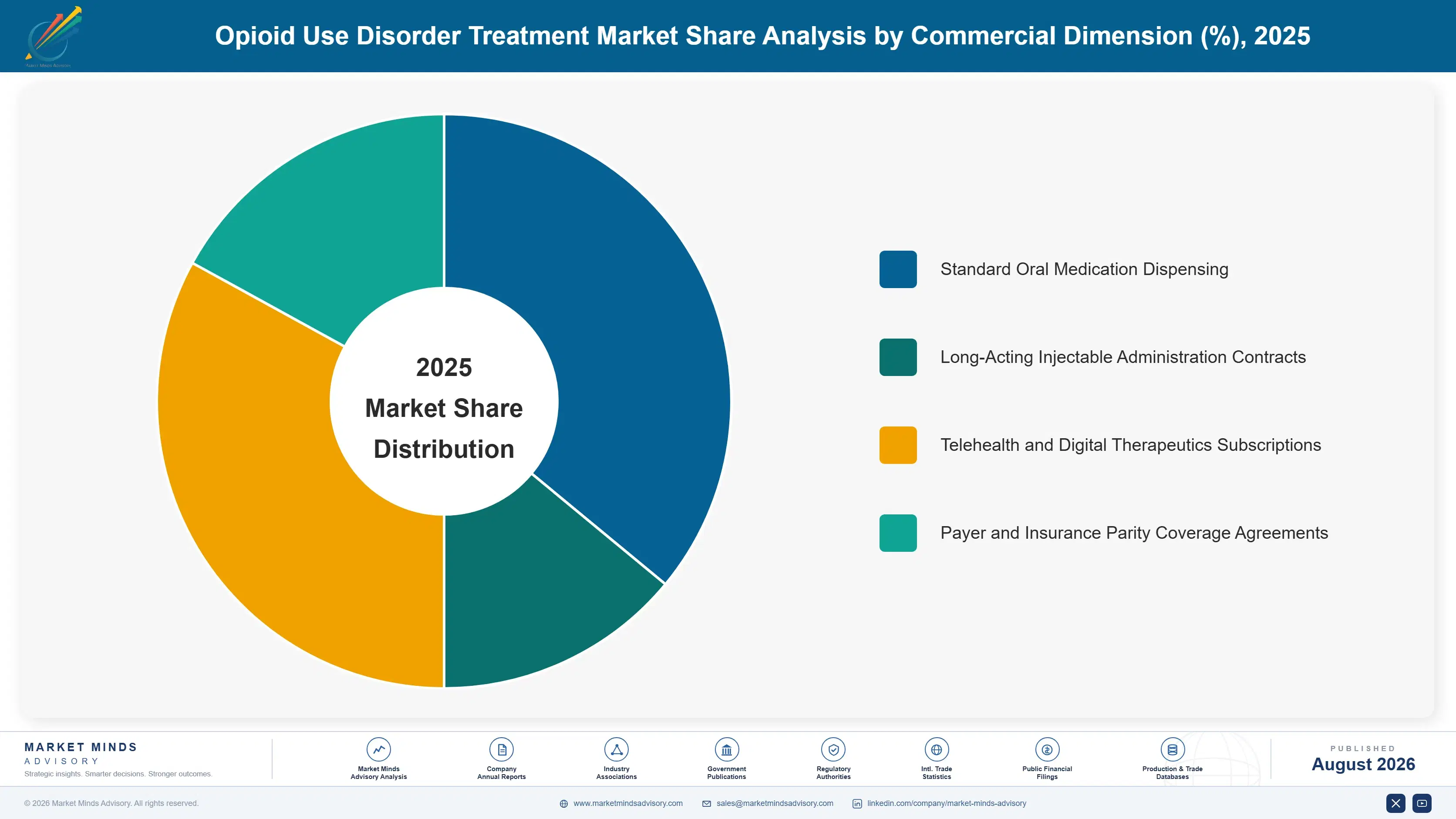
MMA segments the opioid use disorder treatment market by medication and treatment modality type, the classification that most directly determines dosing frequency, clinical setting, and pricing tier for treatment program buyers evaluating formulary investment decisions across buprenorphine, methadone, naltrexone, and digital therapeutics categories across patients and treatment settings nationwide, rather than an end-use split.
opioid-use-disorder-treatment-market-market-share-analysis-1787297569600

Long-Acting Injectable and Implant Formulations

Long-acting injectable and implant formulations are growing fastest, at roughly 13.8% annually, as prescribers adopt monthly buprenorphine injections that eliminate daily dosing burden and reduce diversion risk compared to sublingual formulations that require frequent clinic or pharmacy visits for stable patients. Adoption concentrates among patients transitioning from initial stabilization to maintenance treatment, where dosing convenience directly determines whether long-term treatment retention improves measurably over daily oral regimens. Injectable pricing runs considerably higher than generic oral tablets, reflecting both the delivery technology required and the extensive clinical monitoring most prescribers now provide as standard practice. Suppliers with proven injectable formulation portfolios are capturing disproportionate share of new prescriber adoption as this segment shifts from specialized to increasingly standard treatment.
CAGR 13.8%

Digital Therapeutics and Recovery Support Platforms

Digital therapeutics and recovery support platforms are growing at roughly 12.1% annually, driven by telehealth medication-assisted treatment expansion that extends prescriber access into rural and underserved markets historically lacking sufficient addiction medicine specialists to meet local treatment demand across many communities nationwide. Demand concentrates among health systems and payers navigating provider shortage constraints, particularly programs seeking to expand treatment capacity without proportional increases in physical clinic infrastructure investment. This segment faces genuine regulatory uncertainty given evolving telehealth prescribing rules for controlled substances, sustaining cautious but steadily growing adoption among suppliers with proven regulatory compliance and demonstrated clinical outcomes data across similarly sized health system and payer partnerships nationwide and internationally.
CAGR 12.1%
Full segment breakdown across 6 segments available in the complete report.

Regional Architecture and Country Demand Map

North America holds the largest regional share given the opioid epidemic's overwhelming domestic concentration and its position as the largest treatment market globally, while South Asia and Pacific grows fastest as treatment infrastructure expands rapidly. East Asia contributes substantial demand from rising synthetic opioid concern.

North America

North America's demand is anchored by the United States, where the opioid epidemic's overwhelming domestic concentration and expanding insurance parity mandates sustain the largest medication-assisted treatment market globally across thousands of treatment programs and prescriber practices nationwide. Long-acting injectable adoption is accelerating faster here than in most regions given concentrated federal funding for treatment infrastructure and favorable reimbursement pathways for newer formulations relative to other global markets currently in development. Canada's public health treatment programs contribute steady secondary demand concentrated in similar clinical applications and harm reduction services. Mexico's growing private treatment network adds incremental demand for standard oral categories rather than the most specialized injectable formulations currently concentrated in the United States.
Share: 32% | CAGR: 9.6% (2026 to 2036)

Western Europe

Western Europe's demand centers on Germany, France, and the UK, where established opioid substitution treatment programs and progressive harm reduction policy sustain demand for both standard and advanced medication categories across the region's public health treatment infrastructure and specialized addiction clinics nationwide today. The region grows the slowest of the seven given its treatment infrastructure is already comparatively mature, limiting new demand growth relative to faster-expanding Asian markets currently under active steady development and expansion nationwide. German and French treatment programs maintain deep relationships with medication suppliers across the entire continent. Nordic countries contribute smaller but technically sophisticated demand concentrated in digital therapeutics integration and long-acting formulation adoption and research.
Share: 19% | CAGR: 7.5% (2026 to 2036)
Regional intelligence for 5 additional markets available in the complete report: East Asia, South Asia and Pacific, Latin America, Middle East and Africa, Eastern Europe. Contact sales@marketmindsadvisory.com.
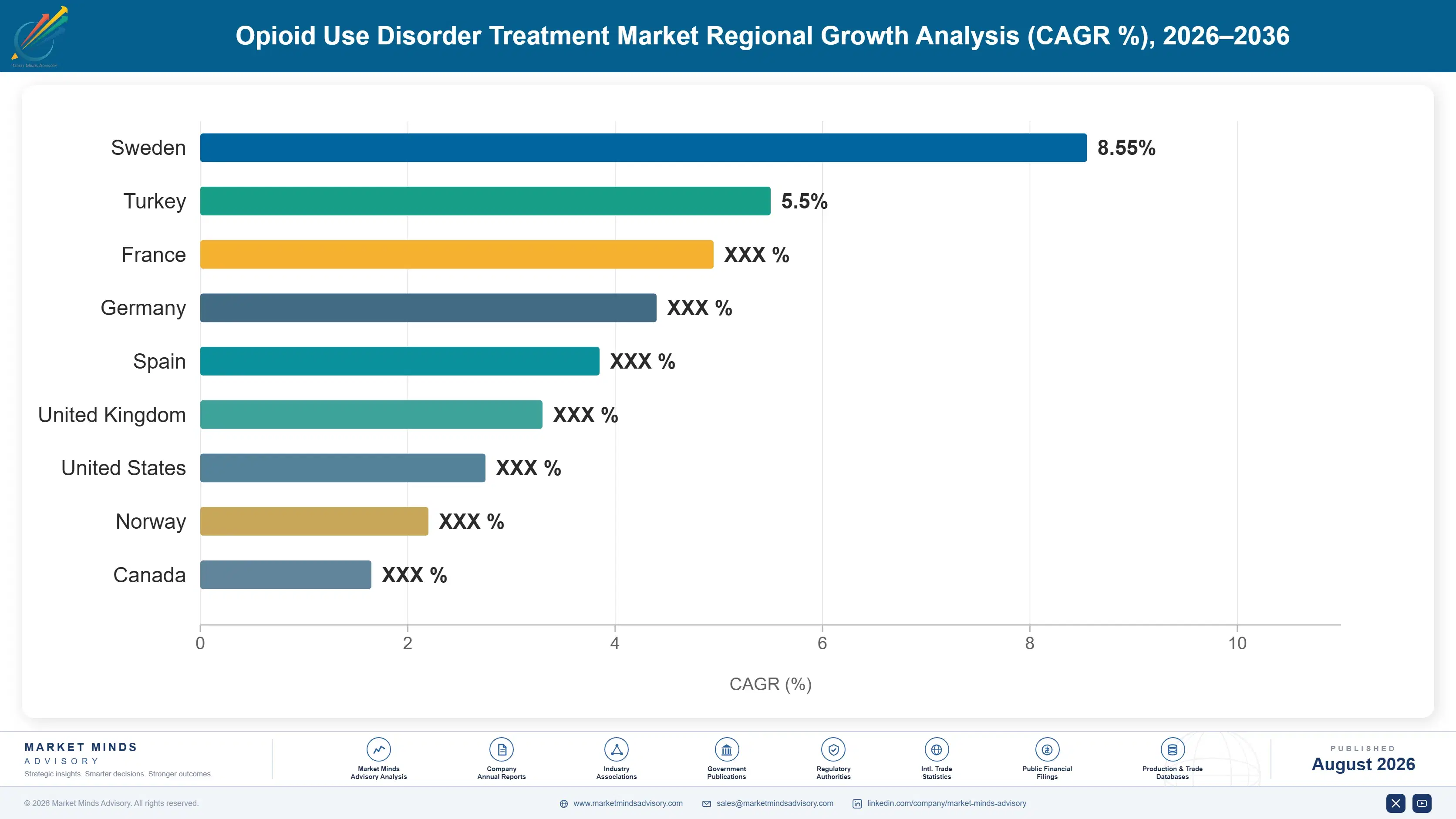
opioid-use-disorder-treatment-market-country-cagr-analysis-1787297570126

Capturing Value Beyond the Oral Medication Sale

Base oral medication pricing faces steady downward pressure from generic manufacturers competing aggressively on commodity buprenorphine and naltrexone categories. Suppliers that build recurring revenue through long-acting injectable formulations, digital therapeutics platforms, and payer partnership contracts capture considerably better lifetime value than those competing purely on unit medication pricing across every major treatment market segment.

Building Long-Acting Injectable Formulation Portfolios Broadly

Suppliers investing in dedicated long-acting injectable and implant formulation development capture disproportionate share of a demand pool worth an estimated 3 to 5 times generic oral tablet pricing, where dosing convenience directly determines whether a treatment program can improve measurable patient retention outcomes across its full enrolled patient population. This formulation development typically requires eighteen to twenty-four months of clinical trial and regulatory approval investment, but suppliers that complete this process successfully capture durable, multi-year prescriber relationships that persist across a patient's full treatment lifecycle and well beyond initial stabilization.
Market Impact: Commands pricing 3 to 5 times oral tablets

Offering Telehealth and Digital Recovery Support Platforms

Suppliers offering dedicated telehealth prescribing and digital recovery support platforms capture meaningful service revenue worth an estimated 20 to 28% above base medication pricing, addressing the genuine prescriber shortage that limits how quickly underserved rural and suburban markets can access medication-assisted treatment services through traditional in-person clinic models alone. This telehealth relationship, difficult for pure medication manufacturers to replicate without comparable clinical technology infrastructure, creates durable customer dependency that extends the commercial relationship well beyond the initial prescription into ongoing recovery support and future treatment adjustments across a patient's care journey.
Market Impact: Adds 20 to 28% above base medication pricing

Expanding India and Southeast Asia Manufacturing Presence

Suppliers building dedicated manufacturing capacity in India and Southeast Asia are capturing disproportionate share of the region's expanding treatment infrastructure demand pool worth an estimated 190 million dollars, positioning closer to fast-growing regional treatment program activity rather than serving the market purely through imports carrying longer lead times and considerably higher landed costs today across most engagements. This regional capacity investment requires meaningful capital commitment but positions suppliers to capture recurring, multi-year medication supply relationships as regional treatment programs scale operations alongside expanding government healthcare investment across many states and countries region-wide.
Market Impact: Captures a growing $190M regional demand segment now

Growing Payer and Insurance Parity Compliance Contracts

Suppliers securing payer contracts tied to expanding insurance parity compliance are capturing disproportionate share of a demand pool worth an estimated 260 million dollars tied to broadening substance use disorder coverage mandates across North America and Western Europe, a segment offering predictable, mandate-backed treatment volume that out-of-pocket private sales rarely provide at comparable scale. This payer relationship requires meaningful reimbursement infrastructure investment but positions suppliers to capture recurring, coverage-anchored medication procurement across a mandate's full multi-year implementation cycle, a relationship considerably more durable than typical cash-pay transactions negotiated purely on price.
Market Impact: Captures a growing $260M parity-driven demand pool now

Who Controls the Margin Pool

The opioid use disorder treatment market is moderately concentrated, with a CR5 of roughly 42%. Indivior and Alkermes lead a group of established medication makers with a meaningful gap over the next tier of specialized formulation developers and digital therapeutics companies competing across multiple treatment modalities and clinical applications simultaneously in the current market environment.
Competitive activity concentrates on three fronts: long-acting injectable formulation development tied to expanding treatment retention demand, digital therapeutics and telehealth platforms that extend prescriber access into underserved markets, and payer partnership contracts tied to expanding insurance parity mandates across multiple states. Established medication makers defend positions through decades of accumulated clinical evidence and prescriber relationships that smaller regional competitors cannot easily replicate quickly or affordably.

Emerging pressure comes from specialized digital therapeutics developers building genuine access advantages that established medication makers are racing to match through partnership rather than organic development. Rankings could shift meaningfully if a specialized developer successfully wins a major payer's enterprise-wide treatment platform contract, demonstrating credible multi-state scale that has historically been the primary advantage of established diversified medication makers with broad formulation coverage and clinical evidence depth.
opioid-use-disorder-treatment-market-company-positioning-matrix-1787297570653

Competitive Moat and Risk Dimensions

INDIVIOR PLC

Moat: Pioneer Long-Acting Injectable Franchise

Indivior's Sublocade franchise carries first-mover clinical evidence and prescriber familiarity as the original monthly buprenorphine injectable, giving it deep treatment program penetration and reimbursement pathway establishment that newer injectable entrants without comparable market history and payer relationships cannot easily replicate across major treatment network accounts quickly.
INDIVIOR PLC

Risk: Exposure to Generic Oral Competition

A meaningful share of Indivior's legacy revenue base remains tied to sublingual film products facing sustained price competition from generic buprenorphine manufacturers, requiring continued mix-shift investment toward premium injectable and digital therapeutics segments to offset this margin pressure over time and across future budget cycles.
ALKERMES PLC

Moat: Diversified Injectable and Implant Portfolio

Alkermes' broader neuroscience portfolio spans both extended-release naltrexone and complementary psychiatric medications, giving it diversified prescriber relationships across addiction medicine and behavioral health specialties that single-indication competitors without comparable portfolio breadth cannot easily replicate across major treatment center and health system accounts nationwide and internationally.
ALKERMES PLC

Risk: Narrower Buprenorphine Franchise Presence

Alkermes' portfolio concentration in naltrexone rather than buprenorphine limits its addressable share of the largest medication category within opioid use disorder treatment, a gap that buprenorphine-focused competitors are exploiting to win prescriber relationships specifically seeking the broader clinical evidence base supporting buprenorphine as first-line treatment therapy.

Players Tracked

Prominent Players

Indivior plc
Alkermes plc
Braeburn Inc.
Camurus AB
Orexo AB

Other Key Players

Titan Pharmaceuticals Inc
US WorldMeds LLC
Hikma Pharmaceuticals plc
Teva Pharmaceutical Industries
Mallinckrodt plc
Amneal Pharmaceuticals Inc
Sun Pharmaceutical Industries
DemeRx Inc
Workit Health Inc
Boulder Care Inc
Ophelia Health Inc
Bicycle Health Inc
Groups Recover Together Inc
Wayspring Inc
Aware Recovery Care Inc

Recent Developments

JANUARY 2025

Indivior Launches Sublocade Dosing Flexibility Update

Indivior launched a new formulation update to its Sublocade injectable platform with expanded dosing flexibility options, aimed at treatment programs seeking to better individualize maintenance therapy for patients transitioning from initial stabilization to long-term recovery across outpatient and residential treatment settings and clinics nationwide and internationally.
Signal: Signals established medication makers are investing heavily in formulation flexibility to defend injectable market leadership positions.
MAY 2025

Alkermes Expands Digital Patient Support Platform

Alkermes expanded its digital patient support platform for extended-release naltrexone patients with new telehealth check-in and adherence tracking capabilities, aimed at treatment programs seeking to improve medication persistence and reduce discontinuation rates among patients navigating early recovery across community-based treatment settings and networks nationwide today.
Signal: Signals medication makers increasingly bundle digital support tools with core pharmaceutical products to improve retention rates.
SEPTEMBER 2025

Ophelia Health Expands Rural Telehealth Prescribing Network

Ophelia Health announced a significant expansion of its telehealth prescribing network into additional rural and underserved states, aimed at extending medication-assisted treatment access to patients lacking local addiction medicine specialists through virtual visits combined with local pharmacy dispensing and coordinated care across expanding partner networks.
Signal: Signals digital therapeutics companies are scaling access to capture fast-growing underserved market demand directly and quickly.

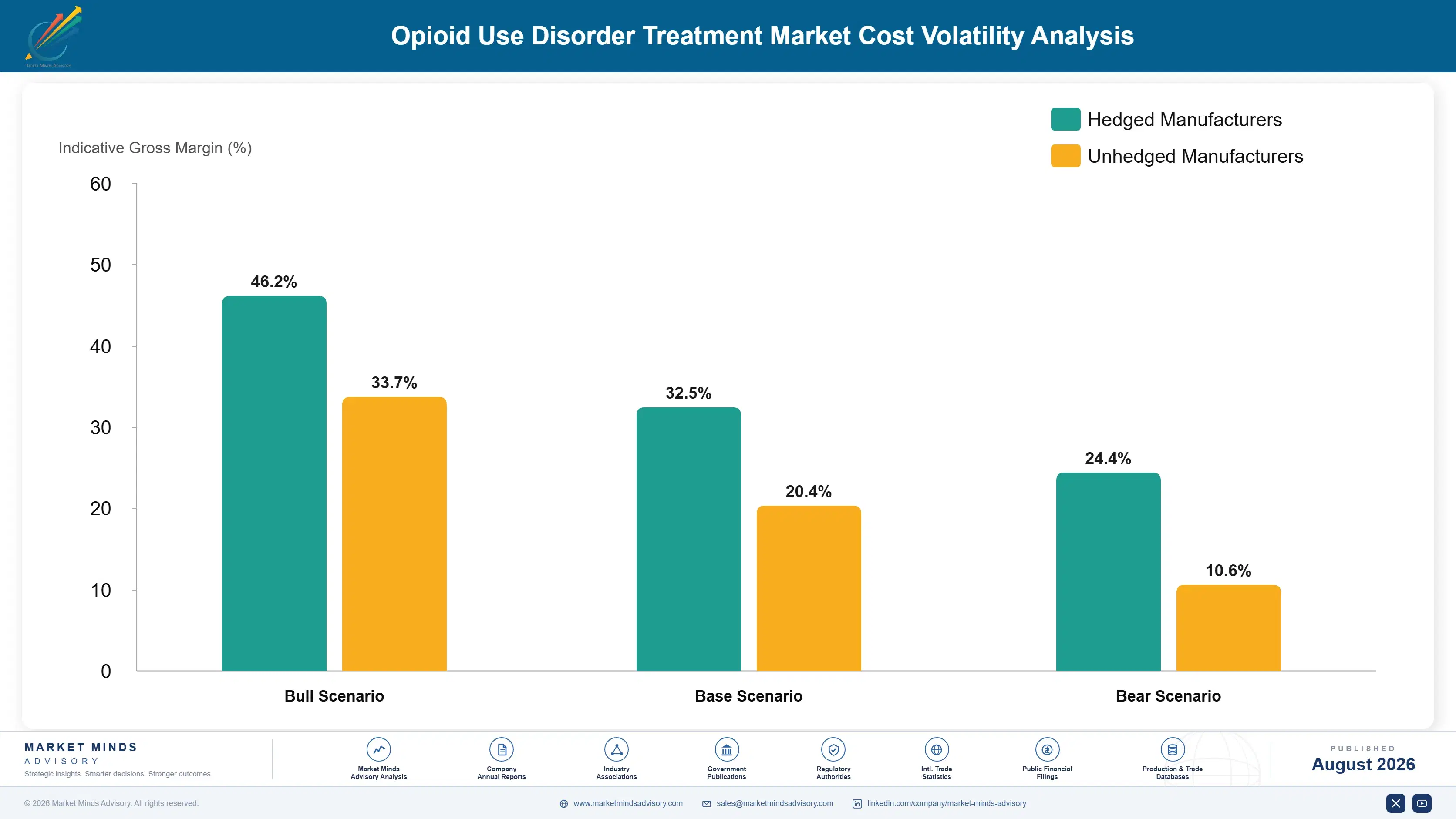
Active Ingredient and Delivery Device Sourcing Risk

Buprenorphine and naltrexone active pharmaceutical ingredients, sourced primarily from specialized controlled-substance manufacturers, account for roughly 28 to 34% of operating cost, given the strict regulatory licensing requirements governing controlled substance production across the pharmaceutical supply chain. Long-acting injectable delivery device and biodegradable polymer matrix components contribute a further 16 to 20% of total operating cost across the device and formulation portfolio.
Global specialty polymer supply for extended-release delivery systems tightened meaningfully during 2022 amid broader pharmaceutical excipient shortages affecting injectable manufacturers industry-wide, pushing component costs up by more than 16% within several months, according to operating cost disclosures in Indivior's 2022 annual report. The disruption prompted several manufacturers to diversify polymer sourcing across multiple regional suppliers and qualify backup material manufacturers to reduce dependency going forward.

Smaller specialty pharmaceutical manufacturers without long-term active ingredient supply agreements face greater cost exposure than larger diversified players like Indivior and Alkermes, who negotiate volume-based contracts directly with controlled-substance manufacturers. Manufacturers dependent on specialized injectable delivery technology face additional exposure to precision manufacturing capacity constraints, a limitation that vertically integrated companies do not share to the same degree industry-wide.
opioid-use-disorder-treatment-market-cost-volatility-analysis-1787297570851

Diversifying Active Ingredient and Polymer Suppliers

Larger manufacturers are increasingly qualifying multiple specialized controlled-substance and polymer material suppliers across different geographic regions to reduce dependence on any single supplier relationship, a meaningful undertaking given the strict regulatory licensing and purity standards controlled-substance medication production requires before formal regulatory approval for use in active, ongoing clinical treatment programs nationwide and internationally.

Building In-House Injectable Manufacturing Capability

Several manufacturers have established dedicated internal injectable formulation and delivery device assembly capability to build direct control over critical production processes, reducing dependence on external specialized manufacturing markets that remain genuinely tight relative to growing industry-wide demand for long-acting formulations across multiple treatment categories, therapeutic areas, and various expanding geographic markets simultaneously and continuously.

Negotiating Volume-Based Active Ingredient Agreements

Larger manufacturers are increasingly negotiating volume-based active pharmaceutical ingredient and polymer material supply agreements directly with specialized suppliers, reducing per-unit cost exposure and building predictable pricing structures that protect margin during periods of broader pharmaceutical excipient price volatility affecting formulation and delivery device costs across the industry more broadly and consistently over multiple fiscal years.

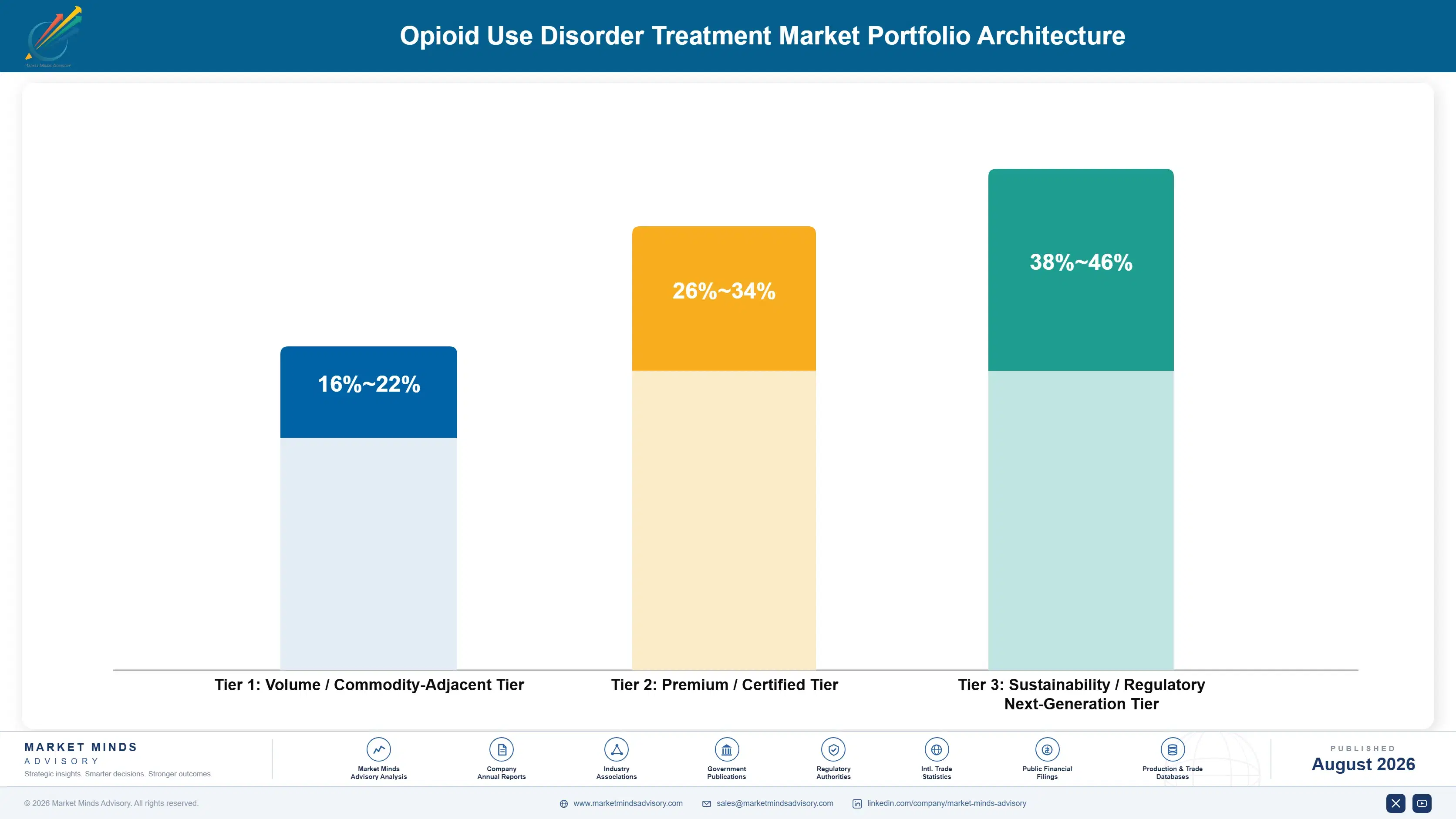
Portfolio Architecture for Margin Defence

The market splits into three tiers running from commodity generic oral medications to premium injectable and digital therapeutics systems bundled with clinical support and payer partnership contracts. Margin concentrates heavily at the top: injectable and digital-bundled systems paired with clinical support earn gross margins 22 to 30 percentage points above commodity oral products, reflecting both formulation development cost and the recurring service revenue layered on top of the initial medic
Volume and premium tiers pull manufacturers in different strategic directions simultaneously across the industry. Generic manufacturers are pushing aggressively into standard oral buprenorphine and naltrexone categories, compressing margin in segments where established branded suppliers historically earned steady returns, forcing incumbents to defend premium injectable and digital therapeutics segments more aggressively through clinical differentiation rather than pricing alone.

High-value margin pools concentrate among manufacturers serving treatment programs through combined medication, digital support, and payer collaboration relationships, since these accounts generate recurring revenue across multiple patient enrollments and expanding coverage categories simultaneously, far exceeding the value of a single prescription transaction and remaining the primary target of every major supplier's account strategy and long-term growth planning today.

Volume / Commodity-Adjacent Tier

Generic oral buprenorphine and naltrexone tablets sold primarily into price-sensitive public health and safety-net treatment markets, competing on price against a fragmented global generic manufacturer base offering comparable products, with thin margins persisting across most transactions.
Gross Margin: 16-22%

Premium / Certified Tier

Branded oral formulations and extended-release naltrexone sold with clinical support into growing private treatment center markets, capturing better margin through demonstrated adherence data, regulatory certification, and treatment outcomes relevance across a broadening range of patient populations.
Gross Margin: 26-34%

Sustainability / Regulatory / Next-Generation Tier

Long-acting injectable formulations and digital therapeutics platforms bundled with clinical support and payer partnership agreements, commanding the highest margin as treatment retention becomes a baseline procurement requirement across expanding insurance parity and value-based care programs worldwide.
Gross Margin: 38-46%
opioid-use-disorder-treatment-market-portfolio-architecture-1787297571356

High-value Sub-segments and Strategic Watch-out

Injectable Formulations With Digital Clinical Support

Bundled injectable formulations and digital clinical support generating recurring revenue through multi-year payer partnership relationships, growing fastest as expanding treatment retention demand makes documented adherence data a contractual condition for formulary coverage across multiple insurance categories, treatment settings, and rapidly expanding parity compliance programs worldwide today.
Gross Margin: 40-46%

Telehealth and Digital Recovery Support Development

Telehealth and digital recovery support platform development for underserved market access, expanding steadily as prescriber shortage pressure accelerates and requires increasingly sophisticated virtual care infrastructure tailored to each region's specific regulatory and reimbursement requirements across multiple states and rapidly expanding rural treatment networks and communities industry-wide.
Gross Margin: 32-38%

Generic Oral Buprenorphine and Naltrexone Medications

The largest unit volume segment, serving public health and safety-net treatment programs globally that need proven generic oral medications without the highest tier's full injectable and digital support cost, forming the steady revenue backbone of most manufacturers' order books across mature and emerging treatment markets alike worldwide.
Gross Margin: 16-22%

Active Ingredient Supply Facing Persistent Constraints

Constrained specialized controlled-substance active ingredient and injectable delivery manufacturing capacity facing sustained demand growth from expanding long-acting formulation development, a segment strategic watchers should track closely as material scarcity intensifies production cost faster than some manufacturers' capacity expansion plans currently anticipate or have adequately prepared for.
Gross Margin: 30-38%

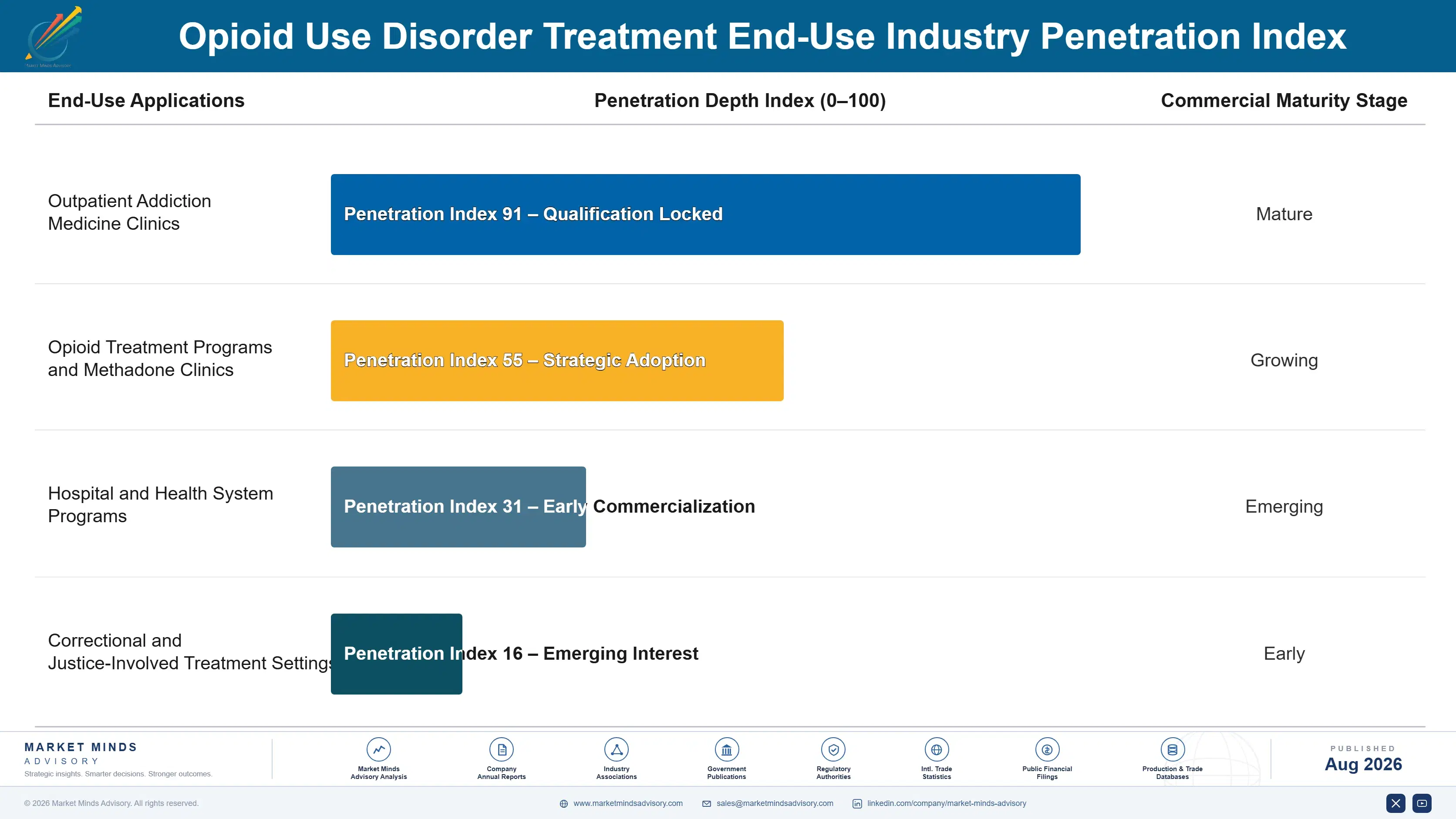
From Medication Sale to Recovery Partnership

Opioid use disorder treatment demand is shifting from a transactional medication sale toward an ongoing recovery partnership as digital support services, payer collaboration, and multi-year treatment contracts increasingly extend a supplier's commercial relationship across a patient's evolving recovery journey rather than a single prescription purchase, particularly among suppliers that have successfully bundled clinical support expertise into their core offering rather than selling standard tab
Adoption depth varies sharply by end-use vertical. Large health systems and specialty treatment centers navigating persistent prescriber shortage constraints engage most deeply with injectable and telehealth partnerships, given the direct clinical outcome and access consequences of treatment modality selection at their patient population scale. Community clinics adopt more transactionally, often prescribing standard oral medications for routine cases rather than committing to the deeper digital relationships that characterize specialty center accounts.

A generational shift in buyer profile is underway as addiction medicine specialists and value-based care administrators, increasingly focused on retention data and long-term recovery outcomes, join traditional formulary purchasing staff in procurement decisions, a change reshaping which supplier capabilities actually win payer and treatment center contracts across institutions of all sizes.
opioid-use-disorder-treatment-market-end-use-penetration-index-1787297571862

Where Medication Makers Should Focus Next

These are among the four positions where our research anticipates prominent divergence between winners and laggards over the coming forecast period. Each is grounded in the demand model, the regulatory perimeter, and the announced capacity pipeline.
01 / INJECTABLE FORMULATION INVESTMENT

Build long-acting formulation capability before adoption outpaces supply

Expanding long-acting injectable adoption across major treatment programs is driving substantial demand for formulation development capability that oral-only medication makers cannot supply without dedicated clinical trial investment, converting this capability from a specialized niche into an increasingly central procurement requirement across payer formularies. Manufacturers still concentrated in oral tablets risk losing prescriber relationships to specialized injectable developers already established in this fast-growing segment. Moving now, ahead of the point where injectable capability becomes table stakes, allows manufacturers to capture premium positioning before competition intensifies meaningfully further across the industry.
02 / TELEHEALTH ACCESS EXPANSION

Build virtual care infrastructure ahead of prescriber shortage growth

Prescriber shortages increasingly limit medication-assisted treatment access in rural and suburban markets that standard in-person clinic models cannot adequately serve, creating genuine differentiation opportunity for suppliers willing to invest in telehealth infrastructure and virtual care compliance across multiple state regulatory frameworks. Suppliers building dedicated digital access capability now are positioned to capture disproportionate share of underserved market demand as prescriber shortage concerns continue rising across the industry. Waiting until telehealth capability becomes a universal baseline expectation risks ceding this differentiation opportunity to competitors already investing in virtual care infrastructure.
03 / ASIAN MANUFACTURING EXPANSION

Build India and Southeast Asia capacity ahead of infrastructure growth

India's treatment infrastructure is scaling rapidly as government healthcare investment and private treatment program expansion create substantial near-term demand for regionally manufactured medications tied to this infrastructure growth across the country's major metropolitan regions and expanding secondary cities. Manufacturers building dedicated regional manufacturing capacity now are positioned to capture disproportionate share as regional demand accelerates over the coming several years. Waiting until regional demand growth peaks to build this capacity risks ceding early-mover advantage to competitors already embedded in ongoing treatment program relationships and government contracts.
04 / PAYER PARTNERSHIP CONTRACTS

Build reimbursement infrastructure ahead of expanding parity mandates

Insurance parity mandates continue expanding across North America and Western Europe as governments respond to overdose mortality pressure with formal substance use disorder coverage requirements, creating substantial predictable, mandate-anchored medication volume that out-of-pocket private sales rarely match at comparable scale or consistency across most private markets. Manufacturers investing in payer relationships and reimbursement infrastructure are positioned to capture disproportionate share of this durable, coverage-backed demand pool. This infrastructure investment requires meaningful upfront cost, but the alternative is continued reliance on less predictable cash-pay sales cycles and volumes.

Engagement Snapshot From the Field

A live engagement with an industry participant carrying material or product regulatory and market exposure ahead of a defining policy shift, showing how our research translates into a defensible multi-year portfolio strategy.
MARKET MINDS ADVISORY · CLIENT ENGAGEMENT SUMMARY
Opioid Use Disorder Treatment Producer Strategic Portfolio Review and Transition Roadmap 2026·Investment Scenario on Opioid Use Disorder Treatment Exposure Evaluation 2025-26
CLIENT PROFILE
The client is a mid-sized regional health system generating roughly $760 million in annual revenue (client-reported, unverified by MMA) operating outpatient addiction medicine clinics across four counties. The system had historically offered only oral medication-assisted treatment and was evaluating whether adding long-acting injectable and telehealth services would improve patient retention and expand access to underserved rural areas.
STRATEGIC CHALLENGE
Management needed to decide whether investing in injectable formulation inventory, cold-chain storage, and telehealth prescribing infrastructure justified the capital and staffing investment required, given genuine uncertainty about achievable patient retention improvement and whether the system could recruit qualified addiction medicine prescribers within a reasonable timeline and available operating budget constraints.
MMA APPROACH
MMA benchmarked three medication and telehealth vendor combinations against the system's historical patient retention and dropout data, modeled projected clinical and financial impact under different service expansion scenarios, and assessed staffing and regulatory requirements against the system's existing outpatient clinic infrastructure and prior digital health adoption experience across its service area.
KEY FINDINGS
  1. Historical dropout data across the system's four clinics showed a projected 20 to 26% retention improvement opportunity through expanded injectable formulation availability.
  2. Total cost of ownership favored the combined injectable and telehealth investment within two years given the system's elevated rural patient dropout rate relative to peers.
  3. Telehealth prescribing regulations in the system's service state supported virtual buprenorphine initiation, removing a significant barrier that had constrained rural market access previously.
  4. Staffing analysis identified one clinic with limited nursing capacity for injectable administration, requiring targeted hiring before full service expansion could safely proceed.
CLIENT PROFILE
The client is a mid-sized regional health system generating roughly $760 million in annual revenue (client-reported, unverified by MMA) operating outpatient addiction medicine clinics across four counties. The system had historically offered only oral medication-assisted treatment and was evaluating whether adding long-acting injectable and telehealth services would improve patient retention and expand access to underserved rural areas.
STRATEGIC CHALLENGE
Management needed to decide whether investing in injectable formulation inventory, cold-chain storage, and telehealth prescribing infrastructure justified the capital and staffing investment required, given genuine uncertainty about achievable patient retention improvement and whether the system could recruit qualified addiction medicine prescribers within a reasonable timeline and available operating budget constraints.
MMA APPROACH
MMA benchmarked three medication and telehealth vendor combinations against the system's historical patient retention and dropout data, modeled projected clinical and financial impact under different service expansion scenarios, and assessed staffing and regulatory requirements against the system's existing outpatient clinic infrastructure and prior digital health adoption experience across its service area.
KEY FINDINGS
  1. Historical dropout data across the system's four clinics showed a projected 20 to 26% retention improvement opportunity through expanded injectable formulation availability.
  2. Total cost of ownership favored the combined injectable and telehealth investment within two years given the system's elevated rural patient dropout rate relative to peers.
  3. Telehealth prescribing regulations in the system's service state supported virtual buprenorphine initiation, removing a significant barrier that had constrained rural market access previously.
  4. Staffing analysis identified one clinic with limited nursing capacity for injectable administration, requiring targeted hiring before full service expansion could safely proceed.
RECOMMENDED STRATEGY
Phase 1: Phase 1 (Months 1 to 3): Establish injectable formulation supply agreements and hire additional nursing staff at the constrained clinic. Phase 2: Phase 2 (Months 4 to 8): Launch telehealth prescribing across all four clinics while training staff on injectable administration protocols. Phase 3: Phase 3 (Months 9 to 14): Expand rural outreach through telehealth partnerships and evaluate retention outcomes against baseline dropout rates.
OUTCOME
The health system improved patient retention by approximately 21% within fourteen months of full service expansion across all four clinics (client-reported, unverified by MMA). Rural patient enrollment grew significantly following telehealth launch, and the system began evaluating expansion into two additional neighboring counties within its broader service region.

Frequently Asked Questions

Foundational context covering the market sizes, CAGR, scope, country, region and competition that inform every finding below. This section is provided to cover basics and most often pre-purchase conversations, answered from the MMA Primary Research Dataset.

What is the current size of the Opioid Use Disorder Treatment Market?

The global opioid use disorder treatment market was valued at approximately $6.8 billion in 2025. Growth is being driven by long-acting injectable adoption and telehealth expansion.

How large will the Opioid Use Disorder Treatment Market be by 2036?

The market is projected to reach approximately $17.20 billion by 2036, up from $7.40 billion in 2026. This represents more than double the value over the ten-year forecast window.

What is the CAGR for the Opioid Use Disorder Treatment Market 2026 to 2036?

The market is forecast to grow at a CAGR of 8.8% between 2026 and 2036. Bull and bear scenarios range from roughly 7.6% to 10.0%.

Which segment is growing fastest?

Long-acting injectable and implant formulations are the fastest-growing segment, expanding at approximately 13.8% annually. This is roughly 1.57 times the overall market's growth rate of 8.8%.

Who are the major companies in the Opioid Use Disorder Treatment Market?

Leading medication makers in this treatment space include Indivior, Alkermes, Braeburn, Camurus, and Orexo. Together these five companies hold roughly 42% of global market share.

Which country is growing fastest?

The United States remains the largest treatment market, while regional East Asian markets show the fastest percentage growth as synthetic opioid concern expands treatment infrastructure investment there.

Report Segmentation Architecture

The full report scope spans multiple orthogonal segmentation dimensions, with cross-tabulated demand data provided for each dimension pair. Coverage extends further to regional breakdowns, trend trajectories, and the competitive detail needed to support segment-level decision-making.

By Medication and Treatment Modality Type

  • Buprenorphine-Based Medications
  • Methadone Treatment Programs
  • Naltrexone-Based Medications
  • Long-Acting Injectable and Implant Formulations
  • Digital Therapeutics and Recovery Support Platforms
  • Behavioral Counseling and Psychosocial Support Services

By End-Use Industry

  • Outpatient Addiction Medicine Clinics
  • Opioid Treatment Programs and Methadone Clinics
  • Hospital and Health System Programs
  • Correctional and Justice-Involved Treatment Settings

By Commercial Dimension

  • Standard Oral Medication Dispensing
  • Long-Acting Injectable Administration Contracts
  • Telehealth and Digital Therapeutics Subscriptions
  • Payer and Insurance Parity Coverage Agreements

By Region

  • North America
  • Western Europe
  • East Asia
  • South Asia and Pacific
  • Latin America
  • Middle East and Africa
  • Eastern Europe

Scope, Methodology, and Coverage

Every figure in this report is reproducible from documented input assumptions. The scope below maps the historical period, the forecast horizon, the segmentation dimensions, and the countries covered, alongside the underlying primary and qualitative methodology.
Historical Period
2020 to 2025
Forecast Period
2026 to 2036
Base Year
2025 (USD billions; MMA Primary Research Dataset, August 2026)
Market Definition
The opioid use disorder treatment market covers pharmacological and behavioral therapies used to treat opioid addiction, including medication-assisted treatment drugs such as buprenorphine, methadone, and naltrexone, along with digital therapeutics, telehealth prescribing platforms, and behavioral counseling services. It excludes general pain management medications, harm reduction supplies such as naloxone distribution, and inpatient detoxification services sold independently of ongoing medication-assisted treatment.
Quantitative Units
USD billions (current prices); treated patient population where disclosed
Segmentation Dimensions
By Medication and Treatment Modality Type; By End-Use Industry; By Commercial Dimension; By Region
Regions Covered
North America, Western Europe, East Asia, South Asia and Pacific, Latin America, Middle East and Africa, Eastern Europe
Countries Covered
USA, Canada, Mexico, Germany, France, UK, China, Japan, South Korea, India, Australia, Brazil, Indonesia, Vietnam, Thailand, Malaysia, UAE, Saudi Arabia, South Africa, Nigeria, Turkey, Poland, Netherlands, Italy, Spain, Sweden, Switzerland, Argentina, Colombia, Singapore, and additional markets relevant to this sector
Key Companies Profiled
Indivior plc, Alkermes plc, Braeburn Inc., Camurus AB, Orexo AB, Titan Pharmaceuticals Inc, US WorldMeds LLC, Hikma Pharmaceuticals plc, Teva Pharmaceutical Industries, Mallinckrodt plc, Amneal Pharmaceuticals Inc, Sun Pharmaceutical Industries, DemeRx Inc, Workit Health Inc, Boulder Care Inc, Ophelia Health Inc, Bicycle Health Inc, Groups Recover Together Inc, Wayspring Inc, Aware Recovery Care Inc
Quantitative Methodology
Primary survey, n=3,800 respondents, Q4 2025, six countries; demand-side model with trade association cross-validation
Qualitative Methodology
47 expert interviews, Q4 2025; applied to validate demand model assumptions, identify emerging dynamics, and assess competitive positioning
Report Format
PDF and XLSX data workbook (Word format preview document)
Publisher
Market Minds Advisory
Report Code
MMA-2026-HLT-329
Published
August 2026
Contact
sales@marketmindsadvisory.com | www.marketmindsadvisory.com

Purchase the full Opioid Use Disorder Treatment Market Report (2026 to 2036).

The full report provides a comprehensive assessment of the global opioid use disorder treatment market, including detailed segmentation by medication and treatment modality type, end-use industry, and commercial dimension across all seven world regions. It profiles twenty leading and emerging medication makers and digital therapeutics companies, benchmarking injectable formulation capability, telehealth access depth, and regional manufacturing presence. The analysis includes ten-year forecasts through 2036 under base, bull, and bear scenarios, alongside primary research findings drawn from MMA's survey of 3,800 respondents and 47 expert interviews conducted in the fourth quarter of 2025. A dedicated input cost section examines active ingredient and delivery device exposure across major medication markets.
Detailed segment-level ten-year forecasts through 2036
Profiles of twenty leading and emerging medication makers
Regional analysis spanning all seven world regions
Input cost and supply chain risk assessment
Competitive benchmarking on moats and vulnerabilities
Primary survey and expert interview data appendix

Built For The People Who Decide

From boardroom strategy to bench-side execution, this report is read cover-to-cover by leaders shaping the next decade of their industry, turning demand scenarios, market dynamics and valuation benchmarks into decisions.
CXOs/ Presidents/ VPs/ Managers
M&A and Corporate Development
Strategy Teams and R&D Heads
Procurement and Product Directors
Regulatory and Compliance Leaders
Investor Relations and Equity Analysts