Market Minds Advisory
Opioid Substitution Therapy Market

Opioid Substitution Therapy Market: Buprenorphine, Methadone, and Long-Acting Injectable Formulations

Long-acting injectable buprenorphine is displacing daily sublingual dosing as the preferred maintenance therapy at addiction treatment centres, forcing prescribers and payers to rethink adherence economics while telehealth-supported access expands treatment capacity nationwide.

Lead Analyst

Alice Ballenger

Published

September 2026

Make Smarter Decisions with Customized Research Insights

Request a free sample report and evaluate market opportunities, growth trends, and competitive dynamics relevant to your business needs.

2025 MARKET VALUE$5.4BMarket Size 2025
2036 FORECAST VALUE$11.6BBase Case , 2026 to 2036
CAGR 2026 TO 20367.2 %Bull 8.4% / Bear 5.9%
INCREMENTAL OPPORTUNITY$5.8BNet 10- year value creation
EXPANSION MULTIPLE2.00x2036 value over 2026 base
Strategic Levers
M&A Pipeline
Regional Outlook
Country Rankings
Competitive Intelligence
Segmental Deep-dive
Call-Us : 91 93563 13602

Executive Snapshot and Market Trajectory

Long-acting injectable buprenorphine is displacing daily sublingual dosing as the preferred maintenance therapy at addiction treatment centres, compressing adherence risk for patients who previously struggled with daily dosing schedules across major treatment networks nationwide. Addiction medicine prescribers describe this as the biggest treatment access shift the category has seen in.
Expanding telehealth-supported prescribing, rising opioid use disorder diagnosis rates, and broadening insurance coverage for medication-assisted treatment are concentrating demand in North America, where the opioid crisis burden and treatment infrastructure maturity sustain the highest per-patient treatment spend of any region tracked in this study by a considerable margin. Canada's aggressive treatment expansion in response to its fentanyl crisis reinforces this concentration well beyond population size alone across nearly every reimbursement pathway studied in this report.
A moderately concentrated group of originator pharmaceutical companies controls most branded revenue, while generic manufacturers compete on price for sublingual formulations, even as long-acting injectable technology reshapes which companies lead addiction medicine specialist relationships at major clinical conferences worldwide. Smaller specialty companies without meaningful correctional health partnerships increasingly struggle to secure large institutional accounts at scale across most major clinical conferences and treatment networks tracked.
Market Definition
This market covers pharmacological therapies used in medication-assisted treatment for opioid use disorder, including buprenorphine, methadone, and naltrexone formulations across sublingual, oral, and long-acting injectable delivery routes. It excludes acute opioid overdose reversal agents and general pain management opioid therapies unrelated to substitution treatment.
Base Year Value
$5.4B in 2025 (MMA Primary Research Dataset, August 2026)
Forecast Period
2026 to 2036, eleven discrete annual values
CAGR
7.2% base case. Bull 8.4%. Bear 5.9%.
Fastest Growth Segment
Long-Acting Injectable Buprenorphine: 13.5% CAGR
Fastest Growth Country
Canada: 11.5% CAGR
Fastest Growth Region
South Asia and Pacific: 9.2% CAGR
Largest Region
North America: 38% of 2025 global value
Market Leaders
Indivior PLC, Alkermes plc, Camurus AB, Braeburn Inc., Hikma Pharmaceuticals PLC. Source: MMA Analysis based on company annual reports.
Primary Survey
n=3,800 procurement and R&D decision-makers, Q4 2025, six countries
Methodology
Demand-side build-up, cross-validated against public data, 47 expert interviews

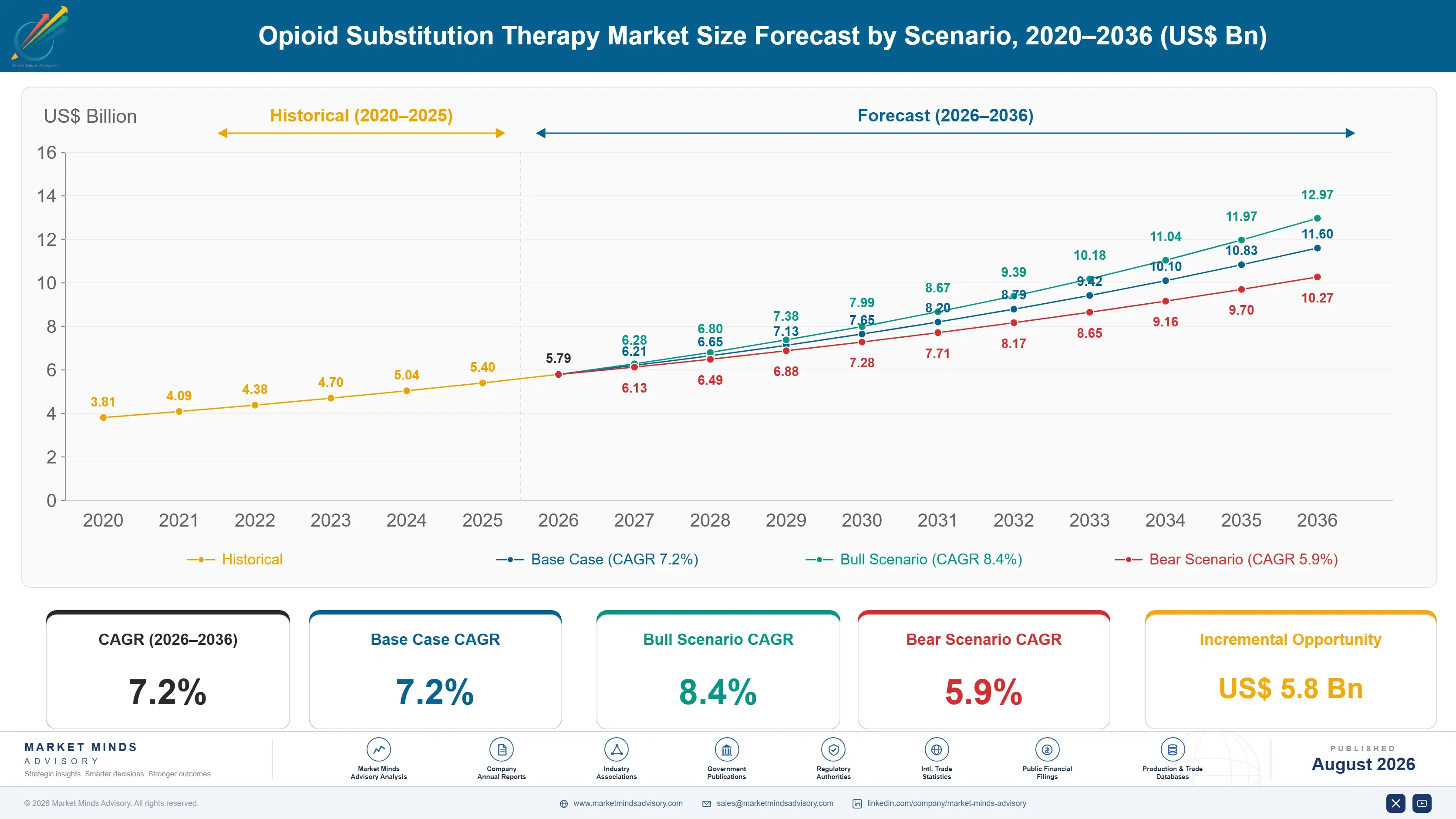
Opioid Substitution Therapy Market Forecast Scenarios

opioid-substitution-therapy-market-size-forecast-scenario-1787305884342
Opioid substitution therapy spending grew at roughly 6.4% annually between 2020 and 2025, as expanding telehealth prescribing flexibility and rising diagnosed opioid use disorder prevalence brought more patients into medication-assisted treatment across major developed healthcare markets tracked closely by industry observers throughout the period. Growth accelerated further toward the end of the historical window as telehealth prescribing flexibility broadened considerably.
The base case assumes continued long-acting injectable adoption, expanding telehealth-supported prescribing access, and steady insurance coverage broadening for medication-assisted treatment, sustaining a 7.2% blended annual growth rate through 2036 across most major treatment markets worldwide tracked closely in this study. Continued correctional health partnership expansion and outcomes-based contracting further reinforce this trajectory across most major reimbursement markets reviewed by MMA analysts nationwide today overall across the industry currently across the board.
A bull scenario assumes accelerated telehealth prescribing reform pulls treatment access into underserved rural and suburban areas faster than expected. The bear case centers on reimbursement tightening and stigma-driven treatment gaps that slow diagnosed patient conversion into active medication-assisted treatment across cost-constrained public health systems. Either scenario would meaningfully reshape which companies lead addiction medicine specialist relationships by the end of the forecast period.

Long-Acting Formulations Redraw Adherence Economics

Opioid substitution therapy sits at the convergence of public health crisis response, addiction medicine specialty growth, and a genuinely fast-moving delivery technology shift that has repositioned long-acting injectable formulations from a niche option into a mainstream maintenance therapy choice. Physicians increasingly weigh adherence advantages as heavily as raw pharmacological efficacy when selecting formulations. This dynamic increasingly rewards companies with genuinely differentiated fo
MARKET CONCENTRATIONCR5 64%share held by the five largest originator companies combined
AVERAGE ANNUAL TREATMENT COST$6,800per patient across current medication-assisted treatment regimens typically
LEADING COUNTRY SHAREUnited States 39%of global branded treatment spend concentrated domestically today
TREATMENT PENETRATION RATE48%of diagnosed opioid use disorder patients currently receiving active treatment
LONG-ACTING INJECTABLE UPTAKE31%of treated patients receiving long-acting injectable formulations currently
TELEHEALTH PRESCRIBING SHARE26%of new treatment initiations occurring through telehealth consultation channels
Commercially, this market splits between branded long-acting injectable and sublingual film formulations commanding premium pricing, and generic sublingual tablets and methadone used in cost-constrained public treatment programmes, a divide that determines which manufacturers capture margin as treatment volume expands. This divide increasingly determines which manufacturers can fund the clinical research the category requires. Few other specialty pharmaceutical categories combine this stark volume-premium divide so directly across accounts.
Over the next decade, expanding telehealth prescribing access, broadening insurance coverage, and growing long-acting injectable adoption will keep pulling treatment protocols toward higher-adherence, lower-diversion-risk formulations across most major healthcare systems tracked closely in this study by industry analysts. Manufacturers slow to adapt risk ceding specialist mindshare to faster-moving competitors across the category. Regulatory reform around prescribing access will remain a key factor shaping this trajectory.
"A once-monthly shot beats a daily pill for one simple reason: it removes the daily decision to relapse. That single fact is reshaping how addiction medicine prescribers think about first-line therapy."
Director, Addiction Medicine and Specialty Pharmaceuticals Practice · MMA Pharma

Market Trends

Long-Acting Injectable Formulations Gain Guideline Endorsement

Major addiction medicine treatment guidelines increasingly endorse long-acting injectable buprenorphine as a preferred option for patients with adherence challenges or diversion risk concerns, directly accelerating clinic formulary conversion at addiction treatment centres and correctional health systems nationwide. Treatment centres report long-acting injectable adoption reaching roughly 31% of treated patients in leading markets, a substantial increase from a low single-digit share just five years ago when these formulations first reached commercial availability. This adoption pace is prompting state Medicaid programmes and correctional health systems to expand coverage and formulary access for these formulations specifically.
Market Impact: Affects 2.7 million diagnosed patie
Telehealth Prescribing Flexibility Expands Treatment Access

Regulatory flexibility allowing telehealth-based buprenorphine prescribing without an initial in-person visit, extended following pandemic-era policy changes, continues expanding treatment access to rural and underserved populations that previously lacked nearby addiction medicine specialist availability. Telehealth platforms report treatment initiation volume through virtual consultation has grown by roughly 52% since 2022, reflecting both continued regulatory flexibility and growing patient comfort with virtual addiction medicine care delivery models. This trend is pulling more primary care physicians into prescribing medication-assisted treatment through telehealth-supported clinical support programmes. Manufacturers view this trend as essential to sustaining long-term treatment access growth broadly.
Market Impact: Expands coverage for 4 million pati

Market Opportunities and Growth Drivers

Rising Diagnosed Opioid Use Disorder Prevalence

Opioid use disorder diagnosis rates continue rising across most developed healthcare markets, driven by the ongoing synthetic opioid crisis and improving diagnostic screening protocols at primary care and emergency department settings, directly expanding the addressable medication-assisted treatment population year over year across major markets tracked in this study. National health surveillance data indicates diagnosed prevalence has grown steadily even as overdose mortality trends have shown some recent improvement, reflecting both genuine incidence growth and improved case identification through expanded screening programmes. This driver alone sustains steady baseline treatment demand growth even without accounting for long-acting formulation or telehealth adoption effects.
Market Impact: Cuts access by 30 percent

Expanding Insurance Coverage for Medication-Assisted Treatment

Broadening private and public insurance coverage requirements for medication-assisted treatment, including parity legislation requiring coverage comparable to other chronic disease treatment, continue lowering the financial barrier that previously limited treatment access for many diagnosed patients across major healthcare markets. Government mandates requiring insurers to cover medication-assisted treatment without restrictive prior authorization requirements have expanded coverage access considerably over the past several years across most major commercial and public insurance markets. This driver is expected to sustain above-average treatment initiation growth among previously underinsured populations for years to come. Manufacturers view continued coverage expansion as essential to sustaining long-term treatment volume.
Market Impact: Rural counties lack 60 percent acce

Market Restraints and Challenges

Persistent Treatment Stigma Limits Care-Seeking Behavior

Despite substantial public health awareness campaigns, meaningful stigma around opioid use disorder and medication-assisted treatment continues discouraging some diagnosed patients from seeking or continuing treatment, fundamentally limiting the addressable treated population regardless of formulation innovation or expanded access infrastructure availability. The root cause is decades of public perception treating addiction as a moral failing rather than a chronic medical condition, a perception that persists despite substantial clinical evidence supporting medication-assisted treatment as effective evidence-based care. This stigma disproportionately affects treatment-seeking in smaller communities and certain demographic groups where addiction carries particularly strong social consequences.
Market Impact: Adds 31 percent long-acting injecta

Prescriber Training and Certification Requirements Constrain Supply

Despite recent regulatory simplification, meaningful gaps remain in the number of physicians trained and willing to prescribe medication-assisted treatment, particularly in rural and underserved areas where addiction medicine specialists remain scarce relative to diagnosed patient population size across most affected communities. The underlying cause is that many primary care physicians received limited addiction medicine training during medical school and residency, leaving them uncomfortable managing complex substance use disorder patients even after regulatory prescribing barriers have been reduced considerably. This constraint disproportionately limits access in geographic areas with the highest diagnosed prevalence but fewest addiction medicine specialists available locally.
Market Impact: Grows telehealth treatment volume 5
3 additional market trends, 3 additional growth drivers, and 4 additional restraints and challenges are covered in the full report. Contact sales@marketmindsadvisory.com to access the complete intelligence.

Segment CAGR and Growth Architecture

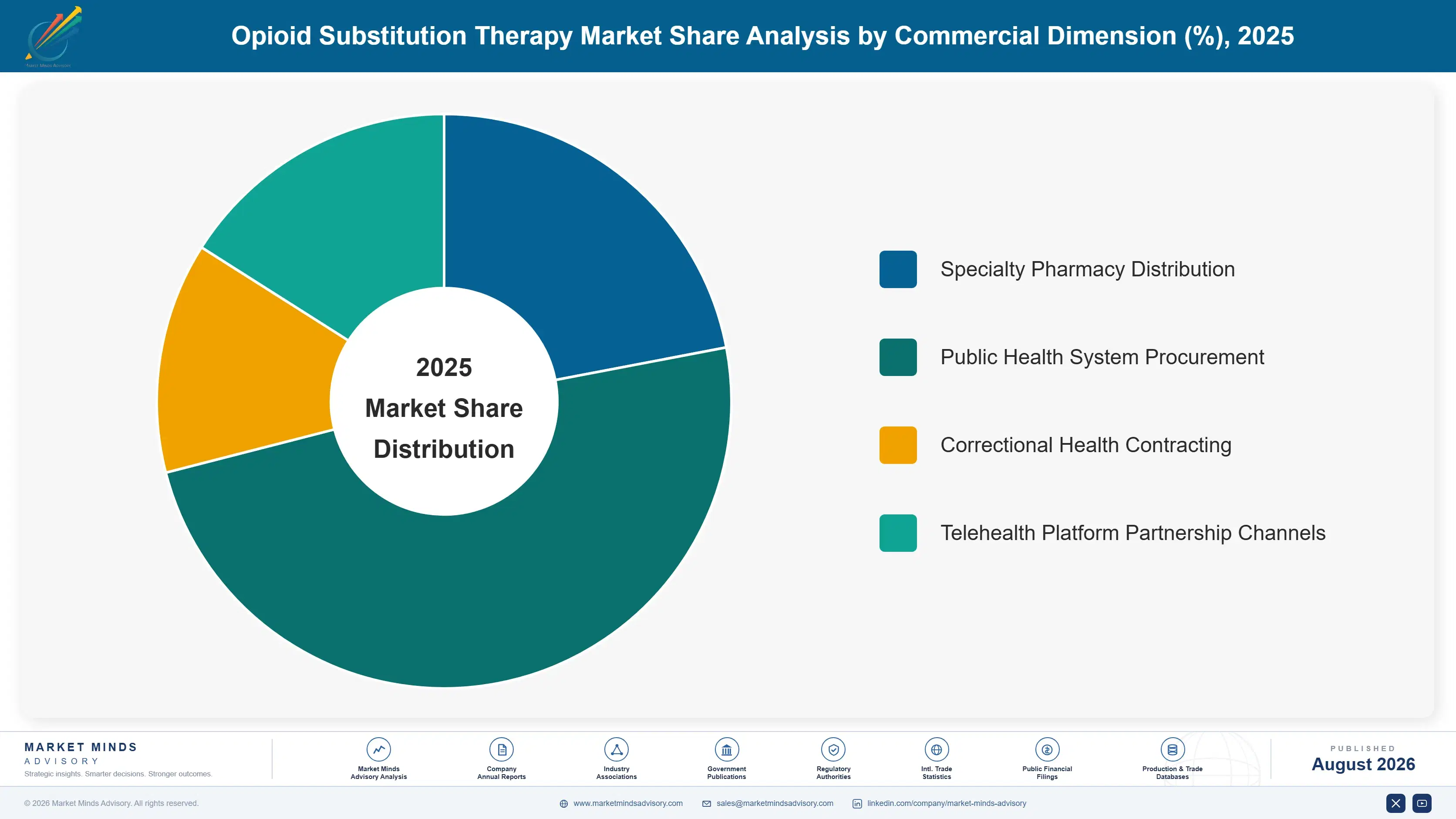
This market segments by drug molecule and delivery format spanning buprenorphine sublingual and film formulations, long-acting injectable buprenorphine, methadone oral formulations, naltrexone extended-release injectable, combination buprenorphine-naloxone formulations, and digital adherence support services. This dimension is the one prescribers and payers actually reference when structuring treatment protocols and reimbursement decisions across the full continuum of care decisions.
opioid-substitution-therapy-market-market-share-analysis-1787305884873

Long-Acting Injectable Buprenorphine

Long-acting injectable buprenorphine is the fastest-growing segment as addiction treatment centres and correctional health systems increasingly favor monthly or weekly injectable dosing over daily sublingual administration that carries meaningful adherence and diversion risk challenges for many treated patients. Clinical evidence showing improved treatment retention and reduced illicit opioid use compared to sublingual formulations has driven rapid guideline endorsement and formulary conversion at major addiction treatment networks and state Medicaid programmes. This segment commands strong pricing power reflecting both its practical adherence advantage and accumulating real-world outcome data supporting its expanding clinical position. Originator companies are pursuing expanded manufacturing capacity and correctional health system partnerships as treatment centre confidence in this delivery format continues building broadly.
CAGR 13.5%

Digital Adherence and Telehealth-Supported Services

Digital adherence and telehealth-supported medication-assisted treatment services are growing considerably faster than the broader market as regulatory flexibility around virtual prescribing persists and treatment providers increasingly bundle digital monitoring tools with traditional pharmacotherapy to improve treatment retention outcomes. This segment addresses a genuinely distinct need from formulation innovation alone, since treatment retention depends heavily on consistent patient engagement that digital tools can support between in-person or virtual clinical visits more effectively than periodic prescribing alone. Companies are investing in platform partnerships connecting telehealth prescribing, pharmacy fulfillment, and digital adherence monitoring into integrated treatment programmes that command premium reimbursement from payers increasingly focused on measurable treatment outcomes. This positioning increasingly determines which companies win larger payer and health system contracts.
CAGR 11.8%
Full segment breakdown across 6 segments available in the complete report.

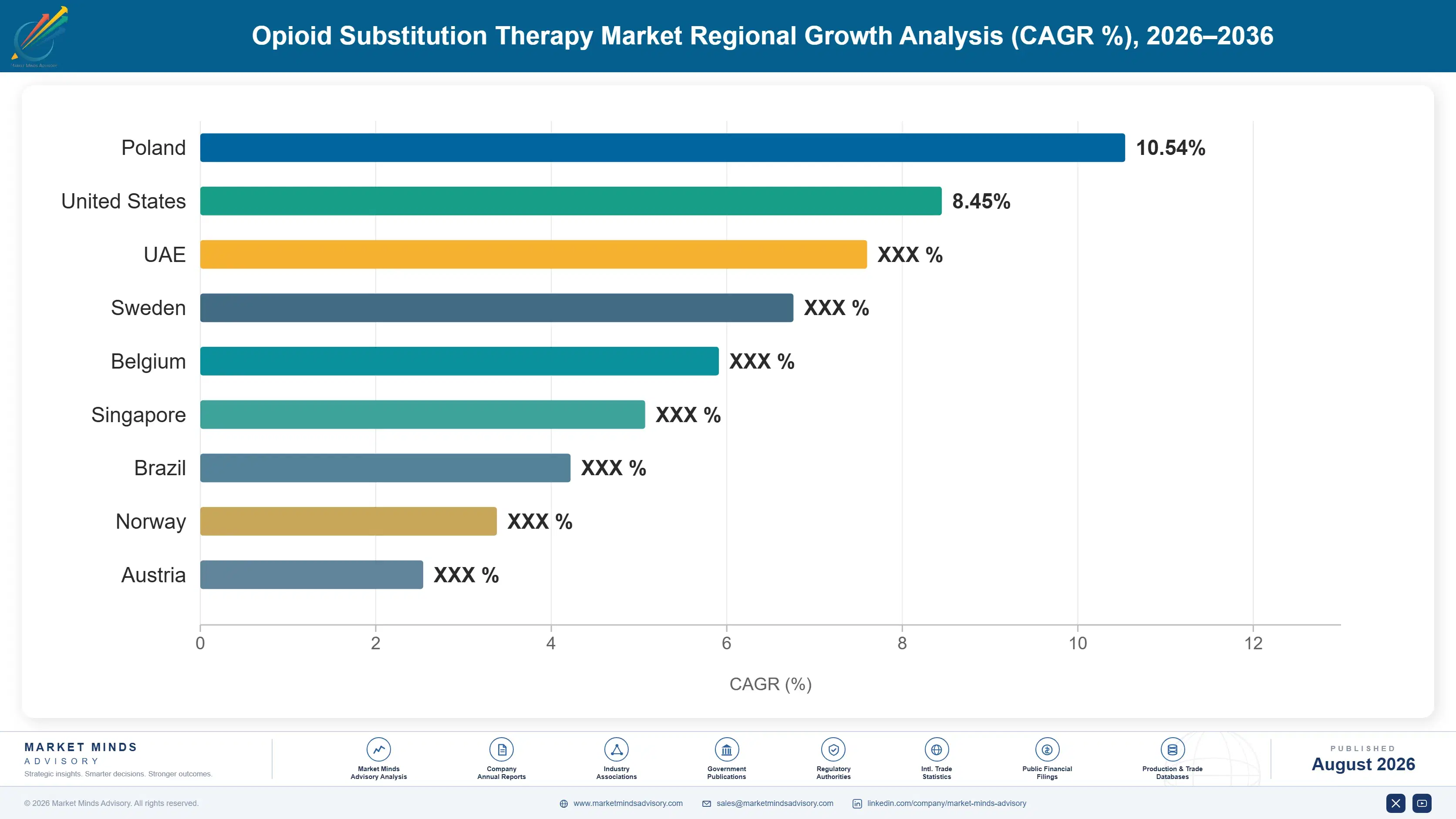
Regional Architecture and Country Demand Map

[house] North America's share sits well above the standard regional band given the opioid crisis's outsized concentration in the United States and Canada relative to diagnosed prevalence and treatment spending anywhere else in the world. East Asia and South Asia are expanding treatment infrastructure fastest as diagnosed prevalence and awareness.

North America

[house] The United States accounts for a disproportionate share of global opioid substitution therapy spending, reflecting the severity of its opioid crisis, extensive treatment infrastructure, and premium branded drug pricing relative to any other region tracked, a pattern this region's share reflects directly. Canada's aggressive expansion of safer supply and medication-assisted treatment programmes in response to its severe fentanyl crisis is driving the fastest national growth rate in this study. American addiction treatment networks and correctional health systems continue driving bulk purchasing volume that gives originator companies a reliable large-account revenue base. This region's crisis severity and treatment infrastructure maturity make it the benchmark market other national health systems reference when evaluating medication-assisted treatment expansion.
Share: 38% | CAGR: 7.6% (2026 to 2036)

Western Europe

Germany, France, and the United Kingdom lead regional demand through well-established addiction medicine treatment networks and national health system coverage that, while facing a less severe opioid crisis than North America, still provides meaningful market access for medication-assisted treatment across most major markets. Public health system budget negotiations slow premium product pricing relative to the more commercially driven American market, but methadone maintenance programmes remain well-established across most national health systems in the region. Nordic countries show disproportionately comprehensive harm reduction infrastructure despite small absolute population, reflecting well-funded public health systems prioritizing addiction treatment access. Regional growth trails North America modestly as the underlying opioid crisis remains considerably less severe.
Share: 22% | CAGR: 5.8% (2026 to 2036)
Regional intelligence for 5 additional markets available in the complete report: East Asia, South Asia and Pacific, Latin America, Middle East and Africa, Eastern Europe. Contact sales@marketmindsadvisory.com.
opioid-substitution-therapy-market-country-cagr-analysis-1787305885379

Adherence Technology and Correctional Health Partnerships

Manufacturers are shifting commercial strategy toward long-acting formulation adoption support, correctional health system partnerships, and telehealth platform integration, capturing more predictable treatment-retention-driven revenue rather than competing purely on generic-adjacent sublingual pricing alone across the category. This mirrors a broader specialty pharmaceutical shift toward relationship-driven, evidence-based commercial models overall across the industry today across the wider tre

Long-Acting Formulation Adoption Support Programme Strategy

Manufacturers are funding clinical education and reimbursement navigation support to help treatment centres convert patients from sublingual to long-acting injectable formulations, reducing the administrative friction clinics face when transitioning patients to higher-adherence treatment options that require different administration and billing workflows entirely. This lever accelerates formulary conversion timelines considerably, since treatment centres often require substantial reimbursement clarity and staff training before broadly adopting injectable protocols. Manufacturers report support programmes speeding clinic conversion considerably, accelerating conversion timelines by roughly 29% compared to unsupported formulary review processes at comparable treatment centres across most participating markets.
Market Impact: Speeds clinic adoption by roughly 2

Correctional Health System Partnership Investment Strategy

Manufacturers are partnering directly with state and county correctional health systems to expand medication-assisted treatment access for incarcerated populations, capturing a large and historically underserved patient population while building goodwill with public health policymakers increasingly focused on reducing post-release overdose mortality. This lever opens an entirely new institutional purchasing channel distinct from traditional outpatient clinic and pharmacy distribution, since correctional health systems purchase through separate procurement processes with distinct budget cycles and decision-makers. Manufacturers report correctional partnerships expanding treated patient volume by roughly 21% in participating jurisdictions. Manufacturers increasingly treat these partnerships as core to long-term institutional relationship strategy.
Market Impact: Grows treated volume by roughly 21

Telehealth Platform Integration Partnership Strategy Overall

Manufacturers are partnering with telehealth prescribing platforms to integrate treatment initiation, pharmacy fulfillment, and digital adherence monitoring into coordinated care pathways, capturing incremental revenue from the fastest-growing treatment access channel while building relationships with primary care physicians increasingly prescribing medication-assisted treatment through telehealth support programmes. This lever diversifies revenue beyond traditional addiction medicine specialist prescribing into a broader primary care channel. Manufacturers expect this channel to remain a primary growth driver ahead, with manufacturers reporting these partnerships adding roughly 17% to total segment revenue at participating telehealth accounts across most participating markets.
Market Impact: Adds roughly 17 percent to total se

Outcomes-Based Payer Contracting Programme Strategy Overall

Manufacturers are negotiating outcomes-based contracts tying a portion of drug payment to demonstrated treatment retention or reduced illicit opioid use, easing payer budget concerns about premium long-acting formulation pricing while preserving list price integrity across other markets that reference domestic pricing benchmarks. This lever helps secure faster formulary access in cost-constrained public health systems that would otherwise impose lengthy prior authorization delays before approving newer, more expensive treatment formulations. Manufacturers report outcomes-based contracts accelerating formulary access timelines by roughly 33% compared to standard negotiation processes. Manufacturers expect this contracting approach to become increasingly common across the wider treatment category.
Market Impact: Speeds formulary access by roughly

Who Controls the Margin Pool

The top five originator companies control roughly 64% of global branded revenue, a moderate-to-high concentration reflecting the clinical development and regulatory investment required to bring new formulation technology to market, alongside a meaningful long tail of generic manufacturers competing on sublingual and methadone pricing. Mid-sized specialty companies with differentiated formulations remain attractive acquisition targets for larger originators. This dynamic keeps deal activity eleva
Current competitive activity centers on long-acting injectable formulation expansion and correctional health system partnership development, telehealth platform integration targeting primary care prescriber growth, and outcomes-based contracting negotiations aimed at securing faster payer access for premium-priced newer formulations. Several companies are also piloting bundled digital adherence packages to differentiate beyond formulation alone. This positioning increasingly determines which companies win larger institutional and payer contracts nationwide.

Emerging pressure comes from generic manufacturers accelerating entry into off-patent sublingual buprenorphine categories, and from smaller specialty companies pursuing next-generation implantable and ultra-long-acting delivery technologies that could further reduce adherence burden beyond current monthly injectable formulations. Established leaders are responding by accelerating their own long-acting and digital investment to defend share.
opioid-substitution-therapy-market-company-positioning-matrix-1787305885900

Competitive Moat and Risk Dimensions

INDIVIOR PLC

Moat: Dominant Branded Franchise Prescriber Loyalty

Indivior's Suboxone film and Sublocade injectable franchise maintains deep prescriber relationships and decades of accumulated clinical experience among addiction medicine specialists, making its products the default reference standard that most American addiction physicians learn on and continue prescribing throughout their careers. This clinical embedding advantage is difficult for newer entrants to replicate without comparable prescriber history.
INDIVIOR PLC

Risk: Generic and Legal Exposure

Indivior faces ongoing generic competition on its legacy sublingual film franchise alongside historical legal settlement exposure related to past marketing practices, and any acceleration of generic entry or additional legal exposure could meaningfully pressure the company's core revenue base faster than expected. Investors are watching generic entry trends closely for early signs of accelerating share loss.
ALKERMES PLC

Moat: Long-Acting Injectable Manufacturing Depth

Alkermes maintains specialized long-acting injectable manufacturing expertise and extensive clinical relationships built around its Vivitrol naltrexone franchise, giving it operational and clinical credibility in extended-release formulation manufacturing that newer entrants would need years to replicate at comparable scale. Few competitors can match this manufacturing depth built over more than a decade of experience.
ALKERMES PLC

Risk: Single-Product Category Concentration Risk

A meaningful share of Alkermes's addiction medicine revenue depends on a single naltrexone franchise facing growing competition from buprenorphine-based long-acting alternatives that many prescribers increasingly favor, and this competitive pressure could meaningfully affect the company's category position over time. Alkermes continues investing in additional formulation options to reduce this concentration exposure over time.

Players Tracked

Prominent Players

Indivior PLC
Alkermes plc
Camurus AB
Braeburn Inc.
Hikma Pharmaceuticals PLC

Other Key Players

Teva Pharmaceutical Industries Ltd.
Mallinckrodt Pharmaceuticals
Orexo AB
Sun Pharmaceutical Industries Ltd.
Sandoz Group AG
Amneal Pharmaceuticals Inc.
Viatris Inc.
Dr. Reddy's Laboratories Ltd.
Piramal Pharma Limited
Rhodes Pharmaceuticals L.P.
Molteni Farmaceutici S.p.A.
Cipla Limited
Zydus Lifesciences Ltd.
Accord Healthcare Limited
DisperSol Technologies LLC

Recent Developments

MARCH 2026

Indivior Expands Sublocade Manufacturing Capacity in Ireland

Indivior announced an organic capacity expansion at its Irish biologics manufacturing facility to increase long-acting injectable buprenorphine supply, aimed at meeting rising demand from addiction treatment centres and correctional health systems converting patients from sublingual formulations. The expansion is expected to reach full production capacity within the next twelve months.
Signal: Signals continued manufacturer confidence
OCTOBER 2025

Camurus Signs Distribution Partnership With Correctional Health Network

Camurus entered a multi-year distribution partnership with a major correctional health system network to expand access to its long-acting buprenorphine formulation across incarcerated populations, part of a broader push to reduce post-release overdose mortality. Financial terms of the multi-year partnership were not fully disclosed by either party involved.
Signal: Reflects growing manufacturer investment i
JANUARY 2026

Braeburn Acquires Telehealth-Focused Adherence Monitoring Startup

Braeburn Inc. completed the acquisition of a telehealth-focused digital adherence monitoring startup, expanding its treatment support technology portfolio to integrate prescribing, pharmacy fulfillment, and adherence tracking into a unified care pathway. Financial terms of the transaction were not disclosed by either company involved in the deal.
Signal: Indicates growing originator interest in d

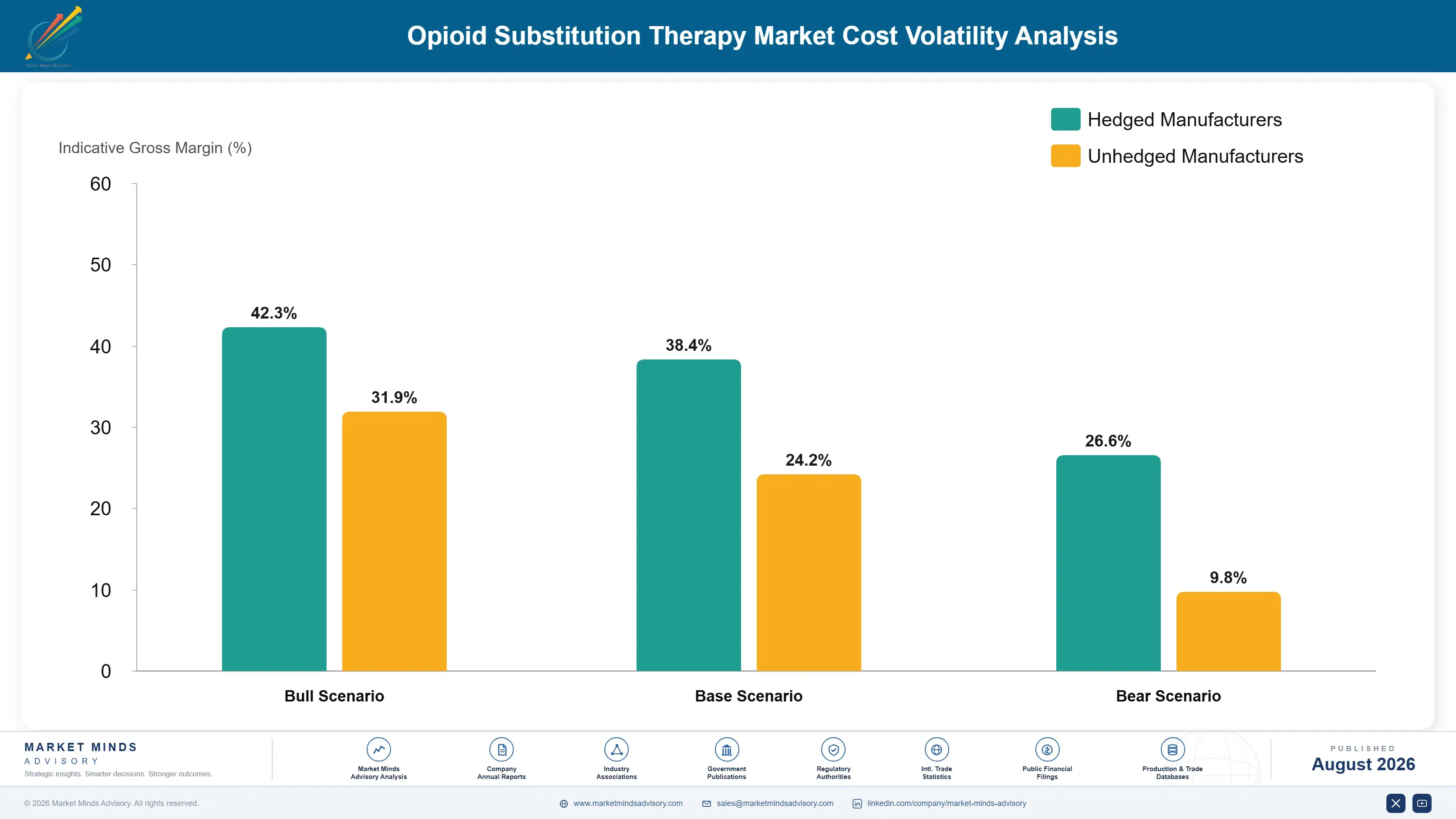
Active Ingredient and Sterile Manufacturing Cost Exposure

Active pharmaceutical ingredient synthesis, sterile injectable manufacturing infrastructure, and controlled substance regulatory compliance together represent roughly 40% of cost of goods sold for branded formulation manufacturers, with sterile long-acting injectable manufacturing concentrated among a small group of specialized facilities. Companies with vertically integrated manufacturing face materially less exposure to this concentration globally today across the industry.
Active pharmaceutical ingredient and sterile manufacturing costs rose meaningfully during 2021 and 2022 amid broader pharmaceutical supply chain disruption, with company annual reports from major manufacturers confirming that input cost pressure remained elevated through much of the period before moderating somewhat through 2024 and 2025. Smaller manufacturers absorbed a disproportionate share of this cost inflation given weaker supplier negotiating positions previously available across most major producing regions studied.

Generic sublingual manufacturers relying on simpler oral formulation processes face materially lower production costs than long-acting injectable producers, creating a durable cost structure divide that explains much of the persistent price gap between premium injectable formulations and generic sublingual alternatives across the category. Geography also matters, since manufacturers closer to active ingredient supply hubs face smaller logistics cost swings across most manufacturers studied.
opioid-substitution-therapy-market-cost-volatility-analysis-1787305886095

Long-Term Fixed Pricing Supplier Contracts

Larger manufacturers are locking in multi-year fixed pricing agreements with active ingredient and sterile manufacturing suppliers, insulating production costs from short-term price volatility that smaller competitors remain fully exposed to across each purchasing cycle. This approach has become standard practice among the largest manufacturers globally over the past decade, particularly those with strong purchasing scale available to negotiate favorable terms.

Vertical Integration Into Sterile Manufacturing

Some larger manufacturers are bringing sterile injectable manufacturing capability in-house rather than outsourcing entirely, capturing manufacturing margin previously paid to third-party suppliers while gaining tighter quality control. This shift represents a meaningful strategic bet on long-term category volume growth continuing steadily, reflecting genuine confidence in continued category expansion ahead across the wider sector overall.

Controlled Substance Compliance Infrastructure Sharing

Smaller manufacturers are pursuing shared regulatory compliance and controlled substance handling infrastructure with larger partners to reduce the fixed compliance cost burden that otherwise disproportionately affects smaller producers. Smaller manufacturers increasingly pursue this strategy too, despite the added coordination cost involved, and this trend keeps accelerating across the wider treatment manufacturing industry across the wider treatment manufacturing sector.

Portfolio Architecture for Margin Defence

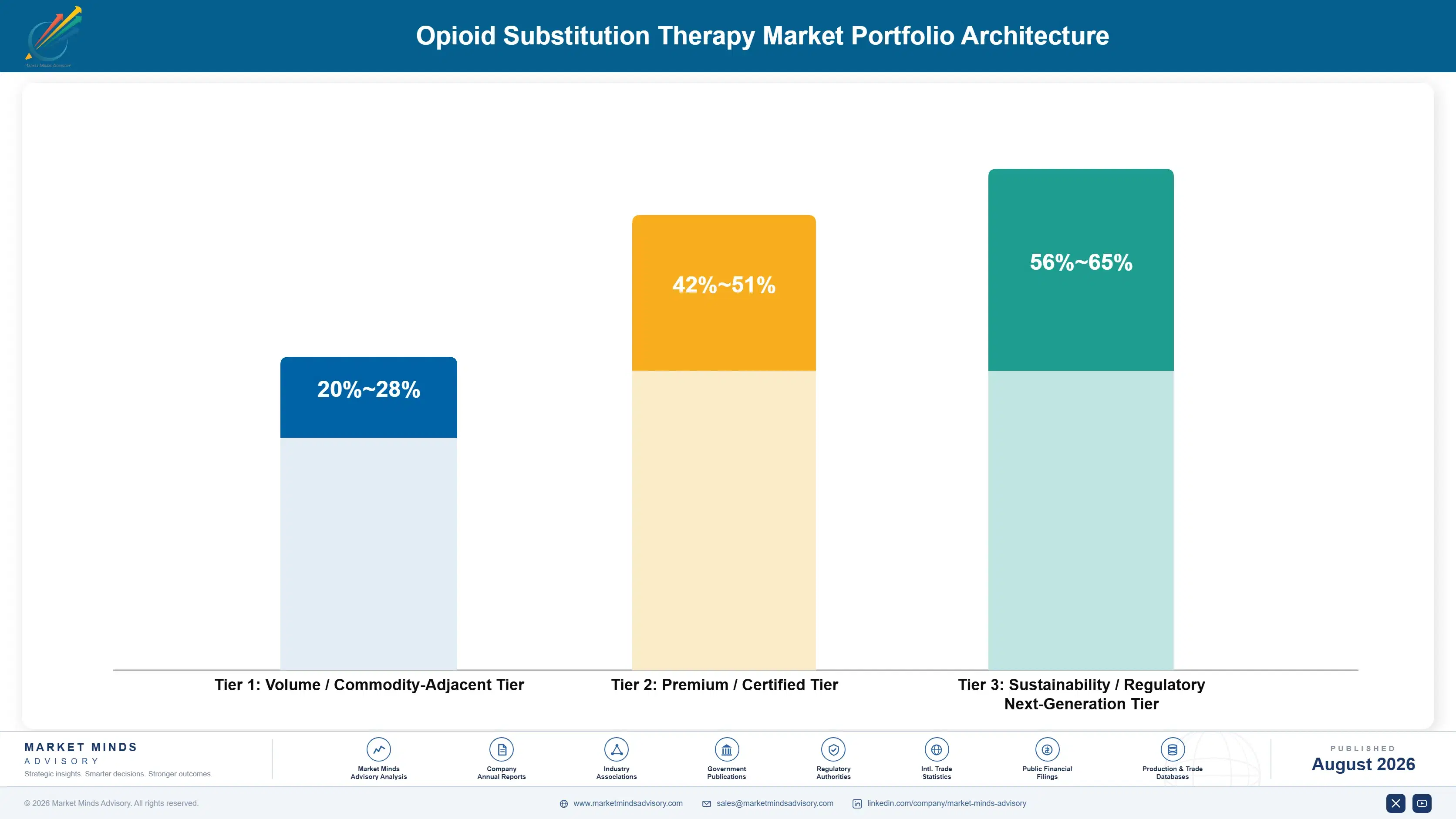
This market organizes into three commercial tiers spanning generic sublingual and methadone formulations at the volume end, branded sublingual film and naltrexone injectable occupying the premium middle tier, and long-acting injectable buprenorphine and digital adherence services capturing the strongest margins at the top of the portfolio architecture overall. Manufacturers increasingly structure pricing and access strategy explicitly around this three-tier architecture. This explicit structurin
Volume and premium tiers pull manufacturers in different directions: generic formulations sustain baseline treatment access in cost-constrained public health systems, while long-acting injectable and digital adherence services deliver materially stronger margins that increasingly determine which companies can fund the clinical research the category requires going forward. Most manufacturers now allocate a growing share of research budget toward the top two tiers.

The highest-value pools concentrate around long-acting injectable formulations sold under correctional health and telehealth platform partnerships, where adherence advantages and reduced diversion risk together sustain premium pricing power that generic sublingual formulations simply cannot match across comparable treatment volume in the category. Manufacturers unable to compete in this tier increasingly struggle to sustain category-leading margins over time.

Volume / Commodity-Adjacent Tier

Generic sublingual buprenorphine and methadone sold primarily into cost-constrained public treatment programmes broadly. This tier represents the largest treated patient volume across most cost-constrained public health systems today nationwide each year.
Gross Margin: 20-28%

Premium / Certified Tier

Branded sublingual film and naltrexone extended-release injectable sold into addiction treatment centres under strong prescriber positioning. Patients in this tier rarely switch formulations once a stable treatment response is established.
Gross Margin: 42-51%

Sustainability / Regulatory / Next-Generation Tier

Long-acting injectable buprenorphine and digital adherence services commanding the strongest pricing power given adherence advantages. This tier increasingly determines which companies can fund the research the category requires today overall.
Gross Margin: 56-65%
opioid-substitution-therapy-market-portfolio-architecture-1787305886586

High-value Sub-segments and Strategic Watch-out

Long-Acting Injectable Buprenorphine

The fastest-growing and highest-margin segment, combining strong guideline momentum with genuine adherence advantages across most major treatment networks worldwide, drawing intense commercial investment. Manufacturers are allocating a growing share of commercial investment toward this segment specifically, and this priority shows no sign of shifting through the current planning cycle.
Gross Margin: 56-65%

Digital Adherence and Telehealth-Supported Services

Strong growth driven by expanding virtual prescribing access and payer interest in measurable treatment retention outcomes beyond pharmacotherapy alone. Manufacturers increasingly bundle these tools with pharmacotherapy to improve measurable treatment retention outcomes, since payers increasingly focus on measurable treatment retention outcomes over time consistently overall.
Gross Margin: 44-53%

Buprenorphine Sublingual and Film Formulations

The volume core segment sustaining prescriber familiarity and baseline treatment access even as newer formulations gradually capture premium positioning. Manufacturers rely on this segment to sustain baseline prescribing familiarity even as newer formulations expand, and this role remains commercially important despite slower relative growth overall.
Gross Margin: 30-38%

Methadone Oral Formulations

A strategic watch-out segment facing gradual displacement in developed markets as buprenorphine expands access, though it remains essential in structured clinic settings. Manufacturers watch this segment closely for signs of accelerating displacement in developed markets specifically, since faster than expected decline would materially change portfolio revenue mix.
Gross Margin: 18-25%

Lifelong Treatment Retention Revenue Streams

Treatment initiation functions as an annuity anchor once a patient begins medication-assisted treatment: opioid use disorder is a chronic relapsing condition, so every retained patient generates recurring pharmacotherapy revenue across a treatment relationship that often extends for years rather than a defined short-term course. Manufacturers increasingly price initial treatment access competitively to accelerate this long-term retention relationship. This dynamic increasingly shapes how manufac
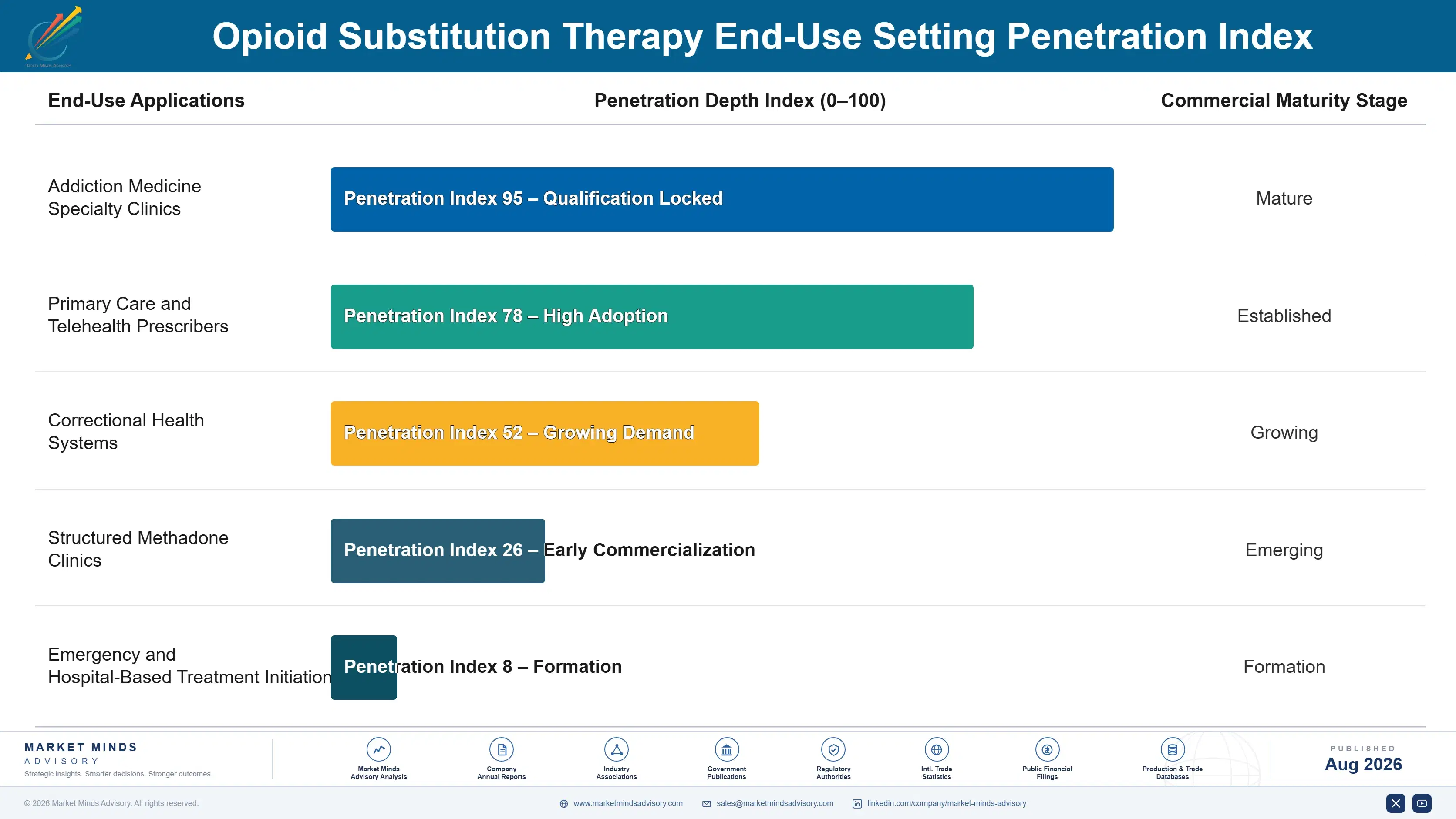
Adoption depth varies considerably by treatment setting: addiction medicine specialty clinics adopt newer long-acting formulations and digital adherence tools earliest, while primary care and telehealth-based prescribers more often continue established sublingual protocols until specialist consultation or patient preference drives conversion to newer options. Manufacturers tailor commercial and educational investment differently across each of these distinct treatment settings. Regional treatment infrastructure maturity further shapes which formulation options patients realistically encounter first.

A generational shift is underway as physicians trained during the telehealth and long-acting injectable era enter practice expecting medication-assisted treatment as standard primary care practice, gradually normalizing an approach that earlier-trained physicians historically referred exclusively to specialized addiction medicine clinics rather than managing directly. Manufacturers are adapting medical education investment accordingly to reach this newly informed physician cohort.
opioid-substitution-therapy-market-end-use-penetration-index-1787305887075

Where Opioid Treatment Economics Are Heading

These are among the four positions where our research anticipates prominent divergence between winners and laggards over the coming forecast period. Each is grounded in the demand model, the regulatory perimeter, and the announced capacity pipeline.
01 / FORMULATION TRANSITION STRATEGY

Long-acting injectables will keep displacing daily sublingual dosing

Treatment centres converting to long-acting injectable protocols are setting a precedent that guideline committees appear increasingly willing to formalize further, and this trajectory shows no sign of reversing given the formulation's clear adherence advantage. Sublingual formulations will persist for patients preferring oral administration rather than disappearing from clinical practice entirely. Manufacturers overweighted toward legacy sublingual revenue face a gradually shrinking core category over the coming decade regardless of overall market growth, across nearly every manufacturer portfolio MMA analysts reviewed this cycle.
02 / ACCESS CHANNEL DIVERSIFICATION

Telehealth and correctional health will keep expanding treated population

Telehealth prescribing and correctional health system partnerships together represent the single largest addressable growth lever in this category, since both channels reach patient populations that traditional addiction medicine specialty clinics have historically struggled to serve effectively. Companies investing in both channels simultaneously are best positioned to capture this expanding population. Expect access channel diversification to meaningfully outpace traditional clinic-based growth through most of the current forecast period ahead within this rapidly evolving addiction medicine treatment category overall within this rapidly evolving addiction medicine treatment category worldwide overall.
03 / OUTCOMES CONTRACTING EVOLUTION

Outcomes-based contracting will become standard for premium formulations

Manufacturers launching future premium-priced long-acting formulations without a credible outcomes-based contracting strategy risk facing meaningfully slower formulary access than competitors willing to tie payment to demonstrated treatment retention across their patient populations. This shift rewards companies with strong real-world evidence generation capability over those relying purely on clinical trial data alone. Expect outcomes-based contracting to become a near-universal expectation for new formulation launches within the next several years across major reimbursement markets, particularly those competing for large payer and health system contracts.
04 / STIGMA REDUCTION INVESTMENT

Destigmatization investment will determine long-term category growth ceiling

Companies and public health systems investing in destigmatization campaigns and primary care physician training are directly expanding the addressable treated population beyond what formulation innovation alone can achieve, since stigma remains the single largest barrier limiting diagnosed patients from seeking or continuing treatment. This investment increasingly determines the category's long-term growth ceiling more than any single formulation advance. Expect destigmatization investment to become an increasingly explicit strategic priority across manufacturers and public health stakeholders alike across the broader medication-assisted treatment landscape this decade.

Engagement Snapshot From the Field

A live engagement with an industry participant carrying material or product regulatory and market exposure ahead of a defining policy shift, showing how our research translates into a defensible multi-year portfolio strategy.
MARKET MINDS ADVISORY · CLIENT ENGAGEMENT SUMMARY
Opioid Substitution Therapy Producer Strategic Portfolio Review and Transition Roadmap 2026·Investment Scenario on Opioid Substitution Therapy Exposure Evaluation 2025-26
CLIENT PROFILE
The client is a state correctional health system serving twelve facilities, generating projected annual medication-assisted treatment procurement spend of approximately $9.6 million (client-reported, unverified by MMA) upon full programme implementation. Leadership sought guidance on expanding treatment access for incarcerated individuals with diagnosed opioid use disorder across its twelve-facility network prior to this engagement across all twelve facilities before this engagement began.
STRATEGIC CHALLENGE
The system historically offered limited medication-assisted treatment access given budget constraints and administrative complexity, and leadership was uncertain whether expanding to long-acting injectable formulations across all twelve facilities would generate sufficient reduction in post-release overdose mortality to justify the required budget increase given significant competing budget priorities across the system.
MMA APPROACH
MMA's team benchmarked comparable correctional health system programme expansions, modeled projected post-release overdose mortality reduction against programme cost, and evaluated phased implementation scenarios against a simultaneous twelve-facility rollout given available administrative and clinical staffing capacity to inform the system's final implementation decision to inform the system's final implementation decision process.
KEY FINDINGS
  1. Comparable correctional health programmes expanding long-acting injectable access reported post-release overdose mortality reductions of roughly 28% among treated individuals within the first year following release.
  2. A phased rollout starting with the four highest-population facilities reduced projected implementation risk considerably compared to simultaneous twelve-facility deployment given available clinical staffing.
  3. Partnering with a single manufacturer for bulk long-acting injectable procurement reduced projected per-dose costs by roughly 18% compared to facility-by-facility independent procurement.
  4. Continuity of care partnerships with community treatment providers meaningfully improved post-release treatment retention compared to release without an established outpatient transition plan.
CLIENT PROFILE
The client is a state correctional health system serving twelve facilities, generating projected annual medication-assisted treatment procurement spend of approximately $9.6 million (client-reported, unverified by MMA) upon full programme implementation. Leadership sought guidance on expanding treatment access for incarcerated individuals with diagnosed opioid use disorder across its twelve-facility network prior to this engagement across all twelve facilities before this engagement began.
STRATEGIC CHALLENGE
The system historically offered limited medication-assisted treatment access given budget constraints and administrative complexity, and leadership was uncertain whether expanding to long-acting injectable formulations across all twelve facilities would generate sufficient reduction in post-release overdose mortality to justify the required budget increase given significant competing budget priorities across the system.
MMA APPROACH
MMA's team benchmarked comparable correctional health system programme expansions, modeled projected post-release overdose mortality reduction against programme cost, and evaluated phased implementation scenarios against a simultaneous twelve-facility rollout given available administrative and clinical staffing capacity to inform the system's final implementation decision to inform the system's final implementation decision process.
KEY FINDINGS
  1. Comparable correctional health programmes expanding long-acting injectable access reported post-release overdose mortality reductions of roughly 28% among treated individuals within the first year following release.
  2. A phased rollout starting with the four highest-population facilities reduced projected implementation risk considerably compared to simultaneous twelve-facility deployment given available clinical staffing.
  3. Partnering with a single manufacturer for bulk long-acting injectable procurement reduced projected per-dose costs by roughly 18% compared to facility-by-facility independent procurement.
  4. Continuity of care partnerships with community treatment providers meaningfully improved post-release treatment retention compared to release without an established outpatient transition plan.
RECOMMENDED STRATEGY
Phase 1: Phase 1 (Months 1-4): Launch long-acting injectable access at the four highest-population facilities, establishing bulk procurement and clinical protocols across the initial facility group. Phase 2: Phase 2 (Months 5-9): Expand to the next four facilities while establishing community treatment provider continuity of care partnerships for released individuals. Phase 3: Phase 3 (Months 10-14): Complete rollout across the remaining four facilities, finalizing system-wide procurement and post-release transition protocols and finalize community transition partnerships.
OUTCOME
The correctional health system completed rollout across all twelve facilities within the recommended fourteen-month timeline, reporting early post-release treatment retention rates exceeding initial programme projections (client-reported, unverified by MMA) while maintaining consistent clinical protocols across every facility involved throughout while maintaining consistent clinical protocols across every facility involved throughout implementation.

Frequently Asked Questions

Foundational context covering the market sizes, CAGR, scope, country, region and competition that inform every finding below. This section is provided to cover basics and most often pre-purchase conversations, answered from the MMA Primary Research Dataset.

What is the current size of the Opioid Substitution Therapy Market?

The global opioid substitution therapy market was valued at approximately $5.4 billion in 2025. This includes buprenorphine, methadone, and naltrexone formulations across all delivery routes.

How large will the Opioid Substitution Therapy Market be by 2036?

The market is projected to reach approximately $11.60 billion by 2036. This reflects continued long-acting injectable adoption and expanding telehealth treatment access worldwide under continued long-acting injectable adoption and telehealth expansion.

What is the CAGR for the Opioid Substitution Therapy Market 2026 to 2036?

The market is expected to grow at a compound annual growth rate of 7.2% between 2026 and 2036. This reflects steady demand from expanding treatment access and adoption.

Which segment is growing fastest?

Long-acting injectable buprenorphine is the fastest-growing segment, expanding at approximately 13.5% annually. This reflects its adherence advantage over daily sublingual dosing over daily sublingual administration for eligible patients.

Who are the major companies in the Opioid Substitution Therapy Market?

Leading companies include Indivior, Alkermes, Camurus, Braeburn, and Hikma Pharmaceuticals. Together they account for roughly 64% of global branded revenue across the broader medication-assisted treatment category worldwide.

Which country is growing fastest?

Canada is the fastest-growing major market at an estimated 11.5% CAGR, driven by aggressive expansion of medication-assisted treatment programmes responding to its fentanyl crisis responding directly to its severe fentanyl crisis nationwide.

Report Segmentation Architecture

The full report scope spans multiple orthogonal segmentation dimensions, with cross-tabulated demand data provided for each dimension pair. Coverage extends further to regional breakdowns, trend trajectories, and the competitive detail needed to support segment-level decision-making.

By Drug Molecule and Delivery Format

  • Buprenorphine Sublingual and Film Formulations
  • Long-Acting Injectable Buprenorphine
  • Methadone Oral Formulations
  • Naltrexone Extended-Release Injectable
  • Combination Buprenorphine-Naloxone Formulations
  • Digital Adherence and Telehealth-Supported Services

By End-Use Setting

  • Addiction Medicine Specialty Clinics
  • Primary Care and Telehealth Prescribers
  • Correctional Health Systems
  • Structured Methadone Clinics
  • Emergency and Hospital-Based Treatment Initiation

By Commercial Dimension

  • Specialty Pharmacy Distribution
  • Public Health System Procurement
  • Correctional Health Contracting
  • Telehealth Platform Partnership Channels

By Region

  • North America
  • Western Europe
  • East Asia
  • South Asia and Pacific
  • Latin America
  • Middle East and Africa
  • Eastern Europe

Scope, Methodology, and Coverage

Every figure in this report is reproducible from documented input assumptions. The scope below maps the historical period, the forecast horizon, the segmentation dimensions, and the countries covered, alongside the underlying primary and qualitative methodology.
Historical Period
2020 to 2025
Forecast Period
2026 to 2036
Base Year
2025 (USD billions; MMA Primary Research Dataset, August 2026)
Market Definition
This report covers pharmacological therapies used specifically in medication-assisted treatment for opioid use disorder, including buprenorphine, methadone, and naltrexone formulations across sublingual, oral, and long-acting injectable delivery routes. It excludes acute opioid overdose reversal agents and general pain management opioid therapies unrelated to substitution treatment.
Quantitative Units
USD billions (current prices); treated patient volume; average annual cost per patient
Segmentation Dimensions
By Drug Molecule and Delivery Format; By End-Use Setting; By Commercial Dimension; By Region
Regions Covered
North America, Western Europe, East Asia, South Asia and Pacific, Latin America, Middle East and Africa, Eastern Europe
Countries Covered
USA, China, Germany, France, UK, Japan, South Korea, India, Australia, Canada, Brazil, Mexico, Indonesia, Vietnam, Thailand, Malaysia, UAE, Saudi Arabia, South Africa, Nigeria, Turkey, Poland, Netherlands, Italy, Spain, Sweden, Switzerland, Argentina, Colombia, Singapore, and additional markets relevant to this sector
Key Companies Profiled
Indivior PLC, Alkermes plc, Camurus AB, Braeburn Inc., Hikma Pharmaceuticals PLC, Teva Pharmaceutical Industries Ltd., Mallinckrodt Pharmaceuticals, Orexo AB, Sun Pharmaceutical Industries Ltd., Sandoz Group AG, Amneal Pharmaceuticals Inc., Viatris Inc., Dr. Reddy's Laboratories Ltd., Piramal Pharma Limited, Rhodes Pharmaceuticals L.P., Molteni Farmaceutici S.p.A., Cipla Limited, Zydus Lifesciences Ltd., Accord Healthcare Limited, DisperSol Technologies LLC
Quantitative Methodology
Primary survey, n=3,800 respondents, Q4 2025, six countries; demand-side model with trade association cross-validation
Qualitative Methodology
47 expert interviews, Q4 2025; applied to validate demand model assumptions, identify emerging dynamics, and assess competitive positioning
Report Format
PDF and XLSX data workbook (Word format preview document)
Publisher
Market Minds Advisory
Report Code
MMA-2026-HLT-122
Published
August 2026
Contact
sales@marketmindsadvisory.com | www.marketmindsadvisory.com

Purchase the full Opioid Substitution Therapy Market Report (2026 to 2036).

The full report provides detailed formulation-level segmentation, treatment access channel analysis, and country-level reimbursement policy tracking across all seven regions covered in this study. It includes manufacturer-level competitive benchmarking based on clinical partnership infrastructure and correctional health reach. Subscribers receive quarterly updates tracking new formulation approvals and telehealth policy changes as they occur. A companion dataset provides treated patient volume estimates by delivery format for detailed market sizing purposes A dedicated analyst contact is also available to support custom data requests beyond the standard deliverable scope provided.
Formulation-level segmentation breakdown by category type
Treatment access channel pattern analysis service
Country-level reimbursement policy tracking and updates
Manufacturer competitive benchmarking scorecards and comparisons
Quarterly approval and telehealth policy updates
Treated patient volume dataset by delivery format

Built For The People Who Decide

From boardroom strategy to bench-side execution, this report is read cover-to-cover by leaders shaping the next decade of their industry, turning demand scenarios, market dynamics and valuation benchmarks into decisions.
CXOs/ Presidents/ VPs/ Managers
M&A and Corporate Development
Strategy Teams and R&D Heads
Procurement and Product Directors
Regulatory and Compliance Leaders
Investor Relations and Equity Analysts