Market Minds Advisory
Ophthalmic Sprays Market

Ophthalmic Sprays Market: Delivery over chemistry, the dose precision ceiling and lid hygiene expansion to 2036

This format wins because the patient never has to aim, and it will never take prescription therapy because nobody can tell you how much of a sprayed dose actually reached the eye.

Lead Analyst

Alice Ballenger

Published

September 2026

Make Smarter Decisions with Customized Research Insights

Request a free sample report and evaluate market opportunities, growth trends, and competitive dynamics relevant to your business needs.

2025 MARKET VALUE$0.6BMarket Size 2025
2036 FORECAST VALUE$1.6BBase Case , 2026 to 2036
CAGR 2026 TO 20369.8 %Bull 11.0% / Bear 8.6%
INCREMENTAL OPPORTUNITY$1.0BNet 10- year value creation
EXPANSION MULTIPLE2.55x2036 value over 2026 base
Strategic Levers
M&A Pipeline
Regional Outlook
Country Rankings
Competitive Intelligence
Segmental Deep-dive
Call-Us : 91 93563 13602

Executive Snapshot and Market Trajectory

Roughly 43% of patients fail to land an eye drop where it is meant to go, defeated by aim, blink reflex or a shaking hand. The dry eye population is overwhelmingly elderly. A spray applied to the closed lid removes both problems at once. That is the whole proposition here.
The mechanism happens to fit as well as the format does, which is why this is not merely a delivery gimmick. About 86% of dry eye is evaporative, meaning the tear film lipid layer is deficient, and an aqueous drop replaces the wrong layer entirely. A liposomal spray delivers phospholipid to the lid margin where that layer is actually generated. That is a different intervention entirely.
Hypochlorous acid lid hygiene grows at 14.7%, half again the market rate of 9.8%, as blepharitis and Demodex diagnosis rises with clinical attention. Western Europe holds 36% of value because the category is a German-speaking pharmacy phenomenon that spread across the continent while remaining comparatively unknown in American retail. That head start rests on pharmacist recommendation rather than on any formulation advantage, and a recommendation lifts conversion around 3.2 times where pharmacists decide.
Market Definition
This report covers ophthalmic sprays applied to the closed eyelid or ocular surface, spanning liposomal dry eye sprays, hypochlorous acid lid hygiene, preservative-free saline and comfort sprays, allergy and antihistamine eye sprays, peri-operative and antiseptic sprays, and paediatric and contact lens comfort sprays. Value is measured at manufacturer level across pharmacy, retail and professional channel sales. Excluded are conventional eye drops and gels in any format, ointments, contact lens solutions, prescription ophthalmic medicines delivered by drop or injection, and lid wipes or mechanical cleaning devices.
Base Year Value
$0.6B in 2025 (MMA Primary Research Dataset, August 2026)
Forecast Period
2026 to 2036, eleven discrete annual values
CAGR
9.8% base case. Bull 11.0%. Bear 8.6%.
Fastest Growth Segment
Hypochlorous Acid Lid Hygiene: 14.7% CAGR
Fastest Growth Country
United States: 11.4% CAGR
Fastest Growth Region
South Asia and Pacific: 11.8% CAGR
Largest Region
Western Europe: 36% of 2025 global value
Market Leaders
Bausch and Lomb, Thea Pharma, Santen Pharmaceutical, Optima Pharmazeutische and NovaBay Pharmaceuticals lead the market. Source: MMA Primary Research Dataset, July 2026.
Primary Survey
n=3,800 procurement and R&D decision-makers, Q4 2025, six countries
Methodology
Demand-side build-up, cross-validated against public data, 47 expert interviews

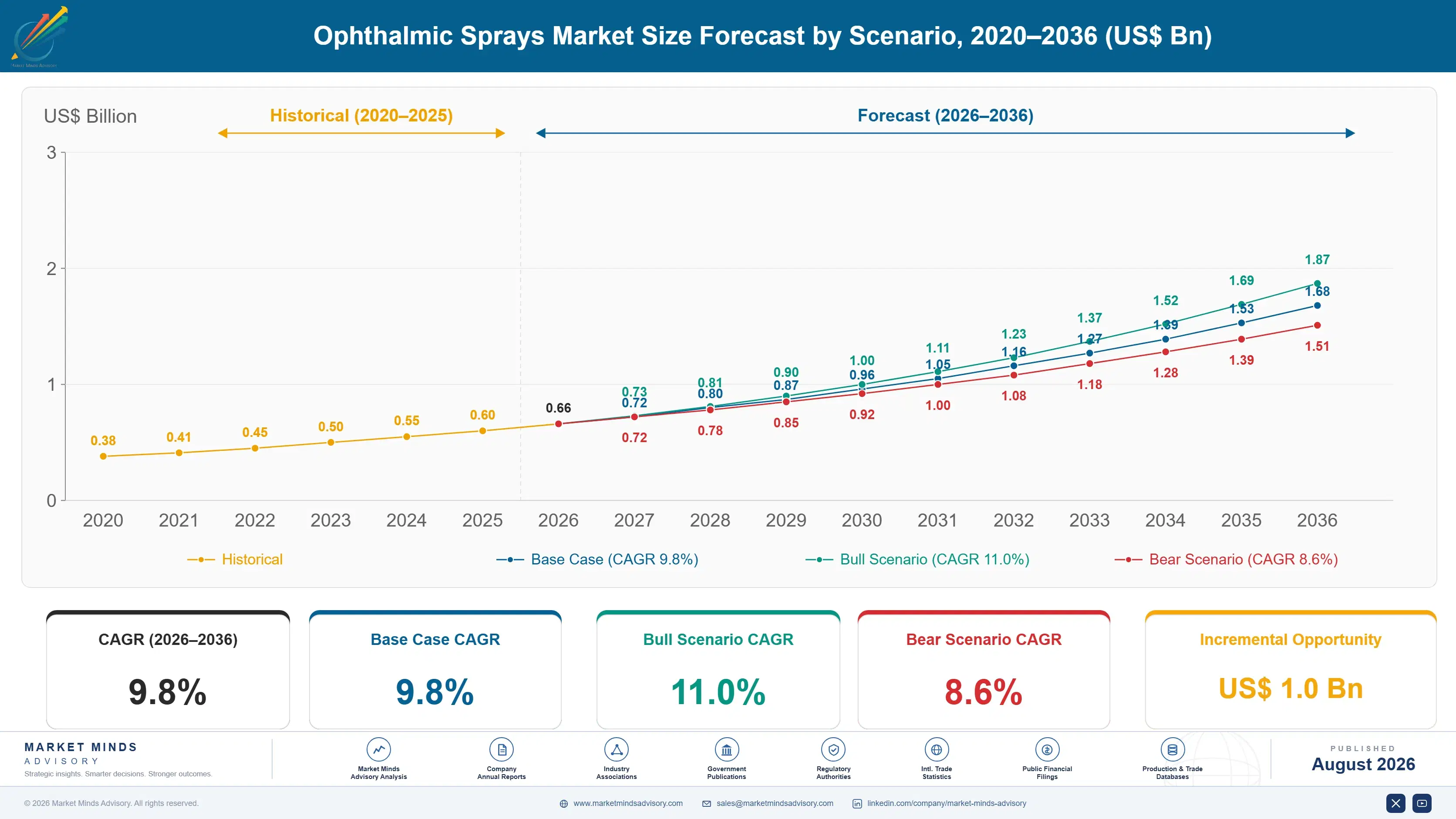
Ophthalmic Sprays Market Forecast Scenarios

ophthalmic-sprays-market-size-forecast-scenario-1787559493581
Growth ran at 8.4% between 2020 and 2025 and it came almost entirely from European pharmacy where the format was already established and pharmacists recommended it routinely. Screen-related dry eye complaints rose considerably through the period and supported the whole category. Hypochlorous acid lid hygiene began growing sharply toward the end as blepharitis and Demodex received far more clinical attention than before.
The 9.8% base case rests on three mechanisms. Hypochlorous acid lid hygiene at 14.7% as Demodex blepharitis diagnosis rises from a very low base of recognition. Liposomal dry eye sprays at 11.4% on evaporative disease that aqueous drops address poorly. And American growth at 11.4%, the fastest of any country, because it is the least penetrated large market with high dry eye prevalence throughout. None of those three depends on the format taking any prescription therapy.
The 11.0% bull case is eye care professional recommendation extending in markets where pharmacists are less central to the purchase decision than they are in Europe. The 8.6% bear case is category crowding under a device regulatory route that 78% of products use, which lets anybody enter cheaply and compresses brand pricing across pharmacy shelves.

Winning On Delivery Alone

An eye drop asks a great deal of the person using it. They must tilt their head, hold the bottle steady above an open eye, and suppress a blink reflex that exists precisely to prevent things landing on the cornea. Around 43% fail, and the rate is worst among the elderly patients who need it most. A spray applied to the closed lid removes aiming and blinking from the procedure entirely, and the liquid migrates over the lid margin into the tear film within about ninety seconds.
TOP-FIVE CONCENTRATION26%Combined position across supply held by the leading brand owners
DROP INSTILLATION FAILURE RATE43%Share of patients who miss the eye applying a drop
EVAPORATIVE DRY EYE SHARE86%Portion of cases involving a deficient tear film lipid layer
DEVICE REGULATORY ROUTE SHARE78%Products cleared as devices rather than as licensed medicines
PHOSPHOLIPID SPREAD TIME90 sInterval before sprayed lipid reaches the tear film layer
PHARMACY RECOMMENDATION WEIGHT3.2xPurchase conversion when a pharmacist actively suggests it
What makes this more than a convenience format is that the mechanism happens to align with the disease. Roughly 86% of dry eye is evaporative rather than aqueous deficient, which means the tear film's outer lipid layer is failing and water evaporates through it. An aqueous drop replaces the layer that was never the problem. A liposomal spray deposits phospholipid where the lipid layer is generated, which is a genuinely different intervention.
The ceiling is dose precision. Nobody can state how much of a sprayed dose reached the eye, which permanently excludes this format from prescription therapy where the delivered quantity has to be known.
"The whole category rests on the fact that people cannot reliably get a drop into their own eye, which is embarrassing enough that clinicians rarely mention it. Once you accept that, a spray is obviously better for lubrication and obviously useless for anything where the dose has to be known."
Director, Eye Care and Consumer Health Practice · MMA Consumer Health and Eye Care Practice · August 2026

Market Trends

Lid hygiene expands as Demodex blepharitis gains clinical attention

Blepharitis and Demodex infestation of the lash follicles were long under-recognised and under-treated, and recent clinical attention to the condition has raised diagnosis considerably from a very low base. Hypochlorous acid lid sprays clean the lid margin without the mechanical scrubbing that irritated patients into abandoning older lid hygiene routines. Growth at 14.7% is the fastest here and it follows diagnosis rather than any product development. Commercially the eye care professional rather than the pharmacist drives this segment, which changes the channel economics considerably against the rest of the category.
Market Impact: Failure affects 43% of applications

Device regulatory route keeps the category cheap to enter

Around 78% of ophthalmic sprays reach market as devices rather than as licensed medicines, which makes entry dramatically faster and cheaper than any drug route and explains why the category is populated by small brands rather than by pharmaceutical companies. It also caps what a label may claim, pushing differentiation toward channel and recommendation rather than efficacy statements. Commercially this means value accrues to whoever holds pharmacy distribution and professional endorsement rather than to whoever developed a formulation, which is unusual for eye care. Small brands dominate the shelf as a direct consequence.
Market Impact: American demand compounds at 11.4%

Market Opportunities and Growth Drivers

Instillation failure makes delivery the therapeutic variable

Roughly 43% of patients miss the eye when applying a drop, and the failure concentrates among elderly users with tremor, arthritis or poor vision, who are also the population most affected by dry eye. A medication that does not reach the eye has no effect whatever its formulation, which makes delivery a clinical variable rather than a convenience one. Commercially this is the argument that persuades eye care professionals, and it is considerably stronger than anything a formulation claim could achieve under device labelling constraints. Clinicians find the point immediately persuasive.
Market Impact: Spread takes about 90 seconds

American market offers the largest unpenetrated dry eye population

American growth at 11.4% leads every country in this market, and the reason is simply that the format remains comparatively unknown in a country with very high dry eye prevalence and a large elderly population. European pharmacies have recommended sprays for years while American retail eye care remains dominated by drops. Optometrist and ophthalmologist recommendation is the route in, since American pharmacists play a far smaller role in product selection than their German or French counterparts do. Retail eye care remains dominated by drops across the country. Awareness rather than prevalence is the constraint here.
Market Impact: Recommendation lifts conversion 3.2 times

Market Restraints and Challenges

Dose imprecision permanently excludes prescription therapy

Nobody can state how much of a sprayed dose actually reached the ocular surface, because the liquid lands on a closed lid and migrates over the margin in quantities that vary with technique, blink rate and tear volume. The root cause is physics rather than formulation, so no development effort resolves it. Commercially this confines the format to lubrication, comfort and lid hygiene and permanently excludes glaucoma, anti-infective and anti-inflammatory therapy where delivered quantity must be known. That boundary defines the market ceiling more firmly than any adoption curve. The ceiling is fixed rather than a development problem.
Market Impact: Segment compounds at 14.7% yearly

Cheap entry crowds pharmacy shelves and compresses pricing

The device regulatory route used by 78% of products lets a new brand reach market quickly and inexpensively, which has filled pharmacy shelves with offerings a consumer cannot meaningfully distinguish between. The root cause is that device clearance requires safety and performance evidence rather than clinical efficacy demonstration. Commercially this compresses pricing and makes shelf position and pharmacist recommendation decisive. Established brands are responding with clinical evidence generation that device labelling barely permits them to use, which is a frustrating position to occupy. Consumers cannot meaningfully distinguish the offerings on packaging alone.
Market Impact: Devices account for 78% of products
4 additional market trends, 3 additional growth drivers, and 2 additional restraints and challenges are covered in the full report. Contact sales@marketmindsadvisory.com to access the complete intelligence.

Segment CAGR and Growth Architecture

Value is classified here by product type and indication, since the channel, the buyer and the growth driver all differ sharply between a lubricating spray bought in a pharmacy and a lid hygiene product recommended in a clinic. Formulation chemistry, packaging system and distribution route are handled separately in the framework below, because several chemistries serve overlapping indications.
ophthalmic-sprays-market-market-share-analysis-1787559494112

Hypochlorous Acid Lid Hygiene

Growing at 14.7%, half again the market rate and faster than anything else in this category, hypochlorous acid lid sprays clean the lid margin and reduce bacterial and Demodex load without the mechanical scrubbing that made older lid hygiene routines unpleasant enough that patients abandoned them. Growth follows diagnosis rather than product development, since blepharitis and Demodex infestation were long under-recognised and clinical attention has risen considerably from a low base. The eye care professional rather than the pharmacist drives this segment, which changes channel economics against the rest of the category and rewards clinic detailing over retail listing entirely. Protocol inclusion makes these positions durable once won. Retail listing reaches almost none of this demand.
CAGR 14.7%

Liposomal Dry Eye Sprays

Roughly 86% of dry eye is evaporative rather than aqueous deficient, meaning the tear film's outer lipid layer has failed and water escapes through it, and an aqueous drop replaces the layer that was never the problem. A liposomal spray deposits phospholipid onto the lid margin where the lipid layer is generated and spread, reaching the tear film in around ninety seconds. Growth at 11.4% reflects both the delivery advantage among elderly patients and a mechanism that genuinely suits the dominant disease type. Pharmacist recommendation drives most volume, and conversion runs roughly 3.2 times higher when it is offered actively. Positioning the product as another lubricant invites a shelf price comparison against every artificial tear available.
CAGR 11.4%
Full segment breakdown across 6 segments available in the complete report.

Regional Architecture and Country Demand Map

Western Europe holds 36% of value, well above the standard band, because the eyelid spray format began in German-speaking pharmacy practice and spread across the continent from there. North America follows at 24% and grows fastest of all, despite the format still remaining comparatively unfamiliar there.

Western Europe

At 36% this region sits well above the standard band and leads the market, because the eyelid spray format originated in German, Austrian and Swiss pharmacy practice and spread outward from there across the continent. Pharmacists in those markets occupy a far more central role in product selection than elsewhere, and a pharmacist recommendation lifts conversion around 3.2 times, which built the category before any clinical channel existed. French and Italian ophthalmic practice adopted liposomal sprays readily. Device regulatory clearance under European rules is what made entry cheap enough to populate the shelves. Growth at 8.2% is the weakest here on an established base. Clinic channels are developing more slowly than pharmacy relationships.
Share: 36% | CAGR: 8.2% (2026 to 2036)

North America

American growth at 11.4% leads every country in this market for the straightforward reason that the format remains comparatively unfamiliar in a country with high dry eye prevalence, a large elderly population and considerable screen-related complaint. Retail eye care is dominated by drops and pharmacists play a much smaller role in product selection than in European practice. Optometrist and ophthalmologist recommendation is therefore the route in, which suits hypochlorous acid lid hygiene particularly well since that segment is clinic-driven anyway. Canadian practice follows American patterns closely at smaller volume. Screen-related dry eye complaint has raised diagnosis considerably, which expands the addressable population faster than product awareness is currently growing. Optometry is the route in.
Share: 24% | CAGR: 11.0% (2026 to 2036)
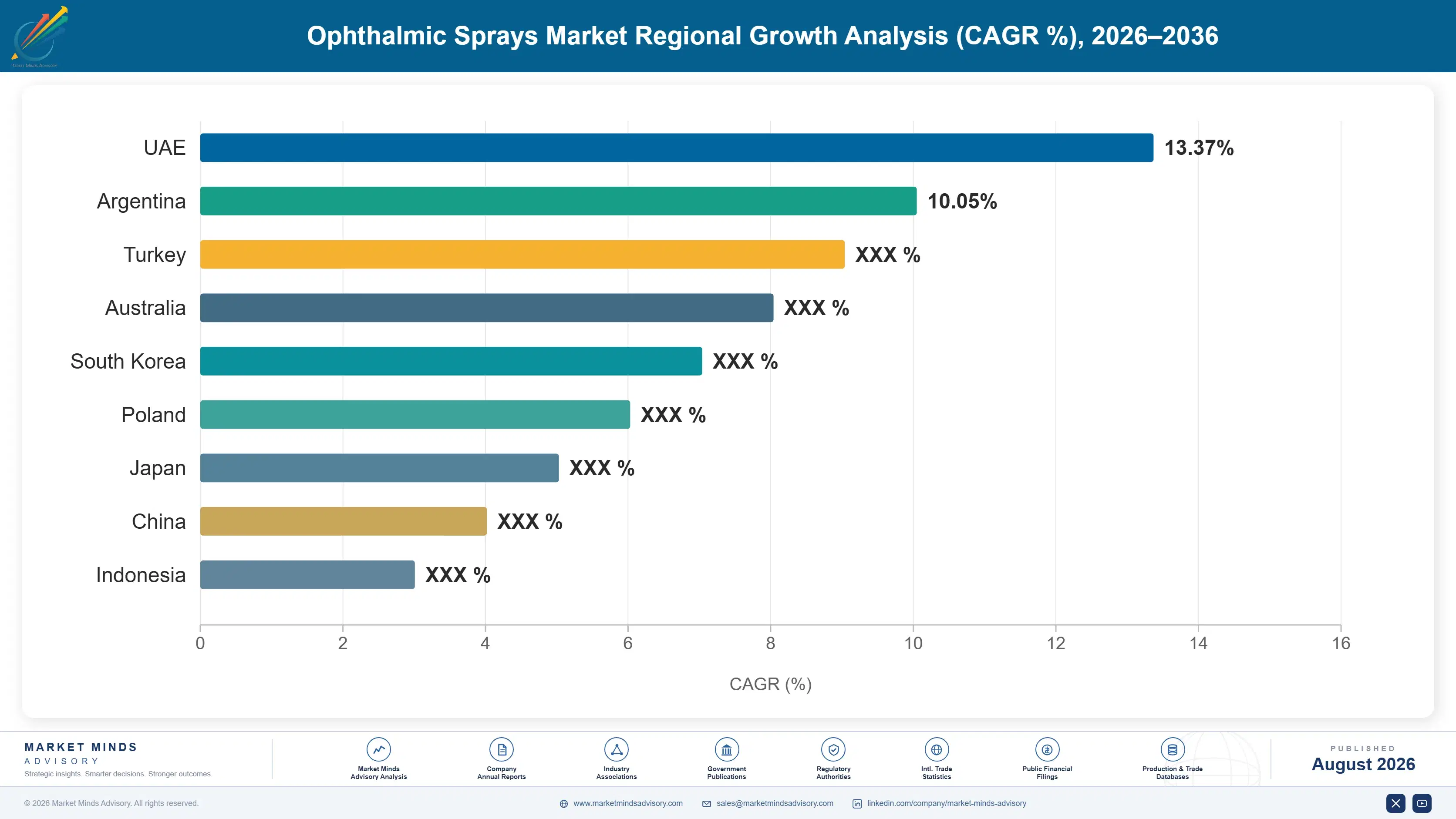
Regional intelligence for 5 additional markets available in the complete report: East Asia, South Asia and Pacific, Latin America, Middle East and Africa, Eastern Europe. Contact sales@marketmindsadvisory.com.
ophthalmic-sprays-market-country-cagr-analysis-1787559494631

Where Ophthalmic Spray Value Concentrates

Four moves matter for a format that wins on delivery rather than on chemistry, sits inside a permanent ceiling set by dose imprecision, and can be entered cheaply by almost anybody through a device clearance route. Two concern the channels that actually decide purchase, and two concern where this format genuinely outperforms a drop.

Sell instillation failure to the eye care professional

Around 43% of patients miss the eye applying a drop, and failure concentrates among the elderly patients most affected by dry eye, which makes delivery a clinical variable rather than a convenience. That argument persuades an optometrist or ophthalmologist in a way no device-constrained efficacy claim ever will. Manufacturers who put instillation technique data in front of clinicians reach the recommendation that actually drives purchase, and the argument works identically in every market regardless of pharmacy convention. It also works identically in every market regardless of local pharmacy convention. Convention varies but physiology does not.
Market Impact: Addresses a 43% rate of drop instillation failure

Build clinic detailing for lid hygiene specifically

Hypochlorous acid lid hygiene grows at 14.7% and is driven by eye care professionals rather than pharmacists, because blepharitis and Demodex are diagnosed in a clinic and not identified by a patient browsing a shelf. That makes the channel economics completely different from the rest of this category. Manufacturers organised around pharmacy distribution reach none of that demand, and a clinic detailing capability built for lid hygiene also carries dry eye products into the same conversation. Nobody browsing a shelf diagnoses their own blepharitis. The capability pays for itself across both segments.
Market Impact: Serves a segment now growing at 14.7% yearly

Lead with the lipid layer mechanism, not lubrication

Roughly 86% of dry eye is evaporative, meaning the outer lipid layer has failed, and an aqueous drop replaces the layer that was never deficient. A liposomal spray deposits phospholipid where that layer is generated. Positioning the product as lubrication puts it beside every artificial tear on the shelf and invites a price comparison. Positioning it against evaporative disease specifically explains why a drop has been failing the patient, which is a considerably stronger and entirely accurate argument. It is also entirely accurate, which matters under device labelling where overreach is not permitted and clinicians check.
Market Impact: Targets the 86% evaporative share of all cases

Win pharmacy recommendation where pharmacists decide

A pharmacist recommendation raises conversion around 3.2 times in markets where pharmacists occupy a central role in product selection, which describes German, Austrian, Swiss and much of Eastern European practice. Under a device route that limits efficacy claims, that recommendation is worth more than any packaging or advertising investment available. Manufacturers treating European pharmacy as retail distribution rather than as a professional recommendation channel consistently underperform brands that train and support the counter. Training the counter costs less than buying the shelf and cannot be outbid. Trade terms give away price and buy no recommendation at all.
Market Impact: Lifts conversion 3.2 times at the pharmacy counter

Who Controls the Margin Pool

Five brand owners hold 26% of this market, measured on retail and pharmacy sales value at manufacturer level, the basis used throughout this section. Concentration is low because 78% of products reach market through a device clearance route that costs a fraction of any medicine approval, which has filled shelves with brands a consumer cannot readily distinguish between on packaging alone.
Competition runs on four dimensions. Pharmacy counter recommendation, which lifts conversion around 3.2 times in the markets where pharmacists genuinely decide what a patient takes home. Eye care professional detailing, which drives lid hygiene entirely and increasingly reaches dry eye as well. Clinical evidence generation, which device labelling barely permits a brand to use commercially. And formulation quality in liposomal systems, where stability and spread behaviour do genuinely differ.

Rankings shift toward brands with clinic detailing capability and toward whoever establishes the format in American retail, which is by some distance the largest unpenetrated opportunity available. European brands hold the pharmacy counter relationships that built this category originally. Pharmaceutical eye care companies hold clinic access that small device-route brands cannot possibly afford to build for themselves.
ophthalmic-sprays-market-company-positioning-matrix-1787559495151

Competitive Moat and Risk Dimensions

BAUSCH AND LOMB

Moat: Eye care clinic access breadth

The company holds established detailing relationships with optometrists and ophthalmologists built across a full eye care portfolio, which matters because lid hygiene is entirely clinic-driven and dry eye recommendation increasingly is too. A small device brand cannot afford a comparable field organisation, and clinicians accept a call from a supplier they already buy other products from far more readily.
BAUSCH AND LOMB

Risk: Device claim constraints on evidence

Clinical evidence is expensive and device labelling barely permits a brand to use it, which limits differentiation against cheap entrants on the same shelf. Brands competing purely on pharmacy recommendation incur none of that cost. The regulatory route rewards low investment in a way that disadvantages participants best able to fund research.
THEA PHARMA

Moat: European pharmacy relationships depth

The company holds deep pharmacy counter relationships across European markets where pharmacist recommendation lifts conversion around 3.2 times and effectively decides which brand a patient takes home. Those relationships were built through training and support rather than through trade terms, which makes them considerably harder for a new entrant to buy into at any price.
THEA PHARMA

Risk: American market position underdeveloped

American growth at 11.4% leads every country here and the route in runs through optometrist and ophthalmologist recommendation rather than pharmacy, since American pharmacists play a much smaller role in product selection. European pharmacy capability transfers poorly to that channel. Brands with existing American eye care detailing organisations start considerably ahead in the fastest growing market.

Players Tracked

Prominent Players

Bausch and Lomb
Thea Pharma
Santen Pharmaceutical
Optima Pharmazeutische
NovaBay Pharmaceuticals

Other Key Players

Alcon
URSAPHARM
Horus Pharma
Reckitt Benckiser
Croma-Pharma
OCuSOFT
Similasan
Laboratoires Chauvin
Omisan Farmaceutici
Bruschettini
Visufarma
Sifi
Farmigea
Alfa Intes
Eyecare Pharmaceuticals

Recent Developments

FEBRUARY 2025

An eye care group added lid hygiene to standard blepharitis protocols

An optometry practice group incorporated hypochlorous acid lid spray into its standard blepharitis and Demodex management protocols, replacing mechanical lid scrub routines that patients had abandoned at high rates. This was a clinical protocol decision rather than any commercial arrangement with manufacturers. Adherence had been the stated problem.
Signal: Protocol inclusion converts a shelf product into a clinical instruction, which is where lid hygiene volume actually originates
JUNE 2025

A brand entered American optometry channels with liposomal spray

A European liposomal spray brand began detailing American optometry practices directly rather than pursuing retail pharmacy listing, citing the limited role American pharmacists play in eye care product selection compared with European practice. This was a channel strategy rather than any transaction. Retail listing was deliberately deferred.
Signal: European pharmacy capability transfers poorly into American markets where clinicians rather than pharmacists actually recommend products
OCTOBER 2025

A manufacturer published instillation technique comparison data

A spray manufacturer published comparative data on successful ocular delivery between drop instillation and closed lid spray application among elderly patients, positioning delivery reliability rather than formulation as the clinical argument. This was a research publication rather than any commercial transaction. Elderly patients formed the study population.
Signal: Delivery reliability is the one argument device labelling permits and clinicians find genuinely persuasive on its merits

What Drives Product Cost

The airless multi-dose spray pump accounts for roughly 41% of manufactured cost, which is high for a consumer health product and reflects that preservative-free delivery requires a mechanical solution rather than a chemical one. Phospholipid and active ingredients add around 19% in liposomal products and considerably less in saline formats. Filling under controlled conditions takes about 14%. Regulatory and evidence costs vary enormously by route.
Pump and component costs rose through 2021 and 2022 alongside general polymer and precision component inflation, while smaller brands buying modest volumes faced considerably worse terms than established manufacturers. Bausch and Lomb noted input cost and supply chain pressure across its consumer eye care operations in its Annual Report 2022. Brands on annual pharmacy pricing absorbed most of it, since shelf price changes require negotiation buyers resist.

The disadvantage falls on small brands buying pumps in low volume, and it appears through unit cost on the single largest component. A pump at 41% of cost bought at small-brand volumes can cost half again what a large manufacturer pays, erasing the advantage cheap clearance promised. Cheap entry does not mean cheap operation, which many small entrants discover only after launch.
ophthalmic-sprays-market-cost-volatility-analysis-1787559495345

Aggregate pump purchasing across a full product range

The airless spray pump is roughly 41% of manufactured cost and small volume purchasing carries a substantial penalty against established buyers. Standardising one pump platform across a whole product range consolidates volume onto a single component and improves terms materially. Brands running different pumps per product multiply their own cost disadvantage without gaining anything a consumer notices.

Fund evidence that device labelling can actually carry

Clinical efficacy claims are largely unavailable under device clearance, which makes efficacy research expensive and commercially unusable. Delivery reliability and instillation technique data are permitted and persuade clinicians directly. Directing evidence spending toward what a label may carry and a clinician will accept converts research budget into recommendation rather than into unpublishable data. Unpublishable data helps nobody.

Train pharmacy counters rather than buying shelf position

Pharmacist recommendation lifts conversion around 3.2 times in markets where pharmacists decide, and it responds to training and support rather than to trade terms. Shelf position purchased with margin gives away price without generating recommendation. Counter training costs less and produces an advantage competitors cannot simply outbid at the next negotiation. Recommendation is not for sale at auction.

Portfolio Architecture for Margin Defence

Margin separates on channel and recommendation rather than on formulation, which follows directly from a device route that limits what any brand may claim. Saline and comfort sprays run at gross margins in the high twenties against crowded pharmacy shelves where consumers cannot distinguish products. Allergy and paediatric formats run modestly better on specificity. Liposomal dry eye sprays run considerably higher where a mechanism argument is made properly. Clinic-recommended lid hygiene runs highest, because a professional instruction removes price comparison almost entirely.
The tension is that pharmacy volume built this category while clinic channels now carry the growth, and reaching clinicians requires a field organisation that a small device brand cannot fund from device-route margins. Brands weighted toward pharmacy face crowded shelves and cheap entrants indefinitely. Several have concluded that clinic detailing is unaffordable, which is arithmetically true and leaves the fastest growing segment entirely to competitors who found a way.

High-value pools sit in clinic-recommended lid hygiene, mechanism-positioned liposomal products and the unpenetrated American opportunity. Crowded pharmacy comfort sprays are where cheap device clearance has already decided how much anybody earns. The arithmetic is uncomfortable and it does not improve by being ignored.

Volume / Commodity-Adjacent

Saline and comfort sprays competing on crowded pharmacy shelves where device clearance lets anybody enter cheaply. The ten-point range separates brands with pump purchasing scale from small entrants paying substantially more for the same component.
Gross Margin: 26%-36%

Premium / Certified

Liposomal dry eye and allergy formats where formulation stability and a mechanism argument support genuine differentiation. The fourteen-point spread reflects how well the evaporative disease argument is actually made rather than any formulation gap.
Gross Margin: 38%-52%

Sustainability / Regulatory / Next-Generation

Clinic-recommended lid hygiene and peri-operative antiseptic products supported by professional detailing. The twenty-point range is wide because clinical channel depth and protocol inclusion vary enormously between brands and practice groups.
Gross Margin: 50%-70%
ophthalmic-sprays-market-portfolio-architecture-1787559495842

High-value Sub-segments and Strategic Watch-out

Clinic-Recommended Lid Hygiene

Compounding at 14.7% as Demodex blepharitis diagnosis rises from a very low recognition base. A professional instruction removes price comparison, and protocol inclusion makes the position genuinely durable. Clinic detailing is the barrier and also the moat. Small brands cannot fund it. Diagnosis drives it.
Gross Margin: 52%-70%

Mechanism-Positioned Liposomal

Growing at 11.4% where the evaporative disease argument is made properly rather than positioning the product as another lubricant. That framing explains why the patient's drops were failing them. Explaining the failure of previous drops is the strongest argument available here. Mechanism beats lubrication claims.
Gross Margin: 40%-54%

American Channel Entry

The largest unpenetrated opportunity at 11.4% country growth, reached through optometry rather than pharmacy. European counter relationships transfer poorly, which leaves the position genuinely open. Optometry detailing is the route rather than retail pharmacy listing. The opening remains wide. Awareness rather than prevalence is the real constraint.
Gross Margin: 36%-52%

Pharmacy Comfort Sprays

The shelf volume, crowded by cheap device clearance and offering nothing a consumer can distinguish. Manage this for pump purchasing scale rather than for any margin that competition will permit. Device clearance has already settled what anybody earns here. Pump scale is the only lever.
Gross Margin: 26%-36%

How Spray Demand Renews

Demand renews continuously because dry eye and blepharitis are chronic conditions managed rather than cured, which produces a genuine annuity provided the patient keeps using the product. Adherence is the fragile part. A patient who found drops difficult and switched is unusually likely to persist, since the reason they abandoned the previous format has gone.
Stickiness varies sharply by how the patient started. A product included in a clinical protocol and instructed by an eye care professional renews as long as the condition persists, because stopping feels like disregarding advice. A pharmacy purchase made on a counter recommendation renews while the recommendation is remembered. A shelf purchase made unaided renews only if the patient perceives benefit, and with device labelling limiting expectations, many do not. Device labelling limits what a shelf shopper is ever told to expect.

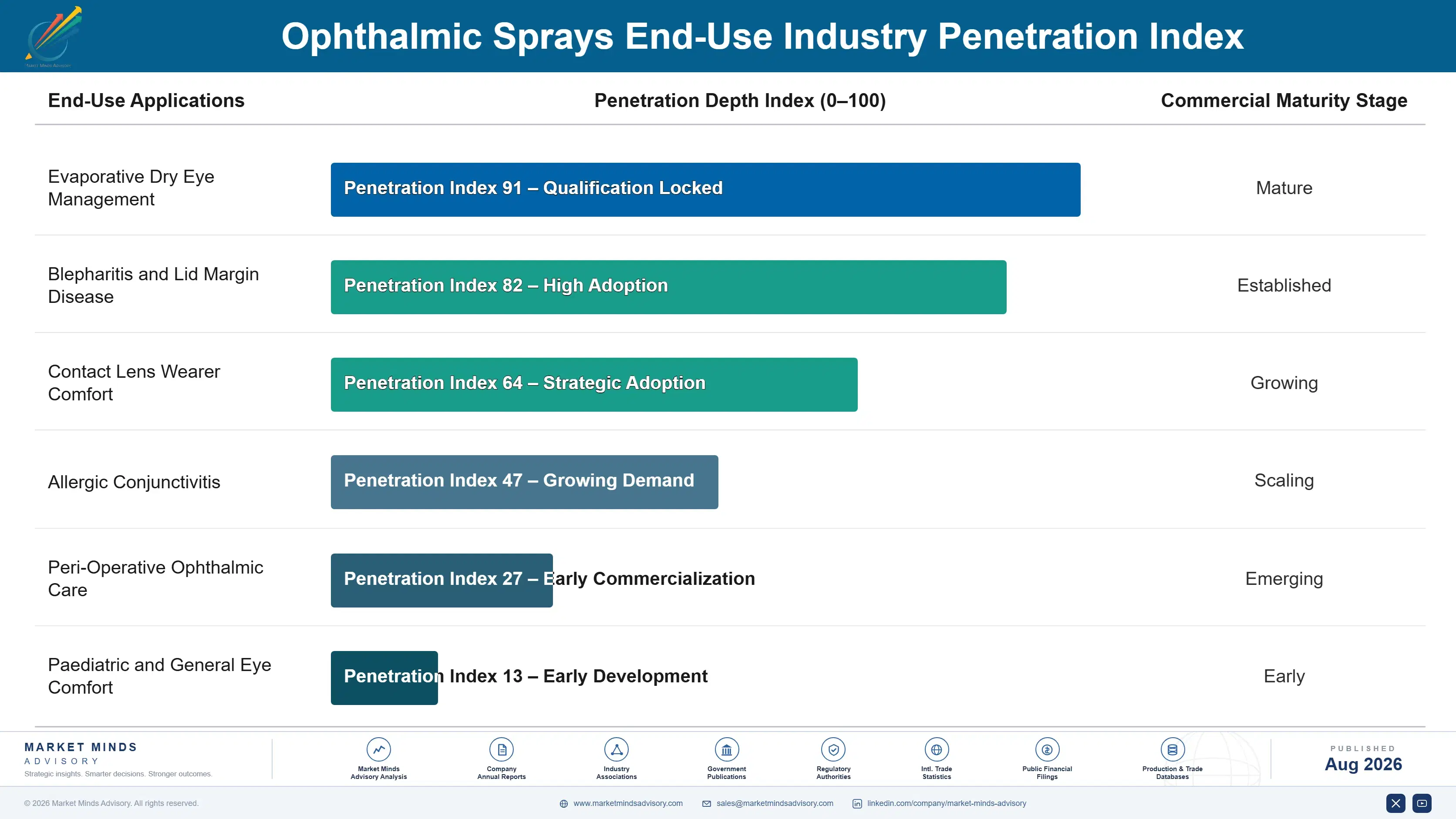
The buyer sits in three different places depending on segment, and brands organised around one of them serve the others poorly. Lid hygiene is effectively prescribed by clinicians. Liposomal dry eye products are recommended at a pharmacy counter in Europe and by optometrists elsewhere. Comfort sprays are chosen unaided from a shelf on packaging and price alone.
ophthalmic-sprays-market-end-use-penetration-index-1787559496327

Where To Place The Bet

These are among the four positions where our research anticipates prominent divergence between winners and laggards over the coming forecast period. Each is grounded in the demand model, the regulatory perimeter, and the announced capacity pipeline.
01 / DELIVERY EVIDENCE SELLING

Sell what device labelling actually permits you to claim

Roughly 43% of patients miss the eye when applying a drop, and the failure rate concentrates among elderly users with tremor, arthritis or poor vision who are precisely the population most affected by chronic dry eye disease. Medication that never reaches the eye has no effect regardless of its formulation, which makes delivery a genuine clinical variable. That argument persuades clinicians and is permitted under device labelling in a way that efficacy claims are not, which makes it the only research spending that converts into recommendation.
02 / CLINIC CHANNEL BUILDING

Follow lid hygiene into the consulting room

Hypochlorous acid lid hygiene compounds at 14.7% and is driven entirely by eye care professionals rather than pharmacists, because blepharitis and Demodex are diagnosed in a clinic and never identified by a patient browsing a pharmacy shelf unaided. That makes the channel economics completely different from everything else in this category. Manufacturers organised around pharmacy distribution reach none of that demand, and a clinic capability built for lid hygiene carries dry eye products into exactly the same clinical conversation without additional cost.
03 / EVAPORATIVE DISEASE POSITIONING

Explain why their drops were not working

Around 86% of dry eye is evaporative rather than aqueous deficient, which means the tear film's outer lipid layer has failed and an aqueous artificial tear replaces the layer that was never the problem in the first place. A liposomal spray deposits phospholipid onto the lid margin where that lipid layer is generated and spread. Positioning the product as lubrication puts it beside every artificial tear on the shelf, while positioning it against evaporative disease explains the patient's actual experience.
04 / AMERICAN MARKET ENTRY

Take the largest unpenetrated dry eye population

American country growth at 11.4% leads this entire market simply because the format remains comparatively unfamiliar in a country with high dry eye prevalence, a large elderly population and considerable screen-related complaint driving new diagnosis. The route in runs through optometrist and ophthalmologist recommendation rather than pharmacy, since American pharmacists play a far smaller role in eye care product selection than their European counterparts. European pharmacy counter capability transfers poorly, which leaves the opening genuinely available to whoever builds the clinical channel first.

Engagement Snapshot From the Field

A live engagement with an industry participant carrying material or product regulatory and market exposure ahead of a defining policy shift, showing how our research translates into a defensible multi-year portfolio strategy.
MARKET MINDS ADVISORY · CLIENT ENGAGEMENT SUMMARY
Ophthalmic Sprays Producer Strategic Portfolio Review and Transition Roadmap 2026·Investment Scenario on Ophthalmic Sprays Exposure Evaluation 2025-26
CLIENT PROFILE
A European ophthalmic spray brand with annual revenue around EUR 42 million (client-reported, unverified by MMA), selling liposomal dry eye and comfort sprays through pharmacy channels across German-speaking and adjacent markets. No lid hygiene product existed. No American presence existed anywhere in the business. Growth had slowed as pharmacy shelves crowded with device-route entrants. Lid hygiene was absent.
STRATEGIC CHALLENGE
European growth had slowed as pharmacy shelves crowded with cheap device-route entrants, and management proposed increasing trade terms to defend shelf position. Nobody had examined which segments were actually growing or whether shelf position was what determined purchase in the first place. The conversion mechanism itself had never been tested.
MMA APPROACH
MMA decomposed category growth by segment and by channel rather than by geography, then tested whether shelf position or pharmacist recommendation drove conversion in the client's core markets. Lid hygiene entry requirements were costed against clinic detailing capability. American channel structure was assessed against the client's existing pharmacy competencies. Pump purchasing was benchmarked.
KEY FINDINGS
  1. Pharmacist recommendation drove conversion around three times more strongly than shelf position, which meant trade term increases would have bought the weaker of the two available levers.
  2. Lid hygiene was growing at nearly half again the client's own segment rate and required clinic detailing the client did not have, but the same capability would carry dry eye products alongside.
  3. American opportunity was substantially larger than any remaining European upside, and the route ran through optometry rather than pharmacy, where the client's competencies transferred poorly.
  4. Pump purchasing was split across three platforms for no consumer-visible reason, which was costing meaningful margin against competitors buying a single component in volume.
CLIENT PROFILE
A European ophthalmic spray brand with annual revenue around EUR 42 million (client-reported, unverified by MMA), selling liposomal dry eye and comfort sprays through pharmacy channels across German-speaking and adjacent markets. No lid hygiene product existed. No American presence existed anywhere in the business. Growth had slowed as pharmacy shelves crowded with device-route entrants. Lid hygiene was absent.
STRATEGIC CHALLENGE
European growth had slowed as pharmacy shelves crowded with cheap device-route entrants, and management proposed increasing trade terms to defend shelf position. Nobody had examined which segments were actually growing or whether shelf position was what determined purchase in the first place. The conversion mechanism itself had never been tested.
MMA APPROACH
MMA decomposed category growth by segment and by channel rather than by geography, then tested whether shelf position or pharmacist recommendation drove conversion in the client's core markets. Lid hygiene entry requirements were costed against clinic detailing capability. American channel structure was assessed against the client's existing pharmacy competencies. Pump purchasing was benchmarked.
KEY FINDINGS
  1. Pharmacist recommendation drove conversion around three times more strongly than shelf position, which meant trade term increases would have bought the weaker of the two available levers.
  2. Lid hygiene was growing at nearly half again the client's own segment rate and required clinic detailing the client did not have, but the same capability would carry dry eye products alongside.
  3. American opportunity was substantially larger than any remaining European upside, and the route ran through optometry rather than pharmacy, where the client's competencies transferred poorly.
  4. Pump purchasing was split across three platforms for no consumer-visible reason, which was costing meaningful margin against competitors buying a single component in volume.
RECOMMENDED STRATEGY
Phase 1: Phase one: redirect trade term spending into pharmacy counter training, since recommendation drives conversion around three times more strongly than shelf position does. Phase 2: Phase two: add a hypochlorous acid lid hygiene product and build clinic detailing capability, which serves the fastest growing segment and carries dry eye products with it. Phase 3: Phase three: enter American optometry channels directly rather than pursuing retail pharmacy listing, and consolidate onto a single pump platform to recover component margin.
OUTCOME
Counter training lifted conversion in trained pharmacies materially against untrained comparators. Lid hygiene launched with clinic detailing and is growing ahead of plan. American optometry entry has begun, and the client reports gross margin improving on pump consolidation alone (client-reported, unverified by MMA). Trade term spending was redirected entirely.

Frequently Asked Questions

Foundational context covering the market sizes, CAGR, scope, country, region and competition that inform every finding below. This section is provided to cover basics and most often pre-purchase conversations, answered from the MMA Primary Research Dataset.

What is the current size of the Ophthalmic Sprays Market?

The market was valued at USD 0.58 billion in 2025, rising to an estimated USD 0.64 billion in 2026. Western Europe holds the largest regional share at 36% of value.

How large will the Ophthalmic Sprays Market be by 2036?

MMA forecasts USD 1.62 billion by 2036 under the base case, an expansion multiple of 2.55 times the 2026 value. That represents USD 0.98 billion of incremental value.

What is the CAGR for the Ophthalmic Sprays Market 2026 to 2036?

The base case runs at 9.8% compound annual growth between 2026 and 2036, with a bull case at 11.0% and a bear case at 8.6%. Historical growth from 2020 to 2025 was 8.4%.

Which segment is growing fastest?

Hypochlorous acid lid hygiene leads at 14.7%, half again the market rate, as Demodex blepharitis diagnosis rises from a low base. Liposomal dry eye sprays follow at 11.4%.

Who are the major companies in the Ophthalmic Sprays Market?

Bausch and Lomb, Thea Pharma, Santen, Optima Pharmazeutische and NovaBay hold 26% of the market. Cheap device clearance keeps concentration unusually low across crowded pharmacy shelves.

Which country is growing fastest?

The United States leads at 11.4%, simply because the format remains comparatively unfamiliar in a country with high dry eye prevalence and a large elderly population.

Report Segmentation Architecture

The full report scope spans multiple orthogonal segmentation dimensions, with cross-tabulated demand data provided for each dimension pair. Coverage extends further to regional breakdowns, trend trajectories, and the competitive detail needed to support segment-level decision-making.

By Product Type

  • Liposomal Dry Eye Sprays
  • Hypochlorous Acid Lid Hygiene
  • Preservative-Free Saline and Comfort Sprays
  • Allergy and Antihistamine Eye Sprays
  • Peri-Operative and Antiseptic Sprays
  • Paediatric and Contact Lens Comfort Sprays

By End-Use Industry

  • Evaporative Dry Eye Management
  • Blepharitis and Lid Margin Disease
  • Contact Lens Wearer Comfort
  • Allergic Conjunctivitis
  • Peri-Operative Ophthalmic Care
  • Paediatric and General Eye Comfort

By Distribution Channel

  • Retail and Community Pharmacy
  • Optometry Practice Supply
  • Ophthalmology Clinic Recommendation
  • Online and Direct to Consumer
  • Hospital and Surgical Supply

By Region

  • North America
  • Western Europe
  • East Asia
  • South Asia and Pacific
  • Latin America
  • Middle East and Africa
  • Eastern Europe

Scope, Methodology, and Coverage

Every figure in this report is reproducible from documented input assumptions. The scope below maps the historical period, the forecast horizon, the segmentation dimensions, and the countries covered, alongside the underlying primary and qualitative methodology.
Historical Period
2020 to 2025
Forecast Period
2026 to 2036
Base Year
2025 (USD billions; MMA Primary Research Dataset, August 2026)
Market Definition
The market comprises ophthalmic sprays applied to the closed eyelid or ocular surface, including liposomal dry eye sprays, hypochlorous acid lid hygiene, preservative-free saline and comfort sprays, allergy and antihistamine eye sprays, peri-operative and antiseptic sprays, and paediatric and contact lens comfort sprays, distributed through pharmacy, optometry, ophthalmology, online and hospital channels. Value is measured at manufacturer level across pharmacy, retail and professional sales. Conventional eye drops and gels, ointments, contact lens solutions, prescription ophthalmic medicines delivered by drop or injection, and lid wipes or mechanical cleaning devices fall outside scope.
Quantitative Units
USD billions (current prices); units sold; USD per unit by product type and channel
Segmentation Dimensions
By Product Type; By End-Use Industry; By Distribution Channel; By Region
Regions Covered
North America, Western Europe, East Asia, South Asia and Pacific, Latin America, Middle East and Africa, Eastern Europe
Countries Covered
Germany, Austria, Switzerland, France, Italy, Spain, Netherlands, Belgium, United Kingdom, Sweden, United States, Canada, Mexico, Brazil, Argentina, Colombia, Japan, China, South Korea, Taiwan, India, Thailand, Singapore, Australia, Poland, Czechia, Hungary, United Arab Emirates, Saudi Arabia, South Africa
Key Companies Profiled
Bausch and Lomb, Thea Pharma, Santen Pharmaceutical, Optima Pharmazeutische, NovaBay Pharmaceuticals, Alcon, URSAPHARM, Horus Pharma, Reckitt Benckiser, Croma-Pharma, OCuSOFT, Similasan, Laboratoires Chauvin, Omisan Farmaceutici, Bruschettini, Visufarma, Sifi, Farmigea, Alfa Intes, Eyecare Pharmaceuticals
Quantitative Methodology
Primary survey, n=3,800 respondents, Q4 2025, six countries; demand-side model with trade association cross-validation
Qualitative Methodology
47 expert interviews, Q4 2025; applied to validate demand model assumptions, identify emerging dynamics, and assess competitive positioning
Report Format
PDF and XLSX data workbook (Word format preview document)
Publisher
Market Minds Advisory
Report Code
MMA-2026-HLT-105
Published
August 2026
Contact
sales@marketmindsadvisory.com | www.marketmindsadvisory.com

Purchase the full Ophthalmic Sprays Market Report (2026 to 2036).

The full report sizes the global ophthalmic spray market to 2036 across six product types and seven regions, measured at manufacturer level across pharmacy, retail and professional channels. It treats delivery reliability rather than formulation as the therapeutic argument, and quantifies the dose precision ceiling that permanently confines this format to lubrication and lid hygiene. Competitive analysis covers 20 brand owners on one consistent revenue basis, with moat and risk assessment for the two leaders. Channel conversion economics are compared across pharmacy and clinical routes by region. Four quantified revenue levers close the analysis.
Six product type segments with individual growth rates
Instillation failure quantified as the underlying therapeutic argument
Dose precision ceiling modelled as a permanent market boundary
Pharmacy and clinical channel conversion economics compared by region
Twenty-brand competitive map on one consistent revenue basis
Four quantified revenue levers with commercial impact ranges

Built For The People Who Decide

From boardroom strategy to bench-side execution, this report is read cover-to-cover by leaders shaping the next decade of their industry, turning demand scenarios, market dynamics and valuation benchmarks into decisions.
CXOs/ Presidents/ VPs/ Managers
M&A and Corporate Development
Strategy Teams and R&D Heads
Procurement and Product Directors
Regulatory and Compliance Leaders
Investor Relations and Equity Analysts