Market Minds Advisory
Ophthalmic Drug Packaging Market

Ophthalmic Drug Packaging Market: Preservative removal, the unit-dose reversal and intravitreal presentation to 2036

Taking the preservative out of an eye drop moved the entire technical burden onto the container, and the container stopped being packaging and became a device that costs several times more.

Lead Analyst

Bilal Shaikh

Published

September 2026

Make Smarter Decisions with Customized Research Insights

Request a free sample report and evaluate market opportunities, growth trends, and competitive dynamics relevant to your business needs.

2025 MARKET VALUE$2.8BMarket Size 2025
2036 FORECAST VALUE$6.8BBase Case , 2026 to 2036
CAGR 2026 TO 20368.4 %Bull 9.6% / Bear 7.2%
INCREMENTAL OPPORTUNITY$3.8BNet 10- year value creation
EXPANSION MULTIPLE2.24x2036 value over 2026 base
Strategic Levers
M&A Pipeline
Regional Outlook
Country Rankings
Competitive Intelligence
Segmental Deep-dive
Call-Us : 91 93563 13602

Executive Snapshot and Market Trajectory

Benzalkonium chloride damages the ocular surface with chronic use, which matters enormously to a glaucoma patient dosing daily for decades. Around 46% of chronic drop prescriptions are now preservative-free, and without a preservative the container itself has to prevent contamination. That transfer is the whole story here.
That single requirement turned packaging into a device. A multi-dose preservative-free bottle needs a one-way valve and a filter membrane and costs roughly six times a plain bottle, while a sealed single-use ampoule solves the problem differently. Multi-dose preservative-free systems grow at 12.6%, half again the market rate of 8.4%. Moulders quoting on resin cost were not prepared for a microbiology problem arriving in their specification.
The reversal almost nobody anticipated is sustainability. Unit-dose ampoules waste around 68% of the product they hold and use roughly nine times the plastic per dose, so packaging rules now argue against the format that preservative-free conversion originally built. Western Europe holds 30% of value, where both the clinical practice and the device technology originated. Both the clinical practice and the device technology originated in the same place, which is unusual and commercially consequential.
Market Definition
This report covers primary packaging and delivery presentations for ophthalmic medicines, spanning multi-dose preserved bottles, multi-dose preservative-free systems, unit-dose blow-fill-seal ampoules, prefilled syringes for intravitreal use, vials and ampoules for injection, and ointment tubes and gel applicators. Value is measured at packaging supplier level on components and assembled presentations. Excluded are secondary and carton packaging, contact lens packaging and solutions, surgical instruments and intraocular devices, drug substance and formulation, and contract filling services billed separately from components.
Base Year Value
$2.8B in 2025 (MMA Primary Research Dataset, August 2026)
Forecast Period
2026 to 2036, eleven discrete annual values
CAGR
8.4% base case. Bull 9.6%. Bear 7.2%.
Fastest Growth Segment
Multi-Dose Preservative-Free Systems: 12.6% CAGR
Fastest Growth Country
India: 11.8% CAGR
Fastest Growth Region
South Asia and Pacific: 10.4% CAGR
Largest Region
Western Europe: 30% of 2025 global value
Market Leaders
AptarGroup, Nemera, Gerresheimer, Becton Dickinson and Rommelag lead the market. Source: MMA Primary Research Dataset, July 2026.
Primary Survey
n=3,800 procurement and R&D decision-makers, Q4 2025, six countries
Methodology
Demand-side build-up, cross-validated against public data, 47 expert interviews

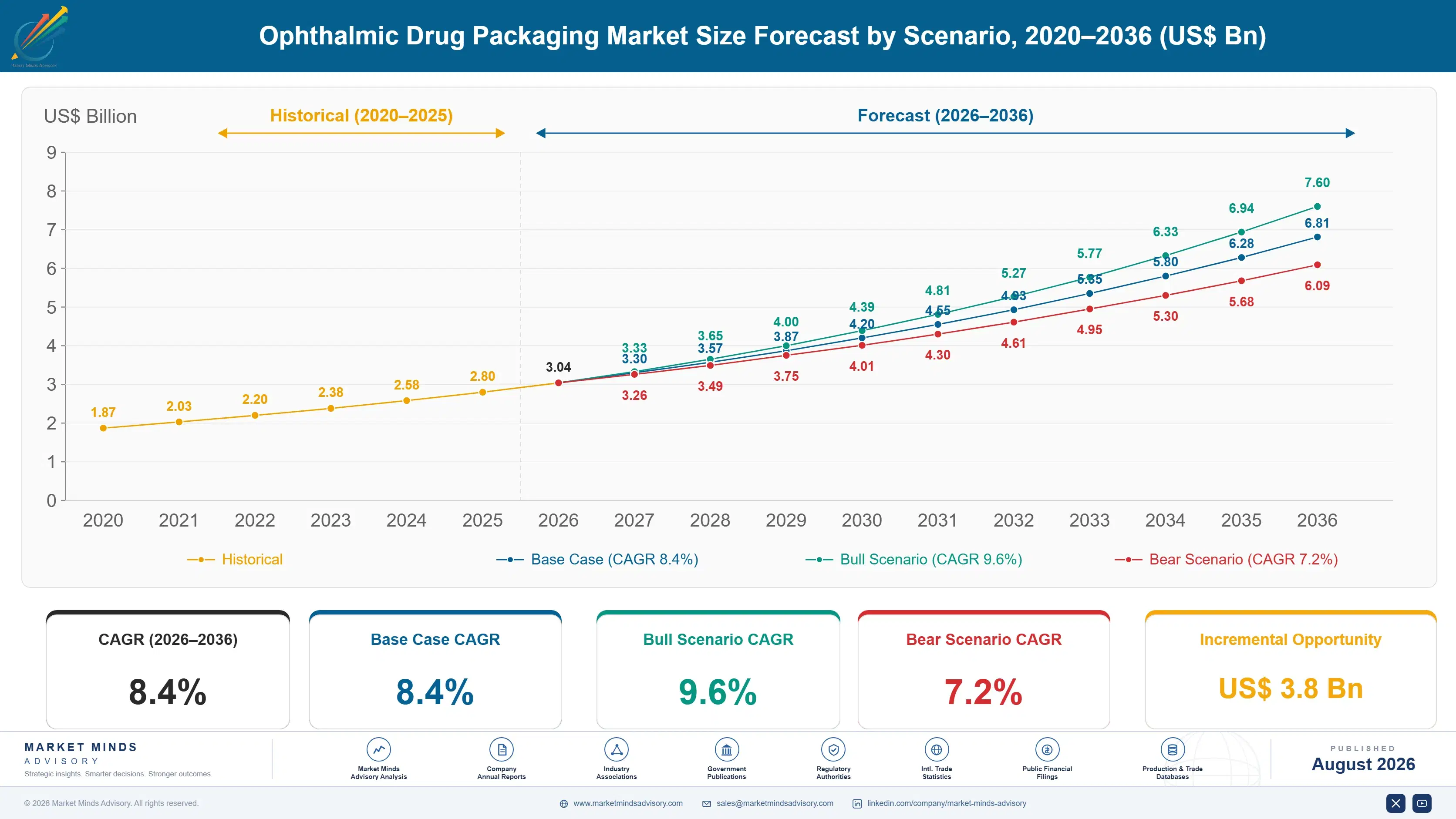
Ophthalmic Drug Packaging Market Forecast Scenarios

ophthalmic-drug-packaging-market-size-forecast-scenario-1787559474177
Growth ran at 7.0% between 2020 and 2025 and preservative removal drove almost all of it. Chronic glaucoma and dry eye therapy converted steadily away from benzalkonium chloride, mostly into unit-dose ampoules because they were the established preservative-free answer. Intravitreal injection volumes grew rapidly alongside, though much of that drug supply remained in vials rather than moving to prefilled presentation.
The 8.4% base case rests on three mechanisms. Multi-dose preservative-free systems at 12.6% as sustainability arithmetic turns against unit-dose formats. Prefilled syringes at 11.4% on intravitreal procedures growing around 14% annually and prefilled presentation removing preparation steps. And Indian growth at 11.8%, the fastest of any country, on diabetic retinopathy and glaucoma diagnosis expanding with healthcare access. Each diagnosed patient converts into sustained packaging demand rather than any single course of treatment.
The 9.6% bull case is packaging waste rules reaching pharmaceuticals directly, which would accelerate the shift away from unit-dose faster than clinical preference alone manages. The 7.2% bear case is multi-dose device cost restricting adoption in price-sensitive markets, since a valve and filter system at six times a plain bottle is a genuine obstacle to reimbursement.

When Packaging Became A Device

A preserved eye drop bottle is a simple moulded container because the chemistry inside it handles contamination. Remove the preservative, which chronic glaucoma therapy increasingly demands because benzalkonium chloride damages the ocular surface over years of daily dosing, and that burden transfers entirely to the container. It must now stop air and organisms travelling back through the tip after every drop, which requires a one-way valve, a filter membrane and frequently an antimicrobial tip treatment. The result costs around six times a plain bottle and is a device rather than packaging.
TOP-FIVE CONCENTRATION44%Combined position across supply held by the leading packaging suppliers
PRESERVATIVE-FREE PRESCRIPTION SHARE46%Portion of chronic eye drops now dispensed without any preservative
UNIT-DOSE VOLUME WASTE68%Product discarded because an ampoule holds more than needed
MULTI-DOSE DEVICE COST RATIO6xPrice relative to a plain bottle for valve systems
PLASTIC PER DOSE RATIO9xMaterial used by unit ampoules against a multi-dose alternative
INTRAVITREAL INJECTION GROWTH14%Annual increase in procedures requiring sterile delivery presentation
Unit-dose ampoules solved the same problem far more simply by sealing a single dose and discarding the container, and they carried most of the preservative-free conversion for a decade. Their weakness has become visible only recently. An ampoule holds more than a patient uses, so roughly 68% of the product is discarded, and the format consumes around nine times the plastic per dose that a multi-dose system does. As packaging waste rules reach pharmaceuticals, that arithmetic is turning against the format.
Injectable ophthalmics run on a separate track entirely. Intravitreal procedures are growing near 14% a year and prefilled syringes remove preparation steps that introduce contamination risk.
"The moment you take the preservative out, you have handed the microbiology problem to a moulder, and most moulders were not ready for that. The companies who understood they were now making a device rather than a bottle have done very well, and the rest are still quoting on resin cost."
Director, Pharmaceutical Packaging and Drug Delivery Practice · MMA Medical Devices and Pharmaceutical Packaging Practice · August 2026

Market Trends

Sustainability arithmetic turns against unit-dose ampoules

Unit-dose ampoules carried preservative-free conversion for a decade by sealing a single dose, but a patient uses far less than an ampoule holds and roughly 68% of the product is discarded, while the format consumes around nine times the plastic per dose that a multi-dose system requires. Packaging waste requirements now reaching pharmaceuticals make that difficult to defend. Commercially this reverses a decade of format growth and redirects it toward multi-dose preservative-free systems at 12.6%, which is an unusually sharp change of direction for a regulated packaging category. Payers are already applying the arithmetic in formulary decisions.
Market Impact: Reaches 46% of chronic prescriptions
Prefilled presentation removes steps that introduce contamination

Intravitreal anti-VEGF injection volumes grow near 14% annually and each procedure traditionally required drawing drug from a vial into a syringe in the clinic, a preparation sequence with genuine contamination and dosing error exposure. Prefilled syringes eliminate it entirely. Growth at 11.4% follows both procedure volume and conversion from vial presentation. Silicone oil used as a barrel lubricant complicates matters, since it has been associated with floaters after injection, which has pushed development toward low-silicone and silicone-free barrel technology across the segment. Each alternative barrel technology needs separate qualification against the specific drug product it will carry.
Market Impact: Indian demand compounds at 11.8%

Market Opportunities and Growth Drivers

Chronic glaucoma therapy converts away from preservatives

Glaucoma patients apply drops daily for decades, and benzalkonium chloride causes cumulative ocular surface damage that becomes clinically significant across that timeframe rather than in any single course of treatment. Around 46% of chronic prescriptions are now preservative-free and prescribing practice continues moving. Commercially this converts a simple moulded bottle into either a sealed ampoule or a valve and filter device, which multiplies packaging value per prescription several times over and shifts supply toward participants with device rather than container capability. Device rather than container capability now decides who can supply it.
Market Impact: Devices cost 6 times a bottle

Indian diagnosis rates expand with healthcare access

Indian growth at 11.8% leads every country in this market, driven by diabetic retinopathy and glaucoma diagnosis expanding as ophthalmic healthcare access improves and a very large diabetic population enters screening. Both conditions require chronic therapy or repeated injection, which makes each diagnosed patient a sustained packaging demand rather than a single course. Domestic pharmaceutical manufacture supplies most of that volume and packaging is sourced regionally where possible, though preservative-free device components are largely imported from European suppliers. Preservative-free device components remain largely imported from European suppliers, which raises cost in a price-sensitive market considerably.
Market Impact: Segment grows at 11.4% annually

Market Restraints and Challenges

Device cost restricts preservative-free access in price-sensitive markets

A multi-dose preservative-free system with a one-way valve and filter membrane costs roughly six times a plain preserved bottle, which is a genuine obstacle where reimbursement is tight or patients pay directly. The root cause is that removing a cheap chemical preservative requires an engineered mechanical solution in its place. Commercially this splits the market by health system rather than by clinical need, since the patients dosing longest are often those least able to fund the premium. Suppliers are pursuing simplified valve designs at lower cost points. Patients dosing longest are often least able to fund it.
Market Impact: Ampoules waste 68% of product

Silicone lubricant complicates prefilled intravitreal presentation

Prefilled syringes rely on silicone oil to let the plunger move smoothly, and silicone droplets have been associated with floaters appearing after intravitreal injection, which patients notice and report. The root cause is that a lubricant acceptable in most injection routes becomes visible when it enters the vitreous. Commercially this has required low-silicone and silicone-free barrel development with different sealing and gliding solutions. Suppliers are advancing cross-linked silicone and alternative coatings, though each requires fresh extractables and stability qualification. Qualification timelines make a late position expensive, since requalification runs alongside the drug programme rather than independently of it.
Market Impact: Procedures grow 14% each year
4 additional market trends, 3 additional growth drivers, and 2 additional restraints and challenges are covered in the full report. Contact sales@marketmindsadvisory.com to access the complete intelligence.

Segment CAGR and Growth Architecture

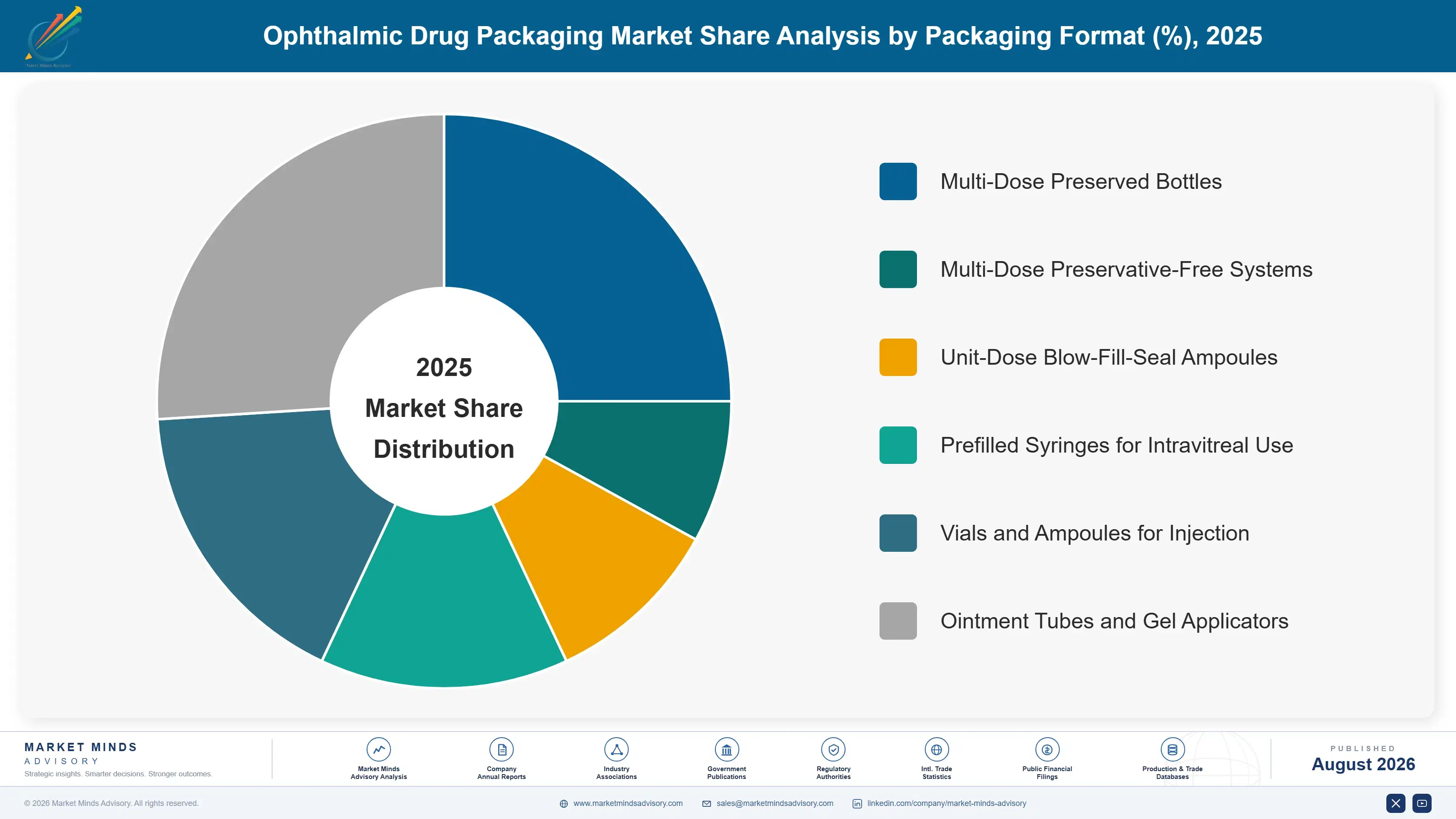
Value is classified here by packaging format and presentation, since the contamination control approach, the cost and the regulatory qualification all follow directly from how a dose reaches the eye. Material, therapeutic area and supply arrangement are each handled separately in the framework below, because a single format serves several different therapies entirely unchanged.
ophthalmic-drug-packaging-market-market-share-analysis-1787559474742

Multi-Dose Preservative-Free Systems

Growing at 12.6%, half again the market rate, these systems replace a chemical preservative with a mechanical one, using a one-way valve and filter membrane to stop air and organisms travelling back through the tip after each drop. The result costs roughly six times a plain bottle and is genuinely a device rather than a container. Growth now comes from two directions at once: continuing conversion away from preserved formulations, and a reversal in which sustainability arithmetic pushes prescribers and payers away from unit-dose ampoules. Squeeze force and dosing consistency matter enormously here, because elderly glaucoma patients with limited hand strength are the principal users. Actuation force is a clinical outcome rather than a specification detail.
CAGR 12.6%

Prefilled Syringes for Intravitreal Use

Intravitreal anti-VEGF injection volumes grow near 14% annually across macular degeneration, diabetic macular oedema and retinal vein occlusion, and prefilled presentation removes the clinic preparation sequence where drug is drawn from a vial into a syringe. That sequence carries genuine contamination and dosing accuracy exposure, and eliminating it is the commercial argument. Growth at 11.4% reflects procedure volume and vial conversion together. Silicone oil lubrication is the technical complication, having been associated with post-injection floaters, which has driven low-silicone and silicone-free barrel work that each requires separate extractables and stability qualification. Drug developer relationships formed during clinical development persist for the whole commercial life of a product, which makes early qualification unusually valuable to a supplier.
CAGR 11.4%
Full segment breakdown across 6 segments available in the complete report.

Regional Architecture and Country Demand Map

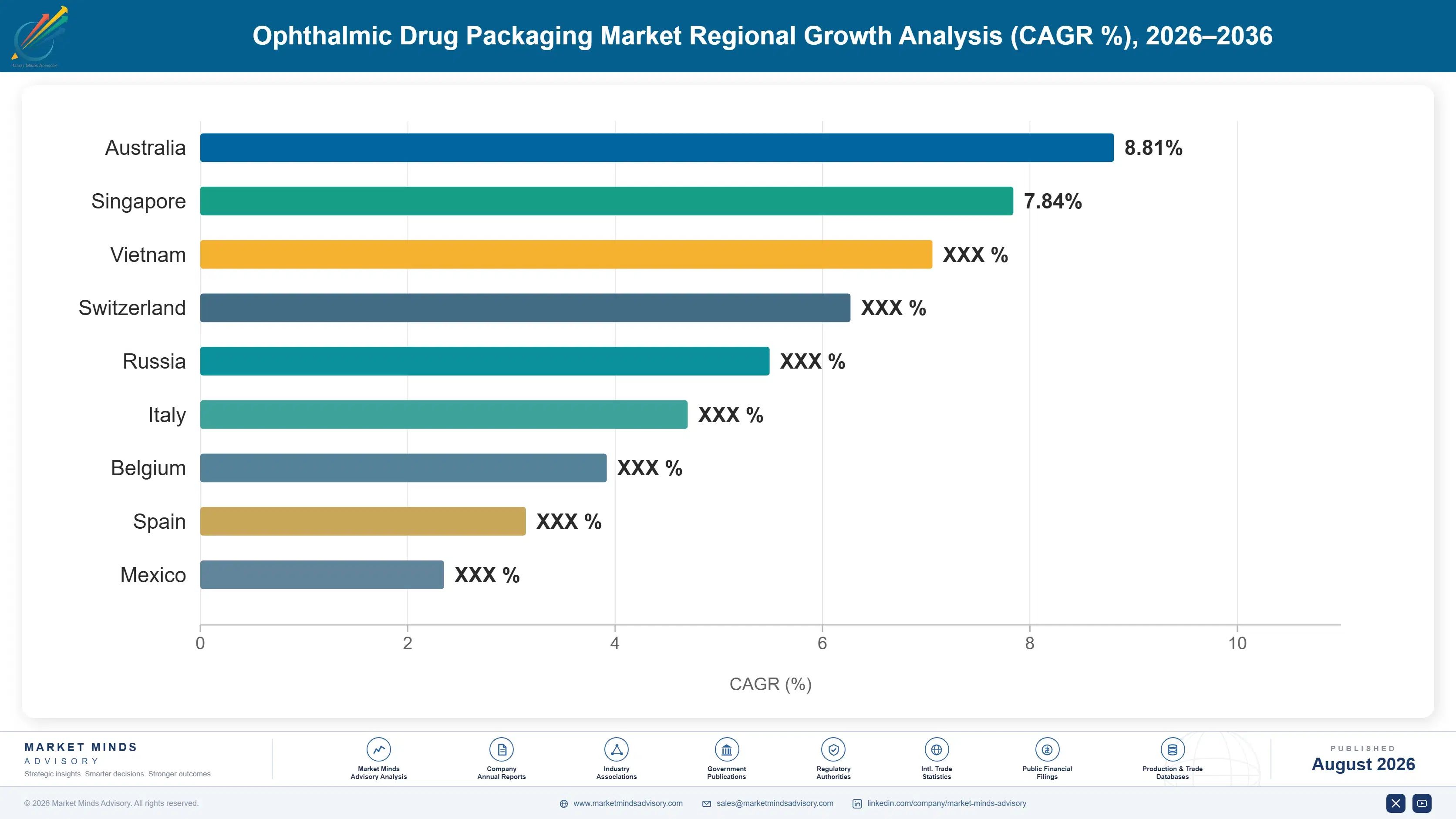
Western Europe holds 30% of value here, well above the standard band, because preservative-free ophthalmic prescribing began here and because the multi-dose device technology itself was developed by European suppliers. North America follows closely at 28% on ophthalmic drug spending and on intravitreal procedure volume together.

Western Europe

At 30% this region sits above the standard band and leads the market, because preservative-free ophthalmic prescribing began here and remains furthest advanced, particularly across French and German glaucoma practice where benzalkonium chloride avoidance became standard well ahead of other markets. The multi-dose device technology itself is overwhelmingly European, with Aptar, Nemera, Rommelag and Ursatec all holding significant positions built from that clinical demand. Packaging waste requirements also reach pharmaceuticals here first, which is what is now turning the argument against unit-dose. Growth at 6.8% is the weakest here on an advanced conversion base. Regional suppliers hold qualification history that travels with every approved product they serve. Waste rules arrive here first.
Share: 30% | CAGR: 6.8% (2026 to 2036)

North America

Ophthalmic drug spending and intravitreal procedure volumes are both substantial, which makes this the largest pool for prefilled syringe and injectable presentation demand even though preservative-free drop conversion lags European practice. Reimbursement structures have supported preserved formulations longer than clinical evidence alone would suggest. Anti-VEGF injection volume is enormous and prefilled conversion is advancing quickly. Becton Dickinson and West Pharmaceutical hold strong injectable positions. Growth at 8.0% sits close to the market rate and reflects injectable presentation more than any drop format conversion. Preservative-free drop conversion lags European practice noticeably, since reimbursement has supported preserved formulations longer than clinical evidence alone would justify. Anti-VEGF volumes are enormous and converting steadily.
Share: 28% | CAGR: 8.0% (2026 to 2036)
Regional intelligence for 5 additional markets available in the complete report: East Asia, South Asia and Pacific, Latin America, Middle East and Africa, Eastern Europe. Contact sales@marketmindsadvisory.com.
ophthalmic-drug-packaging-market-country-cagr-analysis-1787559475265

Where Ophthalmic Packaging Value Sits

Four moves matter in a category where the removal of a chemical preservative transferred the entire contamination problem onto the container and turned ordinary packaging into an engineered delivery device. Two concern the format shift now reversing a decade of unit-dose growth, and two concern the injectable presentations growing alongside on entirely separate clinical drivers.

Build multi-dose device capability, not bottle capacity

A preservative-free multi-dose system needs a one-way valve, a filter membrane and often antimicrobial tip treatment, and it costs roughly six times a plain bottle because it is a device rather than a container. Growth at 12.6% is the fastest here and it is now driven from two directions, with continuing preservative conversion joined by sustainability arithmetic turning against ampoules. Moulders quoting on resin cost are competing for the segment growing slowest while device capability captures everything else. Device capability captures everything else that is actually growing. The divergence widens every year.
Market Impact: Serves device systems now growing at 12.6% yearly

Quantify the waste case against unit-dose formats

Unit-dose ampoules discard roughly 68% of the product they hold and consume around nine times the plastic per dose that a multi-dose system uses, which is a difficult position to defend as packaging waste requirements reach pharmaceutical products. Suppliers who put those numbers in front of payers and prescribers rather than waiting for regulation to do it accelerate a shift already underway. The argument is arithmetic rather than persuasion, which makes it unusually easy to win. Payers have already begun applying it in formulary decisions. The case is arithmetic, not persuasion.
Market Impact: Cuts around 9 times the plastic per dose

Solve silicone for intravitreal prefilled syringes

Silicone oil lubricates a syringe barrel and has been associated with floaters appearing after intravitreal injection, which patients notice and report to their clinician. Low-silicone and silicone-free barrel technology addresses it but each approach requires separate extractables and stability qualification with the drug involved. Intravitreal procedures grow near 14% annually, so a supplier holding qualified silicone-free presentation reaches a rapidly expanding drug class that competitors must requalify from scratch to serve. Developer relationships formed during clinical work persist for a product's whole commercial life, which compounds the advantage well beyond the qualification itself.
Market Impact: Serves procedures that are growing at 14% annually

Design for the hands that actually use the bottle

Glaucoma patients are typically elderly, frequently arthritic and dose daily for decades, and a bottle requiring high squeeze force produces missed drops, double drops and wasted medication in a disease where compliance determines whether sight is preserved. Suppliers who measure and reduce actuation force and improve dose consistency address a clinical outcome rather than a packaging specification. Prescribers notice that, and in a category where 46% of chronic prescriptions are already preservative-free the differentiation has to come from somewhere. A missed drop in glaucoma is a compliance failure with sight at stake.
Market Impact: Serves a 46% preservative-free share of all prescriptions

Who Controls the Margin Pool

Five suppliers hold 44% of this market, measured on packaging revenue at supplier level, the basis used throughout this section. Concentration reflects the shift from container to device, since valve and filter systems, blow-fill-seal capability and prefilled syringe manufacture each demand engineering and regulatory capability that ordinary pharmaceutical moulding does not. Preserved bottle supply remains fragmented and regionally competitive. Very few participants span both ends.
Competition runs on four dimensions. Device engineering across valves, filter membranes and dose consistency, which is what preservative-free supply now actually requires. Regulatory qualification depth, since extractables and leachables requirements for ocular contact are among the most demanding anywhere. Silicone-free syringe capability for intravitreal presentation. And cost engineering for markets where a six times premium is simply not fundable at all.

Rankings shift toward suppliers with multi-dose device positions and qualified silicone-free syringes, and away from those supplying preserved bottles into a segment growing at only 2.4%. European suppliers hold the device technology and the qualification history behind it. Injectable specialists hold the prefilled positions. Regional moulders hold volume in preserved formats with a visibly shrinking future ahead of them.
ophthalmic-drug-packaging-market-company-positioning-matrix-1787559475781

Competitive Moat and Risk Dimensions

APTARGROUP

Moat: Multi-dose device engineering depth

The company holds deep capability in preservative-free multi-dose delivery systems combining one-way valves, filter membranes and dose consistency engineering, which is genuinely device development rather than packaging manufacture. Regulatory qualification across ocular extractables requirements and long-standing relationships with ophthalmic pharmaceutical developers both take years to build and travel with each approved product.
APTARGROUP

Risk: Device cost in emerging markets

A valve and filter system at roughly six times a plain bottle is not fundable in health systems where patients pay directly or reimbursement is tight, which excludes much of the fastest growing diagnosis volume in India and elsewhere. Suppliers developing simplified lower cost valve designs reach patients that premium device engineering cannot, and those volumes are considerable.
BECTON DICKINSON

Moat: Prefilled syringe manufacturing scale

Prefilled syringe manufacturing at pharmaceutical scale requires sterile production, barrel and closure integration and regulatory qualification that very few participants hold, and intravitreal procedures growing near 14% annually make that capability increasingly valuable. Drug developer relationships formed during clinical development persist for a product's whole commercial life.
BECTON DICKINSON

Risk: Silicone qualification and floaters

Silicone oil lubrication has been associated with floaters following intravitreal injection, which pushes drug developers toward low-silicone and silicone-free barrels requiring separate extractables and stability qualification for each product. Suppliers already holding qualified silicone-free presentations start ahead. Requalification is slow enough that a late position on this technology costs a product generation.

Players Tracked

Prominent Players

AptarGroup
Nemera
Gerresheimer
Becton Dickinson
Rommelag

Other Key Players

SCHOTT Pharma
Stevanato Group
Ursatec
Berry Global
Amcor
West Pharmaceutical Services
Catalent
Recipharm
Unicep
Silgan Dispensing
Nipro
Datwyler
Origin Pharma Packaging
Weigao
Cospack

Recent Developments

FEBRUARY 2025

A payer favoured multi-dose formats on waste grounds

A European health system began favouring multi-dose preservative-free presentations over unit-dose ampoules in ophthalmic formulary decisions, citing discarded product volume and packaging waste alongside comparable clinical outcomes. This was a reimbursement decision rather than any transaction involving packaging suppliers. Clinical outcomes were treated as comparable between the two formats.
Signal: Payers are now applying waste arithmetic to formats, which reverses a decade of unit-dose preservative-free growth
JUNE 2025

A developer qualified a silicone-free syringe for intravitreal use

An ophthalmic drug developer completed qualification of a silicone-free prefilled syringe presentation for an intravitreal product, addressing post-injection floater reports associated with conventional silicone barrel lubrication. This was a product development milestone rather than any commercial transaction between suppliers. Stability and extractables data accompanied the submission throughout.
Signal: Silicone-free qualification is slow enough that a late position costs a supplier an entire product generation
OCTOBER 2025

A supplier launched a lower cost preservative-free valve system

A packaging supplier introduced a simplified preservative-free multi-dose valve system priced substantially below existing device offerings, targeting markets where reimbursement cannot fund the established premium presentations. This was a product launch rather than any acquisition or partnership arrangement. Contamination performance was demonstrated against established device benchmarks.
Signal: Cost engineering opens up preservative-free access to the diagnosis volumes that premium device pricing entirely excludes

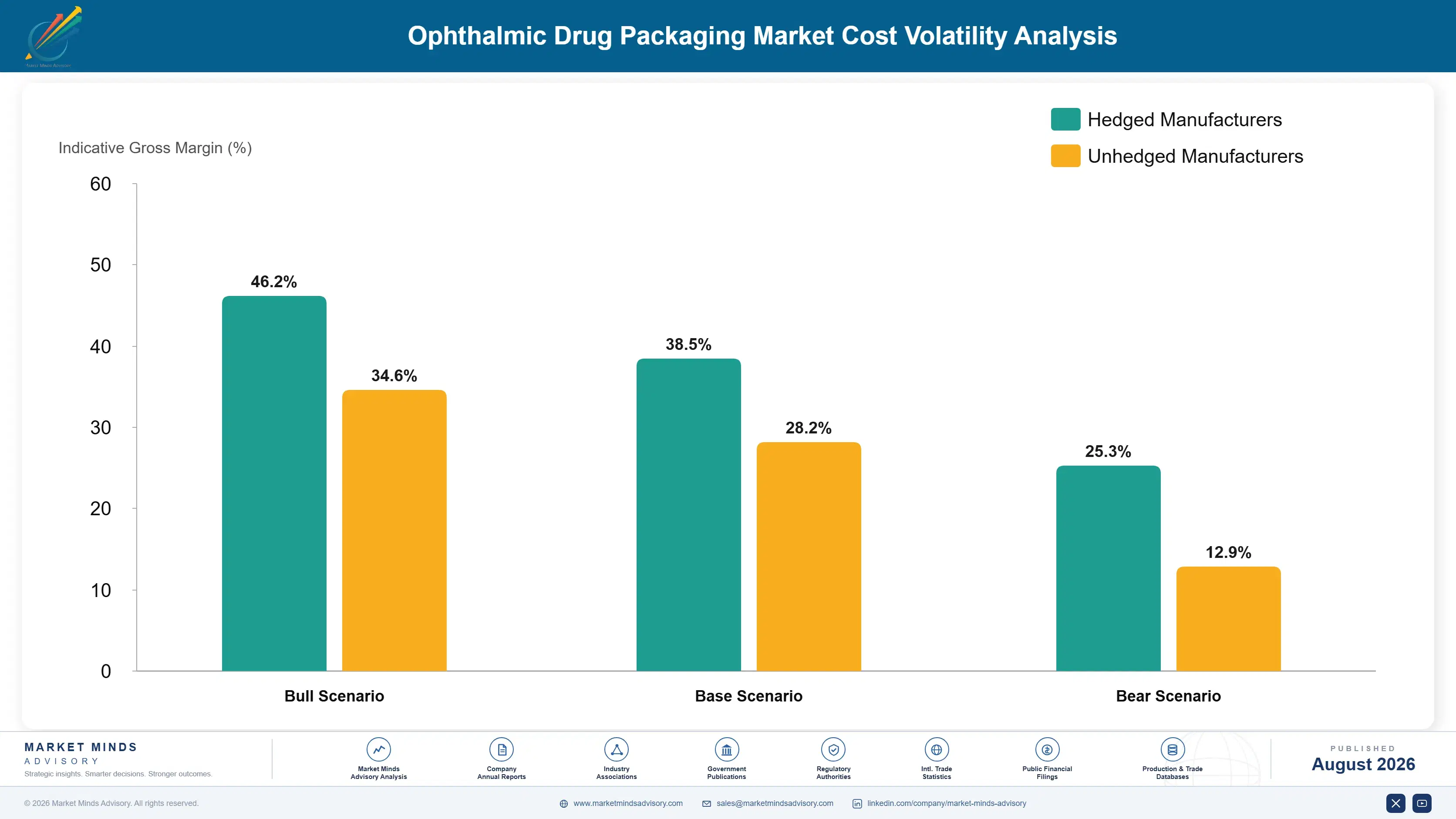
What Drives Component Cost

Medical grade polymers account for roughly 31% of component cost across drop packaging, which is lower than most packaging categories because engineering and validation carry so much of the burden here. Valve, filter membrane and tip treatment components add around 26% in preservative-free systems. Sterile manufacturing environment and validation take about 22%, and prefilled syringe production carries higher figures again on barrel, closure and sterile fill requirements.
Medical grade polymer and elastomer costs rose through 2021 and 2022 alongside general petrochemical inflation, while sterile manufacturing capacity tightened as pharmaceutical demand competed for the same clean room resources. Gerresheimer noted material and energy cost pressure across its pharmaceutical packaging operations in its Annual Report 2022. Suppliers on multi-year pharmaceutical contracts absorbed much of it, since qualified packaging cannot be substituted quickly at any price.

The disadvantage falls on suppliers without device engineering capability, and it appears through segment access rather than through unit cost. Preserved bottle supply grows at 2.4% and competes regionally on moulding cost, while preservative-free devices grow at 12.6% and command six times the price. A moulder without valve and membrane capability is efficiently manufacturing the part of this market that is disappearing.
ophthalmic-drug-packaging-market-cost-volatility-analysis-1787559475977

Qualify device components across multiple drug products deliberately

Extractables and leachables qualification for ocular contact is demanding and expensive, and running it separately for each drug product multiplies cost that shared platform data would largely cover. Designing a device platform qualified across a therapeutic range spreads that work considerably. Drug developers also prefer platforms with existing qualification history because it shortens their own submissions.

Develop a simplified valve at a fundable price point

A device at six times a plain bottle excludes health systems where patients pay directly, and those systems contain much of the fastest diagnosis growth anywhere. Simplified valve designs meeting contamination requirements at lower cost open volumes premium engineering cannot reach. The engineering challenge is real but the addressable population is considerably larger than the premium segment.

Secure sterile fill capacity before intravitreal demand tightens it

Prefilled syringe production for intravitreal use requires sterile capacity competing against every other injectable pharmaceutical for the same clean rooms and validation resources. Procedures growing near 14% annually will tighten that further. Committing capacity ahead of demand costs less than being unable to supply a drug developer during a product launch window. Launch windows do not wait for capacity.

Portfolio Architecture for Margin Defence

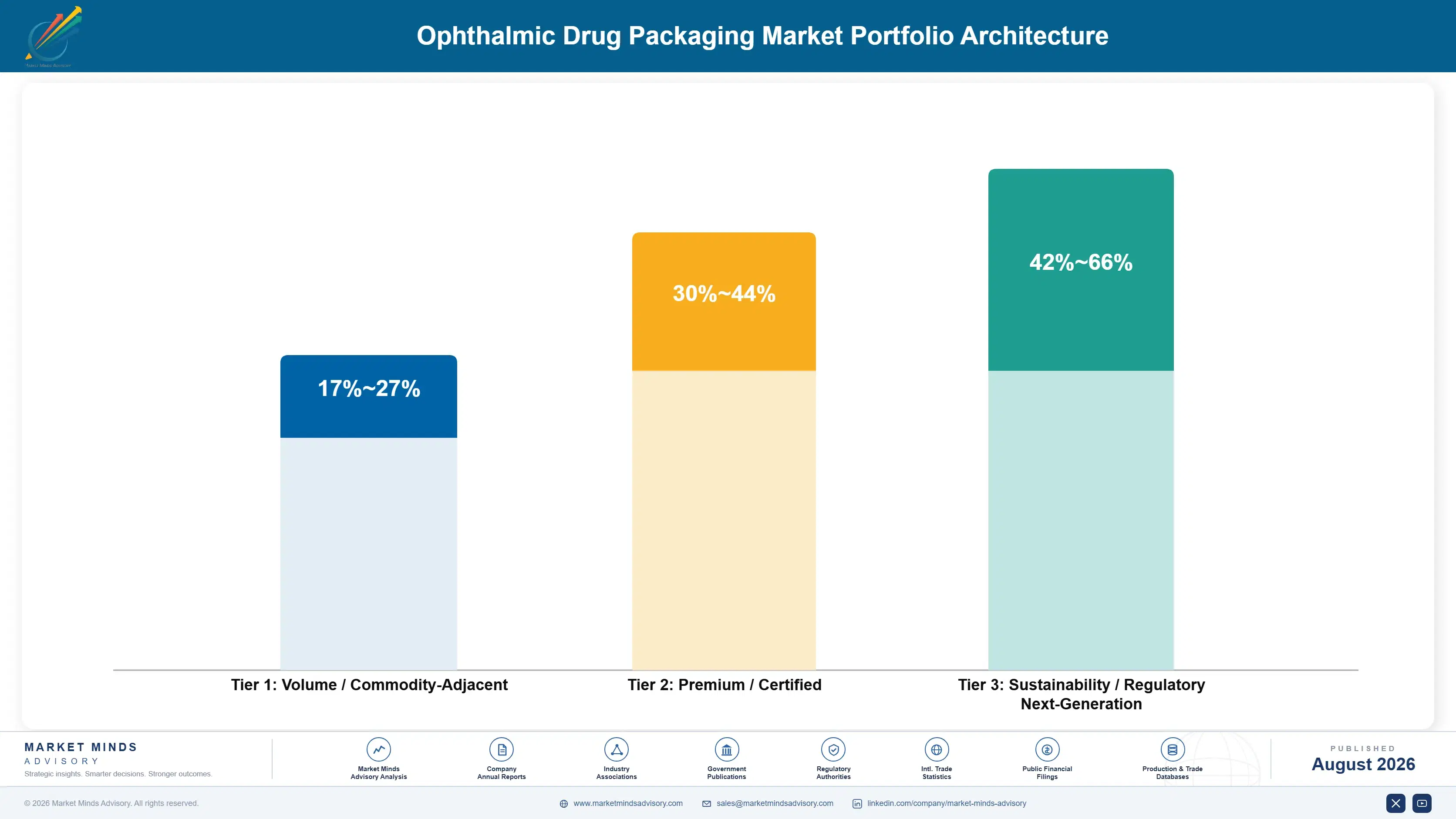
Margin separates on device content and regulatory qualification rather than on moulding capability, which is the whole story of how this category has changed. Preserved multi-dose bottles run at gross margins in the high teens against regional moulders competing on resin and tooling cost. Unit-dose blow-fill-seal runs better on aseptic process capability. Multi-dose preservative-free devices run considerably higher on valve and membrane engineering. Prefilled intravitreal syringes run highest, because sterile manufacture and drug-specific qualification narrow the field severely.
The tension is that preserved bottles still carry meaningful volume while devices and syringes earn the returns, and moving between them requires engineering and regulatory capability rather than any manufacturing investment. Suppliers weighted toward preserved formats face a segment growing at 2.4% while the market grows at 8.4%, which is a widening gap rather than a stable position. Several regional moulders have not registered how quickly that divergence is compounding against them.

High-value pools sit in preservative-free device systems, qualified silicone-free syringes and simplified valve designs for price-constrained markets. Preserved bottle supply is where moulding cost decides everything and the segment itself is disappearing. That divergence compounds quietly against anybody who has not moved.

Volume / Commodity-Adjacent

Preserved multi-dose bottles and simple closures competing on moulding and tooling cost against regional suppliers. The ten-point range separates suppliers with pharmaceutical qualification and scale from general moulders serving the segment opportunistically.
Gross Margin: 17%-27%

Premium / Certified

Unit-dose blow-fill-seal ampoules and vials requiring aseptic process capability and pharmaceutical validation. The fourteen-point spread reflects sterile manufacturing capability and qualification depth rather than any material advantage. Aseptic validation is the barrier here.
Gross Margin: 30%-44%

Sustainability / Regulatory / Next-Generation

Preservative-free multi-dose devices and prefilled intravitreal syringes with silicone-free qualification. The twenty-four-point range is wide because device engineering content and drug-specific regulatory qualification vary enormously between programmes. Drug-specific work rarely transfers.
Gross Margin: 42%-66%
ophthalmic-drug-packaging-market-portfolio-architecture-1787559476480

High-value Sub-segments and Strategic Watch-out

Preservative-Free Device Systems

Compounding at 12.6% on valve and membrane engineering costing six times a plain bottle. Growth arrives from continuing preservative conversion and from sustainability arithmetic turning against unit-dose formats simultaneously. Elderly actuation force is a genuine clinical differentiator. Prescribers notice it. Payers are moving toward it.
Gross Margin: 46%-66%

Silicone-Free Intravitreal Syringes

Serving procedures growing near 14% annually where post-injection floaters have pushed developers away from conventional lubrication. Requalification is slow enough that a late position costs an entire product generation. Developer relationships from clinical work persist commercially. Early qualification compounds. Requalification is genuinely slow work. Timing decides it.
Gross Margin: 44%-62%

Simplified Valve Designs

Opening preservative-free access in health systems where six times a bottle is not fundable at all. The addressable diagnosis volume is considerably larger than the premium device segment currently reaches anywhere. Engineering the cost down is harder than engineering the device. The volumes justify it.
Gross Margin: 32%-48%

Preserved Multi-Dose Bottles

The moulding volume, growing at 2.4% against a market at 8.4% and competing regionally on resin and tooling cost. Manage this for cash while device capability is built rather than for growth. No customer development pipeline is replenishing this segment at all anywhere. Manage it purely for cash.
Gross Margin: 17%-27%

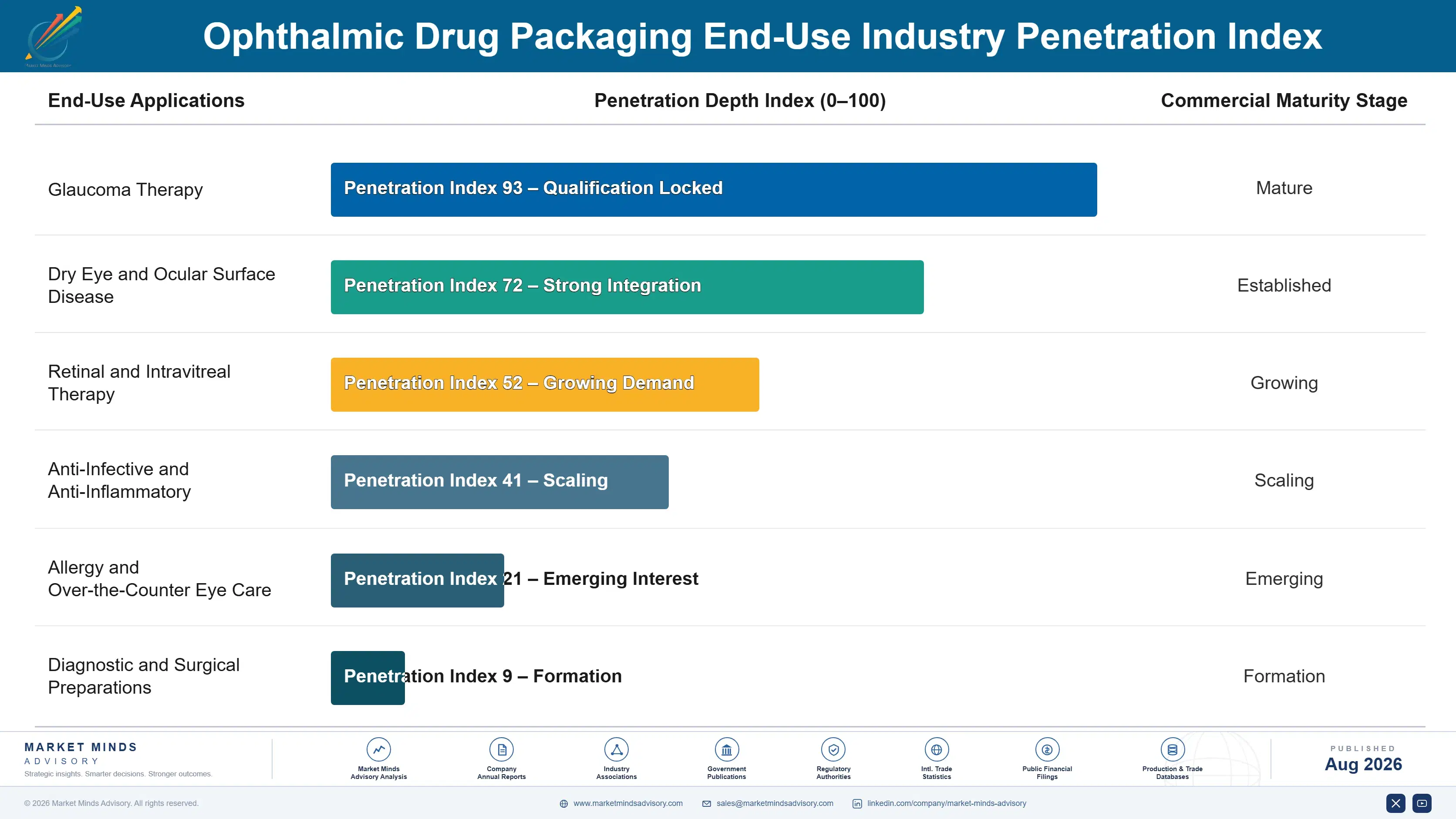
How Packaging Demand Renews

Demand renews per prescription and per procedure, which makes this an annuity attached to chronic disease rather than to any purchasing cycle. A glaucoma patient dosing daily for decades generates continuous packaging consumption that ends only with the patient, and an intravitreal patient returns for injections at intervals measured in weeks. That produces unusually predictable volume, and it explains why packaging qualified into an approved product is worth so much more than its manufacturing content suggests.
Stickiness is close to absolute once a presentation is approved. Changing primary packaging on an approved ophthalmic product requires regulatory variation, fresh extractables and leachables data and often stability studies, which no pharmaceutical company undertakes to save packaging cost. That makes original qualification the entire commercial contest and post-approval competition almost nonexistent. Suppliers who lose at development lose for the product's whole commercial life.

The buyer has shifted from pharmaceutical packaging procurement toward device development and regulatory affairs. Packaging was specified late and bought on qualified cost. Preservative-free systems and prefilled syringes are now selected during formulation development by people evaluating contamination control, dose consistency and extractables data, and they are choosing a device partner rather than a component supplier.
ophthalmic-drug-packaging-market-end-use-penetration-index-1787559476977

Where To Place The Bet

These are among the four positions where our research anticipates prominent divergence between winners and laggards over the coming forecast period. Each is grounded in the demand model, the regulatory perimeter, and the announced capacity pipeline.
01 / DEVICE CAPABILITY BUILDING

Stop moulding bottles and start engineering delivery

A preservative-free multi-dose system requires a one-way valve, a filter membrane and frequently antimicrobial tip treatment, and it costs roughly six times a plain bottle because it is genuinely a device rather than a container of any kind. That segment compounds at 12.6% while preserved bottles grow at 2.4% against a market growing at 8.4%. Moulders quoting on resin and tooling cost are competing efficiently for the only part of this category that is actually disappearing beneath them while everything else grows.
02 / WASTE CASE ADVOCACY

Put the ampoule arithmetic in front of payers

Unit-dose ampoules discard roughly 68% of the product they contain and consume around nine times the plastic per dose that a multi-dose preservative-free system uses, which becomes very difficult to defend as packaging waste requirements reach pharmaceutical products directly. Suppliers who present that arithmetic to payers and prescribers rather than waiting for regulation to arrive accelerate a shift that is already underway. The case is arithmetic rather than persuasion, which makes it unusually straightforward to win with the technical audiences who decide formulary questions.
03 / SILICONE FREE QUALIFICATION

Qualify now or lose a product generation

Silicone oil lubricates a syringe barrel and has been associated with floaters appearing after intravitreal injection, which patients notice immediately and report to their treating clinician without prompting. Low-silicone and silicone-free barrels address it, but each approach requires separate extractables and stability qualification against the specific drug product involved. With intravitreal procedures growing near 14% annually, a supplier holding qualified presentations reaches an expanding drug class that competitors would have to requalify entirely from scratch in order to serve at all.
04 / ACCESS COST ENGINEERING

Design a valve that a paying patient can afford

A preservative-free device at roughly six times a plain bottle is simply not fundable in health systems where patients pay directly or reimbursement is tightly constrained, and those systems contain much of the fastest diagnosis growth anywhere in this market including India at 11.8%. Simplified valve designs meeting contamination requirements at materially lower cost open volumes that premium device engineering cannot reach at all. The addressable patient population in those markets is considerably larger than the entire premium device segment.

Engagement Snapshot From the Field

A live engagement with an industry participant carrying material or product regulatory and market exposure ahead of a defining policy shift, showing how our research translates into a defensible multi-year portfolio strategy.
MARKET MINDS ADVISORY · CLIENT ENGAGEMENT SUMMARY
Ophthalmic Drug Packaging Producer Strategic Portfolio Review and Transition Roadmap 2026·Investment Scenario on Ophthalmic Drug Packaging Exposure Evaluation 2025-26
CLIENT PROFILE
A European pharmaceutical packaging supplier with annual revenue around EUR 155 million (client-reported, unverified by MMA), supplying preserved ophthalmic bottles and closures alongside limited blow-fill-seal capacity. No preservative-free device capability existed. No prefilled syringe position existed anywhere in the business. Ophthalmic revenue had grown slowly against a market expanding considerably faster. Device capability was absent.
STRATEGIC CHALLENGE
Ophthalmic revenue had grown slowly while the overall market expanded, and management proposed tooling investment to reduce preserved bottle cost and defend share. Nobody had established which segments were actually growing or what capability their growth required from a supplier. The capability question behind that growth had never been examined at all.
MMA APPROACH
MMA decomposed ophthalmic packaging growth by format rather than by customer, then mapped each format against the capability required to serve it. Device engineering investment was costed against the preservative-free growth rate. Existing customer development pipelines were reviewed to identify which presentations were being selected for products in development. Partnership options were assessed.
KEY FINDINGS
  1. Preserved bottles were growing at a small fraction of the overall market rate, so cost reduction there would defend a shrinking position rather than restore growth to the business.
  2. Every ophthalmic product in the client's customers' development pipelines was being formulated preservative-free, which meant the preserved bottle base had no replenishment coming behind it.
  3. Device engineering investment for a multi-dose valve system was substantial but reachable, and the client's existing pharmaceutical qualification infrastructure covered much of the regulatory burden.
  4. Prefilled syringe entry required sterile manufacturing capability the client did not have and could not realistically acquire within the relevant commercial timeframe.
CLIENT PROFILE
A European pharmaceutical packaging supplier with annual revenue around EUR 155 million (client-reported, unverified by MMA), supplying preserved ophthalmic bottles and closures alongside limited blow-fill-seal capacity. No preservative-free device capability existed. No prefilled syringe position existed anywhere in the business. Ophthalmic revenue had grown slowly against a market expanding considerably faster. Device capability was absent.
STRATEGIC CHALLENGE
Ophthalmic revenue had grown slowly while the overall market expanded, and management proposed tooling investment to reduce preserved bottle cost and defend share. Nobody had established which segments were actually growing or what capability their growth required from a supplier. The capability question behind that growth had never been examined at all.
MMA APPROACH
MMA decomposed ophthalmic packaging growth by format rather than by customer, then mapped each format against the capability required to serve it. Device engineering investment was costed against the preservative-free growth rate. Existing customer development pipelines were reviewed to identify which presentations were being selected for products in development. Partnership options were assessed.
KEY FINDINGS
  1. Preserved bottles were growing at a small fraction of the overall market rate, so cost reduction there would defend a shrinking position rather than restore growth to the business.
  2. Every ophthalmic product in the client's customers' development pipelines was being formulated preservative-free, which meant the preserved bottle base had no replenishment coming behind it.
  3. Device engineering investment for a multi-dose valve system was substantial but reachable, and the client's existing pharmaceutical qualification infrastructure covered much of the regulatory burden.
  4. Prefilled syringe entry required sterile manufacturing capability the client did not have and could not realistically acquire within the relevant commercial timeframe.
RECOMMENDED STRATEGY
Phase 1: Phase one: cancel the preserved bottle tooling investment, since it defends a segment with no replenishment in any customer development pipeline. Phase 2: Phase two: commit device engineering investment toward a multi-dose preservative-free valve system, using existing pharmaceutical qualification infrastructure to reduce the regulatory burden. Phase 3: Phase three: forgo prefilled syringe entry and instead partner for injectable presentations rather than attempting to build sterile capability from nothing.
OUTCOME
Tooling investment was cancelled before commitment. Device development is underway with two customer development programmes evaluating the system. Injectable partnership discussions have begun rather than any internal build, and the client reports its pipeline position materially stronger (client-reported, unverified by MMA). Capital was redirected rather than committed.

Frequently Asked Questions

Foundational context covering the market sizes, CAGR, scope, country, region and competition that inform every finding below. This section is provided to cover basics and most often pre-purchase conversations, answered from the MMA Primary Research Dataset.

What is the current size of the Ophthalmic Drug Packaging Market?

The market was valued at USD 2.8 billion in 2025, rising to an estimated USD 3.04 billion in 2026. Western Europe holds the largest regional share at 30% of value.

How large will the Ophthalmic Drug Packaging Market be by 2036?

MMA forecasts USD 6.80 billion by 2036 under the base case, an expansion multiple of 2.24 times the 2026 value. That represents USD 3.76 billion of incremental value.

What is the CAGR for the Ophthalmic Drug Packaging Market 2026 to 2036?

The base case runs at 8.4% compound annual growth between 2026 and 2036, with a bull case at 9.6% and a bear case at 7.2%. Historical growth from 2020 to 2025 was 7.0%.

Which segment is growing fastest?

Multi-dose preservative-free systems lead at 12.6%, half again the market rate, as sustainability arithmetic turns against unit-dose ampoules. Prefilled intravitreal syringes follow closely at 11.4%.

Who are the major companies in the Ophthalmic Drug Packaging Market?

AptarGroup, Nemera, Gerresheimer, Becton Dickinson and Rommelag hold 44% of supply between them. Device engineering and regulatory qualification rather than moulding capability sustain those positions.

Which country is growing fastest?

India leads at 11.8%, driven by diabetic retinopathy and glaucoma diagnosis expanding as ophthalmic healthcare access improves across a very large diabetic population entering screening.

Report Segmentation Architecture

The full report scope spans multiple orthogonal segmentation dimensions, with cross-tabulated demand data provided for each dimension pair. Coverage extends further to regional breakdowns, trend trajectories, and the competitive detail needed to support segment-level decision-making.

By Packaging Format

  • Multi-Dose Preserved Bottles
  • Multi-Dose Preservative-Free Systems
  • Unit-Dose Blow-Fill-Seal Ampoules
  • Prefilled Syringes for Intravitreal Use
  • Vials and Ampoules for Injection
  • Ointment Tubes and Gel Applicators

By End-Use Industry

  • Glaucoma Therapy
  • Dry Eye and Ocular Surface Disease
  • Retinal and Intravitreal Therapy
  • Anti-Infective and Anti-Inflammatory
  • Allergy and Over-the-Counter Eye Care
  • Diagnostic and Surgical Preparations

By Material and Supply

  • Medical Grade Polyolefin Components
  • Glass Barrel and Vial Presentations
  • Elastomer Closures and Plungers
  • Filter Membrane and Valve Assemblies
  • Integrated Device Platform Supply

By Region

  • North America
  • Western Europe
  • East Asia
  • South Asia and Pacific
  • Latin America
  • Middle East and Africa
  • Eastern Europe

Scope, Methodology, and Coverage

Every figure in this report is reproducible from documented input assumptions. The scope below maps the historical period, the forecast horizon, the segmentation dimensions, and the countries covered, alongside the underlying primary and qualitative methodology.
Historical Period
2020 to 2025
Forecast Period
2026 to 2036
Base Year
2025 (USD billions; MMA Primary Research Dataset, August 2026)
Market Definition
The market comprises primary packaging and delivery presentations for ophthalmic medicines, including multi-dose preserved bottles, multi-dose preservative-free systems, unit-dose blow-fill-seal ampoules, prefilled syringes for intravitreal use, vials and ampoules for injection, and ointment tubes and gel applicators, supplied as polyolefin components, glass presentations, elastomer closures, valve and membrane assemblies and integrated device platforms. Value is measured at packaging supplier level. Secondary and carton packaging, contact lens packaging and solutions, surgical instruments and intraocular devices, drug substance and formulation, and separately billed contract filling services fall outside scope.
Quantitative Units
USD billions (current prices); million units and presentations supplied; USD per unit by format and content
Segmentation Dimensions
By Packaging Format; By End-Use Industry; By Material and Supply; By Region
Regions Covered
North America, Western Europe, East Asia, South Asia and Pacific, Latin America, Middle East and Africa, Eastern Europe
Countries Covered
Germany, France, Italy, Spain, United Kingdom, Switzerland, Netherlands, Belgium, Sweden, Denmark, United States, Canada, Mexico, Brazil, Argentina, Colombia, China, Japan, South Korea, Taiwan, India, Thailand, Indonesia, Australia, Poland, Czechia, Romania, Saudi Arabia, United Arab Emirates, South Africa
Key Companies Profiled
AptarGroup, Nemera, Gerresheimer, Becton Dickinson, Rommelag, SCHOTT Pharma, Stevanato Group, Ursatec, Berry Global, Amcor, West Pharmaceutical Services, Catalent, Recipharm, Unicep, Silgan Dispensing, Nipro, Datwyler, Origin Pharma Packaging, Weigao, Cospack
Quantitative Methodology
Primary survey, n=3,800 respondents, Q4 2025, six countries; demand-side model with trade association cross-validation
Qualitative Methodology
47 expert interviews, Q4 2025; applied to validate demand model assumptions, identify emerging dynamics, and assess competitive positioning
Report Format
PDF and XLSX data workbook (Word format preview document)
Publisher
Market Minds Advisory
Report Code
MMA-2026-MED-102
Published
August 2026
Contact
sales@marketmindsadvisory.com | www.marketmindsadvisory.com

Purchase the full Ophthalmic Drug Packaging Market Report (2026 to 2036).

The full report sizes the global ophthalmic drug packaging market to 2036 across six formats and seven regions, measured at packaging supplier level. It treats preservative removal as the event that turned packaging into a delivery device, and quantifies the waste arithmetic now reversing a decade of unit-dose format growth. Competitive analysis covers 20 suppliers on one consistent revenue basis, with moat and risk assessment for the two leaders. Silicone-free qualification status is assessed across intravitreal presentations by supplier. Four quantified revenue levers close the analysis.
Six-format segment sizing with individual growth rates
Preservative-free conversion tracked by therapy area and region
Unit-dose waste arithmetic quantified against multi-dose alternatives
Silicone-free intravitreal qualification status mapped by supplier
Twenty-supplier competitive map on one consistent revenue basis
Four quantified revenue levers with commercial impact ranges

Built For The People Who Decide

From boardroom strategy to bench-side execution, this report is read cover-to-cover by leaders shaping the next decade of their industry, turning demand scenarios, market dynamics and valuation benchmarks into decisions.
CXOs/ Presidents/ VPs/ Managers
M&A and Corporate Development
Strategy Teams and R&D Heads
Procurement and Product Directors
Regulatory and Compliance Leaders
Investor Relations and Equity Analysts