Market Minds Advisory
Open Source Service Market

Open Source Service Market: Open Source Service Market. Enterprise AI Adoption Drives Support Demand

Enterprises are purchasing commercial support and managed services for open source software as AI infrastructure adoption accelerates, pushing organizations to seek vendor accountability for tools their internal teams cannot fully support alone.

Lead Analyst

Published

September 2026

Make Smarter Decisions with Customized Research Insights

Request a free sample report and evaluate market opportunities, growth trends, and competitive dynamics relevant to your business needs.

2025 MARKET VALUE$28.5BMarket Size 2025
2036 FORECAST VALUE$114.8BBase Case , 2026 to 2036
CAGR 2026 TO 203613.5 %Bull 14.8% / Bear 12.2%
INCREMENTAL OPPORTUNITY$82.4BNet 10- year value creation
EXPANSION MULTIPLE3.55x2036 value over 2026 base
Strategic Levers
M&A Pipeline
Regional Outlook
Country Rankings
Competitive Intelligence
Segmental Deep-dive
Call-Us : 91 93563 13602

Executive Snapshot and Market Trajectory.

Enterprises worldwide are increasingly purchasing commercial support contracts for open source software as internal engineering teams struggle to maintain and troubleshoot the growing complexity of AI infrastructure stacks built on freely available code spanning multiple interconnected systems, dependencies, outside vendors, and rapidly shifting release cycles across every industry.
AI and machine learning infrastructure support is growing fastest as enterprises deploy open source model serving, vector database, and orchestration tools faster than their internal teams can develop deep operational expertise across every layer of the stack and its rapidly evolving components. Financial services and technology sector customers drive the largest current share of demand, reflecting their disproportionate exposure to production AI workloads requiring guaranteed support response times and documented service level agreements.
Competitive intensity is rising as commercial open source vendors defend maintainer relationships while independent support providers compete on multi-project coverage breadth and pricing flexibility rather than deep single-project specialization alone or brand recognition. Vendor lock-in concerns and licensing model changes among popular open source projects are shaping which support providers can credibly win enterprise contracts without triggering procurement compliance objections or legal review delays.
Market Definition
This market covers commercial support contracts, consulting services, and managed hosting offered for open source software projects to enterprise customers. It excludes the open source software itself when distributed without paid support, and proprietary software licensing unrelated to open source project commercialization.
Base Year Value
$28.5B in 2025 (MMA Primary Research Dataset, September 2026)
Forecast Period
2026 to 2036, eleven discrete annual values
CAGR
13.5% base case. Bull 14.8%. Bear 12.2%.
Fastest Growth Segment
AI and Machine Learning Infrastructure Support: 20.0% CAGR
Fastest Growth Country
India: 17.0% CAGR
Fastest Growth Region
South Asia and Pacific: 15.5% CAGR
Largest Region
North America: 32% of 2025 global value
Market Leaders
Red Hat, Canonical, SUSE, Cloudera, MongoDB
Primary Survey
n=3,800 procurement and R&D decision-makers, Q4 2025, six countries
Methodology
Demand-side build-up, cross-validated against public data, 47 expert interviews

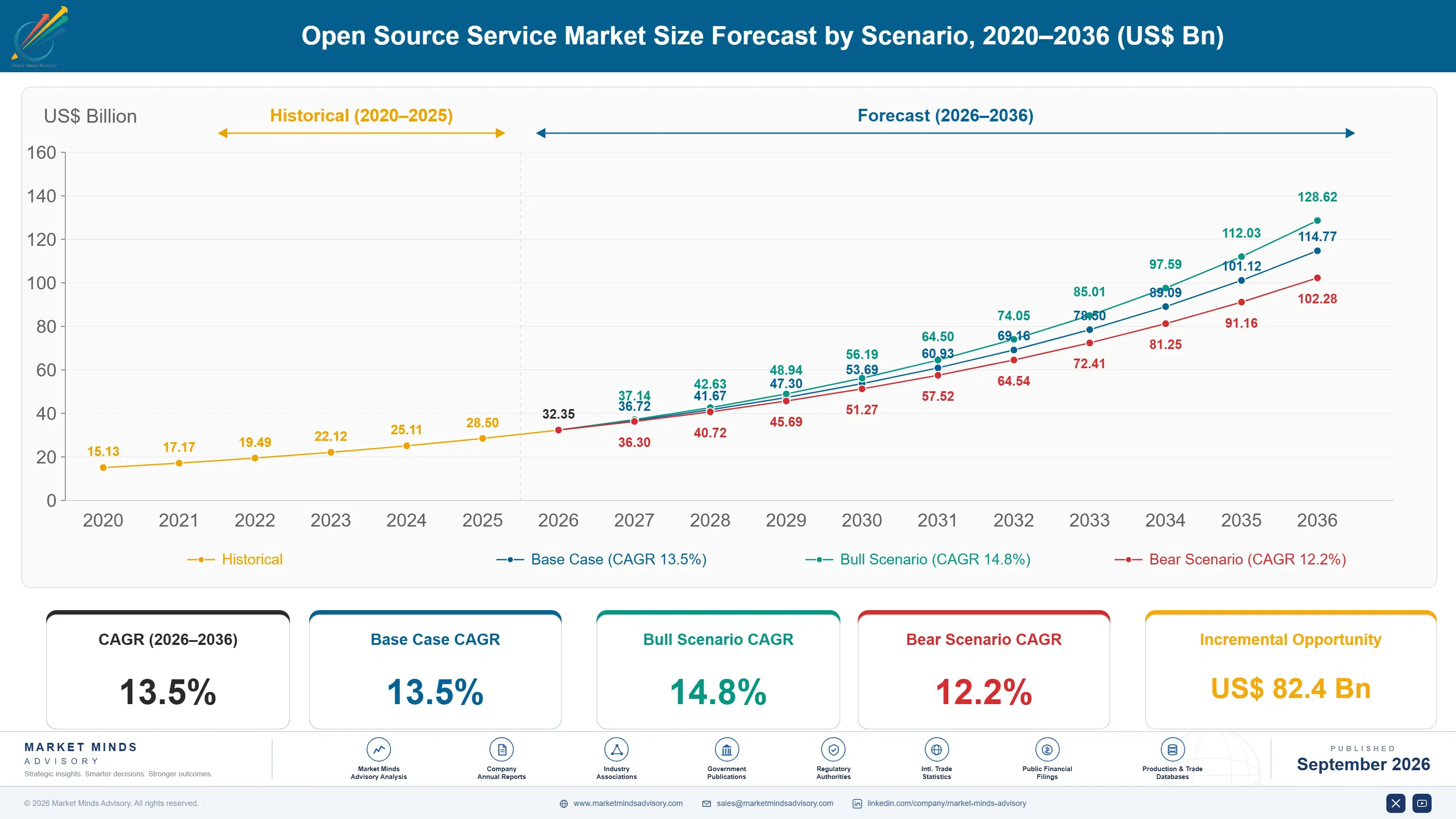
Open Source Service Market Forecast Scenarios

open-source-service-market-size-forecast-scenario-1788503338938
Open source service demand between 2020 and 2025 grew steadily as cloud-native infrastructure adoption expanded and enterprises increasingly relied on open source components for core production systems rather than experimental projects alone. The 2023 licensing model changes at several popular open source projects briefly disrupted vendor relationships industry-wide, but demand recovered as providers adapted to shifting license terms.
The base case assumes continued expansion driven by three commercial mechanisms: AI infrastructure adoption requiring specialized support for open source model serving and orchestration tools that internal teams cannot fully staff, enterprise risk management policies increasingly mandating paid support contracts for production open source dependencies as a compliance requirement, and existing open source vendors expanding service breadth to cover adjacent projects within a customer's broader technology stack. Cybersecurity vulnerability response requirements are also driving increased support contract adoption for previously unsupported open source components.
A bull scenario centers on enterprise AI adoption accelerating faster than expected, pulling open source infrastructure support demand well above currently modeled base case levels across every industry vertical. The bear risk is major cloud providers increasingly offering bundled managed open source services that substitute for independent support contracts, which would compress the addressable market for independent providers.

Where Accountability Meets Open Source Adoption

Open source service providers sit at the intersection of enterprise risk management and community-developed software, converting freely available code into a commercially supported product backed by guaranteed response times and accountability structures that internal teams alone cannot easily replicate. The category expanded from operating system and database support into a far broader range of AI, data infrastructure, and cloud-native tooling as enterprise reliance on open source deepened.
MARKET CONCENTRATIONCR5 38%Top five providers hold a moderate combined revenue share
AVERAGE SUPPORT CONTRACT VALUE$50K to $500KTypical annual contract range across small and large enterprise deals
TOP COUNTRY CUSTOMER SHAREUnited States leadsSingle country contributes the largest share of contracted spending
CONTRACT RENEWAL RATE~88% annuallyShare of existing support contracts renewed at each yearly cycle
AI WORKLOAD SUPPORT SHARE~25% of revenuePortion of total support revenue tied to AI infrastructure projects
RESPONSE TIME SLA STANDARD~1 to 4 hoursTypical guaranteed response window for critical production issues
AI infrastructure support increasingly represents the fastest-growing service category, since production machine learning systems built on rapidly evolving open source frameworks require specialized troubleshooting expertise that most internal enterprise teams have not yet developed internally. Multi-project support bundling increasingly differentiates providers from single-project specialists, since enterprise customers prefer consolidating vendor relationships rather than managing dozens of separate support contracts across their technology stack.
Competitive advantage increasingly rests on maintainer relationship depth and upstream contribution credibility rather than support ticket volume alone, since customers value providers who can influence project roadmap direction on their behalf. Providers lacking demonstrated security vulnerability response capability face growing difficulty winning enterprise contracts as procurement teams increasingly require documented incident response commitments before approving new support vendor relationships.
"Nobody pays for open source support because they can't read the code. They pay because someone else needs to be awake at 3 AM when production breaks."
Principal Analyst, Enterprise Open Source and Infrastructure Software Practice · MMA Commercial Support Practice · September 2026

Market Trends

AI Infrastructure Support Becomes a Distinct Service Category

Support providers increasingly organize dedicated practice areas specifically for AI and machine learning infrastructure, covering open source model serving frameworks, vector databases, and orchestration tools that did not exist as a distinct enterprise support category just a few years ago. Red Hat and Canonical have both launched dedicated AI infrastructure support offerings, extending their traditional operating system and cloud support expertise into this rapidly growing adjacent category. This shift matters because AI infrastructure changes rapidly enough that internal teams struggle to maintain current expertise, creating durable demand for specialized external support.
Market Impact: Mandated support coverage rose 20 percent

Multi-Project Support Bundling Gains Enterprise Preference

Enterprise customers increasingly prefer consolidating open source support across multiple projects with a single vendor rather than managing dozens of separate point-solution support contracts spread across their technology stack, each with different renewal dates and account relationships. This consolidation trend favors larger support providers with broad multi-project coverage capability over narrow single-project specialists lacking comparable breadth. Providers responding to this preference increasingly market comprehensive technology stack support as a primary differentiator, bundling database, infrastructure, and AI tooling support into unified contract structures that simplify enterprise vendor management considerably. Providers report this bundling improves customer retention across renewal cycles.
Market Impact: Vulnerability-driven contracts up 22 percent

Market Opportunities and Growth Drivers

Enterprise Risk Policies Increasingly Mandate Paid Support

Enterprise risk management and procurement policies increasingly mandate paid commercial support contracts for any open source component used in production systems, treating unsupported open source dependencies as an unacceptable operational and security risk regardless of internal team confidence in self-support capability. This policy shift directly converts previously unpaid open source usage into contracted revenue for support providers, expanding the addressable market considerably beyond organizations that previously sought support only reactively. Financial services and healthcare customers lead this policy shift given their heightened regulatory scrutiny around operational resilience and vendor accountability documentation requirements.
Market Impact: Could reduce addressable market 15 percent

Security Vulnerability Response Requirements Drive Adoption

Enterprise cybersecurity policies increasingly require documented vulnerability response commitments for all software components including open source dependencies, driving support contract adoption specifically to satisfy security compliance requirements that previously received limited attention from procurement and security teams alike. High-profile open source vulnerability incidents in recent years have heightened board-level awareness of open source supply chain risk considerably, translating directly into increased willingness to fund dedicated support contracts. Support providers increasingly market rapid vulnerability response time commitments as a primary competitive differentiator addressing this specific enterprise concern. This translates directly into larger contract values as customers add vulnerability response coverage.
Market Impact: Adds 3 to 6 months

Market Restraints and Challenges

Cloud Provider Bundled Services Compress Independent Demand

Major cloud providers increasingly offer bundled managed open source services directly within their broader cloud platform offerings, creating a genuine substitute for independent support contracts that some enterprise customers find more convenient given existing cloud vendor relationships and unified billing arrangements. The root cause is that cloud providers can subsidize support economics using broader platform revenue in ways that independent providers cannot easily match. This substitution risk concentrates most acutely among customers already heavily committed to a single cloud provider's broader platform. Some providers mitigate this through multi-cloud positioning cloud providers cannot credibly offer.
Market Impact: AI support reached 25 percent

Licensing Model Changes Create Vendor Relationship Uncertainty

Several popular open source projects have changed their licensing terms in recent years, restricting commercial use or requiring separate paid licensing that creates genuine uncertainty for both enterprise customers and support providers navigating shifting maintainer relationships and community governance changes. The root cause is that open source maintainers increasingly seek sustainable commercial models as venture-backed open source companies face pressure to demonstrate durable revenue beyond pure community goodwill and voluntary contribution. This uncertainty complicates long-term enterprise procurement planning considerably. Support providers are mitigating this by diversifying across multiple open source projects to reduce single-project licensing risk exposure.
Market Impact: Bundled contracts grew roughly 30 percent
3 additional market trends, 4 additional growth drivers, and 2 additional restraints and challenges are covered in the full report. Contact sales@marketmindsadvisory.com to access the complete intelligence.

Segment CAGR and Growth Architecture

Open source services segment by the underlying software category supported, spanning AI and machine learning infrastructure, database and data infrastructure, operating system and container platforms, developer tooling and CI/CD pipelines, security and vulnerability management, and enterprise middleware and integration frameworks serving large-scale production deployments across every industry vertical, company size, geography, and deployment model served.
open-source-service-market-market-share-analysis-1788503339491

AI and Machine Learning Infrastructure Support

AI and machine learning infrastructure support covers model serving frameworks, vector databases, and orchestration tools that enterprises deploy for production machine learning workloads, requiring specialized troubleshooting expertise that most internal engineering teams have not yet developed given how recently these tools reached mainstream enterprise adoption. Growth outpaces the broader market by a wide margin because AI infrastructure support essentially did not exist as a distinct commercial category before the recent surge in enterprise machine learning deployment, meaning growth registers from a much smaller base than mature support categories like database or operating system support. Providers with early AI infrastructure expertise increasingly command premium pricing given genuine scarcity of qualified support talent in this specific domain.
CAGR 20.0%

Database and Data Infrastructure Support

Database and data infrastructure support covers established open source database systems, data pipeline tools, and storage infrastructure that has anchored enterprise open source support spending for well over a decade, representing a mature but still steadily growing support category. This segment grows more slowly than AI infrastructure support because it represents an already mature market with well-established vendor relationships and support provider expertise built up over many years of enterprise deployment experience. Providers in this segment increasingly differentiate through migration and modernization services helping enterprises move legacy database deployments onto more current open source versions and configurations. Consolidation among database support vendors has also concentrated this segment among fewer, larger providers over recent years.
CAGR 12.0%
Full segment breakdown across 6 segments available in the complete report.

Regional Architecture and Country Demand Map

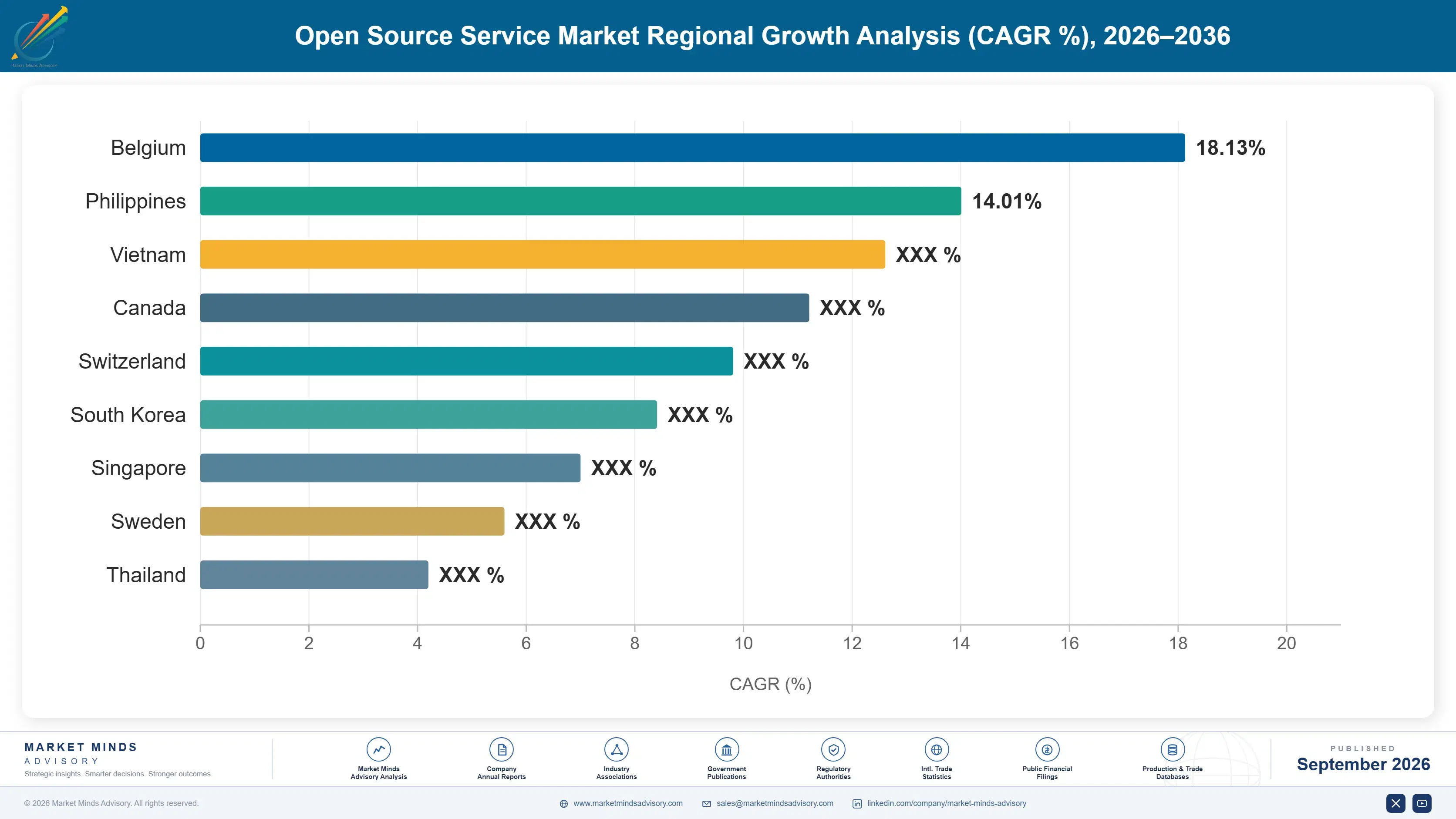
North America leads given Red Hat, MongoDB, and major cloud provider headquarters concentration and the deepest enterprise AI infrastructure spending among all tracked markets globally, while South Asia and Pacific posts the fastest growth as regional technology adoption accelerates across a rapidly expanding developer base.

North America

The United States hosts the deepest concentration of open source service providers, with Red Hat, MongoDB, and major cloud providers all headquartered domestically and driving the majority of enterprise AI infrastructure spending tracked in this report. American financial services and technology sector customers generate the highest per-contract support spending among tracked markets, reflecting both regulatory risk management requirements and the sheer scale of production AI deployment across the region's largest enterprises. Canada's growing technology sector also contributes meaningfully to regional demand, particularly around AI infrastructure support given its established artificial intelligence research community. Growing government agency adoption of open source infrastructure also contributes to steady regional demand growth. Mexico's growing technology sector also contributes modestly to this regional grouping.
Share: 32% | CAGR: 14.5% (2026 to 2036)

Western Europe

German and French enterprises show strong open source adoption tied to digital sovereignty concerns, favoring open source infrastructure over proprietary American cloud alternatives for certain regulated workloads specifically. SUSE maintains substantial European headquarters presence, giving regional customers a qualified domestic support option that some enterprises prefer for data residency and vendor independence reasons. Growth trails North America and East Asia somewhat, reflecting more conservative enterprise AI infrastructure adoption timelines compared to American and Chinese technology sector customers currently. The United Kingdom, outside the European Union, tracks broadly similar enterprise adoption patterns as its continental neighbors. Regional enterprises increasingly view multi-project open source support bundling as standard procurement practice. This trend continues expanding steadily.
Share: 22% | CAGR: 12.0% (2026 to 2036)
Regional intelligence for 5 additional markets available in the complete report: East Asia, South Asia and Pacific, Latin America, Middle East and Africa, Eastern Europe. Contact sales@marketmindsadvisory.com.
open-source-service-market-country-cagr-analysis-1788503339998

Where Support Providers Build Lasting Margin

Beyond standard annual support contract fees, open source service providers build durable revenue through mechanisms that deepen enterprise dependency and demonstrate measurable operational value over multi-year relationships, rewarding providers that invest early in AI infrastructure expertise, multi-project coverage breadth, and maintainer relationship depth rather than pure ticket-response speed competition across every customer segment served.

Structuring Tiered Response Time Service Level Agreements

Providers increasingly structure support contracts around tiered response time commitments, charging meaningfully higher fees for 1-hour critical incident response compared to standard next-business-day service levels available at lower price points. This tiering lets providers capture premium pricing from customers running production-critical workloads while still serving cost-sensitive customers at lower service levels, expanding the addressable customer base across a wider budget range. Financial services and healthcare customers overwhelmingly select premium tiers given their heightened operational resilience requirements and regulatory scrutiny around production incident response times. Providers report tiered pricing has meaningfully improved overall contract profitability across their customer base.
Market Impact: Premium tiers command 2 to 3 times pricing

Selling Migration and Modernization Consulting Services

Providers increasingly sell dedicated migration and modernization consulting services helping enterprises move legacy open source deployments onto current versions, a revenue stream distinct from ongoing annual support and typically billed as a separate project engagement. This consulting revenue captures incremental value from an existing support relationship without requiring an entirely new customer acquisition process, since migration projects flow naturally from ongoing support conversations. Migration engagements typically generate 15 to 25 percent additional revenue per customer relationship beyond standard annual support contract value alone. Larger enterprises with complex legacy deployments generate the highest migration project revenue per engagement.
Market Impact: Migration projects add roughly 15 to 25pp yearly

Offering Proactive Security Vulnerability Monitoring Subscriptions

Providers increasingly sell dedicated security vulnerability monitoring and proactive patching subscriptions as a distinct service tier beyond reactive support ticket handling, addressing enterprise security compliance requirements that increasingly mandate documented vulnerability response commitments. This proactive monitoring service, typically priced at 10 to 15 percent above standard support, commands meaningfully higher margins than reactive support alone, since it requires less unpredictable emergency response staffing and more predictable, schedulable security engineering work performed on a routine basis. Enterprise customers increasingly view this monitoring subscription as a mandatory compliance requirement rather than an optional add-on service.
Market Impact: Monitoring subscriptions add roughly 8 to 12pp yearly

Building Certified Training and Professional Certification Programs

Providers increasingly build certified training and professional certification programs for their supported open source projects, generating separate revenue from enterprise customers seeking to build internal expertise while still maintaining an ongoing commercial support relationship as a safety net. This training revenue diversifies provider income beyond pure support ticket volume, capturing value from customers actively trying to reduce their support dependency over time. Red Hat's certification programs demonstrate this model's viability, generating standalone revenue worth roughly 5 percent of total company revenue while also strengthening customer loyalty. Certification revenue also creates a durable talent pipeline that benefits the broader project community.
Market Impact: Training revenue reaches roughly 5 to 8pp yearly

Who Controls the Margin Pool

Concentration among the top five open source service providers sits at roughly thirty-eight percent, moderate for a category spanning hundreds of specialized point-solution and consulting providers across dozens of distinct open source project categories. Red Hat and MongoDB lead on enterprise contract breadth and revenue scale, while the gap separating them from mid-tier challengers like Cloudera remains narrow enough that a well-executed AI infrastructure practice launch could shift rankings within a single sales cycle.
Current competitive activity centers on AI infrastructure practice expansion and multi-project support bundling, since both directly address the coverage breadth and specialized expertise that increasingly determine enterprise vendor selection decisions. Several providers have also launched dedicated security vulnerability monitoring service lines, capturing compliance-driven demand distinct from traditional reactive support ticket handling.

Emerging pressure comes from major cloud providers bundling managed open source services directly into their broader cloud platform offerings, threatening independent providers lacking comparable platform-level customer relationships and integrated billing convenience. Ranking shifts are most likely among mid-tier providers lacking either AI infrastructure expertise or demonstrated multi-cloud support positioning, since both dimensions increasingly separate durable market leaders from vulnerable niche competitors.
open-source-service-market-company-positioning-matrix-1788503340591

Competitive Moat and Risk Dimensions

RED HAT

Moat: Broad Enterprise Linux Portfolio

Red Hat maintains the broadest enterprise Linux and adjacent open source project support portfolio among independent providers, giving it cross-selling opportunities and accumulated enterprise trust that smaller, narrower competitors cannot easily match without years of comparable relationship building. This trust advantage compounds each year as new enterprise customers reference existing satisfied deployments.
RED HAT

Risk: IBM Integration Priority Tension

Red Hat's ownership by IBM creates some tension between pursuing independent open source community goodwill and satisfying IBM's broader corporate revenue integration priorities, a balance that competitors without a large parent company do not need to manage. Red Hat has generally maintained community credibility despite this tension so far.
MONGODB

Moat: Deep Single-Database Specialization

MongoDB's focused specialization on its own database technology gives it deeper product expertise and faster feature response capability than generalist multi-project support providers spreading engineering resources across dozens of different open source technologies simultaneously. This deep specialization has historically translated into faster resolution times for MongoDB-specific technical issues.
MONGODB

Risk: Narrow Single-Product Dependence

MongoDB's revenue remains concentrated around a single database technology, exposing the company to competitive risk if enterprise customers shift toward alternative database technologies or reduce reliance on any single specialized data infrastructure provider. MongoDB has responded by expanding into adjacent data infrastructure categories to diversify this exposure somewhat.

Players Tracked

Prominent Players

Red Hat
Canonical
SUSE
Cloudera
MongoDB

Other Key Players

Elastic
Confluent
HashiCorp
GitLab
Percona
EnterpriseDB
Grafana Labs
Chef Software
Puppet
Sysdig
Weaveworks
Aiven
Instaclustr (NetApp)
Bitnami (VMware)
OpenLogic (Perforce)

Recent Developments

FEBRUARY 2026

Red Hat Expands AI Infrastructure Support Practice

Red Hat expanded its dedicated AI infrastructure support practice, adding coverage for additional open source model serving and orchestration frameworks used across enterprise production machine learning deployments nationwide and across international markets. The expansion represents organic practice growth rather than an acquisition of external technology.
Signal: Signals continued vendor investment in AI infrastructure support as a key long-term competitive differentiator ahead of rivals
OCTOBER 2025

Cloudera Acquires Data Pipeline Support Startup

Cloudera acquired a smaller data pipeline support startup to accelerate development of managed data infrastructure services covering additional open source projects beyond its traditional Hadoop-centric support portfolio and existing customer relationships across global markets. The acquisition brought in specialized technical expertise that Cloudera plans to integrate.
Signal: Demonstrates the multi-project bundling expansion pattern this report identifies as a central future growth revenue lever
JULY 2025

SUSE Signs Multi-Year Contract With European Bank

SUSE signed a multi-year support contract with a major European bank covering its production Linux and container infrastructure across the bank's full multi-country operations, subsidiary network, and several major regional data centers. The agreement is a service contract rather than an acquisition or joint venture.
Signal: Extends an established vendor's reach into a large, regulated European financial services customer relationship directly and meaningfully

Skilled Engineering Talent Cost Exposure

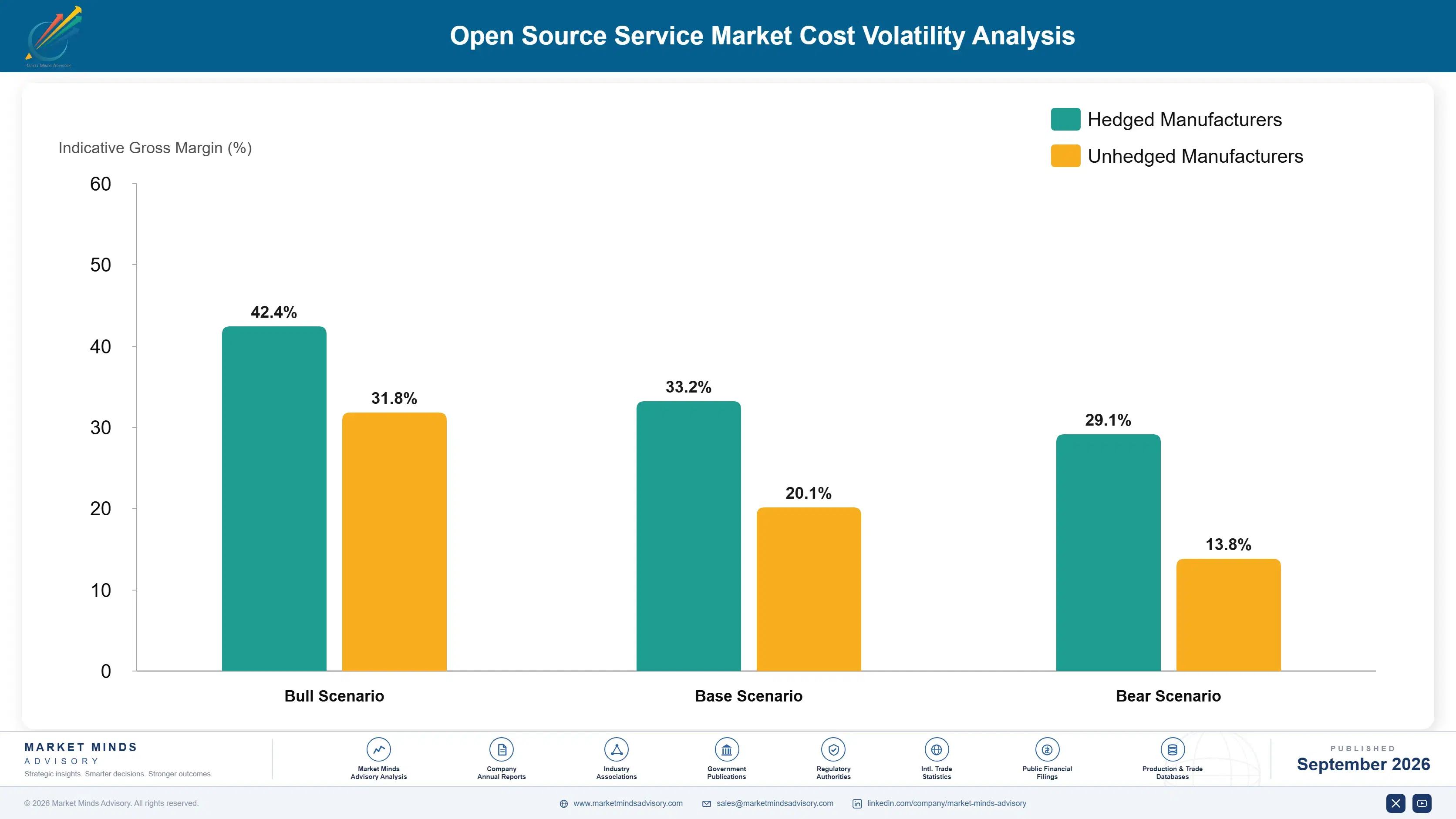
Open source service provider cost structures are dominated by skilled software engineering and support staff compensation, cloud infrastructure hosting for managed services, and increasingly substantial AI infrastructure specialist recruitment costs, rather than physical inputs or manufacturing expenses. Engineers with deep expertise in specific open source projects command premium compensation given genuine scarcity, particularly for rapidly evolving AI infrastructure tools where relevant experience remains limited across the broader talent market.
AI infrastructure specialist compensation rose sharply during 2023 and 2024 as enterprise demand for machine learning support expertise outpaced available qualified talent supply, according to industry compensation surveys and provider annual reports discussing rising engineering talent acquisition costs across the sector. Providers without established AI infrastructure practices absorbed proportionally higher recruitment and retention costs than established competitors with existing specialized teams and internal training pipelines already in place.

Smaller providers lacking established AI infrastructure practices face a genuine competitive disadvantage versus larger competitors able to offer more attractive compensation and career development paths to scarce specialized talent. This exposure varies by player type: providers with established AI infrastructure teams built before the recent talent cost surge weathered compensation inflation more smoothly than newer entrants competing for the same limited talent pool.
open-source-service-market-cost-volatility-analysis-1788503340786

Build Internal Training and Career Development Pipelines

Providers are building internal training and career development pipelines that develop AI infrastructure expertise from existing generalist engineering staff rather than relying entirely on external recruitment, reducing dependence on a scarce and expensive external talent market for this rapidly growing specialization. This approach also improves employee retention by offering existing staff a clear path toward higher-value specialized work.

Establish Distributed Global Engineering Team Locations

Providers are establishing distributed engineering teams across multiple countries with lower average compensation costs than traditional technology hub locations, capturing meaningful cost savings while still accessing qualified engineering talent capable of supporting demanding enterprise customer relationships. This distributed approach also provides useful business continuity coverage during regional talent market disruptions, shortages, or wage spikes.

Automate Routine Support Tasks With AI Tooling

Providers are deploying AI-assisted diagnostic and troubleshooting tools that automate routine support ticket triage and resolution, letting existing engineering staff handle higher support volume without proportional headcount growth as compensation costs continue climbing steadily industry-wide. This automation also improves consistency in how routine issues get diagnosed and resolved across the entire global support team.

Portfolio Architecture for Margin Defence

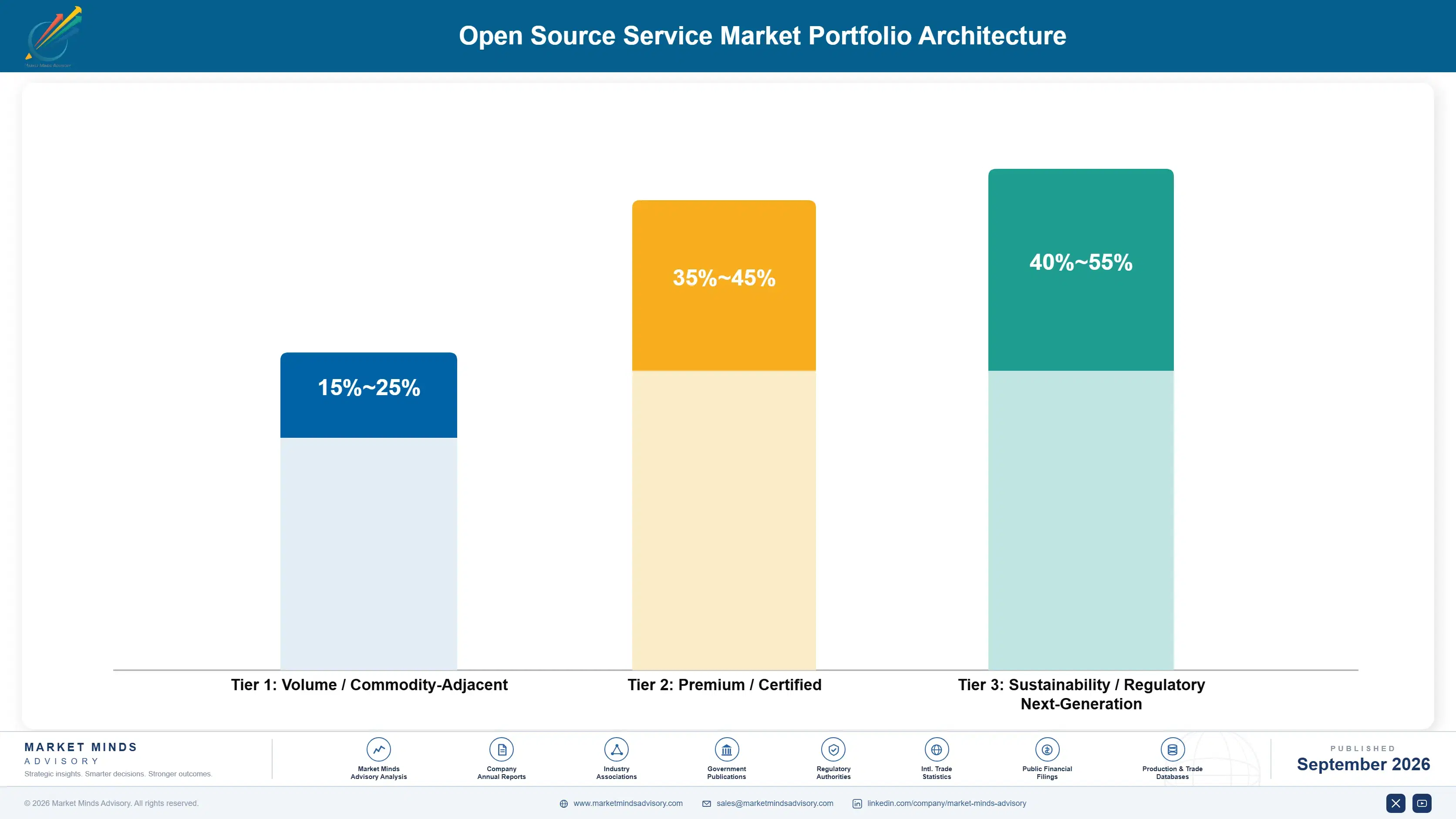
Portfolio economics across open source service providers split between standard reactive support contracts competing largely on price and response time, and premium AI infrastructure or compliance-driven services commanding meaningfully higher margins given specialized expertise and proactive security monitoring capability sold alongside core support across every customer segment served today, from small technology startups to large multinational financial services and healthcare enterprises.
The tension between volume and premium positioning shows clearly in service tier structure: standard support contracts compete on baseline response time and per-seat pricing, while AI infrastructure practices and security compliance services command substantially higher effective margins justified by genuine talent scarcity and documented enterprise risk mitigation value across every regulated industry vertical and company size served.

High-value margin pools concentrate around AI infrastructure expertise and proactive security monitoring subscriptions, both requiring specialized talent and accumulated maintainer relationship depth that smaller providers cannot easily replicate without years of dedicated investment and community trust. Providers positioned purely as reactive ticket-response services will struggle to capture this premium tier without meaningful, sustained investment in specialized practice areas and talent. Larger providers with established practice areas increasingly capture this premium tier ahead of smaller specialized competitors.

Volume / Commodity-Adjacent

Standard reactive support contracts competing largely on price and baseline response time against similar undifferentiated providers serving less demanding enterprise customer segments facing constant price pressure from cloud provider bundled alternatives.
Gross Margin: 15-25%

Premium / Certified

AI infrastructure support and tiered critical incident response services sold to enterprise customers requiring demonstrated specialized expertise and premium service level guarantees beyond what generic reactive support can reliably deliver at scale.
Gross Margin: 35-45%

Sustainability / Regulatory / Next-Generation

Proactive security vulnerability monitoring and compliance-driven documentation services requiring specialized expertise smaller providers cannot easily replicate quickly or affordably, commanding the category's strongest and most defensible margin position across the entire service portfolio.
Gross Margin: 40-55%
open-source-service-market-portfolio-architecture-1788503341298

High-value Sub-segments and Strategic Watch-out

AI and Machine Learning Infrastructure Support

The fastest-growing, highest-value segment as enterprises deploy open source AI tooling faster than internal teams can develop deep specialized operational expertise, creating durable demand for external providers who can keep pace with rapidly evolving open source project releases, configurations, deployment architectures, and integration requirements industry-wide.
Gross Margin: 35-45%

Proactive Security Monitoring Subscriptions

High-value and steadily growing as enterprise compliance requirements increasingly mandate documented vulnerability response commitments beyond basic reactive support ticket handling, rewarding providers that invest early in dedicated security monitoring capability, rapid patch deployment processes, formal incident documentation, and audit-ready compliance reporting frameworks required by regulators.
Gross Margin: 40-55%

Standard Reactive Support Contracts

The volume core of the market, generating steady contract revenue but facing margin pressure from cloud provider bundled service competition, requiring efficient operations and multi-project coverage breadth to sustain acceptable margins as competition intensifies across every served geography, industry, company size, and contract type tracked.
Gross Margin: 15-25%

Cloud Provider Bundled Services

A strategic watch-out category where cloud providers subsidizing managed open source services could meaningfully compress independent provider pricing power over time, potentially reshaping which providers capture the AI infrastructure opportunity this report identifies as the category's central near-term growth driver and primary future margin source.
Gross Margin: N/A, bundled

How Support Contracts Compound Value

Support contracts function like an annuity once an enterprise's production systems become dependent on a provider's specific troubleshooting expertise and accumulated institutional knowledge of that customer's particular deployment configuration, since switching providers mid-relationship risks disrupting incident response continuity built up over months of documented issue resolution history that a new provider relationship would need to rebuild from scratch, adding real transition cost and risk.
Adoption stickiness varies by end-use vertical: financial services and healthcare customers show the deepest lock-in given regulatory documentation requirements tied to specific vendor relationships and compliance audit trails, while smaller technology companies switch more readily given simpler compliance needs and lower integration requirements tied to any single provider's specific support methodology across a typical deployment's operational lifecycle. Switching costs also extend to documented incident response history required for regulatory audits.

Generational shifts in enterprise engineering culture are reshaping buyer profiles, as newer engineering leaders entering the workforce now expect AI-assisted diagnostic tooling and proactive monitoring as a baseline support capability rather than a premium feature reserved for the most expensive contracts only. This mindset shift accelerates vendor evaluation cycles considerably compared to prior engineering leadership generations accustomed to purely reactive support relationships.
open-source-service-market-end-use-penetration-index-1788503341847

MMA Verdict on Open Source Services

These are among the four positions where our research anticipates prominent divergence between winners and laggards over the coming forecast period. Each is grounded in the demand model, the regulatory perimeter, and the announced capacity pipeline.
01 / AI PRACTICE INVESTMENT

Build dedicated AI infrastructure support practices now

Providers still treating AI infrastructure as a generalist support extension rather than a dedicated practice area risk losing ground to competitors demonstrating specialized expertise in rapidly evolving open source model serving and orchestration tools across every deployment scenario. Investing in dedicated AI infrastructure talent now, even at meaningful recruitment cost given scarce specialized talent, positions a provider to capture disproportionate share of the fastest-growing service category tracked in this report. Providers delaying this investment risk permanently ceding this opportunity to faster-moving competitors already building capability.
02 / COMPLIANCE SERVICE EXPANSION

Expand proactive compliance and security monitoring services

Providers offering only reactive ticket-based support increasingly lose enterprise contracts to competitors bundling proactive security vulnerability monitoring and compliance documentation as a standard service tier addressing genuine regulatory requirements across every regulated industry vertical and geography. Building this capability early captures compliance-driven demand before it becomes a baseline market expectation rather than a genuine competitive differentiator worth premium pricing to enterprise buyers evaluating multiple vendors. Providers should treat proactive compliance capability as a durable strategic investment, not optional add-on service.
03 / MULTI-CLOUD POSITIONING STRATEGY

Position explicitly against cloud provider bundled alternatives

Independent providers ceding ground to cloud provider bundled managed open source services without a clear differentiated value proposition risk gradual margin compression as bundled alternatives capture increasing enterprise mindshare through billing convenience alone and existing vendor relationships already in place. Explicit multi-cloud support positioning, emphasizing vendor independence and cross-platform expertise that no single cloud provider can credibly offer, gives independent providers a durable differentiation angle worth defending aggressively. Providers should lean into this positioning rather than competing purely on price.
04 / TALENT PIPELINE DEVELOPMENT

Build internal talent pipelines ahead of specialist shortages

Providers relying entirely on external recruitment for scarce AI infrastructure specialist talent face escalating compensation costs and retention risk as enterprise demand for this expertise continues outpacing available qualified talent supply industry-wide and across every major technology hub globally. Building internal training pipelines that develop this expertise from existing generalist engineering staff reduces dependence on an increasingly expensive external talent market while also improving employee retention and morale considerably. Providers delaying this investment risk losing the talent war to better-prepared competitors.

Engagement Snapshot From the Field

A live engagement with an industry participant carrying material or product regulatory and market exposure ahead of a defining policy shift, showing how our research translates into a defensible multi-year portfolio strategy.
MARKET MINDS ADVISORY · CLIENT ENGAGEMENT SUMMARY
Open Source Service Producer Strategic Portfolio Review and Transition Roadmap 2026·Investment Scenario on Open Source Service Exposure Evaluation 2025-26
CLIENT PROFILE
The client is a regional insurance carrier operating a growing production machine learning infrastructure built on several open source frameworks, previously relying on internal engineering staff for support but facing increasing incident response delays as the internal team's expertise stretched across too many competing technology responsibilities. The company had never purchased dedicated open source support contracts and needed guidance on vendor selection and expected cost.
STRATEGIC CHALLENGE
Leadership needed to select a support vendor capable of covering multiple open source AI infrastructure components under a single contract, without the multi-vendor management overhead that separate point-solution support contracts would otherwise require given the company's limited internal procurement and vendor management staff capacity, bandwidth, and existing daily operational workload.
MMA APPROACH
MMA conducted a structured vendor evaluation across four open source service providers, assessing multi-project coverage breadth, AI infrastructure expertise depth, and response time service level commitments against the client's existing technology stack and compliance requirements, supplementing vendor-provided data with reference calls to comparable regional insurance carrier clients already using each provider's services.
KEY FINDINGS
  1. Two of four evaluated providers lacked coverage for one of the client's key open source AI infrastructure components, requiring a separate supplemental contract.
  2. The selected provider's bundled multi-project support pricing came in below the client's estimated cost of separate individual point-solution contracts combined together entirely.
  3. Reference clients reported meaningfully faster incident resolution times after transitioning from internal-only support to the selected provider's dedicated coverage arrangement and staff.
  4. The provider's documented compliance reporting capability satisfied the client's regulatory audit requirements without requiring additional internal documentation work or extra staff time.
CLIENT PROFILE
The client is a regional insurance carrier operating a growing production machine learning infrastructure built on several open source frameworks, previously relying on internal engineering staff for support but facing increasing incident response delays as the internal team's expertise stretched across too many competing technology responsibilities. The company had never purchased dedicated open source support contracts and needed guidance on vendor selection and expected cost.
STRATEGIC CHALLENGE
Leadership needed to select a support vendor capable of covering multiple open source AI infrastructure components under a single contract, without the multi-vendor management overhead that separate point-solution support contracts would otherwise require given the company's limited internal procurement and vendor management staff capacity, bandwidth, and existing daily operational workload.
MMA APPROACH
MMA conducted a structured vendor evaluation across four open source service providers, assessing multi-project coverage breadth, AI infrastructure expertise depth, and response time service level commitments against the client's existing technology stack and compliance requirements, supplementing vendor-provided data with reference calls to comparable regional insurance carrier clients already using each provider's services.
KEY FINDINGS
  1. Two of four evaluated providers lacked coverage for one of the client's key open source AI infrastructure components, requiring a separate supplemental contract.
  2. The selected provider's bundled multi-project support pricing came in below the client's estimated cost of separate individual point-solution contracts combined together entirely.
  3. Reference clients reported meaningfully faster incident resolution times after transitioning from internal-only support to the selected provider's dedicated coverage arrangement and staff.
  4. The provider's documented compliance reporting capability satisfied the client's regulatory audit requirements without requiring additional internal documentation work or extra staff time.
RECOMMENDED STRATEGY
Phase 1: Phase one: transition support for the client's highest-risk production AI infrastructure component to the selected provider first to validate performance. Phase 2: Phase two: expand coverage to remaining open source components once initial incident response and compliance reporting metrics clear defined thresholds. Phase 3: Phase three: renegotiate contract terms to include proactive security monitoring once the support relationship demonstrates sustained reliable performance over time.
OUTCOME
The client transitioned its highest-risk component to the selected provider, reporting faster incident resolution times during the initial coverage period compared to internal-only support across its production environment (client-reported, unverified by MMA). Leadership credited the phased transition with limiting operational risk during the initial vendor relationship period.

Frequently Asked Questions

Foundational context covering the market sizes, CAGR, scope, country, region and competition that inform every finding below. This section is provided to cover basics and most often pre-purchase conversations, answered from the MMA Primary Research Dataset.

What is the current size of the Open Source Service Market?

The Open Source Service Market is valued at 28.5 billion dollars in 2025. It is expected to reach 32.35 billion dollars by 2026 as AI infrastructure adoption accelerates.

How large will the Open Source Service Market be by 2036?

The market is projected to reach 114.77 billion dollars by 2036, up from 32.35 billion dollars in 2026. That represents a 3.55 times expansion over the forecast period.

What is the CAGR for the Open Source Service Market 2026 to 2036?

The market is forecast to grow at a 13.5 percent compound annual growth rate between 2026 and 2036. This reflects steady demand tied to enterprise AI infrastructure adoption.

Which segment is growing fastest?

AI and Machine Learning Infrastructure Support leads at a 20.0 percent CAGR, roughly 1.48 times the overall market rate. Enterprise AI deployment is driving this rapid growth.

Who are the major companies in the Open Source Service Market?

Leading providers include Red Hat, Canonical, SUSE, Cloudera, and MongoDB. Together these five companies hold an estimated 38 percent combined market share across the category.

Which country is growing fastest?

India leads at a 17.0 percent CAGR, driven by its massive technology services sector and expanding domestic AI infrastructure investment. Domestic firms are increasingly building open source practice areas.

Report Segmentation Architecture

The full report scope spans multiple orthogonal segmentation dimensions, with cross-tabulated demand data provided for each dimension pair. Coverage extends further to regional breakdowns, trend trajectories, and the competitive detail needed to support segment-level decision-making.

By Primary Market Dimension

  • AI and Machine Learning Infrastructure Support
  • Database and Data Infrastructure Support
  • Operating System and Container Platforms
  • Developer Tooling and CI/CD Pipelines
  • Security and Vulnerability Management
  • Enterprise Middleware and Integration

By End-Use Industry

  • Financial Services
  • Technology and Software
  • Healthcare and Life Sciences
  • Government and Public Sector
  • Retail and Consumer

By Commercial Dimension

  • Standard Reactive Support Contracts
  • Tiered Response Time Agreements
  • Migration and Consulting Services
  • Training and Certification Programs

By Region

  • North America
  • Western Europe
  • East Asia
  • South Asia and Pacific
  • Latin America
  • Middle East and Africa
  • Eastern Europe

Scope, Methodology, and Coverage

Every figure in this report is reproducible from documented input assumptions. The scope below maps the historical period, the forecast horizon, the segmentation dimensions, and the countries covered, alongside the underlying primary and qualitative methodology.
Historical Period
2020 to 2025
Forecast Period
2026 to 2036
Base Year
2025 (USD billions; MMA Primary Research Dataset, September 2026)
Market Definition
This market covers commercial support contracts, consulting services, and managed hosting offered for open source software projects to enterprise customers. It excludes the open source software itself when distributed without paid support, and proprietary software licensing unrelated to open source project commercialization.
Quantitative Units
USD billions, market share percentages, CAGR percentages
Segmentation Dimensions
Software category type, end-use industry, commercial dimension, region
Regions Covered
North America, Western Europe, East Asia, South Asia and Pacific, Latin America, Middle East and Africa, Eastern Europe
Countries Covered
United States, United Kingdom, Germany, Japan, China, India, Brazil, United Arab Emirates, and 30 additional countries across all seven global regions
Key Companies Profiled
Red Hat, Canonical, SUSE, Cloudera, MongoDB, and 15 additional providers
Quantitative Methodology
Primary survey, n=3,800 respondents, Q4 2025, six countries; demand-side model with trade association cross-validation
Qualitative Methodology
47 expert interviews, Q4 2025; applied to validate demand model assumptions, identify emerging dynamics, and assess competitive positioning
Report Format
PDF and XLSX data workbook (Word format preview document)
Publisher
Market Minds Advisory
Report Code
MMA-2026-TEC-164
Published
September 2026
Contact
sales@marketmindsadvisory.com | www.marketmindsadvisory.com

Purchase the full Open Source Service Market Report (2026 to 2036).

This report examines the Open Source Service Market across its full 2026 to 2036 forecast horizon, covering market sizing, segmentation, competitive dynamics, and regional demand patterns in depth. It draws on primary survey data from 3,800 respondents and 47 expert interviews conducted in the fourth quarter of 2025. The analysis profiles twenty leading providers and quantifies revenue levers, talent cost exposure, and portfolio economics across the category's major segments. Strategic recommendations address AI practice investment, compliance expansion, and talent pipeline development for providers and investors.
Full 2026-2036 market sizing and forecast data
Seven-region demand and growth rate breakdown
Twenty-company competitive profiles and moat analysis
Segment-level CAGR and market share detail
Revenue lever and talent cost exposure analysis
Anonymised client case study with strategy recommendations

Built For The People Who Decide

From boardroom strategy to bench-side execution, this report is read cover-to-cover by leaders shaping the next decade of their industry, turning demand scenarios, market dynamics and valuation benchmarks into decisions.
CXOs/ Presidents/ VPs/ Managers
M&A and Corporate Development
Strategy Teams and R&D Heads
Procurement and Product Directors
Regulatory and Compliance Leaders
Investor Relations and Equity Analysts