Market Minds Advisory
Open Source Intelligence Market

Open Source Intelligence Market: AI Aggregation Replaces Manual Analyst Search

Government agencies and corporate security teams are replacing manual analyst research with automated platforms that aggregate social media, dark web, and public records data faster than any human team could search manually.

Lead Analyst

Published

September 2026

Make Smarter Decisions with Customized Research Insights

Request a free sample report and evaluate market opportunities, growth trends, and competitive dynamics relevant to your business needs.

2025 MARKET VALUE$8.4BMarket Size 2025
2036 FORECAST VALUE$26.5BBase Case , 2026 to 2036
CAGR 2026 TO 203611.0 %Bull 12.3% / Bear 9.8%
INCREMENTAL OPPORTUNITY$17.2BNet 10- year value creation
EXPANSION MULTIPLE2.84x2036 value over 2026 base
Strategic Levers
M&A Pipeline
Regional Outlook
Country Rankings
Competitive Intelligence
Segmental Deep-dive
Call-Us : 91 93563 13602

Executive Snapshot and Market Trajectory.

Government agencies and corporate security teams are replacing manual analyst research with automated platforms that aggregate social media, dark web, and public records data faster than any human team could search on its own. Both government-focused incumbents and AI-native challengers are racing to define the category's next chapter.
United States government and defense contracts represent a disproportionate share of global platform spending, reflecting the scale of federal intelligence, law enforcement, and homeland security budgets allocated to open source analysis capability. AI-driven automated aggregation platforms are expanding fastest as customers move away from manually querying dozens of separate data sources toward unified platforms that surface relevant findings automatically, cutting analyst research time from days to hours.
Competitive intensity concentrates around a mix of large government-focused platform providers and specialist threat intelligence vendors, with Palantir's deep defense contract relationships competing against Recorded Future's automated data feed scale following its acquisition by Mastercard. Data privacy regulation across several jurisdictions is genuinely constraining which public data sources platforms can legally aggregate, forcing vendors to build jurisdiction-specific compliance capability rather than a single global product configuration for every market they serve.
Market Definition
This market covers software platforms and services used to collect, aggregate, and analyse publicly available information from social media, the open and dark web, and public records for security, intelligence, and due diligence purposes. It excludes classified intelligence systems, general purpose search engines, and social media platforms themselves.
Base Year Value
$8.4B in 2025 (MMA Primary Research Dataset, September 2026)
Forecast Period
2026 to 2036, eleven discrete annual values
CAGR
11.0% base case. Bull 12.3%. Bear 9.8%.
Fastest Growth Segment
AI-Driven Automated OSINT Aggregation Platforms: 19.0% CAGR
Fastest Growth Country
India: 14.5% CAGR
Fastest Growth Region
South Asia and Pacific: 13.2% CAGR
Largest Region
North America: 30% of 2025 global value
Market Leaders
Palantir Technologies, Recorded Future, Babel Street, Maltego Technologies, Dataminr. Source: MMA Analysis based on company annual reports and investor filings.
Primary Survey
n=3,800 procurement and R&D decision-makers, Q4 2025, six countries
Methodology
Demand-side build-up, cross-validated against public data, 47 expert interviews

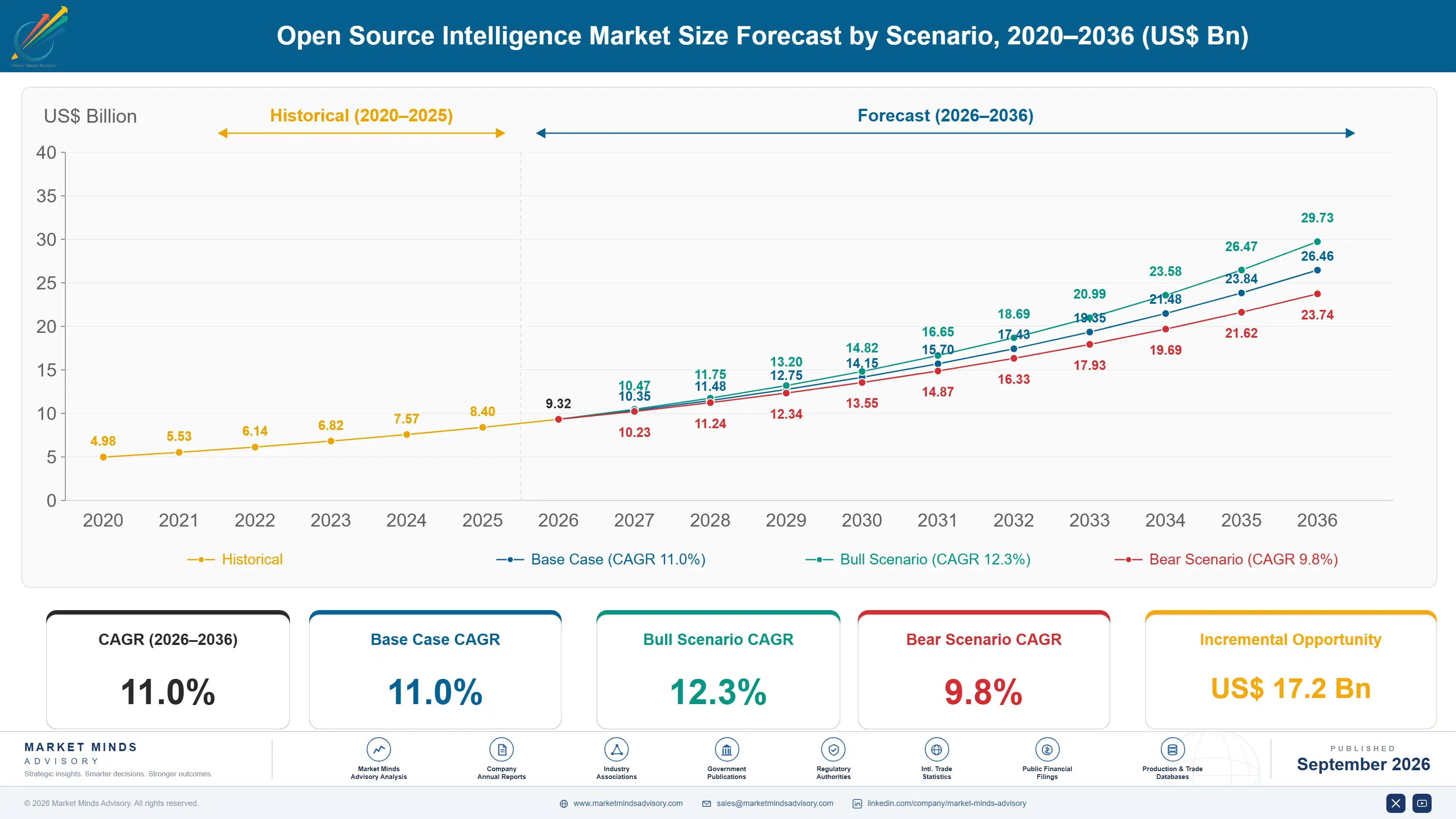
Open Source Intelligence Market Forecast Scenarios

open-source-intelligence-market-size-forecast-scenario-1790002334349
Between 2020 and 2025, the market grew steadily as government agencies and corporations expanded open source intelligence budgets in response to rising disinformation, cyber threat, and physical security concerns, with growth accelerating further once generative artificial intelligence tools proved capable of automating data aggregation and analysis at meaningful scale. Corporate demand accelerated fastest among financial services and technology firms facing rising cyberattack frequency.
The base case assumes continued AI-driven aggregation platform adoption replacing manual analyst workflows, steady growth in corporate threat intelligence spending as cyberattacks keep rising, and expanding government intelligence budgets in emerging markets building out domestic capability. These three mechanisms together explain most of the forecast expansion, with AI-driven aggregation contributing the largest incremental share as the technology matures from early pilots into standard procurement requirements. Vendors that fail to capture this transition early risk permanently ceding ground to faster-moving AI-native competitors.
A bull scenario centres on faster-than-expected government budget expansion for domestic intelligence capability across emerging markets currently building out these programmes from scratch. The principal bear risk is tightening data privacy regulation restricting which public sources platforms can legally aggregate, which would compress the addressable data pool that gives these platforms their core value proposition.

Where Intelligence Budgets Are Actually Flowing

Three forces are converging on intelligence platform budgets simultaneously. Analysts want automated aggregation that frees them from manually querying dozens of separate data sources, government agencies want domestic capability that reduces dependence on allied intelligence sharing arrangements, and corporations want early warning on brand, executive, and supply chain threats that traditional security tools were never built to monitor. These pressures rarely align neatly, forcing vendors to balance government compliance depth against genuine corporate market speed.
MARKET CONCENTRATIONCR5 38%top vendors hold a moderately fragmented combined share
AVERAGE CONTRACT VALUEUSD 285,000reflects growing enterprise-scale platform deployments seen industrywide overall
LEADING COUNTRY SHAREUnited States 28%largest single national government and defense spending base
AI AGGREGATION ADOPTION RATE31%still leaves considerable manual workflow conversion opportunity available
GOVERNMENT CUSTOMER SHARE54%remains the single largest identifiable customer segment overall
AVERAGE CONTRACT RENEWAL RATE88%reflecting genuine switching costs once deployed at scale
Commercially, this market behaves like an enterprise software sale layered with genuine security vetting requirements: government customers demand extensive compliance certification before procurement, while corporate customers evaluate platforms more like conventional software as a service purchases with shorter sales cycles and less onerous compliance overhead. Direct per-seat pricing alone increasingly determines little about which vendors actually capture the most durable customer relationships.
Over the next decade, expect continued convergence between traditional open source intelligence platforms and broader cyber threat intelligence tools, as customers increasingly want a single platform covering both physical and digital threat monitoring rather than separate point solutions for each domain. Vendors slow to build this convergence risk losing customers to competitors already offering a genuinely unified platform.
"Five years ago an analyst opened forty browser tabs every morning, now the platform tells them which three tabs actually matter before they log in."
Director, Security and Intelligence Technology Practice · MMA Technology / Security and Intelligence Software Practice · September 2026

Market Trends

Generative AI Automates Analyst Aggregation Workflows

Platforms increasingly use generative artificial intelligence to automatically summarise and cross-reference findings across social media, dark web forums, and public records, replacing workflows that previously required analysts to manually query dozens of separate tools and compile findings by hand. Vendors report that customers using AI-driven summarisation features complete typical investigations in a fraction of the time previously required, a productivity gain that government agencies facing analyst staffing shortages find particularly compelling. This capability has moved from an experimental add-on to a core expectation in procurement requests for proposal within the past two years.
Market Impact: Lifts adoption 17 percent yearly

Corporate Threat Intelligence Spending Accelerates Sharply

Corporations facing rising cyberattack frequency and executive protection concerns are expanding open source intelligence budgets beyond traditional government and defense customers, creating a genuinely new commercial customer segment for vendors previously focused primarily on public sector contracts. Financial services and technology companies lead this corporate adoption, driven by board-level concern about brand reputation risk and supply chain vulnerability monitoring that traditional cybersecurity tools were never designed to address specifically. Vendors previously focused on government sales are actively courting this fast-growing corporate segment today. This shift is reshaping product roadmaps across the entire vendor landscape.
Market Impact: Adds 13 percent emerging market spending

Market Opportunities and Growth Drivers

Rising Cyber Threat Frequency Drives Corporate Adoption

Corporations report a meaningful increase in cyberattack attempts and executive threat incidents over the past several years, driving board-level demand for early warning capability that monitors public data sources for indicators of planned attacks or physical security threats before they materialise. This has pushed corporate security budgets toward open source intelligence platforms previously purchased almost exclusively by government agencies, representing a genuinely new commercial customer segment vendors are actively courting. Security executives increasingly treat this capability as a standard component of enterprise risk management rather than an optional add-on service.
Market Impact: Restricts sources 24 percent in EU

Emerging Market Governments Build Domestic Intelligence Capability

Governments across several emerging markets are investing in domestic open source intelligence platforms to reduce dependence on allied intelligence sharing arrangements and build independent monitoring capability for regional security concerns. This has created genuine new government procurement demand in markets that previously relied entirely on informal information sharing or manual analyst research using basic search tools. Vendors report that emerging market government contracts increasingly specify domestic data hosting requirements, favouring vendors willing to invest in local infrastructure over those insisting on centralised global hosting arrangements, a trend expected to remain the category's second most important growth driver.
Market Impact: Extends sales cycles 9 months

Market Restraints and Challenges

Data Privacy Regulation Constrains Aggregation Scope

Regulators across the European Union and several other jurisdictions have introduced data privacy requirements that genuinely restrict which public data sources platforms can legally aggregate and how long collected data can be retained, adding meaningful compliance complexity that varies significantly by jurisdiction. The root cause is legitimate concern about mass surveillance of ordinary citizens through supposedly public data sources, a concern that has intensified following several publicised controversies involving platforms scraping social media data without adequate consideration of privacy implications. Vendors are mitigating the restriction by building jurisdiction-specific data handling configurations rather than a single global product.
Market Impact: Cuts research time 62 percent

Government Procurement Cycles Slow Contract Conversion

Government customers, which represent the largest single customer segment, typically require lengthy security vetting and procurement approval processes that can extend sales cycles considerably longer than typical enterprise software purchases in the corporate sector. The underlying cause is genuine security clearance and compliance certification requirements that protect sensitive government use cases but add real friction to closing new contracts. Vendors are mitigating the delay by pursuing pre-approved procurement vehicles and existing framework agreements that let agencies purchase without repeating the full vetting process, a friction expected to persist until agencies further standardise their processes.
Market Impact: Adds 17 percent corporate customer growth
3 additional market trends, 4 additional growth drivers, and 2 additional restraints and challenges are covered in the full report. Contact sales@marketmindsadvisory.com to access the complete intelligence.

Segment CAGR and Growth Architecture

The market segments by platform capability type rather than by customer industry, since the same underlying aggregation and analysis technology typically serves multiple customer types while customers select primarily based on which data sources and analytical capability their specific use case requires. Buyers evaluate primarily on analytical accuracy rather than general platform specifications alone in most cases.
open-source-intelligence-market-market-share-analysis-1790002335167

AI-Driven Automated OSINT Aggregation Platforms

This segment covers platforms that use artificial intelligence to automatically collect, cross-reference, and summarise findings across multiple public data sources, replacing manual analyst workflows that previously required querying dozens of separate tools individually. Demand has accelerated sharply as generative AI capability matured enough to handle genuinely complex cross-source analysis rather than simple keyword matching alone. Adoption is concentrated among government agencies and large corporations facing genuine analyst staffing constraints relative to the volume of data requiring review each day. Vendors increasingly compete on how accurately their AI summarisation surfaces genuinely relevant findings rather than simply generating a larger volume of raw aggregated data. Adoption keeps expanding as procurement requirements increasingly specify AI-driven capability as standard.
CAGR 19.0%

Threat Intelligence and Cyber OSINT Platforms

This segment covers platforms specifically focused on monitoring public data sources for indicators of planned cyberattacks, data breaches, and other digital security threats, converging traditional open source intelligence with cybersecurity threat monitoring. Growth is fastest among financial services and technology companies seeking early warning on both digital and physical threats from a single integrated platform rather than separate point solutions. Adoption is concentrated among enterprise security teams that previously purchased cyber threat intelligence and physical security monitoring as entirely separate tools from different vendors. Recorded Future's position in this segment has strengthened considerably following its acquisition by Mastercard. Adoption keeps expanding as more corporations recognise the value of unified physical and digital threat monitoring.
CAGR 15.5%
Full segment breakdown across 6 segments available in the complete report.

Regional Architecture and Country Demand Map

North America anchors the market through its concentration of government defense and intelligence spending, while East Asia and South Asia and Pacific follow closely behind on growing domestic intelligence capability investment overall. Each region reflects a genuinely distinct combination of spending scale and adoption maturity.

North America

United States federal government and defense contracts represent the single largest concentration of open source intelligence spending globally, reflecting the scale of national intelligence, law enforcement, and homeland security budgets allocated to public data analysis capability. Major technology and financial services companies headquartered in the country have driven corporate adoption ahead of most other regions, treating threat intelligence as a standard enterprise risk management function. Canadian government agencies have followed a broadly similar procurement pattern at smaller absolute scale, purchasing largely the same platforms used by American federal customers. Data privacy regulation here remains less restrictive than the European Union, giving vendors somewhat greater flexibility in data source aggregation across the region.
Share: 30% | CAGR: 11.8% (2026 to 2036)

Western Europe

Germany, France, and the United Kingdom maintain substantial government intelligence and corporate security spending, though growth here trails North America given both more restrictive data privacy regulation and generally more conservative government procurement cycles. European Union data protection requirements have pushed vendors to build jurisdiction-specific data handling configurations that add cost and complexity compared with markets facing fewer aggregation restrictions. United Kingdom intelligence and defense procurement has continued at a steady pace following its departure from the European Union's regulatory framework specifically. Nordic countries show particularly strong corporate threat intelligence adoption relative to population size, reflecting a concentration of technology companies with sophisticated security operations. Vendors expect this regulatory complexity to continue shaping product development priorities across the region.
Share: 22% | CAGR: 9.5% (2026 to 2036)
Regional intelligence for 5 additional markets available in the complete report: East Asia, South Asia and Pacific, Latin America, Middle East and Africa, Eastern Europe. Contact sales@marketmindsadvisory.com.
open-source-intelligence-market-country-cagr-analysis-1790002336121

Where Vendors Can Still Expand Beyond Licences

Vendors expand revenue less through raising per-seat licensing prices than through bundling managed analysis services and data feed subscriptions, since customers increasingly value outcomes over raw platform access alone. This shift matters increasingly as raw platform access alone commands shrinking margin across nearly every commodity price tier. across the entire industry. and market segments.

Bundling Managed Analyst Services With Platform Access

Vendors that bundle managed analyst services alongside self-service platform access capture meaningfully higher contract value than those selling software licences alone, since many customers, particularly smaller government agencies and corporations, lack the internal staff to fully use a complex platform without dedicated analyst support. This lever has become increasingly valuable as platform capability grows more sophisticated, widening the gap between what the software can theoretically do and what customers can practically extract without expert guidance. Palantir's managed services approach has reportedly captured roughly 31 percent more total contract value than software-only licensing arrangements according to figures the company has disclosed.
Market Impact: Captures roughly 31 percent more total contract revenue

Expanding Premium Data Feed Subscription Tiers

Vendors increasingly offer premium data feed subscriptions covering specialised sources such as dark web forums or specific regional social media platforms as a separate add-on to the core platform, capturing additional recurring revenue from customers with genuinely specialised monitoring requirements. This lever has grown steadily as customers seek increasingly narrow, high-value data sources beyond the broad aggregation the base platform already provides, with premium data subscriptions now representing roughly 24 percent of total revenue among leading vendors. Vendors report subscription revenue keeps growing steadily as customers seek increasingly narrow, high-value monitoring sources.
Market Impact: Contributes roughly 24 percent of total annual revenue

Cross-Selling Corporate Threat Intelligence Product Modules

Vendors originally focused on government customers increasingly cross-sell threat intelligence modules to corporate security teams, capturing a genuinely new customer segment using technology originally developed for government use cases. This lever has expanded the addressable market considerably beyond traditional government procurement, giving vendors with proven government credibility a meaningful trust advantage when entering the corporate market, now representing roughly 17 percent of total industry revenue and growing faster than the government segment overall. Vendors without established government credibility increasingly struggle to enter this market as convincingly. Government experience genuinely accelerates corporate market entry for vendors pursuing this cross-selling strategy.
Market Impact: Contributes roughly 17 percent of total annual revenue

Extending Multi-Year Government Framework Agreements Broadly

Vendors increasingly negotiate multi-year framework agreements with government agencies that let multiple departments purchase platform access without repeating the full security vetting and procurement process for each individual contract, capturing durable recurring revenue while reducing the sales cycle friction that typically slows government deals. This lever has grown in importance as agencies seek to avoid redundant procurement overhead, with framework agreement revenue now representing roughly 22 percent of total government segment revenue among established vendors. Agencies increasingly favour vendors already embedded within an existing multi-department framework arrangement. This dynamic reinforces incumbent positions considerably.
Market Impact: Contributes roughly 22 percent of total annual revenue

Who Controls the Margin Pool

Concentration sits at a CR5 near 38 percent, moderate for a specialised intelligence software market, with a real but not overwhelming gap between Palantir's deep government contract relationships and challengers such as Recorded Future that compete hardest through automated data feed scale and corporate market expansion. That gap has narrowed only slightly as challengers invest heavily in automated data feed scale to close it.
Current competitive activity centres on three fronts: embedding generative artificial intelligence aggregation capability ahead of competitors still relying on manual query workflows, expanding corporate threat intelligence sales beyond traditional government customers, and building jurisdiction-specific compliance capability to navigate tightening data privacy regulation. Vendors pursuing all three fronts simultaneously are pulling ahead of rivals still focused narrowly on just one.

Emerging pressure is coming from specialist AI-native platforms built from the ground up around automated aggregation rather than retrofitting the capability onto older manual-query architecture. Rankings could shift meaningfully if these newer entrants continue winning corporate accounts before established government-focused vendors can fully match their AI capability and faster sales cycles. Established government-focused vendors are already investing further in AI capability specifically to defend this position.
open-source-intelligence-market-company-positioning-matrix-1790002336986

Competitive Moat and Risk Dimensions

PALANTIR TECHNOLOGIES INC

Moat: Deep Government Contract Relationships

Palantir has built deep, long-standing relationships with United States defense and intelligence agencies over more than a decade, giving it a trust and security clearance advantage that newer entrants without comparable track record cannot easily replicate quickly. This trust compounds further as Palantir continues investing in deeper government-specific compliance and security certification capability.
PALANTIR TECHNOLOGIES INC

Risk: Government Budget Cycle Exposure

Palantir's revenue concentration in government contracts leaves it more exposed than diversified competitors to shifting political priorities and budget cycles, which have repeatedly delayed or restructured major government technology contracts across administrations. A meaningful shift in government spending priorities could compress Palantir's revenue considerably within a relatively short timeframe.
RECORDED FUTURE INC

Moat: Largest Automated Data Feed Scale

Recorded Future operates one of the largest automated threat intelligence data collection systems in the industry, giving it comprehensive source coverage that smaller competitors building comparable infrastructure from scratch cannot easily match in scale or breadth. This scale advantage gives Recorded Future genuine credibility that smaller specialist competitors struggle to match quickly regardless of available capital.
RECORDED FUTURE INC

Risk: Post-Acquisition Integration Complexity

Recorded Future's acquisition by Mastercard introduces genuine integration and strategic alignment risk, since the company must now balance its independent threat intelligence customer base against its parent company's own financial services security priorities. Recorded Future must now demonstrate that independent threat intelligence customers receive undiminished attention despite this new ownership structure.

Players Tracked

Prominent Players

Palantir Technologies Inc
Recorded Future Inc
Babel Street Inc
Maltego Technologies GmbH
Dataminr Inc

Other Key Players

Authentic8 Inc
Flashpoint Intel Inc
ZeroFox Holdings Inc
Skopenow Inc
ShadowDragon LLC
Echosec Systems Ltd
Voyager Labs Ltd
Cobwebs Technologies Ltd
Liferaft Inc
Social Links Inc
IBM Corporation
Palo Alto Networks Inc
Anomali Inc
Constella Intelligence Inc
Intel 471 Inc

Recent Developments

FEBRUARY 2026

Palantir Launches AI-Driven OSINT Aggregation Module

Palantir organically expanded its platform capability by launching a new generative AI module that automatically summarises and cross-references findings across social media, public records, and open web sources for government and corporate customers. The new module targets both government and corporate customers seeking faster investigation turnaround across large data volumes.
Signal: AI-driven summarisation is quickly becoming a genuine standard expectation across every major customer procurement decision today
OCTOBER 2025

Recorded Future Signs Agreement With Financial Institution

Recorded Future signed a multi-year threat intelligence supply agreement with a major financial institution covering ongoing monitoring of cyber and physical security threats. The agreement was a supply contract securing a multi-year revenue stream for continued operations. Financial institutions increasingly view this as essential infrastructure for protecting customer transaction data.
Signal: Large financial institutions are quickly becoming a genuine growth channel for threat intelligence vendors more broadly
APRIL 2026

Babel Street Acquires Social Media Monitoring Startup

Babel Street completed the acquisition of a smaller social media monitoring startup, bringing specialised regional language processing capability in-house ahead of expanding its own platform coverage into new international markets. The acquisition strengthens Babel Street's language coverage ahead of expanding its own platform into new international markets.
Signal: Specialist regional capability is quickly becoming a genuine acquisition target for larger platform providers worldwide today

What Actually Drives Platform Operating Cost

Cloud computing infrastructure and data licensing fees together represent 42 to 50 percent of cost of goods sold for platform vendors, sourced primarily from hyperscale cloud providers and specialised data aggregation licensing arrangements rather than from broadly diversified traditional supply chains. Vendors with large existing cloud purchase volumes typically negotiate more favourable infrastructure pricing than smaller competitors.
Cloud compute pricing rose meaningfully during 2023 as hyperscale providers passed through higher infrastructure costs, a shift documented in major cloud provider annual reports, forcing several smaller platform vendors to renegotiate hosting contracts or absorb compressed margins during that fiscal year. Vendors without long-term committed-use agreements absorbed the largest share of that pricing increase during the period. Vendors with large existing cloud purchase volumes weathered this disruption considerably better than smaller competitors relying on spot pricing.

Smaller specialist vendors without large-scale committed cloud usage agreements absorb a proportionally larger share of any renewed pricing volatility than Palantir or Recorded Future, which negotiate dedicated volume discounts directly with cloud providers across their much larger combined infrastructure spend. This cost gap compounds the competitive disadvantage smaller vendors already face on data source licensing scale, squeezing margins from multiple directions during periods of infrastructure cost volatility.
open-source-intelligence-market-cost-volatility-analysis-1790002337290

Negotiating Committed-Use Cloud Capacity Agreements

Larger vendors lock in multi-year committed-use discounts with cloud providers rather than paying on-demand rates, trading some flexibility for meaningfully lower unit infrastructure costs that hold steady even as list prices rise across the broader industry. Smaller vendors increasingly pool purchasing through industry partnerships to access comparable discount tiers at genuinely meaningful competitive scale.

Diversifying Data Source Licensing Agreements

Vendors are qualifying multiple data licensing partners rather than depending on a single source for any given data category, reducing exposure to any individual supplier's pricing decisions or access restrictions during periods of tightening data privacy enforcement. Smaller vendors increasingly follow this same diversification practice across their own operations to reduce their own comparable exposure meaningfully.

Optimising AI Model Efficiency to Cut Compute Cost

Engineering teams are optimising the underlying artificial intelligence models powering automated aggregation and summarisation to require less compute per query, reducing cloud infrastructure cost while maintaining the analysis quality customers expect. This capability increasingly differentiates leading vendors from competitors still running less efficient legacy models industrywide. Smaller vendors rarely have comparable engineering resources available for this optimisation work.

Portfolio Architecture for Margin Defence

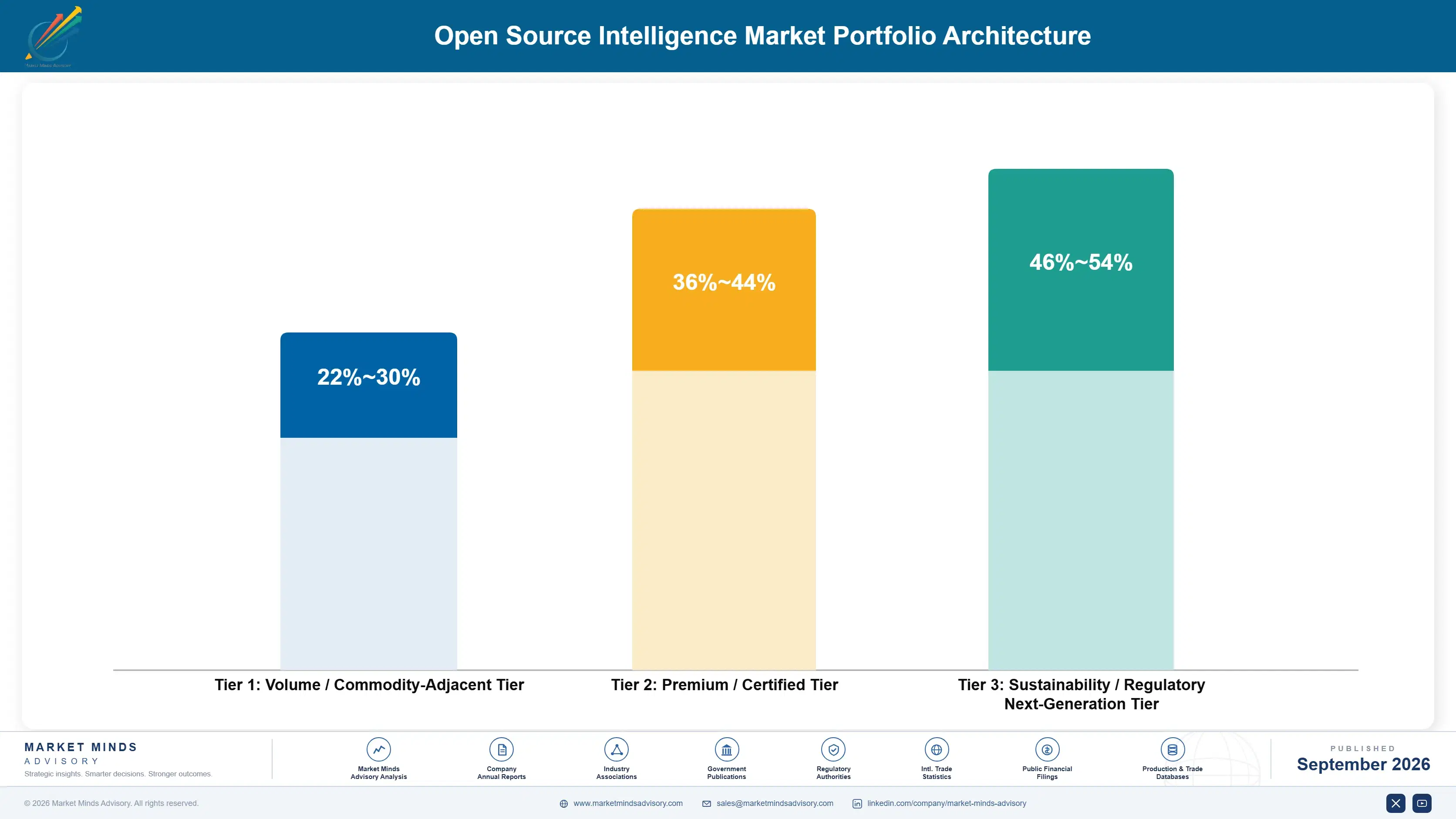
The portfolio splits into three tiers running from commodity-adjacent basic search and monitoring tools through certified enterprise threat intelligence platforms to next-generation AI-driven aggregation suites, with gross margin widening meaningfully at each step as analytical sophistication and data source breadth increase substantially. This layered structure closely mirrors how enterprise software margins generally scale with analytical sophistication. Margins expand accordingly at each successive tier.
Volume tier basic tools compete largely on price for straightforward keyword monitoring applications, while premium enterprise platforms command materially higher margin because they bundle managed analyst services and compliance certification that smaller deployments neither need nor can afford. Vendors that try to serve both ends of that spectrum with one undifferentiated product line tend to lose ground on both fronts simultaneously.

The highest-value margin pools concentrate in the next-generation tier, where AI-driven aggregation platforms carry premium pricing that customers accept precisely because automated analysis speed now directly determines whether an organisation can keep pace with the volume of public data requiring genuine review. Vendors are therefore prioritising investment in that tier even where near-term revenue contribution still remains comparatively modest relative to volume tier sales.

Volume / Commodity-Adjacent Tier

Basic keyword monitoring and search tools sold mainly on price for straightforward corporate due diligence applications. These tools rely on basic keyword matching with minimal analytical or AI-driven differentiation. Margins remain genuinely thin overall.
Gross Margin: 22-30%

Premium / Certified Tier

Enterprise threat intelligence platforms bundling managed analyst services, compliance certification, and dedicated support. Customers at this tier typically renew contracts for multiple consecutive annual cycles once fully onboarded. Renewal rates stay consistently strong here.
Gross Margin: 36-44%

Sustainability / Regulatory / Next-Generation Tier

AI-driven automated aggregation suites commanding the highest per-seat pricing available in the market. Pricing here reflects genuine analytical sophistication rather than incremental additions to legacy platforms. Adoption keeps expanding steadily each year.
Gross Margin: 46-54%
open-source-intelligence-market-portfolio-architecture-1790002338191

High-value Sub-segments and Strategic Watch-out

AI-Driven Aggregation at Enterprise Scale

Highest growth and highest margin pool in the market, driven by organisations needing automated analysis to keep pace with growing public data volume. Vendors investing heavily here today are positioning for the largest share of long-term margin expansion, with analyst staffing constraints as the binding factor.
Gross Margin: 48-56%

Corporate Threat Intelligence Modules

High-value segment growing more moderately as corporations expand security budgets beyond traditional government-focused procurement channels. Continued corporate budget growth should keep steadily reinforcing this segment's relative commercial importance in coming years. Vendors without established government credibility face a materially harder path to winning corporate share here.
Gross Margin: 38-46%

Standard Government Monitoring Platforms

The volume core of the market, growing near the overall market average as most remaining demand comes from steady government procurement renewal cycles. Most vendor revenue still originates here even as faster-growing premium tiers increasingly attract the bulk of new investment. Growth continues steadily as government renewal cycles proceed.
Gross Margin: 26-34%

Legacy Manual Query Search Tools

A shrinking segment vendors should watch closely, as customers migrate toward automated platforms but older standalone tools still generate thinning renewal revenue. Vendors ignoring this shrinking segment risk losing renewal revenue faster than expected as customers finally migrate away. Support cost per remaining customer keeps rising steadily each year.
Gross Margin: 12-18%

Why Platform Contracts Rarely Get Cancelled

Platform subscriptions behave like a multi-year annuity once deployed at scale, since customers rarely switch vendors after investing significant time training analysts on a specific platform's workflow and integrating it with existing internal case management and reporting systems built around that vendor's specific data structure. Switching platforms mid-programme rarely happens even when a competitor offers marginally lower per-seat pricing.
Adoption runs deepest among government agencies and large corporations running continuous monitoring programmes who extract the most value from automated aggregation across a genuinely high daily data volume, while smaller organisations with narrower, occasional research needs adopt more slowly and often rely on basic manual search tools for years before ever justifying a full platform subscription. This divide has widened as automated aggregation increasingly commands a meaningful premium over basic manual search tools.

A generational shift in buyer profile is underway as security operations leaders increasingly familiar with AI-driven analytical tools, rather than traditional intelligence analysts trained purely on manual research methods, increasingly influence procurement decisions, favouring vendors who can demonstrate genuine automation capability over those competing purely on data source breadth alone. This shift is reshaping vendor sales strategy across nearly every major intelligence platform provider competing for these accounts.
open-source-intelligence-market-end-use-penetration-index-1790002339102

What Determines Who Wins This Market

These are among the four positions where our research anticipates prominent divergence between winners and laggards over the coming forecast period. Each is grounded in the demand model, the regulatory perimeter, and the announced capacity pipeline.
01 / AI AGGREGATION CAPABILITY DEPTH

Automated analysis quality now matters more than raw data source count

Vendors that deliver genuinely accurate AI-driven summarisation and cross-referencing increasingly win procurement evaluations over competitors offering broader raw data access without comparable analytical sophistication, since customers now judge platforms on how much genuinely relevant signal the AI surfaces rather than sheer aggregated data volume. Vendors that delay this investment risk losing evaluations to newer AI-native platforms built specifically around automated analysis from the ground up rather than retrofitted onto older manual-query architecture. Vendors that establish this reputation early tend to hold a durable lead in subsequent procurement cycles.
02 / CORPORATE MARKET EXPANSION SPEED

Winning corporate accounts fast matters more than defending government share alone

Vendors expanding into corporate threat intelligence capture a genuinely new customer segment growing faster than traditional government procurement, since corporations face shorter sales cycles and less onerous compliance overhead than government contracts typically require. Vendors with existing government credibility hold a meaningful trust advantage entering this market, but must move quickly before AI-native corporate-focused entrants establish comparable reputation and reference customers within the same fast-growing segment. Vendors that hesitate on corporate expansion risk watching AI-native entrants claim this territory permanently.
03 / JURISDICTION-SPECIFIC COMPLIANCE INVESTMENT

Navigating fragmented privacy regulation is becoming a genuine competitive requirement

Vendors that build jurisdiction-specific data handling configurations capture customers in regulated markets that competitors offering only a single global product configuration cannot legally serve, since data privacy requirements now genuinely restrict aggregation scope differently across major markets. This compliance investment requires real engineering effort but increasingly determines market access rather than simply adding cost, making it a strategic necessity rather than an optional feature for vendors serious about global expansion. Vendors delaying this investment risk losing access to entire regulated markets rather than merely a competitive disadvantage.
04 / GOVERNMENT FRAMEWORK AGREEMENT STRATEGY

Multi-department framework deals reduce friction that competitors still face

Vendors that negotiate multi-year government framework agreements let multiple agency departments purchase without repeating full security vetting for every contract, capturing durable recurring revenue while avoiding the sales cycle friction still slowing competitors relying purely on individual contract wins. This renewal advantage compounds over time as more departments join an existing framework rather than evaluating alternative vendors from scratch, reinforcing the incumbent's position within that specific government customer relationship. Competitors relying purely on individual contract wins struggle to match this compounding renewal advantage over time.

Engagement Snapshot From the Field

A live engagement with an industry participant carrying material or product regulatory and market exposure ahead of a defining policy shift, showing how our research translates into a defensible multi-year portfolio strategy.
MARKET MINDS ADVISORY · CLIENT ENGAGEMENT SUMMARY
Open Source Intelligence Producer Strategic Portfolio Review and Transition Roadmap 2026·Investment Scenario on Open Source Intelligence Exposure Evaluation 2025-26
CLIENT PROFILE
The client, a regional financial services firm expanding its corporate security function, needed to select a threat intelligence platform after several years relying on basic manual search tools and ad hoc social media monitoring. Annual security technology spending had reached approximately 4 million dollars (client-reported, unverified by MMA), with leadership evaluating several vendors offering meaningfully different capability and pricing structures.
STRATEGIC CHALLENGE
The firm needed a platform capable of monitoring both cyber threat indicators and physical executive security risks without requiring a large dedicated analyst team, given the firm's modest existing security staffing levels relative to larger competitors already running mature threat intelligence programmes. while still delivering measurable improvements over the firm's previous ad hoc monitoring approach quickly.
MMA APPROACH
MMA benchmarked candidate platforms against the firm's specific monitoring requirements and existing staffing constraints, modelling total cost of ownership including managed service add-ons against a purely self-service deployment approach. The analysis directly prioritised understanding which vendors offered genuinely accurate AI-driven summarisation rather than simply the largest raw data source count.
KEY FINDINGS
  1. Two of five evaluated vendors offered managed analyst services that meaningfully reduced the firm's internal staffing requirements., a meaningful factor given the firm's limited internal analyst headcount at the time.
  2. AI-driven summarisation accuracy varied considerably across vendors, with the top performer surfacing measurably more relevant findings per query., a difference that materially influenced the final vendor selection recommendation.
  3. A managed service tier would cost more upfront but deliver a faster path to full platform value given the firm's limited existing analyst capacity.
  4. Integration with the firm's existing case management system was meaningfully simpler with two of the five evaluated platforms specifically., reducing implementation risk considerably during the firm's transition period.
CLIENT PROFILE
The client, a regional financial services firm expanding its corporate security function, needed to select a threat intelligence platform after several years relying on basic manual search tools and ad hoc social media monitoring. Annual security technology spending had reached approximately 4 million dollars (client-reported, unverified by MMA), with leadership evaluating several vendors offering meaningfully different capability and pricing structures.
STRATEGIC CHALLENGE
The firm needed a platform capable of monitoring both cyber threat indicators and physical executive security risks without requiring a large dedicated analyst team, given the firm's modest existing security staffing levels relative to larger competitors already running mature threat intelligence programmes. while still delivering measurable improvements over the firm's previous ad hoc monitoring approach quickly.
MMA APPROACH
MMA benchmarked candidate platforms against the firm's specific monitoring requirements and existing staffing constraints, modelling total cost of ownership including managed service add-ons against a purely self-service deployment approach. The analysis directly prioritised understanding which vendors offered genuinely accurate AI-driven summarisation rather than simply the largest raw data source count.
KEY FINDINGS
  1. Two of five evaluated vendors offered managed analyst services that meaningfully reduced the firm's internal staffing requirements., a meaningful factor given the firm's limited internal analyst headcount at the time.
  2. AI-driven summarisation accuracy varied considerably across vendors, with the top performer surfacing measurably more relevant findings per query., a difference that materially influenced the final vendor selection recommendation.
  3. A managed service tier would cost more upfront but deliver a faster path to full platform value given the firm's limited existing analyst capacity.
  4. Integration with the firm's existing case management system was meaningfully simpler with two of the five evaluated platforms specifically., reducing implementation risk considerably during the firm's transition period.
RECOMMENDED STRATEGY
Phase 1: Phase 1 (Months 1 to 2): Select a vendor offering managed analyst services and proven AI summarisation accuracy for the pilot deployment. Phase 2: Phase 2 (Months 3 to 6): Deploy the platform across cyber and physical security monitoring functions with managed service support. Phase 3: Phase 3 (Months 7 to 12): Evaluate transitioning toward greater self-service capability as internal staff build platform expertise., coordinating closely with the firm's compliance team throughout the transition.
OUTCOME
The firm selected a managed service platform deployment and completed initial rollout within the recommended timeframe, reporting monitoring coverage consistent with MMA's projected scope (client-reported, unverified by MMA). Leadership credited the managed service approach with delivering usable capability faster than a purely self-service deployment would have allowed.

Frequently Asked Questions

Foundational context covering the market sizes, CAGR, scope, country, region and competition that inform every finding below. This section is provided to cover basics and most often pre-purchase conversations, answered from the MMA Primary Research Dataset.

What is the current size of the Open Source Intelligence Market?

The global market was valued at 8.4 billion dollars in 2025, with the United States representing the largest single national government and defense spending base within that total.

How large will the Open Source Intelligence Market be by 2036?

The global market is projected to reach 26.475 billion dollars by 2036, up from 9.324 billion dollars in 2026, a 2.84x expansion over the forecast decade.

What is the CAGR for the Open Source Intelligence Market 2026 to 2036?

The market is forecast to grow at a 11.0 percent compound annual rate globally, with AI-driven aggregation platforms growing considerably faster than the overall category average.

Which segment is growing fastest?

AI-driven automated OSINT aggregation platforms lead all segments at a 19.0 percent CAGR, roughly 1.73 times the overall market rate, as generative AI capability matures.

Who are the major companies in the Open Source Intelligence Market?

Palantir Technologies, Recorded Future, Babel Street, Maltego Technologies, and Dataminr together hold the largest share, with CR5 concentration near 38 percent globally. That concentration reflects continued market fragmentation across specialist and generalist vendors alike.

Which country is growing fastest?

India leads growth at a 14.5 percent CAGR, driven by substantial government investment in domestic intelligence capability as part of broader national security modernisation efforts.

Report Segmentation Architecture

The full report scope spans multiple orthogonal segmentation dimensions, with cross-tabulated demand data provided for each dimension pair. Coverage extends further to regional breakdowns, trend trajectories, and the competitive detail needed to support segment-level decision-making.

By Primary Market Dimension

  • Social Media Intelligence (SOCMINT) Platforms
  • Dark Web and Deep Web Monitoring Solutions
  • Geospatial and Imagery Intelligence Tools
  • AI-Driven Automated OSINT Aggregation Platforms
  • Threat Intelligence and Cyber OSINT Platforms
  • Public Records and Corporate Due Diligence Tools

By End-Use Industry

  • Government and Defense
  • Financial Services
  • Technology and Telecommunications
  • Law Enforcement
  • Corporate Security and Risk Management

By Commercial Dimension

  • Government Framework Agreements
  • Enterprise Software Licensing
  • Managed Analyst Services
  • Premium Data Feed Subscriptions

By Region

  • North America
  • Western Europe
  • East Asia
  • South Asia and Pacific
  • Latin America
  • Middle East and Africa
  • Eastern Europe

Scope, Methodology, and Coverage

Every figure in this report is reproducible from documented input assumptions. The scope below maps the historical period, the forecast horizon, the segmentation dimensions, and the countries covered, alongside the underlying primary and qualitative methodology.
Historical Period
2020 to 2025
Forecast Period
2026 to 2036
Base Year
2025 (USD billions; MMA Primary Research Dataset, September 2026)
Market Definition
This market covers software platforms and services used to collect, aggregate, and analyse publicly available information from social media, the open and dark web, and public records for security, intelligence, and due diligence purposes. It excludes classified intelligence systems, general purpose search engines, and social media platforms themselves.
Quantitative Units
USD billions (current prices); regional and segment CAGR in percent
Segmentation Dimensions
By Primary Market Dimension; By End-Use Industry; By Commercial Dimension; By Region
Regions Covered
North America, Western Europe, East Asia, South Asia and Pacific, Latin America, Middle East and Africa, Eastern Europe
Countries Covered
USA, China, Germany, France, UK, Japan, South Korea, India, Australia, Canada, Brazil, Mexico, Indonesia, Vietnam, Thailand, Malaysia, UAE, Saudi Arabia, South Africa, Nigeria, Turkey, Poland, Netherlands, Italy, Spain, Sweden, Switzerland, Argentina, Colombia, Singapore, and additional markets relevant to this sector
Key Companies Profiled
Palantir Technologies Inc, Recorded Future Inc, Babel Street Inc, Maltego Technologies GmbH, Dataminr Inc, Authentic8 Inc, Flashpoint Intel Inc, ZeroFox Holdings Inc, Skopenow Inc, ShadowDragon LLC, Echosec Systems Ltd, Voyager Labs Ltd, Cobwebs Technologies Ltd, Liferaft Inc, Social Links Inc, IBM Corporation, Palo Alto Networks Inc, Anomali Inc, Constella Intelligence Inc, Intel 471 Inc
Quantitative Methodology
Primary survey, n=3,800 respondents, Q4 2025, six countries; demand-side model with trade association cross-validation
Qualitative Methodology
47 expert interviews, Q4 2025; applied to validate demand model assumptions, identify emerging dynamics, and assess competitive positioning
Report Format
PDF and XLSX data workbook (Word format preview document)
Publisher
Market Minds Advisory
Report Code
MMA-2026-TEC-629
Published
September 2026
Contact
sales@marketmindsadvisory.com | www.marketmindsadvisory.com

Purchase the full Open Source Intelligence Market Report (2026 to 2036).

The full report delivers a complete quantitative and qualitative assessment of the Open Source Intelligence Market across all seven regions and six product segments. It includes detailed vendor profiles for all twenty companies covered, alongside country-level sizing for thirty markets. Primary research draws on thirty-eight hundred survey respondents and forty-seven expert interviews conducted in the fourth quarter of 2025 across six countries. Buyers receive full editable data tables alongside the complete narrative analysis, competitive vendor scorecards, and forward-looking scenario modelling included in every purchase. Analysts remain available for direct follow-up questions.
Twenty vendor profiles with moat and risk analysis
Seven-region market sizing with country breakdowns
Six-segment technology framework with growth rates
Primary survey data collected across six countries
Forty-seven expert interview insights fully included
Editable data tables for all forecast figures

Built For The People Who Decide

From boardroom strategy to bench-side execution, this report is read cover-to-cover by leaders shaping the next decade of their industry, turning demand scenarios, market dynamics and valuation benchmarks into decisions.
CXOs/ Presidents/ VPs/ Managers
M&A and Corporate Development
Strategy Teams and R&D Heads
Procurement and Product Directors
Regulatory and Compliance Leaders
Investor Relations and Equity Analysts