Market Minds Advisory
Open Mouth Sacks Market

Open Mouth Sacks Market: A Drop Test Business Specified on the Wrong Property

A filled sack has one job: survive being dropped from waist height onto concrete. The paper property that predicts survival is not the one buyers specify, and the closure everyone uses leaks product.

Lead Analyst

Bilal Shaikh

Published

September 2026

Make Smarter Decisions with Customized Research Insights

Request a free sample report and evaluate market opportunities, growth trends, and competitive dynamics relevant to your business needs.

2025 MARKET VALUE$8.9BMarket Size 2025
2036 FORECAST VALUE$14.3BBase Case , 2026 to 2036
CAGR 2026 TO 20364.4 %Bull 5.6% / Bear 3.2%
INCREMENTAL OPPORTUNITY$5.0BNet 10- year value creation
EXPANSION MULTIPLE1.54x2036 value over 2026 base
Strategic Levers
M&A Pipeline
Regional Outlook
Country Rankings
Competitive Intelligence
Segmental Deep-dive
Call-Us : 91 93563 13602

Executive Snapshot and Market Trajectory

A filled sack exists to survive a 1.2 metre drop onto concrete. What predicts survival is how much work the paper absorbs before rupture, not how strong it tests, and buyers keep specifying the second property while paying for the first, which is a genuinely expensive confusion.
Growth comes from format and closure change rather than from more tonnage bagged. BOPP laminated woven sacks grow fastest at 6.6%, exactly 1.50 times the market rate, on retail-facing rice, flour, feed, and seed where print quality now sells the product. Form fill seal polyethylene follows at 5.8% on filling line economics. South Asia and Pacific sits far above its framework band on Indian cement and grain volume.
Concentration is only 22% across the top five measured on annual sack production, since filled sacks travel badly and regional converters serve customers nearby. Cement carries 43% of global volume and in Africa 92% of it is sold bagged, because sites have no silos. Sewn closures leak roughly 1.4% of product as fines through the stitching. For a producer shipping millions of tonnes that figure is enormous, and it hides inside reported shrinkage.
Market Definition
This market covers sacks open at one end for filling and subsequently closed by sewing, heat sealing, or pinch-bottom gluing, spanning multiwall kraft paper, woven polypropylene. BOPP laminated woven, form fill seal polyethylene, paper-polymer composite, and jute constructions. Scope is measured at converter realised prices across all end uses. Valve sacks closed at both ends, flexible intermediate bulk containers, retail consumer bags below five kilograms, bulk handling equipment, and sack filling and closing machinery are excluded.
Base Year Value
$8.9B in 2025 (MMA Primary Research Dataset, August 2026)
Forecast Period
2026 to 2036, eleven discrete annual values
CAGR
4.4% base case. Bull 5.6%. Bear 3.2%.
Fastest Growth Segment
BOPP Laminated Woven Sacks: 6.6% CAGR
Fastest Growth Country
India: 8.1% CAGR
Fastest Growth Region
South Asia and Pacific: 6.5% CAGR
Largest Region
East Asia: 27% of 2025 global value
Market Leaders
Mondi. Smurfit Westrock. Billerud. Hood Packaging. Berry Global. Source: MMA Analysis based on company annual reports.
Primary Survey
n=3,800 procurement and R&D decision-makers, Q4 2025, six countries
Methodology
Demand-side build-up, cross-validated against public data, 47 expert interviews

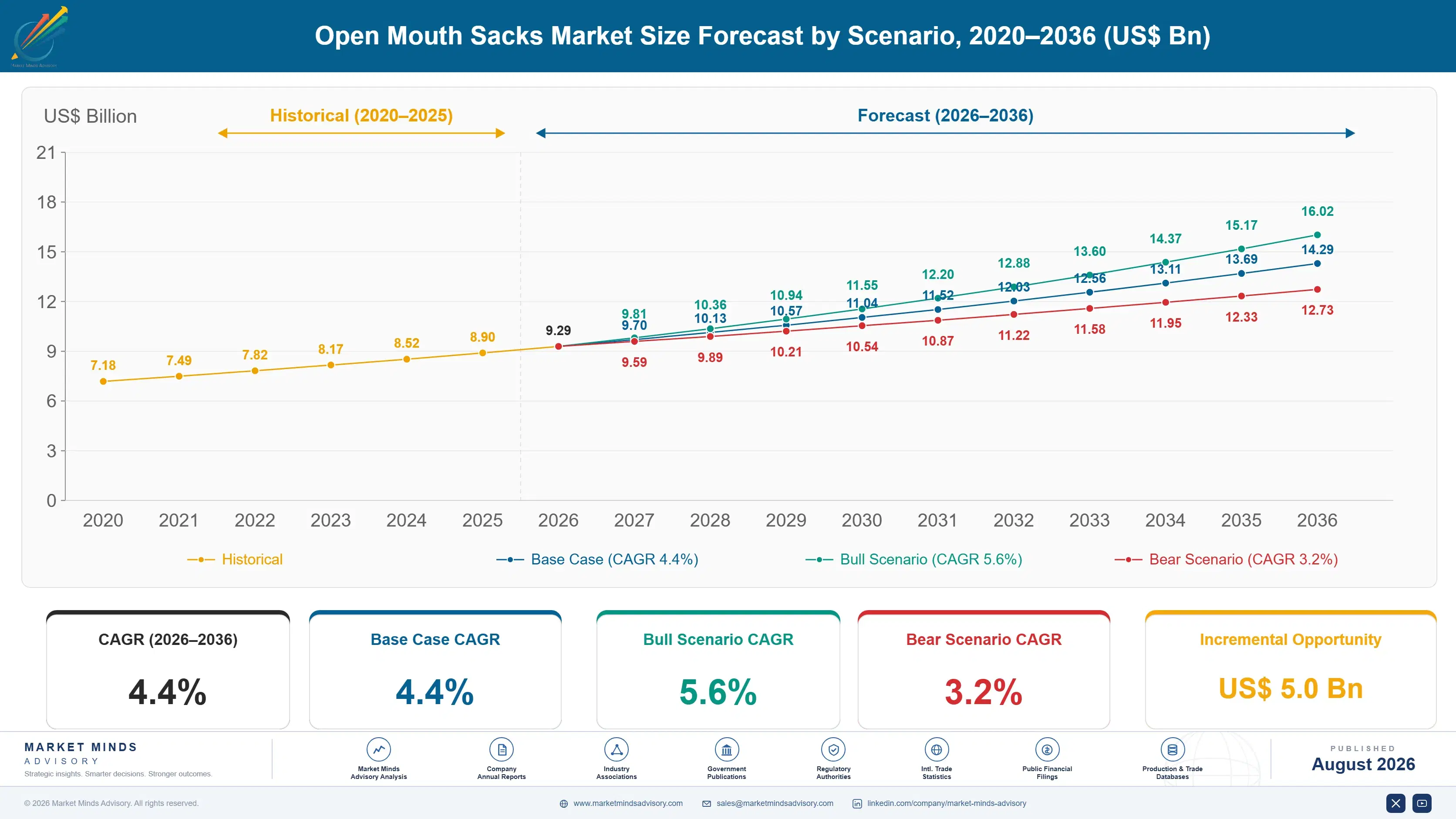
Open Mouth Sacks Market Forecast Scenarios

open-mouth-sacks-market-size-forecast-scenario-1787299143681
The 2020 to 2025 period was governed by cement and by kraft paper pricing. Construction volumes swung across regions while extensible sack kraft, a specialty grade from relatively few mills, moved sharply on pulp and energy. Woven polypropylene took share from paper in several markets on price alone during the worst of it. A 3.5% historical rate averages flat developed market volume against genuine growth across Africa and South Asia.
Three mechanisms carry the 4.4% base case. African and South Asian construction is the largest, since cement in those markets sells bagged rather than in bulk and each tonne needs forty sacks. Retail-facing agricultural packaging is the second, moving rice, flour, feed, and seed onto laminated woven substrates that print properly. And closure conversion is the third, as cement and flour producers finally count what sewn seams have been costing them all along.
The 5.6% bull case rests on African cement capacity additions arriving on announced schedules, since bagged sales there run at 92% and every new plant creates sack demand immediately. The 3.2% bear case is bulk handling infrastructure reaching African and Indian construction faster than expected, repeating the conversion that removed sacked cement from North America and Europe.

The Property Nobody Specifies

Sack paper is not ordinary kraft and the difference matters enormously. Extensible sack kraft is manufactured to stretch, because a filled bag hitting concrete needs to absorb impact energy rather than resist it, and a stiff strong sheet simply tears. Tensile energy absorption predicts drop survival; tensile strength does not. Purchasing specifications across this industry are still written around the wrong number.
TOP FIVE CONCENTRATION22%Regional converters dominate because filled sacks travel poorly
STANDARD DROP TEST HEIGHT1.2 metresSurvival requirement for a filled sack in normal handling
SEWN CLOSURE PRODUCT LOSS1.4%Fines escaping through stitched seams during transit and handling
SACK KRAFT COST SHARE58%Extensible paper grade as a proportion of multiwall cost
CEMENT APPLICATION SHARE43%Single end use dominating global open mouth sack volume
BAGGED CEMENT IN AFRICA92%Share sold in sacks rather than delivered by bulk tanker
The second unexamined cost is the closure. Sewn seams are cheap, fast, and leak, and roughly 1.4% of contents escape as fines through the stitch holes during handling and transit. For a cement producer shipping millions of tonnes that is an enormous figure hiding inside shrinkage. Pinch-bottom gluing and heat sealing are sift-proof and cost more per sack, which is how the comparison usually ends.
Two things shape demand geography. Cement is 43% of volume, and whether it ships bagged or in bulk depends entirely on whether the destination site has a silo. Africa bags 92% of its cement for exactly that reason, while North America and Europe converted to bulk decades ago. Nothing about the sack itself explains that split, and everything about the destination does.
"A cement producer will argue for weeks about a fraction of a cent on the sack price while losing over one percent of the product inside it through the stitching. We have shown that arithmetic to procurement teams who genuinely had never seen it, because the loss shows up as shrinkage and the sack shows up as spend."
Director. Industrial Packaging and Bulk Materials Practice · MMA Packaging and I

Market Trends

Retail-Facing Agricultural Sacks Move To Laminated Woven

Rice, flour, animal feed, and seed increasingly sell from the sack itself rather than being decanted, which makes print quality a commercial requirement rather than an identification one. BOPP lamination over woven polypropylene delivers photographic print, moisture resistance, and strength together, and it grows at 6.6% against a market rate of 4.4%. Brand owners in South and Southeast Asia have driven most of this, since branded rice and feed now compete on shelf appearance in markets where they previously competed on price alone. Shelf appearance now matters where price alone used to.
Market Impact: Africa bags 92% of cement
Closure Conversion Follows Product Loss Rather Than Sack Price

Sewn closures leak around 1.4% of contents as fines through the stitch holes, which for a large cement or flour producer represents a loss far exceeding any plausible saving on sack price. Pinch-bottom gluing and heat sealing are sift-proof and cost more per unit. Producers who measured the loss properly converted quickly, and those who compare only sack quotations have not. The conversion also removes dust from the filling hall, which occupational exposure rules across several jurisdictions have made a separate reason to act. Loss appears as shrinkage while sacks appear as spend.
Market Impact: India grows at 8.1% annually

Market Opportunities and Growth Drivers

African Cement Sells Bagged Because Sites Have No Silos

Around 92% of cement sold across Africa moves in sacks rather than bulk tankers, and the reason is infrastructure rather than preference: construction sites lack silos, roads cannot always take tanker weight, and purchase quantities are small. Each tonne of bagged cement needs roughly forty sacks. Every new grinding plant or capacity expansion therefore creates immediate sack demand at a scale bulk markets never generate. That relationship is direct, predictable, and considerably more durable than construction cycles elsewhere would suggest. Purchase quantities are small, frequent, and entirely retail, which rules bulk delivery out completely.
Market Impact: Filling slows by 30% unvented

Indian Cement And Grain Volume Outruns Every Other Market

Indian cement capacity additions continue at a pace no other country approaches, and Indian cement sells overwhelmingly in sacks through a retail dealer network rather than in bulk to contractors. Food grain and fertiliser procurement add enormous separate volumes moving through government and cooperative channels in sacks. India contributes the fastest national growth rate in this forecast at 8.1%. Domestic converting capacity has grown alongside, and Indian woven polypropylene producers now export sacks across Africa and the Middle East. Dealer network distribution rules out bulk delivery entirely, and capacity keeps being added.
Market Impact: Kraft is 58% of sack cost

Market Restraints and Challenges

Woven Polypropylene Cannot Breathe During Cement Filling

Filling a sack with cement forces out a large volume of entrained air, and if that air cannot escape through the sack wall the bag inflates and bursts or fills badly and slowly. Multiwall paper de-aerates naturally through the sheet, which is why it held cement for a century. Woven polypropylene is stronger and cheaper and does not breathe at all. The root cause is material physics rather than any manufacturing defect. Micro-perforation, vented liners, and modified filling nozzles all address it, and each adds cost or complexity back. Paper held cement for a century on that property.
Market Impact: Growing at 6.6% annually

Extensible Sack Kraft Comes From Very Few Mills

Sack kraft is a specialty grade engineered for stretch and impact absorption, made on a small number of machines concentrated in Nordic countries. Brazil, and Russia, and it is not interchangeable with ordinary kraftliner at any price. At 58% of multiwall cost it dominates the cost base entirely. The root cause is that extensibility requires specific pulp furnish and a creping or micro-crimping step most machines cannot perform. Converters are responding with dual sourcing, woven polypropylene substitution where breathability permits, and grammage optimisation against drop performance. Ordinary kraftliner substitutes for it at no price.
Market Impact: Recovers 1.4% of product loss
4 additional market trends, 3 additional growth drivers, and 2 additional restraints and challenges are covered in the full report. Contact sales@marketmindsadvisory.com to access the complete intelligence.

Segment CAGR and Growth Architecture

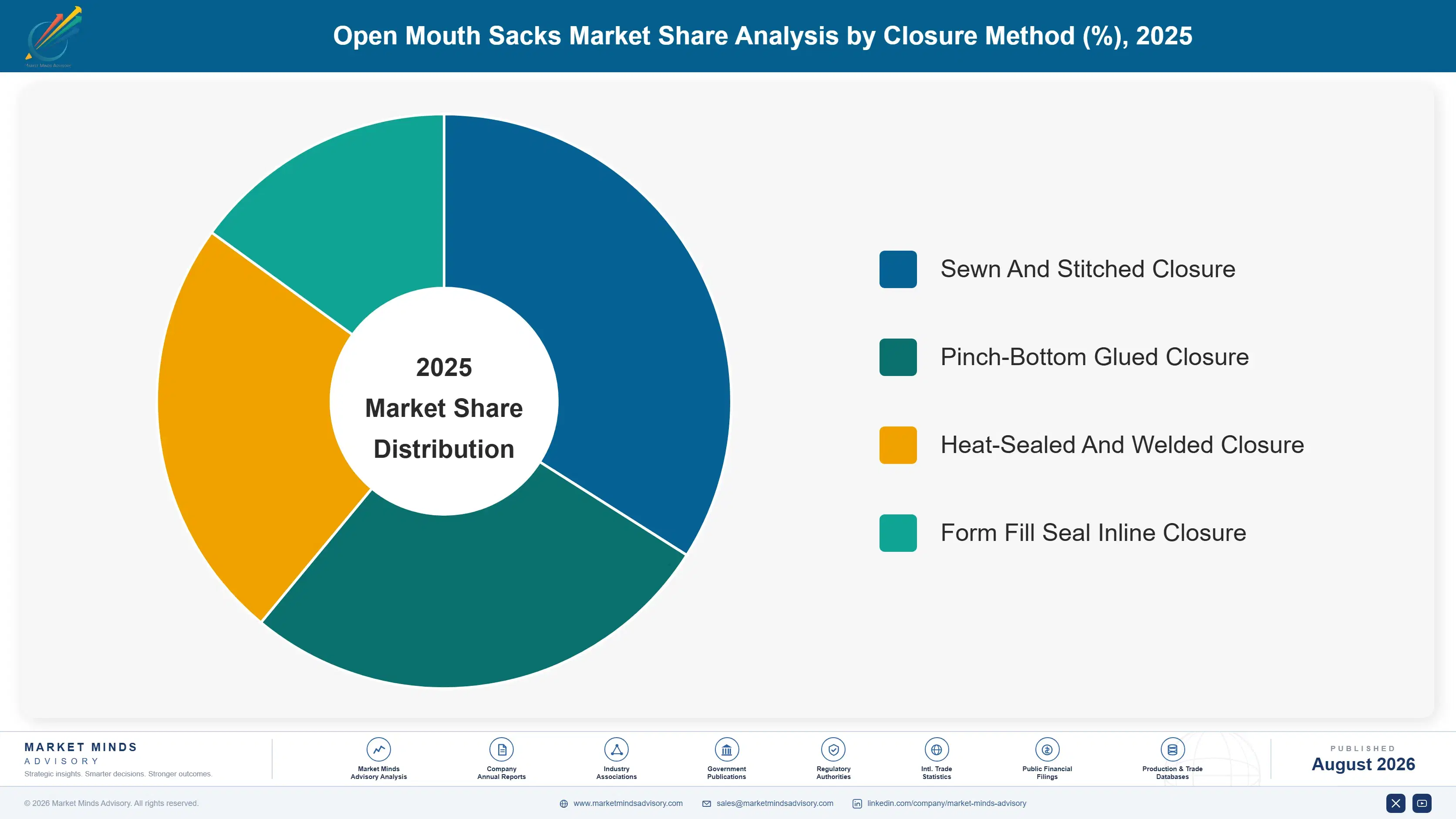
Segmentation follows sack construction, because construction determines drop survival, breathability during filling, print capability, moisture resistance, and cost per unit. End use and closure method both cut across every construction rather than separating them cleanly, so neither functions as a workable primary dimension for this market. Six constructions result, and only some of them breathe.
open-mouth-sacks-market-market-share-analysis-1787299144260

BOPP Laminated Woven Sacks

The fastest construction at 6.6%, exactly 1.50 times the market rate, and it grew because agricultural products started selling from the sack rather than being decanted. Laminating oriented polypropylene film over a woven tape substrate delivers photographic print quality, moisture resistance, and the tensile strength of woven together, which no single material achieves alone. Branded rice, flour, animal feed, and seed have driven adoption hardest across South and Southeast Asia. The construction does not breathe, so cement and other de-aerating products remain closed to it. Recyclability is genuinely poor because separating the laminate film from the woven substrate is not practical at scale anywhere. Cement and other de-aerating products stay closed to it.
CAGR 6.6%

Form Fill Seal Polyethylene Sacks

Second fastest at 5.8%, and it competes on filling line economics rather than on the sack itself. Film arrives on a reel, the machine forms, fills, and seals in one continuous operation, and the converter's product becomes a roll rather than a stack of made bags. That removes sack handling, storage, and bag placement labour from the filling hall entirely. Polymer resin producers packing pellets adopted it first and remain the largest users. The trade is capital: a form fill seal line costs considerably more than a bagging machine, so it only pays above sustained volume, and film changes for different products are slower than swapping a pallet of sacks.
CAGR 5.8%
Full segment breakdown across 6 segments available in the complete report.

Regional Architecture and Country Demand Map

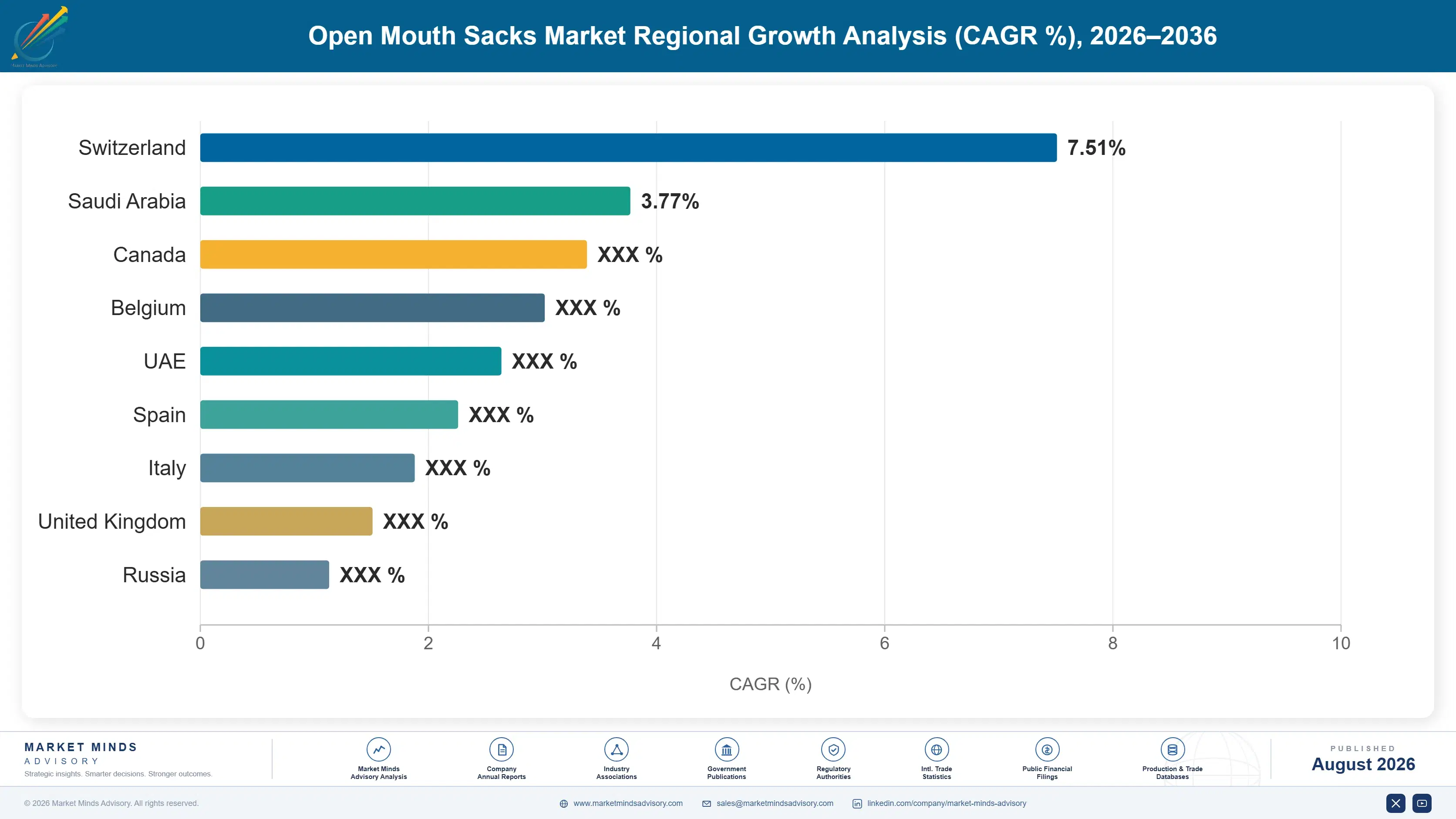
Demand here depends on whether the destination has bulk handling infrastructure, which splits the world sharply. Four regions fall outside their framework bands as a direct result, with Africa and South Asia far above and the mature Western markets well below. Whether a destination site has a silo decides everything.

South Asia and Pacific

Twenty-one percent against a framework band of seven to twelve, and the breach reflects genuine volume rather than any estimation choice. Indian cement sells overwhelmingly through a retail dealer network in sacks rather than in bulk to contractors, and capacity additions continue at a pace no other country approaches. Food grain and fertiliser procurement move enormous separate volumes through government and cooperative channels. India contributes the fastest national growth rate in this forecast at 8.1%. Domestic woven polypropylene converting capacity now exports across Africa and the Middle East. Growth at 6.5% is the highest of any region by a clear margin. Fertiliser and grain procurement add enormous separate volumes, Cement moves through dealers rather than to contractors.
Share: 21% | CAGR: 6.5% (2026 to 2036)

Middle East and Africa

Eleven percent against a framework band of three to six, and the justification is infrastructure. Around 92% of African cement sells bagged because construction sites have no silos, roads cannot always carry tanker weight, and purchase quantities are small and frequent. Every new grinding plant creates sack demand immediately at roughly forty sacks per tonne. Gulf construction bags a smaller proportion but at very large absolute volume. Local converting capacity is thin outside Egypt. Nigeria, and South Africa, so a substantial share arrives imported from India and Turkey. Growth at 4.8% runs above the global rate on cement capacity additions. Each tonne of bagged cement needs roughly forty sacks, which makes the relationship unusually direct.
Share: 11% | CAGR: 4.8% (2026 to 2036)
Regional intelligence for 5 additional markets available in the complete report: East Asia, North America, Western Europe, Latin America, Eastern Europe. Contact sales@marketmindsadvisory.com.
open-mouth-sacks-market-country-cagr-analysis-1787299144774

Four Ways to Improve Sack Margin

Kraft paper and polypropylene tape are commodity inputs bought off published indices, so nobody wins on purchasing. Margin comes from specifying against drop survival rather than tensile strength, from converting closures on product loss, from adding lamination capability, and from contracting sack kraft separately. Four levers follow, and the first two cost almost nothing, beyond changing what gets measured.

Specify Against Tensile Energy Absorption. Not Tensile Strength

Drop survival depends on how much impact energy the sheet absorbs before rupture, and extensible sack kraft is engineered precisely for that while ordinary strong paper simply tears. Specifying against the correct property frequently permits lower grammage at equal or better field performance, saving 7 to 11% of paper cost on the same job. Testing capability costs around 350,000 dollars to establish. It also converts a price argument into a technical one, which is a far better conversation for a converter to be having with procurement. Field reliability improves at the same time as cost falls.
Market Impact: Saves 7 to 11% of total paper cost

Convert Sewn Closures On Product Loss Arithmetic

Sewn seams leak roughly 1.4% of contents as fines, which for a cement or flour producer shipping at scale dwarfs any conceivable saving on sack price. Pinch-bottom gluing and heat sealing are sift-proof and cost more per unit, and that is where the comparison usually stops because the loss appears as shrinkage rather than as packaging spend. Presenting the two numbers together converts customers quickly. Dust reduction in the filling hall gives operations and safety functions a separate reason to support the change. Most producers have simply never done the calculation.
Market Impact: Recovers roughly 1.4% of the shipped product value

Add BOPP Lamination For Retail-Facing Agricultural Sacks

Rice, flour, feed, and seed increasingly sell from the sack, which turns print quality into a commercial requirement rather than a labelling one. Lamination capability costs roughly 6 million dollars for a plant-scale line and lifts realised price per sack by 30 to 45% on converted volume. It is the fastest-growing construction at 6.6% and the qualified converter set in most markets is small. Recyclability is a genuine weakness that brand owners will eventually confront, but they are not confronting it yet in the markets driving adoption. The qualified converter set in most markets stays small.
Market Impact: Lifts price per sack by 30 to 45%

Contract Extensible Sack Kraft Separately From Other Paper

Sack kraft is a specialty grade from a small number of machines in Nordic countries. Brazil, and Russia, and it is not substitutable with ordinary kraftliner at any price. At 58% of multiwall cost it dominates everything, yet converters routinely buy it inside a general paper contract and negotiate an average that suits neither grade. Splitting the contracts and securing sack kraft on longer terms reflects its narrower supply base. Availability rather than price is what bites when the grade tightens. The grade has tightened repeatedly without any warning, and substitution is simply not available.
Market Impact: Sack kraft carries 58% of the multiwall cost

Who Controls the Margin Pool

Concentration reaches only 22% across the top five measured on annual sack production, and freight explains most of it. Empty sacks ship reasonably but filled ones do not travel, so converting sits close to the filling plant and regional producers serve customers within economic range. The leaders are integrated paper groups whose advantage lies upstream in sack kraft supply rather than in converting itself, which is a genuinely different business.
Competition runs on three fronts. Sack kraft access is the first and it separates integrated producers from independent converters absolutely. Lamination and print capability is the second, and it decides the fastest-growing agricultural work. Closure technology and drop performance evidence is the third, and almost nobody competes on it despite it mattering most. Drop performance evidence is where the real gap sits.

Pressure builds from two directions. Indian and Turkish woven polypropylene converters export aggressively into Africa and the Middle East at prices local producers cannot match. And recyclability requirements are beginning to reach laminated constructions that cannot be separated at end of life. Neither pressure responds to price competition at all, and both are reshaping who wins work.
open-mouth-sacks-market-company-positioning-matrix-1787299145306

Competitive Moat and Risk Dimensions

MONDI

Moat: Integrated extensible sack kraft supply

Owning sack kraft machines matters more here than in any other paper packaging category, because the grade is genuinely specialised and made in very few places. Independent converters buy it from producers who also compete with them in finished sacks. Integration decides who absorbs a paper cycle on 58% of multiwall cost.
MONDI

Risk: Paper exposure against woven substitution

Upstream integration in paper becomes a liability wherever woven polypropylene substitutes for multiwall, since that shift removes demand from the mills rather than merely from the converting plants. Growth is concentrated in laminated woven constructions that use no paper at all. Defending paper volume and following the market therefore pull in opposite directions inside the same company.
SMURFIT WESTROCK

Moat: Converting footprint across regions

A wide network of converting plants places the company inside economic range of far more filling sites than a competitor with fewer larger operations, which matters where finished sacks do not travel. That footprint lets specialised capability concentrate at selected plants while standard work runs everywhere else. Building it means acquiring plants.
SMURFIT WESTROCK

Risk: Weighted toward mature bulk markets

A substantial share of the converting network sits in North America and Western Europe, where cement converted to bulk delivery decades ago and sack demand grows slowest anywhere. Volume growth is in Africa. India, and Southeast Asia, where the network is thinner and Indian and Turkish exporters already compete hard.

Players Tracked

Prominent Players

Mondi
Smurfit Westrock
Billerud
Hood Packaging
Berry Global

Other Key Players

Segezha Group
Klabin
Gascogne
LC Packaging
El Dorado Packaging
UFlex
Oji Holdings
Rengo
Nampak
Kanpur Plastipack
Emmbi Industries
Jumbo Bag Limited
Sonoco
Greif
ProAmpac

Recent Developments

FEBRUARY 2025

African cement producer converts bagging lines to pinch-bottom closure

A cement producer operating across several African markets converted bagging lines from sewn to pinch-bottom glued closure across multiple grinding plants, citing product loss through stitched seams and dust exposure in filling halls. The change was an internal operational decision rather than any arrangement with a sack supplier.
Signal: Product loss arithmetic is finally reaching cement operations teams, and it beats sack price every time it is measured
MAY 2025

Indian converter commissions BOPP lamination capacity for agricultural sacks

An Indian woven polypropylene sack manufacturer commissioned laminating capacity aimed at branded rice, flour, and animal feed customers requiring photographic print quality on the sack itself. The expansion was organic capital investment funded internally rather than any partnership with a brand owner or film supplier.
Signal: Agricultural products now sell from the sack rather than being decanted, which makes print a commercial requirement
SEPTEMBER 2025

Nordic mill extends extensible sack kraft capacity at existing site

A Nordic paper producer completed a capacity extension on extensible sack kraft at an existing mill, adding tonnage of the specialty grade used in multiwall construction. The investment was organic capital expenditure rather than any acquisition, and it responds to supply tightness rather than to demand growth.
Signal: Sack kraft supply is narrow enough that a single mill extension is a market event for every independent converter

Paper. Tape, and Everything Else

One input dominates and it differs by construction. Extensible sack kraft runs about 58% of multiwall cost, made on a small number of machines in Nordic countries. Brazil, and Russia. For woven constructions, polypropylene tape yarn accounts for roughly 61% of cost and is produced regionally almost everywhere. Conversion energy, sewing thread or adhesive, print, and labour make up the remainder in both cases.
Sack kraft was the constrained input and polypropylene the volatile one. Extensible kraft tightened as machine capacity failed to keep pace and pulp costs rose, and because the grade is not substitutable converters had no alternative to paying whatever was asked. EIA reporting on petrochemical markets documents the polypropylene movements, which were sharp but offered substitution options. Company annual reports across sack producers describe both effects in consistent terms.

The competitive disadvantage mechanism runs through integration on the paper side and through nothing much on the polymer side. An integrated producer owning sack kraft machines absorbs that cycle internally while independent converters buy from competitors at index. Polypropylene tape is widely available and confers no advantage to anybody. Independent multiwall converters therefore carry an exposure that woven producers simply do not, which partly explains the substitution.
open-mouth-sacks-market-cost-volatility-analysis-1787299145502

Contract extensible sack kraft on longer terms than other grades

Sack kraft is not substitutable with ordinary kraftliner and it comes from a very narrow machine base indeed, so buying it inside a general paper contract will produce an average price that suits neither of the grades at all. Splitting the contract and securing longer terms on the specialty grade reflects its supply reality properly.

Optimise grammage against drop performance rather than specification

Sack specifications frequently demand more paper than the drop requirement needs, because they were written around tensile strength rather than energy absorption. Demonstrating equivalent drop survival at lower grammage cuts paper consumption directly on the input carrying 58% of cost. Testing capability pays for itself quickly and the field reliability improvement is a separate commercial argument in its own right.

Maintain woven capability alongside multiwall in the same plant

Converters running only multiwall carry full exposure to a narrow specialty paper market with no substitution available at all. Holding woven polypropylene capability alongside allows volume to shift where breathability requirements permit it, which is most agricultural and chemical applications though not cement. Dual capability costs capital and complexity, and it removes a genuine single point of failure.

Portfolio Architecture for Margin Defence

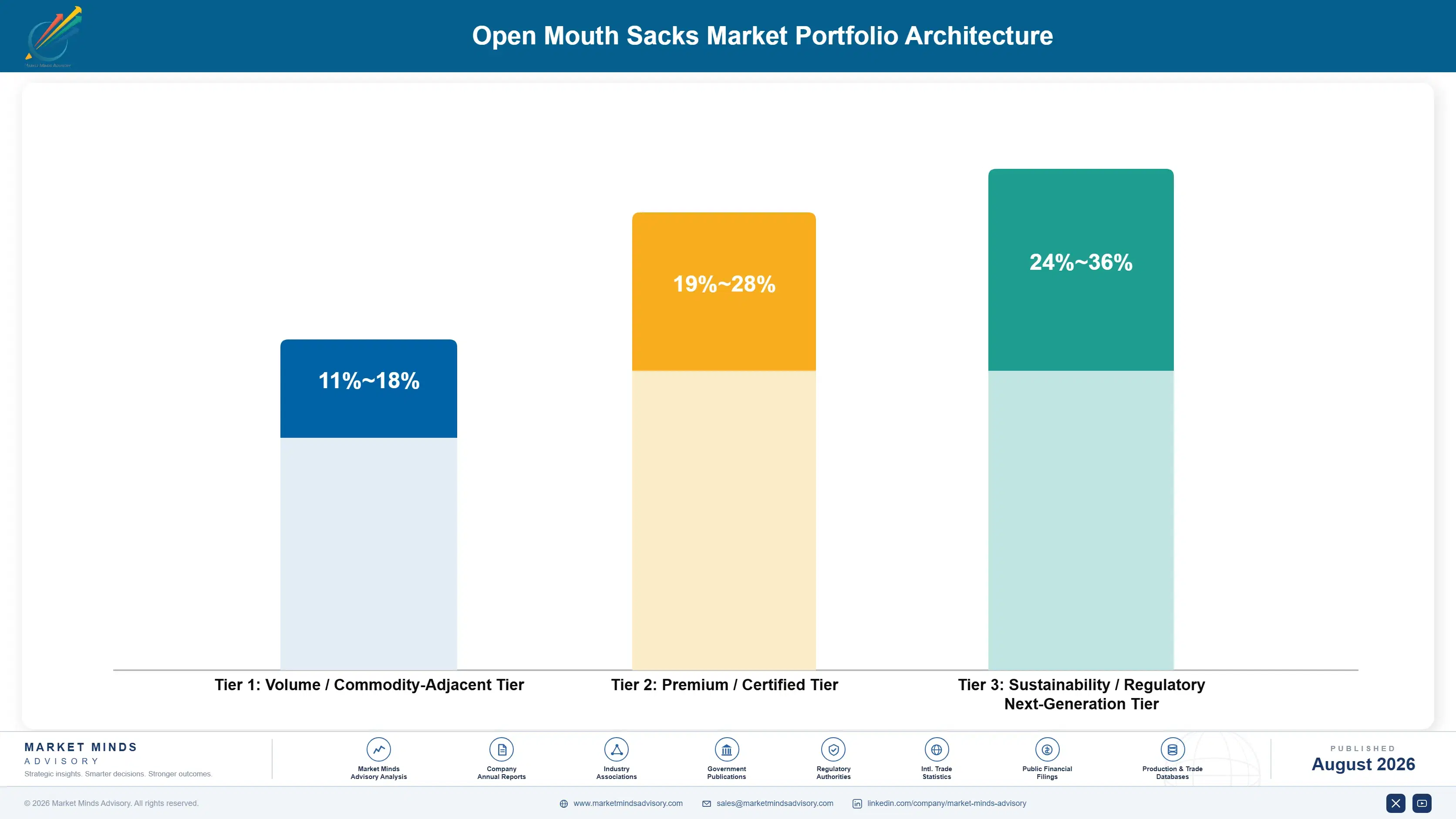
Three tiers describe this business and the spread is narrow because material dominates cost so completely. Standard sewn sacks for cement and bulk commodities sit at the bottom, competing on price against every converter within freight range. Engineered constructions with pinch-bottom or heat-sealed closure and verified drop performance sit meaningfully higher. And laminated retail-facing and specialty barrier sacks occupy a third tier where print quality and product presentation set the price r
The tension is that commodity cement volume keeps converting lines loaded, and lines running below capacity convert at a cost that destroys any margin advantage the premium work carries. Several converters moved toward laminated agricultural work exclusively and found their tube-forming and bottoming equipment idle between campaigns, with unit costs rising across everything they made. Tube-forming and bottoming equipment needs steady loading across everything they made.

High-value pools concentrate where the sack does something beyond containment. Retail print and verified drop performance both command prices that a plain sewn commodity sack never will. Containment alone has never commanded a premium anywhere, and it never will, and retail print is what changed that.

Volume / Commodity-Adjacent Tier

Standard sewn multiwall and woven sacks for cement, fertiliser, and bulk commodities. Thin margin under constant regional competition, and the volume that keeps tube-forming and bottoming lines loaded between higher-value campaigns.
Gross Margin: 11-18%

Premium / Certified Tier

Pinch-bottom glued and heat-sealed constructions with verified drop performance and documented sift resistance. Margin reflects closure engineering and testing evidence rather than any meaningful difference in the paper or tape used.
Gross Margin: 19-28%

Sustainability / Regulatory / Next-Generation Tier

BOPP laminated retail-facing sacks with photographic print quality, plus recyclable mono-material and barrier constructions. Best margin because print quality and shelf presentation set the price rather than containment performance does, which is a different sale entirely.
Gross Margin: 24-36%
open-mouth-sacks-market-portfolio-architecture-1787299146004

High-value Sub-segments and Strategic Watch-out

BOPP Laminated Retail Sacks

Best margin and fastest growth at 6.6%, lifting realised price per sack by 30 to 45% where agricultural products now sell from the pack itself. Recyclability is a genuine weakness that brand owners have not yet been forced to confront anywhere. Separating film from substrate is impractical at scale.
Gross Margin: 24-36%

Pinch-Bottom And Sealed Closures

Strong margin on closure engineering, and the conversion sells itself once the 1.4% product loss through sewn seams is actually measured. Dust reduction in the filling hall gives safety functions a separate reason to support it. Occupational exposure rules have made that a live issue, across several jurisdictions now.
Gross Margin: 19-28%

Standard Sewn Cement Sacks

The volume core at very thin margin, carrying the 43% of global volume that cement represents and keeping converting lines loaded throughout. Converters who abandoned it for laminated work found equipment idle and unit costs rising everywhere. Cement tendering is ruthless and treats sacks as commodity.
Gross Margin: 11-18%

Multiwall Paper Constructions

The strategic watch-out, exposed to woven polypropylene substitution wherever breathability is not required, which is most applications outside cement. Extensible sack kraft at 58% of cost comes from very few machines and has tightened repeatedly. Breathability is the one thing woven cannot replicate, which protects cement volume specifically.
Gross Margin: 13-22%

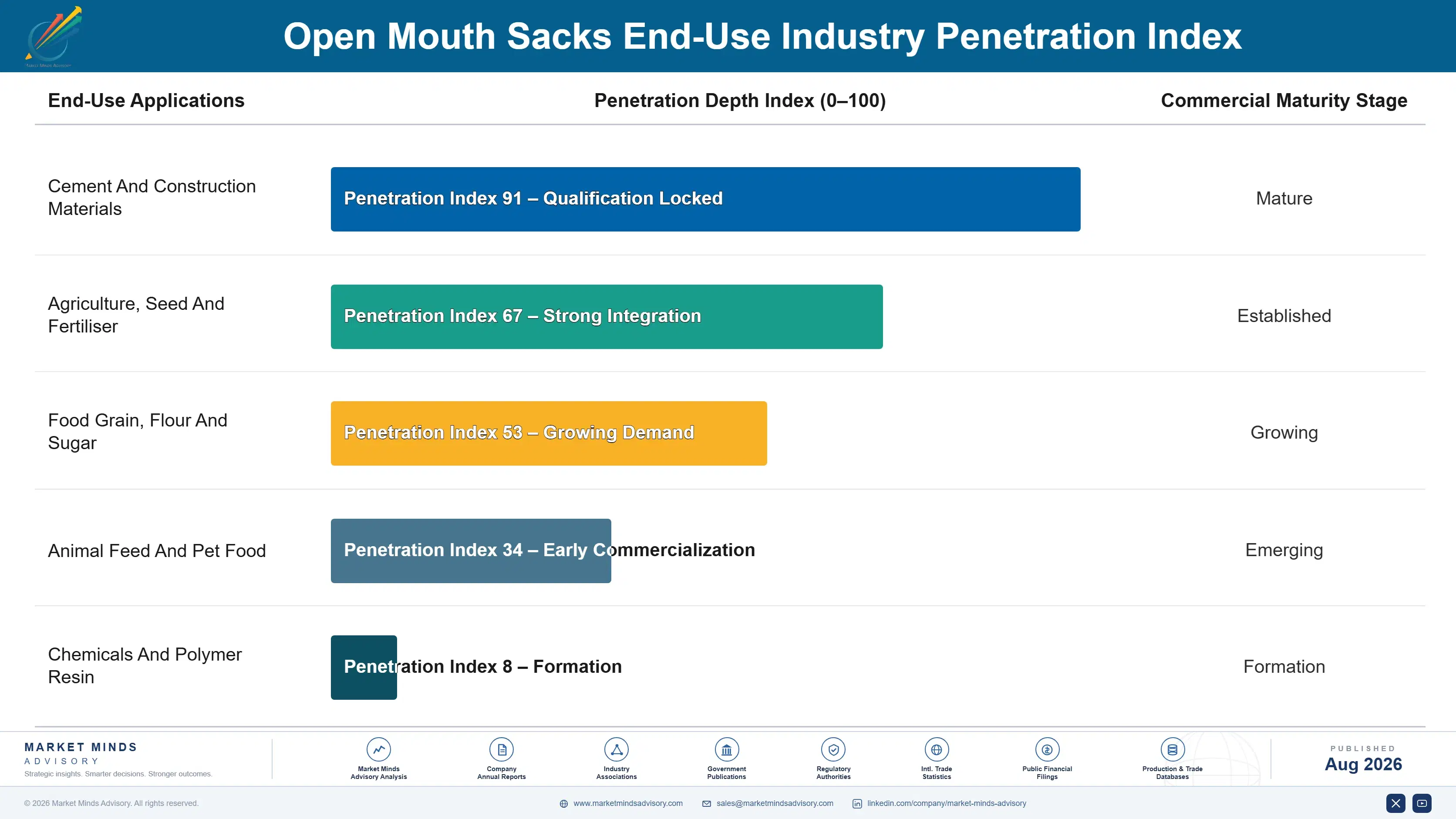
How Sack Demand Actually Recurs

Sack demand tracks the filling plant rather than the end market, which makes it unusually predictable once a supply relationship exists. A cement grinding plant consumes a known number of sacks per tonne produced, orders against production schedule, and rarely changes supplier because bag dimensions are matched to a specific bagging machine and closure system. Contracts run one to three years and renew on price. What ends a relationship is a bagging line change or a quality failure.
Depth of relationship varies sharply by customer type. Cement producers buy enormous volume on annual tenders and negotiate ruthlessly, treating sacks as a pure commodity input. Agricultural brand owners buying laminated retail sacks behave like consumer packaging customers, valuing print quality and colour consistency. Chemical and resin producers specify cleanliness and dust performance tightly. Cooperative and government grain procurement buys on tender at the lowest compliant price.

Buyer profiles are shifting as operations and safety functions gain influence over closure decisions procurement used to own. Dust exposure and product shrinkage now enter conversations that once covered only sack price. Procurement no longer owns the closure decision alone, and converters are slow to redirect their argument.
open-mouth-sacks-market-end-use-penetration-index-1787299146504

What We Would Tell a Board

These are among the four positions where our research anticipates prominent divergence between winners and laggards over the coming forecast period. Each is grounded in the demand model, the regulatory perimeter, and the announced capacity pipeline.
01 / DROP PERFORMANCE SPECIFICATION

Specify energy absorption; strength does not predict survival

A filled sack must survive a 1.2 metre drop onto concrete, and what determines that is how much impact energy the sheet absorbs before rupture rather than how strong it tests in tension. Extensible sack kraft is engineered exactly for the first property while purchasing specifications across this industry are still written around the second. Specifying against the correct property frequently permits lower grammage at equal or better field performance, saving 7 to 11% of paper cost on identical work.
02 / CLOSURE CONVERSION ECONOMICS

Sewn seams leak more than the sack price argument saves

Stitched closures allow roughly 1.4% of contents to escape as fines during handling and transit, which for a cement or flour producer shipping at scale dwarfs any plausible saving on the sack itself. The comparison never happens because loss appears as shrinkage while sacks appear as packaging spend, and different people own the two lines. Presenting both numbers together converts customers remarkably quickly, and dust reduction in the filling hall gives safety functions their own separate reason to support it.
03 / LAMINATION CAPABILITY ADDITION

Agricultural products now sell from the sack itself

Rice, flour, feed, and seed increasingly reach the buyer in the sack rather than being decanted, which turns print quality from a labelling detail into a commercial requirement the brand owner will pay for. Lamination capability costs roughly 6 million dollars at plant scale, and it lifts realised price per sack by 30 to 45% on converted volume. It remains the fastest-growing construction in the category at 6.6%, and the qualified converter set across most markets is still genuinely small.
04 / SPECIALTY PAPER CONTRACTING

Buy sack kraft separately; nothing else substitutes for it

Extensible sack kraft carries 58% of multiwall cost, comes from a very small number of machines concentrated in the Nordic countries, Brazil, and Russia, and cannot be replaced by ordinary kraftliner at any price whatsoever. Converters routinely buy it inside a general paper contract and then end up negotiating an average price that matches neither grade properly. Availability rather than price is what actually bites when the grade tightens, and it has tightened repeatedly across the past decade with no warning.

Engagement Snapshot From the Field

A live engagement with an industry participant carrying material or product regulatory and market exposure ahead of a defining policy shift, showing how our research translates into a defensible multi-year portfolio strategy.
MARKET MINDS ADVISORY · CLIENT ENGAGEMENT SUMMARY
Open Mouth Sacks Producer Strategic Portfolio Review and Transition Roadmap 2026·Investment Scenario on Open Mouth Sacks Exposure Evaluation 2025-26
CLIENT PROFILE
An independent sack converter with approximately 180 million dollars in annual revenue (client-reported, unverified by MMA), operating two plants producing multiwall paper and sewn woven sacks for cement, fertiliser, and agricultural customers. The company quoted all work on tensile strength specifications, held no lamination capability, and bought extensible sack kraft inside a general paper supply contract alongside ordinary grades.
STRATEGIC CHALLENGE
Margin had compressed for three consecutive years while volumes held steady, and the company had lost several agricultural accounts to converters offering laminated print. A sack kraft supply interruption had forced two weeks of downtime. Management proposed price reductions to defend cement volume, and the board wanted an independent view first.
MMA APPROACH
We drop-tested the client's principal constructions against their specifications at standard height and measured energy absorption alongside tensile strength, benchmarked paper purchasing by grade against integrated and independent comparables, and reviewed the lost agricultural accounts against what the winning converters had actually supplied. Cement customer product loss through sewn closures was quantified at two sites.
KEY FINDINGS
  1. Client constructions were over-specified against drop requirements by roughly 12% in grammage terms, with equivalent survival achievable on lighter extensible grades throughout.
  2. All four lost agricultural accounts had moved for print quality on laminated woven sacks, and none had cited price as a factor in the decision at any point.
  3. Sack kraft was being purchased at above independent comparables because it sat inside a blended contract covering ordinary grades with entirely different supply dynamics.
  4. Measured product loss through sewn closures at two cement customer sites exceeded the total annual sack spend at both, and neither customer had ever quantified it.
CLIENT PROFILE
An independent sack converter with approximately 180 million dollars in annual revenue (client-reported, unverified by MMA), operating two plants producing multiwall paper and sewn woven sacks for cement, fertiliser, and agricultural customers. The company quoted all work on tensile strength specifications, held no lamination capability, and bought extensible sack kraft inside a general paper supply contract alongside ordinary grades.
STRATEGIC CHALLENGE
Margin had compressed for three consecutive years while volumes held steady, and the company had lost several agricultural accounts to converters offering laminated print. A sack kraft supply interruption had forced two weeks of downtime. Management proposed price reductions to defend cement volume, and the board wanted an independent view first.
MMA APPROACH
We drop-tested the client's principal constructions against their specifications at standard height and measured energy absorption alongside tensile strength, benchmarked paper purchasing by grade against integrated and independent comparables, and reviewed the lost agricultural accounts against what the winning converters had actually supplied. Cement customer product loss through sewn closures was quantified at two sites.
KEY FINDINGS
  1. Client constructions were over-specified against drop requirements by roughly 12% in grammage terms, with equivalent survival achievable on lighter extensible grades throughout.
  2. All four lost agricultural accounts had moved for print quality on laminated woven sacks, and none had cited price as a factor in the decision at any point.
  3. Sack kraft was being purchased at above independent comparables because it sat inside a blended contract covering ordinary grades with entirely different supply dynamics.
  4. Measured product loss through sewn closures at two cement customer sites exceeded the total annual sack spend at both, and neither customer had ever quantified it.
RECOMMENDED STRATEGY
Phase 1: Phase 1 (months one to six): install drop testing capability, requote the cement portfolio against energy absorption, and split the sack kraft contract. Phase 2: Phase 2 (months six to eighteen): present measured product loss data to cement customers and convert closure specifications toward pinch-bottom gluing. Phase 3: Phase 3 (months eighteen to thirty): commission BOPP lamination capability and pursue the agricultural accounts previously lost on print quality.
OUTCOME
The client installed drop testing and split its paper contracting by grade. Paper consumption fell materially on requoted constructions while field performance improved, margin recovered without any price increase (client-reported, unverified by MMA), and two cement customers began closure conversion after seeing their own loss figures.

Frequently Asked Questions

Foundational context covering the market sizes, CAGR, scope, country, region and competition that inform every finding below. This section is provided to cover basics and most often pre-purchase conversations, answered from the MMA Primary Research Dataset.

What is the current size of the Open Mouth Sacks Market?

The market is valued at USD 8.9 billion in 2025, rising to USD 9.29 billion in 2026. Cement alone carries roughly 43% of global volume.

How large will the Open Mouth Sacks Market be by 2036?

MMA forecasts USD 14.29 billion by 2036, an increase of USD 5.00 billion over the 2026 base. That represents an expansion multiple of 1.54 times.

What is the CAGR for the Open Mouth Sacks Market 2026 to 2036?

The base case CAGR is 4.4%, with a bull case of 5.6% and a bear case of 3.2%. The historical rate from 2020 to 2025 was 3.5%.

Which segment is growing fastest?

BOPP laminated woven sacks at 6.6%, exactly 1.50 times the market rate. Agricultural products increasingly sell from the sack rather than being decanted, which makes print quality commercial.

Who are the major companies in the Open Mouth Sacks Market?

Mondi, Smurfit Westrock, Billerud, Hood Packaging, and Berry Global lead on annual sack production. The top five hold only 22% because filled sacks do not travel.

Which country is growing fastest?

India at 8.1%, driven by cement capacity additions sold through retail dealer networks in sacks and by food grain and fertiliser procurement volumes. Domestic converting capacity now exports widely.

Report Segmentation Architecture

The full report scope spans multiple orthogonal segmentation dimensions, with cross-tabulated demand data provided for each dimension pair. Coverage extends further to regional breakdowns, trend trajectories, and the competitive detail needed to support segment-level decision-making.

By Sack Construction

  • Multiwall Kraft Paper Sacks
  • Woven Polypropylene Sacks
  • BOPP Laminated Woven Sacks
  • Form Fill Seal Polyethylene Sacks
  • Paper-Polymer Composite Sacks
  • Jute And Natural Fibre Sacks

By End-Use Industry

  • Cement And Construction Materials
  • Agriculture, Seed And Fertiliser
  • Food Grain, Flour And Sugar
  • Animal Feed And Pet Food
  • Chemicals And Polymer Resin

By Closure Method

  • Sewn And Stitched Closure
  • Pinch-Bottom Glued Closure
  • Heat-Sealed And Welded Closure
  • Form Fill Seal Inline Closure

By Region

  • South Asia and Pacific
  • Middle East and Africa
  • East Asia
  • North America
  • Western Europe
  • Latin America
  • Eastern Europe

Scope, Methodology, and Coverage

Every figure in this report is reproducible from documented input assumptions. The scope below maps the historical period, the forecast horizon, the segmentation dimensions, and the countries covered, alongside the underlying primary and qualitative methodology.
Historical Period
2020 to 2025
Forecast Period
2026 to 2036
Base Year
2025 (USD billions; MMA Primary Research Dataset, August 2026)
Market Definition
This market comprises sacks open at one end for filling and subsequently closed by sewing, pinch-bottom gluing, heat sealing, or inline form fill seal operation, measured at converter realised prices across all end-use industries. Construction coverage spans multiwall extensible kraft paper, woven polypropylene, BOPP laminated woven, form fill seal polyethylene, paper-polymer composite, and jute or natural fibre sacks in filled weights above five kilograms. Valve sacks closed at both ends, flexible intermediate bulk containers and bulk bags, retail consumer bags below five kilograms, bulk handling and silo equipment, and sack filling, closing, or palletising machinery fall outside scope.
Quantitative Units
USD billions (current prices); billion sacks produced annually; realised price per sack
Segmentation Dimensions
By Sack Construction; By End-Use Industry; By Closure Method; By Region
Regions Covered
South Asia and Pacific, Middle East and Africa, East Asia, North America, Western Europe, Latin America, Eastern Europe
Countries Covered
India, China, Vietnam, Indonesia, Thailand, Bangladesh, Pakistan, Australia, Japan, South Korea, Nigeria, Egypt, South Africa, Kenya, Ethiopia, Saudi Arabia, UAE, Morocco, USA, Canada, Mexico, Brazil, Argentina, Colombia, Germany, France, Spain, Poland, Turkey, and additional markets relevant to this sector
Key Companies Profiled
Mondi, Smurfit Westrock, Billerud, Hood Packaging, Berry Global, Segezha Group, Klabin, Gascogne, LC Packaging, El Dorado Packaging, UFlex, Oji Holdings, Rengo, Nampak, Kanpur Plastipack, Emmbi Industries, Jumbo Bag Limited, Sonoco, Greif, ProAmpac
Quantitative Methodology
Primary survey, n=3,800 respondents, Q4 2025, six countries; demand-side model with trade association cross-validation
Qualitative Methodology
47 expert interviews, Q4 2025; applied to validate demand model assumptions, identify emerging dynamics, and assess competitive positioning
Report Format
PDF and XLSX data workbook (Word format preview document)
Publisher
Market Minds Advisory
Report Code
MMA-2026-PAC-315
Published
August 2026
Contact
sales@marketmindsadvisory.com | www.marketmindsadvisory.com

Purchase the full Open Mouth Sacks Market Report (2026 to 2036).

The full report sizes open mouth sacks across six constructions, five end-use industries, four closure methods, and seven regions, with country detail for the twenty largest national markets. Bagged versus bulk delivery share is modelled by market for cement specifically, since that single split explains most of the regional variation in this category. Drop survival is benchmarked against energy absorption and tensile strength across common constructions. Competitive profiling covers twenty converters on annual sack production. Extensible sack kraft supply and machine capacity is mapped producer by producer.
Bagged versus bulk cement delivery share modelled by market
Drop survival benchmarked against energy absorption and tensile strength
Product loss through sewn closures quantified by application
Extensible sack kraft supply mapped by producer and machine
Lamination capability and print quality compared across converters
Woven and multiwall substitution economics by end-use requirement

Built For The People Who Decide

From boardroom strategy to bench-side execution, this report is read cover-to-cover by leaders shaping the next decade of their industry, turning demand scenarios, market dynamics and valuation benchmarks into decisions.
CXOs/ Presidents/ VPs/ Managers
M&A and Corporate Development
Strategy Teams and R&D Heads
Procurement and Product Directors
Regulatory and Compliance Leaders
Investor Relations and Equity Analysts