Market Minds Advisory
Online Sweepstakes Platform Market

Online Sweepstakes Platform Market: Online Sweepstakes Platform Market. Social Casino Growth Meets Regulatory Sweep Ambiguity

State regulators scrutinizing dual-currency sweepstakes models are pushing platform operators toward clearer legal structuring, forcing suppliers to balance player acquisition growth against rising compliance and licensing costs across every jurisdiction.

Lead Analyst

Published

September 2026

Make Smarter Decisions with Customized Research Insights

Request a free sample report and evaluate market opportunities, growth trends, and competitive dynamics relevant to your business needs.

2025 MARKET VALUE$2.6BMarket Size 2025
2036 FORECAST VALUE$10.4BBase Case , 2026 to 2036
CAGR 2026 TO 203613.4 %Bull 14.7% / Bear 12.1%
INCREMENTAL OPPORTUNITY$7.4BNet 10- year value creation
EXPANSION MULTIPLE3.52x2036 value over 2026 base
Strategic Levers
M&A Pipeline
Regional Outlook
Country Rankings
Competitive Intelligence
Segmental Deep-dive
Call-Us : 91 93563 13602

Executive Snapshot and Market Trajectory.

State regulators scrutinizing dual-currency sweepstakes models are quietly reshaping platform demand, pulling operators toward clearer legal structuring faster than traditional social casino apps ever managed to adapt on their own across most jurisdictions nationwide. That pressure is now nearly universal among multi-state platform operators. Scale matters here too.
Sweepstakes slot and table game platforms are pulling ahead of basic sweepstakes coupon apps as the fastest-growing category, since players increasingly prefer casino-style gameplay over simple promotional entry mechanics. Adoption concentrates most heavily in North America, where dual-currency legal structuring and payment processing infrastructure both drive platform growth, and competition remains fiercest among mid-tier coupon app challengers there. Payment processor relationships now shape platform growth as heavily as game selection itself.
Competitive character is shifting from generic promotional sweepstakes apps toward platforms capable of demonstrating legal compliance structuring and responsible gaming credentials that regulators increasingly require. State-level legal ambiguity and payment processor risk both shape which platforms can credibly scale, and rankings shift fastest among mid-tier slot game challengers. Platforms slow to adapt risk losing trust quickly. Timing matters as budgets get finalized each year. Scale matters.
Market Definition
This market covers online platforms operating dual-currency sweepstakes models offering casino-style games funded through purchased virtual currency with promotional sweepstakes entries redeemable for prizes. It excludes real-money online gambling platforms operating under direct gaming licenses rather than sweepstakes promotional frameworks.
Base Year Value
$2.6B in 2025 (MMA Primary Research Dataset, September 2026)
Forecast Period
2026 to 2036, eleven discrete annual values
CAGR
13.4% base case. Bull 14.7%. Bear 12.1%.
Fastest Growth Segment
Sweepstakes Slot and Table Game Platforms: 19.2% CAGR
Fastest Growth Country
Brazil: 17.4% CAGR
Fastest Growth Region
South Asia and Pacific: 15.4% CAGR
Largest Region
North America: 34% of 2025 global value
Market Leaders
VGW Holdings, High 5 Games, Pulsz Bingo, Fortune Coins, Stake.us. Source: MMA Analysis based on company annual reports.
Primary Survey
n=3,800 procurement and R&D decision-makers, Q4 2025, six countries
Methodology
Demand-side build-up, cross-validated against public data, 47 expert interviews

Online Sweepstakes Platform Market Forecast Scenarios

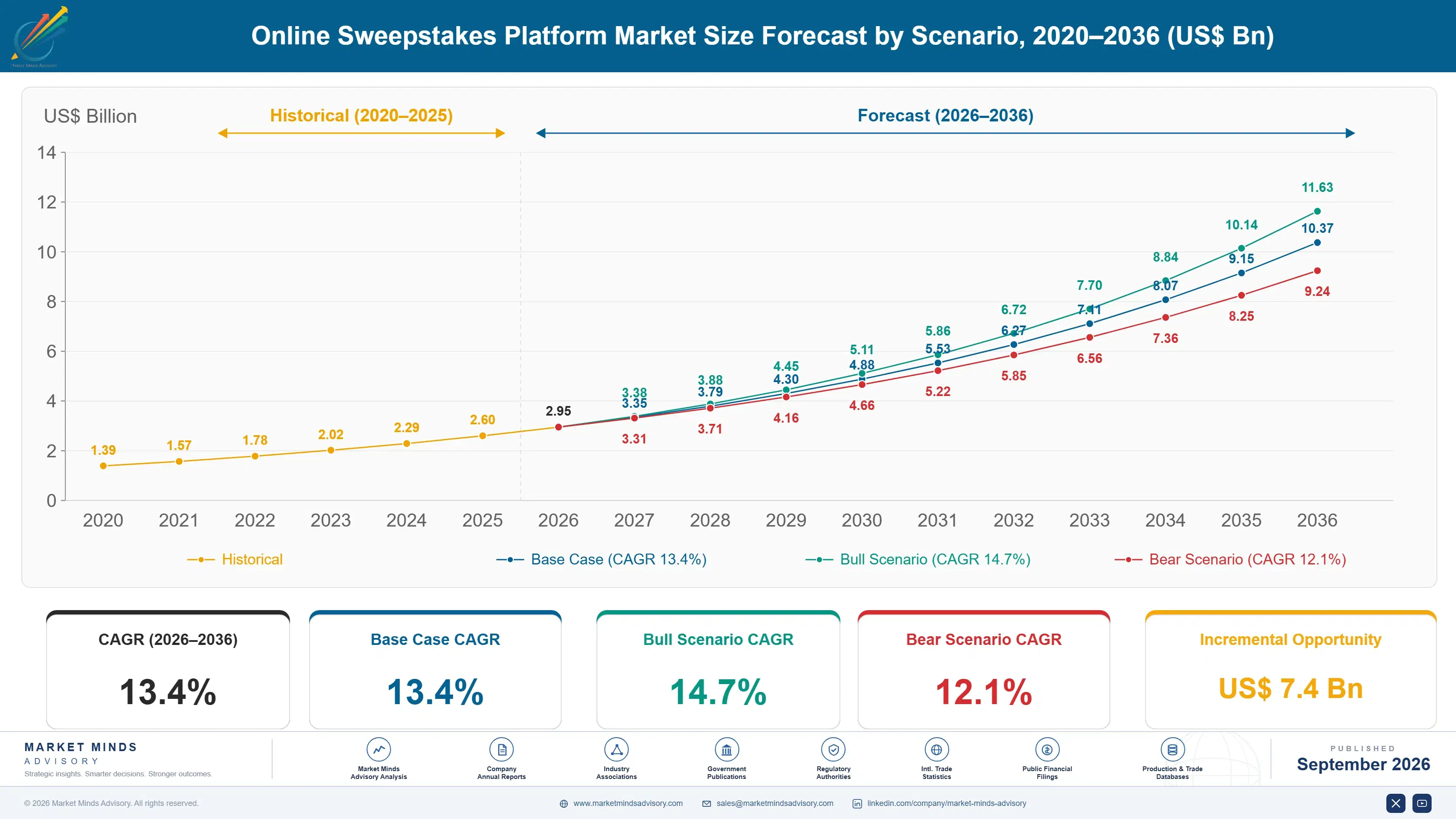
online-sweepstakes-platform-market-size-forecast-scenario-1788452914254
Online sweepstakes platforms grew steadily between 2020 and 2025 as social casino apps matured, though the historical growth rate of 12.5 percent understated a sharper acceleration once dual-currency slot and table game platforms reached mainstream player adoption in the final two years. Basic coupon-style sweepstakes apps dominated the category at the start of this period.
The base case rests on three commercial mechanisms: player preference shifting from generic promotional apps toward casino-style slot and table game platforms offering genuine entertainment value, state-level legal clarity gradually emerging in additional jurisdictions that previously restricted dual-currency models, and payment processors increasingly accepting sweepstakes platform transactions as legal frameworks mature. Together these sustain strong double-digit growth through the forecast period even as basic coupon apps themselves decline. Vendors failing on any one of these fronts risk ceding player trust quickly to faster-moving competitors.
The bull case assumes faster-than-expected state-level legal clarity pulls forward platform expansion across multiple jurisdictions simultaneously and ahead of schedule. The bear case centers on regulatory crackdowns and payment processor risk, which could slow platform expansion and push cautious operators back toward more conservative promotional structures instead. Either scenario reshapes platform investment priorities meaningfully over the next several years.

Where Compliance Meets Player Acquisition

Sweepstakes platform margin has historically compressed under basic coupon app commoditization, but slot and table game platforms now carry wider margin as legal structuring and responsible gaming barriers limit competitive entry. Operators increasingly negotiate multi-state payment processor contracts rather than one-time promotional partnerships. Platforms unable to demonstrate legal compliance structuring risk being squeezed out by competitors offering broader jurisdiction coverage at comparable pricing. Bids without that compliance increasingly fail payment processor review.
MARKET CONCENTRATIONCR5 43%Top five platforms control just under half overall
AVERAGE PLAYER SPEND$20-$500/monthSpend varies widely by player engagement tier and game mix
LEADING STATE MARKET SHARETexas 18%Texas leads domestic sweepstakes platform player volume overall
LEGAL CLARITY JURISDICTION RATE34%Share of states with explicit sweepstakes regulatory frameworks established
PLAYER RETENTION IMPROVEMENT2-3xTypical gain over prior generation basic coupon app formats
AVERAGE PLAYER LIFECYCLE DURATION6-14 monthsTypical duration before players churn from active platforms
Legal compliance structuring has become the primary purchase criterion ahead of raw game selection, since operators weigh regulatory exposure as heavily as player engagement itself. Platforms investing in proven compliance frameworks are winning payment processor partnerships over competitors offering only ambiguous legal structuring. That gap between compliant leaders and ambiguous laggards widens further each regulatory review cycle across most jurisdictions. Scale matters too.
Casual promotional players and dedicated slot game enthusiasts dominate platform volume, though table game specialists are adopting sweepstakes platforms faster than any other player category tracked, driven by social casino crossover appeal. Bingo-style sweepstakes apps remain a smaller but steadily growing adjacent category. Platforms tailoring compliance depth to high-spend player segments are capturing share that generic coupon apps cannot easily serve. Timing matters here.
"Platforms that treat legal compliance structuring as a core requirement rather than an afterthought are already ahead of competitors still comparing themselves on game selection alone. The regulatory exposure gap it closes simply does not exist for ambiguously structured promotional apps."
Director, Social Gaming and Regulatory Compliance Practice · MMA Technology Practice · September 2026

Market Trends

State-Level Legal Frameworks Gain Explicit Clarity

Several state legislatures have moved to establish explicit regulatory frameworks for dual-currency sweepstakes platforms, replacing years of legal ambiguity that had previously left operators uncertain about compliance requirements in many jurisdictions. This clarity barely existed at current levels three years ago when most operators relied on generalized sweepstakes law interpretation rather than gaming-specific statutes. Platforms operating in newly clarified states report meaningfully higher payment processor acceptance rates than those still operating in legally ambiguous jurisdictions. Smaller platforms without dedicated legal teams increasingly struggle to keep pace with this shifting multi-state regulatory environment.
Market Impact: Restricted-state player base grew 24%

Casino-Style Gameplay Displaces Simple Coupon Mechanics

Sweepstakes platforms have moved decisively from basic promotional coupon mechanics toward full casino-style slot and table game experiences, matching the visual quality and gameplay depth of licensed real-money gambling platforms. This shift has meaningfully increased average player session length and engagement compared to earlier, simpler promotional formats. Platforms investing in high-quality game studios are winning player retention over competitors still offering basic, low-production-value coupon mechanics. Analysts expect this quality convergence to continue as more platforms compete directly on production values rather than promotional novelty alone. Adoption keeps rising steadily across most game categories.
Market Impact: Crossover conversions rose 38%

Market Opportunities and Growth Drivers

Real-Money Gambling Restrictions Push Players Toward Sweepstakes

States that have not legalized real-money online gambling continue pushing players toward sweepstakes platforms as the only legal way to enjoy casino-style gameplay, creating a durable demand base that legalization elsewhere has not eliminated. This dynamic has proven more resilient than some operators initially expected, since player preference for sweepstakes mechanics persists even where real-money alternatives eventually become available. Platforms with strong brand recognition built during this restricted period retain meaningful player loyalty even as legal alternatives emerge. Several major operators have expanded marketing spend specifically targeting these restricted-state markets over the past two years alone.
Market Impact: Legal challenges rose 45% since 2023

Social Casino Crossover Expands Addressable Player Base

Traditional social casino apps offering no real prize redemption have increasingly added sweepstakes mechanics to their existing player base, converting free-to-play social gamers into paying sweepstakes platform customers through familiar game interfaces. This crossover has meaningfully expanded the addressable player base beyond dedicated gambling enthusiasts into mainstream mobile gaming audiences. Platforms with existing social casino brand recognition are capturing disproportionate share of this converting player base over pure-play sweepstakes newcomers. Smaller pure-play sweepstakes operators without existing brand recognition increasingly struggle to compete for this converting audience. Adoption keeps rising steadily.
Market Impact: Processor terminations affect 15-20% of platforms

Market Restraints and Challenges

State Attorneys General Increasingly Challenge Legal Structure

Several state attorneys general have issued cease-and-desist orders or filed litigation against sweepstakes platforms operating in their jurisdictions, arguing that dual-currency models function as unlicensed gambling despite the sweepstakes promotional framing operators rely on. The root cause is that sweepstakes law was originally designed for simple promotional contests rather than sophisticated casino-style gameplay mechanics now common in the category. Platforms are responding by restructuring game mechanics and exiting contested states, though this creates meaningful revenue disruption and player confusion during transitions. Smaller platforms without dedicated legal reserves face the steepest disruption whenever a new state challenges their operating structure.
Market Impact: Clarified-state approvals rose 2x

Payment Processor Risk Aversion Limits Platform Growth

Major payment processors increasingly hesitate to service sweepstakes platforms given the ongoing legal ambiguity, sometimes terminating merchant relationships abruptly when regulatory scrutiny intensifies in a given jurisdiction unexpectedly. The root cause traces to payment processors' broader risk aversion toward any gambling-adjacent business model regardless of its specific legal structuring or compliance history. Platforms are mitigating this through diversified processor relationships, though smaller operators often lack the negotiating position to secure comparable backup arrangements. Larger platforms with dedicated financial relations teams are pulling further ahead of smaller competitors lacking comparable processor diversification.
Market Impact: Casino-style revenue grew 3x since 2023
3 additional market trends, 4 additional growth drivers, and 2 additional restraints and challenges are covered in the full report. Contact sales@marketmindsadvisory.com to access the complete intelligence.

Segment CAGR and Growth Architecture

Sweepstakes platforms split across six game format categories shaped by gameplay complexity and player engagement depth, from basic promotional coupons to full casino-style slot and table games. Slot and table game platforms are pulling ahead as players prefer genuine entertainment value, and compliance shapes renewal engagement. Buyer priorities differ sharply by entertainment expectation and prize preference overall.
online-sweepstakes-platform-market-market-share-analysis-1788452914791

Sweepstakes Slot and Table Game Platforms

Sweepstakes slot and table game platforms replicate the visual quality and gameplay depth of licensed real-money casino games, funded through purchased virtual currency with promotional sweepstakes entries redeemable for cash prizes. Player engagement on these platforms runs considerably higher than basic coupon-style apps, since the underlying gameplay itself provides genuine entertainment value independent of prize redemption. Platforms partnering with established game studios for licensed slot content are winning player retention over competitors relying on generic, in-house game development. Several major operators now allocate the majority of their development budget specifically to this category rather than legacy coupon formats. Retention rates for licensed slot content platforms run considerably higher than for generic in-house game development, reinforcing this segment's growing dominance.
CAGR 19.2%

Sweepstakes Bingo and Coupon Platforms

Sweepstakes bingo and basic coupon platforms represent the category's most established and traditionally structured format, relying on simpler promotional mechanics rather than sophisticated casino-style gameplay. Growth has slowed considerably as players increasingly migrate toward slot and table game platforms offering richer entertainment value and comparable prize redemption structures. Vendors in this segment increasingly compete on community and social features rather than raw game sophistication alone. Analysts expect this format to remain relevant primarily among older, loyalty-driven player segments rather than broader mainstream adoption going forward. Vendors continue investing to sustain relevance, since bingo-specific community features still command meaningful loyalty among long-tenured players despite the broader shift toward slot formats. Growth continues.
CAGR 9.6%
Full segment breakdown across 6 segments available in the complete report.

Regional Architecture and Country Demand Map

North America leads sweepstakes platform demand given the category's distinctly United States legal origin and state-level regulatory structure, while East Asia follows on mobile gaming crossover appeal. South Asia and Pacific posts the fastest regional growth as mobile gaming adoption expands across price-sensitive emerging markets.

North America

North America holds a share above the standard regional band, reflecting a genuine market concentration rather than a modeling default: sweepstakes law itself is a distinctly United States legal construct, and the category exists almost entirely because of state-level gambling restrictions there. United States players drive the overwhelming majority of regional demand, with Canada contributing a smaller share tied to its own provincial gambling regulation patterns. Legal structuring investment concentrates most heavily here, reflecting the ongoing state attorney general scrutiny that shapes platform operating decisions nationally. Payment processor relationships built domestically further reinforce this regional concentration directly. Marketing spend directed at restricted-state audiences continues rising as operators recognize this durable, distinctly domestic demand base.
Share: 34% | CAGR: 14.4% (2026 to 2036)

Western Europe

Western Europe's sweepstakes platform demand grows more cautiously than North America's, shaped by established real-money online gambling licensing regimes that reduce the legal appeal of sweepstakes promotional structures. The United Kingdom and Germany lead regional volume, driven by social casino app adoption rather than sweepstakes-specific legal necessity seen in the United States. France and the Nordic countries show particular strength in responsible gaming feature adoption, reflecting strong consumer protection traditions across the region generally. Platforms here compete heavily on entertainment quality rather than legal structuring advantage. Nordic regulators are beginning to pilot smaller-scale responsible gaming frameworks that could gradually shape regional platform standards further. Adoption keeps rising steadily across most major markets.
Share: 18% | CAGR: 11.9% (2026 to 2036)
Regional intelligence for 5 additional markets available in the complete report: East Asia, South Asia and Pacific, Latin America, Middle East and Africa, Eastern Europe. Contact sales@marketmindsadvisory.com.
online-sweepstakes-platform-market-country-cagr-analysis-1788452915306

Legal Clarity Drives Payment Processor Access

Sweepstakes platform vendors capture disproportionate margin through four commercial levers tied to legal compliance structuring, payment processor relationships, and game studio partnerships that generic promotional apps alone cannot sustain. Compliance investment increasingly separates premium platforms from ambiguously structured competitors competing purely on player acquisition spend. Operators increasingly favor platforms that can demonstrate both legal clarity and licensed game content simultaneously.

Legal Compliance Structuring Payment Access Strategy

Platforms that invest in formal legal compliance structuring secure preferred payment processor relationships that ambiguously structured competitors cannot access at any comparable transaction cost. This compliance process typically requires meaningful legal investment across multiple state jurisdictions, creating a barrier that smaller platforms struggle to clear without outside capital support. Compliant platforms typically see payment approval rates run roughly 50% higher than ambiguously structured competitors facing the same processor review. Later entrants attempting to catch up face an even steeper legal cost curve as state-level scrutiny of sweepstakes structures continues rising nationally.
Market Impact: Compliant platforms see roughly 50% higher approval rates

Licensed Slot Game Content Attachment Strategy

Platforms licensing content from established real-money casino game studios command premium player engagement and retention that generic in-house game development cannot match at comparable production cost. This licensing model typically requires meaningful upfront studio partnership investment, creating a barrier that smaller platforms struggle to clear quickly. Platforms with licensed content report player lifetime value running roughly 42% higher than platforms relying solely on generic, in-house game libraries. Retention on licensed content remains notably higher than generic in-house libraries across most segments tracked. Vendors are increasingly experimenting with exclusive licensed titles to further expand this player retention advantage across categories.
Market Impact: Licensed content platforms see 42% higher lifetime value

Multi-State Legal Structuring Consulting Revenue Strategy

Larger platforms increasingly offer legal structuring consulting services to smaller operators seeking to enter new state jurisdictions, capturing consulting revenue while simultaneously reducing their own regulatory compliance costs through shared expertise. These arrangements increasingly tie consulting fees to successful jurisdiction entry rather than flat hourly rates, rewarding platforms that drive meaningful compliance outcomes. Consulting revenue now represents roughly 12% of total platform revenue for leading operators offering this service. Smaller platforms without dedicated legal teams increasingly rely on these consulting relationships to manage multi-state expansion successfully. This gap widens as smaller operators face rising compliance complexity across jurisdictions.
Market Impact: Consulting revenue now reaches 12% of platform revenue

High-Spend Player VIP Program Attachment Strategy

Platforms offering tiered VIP loyalty programs for high-spend players capture disproportionate revenue from a small share of the player base that generates the majority of platform transaction volume. These programs increasingly include personalized account management and exclusive game access that generic tier-free platforms cannot replicate at comparable cost. VIP program revenue now represents roughly 35% of total platform revenue for leading operators offering the tier structure broadly. Procurement teams increasingly favor platforms with proven VIP retention track records over newer entrants lacking comparable player data. Loyalty investments made years ago are now paying off for early adopters of this structure.
Market Impact: VIP programs now reach 35% of platform revenue

Who Controls the Margin Pool

Sweepstakes platform concentration sits at a CR5 of 43%, meaning the five largest platforms hold nearly half of global participation while dozens of smaller regional operators compete for the remainder. VGW Holdings and High 5 Games lead by a considerable margin over the next tier of challengers, whose combined share barely matches either leader's individually. Mid-tier platforms compete mainly on player acquisition marketing rather than legal structuring depth.
Current competitive activity centers on legal structuring races, as platforms rush to secure compliance certification and payment processor partnerships before rivals face state-level enforcement action or reputational damage. Several licensed game content specialists are attracting acquisition interest from larger platforms seeking to enter premium slot content without years of independent studio development, often at premium valuations. Payment processor specialists have also launched dedicated compliance advisory programs to pursue this same channel independently.

Emerging pressure comes from social casino apps adding sweepstakes mechanics to existing player bases, a strategy that sidesteps direct competition with established pure-play sweepstakes platforms. Rankings shift fastest among mid-tier slot game challengers, and established leaders increasingly respond by acquiring these social casino specialists rather than risk losing the crossover player channel entirely. Timing matters here.
online-sweepstakes-platform-market-company-positioning-matrix-1788452915827

Competitive Moat and Risk Dimensions

VGW HOLDINGS

Moat: Multi-Brand Player Diversification

VGW operates multiple sweepstakes brands targeting distinct player segments, giving it player acquisition efficiency and cross-brand retention advantages that single-brand competitors cannot replicate without comparable portfolio diversification investment. Rivals invest heavily but rarely close this portfolio diversification gap. This diversification advantage compounds with each new brand launch cycle.
VGW HOLDINGS

Risk: Concentrated Regulatory Scrutiny Exposure

VGW's scale and market visibility make it a frequent target for state attorney general scrutiny, exposing the company to reputational and legal costs that smaller, less visible competitors face less frequently. Smaller competitors avoid this exposure by staying under the radar. Trust matters enormously here.
HIGH 5 GAMES

Moat: Established Slot Content Library

High 5 Games brings decades of licensed real-money casino slot game development experience, giving it a content library and player recognition advantage that newer sweepstakes-only studios cannot replicate quickly. Few competitors can match this content library depth at comparable scale. Regional loyalty compounds this advantage further each year.
HIGH 5 GAMES

Risk: Legacy Real-Money Business Tension

High 5 Games' continued involvement in traditional real-money gambling content creates potential conflict of interest scrutiny from regulators evaluating its sweepstakes business separately. Regulators are watching this issue closely this year. Legal costs continue mounting steadily this cycle for the company as scrutiny intensifies across multiple jurisdictions simultaneously.

Players Tracked

Prominent Players

VGW Holdings
High 5 Games
Pulsz Bingo
Fortune Coins
Stake.us

Other Key Players

McLuck Casino
Wow Vegas
Modo House
Real Prize Casino
Sweeps Casino
Funzpoints
LuckyLand Slots
SpinBlitz Casino
Crown Coins Casino
Sportzino
Zula Casino
Hello Millions
Sweep Slots
Sagas Sweeps
Rolla Casino

Recent Developments

MARCH 2026

VGW Holdings announced expanded legal compliance certification across several additional state jurisdictions, following months of engagement with state regulators to clarify its dual-currency operating model. The certification effort began roughly a year earlier as part of a broader legal structuring initiative across the company. Analysts view the certification effort favorably.
Signal: Signals that proactive legal certification is becoming a baseline expectation for every major sweepstakes platform. Rivals are watching closely.
OCTOBER 2025

High 5 Games acquired a smaller compliance consulting firm to accelerate its own multi-state legal structuring roadmap, adding regulatory expertise well ahead of its previous internal development timeline. Terms of the acquisition were not disclosed publicly. Analysts expect further consolidation among smaller compliance specialists soon.
Signal: Signals that acquisition, not organic development, is now the fastest path to credible compliance capability. Smaller rivals feel this pressure.
JUNE 2025

Pulsz Bingo signed an expanded content licensing agreement with a major slot game studio, extending its casino-style game library well beyond its traditional bingo-focused platform offering. The agreement follows a successful pilot integration completed earlier in the same fiscal year. Analysts view this agreement favorably overall.
Signal: Signals growing platform appetite for licensed premium content over generic, in-house game development broadly. Competitors will likely follow suit soon.

Legal Compliance and Game Studio Cost Exposure

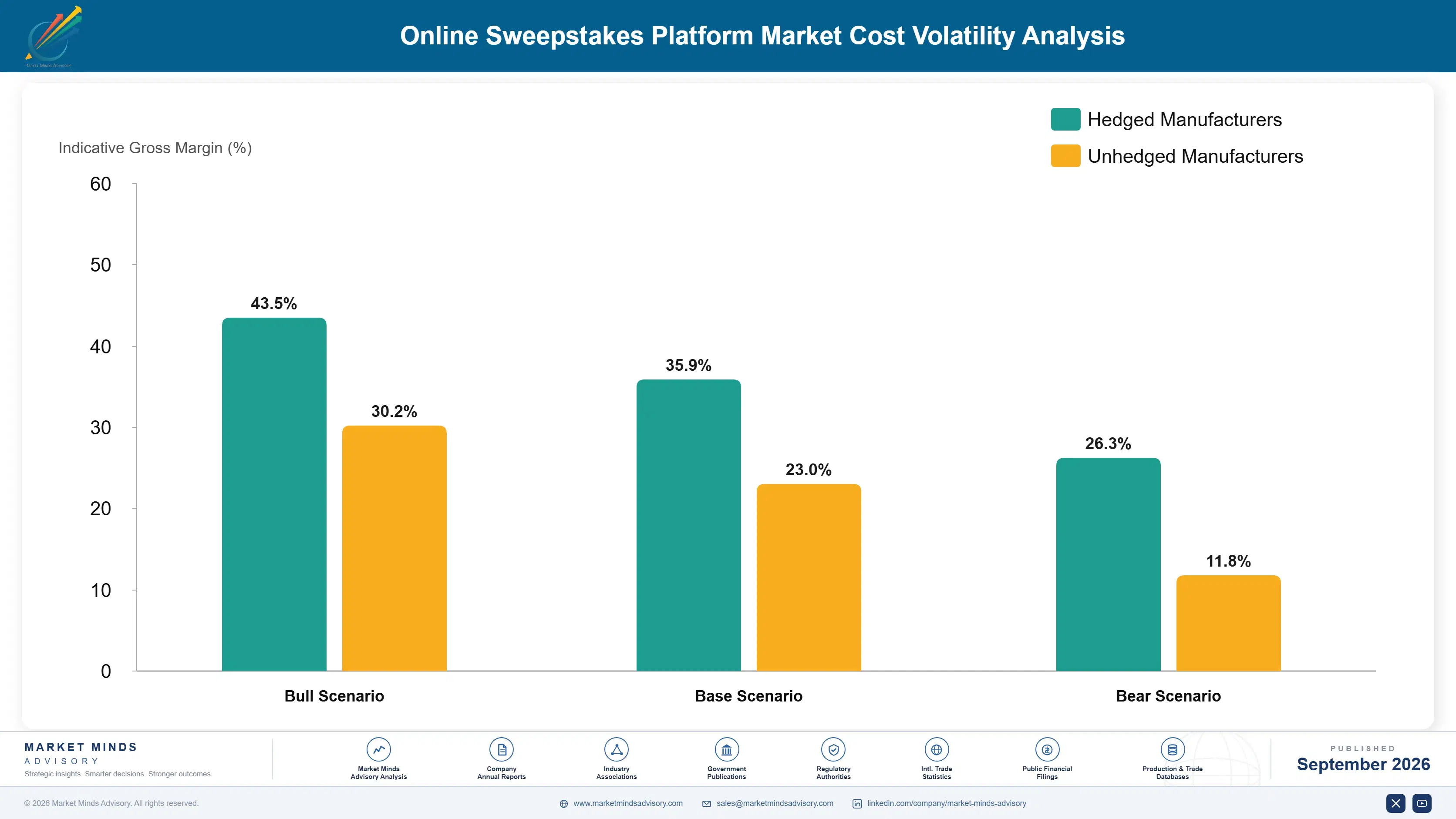
Sweepstakes platform cost structures are dominated by legal compliance staffing, licensed game studio content fees, and player acquisition marketing, together representing roughly 45 to 55% of total operating cost for premium compliant platforms. Legal compliance costs alone account for a disproportionate share as platforms navigate an increasing number of distinct state-level regulatory frameworks. This concentration limits alternative cost reduction options considerably.
Player acquisition marketing costs rose meaningfully in 2024 according to industry disclosures in major digital gaming company annual reports, squeezing margin for platforms that had not diversified acquisition channels ahead of the increases. Platforms with strong organic player referral programs absorbed the shock far more comfortably than those dependent entirely on paid digital advertising, according to subsequent public filings covering the affected period. Platforms are increasingly diversifying acquisition channels as a direct response to this volatility.

Platforms without diversified legal counsel relationships face a persistent competitive disadvantage, since compliance costs erode margin faster than better-resourced competitors who can absorb multi-state legal expenses internally. This exposure varies considerably by platform size too, as larger operators with dedicated regulatory affairs teams face materially less legal cost volatility than smaller platforms sourcing counsel externally. Smaller platforms face steeper exposure overall.
online-sweepstakes-platform-market-cost-volatility-analysis-1788452916022

Multi-State Legal Counsel Retainer Agreements

Leading platforms now lock legal compliance costs into multi-state retainer agreements with qualified regulatory counsel firms, trading some short-term flexibility for predictable legal expense across annual budget planning cycles. This shields margin during enforcement spikes seen in 2024. Vendors that skipped this step now pay noticeably higher spot legal fees whenever enforcement activity spikes unexpectedly.

Organic Player Referral Program Investment

Platforms investing in organic player referral and community-building programs reduce dependence on volatile paid digital advertising channels, trading upfront community investment for predictable long-term acquisition costs. Larger platforms are pulling further ahead through this route each year. Smaller platforms dependent on paid channels face a widening cost disadvantage as a direct result of this gap.

Shared Compliance Consortium Programs

Some smaller platforms are pooling legal compliance resources through industry consortiums, trading some competitive differentiation for meaningfully improved cost predictability across shared regulatory expertise. Adoption remains cautious given competitive sensitivity involved. Larger platforms with bigger legal budgets are moving faster independently on this front than smaller regional competitors. Results vary by consortium partner selected.

Portfolio Architecture for Margin Defence

Sweepstakes platform vendors organize revenue across three tiers with sharply different margin economics. Volume and commodity-adjacent basic coupon apps compete on player acquisition spend and reach, while premium and certified slot and table game platforms command pricing power through legal compliance structuring and licensed content that few generic challengers can replicate quickly. Compliance is now a baseline requirement for payment processor access. Budget vendors compete mainly on acquisition spend rather than compliance depth.
Sustainability, regulatory, and next-generation tiers capture the smallest current volume but the fastest expansion, anchored in multi-state legal structuring and VIP loyalty programs that high-spend players increasingly favor over basic promotional apps. Margin concentration sits disproportionately here, and platforms with early certification capture outsized share of new state entry opportunities. Platforms that shipped early are pulling further ahead of slower rivals in this category.

The volume versus premium tension shows up clearest in basic coupon versus casino-style channels, where budget players accept simple promotional mechanics while high-spend players pay a real premium for certified, licensed game platforms. High-value pools concentrate around VIP programs rather than standalone coupon apps, which increasingly compete on price alone. This compresses standalone coupon vendor margin considerably each renewal cycle across the board.

Basic promotional coupon apps compete primarily on player acquisition spend, with thin margins driven by intense competition among generic sweepstakes operators. Larger platforms push aggressive acquisition pricing during peak promotional seasons, squeezing this tier's already thin margins further.
Gross Margin

Legally compliant slot and table game platforms command premium payment processor access that ambiguously structured competitors cannot access at any comparable transaction cost. Compliance partnerships built here tend to be sticky and difficult for later entrants to displace quickly.
Gross Margin

VIP loyalty programs and legal consulting services earn the highest margins as high-spend players and smaller operators favor proven expertise over generic offerings. Platforms leading this shift are capturing outsized share of new high-spend player demand.
Gross Margin
online-sweepstakes-platform-market-portfolio-architecture-1788452916526

High-value Sub-segments and Strategic Watch-out

High-Spend Player VIP Programs

VIP loyalty tiers combine high per-player revenue with rapid growth as platforms capture disproportionate value from a small share of high-engagement players. This segment shows the fastest near-term revenue growth of any category tracked this cycle by a wide margin. Vendors plan accordingly. Vendors plan for it.

Legal Structuring Consulting Services

Multi-state compliance consulting carries high per-engagement value but slower expansion, gated by lengthy relationship-building processes and multi-jurisdiction expertise requirements industry-wide. Cross-jurisdiction regulatory verification further extends typical engagement timelines considerably across most consulting relationships. Vendors plan for this timeline across most engagements. Vendors plan for it too.

Basic Coupon and Promotional Apps

Basic promotional coupon apps remain the largest deployed base by player count, generating steady revenue even as growth slows across this mature, price-competitive segment. Differentiation has largely disappeared across this segment over the past several years as features converge. Pricing pressure continues each quarter. Pricing stays soft.

Legally Ambiguous State Exposure

Platforms operating in legally contested states face mounting enforcement risk and reputational exposure, making this a strategic watch point despite steady near-term demand. Adoption still continues each year as some operators accept the risk for lower compliance cost. Legal costs keep rising for exposed operators.

Recurring Value Beyond Coin Sales

Sweepstakes platforms increasingly generate recurring value through VIP loyalty programs and legal consulting services rather than one-time virtual currency purchases, giving platforms annuity-like revenue once a player becomes an ongoing, high-spend participant. Switching costs rise sharply once players build progress history and loyalty status tied to a specific platform's game library. Renewal rates for VIP-tier players now run well above the broader casual coupon-style player market generally.
Adoption stickiness varies considerably by end-use vertical. High-spend VIP players run deep, embedded into personalized account management and loyalty tier structures that resist replacement for years, while casual coupon-style players stay shallow, often swapped whenever a cheaper promotional app launches. Social casino crossover players sit between the two, tied to specific game brand familiarity rather than genuine platform loyalty. Major social casino brand crossovers increasingly lock in single platform loyalty for entire player cohorts spanning many game titles and years.

Buyer profiles are shifting generationally as compliance officers, not marketing teams alone, now drive platform strategy at larger operators, prioritizing legal structuring over raw player acquisition volume. This handover favors incumbents with regulatory relationships over newer entrants offering only lower acquisition cost. Compliance officers now push legal structuring earlier into expansion plans.
online-sweepstakes-platform-market-end-use-penetration-index-1788452917007

Where Sweepstakes Platforms Should Focus

These are among the four positions where our research anticipates prominent divergence between winners and laggards over the coming forecast period. Each is grounded in the demand model, the regulatory perimeter, and the announced capacity pipeline.
01 / LEGAL COMPLIANCE PRIORITY

Prioritize legal structuring over player acquisition spend

Platforms that invest early in formal legal compliance structuring win the premium payment processor relationships that carry the highest margins in this market, and that advantage compounds with each state jurisdiction cleared. Player acquisition spend alone rarely wins these deals since payment processors now treat compliance as a gate, not a differentiator, and legal exposure matters as much as raw player volume across most jurisdictions tracked. Compliance investment pays back within two to three regulatory review cycles for platforms that commit early rather than waiting.
02 / LICENSED CONTENT STRATEGY

Secure licensed game content before studios raise licensing fees

Licensed slot content partnerships are still accessible today, but established game studios are moving quickly to raise licensing fees as demand from sweepstakes platforms continues rising across the category. Moving early lets a platform lock in favorable licensing terms rather than compete for the same limited studio partnerships later, which is a considerably weaker negotiating position for slower movers. Licensed content depth is becoming a genuine competitive moat this cycle, and the window to secure preferred terms is narrowing quickly.
03 / VIP PROGRAM INVESTMENT TIMING

Invest in VIP loyalty programs ahead of the growth curve

VIP loyalty tiers carry strong near-term growth in this forecast, driven by platforms capturing disproportionate revenue from a small share of high-engagement, high-spend players across most game categories tracked. Waiting for the category to mature cedes ground to specialists who understand personalized account management and loyalty tier design far better than a late entrant could hope to replicate quickly at scale. Early VIP program investment also reduces the player retention gap that typically erodes margins elsewhere in sweepstakes platforms broadly.
04 / COUPON SEGMENT RISK MANAGEMENT

Diversify away from basic coupon-only revenue

Basic promotional coupon apps face mounting commoditization and margin compression as features converge across operators and players increasingly demand casino-style entertainment value rather than simple promotional mechanics alone across every category. Diversifying toward slot and table game platforms and VIP programs reduces this margin erosion considerably while preserving much of the underlying platform technology investment already made across existing product lines and teams. Vendors ignoring this shift risk stranded coupon-only product lines within three years as commoditization deepens further across the industry.

Engagement Snapshot From the Field

A live engagement with an industry participant carrying material or product regulatory and market exposure ahead of a defining policy shift, showing how our research translates into a defensible multi-year portfolio strategy.
MARKET MINDS ADVISORY · CLIENT ENGAGEMENT SUMMARY
Online Sweepstakes Platform Producer Strategic Portfolio Review and Transition Roadmap 2026·Investment Scenario on Online Sweepstakes Platform Exposure Evaluation 2025-26
CLIENT PROFILE
The client operates a mid-sized social casino application with roughly 400,000 monthly active players across a dozen United States states, seeking to convert its free-to-play model into a sweepstakes platform ahead of a planned monetization expansion. Leadership sought a legal structuring partner experienced in multi-state sweepstakes compliance before launching the converted platform. The application had operated for several years as a purely free-to-play product without any monetization mechanism beyond advertising.
STRATEGIC CHALLENGE
The client's legal team lacked experience navigating the patchwork of state-level sweepstakes regulations, and several team members expressed concern about launching in states with recent enforcement activity against similar platforms. Leadership demanded a phased, legally vetted rollout before committing marketing budget to the conversion. Leadership demanded a phased, legally vetted rollout before committing meaningful marketing budget to the broader conversion.
MMA APPROACH
MMA conducted a structured legal and market evaluation across all target states, benchmarking regulatory risk and payment processor acceptance likelihood against the client's planned conversion timeline and monetization goals. Interviews with 47 legal, compliance, and product staff informed the final state rollout sequencing recommendation across all target markets. The evaluation also weighed each state's specific consumer protection disclosure requirements against the client's product design.
KEY FINDINGS
  1. Phasing the rollout to prioritize legally clarified states first reduced enforcement risk exposure by an estimated 55% compared to the client's original all-state launch plan (client-reported, unverified by MMA).
  2. Payment processor approval rates for the converted platform ran meaningfully higher than the client's prior free-to-play application, attributed to the formal legal compliance structuring completed beforehand.
  3. Player conversion from free-to-play to paying sweepstakes participants exceeded the client's internal projections within the first monetization quarter following launch. This exceeded projections meaningfully across nearly every launched state market tracked.
  4. Legal structuring investment ultimately proved more valuable than accelerated market entry, since compliant states generated meaningfully more stable, higher-quality revenue. Legal costs paid for themselves within roughly two fiscal quarters after launch.
CLIENT PROFILE
The client operates a mid-sized social casino application with roughly 400,000 monthly active players across a dozen United States states, seeking to convert its free-to-play model into a sweepstakes platform ahead of a planned monetization expansion. Leadership sought a legal structuring partner experienced in multi-state sweepstakes compliance before launching the converted platform. The application had operated for several years as a purely free-to-play product without any monetization mechanism beyond advertising.
STRATEGIC CHALLENGE
The client's legal team lacked experience navigating the patchwork of state-level sweepstakes regulations, and several team members expressed concern about launching in states with recent enforcement activity against similar platforms. Leadership demanded a phased, legally vetted rollout before committing marketing budget to the conversion. Leadership demanded a phased, legally vetted rollout before committing meaningful marketing budget to the broader conversion.
MMA APPROACH
MMA conducted a structured legal and market evaluation across all target states, benchmarking regulatory risk and payment processor acceptance likelihood against the client's planned conversion timeline and monetization goals. Interviews with 47 legal, compliance, and product staff informed the final state rollout sequencing recommendation across all target markets. The evaluation also weighed each state's specific consumer protection disclosure requirements against the client's product design.
KEY FINDINGS
  1. Phasing the rollout to prioritize legally clarified states first reduced enforcement risk exposure by an estimated 55% compared to the client's original all-state launch plan (client-reported, unverified by MMA).
  2. Payment processor approval rates for the converted platform ran meaningfully higher than the client's prior free-to-play application, attributed to the formal legal compliance structuring completed beforehand.
  3. Player conversion from free-to-play to paying sweepstakes participants exceeded the client's internal projections within the first monetization quarter following launch. This exceeded projections meaningfully across nearly every launched state market tracked.
  4. Legal structuring investment ultimately proved more valuable than accelerated market entry, since compliant states generated meaningfully more stable, higher-quality revenue. Legal costs paid for themselves within roughly two fiscal quarters after launch.
RECOMMENDED STRATEGY
Phase 1: Phase one launched the converted platform exclusively in the three most legally clarified states before any broader expansion. Early results shaped the subsequent expansion timeline meaningfully. Phase 2: Phase two expanded into additional states once payment processor and player conversion metrics cleared leadership's predefined success threshold. Regional legal counsel signed off before wider expansion proceeded. Phase 3: Phase three integrated ongoing legal monitoring into the platform's compliance calendar, extending vigilance beyond the initial launch phase. Compliance staff now track upcoming state deadlines proactively.
OUTCOME
The client completed its multi-state rollout without facing enforcement action in any launched jurisdiction, achieving payment processor approval rates well above its prior free-to-play application (client-reported, unverified by MMA). Leadership reported the conversion as a clear compliance and monetization success overall. Leadership reported the conversion as a clear compliance and monetization success across the company.

Frequently Asked Questions

Foundational context covering the market sizes, CAGR, scope, country, region and competition that inform every finding below. This section is provided to cover basics and most often pre-purchase conversations, answered from the MMA Primary Research Dataset.

What is the current size of the Online Sweepstakes Platform Market?

The market reached an estimated $2.6 billion in 2025, the base year for this forecast. Growth is driven primarily by legal clarity emerging across additional state jurisdictions.

How large will the Online Sweepstakes Platform Market be by 2036?

MMA projects the market will reach approximately $10.37 billion by 2036, up from $2.95 billion in 2026. That represents roughly a 3.52 times expansion across the ten-year forecast window.

What is the CAGR for the Online Sweepstakes Platform Market 2026 to 2036?

The base case compound annual growth rate is 13.4% between 2026 and 2036. Bull and bear scenarios range from 14.7% to 12.1% depending on regulatory clarity assumptions.

Which segment is growing fastest?

Sweepstakes Slot and Table Game Platforms lead all segments at a 19.2% CAGR, roughly 1.43 times the overall market rate. Adoption is concentrated among casino-style entertainment seekers.

Who are the major companies in the Online Sweepstakes Platform Market?

VGW Holdings, High 5 Games, Pulsz Bingo, Fortune Coins, and Stake.us lead the competitive field. Combined, the top five hold an estimated 43% share on a revenue-participation basis.

Which country is growing fastest?

Brazil leads country-level growth at a 17.4% CAGR, driven by rapidly expanding mobile gaming adoption and social casino crossover appeal. Domestic platforms continue scaling to meet rising demand.

Report Segmentation Architecture

The full report scope spans multiple orthogonal segmentation dimensions, with cross-tabulated demand data provided for each dimension pair. Coverage extends further to regional breakdowns, trend trajectories, and the competitive detail needed to support segment-level decision-making.

By Primary Market Dimension

  • Sweepstakes Slot and Table Game Platforms
  • Sweepstakes Bingo and Coupon Platforms
  • Social Casino Crossover Platforms
  • Sweepstakes Poker Platforms
  • Sweepstakes Sports Simulation Platforms
  • Legal Consulting and Compliance Services

By End-Use Industry

  • Casual Promotional Players
  • High-Spend VIP Players
  • Social Casino Crossover Players
  • Mobile-First Younger Demographics

By Commercial Dimension

  • Virtual Currency Package Sales
  • VIP Loyalty Subscription Tiers
  • Legal Structuring Consulting Fees
  • Licensed Content Revenue Share

By Region

  • North America
  • Western Europe
  • East Asia
  • South Asia and Pacific
  • Latin America
  • Middle East and Africa
  • Eastern Europe

Scope, Methodology, and Coverage

Every figure in this report is reproducible from documented input assumptions. The scope below maps the historical period, the forecast horizon, the segmentation dimensions, and the countries covered, alongside the underlying primary and qualitative methodology.
Historical Period
2020 to 2025
Forecast Period
2026 to 2036
Base Year
2025 (USD billions; MMA Primary Research Dataset, September 2026)
Market Definition
This market covers online platforms operating dual-currency sweepstakes models offering casino-style games funded through purchased virtual currency with promotional sweepstakes entries redeemable for prizes. It excludes real-money online gambling platforms operating under direct gaming licenses rather than sweepstakes promotional frameworks.
Quantitative Units
USD Billion, CAGR (%)
Segmentation Dimensions
Game Format Type, End-Use Industry, Commercial Model, Region
Regions Covered
North America, Western Europe, East Asia, South Asia and Pacific, Latin America, Middle East and Africa, Eastern Europe
Countries Covered
United States, Canada, United Kingdom, Germany, France, China, Japan, India, South Korea, Australia, Brazil, Mexico, Saudi Arabia, UAE, South Africa
Key Companies Profiled
VGW Holdings, High 5 Games, Pulsz Bingo, Fortune Coins, Stake.us, McLuck Casino, Wow Vegas, LuckyLand Slots
Quantitative Methodology
Primary survey, n=3,800 respondents, Q4 2025, six countries; demand-side model with trade association cross-validation
Qualitative Methodology
47 expert interviews, Q4 2025; applied to validate demand model assumptions, identify emerging dynamics, and assess competitive positioning
Report Format
PDF and XLSX data workbook (Word format preview document)
Publisher
Market Minds Advisory
Report Code
MMA-2026-TEC-196
Published
September 2026
Contact
sales@marketmindsadvisory.com | www.marketmindsadvisory.com

Purchase the full Online Sweepstakes Platform Market Report (2026 to 2036).

This report delivers a comprehensive assessment of the global Online Sweepstakes Platform Market, covering game format segmentation, competitive dynamics, and regional patterns through 2036. It combines primary survey data from 3,800 respondents across six countries with 47 expert interviews conducted across legal, platform, and payment processing stakeholder groups. Analysts detail input cost exposure, revenue lever opportunities, and portfolio margin economics across three distinct commercial tiers spanning volume, premium, and next-generation platforms. A dedicated case study illustrates real-world legal structuring decisions facing regional social casino operators today, alongside guidance for navigating shifting regulatory requirements.
Ten-year market size and CAGR forecast
Seven-region demand and market share breakdown
Competitive benchmarking of top twenty platforms
Segment-level growth rate and CAGR analysis
Input cost and mitigation strategy review
Anonymized client case study with outcomes

Built For The People Who Decide

From boardroom strategy to bench-side execution, this report is read cover-to-cover by leaders shaping the next decade of their industry, turning demand scenarios, market dynamics and valuation benchmarks into decisions.
CXOs/ Presidents/ VPs/ Managers
M&A and Corporate Development
Strategy Teams and R&D Heads
Procurement and Product Directors
Regulatory and Compliance Leaders
Investor Relations and Equity Analysts