Market Minds Advisory
Online Payment Gateway Market

Online Payment Gateway Market: Online Payment Gateway Market. Real-Time Rails Force Gateways Off Card-Only Architecture

Real-time payment rail mandates and instant settlement expectations are forcing gateways off card-only architecture, pulling merchants toward providers that can route transactions across multiple rail types across every major digital commerce category worldwide

Lead Analyst

Published

September 2026

Make Smarter Decisions with Customized Research Insights

Request a free sample report and evaluate market opportunities, growth trends, and competitive dynamics relevant to your business needs.

2025 MARKET VALUE$38.5BMarket Size 2025
2036 FORECAST VALUE$128.8BBase Case , 2026 to 2036
CAGR 2026 TO 203611.6 %Bull 12.9% / Bear 10.3%
INCREMENTAL OPPORTUNITY$85.8BNet 10- year value creation
EXPANSION MULTIPLE3.00x2036 value over 2026 base
Strategic Levers
M&A Pipeline
Regional Outlook
Country Rankings
Competitive Intelligence
Segmental Deep-dive
Call-Us : 91 93563 13602

Executive Snapshot and Market Trajectory.

Online payment gateways have moved from simple card-processing intermediaries into multi-rail transaction routing platforms, as merchants demand instant settlement options beyond traditional card networks across every major sales channel they operate. Investment committees now treat multi-rail routing capability as core infrastructure spending rather than optional payment technology.
Real-time payment rail adoption is the biggest near-term demand driver, forcing gateways to build routing logic that can direct a transaction across card networks, bank transfer rails, or digital wallets depending on cost and settlement speed, a capability that legacy card-only gateways were never architected to support natively. Merchants that once accepted whatever routing a single gateway offered now actively compare settlement speed and cost across competing rail options.
Competitive intensity is high among gateway providers racing to consolidate fraud detection, multi-currency processing, and rail routing into unified platforms, while smaller regional gateways increasingly face acquisition pressure as merchants consolidate purchasing around fewer, broader providers. Smaller regional gateways increasingly see this platform consolidation as a genuine threat to their traditionally localized service model. Analysts expect at least one acquisition among mid-tier regional gateway providers within the next year, given the scale gap that persists.
Market Definition
The online payment gateway market comprises software platforms that authorize, route, and settle digital transactions across card networks, bank transfer rails, and digital wallets on behalf of merchants. It excludes point-of-sale hardware and traditional in-branch banking transaction processing systems.
Base Year Value
$38.5B in 2025 (MMA Primary Research Dataset, September 2026)
Forecast Period
2026 to 2036, eleven discrete annual values
CAGR
11.6% base case. Bull 12.9%. Bear 10.3%.
Fastest Growth Segment
Real-Time Payment Rail Integration Services: 19.0% CAGR
Fastest Growth Country
India: 17.8% CAGR
Fastest Growth Region
South Asia and Pacific: 13.6% CAGR
Largest Region
East Asia: 29% of 2025 global value
Market Leaders
Stripe, Adyen, PayPal, Worldpay, and Checkout.com lead the market. Source: MMA Primary Research Dataset, July 2026.
Primary Survey
n=3,800 procurement and R&D decision-makers, Q4 2025, six countries
Methodology
Demand-side build-up, cross-validated against public data, 47 expert interviews

Online Payment Gateway Market Forecast Scenarios

online-payment-gateway-market-size-forecast-scenario-1790007824630
Between 2020 and 2025 the market grew through a pandemic-driven ecommerce acceleration, then continued expanding steadily as digital wallet and real-time payment adoption broadened beyond early-adopter markets, a historical CAGR near 10.6% across that period. Early growth concentrated heavily in card-based ecommerce checkout flows. Gateway providers spent much of this period building fraud detection infrastructure capable of handling surging transaction volume without proportional staffing increases.
The base case assumes continued real-time payment rail expansion, falling gateway processing costs for smaller merchants, and broader multi-currency routing adoption that lets merchants sell internationally without separate regional gateway relationships. Together these three mechanisms push adoption beyond large enterprise merchants into mainstream small and medium-sized business procurement across most major digital commerce markets over the coming decade. Multi-currency routing removes a friction point that has slowed small merchant expansion for years.
The bull case centers on a named catalyst: additional major economies mandating real-time payment rail interoperability similar to India's unified payments interface. The bear case centers on persistent fraud losses that could erode merchant trust in newer, less-tested payment rail types faster than security improvements can respond. Vendors addressing fraud risk through machine learning detection are winning trust among cautious enterprise merchants.

Real-Time Rails Force Gateways Off Card-Only Architecture

Payment gateways have moved past the single-rail, card-only architecture that defined their first decade, when merchants accepted whatever settlement speed and cost structure a single card network relationship provided them regardless of what alternatives might exist. That earlier era generated reliable revenue but limited merchant negotiating power. Procurement committees today treat multi-rail flexibility as a baseline requirement rather than a competitive differentiator.
MARKET CONCENTRATIONCR5 42%Top five providers hold slightly over two fifths
AVERAGE TRANSACTION FEE2.4% plus fixed feeTypical blended processing cost charged to merchants per transaction
TOP PROCESSING COUNTRY SHAREUnited States 28%Share of global transaction volume processed within that country
FRAUD FALSE POSITIVE RATE3% averageTypical share of legitimate transactions incorrectly flagged as fraud
REAL-TIME RAIL PENETRATION34% of transaction volumeShare of transaction volume routed through instant settlement rails
COMPLIANCE COST SHARE22%Share of operating cost from regulatory compliance functions alone
Procurement officers now evaluate providers on multi-rail routing flexibility and fraud detection accuracy rather than on transaction fee alone, forcing providers that once competed purely on card processing rates to build genuine cross-rail routing capability internally or through acquisition. This shift has reshaped which providers win large enterprise merchant contracts. Providers lacking dedicated fraud detection infrastructure increasingly lose enterprise renewal bids to fuller-coverage competitors.
Multi-rail platform providers increasingly outearn single-rail specialists on a per-merchant basis, since bundled routing and fraud detection subscriptions capture a larger share of total payment infrastructure spend than card processing alone could command across a merchant's full transaction volume. Margin pools are shifting decisively toward providers with the broadest rail coverage. Investors have taken notice, valuing multi-rail-heavy providers at meaningfully higher multiples than card-only specialists.
"The providers winning this transition are not the ones with the lowest transaction fee. They are the ones that can route a payment through whichever rail actually settles it fastest."
Director, Digital Payments and Fintech Infrastructure Practice · MMA Technology Practice · September 2026

Market Trends

Smart routing engines optimize transactions across multiple rails

Gateway providers are deploying intelligent routing engines that automatically select the optimal payment rail for each individual transaction based on cost, settlement speed, and success probability rather than routing every transaction through a single default card network regardless of whether a cheaper or faster alternative exists. This capability meaningfully reduces merchant processing costs while improving transaction success rates, since routing engines can automatically retry a declined transaction through an alternative rail rather than losing the sale entirely. Major providers have begun marketing measurable cost savings figures directly to prospective enterprise merchants evaluating competing platforms.
Market Impact: 56% lower cost via real-time rails

Embedded finance platforms integrate payment gateways directly

Software platforms across industries are increasingly embedding payment gateway functionality directly into their own products rather than directing customers to separate standalone payment providers, letting software companies capture payment processing revenue that previously flowed entirely to dedicated gateway providers. This embedded finance trend creates a genuine channel shift where gateway providers increasingly sell through software platform partnerships rather than direct merchant acquisition alone. Major gateway providers have launched dedicated platform partnership programs specifically targeting software companies seeking embedded payment capability. Adoption is accelerating fastest among software-as-a-service platforms serving small and medium-sized business customers directly.
Market Impact: 44% higher conversion locally

Market Opportunities and Growth Drivers

Real-time payment rail expansion creates rising routing demand

Government-backed real-time payment systems are expanding across multiple major economies, offering merchants instant settlement at meaningfully lower cost than traditional card network interchange fees, creating rising procurement volume for gateways capable of routing transactions through these newer rail types alongside legacy card processing. Merchants increasingly demand gateway support for real-time rails specifically because the cost savings compound meaningfully at scale across high transaction volume businesses processing thousands of payments daily. Gateway providers report this rail expansion is the primary reason routing infrastructure investment has accelerated so quickly across their engineering roadmaps this year.
Market Impact: 3% of legitimate transactions wrongly blocked

Cross-border ecommerce growth demands multi-currency capability

Expanding cross-border ecommerce activity is pushing merchants to seek payment gateways capable of accepting and settling transactions across multiple currencies and local payment methods without requiring separate regional banking relationships for each target market, creating rising procurement volume for gateways offering genuine multi-currency and local payment method coverage. This capability particularly benefits merchants expanding into markets where local payment methods significantly outperform international card networks in conversion rate. Merchants entering new international markets increasingly view local payment method coverage as essential rather than optional given documented conversion rate differences. Adoption keeps growing.
Market Impact: 27% higher cost for multi-region providers

Market Restraints and Challenges

Fraud detection false positives erode legitimate transaction volume

Aggressive fraud detection algorithms tuned to minimize actual fraud losses frequently flag legitimate transactions incorrectly, causing merchants to lose genuine sales when real customers get blocked at checkout for behavior that merely resembles fraudulent patterns statistically. The root cause lies in the inherent tradeoff between fraud prevention aggressiveness and false positive rate, a balance that remains genuinely difficult to optimize given how fraud patterns constantly evolve to evade detection models. Commercially this costs merchants meaningful revenue from wrongly blocked legitimate customers who simply abandon the purchase. Vendors are investing in machine learning trained on richer behavioral data as mitigation.
Market Impact: 18% reduction in average processing cost

Regulatory fragmentation complicates cross-border rail integration

Different jurisdictions regulate real-time payment rails, data localization, and consumer protection inconsistently, forcing gateway providers to maintain separate compliance and technical integration workflows for each regulatory regime rather than a single unified global rail integration approach. The root cause is the absence of international payment regulation harmonization, with each major economy developing its own real-time payment infrastructure and governance framework independently. Commercially this increases integration cost and time for gateways expanding into new regulatory jurisdictions. Industry associations are pushing for harmonized cross-border payment standards as a mitigation pathway. Adoption remains slow given competing national regulatory priorities.
Market Impact: 38% of volume now embedded
3 additional market trends, 4 additional growth drivers, and 2 additional restraints and challenges are covered in the full report. Contact sales@marketmindsadvisory.com to access the complete intelligence.

Segment CAGR and Growth Architecture

The market divides across six product segments spanning routing, risk, and settlement layers. Real-time payment rail integration services, and fraud detection and risk management software, are growing fastest as merchants push beyond card-only processing toward faster, smarter transaction routing. This split increasingly determines where gateway providers concentrate engineering and partnership investment budgets. Vendors track this closely today.
online-payment-gateway-market-market-share-analysis-1790007825200

Real-Time Payment Rail Integration Services

Real-time payment rail integration services connect merchant checkout systems to government-backed instant settlement infrastructure, letting transactions clear in seconds at meaningfully lower cost than traditional card network interchange fees. This segment is growing fastest because real-time payment systems are expanding rapidly across multiple major economies, and merchants increasingly demand gateway support for these rails specifically because the cost savings compound significantly at high transaction volume. Gateway providers are racing to build certified integration capability with each new national real-time payment system as it launches, since first-mover advantage in a new market often determines long-term merchant relationships. Analysts expect this lead to widen further as more national real-time payment systems reach commercial launch.
CAGR 19.0%

Fraud Detection and Risk Management Software

Fraud detection and risk management software uses machine learning models trained on transaction behavior patterns to identify and block fraudulent payments while minimizing false positives that would otherwise block legitimate customer purchases. This segment benefits directly from rising fraud sophistication that makes rule-based detection systems increasingly inadequate, pushing merchants toward providers offering genuinely adaptive machine learning capability that improves continuously as fraud patterns evolve. Enterprise merchants increasingly view fraud detection accuracy as a primary vendor selection criterion rather than a secondary consideration. Analysts expect fraud detection investment to keep growing as generative AI tools make fraudulent transaction patterns increasingly sophisticated and harder to distinguish from legitimate purchases. Vendors here report strong renewal rates.
CAGR 16.0%
Full segment breakdown across 7 segments available in the complete report.

Regional Architecture and Country Demand Map

East Asia leads global demand, anchored by China's massive mobile payment volume and deeply embedded digital wallet infrastructure. North America and Western Europe follow, driven by mature ecommerce penetration and expanding real-time payment rail adoption across their markets. Every region shows measurable, if uneven, real-time rail adoption growth this year.

East Asia

China's massive mobile payment infrastructure, anchored by deeply embedded digital wallet platforms, processes transaction volume that dwarfs most other regions given the sheer scale of domestic ecommerce and in-person mobile payment adoption. South Korea contributes through its advanced digital payment infrastructure and high smartphone penetration supporting sophisticated mobile checkout experiences. Japan's payment market grows more conservatively, reflecting continued strong cash usage alongside growing digital adoption among younger consumers. Regional gateway providers increasingly export their mobile payment technology and expertise to other Asian and emerging markets as domestic growth matures. Vendors with early mobile wallet partnerships in these markets are building durable advantages that international competitors find difficult to replicate quickly.
Share: 29% | CAGR: 12.6% (2026 to 2036)

North America

The United States anchors regional demand as home to the largest concentration of gateway provider headquarters and the deepest enterprise ecommerce merchant base globally. Canada contributes steady demand through its own ecommerce growth and financial services sector, though at meaningfully smaller absolute scale than its southern neighbor. Real-time payment rail adoption is accelerating here following the launch of a national instant payment system, though adoption still trails leading international markets. Major gateway providers headquartered in the region increasingly compete on embedded finance partnership breadth with software platforms across industries. Analysts expect embedded finance partnership breadth to keep determining competitive rankings as more software platforms integrate payment capability directly. Renewal rates here run well above the global average.
Share: 26% | CAGR: 12.4% (2026 to 2036)
Regional intelligence for 5 additional markets available in the complete report: Western Europe, South Asia and Pacific, Latin America, Middle East and Africa, Eastern Europe. Contact sales@marketmindsadvisory.com.
online-payment-gateway-market-country-cagr-analysis-1790007825716

Monetizing Beyond the Transaction Fee

Basic transaction processing fees alone generate the thinnest margin in this market, so providers increasingly build recurring revenue through fraud detection subscriptions, embedded finance partnerships, and value-added analytics that merchants renew continuously rather than pay only per transaction. Margin pools are shifting decisively toward providers that build services and partnership revenue beyond transaction processing alone.

Bundle fraud detection subscriptions with core processing

Providers increasingly bundle machine learning-based fraud detection subscriptions directly into core processing contracts rather than selling transaction routing and fraud protection separately, capturing incremental revenue that survives beyond the base processing fee. This bundling lifts blended gross margin by an estimated 17 percentage points compared to processing-fee-only revenue, since fraud detection carries far lower marginal delivery cost once the underlying models are trained. Merchants increasingly view fraud detection as essential given rising fraud sophistication rather than an optional add-on. Providers report this bundled approach is becoming standard practice across most large enterprise renewal negotiations.
Market Impact: 17 percentage point margin lift from fraud bundling

Charge revenue-share fees for embedded finance partnerships

Gateway providers increasingly negotiate revenue-share arrangements with software platforms embedding payment capability directly into their products, capturing a portion of the payment revenue that flows through the software platform's own merchant base rather than acquiring those merchants directly. This partnership model typically carries gross margin above 60% since delivery scales through the software platform's existing customer relationships rather than dedicated sales effort for every individual merchant account. Software platforms benefit by monetizing payment flows they previously had no mechanism to capture directly, creating a genuinely aligned incentive structure for both parties.
Market Impact: 60% gross margin earned on embedded finance revenue

Sell payment analytics and reconciliation software as an add-on

Providers increasingly charge premium fees for payment analytics and automated reconciliation software that helps merchants understand transaction patterns and match settlements against accounting records without manual effort. This analytics layer commands price premiums of 20 to 25% over basic processing because it directly answers the reconciliation burden that finance teams genuinely face at scale. Adoption has grown quickly among enterprise merchants processing thousands of daily transactions across multiple sales channels. Larger providers are extending this into ongoing quarterly reporting subscriptions to keep this revenue stream recurring. Enterprise finance teams increasingly budget for this proactively.
Market Impact: 23% attach rate on analytics and reconciliation add-ons

License routing technology to smaller regional gateway providers

Larger gateway providers increasingly license their multi-rail routing technology to smaller regional providers under royalty arrangements, extending technology reach into markets the original developer lacks direct merchant relationships to serve efficiently. This licensing model generates high-margin recurring revenue, typically 35 to 40% of licensed revenue, with minimal incremental delivery cost since the underlying routing infrastructure has already been developed and validated at scale. Smaller providers benefit by launching multi-rail capability quickly rather than building proprietary routing technology themselves. Larger developers view this as a low-risk way to extend market reach without direct regional sales investment.
Market Impact: 38% royalty margin earned on licensing deals annually

Who Controls the Margin Pool

Market concentration is moderate, with a CR5 of 42% split across global platform generalists and specialist regional providers rather than concentrated around a single dominant leader. The gap between the top vendor and the fifth-ranked challenger remains narrower than in more mature financial infrastructure categories. No single vendor commands more than roughly a tenth of global revenue today, leaving room for smaller specialists to win individual regional and vertical accounts outright.
Current competitive activity centers on rail coverage: global providers are acquiring or partnering with regional gateway specialists to extend real-time rail integration that merchants increasingly demand, while embedded finance platforms compete for software platform partnerships that redirect merchant relationships away from direct gateway acquisition. Several mid-tier regional gateway specialists have received acquisition interest over the past eighteen months specifically as global providers close rail coverage gaps quickly.

Emerging pressure comes from vertical-specific payment providers tailored to particular industries like subscription software or marketplace platforms, appealing to merchants underserved by broad horizontal gateways. Rankings could shift meaningfully if these vertical specialists prove comparable reliability at enterprise scale. Established generalists are responding by launching their own vertical-specific product lines rather than ceding these specialized niches entirely to newer entrants.
online-payment-gateway-market-company-positioning-matrix-1790007826250

Competitive Moat and Risk Dimensions

STRIPE

Moat: Deep developer platform integration

Stripe has built exceptionally strong developer tooling and API documentation that makes its platform the default choice for software companies embedding payment capability, giving it a distribution advantage through developer mindshare that competitors struggle to match. This developer-first approach drives organic adoption beyond what direct sales alone could achieve.
STRIPE

Risk: Premium pricing versus regional rivals

Stripe generally prices at a premium relative to lower-cost regional gateway providers, particularly in price-sensitive emerging markets, leaving it exposed to competitive pressure from local providers offering comparable functionality at meaningfully lower transaction fees for smaller merchants. Local providers increasingly market lower total cost of ownership as a direct competitive counter to Stripe's premium positioning.
ADYEN

Moat: Single-platform global rail coverage

Adyen built its platform from the outset as a unified global system rather than stitching together acquired regional providers, giving it cleaner multi-rail routing and reporting consistency that competitors assembled through acquisition struggle to replicate. This architectural advantage commands premium pricing among large enterprise merchants operating across many countries simultaneously.
ADYEN

Risk: Smaller merchant segment underserved

Adyen's enterprise-focused go-to-market model and pricing structure leave it comparatively underrepresented among smaller merchants who prioritize simplicity and low upfront cost over the comprehensive multi-rail capability that justifies Adyen's premium positioning for larger accounts. Adyen is expanding into simplified small-merchant tiers, but closing this gap will take meaningful time given its enterprise-oriented product architecture.

Players Tracked

Prominent Players

Stripe
Adyen
PayPal
Worldpay
Checkout.com

Other Key Players

Fiserv
Global Payments
dLocal
Square (Block)
Razorpay
Paytm
Klarna
Wise
Rapyd
PayU
Nuvei
BitPay
Payoneer
2Checkout (Verifone)
Airwallex

Recent Developments

FEBRUARY 2026

Worldpay launched an expanded real-time payment rail integration covering several additional national instant payment systems, targeting enterprise merchants seeking unified routing across an increasingly fragmented global real-time payment landscape without separate regional integration projects. Early enterprise pilots have shown promising results across several major markets currently.
Signal: Signals global gateway providers racing to build comprehensive real-time rail coverage ahead of competitors. ahead of tightening merchant expectations.
SEPTEMBER 2025

Checkout.com acquired a smaller fraud detection technology provider, adding expanded machine learning-based risk scoring capability to its existing payment platform, extending its addressable market among enterprise merchants requiring advanced fraud prevention beyond basic rule-based detection. Terms of the transaction were not disclosed publicly by either company involved.
Signal: Signals continued consolidation as gateway providers race to build differentiated fraud detection capability ahead of rivals.

Interchange and Fraud Cost Pressure

Gateway cost structure centers on two primary inputs: card network interchange fees, representing an estimated 55 to 65% of total transaction cost passed through to gateway providers, and fraud loss absorption and detection infrastructure, representing a further meaningful share concentrated among machine learning and risk management specialists. Interchange fees are set by card networks and largely outside gateway providers' direct control.
Fraud-related losses spiked roughly 22% during 2025 as increasingly sophisticated generative AI-assisted fraud techniques outpaced existing detection models, according to company annual report disclosures from major payment processors. Several gateway providers absorbed higher fraud losses mid-contract, compressing gross margin on existing enterprise accounts by an estimated 2 to 3 percentage points within two quarters. Several providers delayed planned merchant price reductions for a full contract cycle as a direct result of these losses.

Smaller gateway providers carry disproportionate exposure because they lack the negotiating leverage over card network interchange rates that larger diversified providers secure through higher processing volume commitments. This cost asymmetry compounds over multi-year contracts, pushing some smaller providers toward acquisition rather than continued independent processing volume growth. Larger diversified providers use their broader processing volume to smooth these cost swings in ways smaller specialists simply cannot.
online-payment-gateway-market-cost-volatility-analysis-1790007826454

Multi-rail routing to reduce interchange exposure

Providers increasingly route eligible transactions through lower-cost real-time payment rails instead of card networks whenever possible, reducing overall blended interchange exposure and preserving margin as card network fees remain largely outside direct negotiating control for smaller providers. Several providers report meaningfully improved blended margin after adopting aggressive rail-routing strategies over the past two years.

Shared fraud detection model investment

Smaller providers increasingly pool fraud detection data and model development costs through industry consortiums rather than building proprietary detection capability independently, reducing per-provider development cost while still benefiting from detection accuracy improvements shared across the pool of participants. Smaller providers report substantial savings from this pooled approach without sacrificing detection accuracy meaningfully. Adoption continues to grow.

Portfolio Architecture for Margin Defence

Vendor portfolios span a wide margin gradient, from commodity card-only processing sold on thin per-transaction fees to premium certified multi-rail routing and fraud detection platforms commanding substantially higher gross margin across most product categories. Vendors that once competed purely on transaction fee percentage now differentiate primarily through routing intelligence and fraud detection accuracy. Buyers increasingly expect routing intelligence as a baseline requirement rather than a differentiator.
The volume tier still anchors most vendor transaction counts today, but margin expansion increasingly comes from premium certified fraud detection and embedded finance partnership products that enterprise procurement processes increasingly favor. This tension between volume processing fees and premium services migration shapes how vendors prioritize product roadmaps across their organizations. Vendors that misjudge this balance risk losing share to competitors better aligned with merchant priorities.

High-value margin pools concentrate specifically around embedded finance partnerships paired with fraud detection, where merchants and software platforms pay a meaningful premium for demonstrated conversion improvement and reduced fraud losses. Vendors slow to build genuine embedded finance and fraud capability risk ceding this expanding premium pool to newer, more focused competitors within a few product cycles. This premium pool should expand faster than the overall market this decade.

Standard card-only transaction processing sold primarily on per-transaction fee to budget-constrained smaller merchants with minimal fraud detection or multi-rail routing requirements across most standard transactions. Margins here remain the thinnest across the entire vendor product portfolio.
Gross Margin

Certified multi-rail routing and fraud detection bundles sold to enterprise merchants requiring documented reliability and ongoing vendor support across multi-year processing contracts and partnerships. Renewal rates in this tier run notably higher than in the volume tier below it.
Gross Margin

Embedded finance partnerships and real-time payment rail integration positioned for merchants and platforms seeking measurable conversion improvement and formal compliance with evolving payment regulation. Vendors here typically enjoy the strongest pricing power in the entire market.
Gross Margin
online-payment-gateway-market-portfolio-architecture-1790007826957

High-value Sub-segments and Strategic Watch-out

Embedded Finance Partnership Revenue

The fastest-growing, highest-margin pool in the market, capturing payment revenue through software platform relationships rather than direct merchant acquisition. Providers increasingly view this as essential for growth, pulling investment away from direct sales quickly. This trend should continue through the forecast period. Vendors here command strong pricing power.

Real-Time Payment Rail Integration

A high-value, moderate-growth pool where established providers defend share through deep national rail certification expertise and proven reliability at scale. Growth remains healthy but slower than embedded finance as the underlying rail expansion matures further. This trend should continue through the forecast period. Buyers value this reliability.

Standard Card Transaction Processing

The volume core of the market, still generating the largest transaction count base despite slowing margin growth. Providers defend this base through bundled pricing and multi-year merchant contracts even as buyers gradually shift new spending toward premium alternatives instead. This trend should continue through the forecast period.

Standalone Basic Card Gateways

A strategic watch-out segment facing mounting pressure as multi-rail platforms increasingly absorb basic card processing functionality natively. Standalone card-only gateway vendors without a broader rail roadmap risk losing renewal share to integrated competitors. This trend should continue through the forecast period. Investment here is slowing.

Why Merchant Relationships Compound Over Time

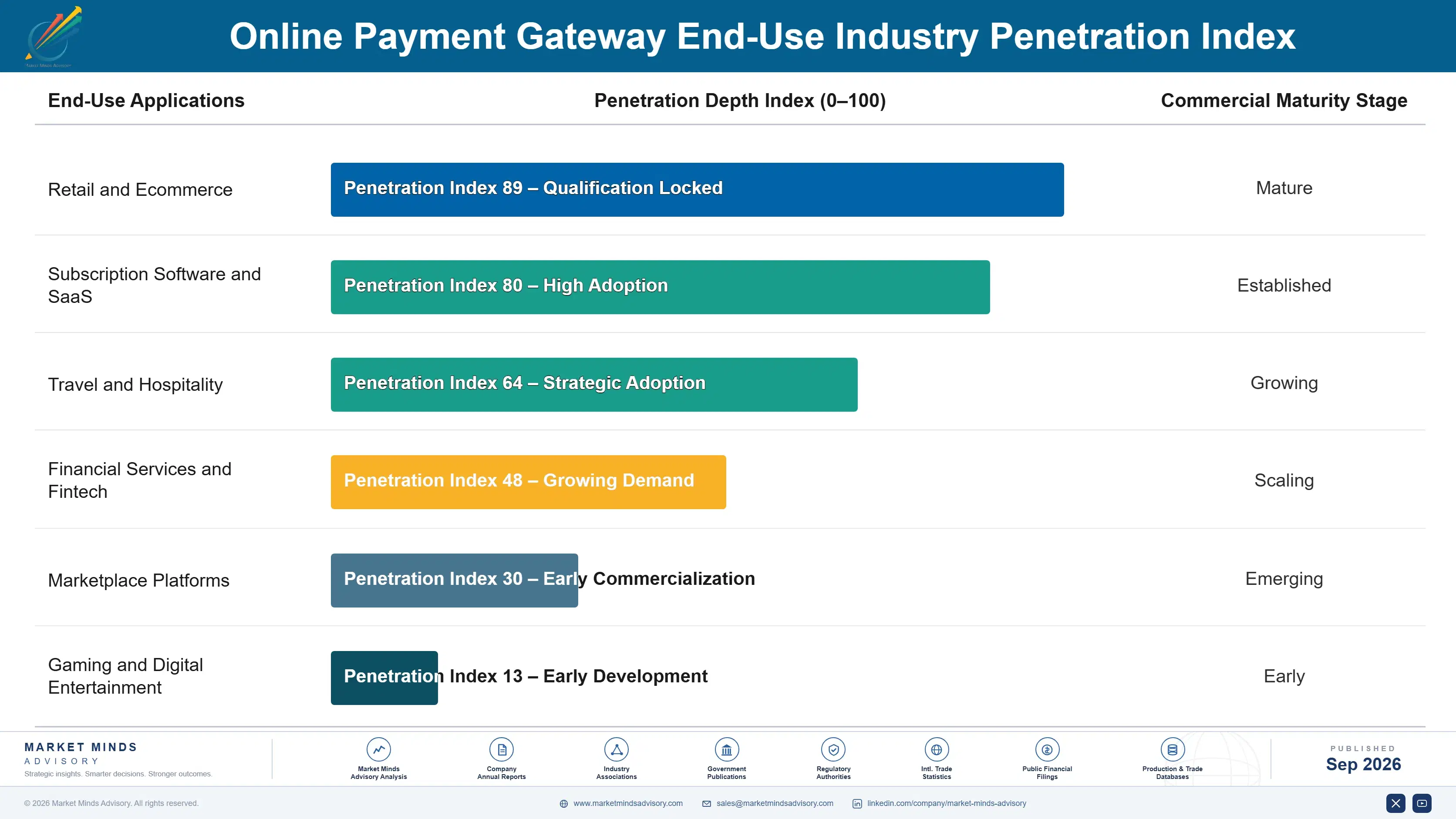
Gateway relationships increasingly resemble annuity revenue rather than one-time integration projects, since merchants rarely switch payment providers once checkout flows and financial reconciliation systems have been built around a specific gateway's infrastructure. Renewal rates on bundled processing-plus-fraud-detection contracts run meaningfully higher than basic processing alone, and expansion revenue from added rail coverage compounds steadily across multi-year merchant relationships.
Adoption stickiness varies meaningfully by end-use vertical: large enterprise retailers and subscription software companies embed gateways deeply into recurring billing and financial reconciliation workflows, making displacement costly and rare, while smaller seasonal merchants adopt more selectively around specific sales periods, keeping switching costs comparatively lower and renewal cycles shorter across those less integrated accounts. Vendors track this closely when planning development budget.

Buyer profiles are shifting generationally as chief financial officers and payment operations leaders, rather than traditional IT staff, increasingly own the gateway purchasing decision, prioritizing conversion rate and fraud loss reduction over raw processing fee percentage. This generational handoff favors providers that can demonstrate measurable revenue impact over incumbents selling primarily on transaction cost alone. Vendors that misjudge this generational shift risk losing the champion inside the merchant buying committee entirely.
online-payment-gateway-market-end-use-penetration-index-1790007827449

Where MMA Sees Durable Advantage

These are among the four positions where our research anticipates prominent divergence between winners and laggards over the coming forecast period. Each is grounded in the demand model, the regulatory perimeter, and the announced capacity pipeline.
01 / VENDOR SELECTION DISCIPLINE

Prioritize multi-rail routing over transaction fee alone

Merchants evaluating payment gateway vendors should weight genuine multi-rail routing capability well above headline transaction fee percentage when comparing shortlisted providers for multi-year processing commitments across their sales channels. Providers offering only card processing without genuine real-time rail routing capability routinely underperform bundled competitors on total cost and conversion rate within eighteen months of deployment, according to feedback gathered across the primary survey. Merchants that select correctly the first time avoid a costly, disruptive gateway migration a few years later.
02 / EMBEDDED FINANCE INVESTMENT TIMING

Pursue software platform partnerships ahead of competitors

Gateway providers lacking embedded finance partnership strategy face mounting competitive pressure from rivals capturing merchant relationships indirectly through software platform integrations rather than direct acquisition alone. MMA expects embedded finance partnership activity to accelerate over the next two to three years as more software platforms recognize the revenue opportunity in embedding payment capability. Providers should prioritize securing these partnerships before competitors establish exclusive platform relationships that would be costly to displace later, since early movers tend to see disproportionate returns.
03 / FRAUD MODEL INVESTMENT

Invest in adaptive fraud detection ahead of AI-assisted fraud

Gateway providers routinely underestimate how quickly generative AI-assisted fraud techniques could outpace static, rule-based detection models, treating current fraud loss rates as an acceptable baseline rather than a genuine competitive vulnerability worth urgent investment. This underinvestment directly explains why some providers lose enterprise merchant contracts to competitors demonstrating measurably lower fraud loss rates. MMA recommends providers prioritize adaptive machine learning fraud investment now rather than waiting for merchant defection to force a reactive response, since early investment builds a durable pricing and reliability advantage.
04 / REGIONAL RAIL CERTIFICATION TIMING

Build local rail certification ahead of merchant expansion

Providers routinely underestimate how quickly merchants expanding internationally will demand native local payment rail certification rather than accepting generic card-only processing in new markets, leaving providers without proactive certification investment poorly positioned when merchant expansion plans accelerate. This risk compounds for providers that delay certification investment until merchants already demand it during active expansion. MMA recommends providers prioritize certification investment in high-growth markets now rather than reacting to individual merchant requests, since early investment costs meaningfully less than reactive scrambling later.

Engagement Snapshot From the Field

A live engagement with an industry participant carrying material or product regulatory and market exposure ahead of a defining policy shift, showing how our research translates into a defensible multi-year portfolio strategy.
MARKET MINDS ADVISORY · CLIENT ENGAGEMENT SUMMARY
Online Payment Gateway Producer Strategic Portfolio Review and Transition Roadmap 2026·Investment Scenario on Online Payment Gateway Exposure Evaluation 2025-26
CLIENT PROFILE
The client is a multinational subscription software company with over $2 billion in annual recurring revenue serving customers across 35 countries (client-reported, unverified by MMA). The company relied on a single legacy card-only gateway that lacked real-time rail support and local payment method coverage in key growth markets. Individual regional teams had previously handled payment provider relationships independently without company-wide coordination or shared evaluation standards.
STRATEGIC CHALLENGE
Leadership needed to modernize payment infrastructure to reduce international payment failures and support local payment methods in expansion markets but lacked internal expertise to evaluate competing multi-rail gateway providers objectively. The finance team was concerned about migration risk to existing recurring billing workflows. The finance team explicitly requested independent, vendor-neutral evaluation before approving any company-wide migration commitment.
MMA APPROACH
MMA conducted a structured vendor evaluation spanning six gateway providers, combining payment failure data analysis with finance and engineering team interviews across priority expansion markets. The engagement produced a phased twelve-month migration plan sequencing highest-failure-rate markets ahead of the remaining customer base. Recommendations were validated against each market's existing payment failure data before finalizing the migration sequence.
KEY FINDINGS
  1. Three of six evaluated providers could not demonstrate sufficient local payment method coverage in the company's priority expansion markets (client-reported, unverified by MMA).
  2. Markets migrated to the new gateway saw a 24% reduction in payment failure rate within two quarters (client-reported, unverified by MMA). across the migrated customer base overall.
  3. Bundled processing-plus-fraud-detection pricing reduced total payment infrastructure cost by an estimated 17% compared to separate procurement (client-reported, unverified by MMA). across the completed infrastructure program.
  4. Customer churn attributable to failed recurring billing attempts declined measurably following the migration across all affected markets (client-reported, unverified by MMA). across all affected regional markets.
CLIENT PROFILE
The client is a multinational subscription software company with over $2 billion in annual recurring revenue serving customers across 35 countries (client-reported, unverified by MMA). The company relied on a single legacy card-only gateway that lacked real-time rail support and local payment method coverage in key growth markets. Individual regional teams had previously handled payment provider relationships independently without company-wide coordination or shared evaluation standards.
STRATEGIC CHALLENGE
Leadership needed to modernize payment infrastructure to reduce international payment failures and support local payment methods in expansion markets but lacked internal expertise to evaluate competing multi-rail gateway providers objectively. The finance team was concerned about migration risk to existing recurring billing workflows. The finance team explicitly requested independent, vendor-neutral evaluation before approving any company-wide migration commitment.
MMA APPROACH
MMA conducted a structured vendor evaluation spanning six gateway providers, combining payment failure data analysis with finance and engineering team interviews across priority expansion markets. The engagement produced a phased twelve-month migration plan sequencing highest-failure-rate markets ahead of the remaining customer base. Recommendations were validated against each market's existing payment failure data before finalizing the migration sequence.
KEY FINDINGS
  1. Three of six evaluated providers could not demonstrate sufficient local payment method coverage in the company's priority expansion markets (client-reported, unverified by MMA).
  2. Markets migrated to the new gateway saw a 24% reduction in payment failure rate within two quarters (client-reported, unverified by MMA). across the migrated customer base overall.
  3. Bundled processing-plus-fraud-detection pricing reduced total payment infrastructure cost by an estimated 17% compared to separate procurement (client-reported, unverified by MMA). across the completed infrastructure program.
  4. Customer churn attributable to failed recurring billing attempts declined measurably following the migration across all affected markets (client-reported, unverified by MMA). across all affected regional markets.
RECOMMENDED STRATEGY
Phase 1: Phase one prioritized migration in the five highest-failure-rate expansion markets before any additional global rollout commitment was made. first. overall. Phase 2: Phase two expanded migration to fifteen additional markets over six months, sequenced by existing local payment method availability. limiting integration risk throughout. Phase 3: Phase three completed migration across the remaining fifteen markets over three months, prioritized by customer renewal timing. completing the migration smoothly.
OUTCOME
One year post-engagement, the company reports meaningfully reduced payment failure rates, improved customer retention in affected markets, and positive finance team sentiment toward the new infrastructure (client-reported, unverified by MMA). The company has since made multi-rail gateway support a standard requirement for all future market entries.

Frequently Asked Questions

Foundational context covering the market sizes, CAGR, scope, country, region and competition that inform every finding below. This section is provided to cover basics and most often pre-purchase conversations, answered from the MMA Primary Research Dataset.

What is the current size of the Online Payment Gateway Market?

The global market reached an estimated $38.5 billion in 2025. This figure covers card processing, real-time payment rail integration, fraud detection, and multi-currency routing software sold to merchants worldwide.

How large will the Online Payment Gateway Market be by 2036?

MMA projects the market will reach approximately $128.8 billion by 2036. Growth is driven primarily by real-time rail expansion and rising cross-border ecommerce activity worldwide.

What is the CAGR for the Online Payment Gateway Market 2026 to 2036?

The market is projected to grow at an 11.6% compound annual growth rate across the forecast period. This reflects accelerating multi-rail routing adoption and embedded finance partnership growth.

Which segment is growing fastest?

Real-Time Payment Rail Integration Services lead growth at a 19.0% CAGR, roughly 1.64 times the overall market rate. Government-backed instant payment systems increasingly drive this demand.

Who are the major companies in the Online Payment Gateway Market?

Stripe, Adyen, PayPal, Worldpay, and Checkout.com lead the market. These providers combine card processing, multi-rail routing, and increasingly fraud detection capability at truly global scale.

Which country is growing fastest?

India leads country-level growth at a 17.8% CAGR. Its unified payments interface has become one of the world's most successful real-time payment systems, driving rapid adoption.

Report Segmentation Architecture

The full report scope spans multiple orthogonal segmentation dimensions, with cross-tabulated demand data provided for each dimension pair. Coverage extends further to regional breakdowns, trend trajectories, and the competitive detail needed to support segment-level decision-making.

By Primary Market Dimension

  • Hosted Payment Gateway Solutions
  • API-Integrated Payment Gateway Solutions
  • Payment Gateway Fraud Detection and Risk Management Software
  • Cross-Border and Multi-Currency Payment Processing
  • Real-Time Payment Rail Integration Services
  • Payment Gateway Analytics and Reconciliation Software

By End-Use Industry

  • Retail and Ecommerce
  • Subscription Software and SaaS
  • Travel and Hospitality
  • Financial Services and Fintech
  • Marketplace Platforms
  • Gaming and Digital Entertainment

By Commercial Dimension

  • Direct Merchant Acquisition
  • Embedded Finance Partnership Channel
  • Payment Facilitator Model
  • Enterprise Multi-Rail Licensing

By Region

  • East Asia
  • North America
  • Western Europe
  • South Asia and Pacific
  • Latin America
  • Middle East and Africa
  • Eastern Europe

Scope, Methodology, and Coverage

Every figure in this report is reproducible from documented input assumptions. The scope below maps the historical period, the forecast horizon, the segmentation dimensions, and the countries covered, alongside the underlying primary and qualitative methodology.
Historical Period
2020 to 2025
Forecast Period
2026 to 2036
Base Year
2025 (USD billions; MMA Primary Research Dataset, September 2026)
Market Definition
The online payment gateway market comprises software platforms that authorize, route, and settle digital transactions across card networks, bank transfer rails, and digital wallets on behalf of merchants. It excludes point-of-sale hardware and traditional in-branch banking transaction processing systems.
Quantitative Units
USD billions (current prices); transaction volume where applicable
Segmentation Dimensions
By Primary Market Dimension; By End-Use Industry; By Commercial Dimension; By Region
Regions Covered
East Asia, North America, Western Europe, South Asia and Pacific, Latin America, Middle East and Africa, Eastern Europe
Countries Covered
USA, China, Germany, France, UK, Japan, South Korea, India, Australia, Canada, Brazil, Mexico, Indonesia, Vietnam, Thailand, Malaysia, UAE, Saudi Arabia, South Africa, Nigeria, Turkey, Poland, Netherlands, Italy, Spain, Sweden, Switzerland, Argentina, Colombia, Singapore, and additional markets relevant to this sector
Key Companies Profiled
Stripe, Adyen, PayPal, Worldpay, Checkout.com, Fiserv, Global Payments, dLocal, Square (Block), Razorpay, Paytm, Klarna, Wise, Rapyd, PayU, Nuvei, BitPay, Payoneer, 2Checkout (Verifone), Airwallex
Quantitative Methodology
Primary survey, n=3,800 respondents, Q4 2025, six countries; demand-side model with trade association cross-validation
Qualitative Methodology
47 expert interviews, Q4 2025; applied to validate demand model assumptions, identify emerging dynamics, and assess competitive positioning
Report Format
PDF and XLSX data workbook (Word format preview document)
Publisher
Market Minds Advisory
Report Code
MMA-2026-TEC-501
Published
September 2026
Contact
sales@marketmindsadvisory.com | www.marketmindsadvisory.com

Purchase the full Online Payment Gateway Market Report (2026 to 2036).

The full report delivers a comprehensive assessment of the global online payment gateway market across all seven regions, six segmentation categories, and twenty profiled vendors spanning global platform generalists and specialist regional providers. It includes detailed forecast modeling through 2036, competitive positioning analysis, input cost exposure, and regulatory tracking across major payment jurisdictions. Buyers receive access to the underlying primary survey dataset and expert interview transcripts referenced throughout the analysis. Custom consulting engagements building on this research are available on request. The analysis draws on both quantitative survey and qualitative expert interview methodology, referenced separately throughout the document.
Ten-year quantitative market sizing and forecast model
Vendor competitive benchmarking and positioning matrix
Detailed regional commentary across seven regions
Primary survey dataset access, n equals 3800
Expert interview transcript summaries and analysis
Quarterly market update subscription option available

Built For The People Who Decide

From boardroom strategy to bench-side execution, this report is read cover-to-cover by leaders shaping the next decade of their industry, turning demand scenarios, market dynamics and valuation benchmarks into decisions.
CXOs/ Presidents/ VPs/ Managers
M&A and Corporate Development
Strategy Teams and R&D Heads
Procurement and Product Directors
Regulatory and Compliance Leaders
Investor Relations and Equity Analysts