Market Minds Advisory
Online Clothing Rental Market

Online Clothing Rental Market: Online Clothing Rental Market. Subscription Economy Expansion and Sustainability Adoption to 2036

Expanding subscription-economy comfort and rising sustainability-conscious fashion consumption are pulling demand toward everyday casual wear rental beyond niche occasion dressing, even as logistics and dry-cleaning costs squeeze platform margins across smaller regional operators.

Lead Analyst

Published

September 2026

Make Smarter Decisions with Customized Research Insights

Request a free sample report and evaluate market opportunities, growth trends, and competitive dynamics relevant to your business needs.

2025 MARKET VALUE$2.4BMarket Size 2025
2036 FORECAST VALUE$7.2BBase Case , 2026 to 2036
CAGR 2026 TO 203610.5 %Bull 11.8% / Bear 9.2%
INCREMENTAL OPPORTUNITY$4.5BNet 10- year value creation
EXPANSION MULTIPLE2.71x2036 value over 2026 base
Strategic Levers
M&A Pipeline
Regional Outlook
Country Rankings
Competitive Intelligence
Segmental Deep-dive
Call-Us : 91 93563 13602

Executive Snapshot and Market Trajectory.

Online clothing rental demand is shifting from niche occasion-wear borrowing into mainstream everyday wardrobe subscription, as consumer comfort with subscription commerce and sustainability-conscious fashion consumption push platforms toward broader casual wear categories beyond formal event dressing, particularly across sustainability-conscious urban households nationwide considerably.
Everyday and casual wear rental is growing fastest as platforms expand subscription models beyond special-occasion borrowing into daily wardrobe rotation, pulling volume toward recurring subscription formats over one-time rental transactions. North America absorbs the largest share of global demand given its concentration of pioneering rental platforms and established subscription commerce culture, particularly across the United States, particularly across the United States and United Kingdom, where subscription commerce culture is most deeply established today.
Competition sits between diversified subscription-model platforms offering broad wardrobe rotation across multiple clothing categories and specialty platforms competing on designer access and curated occasion-wear selection. Rising subscription commerce comfort and sustainability-conscious fashion consumption are accelerating demand for recurring wardrobe rental well beyond one-time event borrowing, while logistics and dry-cleaning costs continue to squeeze platform margins among smaller regional operators lacking comparable scale efficiencies, particularly across brand-owned rental initiatives broadly.
Market Definition
Online clothing rental covers designer and luxury apparel, everyday and casual wear, occasion and event wear, maternity clothing, children's clothing, and workwear rental transacted through digital platforms. The market excludes physical costume rental shops, formal wear rental transacted entirely in-store, and unrelated secondhand resale marketplaces without a rental transaction structure.
Base Year Value
$2.4B in 2025 (MMA Primary Research Dataset, August 2026)
Forecast Period
2026 to 2036, eleven discrete annual values
CAGR
10.5% base case. Bull 11.8%. Bear 9.2%.
Fastest Growth Segment
Everyday and Casual Wear Rental: 12.5% CAGR
Fastest Growth Country
Australia: 13.2% CAGR
Fastest Growth Region
South Asia and Pacific: 12.8% CAGR
Largest Region
North America: 30% of 2025 global value
Market Leaders
Rent the Runway Inc, Nuuly, Le Tote Inc, HURR Collective, and By Rotation lead the field. Source: MMA Analysis based on company disclosures.
Primary Survey
n=3,800 procurement and R&D decision-makers, Q4 2025, six countries
Methodology
Demand-side build-up, cross-validated against public data, 47 expert interviews

Online Clothing Rental Market Forecast Scenarios

online-clothing-rental-market-size-forecast-scenario-1788168008686
Between 2020 and 2025 online clothing rental demand grew at roughly 9.5 percent a year, held back initially by pandemic-era event cancellations before accelerating as subscription commerce comfort and sustainability awareness expanded rapidly across major consumer markets. Logistics automation investment during this period gradually improved platform unit economics, particularly as subscription commerce comfort expanded rapidly across major urban consumer markets considerably.
The base case assumes continued growth as three mechanisms compound: platforms increasingly expanding subscription models beyond special-occasion borrowing into everyday casual wardrobe rotation; sustainability-conscious consumers increasingly treating rental as a default rather than niche fashion choice; and retail brands increasingly launching owned rental subscription services that extend their existing customer relationships into recurring revenue streams, particularly as logistics automation and inventory management technology mature enough for mainstream subscription scaling nationwide across most major consumer markets.
The bull case turns on faster-than-expected everyday wear subscription adoption pulling additional volume beyond occasion-wear borrowing. The bear case centers on persistent logistics and dry-cleaning cost pressure, which has historically compressed platform margins and forced smaller regional operators to consolidate or exit the category, a risk platforms with diversified logistics partnerships have so far managed better than smaller regional competitors reliant on single vendors.

Subscription Expansion Meets Logistics Cost Economics

Online clothing rental sits at the intersection of subscription commerce comfort, sustainability-driven fashion consumption, and logistics cost economics. As everyday wear subscription spreads, platforms increasingly compete on wardrobe rotation flexibility and cleaning turnaround speed rather than price alone, even where premium designer subscription tiers carry a substantial cost above basic casual wear plans.
MARKET CONCENTRATIONCR5: 52%Ownership concentrates heavily among subscription platform majors overall
AVERAGE SELLING PRICE$95 per monthly subscriptionPricing varies sharply by category tier and item count
SUBSCRIPTION RETENTION RATE61% after six monthsLong-term subscriber retention remains a majority outcome overall
LOGISTICS COST SHARE34% of cost of goods soldShipping and cleaning operations dominate total platform cost
TOP PRODUCER COUNTRY SHARETop 3 countries: 63%Platform headquarters concentrate heavily near major fashion hubs
REPEAT RENTAL RATE68% of active usersOwners reordering additional rentals remain a majority category
Commercially the category splits between diversified subscription-model platforms offering broad wardrobe rotation across multiple clothing categories and specialty platforms competing on designer access and curated occasion-wear selection. Diversified platforms compete on logistics scale and subscriber retention infrastructure, while specialty platforms win on curation credibility and designer brand relationships, since everyday, occasion, and maternity applications each demand distinct inventory and fit specifications.
The next decade will be shaped by continued subscription model expansion, rising demand for everyday casual wear rotation paired with sustainability expectations, and diversification of logistics and cleaning infrastructure beyond concentrated regional hubs facing periodic cost volatility. Platforms that can pair reliable wardrobe rotation with efficient, diversified logistics stand to capture share from competitors still operating narrow occasion-only rental models without comparable subscription retention, particularly across platforms weighing logistics investment against subscriber retention.
"Renting a dress for one wedding used to be the entire business model; the platforms actually building durable subscriber relationships now are the ones treating rental like a Netflix queue for your closet, where the item that shows up matters less than the fact that a new one always will."
Director, Digital Fashion Rental Platforms and Circular Apparel Practice · MMA Digital Fashion Rental Platforms and Circular Apparel Practice · August 2026

Market Trends

Everyday Wear Subscription Models Expand Beyond Occasion Rental

Platforms across the United States, United Kingdom, and increasingly Australia are expanding subscription models beyond special-occasion borrowing into daily wardrobe rotation, creating clearer commercial pathways for recurring subscription revenue than the one-time rental transactions the category previously relied on. Expansion has required platforms to invest in broader casual wear inventory and faster cleaning turnaround infrastructure, a process that can take twelve to eighteen months per market given varying logistics partnership requirements. Platforms with established everyday wear inventory are capturing share from smaller competitors unable to invest in the required transition.
Market Impact: Adds 5 percent subscription volume
Retail Brands Launch Owned Rental Subscription Services

Established retail brands are increasingly launching owned rental subscription services that extend existing customer relationships into recurring revenue streams, responding to consumer demand for rental access without switching away from familiar brand relationships. Brand-owned rental services increasingly differentiate competing retail strategies more than standalone rental platforms alone, since consumers evaluate a subscription primarily on whether it includes brands they already trust. Retailers investing in owned rental infrastructure are capturing subscriber loyalty faster than standalone platforms relying on third-party brand inventory alone, particularly across mainstream retailers seeking recurring revenue diversification beyond one-time sales.
Market Impact: Adds 6 percent volume from sustainability

Market Opportunities and Growth Drivers

Subscription Commerce Comfort Sustains Broad Adoption Growth

Consumers across major developed markets continue growing comfortable with recurring subscription commerce across categories beyond fashion, positioning clothing rental as a natural extension for households already managing multiple subscription relationships rather than a standalone novel purchase decision. Households with existing subscription commerce experience show meaningfully higher willingness to add a clothing rental subscription than first-time subscription buyers evaluating the category in isolation. Platforms with established subscription commerce positioning benefit from cross-category comfort that newer entrants cannot easily replicate without comparable existing customer trust, particularly among households already managing multiple recurring digital subscriptions.
Market Impact: Adds up to 24 percent cost

Sustainability Awareness Sustains Landfill-Conscious Fashion Choices

Consumers across major markets continue treating fast fashion landfill waste as an environmental concern worth addressing through purchasing decisions, positioning clothing rental as a category-defining alternative to disposable fashion consumption independent of any single platform's marketing campaign. Consumers who adopt rental for sustainability reasons show meaningfully higher subscription retention rates than those trying the category purely for cost savings. Platforms with credible sustainability positioning benefit from this values-driven demand that runs ahead of pure convenience comparisons, and several platforms report that customers citing sustainability as their primary motivation show significantly stronger long-term retention than price-motivated subscribers.
Market Impact: Limits trial conversion to 38 percent

Market Restraints and Challenges

Logistics And Cleaning Costs Compress Platform Margins

Shipping, dry-cleaning, and garment inspection costs swing meaningfully with fuel and labor cost cycles, creating margin volatility that platforms must manage through pricing mechanisms beyond what conventional e-commerce categories typically require across most operating regions. Root causes include the tight linkage between logistics costs and fuel and labor markets combined with limited platform ability to pass through cost increases immediately given competitive subscription pricing pressure. When logistics costs spike, platforms either absorb margin compression or risk losing subscribers to lower-priced alternatives, both of which have historically strained margins during volatile cost periods.
Market Impact: Shifts 15 percent everyday wear volume

Garment Damage And Fit Uncertainty Restrict Trial Conversion

First-time renters continue expressing hesitancy about garment damage liability and fit uncertainty when ordering clothing without trying it on beforehand, restricting trial conversion among consumers who evaluate the category against the certainty of conventional retail purchase. The root cause is that clothing fit varies meaningfully across brands and body types in ways that online sizing tools cannot fully resolve for first-time renters. Platforms are addressing the barrier through virtual fit technology and flexible damage waiver policies that reduce perceived trial risk, particularly among consumers new to the category evaluating it against familiar retail purchase certainty.
Market Impact: Adds 10 percent volume from brand-owned
4 additional market trends, 4 additional growth drivers, and 3 additional restraints and challenges are covered in the full report. Contact sales@marketmindsadvisory.com to access the complete intelligence.

Segment CAGR and Growth Architecture

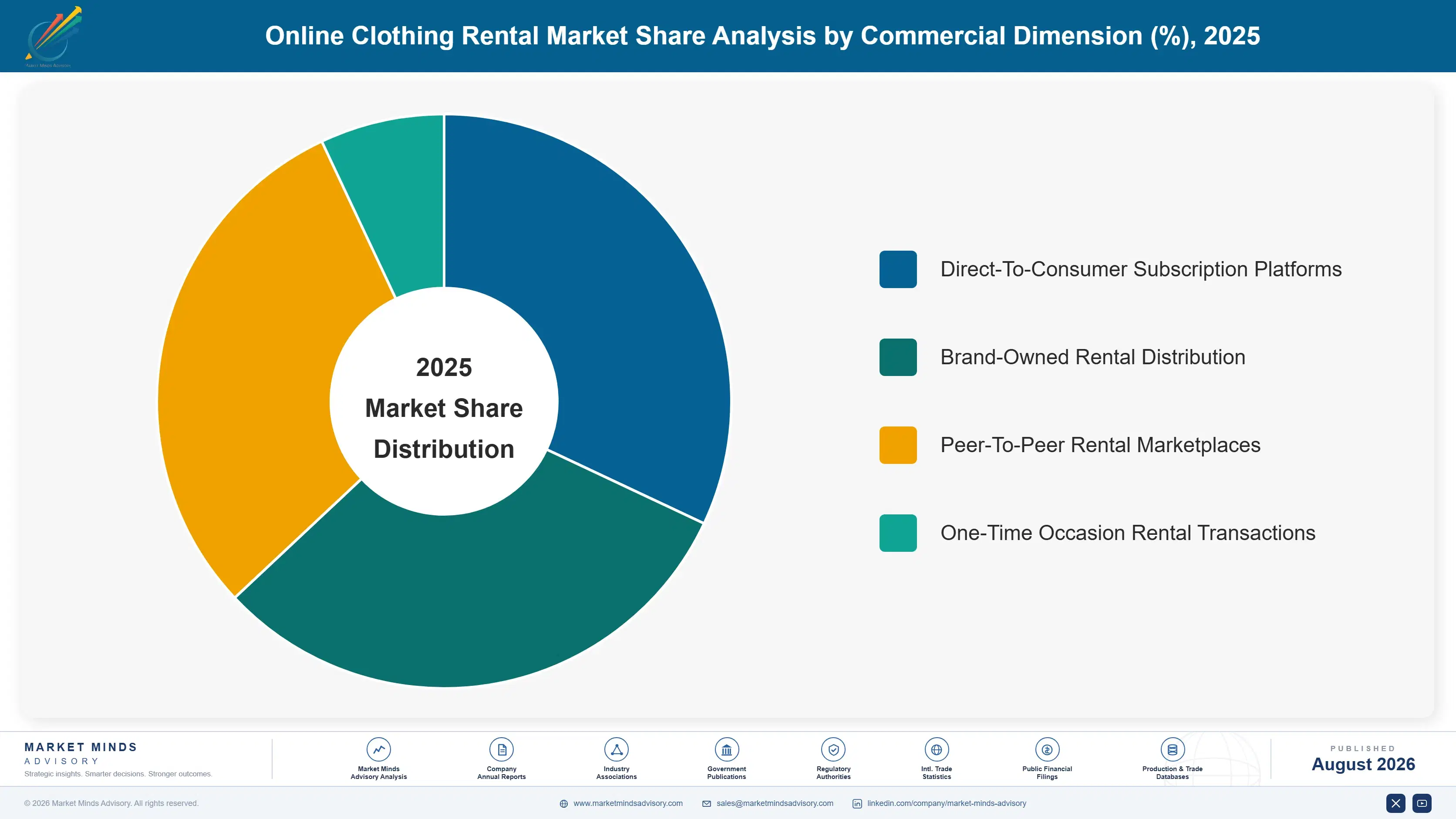
Online clothing rental segments most usefully by clothing category, since designer, everyday, occasion, maternity, children's, and workwear rental carry distinct inventory and fit requirements. This framework mirrors how platforms organise subscription tiers and how consumers evaluate rental options across different wardrobe needs today, particularly as platforms weigh inventory breadth against operational logistics complexity overall.
online-clothing-rental-market-market-share-analysis-1788168009244

Everyday and Casual Wear Rental

Everyday and casual wear rental is the fastest-growing segment as platforms expand subscription models beyond special-occasion borrowing into daily wardrobe rotation across most major consumer markets. Everyday wear subscriptions require substantially broader inventory breadth and faster cleaning turnaround than occasion-only rental, a logistics capability that favors platforms with dedicated infrastructure investment over smaller occasion-focused competitors. Growth concentrates among platforms with documented retention credentials and broad casual wear inventory, since subscribers increasingly expect fresh rotation options before committing to recurring monthly payments. Growth is fastest in North America and increasingly Western Europe, where subscription commerce infrastructure continues expanding fastest, especially among urban professionals seeking frequent wardrobe variety without ownership commitment overall.
CAGR 12.5%

Children's Clothing Rental

Children's clothing rental forms the second-fastest-growing segment, benefiting from rapid sizing turnover that makes conventional ownership economically inefficient for fast-growing children and appeals directly to sustainability-conscious parents. Online clothing rental's documented cost savings and reduced waste benefits position children's rental favorably within parenting retail compared with conventional ownership-based purchasing. Growth is fastest in markets with well-developed parenting subscription commerce infrastructure, particularly North America and Western Europe, where parenting platforms increasingly bundle children's clothing rental into broader subscription offerings, providing platforms new distribution channels beyond standalone rental marketing. Platforms with documented sizing accuracy track records command premium retention as parents standardize rental into routine wardrobe management, particularly across families prioritizing sustainability over conventional ownership economics.
CAGR 10.8%
Full segment breakdown across 6 segments available in the complete report.

Regional Architecture and Country Demand Map

Online clothing rental demand concentrates where subscription commerce culture and pioneering platform development are most advanced. North America accounts for the largest share of global demand given its concentration of pioneering rental platforms and established subscription commerce culture today across most tracked regional markets overall.

North America

The United States' concentration of pioneering rental platforms, backed by strong subscription commerce culture across multiple consumer categories, makes it the largest online clothing rental market globally, supporting sustained demand across both designer and everyday wear categories. Rising everyday wear subscription adoption and brand-owned rental services are reshaping demand toward recurring subscription formats over one-time occasion rental specifically. Canada's subscription commerce sector, closely integrated with United States platforms, mirrors American product specifications and adoption timelines. Growth is supported by continued everyday wear expansion and brand-owned rental adoption across the region's major consumer markets, and several major retailers now dedicate expanded digital marketing to everyday wear subscription offerings ahead of growing consumer demand nationwide considerably.
Share: 30% | CAGR: 10.8% (2026 to 2036)

Western Europe

The United Kingdom's established rental platform sector, home to pioneering peer-to-peer and curated designer rental services, anchors substantial regional demand for both occasion and everyday wear categories. France and Germany's growing subscription commerce sectors contribute additional demand from consumers integrating rental into broader sustainable fashion consumption. Italy and the Netherlands' rental platform sectors contribute meaningful additional demand, though everyday wear adoption there still lags the more advanced United Kingdom infrastructure. Growth trails the fastest-growing regions because the region's occasion-wear rental segment is already comparatively mature, with further gains depending on everyday format mainstream adoption, and several platforms are increasingly featuring sustainability-certified rental lines prominently in digital marketing campaigns across most major metropolitan markets overall.
Share: 26% | CAGR: 9.2% (2026 to 2036)
Regional intelligence for 5 additional markets available in the complete report: East Asia, South Asia and Pacific, Latin America, Middle East and Africa, Eastern Europe. Contact sales@marketmindsadvisory.com.
online-clothing-rental-market-country-cagr-analysis-1788168009785

Subscription Retention and Brand Partnership Premiumisation

Platforms can grow revenue per subscriber even where basic occasion-wear volume growth is modest by shifting consumers toward everyday wear subscriptions, securing brand-owned rental partnerships, and expanding logistics efficiency investment. The most durable gains come from capturing subscription-retention-driven demand rather than competing purely on one-time rental price, particularly for platforms already serving established subscriber distribution channels.

Developing Everyday Wear Subscription Inventory Breadth

Platforms investing in broad everyday and casual wear inventory targeted at recurring subscription buyers capture retention rates roughly 28 to 42 percent higher than occasion-only rental models, reflecting the inventory breadth and logistics infrastructure these subscriptions require. This inventory investment requires meaningful capital deployment and logistics scaling, but it pays back through recurring subscription revenue that smooths the lumpy occasion-driven demand cycle and strengthens subscriber retention across product generations. The approach works best for platforms already serving occasion-wear customers seeking to extend into recurring everyday distribution, particularly among platforms already serving general occasion-wear channels.
Market Impact: Commands a 28 to 42 percent retention premium

Securing Brand-Owned Rental Subscription Partnerships Broadly

Platforms securing multi-year partnerships with retail brands launching owned rental subscription services gain revenue visibility uncommon in standalone occasion-wear rental, since brand partnership relationships rarely reverse once a retailer standardizes on a particular logistics and inventory management partner. These partnerships also create durable switching barriers, since brands face significant operational cost changing logistics partners mid-programme. Platforms with established brand partnerships report contract values roughly 4 times higher than comparable standalone consumer subscription sales, and several retailers report that standardizing on a single logistics partner across multiple brand categories meaningfully reduces coordination overhead compared with sourcing from multiple vendors independently.
Market Impact: Lifts contract values by 4 times overall industry-wide

Expanding Logistics And Cleaning Infrastructure Efficiency

Platforms building direct logistics and cleaning infrastructure capture margin previously lost to third-party fulfillment vendors, while simultaneously reducing the turnaround delays that have historically discouraged frequent subscription renewal among time-sensitive subscribers. This infrastructure investment requires meaningful capital deployment and operational development, but platforms who succeed report margin improvement of roughly 19 percent compared with third-party-dependent fulfillment strategies. The approach works best for platforms with sufficient subscriber scale to justify dedicated infrastructure investment, and several platforms report that Western operators increasingly prefer domestic logistics infrastructure over import-dependent alternatives facing longer turnaround times.
Market Impact: Improves overall platform margin by 19 percent industry-wide

Offering Virtual Fit Technology And Sizing Guarantee Programmes

Platforms offering virtual fit technology and sizing guarantee programmes are capturing subscribers who previously hesitated due to fit uncertainty, simplifying the trial decision for first-time renters evaluating the category against conventional retail purchase certainty. This fit technology approach commands meaningfully higher trial conversion rates than platforms relying on static sizing charts alone, and subscribers increasingly prefer platforms who can guarantee fit accuracy rather than managing frequent exchange requests themselves. Fit guarantee programmes lift trial conversion by roughly 21 percent compared with standard sizing information alone, particularly among first-time renters seeking documented sizing accuracy assurances.
Market Impact: Lifts overall trial conversion by 21 percent industry-wide

Who Controls the Margin Pool

The online clothing rental market is moderately concentrated, with an estimated CR5 near 52 percent, reflecting a category where logistics scale and subscriber retention infrastructure matter more than inventory breadth alone. Rent the Runway Inc and Nuuly lead on combined logistics scale and subscriber base, but the gap to specialty designer-focused platforms is narrower on occasion-wear rental than on mass-market everyday subscription categories.
Competitive activity centers on three fronts: everyday wear inventory development aimed at capturing recurring subscription demand, brand-owned partnership development to secure retailer-driven volume, and logistics infrastructure investment to reduce third-party fulfillment dependency. Acquisitions of specialty designer-focused platforms with established curation capability have picked up as diversified majors seek to close inventory breadth gaps organically.

Emerging pressure comes from retail brands launching owned rental subscription services rapidly closing the logistics and inventory management gap, threatening established standalone platforms on brand trust in mainstream retail categories. Peer-to-peer rental platforms are also pushing further into curated inventory management, threatening to disintermediate traditional platforms relying entirely on owned inventory. Rankings could shift meaningfully if a retail brand achieves logistics scale parity with established standalone rental platforms.
online-clothing-rental-market-company-positioning-matrix-1788168010307

Competitive Moat and Risk Dimensions

RENT THE RUNWAY INC

Moat: Deep Logistics And Cleaning Infrastructure

Rent the Runway's extensive in-house logistics and cleaning infrastructure, built over years of capital investment, gives it operational scale and turnaround speed that smaller specialty competitors cannot easily match, particularly for reaching subscribers requiring rapid inventory rotation. That logistics depth lets Rent the Runway maintain broader everyday wear inventory where smaller competitors would need years to build comparable operational capacity.
RENT THE RUNWAY INC

Risk: Exposure To Subscription Retention Volatility

Rent the Runway's substantial reliance on recurring subscription revenue leaves it more exposed to subscriber churn volatility than competitors with more diversified one-time rental and brand partnership revenue streams. This has, at times, pressured Rent the Runway's revenue predictability during periods of elevated subscriber cancellation.
NUULY

Moat: Strong Parent Company Retail Integration

Nuuly's integration with Urban Outfitters' broader retail and logistics infrastructure, built through corporate parent investment, gives it operational cost efficiency that standalone competitors cannot easily replicate. That integration helps Nuuly cross-sell rental subscriptions to Urban Outfitters' existing customer base more effectively than standalone platforms building customer relationships from scratch.
NUULY

Risk: Limited Independence From Parent Retailer

Nuuly's close integration with Urban Outfitters' brand positioning leaves it less positioned to attract subscribers seeking broader designer variety than standalone platforms with independent brand relationships across the industry. Independent platforms have, at times, captured designer-focused subscribers that Nuuly's parent-brand-centered inventory strategy left underserved This dependency has, at times, constrained Nuuly's ability to expand beyond its parent brand's core aesthetic.

Players Tracked

Prominent Players

Rent the Runway Inc
Nuuly
Le Tote Inc
HURR Collective
By Rotation

Other Key Players

Rent Frock Repeat
Chic by Choice
Onloan
My Wardrobe HQ
Rotaro
Vestiaire Collective
Armoire
Gwynnie Bee
CaaStle Inc
Urban Outfitters Inc
Express Style Trial
Ann Taylor
Bag Borrow or Steal
Girl Meets Dress
Loanhood

Recent Developments

MARCH 2026

Rent the Runway Expands Everyday Wear Inventory Programme

Rent the Runway Inc launched an expanded everyday and casual wear inventory programme targeted at subscribers seeking daily wardrobe rotation beyond occasion dressing, aimed at directly capturing growing demand for recurring subscription value across major metropolitan markets, with the programme expected in full rollout by mid-2026 to meet accelerating demand.
Signal: Signals established platforms are increasingly prioritising everyday wear inventory investment over continued reliance on occasion-only rental volume.
SEPTEMBER 2025

Nuuly Announces Brand Partnership Expansion Programme

Nuuly introduced a dedicated brand partnership expansion programme bundling documented subscriber retention data with inventory supply agreements, providing performance-ready documentation increasingly demanded by fashion brands evaluating competing rental platforms for long-term inventory partnerships, positioning the company ahead of rivals still developing comparable partnership infrastructure industry-wide.
Signal: Confirms brand partnership bundling is quickly becoming a standard competitive requirement among clothing rental platforms industry-wide.
JANUARY 2026

HURR Collective Announces Diversified Logistics Partnership Agreement

HURR Collective announced a new multi-year logistics and cleaning partnership agreement with providers across continental Europe, diversifying the company's operational base beyond its traditional United Kingdom infrastructure and reducing exposure to single-region cost volatility that has periodically compressed margins across the industry, according to a company statement.
Signal: Signals platforms are treating multi-region logistics diversification as a competitive necessity rather than a contingency measure.

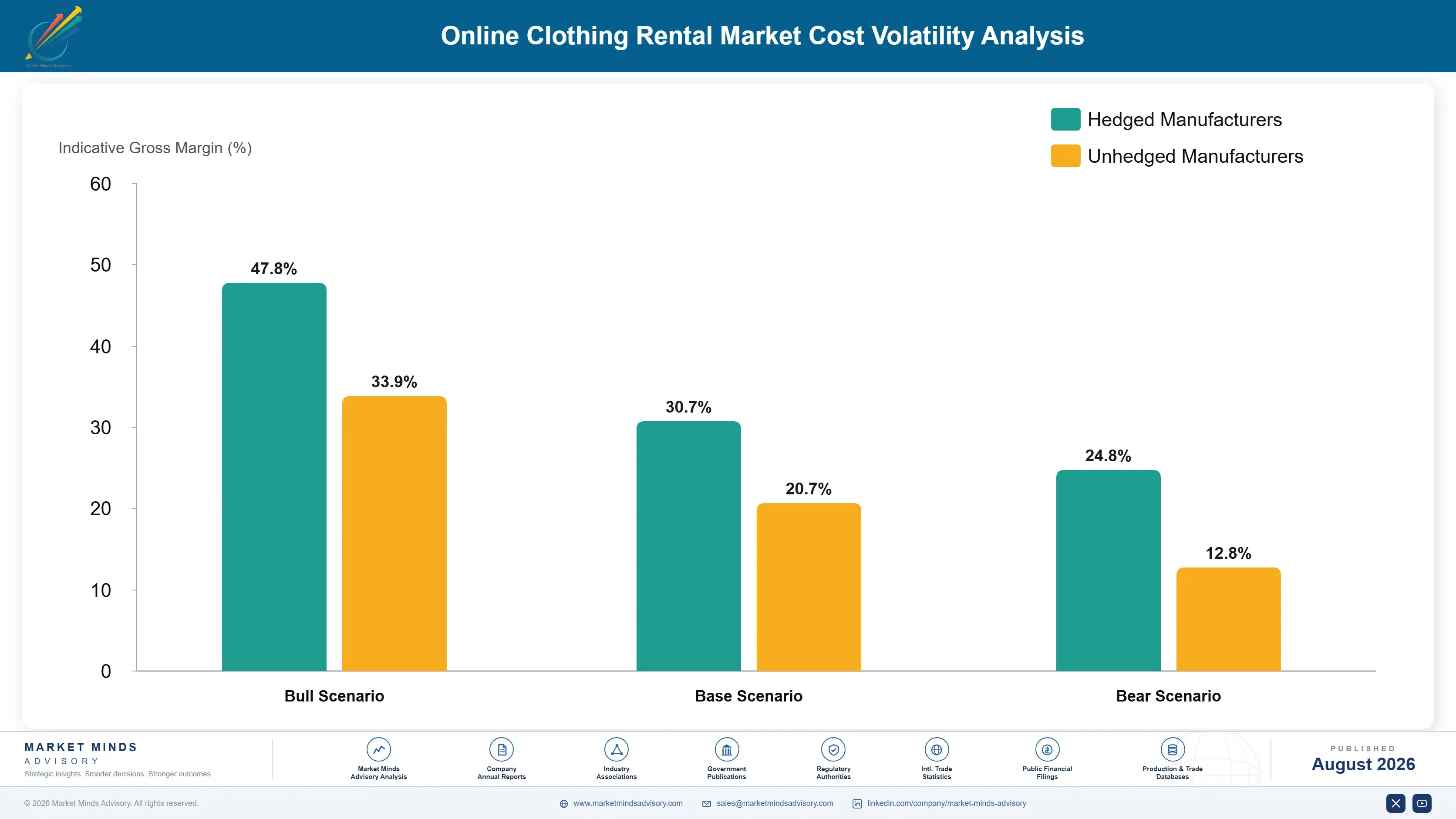
Logistics And Garment Cleaning Cost Exposure

Shipping, dry-cleaning, and garment inspection operations account for 34 percent of cost of goods sold across most online clothing rental platforms, with inventory acquisition, packaging, and technology costs making up the remainder. Operational sourcing concentrates in the United States, United Kingdom, and China, tying platform costs to logistics and cleaning labor pricing rather than broader commodity markets subject to periodic global disruption.
Fuel and logistics cost increases across major operating regions during 2022, driven by energy price inflation affecting shipping and delivery operating costs, pushed platform operational costs up by more than 18 percent within months, according to trade body reporting, forcing platforms with fixed subscription pricing to absorb margin compression. Smaller regional platforms without diversified logistics partnerships faced the sharpest impact, and several reported delayed order fulfillment while renegotiating logistics contracts.

Exposure varies by player type: larger integrated platforms like Rent the Runway, with direct logistics infrastructure and diversified regional operations, weather cost spikes with meaningfully less margin disruption than smaller platforms reliant on third-party fulfillment vendors. Geographic exposure differs, since platforms operating primarily in United States logistics networks face different risk timing than those dependent on European or Asian fulfillment infrastructure, meaning cost impact varies across the industry.
online-clothing-rental-market-cost-volatility-analysis-1788168010506

Diversifying Logistics And Cleaning Partnerships Across Regions

Platforms are increasingly qualifying logistics and cleaning partners across the United States, United Kingdom, and continental Europe simultaneously rather than relying on a single region, so a disruption or cost spike in one region does not halt fulfillment entirely. This diversification raises operational coordination complexity but reduces the risk of the sharp, single-region cost spikes that hit under-diversified platforms hardest.

Securing Multi-Year Fixed-Rate Logistics Agreements

Platforms are increasingly signing multi-year fixed-rate agreements directly with logistics and cleaning providers, securing guaranteed capacity ahead of the open market and capturing pricing stability that smaller platforms reliant on spot arrangements cannot access. This approach requires committed volume most smaller platforms cannot guarantee, reinforcing a cost advantage for larger, established platforms across supplier negotiations.

Vertically Integrating In-House Logistics Capability

Larger platforms are increasingly building proprietary logistics and cleaning infrastructure in-house rather than relying entirely on third-party fulfillment vendors, reducing dependency on external logistics markets during periods of cost volatility. This approach requires substantial capital investment most smaller platforms lack, reinforcing a durable cost and operational advantage for scale players across product development cycles overall.

Portfolio Architecture for Margin Defence

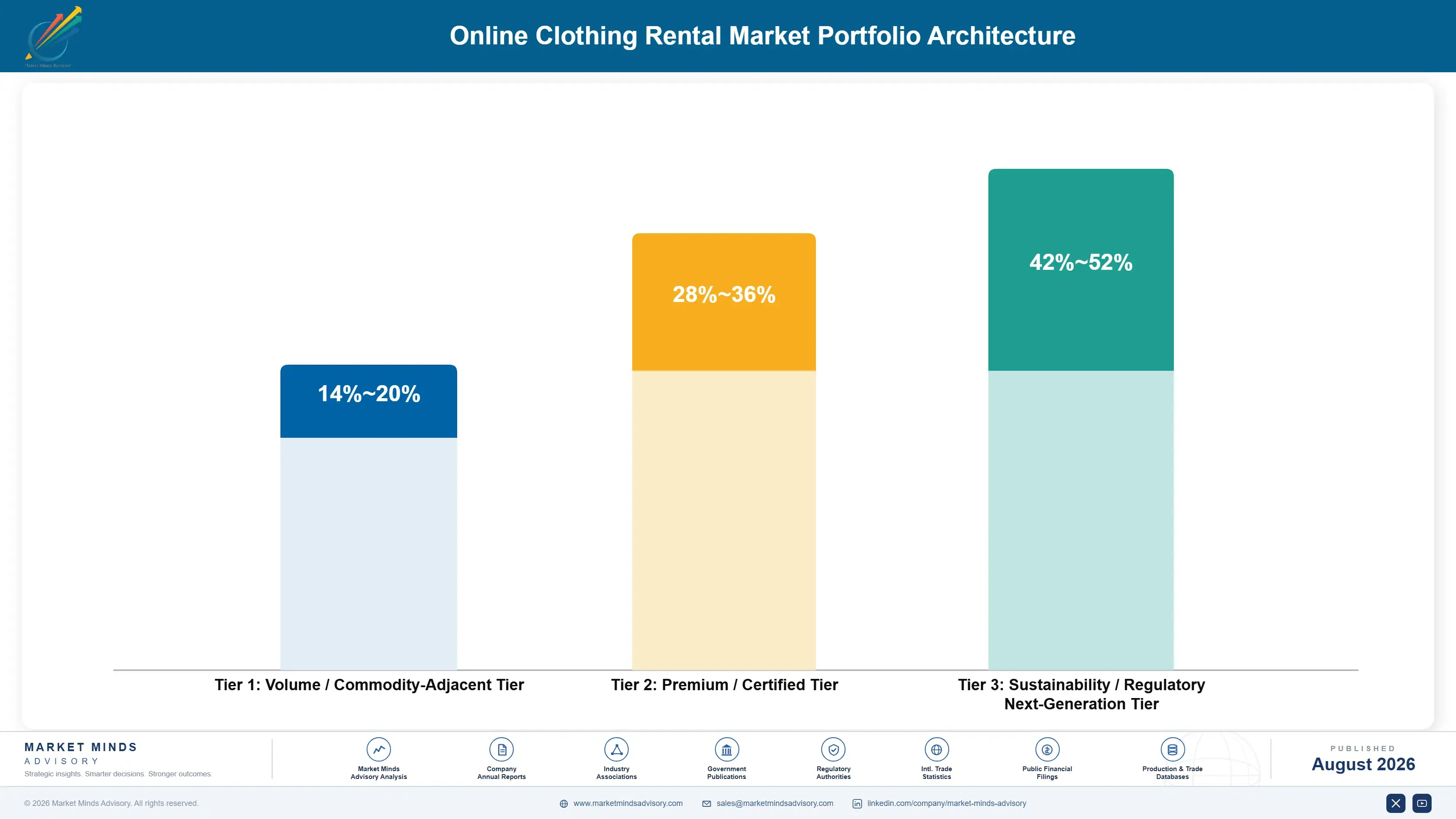
Online clothing rental organises into three commercial tiers running from basic occasion-only rental supply through certified everyday subscription formats to premium brand-partnered next-generation platforms. Gross margins widen sharply moving up the tiers, since occasion-only formats compete largely on unit price and inventory breadth, while everyday and brand-partnered formats capture value from documented retention performance, logistics reliability, and partnership integration rather than transaction volume alone.
The tension between transactional volume and subscription format revenue shapes platform strategy: basic occasion rental generates the transaction scale that supports inventory purchasing power, but everyday and brand-partnered formats generate the margin that justifies continued logistics research investment. Platforms overweighted toward occasion-only sales face intensifying price competition from peer-to-peer alternatives, while subscription-forward platforms carry steadier, higher-margin profitability less exposed to seasonal demand cycles.

High-value pools concentrate among everyday subscription formats sold into recurring wardrobe rotation channels, and among brand-partnered formats sold into retailer partnership channels commanding multi-year contract value. Both pools reward platforms who can pair documented retention credibility with reliable, diversified logistics infrastructure rather than competing purely on occasion-only transaction price alone, a distinction becoming more pronounced as subscription models deepen across major consumer markets.

Volume / Commodity-Adjacent Tier

Basic occasion-only rental transactions sold largely on unit price and inventory breadth, competing on price sensitivity across broad mass-market consumer channels, particularly across price-sensitive mass-market consumer channels broadly worldwide today.
Gross Margin: 14-20%

Premium / Certified Tier

Certified everyday subscription formats backed by documented retention and logistics reliability, sold at a meaningful premium to recurring subscription buyers, appealing especially to subscribers requiring documented retention and reliability assurances broadly.
Gross Margin: 28-36%

Sustainability / Regulatory / Next-Generation Tier

Premium brand-partnered platforms sold to retailers and consumers seeking comprehensive wardrobe solutions, priced on documented retention performance rather than transaction volume alone, commanding the highest margins, and increasingly bundled with dedicated logistics and partnership support services.
Gross Margin: 42-52%
online-clothing-rental-market-portfolio-architecture-1788168011014

High-value Sub-segments and Strategic Watch-out

Brand-Partnered Retailer Subscription Platforms

Brand-partnered platforms sold into retailer partnership channels command the category's highest margins and fastest growth, concentrated among platforms with proven logistics reliability and established retail relationships reaching consumers across modern subscription commerce markets today, with adoption accelerating fastest among retailers seeking recurring revenue diversification nationwide.
Gross Margin: 44-54%

Everyday Wear Subscription Platforms

Everyday wear subscription platforms carry strong margins tied to inventory breadth depth, though growth is more moderate than brand-partnered formats since adoption depends on individual platform logistics scaling timelines across regional markets overall, with adoption pace varying considerably between well-funded and smaller under-resourced regional platforms.
Gross Margin: 30-38%

Basic Occasion-Only Rental Transactions

Basic occasion-only rental remains the largest volume category by far, generating steady transaction revenue across event-driven applications, even as growth increasingly shifts toward everyday and brand-partnered formats elsewhere in the portfolio, particularly among platforms investing heavily in premium format development across most established consumer retail markets today.
Gross Margin: 13-19%

Logistics Cost And Fit Uncertainty Risk

Volatile logistics and cleaning pricing combined with persistent fit uncertainty represents a meaningful ongoing risk, since platforms dependent heavily on third-party fulfillment and unresolved trial conversion gaps must monitor closely across supplier and subscriber trust relationships, particularly as adoption broadens further overall in the years ahead.
Gross Margin: n/a

Subscription-Locked Retention Economics

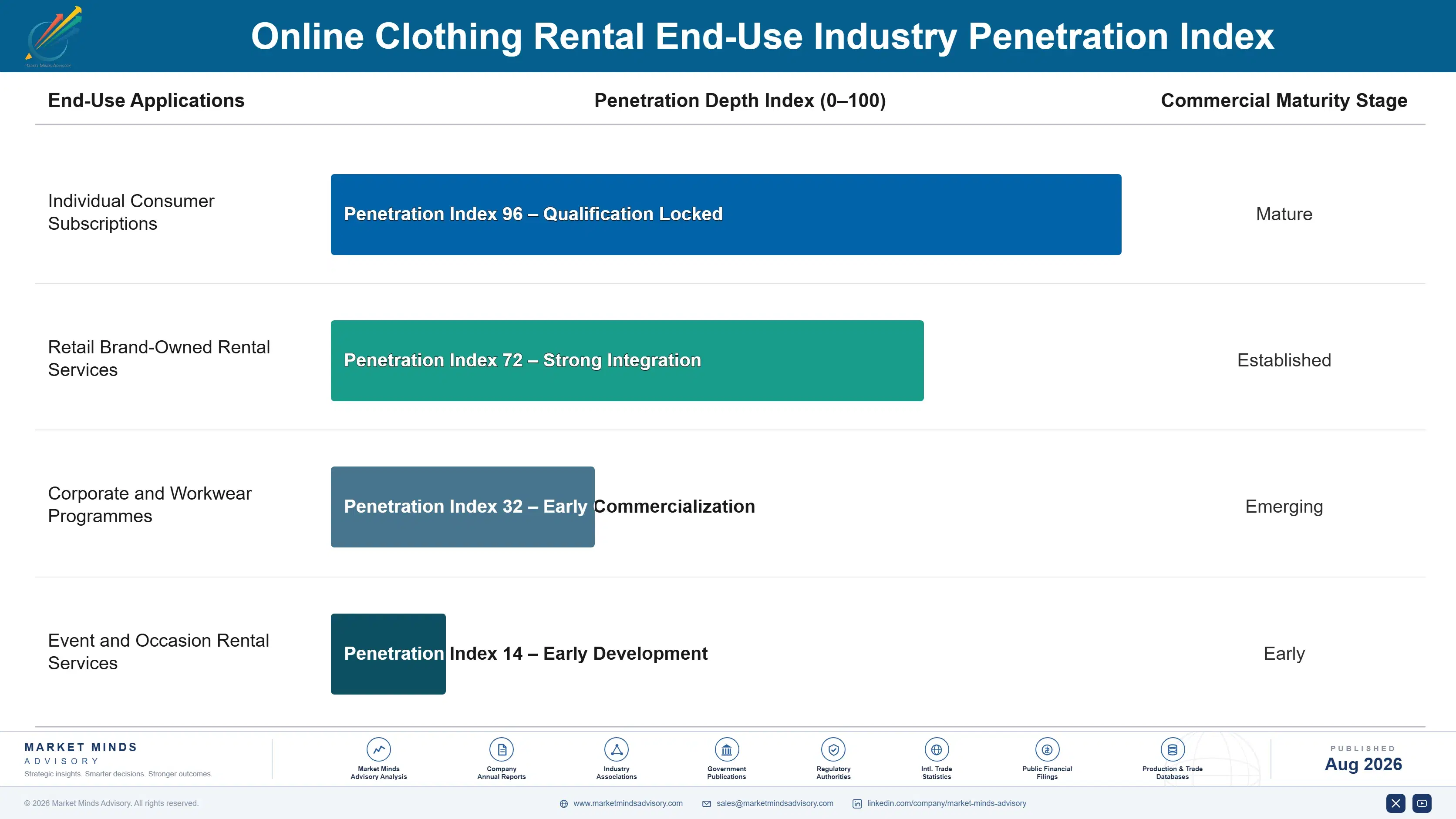
Online clothing rental demand behaves like an annuity once a subscriber establishes a recurring wardrobe rotation habit, since canceling requires actively deciding to revert to conventional ownership-based purchasing that most satisfied subscribers strongly prefer to avoid absent a serious service failure. That subscription lock-in shapes how platforms price and structure long-term subscriber relationships, particularly for everyday and brand-partnered formats where retention value matters most.
Adoption depth varies sharply by end use: recurring everyday wear subscribers penetrate deepest into documented, habitual rotation relationships, often exclusively favoring a single trusted platform across multiple wardrobe categories, while occasion-only renters adopt more transactionally, switching platforms more readily based on price and inventory availability for a specific event. Brand-partnered subscribers sit between the two, balancing retailer loyalty against curiosity about competing standalone platforms.

A generational shift in buyer profiles is underway as younger consumers, increasingly comfortable with subscription-based ownership models and digital-first fashion discovery, demand continuous inventory refresh before committing to a platform, replacing an older generation that expected occasion rental as a one-time transactional service. Platforms slow to adapt risk losing share to subscription-forward competitors, particularly among younger buyers who increasingly evaluate platforms on inventory freshness rather than one-time price alone.
online-clothing-rental-market-end-use-penetration-index-1788168011526

Where To Focus Investment Next

These are among the four positions where our research anticipates prominent divergence between winners and laggards over the coming forecast period. Each is grounded in the demand model, the regulatory perimeter, and the announced capacity pipeline.
01 / EVERYDAY WEAR INVESTMENT

Prioritise Subscription Expansion Over Occasion Volume

Everyday and casual wear rental commands the category's fastest growth and widest retention premiums, driven by platforms prioritizing recurring subscription revenue over one-time occasion transactions across most major consumer markets. Platforms that invest in broad casual wear inventory are capturing this premium demand at a faster rate than competitors still selling narrow occasion-only rental without comparable subscription positioning. Capital allocated toward inventory breadth and logistics scaling will likely generate better returns than occasion-only capacity expansion over the next several years, particularly for platforms serving high-volume subscription programmes.
02 / BRAND PARTNERSHIP DEVELOPMENT

Secure Brand Partnerships Ahead Of Retail Consolidation

Retail brands launching owned rental subscription services are expanding rapidly across major consumer platforms, and platforms who secure early partnership relationships gain multi-year volume visibility and durable switching barriers uncommon in standalone consumer subscription sales. This partnership-based revenue model requires sustained investment in logistics reliability and retailer relationship management that smaller platforms cannot easily replicate. Platforms that delay building these relationships risk ceding fast-expanding brand-partnered volume entirely to more established competitors already positioned with major retailers managing large, multi-year inventory programmes across multiple regions.
03 / LOGISTICS INFRASTRUCTURE INVESTMENT

Diversify Logistics Partnerships Across Regions

Logistics cost volatility periodically compresses margins across the industry, and platforms who diversify partnerships across the United States, United Kingdom, and continental Europe gain meaningfully more stable operational availability than competitors reliant entirely on single-region fulfillment during periods of cost disruption. This diversification requires substantial coordination investment across multiple regions with different operational economics that smaller platforms cannot easily replicate. Platforms that delay this diversification risk continued cost volatility that better-diversified competitors have already substantially reduced through geographic operational spread.
04 / FIT TECHNOLOGY INVESTMENT

Build Fit Confidence Ahead Of Mainstream Demand

Virtual fit technology is opening substantial addressable markets among consumers previously deterred by sizing uncertainty, and platforms who build dedicated fit confidence capability capture share before competitors recognise the opportunity clearly. This fit-forward approach is already commanding stronger trial conversion among platforms serving first-time renters entering the category for the first time. Platforms that delay building this capability risk ceding trial-driven volume entirely to more prepared competitors already established with fit guarantee programmes across multiple regional markets and subscriber segments simultaneously.

Engagement Snapshot From the Field

A live engagement with an industry participant carrying material or product regulatory and market exposure ahead of a defining policy shift, showing how our research translates into a defensible multi-year portfolio strategy.
MARKET MINDS ADVISORY · CLIENT ENGAGEMENT SUMMARY
Online Clothing Rental Producer Strategic Portfolio Review and Transition Roadmap 2026·Investment Scenario on Online Clothing Rental Exposure Evaluation 2025-26
CLIENT PROFILE
The client is a regional fashion retailer operating an estimated 140 stores, evaluating a launch of an owned rental subscription service to extend existing customer relationships into recurring revenue (client-reported, unverified by MMA). The retailer needed to determine optimal logistics partnership and subscription pricing structure ahead of a planned national launch, built primarily around available store inventory and customer relationship data.
STRATEGIC CHALLENGE
Digital strategy and operations leadership needed to evaluate logistics partnership options against projected subscriber demand, but lacked reliable data on regional consumer willingness to pay for owned-brand rental subscriptions within the retailer's specific customer base and competitive positioning Delaying the launch risked ceding first-mover positioning to a competing regional retailer already piloting a comparable rental initiative.
MMA APPROACH
MMA analysts benchmarked comparable brand-owned rental launches against documented subscriber acquisition and retention outcomes, modeling expected demand and logistics cost across representative launch scenarios. The engagement combined primary interviews with the retailer's digital strategy team, logistics partner capability comparison, and analysis against MMA's broader dataset of brand-owned rental launch outcomes across comparable retailers.
KEY FINDINGS
  1. The recommended logistics partnership structure reduced the retailer's projected fulfillment cost per subscriber by roughly 22 percent compared with the retailer's initial internal proposal, based on comparable launch benchmarks (client-reported, unverified by MMA).
  2. Two of five benchmarked logistics partners lacked sufficient regional cleaning capacity to support the retailer's projected national subscriber volume within the planned launch timeline.
  3. Subscription pricing calibrated to the recommended benchmark showed meaningfully higher projected six-month retention than the retailer's initial higher-priced proposal, reducing projected subscriber acquisition costs meaningfully across the launch period.
  4. The recommended logistics partner offered dedicated onboarding support throughout the launch process, reducing the retailer's internal operational preparation burden compared with competing proposals.
CLIENT PROFILE
The client is a regional fashion retailer operating an estimated 140 stores, evaluating a launch of an owned rental subscription service to extend existing customer relationships into recurring revenue (client-reported, unverified by MMA). The retailer needed to determine optimal logistics partnership and subscription pricing structure ahead of a planned national launch, built primarily around available store inventory and customer relationship data.
STRATEGIC CHALLENGE
Digital strategy and operations leadership needed to evaluate logistics partnership options against projected subscriber demand, but lacked reliable data on regional consumer willingness to pay for owned-brand rental subscriptions within the retailer's specific customer base and competitive positioning Delaying the launch risked ceding first-mover positioning to a competing regional retailer already piloting a comparable rental initiative.
MMA APPROACH
MMA analysts benchmarked comparable brand-owned rental launches against documented subscriber acquisition and retention outcomes, modeling expected demand and logistics cost across representative launch scenarios. The engagement combined primary interviews with the retailer's digital strategy team, logistics partner capability comparison, and analysis against MMA's broader dataset of brand-owned rental launch outcomes across comparable retailers.
KEY FINDINGS
  1. The recommended logistics partnership structure reduced the retailer's projected fulfillment cost per subscriber by roughly 22 percent compared with the retailer's initial internal proposal, based on comparable launch benchmarks (client-reported, unverified by MMA).
  2. Two of five benchmarked logistics partners lacked sufficient regional cleaning capacity to support the retailer's projected national subscriber volume within the planned launch timeline.
  3. Subscription pricing calibrated to the recommended benchmark showed meaningfully higher projected six-month retention than the retailer's initial higher-priced proposal, reducing projected subscriber acquisition costs meaningfully across the launch period.
  4. The recommended logistics partner offered dedicated onboarding support throughout the launch process, reducing the retailer's internal operational preparation burden compared with competing proposals.
RECOMMENDED STRATEGY
Phase 1: Phase 1 (Months 1 to 3): Finalise logistics partnership and subscription pricing using MMA's benchmarked demand model across the flagship metropolitan market. Phase 2: Phase 2 (Months 4 to 7): Execute a phased regional launch beginning with flagship metropolitan markets before national expansion across all participating flagship locations. Phase 3: Phase 3 (Months 8 to 10): Extend the subscription service nationally using retention data carried forward from the regional launch.
OUTCOME
The retailer launched its owned rental subscription service within the planned competitive window and exceeded its first-year subscriber target by roughly 14 percent (client-reported, unverified by MMA), with digital strategy leadership crediting the benchmarked logistics partnership with avoiding the fulfillment delays that affected a comparable competing retailer's launch that year.

Frequently Asked Questions

Foundational context covering the market sizes, CAGR, scope, country, region and competition that inform every finding below. This section is provided to cover basics and most often pre-purchase conversations, answered from the MMA Primary Research Dataset.

What is the current size of the Online Clothing Rental Market?

The global online clothing rental market was valued at approximately $2.4 billion in 2025. Demand is driven by subscription commerce comfort, sustainability awareness, and brand-owned rental expansion.

How large will the Online Clothing Rental Market be by 2036?

MMA forecasts the market will reach approximately $7.19 billion by 2036, roughly 2.71 times its 2026 value. Growth is driven by continued everyday wear subscription adoption and brand partnerships.

What is the CAGR for the Online Clothing Rental Market 2026 to 2036?

The market is projected to grow at a compound annual growth rate of 10.5 percent between 2026 and 2036. Bull and bear scenarios range from roughly 9.2 to 11.8 percent depending on adoption pace.

Which segment is growing fastest?

Everyday and casual wear rental is the fastest-growing segment, expanding at approximately 12.5 percent annually, driven by platforms expanding beyond occasion-wear borrowing across most major subscription commerce markets.

Who are the major companies in the Online Clothing Rental Market?

Leading platforms include Rent the Runway Inc, Nuuly, Le Tote Inc, HURR Collective, and By Rotation. Competition centers on logistics scale, subscriber retention, and brand partnerships.

Which country is growing fastest?

Australia is the fastest-growing major market, driven by its well-developed sustainability-conscious consumer base and strong subscription commerce culture adopting rental models early across most established subscription commerce markets.

Report Segmentation Architecture

The full report scope spans multiple orthogonal segmentation dimensions, with cross-tabulated demand data provided for each dimension pair. Coverage extends further to regional breakdowns, trend trajectories, and the competitive detail needed to support segment-level decision-making.

By Clothing Category

  • Designer and Luxury Apparel Rental
  • Everyday and Casual Wear Rental
  • Occasion and Event Wear Rental
  • Maternity Clothing Rental
  • Children's Clothing Rental
  • Workwear and Professional Attire Rental

By End-Use Industry

  • Individual Consumer Subscriptions
  • Retail Brand-Owned Rental Services
  • Corporate and Workwear Programmes
  • Event and Occasion Rental Services

By Commercial Dimension

  • Direct-To-Consumer Subscription Platforms
  • Brand-Owned Rental Distribution
  • Peer-To-Peer Rental Marketplaces
  • One-Time Occasion Rental Transactions

By Region

  • North America
  • Western Europe
  • East Asia
  • South Asia and Pacific
  • Latin America
  • Middle East and Africa
  • Eastern Europe

Scope, Methodology, and Coverage

Every figure in this report is reproducible from documented input assumptions. The scope below maps the historical period, the forecast horizon, the segmentation dimensions, and the countries covered, alongside the underlying primary and qualitative methodology.
Historical Period
2020 to 2025
Forecast Period
2026 to 2036
Base Year
2025 (USD billions; MMA Primary Research Dataset, August 2026)
Market Definition
The online clothing rental market covers designer and luxury apparel, everyday and casual wear, occasion and event wear, maternity clothing, children's clothing, and workwear rental transacted through digital platforms. It excludes physical costume rental shops, formal wear rental transacted entirely in-store, and unrelated secondhand resale marketplaces without a rental transaction structure.
Quantitative Units
USD billions (current prices); volume in million rental transactions where cited
Segmentation Dimensions
By Clothing Category; By End-Use Industry; By Commercial Dimension; By Region
Regions Covered
North America, Western Europe, East Asia, South Asia and Pacific, Latin America, Middle East and Africa, Eastern Europe
Countries Covered
USA, Canada, UK, France, Germany, Italy, Netherlands, China, Japan, South Korea, Australia, India, Singapore, Brazil, Mexico, Argentina, South Africa, UAE, Nigeria, Poland, Russia, and additional markets relevant to this sector
Key Companies Profiled
Rent the Runway Inc, Nuuly, Le Tote Inc, HURR Collective, By Rotation, Rent Frock Repeat, Chic by Choice, Onloan, My Wardrobe HQ, Rotaro, Vestiaire Collective, Armoire, Gwynnie Bee, CaaStle Inc, Urban Outfitters Inc, Express Style Trial, Ann Taylor, Bag Borrow or Steal, Girl Meets Dress, Loanhood
Quantitative Methodology
Primary survey, n=3,800 respondents, Q4 2025, six countries; demand-side model with trade association cross-validation
Qualitative Methodology
47 expert interviews, Q4 2025; applied to validate demand model assumptions, identify emerging dynamics, and assess competitive positioning
Report Format
PDF and XLSX data workbook (Word format preview document)
Publisher
Market Minds Advisory
Report Code
MMA-2026-TEC-905
Published
August 2026
Contact
sales@marketmindsadvisory.com | www.marketmindsadvisory.com

Purchase the full Online Clothing Rental Market Report (2026 to 2036).

The full report provides a quantitative and qualitative assessment of the global online clothing rental market through 2036, including regional sizing across all seven MMA-tracked geographies and category-level segmentation covering designer, everyday, occasion, maternity, children's, and workwear rental. It profiles twenty leading platforms, benchmarking logistics scale, subscriber retention, and brand partnership capability across the competitive landscape. The report includes primary survey findings from 3,800 respondents and 47 expert interviews conducted in the fourth quarter of 2025, alongside logistics cost and supply chain risk analysis. Buyers receive segment-level revenue models, editable data tables, and a framework for evaluating platform and market entry decisions.
Seven-region market sizing with category-level revenue breakdowns
Twenty-company competitive profiles with moat and risk analysis
Primary survey data from 3,800 respondents across six countries
Forty-seven expert interviews on adoption and retention trends
Editable data tables for custom scenario and sensitivity modeling
Logistics cost and supply chain risk assessment

Built For The People Who Decide

From boardroom strategy to bench-side execution, this report is read cover-to-cover by leaders shaping the next decade of their industry, turning demand scenarios, market dynamics and valuation benchmarks into decisions.
CXOs/ Presidents/ VPs/ Managers
M&A and Corporate Development
Strategy Teams and R&D Heads
Procurement and Product Directors
Regulatory and Compliance Leaders
Investor Relations and Equity Analysts