Market Minds Advisory
On-The-Go Packaging Market

On-The-Go Packaging Market: Mono-Material Technology Reshapes Mobile Consumption

Convenience store chains and beverage manufacturers are converting toward mono-material recycled-content pouches as urban mobile consumption growth and recyclability labeling requirements reshape portable food and beverage packaging specifications across most established convenience retail channels worldwide.

Lead Analyst

Bilal Shaikh

Published

September 2026

Make Smarter Decisions with Customized Research Insights

Request a free sample report and evaluate market opportunities, growth trends, and competitive dynamics relevant to your business needs.

2025 MARKET VALUE$18.5BMarket Size 2025
2036 FORECAST VALUE$42.3BBase Case , 2026 to 2036
CAGR 2026 TO 20367.8 %Bull 9.1% / Bear 6.5%
INCREMENTAL OPPORTUNITY$22.3BNet 10- year value creation
EXPANSION MULTIPLE2.12x2036 value over 2026 base
Strategic Levers
M&A Pipeline
Regional Outlook
Country Rankings
Competitive Intelligence
Segmental Deep-dive
Call-Us : 91 93563 13602

Executive Snapshot and Market Trajectory

Mono-material recycled-content pouches are gaining share across convenience retail and beverage fill lines nationwide, as brand owners prioritize recyclability certification and portability for on-the-go consumption requiring stricter mobile durability standards under tightening retail sustainability scrutiny, rising consumer convenience expectations, growing urban shelf-space allocation, and expanding beverage portfolio investment industry-wide.
Convenience store chains and beverage manufacturers now drive purchasing volume, favoring mono-material recycled-content and spouted pouch formats over legacy multi-layer laminate packaging as urban mobile consumption growth and recyclability labeling requirements tighten across most established convenience retail channels nationwide today. East Asia leads global demand given its dense convenience store retail network and expanding urban on-the-go consumption culture across Japan and South Korea specifically, alongside growing Chinese metropolitan mobile lifestyle adoption.
A highly fragmented group of specialized flexible packaging manufacturers competes on recyclability certification and portability integration rather than price alone, spanning established converters and expanding sustainability-focused specialists serving beverage and food clients across most established and rapidly emerging retail markets reliably and consistently. Retail sustainability procurement mandates are reshaping competitive rankings meaningfully across most regulated packaging markets, rewarding early movers with capacity investment and qualification speed.
Market Definition
The On-The-Go Packaging Market covers portable single-serve packaging formats including spouted pouches, single-serve cups, resealable stand-up pouches, and portable beverage bottles designed for mobile consumption. It excludes standard bulk consumer packaging, foodservice packaging, and industrial bulk containers.
Base Year Value
$18.5B in 2025 (MMA Primary Research Dataset, August 2026)
Forecast Period
2026 to 2036, eleven discrete annual values
CAGR
7.8% base case. Bull 9.1%. Bear 6.5%.
Fastest Growth Segment
Mono-Material Recycled-Content Formats: 11.8% CAGR
Fastest Growth Country
India: 10.2% CAGR
Fastest Growth Region
South Asia and Pacific: 9.9% CAGR
Largest Region
East Asia: 27% of 2025 global value
Market Leaders
Amcor, Sealed Air Corporation, Sonoco Products, Constantia Flexibles, ProAmpac. Source: MMA Analysis, July 2026.
Primary Survey
n=3,800 procurement and R&D decision-makers, Q4 2025, six countries
Methodology
Demand-side build-up, cross-validated against public data, 47 expert interviews

On-The-Go Packaging Market Forecast Scenarios

on-the-go-packaging-market-size-forecast-scenario-1787308001003
Global on-the-go packaging revenue grew steadily between 2020 and 2025 as convenience retail expanded rapidly and urban mobile consumption habits increased across most major retail regions worldwide, lifting the historical growth rate above six percent annually across most established markets in East Asia, North America, and Western Europe specifically throughout this entire recent decade period.
The base case assumes continued conversion from multi-layer laminate to mono-material recycled-content pouches across convenience retail and beverage fill lines, expanding recyclability certification across major retail regions, and rising urban mobile consumption tied to expanding convenience store investment worldwide. These three mechanisms together support base-case growth near the middle of the forecast band through 2036, with sustainability-grade packaging formats capturing an increasing share of new procurement specification decisions across most regulated retail markets.
A bull scenario assumes accelerated mono-material recycled-content adoption across several emerging retail hubs, pushing growth toward the top of the forecast band through the coming decade steadily. A bear scenario assumes slower beverage capital equipment spending and delayed extended producer responsibility regulation harmonization, holding conversion timelines back and growth closer to the forecast floor instead across most retail regions.

Mono-Material Technology Reshapes Mobile Consumption

The on-the-go packaging market is undergoing a meaningful portability and material shift, as mono-material recycled-content pouches displace legacy multi-layer laminate formats across convenience retail and beverage fill lines nationwide and consistently across most regulated retail regions worldwide today. Purchasing committees increasingly require recyclability certification and portability validation as baseline specifications when evaluating new packaging suppliers rather than treating them
MARKET CONCENTRATION32%Combined revenue share held by top five packaging manufacturers
AVERAGE SELLING PRICE$0.11 per unitBlended selling price across current mono-material pouch product formats
TOP PRODUCING COUNTRYChina, 18% shareShare of global production concentrated in one leading country
PLANT UTILIZATION75% utilizationAverage plant utilization across contracted flexible packaging production lines
TRADE INTENSITY28% export shareShare of finished packaging sold across international trade corridors
SUPPLIER SWITCHING CYCLE11 monthsTypical qualification duration before switching validated packaging supplier relationships
Commercial character is defined by flexible film extrusion and precision lamination capability followed by recurring multi-year supply agreements, so manufacturer economics depend heavily on validated production capacity and sustainability documentation depth rather than any single large account win alone across most beverage and food markets worldwide today. Purchasing teams increasingly evaluate total cost per validated production batch rather than unit price alone consistently across most established accounts.
Retail sustainability procurement mandates are reshaping competitive rankings meaningfully, rewarding manufacturers that moved fastest through mono-material qualification and recyclability validation infrastructure while rising urban mobile consumption keeps expanding the addressable packaging volume steadily across most developed and rapidly expanding retail markets, convenience purchasing systems, beverage networks, distribution channels, and export supply chains worldwide and nationwide today.
"Nobody specs a beverage launch without recyclability certification anymore, multi-layer laminate is basically legacy material for new launches now."
Director, Beverage and Convenience Retail Packaging Practice · MMA Beverage and

Market Trends

Mono-Material Pouch Adoption Accelerates Across Convenience Retail

Mono-material recycled-content pouches are displacing legacy multi-layer laminate formats as the preferred packaging for on-the-go beverages and snacks, offering certified recyclability that meets store shelf compliance labeling and extended producer responsibility regulations across major retail markets. Major beverage brands have updated internal packaging specifications to favor mono-material formats for new product launches rather than defaulting to multi-layer laminate as the historical standard. Roughly 24 percent of new on-the-go product launches introduced since 2023 specify mono-material recycled-content pouches as the primary packaging format, up meaningfully from a much smaller share five years earlier.
Market Impact: Convenience retail volume grows 10

Spouted Pouch Format Adoption Expands Across Beverage Brands

Beverage and food brands are increasingly specifying spouted pouches that improve portability and resealability for mobile consumption, pushing purchasing teams toward suppliers with validated spout engineering and formulation compatibility testing capability across most product categories and retail formats. This dispensing push is expanding demand for pouches that combine spout convenience with mono-material recyclability rather than accepting standard flat pouch formats alone. Spouted pouch adoption has grown by roughly 21 percent across major retail markets over the past three years, directly favoring manufacturers with established spout engineering and testing capability already in place.
Market Impact: Mobile consumption volume grows 13

Market Opportunities and Growth Drivers

Expanding Convenience Store Retail Drives Packaging Demand

Global convenience store retail continues expanding as retail chains scale store counts and grab-and-go offerings across major retail regions, directly increasing demand for validated on-the-go packaging used throughout filling, sealing, and labeling processes across most manufacturing facilities worldwide. Retailers are scaling procurement volume to meet rising customer demand from convenience chains that increasingly specify sustainability-grade packaging formats over general-purpose laminate materials for premium retail programs. Convenience store retail volume has grown by roughly 10 percent annually across major retail markets, directly expanding addressable packaging demand for specialized manufacturers serving this segment specifically.
Market Impact: Qualification speed lags by 10 week

Rising Urban Mobile Lifestyle Investment Across Markets

Urban mobile lifestyle investment continues rising across established and emerging retail markets as commuting populations expand and busy consumer schedules grow, directly increasing demand for portable on-the-go packaging suited to beverage, snack, and meal-replacement distribution channels worldwide. This investment growth reflects a broader shift among consumer packaged goods brands toward smaller, more convenient package formats that support mobile consumption rather than legacy at-home bulk packaging formats. Urban mobile consumption volume has grown by roughly 13 percent across major East Asian markets since 2022, directly expanding equipment and packaging demand for manufacturers serving this expanding segment.
Market Impact: Resin cost reaches 34 percent share

Market Restraints and Challenges

Mono-Material Barrier Performance Trade-Off Burden Rises

Achieving both recyclability compliance and sufficient oxygen and moisture barrier performance requires specialized mono-material resin engineering that many smaller packaging manufacturers lack the technical depth to develop consistently across their full product portfolio. The root cause is the inherent trade-off between single-material construction required for recyclability and the multi-layer barrier structures traditionally used to protect sensitive formulations, limiting how broadly smaller manufacturers can compete for validated premium beverage contracts. Manufacturers are pursuing specialized barrier coating partnerships to soften the tension, but smaller packaging producers still trail established competitors in qualification speed by roughly 10 weeks on average.
Market Impact: Mono-material share reaches 24 perc

Resin Price Volatility Strains Packaging Manufacturer Margins

Polyethylene and specialty barrier resin prices fluctuate meaningfully with broader petrochemical feedstock cost swings, generating margin pressure for packaging manufacturers operating under multi-year fixed-price supply agreements negotiated before recent volatility periods took hold across most manufacturing regions. The root cause is the packaging industry's dependence on specialized petrochemical resin producers whose output ties closely to crude oil and ethylene pricing cycles largely outside converter control. Manufacturers are exploring resin hedging contracts and multi-supplier qualification to soften exposure, but average resin cost still accounts for roughly 34 percent of total packaging production cost across most manufacturers.
Market Impact: Spouted pouch adoption grows 21 per
4 additional market trends, 4 additional growth drivers, and 4 additional restraints and challenges are covered in the full report. Contact sales@marketmindsadvisory.com to access the complete intelligence.

Segment CAGR and Growth Architecture

Segmentation follows material technology and format type, the dimension that most directly determines recyclability credential depth, portability integration, and manufacturer margin structure across convenience retail, beverage, and food packaging buyers worldwide today and quite consistently across most established, emerging, and rapidly scaling global retail markets everywhere. This lens captures where investment is shifting fastest.
on-the-go-packaging-market-market-share-analysis-1787308001536

Mono-Material Recycled-Content Formats

Mono-material recycled-content formats are the fastest-growing product category, expanding at roughly 11.8 percent annually as beverage and food brands convert product launches from multi-layer laminate formats toward this superior recyclability credential and regulatory compliance method, control approach, and certification standard. Adoption is concentrated among large beverage brands and premium food producers first, with smaller regional brands following as validated mono-material resin supply expands and per-unit pricing gradually declines over time. Manufacturers are racing to expand mono-material production capacity, while purchasing committees increasingly treat recyclability certification as a mandatory specification. Testing data continues expanding evidence supporting mono-material barrier performance, further widening addressable demand for this segment specifically across most regulated markets.
CAGR 11.8%

Spouted Pouches

Spouted pouches form the second-fastest-growing category at roughly 10.2 percent annually, combining spout-based dispensing technology with portability design to meet mobile consumption requirements across major retail regions, convenience channels, and export supply agreements worldwide, nationwide, and internationally today and consistently. These pouches appeal to manufacturers seeking portability improvement without sacrificing the recyclability standards required for sensitive on-the-go beverage and food formulations across their product lines and customer contracts. Convenience retail brand owners increasingly specify spouted pouches where mobile consumption claims influence purchasing decisions and retail listing outcomes. Growth trails mono-material formats because spout engineering qualification depends on formulation compatibility testing infrastructure that not every manufacturer has completed yet across the industry.
CAGR 10.2%
Full segment breakdown across 6 segments available in the complete report.

Regional Architecture and Country Demand Map

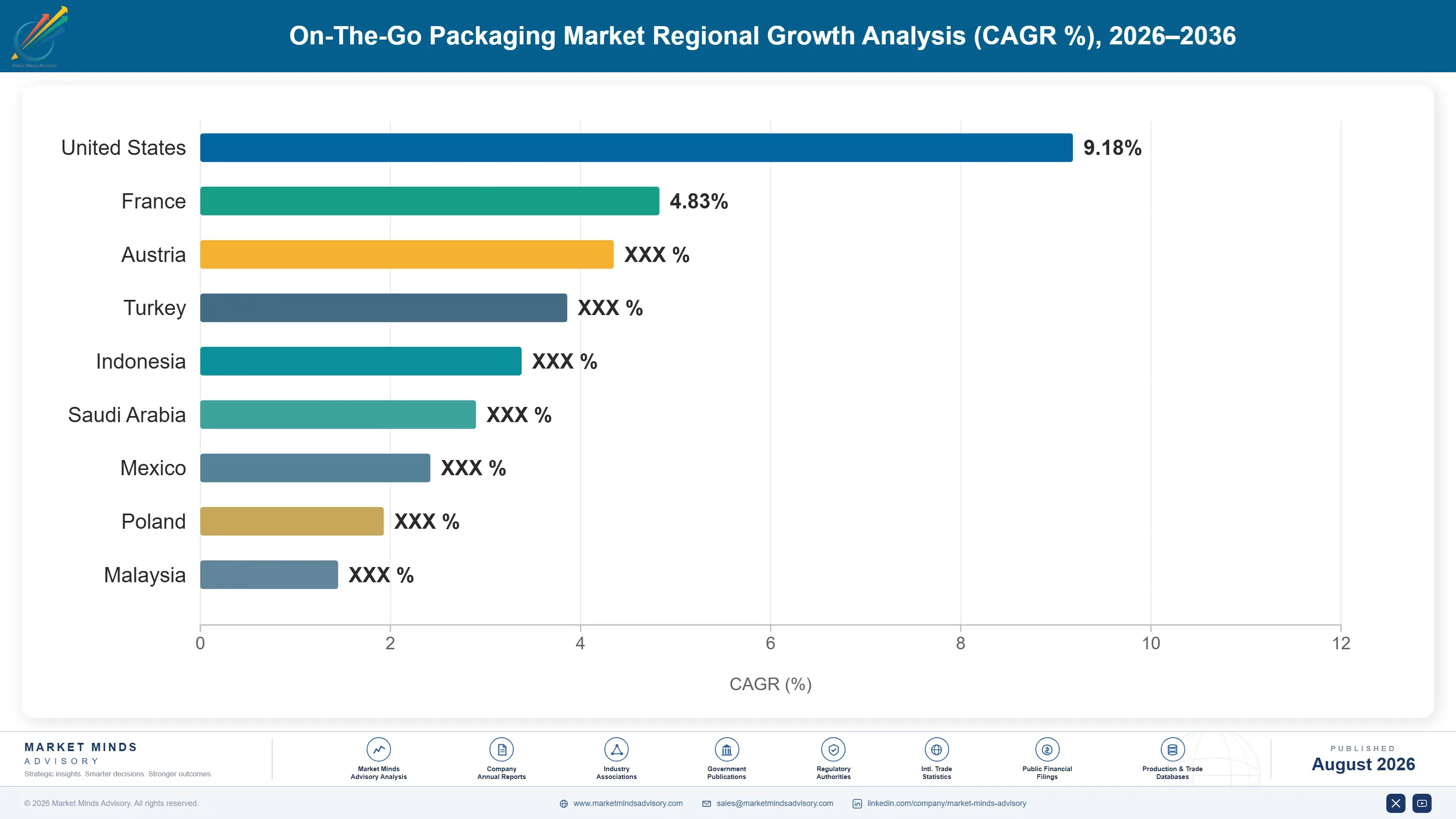
Production and packaging demand concentrate in markets with dense convenience retail and urban mobile consumption infrastructure, with East Asia leading global revenue given its scale advantage in Japan and South Korea specifically, while adoption elsewhere tracks recyclability regulation harmonization and convenience retail expansion closely across the decade.

North America

North America carries the second-largest regional share, anchored by the United States, where dense convenience store retail infrastructure and stringent state-level extended producer responsibility requirements push brand owners toward validated mono-material and spouted pouch formats faster than in most other regions globally today and consistently. Extensive beverage and food distribution infrastructure supports rapid packaging qualification for new product launches across most major metropolitan convenience retail clusters nationwide. Regulatory clearance for novel packaging formats typically arrives quickly given several states' established extended producer responsibility review pathway experience with recyclable materials specifically. Canada contributes steady incremental volume, though smaller domestic convenience retail manufacturing capacity keeps its packaging demand modest relative to the dominant United States market.
Share: 24% | CAGR: 7.9% (2026 to 2036)

Western Europe

Western Europe reflects the region's long-established convenience retail tradition and comprehensive regulatory framework under the European Union's Single-Use Plastics Directive, which has driven early and consistent adoption of mono-material recyclable packaging regulations across most member countries and manufacturing sites nationwide and reliably. Germany's large beverage manufacturing base and deep packaging engineering expertise anchor regional revenue, given the country's established flexible packaging industry dating back decades. France and the United Kingdom maintain substantial convenience retail and food manufacturing capacity that sustains steady demand for premium mono-material formats. Nordic countries maintain some of the strictest environmental packaging regulations globally, gradually pushing manufacturers there toward fully recyclable formats ahead of most regional peers.
Share: 20% | CAGR: 6.3% (2026 to 2036)
Regional intelligence for 5 additional markets available in the complete report: East Asia, South Asia and Pacific, Latin America, Middle East and Africa, Eastern Europe. Contact sales@marketmindsadvisory.com.
on-the-go-packaging-market-country-cagr-analysis-1787308002051

Mono-Material Qualification Depth and Brand Contract Reach

Manufacturer revenue growth in this market depends heavily on converting beverage and food brands into recurring validated packaging supply relationships, since switching suppliers carries meaningful requalification cost once a brand's procurement specification references a specific mono-material or barrier construction. These four levers describe where packaging revenue is concentrating fastest during this ongoing material transition.

Mono-Material Recyclability Qualification Investment Building Strategy

Winning the initial packaging qualification for a new beverage or food formulation typically locks in years of recurring packaging supply revenue, since switching suppliers requires costly formulation stability testing and requalification that brand owners rarely pursue without a compelling performance or cost reason to change vendors entirely. Manufacturers prioritizing rapid, thorough qualification support over near-term margin are capturing installed-account advantage that compounds meaningfully as formulations scale toward commercial volume over subsequent years. Repeat order rates have climbed to roughly 75 percent among leading manufacturers as formulation specification dependence deepens with each qualification cycle.
Market Impact: Repeat order rates reach roughly 75

Barrier Resin Testing Infrastructure Buildout Investment Strategy

Investing in dedicated mono-material barrier testing infrastructure accelerates how quickly a manufacturer can support new beverage customer qualification requests, since brand owners increasingly require documented barrier performance data before finalizing any new packaging specification for their formulations, regulatory submissions, and full quality systems. Manufacturers investing early in testing infrastructure build technical credibility that persists even as competing suppliers enter the market later with comparable core extrusion technology. Reducing average qualification support turnaround from thirteen weeks toward roughly 7 weeks meaningfully accelerates new customer revenue capture, directly improving competitive win rates.
Market Impact: Turnaround time falls from 13 to 7

Multi-Brand Beverage Customer Enterprise Contracting Strategy

Negotiating multi-brand global supply agreements covering every product line within a beverage or food customer's portfolio rather than site-by-site contracts lets packaging manufacturers lock in larger recurring revenue commitments while reducing the sales cost of serving many individual brands separately across a large geographic footprint worldwide. Multi-brand agreements now cover roughly 31 percent of contracted beverage accounts among leading manufacturers, up meaningfully from a smaller share three years earlier, and typically include volume-tiered pricing that rewards global standardization on a single validated supplier. Manufacturers able to guarantee consistent multi-brand supply capture a disproportionate share of this consolidating buyer segment.
Market Impact: Multi-brand agreements now cover ro

Emerging Market Convenience Retailer Partnership Strategy

Partnering with beverage and food brands in emerging convenience retail hubs ahead of competitors establishes first-mover advantage in packaging relationships, since many emerging market brands are building formulation capacity for the first time rather than replacing existing established packaging supply relationships. Manufacturers investing in local technical support and regulatory registration tailored to specific national retail authorities capture a disproportionate share of new packaging relationships as this capacity comes online. Emerging market packaging volume is growing roughly 17 percent annually, outpacing mature market growth meaningfully as convenience retail capacity expansion continues across these developing markets.
Market Impact: Emerging market volume grows roughl

Who Controls the Margin Pool

The top five manufacturers by revenue share hold roughly 32 percent combined, a moderately fragmented concentration level reflecting the many regional flexible packaging converters serving beverage and food customers across most established retail markets worldwide. Amcor and Sealed Air Corporation lead through combined validated capacity breadth and sustainability documentation depth, with a clear gap separating them from smaller regional challengers.
Current competitive activity centers on three dimensions: expanding mono-material packaging qualification and recyclability testing infrastructure, building multi-brand global supply agreements with large beverage customers, and investing in spout engineering capability across East Asian manufacturing hubs nationwide and consistently. Recyclability certification depth and spout integration increasingly separate category leaders from smaller manufacturers unable to guarantee consistent multi-brand supply commitments.

Emerging pressure comes from specialized resin compounders and regional flexible packaging specialists offering differentiated mono-material technology or faster qualification turnaround, gradually winning beverage contracts through published recyclability data despite lacking the broader commercial infrastructure of established competitors. Rankings could shift meaningfully if a challenger secures a major beverage enterprise contract, since installed-account advantage compounds quickly once a packaging format becomes embedded in a brand's procurement specification and sustainability program.
on-the-go-packaging-market-company-positioning-matrix-1787308002569

Competitive Moat and Risk Dimensions

AMCOR

Moat: Global Validated Capacity Scale

Amcor's massive global network of validated flexible packaging facilities gives it a captive advantage for multi-brand supply agreements that smaller competitors without comparable manufacturing footprint cannot replicate easily. This installed capacity advantage lets Amcor bundle new mono-material capability into existing customer contracts, reducing incremental qualification friction across thousands of beverage accounts worldwide.
AMCOR

Risk: Slower Spout Engineering Innovation Pace

Amcor's spout engineering innovation pace trails specialized dispensing technology developers who can iterate spout designs faster without the organizational complexity of a diversified global packaging portfolio, potentially ceding leadership in this fast-growing adjacent capability to nimbler, more focused dispensing competitors overall today and quite consistently.
SEALED AIR CORPORATION

Moat: Deep Beverage Brand Relationships

Sealed Air Corporation has invested heavily in flexible packaging expertise and beverage brand customer relationships spanning both standard and premium categories, giving it credibility with brand packaging teams that newer entrants without comparable relationships struggle to match quickly regardless of underlying manufacturing technical performance overall today.
SEALED AIR CORPORATION

Risk: Complex Diversified Portfolio Structure

Sealed Air Corporation's on-the-go packaging business operates within a much larger protective and food packaging organization spanning multiple product categories, potentially receiving less focused management attention and resource allocation than dedicated packaging specialist competitors who compete entirely within this narrower, faster-moving product category and specialty.

Players Tracked

Prominent Players

Amcor
Sealed Air Corporation
Sonoco Products
Constantia Flexibles
ProAmpac

Other Key Players

Berry Global
Huhtamaki
Mondi Group
Coveris
Winpak Ltd
Glenroy Inc.
Printpack Inc.
Clondalkin Group
Transcontinental Inc.
Uflex Limited
Wipak Group
Toppan Printing
Toyo Seikan Group
Nippon Paper Industries
CCL Industries

Recent Developments

MARCH 2025

Amcor Opens Mono-Material Facility in South Korea

Amcor opened a new mono-material pouch production facility in South Korea, expanding validated capacity to serve growing East Asian convenience retail and beverage packaging demand. The facility adds dedicated recyclable resin extrusion lines and testing capability, positioning Amcor to compete more directly for regional contracts overall.
Signal: Signals Amcor prioritizing regional capaci
SEPTEMBER 2024

Sealed Air Signs Multi-Brand Global Agreement

Sealed Air Corporation signed a multi-brand global supply agreement covering pouch packaging across a large beverage customer's product portfolio spanning three continents worldwide. The agreement bundles sustainability certification support and testing services, reflecting the growing importance of enterprise-wide contracts over individual brand purchasing decisions industry-wide.
Signal: Signals growing beverage customer preferen
JANUARY 2025

Sonoco Acquires Specialty Barrier Resin Compounder

Sonoco Products completed the acquisition of a smaller specialty barrier resin compounding company, adding proprietary mono-material formulation technology to strengthen its pouch platform against larger competitors. The acquisition accelerates Sonoco's material science roadmap, reducing dependence on third-party resin supplier licensing arrangements for its packaging products.
Signal: Signals continued industry consolidation a

Polyethylene Resin and Barrier Film Cost Exposure

Polyethylene and specialty barrier resin materials account for roughly 34 percent of cost of goods sold for finished on-the-go packaging, sourced primarily from specialized petrochemical resin producers in the United States, China, and South Korea, while precision extrusion energy and lamination costs account for a comparable share, sourced mainly from regional utility providers and specialized equipment makers serving multiple packaging categories.
Ethylene feedstock prices climbed meaningfully during 2022 as broader packaging demand competed with manufacturers for limited specialty resin production capacity, according to the EIA petrochemical feedstock monitoring reports and industry survey data across the sector. Several manufacturers absorbed the cost increase temporarily rather than pass costs through immediately, before adjusting packaging pricing roughly 5 percent in early 2023 to partially restore margin across affected product lines.

Smaller specialized packaging manufacturers without long-term resin supply contracts face the steepest exposure, since they typically purchase specialty barrier resin on spot markets rather than through hedged forward agreements that larger competitors like Amcor negotiate directly with producers well in advance and at scale. This gap widens further for manufacturers dependent on single-source specialty resin suppliers facing periodic allocation constraints.
on-the-go-packaging-market-cost-volatility-analysis-1787308002763

Forward Contracting With Specialty Resin Producers

Larger manufacturers negotiate annual or multi-year fixed-price agreements directly with specialty barrier resin producers, insulating a meaningful share of production cost from spot market volatility swings that smaller competitors cannot avoid or hedge against. This approach requires scale and forecasting confidence that smaller specialist manufacturers typically lack, reinforcing a durable cost advantage for established category leaders.

Dual Sourcing Across Resin Supply Regions

Qualifying resin suppliers across more than one geographic region reduces exposure to any single manufacturing disruption, shipping delay, or supplier-specific production outage affecting one supply corridor at any given time. Manufacturers pursuing dual sourcing report smoother production planning during volatile periods, avoiding sudden manufacturing delays tied to concentrated single-supplier dependence on any one source.

In-House Mono-Material Compounding Investment

Some larger manufacturers are building in-house mono-material resin compounding capacity rather than relying entirely on external petrochemical suppliers, reducing recurring material cost exposure for companies with sufficiently high and predictable production volume across their packaging product portfolio. This shift requires substantial upfront capital investment that smaller developers cannot easily justify given their more limited volume.

Portfolio Architecture for Margin Defence

Portfolio economics in this category split cleanly across three tiers defined by material recyclability, portability technology depth, and beverage customer tier rather than by any single manufacturer differentiator. Volume-tier legacy multi-layer laminate formats carry moderate margins in a mature, price-competitive segment, while premium and next-generation mono-material and spouted pouch formats command meaningfully higher gross margin as brand owners pay for validated sustainability performa
The volume-premium tension plays out most visibly between value-tier food brands, which remain price-anchored to legacy multi-layer laminate economics, and premium beverage brands, whose sustainability leadership increasingly demands the newest mono-material technology regardless of premium pricing over legacy alternatives. Manufacturers straddling both tiers manage distinct sales motions, qualification support models, and testing infrastructure investment levels for each customer segment simultaneously.

High-value margin pools concentrate in mono-material and spouted pouch bundles sold directly into high-volume premium beverage and food accounts, where brand sustainability commitments justify dedicated manufacturing capacity and recyclability validation investment. Next-generation fully compostable substrate platforms, combining sustainability performance with improved end-of-life material recovery, remain a smaller but closely watched pool as buyers increasingly value sustainability credentials over standalone packaging performance.

Volume / Commodity-Adjacent Tier

Legacy multi-layer laminate formats sold primarily to value-tier food brands and mid-volume convenience programs prioritizing proven track record and lower upfront material cost over newest-generation mono-material adoption timelines and certification investment.
Gross Margin: 23-26%

Premium / Certified Tier

Mono-material and spouted pouch formats sold to premium beverage brands and expanding food packaging programs prioritizing superior recyclability credentials, portability, and enhanced sustainability documentation for regulated on-the-go and convenience retail products.
Gross Margin: 42-45%

Sustainability / Regulatory / Next-Generation Tier

Next-generation fully compostable and bio-based substrate platforms engineered for beverage customers pursuing sustainability-aligned packaging specifications and broader environmental compliance pathways across their product portfolios, manufacturing supply chains, and procurement standards globally.
Gross Margin: 47-50%
on-the-go-packaging-market-portfolio-architecture-1787308003263

High-value Sub-segments and Strategic Watch-out

Mono-Material Consumable Bundles

Mono-material and consumable bundles sold under multi-year premium beverage brand agreements combine high growth with strong margin, as installed-account advantage and recurring formulation specification dependence let manufacturers price above legacy multi-layer laminate systems consistently across most beverage accounts and food relationships nationwide and across major regulated packaging markets.
Gross Margin: 44-47%

Spouted Pouch Platforms

Spouted pouch platforms combining portability with mono-material recyclability offer strong margin with moderate volume growth, benefiting from premium beverage quality positioning that deepens account penetration over successive contract renewal cycles and evolving sustainability standards across most developed global beverage and food packaging retail markets nationwide.
Gross Margin: 40-43%

Legacy Multi-Layer Laminate Formats

Legacy multi-layer laminate formats remain the volume core of the category, generating steady but thinning-margin revenue from value-tier food brands and mid-volume convenience programs not yet converted to mono-material formats given capital budget constraints and slower regulatory guideline adoption timelines across several developed and emerging markets.
Gross Margin: 22-25%

Fully Compostable Substrate Platforms

Fully compostable substrate platforms warrant close monitoring as sustainability specifications could reshape beverage packaging bundles quickly if a major manufacturer combines mono-material recyclability with comprehensive end-of-life material recovery capability across most beverage accounts and rapidly expanding global food packaging distribution networks worldwide and nationwide overall.
Gross Margin: 34-37%

Procurement Lock-In and Recurring Revenue

Demand in this category behaves like a procurement annuity, since winning the initial packaging qualification for a beverage or food product generates years of recurring packaging supply revenue tied directly to that product's commercial volume rather than a single packaging sale event. Supplier economics favor manufacturers who can sustain validated production capacity and sustainability documentation support over the full multi-year retail relationship lifecycle rather than those competing pur
Adoption depth varies meaningfully by vertical: premium beverage brands convert to newest-generation mono-material technology fastest given brand sustainability commitments and marketing incentives, value-tier food brands lag as capital budgets and validation capacity constrain adoption pace, and convenience retail programs increasingly cross-adopt spouted pouch formats originally developed for beverages into broader on-the-go product innovation initiatives.

A generational shift is underway as newer packaging buyers, trained during their careers on mono-material and recyclability qualification protocols, default to specifying it for new beverage programs rather than accepting whatever legacy laminate packaging their organization already validated. This preference is increasingly influencing supplier selection and retail partnership decisions as competition for validated on-the-go packaging capacity intensifies steadily across most major regulated markets.
on-the-go-packaging-market-end-use-penetration-index-1787308003751

Where Packaging Manufacturers Should Focus

These are among the four positions where our research anticipates prominent divergence between winners and laggards over the coming forecast period. Each is grounded in the demand model, the regulatory perimeter, and the announced capacity pipeline.
01 / QUALIFICATION SUPPORT PRIORITY

Prioritize brand packaging qualification support over near-term margin

Winning the initial packaging qualification for a new beverage or food product is the single clearest growth vector in this category, and manufacturers protecting near-term margin instead risk losing installed-account advantage to competitors expanding qualification support faster. Premium beverage brands and expanding food packaging programs are the buyers actually driving specification change, and they have shown strong willingness to switch suppliers for superior validated performance. Capital directed toward qualification speed and testing support will compound faster than spending preserving legacy laminate product lines indefinitely.
02 / BARRIER TESTING INFRASTRUCTURE

Build barrier testing infrastructure that accelerates customer qualification turnaround

Brand owners increasingly require documented barrier performance data before finalizing any new packaging specification, and manufacturers with the deepest testing infrastructure convert qualification requests into recurring supply revenue fastest across their installed beverage customer base. Reducing average qualification support turnaround meaningfully accelerates the revenue ramp following each new customer win, directly improving return on the testing capital investment for both supplier and brand owner. Manufacturers underinvesting in testing infrastructure will struggle increasingly to convert qualification wins into sustained supply revenue growth.
03 / MULTI-BRAND CONTRACT STRUCTURING

Build multi-brand agreements covering every product line within a beverage customer's portfolio

Beverage customers increasingly negotiate supply specifications across every product line in their global portfolio, and this concentrated buying power rewards manufacturers who can offer unified multi-brand contracts rather than treating each product line as an individual transaction. Multi-brand agreements already cover a meaningfully growing share of contracted beverage accounts among leading manufacturers, and that share is likely to keep climbing steadily as beverage company consolidation continues across most developed markets. Manufacturers without multi-brand contracting infrastructure will struggle increasingly to win these consolidating accounts.
04 / EMERGING MARKET EXPANSION

Build brand partnerships ahead of competitors entering emerging convenience retail hubs

Beverage and food brands in emerging convenience retail hubs are frequently building formulation capacity for the first time rather than replacing existing established packaging supply relationships, making partnership timing a decisive first-mover advantage for whichever manufacturer establishes relationships earliest across each national market. Manufacturers investing in local technical support and regulatory registration tailored to specific national retail authorities capture a disproportionate share of these new packaging relationships as capacity comes online. This discipline separates manufacturers building durable emerging market share from those competing only in already-mature packaging markets.

Engagement Snapshot From the Field

A live engagement with an industry participant carrying material or product regulatory and market exposure ahead of a defining policy shift, showing how our research translates into a defensible multi-year portfolio strategy.
MARKET MINDS ADVISORY · CLIENT ENGAGEMENT SUMMARY
On-The-Go Packaging Producer Strategic Portfolio Review and Transition Roadmap 2026·Investment Scenario on On-The-Go Packaging Exposure Evaluation 2025-26
CLIENT PROFILE
The client operates a mid-size premium beverage brand headquartered in South Korea, running two commercial fill lines and preparing sustainability commitments for its entire on-the-go packaging portfolio spanning roughly thirty product lines. The company had relied on legacy multi-layer laminate pouches for its entire commercial range, and leadership faced growing pressure from retail partners reporting recyclability compliance concerns.
STRATEGIC CHALLENGE
Leadership needed to evaluate whether converting to mono-material recycled-content pouches across its entire product range would justify the certification cost and packaging requalification timeline, balancing recyclability credential benefits against the risk of disrupting existing supplier relationships already firmly in place. Procurement data suggested the decision carried meaningful downstream cost implications.
MMA APPROACH
MMA conducted a competitive packaging benchmark comparing the client's pouch strategy against peer premium beverage brands within its category, combined with a certification cost analysis drawing on primary interviews with the client's procurement and sustainability teams. The analysis modeled total cost of ownership across full portfolio conversion versus a phased approach, incorporating certification timelines.
KEY FINDINGS
  1. Peer premium beverage brands within the client's category had already converted three of five comparable competing product ranges to mono-material pouches (client-reported, unverified by MMA).
  2. A phased conversion starting with the client's highest-volume commercial product line captured most recyclability credential benefit at roughly 54 percent of full portfolio capital cost.
  3. Procurement team survey responses indicated retail partner recyclability compliance concerns were creating measurable shelf-listing risk and unplanned reformulation cost across multiple retail markets consistently.
  4. Certification timelines suggested the highest-volume product line could complete mono-material pouch requalification within roughly six months given adequate testing support and early certifier engagement.
CLIENT PROFILE
The client operates a mid-size premium beverage brand headquartered in South Korea, running two commercial fill lines and preparing sustainability commitments for its entire on-the-go packaging portfolio spanning roughly thirty product lines. The company had relied on legacy multi-layer laminate pouches for its entire commercial range, and leadership faced growing pressure from retail partners reporting recyclability compliance concerns.
STRATEGIC CHALLENGE
Leadership needed to evaluate whether converting to mono-material recycled-content pouches across its entire product range would justify the certification cost and packaging requalification timeline, balancing recyclability credential benefits against the risk of disrupting existing supplier relationships already firmly in place. Procurement data suggested the decision carried meaningful downstream cost implications.
MMA APPROACH
MMA conducted a competitive packaging benchmark comparing the client's pouch strategy against peer premium beverage brands within its category, combined with a certification cost analysis drawing on primary interviews with the client's procurement and sustainability teams. The analysis modeled total cost of ownership across full portfolio conversion versus a phased approach, incorporating certification timelines.
KEY FINDINGS
  1. Peer premium beverage brands within the client's category had already converted three of five comparable competing product ranges to mono-material pouches (client-reported, unverified by MMA).
  2. A phased conversion starting with the client's highest-volume commercial product line captured most recyclability credential benefit at roughly 54 percent of full portfolio capital cost.
  3. Procurement team survey responses indicated retail partner recyclability compliance concerns were creating measurable shelf-listing risk and unplanned reformulation cost across multiple retail markets consistently.
  4. Certification timelines suggested the highest-volume product line could complete mono-material pouch requalification within roughly six months given adequate testing support and early certifier engagement.
RECOMMENDED STRATEGY
Phase 1: Phase 1 (Months 1 to 3): Begin mono-material pouch certification testing for the highest-volume product line immediately and quite thoroughly. Phase 2: Phase 2 (Months 4 to 7): Complete full certification documentation and secure formal approval for the newly converted product line. Phase 3: Phase 3 (Months 8 to 15): Evaluate portfolio-wide conversion timeline for remaining lines based on realized sustainability results overall today.
OUTCOME
The brand completed mono-material pouch conversion for its highest-volume product line within the recommended timeline, reporting a measurable improvement in retail partner recyclability acceptance and a 21 percent decrease in shelf-listing risk across converted product lines within the first year (client-reported, unverified by MMA). Leadership approved a phased plan for remaining lines based on the realized results.

Frequently Asked Questions

Foundational context covering the market sizes, CAGR, scope, country, region and competition that inform every finding below. This section is provided to cover basics and most often pre-purchase conversations, answered from the MMA Primary Research Dataset.

What is the current size of the On-The-Go Packaging Market?

The global On-The-Go Packaging Market is valued at approximately 18.5 billion dollars in 2025. This figure spans spouted pouches, single-serve cups, and portable beverage packaging worldwide.

How large will the On-The-Go Packaging Market be by 2036?

The market is projected to reach approximately 42.26 billion dollars by 2036. This represents cumulative growth driven primarily by mono-material adoption and expanding urban mobile consumption demand.

What is the CAGR for the On-The-Go Packaging Market 2026 to 2036?

The market is forecast to grow at a compound annual growth rate of 7.8 percent between 2026 and 2036. Base-case growth reflects accelerating material conversion tempered by qualification constraints.

Which segment is growing fastest?

Mono-material recycled-content formats are the fastest-growing segment, expanding at roughly 11.8 percent annually, more than 1.5 times the overall market rate. Growth is concentrated among beverage brands converting from multi-layer laminate formats.

Who are the major companies in the On-The-Go Packaging Market?

Leading companies include Amcor, Sealed Air Corporation, Sonoco Products, Constantia Flexibles, and ProAmpac. These five companies hold roughly 32 percent of global revenue share combined.

Which country is growing fastest?

India is among the fastest-growing national markets, supported by expanding organized retail and rapidly scaling urban mobile consumption investment. Growth here outpaces most other established markets meaningfully.

Report Segmentation Architecture

The full report scope spans multiple orthogonal segmentation dimensions, with cross-tabulated demand data provided for each dimension pair. Coverage extends further to regional breakdowns, trend trajectories, and the competitive detail needed to support segment-level decision-making.

By Primary Market Dimension

  • Spouted Pouches
  • Single-Serve Cups and Portion Packs
  • Resealable Stand-Up Pouches
  • On-The-Go Beverage Bottles
  • Portable Snack Sachets
  • Mono-Material Recycled-Content Formats

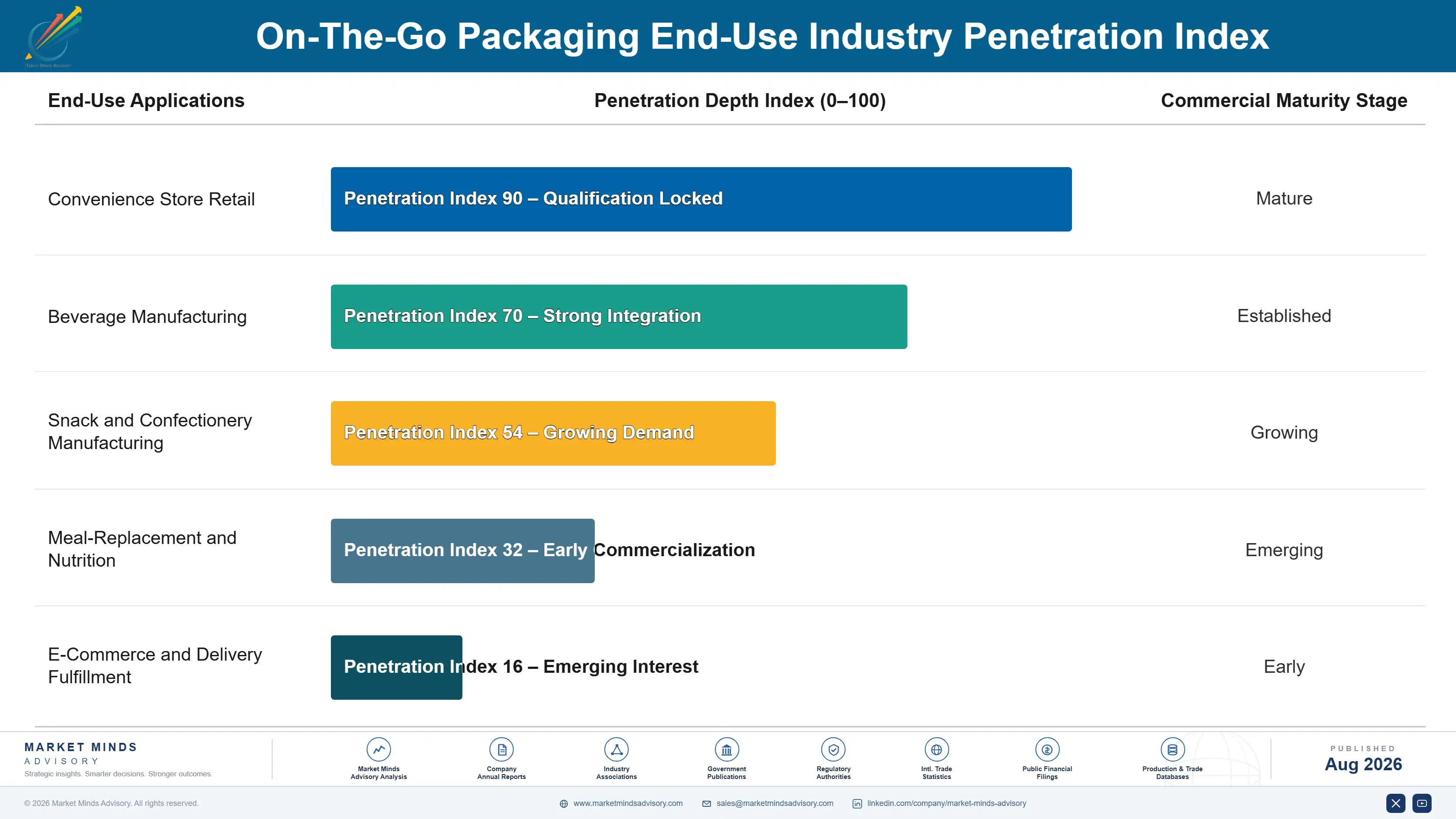
By End-Use Industry

  • Convenience Store Retail
  • Beverage Manufacturing
  • Snack and Confectionery Manufacturing
  • Meal-Replacement and Nutrition
  • E-Commerce and Delivery Fulfillment

By Commercial Dimension

  • Direct Beverage Brand Sales
  • Multi-Year Supply Contracts
  • Convenience Retail Distributor Sales
  • E-Commerce and Wholesale Channels

By Region

  • North America
  • Western Europe
  • East Asia
  • South Asia and Pacific
  • Latin America
  • Middle East and Africa
  • Eastern Europe

Scope, Methodology, and Coverage

Every figure in this report is reproducible from documented input assumptions. The scope below maps the historical period, the forecast horizon, the segmentation dimensions, and the countries covered, alongside the underlying primary and qualitative methodology.
Historical Period
2020 to 2025
Forecast Period
2026 to 2036
Base Year
2025 (USD billions; MMA Primary Research Dataset, August 2026)
Market Definition
The On-The-Go Packaging Market covers portable single-serve packaging formats including spouted pouches, single-serve cups, resealable stand-up pouches, and portable beverage bottles designed for mobile consumption. It excludes standard bulk consumer packaging, foodservice packaging, and industrial bulk containers.
Quantitative Units
USD billions (current prices); unit volume in billions of packaging units
Segmentation Dimensions
By Material Technology and Format Type; By End-Use Industry; By Commercial Dimension; By Region
Regions Covered
North America, Western Europe, East Asia, South Asia and Pacific, Latin America, Middle East and Africa, Eastern Europe
Countries Covered
USA, China, Germany, France, UK, Japan, South Korea, India, Australia, Canada, Brazil, Mexico, Indonesia, Vietnam, Thailand, Malaysia, UAE, Saudi Arabia, South Africa, Nigeria, Turkey, Poland, Netherlands, Italy, Spain, Sweden, Switzerland, Colombia, Czech Republic, Singapore, and additional markets relevant to this sector
Key Companies Profiled
Amcor, Sealed Air Corporation, Sonoco Products, Constantia Flexibles, ProAmpac, Berry Global, Huhtamaki, Mondi Group, Coveris, Winpak Ltd, Glenroy Inc., Printpack Inc., Clondalkin Group, Transcontinental Inc., Uflex Limited, Wipak Group, Toppan Printing, Toyo Seikan Group, Nippon Paper Industries, CCL Industries
Quantitative Methodology
Primary survey, n=3,800 respondents, Q4 2025, six countries; demand-side model with trade association cross-validation
Qualitative Methodology
47 expert interviews, Q4 2025; applied to validate demand model assumptions, identify emerging dynamics, and assess competitive positioning
Report Format
PDF and XLSX data workbook (Word format preview document)
Publisher
Market Minds Advisory
Report Code
MMA-2026-PAC-903
Published
August 2026
Contact
sales@marketmindsadvisory.com | www.marketmindsadvisory.com

Purchase the full On-The-Go Packaging Market Report (2026 to 2036).

This report delivers a full quantitative and qualitative assessment of the global On-The-Go Packaging Market, covering historical performance from 2020 through 2025 and forecasts through 2036 across base, bull, and bear scenarios. It profiles twenty companies spanning flexible film extrusion, lamination, and spout engineering, benchmarked on a consistent revenue basis. Regional analysis spans all seven major world regions, with detailed demand mechanisms specific to each. The report also includes segmentation analysis, input cost exposure assessment, competitive positioning, and an anonymized client case study illustrating practical packaging conversion decision-making.
Ten-year historical and forecast market sizing
Material technology segmentation with growth rates
Seven-region demand mapping and competitive benchmarking
Twenty-company competitive profiling and moat analysis
Input cost exposure and mitigation strategy assessment
Anonymized client case study and strategic verdict

Built For The People Who Decide

From boardroom strategy to bench-side execution, this report is read cover-to-cover by leaders shaping the next decade of their industry, turning demand scenarios, market dynamics and valuation benchmarks into decisions.
CXOs/ Presidents/ VPs/ Managers
M&A and Corporate Development
Strategy Teams and R&D Heads
Procurement and Product Directors
Regulatory and Compliance Leaders
Investor Relations and Equity Analysts