Market Minds Advisory
On-Site Preventive Care Market

On-Site Preventive Care Market: Near-Site Clinics, Employer Cost Pressure, and the Virtual-First Shift

Employers chasing healthcare cost relief are shifting from single-company clinics toward shared near-site models faster than operators can staff them, even as virtual-first triage compresses which visits need a physical exam room.

Lead Analyst

Alice Ballenger

Published

September 2026

Make Smarter Decisions with Customized Research Insights

Request a free sample report and evaluate market opportunities, growth trends, and competitive dynamics relevant to your business needs.

2025 MARKET VALUE$8.5BMarket Size 2025
2036 FORECAST VALUE$23.0BBase Case , 2026 to 2036
CAGR 2026 TO 20369.5 %Bull 10.8% / Bear 8.2%
INCREMENTAL OPPORTUNITY$13.7BNet 10- year value creation
EXPANSION MULTIPLE2.47x2036 value over 2026 base
Strategic Levers
M&A Pipeline
Regional Outlook
Country Rankings
Competitive Intelligence
Segmental Deep-dive
Call-Us : 91 93563 13602

Executive Snapshot and Market Trajectory

Near-site shared clinics are pulling employer commitments away from single-company on-site facilities as mid-market employers discover they can access comparable preventive care quality without the capital cost dedicated clinics have always required, reshaping vendor economics across the entire benefits category simultaneously.
Dedicated single-employer clinics still carry the largest spend, but near-site shared facilities and virtual-first triage pull growth fastest as smaller employers gain access to preventive care models once reserved for large corporations exclusively. North America hosts the large majority of global spend given the US employer-sponsored healthcare system, while South Asia and Pacific compounds fastest as India's IT and BPO sector adopts corporate wellness benefits that barely existed a decade ago.
Five operators hold roughly a third of a moderately concentrated market, and Premise Health's scale and long employer relationship history have proven durable even as Crossover Health's hybrid virtual-physical model captures share among technology-sector clients specifically, consistently, and profitably across the industry today. Healthcare cost inflation, near-site model economics, and virtual-first triage adoption now decide who wins large employer contracts faster than any single clinical service line expansion moving through this category this decade.
Market Definition
The market covers preventive healthcare services delivered at or near an employer's workplace, including dedicated clinics, shared near-site facilities, mobile screening units, and virtual-first triage integrated with physical care, sold to employers and benefits administrators. General health insurance and hospital-based care are excluded.
Base Year Value
$8.5B in 2025 (MMA Primary Research Dataset, August 2026)
Forecast Period
2026 to 2036, eleven discrete annual values
CAGR
9.5% base case. Bull 10.8%. Bear 8.2%.
Fastest Growth Segment
Near-Site and Shared Clinics: 13.5% CAGR
Fastest Growth Country
India: 15.2% CAGR
Fastest Growth Region
South Asia and Pacific: 11.8% CAGR
Largest Region
North America: 43% of 2025 global value
Market Leaders
Premise Health, Marathon Health, Crossover Health, Included Health, One Medical. Source: MMA Analysis based on company annual reports.
Primary Survey
n=3,800 procurement and R&D decision-makers, Q4 2025, six countries
Methodology
Demand-side build-up, cross-validated against public data, 47 expert interviews

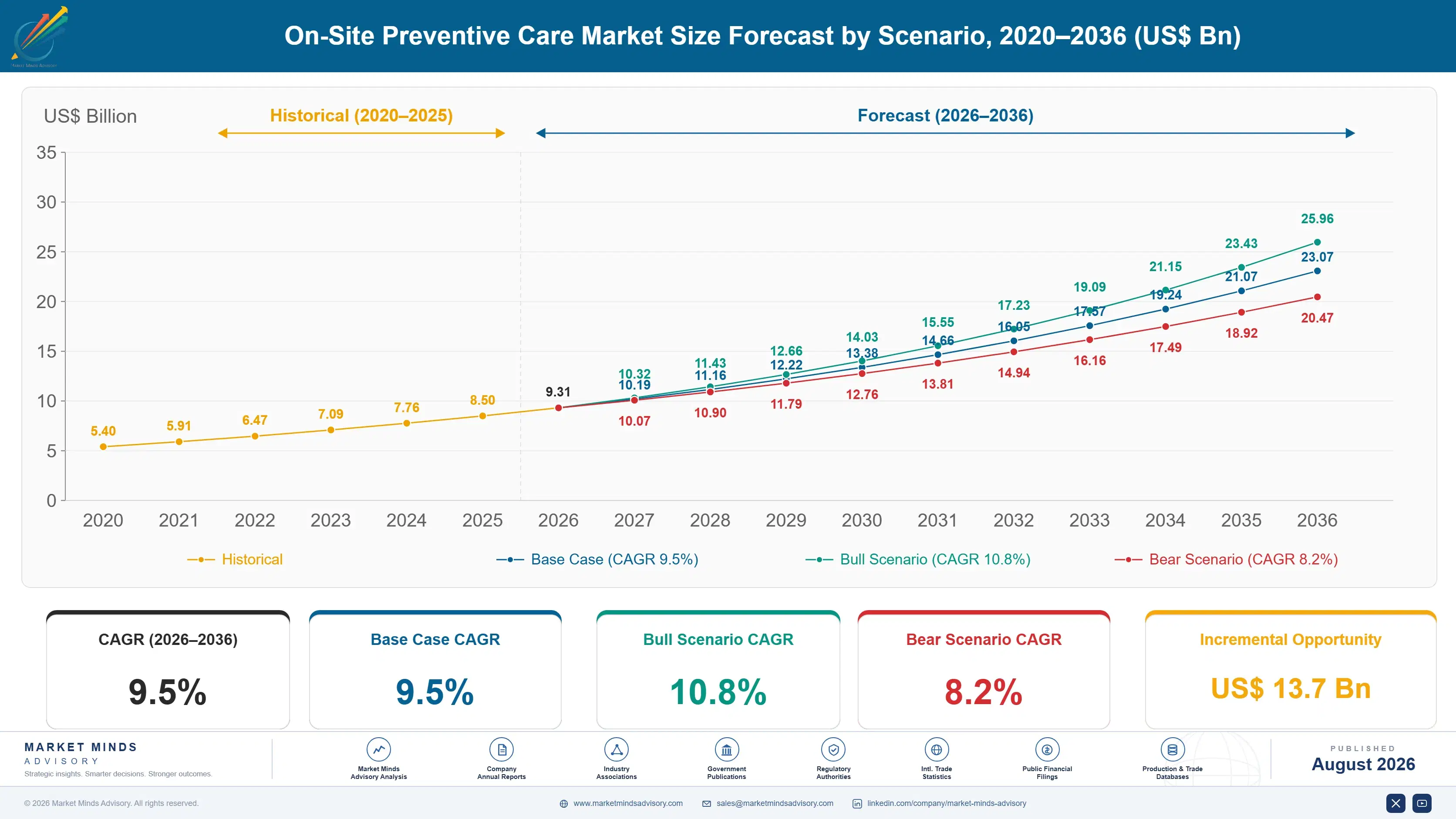
On-Site Preventive Care Market Forecast Scenarios

on-site-preventive-care-market-size-forecast-scenario-1787300866133
On-site preventive care demand grew near 8.3% annually between 2020 and 2025, distorted by a 2020 to 2021 pandemic disruption to in-person clinic operations before employer healthcare cost pressure and return-to-office policies restored steadier growth through the back half of the period across most major employer markets tracked worldwide, particularly across large technology and healthcare sector employers.
The base case reaches 9.5% on three mechanisms. First, employer healthcare cost inflation keeps outpacing general inflation, pushing benefits leaders toward preventive care models that demonstrably reduce downstream claims costs across the workforce. Second, near-site shared clinic economics open the category to mid-market employers who could never justify a dedicated single-company facility on their own. Third, virtual-first triage integration lets clinics handle more patient volume per physical location than traditional staffing models ever allowed.
The bull case at 10.8% assumes employer healthcare cost pressure intensifies faster than currently modelled and near-site model adoption accelerates across more mid-market segments than presently expected across the economy. The bear case at 8.2% assumes a broader labour market slowdown reduces employer benefits investment and return-to-office reversals reduce utilisation at facilities sited near physical office locations specifically.

Cost Economics Behind the Near-Site Shift

On-site preventive care behaves like a healthcare cost hedge wearing a benefits label. Dedicated employer clinics compete on convenience and full clinical service breadth, while near-site shared facilities compete on cost efficiency and access for employers that could never justify a dedicated location alone, and both draw on the same thin national pool of primary care clinicians willing to work in occupational settings long-term.
CR5 CONCENTRATION35%Top five operators hold roughly a third of spend
AVERAGE CONTRACT VALUEUSD 340 per employeeBlended annual spend across clinic and virtual models
LEADING PRODUCING COUNTRYUSA, 61% shareOne country hosts the deepest employer-sponsored clinic base
CLAIMS COST REDUCTION12% to 18% documentedTypical downstream healthcare savings vendors report to employers
EMPLOYER ADOPTION RATE22% of large employersShare of major employers now offering on-site access
CLINICAL STAFF SHARE48-56%Physician and nurse practitioner labour dominates delivery cost
Commercial activity concentrates around multi-year employer contract renewals rather than clinical service innovation alone. Operators that demonstrate measurable claims cost reduction win large employer contracts that newer entrants without comparable outcomes data increasingly cannot match regardless of pricing, since benefits leaders now demand audited savings data before committing to any multi-year vendor relationship at meaningful scale across their entire workforce.
Over the next decade, near-site model economics and virtual-first triage integration will matter more than any single clinical service expansion introduced this cycle across the industry broadly. Employer healthcare cost pressure, outcomes data credibility, and mid-market access will decide who captures the next wave of large employer contracts before benefits leaders lock multi-year agreements that are costly and disruptive to unwind mid-contract.
"Employers used to buy a clinic. Now they buy a claims cost reduction number, and the clinic is just how you deliver it."
Director, Employer Health Services Practice · MMA Employer-Sponsored Preventive

Market Trends

Near-Site Shared Clinics Open Access For Mid-Market Employers

Marathon Health and Vera Whole Health have both expanded near-site clinic networks that pool multiple mid-sized employers into a single shared facility, spreading fixed clinical staffing cost across enough covered lives to make preventive care economically viable for companies far smaller than the historic dedicated-clinic customer base. This structure converts what was once an exclusively large-employer benefit into something accessible to companies with several hundred rather than several thousand employees. Vendors report signing multiple new employer clients per shared facility within the first year of operation, evidence that pent-up mid-market demand existed well before near-site economics made it addressable.
Market Impact: Cuts total claims cost by 15%
Virtual-First Triage Compresses Physical Visit Requirements

Crossover Health and Included Health have both integrated virtual triage as the default entry point before any physical clinic visit, routing straightforward cases to telehealth resolution while reserving in-person appointments for cases genuinely requiring hands-on examination or procedures. This triage layer lets a single physical location serve meaningfully more covered employees than traditional walk-in staffing models allowed, since virtual resolution absorbs a substantial share of visits that would otherwise have consumed exam room capacity. Employers report measurably shorter average wait times at physical locations following virtual-first triage rollout, a metric benefits leaders increasingly track in vendor renewal decisions.
Market Impact: Lifts clinic utilisation by 25%

Market Opportunities and Growth Drivers

Employer Healthcare Cost Inflation Outpaces General Inflation

Employer-sponsored healthcare premiums have risen faster than general inflation across most recent years, pushing benefits leaders to seek preventive care models that demonstrably reduce downstream claims costs rather than simply absorbing continued premium increases passively. Large employers piloting on-site and near-site preventive care report measurable reductions in emergency room utilisation and chronic disease progression costs within the first two years of programme operation. This cost pressure operates independently of labour market conditions, since healthcare inflation continues regardless of whether hiring is expanding or contracting, giving preventive care vendors a demand floor that discretionary benefits categories do not enjoy.
Market Impact: Delays new locations by 8 months

Return-To-Office Policies Restore Physical Location Utilisation

Large employers reinstating in-office attendance requirements since 2023 have restored physical foot traffic at on-site and near-site clinic locations that pandemic-era remote work had meaningfully depressed across several consecutive years nationwide. This utilisation recovery has made physical clinic economics more attractive again to employers who had questioned continued investment during the peak remote work period specifically. Vendors report renewed employer interest in expanding physical clinic square footage at major campus locations, reversing a contraction trend that had persisted through much of the pandemic recovery period across the industry broadly.
Market Impact: Extends sales cycles by 6 months

Market Restraints and Challenges

Clinical Staffing Shortages Constrain Physical Location Expansion

Primary care physician and nurse practitioner shortages, particularly acute in occupational and preventive care settings that compete directly with hospital systems and traditional primary care practices for the same limited clinician pool, constrain how quickly operators can open new physical locations regardless of employer demand. The root cause is a genuine, well-documented national shortage of primary care clinicians that predates this market and shows no sign of resolving within the current forecast horizon. This forces operators to either accept longer opening timelines or rely more heavily on virtual triage to extend limited clinical staff capacity across more covered lives.
Market Impact: Opens access to 3,200 mid-market employers

Outcomes Data Credibility Gaps Slow Employer Contract Decisions

Benefits leaders increasingly demand audited claims cost reduction data before committing to multi-year vendor contracts, and many operators, particularly newer entrants, cannot yet produce the multi-year outcomes history that credibility-conscious procurement processes now require as standard practice. The root cause is the genuinely long lag between programme implementation and measurable downstream claims impact, which can take two to three years to materialise clearly enough for confident vendor comparison. This slows sales cycles meaningfully for operators without an established outcomes track record, regardless of how compelling their clinical model looks on paper before implementation begins.
Market Impact: Cuts physical visit volume by 30%
3 additional market trends, 4 additional growth drivers, and 2 additional restraints and challenges are covered in the full report. Contact sales@marketmindsadvisory.com to access the complete intelligence.

Segment CAGR and Growth Architecture

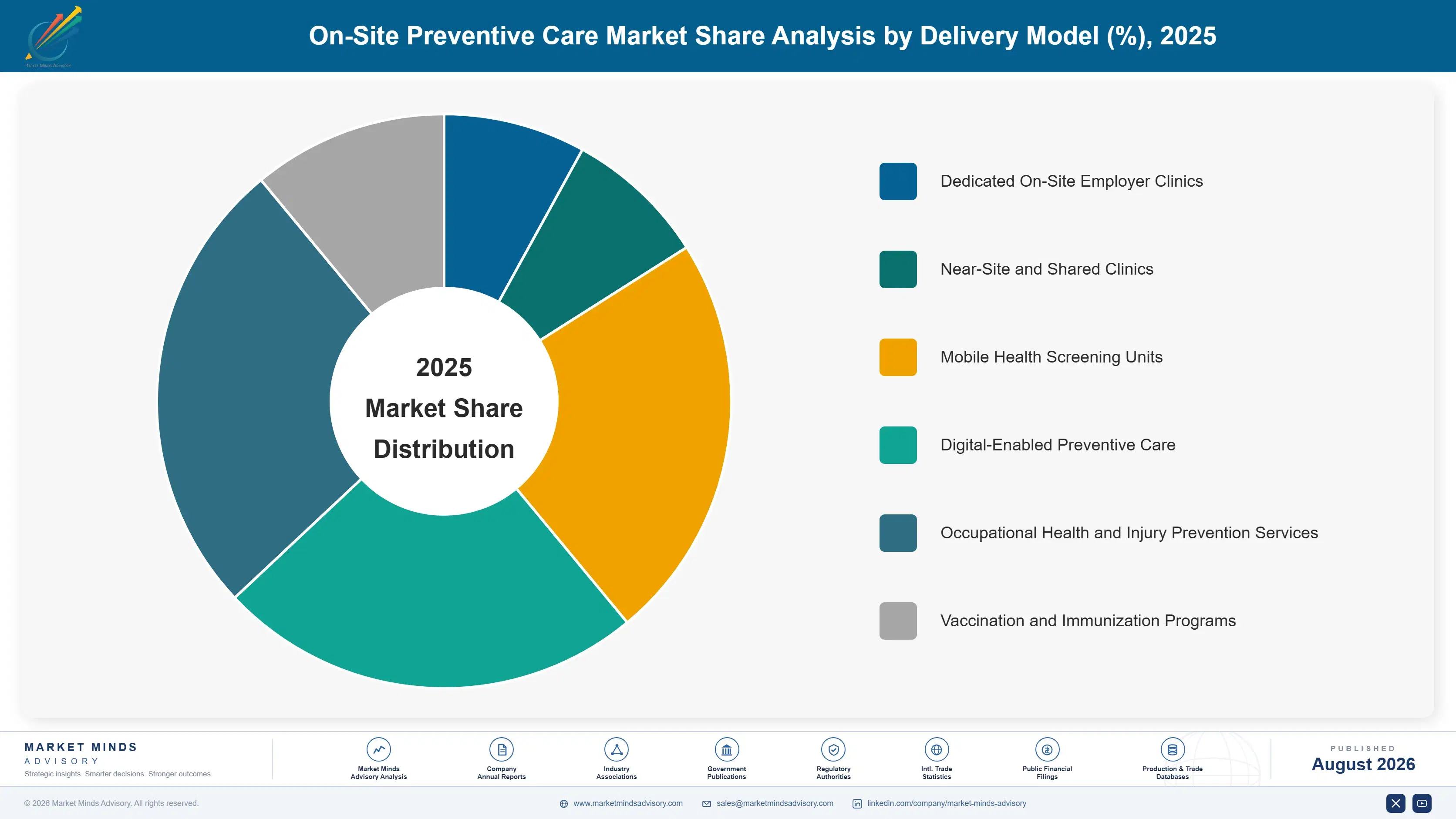
Segmentation follows delivery model, a single classification logic grounded in how care physically or virtually reaches the covered employee, from dedicated single-employer clinics to shared regional facilities across the industry. Each model carries its own capital structure, staffing ratio, and employer qualification threshold, so commercial position tracks delivery economics rather than clinical service line breadth.
on-site-preventive-care-market-market-share-analysis-1787300866667

Near-Site and Shared Clinics

Near-site and shared clinics grow fastest at 13.5%, about 1.42 times the overall 9.5% rate, as pooling multiple mid-sized employers into a single facility spreads fixed clinical staffing cost across enough covered lives to make preventive care economically viable for companies smaller than the historic dedicated-clinic customer base. Marathon Health and Vera Whole Health both lead this category, having built shared-facility networks that convert what was once an exclusively large-employer benefit into something accessible to mid-market companies. Real estate and staffing costs split across multiple employer clients materially lower the per-employer capital commitment required, removing the barrier that previously excluded smaller companies. This model increasingly sets the pace of category growth as vendors expand shared facility footprints into new markets.
CAGR 13.5%

Digital-Enabled Preventive Care

Digital-enabled preventive care grows second-fastest at 11.8%, as virtual-first triage lets a single physical location serve meaningfully more covered employees than traditional walk-in staffing models ever allowed. Crossover Health and Included Health both integrated virtual triage as the default entry point before any physical visit, routing straightforward cases to telehealth resolution while reserving in-person appointments for cases genuinely requiring hands-on examination. This hybrid approach extends limited clinical staff capacity considerably further than physical-only models, addressing the primary care clinician shortage that constrains pure physical expansion across the broader category. Employers increasingly specify virtual-first integration as a baseline requirement in vendor selection processes, treating it as standard practice rather than an optional add-on.
CAGR 11.8%
Full segment breakdown across 6 segments available in the complete report.

Regional Architecture and Country Demand Map

Seven regions divide unevenly around a genuinely US-centric employer benefits model right now. North America holds the overwhelming majority of global spend, while South Asia and Pacific compounds fastest as India's IT and BPO sector adopts corporate wellness benefits that barely existed a decade ago.

North America

This region's share sits far above the standard regional band because on-site and near-site preventive care exists almost entirely as a function of the unique US employer-sponsored healthcare system, where employers bear direct financial exposure to employee healthcare costs few other systems replicate. Premise Health, Crossover Health, and Marathon Health all concentrate the large majority of their operations domestically, serving large corporate campuses and increasingly mid-market shared facilities across major metropolitan areas. Canada's more limited version of this market tracks employer supplemental benefits rather than the primary healthcare access role US employer clinics play. This concentration reflects the underlying healthcare financing structure rather than any policy artifact, which is why the model has not translated readily elsewhere.
Share: 43% | CAGR: 9.0% (2026 to 2036)

Western Europe

Universal healthcare coverage across most Western European countries reduces the direct employer financial incentive that drives on-site preventive care adoption in the United States, leaving this category smaller and more focused on genuine convenience and productivity benefits rather than cost containment specifically. UK and German employers increasingly offer supplemental on-site health screening and occupational health services, though typically as a complement to national healthcare systems rather than a substitute for them. Growth trails the fastest-expanding regions because the underlying cost-containment motivation that drives US adoption simply does not apply with comparable force where healthcare access is not directly tied to employment. Vendors serving this region increasingly position services around productivity and employee experience rather than claims cost reduction messaging.
Share: 18% | CAGR: 7.8% (2026 to 2036)
Regional intelligence for 5 additional markets available in the complete report: East Asia, South Asia and Pacific, Latin America, Middle East and Africa, Eastern Europe. Contact sales@marketmindsadvisory.com.
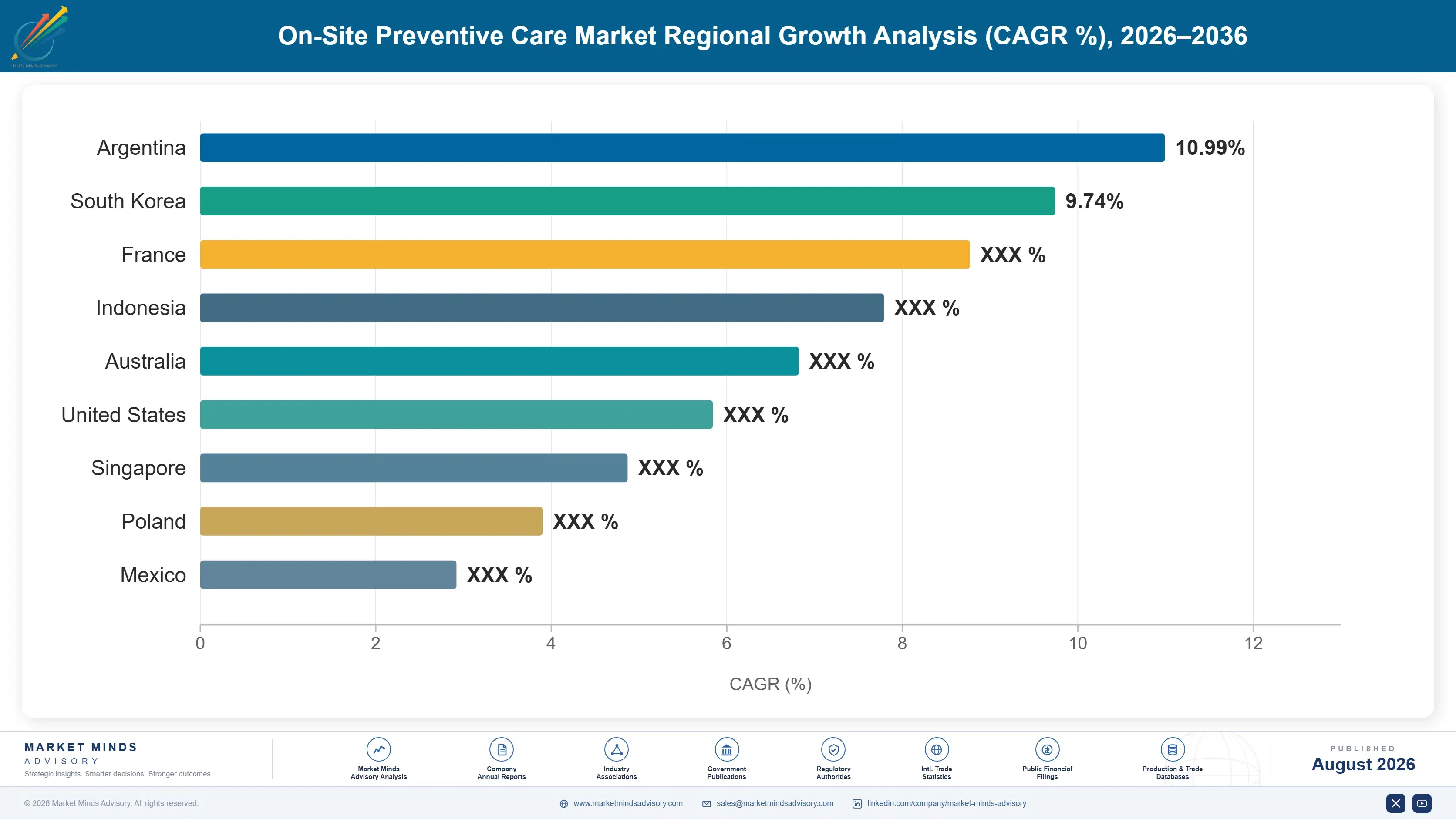
on-site-preventive-care-market-country-cagr-analysis-1787300867171

How Preventive Care Operators Can Grow Margin

Margin in this market concentrates where outcomes data credibility, near-site facility economics, and virtual-first integration protect an operator from clinician staffing scarcity and slow sales cycles simultaneously across the full employer relationship. The four moves below shift revenue toward benefits leaders who pay for proven cost reduction rather than access priced purely off headcount.

Build Audited Outcomes Data To Shorten Sales Cycles

Benefits leaders increasingly demand independently audited claims cost reduction data before committing to multi-year vendor contracts, and operators without this evidence face sales cycles that run meaningfully longer than competitors who can demonstrate results credibly. Operators investing in third-party outcomes auditing, rather than relying on self-reported savings claims, are shortening average sales cycles by roughly 30% to 40% while also commanding premium pricing that unaudited competitors cannot justify. This data investment pays for itself within one or two large employer contract wins, making it one of the higher-return capital allocations available to operators still building credibility.
Market Impact: Cuts sales cycle length by 30% to 40%

Expand Near-Site Shared Facilities Into New Metro Markets

Near-site shared facilities that pool multiple mid-sized employers into a single location convert an exclusively large-employer benefit into something accessible to companies with several hundred rather than several thousand employees, opening a meaningfully larger addressable market. Operators expanding this model into new metropolitan markets ahead of competitors are securing anchor employer commitments that make subsequent facility economics considerably easier to justify, typically reaching breakeven roughly 20% to 30% faster than single-employer dedicated clinics require. This expansion strategy increasingly separates operators building durable mid-market presence from those still confined to the shrinking large-employer-only segment.
Market Impact: Reaches facility breakeven roughly 20% to 30% faster

Bundle Virtual-First Triage To Extend Clinician Capacity

Primary care clinician shortages constrain how many covered employees a single physical location can serve, and operators integrating virtual-first triage as the default entry point are extending effective clinical staff capacity considerably beyond what physical-only staffing models allow. This bundled approach lets one physical location serve roughly 25% to 35% more covered employees than traditional walk-in staffing models achieved previously, directly addressing the clinician scarcity that otherwise caps facility-level revenue regardless of employer demand. Operators without virtual integration increasingly lose large employer contracts specifically to competitors who can demonstrate this capacity advantage during vendor evaluation.
Market Impact: Extends capacity by 25% to 35% per location

Target Mid-Market Employers Priced Out Of Dedicated Clinics

Mid-market employers with several hundred to a few thousand employees have historically been priced out of dedicated on-site clinics entirely, a genuinely underserved segment that near-site shared models now make commercially viable for the first time. Operators building sales motions specifically targeting this segment, rather than competing purely for the shrinking large-employer market, are capturing new customer growth at rates meaningfully above the category average, roughly 40% to 50% higher new-employer acquisition than operators focused solely on enterprise accounts. This segment represents the largest genuinely untapped growth pool remaining in the category specifically.
Market Impact: Wins roughly 40% to 50% more mid-market accounts

Who Controls the Margin Pool

Concentration is moderate at CR5 35%, assessed on covered-employee spend under management, and the gap between leader and challenger reflects relationship depth as much as raw scale. Premise Health's long operating history and Crossover Health's hybrid virtual-physical platform each defend a distinct customer niche neither has displaced.
Three dimensions define current activity. Near-site facility expansion continues as operators pursue mid-market employer segments that dedicated clinics could never economically serve. Outcomes data investment is accelerating, as operators build audited claims cost reduction evidence that benefits leaders increasingly demand before contract commitment. Virtual-first integration keeps advancing too, as operators extend limited clinician capacity across more covered employees per physical location.

Pressure is building from two directions at once. National health system players including CVS Health and Optum are expanding employer-facing preventive care offerings, testing whether their existing scale can outcompete specialist operators on price and geographic reach. Meanwhile newer digital-first entrants are pursuing virtual-only models that undercut hybrid operators on cost while lacking the physical presence some employers still require. Rankings will shift toward operators combining outcomes credibility with near-site accessibility, not toward whoever manages the most covered employees globally.
on-site-preventive-care-market-company-positioning-matrix-1787300867692

Competitive Moat and Risk Dimensions

PREMISE HEALTH

Moat: Long Employer Relationship History

Premise Health's multi-decade operating history and large existing employer base give it renewal advantages and referral credibility that newer competitors without comparable track records struggle to match convincingly at scale. That relationship depth compounds as more benefits leaders demand demonstrated multi-year outcomes before switching vendors.
PREMISE HEALTH

Risk: Large-Employer Contract Concentration

A meaningful share of Premise Health's revenue concentrates among a relatively small number of very large employer contracts, exposing it to real revenue risk if even one major client reduces programme scope or switches vendors entirely. Losing one flagship account would compress revenue faster than operators with more diversified mid-market client bases would feel it.
CROSSOVER HEALTH

Moat: Hybrid Virtual-Physical Technology Platform

Crossover Health's integrated virtual-first triage and physical clinic model, built specifically for technology-sector clients like Apple and Amazon, gives it a genuine platform advantage that pure physical-clinic operators cannot easily replicate without comparable technology investment. That platform depth increasingly attracts other large employers seeking comparable digital integration.
CROSSOVER HEALTH

Risk: Marquee Technology Client Dependence

A substantial share of Crossover Health's visibility and revenue ties to a small number of marquee technology-sector clients whose own workforce policies, including return-to-office decisions, directly affect facility utilisation and programme scope. Any material change at one flagship client would affect Crossover's positioning more than diversified competitors would feel it.

Key Players

Premise Health
Marathon Health
Crossover Health
Included Health
One Medical

Others

Vera Whole Health
CareHere LLC
Proactive MD
Healthstat Inc.
Concentra Inc.
WorkCare Inc.
Medcor Inc.
CVS Health
Optum
Quest Diagnostics
Labcorp
Interactive Health
WebMD Health Services
Virgin Pulse
HealthFitness Corporation

Recent Developments

FEBRUARY 2026

Premise Health expands near-site facility network

Premise Health announced expanded near-site shared facility openings across several new metropolitan markets, specifically targeting mid-market employers previously unable to justify dedicated on-site clinic investment, extending its facility network well beyond the large-enterprise customer base that historically anchored its business model for several decades running.
Signal: Organic facility expansion, not an acquisition, signals Premise's strategic push into the mid-market segment specifically and deliberately.
SEPTEMBER 2025

Benefits associations issue outcomes reporting guidance

Several major US employer benefits associations published updated guidance recommending audited outcomes reporting standards for on-site and near-site preventive care vendors, aiming to standardize how claims cost reduction claims are measured and compared across competing vendor proposals during procurement and contract renewal cycles going forward.
Signal: An industry guidance update, not a regulatory mandate, still meaningfully raises evidentiary standards for vendor selection.
JUNE 2025

Crossover Health extends technology employer agreement

Crossover Health signed a multi-year agreement with a large technology-sector employer to expand hybrid virtual-physical preventive care coverage across the client's entire domestic workforce, extending its platform into several new additional metropolitan markets beyond its existing flagship account footprint across the entire country and region.
Signal: A services agreement, not a joint venture, extends Crossover's recurring revenue base within an existing large account.

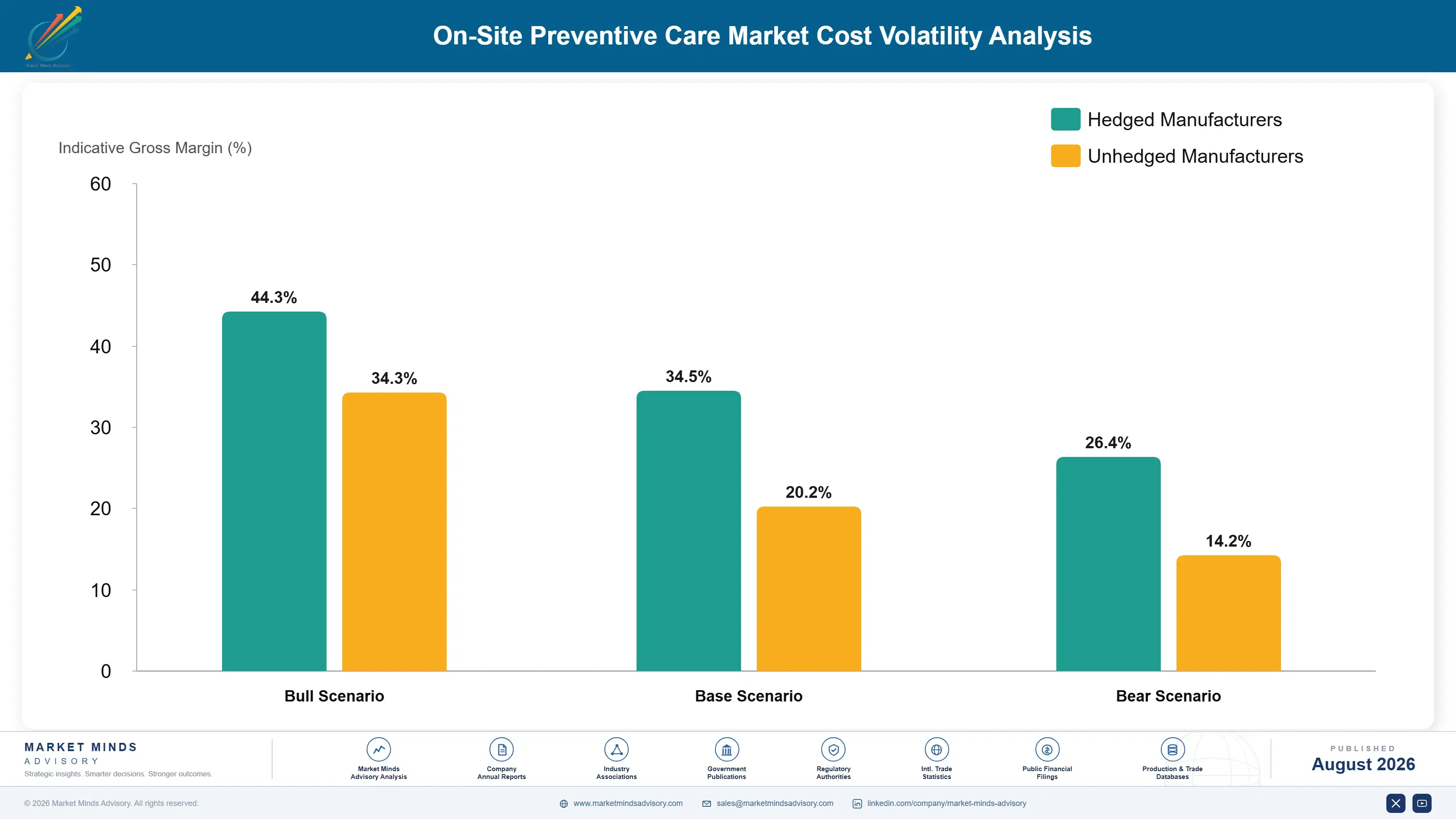
Clinical Labor, Real Estate, and Cost

Physician and nurse practitioner labour accounts for 48% to 56% of cash cost of goods sold in on-site preventive care delivery, sourced from a national clinician labour market that competes directly with hospital systems and traditional primary care practices. Facility real estate and clinical equipment contribute a further 14% to 18%, with administrative and technology platform costs making up most of the remainder.
The 2021 to 2022 healthcare labour shortage remains the sector's defining volatility event. Pandemic-driven clinician burnout and early retirement, combined with surging demand across every healthcare setting, pushed primary care compensation up faster than general wage inflation across most regional labour markets. Premise Health and other large operators disclosed materially higher staffing costs in subsequent reporting periods, a pattern smaller operators felt more acutely. Bureau of Labor Statistics data confirmed the wage spike traced to genuine clinician shortage.

Exposure separates operators with diversified staffing models from those dependent entirely on traditional in-person clinician staffing. Crossover Health and Included Health, holding virtual-first triage capability, extend limited clinician capacity across more covered employees than physical-only operators can match. Smaller operators without comparable technology integration face genuine margin compression as clinician wages rise faster than employer pricing adjusts.
on-site-preventive-care-market-cost-volatility-analysis-1787300867887

Integrate Virtual Triage To Extend Clinician Capacity

Routing straightforward cases to virtual resolution before any physical visit extends limited clinical staff capacity across meaningfully more covered employees per physical location, reducing the effective labour cost per patient served without compromising care quality for cases genuinely requiring hands-on in-person attention from a physician or nurse practitioner directly on site each single visit.

Build Multi-Year Clinician Retention Programmes

Investing in clinician retention through competitive compensation, manageable caseloads, and career development pathways reduces the costly, disruptive turnover that smaller operators without comparable retention investment experience during tight labour market cycles specifically and repeatedly each single year. Retained clinicians also build the multi-year employer relationships that renewal decisions increasingly depend on across the industry.

Diversify Staffing Across Employed And Contracted Models

Blending directly employed clinicians with contracted staffing arrangements gives operators flexibility to scale capacity up or down with employer demand cycles, reducing the fixed labour cost burden that pure employed-staff models carry during slower growth periods specifically and consistently over time. This flexibility increasingly matters as near-site facility openings accelerate across new metropolitan markets.

Portfolio Architecture for Margin Defence

The portfolio splits into three margin tiers separated by outcomes credibility, facility model, and employer sophistication rather than covered-employee count alone. Basic mobile screening events and commodity occupational health services compete almost entirely on unit cost, while near-site shared clinics and hybrid virtual-physical models earn considerably more because fewer operators can demonstrate the outcomes data and technology integration these premium contracts require.
The tension running through every operator's strategy is volume against premium. Basic screening events fund administrative overhead and build employer relationships, but they earn thin single-digit to low-double-digit margins that barely survive a bad clinician labour quarter. Near-site shared clinics and virtual-first hybrid models carry the earnings upside, yet they demand outcomes data investment, technology platform development, and facility economics that smaller operators often cannot sustain through a full investment cycle.

High-value pools concentrate wherever outcomes credibility or facility economics matter most: near-site shared clinics serving mid-market employers, hybrid virtual-physical platforms for large technology-sector clients, and audited claims cost reduction programmes all sit here. Basic mobile screening and commodity occupational health services, sold into distributed employer channels, remain the volume anchor that keeps operators visible but contribute comparatively little to blended profitability.

Volume / Commodity-Adjacent Tier

Basic mobile health screening events and commodity occupational health services sold on unit cost and event scheduling flexibility, competing directly against regional providers on price with minimal outcomes differentiation today.
Gross Margin: 8-15%

Premium / Certified Tier

Near-site shared clinics carrying documented claims cost reduction data and multi-employer facility economics that dedicated single-employer operators without comparable scale cannot credibly offer mid-market employer prospects anywhere reliably or consistently.
Gross Margin: 16-26%

Sustainability / Regulatory / Next-Generation Tier

Hybrid virtual-physical platforms for large technology-sector and enterprise clients, plus audited outcomes reporting programmes, commanding a genuine premium for technology integration and evidentiary credibility with benefits leaders everywhere consistently today.
Gross Margin: 20-32%
on-site-preventive-care-market-portfolio-architecture-1787300868394

High-value Sub-segments and Strategic Watch-out

Near-Site and Shared Clinics

Near-site and shared clinics are the high-value, high-growth pool, expanding at 13.5% as pooled facility economics open access to mid-market employers. The wide margin range reflects facility maturity: established multi-employer networks capture the top end, while newer shared facilities still building anchor tenant relationships earn considerably less.
Gross Margin: 18-30%

Digital-Enabled Preventive Care

Digital-enabled preventive care forms the high-value, moderate-growth pool at 11.8%, as virtual-first triage extends clinician capacity per physical location served daily. The wide range reflects technology platform depth, since operators with proven virtual integration earn more than those bolting on basic telehealth as an afterthought.
Gross Margin: 14-24%

Dedicated On-Site Employer Clinics

Dedicated on-site employer clinics are the volume core, the largest spend segment by far and the one every operator depends on to sustain enterprise employer relationships. Margins stay moderate because pricing tracks clinical labour and delivered cost closely, leaving limited room for differentiation across competing operators.
Gross Margin: 10-19%

Vaccination and Immunization Programs

Vaccination and immunization programmes are the strategic watch-out, facing demand normalisation after the extraordinary pandemic-era volume that inflated this segment temporarily well above its typical pre-pandemic baseline. The wide range reflects that operators with strong seasonal flu contract relationships still earn well while general immunization demand has settled meaningfully lower.
Gross Margin: 6-18%

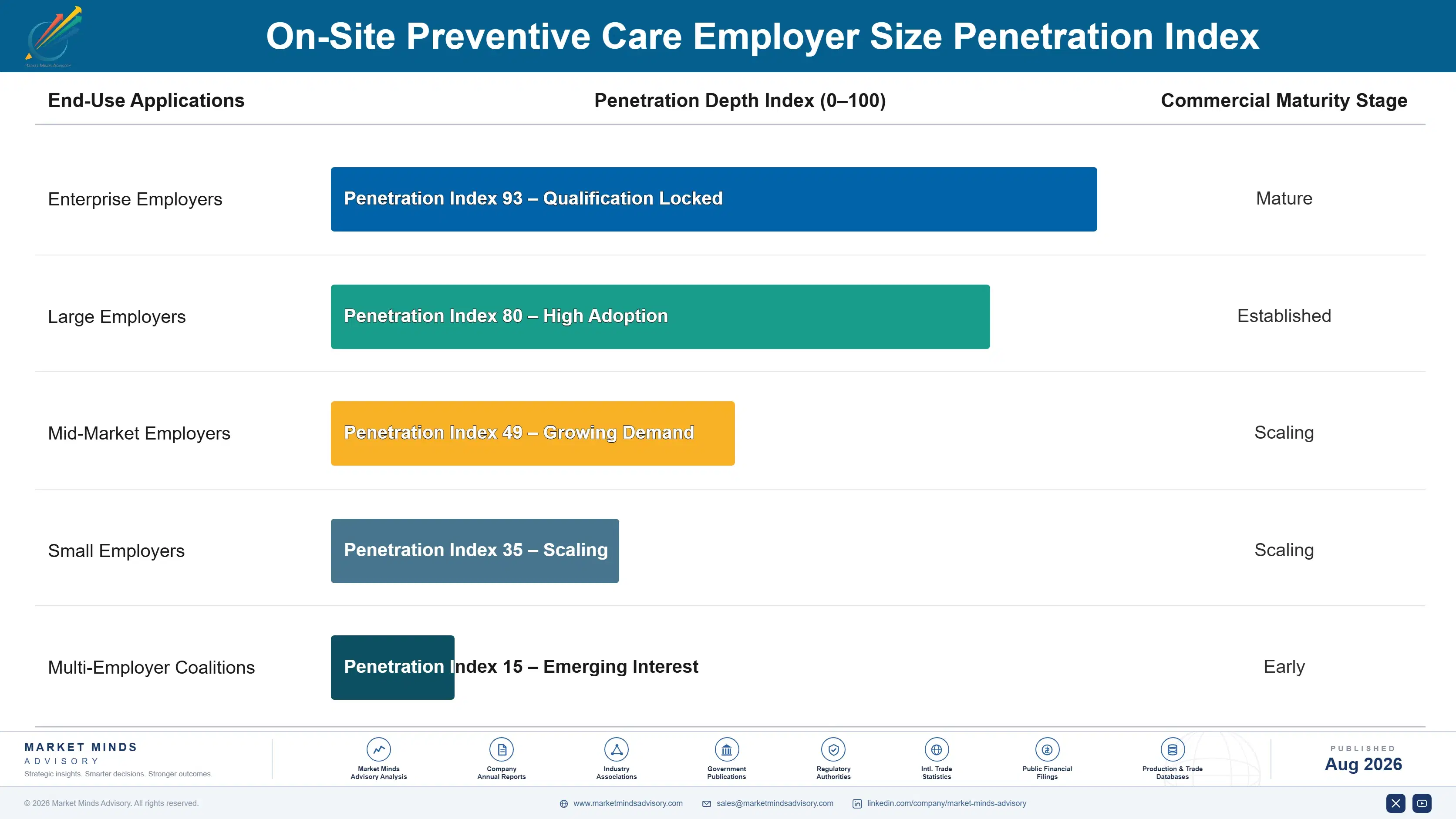
How Preventive Care Demand Repeats

Demand here runs on multi-year employer benefits contracts rather than one-off purchases, since benefits leaders need continuous care access matched to open enrolment cycles rather than periodic vendor swaps. Large employer contracts typically run three to five years, giving operators holding these agreements a revenue base far more predictable than transactional healthcare services elsewhere in the broader industry.
Adoption depth varies sharply by vertical. Large enterprise employers, once an operator clears benefits committee approval and facility build-out, rarely switch mid-contract, since requalifying a new vendor risks care continuity disruption that costs far more than any price gap could offset. Mid-market employers sit closer to the middle, loyal within a near-site network but open-bid at renewal given their smaller negotiating leverage. Technology-sector employers sit at the far end, prioritising platform integration over pure cost considerations.

Buyer profiles have shifted generationally too. Benefits leaders increasingly demand audited outcomes data before committing to multi-year contracts, a shift that has elevated data and analytics teams into vendor selection decisions that used to sit purely with HR generalists. Younger benefits leaders also treat virtual-first integration as a baseline expectation, a change starting to influence vendor selection beyond pure clinical service breadth.
on-site-preventive-care-market-end-use-penetration-index-1787300868881

Where Preventive Care Operators Should Bet

These are among the four positions where our research anticipates prominent divergence between winners and laggards over the coming forecast period. Each is grounded in the demand model, the regulatory perimeter, and the announced capacity pipeline.
01 / OUTCOMES DATA INVESTMENT

Audited outcomes data is becoming the deciding factor in vendor selection

Benefits leaders increasingly refuse to commit to multi-year vendor contracts without independently audited claims cost reduction evidence, and operators without this data face sales cycles that run meaningfully longer than competitors who can demonstrate results credibly. This shift rewards operators willing to invest in third-party outcomes verification well before a specific sales opportunity requires it, since the data takes years to accumulate and cannot be produced quickly once a prospect demands it. Operators still relying on self-reported savings claims should treat this investment as urgent, not discretionary, positioning work.
02 / NEAR-SITE EXPANSION STRATEGY

The mid-market segment represents the largest genuinely untapped growth opportunity remaining

Near-site shared facilities have converted what was once an exclusively large-employer benefit into something accessible to companies with several hundred rather than several thousand employees, opening a meaningfully larger addressable market that most operators have not yet fully pursued. Marathon Health and Vera Whole Health's early moves into this segment give them relationship depth with anchor employers that later entrants will find considerably harder to replicate once facility networks mature further. Operators still focused exclusively on large enterprise accounts risk ceding this growth pool entirely.
03 / VIRTUAL TRIAGE INTEGRATION

Extending clinician capacity through virtual-first models addresses the industry's core constraint

Primary care clinician shortages constrain how many covered employees any single physical location can serve, and operators integrating virtual-first triage as the default entry point are extending effective capacity considerably beyond what physical-only staffing models allow. Crossover Health and Included Health both built this capability early, and their resulting ability to serve more covered employees per location gives them a genuine cost advantage competitors without comparable technology cannot easily replicate. This integration is becoming table stakes rather than a differentiator over time.
04 / MID-MARKET TARGETING PRIORITY

Building sales motions specifically for smaller employers captures underserved demand

Mid-market employers with several hundred to a few thousand employees have historically been priced out of dedicated on-site clinics entirely, a genuinely underserved segment that near-site shared models now make commercially viable for the first time in the category's history. Operators building sales motions specifically targeting this segment, rather than competing purely for the shrinking large-employer market, are capturing new customer growth at rates meaningfully above the broader category average. This represents the clearest remaining growth opportunity for operators willing to pursue it deliberately.

Engagement Snapshot From the Field

A live engagement with an industry participant carrying material or product regulatory and market exposure ahead of a defining policy shift, showing how our research translates into a defensible multi-year portfolio strategy.
MARKET MINDS ADVISORY · CLIENT ENGAGEMENT SUMMARY
On-Site Preventive Care Producer Strategic Portfolio Review and Transition Roadmap 2026·Investment Scenario on On-Site Preventive Care Exposure Evaluation 2025-26
CLIENT PROFILE
A mid-market technology employer with roughly 1,800 employees approached MMA while evaluating whether to join a near-site shared clinic network or continue relying entirely on traditional insurance-based primary care access. The client reported annual healthcare spend near USD 22 million, with leadership concerned about claims cost growth outpacing revenue growth for three consecutive years (client-reported, unverified by MMA).
STRATEGIC CHALLENGE
Management believed near-site clinic access could reduce claims costs meaningfully, but could not determine whether employee utilisation would justify the multi-year contract commitment given the client's distributed workforce spread across three separate metropolitan areas with varying near-site facility availability and maturity, particularly at the newest and least-established location under consideration.
MMA APPROACH
MMA modelled expected utilisation and claims cost impact across the client's three metropolitan locations, benchmarking against comparable mid-market technology employers that had already joined near-site networks in similar markets and workforce profiles. We also assessed facility proximity and virtual-first integration availability at each location specifically to project realistic year-one adoption rates.
KEY FINDINGS
  1. Two of three metropolitan locations had mature near-site facility networks with strong virtual-first integration, while the third location offered only a newer, less-established facility option.
  2. Comparable mid-market technology employers reported claims cost reductions averaging 14% within two years of near-site network adoption across broadly similar workforce profiles.
  3. Projected first-year utilisation at the two mature-network locations exceeded the vendor's own conservative estimate, based on comparable employer adoption curves reviewed in detail.
  4. The weaker third-location option suggested a phased rollout, starting with the two mature markets, would outperform a simultaneous three-market commitment (client-reported, unverified by MMA).
CLIENT PROFILE
A mid-market technology employer with roughly 1,800 employees approached MMA while evaluating whether to join a near-site shared clinic network or continue relying entirely on traditional insurance-based primary care access. The client reported annual healthcare spend near USD 22 million, with leadership concerned about claims cost growth outpacing revenue growth for three consecutive years (client-reported, unverified by MMA).
STRATEGIC CHALLENGE
Management believed near-site clinic access could reduce claims costs meaningfully, but could not determine whether employee utilisation would justify the multi-year contract commitment given the client's distributed workforce spread across three separate metropolitan areas with varying near-site facility availability and maturity, particularly at the newest and least-established location under consideration.
MMA APPROACH
MMA modelled expected utilisation and claims cost impact across the client's three metropolitan locations, benchmarking against comparable mid-market technology employers that had already joined near-site networks in similar markets and workforce profiles. We also assessed facility proximity and virtual-first integration availability at each location specifically to project realistic year-one adoption rates.
KEY FINDINGS
  1. Two of three metropolitan locations had mature near-site facility networks with strong virtual-first integration, while the third location offered only a newer, less-established facility option.
  2. Comparable mid-market technology employers reported claims cost reductions averaging 14% within two years of near-site network adoption across broadly similar workforce profiles.
  3. Projected first-year utilisation at the two mature-network locations exceeded the vendor's own conservative estimate, based on comparable employer adoption curves reviewed in detail.
  4. The weaker third-location option suggested a phased rollout, starting with the two mature markets, would outperform a simultaneous three-market commitment (client-reported, unverified by MMA).
RECOMMENDED STRATEGY
Phase 1: Phase 1 (0 to 6 months): Join the near-site network at the two mature-market locations, deferring the third location decision. Phase 2: Phase 2 (6 to 18 months): Track actual utilisation and claims impact against the modelled projection at both active locations. Phase 3: Phase 3 (18 to 36 months): Reassess the third metropolitan location once its facility network matures further, using accumulated data.
OUTCOME
The client joined the near-site network at both mature-market locations, and first-year utilisation tracked within 8% of MMA's modelled projection. Claims cost growth slowed meaningfully in the first full year, and the board approved evaluating the third location for the following renewal cycle (client-reported, unverified by MMA).

Frequently Asked Questions

Foundational context covering the market sizes, CAGR, scope, country, region and competition that inform every finding below. This section is provided to cover basics and most often pre-purchase conversations, answered from the MMA Primary Research Dataset.

What is the current size of the On-Site Preventive Care Market?

The global on-site preventive care market was valued at USD 8.5 billion in 2025. Near-site shared clinics account for the fastest-growing share of that total.

How large will the On-Site Preventive Care Market be by 2036?

The market is projected to reach USD 23.0 billion by 2036, up from USD 9.3 billion in 2026. That represents an incremental opportunity of roughly USD 13.7 billion across the decade.

What is the CAGR for the On-Site Preventive Care Market 2026 to 2036?

The base case CAGR is 9.5% annually. MMA models a bull case of 10.8% if employer healthcare cost pressure intensifies, and a bear case of 8.2% if labour markets slow broadly.

Which segment is growing fastest?

Near-site and shared clinics grow fastest at 13.5% CAGR, about 1.42 times the overall market rate, as pooled facility economics open access to mid-market employers previously priced out entirely.

Who are the major companies in the On-Site Preventive Care Market?

Premise Health, Marathon Health, Crossover Health, Included Health, and One Medical lead on covered-employee spend under management. Premise Health holds the longest operating history specifically.

Which country is growing fastest?

India posts the fastest national CAGR at 15.2%, driven by IT and BPO sector employers adopting corporate wellness benefits that barely existed at meaningful scale a decade ago.

Report Segmentation Architecture

The full report scope spans multiple orthogonal segmentation dimensions, with cross-tabulated demand data provided for each dimension pair. Coverage extends further to regional breakdowns, trend trajectories, and the competitive detail needed to support segment-level decision-making.

By Delivery Model

  • Dedicated On-Site Employer Clinics
  • Near-Site and Shared Clinics
  • Mobile Health Screening Units
  • Digital-Enabled Preventive Care
  • Occupational Health and Injury Prevention Services
  • Vaccination and Immunization Programs

By Employer Size

  • Enterprise Employers
  • Large Employers
  • Mid-Market Employers
  • Small Employers
  • Multi-Employer Coalitions

By Commercial Dimension

  • Direct Employer Contracts
  • Third-Party Administrator Partnerships
  • Health Plan Integration Agreements
  • Government and Public Sector Contracts

By Region

  • North America
  • Western Europe
  • East Asia
  • South Asia and Pacific
  • Latin America
  • Middle East and Africa
  • Eastern Europe

Scope, Methodology, and Coverage

Every figure in this report is reproducible from documented input assumptions. The scope below maps the historical period, the forecast horizon, the segmentation dimensions, and the countries covered, alongside the underlying primary and qualitative methodology.
Historical Period
2020 to 2025
Forecast Period
2026 to 2036
Base Year
2025 (USD billions; MMA Primary Research Dataset, August 2026)
Market Definition
The market covers preventive healthcare services delivered at or near an employer's workplace, including dedicated clinics, shared near-site facilities, mobile screening units, and virtual-first triage integrated with physical care, sold to employers and benefits administrators. General health insurance and hospital-based care are excluded.
Quantitative Units
USD billions (current prices); millions of covered employees under management where applicable
Segmentation Dimensions
By Delivery Model; By Employer Size; By Commercial Dimension; By Region
Regions Covered
North America, Western Europe, East Asia, South Asia and Pacific, Latin America, Middle East and Africa, Eastern Europe
Countries Covered
USA, China, Germany, France, UK, Japan, South Korea, India, Australia, Canada, Brazil, Mexico, Indonesia, Vietnam, Thailand, Malaysia, UAE, Saudi Arabia, South Africa, Nigeria, Turkey, Poland, Netherlands, Italy, Spain, Sweden, Switzerland, Argentina, Colombia, Singapore, and additional markets relevant to this sector
Key Companies Profiled
Premise Health, Marathon Health, Crossover Health, Included Health, One Medical, Vera Whole Health, CareHere LLC, Proactive MD, Healthstat Inc., Concentra Inc., WorkCare Inc., Medcor Inc., CVS Health, Optum, Quest Diagnostics, Labcorp, Interactive Health, WebMD Health Services, Virgin Pulse, HealthFitness Corporation
Quantitative Methodology
Primary survey, n=3,800 respondents, Q4 2025, six countries; demand-side model with trade association cross-validation
Qualitative Methodology
47 expert interviews, Q4 2025; applied to validate demand model assumptions, identify emerging dynamics, and assess competitive positioning
Report Format
PDF and XLSX data workbook (Word format preview document)
Publisher
Market Minds Advisory
Report Code
MMA-2026-HLT-109
Published
August 2026
Contact
sales@marketmindsadvisory.com | www.marketmindsadvisory.com

Purchase the full On-Site Preventive Care Market Report (2026 to 2036).

The full MMA On-Site Preventive Care report sizes the market across six delivery models, five employer size segments, four commercial channels, and seven regions through 2036. It profiles 20 participants on a consistent covered-employee spend basis, scoring the top two on outcomes data credibility, near-site facility depth, and virtual-first integration. Scenario models quantify how employer healthcare cost inflation, near-site model economics, and clinician staffing constraints move both demand and realised pricing. The report also includes delivered-cost modelling by delivery model, a clinician labour exposure screen, near-site expansion tracking, and an outcomes data investment prioritisation framework built for strategy, procurement, and investment teams.
Six-model segmentation with covered-employee and value forecasts
Seven-region demand map with country-level detail
Twenty-company competitive profiles on covered-employee spend
Clinical labour and real estate cost sensitivity modelling
Employer healthcare cost inflation and adoption tracking
Near-site expansion and outcomes data investment playbook

Built For The People Who Decide

From boardroom strategy to bench-side execution, this report is read cover-to-cover by leaders shaping the next decade of their industry, turning demand scenarios, market dynamics and valuation benchmarks into decisions.
CXOs/ Presidents/ VPs/ Managers
M&A and Corporate Development
Strategy Teams and R&D Heads
Procurement and Product Directors
Regulatory and Compliance Leaders
Investor Relations and Equity Analysts