Market Minds Advisory
On-shelf Availability Solution Market

On-shelf Availability Solution Market: On-Shelf Availability Solution Market. Computer Vision Reshapes Retail Out-of-Stock Detection

Retailers losing billions to phantom inventory and out-of-stock shelves while computer vision hardware costs keep falling are colliding as shelf monitoring platforms scale fast enough to replace manual store walks across large-format retail chains.

Lead Analyst

Published

September 2026

Make Smarter Decisions with Customized Research Insights

Request a free sample report and evaluate market opportunities, growth trends, and competitive dynamics relevant to your business needs.

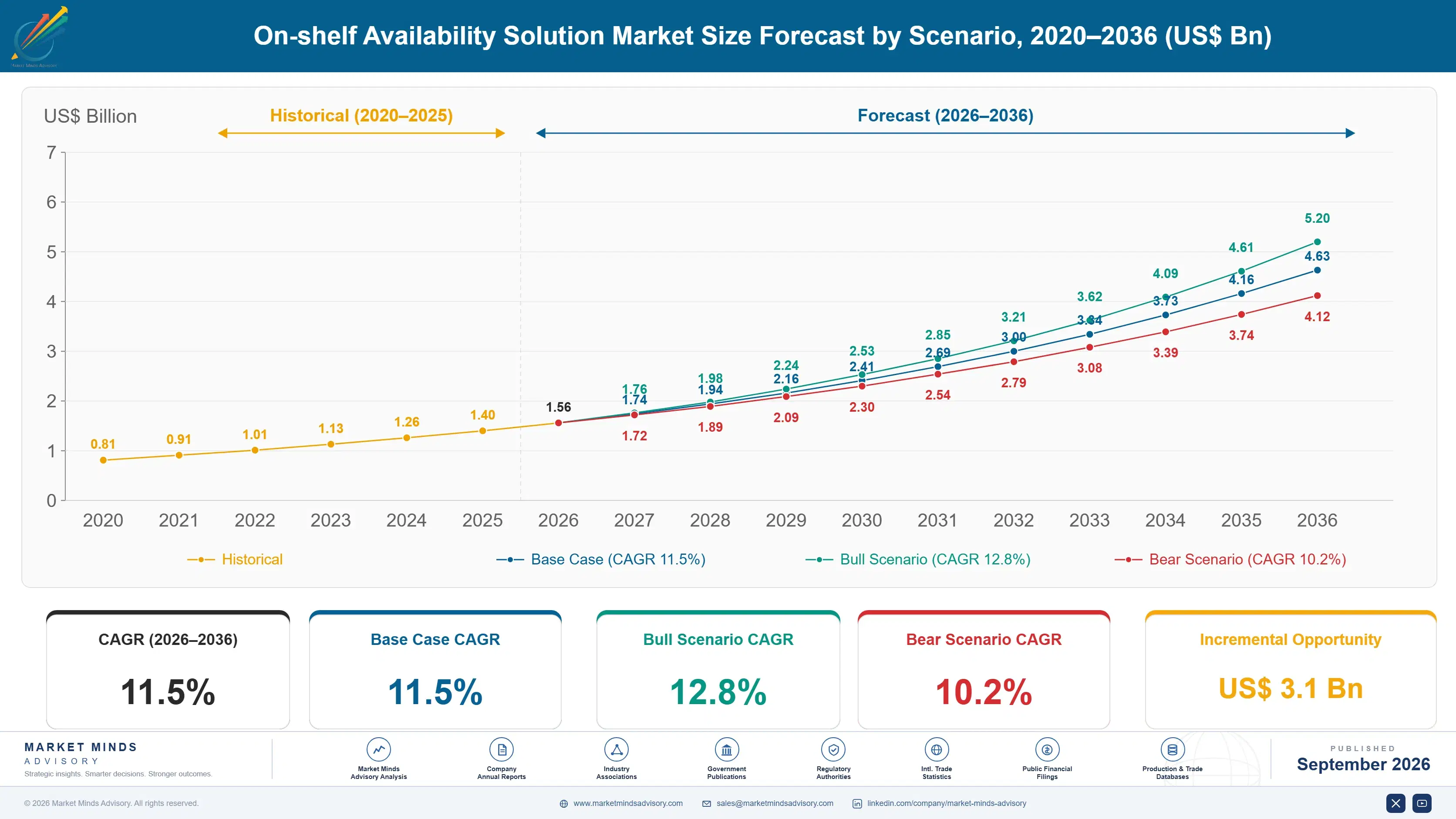
2025 MARKET VALUE$1.4BMarket Size 2025
2036 FORECAST VALUE$4.6BBase Case , 2026 to 2036
CAGR 2026 TO 203611.5 %Bull 12.8% / Bear 10.2%
INCREMENTAL OPPORTUNITY$3.1BNet 10- year value creation
EXPANSION MULTIPLE2.97x2036 value over 2026 base
Strategic Levers
M&A Pipeline
Regional Outlook
Country Rankings
Competitive Intelligence
Segmental Deep-dive
Call-Us : 91 93563 13602

Executive Snapshot and Market Trajectory.

Retailers are replacing manual store walks with computer vision cameras and shelf-scanning robots that detect empty shelf space in real time, addressing out-of-stock losses that manual audits catch only hours or days after the fact. This shift is reshaping store operations staffing and technology procurement priorities across large-format retail chains.
Falling computer vision hardware costs are pulling shelf monitoring out of pilot programs and into mainstream large-format retail deployment as chains seek to recover lost sales from phantom inventory, and South Asian grocery chains are adopting these platforms fastest given rapidly expanding organized retail footprints. Consumer packaged goods manufacturers are separately driving demand as they seek independent shelf compliance verification data beyond what retailers self-report through point-of-sale systems.
A fragmented vendor landscape still includes retail analytics platforms treating shelf monitoring as an add-on module, but specialist computer vision robotics vendors are entering directly from the warehouse automation side rather than the retail software side, changing who counts as a credible competitor. Integration requirements connecting shelf imagery to inventory management systems are forcing vendors to navigate a genuinely more complex technical landscape. Vendors combining both robotics and software integration increasingly win the largest contracts.
Market Definition
This report covers software and hardware platforms that monitor retail shelf inventory levels using computer vision, robotics, or sensor technology to detect and alert on out-of-stock and misplaced product conditions, measured on a global revenue basis. It excludes general retail point-of-sale systems and warehouse inventory management software not centered on in-store shelf visibility.
Base Year Value
$1.4B in 2025 (MMA Primary Research Dataset, September 2026)
Forecast Period
2026 to 2036, eleven discrete annual values
CAGR
11.5% base case. Bull 12.8%. Bear 10.2%.
Fastest Growth Segment
Computer Vision Shelf Monitoring Robots and Cameras: 16.0% CAGR
Fastest Growth Country
India: 16.5% CAGR
Fastest Growth Region
South Asia and Pacific: 13.8% CAGR
Largest Region
North America: 32% of 2025 global value
Market Leaders
Simbe Robotics, Trax Retail, Focal Systems, AiFi, Zippin
Primary Survey
n=3,800 procurement and R&D decision-makers, Q4 2025, six countries
Methodology
Demand-side build-up, cross-validated against public data, 47 expert interviews

On-shelf Availability Solution Market Forecast Scenarios

on-shelf-availability-solution-market-size-forecast-scenario-1788419090175
Between 2020 and 2025 the on-shelf availability solution market grew at roughly 10.3 percent annually as pandemic-era supply chain disruption made out-of-stock detection a visible, board-level concern for major retailers for the first time. Growth accelerated once computer vision hardware costs fell enough to make continuous shelf monitoring economically viable across full store fleets rather than pilot locations alone.
The base case assumes continued steady expansion as three commercial mechanisms compound: retailers extend shelf monitoring coverage from grocery pilot programs to general merchandise and pharmacy store formats, consumer packaged goods manufacturers fund shelf compliance verification programs that subsidize retailer adoption costs, and computer vision accuracy improves enough to reliably detect misplaced and low-stock conditions beyond simple empty-shelf detection. Vendors respond by building dedicated retail computer vision research teams rather than adapting warehouse robotics technology as a secondary use case.
The bull case centers on major consumer packaged goods manufacturers making shelf compliance verification a standard supply agreement requirement, accelerating retailer adoption across their entire supplier base. The bear case centers on retailer capital expenditure constraints during a broader economic slowdown, delaying planned technology rollouts and extending reliance on manual store walk processes well beyond their intended replacement timeline.

Shelf Monitoring Becomes Continuous Visibility

Shelf monitoring vendors are no longer selling a photo-capture camera, they are selling continuous inventory visibility, and that shift is rewriting who counts as a credible supplier to a large retail chain. A vendor without genuine computer vision detection capability cannot win a contract that now requires real-time out-of-stock alerts rather than periodic manual audits.
MARKET CONCENTRATION38% CR5Top five vendors hold a modest share of platform revenue
AVERAGE STORE DEPLOYMENT COST$25,000 per store locationCost varies widely based on store size and camera density
TOP ADOPTION COUNTRY SHAREUnited States, 34% of platform revenueSingle country accounts for largest share of platform subscription spending
COMPUTER VISION PENETRATION42% of new deploymentsShare of new implementations using computer vision technology
OUT-OF-STOCK REDUCTION IMPACT35% fewer stockout incidentsReported decline in stockout incidents among stores using monitoring platforms
AVERAGE CONTRACT LENGTHThree years per retail dealTypical duration of an on-shelf availability platform service agreement
Vendors that historically sold manual audit scheduling software are being squeezed out unless they build genuine computer vision detection capability, since retailers increasingly demand real-time alerts rather than periodic manual walk reports. Several smaller vendors have already exited direct enterprise sales entirely, choosing instead to license their scheduling software wholesale to larger platforms that already own the customer relationship.
Warehouse robotics companies are moving directly into retail floor monitoring, competing with traditional retail analytics vendors who never built computer vision hardware, creating a market where neither pure software nor pure hardware positioning is defensible alone anymore. Retail chains increasingly evaluate vendors on detection accuracy and alert latency almost as closely as software integration depth, a criterion that barely mattered in procurement decisions a decade ago when scheduled manual walks were considered sufficient.
"A store manager doing a walk twice a day finds out about an empty shelf hours after the sale was already lost. The walk was never the solution, it was the delay."
Practice Lead, Retail Technology · MMA Retail Technology and Inventory Visibility Software Practice · September 2026

Market Trends

Consumer Packaged Goods Manufacturers Fund Shelf Verification

Major consumer packaged goods manufacturers are increasingly funding shelf compliance verification programs directly, subsidizing retailer adoption costs in exchange for independent data proving their products are properly stocked and displayed according to negotiated planogram agreements. Over 30 major manufacturers now sponsor shelf monitoring pilot programs at partner retail chains, a scale that has grown considerably from a handful of early experiments just a few years ago. This funding dynamic is accelerating retailer adoption timelines beyond what retailers would independently justify based purely on their own lost-sales calculations. Retailers increasingly negotiate this funding into supplier agreements as a standard program term.
Market Impact: Losses reach 130 billion dollars annually
Autonomous Shelf-Scanning Robots Enter Mainstream Retail Deployment

Autonomous robots that navigate store aisles overnight to capture shelf imagery are moving from pilot deployments into mainstream large-format retail rollout, offering continuous coverage without requiring dedicated camera infrastructure installed throughout every aisle. Robot-based shelf scanning deployments have grown past 5,000 active units across major retail chains, up sharply from a small pilot fleet just several years earlier. This deployment scale is validating the robotics approach as commercially viable at scale rather than merely an experimental technology demonstration. Vendors offering robotics-as-a-service leasing models are winning contracts from chains hesitant to purchase hardware outright.
Market Impact: Camera costs fell over 50 percent

Market Opportunities and Growth Drivers

Rising Out-of-Stock Losses Justify Technology Investment

Global retail out-of-stock losses continue mounting as supply chain volatility and inventory management complexity increase, creating a direct financial justification for shelf monitoring technology investment that was harder to make when losses remained less visible. Retailers lose an estimated 130 billion dollars annually worldwide to out-of-stock incidents, a figure large enough to justify meaningful technology budget even at modest detection and prevention effectiveness rates. This scale of quantified loss is pulling shelf monitoring budget approval processes above the threshold that previously required extended internal justification. Retail finance teams increasingly model expected return before proposing pilot programs to store operations leadership.
Market Impact: Adds 20 to 30 percent cost

Falling Camera and Sensor Costs Expand Addressable Store Base

The cost of computer vision cameras and edge processing hardware suitable for retail shelf monitoring has fallen considerably over the past several years, expanding the addressable store base beyond flagship locations that could previously justify the capital cost. Camera hardware costs have fallen by more than 50 percent over the past five years, crossing the threshold where mid-size and smaller format stores can economically justify deployment rather than reserving the technology for only the highest-volume flagship locations. This cost decline is accelerating full-fleet rollout timelines across retail chains that previously limited deployment to pilot stores.
Market Impact: Integration takes 4 to 6 months

Market Restraints and Challenges

High Deployment Cost Slows Smaller Retailer Adoption

Comprehensive camera or robotics deployment across a full store fleet requires substantial upfront capital investment that smaller regional retail chains with limited budgets struggle to justify against uncertain return timelines. The root cause is that shelf monitoring technology still requires meaningful per-store hardware investment despite falling unit costs, unlike pure software solutions that scale without proportional hardware spending. This forces many smaller retailers to delay adoption or limit deployment to only their highest-volume flagship locations. Vendors are mitigating this by offering hardware leasing and phased rollout programs that spread capital cost over multiple years instead of requiring upfront purchase.
Market Impact: Over 30 manufacturers now sponsor programs

Integration Complexity With Legacy Inventory Systems

Large retailers running legacy inventory management systems built years before computer vision technology existed face genuine integration complexity connecting shelf-level detection data to core inventory and replenishment workflows. The underlying cause is that many retail inventory systems were designed around periodic batch updates rather than the real-time data streams that shelf monitoring platforms generate continuously. This forces vendors to build custom integration layers for each retailer's legacy system configuration, adding engineering cost smaller vendors struggle to sustain. Vendors mitigate this by developing standardized middleware that translates real-time detection data into formats legacy systems can already process.
Market Impact: Over 5,000 robots now deployed
3 additional market trends, 4 additional growth drivers, and 3 additional restraints and challenges are covered in the full report. Contact sales@marketmindsadvisory.com to access the complete intelligence.

Segment CAGR and Growth Architecture

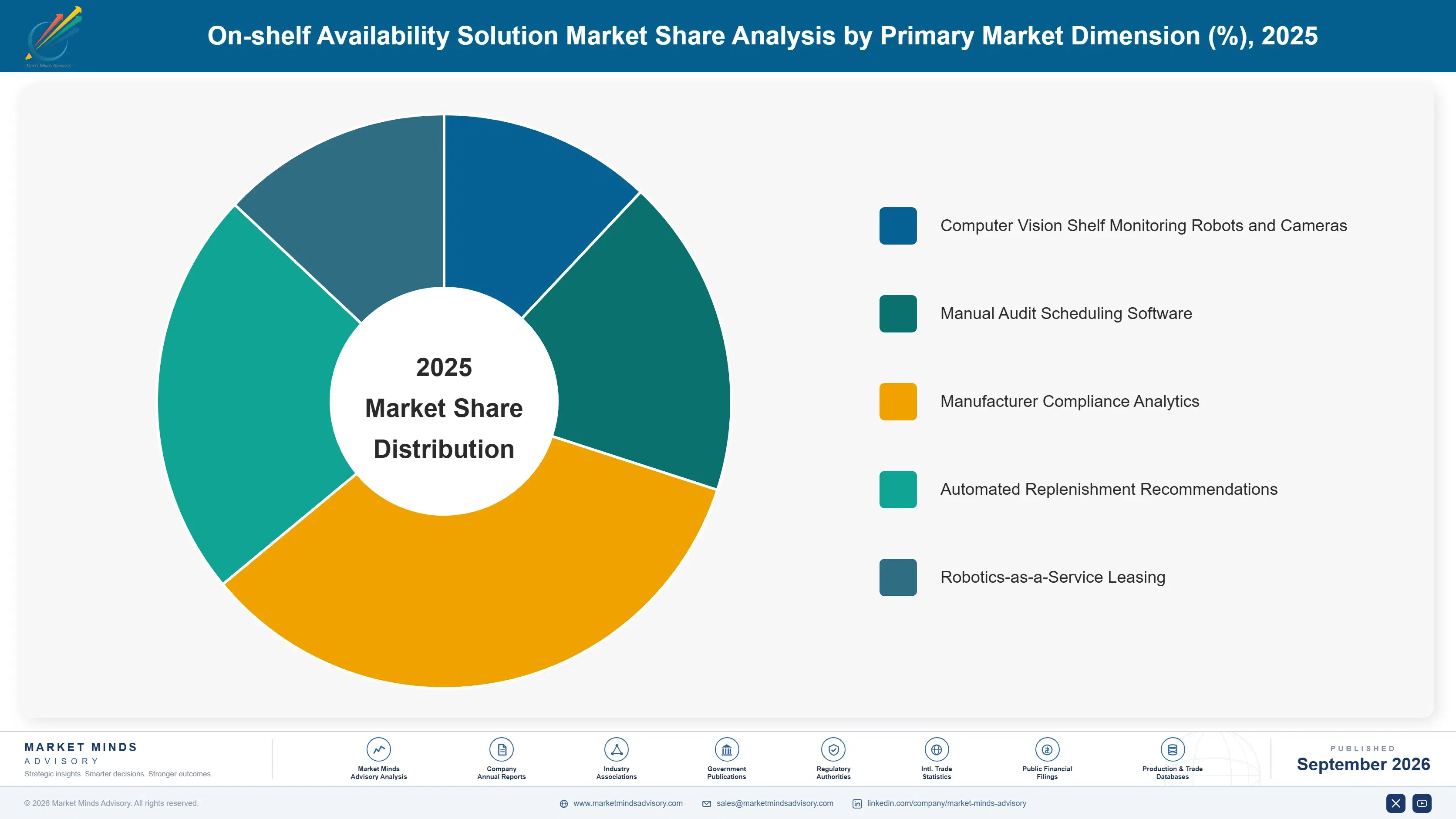
The on-shelf availability solution market splits across five technology-defined segments spanning detection method, deployment format, and integration depth used across retail store operations broadly. Computer vision shelf monitoring robots and cameras lead growth as continuous coverage becomes standard, while manual audit scheduling software still represents the largest installed base by store count across smaller retail chains worldwide.
on-shelf-availability-solution-market-market-share-analysis-1788419090709

Computer Vision Shelf Monitoring Robots and Cameras

Computer vision shelf monitoring robots and cameras continuously capture and analyze shelf imagery to detect empty space, misplaced products, and pricing errors in real time, moving well beyond scheduled manual walks into always-on inventory visibility. This capability requires substantial investment in computer vision model training and hardware integration, a barrier that favors vendors with deep retail-specific image recognition datasets accumulated over years of customer deployment. Growth here outpaces every other segment because retailers and consumer packaged goods manufacturers increasingly demand real-time, validated shelf data rather than periodic manual reports that arrive hours or days after a stockout occurs. Vendors with the deepest proprietary image recognition datasets are capturing the largest share of new large-format retail contracts.
CAGR 16.0%

Manual Audit Scheduling Software

Manual audit scheduling software remains the largest segment by store count, covering the foundational task management and reporting tools that most retail chains adopted years before computer vision became commercially viable for widespread deployment. This tooling predates the current computer vision boom and continues serving smaller retail chains that lack budget or store complexity to justify premium automated detection tiers. Growth here is comparatively modest since these retailers face less complex inventory visibility needs, with most new spending going toward incremental scheduling feature additions rather than a full platform upgrade to automated detection. Vendors serving this segment compete primarily on price and ease of use rather than the detection sophistication that differentiates computer vision platforms.
CAGR 5.5%
Full segment breakdown across 6 segments available in the complete report.

Regional Architecture and Country Demand Map

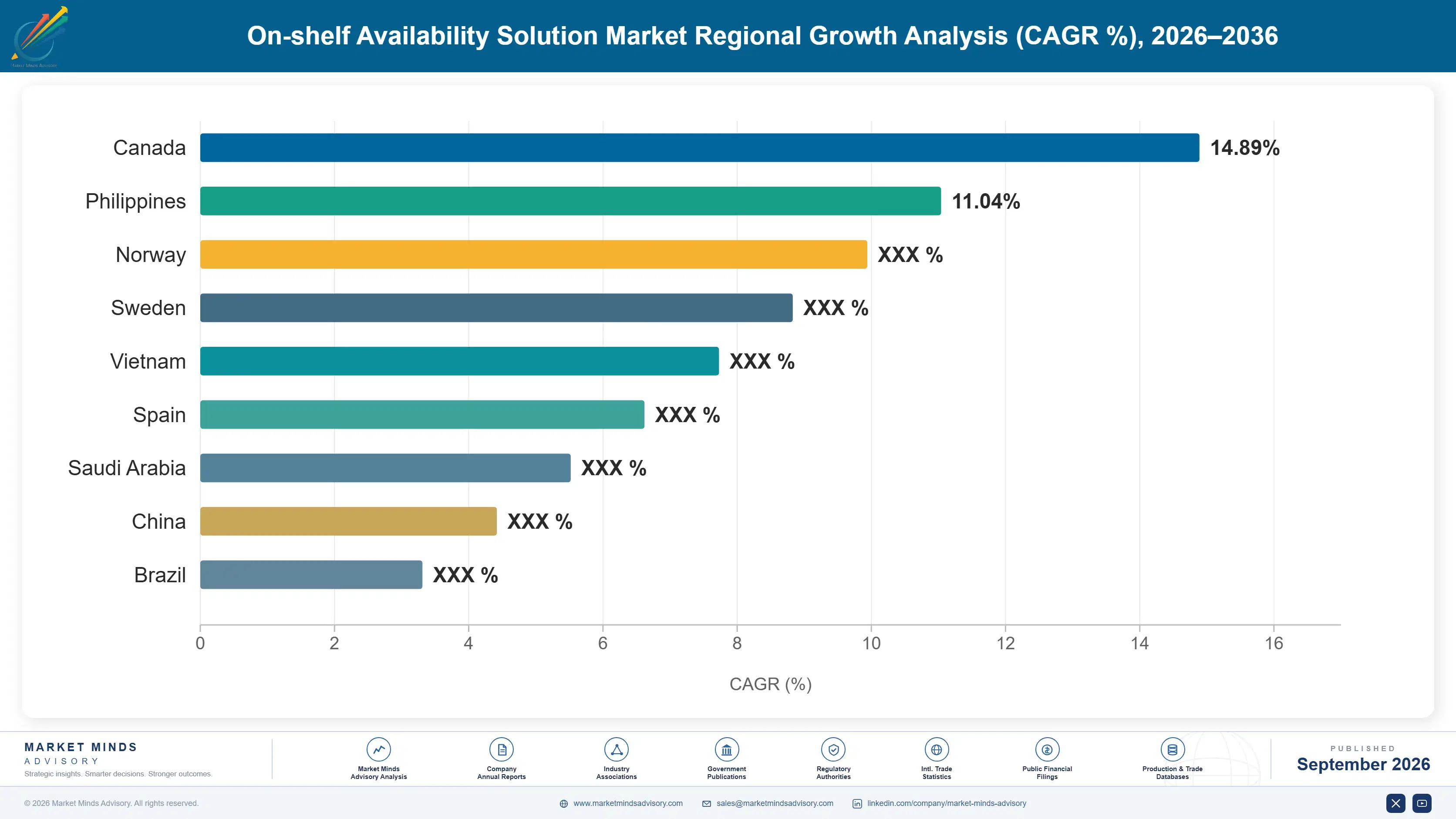
North America leads global platform revenue on the strength of key vendor headquarters concentration and mature large-format grocery adoption, while East Asia holds a strong secondary share tied to regional retail digitization. South Asia and Pacific grows fastest as India's organized retail sector expands rapidly.

North America

Vendor headquarters concentration defines North America's share more than raw store count alone. Simbe Robotics and Focal Systems both book the majority of their global platform revenue through United States entities, reflecting the region's outsized concentration of large-format grocery and general merchandise chains that represent the core buyer base for this category. Major consumer packaged goods manufacturers headquartered domestically continue funding shelf compliance verification programs at scale across their retail partner network. Canada's smaller retail sector follows a similar adoption pattern, concentrated among a handful of major national grocery chains. Insurance and liability considerations at large chains also increasingly favor documented shelf compliance over undocumented manual walk processes. over time.
Share: 32% | CAGR: 12.5% (2026 to 2036)

Western Europe

Western Europe's growth trails the global rate mainly because the region's retail sector has historically invested more conservatively in shelf monitoring technology relative to North American counterparts, favoring proven manual audit processes over rapid computer vision adoption. Germany and France continue showing steady demand tied to expanding grocery retail chains in both countries. The United Kingdom's grocery sector, among the most consolidated in the region, drives meaningful regional demand tied to competitive pressure among a small number of dominant national chains. France and the Nordic countries are following a more gradual adoption path, tied to their comparatively smaller grocery chain scale relative to Germany and the United Kingdom. Spain follows too.
Share: 19% | CAGR: 10.0% (2026 to 2036)
Regional intelligence for 5 additional markets available in the complete report: East Asia, South Asia and Pacific, Latin America, Middle East and Africa, Eastern Europe. Contact sales@marketmindsadvisory.com.
on-shelf-availability-solution-market-country-cagr-analysis-1788419091230

Where Shelf Monitoring Vendors Can Add Margin

Commoditizing basic detection features and thinning per-store hardware margins are pushing vendors toward adjacent revenue lines that ride on top of the same retailer relationship rather than the platform subscription itself. Four levers stand out as genuinely additive to core revenue rather than cannibalistic of it, each drawing on data or hardware the vendor already has.

Selling Consumer Packaged Goods Compliance Analytics

Vendors with shelf-level detection data can package compliance analytics products sold directly to consumer packaged goods manufacturers, capturing revenue from a separate buyer within the same retail relationship who wants independent verification of planogram and pricing compliance. This model captures value from manufacturers who want visibility without negotiating separate data access agreements with each individual retailer. Vendors offering this capability command analytics licensing fees running roughly 10 to 15 percent of the base platform contract value annually. Building these manufacturer relationships requires sales expertise most retail-focused vendors historically never developed internally.
Market Impact: License fees add 10 to 15 percent yearly

Providing Automated Inventory Replenishment Recommendation Services

Vendors that combine shelf detection data with inventory and sales data can generate automated replenishment recommendations, capturing service revenue beyond pure detection alerts by closing the loop into actionable restocking guidance. This capability has proven especially valuable to retailers seeking to reduce labor cost associated with manual replenishment decision-making at the store level. Vendors offering this service report attach rates above 25 percent among retailers already using core detection capability. Building this replenishment intelligence requires integration expertise most detection-only vendors historically never developed. each cycle. Vendors building this early gain a head start over rivals still developing similar capability.
Market Impact: Attach rates now exceed a 25 percent mark

Selling Robotics-as-a-Service Fleet Leasing Programs to Retailers

Vendors that own and maintain shelf-scanning robot fleets can offer leasing arrangements rather than outright hardware sale, capturing recurring revenue from retailers unwilling to commit capital budget to depreciating robotics hardware. This model has proven especially valuable to smaller retail chains that prefer predictable operating expense over large upfront capital investment for unproven technology. Vendors offering this leasing model report contract values extending 3 to 5 years on average compared to traditional hardware purchase agreements. Building this leasing infrastructure requires balance sheet capacity most software-only vendors historically never developed. at scale.
Market Impact: Contracts now extend 3 to 5 years overall

Offering Custom Computer Vision Model Training for Retailers

Vendors that build dedicated data science teams can offer large retail chains custom computer vision model training tuned to their specific store layouts and product categories, capturing premium revenue beyond the standard platform subscription. This capability has proven especially valuable to retailers in specialized categories where generic detection models underperform on unique packaging and shelf arrangement patterns. Vendors offering this capability report custom training engagements reaching over 400,000 dollars for the largest retail chain accounts. Building this custom training capability requires data science talent most vendors must recruit or acquire externally.
Market Impact: Custom engagements reach well over 400,000 dollars each

Who Controls the Margin Pool

Global platform revenue concentrates modestly, with the top five vendors holding roughly 38 percent share on a platform revenue basis, the consistent yardstick applied throughout this assessment. Simbe Robotics and Trax Retail lead the enterprise category, though Focal Systems' camera-first scale gives it a distinct competitive position built on fixed-infrastructure economics rather than mobile robotics breadth. The gap between these leaders and mid-tier challengers remains narrow enough that near-term ranking changes look plausible.
Current activity centers on computer vision accuracy expansion and manufacturer analytics bundling rather than price competition on basic detection. Vendors are racing to extend detection capability across pricing errors, planogram compliance, and misplaced products simultaneously, since large retailers increasingly refuse to purchase point solutions covering only basic out-of-stock detection. Several mid-tier players have pursued robotics acquisitions specifically to close the mobile coverage gap with established leaders.

Emerging pressure comes from warehouse robotics specialists entering retail floor monitoring directly, competing with traditional retail analytics vendors who never built computer vision hardware. Ranking shifts are most likely in the mid-tier, where vendors lacking broad detection capability risk losing enterprise contracts to faster-moving specialists. The very top of the market remains comparatively unsettled, unlike more mature retail technology categories.
on-shelf-availability-solution-market-company-positioning-matrix-1788419091760

Competitive Moat and Risk Dimensions

SIMBE ROBOTICS

Moat: Largest Deployed Robot Fleet

Simbe Robotics operates one of the largest deployed shelf-scanning robot fleets in the category, giving it real-world operational data and reliability track record that newer robotics entrants cannot easily replicate without comparable deployment scale. This operational track record gives Simbe credibility when negotiating large multi-year fleet expansion contracts with major chains.
SIMBE ROBOTICS

Risk: Higher Cost Than Camera Systems

Simbe's robotics approach generally carries higher per-store cost than fixed camera installations, risking share loss to camera-based competitors among cost-sensitive retailers who prioritize deployment cost over the flexibility robots provide. Closing this gap would require reducing hardware cost enough to compete directly on price with fixed camera installations.
FOCAL SYSTEMS

Moat: Fixed Camera Infrastructure Economics

Focal Systems' fixed camera approach avoids the ongoing maintenance and battery management overhead that mobile robotics require, appealing to retailers who prioritize lower total cost of ownership over the flexibility that mobile coverage provides. This lower maintenance burden has made Focal Systems a preferred choice among cost-conscious mid-size retail chains specifically.
FOCAL SYSTEMS

Risk: Less Flexible Store Coverage

Focal Systems' fixed camera installations cannot easily adapt to store layout changes the way mobile robots can, limiting its appeal among retailers who frequently reconfigure store layouts and product placement across seasonal cycles. Addressing this limitation would require developing modular camera systems that can be relocated without significant reinstallation cost.

Players Tracked

Prominent Players

Simbe Robotics
Trax Retail
Focal Systems
AiFi
Zippin

Other Key Players

Shelfie
Bossa Nova Robotics
Panasonic Retail Solutions
IMAGR
Pensa Systems
Zebra Technologies
SES-imagotag
Captana
Retail Vision
Nuvi Labs
Verix
Grabango
Standard Cognition
Cooler Screens
Vispera

Recent Developments

FEBRUARY 2026

Simbe Robotics Expands Fleet to Pharmacy Retail Format

Simbe Robotics announced expansion of its shelf-scanning robot fleet into pharmacy retail formats, adapting its detection algorithms to handle the smaller package sizes and denser shelf arrangements common in pharmacy store layouts. The expansion follows successful pilot programs at several pharmacy chain locations over the past year.
Signal: Robotics vendors are extending beyond grocery into adjacent retail formats requiring format-specific adaptation. broadly across the sector.
SEPTEMBER 2025

Trax Retail Wins Multi-Year Contract in India

Trax Retail secured a multi-year shelf monitoring contract with a major Indian grocery chain, expanding its presence in a market central to the region's fastest-growing organized retail technology demand. Financial terms of the multi-year contract were not disclosed publicly by either party involved in the deal.
Signal: Organized retail expansion in emerging markets is becoming a primary channel for winning meaningful volume. today.
MAY 2025

Focal Systems Acquires Replenishment Analytics Startup

Focal Systems completed the acquisition of a smaller replenishment analytics startup, adding automated restocking recommendation capability to its existing detection platform rather than partnering with a third-party analytics vendor. Financial terms of the acquisition were not disclosed publicly by either company involved in the deal.
Signal: Vertical integration into replenishment analytics is becoming a competitive necessity across the category. across the industry.

Camera and Robotics Hardware Cost Exposure

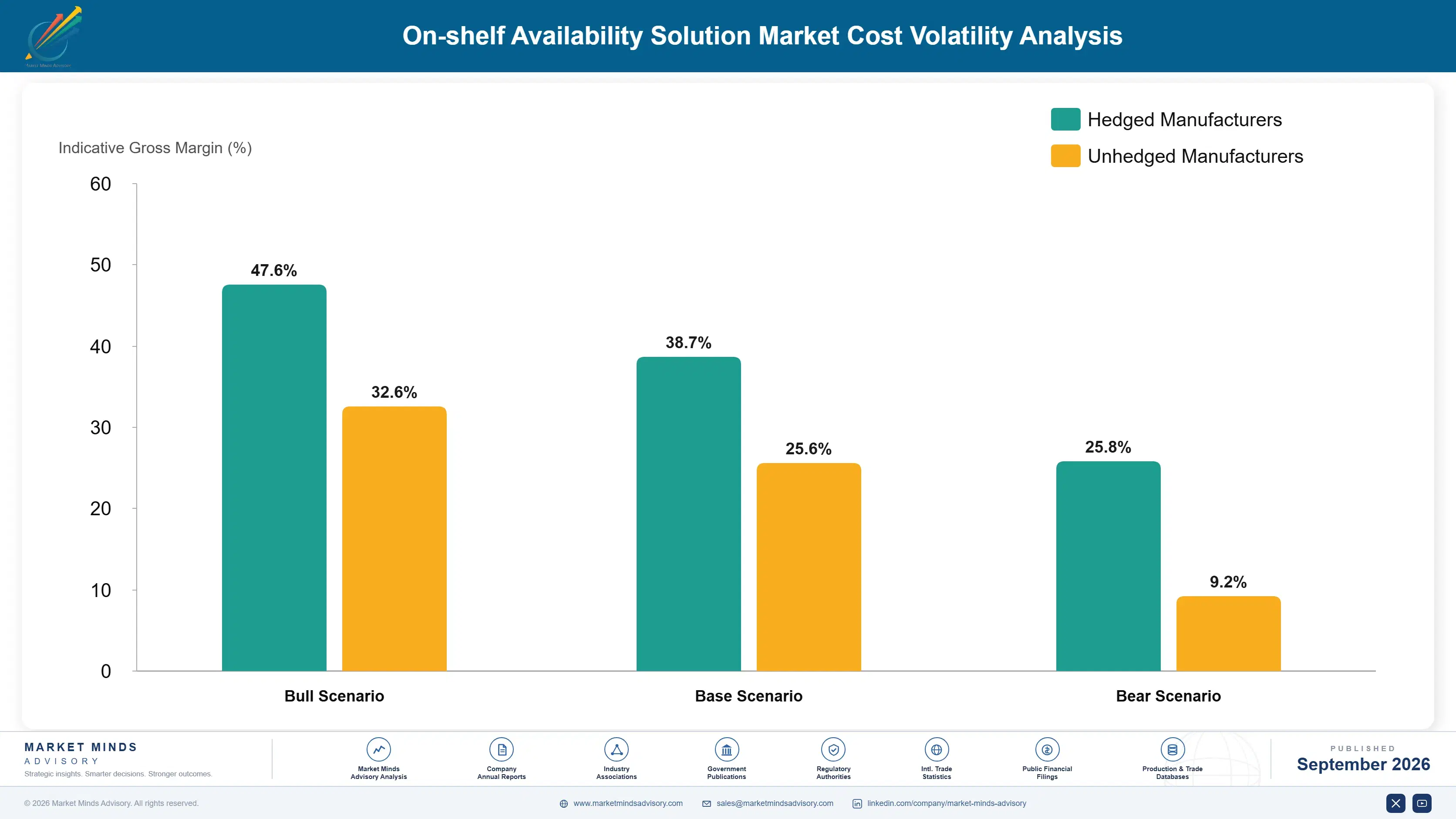
Camera modules and robotics components account for roughly 35 to 42 percent of a typical shelf monitoring vendor's cost of goods sold, sourced primarily from specialized imaging and robotics component suppliers in Taiwan, South Korea, and the United States. Cloud processing and computer vision compute costs add a further 18 to 24 percent, sourced from major hyperscale cloud providers.
A 2021 semiconductor shortage, documented in Sony Corporation's 2022 annual report as a material supply constraint affecting its camera sensor division, delayed camera module production for several shelf monitoring vendors across multiple quarters. Simbe Robotics has publicly discussed component sourcing challenges as a factor in its decision to diversify its supplier base across multiple component manufacturers rather than depending on a single source for critical robotics parts.

Smaller vendors face a genuine disadvantage here because they lack the purchasing volume to secure priority component allocation from constrained suppliers during shortage periods, unlike larger vendors with long-term supply agreements. Vendors based in regions without domestic imaging component fabrication face additional exposure, since they must compete globally for the same limited specialized component supply. This dynamic particularly affects vendors headquartered outside major imaging component manufacturing hubs.
on-shelf-availability-solution-market-cost-volatility-analysis-1788419091957

Dual-Sourcing Camera and Robotics Components

Vendors are increasingly qualifying two or more component suppliers for critical camera and robotics elements so a single-source shortage cannot halt production. This adds validation cost but has become close to standard practice among vendors shipping meaningful volume. Vendors serving large enterprise contracts increasingly treat dual-sourcing as a contractual requirement rather than an optional engineering choice made independently.

Long-Term Component Purchase Agreements

Locking in multi-year purchase commitments with imaging and robotics component suppliers secures priority allocation during shortage periods and more predictable unit pricing, trading flexibility for supply security that smaller vendors without scale often cannot negotiate. This approach requires substantial upfront capital commitment years ahead of actual production need, a tradeoff favoring well-capitalized vendors over smaller rivals.

Cloud Compute Cost Optimization Strategies

Vendors are increasingly optimizing computer vision model efficiency to reduce cloud processing cost per store, a technical investment that pays back quickly at scale across a large multi-store deployment base. Vendors combine this with usage forecasting models to avoid over-committing cloud spend beyond actual projected customer growth trajectories each year. at scale, reliably and consistently.

Portfolio Architecture for Margin Defence

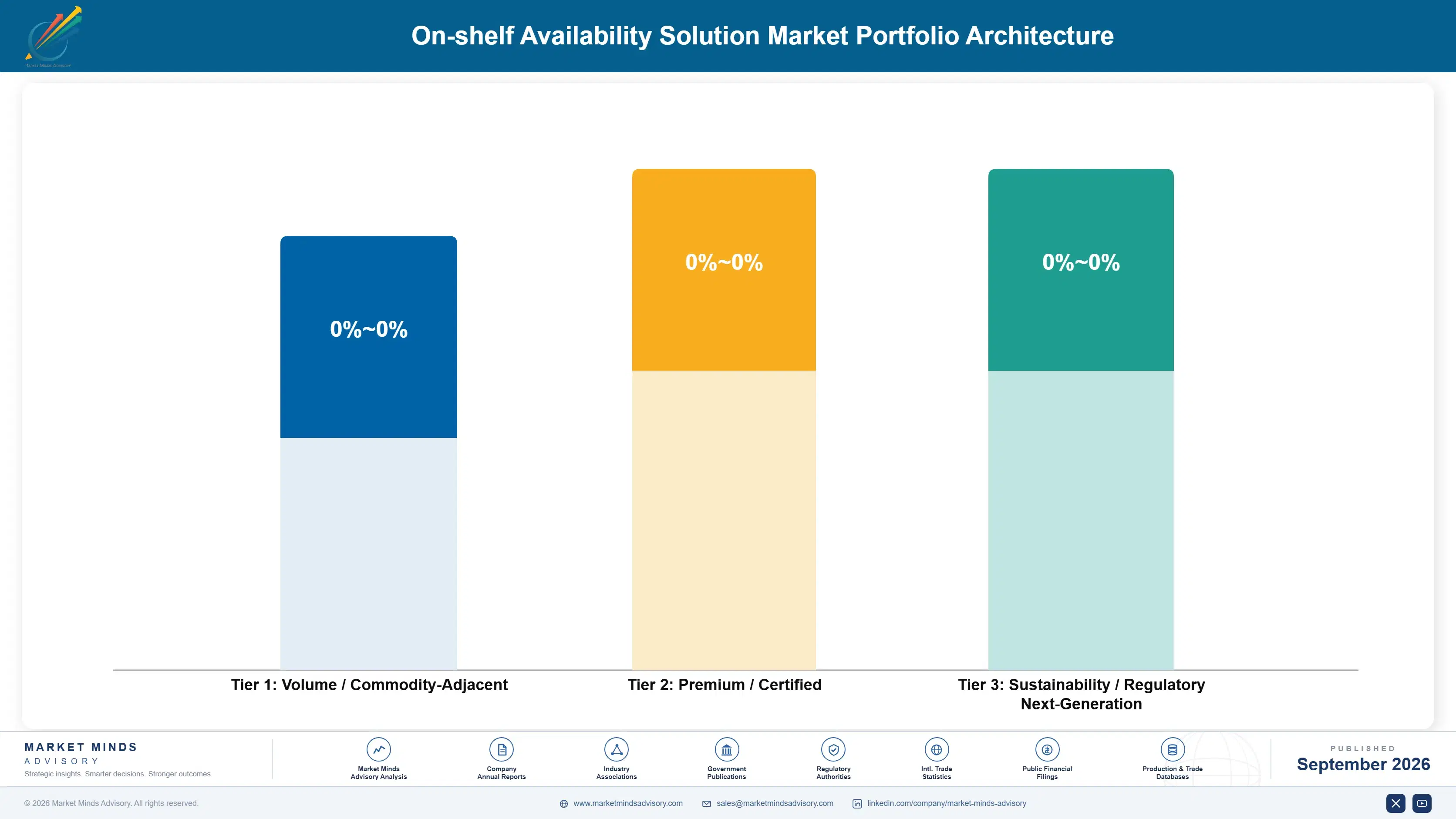
Shelf monitoring vendors operate across a widening tier structure as basic detection commoditizes and higher-margin analytics and replenishment services concentrate pricing power elsewhere in the stack. Volume-tier detection now carries gross margins compressed by increasing competition, while premium platforms bundled with manufacturer analytics retain meaningfully stronger pricing. Portfolio strategy increasingly determines profitability more than raw store count growth.
The tension between chasing store count and defending premium analytics positioning defines strategic choice across the industry. Vendors competing purely on per-store price find margin eroding faster than their cost base can adjust, while vendors segmenting customers by manufacturer analytics and replenishment service uptake are protecting margin even as basic detection fees compress across the broader market. This divergence is reshaping how vendors allocate engineering and sales investment across their retail customer base.

High-value margin pools concentrate in manufacturer compliance analytics, replenishment recommendations, and robotics leasing sold as standalone offerings rather than bundled features. These pools grow faster than core detection revenue because they scale with data and infrastructure a vendor already owns rather than requiring incremental store deployments, making them the most defensible source of margin expansion available today. Vendors without such a plan risk the commodity tier over time.

Volume / Commodity-Adjacent

Basic manual audit scheduling software sold to price-sensitive small retail chains where per-store pricing is the primary purchase driver and switching cost remains modest. Retailers in this tier churn readily toward whichever vendor offers the lowest visible per-store price.
Gross Margin: 10 to 16%

Premium / Certified

Computer vision detection platforms bundled with manufacturer analytics and dedicated account management for large chains that value data quality over marginal cost savings. These retailers typically sign multi-year contracts, reducing acquisition cost per dollar of recurring revenue.
Gross Margin: 22 to 32%

Sustainability / Regulatory / Next-Generation

Robotics leasing, custom model training, and automated replenishment recommendations built to meet emerging retail efficiency demands ahead of competitors, commanding premium pricing while scarce. Vendors here often price on a subscription basis tied to service scope rather than pure store count.
Gross Margin: 26 to 38%
on-shelf-availability-solution-market-portfolio-architecture-1788419092461

High-value Sub-segments and Strategic Watch-out

Consumer Packaged Goods Compliance Analytics

High-value, high-growth pool as manufacturers pay premium pricing for independent shelf verification data, rewarding vendors who build effective analytics products earliest with durable multi-year contracts locked in ahead of rivals. Vendors absent from this capability risk losing the largest manufacturer contracts entirely to faster-moving specialists.

Automated Replenishment Recommendation Services

High-value, moderate-growth pool constrained by integration complexity with legacy inventory systems, but delivering strong margin once a vendor has built credible closed-loop replenishment capability. Expansion here depends heavily on how quickly a vendor can build integration credibility in a competitive field. quite gradually over time.

Manual Audit Scheduling Software

Volume core segment carrying the bulk of smaller retail chains but facing steady margin compression as computer vision platforms and commoditized pricing erode differentiation across most basic offerings. Consolidation among smaller scheduling-only vendors is likely as scale becomes the primary way to defend margin. gradually.

Robotics-as-a-Service Leasing Expansion

Strategic watch-out segment where shifting retailer capital allocation preferences could rapidly change the competitive map, rewarding vendors with flexible hardware financing infrastructure already established. A sudden shift in retailer capital allocation preferences in any single major chain could reroute meaningful volume quickly. quite suddenly and unexpectedly.

Recurring Revenue Across the Store Network

Vendor revenue behaves like an annuity once a retailer integrates shelf monitoring into daily store operations workflows, since switching vendors requires re-installing hardware and retraining staff, a cost most retailers avoid unless service quality deteriorates. This stickiness means vendors earn recurring revenue across every store location for years after deployment, with almost no incremental sales cost.
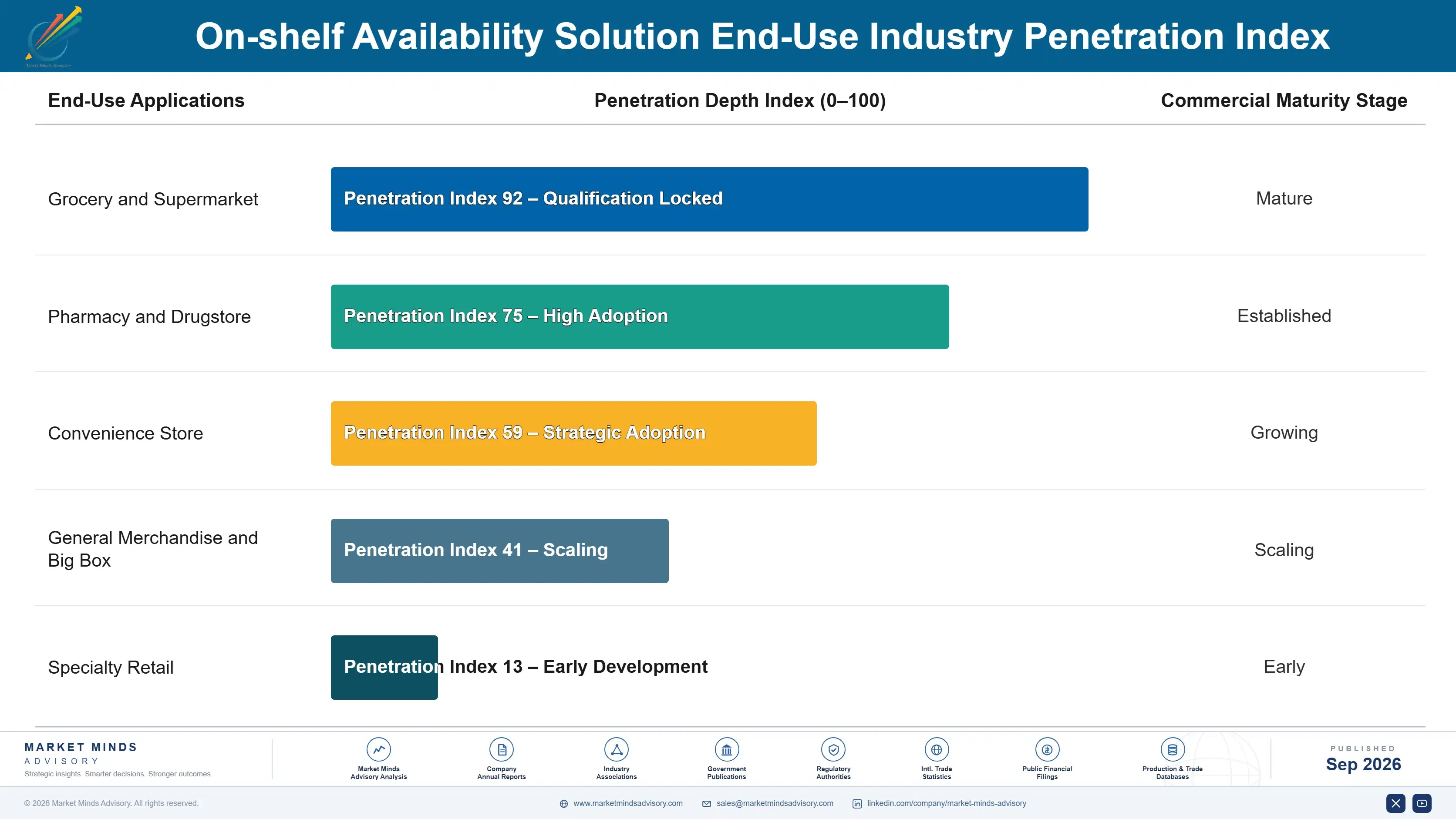
Adoption depth varies sharply by end-use vertical. Large-format grocery chains adopt computer vision detection quickly since out-of-stock losses directly affect razor-thin grocery margins, while smaller specialty retailers integrate more slowly due to cost sensitivity that can stretch adoption timelines past several years. Pharmacy and convenience store formats sit at a different pace entirely, since smaller store footprints and denser shelf arrangements require format-specific technology adaptation.

Buyer profiles are shifting generationally as newer retail operations leaders, trained on data-driven inventory management rather than pure manual processes, replace an older generation comfortable with scheduled store walks and paper checklists. Younger operations leaders expect shelf data to integrate directly with broader inventory and supply chain platforms from day one, treating a standalone monitoring tool as an outdated concept. This turnover is accelerating adoption of connected, continuously monitored store networks faster than pricing alone would predict.
on-shelf-availability-solution-market-end-use-penetration-index-1788419092954

Where MMA Sees the Real Bets

These are among the four positions where our research anticipates prominent divergence between winners and laggards over the coming forecast period. Each is grounded in the demand model, the regulatory perimeter, and the announced capacity pipeline.
01 / DETECTION ACCURACY PRIORITY

Build genuine detection accuracy before differentiation narrows further

Vendors with unreliable detection accuracy are already losing contracts to rivals whose platforms consistently flag real out-of-stock conditions without excessive false positives. This gap widens every quarter a vendor delays investment, since large retailers increasingly treat detection accuracy as a baseline procurement requirement rather than a premium feature reserved for the largest chains. MMA firmly views detection reliability as the clearest predictor of which vendors defend premium pricing over the next several years, more so than raw hardware cost alone.
02 / MANUFACTURER ANALYTICS BUILD

Package compliance analytics for consumer packaged goods buyers now

Consumer packaged goods manufacturers increasingly want independent shelf verification data separate from what retailers self-report, creating a genuinely quite significant and valuable second buyer entirely within the same retail relationship and underlying data pipeline. Vendors clearly without this capability are ceding meaningful revenue to rivals who can demonstrate measurable compliance improvement directly to manufacturer partners. MMA very firmly expects the manufacturer-analytics gap to widen further still as more and more manufacturers fund pilot programs directly at many partner retail chains nationwide.
03 / ROBOTICS LEASING POSITIONING

Build leasing infrastructure before capital-constrained retailers commit elsewhere

Smaller and mid-size retail chains increasingly prefer operating expense over capital investment for unproven technology, rewarding vendors who can offer genuinely flexible leasing terms early in the sales cycle and ongoing negotiation process. Vendors building this genuinely important leasing infrastructure now are positioning well ahead of the broader industry shift toward comprehensive consumption-based retail technology procurement models. MMA very firmly regards early leasing infrastructure investment as a meaningfully lower risk than waiting for retailer preferences to fully shift toward this model.
04 / FORMAT EXPANSION STRATEGY

Adapt detection technology for pharmacy and convenience formats early

Pharmacy and convenience store formats clearly represent a genuinely underserved segment relative to the heavily contested grocery category overall, rewarding vendors who adapt technology for these smaller footprints early, thoroughly, consistently, and quite reliably. Vendors that delay this format-specific adaptation risk ceding an entire, rapidly and steadily expanding segment entirely to specialist competitors already firmly active there. MMA very strongly advises treating format expansion as a standing product priority rather than a reactive afterthought bolted on once competitors already lead.

Engagement Snapshot From the Field

A live engagement with an industry participant carrying material or product regulatory and market exposure ahead of a defining policy shift, showing how our research translates into a defensible multi-year portfolio strategy.
MARKET MINDS ADVISORY · CLIENT ENGAGEMENT SUMMARY
On-shelf Availability Solution Producer Strategic Portfolio Review and Transition Roadmap 2026·Investment Scenario on On-shelf Availability Solution Exposure Evaluation 2025-26
CLIENT PROFILE
The client is a regional grocery chain operating 85 store locations across three states, facing persistent out-of-stock complaints from customers and declining satisfaction scores tied to product availability. Its existing process relied on twice-daily manual store walks by department staff, covering only a fraction of total shelf space consistently. The chain had never previously deployed any computer vision monitoring technology across its stores.
STRATEGIC CHALLENGE
The chain faced measurable sales loss from stockouts that manual walks caught only hours after the fact, while competing chains had already begun piloting computer vision monitoring. Leadership needed a rollout strategy deployable within two fiscal quarters across all store locations, without disrupting daily store operations during installation. Executive sponsorship required demonstrating measurable loss reduction within the first budget cycle.
MMA APPROACH
MMA conducted a store-by-store loss analysis alongside interviews with department managers and store operations leadership, then benchmarked three shelf monitoring vendors against installation complexity and total cost of ownership including leasing options. The engagement produced a phased rollout plan prioritizing the highest-loss stores first, sequenced to demonstrate impact before full-fleet deployment.
KEY FINDINGS
  1. The chain's ten highest-volume stores accounted for over 35 percent of total estimated out-of-stock sales loss company-wide. across the entire chain overall.
  2. A camera-based fixed installation approach could complete initial store coverage within three weeks per location, faster than robotics alternatives. combined across all installation sites.
  3. Two of three vendors evaluated already offered integration with the chain's existing inventory management software platform. already at the outset of the engagement.
  4. Department staff required minimal additional training since detected out-of-stock alerts routed directly into their existing task management app. smoothly and without significant disruption.
CLIENT PROFILE
The client is a regional grocery chain operating 85 store locations across three states, facing persistent out-of-stock complaints from customers and declining satisfaction scores tied to product availability. Its existing process relied on twice-daily manual store walks by department staff, covering only a fraction of total shelf space consistently. The chain had never previously deployed any computer vision monitoring technology across its stores.
STRATEGIC CHALLENGE
The chain faced measurable sales loss from stockouts that manual walks caught only hours after the fact, while competing chains had already begun piloting computer vision monitoring. Leadership needed a rollout strategy deployable within two fiscal quarters across all store locations, without disrupting daily store operations during installation. Executive sponsorship required demonstrating measurable loss reduction within the first budget cycle.
MMA APPROACH
MMA conducted a store-by-store loss analysis alongside interviews with department managers and store operations leadership, then benchmarked three shelf monitoring vendors against installation complexity and total cost of ownership including leasing options. The engagement produced a phased rollout plan prioritizing the highest-loss stores first, sequenced to demonstrate impact before full-fleet deployment.
KEY FINDINGS
  1. The chain's ten highest-volume stores accounted for over 35 percent of total estimated out-of-stock sales loss company-wide. across the entire chain overall.
  2. A camera-based fixed installation approach could complete initial store coverage within three weeks per location, faster than robotics alternatives. combined across all installation sites.
  3. Two of three vendors evaluated already offered integration with the chain's existing inventory management software platform. already at the outset of the engagement.
  4. Department staff required minimal additional training since detected out-of-stock alerts routed directly into their existing task management app. smoothly and without significant disruption.
RECOMMENDED STRATEGY
Phase 1: Phase 1 (Months 1-3): deploy camera monitoring across the ten highest-loss stores identified in the analysis. immediately upon program approval. Phase 2: Phase 2 (Months 4-6): extend deployment to the remaining store locations based on lessons learned from phase one. systematically and thoroughly. Phase 3: Phase 3 (Month 7): integrate manufacturer compliance analytics reporting into the platform for key supplier partners. formally and quite completely.
OUTCOME
The chain completed priority store deployment within eleven weeks, ahead of the twelve-week target (client-reported, unverified by MMA). Customer-reported out-of-stock complaints declined measurably within two quarters of full rollout completion (client-reported, unverified by MMA). The chain has since expanded the program to include two additional store formats (client-reported, unverified by MMA).

Frequently Asked Questions

Foundational context covering the market sizes, CAGR, scope, country, region and competition that inform every finding below. This section is provided to cover basics and most often pre-purchase conversations, answered from the MMA Primary Research Dataset.

What is the current size of the On-Shelf Availability Solution Market?

The On-Shelf Availability Solution Market reached 1.4 billion dollars in 2025, the report's base year for all forecast calculations. This figure covers computer vision, robotics, and manual audit shelf monitoring platforms globally.

How large will the On-Shelf Availability Solution Market be by 2036?

The market is projected to reach 4.63 billion dollars by 2036, roughly 2.97 times its 2026 starting value. That growth reflects falling hardware costs and expanding manufacturer-funded verification programs.

What is the CAGR for the On-Shelf Availability Solution Market 2026 to 2036?

The market is forecast to grow at an 11.5 percent compound annual rate between 2026 and 2036. Bull and bear scenarios range from 12.8 percent to 10.2 percent respectively.

Which segment is growing fastest?

Computer vision shelf monitoring robots and cameras lead growth at 16.0 percent CAGR, roughly 1.39 times the overall market rate. Falling hardware costs are driving this expansion across most retail formats.

Who are the major companies in the On-Shelf Availability Solution Market?

Simbe Robotics, Trax Retail, Focal Systems, AiFi, and Zippin lead the market on a platform revenue basis. Together these five vendors hold roughly 38 percent combined share.

Which country is growing fastest?

India leads country-level growth at 16.5 percent CAGR, driven by its rapidly expanding organized retail sector and growing domestic grocery chains. Rising technology adoption is accelerating this shift further.

Report Segmentation Architecture

The full report scope spans multiple orthogonal segmentation dimensions, with cross-tabulated demand data provided for each dimension pair. Coverage extends further to regional breakdowns, trend trajectories, and the competitive detail needed to support segment-level decision-making.

By Primary Market Dimension

  • Computer Vision Shelf Monitoring Robots and Cameras
  • Manual Audit Scheduling Software
  • Manufacturer Compliance Analytics
  • Automated Replenishment Recommendations
  • Robotics-as-a-Service Leasing

By End-Use Industry

  • Grocery and Supermarket
  • Pharmacy and Drugstore
  • Convenience Store
  • General Merchandise and Big Box
  • Specialty Retail

By Commercial Dimension

  • Large-Format Retail Chains
  • Small and Medium Retailers
  • Consumer Packaged Goods Manufacturers
  • Retail Technology Integrators

By Region

  • North America
  • Western Europe
  • East Asia
  • South Asia and Pacific
  • Latin America
  • Middle East and Africa
  • Eastern Europe

Scope, Methodology, and Coverage

Every figure in this report is reproducible from documented input assumptions. The scope below maps the historical period, the forecast horizon, the segmentation dimensions, and the countries covered, alongside the underlying primary and qualitative methodology.
Historical Period
2020 to 2025
Forecast Period
2026 to 2036
Base Year
2025 (USD billions; MMA Primary Research Dataset, September 2026)
Market Definition
This report covers software and hardware platforms that monitor retail shelf inventory levels using computer vision, robotics, or sensor technology to detect and alert on out-of-stock and misplaced product conditions, measured on a global revenue basis. It excludes general retail point-of-sale systems and warehouse inventory management software not centered on in-store shelf visibility.
Quantitative Units
USD billions, global market size and forecast
Segmentation Dimensions
Product/technology type, end-use industry, commercial/customer dimension, region
Regions Covered
North America, Western Europe, East Asia, South Asia and Pacific, Latin America, Middle East and Africa, Eastern Europe
Countries Covered
United States, China, Germany, France, United Kingdom, Japan, South Korea, India, Canada, Brazil, Mexico, Indonesia, Vietnam, Thailand, Malaysia, United Arab Emirates, Saudi Arabia, South Africa, Nigeria, Turkey, Poland, Netherlands, Italy, Spain, Sweden, Switzerland, Argentina, Colombia, Australia, Singapore, and additional markets relevant to this sector
Key Companies Profiled
Simbe Robotics, Trax Retail, Focal Systems, AiFi, Zippin, Shelfie, Bossa Nova Robotics, Panasonic Retail Solutions, IMAGR, Pensa Systems, Zebra Technologies, SES-imagotag, Captana, Retail Vision, Nuvi Labs, Verix, Grabango, Standard Cognition, Cooler Screens, Vispera
Quantitative Methodology
Primary survey, n=3,800 respondents, Q4 2025, six countries; demand-side model with trade association cross-validation
Qualitative Methodology
47 expert interviews, Q4 2025; applied to validate demand model assumptions, identify emerging dynamics, and assess competitive positioning
Report Format
PDF and XLSX data workbook (Word format preview document)
Publisher
Market Minds Advisory
Report Code
MMA-2026-TEC-139
Published
September 2026
Contact
sales@marketmindsadvisory.com | www.marketmindsadvisory.com

Purchase the full On-shelf Availability Solution Market Report (2026 to 2036).

This report delivers a comprehensive analysis of the global On-Shelf Availability Solution Market, covering market sizing, segmentation, and regional dynamics through 2036. It profiles the competitive landscape across twenty leading vendors, benchmarked on a consistent platform revenue basis. Regional analysis spans all seven major world regions, quantifying share and growth rate differences driven by retail, manufacturer, and technology adoption factors. The report also examines revenue diversification strategies, input cost exposure, and portfolio economics shaping vendor profitability. A dedicated case study illustrates practical implementation lessons for grocery chains pursuing monitoring rollouts.
Ten-year market size and CAGR forecast through 2036
Five-segment MECE market breakdown with growth rates
Seven-region share and growth rate analysis
Twenty-company competitive benchmarking on platform revenue basis
Revenue diversification strategy analysis across four commercial levers
Anonymized client implementation case study with outcomes

Built For The People Who Decide

From boardroom strategy to bench-side execution, this report is read cover-to-cover by leaders shaping the next decade of their industry, turning demand scenarios, market dynamics and valuation benchmarks into decisions.
CXOs/ Presidents/ VPs/ Managers
M&A and Corporate Development
Strategy Teams and R&D Heads
Procurement and Product Directors
Regulatory and Compliance Leaders
Investor Relations and Equity Analysts