Market Minds Advisory
Omega-3 Pet Supplement Market

Omega-3 Pet Supplement Market: Oxidation control, residual claim on a fishery and algal substitution to 2036

The active ingredient here spoils faster than almost anything else sold on a shelf, and a great deal of what reaches the animal has already turned before the packet is ever opened.

Lead Analyst

Lisa Gevelber

Published

September 2026

Make Smarter Decisions with Customized Research Insights

Request a free sample report and evaluate market opportunities, growth trends, and competitive dynamics relevant to your business needs.

2025 MARKET VALUE$1.3BMarket Size 2025
2036 FORECAST VALUE$3.5BBase Case , 2026 to 2036
CAGR 2026 TO 20369.2 %Bull 10.4% / Bear 8.0%
INCREMENTAL OPPORTUNITY$2.1BNet 10- year value creation
EXPANSION MULTIPLE2.41x2036 value over 2026 base
Strategic Levers
M&A Pipeline
Regional Outlook
Country Rankings
Competitive Intelligence
Segmental Deep-dive
Call-Us : 91 93563 13602

Executive Snapshot and Market Trajectory

The technical content of this product is oxidation control rather than omega-3. Above roughly 20 milliequivalents of peroxide the oil is rancid enough for an animal to refuse and degraded enough that the benefit has gone. Around 22% of cats decline the dose then, and a refusal delivers nothing.
A refused dose has no efficacy whatever the label concentration says, which makes encapsulation, antioxidant systems and barrier packaging the actual product being sold. Competing on milligrams of long chain fatty acid per capsule advertises a number that means nothing at all once the oil has turned somewhere in the supply chain. Cheap oil sitting warm on a shelf has often passed that point already.
Algal oil supplements grow at 13.8%, half again the market rate of 9.2%, because they escape a fishery where aquaculture takes 73% of world marine oil and outbids everybody else. Pet supplements are a residual claimant on that supply. North America holds 38% of value on pet spending per animal that no other region approaches. Veterinary channel depth exceeds every other market considerably. Clinical recommendation converts roughly 3.6 times better than retail.
Market Definition
This report covers omega-3 supplements formulated for companion animals, spanning fish oil supplements, krill oil supplements, algal oil supplements, blended and fortified formats, functional treats and chews, and therapeutic veterinary formulations. Value is measured at manufacturer level across retail and veterinary channel sales. Excluded are complete pet foods where omega-3 is a formulation component rather than a marketed supplement, human omega-3 products, marine oils sold as bulk ingredients to formulators, livestock and aquaculture feed supplements, and veterinary pharmaceuticals.
Base Year Value
$1.3B in 2025 (MMA Primary Research Dataset, August 2026)
Forecast Period
2026 to 2036, eleven discrete annual values
CAGR
9.2% base case. Bull 10.4%. Bear 8.0%.
Fastest Growth Segment
Algal Oil Supplements: 13.8% CAGR
Fastest Growth Country
China: 12.8% CAGR
Fastest Growth Region
South Asia and Pacific: 11.2% CAGR
Largest Region
North America: 38% of 2025 global value
Market Leaders
Nestlé Purina PetCare, Mars, Zoetis, Nutramax Laboratories and Virbac lead the market. Source: MMA Primary Research Dataset, July 2026.
Primary Survey
n=3,800 procurement and R&D decision-makers, Q4 2025, six countries
Methodology
Demand-side build-up, cross-validated against public data, 47 expert interviews

Omega-3 Pet Supplement Market Forecast Scenarios

omega-3-pet-supplement-market-trends-size-forecast-scenario-1787559435844
Growth ran at 8.0% between 2020 and 2025 as pet ownership rose sharply and supplement spending followed, with joint, skin and coat positioning driving most of the volume. Fish oil dominated throughout and its price moved with fishery quota rather than with pet demand, which surprised several manufacturers who had modelled input cost against their own category. Algal supply began scaling toward the end of the period.
The 9.2% base case rests on three mechanisms. Algal oil at 13.8% as manufacturers seek supply independent of fishery quota and palatability free of marine odour. Functional treats and chews at 10.2%, where the delivery format solves compliance rather than the ingredient solving anything. And Chinese growth at 12.8%, the fastest of any country, on companion animal ownership rising very quickly among urban households. None of the three depends on fish oil becoming cheaper or more available.
The 10.4% bull case is veterinary channel recommendation extending across more conditions, since a clinical recommendation converts to repeat purchase around 3.6 times better than retail display does. The 8.0% bear case is a fishery quota reduction lifting fish oil cost sharply, which passes straight through a category with thin formulation margin and price-sensitive retail shelves.

An Ingredient That Spoils

Long chain omega-3 fatty acids are among the least stable molecules sold in any consumer product, and that single property decides almost everything commercially important about this category. Oxidation proceeds from the moment the oil is extracted, and above roughly twenty milliequivalents of peroxide value the material is simultaneously rancid enough that an animal refuses it and degraded enough that the health benefit has disappeared or inverted. About 22% of cats decline a dose at that point, and a refused dose delivers exactly nothing regardless of what the label claims about concentration.
TOP-FIVE CONCENTRATION32%Combined position across supply held by the leading supplement manufacturers
SHELF LIFE OXIDATION THRESHOLD20 meqPeroxide level above which palatability and benefit both fail
AQUACULTURE FISH OIL SHARE73%Portion of world marine oil consumed by farmed fish feed
VETERINARY CHANNEL CONVERSION3.6xRepeat purchase relative to retail impulse buying of supplements
ALGAL OIL COST PREMIUM2.8xPrice above fish oil for equivalent long chain fatty acid
PRODUCT REFUSAL RATE22%Share of cats declining a dose once the oil oxidises
The product being sold is therefore oxidation control rather than omega-3 itself. Encapsulation, antioxidant systems, oxygen barrier packaging and nitrogen flushing are where the technical difficulty and the genuine cost sit, and a cheap bottle of fish oil that has sat warm on a shelf for months is frequently already past the point of usefulness before anybody opens it. Manufacturers competing on milligrams per capsule are advertising a figure that a peroxide test would render meaningless.
Supply is the other underappreciated constraint. Aquaculture consumes 73% of world marine oil and outbids everybody, which makes pet supplements a residual claimant on a quota-limited fishery.
"Half the fish oil in this category is oxidised by the time an animal sees it, and the marketing is all about how many milligrams are in the capsule. The number that matters is peroxide value, almost nobody prints it, and the cat can tell."
Director, Companion Animal Health and Nutrition Practice · MMA Animal Health and Nutrition Practice · August 2026

Market Trends

Algal oil escapes both the fishery and the smell

Algal oil delivers long chain omega-3 without drawing on a fishery where aquaculture takes 73% of world marine oil, without the heavy metal and contaminant concerns that fish sources carry, and without the marine odour that makes cats refuse a dose. It costs roughly 2.8 times fish oil per unit of fatty acid and wins anyway wherever palatability or supply security matters more than shelf price. Growth at 13.8% is the fastest here. Commercially it converts an input governed by fishing quota into one governed by fermentation capacity, which manufacturers can actually plan against.
Market Impact: Clinic conversion runs 3.6 times higher

Delivery format solves compliance where the ingredient cannot

A supplement only works if the animal actually consumes it, and pumping oil onto food or administering a capsule to a cat fails often enough that compliance rather than formulation limits real world outcomes. Functional treats and chews solve that by making the dose something the animal wants, and they grow at 10.2% as a result. Commercially this shifts value toward manufacturers with palatability and treat manufacturing capability rather than oil sourcing expertise, and it changes the competitive field considerably in favour of pet food companies. Oxidation control is harder in a chew than in a sealed capsule.
Market Impact: Chinese demand compounds at 12.8%

Market Opportunities and Growth Drivers

Veterinary recommendation converts far better than retail display

A clinical recommendation for joint, skin, coat or renal support converts into sustained repeat purchase around 3.6 times more reliably than a retail shelf purchase does, because the owner has been told why rather than persuaded to try. Veterinary channel supplements also carry claim substantiation expectations that retail products largely avoid. Commercially this makes clinic detailing worth considerably more per contact than any retail promotion, and manufacturers organised purely around grocery and pet specialty distribution are missing the channel where compliance actually happens. Measurability is why retail keeps getting funded regardless.
Market Impact: Aquaculture takes 73% of oil

Chinese urban pet ownership expands from a very low base

Chinese growth at 12.8% leads every country in this market, driven by companion animal ownership rising rapidly among urban households where pets were uncommon a generation ago and where spending per animal is climbing faster than ownership itself. Cat ownership in particular has grown quickly in apartment living, which matters here because cats are the harder palatability problem. Domestic and international manufacturers both compete actively, and online channels dominate distribution in a way that differs considerably from Western retail structures. Cat ownership in apartment living has grown particularly quickly. Cats present the harder palatability problem by far.
Market Impact: Refusal reaches 22% of cats

Market Restraints and Challenges

Fish oil price follows aquaculture rather than pet demand

Aquaculture consumes 73% of world marine oil and pays more for it than pet supplement manufacturers can, which makes this category a residual claimant on a supply capped by fishery quota. The root cause is that farmed salmon economics support a higher oil price than a shelf-priced pet product does. Commercially this means input cost moves on El Niño conditions and Peruvian anchoveta quota decisions that nobody in the pet category tracks. Manufacturers are qualifying algal sources specifically to remove the dependency rather than to reduce cost. Nobody in this category tracks anchoveta quota decisions.
Market Impact: Costs 2.8 times fish oil

Oxidised product reaches animals and undermines the category

Omega-3 oxidises continuously from extraction onward, and product sitting warm on a shelf frequently exceeds twenty milliequivalents peroxide value before purchase, at which point it is rancid and the benefit has gone. The root cause is that the molecule's instability is inherent to what makes it biologically useful. Commercially, owners who see no result stop repurchasing and conclude the category does not work. Manufacturers are addressing it through microencapsulation, antioxidant systems and barrier packaging, none of which are visible to a shopper comparing prices. A shopper comparing prices sees none of that protection.
Market Impact: Treat formats compound at 10.2%
4 additional market trends, 3 additional growth drivers, and 2 additional restraints and challenges are covered in the full report. Contact sales@marketmindsadvisory.com to access the complete intelligence.

Segment CAGR and Growth Architecture

Value is classified here by omega-3 source and delivery format, since oxidation behaviour, supply exposure, palatability and cost all follow directly from what the oil is and how it reaches the animal. Species, distribution channel and health positioning are handled separately in the framework below, because most formats serve both dogs and cats with adjusted dosing.
omega-3-pet-supplement-market-trends-market-share-analysis-1787559436404

Algal Oil Supplements

Growing at 13.8%, half again the market rate and faster than anything else here, algal oil delivers long chain omega-3 from fermentation rather than from a fishery where aquaculture consumes 73% of world supply and consistently outbids pet manufacturers. It also avoids the heavy metal and organic contaminant concerns attached to marine sources and carries no fishy odour, which matters enormously with cats. The material costs roughly 2.8 times fish oil per unit of fatty acid and wins specifications anyway wherever palatability or supply predictability outweighs shelf price. Fermentation capacity rather than quota governs availability, which is something a manufacturer can actually plan production against. Contaminant testing burdens fall away entirely as well.
CAGR 13.8%

Functional Treats and Chews

A supplement delivers nothing unless the animal consumes it, and pumping oil onto food or administering capsules fails frequently enough that compliance rather than formulation limits results in practice. Treats and chews make the dose something the animal actively wants, which removes the compliance problem rather than working around it. Growth at 10.2% follows that directly. The format demands palatability development and treat manufacturing capability rather than oil sourcing expertise, which shifts advantage toward pet food companies with existing production. Oxidation control is harder in a chew than in a capsule, since the matrix offers less protection than a sealed shell. Pet food companies with existing lines therefore start well ahead.
CAGR 10.2%
Full segment breakdown across 6 segments available in the complete report.

Regional Architecture and Country Demand Map

North America holds 38% of value, well above the standard band, because spending per companion animal and veterinary channel depth both exceed those of anywhere else by a wide margin. Western Europe follows at 24% on broadly similar ownership patterns alongside considerably stricter claim regulation.

North America

At 38% this region sits well above the standard band, because spending per companion animal exceeds every other market by a considerable margin and pet humanisation has gone furthest here. The veterinary channel is deep and clinics recommend supplements routinely for joint, skin and renal conditions, which converts to repeat purchase around 3.6 times better than retail. Supplement regulation operates through industry self-governance rather than pre-market approval, which permits a broad claim environment. Algal oil adoption is furthest advanced anywhere. Growth at 8.6% sits below the market rate on a large and relatively mature base. Warm-climate distribution across southern states exposes product to oxidation conditions that northern supply chains never encounter.
Share: 38% | CAGR: 8.6% (2026 to 2036)

Western Europe

Ownership patterns resemble North America but claim regulation is considerably stricter, since supplements fall under feed additive rules that constrain what a label may say about efficacy. That pushes marketing toward veterinary channels where a professional recommendation carries the message the packaging cannot. Nordic and British markets show the highest supplement penetration. Fish oil sourcing sits close to substantial European aquaculture operations, which is a disadvantage rather than an advantage given they consume the same supply. Growth at 7.6% is the weakest on this table and reflects regulatory constraint alongside a mature base. Algal adoption is advancing on sustainability grounds as much as on palatability, since marine sourcing attracts scrutiny here.
Share: 24% | CAGR: 7.6% (2026 to 2036)
Regional intelligence for 5 additional markets available in the complete report: East Asia, South Asia and Pacific, Latin America, Middle East and Africa, Eastern Europe. Contact sales@marketmindsadvisory.com.
omega-3-pet-supplement-market-trends-country-cagr-analysis-1787559436934

Where Omega-3 Value Actually Sits

Four moves matter for a product whose active ingredient degrades continuously from the moment it is made and whose supply is set by an industry that outbids this category comfortably. Two concern controlling oxidation and compliance properly, and two concern the source and channel decisions that determine whether any of it reaches the animal.

Sell peroxide value, not milligrams per capsule

Above roughly 20 milliequivalents of peroxide the oil is rancid enough for an animal to refuse and degraded enough that the benefit has gone, and around 22% of cats decline a dose at that point. Concentration claims mean nothing against that. Manufacturers who specify, test and publish oxidation status differentiate on the one measure that actually determines whether the product works, and veterinary buyers understand the argument immediately even where retail shoppers do not. Publishing batch results is unusual enough to differentiate immediately, and it costs almost nothing beyond the testing already being performed internally.
Market Impact: Holds the peroxide value below 20 milliequivalents throughout

Qualify algal supply to escape the fishery entirely

Aquaculture consumes 73% of world marine oil and pays more for it than a shelf-priced pet supplement can support, which leaves this category taking whatever remains at whatever quota decisions allow. Algal oil costs around 2.8 times fish oil per unit of fatty acid and removes the dependency completely, replacing quota exposure with fermentation capacity a manufacturer can plan against. Growth at 13.8% reflects manufacturers buying supply predictability and palatability rather than buying cheaper omega-3. Contracting years ahead against planned fermentation capacity is possible in a way that contracting against a fishery quota simply is not.
Market Impact: Escapes a 73% supply claim by aquaculture buyers

Build treat formats to solve the compliance problem

A supplement the animal refuses delivers nothing whatever the formulation says, and administering oil or capsules to a cat fails often enough that compliance rather than dosing limits real world results. Treats and chews grow at 10.2% because they make the dose something the animal wants. The capability required is palatability development and treat manufacturing rather than oil sourcing, which favours pet food companies and disadvantages supplement specialists who have never made anything an animal eats voluntarily. The animal asking for the dose is a compliance mechanism no formulation achieves.
Market Impact: Serves treat formats now growing at 10.2% yearly

Detail veterinary clinics rather than funding retail promotion

A clinical recommendation converts to sustained repeat purchase around 3.6 times better than a retail shelf purchase, because the owner has been told why the animal needs it rather than persuaded to try something. Clinic detailing costs more per contact and returns considerably more per converted owner. Manufacturers organised entirely around grocery and pet specialty distribution are funding the channel that converts worst, and they are usually doing it because it is easier to measure. Clinic relationships also survive competitor promotion in a way retail listings never do. Measurability is why retail keeps getting funded anyway.
Market Impact: Converts 3.6 times better than a retail purchase

Who Controls the Margin Pool

Five manufacturers hold 32% of this market, measured on retail and veterinary sales value at manufacturer level, the basis used throughout this section. Concentration is moderate and the participants divide into groups with quite different capabilities: pet food companies with palatability and treat manufacturing, animal health companies with veterinary channel access, and supplement specialists with formulation and oxidation control expertise. Very few participants hold all three capabilities.
Competition runs on four dimensions. Oxidation control across encapsulation, antioxidant systems and barrier packaging, which decides whether the product works at all once it reaches an animal. Source security across fish, krill and algal supply in a market where quota decides availability. Palatability and treat manufacturing capability, which solves compliance. And veterinary channel access, which converts far better than any retail investment ever does.

Rankings shift toward manufacturers with contracted algal supply and genuine treat capability, and away from those dependent on merchant fish oil purchasing at whatever quota leaves available. Animal health companies hold clinic relationships that pet food scale cannot simply buy its way into. Pet food companies hold palatability capability that supplement specialists have never had any reason to develop.
omega-3-pet-supplement-market-trends-company-positioning-matrix-1787559437458

Competitive Moat and Risk Dimensions

NESTLÉ PURINA PETCARE

Moat: Palatability and treat manufacturing

The company holds palatability development and treat manufacturing capability that supplement specialists have never had to build, which matters directly because compliance rather than formulation limits real world results and treats grow at 10.2%. Distribution reach across grocery, pet specialty and veterinary channels covers every route to the owner rather than depending on any single one of them.
NESTLÉ PURINA PETCARE

Risk: Fish oil sourcing exposure

Scale purchasing does not overcome a fishery where aquaculture consumes 73% of supply and pays more, so input cost still moves on quota decisions outside the category entirely. Manufacturers with contracted algal supply hold predictability that purchasing power alone does not deliver. Algal grades also solve a palatability problem that treat formulation addresses only partially.
NUTRAMAX LABORATORIES

Moat: Veterinary channel and substantiation

The company built its position through veterinary clinic recommendation supported by published research, which converts to repeat purchase around 3.6 times better than retail display and creates an owner relationship founded on clinical advice rather than packaging. Claim substantiation depth also travels well into markets where feed additive rules restrict what a label may state about efficacy.
NUTRAMAX LABORATORIES

Risk: Limited treat format capability

Functional treats and chews grow at 10.2% and demand palatability development and treat manufacturing that a capsule and tablet business has never needed. Pet food companies hold that capability outright. A veterinary supplement specialist competing in the treat format is entering a manufacturing discipline where established food companies start with a considerable advantage.

Players Tracked

Prominent Players

Nestlé Purina PetCare
Mars
Zoetis
Nutramax Laboratories
Virbac

Other Key Players

Vetoquinol
Elanco
DSM-Firmenich
Corbion
Veramaris
Aker BioMarine
KD Pharma
Croda
Kemin Industries
Standard Process
VetriScience
Zesty Paws
NaturVet
Pet Honesty
Alltech

Recent Developments

FEBRUARY 2025

A manufacturer contracted algal oil supply for a supplement range

A pet supplement manufacturer signed a multi-year algal oil supply agreement covering its premium omega-3 range, citing supply predictability against fishery quota volatility and palatability in feline products rather than any cost consideration. This was a supply agreement rather than an equity transaction. Volumes covered several years forward.
Signal: Manufacturers are now buying supply predictability and palatability with algal oil rather than seeking cheaper omega-3
JUNE 2025

A veterinary group added omega-3 to standard renal support protocols

A veterinary practice group incorporated omega-3 supplementation into standard renal and joint support protocols across its clinics, with dosing guidance and product specification including oxidation limits. This was a clinical protocol decision rather than any commercial arrangement with a supplement manufacturer. Dosing guidance accompanied the protocol.
Signal: Protocol inclusion converts a discretionary purchase into a clinical instruction, which is where compliance actually comes from
OCTOBER 2025

A brand published peroxide value testing across its product range

A supplement brand began publishing batch peroxide value results for its omega-3 range, positioning oxidation status as the measure of product quality rather than the concentration claims competitors emphasise on packaging. This was a marketing and quality decision rather than any transaction. Testing covered every production batch shipped.
Signal: Publishing oxidation status differentiates on the one measure that actually decides efficacy, which concentration claims obscure

What Drives Formulation Cost

Marine or algal oil accounts for roughly 44% of manufactured cost, and algal grades run around 2.8 times fish oil per unit of long chain fatty acid. Encapsulation, antioxidant systems and oxygen barrier packaging together add about 27%, which is high for a supplement and reflects where the genuine technical work sits. Treat formats carry a different structure again, with palatability development spread across volume.
Fish oil prices rose sharply through 2023 as Peruvian anchoveta quota was cut following El Niño conditions, and aquaculture buyers absorbed the available supply at prices pet supplement manufacturers could not match. Aker BioMarine noted marine ingredient supply and pricing conditions across its operations in its Annual Report 2023. Manufacturers on annual retail pricing absorbed most of the increase, and several reformulated toward lower inclusion rates rather than raise shelf prices.

The disadvantage falls on manufacturers buying fish oil on merchant terms, and it operates through availability as much as cost. Aquaculture takes 73% of world marine oil and outbids consistently, so a quota reduction removes supply rather than merely repricing it. Contracted algal capacity carries higher unit cost and complete predictability, a trade several have now made deliberately.
omega-3-pet-supplement-market-trends-cost-volatility-analysis-1787559437653

Contract algal capacity to replace quota exposure with fermentation capacity

Fish oil supply is capped by fishery quota and claimed first by aquaculture at prices this category cannot match, which makes availability rather than price the genuine exposure during a quota reduction. Algal oil costs around 2.8 times more and can be contracted years ahead against planned fermentation capacity. That predictability is what manufacturers are actually purchasing.

Specify peroxide limits into supply contracts and test on receipt

Oxidation begins at extraction and continues throughout the supply chain, so oil that met specification when it left the refiner frequently does not when it arrives. Contractual peroxide limits with testing on receipt catch that before it reaches formulation. Manufacturers who test only their finished product discover the problem far too late to do anything useful.

Invest encapsulation cost where the shelf conditions demand it

Encapsulation and barrier packaging at roughly 27% of cost protect the active through warm storage and long transit, and product destined for hot climates or extended distribution needs considerably more protection than domestic refrigerated supply. Applying uniform packaging specification across all markets either overspends at home or fails abroad, and the second failure destroys repeat purchase entirely.

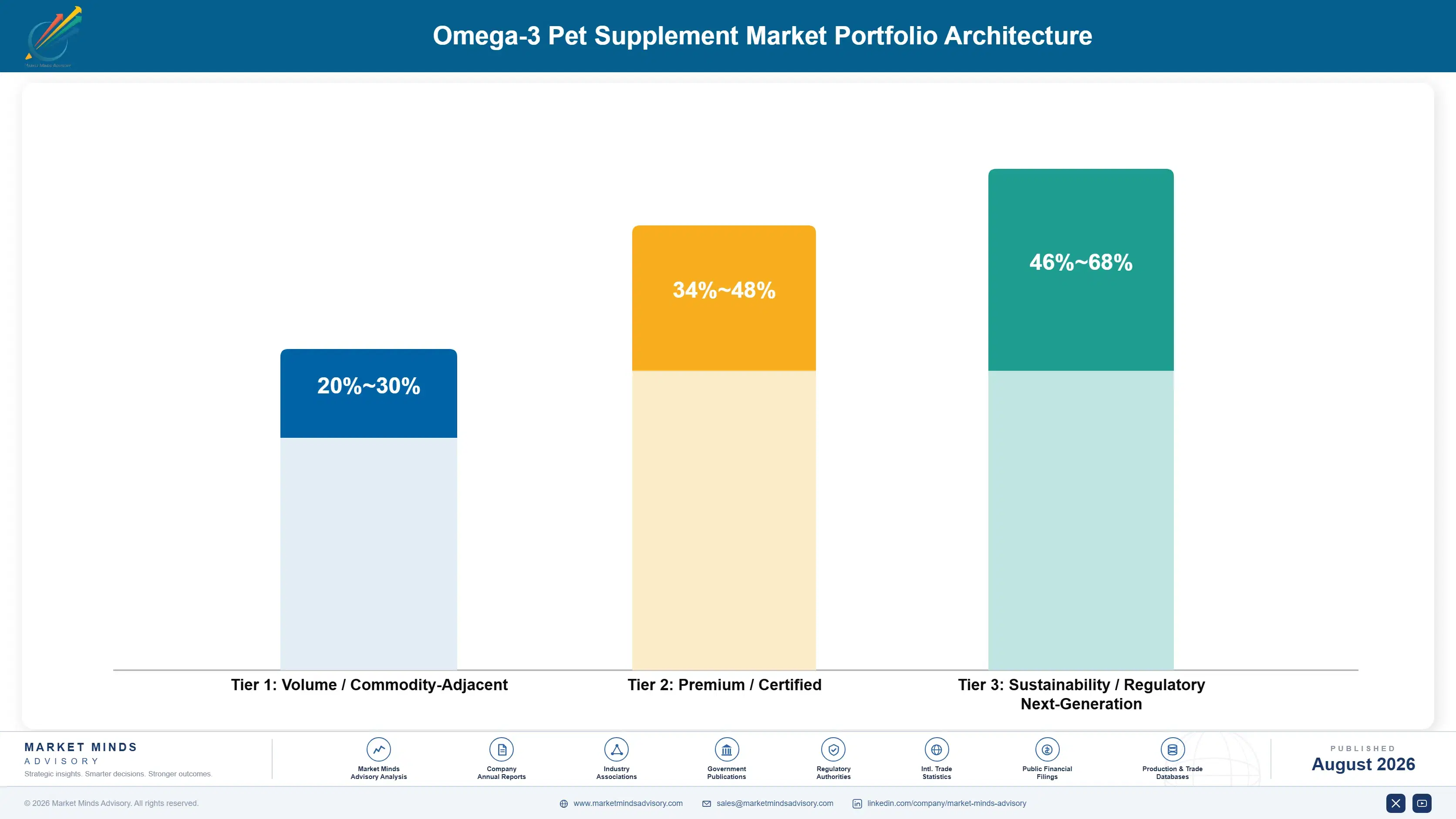
Portfolio Architecture for Margin Defence

Margin separates on oxidation control and channel rather than on ingredient sourcing, which is not how a supplement category usually behaves. Commodity fish oil in simple bottles runs at gross margins in the low twenties against private label and online sellers competing purely on concentration claims. Encapsulated and stabilised formats run considerably better. Functional treats run better again on palatability and format value. Veterinary therapeutic formulations run highest, because a clinical recommendation removes price comparison almost entirely from the purchase.
The tension is that commodity fish oil carries volume while stabilised formats and veterinary products earn the returns, and moving toward them requires encapsulation capability, palatability development or clinic detailing rather than any sourcing improvement. Manufacturers weighted toward retail fish oil face price competition from sellers whose product may well be oxidised and who compete on a number that does not measure efficacy at all.

High-value pools sit in veterinary therapeutic formulations, algal-based premium products and functional treats. Commodity retail fish oil is where the category damages its own reputation by delivering product that does not work. Owners who conclude supplements do not work rarely return to try again.

Volume / Commodity-Adjacent

Commodity fish oil supplements in simple bottles competing on concentration claims against private label and online sellers. The ten-point range separates manufacturers with contracted oil supply and basic stabilisation from those buying merchant oil and packaging it plainly.
Gross Margin: 20%-30%

Premium / Certified

Encapsulated and stabilised formats with oxidation control and functional treats carrying palatability development. The fourteen-point spread reflects encapsulation and treat manufacturing capability rather than any difference in the underlying omega-3 source.
Gross Margin: 34%-48%

Sustainability / Regulatory / Next-Generation

Veterinary therapeutic formulations with claim substantiation and algal-based premium products with contracted supply. The twenty-two-point range is wide because clinical evidence depth and supply security vary enormously between manufacturers and product ranges.
Gross Margin: 46%-68%
omega-3-pet-supplement-market-trends-portfolio-architecture-1787559438148

High-value Sub-segments and Strategic Watch-out

Veterinary Therapeutic Formulations

Clinical recommendation converts to repeat purchase around 3.6 times better than retail and removes price comparison almost entirely. Claim substantiation travels into markets where labelling rules restrict what packaging may say. Stopping feels like disregarding clinical advice, which is why these renew. Price comparison largely disappears.
Gross Margin: 48%-68%

Algal Premium Products

Compounding at 13.8% on supply predictability and palatability rather than on cost, at roughly 2.8 times fish oil per unit. Fermentation capacity replaces fishery quota as the constraint a manufacturer plans against. Contaminant concerns and marine odour both disappear alongside the quota exposure. Planning becomes possible again.
Gross Margin: 44%-60%

Functional Treat Formats

Growing at 10.2% because they solve compliance rather than dosing, making the supplement something the animal wants. Palatability development and treat manufacturing favour pet food companies over supplement specialists entirely. The animal asking for the dose beats any formulation improvement available. Manufacturing capability decides this.
Gross Margin: 34%-48%

Commodity Retail Fish Oil

The volume base, competing on concentration claims that peroxide testing would render meaningless. Manage this for supply contracting and basic stabilisation rather than for margin that price competition prevents. Silent failure here damages the whole category's reputation with owners. Concentration claims measure nothing useful at all here.
Gross Margin: 20%-30%

How Supplement Demand Renews

Demand renews on repeat purchase driven by whether the owner believes it is working, which makes this an unusually fragile annuity for something consumed daily. An animal that refuses the dose or an owner who sees no coat improvement simply stops buying, and neither outcome produces a complaint that reaches the manufacturer. Oxidised product destroys repeat purchase silently, and a category reputation for not working is usually earned.
Stickiness varies enormously by channel and by why the owner started. A supplement recommended by a veterinarian for a diagnosed condition renews as long as the condition persists, because stopping feels like disregarding clinical advice. A retail purchase made on packaging claims renews only while the owner remains convinced, which is rarely long. Treat formats renew better than oils because the animal asks for them, which is a compliance mechanism no formulation achieves.

The buyer profile has shifted from owner toward veterinarian in the segments that matter most. Supplements were bought by owners responding to shelf messaging about coat and joints. In therapeutic segments the veterinarian specifies and the owner executes, so marketing must persuade a clinician reading evidence.
omega-3-pet-supplement-market-trends-end-use-penetration-index-1787559438637

Where To Place The Bet

These are among the four positions where our research anticipates prominent divergence between winners and laggards over the coming forecast period. Each is grounded in the demand model, the regulatory perimeter, and the announced capacity pipeline.
01 / OXIDATION STATUS SELLING

Compete on peroxide value, not on concentration

Above roughly twenty milliequivalents of peroxide value the oil is simultaneously rancid enough for an animal to refuse and degraded enough that the health benefit has disappeared entirely, and around 22% of cats decline a dose at exactly that point. Milligram concentration claims mean nothing whatever against that reality. Manufacturers who specify, test and publish oxidation status differentiate on the single measure determining whether the product works at all, and veterinary buyers grasp that argument immediately even where retail shoppers never will.
02 / FISHERY INDEPENDENCE BUILDING

Buy predictability rather than cheaper omega-3

Aquaculture consumes 73% of world marine oil and pays more for it than any shelf-priced pet supplement can support, which leaves this entire category taking whatever remains after quota decisions nobody in it influences or even tracks. Algal oil costs around 2.8 times fish oil per unit of long chain fatty acid and removes that dependency completely. What a manufacturer purchases with the premium is fermentation capacity it can plan production against, rather than a fishery quota it can only hope about.
03 / COMPLIANCE FORMAT BUILDING

Make the dose something the animal wants

A supplement the animal refuses delivers precisely nothing regardless of what the formulation contains, and administering oil or capsules to a cat fails frequently enough that compliance rather than dosing limits real world results across the whole category. Functional treats and chews grow at 10.2% because they solve that problem rather than working around it. The capability required is palatability development and treat manufacturing, which favours pet food companies with existing lines and disadvantages supplement specialists who have never made anything an animal eats willingly.
04 / CLINICAL CHANNEL INVESTMENT

Persuade the vet, not the shopper

A clinical recommendation converts into sustained repeat purchase around 3.6 times more reliably than a retail shelf purchase does, because the owner has been told why the animal needs it rather than merely persuaded to try something new. Clinic detailing costs considerably more per contact and returns far more per converted owner over the relationship. Manufacturers organised entirely around grocery and pet specialty distribution are funding the channel that converts worst, usually because its results are simply easier to measure.

Engagement Snapshot From the Field

A live engagement with an industry participant carrying material or product regulatory and market exposure ahead of a defining policy shift, showing how our research translates into a defensible multi-year portfolio strategy.
MARKET MINDS ADVISORY · CLIENT ENGAGEMENT SUMMARY
Omega-3 Pet Supplement Producer Strategic Portfolio Review and Transition Roadmap 2026·Investment Scenario on Omega-3 Pet Supplement Exposure Evaluation 2025-26
CLIENT PROFILE
A North American pet supplement brand with annual revenue around USD 82 million (client-reported, unverified by MMA), selling omega-3 products through pet specialty retail and online channels. Fish oil was purchased on merchant terms. No algal supply existed. Veterinary channel presence was negligible across the business. Repeat purchase had been falling. Oxidation testing was factory only.
STRATEGIC CHALLENGE
Repeat purchase rates had fallen for two years while acquisition spending rose, and management proposed increasing concentration claims to differentiate on shelf. Nobody had tested whether product reaching customers was still within oxidation specification by the time it was consumed. Oxidation had never been tested at the point of consumption rather than at the factory.
MMA APPROACH
MMA tested peroxide value on product purchased from retail shelves across several regions and storage conditions rather than on factory samples. Repeat purchase was analysed against oxidation results by distribution route. Algal supply and veterinary channel economics were costed against the existing retail acquisition spending. Competitor clinic positions were mapped.
KEY FINDINGS
  1. Product purchased from warm-climate retail exceeded the oxidation threshold in a substantial share of samples, and repeat purchase in those regions was markedly worse than elsewhere.
  2. Raising concentration claims would have increased the oxidation load per dose without addressing the reason customers were not repurchasing, which was that the product had stopped working.
  3. Veterinary channel conversion economics were far better than the retail acquisition spending being increased, and no competitor held a strong clinic position in the client's product categories.
  4. Algal supply at roughly 2.8 times fish oil cost was affordable within existing premium pricing once retail promotional spending was redirected away from shelf discounting.
CLIENT PROFILE
A North American pet supplement brand with annual revenue around USD 82 million (client-reported, unverified by MMA), selling omega-3 products through pet specialty retail and online channels. Fish oil was purchased on merchant terms. No algal supply existed. Veterinary channel presence was negligible across the business. Repeat purchase had been falling. Oxidation testing was factory only.
STRATEGIC CHALLENGE
Repeat purchase rates had fallen for two years while acquisition spending rose, and management proposed increasing concentration claims to differentiate on shelf. Nobody had tested whether product reaching customers was still within oxidation specification by the time it was consumed. Oxidation had never been tested at the point of consumption rather than at the factory.
MMA APPROACH
MMA tested peroxide value on product purchased from retail shelves across several regions and storage conditions rather than on factory samples. Repeat purchase was analysed against oxidation results by distribution route. Algal supply and veterinary channel economics were costed against the existing retail acquisition spending. Competitor clinic positions were mapped.
KEY FINDINGS
  1. Product purchased from warm-climate retail exceeded the oxidation threshold in a substantial share of samples, and repeat purchase in those regions was markedly worse than elsewhere.
  2. Raising concentration claims would have increased the oxidation load per dose without addressing the reason customers were not repurchasing, which was that the product had stopped working.
  3. Veterinary channel conversion economics were far better than the retail acquisition spending being increased, and no competitor held a strong clinic position in the client's product categories.
  4. Algal supply at roughly 2.8 times fish oil cost was affordable within existing premium pricing once retail promotional spending was redirected away from shelf discounting.
RECOMMENDED STRATEGY
Phase 1: Phase one: abandon the concentration claim proposal and invest instead in encapsulation and barrier packaging suited to warm-climate distribution conditions. Phase 2: Phase two: contract algal supply for the premium range, funding the cost premium by redirecting retail promotional spending rather than raising shelf price. Phase 3: Phase three: build veterinary clinic detailing capability, since conversion economics there considerably exceed the retail acquisition spending currently being increased.
OUTCOME
Packaging changes lifted repeat purchase materially in the affected regions within two quarters. Algal supply now covers the premium range and is funded from redirected promotional budget. Veterinary detailing has begun in two regions, and the client reports acquisition cost falling as retention improved (client-reported, unverified by MMA).

Frequently Asked Questions

Foundational context covering the market sizes, CAGR, scope, country, region and competition that inform every finding below. This section is provided to cover basics and most often pre-purchase conversations, answered from the MMA Primary Research Dataset.

What is the current size of the Omega-3 Pet Supplement Market?

The market was valued at USD 1.34 billion in 2025, rising to an estimated USD 1.46 billion in 2026. North America holds the largest regional share at 38% of value.

How large will the Omega-3 Pet Supplement Market be by 2036?

MMA forecasts USD 3.53 billion by 2036 under the base case, an expansion multiple of 2.41 times the 2026 value. That represents USD 2.07 billion of incremental value.

What is the CAGR for the Omega-3 Pet Supplement Market 2026 to 2036?

The base case runs at 9.2% compound annual growth between 2026 and 2036, with a bull case at 10.4% and a bear case at 8.0%. Historical growth from 2020 to 2025 was 8.0%.

Which segment is growing fastest?

Algal oil supplements lead at 13.8%, half again the market rate, escaping a fishery where aquaculture takes 73% of supply. Functional treats follow at 10.2%.

Who are the major companies in the Omega-3 Pet Supplement Market?

Nestlé Purina PetCare, Mars, Zoetis, Nutramax Laboratories and Virbac hold 32% of the market. Palatability capability and veterinary access rather than sourcing sustain those positions.

Which country is growing fastest?

China leads at 12.8%, driven by urban household pet ownership rising quickly and by spending per animal climbing faster still across those same urban households.

Report Segmentation Architecture

The full report scope spans multiple orthogonal segmentation dimensions, with cross-tabulated demand data provided for each dimension pair. Coverage extends further to regional breakdowns, trend trajectories, and the competitive detail needed to support segment-level decision-making.

By Source and Format

  • Fish Oil Supplements
  • Krill Oil Supplements
  • Algal Oil Supplements
  • Blended and Fortified Formats
  • Functional Treats and Chews
  • Therapeutic Veterinary Formulations

By End-Use Industry

  • Canine Joint and Mobility
  • Feline Renal and Urinary Support
  • Skin and Coat Health
  • Cognitive and Senior Care
  • Cardiovascular and Inflammatory Support
  • General Wellness Supplementation

By Distribution Channel

  • Veterinary Clinic Supply
  • Pet Specialty Retail
  • Grocery and Mass Retail
  • Online and Subscription
  • Breeder and Professional Channel

By Region

  • North America
  • Western Europe
  • East Asia
  • South Asia and Pacific
  • Latin America
  • Middle East and Africa
  • Eastern Europe

Scope, Methodology, and Coverage

Every figure in this report is reproducible from documented input assumptions. The scope below maps the historical period, the forecast horizon, the segmentation dimensions, and the countries covered, alongside the underlying primary and qualitative methodology.
Historical Period
2020 to 2025
Forecast Period
2026 to 2036
Base Year
2025 (USD billions; MMA Primary Research Dataset, August 2026)
Market Definition
The market comprises omega-3 supplements formulated for companion animals, including fish oil supplements, krill oil supplements, algal oil supplements, blended and fortified formats, functional treats and chews, and therapeutic veterinary formulations, distributed through veterinary clinic, pet specialty, grocery, online and professional channels. Value is measured at manufacturer level across retail and veterinary sales. Complete pet foods where omega-3 is a formulation component rather than a marketed supplement, human omega-3 products, marine oils sold as bulk ingredients to formulators, livestock and aquaculture feed supplements, and veterinary pharmaceuticals fall outside scope.
Quantitative Units
USD billions (current prices); units sold and tonnes of active supplied; USD per unit by source and format
Segmentation Dimensions
By Source and Format; By End-Use Industry; By Distribution Channel; By Region
Regions Covered
North America, Western Europe, East Asia, South Asia and Pacific, Latin America, Middle East and Africa, Eastern Europe
Countries Covered
United States, Canada, Mexico, Brazil, Argentina, Chile, Colombia, Germany, United Kingdom, France, Netherlands, Sweden, Norway, Italy, Spain, Poland, Czechia, Hungary, China, Japan, South Korea, Taiwan, India, Thailand, Singapore, Australia, New Zealand, United Arab Emirates, Saudi Arabia, South Africa
Key Companies Profiled
Nestlé Purina PetCare, Mars, Zoetis, Nutramax Laboratories, Virbac, Vetoquinol, Elanco, DSM-Firmenich, Corbion, Veramaris, Aker BioMarine, KD Pharma, Croda, Kemin Industries, Standard Process, VetriScience, Zesty Paws, NaturVet, Pet Honesty, Alltech
Quantitative Methodology
Primary survey, n=3,800 respondents, Q4 2025, six countries; demand-side model with trade association cross-validation
Qualitative Methodology
47 expert interviews, Q4 2025; applied to validate demand model assumptions, identify emerging dynamics, and assess competitive positioning
Report Format
PDF and XLSX data workbook (Word format preview document)
Publisher
Market Minds Advisory
Report Code
MMA-2026-HLT-098
Published
August 2026
Contact
sales@marketmindsadvisory.com | www.marketmindsadvisory.com

Purchase the full Omega-3 Pet Supplement Market Report (2026 to 2036).

The full report sizes the global omega-3 pet supplement market to 2036 across six sources and formats and seven regions, measured at manufacturer level across retail and veterinary sales. It treats oxidation control as the actual product being sold rather than as a formulation detail, and models this category as a residual claimant on a fishery that aquaculture dominates. Competitive analysis covers 20 manufacturers on one consistent revenue basis, with moat and risk assessment for the two leaders. Channel conversion economics are quantified across veterinary and retail routes. Four quantified revenue levers close the analysis.
Six source and format segments with individual growth rates
Oxidation control modelled as the determinant of product efficacy
Marine oil supply exposure quantified against aquaculture demand
Veterinary and retail channel conversion economics compared directly
Twenty-manufacturer competitive map on one consistent revenue basis
Four quantified revenue levers with commercial impact ranges

Built For The People Who Decide

From boardroom strategy to bench-side execution, this report is read cover-to-cover by leaders shaping the next decade of their industry, turning demand scenarios, market dynamics and valuation benchmarks into decisions.
CXOs/ Presidents/ VPs/ Managers
M&A and Corporate Development
Strategy Teams and R&D Heads
Procurement and Product Directors
Regulatory and Compliance Leaders
Investor Relations and Equity Analysts