Market Minds Advisory
Oil & Gas Terminal Automation Market

Oil & Gas Terminal Automation Market: OT Cybersecurity and the Digital Terminal Transition

Rising export terminal throughput and tightening custody transfer accuracy requirements are pushing operators toward fully digital tank gauging, while escalating OT cyber threats against energy infrastructure increasingly determine which automation platforms win new terminal contracts.

Lead Analyst

David Horsley

Published

September 2026

Make Smarter Decisions with Customized Research Insights

Request a free sample report and evaluate market opportunities, growth trends, and competitive dynamics relevant to your business needs.

2025 MARKET VALUE$5.6BMarket Size 2025
2036 FORECAST VALUE$14.2BBase Case , 2026 to 2036
CAGR 2026 TO 20368.8 %Bull 10.0% / Bear 7.5%
INCREMENTAL OPPORTUNITY$8.1BNet 10- year value creation
EXPANSION MULTIPLE2.33x2036 value over 2026 base
Strategic Levers
M&A Pipeline
Regional Outlook
Country Rankings
Competitive Intelligence
Segmental Deep-dive
Call-Us : 91 93563 13602

Executive Snapshot and Market Trajectory

Terminal automation has shifted from a back-office efficiency upgrade to a frontline safety and cybersecurity decision. Terminal operators now weigh OT network protection as heavily as tank gauging accuracy, and capital committees increasingly route automation spending through corporate cybersecurity budgets rather than plant-level instrumentation line items alone.
OT cybersecurity and network protection systems are growing at roughly 1.5x the market average as terminal operators respond to a wave of publicized attacks against energy infrastructure and tightening regulatory reporting mandates. North America retains the largest revenue base on Gulf Coast export terminal buildout, while the Middle East has emerged as a disproportionately large market given the region's concentration of the world's largest national oil company terminal investment programmes.
Competitive intensity concentrates among five diversified automation vendors that increasingly bundle tank gauging, loading automation, and cybersecurity into a single terminal management platform, leaving smaller instrumentation specialists to compete on price for standalone gauging hardware. Custody transfer accuracy certification and platform cybersecurity credentials, not raw sensor specifications alone, increasingly determine which vendors win multi-terminal operator framework contracts. Insurers are beginning to price terminal risk premiums partly around demonstrated OT security posture, a underwriting shift few operators anticipated even three years ago.
Market Definition
The oil and gas terminal automation market covers hardware and software systems that automate tank inventory management, custody transfer metering, loading and unloading operations, and terminal-level process control across petroleum, petrochemical, and LNG storage and distribution terminals. It includes tank gauging instrumentation, SCADA and terminal management software, and OT cybersecurity systems sold as part of a terminal automation package. Pipeline transmission SCADA sold apart from terminal operations is excluded.
Base Year Value
$5.6B in 2025 (MMA Primary Research Dataset, August 2026)
Forecast Period
2026 to 2036, eleven discrete annual values
CAGR
8.8% base case. Bull 10.0%. Bear 7.5%.
Fastest Growth Segment
OT Cybersecurity and Network Protection Systems: 13.5% CAGR
Fastest Growth Country
India: 12.8% CAGR
Fastest Growth Region
South Asia and Pacific: 11.0% CAGR
Largest Region
North America: 24% of 2025 global value
Market Leaders
Honeywell, Emerson Electric, ABB, Yokogawa Electric, Schneider Electric. Source: MMA Analysis based on company annual reports.
Primary Survey
n=3,800 procurement and R&D decision-makers, Q4 2025, six countries
Methodology
Demand-side build-up, cross-validated against public data, 47 expert interviews

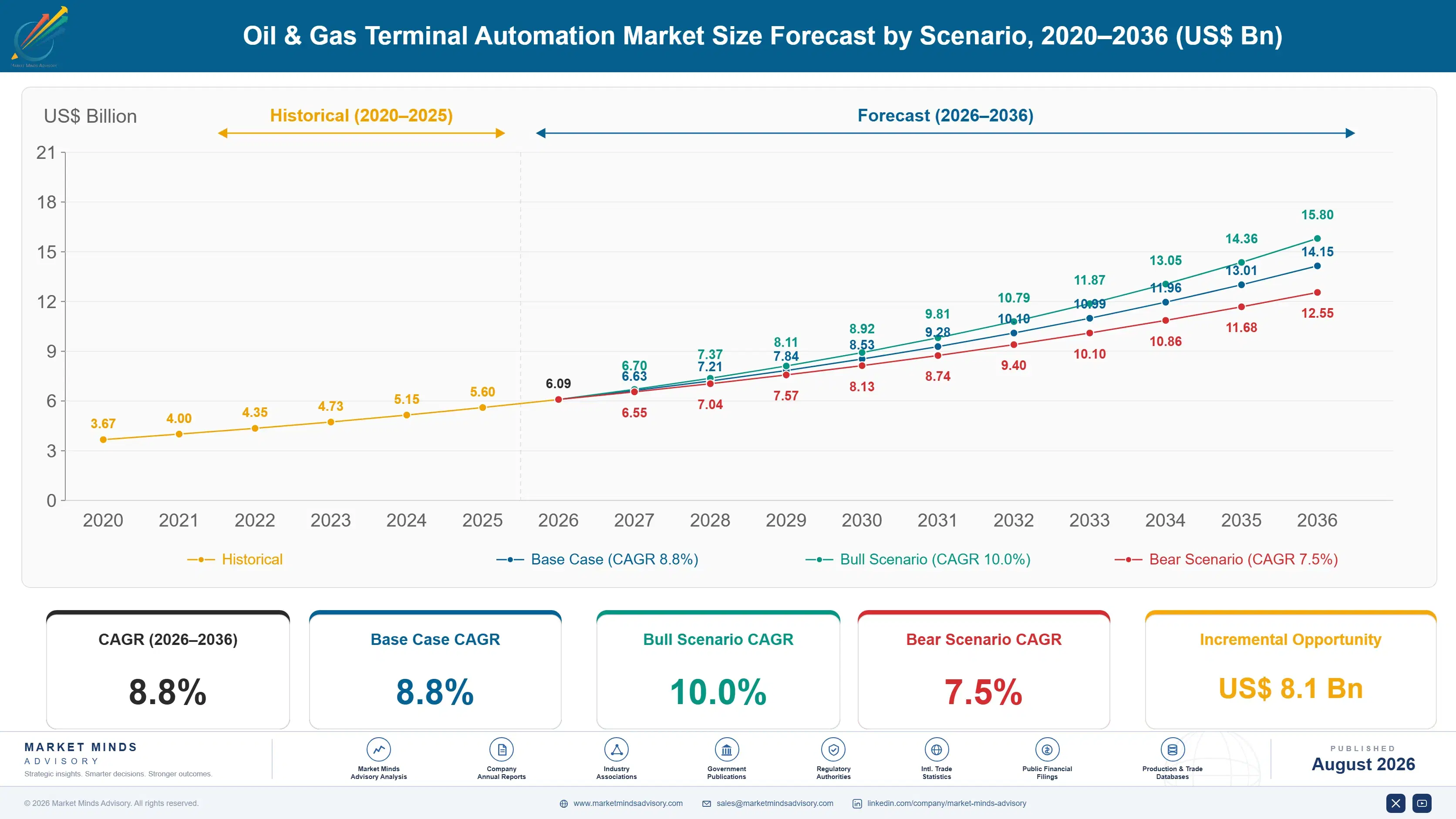
Oil & Gas Terminal Automation Market Forecast Scenarios

oil-gas-terminal-automation-market-size-forecast-scenario-1787303088135
Between 2020 and 2025 the market grew at an estimated 7.8% historical CAGR, recovering from pandemic-era capital deferrals before accelerating as export terminal construction and refining capacity additions resumed across major producing regions. High-profile OT cyberattacks against energy infrastructure from 2021 onward pushed cybersecurity spending into terminal automation budgets faster than prior planning cycles anticipated.
The base case assumes 8.8% CAGR through 2036, anchored in three mechanisms: export terminal capacity expansion across North America, the Middle East, and Asia requiring new automation and metering infrastructure from commissioning, tightening custody transfer accuracy regulation pushing operators toward certified digital gauging, and OT cybersecurity mandates extending into mid-sized terminal operators previously exempt from strict reporting requirements. Terminal management software consolidation adds a reinforcing tailwind as operators standardize platforms across multi-site portfolios rather than running isolated site-level systems.
A bull scenario, near 10.0% CAGR, assumes faster LNG export capacity buildout and accelerated cybersecurity mandate rollout pull automation orders forward. The bear case, near 7.5%, assumes energy capital spending slows amid commodity price weakness and operators extend aging automation systems by two to three years rather than replacing them on the standard equipment cycle.

Cybersecurity Mandates Reshape Terminal Capital Priorities

Three forces are converging on terminal automation demand simultaneously: export capacity expansion requiring new automation infrastructure from first commissioning, an OT cybersecurity mandate wave extending regulatory reporting requirements to a broader population of mid-sized terminal operators, and a generational replacement cycle among analog and early-digital gauging systems installed during the 2000s capital cycle. Operators that once bought tank gauging as an isolated instrumentation pur
MARKET CONCENTRATION58%Combined revenue share held by top five automation vendors
TERMINAL PLATFORM ASP$2.4MBlended selling price for a standard multi-tank terminal package
REPLACEMENT CYCLE12-15 yrsTypical service life before mandated system replacement occurs
CYBERSECURITY ATTACH RATE34%Share of new terminal contracts including integrated OT protection
TOP DEPLOYMENT COUNTRYUnited StatesLeading country for automated terminal installation volume today
CUSTODY TRANSFER ACCURACY0.15%Typical deviation tolerance required under certified metering standards
Commercially, the category increasingly resembles a long-term platform relationship bundled around cybersecurity assurance rather than a one-time hardware sale. Terminal operators commit to multi-year platform and monitoring agreements spanning gauging, metering, and network protection, since fragmenting these functions across multiple vendors creates security seams that a unified platform avoids by design across the full terminal footprint.
Over the next decade, expect OT cybersecurity to keep gaining share within the broader automation budget as regulatory mandates tighten further, continued consolidation among smaller instrumentation vendors unable to fund cybersecurity certification programmes, and growing scrutiny of custody transfer accuracy as digital trading platforms demand tighter measurement tolerances than legacy physical settlement processes required.
"Buyers used to ask how accurately a tank gauge could measure product level. Now the first question is whether that gauge's network connection could become the entry point for an attacker, because that risk now sits on the board's agenda, not just the plant manager's."
Director, Energy Infrastructure and Industrial Automation Practice · MMA Industr

Market Trends

OT Cybersecurity Becomes a Core Terminal Design Requirement

Terminal operators are increasingly specifying OT network protection and intrusion detection as a mandatory design requirement from the earliest engineering phase of a new terminal project, rather than layering security onto an already-commissioned automation system as a later retrofit. Each new terminal automation contract increasingly requires vendors to demonstrate specific cybersecurity certifications and incident response capability alongside traditional gauging accuracy specifications, a qualification bar that did not exist for most vendors a decade ago. Operators report insurers are independently tightening underwriting around demonstrated OT security posture, giving owners a direct incentive to prioritize cybersecurity investment beyond compliance alone.
Market Impact: Adds 210 new terminal berths yearly
Digital Custody Transfer Displaces Manual Gauging Processes

Terminal operators are increasingly replacing manual tank dipping and paper-based custody transfer processes with certified digital gauging and automated ticketing systems that reduce measurement disputes and speed transaction settlement between counterparties. Each digital custody transfer installation typically eliminates hours of manual measurement and reconciliation work per transaction, a labor saving operators increasingly value as skilled terminal staffing becomes harder to recruit and retain across major hub locations. Terminal operators completing digital custody transfer upgrades report meaningfully reduced measurement disputes with counterparties, reinforcing digital gauging as the standard specification across new and upgraded terminal capacity.
Market Impact: Covers 1,800 additional terminal si

Market Opportunities and Growth Drivers

Global Export Terminal Capacity Expansion Drives New Installations

LNG and refined product export terminal construction across North America, the Middle East, and Asia is expanding the addressable base for terminal automation well beyond the replacement demand that dominated the category in prior decades, since each new terminal requires a full automation and metering package from first commissioning. Every new export train or berth typically adds a proportional volume of gauging, metering, and loading automation demand tied directly to committed export capacity under long-term offtake agreements. Vendors with established relationships on prior phases are capturing outsized share of subsequent phases, since operators prefer platform continuity over a second vendor mid-project.
Market Impact: Extends retrofit 6 to 10 months

Tightening Custody Transfer Accuracy Regulation Drives Upgrades

Regulators and commodity exchanges across major trading hubs are increasingly tightening custody transfer accuracy tolerances, pushing operators still running older analog gauging systems toward certified digital alternatives capable of demonstrating tighter measurement precision under audit. Operators report that failing a custody transfer accuracy certification can suspend a terminal's ability to participate in certain trading arrangements entirely, a commercial consequence far more costly than the certified equipment upgrade itself. This regulatory pressure is pulling forward equipment replacement decisions that might otherwise have waited for the next capital cycle, since operators view certification readiness as justifying earlier deployment.
Market Impact: Erodes 6% of entry tier margin

Market Restraints and Challenges

High Integration Complexity Slows Brownfield Retrofit Projects

Retrofitting cybersecurity and digital gauging capability into an operating terminal built decades ago requires integrating new systems with legacy control infrastructure never designed with modern network segmentation or digital interoperability in mind, and the root cause is that many legacy systems use proprietary protocols poorly documented by their original vendors. The commercial impact falls hardest on operators of older terminal assets, since integration engineering and testing can extend a retrofit timeline well beyond the original schedule and budget. Vendors are mitigating this by developing standardized protocol translation gateways and phased retrofit programmes.
Market Impact: Adds 13.5% CAGR to cybersecurity se

Price Competition From Regional Vendors Compresses Entry Tier Margins

Lower cost regional automation vendors, particularly across China and India, are undercutting established brands on basic tank gauging and standard SCADA packages by a meaningful margin, and the root cause is a combination of lower engineering labor cost and simpler product designs that skip advanced cybersecurity certification many smaller operators do not yet require. The commercial impact falls hardest on entry tier hardware sales, since price sensitive regional operators increasingly substitute lower cost systems for basic gauging tasks. Established vendors are mitigating this by shifting focus toward certification credentials and service network density rather than matching import pricing.
Market Impact: Cuts measurement disputes by roughl
3 additional market trends, 3 additional growth drivers, and 2 additional restraints and challenges are covered in the full report. Contact sales@marketmindsadvisory.com to access the complete intelligence.

Segment CAGR and Growth Architecture

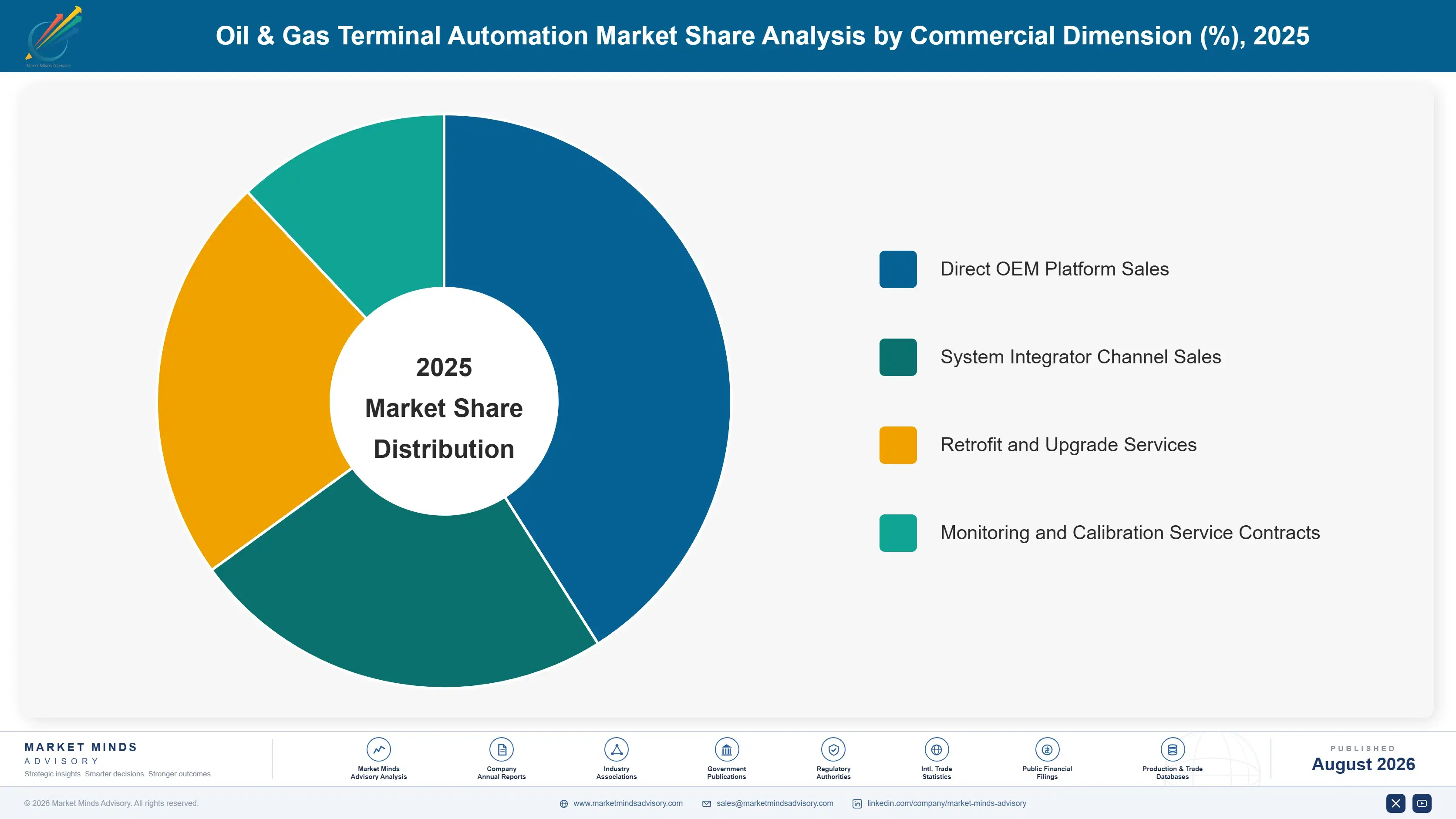
Segmentation follows automation system type, the single dimension terminal operators specify against when designing a new terminal or planning an upgrade programme. Tank gauging, terminal management software, custody transfer metering, loading automation, and OT cybersecurity systems each serve a distinct function, keeping instrumentation hardware and software dimensions separate across every terminal type, application, and commercial channel served.
oil-gas-terminal-automation-market-market-share-analysis-1787303088694

OT Cybersecurity and Network Protection Systems

OT cybersecurity systems protect terminal control networks and connected instrumentation from unauthorized access and cyberattack, spanning network segmentation, intrusion detection, and secure remote access management purpose-built for industrial control environments rather than adapted from generic IT security products. Adoption is concentrated among operators of large export terminals and critical national infrastructure sites facing the strictest regulatory reporting mandates and the highest publicized attack risk. Growth outpaces the broader market by roughly 1.5x as regulatory mandates extend to mid-sized operators previously exempt from strict security requirements. Vendors with proven incident response records and industrial protocol expertise are capturing outsized share, since qualifying a new vendor for a critical terminal requires validation most operators are reluctant to repeat without reason.
CAGR 13.5%

Loading and Unloading Automation Systems

Loading and unloading automation systems manage truck, rail, and marine vessel loading operations automatically, coordinating flow rates, safety interlocks, and transaction documentation without manual operator intervention at each connection point. Adoption is concentrated among high-throughput terminals where automated loading meaningfully reduces truck turnaround time and improves loading bay utilization across peak demand periods. Growth remains strong as operators seek to reduce labor dependency amid persistent skilled terminal staffing shortages across major hub locations. Terminal operators completing loading automation upgrades report meaningfully reduced average truck turnaround time alongside improved safety incident rates, reinforcing automated loading as the standard specification across new and expanded terminal capacity, including several recently commissioned export berths.
CAGR 11.5%
Full segment breakdown across 5 segments available in the complete report.

Regional Architecture and Country Demand Map

North America retains the largest revenue base on Gulf Coast export terminal buildout, while the Middle East has emerged as a disproportionately large market given the region's concentration of the world's largest national oil company terminal investment programmes underway today across multiple Gulf countries.

North America

United States Gulf Coast LNG and refined product export terminal construction, concentrated across Texas and Louisiana, anchors the region's leading revenue base as operators commission new terminal capacity with full automation and cybersecurity packages specified from the outset. Canadian west coast LNG export development continues adding incremental terminal automation demand tied to new pipeline and export infrastructure reaching commercial operation. Regulatory reporting mandates for critical energy infrastructure cybersecurity are accelerating retrofit spending across the region's large installed base of older terminal assets built before modern OT security standards existed. Growth trails East Asia because the region's terminal base is already comparatively mature, meaning much of current demand reflects retrofit and cybersecurity upgrade rather than first-time installation.
Share: 24% | CAGR: 9.5% (2026 to 2036)

Western Europe

German and Dutch petrochemical and refined product terminals, concentrated around Rotterdam and the broader ARA trading hub, sustain steady demand for both digital custody transfer and cybersecurity retrofit tied to some of the world's strictest terminal safety and security regulation. United Kingdom and French terminal operators continue expanding automation investment tied to tightening emissions monitoring requirements increasingly integrated into terminal management platforms. Regional automation vendors, including several leading European instrumentation brands, maintain strong domestic penetration built on decades of precision metering engineering leadership. Regional growth trails the global rate as the market's already high penetration of digital gauging and cybersecurity systems limits the incremental upside further regulatory tightening alone can provide relative to less mature markets elsewhere in the forecast.
Share: 18% | CAGR: 7.2% (2026 to 2036)
Regional intelligence for 5 additional markets available in the complete report: East Asia, South Asia and Pacific, Latin America, Middle East and Africa, Eastern Europe. Contact sales@marketmindsadvisory.com.
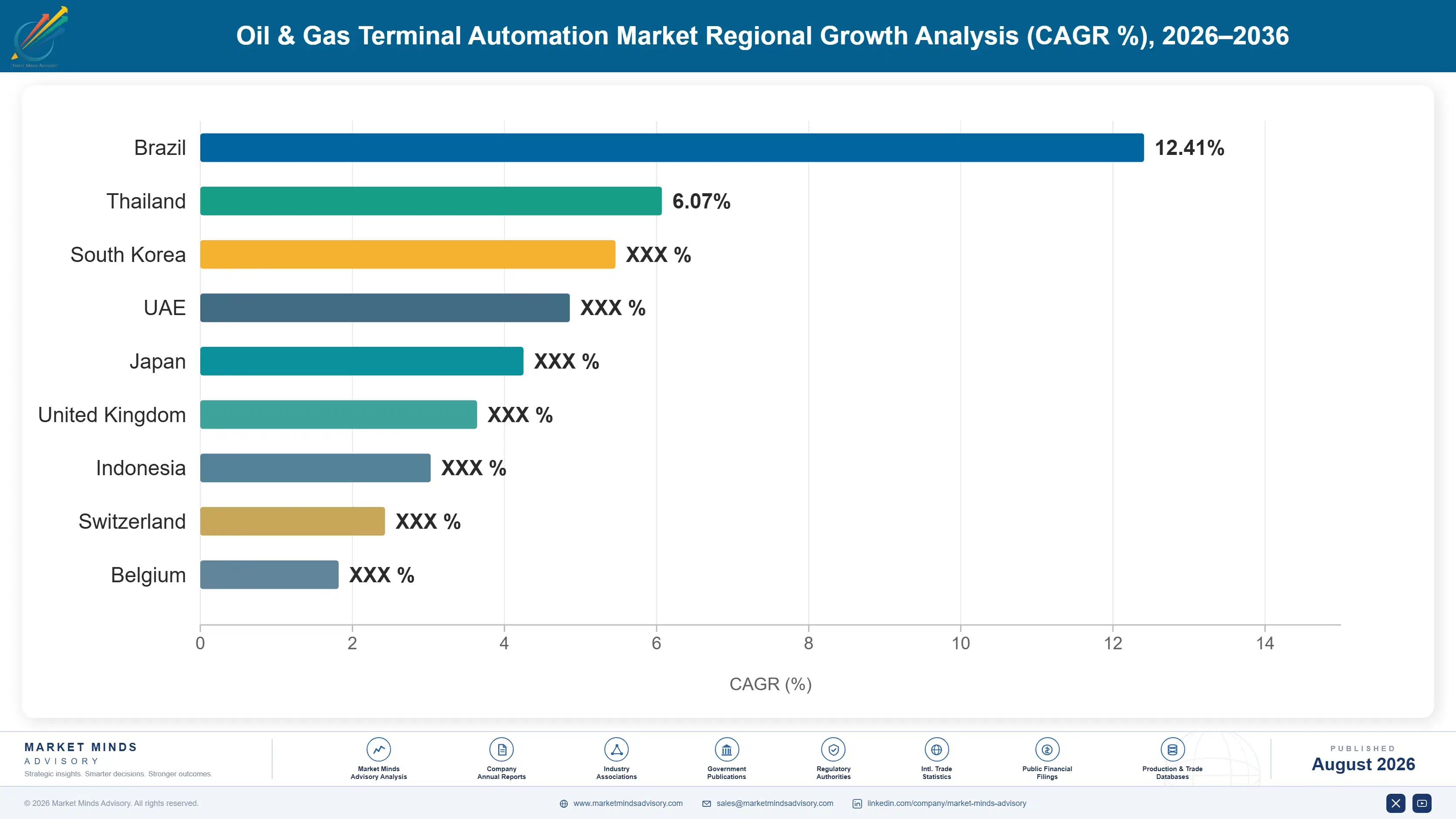
oil-gas-terminal-automation-market-country-cagr-analysis-1787303089212

Monetizing Cybersecurity Assurance and Platform Contracts

Vendors are shifting commercial models toward cybersecurity monitoring subscriptions, calibration service contracts, and multi-terminal platform agreements rather than one-time hardware sales, since operator demand for security assurance and platform continuity now rivals raw gauging accuracy as a purchase criterion. This mirrors a broader shift across industrial automation toward relationship-based commercial structures rather than transactional annual pricing.

Continuous OT Threat Monitoring Subscription Services

Vendors are increasingly selling continuous OT network monitoring subscriptions that provide round-the-clock threat detection and incident response across a terminal's automation network, converting what was historically a one-time security assessment into recurring annual revenue tied directly to the size of an operator's connected terminal footprint. Vendors report subscription attach rates above 44% among operators of large export terminals facing the strictest regulatory reporting mandates, with renewal rates exceeding 85% once an operator experiences a full year of documented threat detection value. This service layer increasingly determines vendor selection ahead of raw hardware pricing during large terminal contract negotiations.
Market Impact: Lifts recurring revenue share to ro

Scheduled Calibration and Certification Renewal Contracts

Vendors are increasingly bundling scheduled calibration visits and custody transfer certification renewal into multi-year service contracts, converting a previously ad hoc compliance task into predictable recurring revenue while reducing the risk of a lapsed certification interrupting an operator's ability to trade. Contracts typically include priority response commitments ahead of scheduled audits, a service level that meaningfully reduces the risk of a costly certification failure during peak trading periods. Vendors report calibration contract attach rates rising fastest among multi-terminal operators managing dozens of connected sites, with roughly 41% of new platform contracts now including bundled certification renewal.
Market Impact: Adds $48,000 per terminal in annual

Offering Legacy System Cybersecurity Retrofit Packages

Vendors are increasingly offering retrofit packages that add network segmentation and intrusion detection to existing legacy automation systems without requiring a full platform replacement, giving operators a lower cost path to regulatory compliance and security assurance. This retrofit path typically costs meaningfully less than a full platform replacement while still delivering most of the security benefit, with retrofit orders now representing roughly 23% of total cybersecurity segment revenue. Vendors report retrofit attach rates rising fastest among operators of older terminal assets facing new regulatory reporting deadlines without budget for a complete system overhaul.
Market Impact: Cuts retrofit capital cost by rough

Structuring Multi-Terminal Platform Standardization Agreements Jointly

Vendors are increasingly structuring multi-year platform standardization agreements that extend a single automation and cybersecurity platform across an operator's entire terminal portfolio rather than negotiating each site independently, giving operators consistent training, spare parts, and security posture across all locations. Operators report cost of ownership reductions of roughly 18% once platform standardization eliminates the redundant vendor management overhead multiple incompatible systems previously required. Vendors with proven multi-site deployment track records spanning at least 40 terminals are capturing outsized share of these portfolio-wide agreements ahead of competitors offering only single-site relationships.
Market Impact: Cuts portfolio-wide operating cost

Who Controls the Margin Pool

The top five vendors hold roughly 58% combined share, a meaningfully high concentration reflecting both the engineering complexity of integrated terminal platforms and the cybersecurity certification barrier that keeps smaller instrumentation specialists confined to standalone hardware sales. The gap between the leading platform vendors and smaller regional builders is widening as operators increasingly restrict bid eligibility to vendors with demonstrated cybersecurity credentials.
Current competitive activity centers on three fronts: OT cybersecurity certification and incident response capability, multi-terminal platform standardization for large operator portfolios, and digital custody transfer accuracy improvements meeting tightening exchange requirements. Several regional vendors are pursuing partnerships with dedicated cybersecurity software providers rather than building detection capability in house, a faster but margin-diluting route to feature parity with established vendors' integrated platforms.

Emerging pressure comes from Chinese and Indian vendors moving up the value chain from basic gauging hardware into integrated platforms sold initially to domestic operators but increasingly targeting export markets as certification credentials accumulate. Rankings among the top five could shift if a leader fails to close its cybersecurity credential gap, since operators increasingly evaluate platform completeness ahead of individual gauging accuracy specifications during large terminal contract decisions.
oil-gas-terminal-automation-market-company-positioning-matrix-1787303089763

Competitive Moat and Risk Dimensions

HONEYWELL

Moat: Integrated platform breadth

Honeywell's combination of tank gauging, terminal management software, and industrial cybersecurity under a single platform gives it a design-in advantage with operators seeking one accountable vendor relationship rather than piecemeal sourcing across multiple specialized suppliers. That platform advantage compounds with every additional connected terminal a customer adds.
HONEYWELL

Risk: Slower specialist responsiveness

Honeywell's scale and organizational complexity can slow its response to niche gauging application requests that smaller specialist vendors serve more quickly, occasionally costing it accounts among operators prioritizing rapid custom engineering support over full-platform integration convenience. That responsiveness gap is unlikely to close soon without a dedicated small-account service tier.
EMERSON ELECTRIC

Moat: Deep custody transfer expertise

Emerson's decades of accumulated custody transfer metering expertise give it durable credibility among operators who weigh certified measurement accuracy heavily, since qualifying a new metering vendor without comparable field history carries meaningful commercial and regulatory risk. That expertise compounds with every additional certified installation Emerson completes.
EMERSON ELECTRIC

Risk: Cybersecurity portfolio still maturing

Emerson's cybersecurity product portfolio remains comparatively less mature than dedicated OT security specialists, occasionally requiring it to partner with third-party providers for the most demanding critical infrastructure contracts rather than offering a fully native solution built entirely in house, ceding some margin to its partners.

Players Tracked

Prominent Players

Honeywell
Emerson Electric
ABB
Yokogawa Electric
Schneider Electric

Other Key Players

Rockwell Automation
Siemens
Endress+Hauser
Krohne
Franklin Fueling Systems
Varec Inc
Motherwell Tank Gauging
Scully Signal Company
Whessoe
OMNI Flow Computers
TechnipFMC
Bartec Group
MTS Systems
BinMaster
L&J Engineering

Recent Developments

OCTOBER 2025

Honeywell Launches Integrated OT Threat Detection Platform for Terminals

Honeywell introduced an upgraded OT threat detection platform purpose-built for terminal automation networks, integrating real-time anomaly detection directly into its existing terminal management software suite across connected sites. The launch targets large export terminal operators seeking centralized security visibility across previously fragmented monitoring systems already in place.
Signal: Confirms cybersecurity integration remains
JANUARY 2026

Emerson Signs Multi-Year Platform Agreement With Gulf State Operator

Emerson signed a multi-year terminal automation and calibration service agreement with a major Gulf state national oil company, covering equipment supply and certification services across several export terminal facilities. The agreement is a supply arrangement rather than a joint venture or acquisition, extending Emerson's Middle East market presence.
Signal: Highlights service contract bundling as th
APRIL 2026

ABB Acquires Industrial Cybersecurity Detection Startup

ABB completed the acquisition of a privately held industrial cybersecurity detection startup, adding specialized OT network monitoring and anomaly detection capability to its existing terminal automation portfolio and engineering team. The deal strengthens ABB's positioning to compete against leading cybersecurity-integrated platforms across major terminal markets worldwide.
Signal: Signals continued consolidation of special

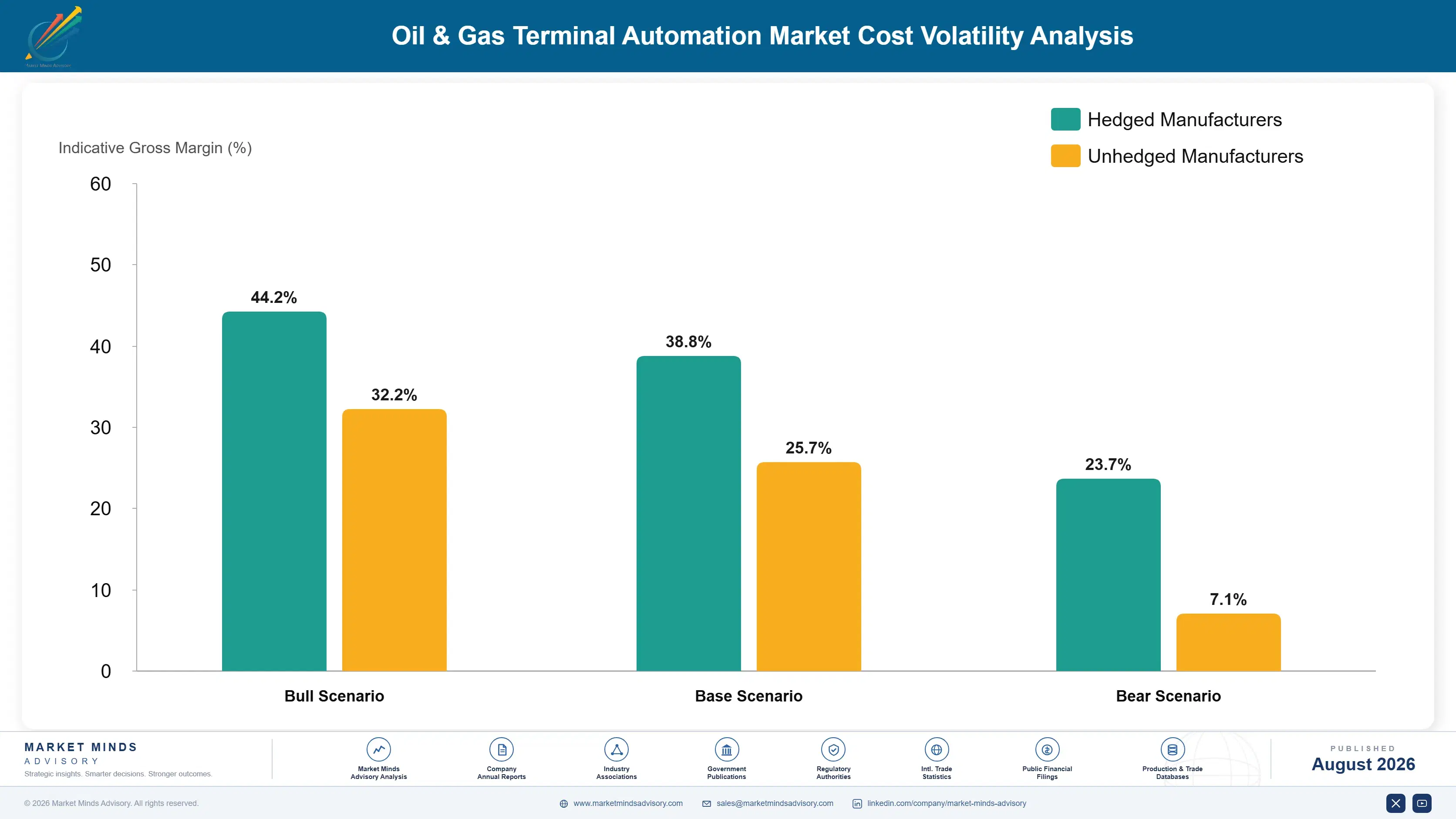
Sensor Hardware and Software Licensing Exposure

Precision radar and servo gauging sensors, industrial computing hardware, and cybersecurity software licensing together represent an estimated 40 to 50% of terminal automation platform cost of goods sold. Sensor component supply remains concentrated among a small number of specialty precision instrument manufacturers, creating a narrower supply base than most broader industrial electronics categories rely upon.
Semiconductor component shortages during 2021 and 2022 delayed industrial computing hardware production broadly, and several vendors flagged the disruption in annual reports as a persistent cost pressure affecting multiple industrial automation categories simultaneously. Several vendors disclosed that precision radar sensor lead times stretched beyond eighteen weeks during the tightest period, forcing some terminal automation makers to delay platform delivery or substitute costlier secondary market components to maintain commitments to committed terminal construction schedules.

Smaller regional vendors carry disproportionate exposure to these input swings since they lack the purchasing scale to negotiate multi-year fixed pricing directly with sensor and semiconductor suppliers that the top five vendors secure. This gap is widest for vendors dependent entirely on third-party cybersecurity software licensing, leaving them more vulnerable to margin compression during licensing cost increases than diversified competitors able to shift toward internally developed detection capability.
oil-gas-terminal-automation-market-cost-volatility-analysis-1787303089961

Multi-Sourcing Precision Radar Sensor Components

Leading vendors now qualify at least two precision radar sensor suppliers per gauging platform, avoiding the single-source exposure that stretched lead times beyond eighteen weeks during the 2021 to 2022 shortage and protecting delivery commitments ahead of committed terminal construction schedules across major export markets worldwide, a practice most smaller regional vendors still lack the purchasing scale to replicate.

Long-Term Semiconductor Component Supply Contracts

Top five vendors increasingly lock multi-year pricing directly with semiconductor and industrial computing suppliers, smoothing hardware input costs and insulating margin from the spot price volatility smaller regional vendors remain exposed to directly, a practice that has become standard procurement policy since the 2021 shortage cycle began and now covers most major hardware categories the platform depends on.

In-House Cybersecurity Software Development

Leading vendors are increasingly developing cybersecurity detection capability internally rather than licensing entirely from third-party providers, reducing exposure to licensing cost increases and giving vendors tighter control over integration with their existing terminal management software already deployed across customer sites, while also shortening the certification cycle for new detection features entering the platform each year.

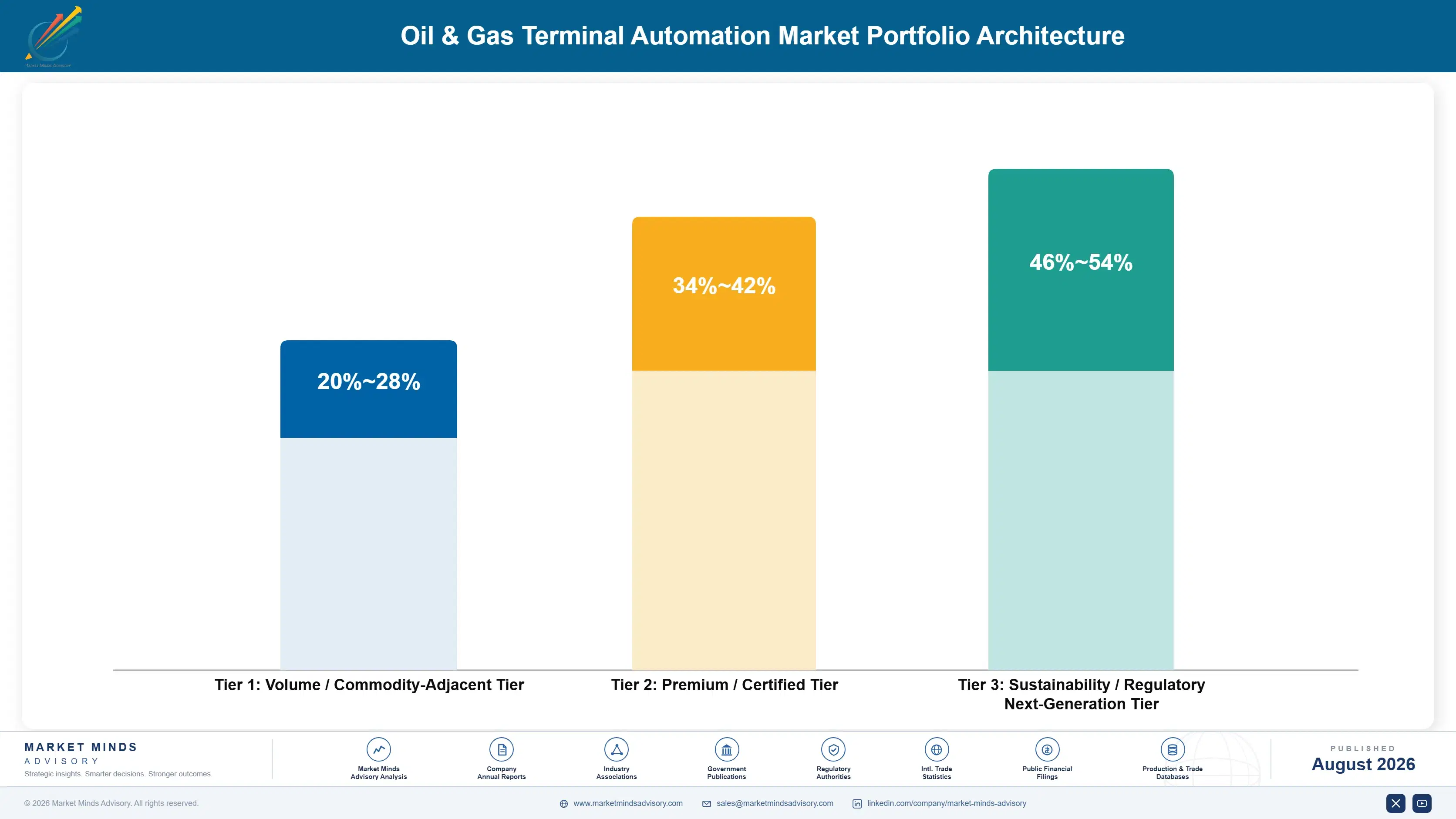
Portfolio Architecture for Margin Defence

Portfolio architecture splits across three tiers: entry priced standalone gauging hardware competing largely on cost, certified custody transfer and loading automation systems carrying certification value that commands a durable price premium, and next generation cybersecurity-integrated platforms bundled with monitoring and calibration services. Gross margins widen meaningfully moving up this ladder as certification and cybersecurity barriers concentrate hardest at the entry tier.
The volume versus premium tension is sharpest in standalone gauging hardware, where regional import competition has compressed prices fastest, pushing established vendors to defend share through calibration service bundling rather than matching import pricing directly on hardware alone. Cybersecurity-integrated platforms retain the strongest pricing power because certification cost and multi-year platform relationships discourage operators from switching vendors mid-portfolio, a dynamic that continues strengthening as regulatory mandates broaden across smaller operator segments.

High value margin pools concentrate in cybersecurity-integrated platforms paired with continuous monitoring subscriptions, where recurring revenue and high switching costs together support gross margins well above the portfolio average. Vendors are consequently prioritizing capital and engineering investment toward this tier even though it remains a minority of total unit volume shipped across the broader portfolio today, betting the mix shifts decisively within the decade.

Volume / Commodity-Adjacent Tier

Basic standalone tank gauging hardware competing primarily on unit price against regional imports, with limited service attach and thin per-unit margins across most transactions worldwide, particularly among smaller domestic distribution terminals with constrained capital budgets.
Gross Margin: 20-28%

Premium / Certified Tier

Certified custody transfer and loading automation systems serving regulated trading and export applications, where certification cost and platform relationships support durable pricing across the industry, especially among operators managing multi-site portfolios under exchange oversight.
Gross Margin: 34-42%

Sustainability / Regulatory / Next-Generation Tier

Cybersecurity-integrated terminal platforms bundled with continuous monitoring, calibration, and certification services, sold on recurring security assurance value rather than hardware alone, increasingly the default specification for new export terminal capacity.
Gross Margin: 46-54%
oil-gas-terminal-automation-market-portfolio-architecture-1787303090460

Platform Contracts Anchor Recurring Revenue

Terminal automation economics function increasingly like an annuity once a connected platform is installed, since continuous monitoring subscriptions, calibration contracts, and periodic certification renewal generate recurring revenue for years after the initial platform sale closes. This recurring layer now represents a growing share of total category revenue and is the primary reason vendors compete aggressively on initial platform placement even at thin entry tier margins, treating the first
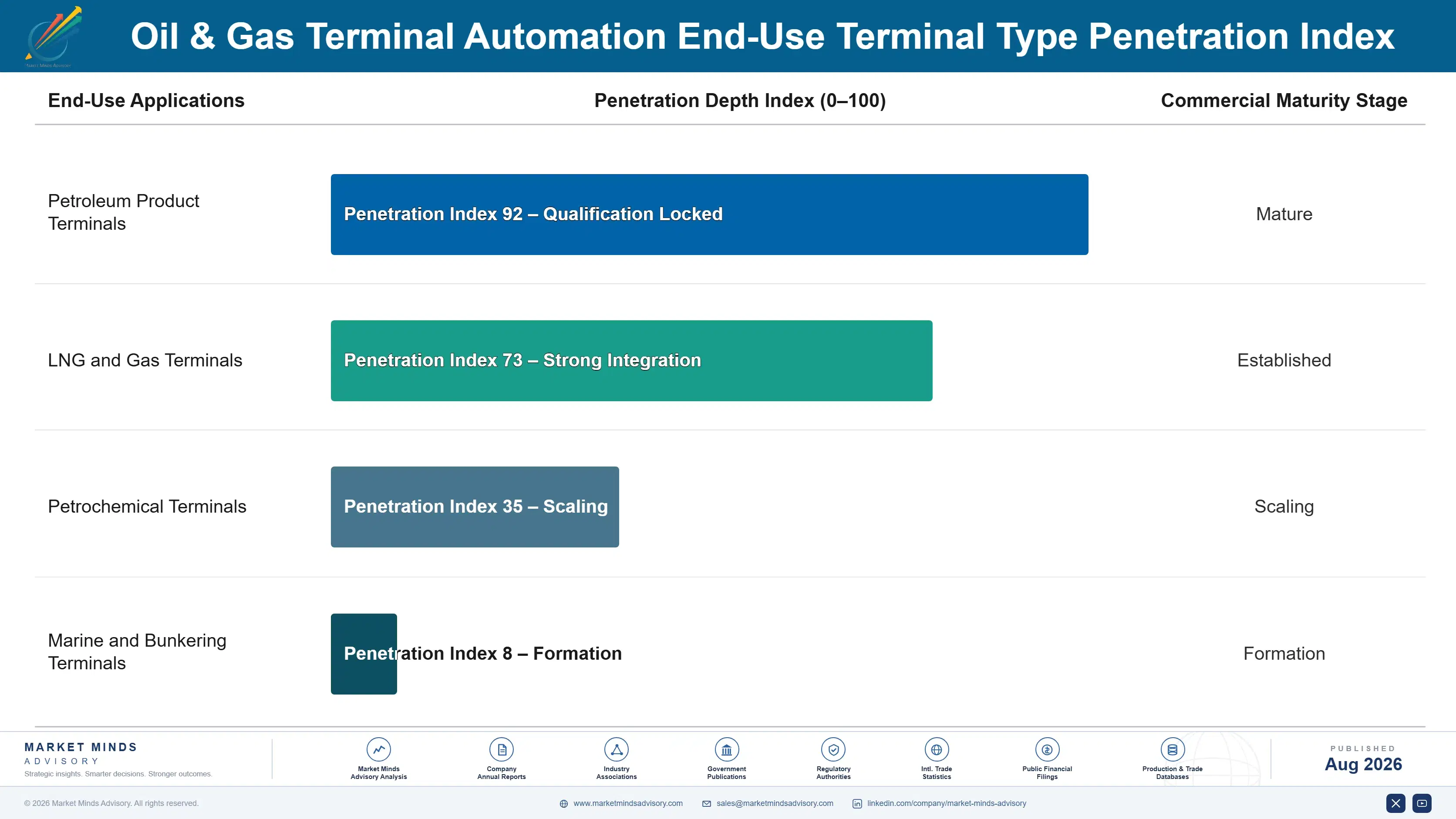
Adoption depth varies sharply by end use vertical. Large export terminals run near saturated cybersecurity-integrated platform coverage and generate mostly replacement and monitoring subscription demand, while mid-sized domestic distribution terminals are still building out first time digital gauging coverage, generating a different mix of new installation revenue layered on top of the maturing replacement base.

Buyer profiles are shifting generationally as terminal operations engineers who trained primarily on connected digital platforms increasingly influence procurement decisions alongside veteran operators who remember when manual gauging handled nearly every terminal function. This is accelerating demand for platforms with strong software usability even among buyers who historically evaluated terminal equipment purely on mechanical gauging accuracy and throughput specifications alone.
oil-gas-terminal-automation-market-end-use-penetration-index-1787303090959

Where Terminal Automation Strategy Should Focus

These are among the four positions where our research anticipates prominent divergence between winners and laggards over the coming forecast period. Each is grounded in the demand model, the regulatory perimeter, and the announced capacity pipeline.
01 / CYBERSECURITY PLATFORM INVESTMENT

Prioritize OT security credentials over raw gauging accuracy claims

Gauging accuracy has become table stakes across certified vendors, no longer a meaningful differentiator in vendor selection for large export terminal operators. Buyers now evaluate cybersecurity credentials and incident response capability ahead of marginal accuracy gains that once justified a premium on their own. Vendors that continue competing primarily on measurement precision specifications risk losing share to platform focused rivals bundling hardware, calibration service, and cybersecurity monitoring into a single recurring revenue relationship that is far harder to unwind once established across a multi-terminal account.
02 / SERVICE MONETIZATION STRATEGY

Shift commercial models toward monitoring and calibration revenue

Hardware margins will keep compressing as regional imports gain share at the entry tier of the category. Vendors that convert continuous monitoring access, calibration scheduling, and certification renewal into contracted recurring revenue will outperform peers still pricing primarily around one-time hardware sales alone. This shift also raises customer switching costs meaningfully, since replacing a connected platform requires displacing an entrenched, multi-year monitoring and compliance relationship built over years of accumulated trust between vendor engineering teams and terminal operations staff across every managed site.
03 / REGIONAL GROWTH PRIORITIZATION

Weight investment toward South Asia and the Middle East over mature markets

South Asia and the Middle East are compounding faster than Western Europe on both share and CAGR, driven by mechanization subsidy programmes, national oil company capex, and first time equipment installation. Vendors weighting sales and service investment toward these regions ahead of competitors will capture a disproportionate share of first time installation revenue. Mature markets, running mostly on replacement cycles, simply cannot replicate that category of demand at comparable scale or growth rate over the coming decade of forecast activity.
04 / LEGACY INTEGRATION RESPONSE

Build standardized retrofit gateways for legacy terminal systems

The installed base of legacy analog and early-digital terminal systems represents a substantial retrofit opportunity that most vendors are not yet equipped to capture efficiently given proprietary legacy protocols. Vendors that develop standardized protocol translation gateways will be better positioned to win retrofit contracts without the extended integration timelines currently discouraging some operators from upgrading. Vendors ignoring this opportunity risk ceding a growing retrofit market to specialists who solve the legacy integration problem first and capture the resulting platform relationship.

Engagement Snapshot From the Field

A live engagement with an industry participant carrying material or product regulatory and market exposure ahead of a defining policy shift, showing how our research translates into a defensible multi-year portfolio strategy.
MARKET MINDS ADVISORY · CLIENT ENGAGEMENT SUMMARY
Oil & Gas Terminal Automation Producer Strategic Portfolio Review and Transition Roadmap 2026·Investment Scenario on Oil & Gas Terminal Automation Exposure Evaluation 2025-26
CLIENT PROFILE
The client operates a multinational midstream terminal business with facilities across North America and Europe, generating revenue in the mid single digit billions from terminal and storage operations (client-reported, unverified by MMA). Its automation fleet spanned nearly two decades of legacy gauging systems from multiple vendors, managed without centralized cybersecurity visibility for corporate risk leadership across its distributed terminal network.
STRATEGIC CHALLENGE
Following new regulatory reporting mandates covering critical energy infrastructure cybersecurity, corporate leadership sought a unified OT security and monitoring platform across all terminals within eighteen months, while minimizing operational disruption during the phased rollout across continuously operating terminal facilities and shift schedules, and while satisfying regional regulators with differing reporting timelines across each jurisdiction the client operated within.
MMA APPROACH
MMA benchmarked five candidate vendors against cybersecurity certification depth, legacy system integration capability, and total cost of ownership over a ten year horizon, then modeled rollout sequencing to minimize simultaneous facility-level disruption across the client's highest risk terminal sites during the phased security installation programme currently under review by corporate risk leadership and regional operations management.
KEY FINDINGS
  1. Three of five vendors evaluated could not demonstrate reliable integration with the client's oldest legacy gauging systems at scale across every facility reviewed.
  2. Phased cybersecurity retrofit reduced projected installation cost by 36% versus full platform replacement across comparable terminal facilities, based on vendor quotes gathered during evaluation (client-reported, unverified by MMA).
  3. Centralizing monitoring access was projected to cut corporate incident response time by roughly half across all terminals combined, according to the client's internal security modeling.
  4. Terminals with the oldest automation generations carried the highest near term cybersecurity risk, reprioritizing the client's original rollout sequence considerably ahead of the initial eighteen month plan.
CLIENT PROFILE
The client operates a multinational midstream terminal business with facilities across North America and Europe, generating revenue in the mid single digit billions from terminal and storage operations (client-reported, unverified by MMA). Its automation fleet spanned nearly two decades of legacy gauging systems from multiple vendors, managed without centralized cybersecurity visibility for corporate risk leadership across its distributed terminal network.
STRATEGIC CHALLENGE
Following new regulatory reporting mandates covering critical energy infrastructure cybersecurity, corporate leadership sought a unified OT security and monitoring platform across all terminals within eighteen months, while minimizing operational disruption during the phased rollout across continuously operating terminal facilities and shift schedules, and while satisfying regional regulators with differing reporting timelines across each jurisdiction the client operated within.
MMA APPROACH
MMA benchmarked five candidate vendors against cybersecurity certification depth, legacy system integration capability, and total cost of ownership over a ten year horizon, then modeled rollout sequencing to minimize simultaneous facility-level disruption across the client's highest risk terminal sites during the phased security installation programme currently under review by corporate risk leadership and regional operations management.
KEY FINDINGS
  1. Three of five vendors evaluated could not demonstrate reliable integration with the client's oldest legacy gauging systems at scale across every facility reviewed.
  2. Phased cybersecurity retrofit reduced projected installation cost by 36% versus full platform replacement across comparable terminal facilities, based on vendor quotes gathered during evaluation (client-reported, unverified by MMA).
  3. Centralizing monitoring access was projected to cut corporate incident response time by roughly half across all terminals combined, according to the client's internal security modeling.
  4. Terminals with the oldest automation generations carried the highest near term cybersecurity risk, reprioritizing the client's original rollout sequence considerably ahead of the initial eighteen month plan.
RECOMMENDED STRATEGY
Phase 1: Phase 1 (Months 1-6): Pilot cybersecurity retrofit at the three highest risk terminal facilities identified through careful review of legacy exposure and audit history. Phase 2: Phase 2 (Months 7-14): Scale the validated retrofit programme across remaining North American and European facilities in strict priority order. Phase 3: Phase 3 (Months 15-18): Integrate all terminals into a single corporate security operations dashboard with automated reporting fully enabled for regulators.
OUTCOME
The client completed cybersecurity retrofit across all priority terminals within the eighteen month window and reported meaningfully improved incident detection capability during subsequent internal security reviews (client-reported, unverified by MMA). Corporate risk leadership gained real time security visibility previously unavailable across its distributed terminal network.

Frequently Asked Questions

Foundational context covering the market sizes, CAGR, scope, country, region and competition that inform every finding below. This section is provided to cover basics and most often pre-purchase conversations, answered from the MMA Primary Research Dataset.

What is the current size of the Oil & Gas Terminal Automation Market?

The global oil and gas terminal automation market reached an estimated $5.6 billion in 2025. Growth is driven by export terminal expansion and rising OT cybersecurity investment across energy infrastructure.

How large will the Oil & Gas Terminal Automation Market be by 2036?

The market is projected to reach approximately $14.2 billion by 2036, roughly 2.33 times its 2026 value. OT cybersecurity systems and loading automation drive most of the added value.

What is the CAGR for the Oil & Gas Terminal Automation Market 2026 to 2036?

The base case CAGR is 8.8% through 2036. Bull and bear scenarios range from roughly 7.5% to 10.0%, depending on export terminal buildout pace and cybersecurity mandate timing.

Which segment is growing fastest?

OT cybersecurity and network protection systems lead at a 13.5% CAGR, about 1.5x the overall market rate. Growth is concentrated among operators of large export terminals facing new regulatory mandates.

Who are the major companies in the Oil & Gas Terminal Automation Market?

Honeywell, Emerson Electric, ABB, Yokogawa Electric, and Schneider Electric lead the category. Combined, the top five suppliers hold roughly 58% of global revenue on a consistent company revenue basis.

Which country is growing fastest?

India leads country level growth at an estimated 12.8% CAGR. Rapid refining and fuel distribution terminal expansion is driving first time automation installation across previously manual facilities.

Report Segmentation Architecture

The full report scope spans multiple orthogonal segmentation dimensions, with cross-tabulated demand data provided for each dimension pair. Coverage extends further to regional breakdowns, trend trajectories, and the competitive detail needed to support segment-level decision-making.

By System Type

  • Tank Gauging and Inventory Management
  • Terminal Management Software
  • Custody Transfer Metering
  • Loading and Unloading Automation
  • OT Cybersecurity and Network Protection

By End-Use Terminal Type

  • Petroleum Product Terminals
  • LNG and Gas Terminals
  • Petrochemical Terminals
  • Marine and Bunkering Terminals

By Commercial Dimension

  • Direct OEM Platform Sales
  • System Integrator Channel Sales
  • Retrofit and Upgrade Services
  • Monitoring and Calibration Service Contracts

By Region

  • North America
  • Western Europe
  • East Asia
  • South Asia and Pacific
  • Latin America
  • Middle East and Africa
  • Eastern Europe

Scope, Methodology, and Coverage

Every figure in this report is reproducible from documented input assumptions. The scope below maps the historical period, the forecast horizon, the segmentation dimensions, and the countries covered, alongside the underlying primary and qualitative methodology.
Historical Period
2020 to 2025
Forecast Period
2026 to 2036
Base Year
2025 (USD billions; MMA Primary Research Dataset, August 2026)
Market Definition
The oil and gas terminal automation market covers hardware and software systems that automate tank inventory management, custody transfer metering, loading and unloading operations, and terminal-level process control across petroleum, petrochemical, and LNG storage and distribution terminals. It includes tank gauging instrumentation, SCADA and terminal management software, and OT cybersecurity systems sold as part of a terminal automation package.
Quantitative Units
USD billions (current prices); installed terminal site count where disclosed
Segmentation Dimensions
By System Type; By End-Use Terminal Type; By Commercial Dimension; By Region
Regions Covered
North America, Western Europe, East Asia, South Asia and Pacific, Latin America, Middle East and Africa, Eastern Europe
Countries Covered
USA, China, Germany, France, UK, Japan, South Korea, India, Australia, Canada, Brazil, Mexico, Indonesia, Vietnam, Thailand, Malaysia, UAE, Saudi Arabia, South Africa, Nigeria, Turkey, Poland, Netherlands, Italy, Spain, Sweden, Switzerland, Argentina, Colombia, Singapore, and additional markets relevant to this sector
Key Companies Profiled
Honeywell, Emerson Electric, ABB, Yokogawa Electric, Schneider Electric, Rockwell Automation, Siemens, Endress+Hauser, Krohne, Franklin Fueling Systems, Varec Inc, Motherwell Tank Gauging, Scully Signal Company, Whessoe, OMNI Flow Computers, TechnipFMC, Bartec Group, MTS Systems, BinMaster, L&J Engineering
Quantitative Methodology
Primary survey, n=3,800 respondents, Q4 2025, six countries; demand-side model with trade association cross-validation
Qualitative Methodology
47 expert interviews, Q4 2025; applied to validate demand model assumptions, identify emerging dynamics, and assess competitive positioning
Report Format
PDF and XLSX data workbook (Word format preview document)
Publisher
Market Minds Advisory
Report Code
MMA-2026-ENE-121
Published
August 2026
Contact
sales@marketmindsadvisory.com | www.marketmindsadvisory.com

Purchase the full Oil & Gas Terminal Automation Market Report (2026 to 2036).

The full report delivers a complete quantitative and qualitative assessment of the global oil and gas terminal automation market through 2036. It includes detailed segmentation by system type, end-use terminal type, and commercial channel, alongside country level sizing across thirty markets covering every major energy terminal demand center. Competitive profiles cover twenty companies with capability, security, and service network benchmarking assessed on a consistent revenue basis. Buyers also receive access to the underlying primary survey and expert interview datasets referenced throughout the analysis, along with editable data tables.
Segment level CAGR and sizing tables
Regional and country level market breakdowns
Twenty company competitive profiles and benchmarks
Detailed OT cybersecurity capability benchmarking matrix
Input cost and supply chain risk analysis
Primary survey and expert interview datasets

Built For The People Who Decide

From boardroom strategy to bench-side execution, this report is read cover-to-cover by leaders shaping the next decade of their industry, turning demand scenarios, market dynamics and valuation benchmarks into decisions.
CXOs/ Presidents/ VPs/ Managers
M&A and Corporate Development
Strategy Teams and R&D Heads
Procurement and Product Directors
Regulatory and Compliance Leaders
Investor Relations and Equity Analysts