
Market Minds Advisory
Off-Road Motorcycles Market

Off-Road Motorcycles Market: Off-Road Motorcycles Market. Trends and Forecast 2026 to 2036

Electric powertrain adoption is reshaping motocross and enduro competition as battery-powered models challenge decades of two-stroke and four-stroke engine dominance, even as emissions regulations threaten to restrict combustion riding access across established trail networks.

Lead Analyst

David Horsley

Published

August 2026

Make Smarter Decisions with Customized Research Insights

Request a free sample report and evaluate market opportunities, growth trends, and competitive dynamics relevant to your business needs.

2025 MARKET VALUE$5.5BMarket Size 2025
2036 FORECAST VALUE$11.0BBase Case , 2026 to 2036
CAGR 2026 TO 20366.5 %Bull 7.7% / Bear 5.3%
INCREMENTAL OPPORTUNITY$5.1BNet 10- year value creation
EXPANSION MULTIPLE1.88x2036 value over 2026 base
Strategic Levers
M&A Pipeline
Regional Outlook
Country Rankings
Competitive Intelligence
Segmental Deep-dive
Call-Us : 91 93563 13602

Executive Snapshot and Market Trajectory.

Off-road motorcycle demand is shifting toward electric powertrains as manufacturers respond to tightening noise and emissions regulations at riding parks and trail systems, reshaping product development priorities and formal competitive strategy across motocross, enduro, and trail riding segments worldwide today and quite increasingly.
Commercial pressure now concentrates on electric powertrain performance parity and battery range, since competitive riders and recreational buyers increasingly evaluate electric models against established two-stroke and four-stroke performance benchmarks across riding disciplines. Electric off-road motorcycles are the fastest-growing segment, driven by trail access restrictions and manufacturer investment in battery technology maturation industry-wide. Western Europe and North America together account for the largest share of global demand, reflecting concentrated motocross heritage and recreational off-road riding culture.
Competitive intensity concentrates among a handful of established manufacturers holding decades of chassis and suspension engineering expertise, leaving newer electric-focused entrants dependent on partnership or acquisition to access proven off-road platform architecture and manufacturing scale nationwide. Trail access regulation adds further complexity, since manufacturers must balance performance development against the noise and emissions restrictions increasingly limiting where riders can legally operate machines across public and private land.
Market Definition
The Off-Road Motorcycles Market covers motocross, enduro, dual-sport, trials, and electric off-road motorcycles designed for unpaved terrain riding in competitive and recreational applications. It excludes street-legal touring and cruiser motorcycles, all-terrain vehicles with more than two wheels, and utility side-by-side vehicles.
Base Year Value
$5.5B in 2025 (MMA Primary Research Dataset, August 2026)
Forecast Period
2026 to 2036, eleven discrete annual values
CAGR
6.5% base case. Bull 7.7%. Bear 5.3%.
Fastest Growth Segment
Electric Off-Road Motorcycles: 15.0% CAGR
Fastest Growth Country
Brazil: 10.5% CAGR
Fastest Growth Region
South Asia and Pacific: 8.5% CAGR
Largest Region
Western Europe: 26% of 2025 global value
Market Leaders
Leading participants include KTM, Honda, Yamaha, Kawasaki, and Husqvarna Motorcycles. Source: MMA Primary Research Dataset, July 2026.
Primary Survey
n=3,800 procurement and R&D decision-makers, Q4 2025, six countries
Methodology
Demand-side build-up, cross-validated against public data, 47 expert interviews

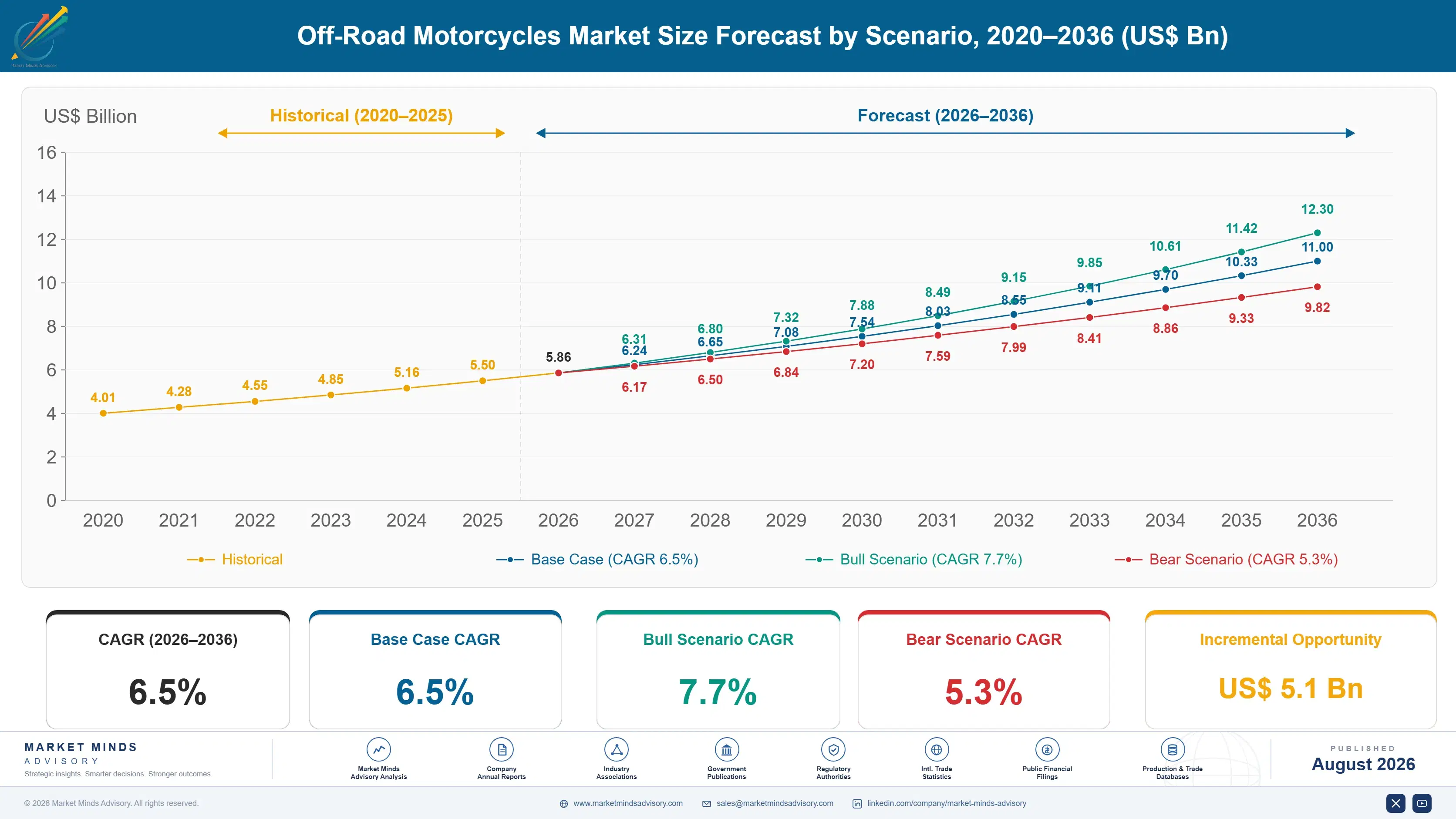
Off-Road Motorcycles Market Forecast Scenarios

off-road-motorcycles-market-trends-growth-size-forecast-scenario-1787559005630
Between 2020 and 2025 the market grew at an estimated 5.6% annual pace, driven by pandemic-era outdoor recreation demand even as supply chain disruption constrained motorcycle production and component availability during 2021 and 2022. Internal combustion two-stroke and four-stroke models dominated the period, since electric off-road motorcycles remained a niche category facing limited battery range and higher unit costs relative to established platforms.
The base case assumes 6.5% annual growth to 2036, driven by three mechanisms: electric powertrain maturation closing the performance gap with internal combustion models while offering quieter operation that expands trail access options, tightening noise and emissions regulation restricting combustion access in key markets, and rising adventure tourism driving demand for dual-sport and adventure touring off-road motorcycles. Internal combustion models retain performance advantages in competitive motocross applications, but their share of total off-road unit sales is declining as electric alternatives mature.
The bull case centers on electric powertrain performance parity arriving faster than current manufacturer development timelines suggest, pushing growth toward 7.7%. The bear risk is continued battery cost and range limitations slowing electric model adoption among performance-focused competitive riders, which would keep internal combustion demand elevated longer, holding growth closer to 5.3% through the forecast window.

Electric Powertrain Transition Reshapes Trail Access

The Off-Road Motorcycles Market sits at the intersection of competitive racing engineering and recreational outdoor equipment manufacturing, where powertrain selection follows trail access regulation and rider performance requirements more than raw production volume alone. Motocross racers and recreational trail riders together represent the largest buyer categories, each imposing increasingly specific suspension and powertrain performance requirements on manufacturers.
MARKET CONCENTRATION62%Share held by five largest manufacturers combined currently
AVERAGE SELLING PRICE$9,500 per unitTypical cost riders pay per new off-road motorcycle
TOP PRODUCING COUNTRY34%Current share of global production output from Japan
CAPACITY UTILIZATION70%Average operating rate across electric powertrain production lines
FEEDSTOCK COST SHARE45%Portion of production cost from engine and battery components
REPLACEMENT CYCLE3 to 5 yearsTypical ownership duration before trade-in or resale occurs
Internal combustion two-stroke and four-stroke platforms remain the workhorse formats for competitive motocross and enduro racing, prized for proven performance and rapid refueling across extended riding sessions. Electric powertrains carry a meaningful cost premium tied to battery technology, yet riding parks and municipalities restricting noise are specifying these formats fast enough that manufacturers are investing in battery development ahead of confirmed long-term volume commitments from recreational and competitive riders.
Manufacturer concentration remains high, with a handful of established motorcycle brands holding decades of chassis and suspension engineering expertise that newer electric-focused entrants cannot easily replicate at comparable scale. Capacity utilization runs tighter in electric powertrain production lines than in conventional engine manufacturing, reflecting the lag between installed battery assembly capacity and accelerating regulatory-driven demand across major recreational riding markets.
"Two-stroke smell used to be the smell of racing. Now the fastest-growing part of this industry is silent, and tracks that banned two-strokes for noise are quietly becoming electric-only venues."
Senior Analyst, Powersports and Recreational Vehicles Practice · MMA Automotive Practice · August 2026

Market Trends

Electric Powertrain Adoption Accelerates Across Trail Riding Segments

Off-road motorcycle manufacturers are converting from exclusively internal combustion product lines to include electric powertrain options as riding parks and municipal trail systems increasingly restrict noise and emissions from two-stroke and four-stroke engines. Manufacturers report electric model orders tied to noise-restricted riding areas growing meaningfully faster than orders tied to unrestricted internal combustion applications. The shift is concentrated among manufacturers with the capital to develop proprietary battery and motor technology, while smaller manufacturers continue relying on internal combustion platforms until electric component costs decline further, creating a two-speed adoption pattern across the industry through the remainder of the decade.
Market Impact: Trail restrictions add 12% demand
Adventure Touring and Overlanding Demand Expands Dual-Sport Segment

Rising consumer interest in adventure touring and overlanding travel is driving demand for dual-sport and adventure off-road motorcycles capable of handling both highway transit and unpaved trail riding within a single platform and vehicle configuration entirely. These dual-sport models command a meaningful price premium over pure competition motocross machines given their additional street-legal equipment and touring-oriented features and accessories. Adoption is concentrated among older, higher-income recreational riders with the disposable income for extended travel, while younger competitive riders continue prioritizing dedicated motocross and enduro platforms optimized purely for racing performance.
Market Impact: Recreational participation supports 7% growth

Market Opportunities and Growth Drivers

Trail Access Regulation Drives Electric Powertrain Investment

Riding parks, public land management agencies, and municipalities across North America and Western Europe are increasingly restricting internal combustion off-road motorcycle access due to noise complaints and emissions concerns, directly increasing demand for electric alternatives that can access these otherwise restricted riding areas. This regulatory pressure gives electric motorcycle manufacturers a genuine market access advantage that internal combustion competitors cannot easily replicate without their own electric development investment. Manufacturers unable to offer electric alternatives risk losing access to an expanding share of total available riding terrain, pushing capital toward electric powertrain development faster than overall market growth alone would justify.
Market Impact: Battery adds $3,000 to $5,000

Rising Recreational Off-Road Riding Participation Sustains Demand

Recreational off-road riding participation continues expanding across North America and Western Europe as outdoor recreation gains sustained popularity following pandemic-era shifts toward outdoor leisure activities and broader lifestyle changes across most demographics, supporting steady replacement and upgrade purchase cycles across the existing rider base. This participation growth gives manufacturers a durable demand base independent of competitive racing trends, since recreational riders represent a substantially larger population than competitive racers alone. Manufacturers serving recreational riders benefit from this sustained demand driver across economic cycles and generational shifts in outdoor recreation preferences.
Market Impact: Two-stroke loyalty retains 35%

Market Restraints and Challenges

Battery Cost and Range Limitations Slow Electric Adoption

Electric off-road motorcycles continue to carry higher unit costs than comparable internal combustion models given battery technology expense, while offering shorter continuous riding time before requiring recharge, particularly limiting for extended trail riding sessions favored by recreational and competitive riders. For cost-sensitive recreational buyers and competitive riders requiring extended track time, these limitations make internal combustion models the practical choice despite regulatory pressure favoring electric alternatives. Some manufacturers are addressing this through swappable battery systems that reduce downtime, though these systems require additional infrastructure investment at riding venues to be practical.
Market Impact: Electric models gain 8 points

Two-Stroke Engine Nostalgia Slows Full Market Transition

A substantial segment of competitive and recreational riders maintains strong brand loyalty and technical preference for traditional two-stroke internal combustion engines, valuing their lightweight simplicity and distinctive performance characteristics over electric alternatives regardless of regulatory pressure or environmental considerations and concerns. This entrenched preference slows manufacturer transition timelines, since abandoning two-stroke product lines entirely risks alienating a loyal and vocal customer base that generates significant aftermarket parts and accessories revenue. Manufacturers are addressing this by maintaining parallel product lines rather than fully transitioning to electric platforms in the near term.
Market Impact: Adventure touring segment grows 9%
3 additional market trends, 4 additional growth drivers, and 2 additional restraints and challenges are covered in the full report. Contact sales@marketmindsadvisory.com to access the complete intelligence.

Segment CAGR and Growth Architecture

The market divides into six product-based segments spanning competitive and recreational riding applications across global motorcycle markets and cultures. Electric off-road motorcycles and adventure touring platforms serve growth-oriented premium demand, while motocross, enduro and dual-sport, trail and trials, and youth entry-level motorcycles serve broader competitive and recreational riding applications across established rider communities worldwide today.
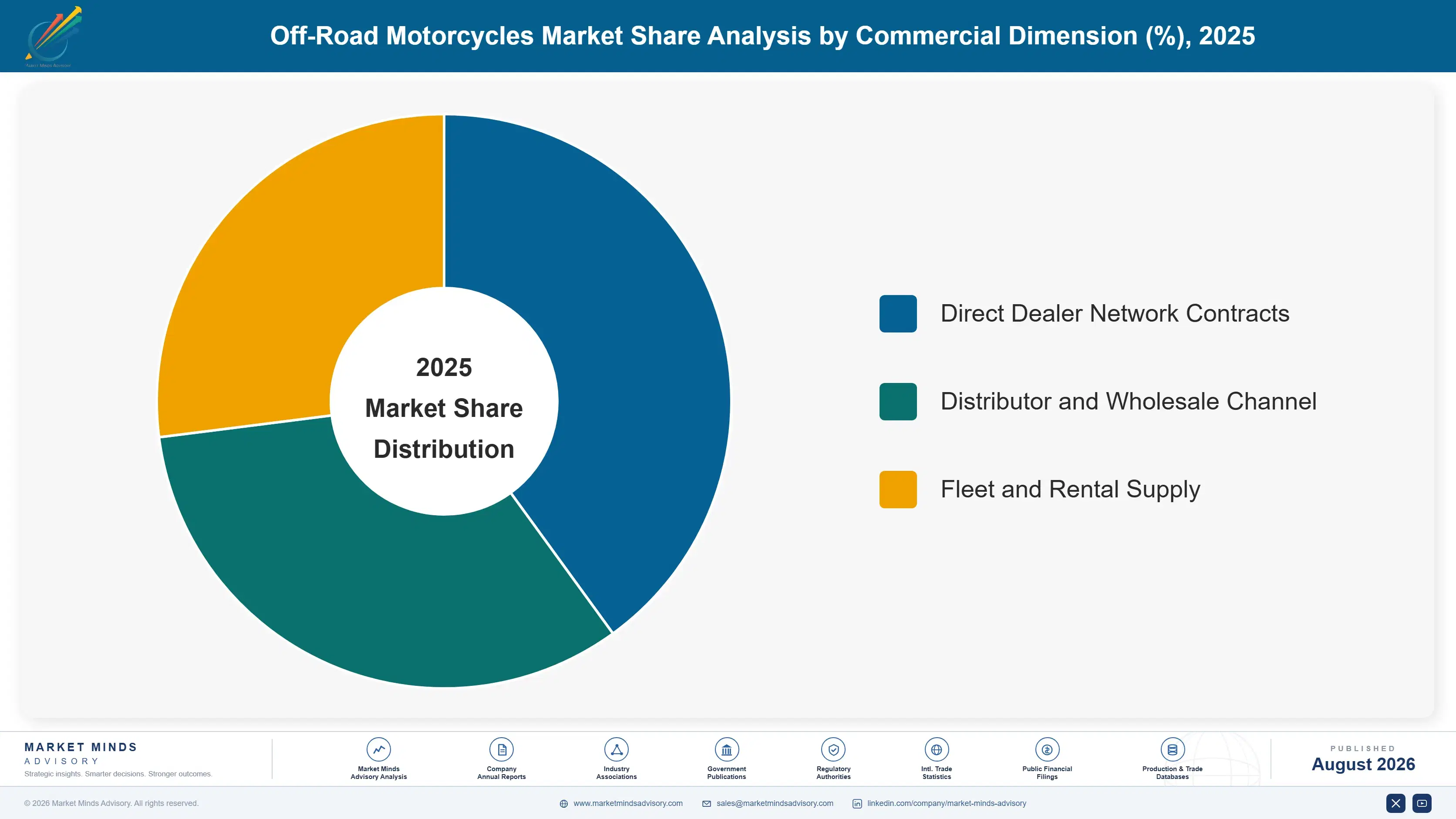
off-road-motorcycles-market-trends-growth-market-share-analysis-1787559006166

Electric Off-Road Motorcycles

Electric off-road motorcycles are converting fastest as riding parks and municipalities increasingly restrict internal combustion engine access given noise and emissions concerns, pushing manufacturers to develop battery-powered alternatives capable of accessing these otherwise restricted riding areas nationwide and abroad quite consistently. These motorcycles command a meaningful price premium over internal combustion equivalents given battery technology costs, yet increasingly appear as the only qualification-compliant option for riders in noise-restricted jurisdictions rather than an optional alternative. Manufacturer investment in battery and motor technology has accelerated well ahead of confirmed long-term volume commitments, reflecting expectations that trail access restrictions across additional jurisdictions will pull demand higher across the coming decade and well beyond.
CAGR 15.0%

Adventure Touring Off-Road Motorcycles

Adventure touring off-road motorcycles are the second-fastest-growing segment, driven by rising consumer interest in overlanding and multi-day off-road travel combining highway transit capability with genuine unpaved terrain performance in a single platform and vehicle configuration entirely and quite consistently indeed. These motorcycles require more sophisticated suspension tuning and fuel capacity engineering than pure competition machines, commanding a meaningful price premium that recreational riders increasingly accept given the versatility these platforms offer across diverse terrain and conditions. Cost sensitivity limits adventure touring penetration into pure competitive racing applications, but recreational riders and travel enthusiasts are increasingly specifying these platforms as standard practice across their touring and exploration activities and lifestyle pursuits.
CAGR 9.0%
Full segment breakdown across 6 segments available in the complete report.

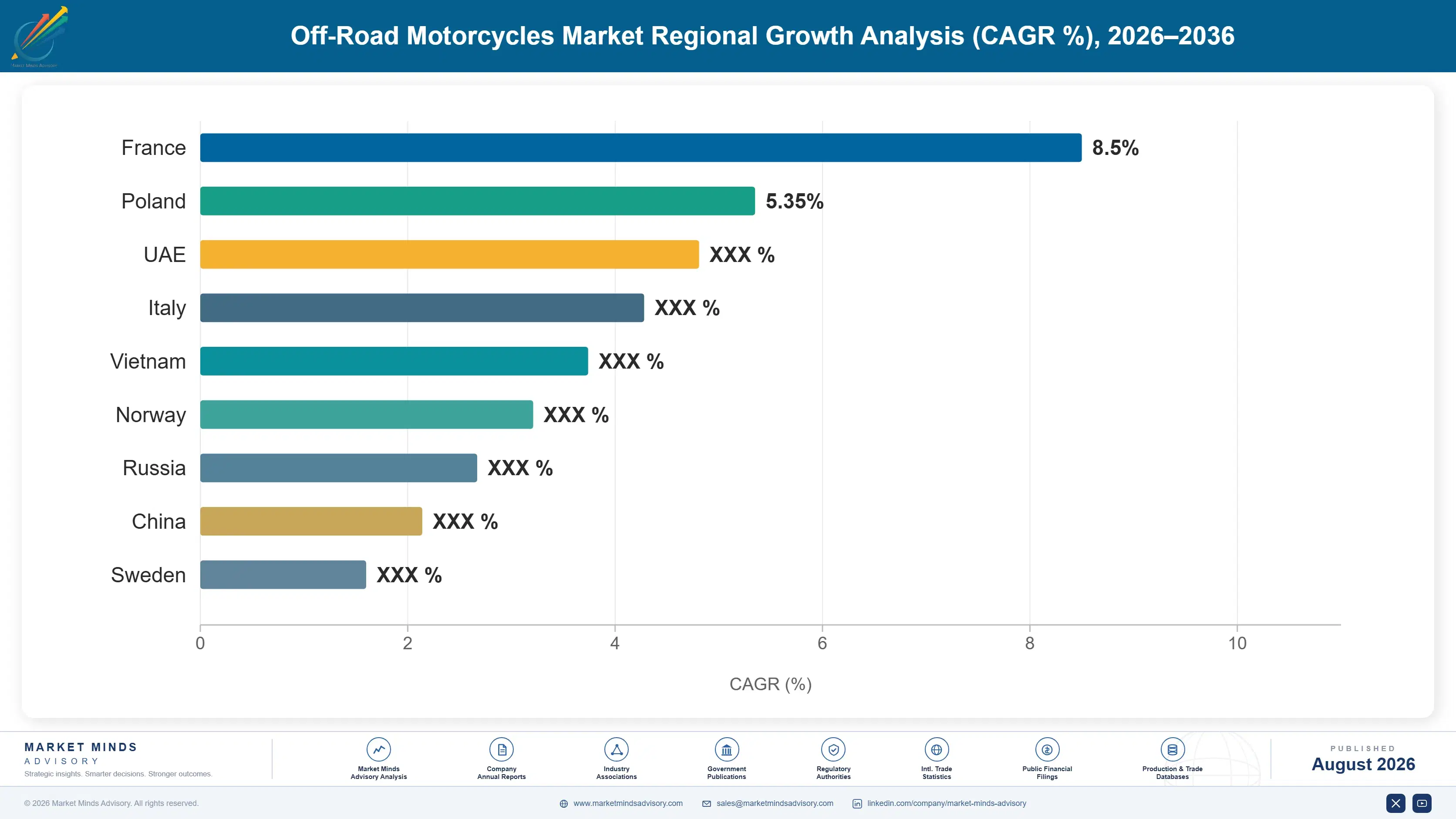
Regional Architecture and Country Demand Map

Regional demand tracks motocross racing heritage and recreational riding culture rather than population or income levels alone. Western Europe leads given its concentrated motocross manufacturing base and championship racing tradition, while North America and East Asia sustain demand through recreational riding participation and manufacturing scale.

North America

United States recreational off-road riding participation, supported by extensive public land access and dedicated riding parks across western states, drives the largest share of regional demand alongside a well-established motocross racing circuit and aftermarket parts industry serving millions of enthusiasts nationwide. Canada's growing adventure touring and overlanding culture contributes secondary regional demand tied to its vast wilderness terrain and expanding trail networks across multiple provinces. Mexico's off-road racing heritage, anchored by events like the Baja 1000, supports a smaller but dedicated competitive riding community and growing spectator interest. Electric powertrain adoption is accelerating faster here than in most other regions given tightening noise regulation at popular riding destinations and public lands.
Share: 25% | CAGR: 5.8% (2026 to 2036)

Western Europe

This region leads global demand reflecting Austria, Italy, and Spain's concentrated motocross and enduro manufacturing base, home to KTM, Husqvarna, Beta, and Gas Gas, alongside a deep competitive racing heritage spanning decades of world championship events and iconic legendary riders across generations. Germany and France's substantial recreational riding populations support strong aftermarket and replacement demand across established trail networks and riding clubs nationwide. The United Kingdom's enduro and trials riding culture, tracing back to historic competitive events, contributes meaningful regional volume and technical innovation. Regulatory pressure on internal combustion noise is more advanced here than in most other regions, accelerating electric powertrain adoption across competitive and recreational segments alike and consistently.
Share: 26% | CAGR: 4.8% (2026 to 2036)
Regional intelligence for 5 additional markets available in the complete report: East Asia, South Asia and Pacific, Latin America, Middle East and Africa, Eastern Europe. Contact sales@marketmindsadvisory.com.
off-road-motorcycles-market-trends-growth-country-cagr-analysis-1787559006685

Where Manufacturers Can Capture Powertrain Margin

Manufacturers face a widening gap between conventional internal combustion pricing and the electric powertrain, trail access compliance, and touring platform capabilities that riders and riding parks now demand. Four levers stand out for capturing margin above baseline motorcycle manufacturing economics: electric powertrain development, swappable battery infrastructure, adventure touring platform engineering, and direct dealer network contract structuring across distribution channels.

Electric Powertrain Development and Battery Engineering

Manufacturers holding proven electric powertrain technology with validated performance parity can charge a premium averaging 20 to 28% above comparable internal combustion models, since riders facing trail access restrictions value guaranteed riding area access over unit cost alone entirely. Developing this capability requires sustained R&D investment, typically three to five years to reach commercial performance parity, but manufacturers who achieve it capture disproportionate share of noise-restricted market segments. Manufacturers lacking electric expertise increasingly compete only on price for unrestricted riding applications, ceding the highest-margin regulated business entirely to specialized competitors.
Market Impact: Electric powertrain adds 20 to 28% pricing power

Swappable Battery Infrastructure for Riding Venues

Manufacturers developing swappable battery infrastructure for riding venues can capture a premium averaging 12 to 18% through venue partnership agreements, since eliminating charging downtime addresses the primary limitation preventing wider electric adoption among competitive and extended-session riders across multiple riding disciplines and formats entirely. This capability requires meaningful investment in standardized battery and charging infrastructure, but manufacturers who build it gain access to venue partnerships largely inaccessible to competitors lacking infrastructure investment. Competitors without swappable battery capability remain constrained by charging downtime that limits electric model appeal for serious riders.
Market Impact: Swappable battery infrastructure adds 12 to 18% premium

Adventure Touring Platform Engineering and Features

Manufacturers engineering adventure touring platforms with extended fuel capacity and touring-specific features can capture a premium averaging 15 to 22% above pure competition motocross machines, since overlanding and touring riders value versatility and comfort over pure racing performance specifications across extended multi-day journeys and expeditions. This capability requires meaningful engineering investment in suspension tuning and ergonomic design, but manufacturers who build it gain access to a growing customer base of higher-income recreational travelers largely inaccessible to competition-focused competitors. Competitors without touring platform capability are effectively excluded from this expanding premium segment.
Market Impact: Touring platform engineering adds 15 to 22% premium

Direct Dealer Network Contract Structuring and Negotiation

Manufacturers negotiating multi-year direct contracts with major dealer networks, bypassing wholesale distributors entirely, can improve gross margin by roughly 8 to 12 percentage points by eliminating distributor markup while offering dealers price stability and firm supply continuity guarantees over the full multi-year contract term itself and quite consistently indeed and reliably. These direct arrangements typically require minimum volume commitments spanning three to five years, favoring larger manufacturers with the balance sheet capacity to guarantee uninterrupted supply that smaller regional competitors cannot credibly match given more limited production capacity and working capital.
Market Impact: Direct contracts improve margin by 8 to 12 points

Who Controls the Margin Pool

Concentration remains high: the top five manufacturers hold 62% combined share on a revenue basis, evaluated consistently across producers regardless of whether they compete primarily in internal combustion or electric powertrain chemistry. KTM leads on motocross and enduro specialization and racing pedigree, followed by Honda, whose broad manufacturing scale and dealer network give it distribution reach that specialized competitors cannot easily replicate.
Competitive activity currently centers on electric powertrain development, as manufacturers race to close the performance gap with internal combustion models ahead of tightening noise regulation at riding venues. Several mid-tier manufacturers have announced new adventure touring platforms, while others are pursuing swappable battery infrastructure instead, betting that charging convenience will prove more durable than raw performance alone as a differentiator.

Emerging pressure comes from electric-focused startups who have developed proprietary battery and motor technology rapidly and are now competing directly with established manufacturers on performance specifications rather than price alone. Rankings could shift meaningfully if major riding venues standardize electric powertrain requirements across additional jurisdictions, since that would commoditize a capability several mid-tier manufacturers currently treat as differentiated, accelerating consolidation among manufacturers lacking sufficient electric development scale.
off-road-motorcycles-market-trends-growth-company-positioning-matrix-1787559007218

Competitive Moat and Risk Dimensions

KTM

Moat: Motocross Racing Pedigree and Engineering

KTM has built decades of motocross and enduro racing success into its brand identity, giving it credibility with competitive riders that newer manufacturers cannot replicate regardless of technical specifications. This racing pedigree also generates continuous engineering feedback from professional racing teams, letting KTM refine suspension and chassis design faster than competitors lacking equivalent competitive racing programmes and factory team relationships.
KTM

Risk: Narrower Product Line Than Honda

KTM's specialized focus on off-road and adventure motorcycles means it lacks the broader product portfolio and manufacturing scale that diversified competitors like Honda maintain across street, touring, and off-road categories simultaneously. This narrower focus could become a disadvantage if broader manufacturers leverage their scale to underprice KTM on entry-level off-road models where brand racing pedigree matters less to price-sensitive buyers.
HONDA

Moat: Broad Manufacturing Scale and Dealers

Honda operates one of the largest dealer networks in global powersports, giving it distribution reach and service infrastructure that specialized off-road manufacturers cannot match when serving recreational riders seeking convenient purchase and maintenance access. This distribution scale also gives Honda negotiating leverage with component suppliers, letting it maintain competitive pricing even as smaller manufacturers absorb cost increases directly.
HONDA

Risk: Less Specialized Racing Credibility

Honda's broad manufacturing focus across multiple vehicle categories means its off-road racing credibility, while historically strong, does not match the singular competitive focus that KTM maintains across motocross and enduro disciplines. Specialized competitors sometimes win serious competitive riders based on demonstrated racing focus that Honda's more generalist positioning cannot always match on the most demanding competition applications.

Players Tracked

Prominent Players

KTM
Honda
Yamaha
Kawasaki
Husqvarna Motorcycles

Other Key Players

Suzuki
Beta Motorcycles
Gas Gas
Sherco
TM Racing
Fantic Motor
Rieju
Cobra Moto
Cake
Stark Future
Zero Motorcycles
Sur-Ron
Talaria
Bultaco
Montesa

Recent Developments

FEBRUARY 2025

KTM commissioned an expanded electric powertrain production facility in Austria, adding dedicated capacity for battery and motor assembly meeting rising demand from noise-restricted riding venues across Western Europe and North America. The expansion responds to accelerating trail access regulation affecting internal combustion motorcycles at major riding destinations.
Signal: Signals accelerating manufacturer investment in electric capacity ahead of confirmed regulatory enforcement timelines nationwide and abroad.
AUGUST 2025

Honda signed a multi-year supply agreement with a major adventure touring dealer network to expand distribution of its off-road touring platform across North American and European markets and multiple territories nationwide, securing volume commitments that support continued manufacturing investment through the dealer network's expansion plans.
Signal: Confirms manufacturers deepening dealer relationships to capture growing adventure touring segment demand nationwide and internationally today.
MAY 2025

Zero Motorcycles acquired a specialty electric off-road component developer to strengthen its powertrain engineering capabilities for competitive motocross applications across multiple international racing series and major global championship events worldwide, extending its technology portfolio into a market where performance parity increasingly determines competitive rider adoption.
Signal: Shows electric manufacturers investing in specialized engineering to close the performance gap with combustion models entirely.

Powertrain Component Cost Exposure

Engine and battery components account for roughly 45% of production cost across off-road motorcycle formulations, sourced primarily from Japanese and European component manufacturers for internal combustion parts and specialized battery cell producers in Asia for electric powertrains. Chassis and suspension components carry a smaller but rising cost share as manufacturers invest in premium materials to reduce weight.
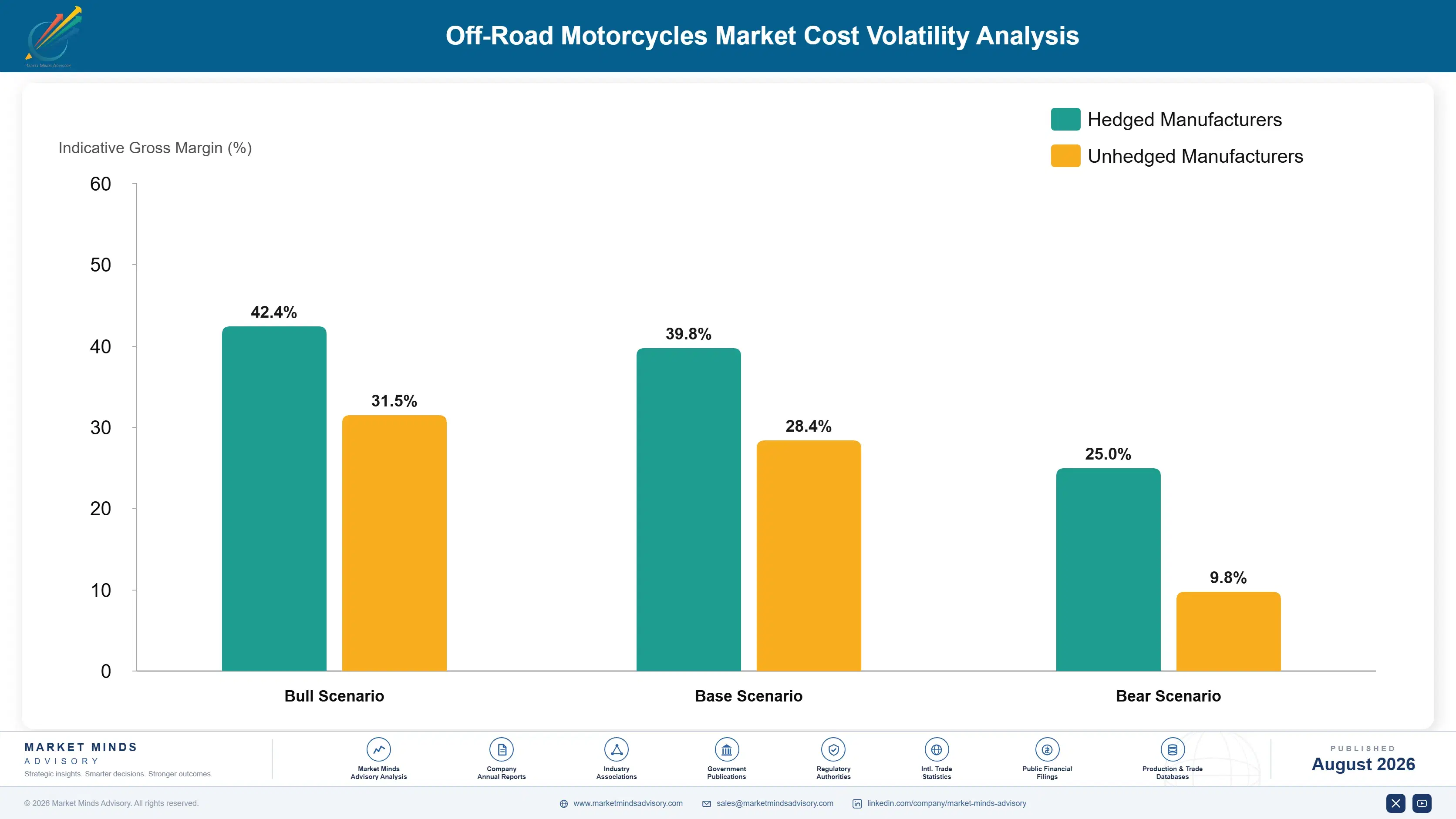
Battery cell prices spiked notably during 2022 as global electric vehicle demand growth outpaced lithium and cobalt supply expansion, a volatility event documented in USGS mineral commodity summary reports. Manufacturers without long-term battery supply contracts absorbed cost increases directly, while those holding fixed-price agreements passed through smaller increases to dealers, illustrating how contract structure shapes margin resilience during feedstock price shocks across the electric motorcycle supply chain.

Smaller regional manufacturers lacking scale to negotiate favorable component contracts face a real competitive disadvantage against integrated players like KTM, who purchase engine and battery components at volumes commanding better pricing terms and delivery schedules. This exposure varies by geography too: European manufacturers face higher baseline component import costs than Japanese competitors benefiting from proximity to domestic engine component suppliers and manufacturing clusters.
off-road-motorcycles-market-trends-growth-cost-volatility-analysis-1787559007417

Long-Term Component Supply Contracts With Price Collars

Manufacturers increasingly negotiate multi-year engine and battery component supply contracts with price collars that cap upside exposure during feedstock spikes while sharing some downside benefit with suppliers during periods of falling prices. This reduces earnings volatility for manufacturers lacking the balance sheet to absorb sudden cost increases without passing them through to dealers immediately.

Diversifying Battery Cell Sourcing Across Suppliers

Several manufacturers are qualifying secondary battery cell suppliers outside their traditional sourcing base, including emerging North American and European producers, to reduce dependence on any single region facing supply disruption or trade policy shifts and tariff changes. This diversification lowers single-source risk and improves negotiating position during periodic contract renewal cycles across multiple suppliers and regions.

Vertical Integration Into Battery Pack Assembly

Larger manufacturers are pursuing vertical integration into battery pack assembly to secure feedstock supply and capture margin that independent buyers currently pay away to intermediaries and component distributors each year consistently and reliably. This integration requires substantial capital investment but reduces exposure to spot market volatility that smaller feedstock-purchasing competitors cannot avoid as easily.

Portfolio Architecture for Margin Defence

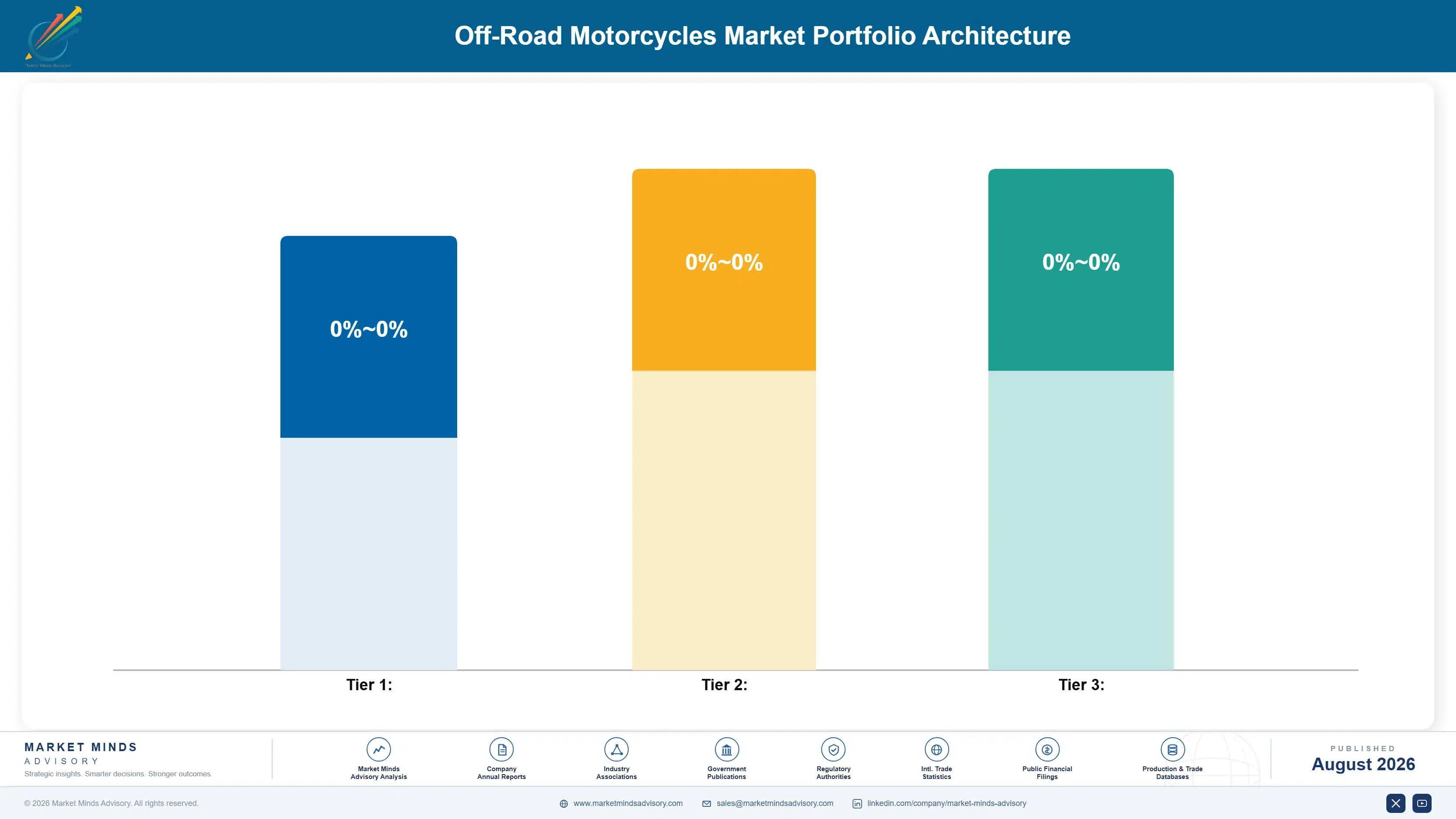
Portfolio economics split sharply along a combustion-versus-electric axis across the industry. Standard internal combustion motocross and trail models compete on proven performance and cost stability, with gross margins compressed by component price volatility and thin differentiation among established manufacturers. Electric and adventure touring formats carry meaningfully higher margins, reflecting battery engineering investment, touring platform development, and the qualification-required status these formats now hold among noise-restricted riding venues and premium recreational riders.
The tension between combustion and electric formats is intensifying as trail access regulation and adventure tourism demand pull volume toward specialized formats faster than battery and engineering capacity can scale industry-wide across most manufacturer networks. Manufacturers over-indexed on standard combustion models face margin erosion as that segment shrinks toward a smaller, price-sensitive core, while those who invested early in electric powertrain and touring platform development are capturing a disproportionate share of the industry's expanding premium revenue pool relative to overall production volume.

High-value margin pools concentrate in electric motorcycles serving noise-restricted riding venues and adventure touring platforms serving premium recreational riders, where engineering barriers and qualification-required status limit competitive entry from smaller regional manufacturers. A second, smaller pool sits in swappable battery infrastructure services serving venues seeking charging convenience.

Standard internal combustion motocross and trail motorcycles sold primarily on proven performance and cost stability to competitive and recreational riders, where thin margins reflect limited differentiation and intense price competition among established manufacturers serving cost-sensitive accounts.
Gross Margin

Electric and adventure touring formats commanding qualification-required status among noise-restricted riding venues and premium recreational riders, where battery engineering investment and touring platform development support meaningfully higher margins than standard combustion alternatives.
Gross Margin

Emerging swappable battery infrastructure technologies and next-generation electric powertrain platforms still scaling commercially, commanding the highest margins as manufacturers price in scarcity value ahead of broader industry-wide adoption and formal venue qualification.
Gross Margin
off-road-motorcycles-market-trends-growth-portfolio-architecture-1787559007925

High-value Sub-segments and Strategic Watch-out

Electric Motorcycles for Noise-Restricted Venues

Electric motorcycles serving noise-restricted riding venues combine the fastest segment growth with the highest margins in the portfolio, driven by qualification-required status limiting new entrant competition industry-wide. Manufacturers holding early battery engineering capability are best positioned to capture this expanding high-value pool consistently and reliably.

Adventure Touring Platforms for Premium Riders

Adventure touring platforms serving premium recreational riders combine strong growth with above-average margins tied to sustained engineering investment in suspension and touring features. This segment benefits from rising overlanding tourism expanding faster than touring platform production capacity across most manufacturer networks currently and consistently over time.

Standard Combustion Motocross and Trail Models

Standard internal combustion motocross and trail models remain the volume core of the market, serving cost-sensitive competitive and recreational riders not yet facing regulatory pressure to convert. Growth is slow and margins are thin, but the segment still represents the largest single share of unit volume shipped across the industry.

Youth and Entry-Level Off-Road Motorcycles

Youth and entry-level off-road motorcycles serve a specialized niche within broader recreational riding categories, facing steady but modest demand growth tied to family participation trends. Manufacturers should monitor whether this format retains relevance as electric and adventure touring formats capture growing rider and dealer attention.

Recurring Demand From Rider Replacement Cycles

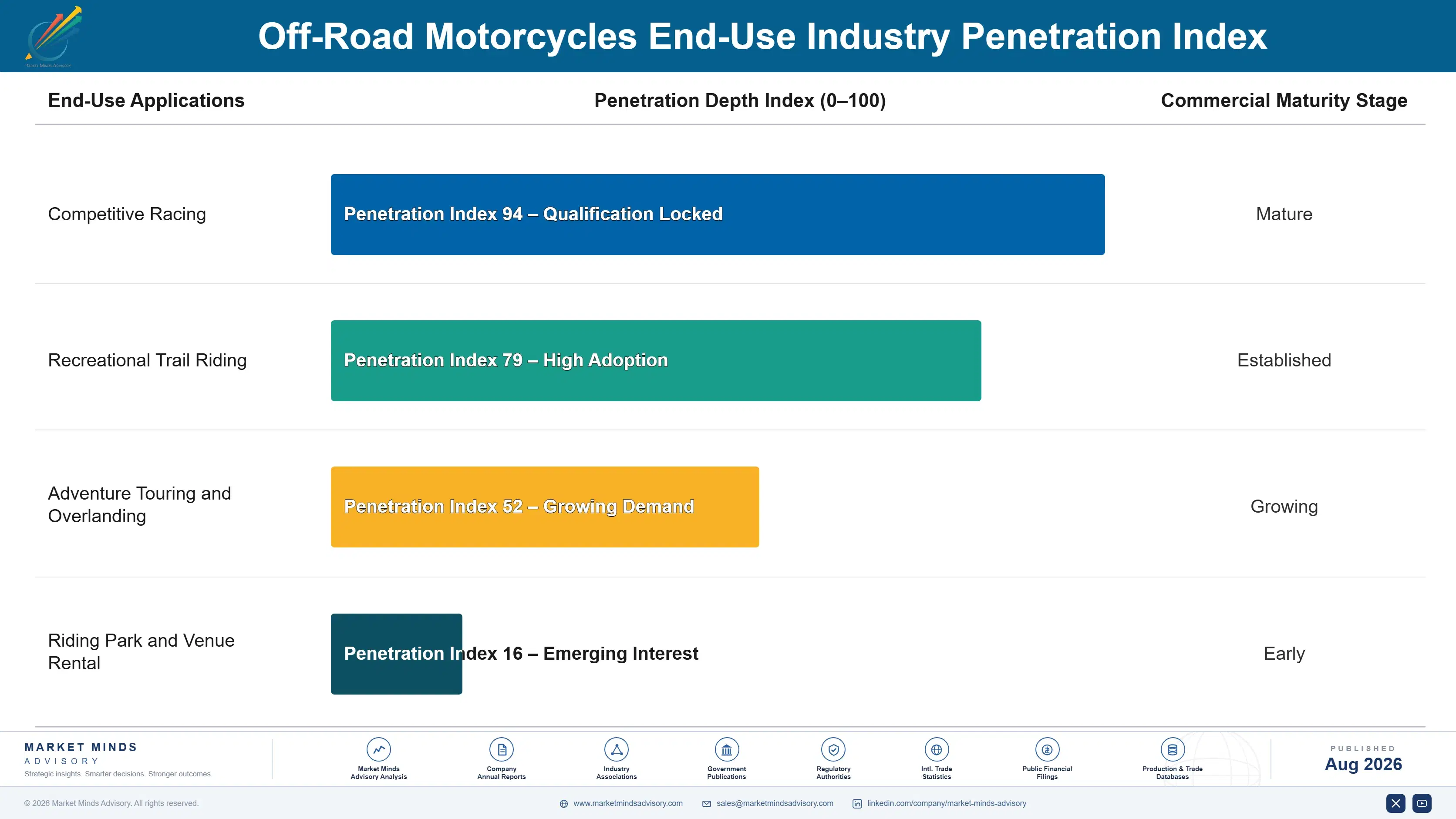
Off-road motorcycle demand behaves like a recurring replacement cycle for manufacturers holding brand loyalty among competitive and recreational riders, since riders rarely switch brands once invested in a manufacturer's network of parts, accessories, and dealer service relationships. Multi-year ownership cycles, typically three to five years, persist through a rider's competitive or recreational progression, giving incumbent manufacturers durable, recurring revenue streams across their loyal customer base.
Stickiness varies meaningfully by end-use vertical: competitive racers rarely switch manufacturers mid-season given sponsorship relationships and mechanical familiarity, while recreational riders switch more readily based on price and dealer availability. Adventure touring riders sit between these extremes, valuing brand reliability but willing to test new manufacturers when touring-specific features and comfort requirements shift across their evolving travel preferences and needs.

Buyer profiles are shifting generationally as purchasing decisions move from riders focused purely on raw performance toward younger buyers weighing environmental impact and trail access alongside performance. This generational shift favors manufacturers who can speak credibly to electric powertrain capability and sustainable riding access rather than performance alone, reshaping which brand relationships and technical capabilities matter most in winning and retaining the next generation of riders.
off-road-motorcycles-market-trends-growth-end-use-penetration-index-1787559008429

MMA Verdict on Manufacturer Strategy

These are among the four positions where our research anticipates prominent divergence between winners and laggards over the coming forecast period. Each is grounded in the demand model, the regulatory perimeter, and the announced capacity pipeline.
01 / ELECTRIC POWERTRAIN PRIORITY

Invest in Electric Powertrains Before Trail Bans Bind

Manufacturers without competitive electric powertrain technology are losing access to noise-restricted riding venues that competitors invested in early, not in some future regulatory cycle several years away from today's tightening trail access reality. The premium electric manufacturers command, averaging 20 to 28% above internal combustion equivalents, will only widen as trail access restrictions expand through 2030 and beyond, rewarding early movers substantially. Delaying electric investment past 2027 risks permanent exclusion from the fastest-growing and highest-margin segment of the entire market for years to come.
02 / SWAPPABLE BATTERY INFRASTRUCTURE

Build Swappable Battery Networks Before Range Anxiety Persists

Manufacturers without swappable battery infrastructure are ceding the extended-session riding segment to competitors who invested in venue partnerships ahead of confirmed charging demand across major riding destinations nationwide and internationally as well. This capability commands a premium averaging 12 to 18% through venue partnership agreements, rewarding manufacturers who build infrastructure ahead of persistent range anxiety concerns among serious riders across the industry. Manufacturers who invest now will capture volume that conventional charging-dependent competitors cannot economically match going forward into the next decade.
03 / ADVENTURE TOURING EXPANSION

Deepen Touring Platform Engineering to Capture Premium Riders

Recreational riders increasingly seek versatile platforms combining highway transit capability with genuine off-road performance, and manufacturers who invest in dedicated touring engineering are capturing meaningful pricing premiums while raising switching costs for existing customer accounts substantially and quite consistently. This capability gap is currently underexploited by all but the largest manufacturers serving this fragmented and still-consolidating industry landscape today, leaving real margin on the table. Building dedicated touring platforms now positions manufacturers ahead of competitors relying on adapted competition models.
04 / BRAZILIAN MARKET EXPANSION PRIORITY

Expand Distribution in Brazil Ahead of Rider Growth

Brazil represents the fastest-growing national market as recreational riding culture and off-road racing events expand across the country, and manufacturers without meaningful Brazilian distribution presence are ceding share to competitors positioned closer to this expanding demand base and its enthusiastic growing rider community. Early movers securing dealer networks and customer relationships in Brazil now will hold a durable cost and lead-time advantage over competitors entering once regional market consolidation is further along. This window will likely close within several years.

Engagement Snapshot From the Field

A live engagement with an industry participant carrying material or product regulatory and market exposure ahead of a defining policy shift, showing how our research translates into a defensible multi-year portfolio strategy.
MARKET MINDS ADVISORY · CLIENT ENGAGEMENT SUMMARY
Off-Road Motorcycles Producer Strategic Portfolio Review and Transition Roadmap 2026·Investment Scenario on Off-Road Motorcycles Exposure Evaluation 2025-26
CLIENT PROFILE
The client is a regional off-road riding park operator managing three trail systems across the western United States, serving roughly 15,000 annual riders facing new county noise ordinances restricting internal combustion motorcycle access during peak hours. Facing potential attendance loss, the operator's management team needed an independent assessment of electric motorcycle rental fleet options and infrastructure cost ahead of a major facility investment decision.
STRATEGIC CHALLENGE
The operator faced a choice between restricting riding hours to comply with noise ordinances or investing in an electric motorcycle rental fleet to maintain full operating hours while meeting regulatory requirements. Internal operations and finance teams disagreed on timing, and the operator lacked independent data comparing electric fleet supplier options and true multi-year cost and revenue impact.
MMA APPROACH
MMA conducted supplier capability benchmarking across four electric off-road motorcycle manufacturers, modeled three-year cost and revenue scenarios under different fleet size assumptions, and interviewed operations directors at two comparable riding parks regarding their own electric fleet transition experience. The engagement combined primary survey data with direct manufacturer interviews to produce a fleet investment and infrastructure framework.
KEY FINDINGS
  1. Electric fleet acquisition carried a 25% cost premium at the time of assessment, expected to narrow to roughly 15% within three years (client-reported, unverified by MMA).
  2. Two of four benchmarked manufacturers already held proven rental fleet durability data from comparable riding park operations, while two required additional field testing.
  3. Attendance modeling showed a meaningful revenue loss risk emerging within six months if the operator restricted hours instead of investing in electric fleet capacity.
  4. Operations directors at both interviewed comparable parks indicated electric fleet rental revenue exceeded internal combustion rental revenue within the first full season.
CLIENT PROFILE
The client is a regional off-road riding park operator managing three trail systems across the western United States, serving roughly 15,000 annual riders facing new county noise ordinances restricting internal combustion motorcycle access during peak hours. Facing potential attendance loss, the operator's management team needed an independent assessment of electric motorcycle rental fleet options and infrastructure cost ahead of a major facility investment decision.
STRATEGIC CHALLENGE
The operator faced a choice between restricting riding hours to comply with noise ordinances or investing in an electric motorcycle rental fleet to maintain full operating hours while meeting regulatory requirements. Internal operations and finance teams disagreed on timing, and the operator lacked independent data comparing electric fleet supplier options and true multi-year cost and revenue impact.
MMA APPROACH
MMA conducted supplier capability benchmarking across four electric off-road motorcycle manufacturers, modeled three-year cost and revenue scenarios under different fleet size assumptions, and interviewed operations directors at two comparable riding parks regarding their own electric fleet transition experience. The engagement combined primary survey data with direct manufacturer interviews to produce a fleet investment and infrastructure framework.
KEY FINDINGS
  1. Electric fleet acquisition carried a 25% cost premium at the time of assessment, expected to narrow to roughly 15% within three years (client-reported, unverified by MMA).
  2. Two of four benchmarked manufacturers already held proven rental fleet durability data from comparable riding park operations, while two required additional field testing.
  3. Attendance modeling showed a meaningful revenue loss risk emerging within six months if the operator restricted hours instead of investing in electric fleet capacity.
  4. Operations directors at both interviewed comparable parks indicated electric fleet rental revenue exceeded internal combustion rental revenue within the first full season.
RECOMMENDED STRATEGY
Phase 1: Phase one: acquire 30% of the rental fleet in electric models within six months, prioritizing the trail system facing the nearest ordinance deadline. Phase 2: Phase two: expand electric fleet to cover all three trail systems within eighteen months, timed to align with full noise ordinance enforcement. Phase 3: Phase three: renegotiate manufacturer fleet contracts at twelve months to capture volume-based pricing improvements as overall fleet size continues to scale.
OUTCOME
The client completed electric fleet expansion within fourteen months, ahead of the county's full ordinance enforcement deadline, and reported rental revenue exceeding original projections by 12% across all three trail systems and every single riding season combined nationwide and quite consistently (client-reported, unverified by MMA).

Frequently Asked Questions

Foundational context covering the market sizes, CAGR, scope, country, region and competition that inform every finding below. This section is provided to cover basics and most often pre-purchase conversations, answered from the MMA Primary Research Dataset.

What is the current size of the Off-Road Motorcycles Market?

The Off-Road Motorcycles Market is valued at $5.5 billion in 2025. This figure reflects global demand across motocross, enduro, dual-sport, trials, and electric off-road motorcycle formats.

How large will the Off-Road Motorcycles Market be by 2036?

The market is projected to reach $11.0 billion by 2036. Growth is driven primarily by electric powertrain adoption and expanding adventure touring demand across recreational riding segments.

What is the CAGR for the Off-Road Motorcycles Market 2026 to 2036?

The market is forecast to grow at a 6.5% compound annual growth rate between 2026 and 2036. Bull and bear scenarios range from 7.7% to 5.3% depending on electric adoption pacing.

Which segment is growing fastest?

Electric off-road motorcycles are the fastest-growing segment, expanding at a 15.0% CAGR, well above the overall market rate. Trail access restrictions on internal combustion engines are the primary driver.

Who are the major companies in the Off-Road Motorcycles Market?

Leading participants include KTM, Honda, Yamaha, Kawasaki, and Husqvarna Motorcycles. Together these five manufacturers hold approximately 62% of global market share on a revenue basis.

Which country is growing fastest?

Brazil is the fastest-growing country market, expanding at a 10.5% CAGR. Expanding recreational riding culture and rising off-road racing events are accelerating motorcycle demand domestically.

Report Segmentation Architecture

The full report scope spans multiple orthogonal segmentation dimensions, with cross-tabulated demand data provided for each dimension pair. Coverage extends further to regional breakdowns, trend trajectories, and the competitive detail needed to support segment-level decision-making.

By Primary Market Dimension

  • Motocross Motorcycles
  • Enduro/Dual-Sport Motorcycles
  • Trail/Trials Motorcycles
  • Electric Off-Road Motorcycles
  • Adventure Touring Off-Road Motorcycles
  • Youth/Entry-Level Off-Road Motorcycles

By End-Use Industry

  • Competitive Racing
  • Recreational Trail Riding
  • Adventure Touring and Overlanding
  • Riding Park and Venue Rental

By Commercial Dimension

  • Direct Dealer Network Contracts
  • Distributor and Wholesale Channel
  • Fleet and Rental Supply

By Region

  • North America
  • Western Europe
  • East Asia
  • South Asia and Pacific
  • Latin America
  • Middle East and Africa
  • Eastern Europe

Scope, Methodology, and Coverage

Every figure in this report is reproducible from documented input assumptions. The scope below maps the historical period, the forecast horizon, the segmentation dimensions, and the countries covered, alongside the underlying primary and qualitative methodology.
Historical Period
2020 to 2025
Forecast Period
2026 to 2036
Base Year
2025 (USD billions; MMA Primary Research Dataset, August 2026)
Market Definition
The Off-Road Motorcycles Market covers motocross, enduro, dual-sport, trials, and electric off-road motorcycles designed for unpaved terrain riding in competitive and recreational applications. It excludes street-legal touring and cruiser motorcycles, all-terrain vehicles with more than two wheels, and utility side-by-side vehicles.
Quantitative Units
USD billions (current prices); thousand units for volume-referenced segment discussion where applicable
Segmentation Dimensions
By Primary Market Dimension; By End-Use Industry; By Commercial Dimension; By Region
Regions Covered
North America, Western Europe, East Asia, South Asia and Pacific, Latin America, Middle East and Africa, Eastern Europe
Countries Covered
USA, Canada, Mexico, Austria, Italy, Spain, Germany, France, UK, Japan, China, South Korea, Australia, India, Thailand, Indonesia, Brazil, Argentina, Chile, UAE, Saudi Arabia, South Africa, Poland, Czech Republic, Hungary, Romania, Russia, and additional markets relevant to this sector
Key Companies Profiled
KTM, Honda, Yamaha, Kawasaki, Husqvarna Motorcycles, Suzuki, Beta Motorcycles, Gas Gas, Sherco, TM Racing, Fantic Motor, Rieju, Cobra Moto, Cake, Stark Future, Zero Motorcycles, Sur-Ron, Talaria, Bultaco, Montesa
Quantitative Methodology
Primary survey, n=3,800 respondents, Q4 2025, six countries; demand-side model with trade association cross-validation
Qualitative Methodology
47 expert interviews, Q4 2025; applied to validate demand model assumptions, identify emerging dynamics, and assess competitive positioning
Report Format
PDF and XLSX data workbook (Word format preview document)
Publisher
Market Minds Advisory
Report Code
MMA-2026-AUT-101
Published
August 2026
Contact
sales@marketmindsadvisory.com | www.marketmindsadvisory.com

Purchase the full Off-Road Motorcycles Market Report (2026 to 2036).

This report provides a comprehensive ten-year forecast of the global Off-Road Motorcycles Market. Coverage spans motocross, enduro, dual-sport, trials, adventure touring, and electric off-road motorcycle formats across all seven world regions. Deliverables include segment-level and regional sizing to 2036, competitive benchmarking of twenty profiled manufacturers on a consistent revenue basis, and feedstock cost exposure analysis. A strategic verdict identifies where manufacturers should concentrate electric powertrain and touring platform investment over the coming decade. The report draws on primary survey data, expert interviews, and company disclosures rather than secondary aggregation.
Ten-year market sizing across seven world regions
Segment-level CAGR and market share benchmarking
Competitive profiling of twenty leading manufacturers
Electric powertrain and trail access pathway analysis
Feedstock cost exposure and mitigation strategies
Strategic verdict on capital allocation priorities

Built For The People Who Decide

From boardroom strategy to bench-side execution, this report is read cover-to-cover by leaders shaping the next decade of their industry, turning demand scenarios, market dynamics and valuation benchmarks into decisions.
CXOs/ Presidents/ VPs/ Managers
M&A and Corporate Development
Strategy Teams and R&D Heads
Procurement and Product Directors
Regulatory and Compliance Leaders
Investor Relations and Equity Analysts