Market Minds Advisory
OEM Insulation Market

OEM Insulation Market: OEM Insulation Market: interior volume economics, blowing agent conversion and electric vehicle acoustics to 2036

In an appliance, thermal performance gets paid for in cabinet litres rather than in dollars, and that trade decides which material wins far more often than the price comparison ever does.

Lead Analyst

Bilal Shaikh

Published

August 2026

Make Smarter Decisions with Customized Research Insights

Request a free sample report and evaluate market opportunities, growth trends, and competitive dynamics relevant to your business needs.

2025 MARKET VALUE$14.8BMarket Size 2025
2036 FORECAST VALUE$29.9BBase Case , 2026 to 2036
CAGR 2026 TO 20366.6 %Bull 7.8% / Bear 5.4%
INCREMENTAL OPPORTUNITY$14.1BNet 10- year value creation
EXPANSION MULTIPLE1.89x2036 value over 2026 base
Strategic Levers
M&A Pipeline
Regional Outlook
Country Rankings
Competitive Intelligence
Segmental Deep-dive
Call-Us : 91 93563 13602

Executive Snapshot and Market Trajectory.

Insulation is roughly 4% of the bill of materials in a refrigeration cabinet and it decides the energy label on the door. That asymmetry is why value engineering never reaches this line. An appliance maker will pay several times over for a material that performs.
What it actually pays for is space. Every step up in foam thickness costs around 6% of interior volume, and a consumer buying a fridge wants capacity within a fixed footprint. Vacuum insulation panels deliver roughly eight times the thermal resistance per millimetre, which gives those litres back, and they grow at 9.9% despite the cost. Quoted per square metre a panel looks expensive; quoted against capacity it looks cheap.
Acoustic and vehicle noise composites follow at 8.2%, because removing a combustion engine removed the noise that had been masking everything else. Electric vehicles need different treatment rather than more of it, and content value runs about 1.4 times a comparable combustion model. East Asia holds 38% of value on appliance and vehicle manufacturing concentration. Weight is the constraint that decides those programmes. Heavier versions of existing treatment lose these programmes immediately on mass.
Market Definition
This report covers thermal and acoustic insulation supplied directly to original equipment manufacturers, spanning rigid polyurethane and polyisocyanurate foam, mineral and glass wool, elastomeric and flexible foams, vacuum insulation panels, acoustic and noise composites, and aerogel and high-performance specialities. Value is measured at supplier level on insulation destined for equipment manufacture. Excluded are building insulation sold through construction distribution, refractory linings for furnaces, pipe insulation installed on site, packaging insulation for cold chain shipping, and raw chemicals sold to foam formulators.
Base Year Value
$14.8B in 2025 (MMA Primary Research Dataset, August 2026)
Forecast Period
2026 to 2036, eleven discrete annual values
CAGR
6.6% base case. Bull 7.8%. Bear 5.4%.
Fastest Growth Segment
Vacuum Insulation Panels: 9.9% CAGR
Fastest Growth Country
India: 9.8% CAGR
Fastest Growth Region
South Asia and Pacific: 8.6% CAGR
Largest Region
East Asia: 38% of 2025 global value
Market Leaders
Saint-Gobain, Rockwool, Knauf Insulation, Armacell and Owens Corning lead the market. Source: MMA Primary Research Dataset, July 2026.
Primary Survey
n=3,800 procurement and R&D decision-makers, Q4 2025, six countries
Methodology
Demand-side build-up, cross-validated against public data, 47 expert interviews

OEM Insulation Market Forecast Scenarios

oem-insulation-market-trends-size-forecast-scenario-1787559396657
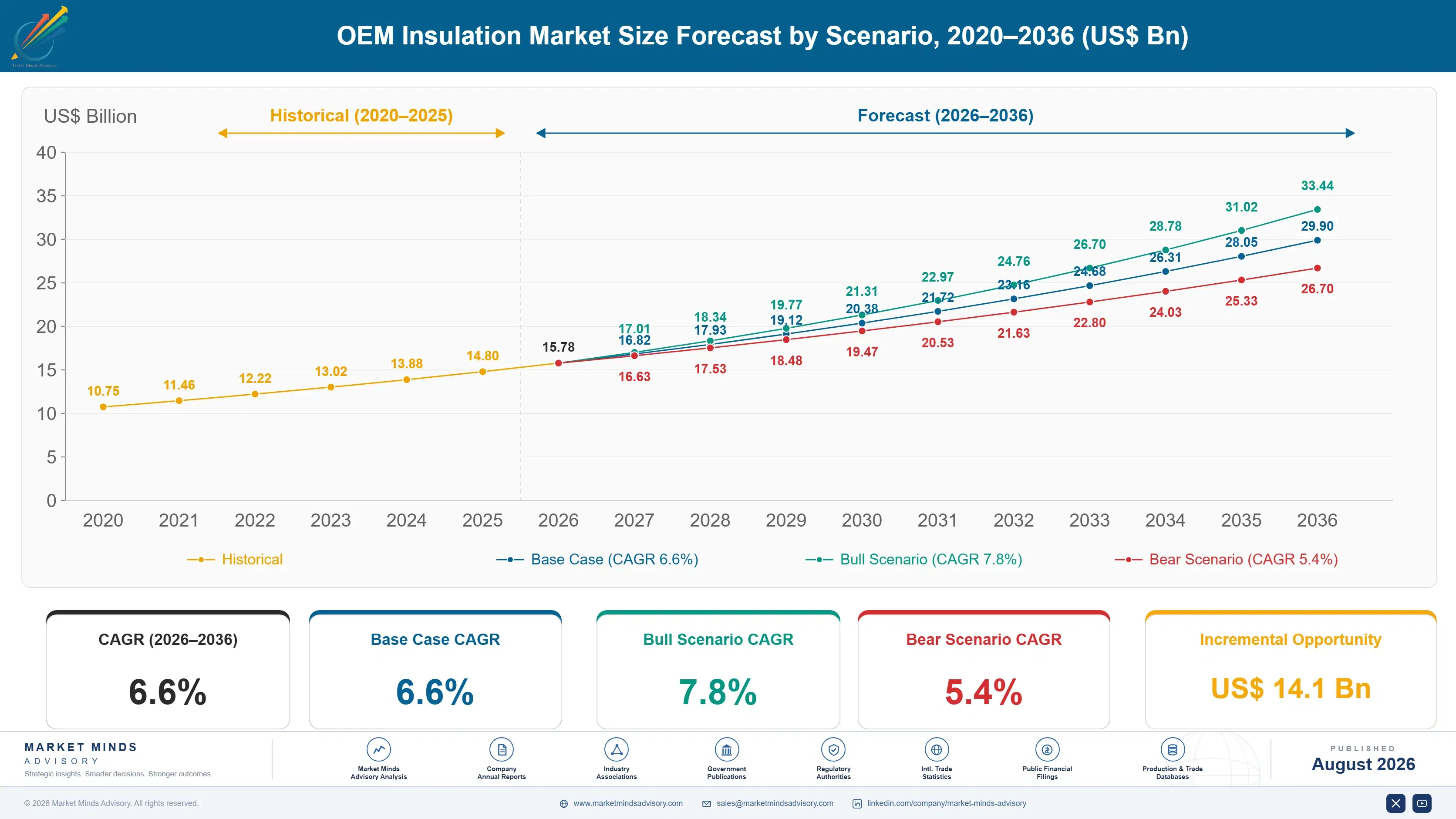
Growth ran at 5.2% between 2020 and 2025 and two forces pulled in opposite directions throughout. Appliance and vehicle production recovered unevenly after 2020, while energy labelling and efficiency standards steadily raised insulation content per unit regardless of how many units were built. Blowing agent conversion added cost that suppliers largely absorbed, and electric vehicle acoustic requirements began appearing in programmes toward the end.
The 6.6% base case rests on three mechanisms. Vacuum insulation panels at 9.9% as appliance makers buy back interior volume that thicker foam would take away. Acoustic and noise composites at 8.2% on electric vehicle treatment that differs in kind rather than degree. And Indian growth at 9.8%, the fastest of any country, on appliance and vehicle manufacturing expanding together under domestic production incentives. Label revisions arrive as step changes rather than gradually.
The 7.8% bull case is appliance energy labelling tightening another step, which forces material substitution rather than incremental thickness across whole product ranges. The 5.4% bear case is vacuum panel cost failing to fall with volume, since a manufacturing process with high scrap sensitivity does not automatically get cheaper simply because more of it is being made.

Performance Paid For In Litres

The economics of appliance insulation are not really about cost, and treating them that way explains almost nothing about which material gets specified. Insulation accounts for roughly 4% of a refrigeration cabinet's bill of materials while determining the energy label that sits on the door in the showroom, which means it is simultaneously the cheapest place to spend money and the most consequential. Value engineering exercises that strip cost out of every other component reach this line and stop, because the label consequence outweighs any saving available.
TOP-FIVE CONCENTRATION36%Combined position across supply held by the leading insulation suppliers
CABINET VOLUME COST6%Interior capacity lost when foam thickness rises one step
VACUUM PANEL PERFORMANCE RATIO8xThermal resistance relative to conventional rigid foam thickness
BLOWING AGENT CONVERSION71%Share of rigid foam lines moved off high warming agents
ELECTRIC VEHICLE ACOUSTIC CONTENT1.4xTreatment value relative to a comparable combustion model
APPLIANCE INSULATION COST SHARE4%Portion of bill of materials in a typical refrigeration cabinet
What the manufacturer is genuinely trading is interior volume. Cabinet dimensions are fixed by kitchen conventions and shipping, so every step up in foam thickness costs around 6% of usable capacity, and the consumer comparing two refrigerators of identical external size notices litres before anything else. That is why vacuum insulation panels win specifications despite costing several times a foam equivalent: at roughly eight times the thermal resistance per millimetre they return the volume that efficiency would otherwise have taken away.
Away from appliances the equivalent constraint is noise. Electric vehicles removed the engine that had been masking road, wind and motor sound, which changed what acoustic treatment has to do.
"Every conversation about appliance insulation starts with cost per square metre and it is the wrong question entirely. The manufacturer is buying back litres of fridge, and once you price it that way a vacuum panel at four times the money is obviously cheap. Very few suppliers sell it in those terms."
Director, Thermal and Acoustic Materials Practice · MMA Construction and Industrial Equipment Practice · August 2026

Market Trends

Vacuum panels win specifications by returning interior volume

Appliance cabinet dimensions are fixed by kitchen conventions and shipping constraints, so improving efficiency through thicker foam costs roughly 6% of interior capacity at every step, and consumers compare litres directly between machines of identical external size. Vacuum insulation panels deliver around eight times the thermal resistance per millimetre and hand that volume back. Growth at 9.9% follows tightening energy labels rather than any cost improvement in the panels themselves. Commercially this means suppliers selling on price per square metre are answering a question the appliance engineer is not actually asking.
Market Impact: Insulation sets a 4% cost share
Electric vehicles change acoustic treatment in kind, not degree

A combustion engine masked road noise, wind noise and everything else happening under the vehicle, and removing it made all of that audible alongside motor whine at frequencies no combustion vehicle ever produced. Electric acoustic packages therefore need targeted high-frequency absorption rather than the broadband mass damping that worked before, and content value runs about 1.4 times a comparable combustion model. Growth at 8.2% follows that change directly. Suppliers offering heavier versions of existing treatment miss the specification entirely, because weight is precisely what an electric platform cannot afford. Mass is the criterion, and attenuation alone does not win.
Market Impact: Indian demand compounds at 9.8%

Market Opportunities and Growth Drivers

Energy labelling forces material change rather than incremental thickness

Appliance efficiency labels have been rescaled and tightened across major markets, and manufacturers running out of dimensional room to add foam are forced into material substitution instead. Water heaters, refrigeration and ovens all face the same arithmetic, since every one of them has an external envelope the consumer will not accept growing. Commercially this converts a slow content increase into a discrete specification change at each label revision, which favours suppliers with a performance answer ready rather than those offering more of the same material at greater thickness. Timing of each revision is the useful thing to forecast.
Market Impact: Conversion reaches 71% complete

Indian appliance and vehicle manufacture expand under production incentives

Indian growth at 9.8% leads every country in this market, driven by refrigeration, air conditioning and vehicle manufacturing all expanding under domestic production incentive schemes at the same time. Appliance ownership penetration remains well below developed market levels, which leaves considerable headroom in units before any content increase is counted. Energy labelling is tightening in parallel, so content per unit is rising alongside volume rather than lagging it. Domestic and international suppliers both hold meaningful positions across the expanding manufacturing base. Appliance ownership penetration remains far below developed market levels.
Market Impact: Panels cost 4 times foam

Market Restraints and Challenges

Blowing agent conversion adds cost suppliers largely absorb

Around 71% of rigid foam lines have converted off high warming potential blowing agents onto hydrofluoroolefin and hydrocarbon systems under refrigerant phasedown rules, and the replacements cost more while sometimes requiring reformulation and equipment modification. The root cause is that the agent doing the insulating is itself a controlled substance. Commercially the increase has been absorbed by suppliers rather than passed to appliance makers who buy on annual contracts. The remaining 29% sits in markets where enforcement is weaker, which distorts competition between regions. Export production faces destination rules regardless of local enforcement.
Market Impact: Returns 6% of cabinet volume

Vacuum panel cost resists the usual volume learning curve

Vacuum insulation panels have not become cheap in the way most manufactured products do with scale, because the process is sensitive to scrap and a panel that loses vacuum is worthless rather than merely degraded. The root cause is that performance depends on maintaining a seal across the panel's whole service life, which puts quality control cost into every unit. Commercially this keeps the material confined to applications where volume recovery justifies it. Producers are pursuing improved barrier films and getter chemistry, both of which help without transforming the economics.
Market Impact: Content runs 1.4 times combustion
4 additional market trends, 3 additional growth drivers, and 2 additional restraints and challenges are covered in the full report. Contact sales@marketmindsadvisory.com to access the complete intelligence.

Segment CAGR and Growth Architecture

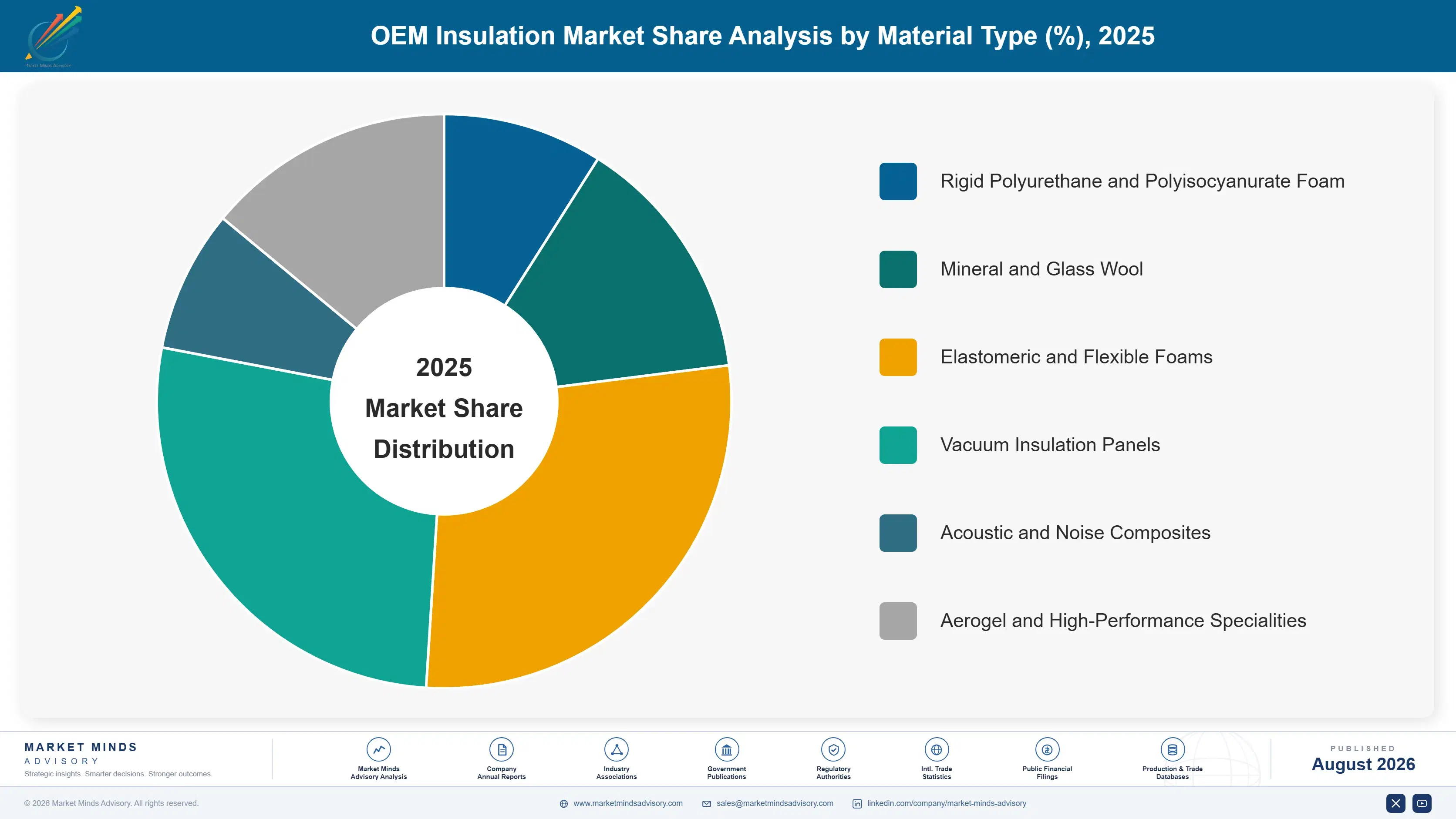
Value is classified here by material and product type, since thermal performance, thickness, weight and cost all follow directly from what the insulation is made of rather than from where it ends up. End equipment category, supply channel and application function are handled separately in the framework below, because most materials serve several equipment types without any modification.
oem-insulation-market-trends-market-share-analysis-1787559397188

Vacuum Insulation Panels

Growing at 9.9%, half again the market rate, vacuum panels exist commercially because appliance cabinet dimensions are fixed and improving efficiency through foam thickness costs roughly 6% of interior volume at every step. Delivering around eight times the thermal resistance per millimetre, a panel hands those litres back to a consumer who compares capacity between machines of identical external size. The material costs several times a foam equivalent and wins anyway. Manufacturing has not followed the usual volume learning curve, since a panel losing vacuum is worthless rather than degraded, which keeps quality control cost in every unit and confines use to applications where volume genuinely matters. Barrier film and getter chemistry improvements help without transforming it.
CAGR 9.9%

Acoustic and Noise Composites

Removing a combustion engine removed the sound that had been covering road noise, wind noise and driveline whine, and electric platforms then added motor frequencies no combustion vehicle produced at all. Treatment consequently changed in kind rather than degree, moving from broadband mass damping toward targeted high-frequency absorption placed precisely where the noise originates. Content value runs around 1.4 times a comparable combustion model, and growth at 8.2% follows that shift. Weight remains the binding constraint, because an electric platform carries battery mass it cannot add to, so heavier versions of existing treatment lose specifications immediately on that basis alone. Placement precision matters as much as material choice, since absorption must sit where the noise originates.
CAGR 8.2%
Full segment breakdown across 6 segments available in the complete report.

Regional Architecture and Country Demand Map

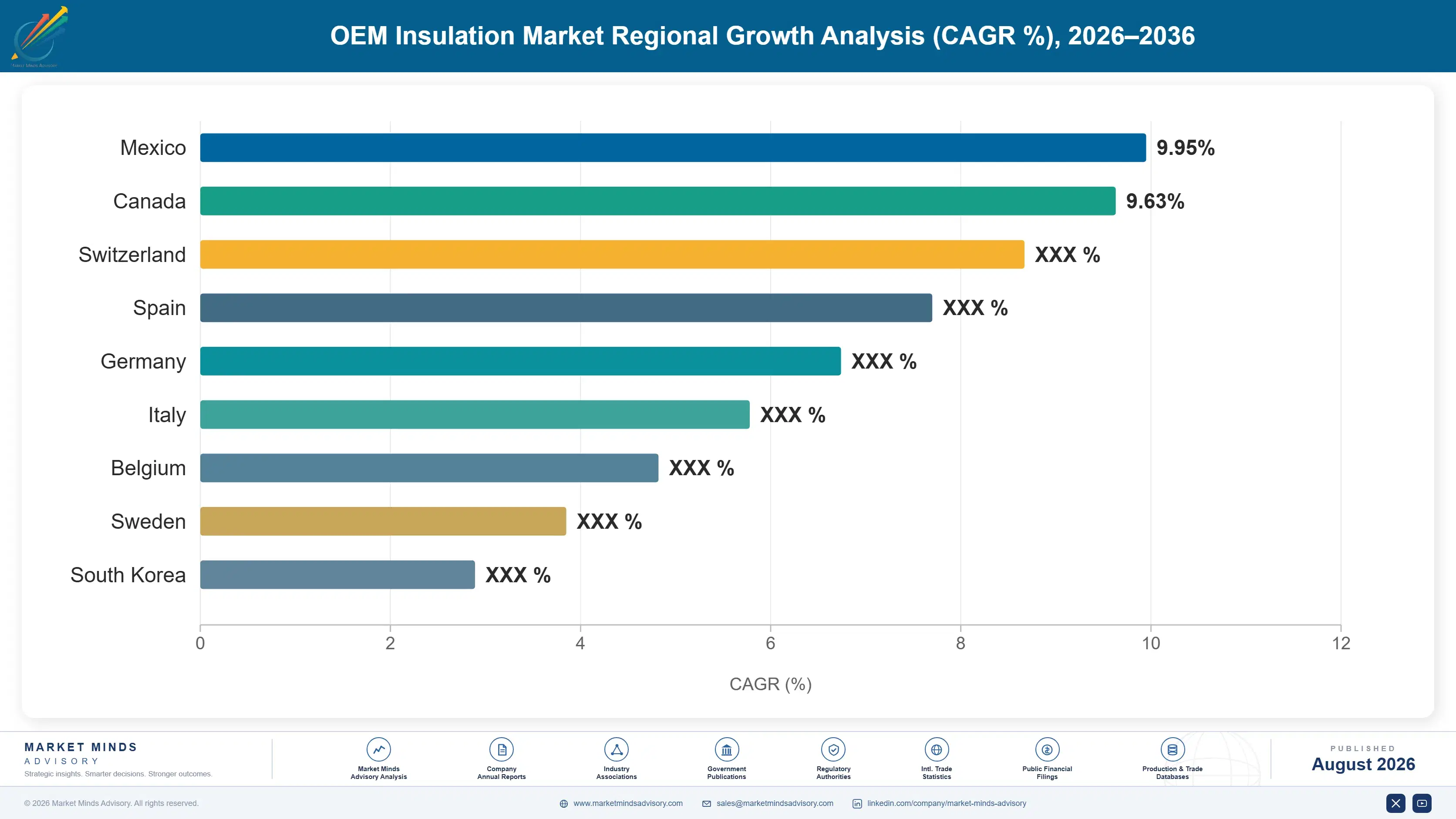
East Asia holds 38% of value, above the standard band, because appliance and vehicle manufacturing both concentrate there at volumes nowhere else approaches. North America follows at 21%, marginally below its usual band, while Western Europe at 19% drives specification worldwide through its labelling policy.

East Asia

At 38% this region sits above the standard band, because Chinese, Japanese and Korean appliance manufacture together with substantial vehicle production concentrate equipment insulation demand here far beyond anywhere else. Chinese refrigeration and air conditioning output alone dwarfs other regions, and domestic suppliers compete hard on standard foam and wool grades. Japanese and Korean manufacturers pioneered vacuum panel adoption in premium refrigeration and hold the deepest experience with the material anywhere, with Panasonic and Kaneka significant participants. Blowing agent conversion is well advanced in export-oriented production. Growth at 7.6% reflects volume and content rising together. Regional capacity sits close to assembly clusters, which matters because insulation is bulky and expensive to move any distance at all.
Share: 38% | CAGR: 7.6% (2026 to 2036)

North America

At 21% this region sits marginally below the standard band, with appliance and vehicle manufacturing substantial but well below Asian volumes. Federal appliance efficiency standards drive content here rather than a labelling scheme, which produces step changes at each rulemaking rather than continuous pressure. Water heater insulation requirements have been particularly consequential, since tank dimensions are constrained by installation clearances in existing homes. Electric vehicle acoustic content is growing quickly with domestic assembly investment. Growth at 6.0% sits below the market rate and reflects content increases more than unit expansion. Regional suppliers hold delivered cost advantages on conventional materials through freight proximity to assembly plants rather than through manufacturing efficiency.
Share: 21% | CAGR: 6.0% (2026 to 2036)
Regional intelligence for 5 additional markets available in the complete report: Western Europe, South Asia and Pacific, Latin America, Middle East and Africa, Eastern Europe. Contact sales@marketmindsadvisory.com.
oem-insulation-market-trends-country-cagr-analysis-1787559397700

Where Insulation Value Now Concentrates

Four moves matter for a component that costs almost nothing and decides an energy label, in a market where the real currency is interior volume and vehicle weight rather than money. Two concern selling performance in the terms the customer actually values, and two concern the conversions and content changes now underway across equipment programmes.

Price vacuum panels in litres, not square metres

An appliance engineer facing a tightening energy label is choosing between thicker foam that costs roughly 6% of interior volume and a vacuum panel that returns those litres at around eight times the thermal resistance per millimetre. Quoted per square metre the panel looks expensive; quoted against the capacity it preserves in a cabinet the consumer compares directly on the shop floor, it looks cheap. Suppliers who reframe the comparison win specifications that a price sheet would have lost outright. Reframing the comparison wins specifications a price sheet loses. The engineer is not asking a price question.
Market Impact: Recovers 6% of the otherwise lost interior volume

Design electric acoustic packages for weight, not mass

Electric platforms need targeted high-frequency absorption for motor whine and tyre noise rather than the broadband mass damping that combustion vehicles used, and content value runs about 1.4 times a comparable model. The binding constraint is weight, since a battery platform has none to spare. Suppliers offering heavier versions of existing treatment lose these specifications immediately, while those delivering equivalent attenuation at lower mass are selling into a requirement the vehicle engineer cannot solve any other way. A battery platform has no spare mass anywhere in its budget. Lighter equivalent attenuation solves an unsolvable problem.
Market Impact: Serves content worth 1.4 times combustion vehicle treatment

Convert remaining blowing agent lines before enforcement arrives

Roughly 71% of rigid foam lines have moved off high warming potential agents and the remaining 29% sits where enforcement is weaker, which is a competitive distortion rather than a permanent condition. Suppliers who complete conversion ahead of requirement can serve export production immediately when destination rules apply, while unconverted lines face sudden reformulation under time pressure. Conversion also removes a compliance question that appliance makers increasingly ask before awarding multi-year supply agreements. Reformulating at a chosen moment costs far less than reformulating under an imposed deadline with production already committed.
Market Impact: Completes the remaining 29% of foam line conversion

Sell against the label consequence, not the bill of materials

Insulation is roughly 4% of a refrigeration cabinet's bill of materials and determines the energy label that decides shelf position and price. Purchasing teams applying uniform cost reduction targets across a bill of materials will attack this line like any other, and the appliance engineer will overrule them if the consequence is properly explained. Suppliers who reach the engineering function rather than only procurement consistently hold price where competitors selling to purchasing alone do not. Engineering access is the whole mechanism, and it takes time to build. Procurement alone never provides that opportunity.
Market Impact: Defends a 4% line in the materials bill

Who Controls the Margin Pool

Five suppliers hold 36% of this market, measured on insulation revenue at supplier level for equipment-destined volume, the basis used throughout this section. Concentration is moderate because standard foam and wool are made regionally by many participants while vacuum panels, aerogel and acoustic composites are not. The transition toward high-performance materials is quietly pulling value toward the concentrated end of the market. Regional foam competition is unavoidable.
Competition runs on four dimensions. High-performance material capability across vacuum panels, aerogel and engineered acoustic composites, which is where growth concentrates. Blowing agent conversion status, which determines which export production a supplier is permitted to serve at all. Engineering access at equipment manufacturers rather than procurement access alone. And regional capacity near assembly plants, since insulation is bulky and expensive to ship.

Rankings shift toward suppliers with vacuum panel and acoustic engineering capability, and away from those offering only conventional foam and wool into regional cost competition. European suppliers hold the deepest technical positions alongside the slowest-growing home markets anywhere. Asian producers hold volume and are moving into vacuum panels, where their appliance manufacturers pioneered adoption a decade ago.
oem-insulation-market-trends-company-positioning-matrix-1787559398216

Competitive Moat and Risk Dimensions

SAINT-GOBAIN

Moat: Material breadth and engineering reach

The group spans mineral wool, foams and high-performance materials with technical teams embedded at equipment manufacturers rather than only commercial contact through purchasing. That access matters disproportionately here, because an engineer facing an energy label will overrule a procurement cost target when the consequence is explained properly and the alternative is a lost label grade.
SAINT-GOBAIN

Risk: European volume growth weakest

Regional positions concentrate in Western Europe, which grows at 5.0% and is the slowest on this table, while volume expansion sits in Asian and Indian manufacturing. Regional capacity near assembly plants matters because insulation is bulky and costly to ship. Suppliers with capacity beside expanding Asian equipment production capture growth that European technical depth alone does not reach.
ARMACELL

Moat: Elastomeric and equipment specialisation

The company specialises in insulation for equipment rather than buildings, which produces genuinely different engineering relationships and product design priorities from suppliers whose principal business is construction. Elastomeric foam positions in refrigeration, air conditioning and industrial equipment are deep, and the customer relationships sit with equipment engineers rather than with construction distribution.
ARMACELL

Risk: Limited vacuum panel position

Vacuum insulation panels grow at 9.9%, faster than anything else here, and the material requires barrier film, getter chemistry and quality control capability quite unlike foam manufacture. Japanese and Korean participants hold the deepest experience from pioneering appliance adoption. Suppliers without a panel position watch the fastest growth in their own market go to somebody else entirely.

Players Tracked

Prominent Players

Saint-Gobain
Rockwool
Knauf Insulation
Armacell
Owens Corning

Other Key Players

Kingspan
BASF
Covestro
Huntsman
Dow
Autoneum
Adler Pelzer
Zotefoams
Aspen Aerogels
Panasonic
Kaneka
L'Isolante K-Flex
Recticel
Johns Manville
Sekisui Chemical

Recent Developments

FEBRUARY 2025

An appliance maker standardised vacuum panels across a premium range

A major appliance manufacturer standardised vacuum insulation panels across its premium refrigeration range, citing interior capacity retention under tightened energy labelling rather than any thermal performance requirement in isolation. This was a specification decision rather than any transaction between insulation suppliers. Cabinet dimensions were held unchanged.
Signal: Volume recovery rather than thermal performance is the argument that actually wins vacuum panel specifications outright
JUNE 2025

A vehicle manufacturer specified lightweight acoustic treatment for electric platforms

A vehicle manufacturer specified a new acoustic package for its electric platforms built around targeted high-frequency absorption at lower mass than the broadband damping used on combustion models. This was an engineering specification rather than any commercial transaction between material suppliers themselves. Existing damping products failed on mass.
Signal: Electric acoustic requirements differ in kind, and heavier versions of existing treatment lose on weight immediately
OCTOBER 2025

A foam supplier completed blowing agent conversion across regional lines

An insulation supplier completed conversion of its remaining rigid foam production lines onto hydrofluoroolefin and hydrocarbon blowing agents, absorbing reformulation and equipment modification cost ahead of enforcement dates in export destination markets. This was internal capital investment rather than any acquisition. Equipment modification accompanied the reformulation work.
Signal: Conversion status increasingly decides which export production a supplier is actually permitted to serve at all

What Drives Supplier Cost

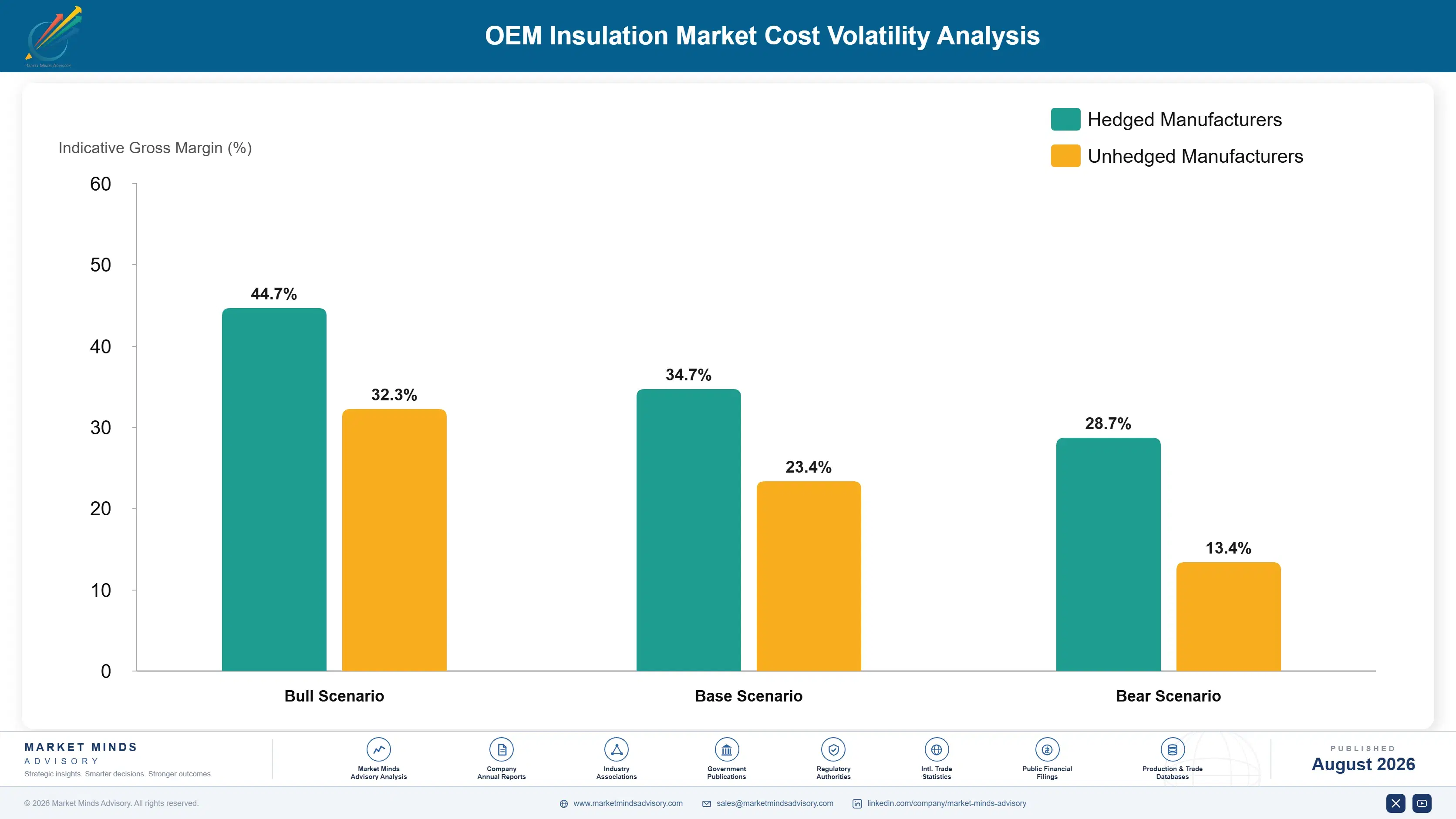
Polyol, isocyanate and blowing agent together account for roughly 62% of rigid foam cost, and the blowing agent share rose materially through conversion onto newer chemistry. Mineral wool cost is dominated by energy at around 34%, since melting rock or glass is genuinely energy intensive. Vacuum panels carry a different structure, with barrier film and quality control dominating.
European energy prices climbed far above Asian and North American levels through 2022, with IEA data showing that gap persisting well beyond the immediate disruption, which hit mineral wool melting economics hardest of all. Rockwool noted energy cost pressure across its operations in its Annual Report 2022. Suppliers on annual equipment manufacturer contracts absorbed most of it, and several European wool lines ran below capacity rather than produce at negative contribution.

The disadvantage falls on suppliers without high-performance material positions, and it operates through where growth sits rather than through any unit cost gap. Standard foam and wool compete regionally on delivered cost against local producers, since bulk makes shipping expensive. Vacuum panels, aerogel and engineered acoustics carry engineering content that regional cost competition does not reach at all, and that is where volume is actually expanding.
oem-insulation-market-trends-cost-volatility-analysis-1787559398410

Site conventional capacity close to equipment assembly plants

Insulation is bulky and expensive to move relative to its value, so delivered cost on standard foam and wool is dominated by freight rather than by manufacturing efficiency. Capacity near equipment assembly clusters beats a more efficient plant several hundred kilometres away. Suppliers optimising plant scale over location consistently lose regional business they should have held.

Complete blowing agent conversion ahead of destination enforcement

Roughly 71% of rigid foam lines have converted and the remainder faces reformulation under time pressure when destination rules apply to export production. Converting early costs reformulation work at a chosen moment rather than an imposed one. Appliance manufacturers increasingly ask about conversion status before awarding any multi-year supply agreement at all. Timing is entirely within a supplier's control.

Recover vacuum panel scrap cost through barrier film investment

A panel that loses vacuum is worthless rather than degraded, which puts quality control cost into every unit produced and explains why volume has not delivered the usual cost learning. Improved barrier films and getter chemistry reduce failure rates directly. That investment lowers unit cost more reliably than any increase in production scale does.

Portfolio Architecture for Margin Defence

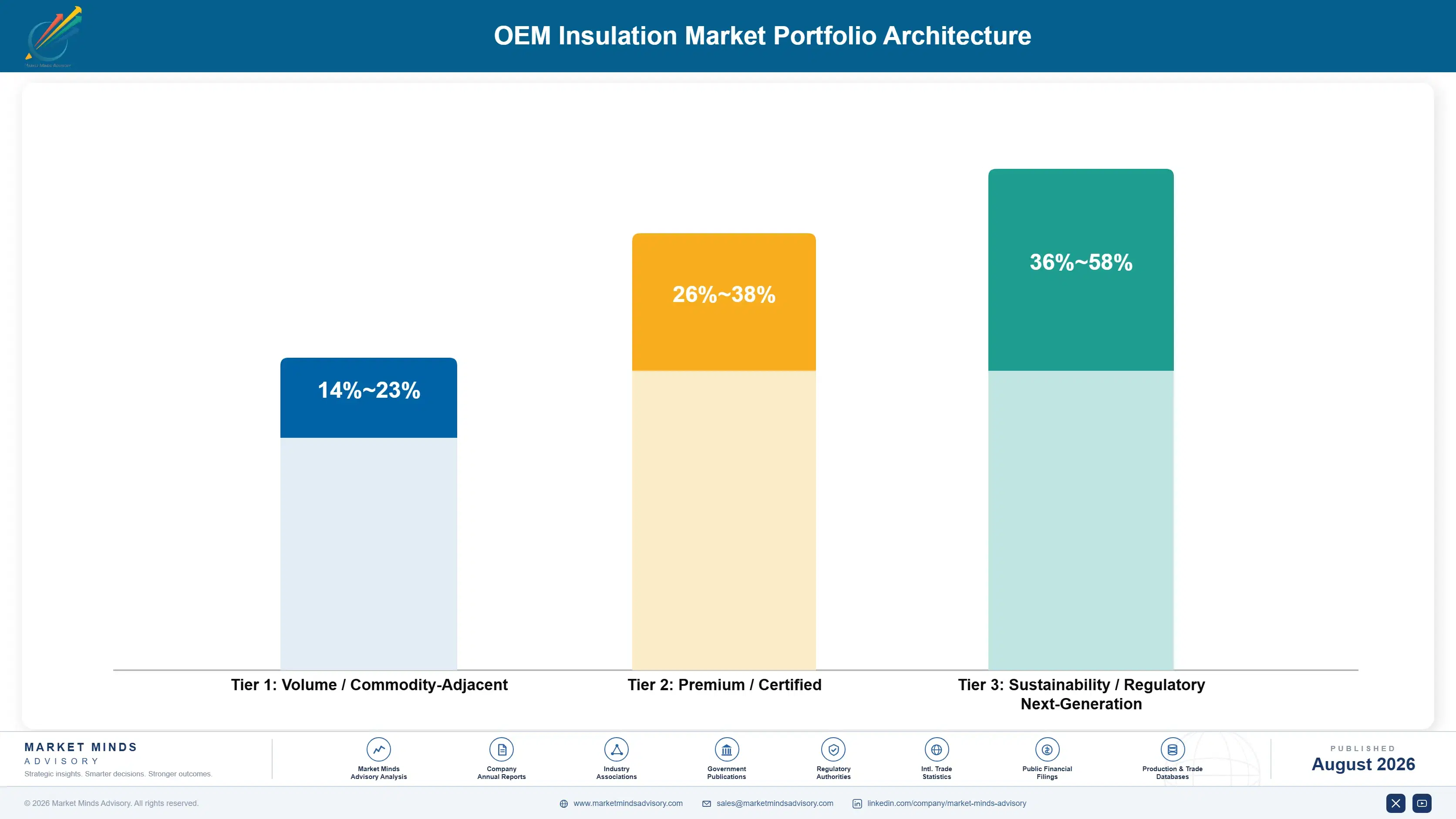
Margin separates on engineering content rather than on manufacturing scale, and the gap between tiers here is wider than in most materials businesses. Standard rigid foam and mineral wool run at gross margins in the mid teens against regional producers where freight rather than efficiency decides delivered cost. Elastomeric and flexible foams run modestly better on equipment-specific formulation. Engineered acoustic composites run considerably higher. Vacuum panels and aerogel run highest of all, because the customer is buying volume or weight rather than insulation.
The tension is that conventional materials fill the plants while high-performance products earn the returns, and moving between them requires quite different manufacturing capability rather than any incremental investment. A wool line cannot be adapted into vacuum panel production by any amount of spending. Suppliers weighted toward conventional materials face regional cost competition and the slowest-growing segments simultaneously, which is an uncomfortable combination to fund development from.

High-value pools sit in vacuum panels, engineered electric vehicle acoustics and aerogel where space is genuinely constrained. Standard foam and wool are where freight economics and local competition have already decided the outcome for everybody.

Volume / Commodity-Adjacent

Standard rigid foam and mineral wool supplied to equipment manufacturers on delivered cost against regional producers. The nine-point range separates suppliers with capacity near assembly plants from those shipping bulky product across longer distances.
Gross Margin: 14%-23%

Premium / Certified

Elastomeric foams and equipment-specific formulations where fire performance, formability and durability are specified into the design. The twelve-point spread reflects formulation and technical support capability rather than any manufacturing advantage.
Gross Margin: 26%-38%

Sustainability / Regulatory / Next-Generation

Vacuum insulation panels, aerogel products and engineered electric vehicle acoustic composites. The twenty-two-point range is wide because the customer is buying interior volume or vehicle weight, and what that is worth varies enormously by programme.
Gross Margin: 36%-58%
oem-insulation-market-trends-portfolio-architecture-1787559398907

High-value Sub-segments and Strategic Watch-out

Vacuum Insulation Panels

Compounding at 9.9% because eight times the thermal resistance per millimetre returns cabinet volume that thicker foam would take. Quality control cost per unit stays high, since a panel losing vacuum is worthless rather than degraded. Barrier film investment lowers cost more reliably than scale.
Gross Margin: 38%-58%

Electric Acoustic Composites

Growing at 8.2% on treatment that differs in kind from combustion damping, targeting motor whine and tyre noise at lower mass. Weight is the binding constraint and heavier solutions lose specifications outright. Placement precision matters quite as much as the material actually chosen. Weight budgets are fixed.
Gross Margin: 36%-50%

Aerogel Space-Constrained Supply

Serving industrial and transport applications where thickness is unavailable at any price and conventional materials simply do not fit. Volumes stay modest and pricing reflects scarcity of the alternative rather than any cost basis. Thickness is simply unavailable at any price in these particular applications.
Gross Margin: 38%-54%

Standard Foam and Wool

The plant volume, competed on delivered cost where freight rather than manufacturing efficiency decides the outcome. Manage this for capacity location near assembly clusters rather than for margin that regional competition prevents. Plant location beats plant efficiency in this particular tier every single time. Freight dominates cost.
Gross Margin: 14%-23%

How Equipment Demand Renews

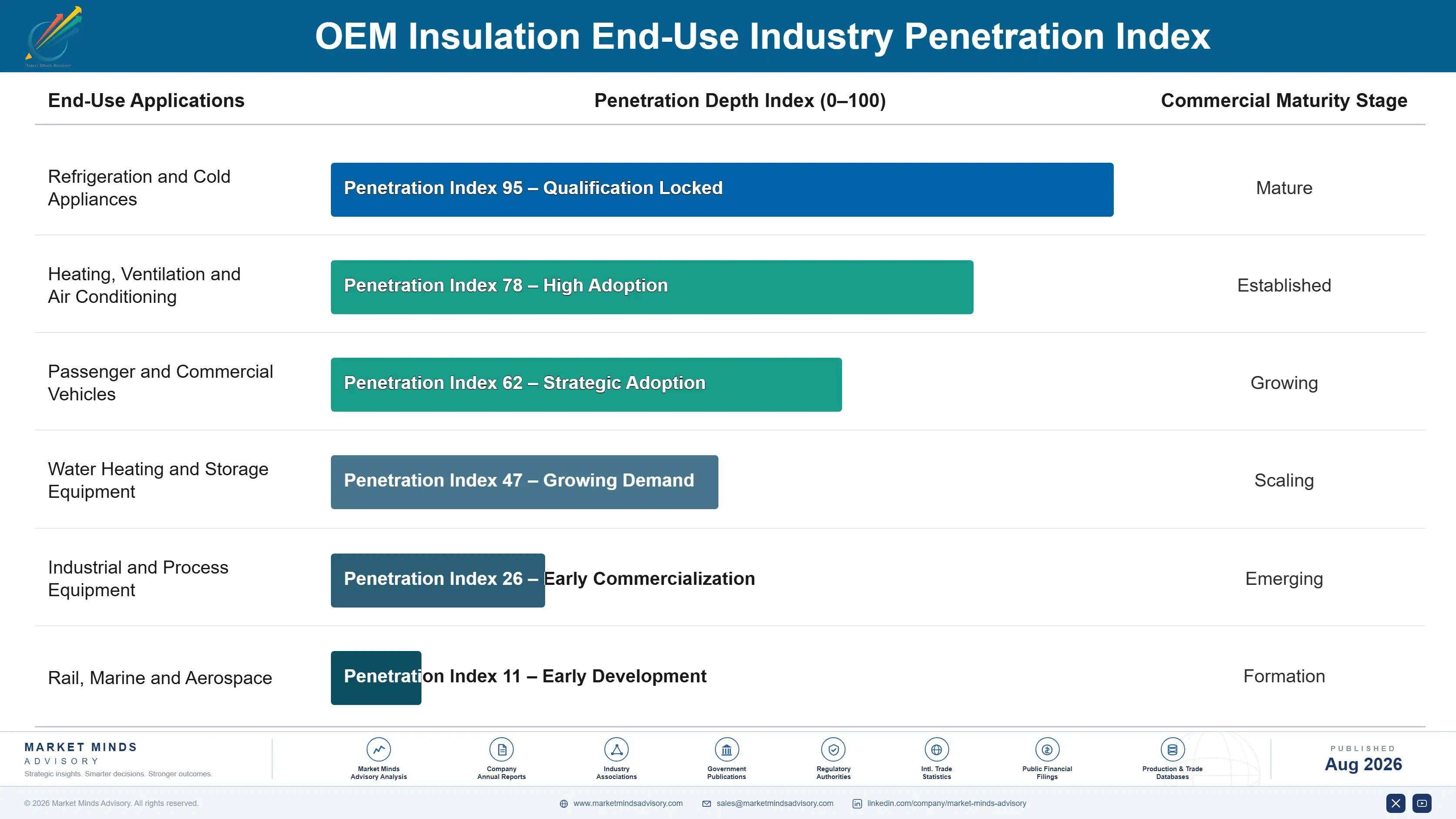
Demand renews with equipment build rate and follows somebody else's production schedule entirely, which makes it an annuity tied to a product programme rather than a business with its own cycle. A material specified into an appliance platform ships at every unit built for the five to seven years that platform runs, with no purchasing decision taken in between. Content increases arrive as step changes at each rule revision, which makes revision timing the most useful thing to forecast.
Stickiness runs through specification depth by equipment type. An appliance platform with a validated foam system and tooling built around a specific panel thickness cannot change material without re-engineering the cabinet, which makes those positions extremely durable. Vehicle acoustic packages are similarly locked once validated for noise targets. Industrial equipment insulation changes far more readily, since specification is looser and purchasing decides more of it.

The buyer sits in two places that want different things, and suppliers who reach only one of them lose predictably. Procurement applies uniform cost reduction targets across a bill of materials. Engineering owns the label and the noise target, and will overrule a saving that costs a grade if somebody explains it.
oem-insulation-market-trends-end-use-penetration-index-1787559399392

Where To Place The Bet

These are among the four positions where our research anticipates prominent divergence between winners and laggards over the coming forecast period. Each is grounded in the demand model, the regulatory perimeter, and the announced capacity pipeline.
01 / VOLUME RECOVERY SELLING

Quote interior litres rather than square metres

An appliance engineer facing a tightened energy label chooses between thicker foam that costs roughly 6% of interior capacity at each step and a vacuum panel returning those litres at around eight times the thermal resistance per millimetre of thickness. Quoted per square metre the panel looks expensive against foam and loses on price. Quoted against the cabinet capacity it preserves, which is the number consumers compare directly between machines of identical external size on a showroom floor, it looks straightforwardly cheap.
02 / ELECTRIC ACOUSTIC ENGINEERING

Attenuate at lower mass or lose the programme

Electric platforms require targeted high-frequency absorption for motor whine and tyre noise rather than the broadband mass damping that worked adequately on combustion vehicles, and content value runs around 1.4 times a comparable model as a result. The binding constraint throughout is weight, because a battery platform has none whatsoever to spare on acoustic treatment. Suppliers offering heavier versions of what they already make lose these specifications immediately, while lighter equivalent attenuation solves a problem the vehicle engineer cannot address any other way.
03 / CONVERSION STATUS ADVANTAGE

Finish blowing agent conversion before somebody makes you

Roughly 71% of rigid foam production lines have moved off high warming potential blowing agents and the remaining 29% sits in markets where enforcement is currently weaker, which is a competitive distortion rather than any permanent state of affairs. Suppliers completing conversion ahead of requirement can serve export production the moment destination rules apply, while unconverted lines face reformulation under severe time pressure. Appliance manufacturers now ask about conversion status routinely before awarding any multi-year supply agreement to a supplier at all.
04 / ENGINEERING CHANNEL ACCESS

Reach the engineer who owns the label

Insulation represents roughly 4% of a refrigeration cabinet's bill of materials while determining the energy label that decides shelf position, price and consumer choice at the point of sale. Purchasing teams applying uniform cost reduction percentages across a bill of materials will attack this line exactly as they attack every other one. The engineering function will overrule that decision when the label consequence is explained to them, and suppliers reaching only procurement never get the chance to have that conversation at all.

Engagement Snapshot From the Field

A live engagement with an industry participant carrying material or product regulatory and market exposure ahead of a defining policy shift, showing how our research translates into a defensible multi-year portfolio strategy.
MARKET MINDS ADVISORY · CLIENT ENGAGEMENT SUMMARY
OEM Insulation Producer Strategic Portfolio Review and Transition Roadmap 2026·Investment Scenario on OEM Insulation Exposure Evaluation 2025-26
CLIENT PROFILE
A European insulation supplier with annual revenue around EUR 290 million (client-reported, unverified by MMA), supplying rigid foam and mineral wool to appliance and equipment manufacturers across Europe. No vacuum panel capability existed. Acoustic composite supply was limited to conventional damping products. Contact at customers ran through purchasing. Volume had been flat for three years.
STRATEGIC CHALLENGE
Appliance volume had been flat while competitors won content on premium ranges, and management proposed price reductions to defend share against regional foam producers. Nobody had asked why competitors were winning specifications the client had never been invited to quote for at all. The question had never once been asked internally.
MMA APPROACH
MMA traced lost specifications back to the decision maker and the criterion applied, rather than accepting price as the explanation. Vacuum panel investment was costed against the premium refrigeration content being lost. Electric vehicle acoustic requirements were assessed against the client's existing damping products and their mass characteristics. Freight economics were benchmarked regionally.
KEY FINDINGS
  1. Premium refrigeration losses were decided by engineering on interior volume grounds and the client had never been invited to quote, because purchasing contacts had no visibility of those specification discussions.
  2. Price reduction against regional foam producers was unwinnable, since their delivered cost advantage came from freight proximity rather than any efficiency the client could match through operations.
  3. Existing acoustic damping products failed electric vehicle specifications on mass rather than on attenuation, which meant the losses were not a performance problem the client had understood.
  4. Vacuum panel investment was substantial but the premium refrigeration content at stake exceeded the payback period considerably at current specification loss rates.
CLIENT PROFILE
A European insulation supplier with annual revenue around EUR 290 million (client-reported, unverified by MMA), supplying rigid foam and mineral wool to appliance and equipment manufacturers across Europe. No vacuum panel capability existed. Acoustic composite supply was limited to conventional damping products. Contact at customers ran through purchasing. Volume had been flat for three years.
STRATEGIC CHALLENGE
Appliance volume had been flat while competitors won content on premium ranges, and management proposed price reductions to defend share against regional foam producers. Nobody had asked why competitors were winning specifications the client had never been invited to quote for at all. The question had never once been asked internally.
MMA APPROACH
MMA traced lost specifications back to the decision maker and the criterion applied, rather than accepting price as the explanation. Vacuum panel investment was costed against the premium refrigeration content being lost. Electric vehicle acoustic requirements were assessed against the client's existing damping products and their mass characteristics. Freight economics were benchmarked regionally.
KEY FINDINGS
  1. Premium refrigeration losses were decided by engineering on interior volume grounds and the client had never been invited to quote, because purchasing contacts had no visibility of those specification discussions.
  2. Price reduction against regional foam producers was unwinnable, since their delivered cost advantage came from freight proximity rather than any efficiency the client could match through operations.
  3. Existing acoustic damping products failed electric vehicle specifications on mass rather than on attenuation, which meant the losses were not a performance problem the client had understood.
  4. Vacuum panel investment was substantial but the premium refrigeration content at stake exceeded the payback period considerably at current specification loss rates.
RECOMMENDED STRATEGY
Phase 1: Phase one: build direct engineering relationships at appliance customers rather than routing everything through purchasing, so specification discussions become visible before they conclude. Phase 2: Phase two: commit vacuum panel investment against the premium refrigeration content currently being lost, which exceeds the payback threshold on realistic assumptions. Phase 3: Phase three: reformulate acoustic products for mass rather than attenuation alone, since electric specifications are lost on weight and not on performance.
OUTCOME
Engineering relationships now generate specification invitations the client previously never saw. Vacuum panel capacity is under construction with two premium refrigeration programmes provisionally committed. Lightweight acoustic reformulation has recovered one electric platform, and the client reports mix improving ahead of plan (client-reported, unverified by MMA).

Frequently Asked Questions

Foundational context covering the market sizes, CAGR, scope, country, region and competition that inform every finding below. This section is provided to cover basics and most often pre-purchase conversations, answered from the MMA Primary Research Dataset.

What is the current size of the OEM Insulation Market?

The market was valued at USD 14.8 billion in 2025, rising to an estimated USD 15.78 billion in 2026. East Asia holds the largest regional share at 38% of value.

How large will the OEM Insulation Market be by 2036?

MMA forecasts USD 29.89 billion by 2036 under the base case, an expansion multiple of 1.89 times the 2026 value. That represents USD 14.11 billion of incremental value.

What is the CAGR for the OEM Insulation Market 2026 to 2036?

The base case runs at 6.6% compound annual growth between 2026 and 2036, with a bull case at 7.8% and a bear case at 5.4%. Historical growth from 2020 to 2025 was 5.2%.

Which segment is growing fastest?

Vacuum insulation panels lead at 9.9%, half again the market rate, because they return cabinet volume that thicker foam removes. Acoustic composites follow at 8.2%.

Who are the major companies in the OEM Insulation Market?

Saint-Gobain, Rockwool, Knauf Insulation, Armacell and Owens Corning together hold 36% of total supply. High-performance material capability rather than manufacturing scale sustains those particular positions.

Which country is growing fastest?

India leads at 9.8%, driven by refrigeration, air conditioning and vehicle manufacturing all expanding together under domestic production incentive schemes at exactly the same time.

Report Segmentation Architecture

The full report scope spans multiple orthogonal segmentation dimensions, with cross-tabulated demand data provided for each dimension pair. Coverage extends further to regional breakdowns, trend trajectories, and the competitive detail needed to support segment-level decision-making.

By Material Type

  • Rigid Polyurethane and Polyisocyanurate Foam
  • Mineral and Glass Wool
  • Elastomeric and Flexible Foams
  • Vacuum Insulation Panels
  • Acoustic and Noise Composites
  • Aerogel and High-Performance Specialities

By End-Use Industry

  • Refrigeration and Cold Appliances
  • Heating, Ventilation and Air Conditioning
  • Passenger and Commercial Vehicles
  • Water Heating and Storage Equipment
  • Industrial and Process Equipment
  • Rail, Marine and Aerospace

By Supply Arrangement

  • Direct Programme Supply
  • Converter and Fabricator Channel
  • Systems House Formulated Supply
  • Regional Distributor Supply
  • Contract Manufactured Assemblies

By Region

  • North America
  • Western Europe
  • East Asia
  • South Asia and Pacific
  • Latin America
  • Middle East and Africa
  • Eastern Europe

Scope, Methodology, and Coverage

Every figure in this report is reproducible from documented input assumptions. The scope below maps the historical period, the forecast horizon, the segmentation dimensions, and the countries covered, alongside the underlying primary and qualitative methodology.
Historical Period
2020 to 2025
Forecast Period
2026 to 2036
Base Year
2025 (USD billions; MMA Primary Research Dataset, August 2026)
Market Definition
The market comprises thermal and acoustic insulation supplied directly to original equipment manufacturers, including rigid polyurethane and polyisocyanurate foam, mineral and glass wool, elastomeric and flexible foams, vacuum insulation panels, acoustic and noise composites, and aerogel and high-performance specialities, delivered through direct programme, converter, systems house, distributor and contract manufacturing arrangements. Value is measured at supplier level on insulation destined for equipment manufacture. Building insulation sold through construction distribution, refractory linings, site-installed pipe insulation, cold chain packaging insulation, and raw chemicals sold to foam formulators fall outside scope.
Quantitative Units
USD billions (current prices); million cubic metres and square metres supplied; USD per unit by material type
Segmentation Dimensions
By Material Type; By End-Use Industry; By Supply Arrangement; By Region
Regions Covered
North America, Western Europe, East Asia, South Asia and Pacific, Latin America, Middle East and Africa, Eastern Europe
Countries Covered
China, Japan, South Korea, Taiwan, India, Thailand, Vietnam, Indonesia, Australia, United States, Canada, Mexico, Brazil, Argentina, Colombia, Germany, France, Italy, Spain, Netherlands, United Kingdom, Denmark, Poland, Czechia, Hungary, Slovakia, Turkey, Saudi Arabia, Egypt, South Africa
Key Companies Profiled
Saint-Gobain, Rockwool, Knauf Insulation, Armacell, Owens Corning, Kingspan, BASF, Covestro, Huntsman, Dow, Autoneum, Adler Pelzer, Zotefoams, Aspen Aerogels, Panasonic, Kaneka, L'Isolante K-Flex, Recticel, Johns Manville, Sekisui Chemical
Quantitative Methodology
Primary survey, n=3,800 respondents, Q4 2025, six countries; demand-side model with trade association cross-validation
Qualitative Methodology
47 expert interviews, Q4 2025; applied to validate demand model assumptions, identify emerging dynamics, and assess competitive positioning
Report Format
PDF and XLSX data workbook (Word format preview document)
Publisher
Market Minds Advisory
Report Code
MMA-2026-CON-326
Published
August 2026
Contact
sales@marketmindsadvisory.com | www.marketmindsadvisory.com

Purchase the full OEM Insulation Market Report (2026 to 2036).

The full report sizes the global equipment insulation market to 2036 across six material types and seven regions, measured at supplier level on volume destined for equipment manufacture. It models the interior volume trade-off that actually decides appliance material selection rather than treating the choice as a cost comparison. Competitive analysis covers 20 suppliers on one consistent revenue basis, with moat and risk assessment for the two leaders. Blowing agent conversion status and electric vehicle acoustic content are quantified by region and programme type. Four quantified revenue levers close the analysis.
Six-material segment sizing with individual growth rates
Interior volume trade-off modelled against energy label requirements
Blowing agent conversion status quantified by region and line
Electric vehicle acoustic content compared against combustion baselines
Twenty-supplier competitive map on one consistent revenue basis
Four quantified revenue levers with commercial impact ranges

Built For The People Who Decide

From boardroom strategy to bench-side execution, this report is read cover-to-cover by leaders shaping the next decade of their industry, turning demand scenarios, market dynamics and valuation benchmarks into decisions.
CXOs/ Presidents/ VPs/ Managers
M&A and Corporate Development
Strategy Teams and R&D Heads
Procurement and Product Directors
Regulatory and Compliance Leaders
Investor Relations and Equity Analysts