Market Minds Advisory
Oblong Tub Lids Market

Oblong Tub Lids Market: Corner Sealing, Shelf Efficiency and the Component Consumers Judge the Whole Pack By

A round lid seals itself through uniform compression. An oblong one has four corners where that compression changes direction, warpage concentrates and reseal performance quietly fails after the consumer has taken it home.

Lead Analyst

Bilal Shaikh

Published

September 2026

Make Smarter Decisions with Customized Research Insights

Request a free sample report and evaluate market opportunities, growth trends, and competitive dynamics relevant to your business needs.

2025 MARKET VALUE$2.9BMarket Size 2025
2036 FORECAST VALUE$5.1BBase Case , 2026 to 2036
CAGR 2026 TO 20365.2 %Bull 6.4% / Bear 4.0%
INCREMENTAL OPPORTUNITY$2.0BNet 10- year value creation
EXPANSION MULTIPLE1.66x2036 value over 2026 base
Strategic Levers
M&A Pipeline
Regional Outlook
Country Rankings
Competitive Intelligence
Segmental Deep-dive
Call-Us : 91 93563 13602

Executive Snapshot and Market Trajectory

Retailers want oblong tubs because they fit roughly 27% more product onto a shelf metre than round ones do. Moulders dislike them because four corners turn a straightforward sealing problem into a warpage problem that only appears after the pack reaches a kitchen. The moulder inherits the problem.
Tamper-evident hinged and frangible lids compound at 7.8%, exactly 1.50 times the market, because an oblong lid cannot use the rotational break that makes tamper evidence trivial on a round closure. East Asia holds 27% of demand, led by Chinese ice cream volume and by convenience store chilled formats across Japan and Korea that use this pack shape heavily. Range refresh there is constant.
Concentration is low, with the top five holding 29%. Lids are mostly air and uneconomic to ship far, so moulding happens near the filler, and tool investment rather than company size determines who can quote a given cavitation and cycle time. Tool ownership decides how long a relationship lasts far more reliably than any pricing negotiation. Regional moulders hold ground against far larger names because of it. Freight economics keep the category fragmented.
Market Definition
The market covers lids and closures for oblong, rectangular and oval rigid tubs used in food packaging, spanning injection-moulded snap-on lids, thermoformed press-on lids, tamper-evident hinged and frangible constructions, in-mould labelled lids, freeze-grade flexible lids and barrier or peel-seal combination lids. Round tub lids, the tubs themselves, flexible lidding film sold as rollstock and closures for bottles or jars are excluded.
Base Year Value
$2.9B in 2025 (MMA Primary Research Dataset, August 2026)
Forecast Period
2026 to 2036, eleven discrete annual values
CAGR
5.2% base case. Bull 6.4%. Bear 4.0%.
Fastest Growth Segment
Tamper-Evident Hinged and Frangible Lids: 7.8% CAGR
Fastest Growth Country
India: 8.0% CAGR
Fastest Growth Region
South Asia and Pacific: 7.2% CAGR
Largest Region
East Asia: 27% of 2025 global value
Market Leaders
Berry Global, Greiner Packaging, Amcor, Huhtamaki, Paccor. Source: MMA Analysis based on company annual reports.
Primary Survey
n=3,800 procurement and R&D decision-makers, Q4 2025, six countries
Methodology
Demand-side build-up, cross-validated against public data, 47 expert interviews

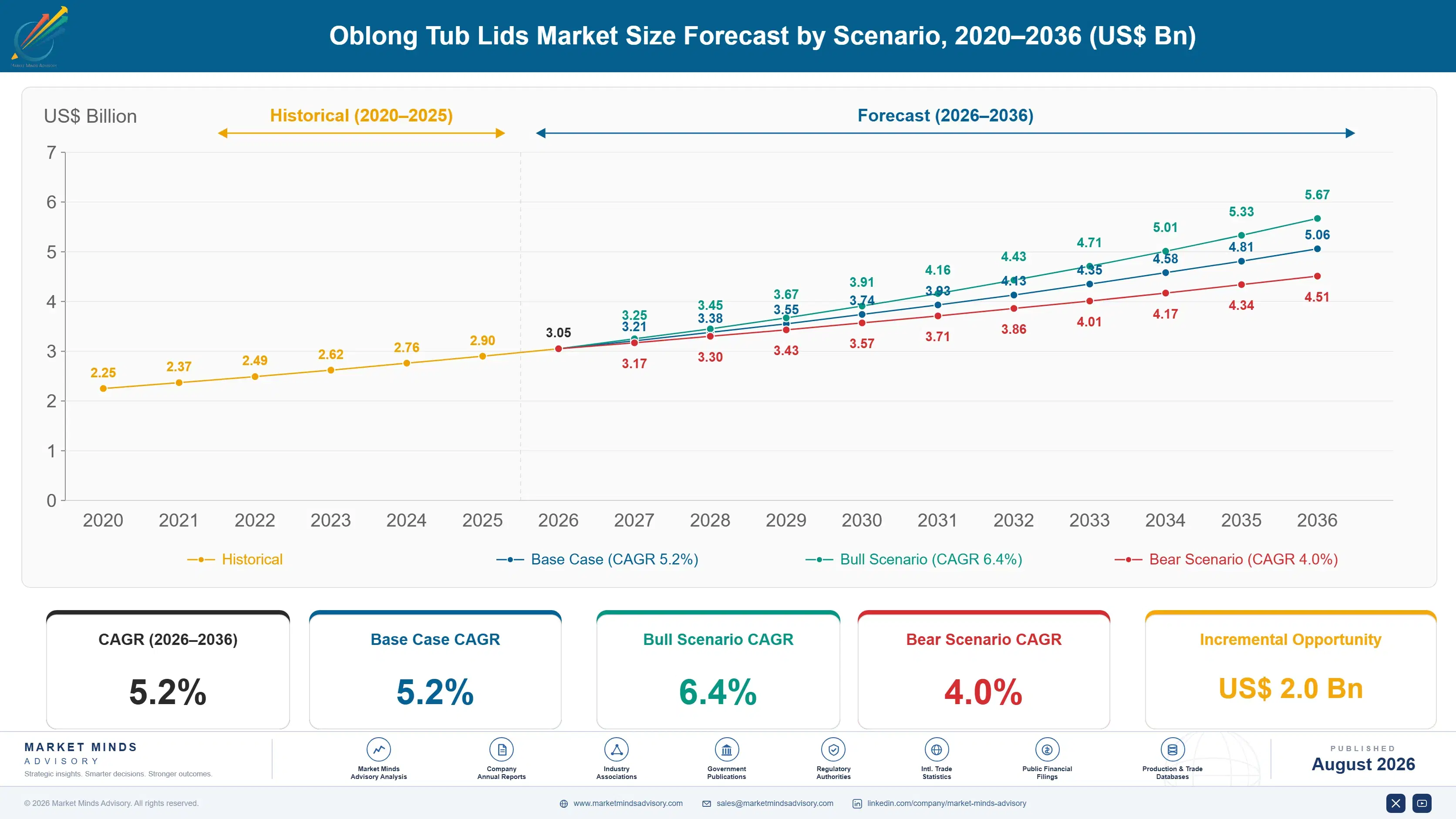
Oblong Tub Lids Market Forecast Scenarios

oblong-tub-lids-market-size-forecast-scenario-1787307950517
Growth ran at an implied 4.2% across 2020 to 2025 and the composition shifted more than the total. Retail dairy and ice cream volumes rose sharply through 2020 and 2021 while food service tub demand collapsed, then resin cost movement from 2022 dominated commercial conversations far more than any change in underlying unit consumption did. Volume barely moved beneath all of it.
The base case at 5.2% rests on three mechanisms. Tamper evidence requirements keep spreading through chilled and delicatessen categories where they were previously optional, and oblong geometry makes that a genuine engineering task. Retailers keep pushing the format for shelf efficiency. And recyclable mono-material polypropylene tub and lid systems command premiums while requiring tighter dimensional control than mixed-material predecessors did. All three mechanisms raise value per lid rather than only unit count.
The bull case at 6.4% assumes chilled ready meal and prepared food growth continues at its current pace across Asia, since those categories use oblong formats almost exclusively. The bear case at 4.0% follows from reuse and refill provisions under the European Packaging and Packaging Waste Regulation reaching into food service tubs, alongside continued lightweighting that reduces polymer content and therefore value per lid.

Four Corners That Decide Everything

Shelf economics created this format and physics has been arguing with it ever since. An oblong tub carries roughly 27% more product per shelf metre than a round one of the same capacity, which is why retailers push it and why brands accept the tooling cost. What retailers never see is that a rectangle is a considerably harder thing to seal reliably than a circle.
TOP FIVE CONCENTRATION29%Combined share held by the five largest global moulders
SHELF DENSITY ADVANTAGE27% more productAdditional volume per shelf metre against equivalent round formats
CORNER WARPAGE TOLERANCE0.15 millimetresDimensional variation beyond which reseal performance degrades noticeably
RESIN COST SHARE58% of COGSPolymer input as proportion of total moulding cost
INJECTION CYCLE TIME2.8 secondsTypical thin wall moulding cycle on high cavitation tooling
RESEAL COMPLAINT SHARE44% of feedbackProportion of consumer packaging complaints concerning lid resealing
A round lid seals through uniform radial compression, and the geometry does most of the work. An oblong lid has four corners where the compression path changes direction, and moulding stresses concentrate at exactly those points during cooling. Warpage beyond about 0.15 millimetres degrades reseal, and the consumer discovers that at home rather than at the filling line. Reseal accounts for 44% of packaging complaints in these categories.
Tamper evidence compounds the problem. A round closure breaks a frangible band as it rotates, which requires almost no design effort. An oblong lid does not rotate, so tamper evidence must come from a hinged flap or a frangible strip engineered into a corner or edge, and both compete for space with the sealing geometry already under strain there.
"Every category manager I meet can tell you exactly how many more units fit on the shelf. Almost none of them can tell you what proportion of their consumer complaints are about a lid that stopped resealing on day three, and those two numbers are describing the same design decision."
Director, Rigid Packaging and Closure Systems Practice · MMA Rigid Plastic Packa

Market Trends

Tamper Evidence Spreads Into Categories That Never Required It

Chilled prepared foods, delicatessen products and fresh salads have moved toward visible tamper evidence, driven by retailer policy and by product safety incidents rather than by any single regulation. On a round closure this is trivial, since rotation breaks a band. An oblong lid does not rotate, so evidence must be engineered as a hinged flap or frangible strip at a corner or edge, competing for space with sealing geometry already under stress. The segment compounds at 7.8% against a market at 5.2%, and it demands tooling capability rather than material change.
Market Impact: Shelf density advantage reaching 27
Mono-Material Polypropylene Systems Tighten Dimensional Demands

Recyclable packaging requirements are pushing brands toward tub and lid systems moulded entirely in polypropylene, including in-mould labels made from the same polymer so the whole pack enters one recycling stream. That removes the option of selecting a lower-shrinkage material for the lid alone to manage corner warpage. Dimensional control must therefore come from tooling and process rather than from material choice, which favours moulders with genuine tool design capability and penalises those who relied on material substitution. Conversions therefore stall for moulders who had quietly been managing warpage through material selection rather than through tool design.
Market Impact: Chilled categories at 31% of demand

Market Opportunities and Growth Drivers

Retail Shelf Efficiency Sustains Format Preference Against Cost

An oblong tub carries roughly 27% more product per shelf metre than a round equivalent of the same capacity, and it palletises better through distribution as well. Retailers understand that arithmetic precisely and apply it in category reviews and planogram decisions. That preference survives the higher tooling cost and the sealing difficulty because the space saving is realised by the retailer while the engineering problem lands on the moulder. Format preference here is set several steps upstream of anyone who has to solve the corner warpage. Nobody upstream carries the consequence.
Market Impact: Reseal driving 44% of complaints

Chilled Prepared Food Growth Favours the Oblong Format

Chilled ready meals, prepared salads, delicatessen products and fresh soups have grown steadily across Asia, North America and Europe, and they use oblong and rectangular formats almost exclusively because the contents suit them and because the packs stack. Convenience store chilled ranges across Japan and Korea are built entirely around this shape. The category also brings tamper evidence and barrier requirements that round dairy tubs never needed, so it drives value per lid rather than only unit volume growth. Value per lid rises alongside unit volume in these categories, which is unusual and worth the moulder's attention.
Market Impact: Resin at 58% of moulding cost

Market Restraints and Challenges

Corner Warpage Undermines Reseal After the Sale

Reseal accounts for 44% of consumer packaging complaints in these categories, and corner geometry is the root cause. Moulding stress concentrates where the compression path changes direction, and cooling shrinkage pulls those corners out of plane by amounts that pass factory inspection and fail in a kitchen three days later. Tolerance beyond roughly 0.15 millimetres degrades performance measurably. Moulders mitigate through tool design, gate positioning and conditioning after ejection, though none of it removes the underlying geometric disadvantage against a round format. Geometry sets the limit rather than process discipline.
Market Impact: Tamper-evident formats compounding

Resin Pass-Through Leaves Thin Genuine Conversion Margin

Polymer accounts for 58% of cost of goods, and thin wall injection moulding at cycle times near 2.8 seconds is a well-understood process available to many moulders. The root cause is that the barrier to entry is tooling capital rather than any proprietary capability. Buyers negotiate against a resin index and treat moulding as the only variable. Moulders mitigate by shifting toward tamper-evident, barrier and in-mould labelled formats where tool complexity and dimensional control genuinely narrow the field of credible suppliers. Tooling capital is the only entry barrier. Many moulders can quote the same part.
Market Impact: Mono-material work at 38% of volume
3 additional market trends, 4 additional growth drivers, and 2 additional restraints and challenges are covered in the full report. Contact sales@marketmindsadvisory.com to access the complete intelligence.

Segment CAGR and Growth Architecture

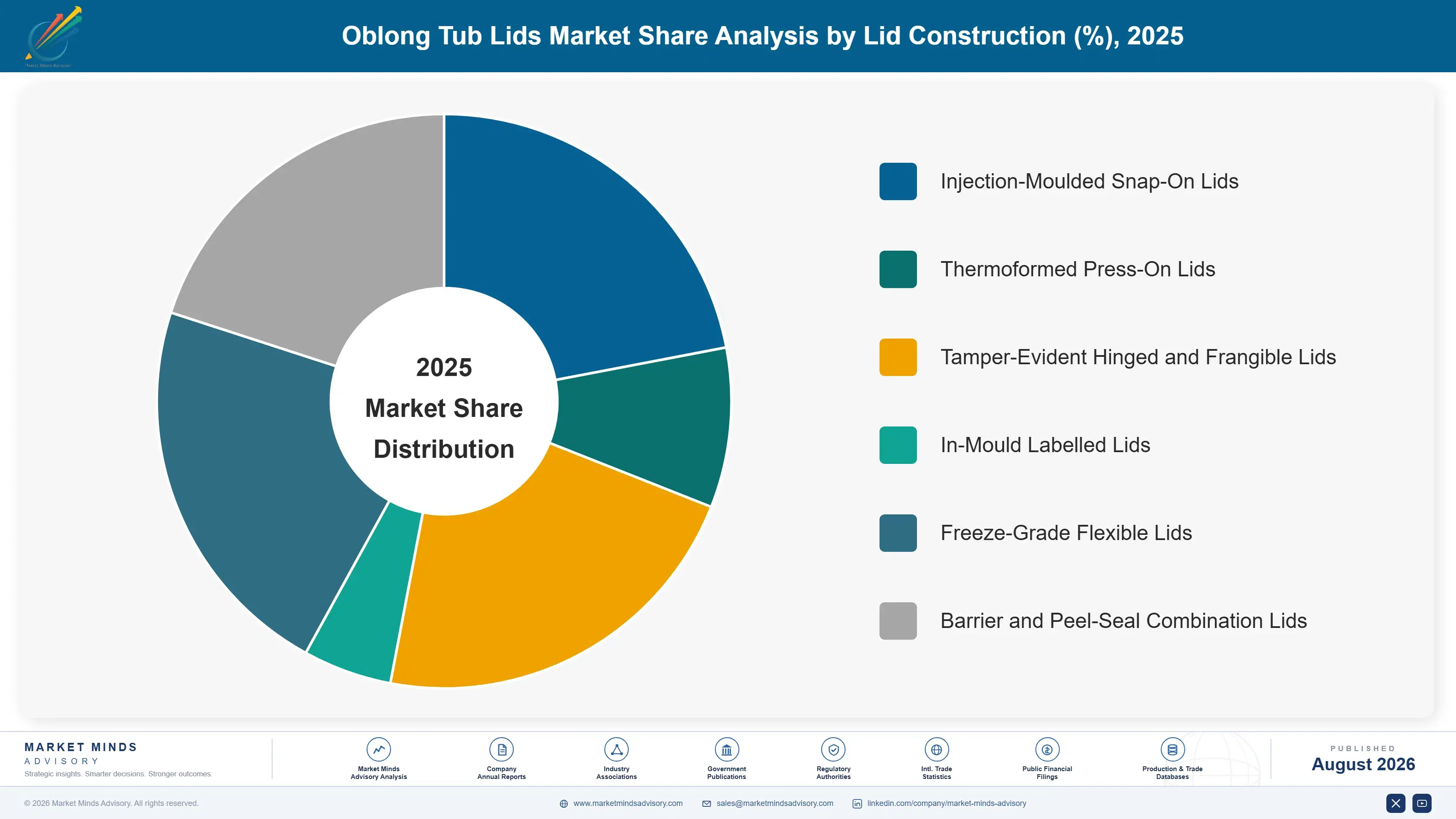
Segmentation follows lid construction, because construction determines the tooling investment, the dimensional control required and the categories a moulder can serve. A tamper-evident hinged lid and a plain snap-on lid share a polymer and a tub, and they require entirely different tool design capability to produce reliably. Tool investment rather than moulding skill decides who can quote.
oblong-tub-lids-market-market-share-analysis-1787307951101

Tamper-Evident Hinged and Frangible Lids

Tamper-evident constructions compound at 7.8%, exactly 1.50 times the market rate, on a requirement that oblong geometry makes genuinely difficult. A round closure breaks a frangible band through rotation and needs almost no design effort to achieve tamper evidence. An oblong lid never rotates, so the evidence has to be a hinged flap or a frangible strip engineered into a corner or edge, and those are precisely the areas already carrying the sealing geometry and the warpage risk. Getting both to work in one tool is a real design problem rather than a specification choice. Chilled prepared foods, delicatessen and fresh salad categories are driving adoption, and tool complexity narrows the credible supplier field considerably.
CAGR 7.8%

In-Mould Labelled Lids

In-mould labelled lids grow at 6.6% by combining decoration and structure in a single moulding operation. The label is placed in the tool and the polymer moulds around it, producing a finished decorated part with no secondary labelling step, no adhesive and no label edge to lift in a chilled cabinet. Where the label is polypropylene, the whole pack stays within one recycling stream, which is why recyclability requirements have accelerated adoption considerably. The complication is that the label affects cooling behaviour across the lid surface, which interacts with the corner warpage problem rather than being independent of it. Tool and robot investment is substantial, and the print quality achievable now rivals conventional labelling closely.
CAGR 6.6%
Full segment breakdown across 6 segments available in the complete report.

Regional Architecture and Country Demand Map

Demand follows chilled and frozen food filling capacity, since lids are moulded close to where tubs are filled. Format preference varies more between regions than most packaging categories, because dairy and prepared food traditions differ sharply in the pack shapes they favour. Filling capacity is the map worth reading here.

East Asia

East Asia holds 27% of global demand, the largest regional share, and three quite separate applications explain it. Chinese ice cream volume is the largest of any national market and multipack and family formats there use rectangular tubs almost exclusively. Convenience store chilled ranges across Japan and Korea are built around oblong packs that stack efficiently in narrow cabinet space, and those ranges refresh constantly, which means frequent tooling work. Chinese chilled prepared food and delicatessen categories have grown quickly from a low base. Domestic moulding capacity is extensive and fragmented, competing hard on delivered cost. Regional growth of 6.2% reflects category expansion rather than any shift in format preference, which was already established.
Share: 27% | CAGR: 6.2% (2026 to 2036)

Western Europe

Western Europe accounts for 24% of demand and grows most slowly of the seven regions at 3.8%. The format is deeply established here through spreads, margarine, quark, creme fraiche and cultured dairy products where the oblong tub has been standard for decades, so growth comes from specification change rather than from new adoption. Packaging and Packaging Waste Regulation recyclability requirements are driving conversion to mono-material polypropylene tub and lid systems, which removes the option of selecting a lower-shrinkage lid material and pushes dimensional control onto tooling. German, Dutch and French dairy processors set much of the specification. Greiner and Paccor operate from strong regional positions built on tool capability rather than moulding scale.
Share: 24% | CAGR: 3.8% (2026 to 2036)
Regional intelligence for 5 additional markets available in the complete report: North America, South Asia and Pacific, Latin America, Middle East and Africa, Eastern Europe. Contact sales@marketmindsadvisory.com.
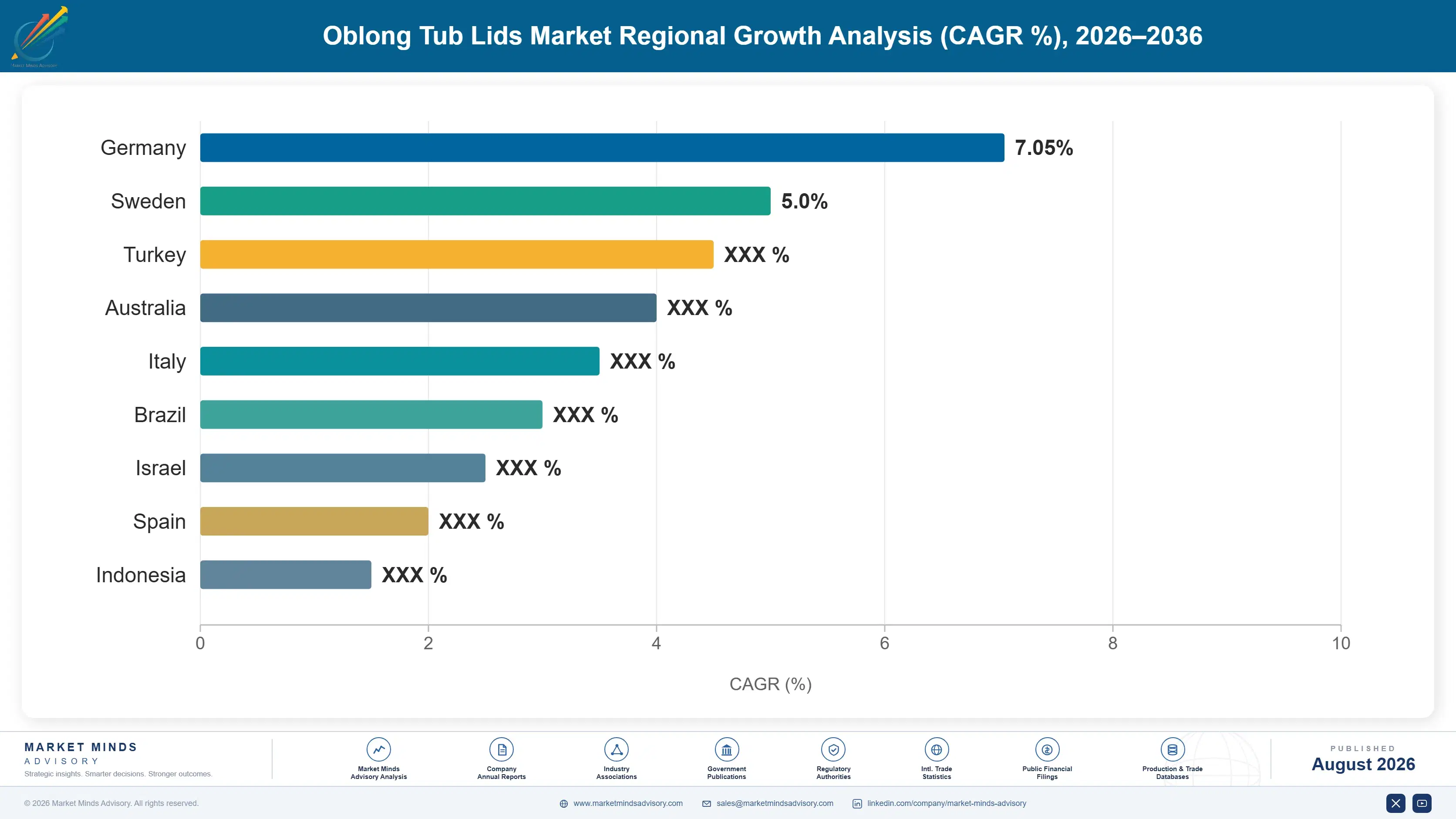
oblong-tub-lids-market-country-cagr-analysis-1787307951622

Getting Paid for Solving the Corner

With polymer at 58% of cost and thin wall moulding widely available, a plain lid is negotiated against a resin index and won on cycle time. The positions worth holding are those where geometry, tooling or a functional requirement makes the part genuinely difficult to produce. Four qualify. Cycle time alone wins nothing worth having.

Engineer Tamper Evidence Into Oblong Geometry Properly

Tamper-evident constructions compound at 7.8% because oblong lids cannot use the rotational break that makes the feature trivial on round closures. The evidence must be a hinged flap or frangible strip at a corner or edge, competing for space with sealing geometry already carrying warpage risk. Solving both in one tool is genuine design work rather than a specification choice, and moulders that can do it quote work others decline. Gross margins run roughly 11 to 17 points above plain snap-on lids, and the tooling investment is what keeps the field narrow.
Market Impact: Tamper-evident lids carrying 11 to

Sell Reseal Performance Into Consumer Complaint Budgets

Reseal accounts for 44% of consumer packaging complaints in these categories, and brand quality functions track complaint volumes closely because each one carries a handling cost and a repeat purchase risk. A moulder demonstrating measurably better corner dimensional stability sells into that concern rather than into a packaging cost line. Tolerance beyond roughly 0.15 millimetres degrades performance, and few moulders measure it at all after ejection. The evidence costs little to generate and reaches a budget holder who never sees a resin index. That budget holder never sees a resin index.
Market Impact: Reseal now driving 44% of all consu

Invest in In-Mould Labelling Tool and Robot Capability

In-mould labelled lids grow at 6.6% by combining decoration and moulding in one operation, removing a secondary labelling step, adhesive and any label edge that lifts in a chilled cabinet. Where the label is polypropylene the whole pack stays in one recycling stream, which recyclability requirements have made valuable. Tool and robot investment is substantial and it is precisely what limits the competing field. Decorated lids price roughly 24 to 33% above plain equivalents, and the label interacts with cooling behaviour in ways that reward moulders who understand the warpage problem already.
Market Impact: Decorated lids priced 24 to 33% abo

Build Dimensional Control for Mono-Material Conversions

Recyclable polypropylene tub and lid systems remove the option of choosing a lower-shrinkage material for the lid alone, so all dimensional control has to come from tooling and process. That converts a material selection problem into an engineering one, and mono-material work already accounts for 38% of volume. Moulders with genuine tool design capability win those conversions while those who relied on material substitution stall at trial stage. The capability is not quickly acquired, and recyclability requirements will keep widening the pool of conversions demanding it. Tool engineering depth decides who converts and who stalls.
Market Impact: Mono-material conversions at 38% of

Who Controls the Margin Pool

The five largest moulders hold 29% of the market measured on lid moulding revenue, the basis applied consistently through this section. Fragmentation reflects freight economics, since lids are mostly air and cannot travel far, so a moulder near a filling plant faces few genuine competitors. Berry Global and Greiner Packaging lead, both on tooling capability rather than scale. Proximity beats scale in almost every quotation.
Competition operates on three dimensions. Tool design capability decides whether a moulder can hold corner dimensional tolerance on a demanding geometry at production cycle times. In-mould labelling and tamper-evident capability decide participation in the segments carrying value growth. And physical proximity to filling capacity decides who can compete for an account at all. All three are physical or engineering advantages rather than commercial ones.

Two pressures are reshaping position. Mono-material conversion rewards moulders with genuine tool engineering and exposes those who managed warpage through material selection. Against that, regional moulders compete hard on delivered cost for plain formats wherever a filler is within reach. Rankings will move toward whoever pairs tool capability with proximity to growing chilled food capacity. Very few hold both today.
oblong-tub-lids-market-company-positioning-matrix-1787307952154

Competitive Moat and Risk Dimensions

BERRY GLOBAL

Moat: Scale and tooling investment capacity

Berry combines moulding capacity across most major regions with the balance sheet to fund high cavitation tooling and in-mould labelling automation, which is the actual barrier in this category rather than moulding skill. That reach lets the company follow multinational dairy and prepared food customers into new filling locations, where lid supply must sit close to the plant.
BERRY GLOBAL

Risk: Regional cost competition

Plain snap-on lids represent most category volume and face regional moulders with materially lower overhead, competing within the same freight radius on delivered cost. With polymer at 58% of cost and moulding widely understood, there is little room for scale to show through in a quotation for standard work,
GREINER PACKAGING

Moat: In-mould labelling and dairy depth

Greiner holds unusually deep in-mould labelling capability alongside long-standing relationships with European dairy processors, which matters because decorated mono-material packs are exactly where recyclability requirements are pushing the category. Combining decoration with structural moulding in one operation is a tooling and automation competence rather than a materials one, and it is not quickly replicated.
GREINER PACKAGING

Risk: European growth exposure

The strongest positions sit in Western Europe, the slowest growing of the seven regions at 3.8%, where the format is long established and expansion comes from specification change rather than new adoption. Reaching the chilled food growth in East Asia and South Asia requires local moulding capacity, since lids cannot be shipped economically from European plants at any volume.

Players Tracked

Prominent Players

Berry Global
Greiner Packaging
Amcor
Huhtamaki
Paccor

Other Key Players

Sonoco Products Company
Coveris
IPL Group
Sabert Corporation
Pactiv Evergreen
Faerch
Guillin Emballages
Nampak
ILIP
Airlite Plastics
Silgan Holdings
Plastipak Holdings
Sealed Air
Novolex
Winpak

Recent Developments

FEBRUARY 2025

Retailer tamper evidence policies extend across chilled prepared foods

Major grocery retailers extended visible tamper evidence requirements across chilled prepared food and delicatessen ranges, following product interference incidents. These were retailer policy decisions rather than regulatory actions or corporate transactions, and they apply to formats where rotational tamper bands are not available. Tooling capability decides who can comply.
Signal: A feature that costs nothing on a round cl
JUNE 2025

Mono-material conversions stall on corner dimensional control

Several European dairy processors reported reseal performance problems converting tub and lid systems to single-polymer polypropylene, tracing the cause to corner warpage rather than to material quality. These were conversion trial findings rather than commercial developments, and they delayed planned recyclability programmes. Resin supplier changes made no difference.
Signal: Removing material choice as a variable exp
OCTOBER 2025

Asian chilled convenience formats expand oblong tub adoption

Convenience store operators across Japan, Korea and China widened chilled prepared food ranges using oblong tub formats that stack efficiently in narrow cabinet space. This reflects category expansion rather than any acquisition, and those ranges refresh frequently enough to generate continuous tooling work. Tooling responsiveness has become a commercial advantage.
Signal: Frequent range refresh turns tooling respo

Polymer, Tooling and Machine Hours

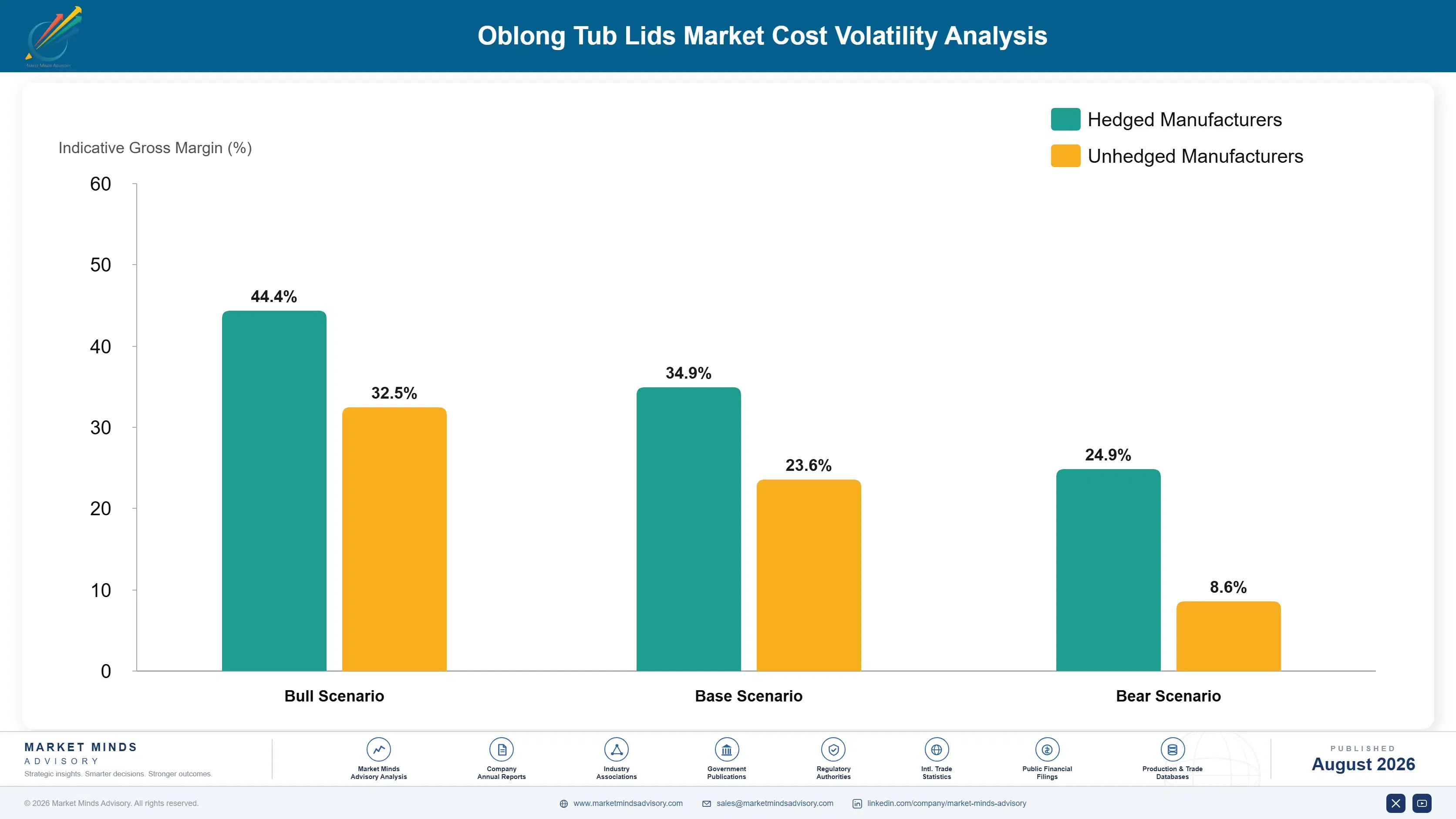
Polypropylene accounts for roughly 58% of cost of goods, purchased regionally from petrochemical producers and compounders. Tooling amortisation runs a further 14%, and high cavitation stack tools represent genuine capital that must be recovered across a programme life. Machine time, in-mould labelling automation, energy and quality inspection make up most of the remainder, with warpage measurement a small but increasingly necessary line.
Polypropylene pricing moved sharply through 2022 and 2023 as European energy disruption raised both feedstock and polymerisation costs, and International Energy Agency reporting across that period documents the underlying movement. Moulders quoting fixed annual lid prices absorbed the increase for a full year while those on resin indexation passed it through within weeks. Company annual reports covering rigid packaging segments disclose the resulting margin divergence clearly.

Exposure divides by contract structure rather than by scale. Indexed moulders carry almost none of the polymer risk, while those quoting annual delivered prices carry all of it. The disadvantage falls hardest on mid-sized moulders serving regional fillers, who lack the volume to negotiate indexation yet compete against larger moulders that hold it. Tool amortisation compounds that exposure further still.
oblong-tub-lids-market-cost-volatility-analysis-1787307952349

Index lid pricing to published polypropylene benchmarks

Indexation removes 58% of the cost base from the moulder's risk entirely, and larger moulders achieve it routinely while smaller operations frequently cannot. Where a customer resists formal indexation, separating tooling recovery from unit pricing at least prevents a resin movement from also stranding the tool investment, which is the compounding exposure most moulders overlook.

Recover tooling across programme life rather than annual volume

High cavitation stack tools are the real capital commitment in this category, and recovering them against a single year's volume prices a moulder out of competitive quotations. Amortising across a realistic programme life, with contractual protection if the programme ends early, matches the recovery to how the customer actually uses the tool. Early termination protection matters here.

Site moulding capacity inside the filler's freight radius

Lids are mostly air, so freight and handling erode delivered value quickly with distance. Moulding close to filling plants, or in-house at the filler where volumes justify it, cuts that cost and creates a position distant competitors cannot contest regardless of their own moulding cost base or scale advantages. Proximity is a position rather than a saving.

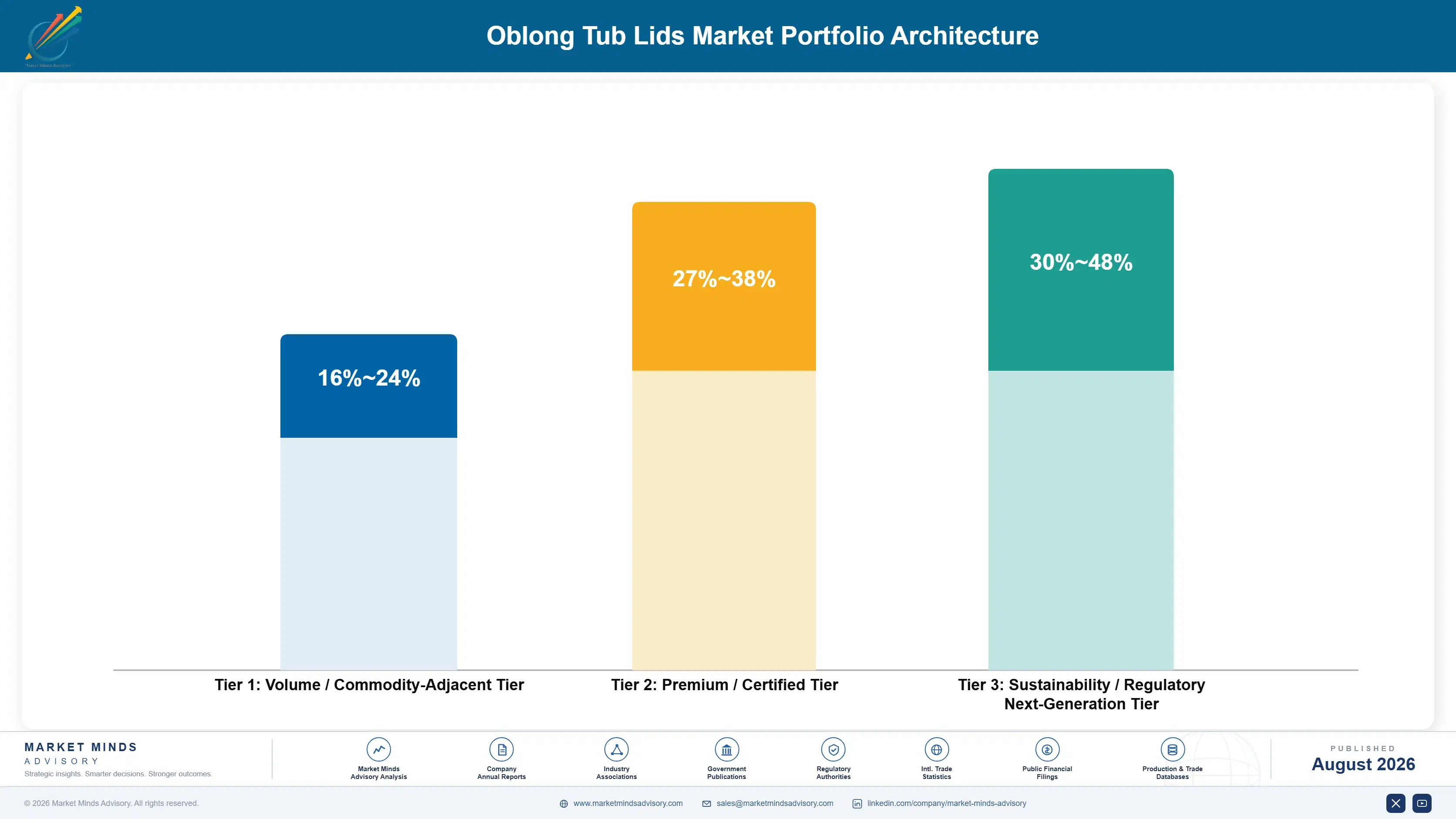
Portfolio Architecture for Margin Defence

The portfolio separates on whether the tool is difficult. Plain snap-on and press-on lids are widely quotable at cycle times near 2.8 seconds, and regional moulders compete for that work on delivered price against a resin index. Tamper-evident, in-mould labelled and barrier constructions demand tool design and automation investment that genuinely narrows the field of moulders able to quote at all. Tool difficulty draws the whole ladder here.
The tension is that plain formats carry the machine hours and the customer relationships from which complex work follows. A moulder that pursues only tamper-evident and decorated programmes finds its presses underutilised and loses accounts when a customer needs an ordinary lid alongside its specialist ones. The successful operators run both with quite different margin expectations attached. Utilisation and margin are separate objectives. Losing the ordinary work costs the specialist work with it.

High-value pools concentrate where geometry, a functional requirement or a recyclability specification makes the part hard to produce reliably. Tamper-evident constructions, in-mould labelled decoration and mono-material conversions all qualify, and none of them is won on cycle time alone. Tool capability rather than price wins each of them. Cycle time decides none of them.

Volume / Commodity-Adjacent Tier

Plain injection-moulded snap-on and thermoformed press-on lids for dairy, spreads and ice cream sold against a resin index. Widely quotable at standard cycle times, with regional moulders competing effectively inside their own freight radius.
Gross Margin: 16-24%

Premium / Certified Tier

Tamper-evident hinged and frangible constructions plus barrier and peel-seal combination lids requiring tool design capability to reconcile the feature with sealing geometry already carrying warpage risk at the corners. Tool investment is the barrier rather than moulding skill.
Gross Margin: 27-38%

Sustainability / Regulatory / Next-Generation Tier

In-mould labelled lids and mono-material polypropylene systems where decoration and recyclability requirements meet. The wide margin range reflects the gap between established decorated programmes and mono-material conversions still failing at trial on dimensional control.
Gross Margin: 30-48%
oblong-tub-lids-market-portfolio-architecture-1787307952856

High-value Sub-segments and Strategic Watch-out

Tamper-Evident Oblong Constructions

Compounding at 7.8% because an oblong lid cannot use the rotational break that makes tamper evidence trivial on round closures. Reconciling a hinged flap or frangible strip with sealing geometry already under warpage stress is genuine design work rather than specification. Retailer policy is driving adoption.
Gross Margin: 31-38%

In-Mould Labelled Decorated Lids

Growing at 6.6% by combining decoration and moulding in one operation with no adhesive and no label edge to lift in chilled cabinets. Tool and robot investment limits the competing field, and decorated lids price 24 to 33% above plain equivalents. Recyclability requirements accelerated it.
Gross Margin: 34-48%

Plain Snap-On and Press-On Lids

The volume core at 3.8 to 4.6%, negotiated against a resin index with cycle time as the only real variable. Run for press utilisation and customer access, since a moulder unable to supply ordinary lids loses the complex work alongside them. Presses have to be filled.
Gross Margin: 16-24%

Mono-Material Conversion Programmes

The watch-out and the opportunity together. Single-polymer systems remove material selection as a warpage remedy, so conversions stall at trial for moulders without tool engineering depth while rewarding those who had it already. Recyclability requirements will keep widening the pool of conversions that demand genuine tool engineering depth.
Gross Margin: 22-44%

Tooling Ties the Relationship

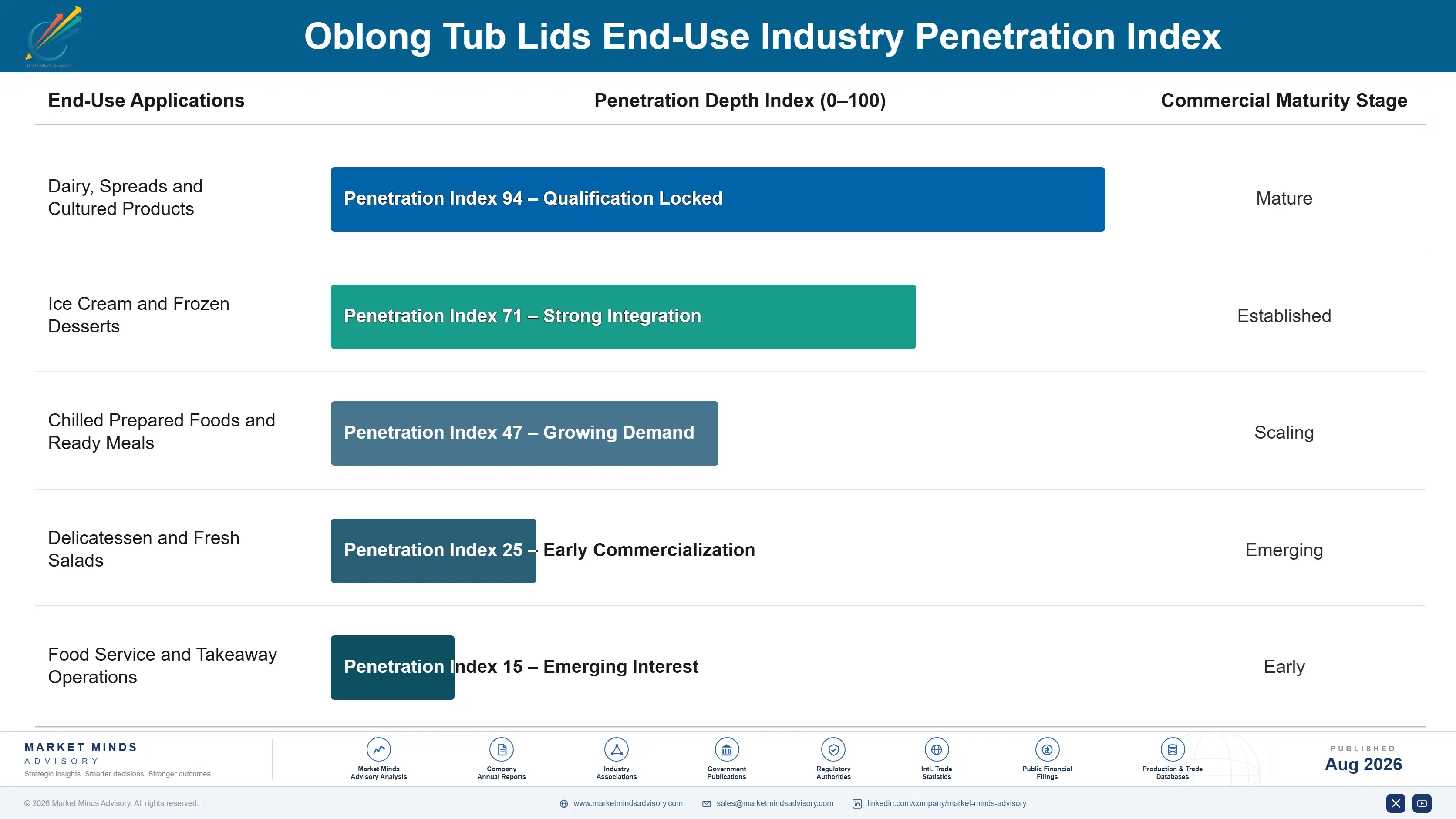
The recurring economics here sit in the tool. A lid programme requires a high cavitation tool cut for one specific geometry, and once it exists the moulder holding it supplies for the programme's life because moving means cutting another tool and requalifying the pack. Whether the customer or the moulder owns that tool is the single most important commercial term in the relationship, and it is frequently negotiated with less attention than the unit price. Tooling is the lock.
Depth varies by category rather than by customer size. Chilled prepared food producers buy deepest, requiring tamper evidence, barrier and frequent range changes that generate continuous tooling work. Dairy processors buy steadily on long programmes with infrequent design change. Ice cream buys seasonally with family formats dominating. Food service and delicatessen operations buy shallowest, switching on delivered price whenever a comparable format is available.

The specifying population has widened. Lid selection once sat with packaging technical functions balancing cost and performance. Now a sustainability function holds recyclability targets and a quality function holds consumer complaint data, and those two participants frequently reach the same moulder with quite different questions.
oblong-tub-lids-market-end-use-penetration-index-1787307953348

Where Lid Moulders Earn Margin

These are among the four positions where our research anticipates prominent divergence between winners and laggards over the coming forecast period. Each is grounded in the demand model, the regulatory perimeter, and the announced capacity pipeline.
01 / GEOMETRIC DIFFICULTY PRICING

Four corners are the only reason this part is worth anything

A round lid seals itself through uniform radial compression and the geometry does most of the work, while an oblong lid concentrates moulding stress at four separate corners where the compression path changes direction. Warpage beyond roughly 0.15 millimetres degrades reseal, and that failure appears in a kitchen rather than at the filling line. Moulders that solve that through tool design, gate positioning and post-ejection conditioning hold a position which competitors simply cannot reach by quoting a shorter cycle time.
02 / TAMPER FEATURE ENGINEERING

What costs nothing on a round closure is real work here

Tamper evidence on a round closure comes almost free with rotation, since the simple act of opening the pack breaks a frangible band. An oblong lid never rotates, so evidence must be a hinged flap or frangible strip engineered into a corner or edge already carrying sealing geometry and warpage risk. The segment compounds at 7.8% against a market at 5.2%, margins run 11 to 17 points above plain lids, and the tooling requirement involved keeps the credible supplier field genuinely narrow.
03 / COMPLAINT DATA SELLING

Reseal failure reaches a budget the resin index never touches

Reseal accounts for 44% of all consumer packaging complaints in these categories, and brand quality functions track complaint volumes closely because each one carries a handling cost and a repeat purchase risk. A moulder demonstrating measurably better corner dimensional stability after conditioning sells into that concern directly, rather than into a packaging cost line. Very few moulders measure warpage at all once the part has left the machine, so generating that evidence costs very little and differentiates a supplier almost immediately.
04 / MONO-MATERIAL TOOL CAPABILITY

Recyclability removed the easy answer to corner warpage

Single-polymer polypropylene tub and lid systems remove the option of selecting a lower-shrinkage material for the lid alone, which means all dimensional control now has to come from tooling and process instead. Mono-material work already accounts for roughly 38% of category volume, and recyclability requirements keep widening that share every year. Moulders holding genuine tool engineering depth win those conversions outright, while those who had quietly been managing warpage through material selection stall repeatedly and expensively at the trial stage.

Engagement Snapshot From the Field

A live engagement with an industry participant carrying material or product regulatory and market exposure ahead of a defining policy shift, showing how our research translates into a defensible multi-year portfolio strategy.
MARKET MINDS ADVISORY · CLIENT ENGAGEMENT SUMMARY
Oblong Tub Lids Producer Strategic Portfolio Review and Transition Roadmap 2026·Investment Scenario on Oblong Tub Lids Exposure Evaluation 2025-26
CLIENT PROFILE
A dairy and chilled prepared foods processor with roughly EUR 1.6 billion in revenue (client-reported, unverified by MMA), filling across nine plants in five European markets. Oblong tub packs represented about 44% of retail volume (client-reported, unverified by MMA), supplied by six lid moulders selected plant by plant with no group specification or shared performance data.
STRATEGIC CHALLENGE
A group commitment to fully recyclable packaging required converting tub and lid systems to single-polymer polypropylene, and four conversion trials had failed on reseal performance. Procurement attributed the failures to material quality and proposed changing resin supplier. The quality function had separately recorded rising reseal complaints on two products that had already converted successfully.
MMA APPROACH
MMA measured corner dimensional stability on converted and unconverted lids from all six moulders after conditioning rather than at ejection, then correlated those measurements against consumer complaint data by product and plant. Tool ownership and amortisation terms were reviewed across the six supply relationships. Complaint data was matched to plant and moulder throughout.
KEY FINDINGS
  1. Corner warpage after conditioning varied by more than a factor of three between the six moulders on identical geometry and identical resin, which eliminated material quality as the explanation for the failed trials.
  2. The two moulders whose converted lids performed acceptably both used gate positioning and post-ejection conditioning that the other four did not, and neither had ever been asked about it during supplier selection.
  3. Reseal complaints correlated directly with measured corner warpage across products and plants, and the two worst-performing products came from the moulder with the highest measured variation.
  4. Four of the six tools were owned by the moulder rather than the client, which meant moving those programmes required funding new tooling on top of any requalification work involved.
CLIENT PROFILE
A dairy and chilled prepared foods processor with roughly EUR 1.6 billion in revenue (client-reported, unverified by MMA), filling across nine plants in five European markets. Oblong tub packs represented about 44% of retail volume (client-reported, unverified by MMA), supplied by six lid moulders selected plant by plant with no group specification or shared performance data.
STRATEGIC CHALLENGE
A group commitment to fully recyclable packaging required converting tub and lid systems to single-polymer polypropylene, and four conversion trials had failed on reseal performance. Procurement attributed the failures to material quality and proposed changing resin supplier. The quality function had separately recorded rising reseal complaints on two products that had already converted successfully.
MMA APPROACH
MMA measured corner dimensional stability on converted and unconverted lids from all six moulders after conditioning rather than at ejection, then correlated those measurements against consumer complaint data by product and plant. Tool ownership and amortisation terms were reviewed across the six supply relationships. Complaint data was matched to plant and moulder throughout.
KEY FINDINGS
  1. Corner warpage after conditioning varied by more than a factor of three between the six moulders on identical geometry and identical resin, which eliminated material quality as the explanation for the failed trials.
  2. The two moulders whose converted lids performed acceptably both used gate positioning and post-ejection conditioning that the other four did not, and neither had ever been asked about it during supplier selection.
  3. Reseal complaints correlated directly with measured corner warpage across products and plants, and the two worst-performing products came from the moulder with the highest measured variation.
  4. Four of the six tools were owned by the moulder rather than the client, which meant moving those programmes required funding new tooling on top of any requalification work involved.
RECOMMENDED STRATEGY
Phase 1: Phase 1 (months 1 to 6): Re-run the four failed conversion trials with the two moulders demonstrating acceptable corner stability rather than changing resin supplier. Phase 2: Phase 2 (months 6 to 16): Introduce a group specification covering corner dimensional tolerance measured after conditioning rather than at ejection. Phase 3: Phase 3 (months 16 to 28): Move tool ownership to the client on all new programmes and renegotiate amortisation on existing moulder-owned tools.
OUTCOME
All four stalled conversions completed within eleven months without any change of resin supplier (client-reported, unverified by MMA). Reseal complaints across the converted range fell by roughly 52%, and the recyclable packaging commitment moved from 61% to 88% of retail volume (client-reported, unverified by MMA). Lid cost rose by approximately 4% on converted lines.

Frequently Asked Questions

Foundational context covering the market sizes, CAGR, scope, country, region and competition that inform every finding below. This section is provided to cover basics and most often pre-purchase conversations, answered from the MMA Primary Research Dataset.

What is the current size of the Oblong Tub Lids Market?

The global market was worth USD 2.9 billion in 2025, reaching USD 3.05 billion in 2026. East Asia holds the largest regional share at 27% of demand.

How large will the Oblong Tub Lids Market be by 2036?

MMA forecasts USD 5.06 billion by 2036, an expansion multiple of 1.66 times the 2026 base. That represents roughly USD 2.01 billion of incremental value.

What is the CAGR for the Oblong Tub Lids Market 2026 to 2036?

The base case compounds at 5.2% annually, with a bull case of 6.4% and a bear case of 4.0%. Historical growth from 2020 to 2025 ran at 4.2%.

Which segment is growing fastest?

Tamper-evident hinged and frangible lids compound at 7.8%, exactly 1.50 times the market rate. Oblong lids cannot use the rotational break that makes tamper evidence trivial on round closures.

Who are the major companies in the Oblong Tub Lids Market?

Berry Global, Greiner Packaging, Amcor, Huhtamaki and Paccor hold a combined 29% of the market. Fragmentation is high because lids cannot be shipped economically beyond a limited radius.

Which country is growing fastest?

India compounds at 8.0%, ahead of every other national market. Ice cream and frozen dessert volumes are rising steadily as cold chain infrastructure continues expanding.

Report Segmentation Architecture

The full report scope spans multiple orthogonal segmentation dimensions, with cross-tabulated demand data provided for each dimension pair. Coverage extends further to regional breakdowns, trend trajectories, and the competitive detail needed to support segment-level decision-making.

By Lid Construction

  • Injection-Moulded Snap-On Lids
  • Thermoformed Press-On Lids
  • Tamper-Evident Hinged and Frangible Lids
  • In-Mould Labelled Lids
  • Freeze-Grade Flexible Lids
  • Barrier and Peel-Seal Combination Lids

By End-Use Industry

  • Dairy, Spreads and Cultured Products
  • Ice Cream and Frozen Desserts
  • Chilled Prepared Foods and Ready Meals
  • Delicatessen and Fresh Salads
  • Food Service and Takeaway Operations

By Commercial Dimension

  • Direct Supply to Food Processors
  • In-House and On-Site Moulding Arrangements
  • Distributor and Food Service Channel
  • Contract Packer and Co-Packer Supply

By Region

  • North America
  • Western Europe
  • East Asia
  • South Asia and Pacific
  • Latin America
  • Middle East and Africa
  • Eastern Europe

Scope, Methodology, and Coverage

Every figure in this report is reproducible from documented input assumptions. The scope below maps the historical period, the forecast horizon, the segmentation dimensions, and the countries covered, alongside the underlying primary and qualitative methodology.
Historical Period
2020 to 2025
Forecast Period
2026 to 2036
Base Year
2025 (USD billions; MMA Primary Research Dataset, August 2026)
Market Definition
The market covers lids and closures for oblong, rectangular and oval rigid tubs used in food packaging, spanning injection-moulded snap-on lids, thermoformed press-on lids, tamper-evident hinged and frangible constructions, in-mould labelled lids, freeze-grade flexible lids and barrier or peel-seal combination lids. Round tub lids, the tubs and containers themselves, flexible lidding film supplied as rollstock, and closures for bottles, jars or pouches are excluded. Sizing is measured at moulder revenue in current prices, inclusive of resin pass-through.
Quantitative Units
USD billions (current prices); lid units and tonnes of converted polymer where applicable
Segmentation Dimensions
By Lid Construction; By End-Use Industry; By Commercial Dimension; By Region
Regions Covered
North America, Western Europe, East Asia, South Asia and Pacific, Latin America, Middle East and Africa, Eastern Europe
Countries Covered
USA, China, Germany, France, UK, Japan, South Korea, India, Australia, Canada, Brazil, Mexico, Indonesia, Vietnam, Thailand, Malaysia, UAE, Saudi Arabia, South Africa, Nigeria, Turkey, Poland, Netherlands, Italy, Spain, Sweden, Switzerland, Argentina, Colombia, Singapore, and additional markets relevant to this sector
Key Companies Profiled
Berry Global, Greiner Packaging, Amcor, Huhtamaki, Paccor, Sonoco Products Company, Coveris, IPL Group, Sabert Corporation, Pactiv Evergreen, Faerch, Guillin Emballages, Nampak, ILIP, Airlite Plastics, Silgan Holdings, Plastipak Holdings, Sealed Air, Novolex, Winpak
Quantitative Methodology
Primary survey, n=3,800 respondents, Q4 2025, six countries; demand-side model with trade association cross-validation
Qualitative Methodology
47 expert interviews, Q4 2025; applied to validate demand model assumptions, identify emerging dynamics, and assess competitive positioning
Report Format
PDF and XLSX data workbook (Word format preview document)
Publisher
Market Minds Advisory
Report Code
MMA-2026-PAC-710
Published
August 2026
Contact
sales@marketmindsadvisory.com | www.marketmindsadvisory.com

Purchase the full Oblong Tub Lids Market Report (2026 to 2036).

The full report sizes oblong tub lids across six constructions, three commercial dimensions and seven regions, with annual forecasts to 2036 under base, bull and bear scenarios. Corner dimensional stability is compared across moulder capability, measured after conditioning rather than at ejection, which is where mono-material conversions actually succeed or fail. Tamper evidence requirements are mapped by retailer policy and category across major markets. Tool ownership and amortisation terms are benchmarked across supply relationships, since they determine switching cost more than unit price does. Twenty moulders are profiled on a consistent lid moulding revenue basis.
Corner dimensional stability compared across moulder capability
Tamper evidence requirements mapped by retailer policy and category
Tool ownership and amortisation terms benchmarked across relationships
Mono-material conversion failure causes analysed by root cause
Reseal complaint data correlated against measured warpage
Freight radius economics quantified by lid geometry and density

Built For The People Who Decide

From boardroom strategy to bench-side execution, this report is read cover-to-cover by leaders shaping the next decade of their industry, turning demand scenarios, market dynamics and valuation benchmarks into decisions.
CXOs/ Presidents/ VPs/ Managers
M&A and Corporate Development
Strategy Teams and R&D Heads
Procurement and Product Directors
Regulatory and Compliance Leaders
Investor Relations and Equity Analysts